
The inaugural 32-team edition of the FIFA Club World Cup in the United States reaches its final chapter, as Chelsea and Paris Saint-Germain prepare to face off in a much-anticipated showdown between two of Europe’s most tactically evolved sides.
The Blues arrive in the final after a composed 2–0 victory over Brazil’s Fluminense, showcasing the balance and maturity developed under Enzo Maresca.
Meanwhile, Les Parisiens‘ emphatic 4–0 demolition of Real Madrid in the CWC semi-final continues their staggering run of dominance this year.
PSG continue building on a historic UEFA Champions League campaign that culminated in a 5–0 win over Inter Milan in the Champions League final, the club’s first European title.
Under Luis Enrique tactics, PSG have emerged not just as winners but as the continent’s tactical benchmark, combining structural precision with devastating final-third execution.
This final, however, is more than a clash of squads; it is a clash of ideologies.
PSG’s possession-based model, infused with explosive transitions, meets Chelsea’s calculated, volume-driven approach, underpinned by a growing edge in both phases of play.
In this data analysis and tactical preview, we dissect the key tactical elements that define each team’s journey and style and attempt to answer the underlying questions that will shape the outcome of this final.
How has Chelsea’s attacking volume and pressing balance matured through the tournament?
Can PSG’s dual-threat model — part-possession, part-transition — hold under pressure from a well-drilled Premier League opponent?
And ultimately, which system is more likely to succeed in a one-off final where moments, not just models, define champions?
Chelsea In Possession – Volume, Control, & Growing Edge
Chelsea’s attacking evolution under Enzo Maresca tactics has been a central narrative of their run to the Club World Cup Final.
Across six matches, they’ve scored 14 goals (2.33 per 90) from an xG total of 9.84 (1.64 per 90), a slight overperformance, but one that reflects intelligent chance creation and moments of sharp finishing rather than pure luck.
Selected Attacking & Possession Metrics For Chelsea At The 2025 FIFA Club World Cup

Their positional play, a hallmark of Maresca’s ideology, continues to thrive: the Blues generate 31.33 positional attacks per game, placing them among the most territorially aggressive sides in the tournament.
However, there’s nuance beneath the surface.
Only 27.1% of these positional attacks result in shots, and their 40% shots-on-target rate suggests a mild drop in efficiency since the group stages.
With 15 shots per 90, the intent is clear, but the execution — particularly in the final third — still leaves room for refinement.
Whether it’s composure, decision-making, or simply rhythm, Chelsea’s forwards are doing just enough but haven’t quite hit a clinical stride.
Still, their strength in possession is hard to overlook.
Averaging 591 passes per match at 90.2% accuracy and maintaining 61.57% of possession, the Blues command the tempo in nearly every fixture.
This ball retention isn’t sterile; it serves as a foundation for controlled progression, spatial domination, and calculated offensive pressure.
The emphasis is not on directness, but instead on manipulating space and wearing down the opponent’s shape over time.
With a midfield capable of recycling possession and full-backs often operating as auxiliary creators, Maresca’s Chelsea enter the final with a clear attacking identity.
The big question now is whether that volume and control can be turned into a more ruthless end product, especially against PSG’s elite defensive structure.
Chelsea Without The Ball – Discipline In Structure, Still Room For Bite
Chelsea’s progression under Maresca has been equally notable on the defensive side of the ball.
Key Defensive Performance Indicators For Chelsea At The 2025 FIFA Club World Cup
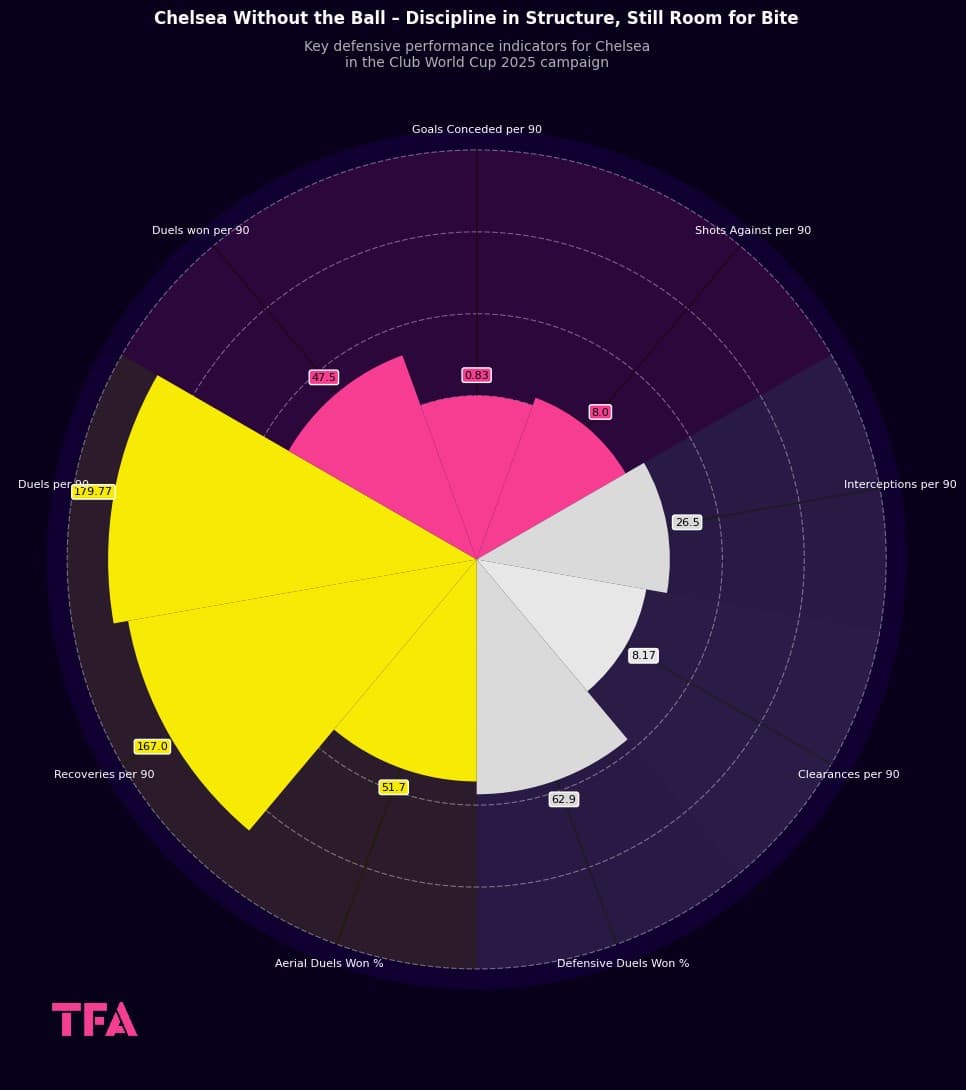
Their current record of 0.83 goals conceded per 90 in the tournament highlights an increasingly mature and structurally sound unit.
Although they face just eight shots per match, they have the second-best defensive shot prevention rate in the competition — only bettered by PSG — a reflection of the midfield’s spatial coverage and the team’s overall shape discipline.
In terms of duels, Chelsea are quietly efficient.
They win 62.9% of their defensive duels, an improvement from earlier rounds, and boast a 51.7% aerial success rate, numbers that place them above PSG in direct physical confrontations.
This physical sharpness complements their zonal positioning and gives them a platform to control games through possession, recovery, and resistance.
That said, some gaps remain.
Their 26.5 interceptions per 90 is the lowest among the finalists, indicating a less proactive defensive style compared to Fluminense or even Real Madrid in earlier rounds.
Chelsea doesn’t always step forward to disrupt passing lanes or anticipate threats early.
Instead, they lean on maintaining compactness and forcing mistakes within structured blocks.
It’s a trade-off: less chaos, but also fewer spontaneous recoveries.
Clearances sit at 8.17 per 90, consistent with a team not often forced deep but prepared to defend its box when needed.
Their midfield balance — particularly the support from deeper-lying players — has been crucial in relieving pressure, allowing full-backs and centre-backs to avoid overloads.
In sum, Chelsea’s off-ball identity is one of control without overexertion.
If they are to lift the trophy, this balance between defensive compactness and anticipation may need to tilt slightly toward aggression, especially against PSG’s precision-based build-up.
PSG In Possession – Tactical Supremacy With A Dual Threat
Paris Saint-Germain have emerged as the most tactically polished side of the 2025 Club World Cup, seamlessly blending a possession-heavy approach with the ability to launch rapid, high-impact transitions.
Key Attacking & Possession-Based Metrics For PSG At The 2025 FIFA Club World Cup
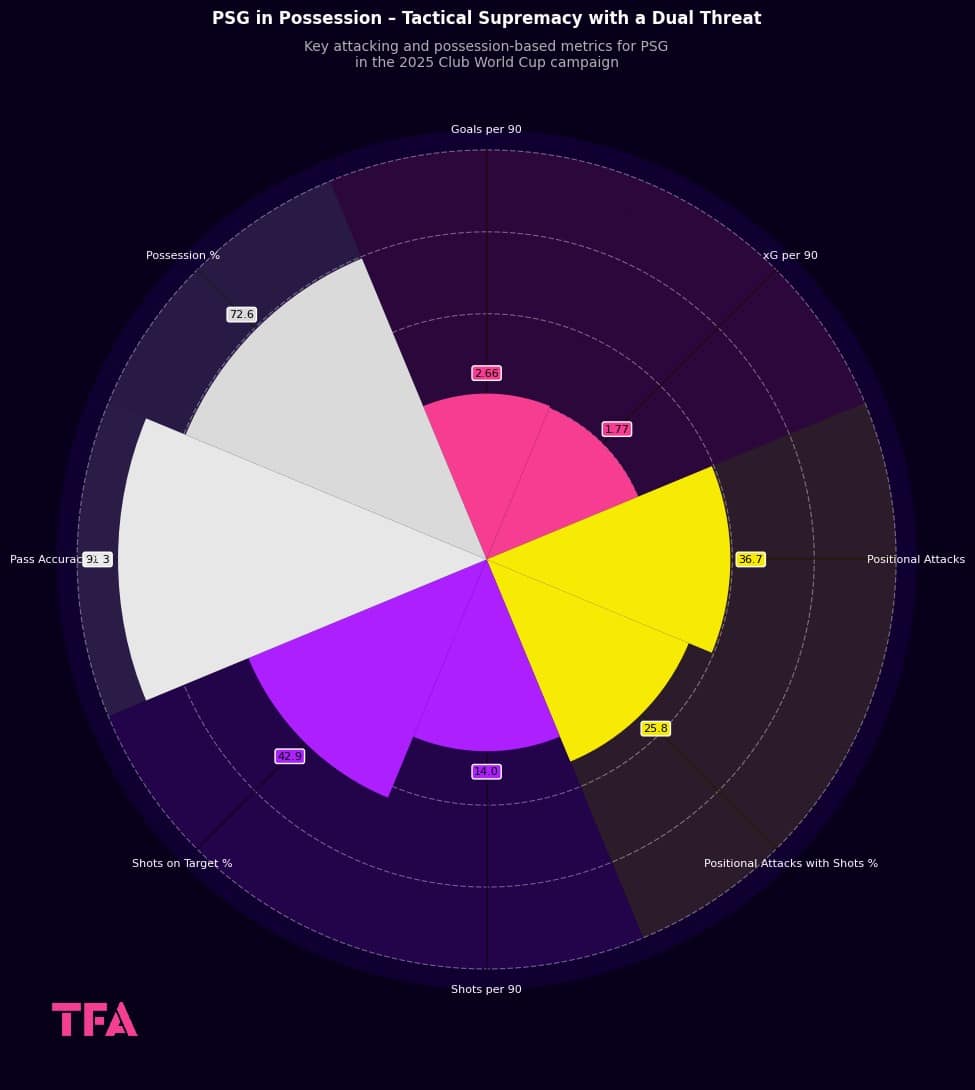
Elite metrics underline their control of matches: they average 686.6 passes per game at 91.3% accuracy, dominating 72.6% of possession, the highest across the competition.
Yet their game is far from static.
While they orchestrate 36.7 positional attacks per 90, more than any other side, only 25.8% end in shots, a relatively low efficiency.
However, their 2.66 goals per 90 from an xG of 1.77 suggests a dangerous ability to strike with precision, especially when they choose to accelerate play.
The presence of players like Ousmane Dembélé, Bradley Barcola, and Khvicha Kvaratskhelia gives Luis Enrique style of play the perfect weapons to switch gears instantly, exploiting space with devastating pace and 1v1 quality.
Although their 14 shots per 90 may be fewer than Chelsea’s, their 42.9% shots on target rate is one of the most efficient.
They don’t bombard; they select.
This balance between calculated control and lightning-fast execution is what sets them apart tactically.
With midfielders capable of drawing pressure and wide players bursting beyond lines, PSG are just as comfortable breaking you down slowly as they are slicing through with three touches.
Enrique’s blueprint, matured after European triumphs, has created a side capable of dictating terms in multiple ways — a rare trait in modern tournament football.
PSG Without The Ball – Compact, Organised, & Statistically Elite
While PSG’s attacking output often takes the spotlight, their defensive numbers reveal a highly organised and difficult-to-break unit.
Key Defensive Metrics For PSG At The 2025 FIFA Club World Cup
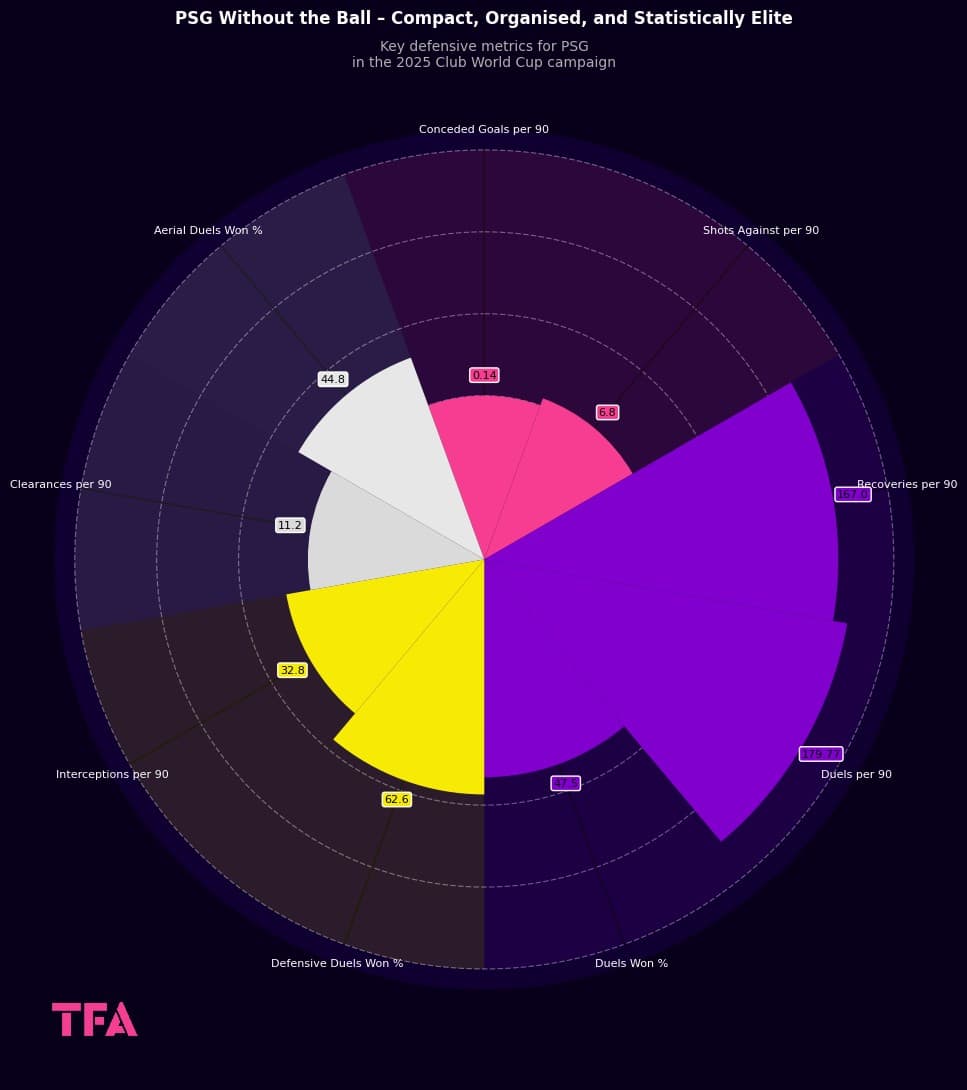
Conceding just 0.14 goals per 90, Les Parisiens have the best defensive record in the tournament, reflecting both their structured off-ball shape and their ability to limit shooting opportunities.
Opponents average only 6.8 shots per game against them, the lowest figure among the finalists.
An intelligent pressing game underpins this resilience.
PSG average 167 recoveries per 90 and engage in a tournament-high 179.77 duels per match, a testament to their aggressive counter-pressing when possession is lost.
Yet, only 47.5% of these duels are won, indicating that while the intent is intense, the execution isn’t always clean.
Still, their 62.6% success rate in defensive duels ensures key moments are handled well in high-stakes areas.
They also average 11.2 clearances per game, surprisingly high for a side with such dominant possession, suggesting they remain vulnerable during sudden transitional moments.
Their interception rate (32.8 per 90) is solid, showcasing good anticipation and spacing.
Still, their aerial duel success (44.8%) lags behind Chelsea, highlighting a potential weakness if forced to defend deeper or against more direct styles.
What defines PSG defensively, though, is not just resistance; it’s structure.
Luis Enrique has built a team that presses, regroups, and defends zones with remarkable clarity.
Their pressing traps, full-back rotations, and midfield compactness all contribute to a coherent identity.
PSG aren’t just playing to avoid conceding, they’re defending to dominate, and doing so with the kind of system-first discipline that wins tournaments.
Attacking Efficiency & Shot Selection – A Tactical Comparison
As Chelsea and Paris Saint-Germain prepare to meet in the Club World Cup Final, their attacking profiles offer a compelling contrast in philosophy and execution.
Direct Comparison Of Final Third Performance At The 2025 FIFA Club World Cup
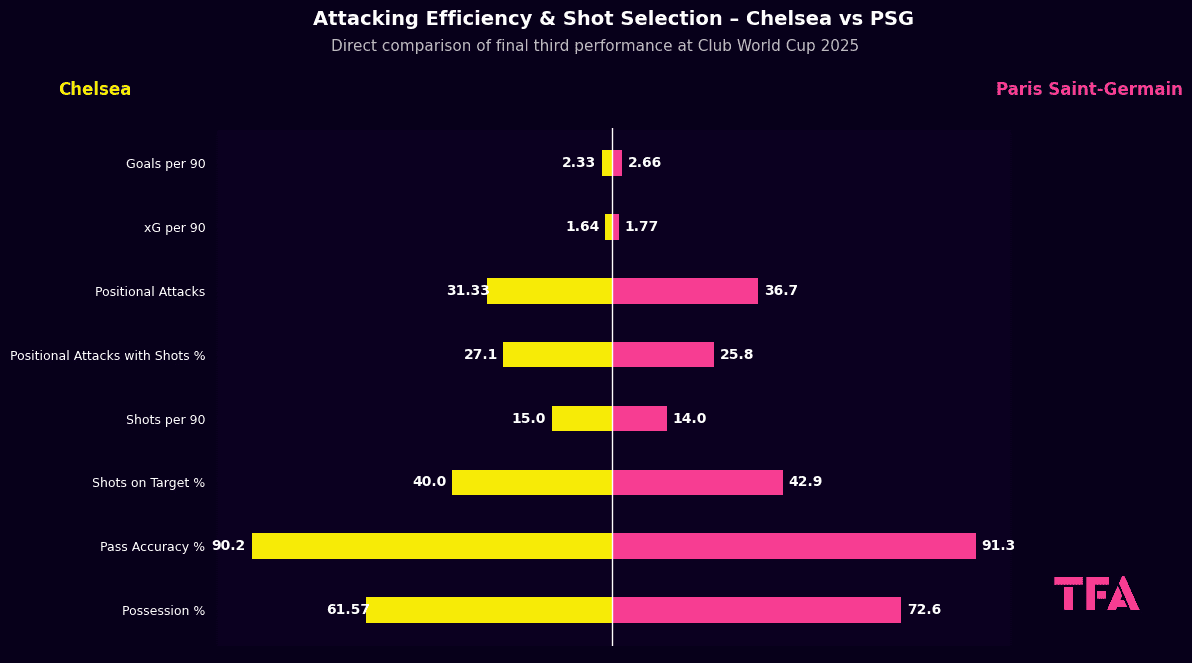
While both teams arrive boasting impressive numbers.
Chelsea, with 2.33 goals per 90, and PSG, with an even higher 2.66 goals per 90, the data reveals key tactical differences in how those goals are constructed.
PSG operate with a clear emphasis on ball control and tempo manipulation.
They lead the field in possession (72.6%), passes per match (686.6), and pass accuracy (91.3%), which collectively support their patient, technical build-up.
Their 36.7 positional attacks per game underline this dominance, yet only 25.8% of these sequences end with shots, indicating a degree of over-circulation in the final third.
Still, with an xG of 10.77 (1.77 per 90) and a 42.9% shot-on-target rate, they have proven adept at choosing moments carefully, especially when breaking from deep through the explosive pace of Dembélé, Barcola, and Kvaratskhelia.
Chelsea, by contrast, bring a slightly more vertical and volume-based approach.
Though they produce fewer positional attacks (31.33 per game) and enjoy less possession (61.57%), they manage a higher shot conversion rate within these attacks (27.1%), and fire 15 shots per 90—one more than PSG.
Their xG of 9.84 is lower than PSG’s, suggesting they rely more on sharpness and timely execution than pure chance quality.
Despite slightly less precision in possession, their 40% shot-on-target rate shows consistency in testing goalkeepers.
PSG build with control and strike with precision, while Chelsea combine structure with urgency.
The final may ultimately hinge on whether PSG’s refinement can outlast Chelsea’s rhythm, or whether Maresca’s men can turn their attacking volume into clinical superiority.
Possession Profiles & Out-Of-Possession Intensity – Tactical Insights
The contrast between Chelsea and Paris Saint-Germain becomes even more pronounced when examining how both teams operate with and without the ball.
Contrasting Tactical Control & Defensive Dynamics At The 2025 FIFA Club World Cup
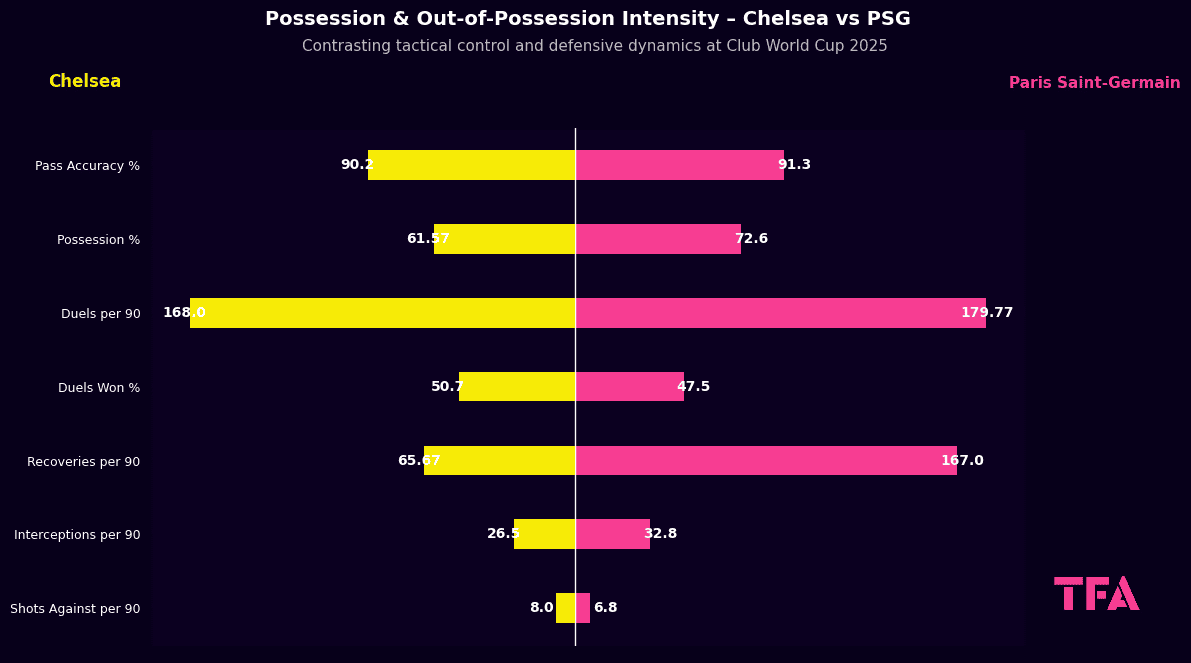
PSG clearly lead in possession metrics, averaging 72.6% of the ball with 686.6 passes per match at a stunning 91.3% accuracy.
This reflects Luis Enrique’s commitment to controlling tempo, pinning opponents back, and building patiently from the back, often through deep rotations and technical overloads.
Their possession is not only a method of attack but also their first layer of defence, starving opponents of rhythm and space.
Chelsea, while not as ball-dominant, still maintain strong numbers: 61.57% possession, 591 passes per match, and a 90.2% pass completion rate.
Under Enzo Maresca, the Blues exhibit a more structured and vertical use of the ball.
Their possession is often shaped to generate positional superiority quickly.
Although they circulate less than PSG, their tempo changes are more frequent, especially when transitioning from build-up to progression.
Out of possession, both teams bring different intensities.
PSG engage in a massive 179.77 duels per 90 — the highest in the tournament — yet they win only 47.5%, highlighting high pressing volume but inconsistent success.
They compensate with 167 recoveries and 32.8 interceptions per match, showing strong anticipation and second-ball coverage.
Their compactness is reinforced by conceding only 0.14 goals per 90 and facing just 6.8 shots per game, which is elite by any standard.
Chelsea, meanwhile, show slightly more balance.
Their duel win rate is 50.7%, better than PSG’s, and their defensive duels success (62.9%) and aerial duels (51.7%) offer a more physical and secure profile.
With 65.67 recoveries, 26.5 interceptions, and only eight shots against per 90, Chelsea combine mid-block control with situational pressing, less aggressive, but more efficient.
Ultimately, PSG use possession to dominate and smother, while Chelsea opt for measured control with greater defensive assurance in duels.
The final decision may depend on whether PSG can impose its rhythm or whether Chelsea’s hybrid system can disrupt it.
Defensive Solidity & Last-Line Protection – Measuring Stability Without The Ball
While attacking patterns may draw the eye, defensive resilience often defines champions.
In this year’s Club World Cup Final, both Chelsea and PSG arrive with compelling but distinct defensive identities.
Comparison Of Off-The-Ball Defensive Metrics At The 2025 FIFA Club World Cup
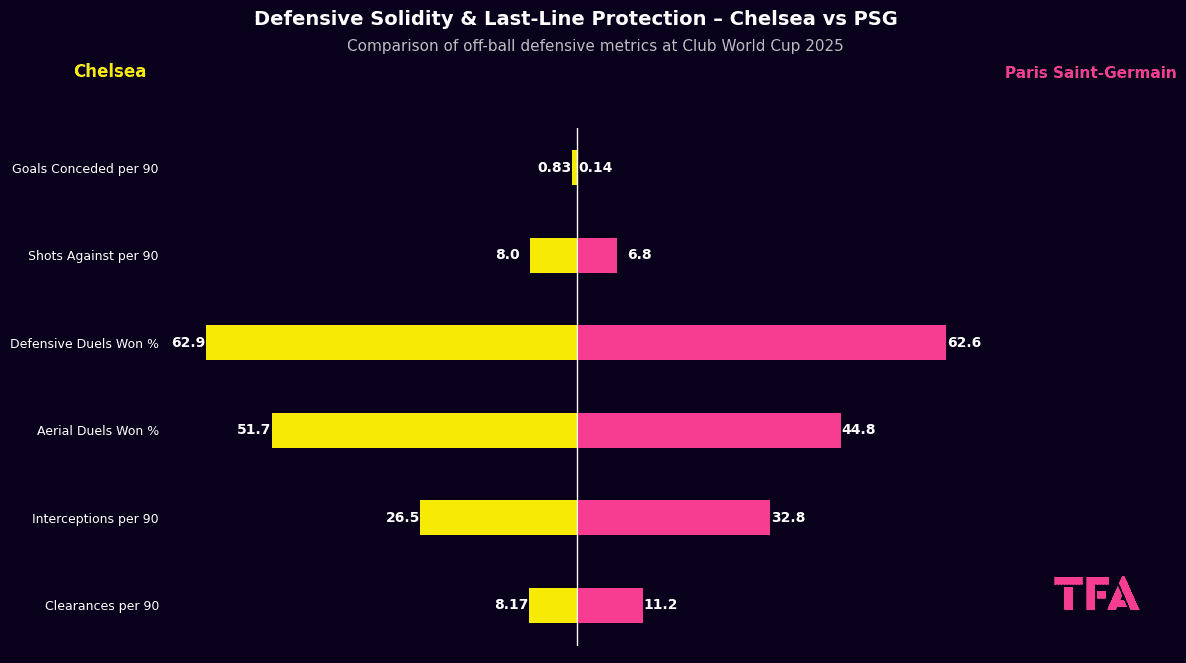
PSG boast the most watertight defensive record in the competition, conceding just 0.14 goals per 90 and allowing a mere 6.8 shots per match, both tournament-best figures.
This success stems from their exceptional possession control (72.6%) and the way they compress space when out of possession.
Their 62.6% defensive duel win rate reflects tactical discipline, though their aerial duel rate (44.8%) reveals vulnerability in direct or set-piece situations.
A strong reading of play underpins their last-line resilience: 32.8 interceptions per 90 and 11.2 clearances, suggesting an intelligent back line that intervenes early and clears decisively when needed.
Chelsea, on the other hand, present a more physically assertive but slightly more porous structure.
Conceding 0.83 goals per 90 and facing eight shots per match, they remain solid, if not impenetrable.
Their 62.9% defensive duel win rate is marginally superior to PSG’s, and their 51.7% aerial duel success adds a vertical robustness that the Parisians lack.
However, with fewer interceptions (26.5) and clearances (8.17) per 90, Chelsea tend to rely more on shape and recovery than anticipation.
Where PSG defend through denial of access via possession and structure, Chelsea defend through reactive solidity, winning individual duels, securing the box, and pressing selectively.
In a high-stakes final, the question may not be which side defends more often but who defends better when it truly matters, especially when space collapses and split-second decisions determine glory.
Conclusion
As the curtain draws on the inaugural 32-team edition of the Club World Cup in the United States, the footballing world turns its full attention to the final chapter: Chelsea versus Paris Saint-Germain.
It’s not just a clash of elite clubs, but a meeting of contrasting managerial ideologies, tactical systems, and psychological states.
Enzo Maresca’s Chelsea arrive in the final as one of the tournament’s most intriguing projects.
They are a team defined by structured progression, technical control, and a growing understanding of their collective roles.
Though impressive, their path to this point has been relatively less turbulent, culminating in a solid 2-0 win over Fluminense in the semi-finals.
They’ve shown control and discipline, but the test awaiting them in the final is entirely different.
Luis Enrique’s PSG, by contrast, have had to battle giants every step of the way.
A resounding 5-0 victory over Inter Milan in the UEFA Champions League Final set the tone, and their Club World Cup campaign has only reinforced their credentials.
Navigating past Bayern Munich in the quarter-finals and dismantling Los Blancos 4-0 in the semis, PSG have asserted themselves as the tournament’s most tactically complete and mentally resilient team.
The numbers speak for themselves.
PSG boast the best defensive record in the competition, conceding just a single goal across six matches.
Their blend of possession control, transitional speed, and tactical flexibility makes them a formidable final opponent.
While Chelsea possess the tools to disrupt and outmanoeuvre, PSG enter with the stronger claim, not only by virtue of their pedigree and recent scalps but also through the sheer consistency and clarity of their performances.
If the final hinges on control, resilience, and cutting-edge execution, then the balance of power subtly tilts towards Paris.
