
Who Is Filipe Luís?
After finishing his playing career a year and a half ago, former Deportivo La Coruña, Atlético Madrid, and Chelsea defender Filipe Luís began a new journey in coaching with the youth teams of Flamengo, his final club.
Luís quickly made an impression on the sidelines with Mengão.
The 39-year-old went on to replace former Brazil boss Tite last September, less than a year after he retired with Flamengo.
After playing 11 games of their 2025 Brazilian Série A campaign, Flamengo sit top of the league table on 24 points.
They’ve won seven of their first 11 games, drawn three, and lost just one.
Filipe Luís’ side has been imposing across all phases of play, in and out of possession.
Defensively, they’ve conceded just four goals so far this term—three fewer than Botafogo, who come next in the goals allowed rankings with seven, giving them the best defensive record in the league.
In attack, they’ve scored 24 goals in their opening 11 league games—seven more than Cruzeiro and Mirassol, respectively, on 17.
Flamengo’s attack has been scintillating this term, and their goalscoring record has not been achieved through a fluke.
On top of their 24 goals, Flamengo have generated the most xG (19.63) in the league and the most xG per shot (0.139).
Furthermore, Filipe Luis side has taken the second-most shots per 90 (11.7) in Brazil’s top-flight this year, with 44% (highest in the league) of their shots being placed on target.
All in all, this clearly shows a side generating a lot of high-quality goalscoring opportunities and converting them; it is undoubtedly a recipe for success.
So, with a FIFA Club World Cup clash with Luís’ former Premier League club, Chelsea, on the horizon, how do they generate this vast quantity of glorious goalscoring chances?
Our tactical analysis details the key relationist principles driving Filipe Luís’ Flamengo attack to such heights.
We’ll examine Flamengo’s narrow shape, fluid zone occupation, frequent positional rotations, quick short passing play, and devastating runs from deep to outline exactly what makes Mengão tick in the ball progression and chance creation phases.
Listen to this article free on the Total Football Analysis Podcast via Spotify, Apple Podcast, or RSS.
Filipe Luís Attacking Tactics: A Narrow Structure
Firstly, let’s address how Filipe Luis sets up his team in possession.

Flamengo’s shape becomes more and more adaptive as they progress towards goal.
Especially in the final third, the shape is highly flexible, with individuals drifting around and using their movement to create numerical and dynamic advantages to enhance their prospects for chance creation.
As they try to progress into the opposition’s half, though, the shape is a bit more fixed, with one full-back pushing up on the wing while the other tucks in alongside the centre-backs.
Meanwhile, a double-pivot sits in midfield ahead of the back-three.
The wingers and attacking midfielder are placed just in front of the double-pivot, with the striker occupying a centre-back up top.
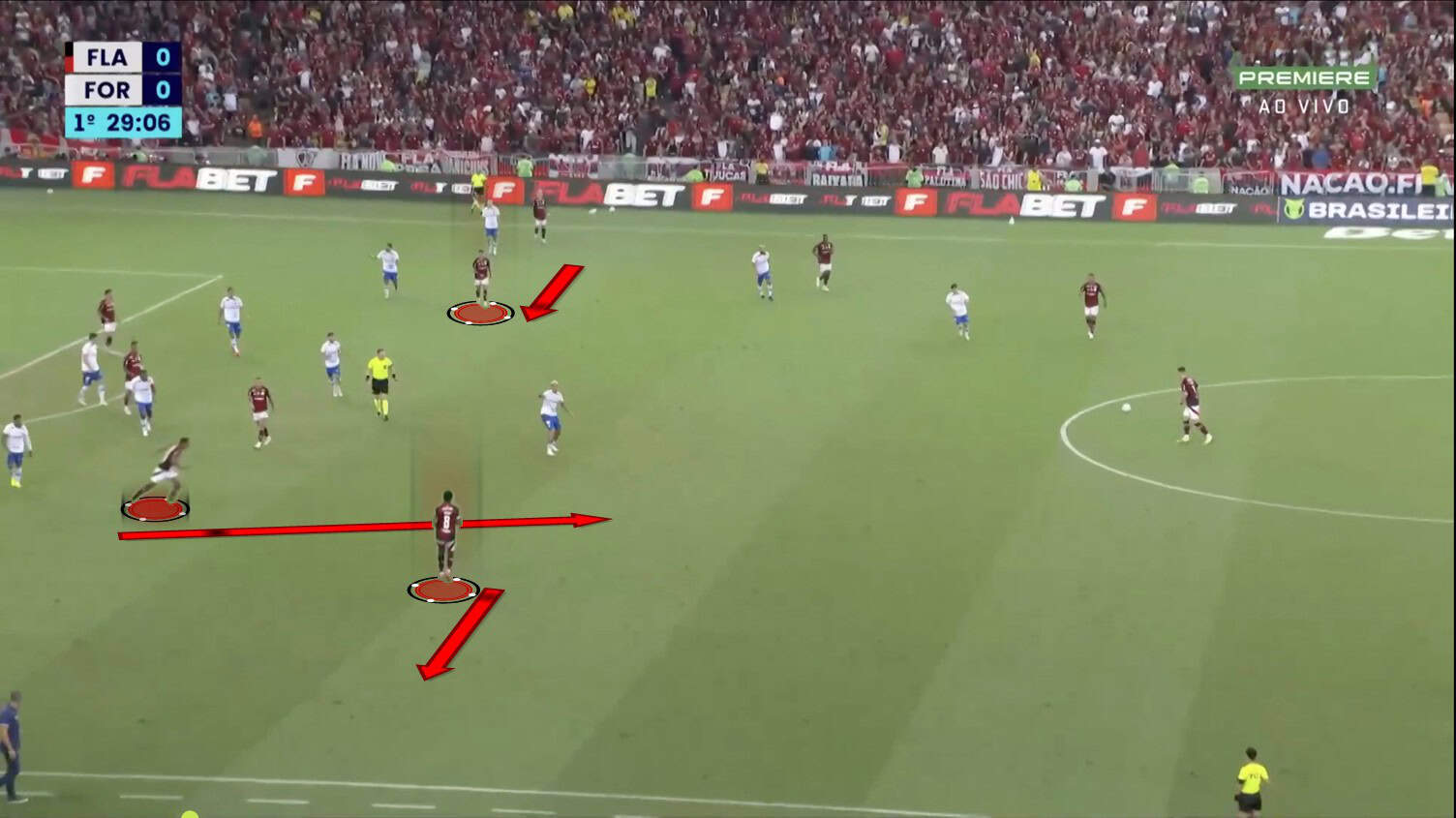
It’s typical to find Filipe Luís’ side in an extremely narrow shape, as is the case in Figure 1.
They don’t look to maximise the width across the pitch.
In fact, Flamengo do not play with constant width on one or both sides of the pitch at all—a player will fill the role of ‘near-sided width provider’ as required, though it’ll normally be an advancing full-back, as is the case on the left in Figure 1.
While positional sides usually enforce quite strict rules of width at all times, resulting in a rigid structure, Filipe Luís’ Flamengo allows more movement and flexibility.
Players can spot when the width is needed based on their principles of play, which are quite strongly influenced by relationist ideals.
Filipe Luís’ Flamengo have kept the most possession (60.3%) in Brazil’s top flight this year and also completed the most passes (498.36 per 90).
They also have the best pass accuracy in the league at the time of writing (88.9%).
We can go on and on with data to back this up in addition to the aforementioned stats, but in a nutshell, Filipe Luís’ side absolutely dominates on the ball.
They rely on a high-tempo, short-passing style of play with lots of positional freedom for their midfielders, attackers, and full-backs.
Only their centre-backs are relatively ‘fixed’ in possession phases, and that doesn’t consider instances where the centre-backs opt to carry the ball forward to set up a better opportunity for ball progression.
The narrow structure created in Figure 1 helps serve this fast-paced, short-passing style of play as bodies are close to one another, aiding combination play through close distances.
To succeed in this system, players need to be technically proficient and intelligent, able to recognise where they need to be positioned and react to the changing context of the attack.
Familiarity between players on the pitch enables better execution of Filipe Luís’ attacking strategy.
At present, they play like a team of players who know each other inside out, which has resulted in their success thus far in 2025.
Filipe Luís Attacking Tactics: Fluid Positioning & Shape
Next, we’ll examine Flamengo’s positional fluidity in the final third, which creates quite a flexible shape for chance creation.
Here, we find Flamengo in the chance creation phase.
They have two centre-backs sitting deep and central, controlling the play.
Meanwhile, a full-back provides the width on the ball-near wing (the right wing).
This is a reverse of Figure 1, where the left was the side where width was being provided—where Flamengo provides width is all about which side of the pitch the ball is on at that time.
In Figure 2, we see Flamengo in the process of moving the ball from their right wing to the centre of the pitch.
At that moment, left-back Alex Sandro, who had been sitting in his team’s furthest forward line in the half-space, began dropping into midfield.
This attracts an opposition player towards him, opening up space for the centre-back to carry the ball into and play a defence-splitting through pass to set up a goal.
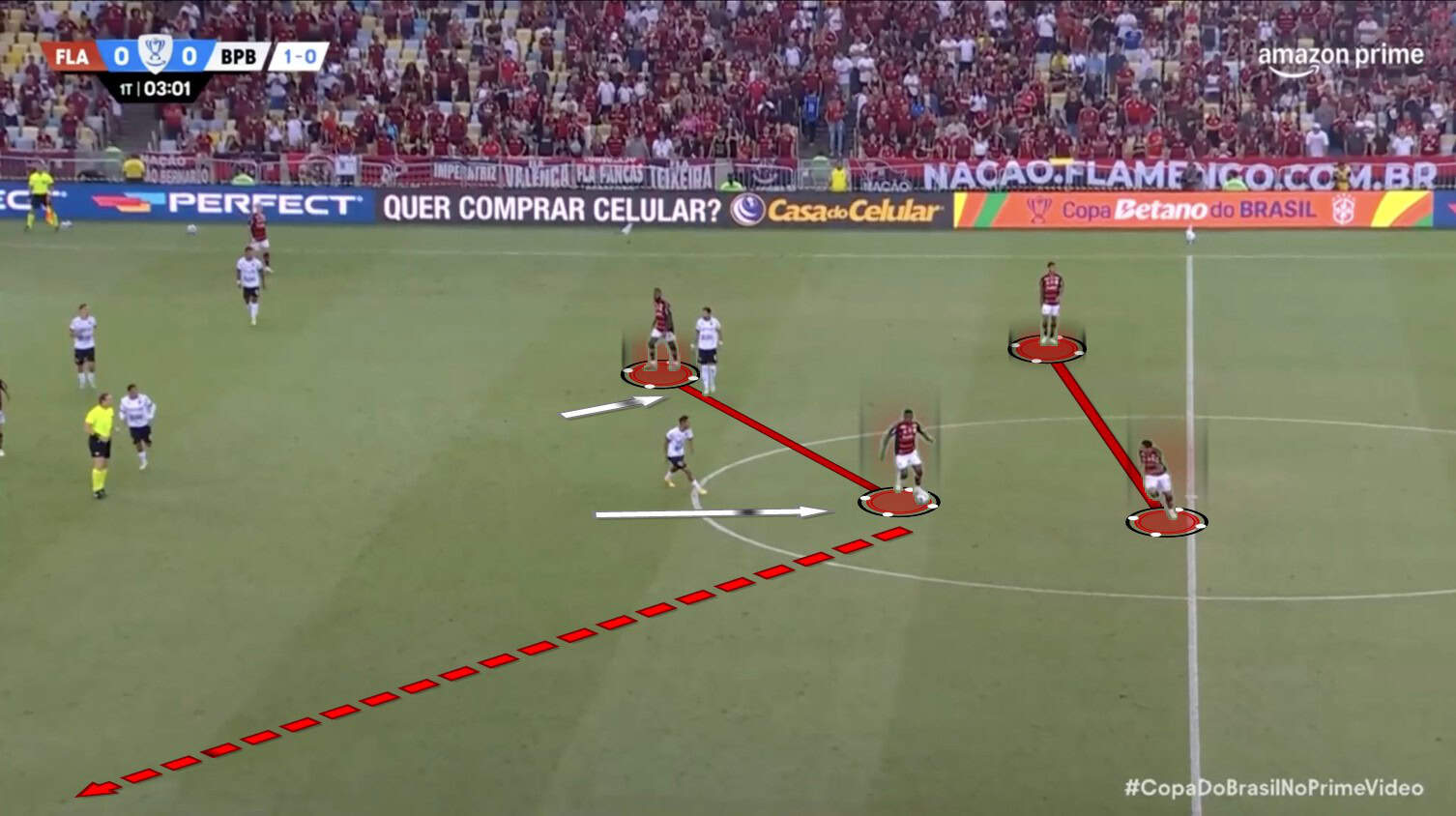
Here, Botafogo PB are able to deter Flamengo’s advances with two forwards matching up man-to-man with Flamengo’s two midfielders, thus making progression into the final third challenging.
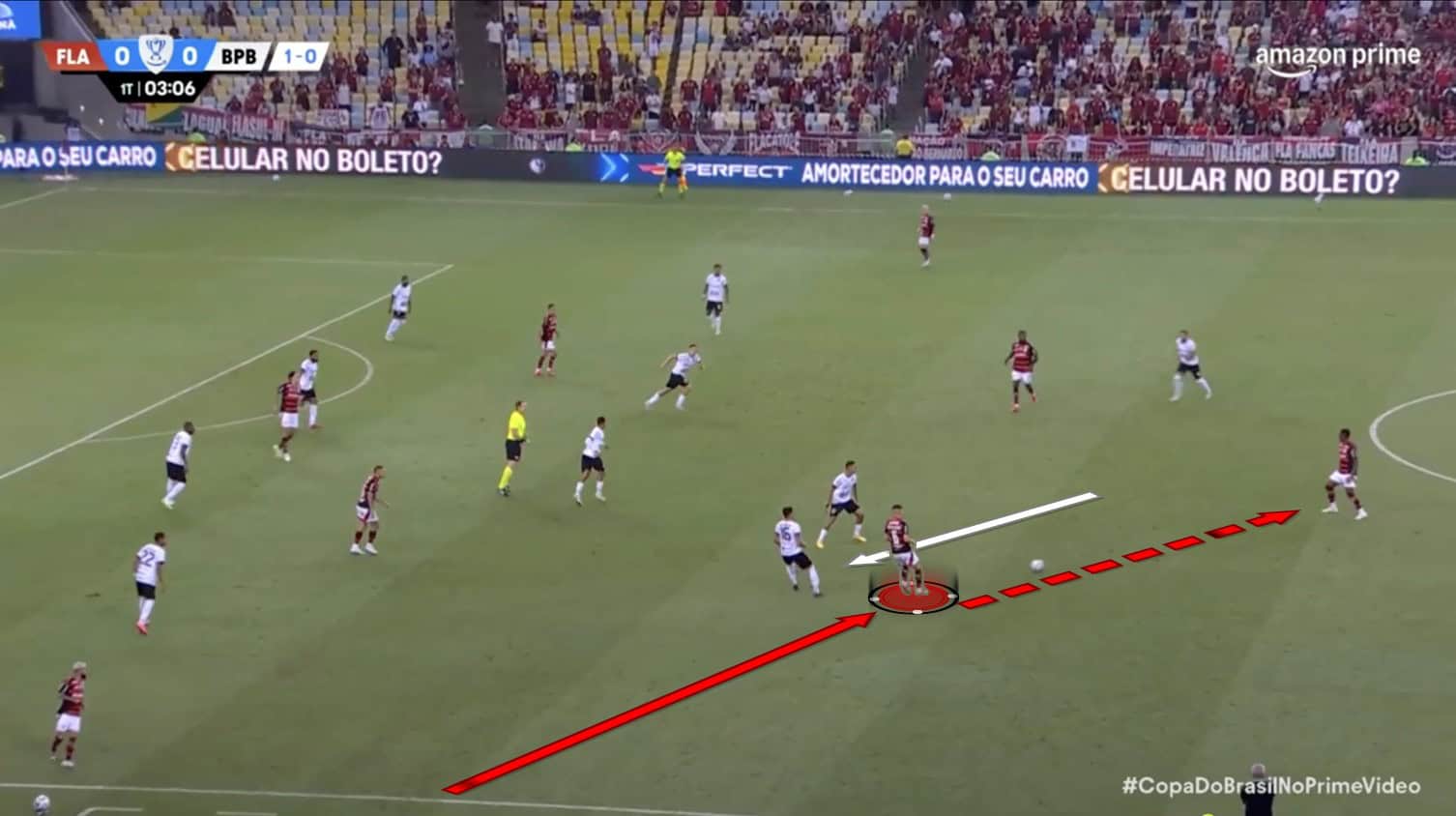
Left-back Ayrton Lucas makes the decision to drop into midfield from the forward line, allowing the rest of the attack to settle into a five-man line rather than the six-man line they’d previously been using.
When he dropped into midfield, Lucas attracted pressure from an opponent.
This, as a result, frees up one of the two midfielders who’d previously been matched man-to-man with the opposition forwards, pressing them.
Lucas’ movement here gave Flamengo control of the midfield and enabled them to progress past the opponents, pressing them into the final third with time and space to pick out their next pass.
Both of these examples show a player dropping into midfield from the most advanced line of attack, based on the context of the situation, to suddenly overload the opposition in the middle of the park, improving Flamengo’s threat standing.
Flamengo’s shape in the chance creation phase is adaptive, changing based on context, and requires a lot of intelligence from the players to execute movements correctly and react to opportunities by placing themselves in the optimal position for that moment.
Filipe Luís Attacking Tactics: Rotations & Forward Runs
Our third and final section of analysis focuses on Flamengo’s positional rotations and the dynamic advantages created by forward runs into space from deep.
Flamengo’s attacking success under Filipe Luís hinges on their players’ responsible use of the positional autonomy afforded to them.
Players are not rigidly held in certain positions; rather, they react and adapt constantly to the changing context of the game.
This creates an attacking shape that’s in constant evolution.
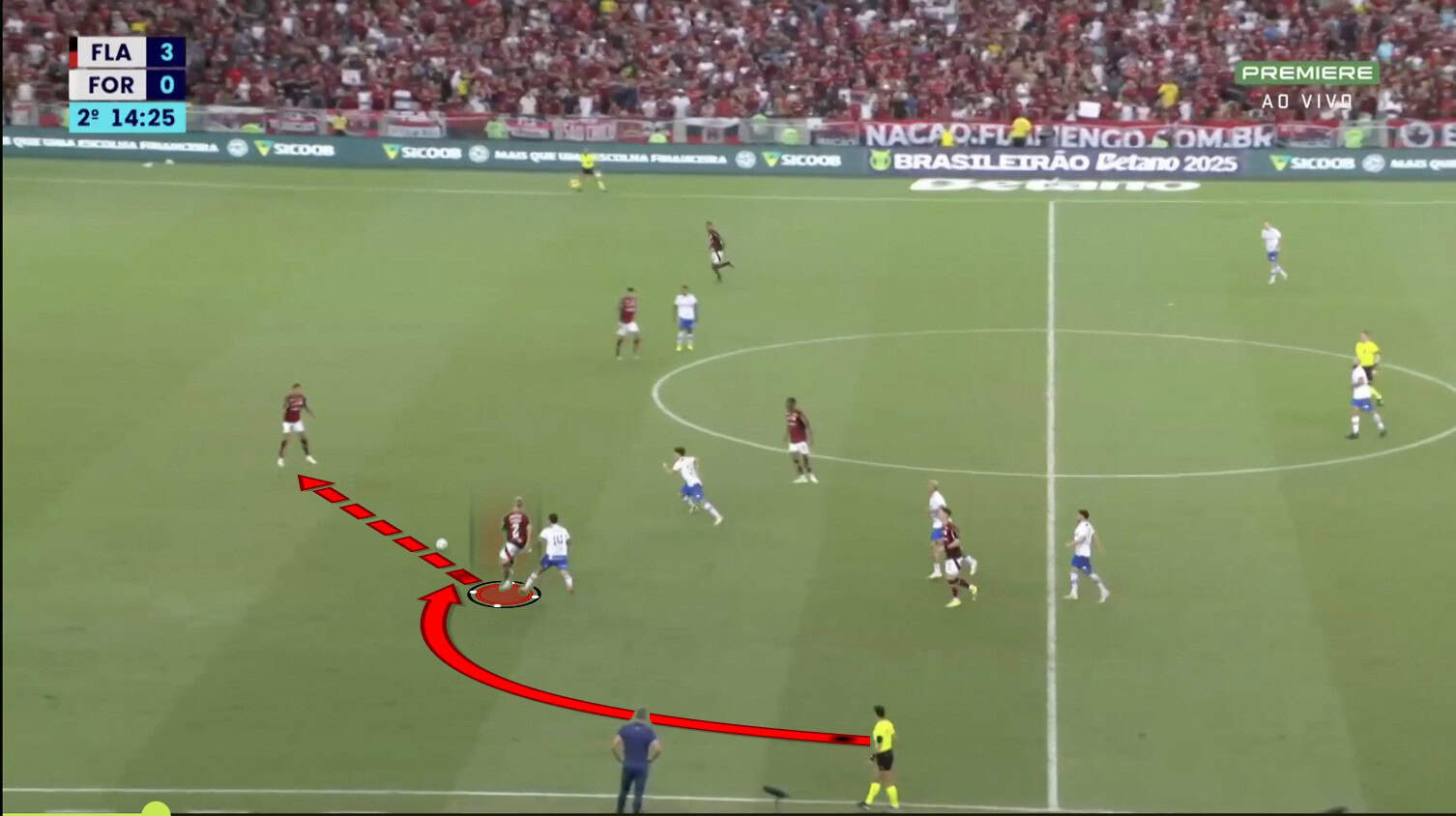
The centre-back had passed Luiz Araújo the ball, but the winger came under immediate pressure from behind.
After carrying the ball backwards, he released it to the right centre-back.
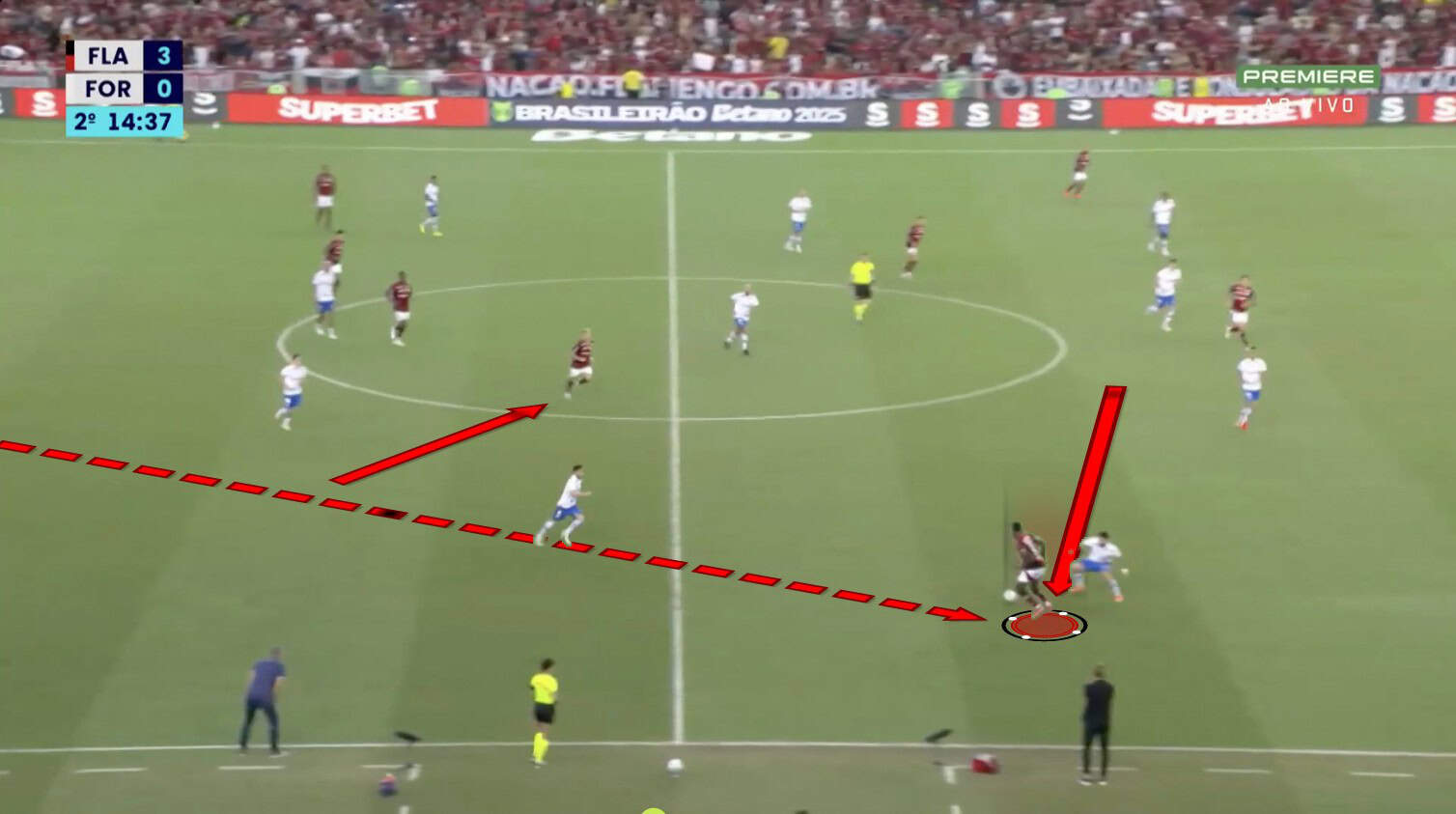
Flamengo ended up progressing around the player who pressed Araújo back and into the centre via that same right wing.
After Araújo moved centrally, Gerson shifted out wide to occupy the now vacated space on the wing in Flamengo’s attacking shape.
As Mengão move the ball back out to the right wing, Araújo finds space in the centre, as his previous marker turns his attention to Gerson on the right wing.
As play moves on, Flamengo’s dynamic advantage created by their fluid movement allows Gerson to receive and immediately knock the ball past his marker into space in midfield, setting up a great opportunity to run at the opposition’s defence.
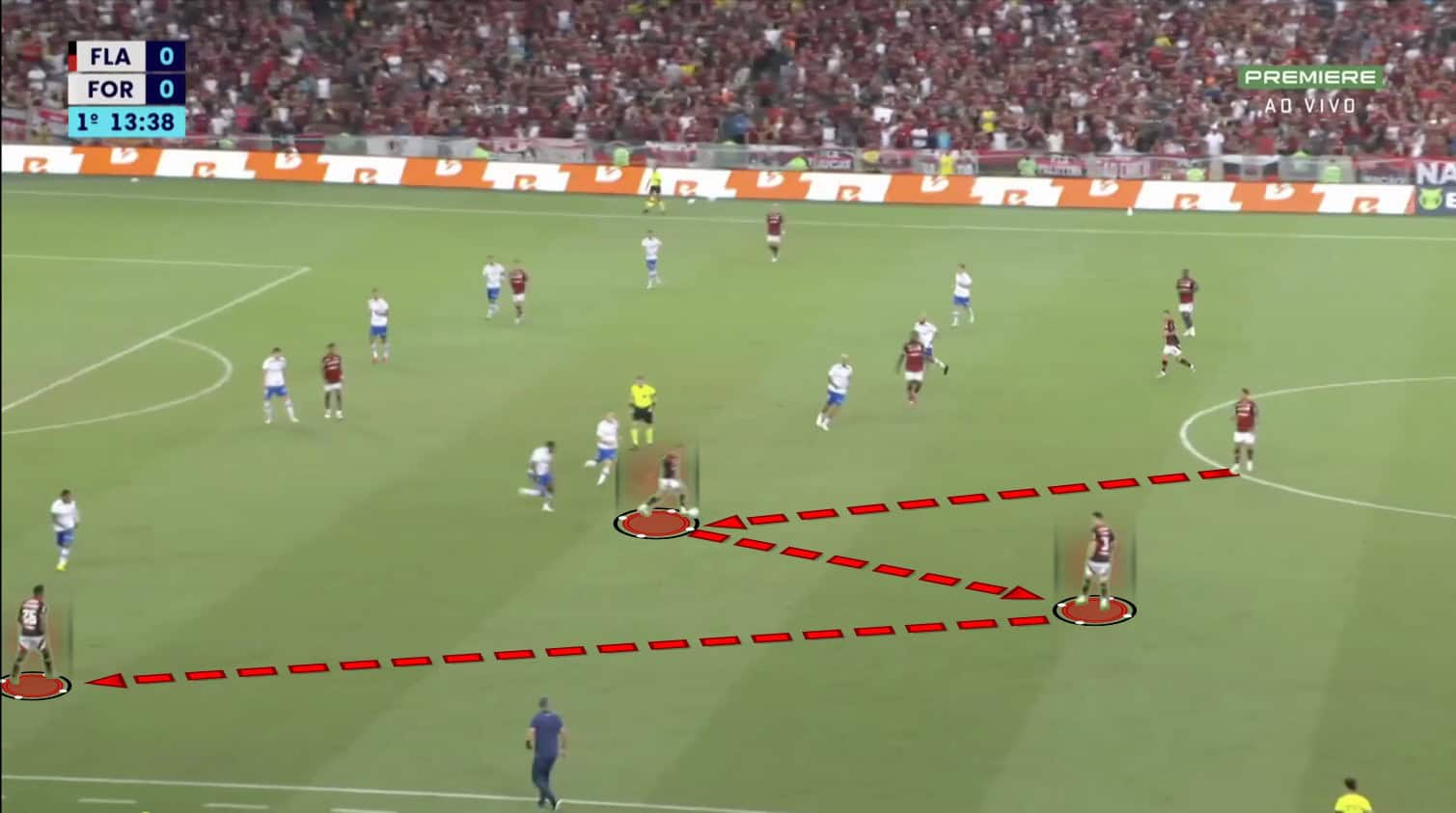
Just before this image, Flamengo had been building an attack with a five-man forward line.
Left-winger Everton, who had been positioned in the left half-space, drops off to receive the ball slightly deeper in the left half-space, attracting pressure from two opponents towards him in the process.
Rather than trying to turn and running into the wall of pressure behind him, Everton plays the ball back to left centre-back Léo Ortiz, who can relay it out to the left wing, where we find Alex Sandro holding the width at this moment.
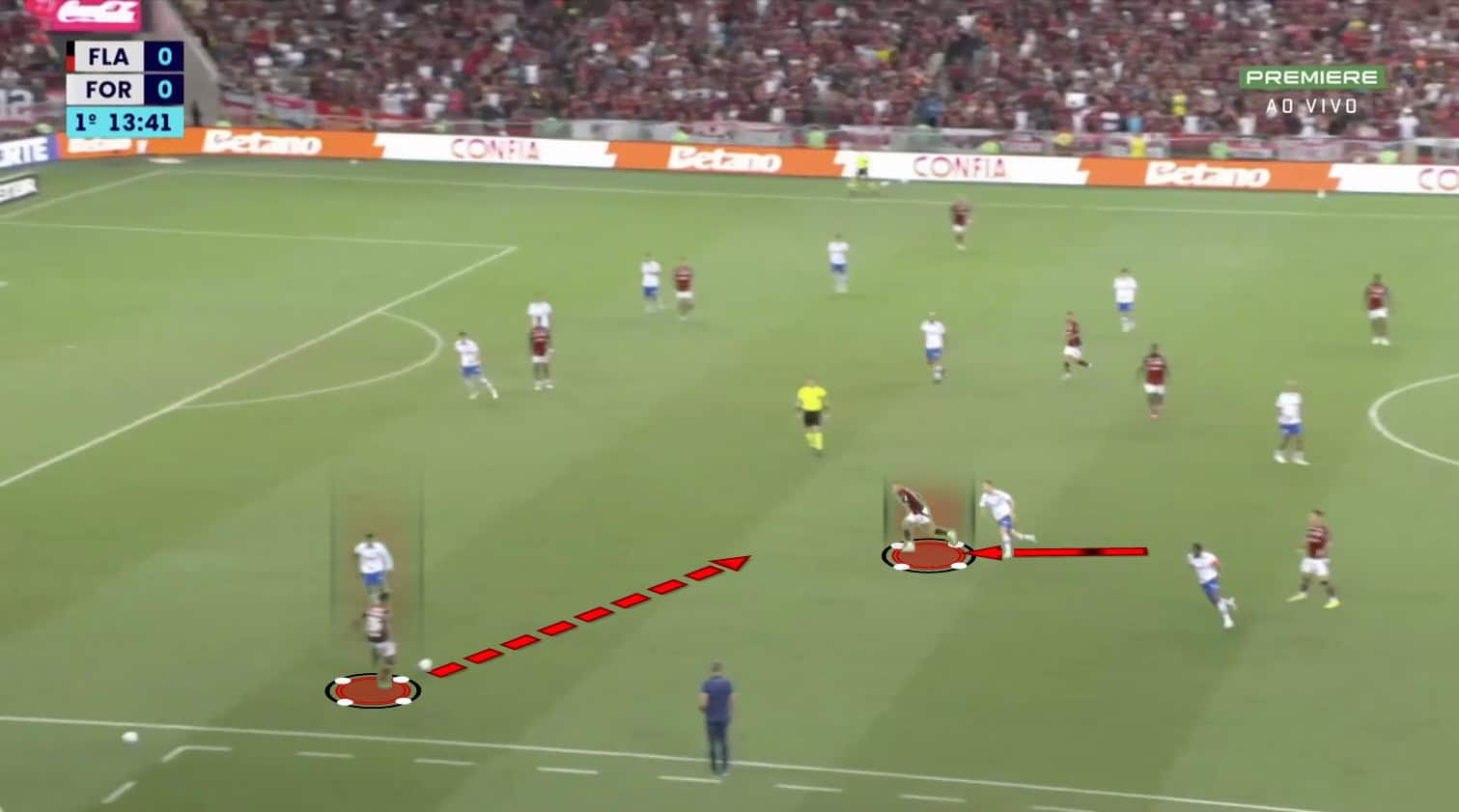
Now, without the ball, Everton can turn and run into the space behind the two players who had come out to press him.
When Alex Sandro receives the ball, he’s met with the sight of Everton bursting into space just on the edge of the final third.
In real time, this was an extremely quick passing move that seemed to slice open Fortaleza in an instant.
When we break it down, we see how positional fluidity, as opposed to rigid structures, dynamism and intelligent choices based on the context of the attack, combined to set Flamengo up for success.
As the attack moves on, the ball finds its way back to Alex Sandro, who can set up a good goalscoring opportunity via a low cross.
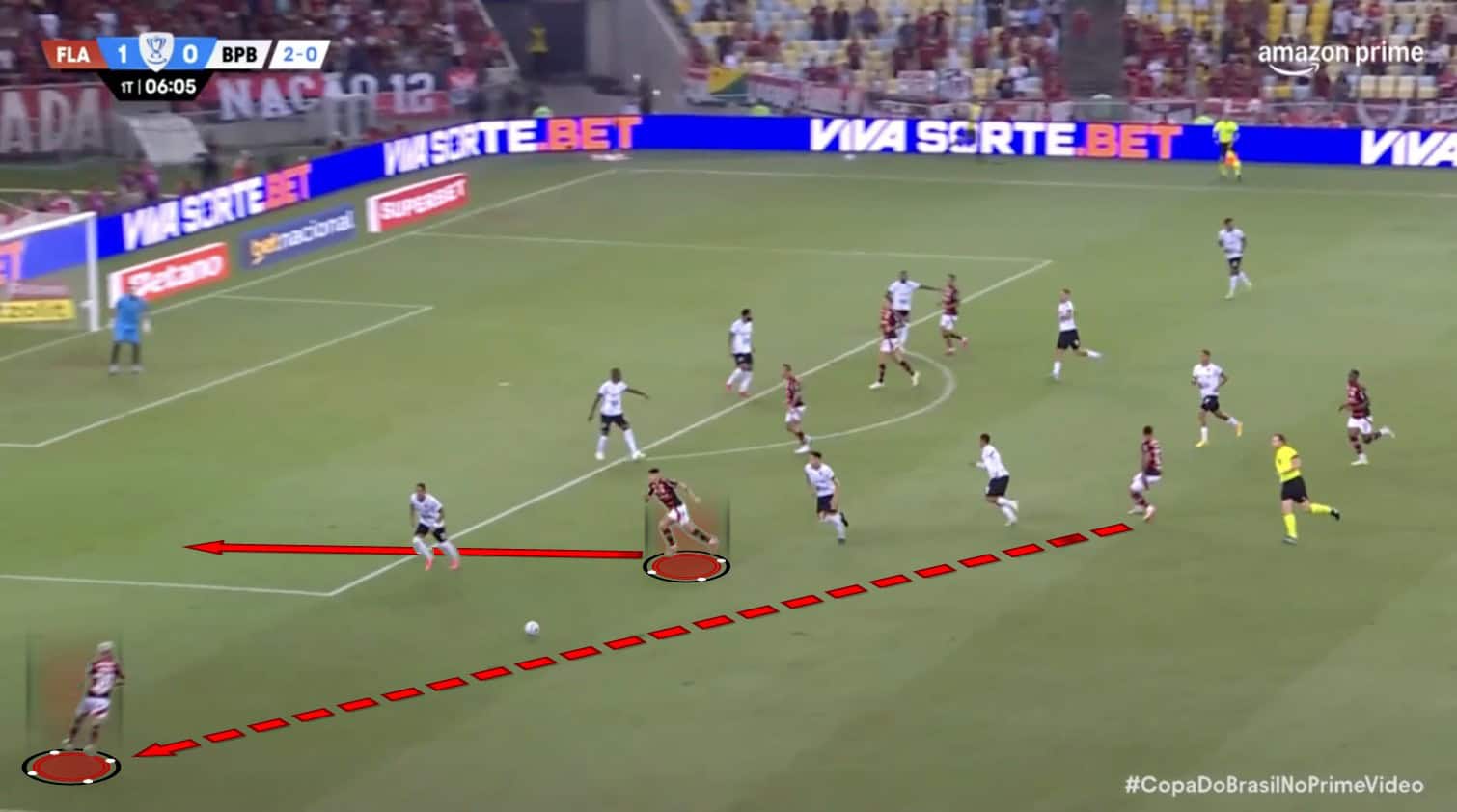
Here, left-winger Michael receives the ball while holding the width.
As the opposition right-back moves out towards Michael, Flamengo left-back Ayrton Lucas begins making a run in behind the opponent, which Michael spots and picks out.
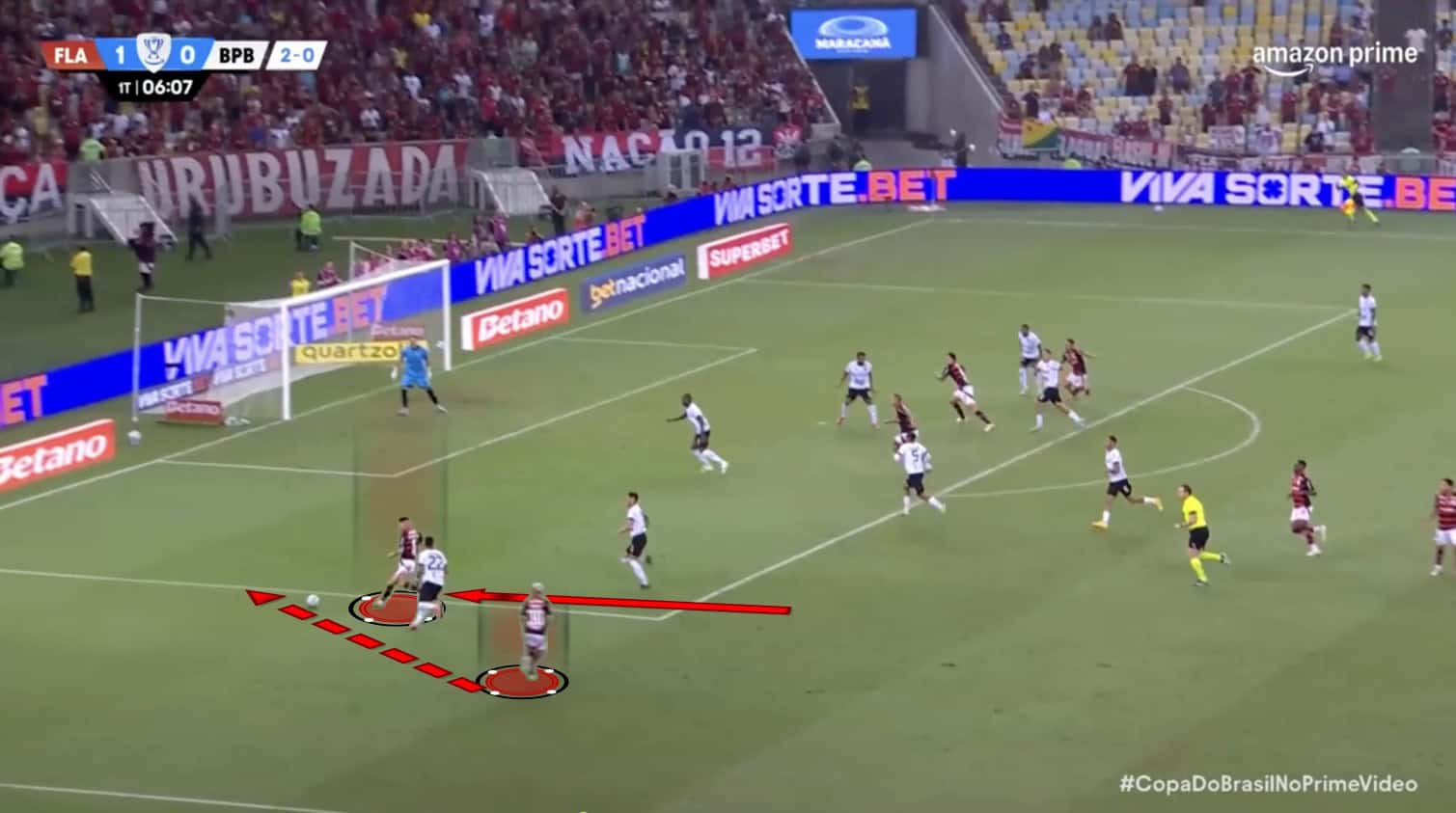
From here, Lucas has some time and space to get his head up, set up his cross and put the ball into the box for a teammate to poke home, doubling Mengão’s lead in the sixth minute.
Again, dynamism, positional fluidity and an air of unpredictability combined to set Flamengo up for success in the final third.
Conclusion
To conclude our tactical analysis, Filipe Luís’ possession-based Flamengo have dominated all their competition this season with attacking performances based on relationist principles.
Their final third attacks can be summarised by their narrow structure, with width provided by a player who will assume that role on the ball-near side when required, a highly adaptive shape in constant evolution, and dynamic advantages created by positional rotations and forward runs from deep designed to outsmart the opposition when playing at the fast tempo that Filipe Luís’ side does.
There’s so much more as well to this side that we haven’t covered, including their out-of-possession tactics, which have been highly impressive this term.
Overall, though, Filipe Luís is leading one of the most tactically interesting sides in world football at the moment, who should get more deserved eyeballs through their Club World Cup participation.
