
In 2013, Juan Pablo Vojvoda’s coaching career began at the same club where his journey as a professional football player began – Newell’s Old Boys. The Leprosos academy product coached for Newell’s at youth level for four years – twice taking charge of the first-team on a caretaker basis in that time – before eventually moving on and taking his first permanent managerial role in senior football at Defensa y Justicia where he stayed for 25 games, winning 56% (14) of them.
Four years and four clubs later, Vojvoda now finds himself at the helm of Campeonato Brasileiro Série A side Fortaleza, where he’s thus far been in charge for 24 games, winning 66.67% (16) of them.
Fortaleza ended the 2020/21 Série A campaign in 16th place, level on points (41) and level on wins (10) with 17th-placed Vasco da Gama. They only avoided relegation on goal difference.
Vojvoda arrived at the Ceará-based club just before the 2021 season began in May but he has had an instant impact, helping Leão do Pici to start this season much better than they finished the previous one. They currently sit in third place in Brazil’s top-flight, trailing top-of-the-table Atlético Mineiro by just four points.
The Argentinian coach, who’s cited compatriot Marcelo Bielsa – currently of EPL side Leeds United and who coached Vojvoda in his days as a Newell’s youth coach from 1980-1990 – as a major inspiration of his, along with former managers of La Liga side Barcelona, Gerardo Martino and Pep Guardiola, the latter of whom reached the UEFA Champions League final with Manchester City last season.
That’s not a bad list of influences for the 46-year-old Argentinian who’s declared that one of his “ideals”, in terms of his football coaching philosophy, is to play “intense, dynamic football with all players participating in the game, that all world wants to attack, but is also committed to defending.”
In this tactical analysis piece, we’ll analyse Vojvoda’s Fortaleza. We’ll highlight some of the key changes that have occurred at the Ceará-based club since the 46-year-old Argentinian’s arrival and provide analysis of some key elements of Vojvoda’s tactics to explain how he’s – thus far – successfully turned a club that was almost relegated earlier this year into one of Brazil’s leading lights.
Build-up
As with any team, how Vojvoda’s Fortaleza side shapes up evolves based on what phase of play they’re in and where the ball is at that moment. This context is always important and alters the team’s ‘shape’. However, if you were to label Fortaleza with playing a particular base formation, you could say that they primarily utilise a 3-4-1-2.
On the ball, within this shape, Fortaleza’s wing-backs typically provide the width, the strikers and ‘10’ alternate the directions of their movement and runs to offer the deeper players options for balls in behind or balls to feet in between the lines, the central midfielders stagger, with one dropping deeper and one remaining slightly higher, while the back three essentially becomes a back two with two centre-backs splitting either side of the goalkeeper and the other centre-back – usually, the right-sided one – advancing, either out wide – basically acting as a full-back would – or centrally, becoming another central midfielder.
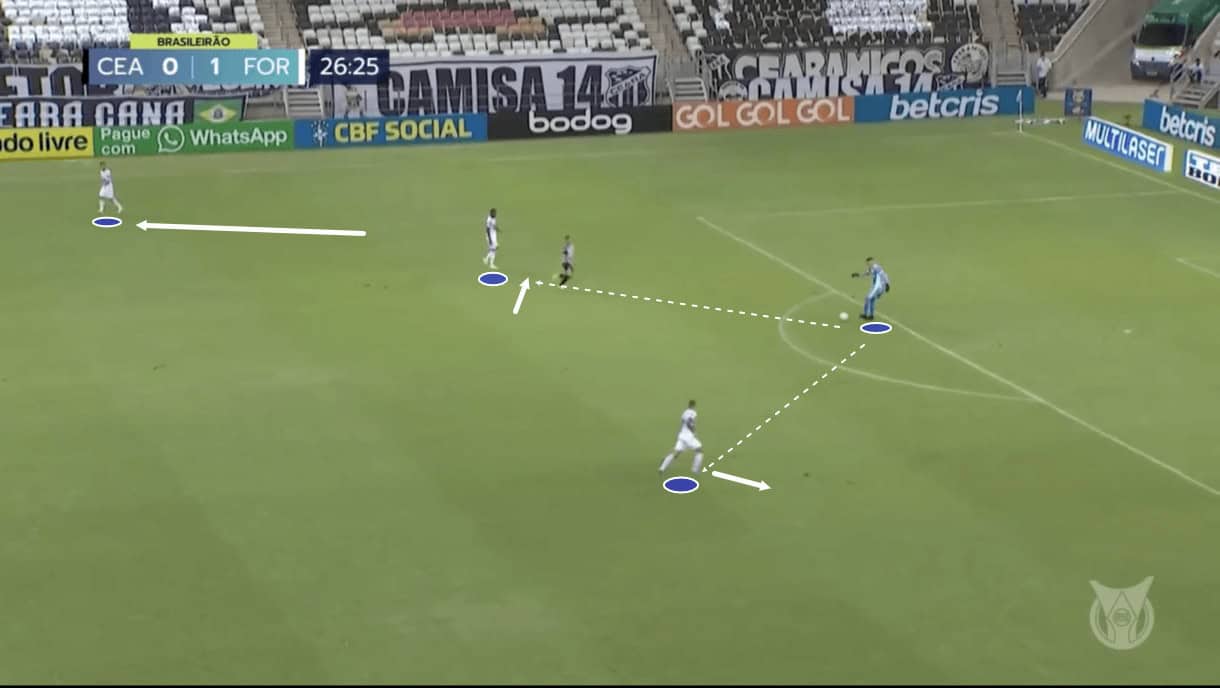
This often leaves Fortaleza’s back three appearing as they do in figure 1 during the build-up phase. Just before this image, Fortaleza sent the ball back to the goalkeeper. Then, the three centre-backs readjusted themselves into the positions we see them here. The left centre-back and central centre-back pushed out wide into the typical left and right centre-back positions, splitting either side of the goalkeeper. Meanwhile, the right centre-back moved out wide, into more of a full-back position.
These movements allow Fortaleza to outnumber the opposition’s striker with their centre-backs – a key component of Vojvoda’s system in the build-up that inspiration Bielsa advocates. So, with the centre-backs splitting wide, forcing the opposition striker to make a decision and mark one – not both – the ‘keeper has one free short pass to a centre-back on. Additionally, the right centre-back’s movement into space further up is crucial too, as this gives the goalkeeper an option for a slightly longer chipped ball upfield, in case a short, accurate pass is impossible or the longer, chipped ball is simply the better option. Fortaleza often like to play the ball longer from the goalkeeper, so this chipped ball is sometimes utilised when the right centre-back finds enough space.
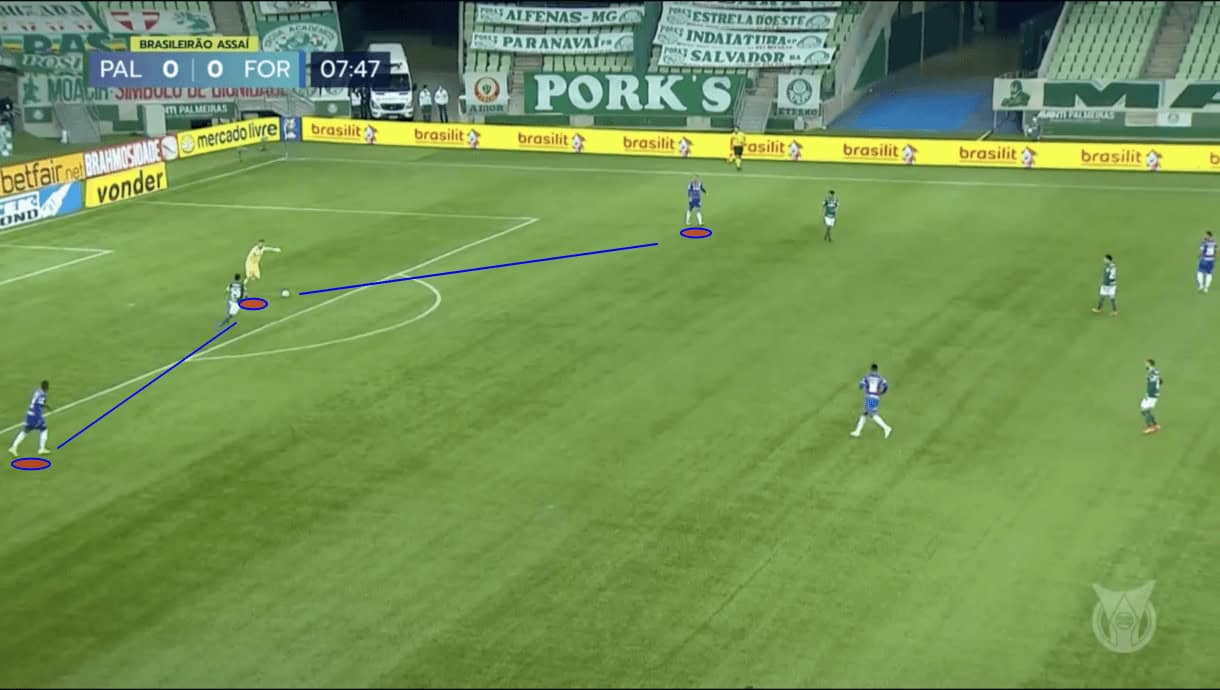
We see another example of Fortaleza’s centre-backs splitting wide during the build-up in figure 2. However, on this occasion, we see that the opposition have managed to press with two centre-forwards and made both of the ‘keeper’s short passing options unappealing. In Vojvoda’s system, the goalkeeper needs to be comfortable and confident with the ball at his feet because he’ll be required to take his time on the ball, draw pressure, find passing options and execute passes accurately and effectively – whether they’re short passes or longer passes – often.
With the centre-backs generally splitting very wide like we see in figure 2 and the goalkeeper being required to step out into the central space of the backline, the ‘keeper can essentially be viewed as another member of this backline in the build-up – giving Fortaleza a back-three which outnumbers the opposition’s two forwards. Again, the ‘keeper’s on-the-ball quality – both in terms of his technical ability and his mental ability – are key to making this element of Vojvoda’s build-up tactics work.
Additionally, it’s worth noting that the goalkeeper has one more potential short passing option available to him in figure 2 – the central midfielder who’s dropping deeper. As mentioned previously, Fortaleza’s central midfield duo stagger during the build-up/ball progression phases and that leaves one central midfielder dropping deep, like we see here, with the other remaining higher to provide a potential forward passing option for that deeper midfielder should he receive the ball and be in position to press for the second ball if Fortaleza’s ‘keeper opts to play a long ball to the centre-forward.
This deeper central midfielder’s movement forms a diamond, of sorts, with the ‘keeper and two centre-backs and creates another short forward passing option for the goalkeeper, making Vojvoda’s side more difficult to defend against while building out from the back.
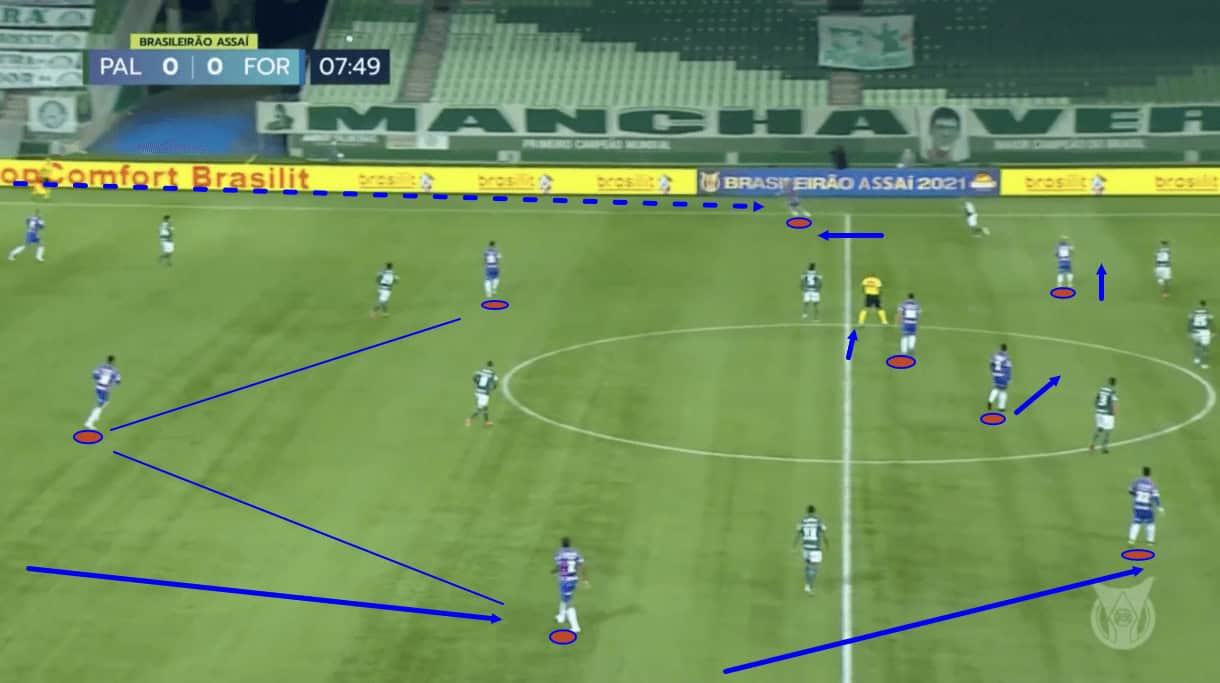
In figure 3, we see an example of how Fortaleza’s shape looks further up the pitch during this particular phase of play. Like the ‘keeper in the deeper area of the pitch, the central midfielder who dropped has two players on either side of him in a slightly more advanced position. This is his central midfield partner, who didn’t drop, and the right centre-back who advanced up the pitch during this phase while his central defensive partners split wide.
As the right centre-back advanced, so too did the right wing-back who takes up a position in the front line – providing the width on the right side of attack while allowing the two strikers and ‘10’ to crowd around the left wing-back and give him options to knock the ball onto or give him support by challenging for the second ball if necessary.
By including the goalkeeper as they do during the build-up, Fortaleza create something like a 3-3-5 shape in this phase and by doing so, their frontline overloads the opposition’s backline. That’s why passes like the one played here – a direct, chipped pass out to the left wing-back – are so effective. They force the opposition full-back into a decision – sit deep and allow the left wing-back to receive the pass freely or advance and allow the opposition to exploit the vacated space in behind via runs from the left striker or ‘10’. By continuing to cover all these players as they move over, the opposition would allow the right wing-back to become completely free on the right side of attack.
Vojvoda’s build-up tactics are exciting and risky. He’s not afraid to take the high risk of committing big numbers forward in pursuit of the big reward that comes with winning the ball further up the pitch when the pass is played there and taking advantage of their overload versus the opposition’s backline.
As play moves on from figure 2 into figure 3, the goalkeeper chipped the ball out to the left wing-back which, as mentioned earlier, is a fairly common part of his game in Vojvoda’s system. They’re happy to go for a longer pass if the short passing options are unavailable or if the long pass is just more appealing. He knocked the ball forward as the opposition full-back advanced and Fortaleza quickly broke away. This highlights how their relatively direct style can quickly create very advantageous attacks for them thanks to their decision to commit big numbers forward.
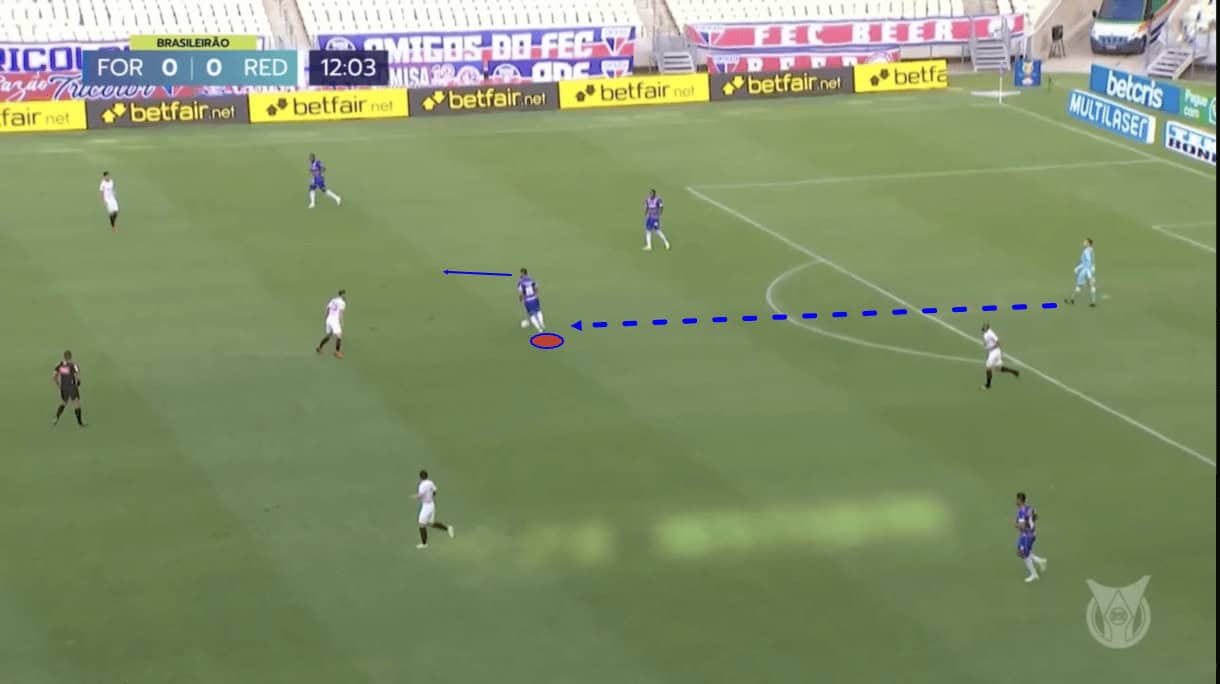
Figure 4 shows an example of Fortaleza’s deeper midfielder receiving the ball during the build-up as he drops into the central space between the two splitting centre-backs and in front of the goalkeeper. It’s very common to see central midfielder Felipe perform this role as the deeper-lying midfielder for Fortaleza. It’s a specific role within Vojvoda’s tactics that requires the player to be press-resistant and, like the ‘keeper behind him, to have good passing technique as well as be quick-thinking.
In the example above, the midfielder was tracked closely as he dropped to receive the ball but he managed to evade the pressure with some nice, quick movement on the ball and turn to set up the scenario we see here where he’s facing forward assessing the passing options ahead of him – his central midfield partner to the right, the ‘10’ ahead of him who’s dropped deep to offer support similar to how this deep midfielder himself drops to support the ‘keeper, and the right wing-back to his right, who as we’ll see in just a moment, drifted centrally in this particular passage of play to overload midfield along with the opposition left-back.
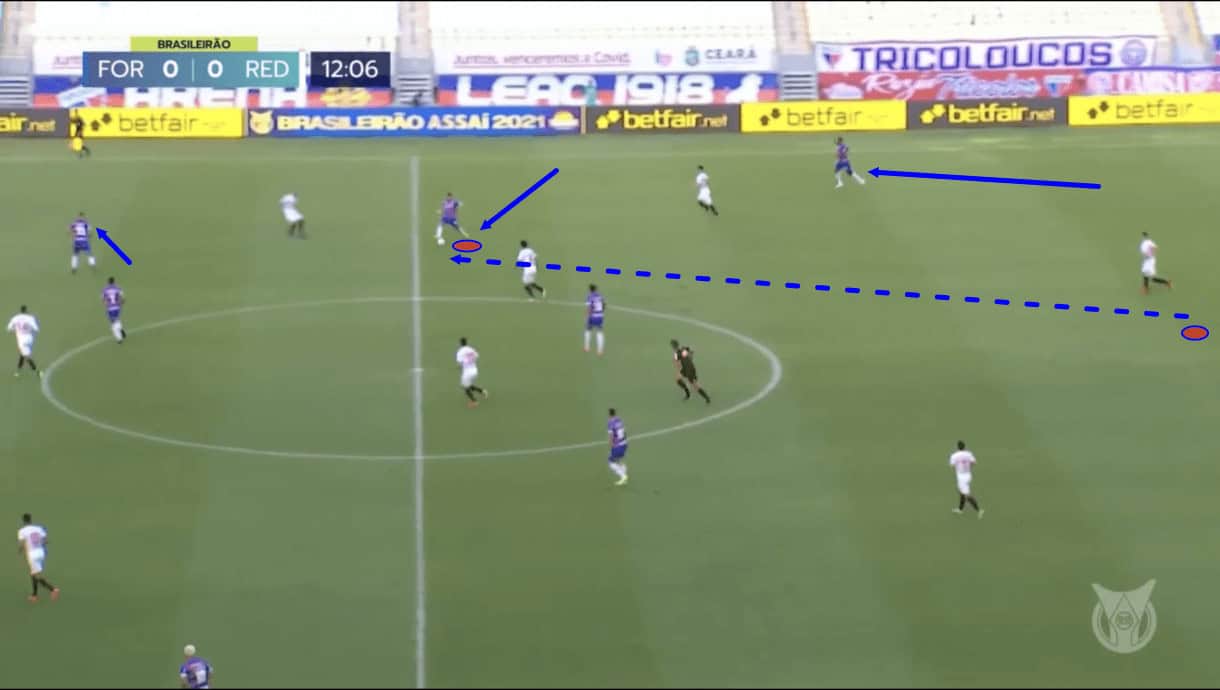
In the previous passage of play, we saw Fortaleza’s right centre-back advance into central midfield, giving the deeper midfielder a passing option to the right as well as to the left. In figure 5, we see the right centre-back stay out wide, with the right wing-back then drifting into midfield.
This serves two purposes – firstly, we see that now Fortaleza’s midfield outnumbers the opposition’s midfield three-to-two in the middle of the park in front of the deeper-lying midfielder on the ball. This helps Vojvoda’s side to progress from the deeper midfielder into the middle third more easily. Secondly, as he receives the pass from the deeper-lying midfielder, the right wing-back also forces the opposition’s left-back to make a decision and either jump out of defence to close him down or stay deep to mark the left striker. As well as overloading midfield three-to-two, Fortaleza overload the opposition’s backline again here early on in the attacking play through positioning and movement – a key component of Vojvoda’s offensive tactics.
As play moves on, we see Fortaleza continue to slice through the opposition’s defensive structure after progressing to this point where they have numerical superiority in the two more advanced thirds. This section highlights a few common ways that Vojvoda’s side build their attacks. Thanks to their aggressive positioning and movement, as well as their passing to exploit that positioning and movement effectively, Fortaleza are generally able to set up dangerous attacking scenarios quite quickly to take advantage of their numerical superiority in the middle and final thirds.
This is a key part of why their attack has improved so much this season. Fortaleza ended the 2020/21 campaign with the fourth-lowest goalscoring record (34) in Brazil’s top-flight. Their attacking struggles were a big reason for their poor performance on the league table last term. However, this season, they’ve scored 25 goals in their first 15 games – giving them the joint-second best goalscoring record in Série A.
Chance creation
Along with scoring much more goals, Fortaleza have been creating far more goalscoring chances this season than they managed to create last season, resulting in far more shots. Fortaleza ended last season having taken the fourth-fewest shots (9.33 per 90) of any side in the league while they’ve currently taken the second-most shots (12.94 per 90) of any Série A side this term. They’ve also got a much better shot accuracy (37.4%) than they did last season (31.9%) at present. Lastly, Fortaleza are also playing more through balls (7.62 per 90) this term than last term (5.58 per 90).
In this section, we’ll provide some analysis of Fortaleza’s tactics in the final third under Vojvoda that have helped them to make these changes in their attacking game to boost their goalscoring numbers.

Firstly, figure 6 highlights a passage of play in which Fortaleza demonstrated some impressive short passing and intricate link-up play between their attackers to play through the opposition’s midfield and break down a stubborn low-block. Just before this image, the left wing-back was in possession on the left wing, with three opposition players crowded around, beginning to apply pressure and blocking off passing options. Through some intelligent movement and a good pass selection, Fortaleza managed to move the ball into central midfield and from here, Leão do Pici were in a much better position to play through the opposition.
While the opposition’s midfielders were packing this area of the pitch quite well, Fortaleza managed to play through them thanks to some intelligent short passing and quick movement. As play progressed from figure 6, the ball moved from the central midfielder to the left striker to the ‘10’ and eventually to the overlapping right wing-back. This player enjoyed some freedom due to the opposition’s left-back also having to worry about the right striker and he ultimately succeeded in assisting a goal for his side via a short cross from high on the right-wing.
This passage of play highlights how Fortaleza’s often like to try and break down the opposition’s low-block. They are happy to play patiently in the final third and effectively utilise short passing and movement to break down the opposition through a passing sequence rather than rushing to get the ball into the box. The attack ultimately ends up forming the front five/six as is always the case in Vojvoda’s Fortaleza side, consisting of the wing-backs out wide, two strikers, the ‘10’ and, in this case, an advanced central midfielder too. This helps Fortaleza to create a crossing scenario and to take advantage of it in the box.
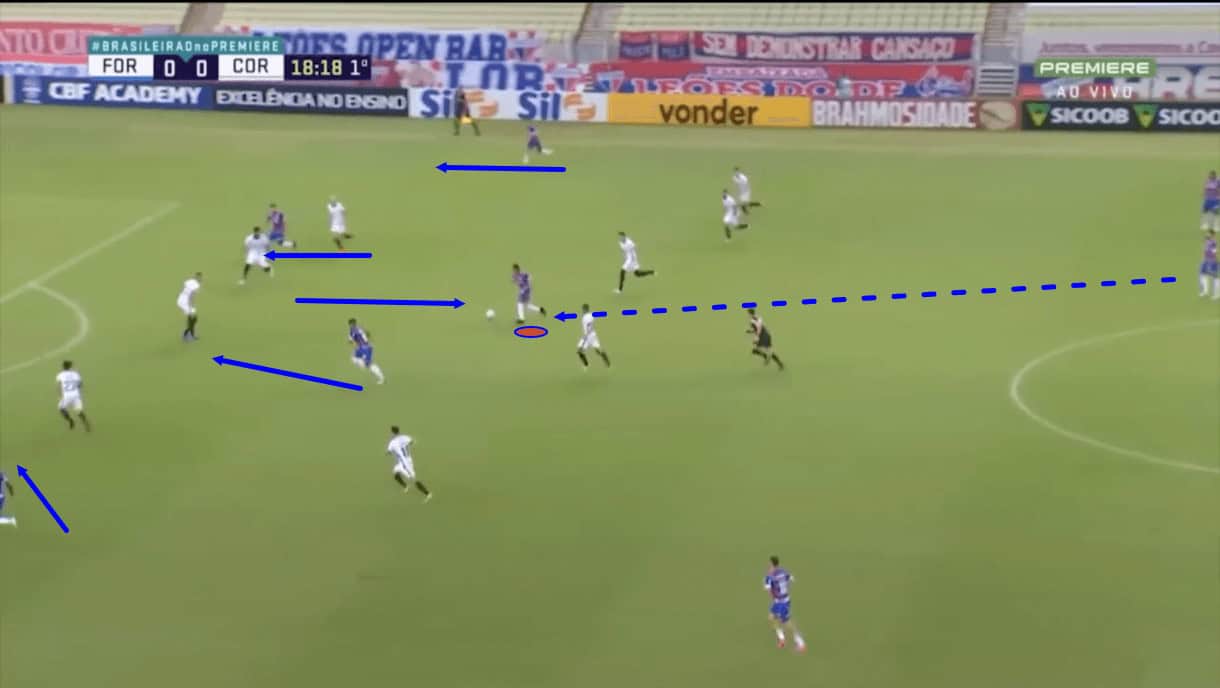
Another instance of Fortaleza creating their front five can be seen in figure 7. Here, again, we see the wing-backs out wide, either side of the opposition’s backline, with one striker sitting on the shoulders of the opposition’s backline, waiting to be played in behind and one striker having dropped deep to receive the ball in between the lines, vacating space for the ‘10’ to attack via a run in behind. This creates the scenario we see here.
As the striker dropped deep, he found space and made himself a passing option for the deeper-lying teammate on the ball. Meanwhile, as that dropping striker received the pass in between the lines, the ‘10’ advanced from his deeper position to give the ball-receiver another passing option. As the striker turned on the ball, he could also run at the opposition’s four-man backline, creating a 5v4 scenario in favour of Fortaleza. It’s common to see Fortaleza play forward passes along the ground towards one of the strikers dropping off. Additionally, as mentioned earlier, it’s common to see Vojvoda’s side make alternating movements, as we saw here with the ‘10’ and the strikers, to become more difficult to defend against by creating different challenges for the opposition defenders.
In general, as these two passages of play demonstrate, Fortaleza love to play through the lines, using intelligent passing and movement to break down the opposition.
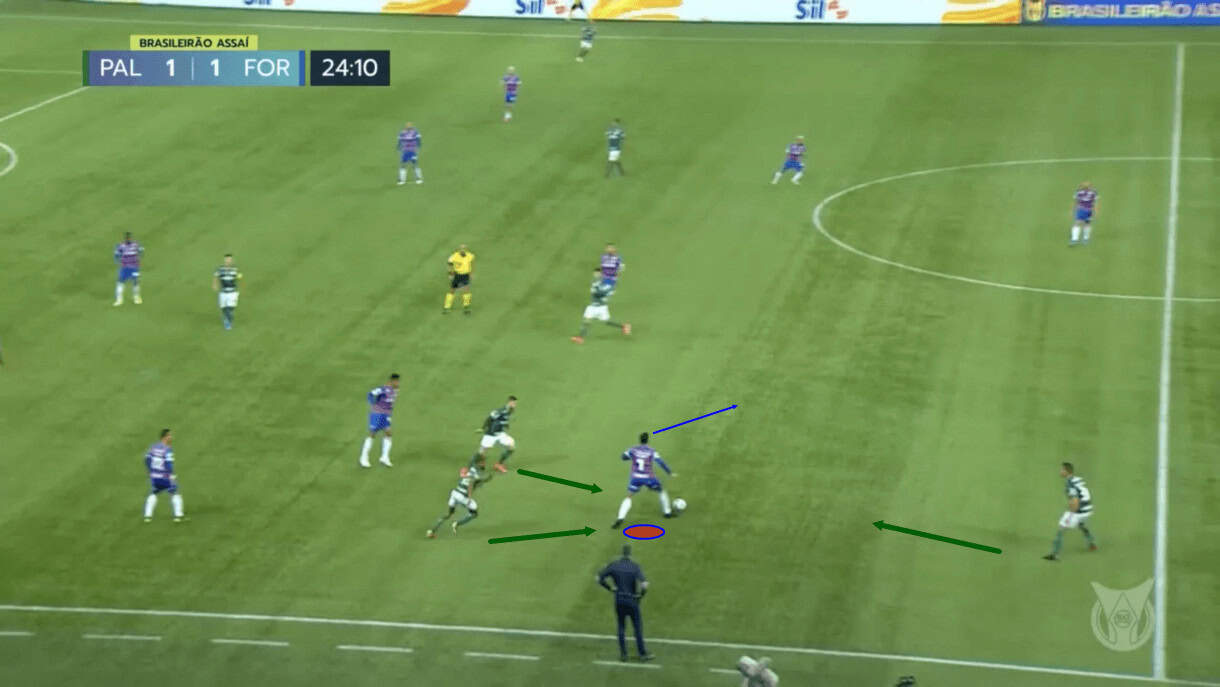
Vojvoda’s side also threaten a lot in transition to attack. On the counter, it’s also common to see them utilise some quick, one/two-touch passing and movement to create superiority over the opposition’s backline. We see an example of one Fortaleza counter-attacking passage of play beginning in figure 8. Just before this image, the right forward received the ball from a deeper-lying teammate who just regained possession for Leão do Pici as the opposition tried to attack through the centre. This creates the scenario we see here, with this attacker assessing his forward passing options on the counter.
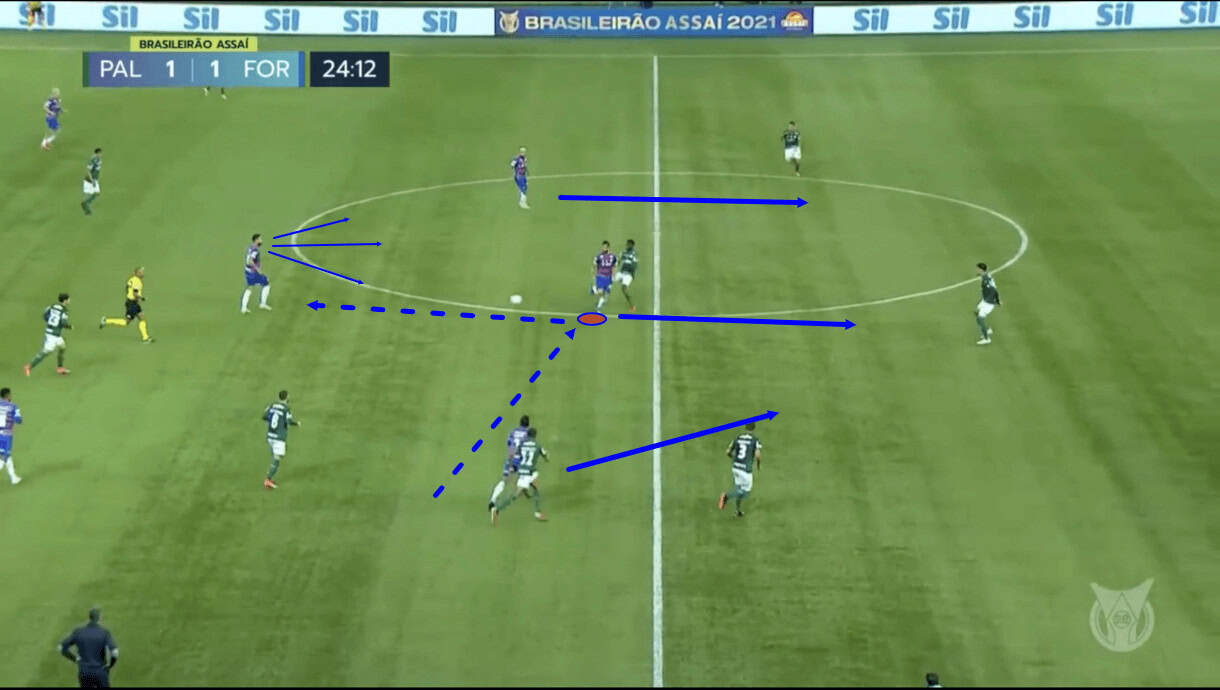
As play moves on into figure 9, we see that the right forward played a low driven pass into the feet of his centre-forward partner, who quickly flicked the ball back to a central midfielder. Now, with three Fortaleza attackers ahead of him running beyond the opposition’s midfield line and attacking their three-man backline on the counter, this midfield player, in space, has three passing options ahead of him – one centrally, one to the right and one to the left – all of whom will be 1v1 with a member of the opposition backline.
Again, this highlights how Fortaleza can successfully create a dangerous attacking scenario through quick, intelligent passing and movement – this time on the counter. So, it’s clear that the quick passing and movement in the middle and final thirds plays a crucial role in chance creation for Vojvoda’s Leão do Pici.
Defence
Last season, Fortaleza actually ended the season with a decent defensive record. Only eight Série A teams conceded fewer goals than Leão do Pici (44) in 2020/21. Their positive defensive record played a key role in their Série A survival last season. However, this term, their defensive record is even better at present. Fortaleza have currently conceded fewer goals (14) than all but just four Série A sides.
So, how has Vojvoda helped his team to improve their defensive record even more this season? One key change in Fortaleza’s defensive tactics under the Argentinian is that they’re pressing more aggressively. Leão do Pici finished the 2020/21 season with the highest PPDA (14.83) of any team in Brazil’s top-flight but they’ve currently got a PPDA of 9.2 – the seventh-lowest in Série A. This is a stylistic change that has helped Fortaleza to become even more solid at the back – in addition to creating more goalscoring chances at the other end by forcing high turnovers.
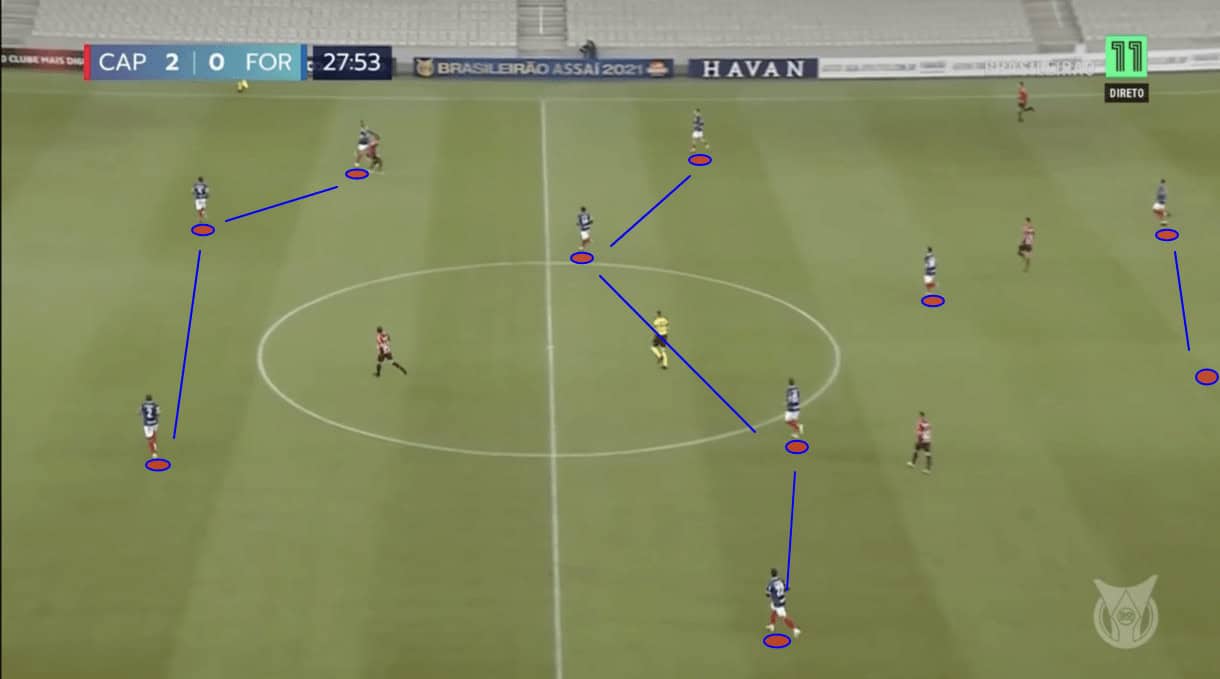
An example of Fortaleza’s 3-4-1-2 defensive shape in the high-block phase can be seen in figure 10. This shows how Vojvoda’s side typically shape up during the opposition’s build-up – the front two and number ‘10’ tend to press very high, giving the opposition’s backline little time on the ball, while their midfield generally isn’t far behind, happy to offer support to that front three by pressing high, showing how Fortaleza’s priority in this phase is preventing the opposition’s deeper players from enjoying time on the ball and forcing high turnovers if possible.
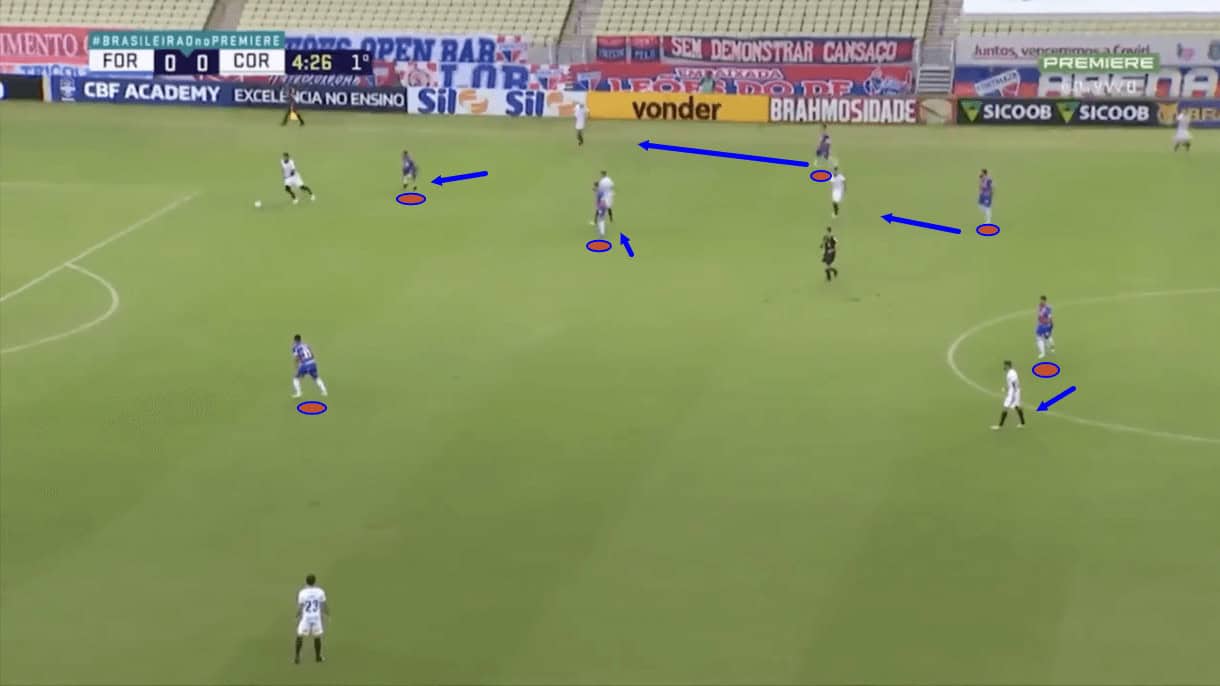
We see an example of how Fortaleza’s defensive shape moves as the opposition begin to play out from the back in figure 11. As the opposition’s left centre-back receives possession, Fortaleza’s right centre-forward springs into action, immediately applying the pressure to him and giving him no space to turn. Meanwhile, the left centre-forward will advance to retain access to the other centre-back, the ‘10’ sits tightly on the holding midfielder, the deeper central midfielders sit just behind, getting tight to near opposition midfielders, while the ball-near wing-back sits high, ready to press the opposition full-back should he receive the ball out wide.
Fortaleza’s defensive shape closes in on the side where the opposition have the ball. They focus primarily on closing off near passing options for the ball carrier and restricting space around the ball for the opposition. They’re happy to engage out wide, with the wing-backs advancing to directly challenge the opposition full-backs/wing-backs, but they’re also happy to close off passes to the outside, instead of forcing play inside where they’ve typically got numerical superiority by packing midfield.
Due to how they focus on closing in around the ball-carrier and restricting space there, Fortaleza can leave too much space open on the opposite wing. The key things for them to do to prevent the opposition from exploiting this are firstly – prevent the switch from occurring in the first place by pressing aggressively and blocking off passing lanes – and secondly – if the switch does occur, reorganise on the opposite wing quickly, allowing the opposition little time to gain an advantage on the other wing.
Fortaleza tend to focus quite heavily on preventing the opposition from playing through the centre. Their central midfielders and ‘10’ tend to engage in a lot of defensive duels because of how active they are in winning the ball back if the opposition does try to play through their midfield. Especially when defending deeper, Fortaleza try to pack the centre full of bodies and are prepared to press aggressively should the opposition play the ball into central midfield. From here, they can then kickstart a counter-attack after regaining possession.
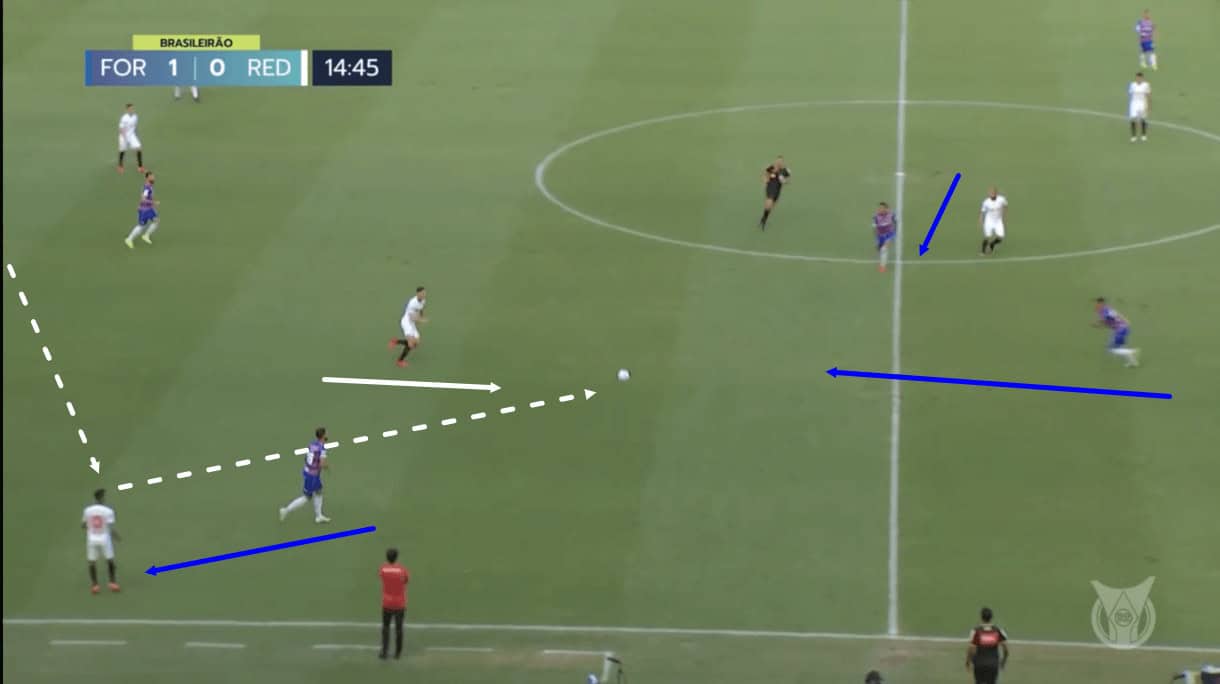
Sometimes, however, with the primary focus on preventing the opposition’s deeper players from playing out from the back, Fortaleza can be exploited centrally when defending higher up the pitch. To buff up their midfield presence and deal with any instances of the opposition exploiting them centrally while defending higher, Fortaleza’s centre-backs often enjoy the freedom to leave the backline and advance into midfield to engage the opposition higher and prevent the opposition from playing through midfield. We see an example of this occurring in figure 12.
Just before this image, the opposition played the ball from the ‘keeper out to the right-back, attracting Fortaleza’s left wing-back forward. Meanwhile, Fortaleza’s front three were occupied higher up the pitch and didn’t have time to drop back into midfield yet. This allowed an opposition midfielder to find some space near to the right-back who tried to find him in the centre. This led to Fortaleza’s left centre-back having to step into midfield and engage the opposition player. The centre-back successfully won the ball on this occasion, highlighting the benefits of his license to defend so aggressively.
The fact that Vojvoda utilises a back three makes this aggressive defending from one centre-back easier, as there are still two defenders in the backline who can cover some of the space behind, along with the other two central midfielders just in front of them to retain a strong presence in central midfield. This kind of aggressive defending can be exploited if the opposition are quick enough to beat the centre-back to the ball or if they’re able to dribble past him and exploit the space he vacated but this is the risk Vojvoda’s willing to take to prioritise winning the ball higher and protecting central midfield. Given his side’s improved defensive record, it’s difficult to argue against this decision.
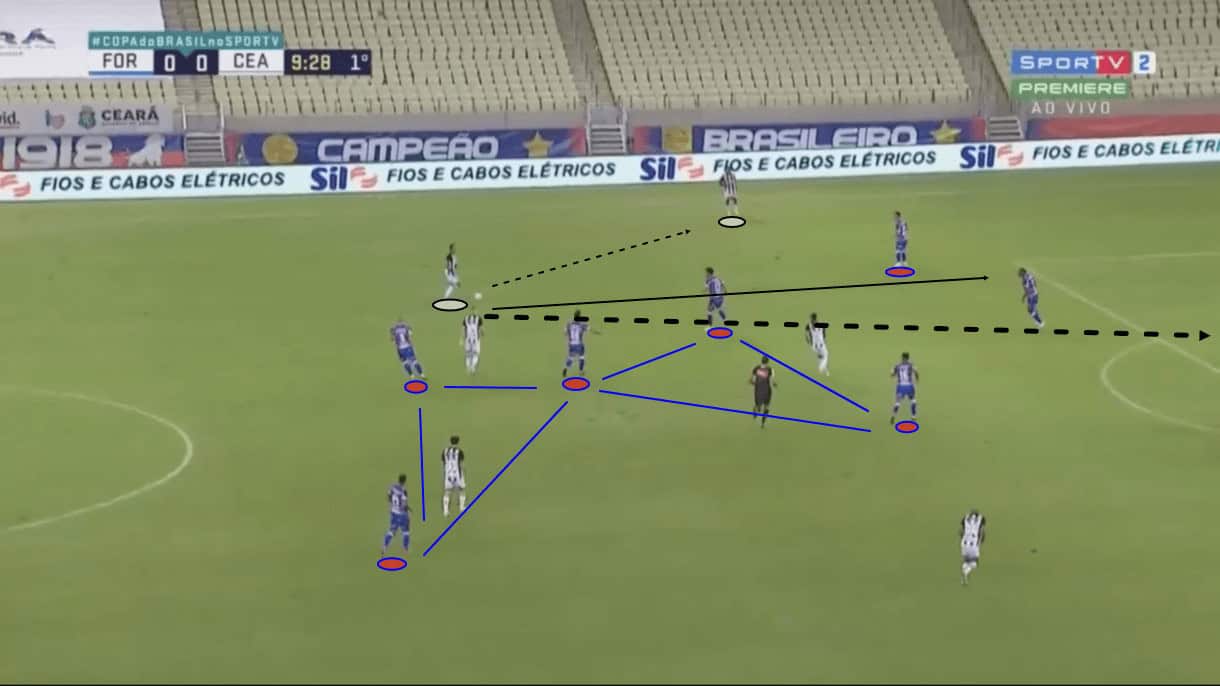
When defending in a low-block, Fortaleza drop into a 5-2-1-2 shape, as shown in figure 13. This image highlights how Leão do Pici pack the centre full of bodies while defending deeper and make it more difficult for the opposition to play through them. Of course, plenty of the time their opponents do still try to play through them centrally, which often results in one of Fortaleza’s central players being called into action to regain possession and start a counter-attack. This was the case for the passage of play analysed in figures 8 and 9, where Vojvoda’s men had just regained possession deep and successfully started a dangerous counter-attack.
While this 5-2-1-2 shape does a good job of protecting the centre – which is the most threatening area of the pitch, so is a sensible move from Vojvoda – it doesn’t offer great coverage on the wings. This shape can allow the opposition to easily double-up on the wing-back and progress into a crossing position high out wide. Even though the back-five does give the wing-back some protection in the form of the near centre-back behind him, he can get isolated and be left vulnerable.
Additionally, as was the case in this particular example, with Fortaleza in a low-block, opposition players can receive the ball deep in the half-space and if the two centre-forwards are occupied, then this player can enjoy lots of time and space to create from deep as the central midfielders won’t want to press too high and expose the centre. As this passage of play moves on, the opposition player sends the ball into the box, creating a dangerous chance against Fortaleza, highlighting this weakness in their defensive structure. However, as mentioned, the centre is generally the most threatening area of the pitch and Fortaleza tend to do a good job of protecting this area, which plays a big part in their impressive defensive record this term.
Conclusion
To conclude this tactical analysis piece on Fortaleza under Juan Pablo Vojvoda, it’s clear that the Argentinian has quickly implemented some changes at the Ceará-based club in the form of their unique style of build-up play, their switch from defending more passively to defending more aggressively, and the implementation of some nice-looking and effective short passing plays inside the final third to break the opposition down.
Fortaleza aren’t without their weaknesses – in build-up, their deeper players can make mistakes resulting in cheap chances for the opposition, their style of build-up requires good on-the-ball ability from the ‘keeper along with the centre-backs and deeper-lying midfielder, their aggressive defending can allow gaps to form in deeper areas, and their protection of the centre when defending deeper can weaken wider areas.
However, Vojvoda has successfully implemented his preferred playing style at the Ceará-based club, while he’s got them playing in an aggressive, entertaining way with and without the ball. Vojvoda’s style is risky, in that large numbers are committed forward to overload the opposition centrally and in the final third, and he likes his side to waste no time in build-up exploiting those overloads intelligently via passing and movement, either directly from the ‘keeper or through the deeper-lying outfield players. This has played a big part in Fortaleza’s successful start to life under the former Newell’s Old Boys man.
