
Following a disappointing season under both Rogério Ceni and Renato Gaúcho, Flamengo have turned to Portuguese manager Paulo Sousa.
Since Jorge Jesus’s victorious spell in 2019/20, when he won five titles in 14 months, Flamengo has not settled on a manager.
With high expectations and high pressure, Paulo Sousa hopes to hit the ground running with the Carioca Championship starting in a few weeks.
Flamengo boasts one of the strongest squads in the country, featuring players such as Gabigol, Arrascaeta, Andreas Pereira, David Luiz, Filipe Luís, and more.
Consequently, Paulo Sousa will be expected to challenge for every competition they are in; a total of five.
With such squad and ambitions, Sousa has described his future Flamengo tactics as “Protagonist, Dominant, Offensive, and Organised”.
Similar philosophies were implemented in his past jobs, but the extent to which they were effective varied.
At any rate, he brings valuable experience in the world’s best leagues with him.
This tactical analysis examines Sousa’s tactics in Fiorentina, Bordeaux, and Poland to determine the playing philosophy he will adopt at Flamengo.
Paulo Sousa Statistical Overview
A brief statistical overview of his past teams allows us to gain a better understanding of his tactical vision.
Firstly, average possession and passes per 90 quickly stand out.
While neither Fiorentina nor Bordeaux are top contenders in their respective leagues, they averaged around 55-59% possession and roughly 500 passes per 90.
More specifically, however, both teams averaged around 200 lateral passes per 90.
That number is incredibly high and indicative of their patient, possession-based approach.
This patient approach can be further illustrated through Fiorentina’s most frequent passing links shown below.
The thickest lines, or most frequent links, are between defenders and midfielders.

There are also a few trends that signal Sousa’s evolution as a manager towards a more effective approach.
During his first season with Fiorentina, the team had the second-highest number of progressive passes per 90 minutes in Serie A, at 91.72.
The following season that figure slightly dropped to 88.31, and then to 59.44 at Bordeaux.
Over the seasons, Sousa’s teams became more patient in the attacking phase, working the ball more to create better chances.
This trend is further supported by their shots per 90 and average shot distance numbers.
Initially, at Fiorentina, his team took a high number of shots (14.24), with most of them being from long range (21.78).
Their long-range tendencies can be further seen in their shot map from a match against Napoli, where the majority of shots were taken from incredibly long distances.
Eventually, at Bordeaux, those figures dropped to 11.34 and 19.83.
Whether these changes were due to league style or a conscious change in the tactics is unclear, but the combination of statistical trends point to the latter.
 Finally, Fiorentina and Bordeaux’s defensive metrics highlight Sousa’s intensive approach.
As his tactics include dominating the ball, they look to win it as soon as possible.
That includes a high defensive block and high-intensity pressing.
In 2015/16, Fiorentina led the league in PPDA, at 7.19.
They also had the highest challenge intensity (defensive actions per minute of opponent possession) in Serie A at 7.9.
These tactics were effective, as Fiorentina had the third-lowest shots against per 90.
At Bordeaux, the team would vary between advancing their defensive block and staying in a mid-block, usually depending on the opposition strength.
For example, they had a PPDA of 14.11 against PSG compared to 5.14 against Metz.
Overall, their PPDA and shots against were both higher than they were at Fiorentina.
Some factors will be important when considering his defensive approach at Flamengo, but more on that later.
Paulo Sousa Attacking Organisation
After analysing some key metrics throughout his projects, it is worth examining how Sousa organises his teams offensively.
For most of his career, Paulo Sousa has opted for a 3-4-2-1 (or 1-2-3-1) formation, though he has occasionally switched to a 4-4-2 or 4-2-3-1 formation.
Anyhow, the initial formation is less relevant as the structure changes with the phases.
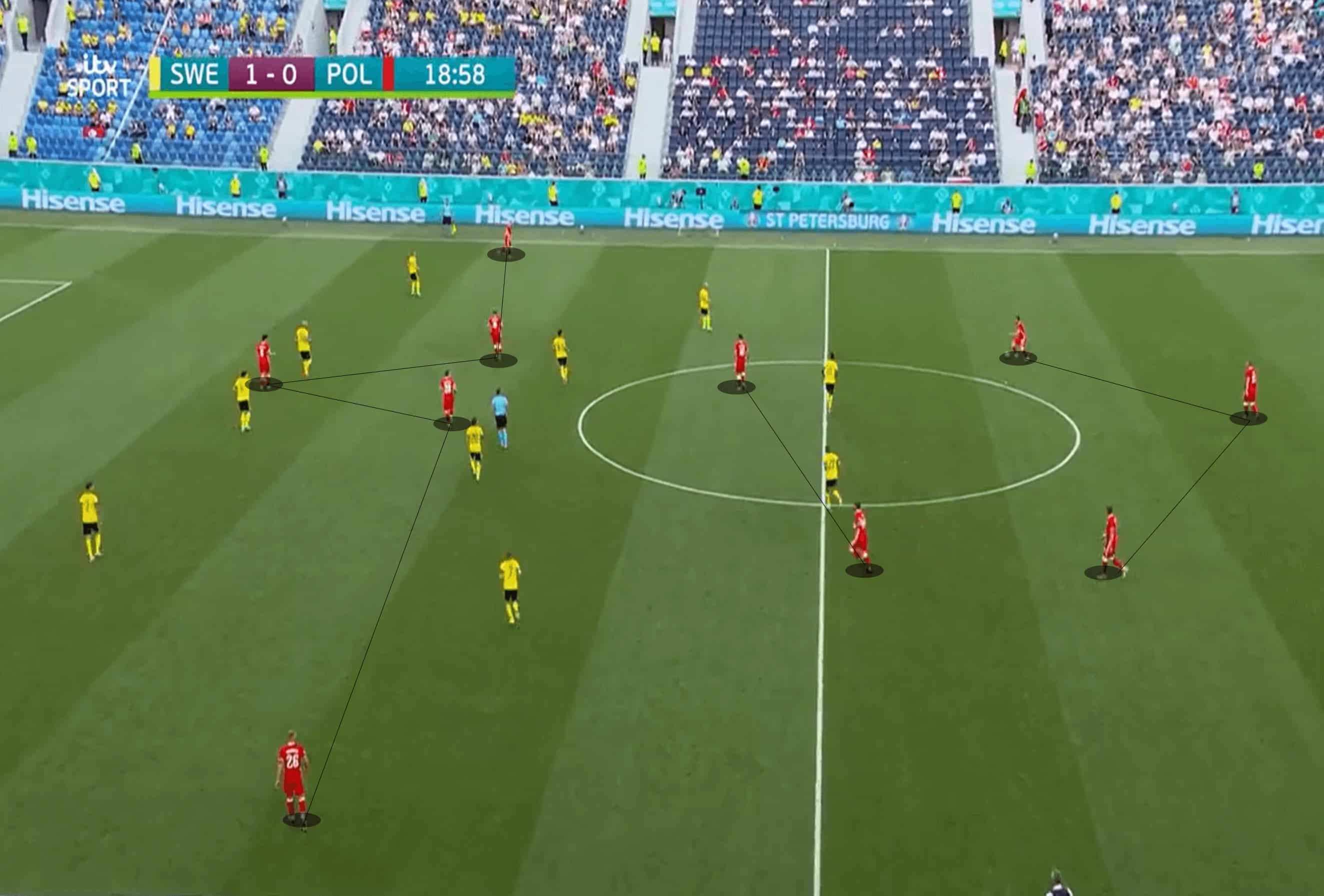
In the attacking phase, Sousa organises his team in the famous 3-2-5.
A double pivot operates in front of a back three with the aim of maintaining possession and starting play.
The two wingbacks provide width and depth sitting on the wings.
The two attacking midfielders will sit in the two half-spaces while the striker sits a little higher, providing depth.
This structure can be identified below in Poland’s possession play against Sweden in the Euro 2020.
Paulo Sousa Tactics In Build up
In the construction phase, Sousa wants his teams to play out of the back.
If the lanes and spaces were there, they would look to break lines and progress through the zones in a controlled manner.
However, their main strategy would be to keep possession and draw the opposition players in to create space further up the pitch.
The long-ball would then be available either in behind or to a target-man.
Similarly, Jorge Jesus adopted a highly successful direct approach at Flamengo, instantly looking to break lines and attack space.
His successor and former Guardiola assistant, Domènec Torrent, attempted to implement a more controlled, patient build-up but failed.
While the former seems more likely for Paulo Sousa to adapt, it will be interesting to see how they construct play.
Examining Fiorentina’s build-up against Juventus in Serie A helps us understand Paulo Sousa’s past approach.
In the image below, Sánchez has no options as all Fiorentina players are tightly marked.
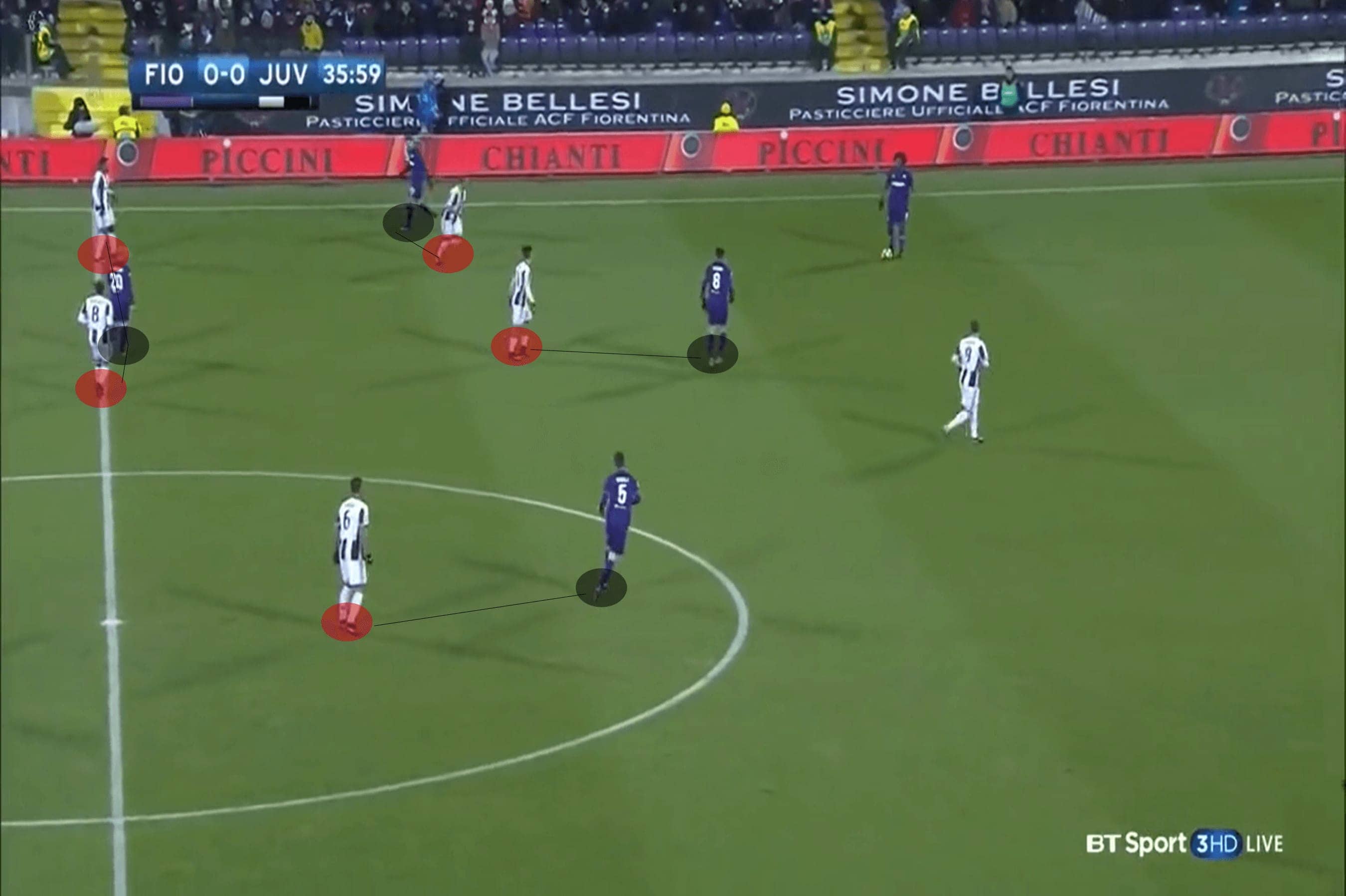 They then keep possession in their own half until Vecino is able to draw Juventus’ second defensive line in.
He lays it off to Sánchez, who then plays a long ball to the striker.
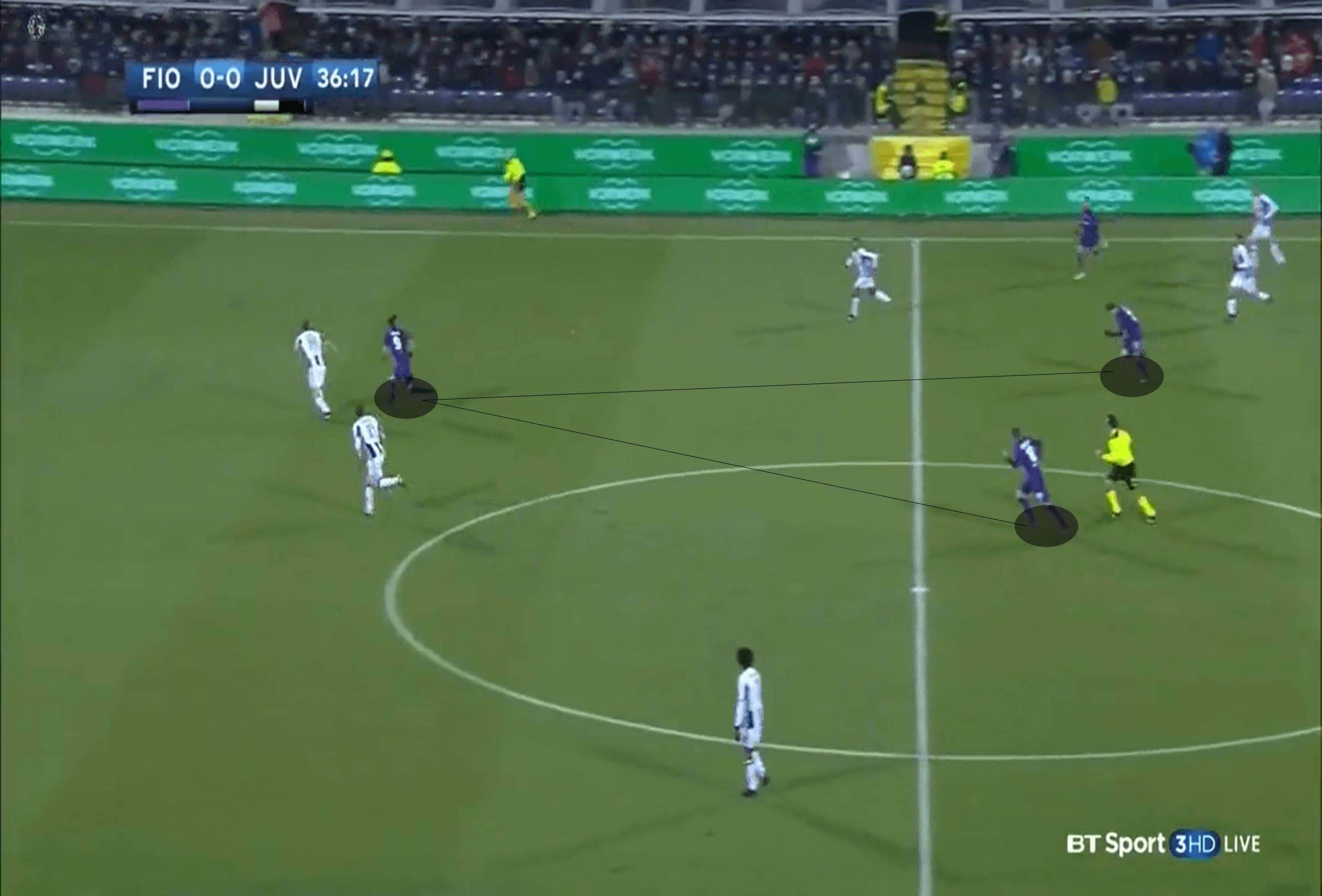
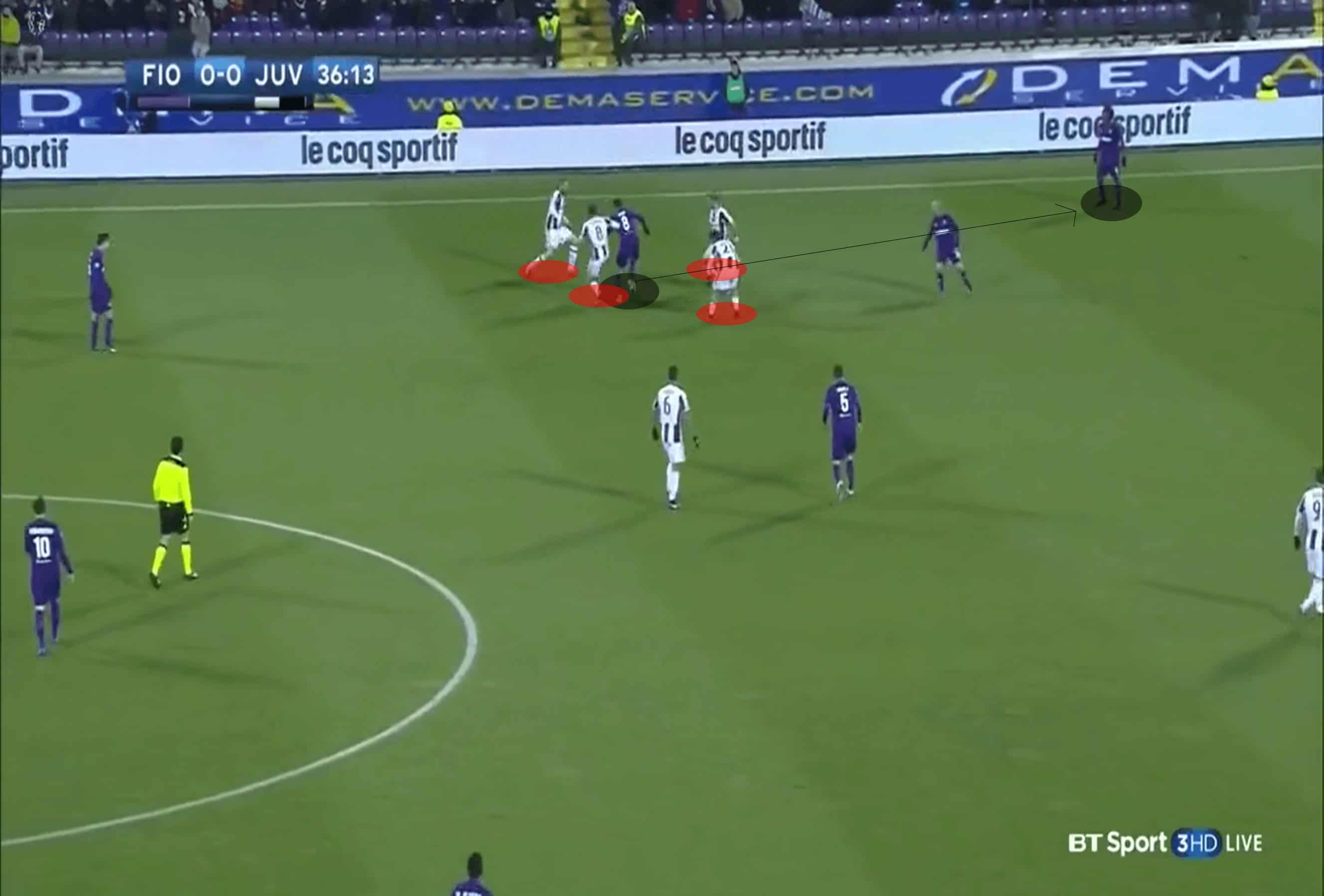 Both attacking midfielders push up to challenge for the second ball.
As Juventus’ midfield was drawn into pressure further up the pitch, Fiorentina are able to win it and quickly create the first goal of the match.
Paulo Sousa Chance Creation
As previously stated, his teams will set up in a 3-2-5 shape in the middle and final third of the pitch.
The two wide centre-backs may look to support possession play on the wings and create overloads, but essentially, it is the two pivots who look to get on the ball and create.
These two will probably be Pereira and Arão as they offer the perfect balance between defending and creating.
The width provided by the wingbacks will stretch the defensive organisation, while the attacking midfielders will look to drop in and play in the half-spaces as seen below.
Whether they get the ball or not, they are still creating space by dropping in and bringing an opposition player.
Ideally, these two roles would be played by Everton Ribeiro and Arrascaeta, the more creative forces of the team.
Left-winger Bruno Henrique is one of the team’s best players and would probably play the left wingback role rather than be dropped.
 In Fiorentina, Sousa’s team often settled for long-range and low-quality opportunities.
As the years went on, his teams became more patient, looking to penetrate the defence carefully.
Neither Fiorentina nor Bordeaux averaged a high number of crosses but often looked to attack through the centre and half-spaces.
Most of their success came from coordinated movements to create space for diagonal passes, as combining through low blocks was very difficult.
In Poland, however, they attacked through the wings and led the Euros in crosses per 90.
Poland’s midfield was not the most technical or creative, and with strong finishers such as Lewandowski and Milik, Sousa found this the optimal strategy.
Flamengo has dangerous wide players – B.
Henrique, Isla, and Matheuzinho – as well as creative midfielders – E.
Ribeiro, Arrascaeta, and Pereira.
Consequently, a balance should be struck between the two.
Paulo Sousa Defensive Phase
While Paulo Sousa has been consistent in his attacking structure, the same cannot be said defensively.
In Fiorentina, the team often reverted to a 4-4-2 in the defensive phase.
Contrastingly, he preferred a 5-4-1 at Bordeaux and a 5-3-2 at Poland.
Sousa’s Fiorentina was more consistent in their relentless, high-pressure approach, whereas Bordeaux was happy to sit in a compact mid to low block at times.
While Poland was very effective in their high pressing, they often played very weak opposition.
As Sousa wants his Flamengo to be “Offensive” and “Dominant”, he will probably opt for a Fiorentina-like approach.
Flamengo has struggled with centre-backs, with Rodrigo Caio often injured and the others being inconsistent.
They have also never experimented with five at the back either, so a 4-4-2 would be more suitable.
Sousa liked an aggressive, man-oriented press.
In a high block, the 4-4-2 would often turn into a 4-2-4, with the wingers pushing up.
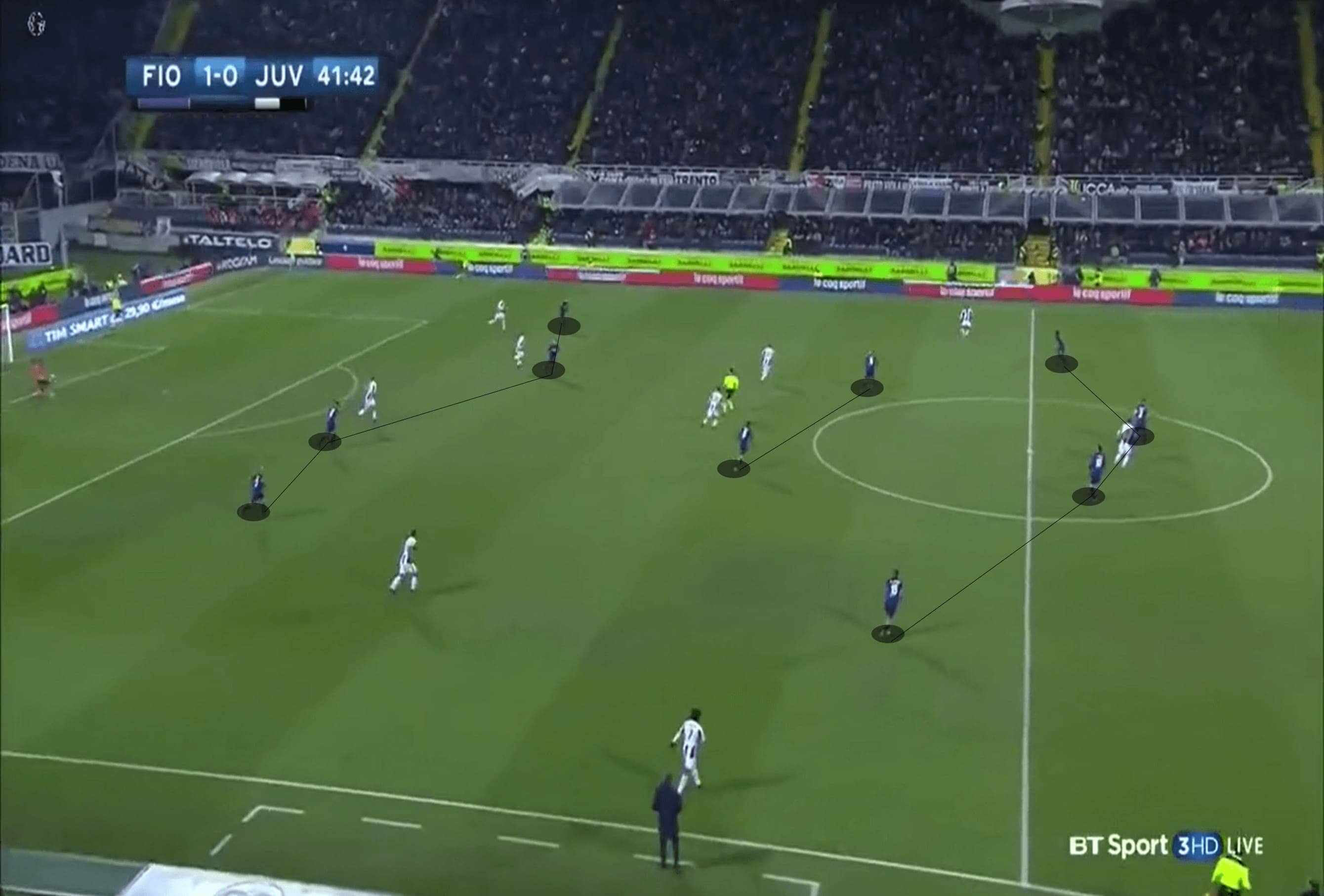 As Juventus played back to Buffon, Fiorentina advanced their block with one of the forwards pressing the keeper.
As highlighted, nearly every Juventus player is marked.
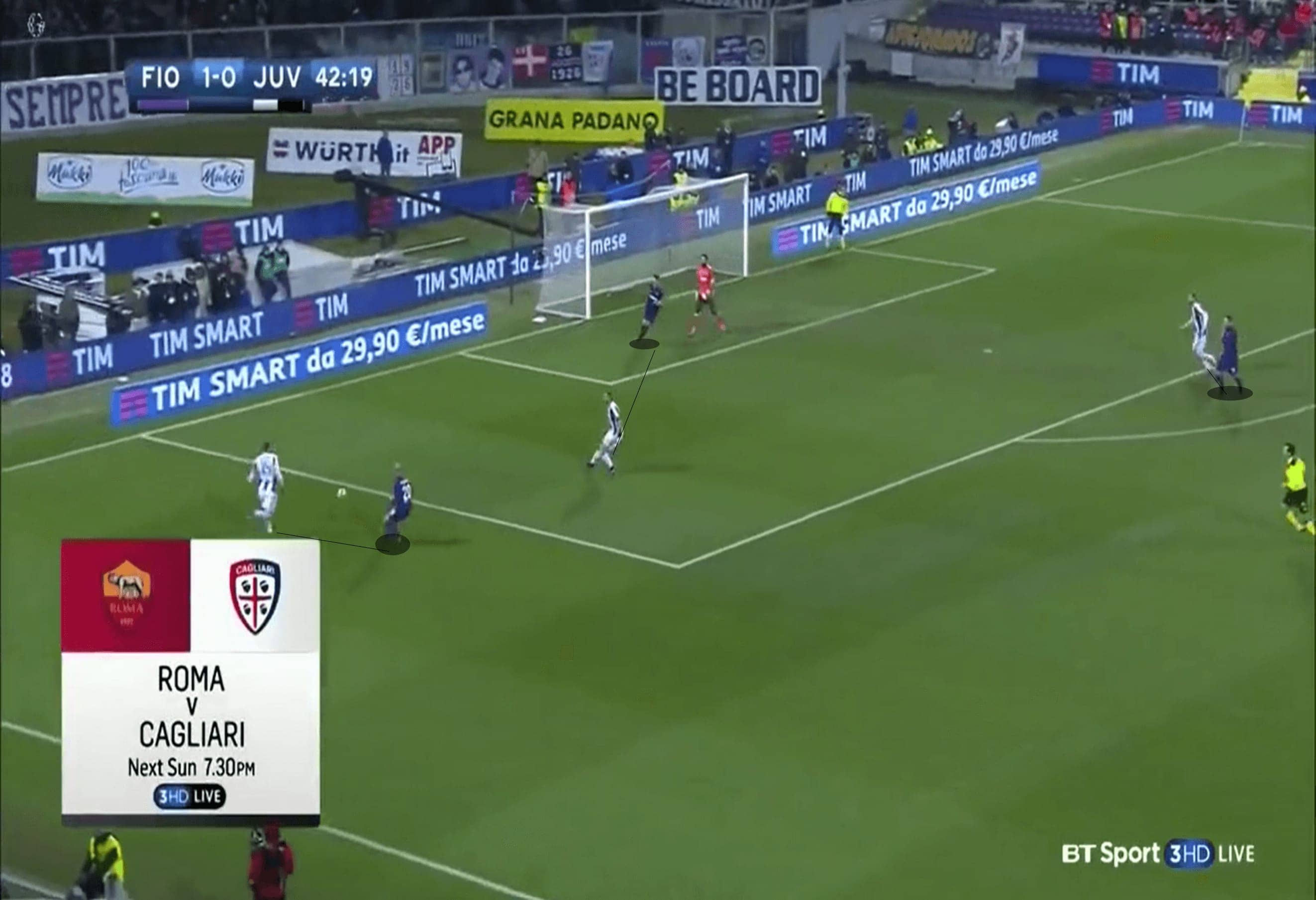 In a later instance, Fiorentina’s man-to-man approach is more visible.
This is a relentless system where the opposition does not have much time to react before a Fiorentina player is on them.
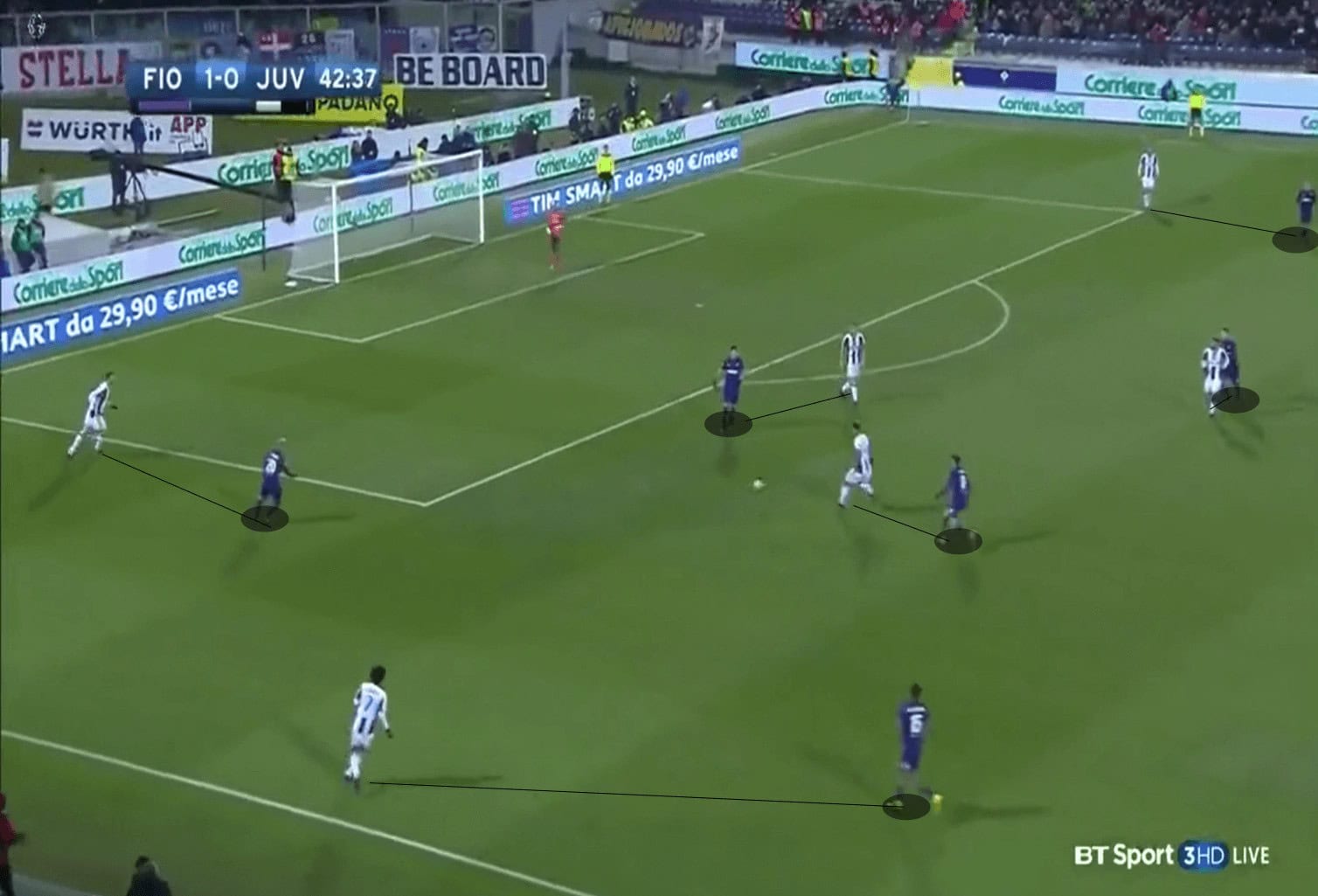 As previously shown with Fiorentina’s challenge intensity, they often maintain a high pressure regardless of the block.
Of course, it is impossible to maintain that intensity throughout the full 90 minutes, so there are instances of compact, patient blocks.
They look to maintain the intensity as much as possible, though.
This system was effective, as proved by their low shots-against figure, and will most likely be implemented at Flamengo.
Paulo Sousa Transitions
In the offensive transitions, Sousa’s teams sought to counter quickly.
After regaining the ball, the player would usually drive forward with it and attack space.
Meanwhile, the nearby players would also sprint forward to create options and attack.
The overall strategy is to attack the space given while the defence is disorganised.
Against Hungary, the player wins the ball and quickly drives forward with it while the others sprint forward.
Notice the big space behind Hungary’s left-back.
 He then plays it out wide as the others attack the box.
Because the others immediately sprint forward after the ball is regained, they are able to make good runs into the box.
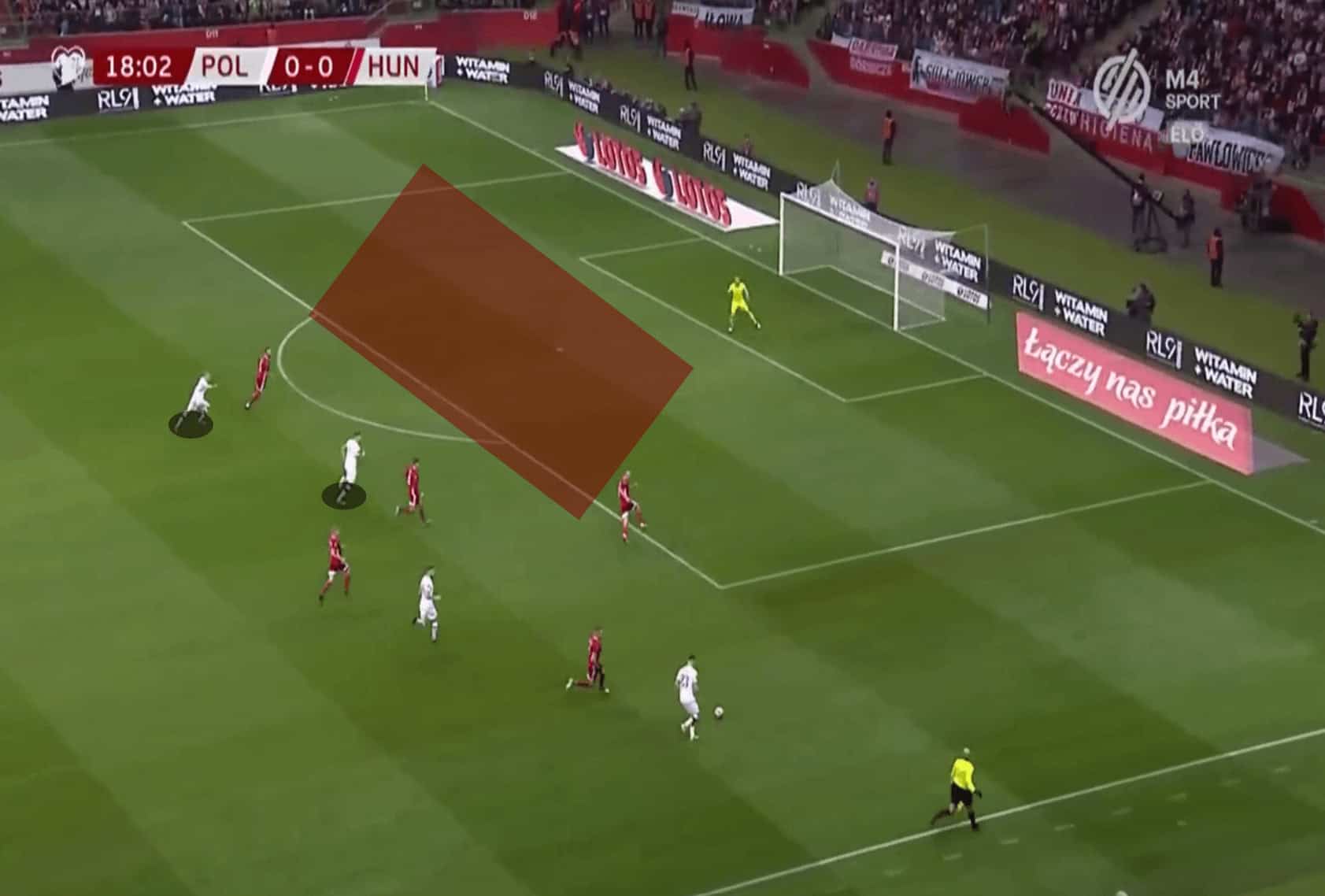 This strategy of dribbling and attacking space in numbers is especially effective when the ball is regained either high up the pitch, or with the defence disorganised.
As Flamengo have midfielders who are very good at launching counterattacks and forwards who are pacey dribblers, Sousa should maintain this approach.
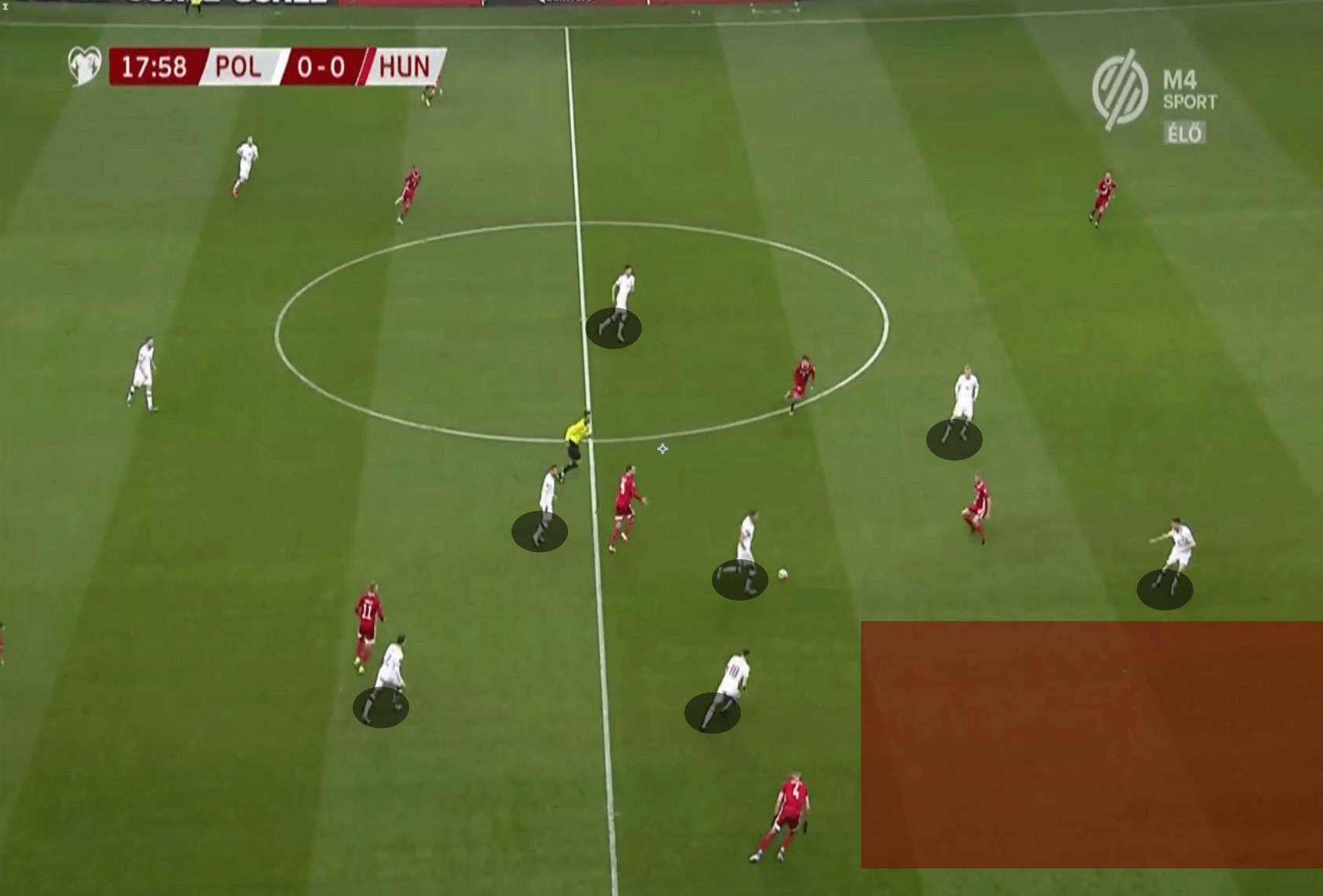
As you would expect, Sousa wants his teams to counter-press after losing the ball.
Contrary to their high press, where they try to man-mark those closest to the ball, this is a more ball-oriented press.
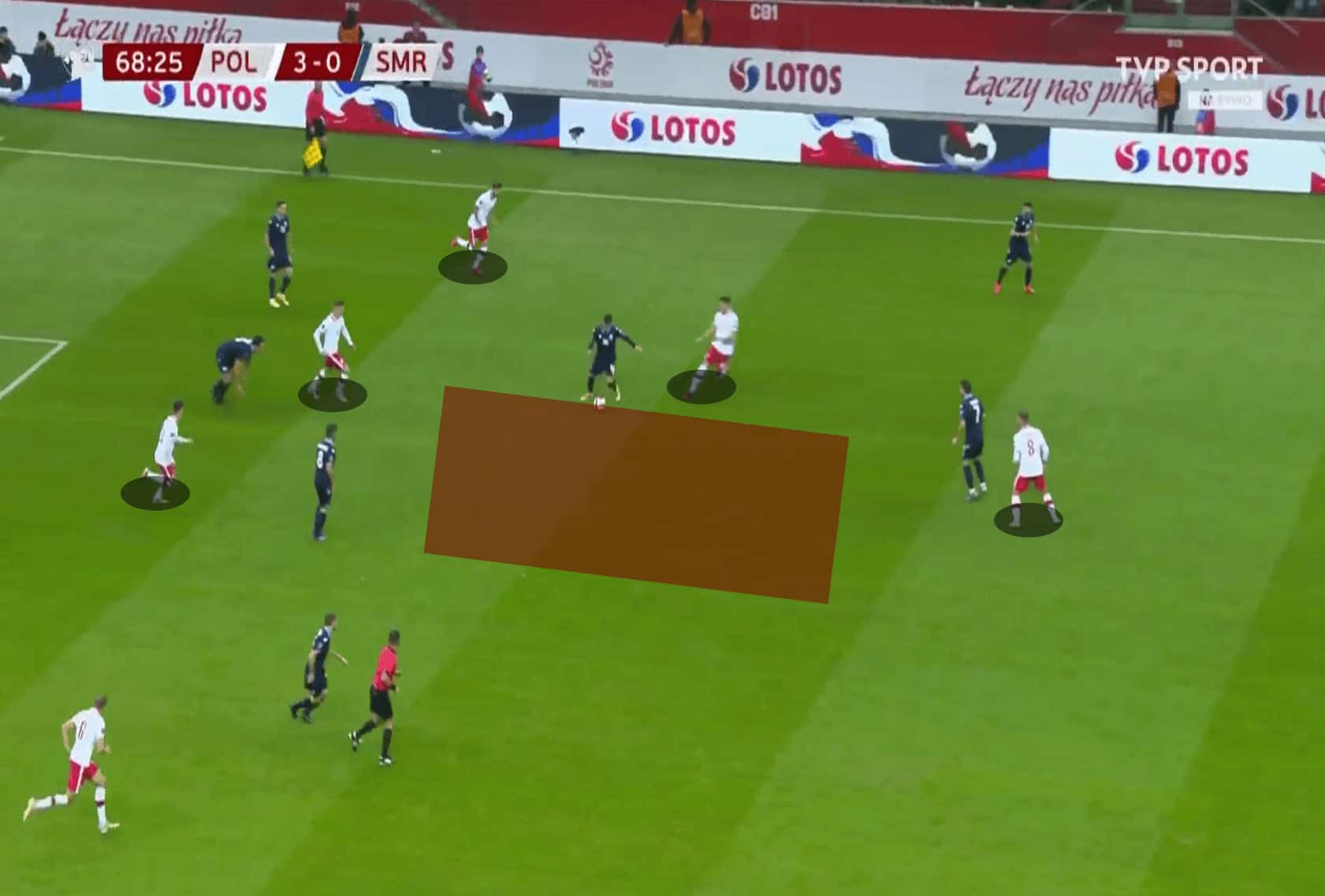
This behaviour can be seen after Kozowski plays the wrong ball below.
Notice where the highlighted players are.
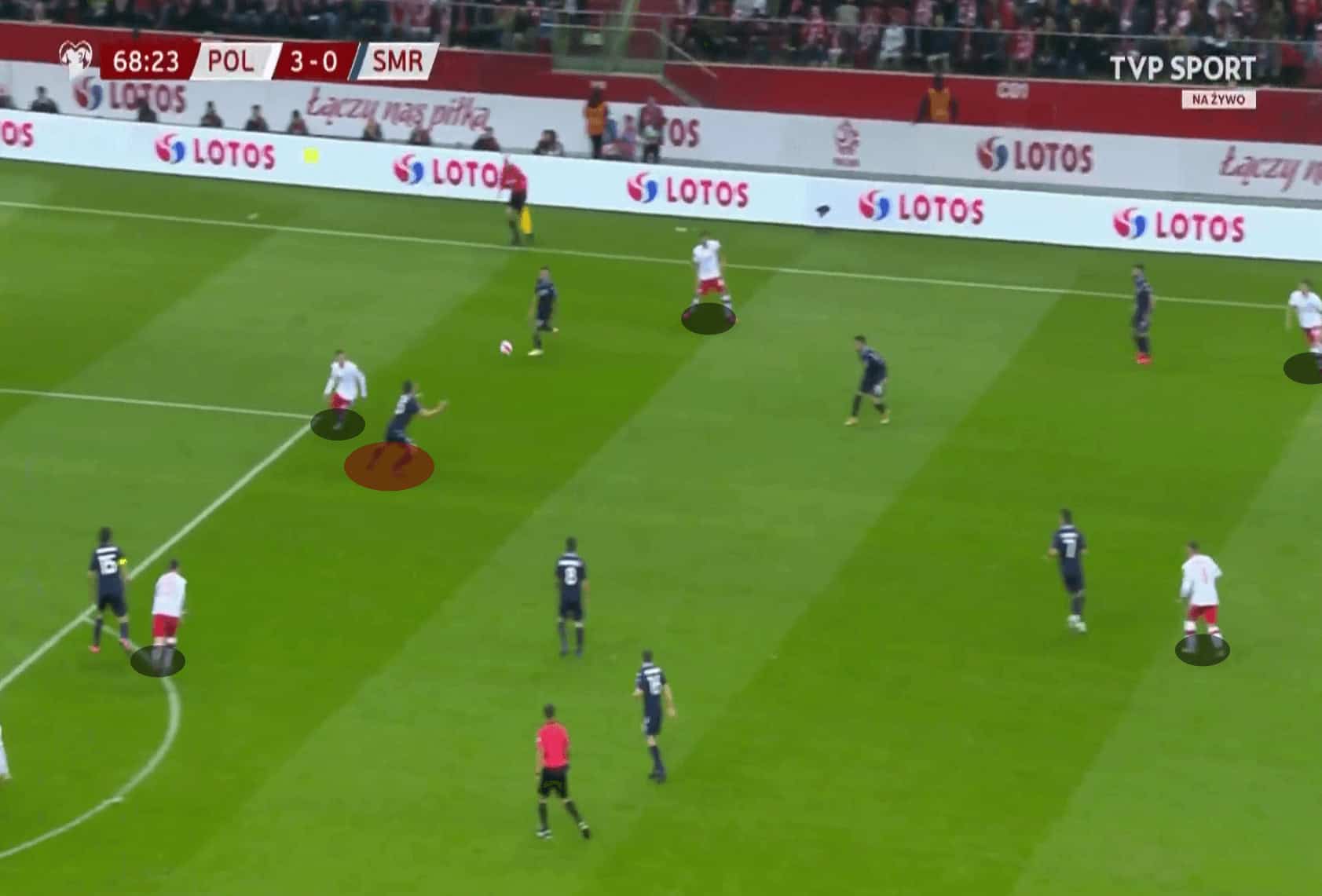 The players immediately sprint towards the ball, more specifically that red zone where the player is dribbling towards.
In this example, they are able to win the ball back.
Paulo Sousa Strengths
Paulo Sousa’s tactics, especially at Fiorentina, have been very effective.
His ability to implement a high-pressing system has been impressive, and he will look to do so at Flamengo.
There are very few teams in Brazil that can build up against a high press successfully, so this system will enable them to be very dominant in matches.
Transitions will also be strong areas for Flamengo, especially offensive transitions.
They have very pacey forwards who have been playing together for three years now.
They are familiar with each other’s movements and tendencies, and Sousa’s counterattack strategy will maximise that.
Not to mention their high press will see them winning the ball in very dangerous positions.
A key area for Sousa will be the build-up.
The initial part of the build-up, more specifically, will be essential to their success.
As examined, Sousa likes his teams to maintain possession in their half to draw the opponents’ players in, and then exploit the spaces left behind.
Previously, Flamengo have not been successful with controlled build-ups.
It was one of the areas that made Torrent’s Flamengo so vulnerable, as they would often give the ball away close to their own goal.
Their ability to play direct football with speed and exploit spaces is unquestionable, but they will have to work hard to create those scenarios.
Paulo Sousa Weaknesses
The big narrative with Flamengo last season was their weak defensive system.
While Rodrigo Caio is proven quality, he is often injured.
Gustavo Henrique and Léo Pereira were often unreliable, committing numerous mistakes.
David Luiz’s recent arrival, though, slightly improved their defensive performances.
Paulo Sousa has been very effective in the defensive phase of the game and will look to implement a defensive structure that maximises the potential of these players.
The other area Sousa will have to keep in mind is the long schedule.
Brazil is notorious for its long, exhausting schedule.
In Flamengo’s case, they will compete in five competitions this year and should expect to play around 70 games.
The problem is, Sousa’s defensive system is very physically demanding, and when they are playing twice a week, this will factor in.
He will have to manage the season and physical demand carefully, as he would not want his team to fall out of form when they are competing in the knockout stages at the end of the year.
Flamengo have a powerful and deep squad, though, and should be able to rotate while maintaining quality.
They also have one of the best youth academies in the country and should be able to call up any youngsters if needed.
Conclusion
As this Paulo Sousa analysis has shown, his playing model has many characteristics and strengths.
His work at Fiorentina was perhaps the most impressive, and he should consider implementing similar tactics at Flamengo.
At any rate, he has an exciting challenge ahead of him with one of the best squads a manager could ask for.
The pressure is high, and so are the expectations.
It will be interesting to see how he performs and how he copes with the demanding media and supporters.
Best of luck to him.
