
In May 2019, Jorge Jesus was appointed as the new manager of Flamengo.
In a brief stint, the Portuguese created one of the most legendary teams in Brazilian football history.
In a little over a year, Jorge Jesus had won five titles and lost four matches.
For the first time in a very long time, the manager was bigger than any player in a completely star-filled squad.
After leaving Flamengo for Benfica, Jorge Jesus found some success, but not quite at the same level as he had there.
Six months after parting ways with Benfica, he has been appointed as the new manager of Turkish giants Fenerbahçe.
Despite being one of the biggest clubs in Turkish football, Fenerbahçe have not enjoyed any success in nearly a decade.
They have not won any trophies since 2014 and are considered by many as a sleeping giant.
With superstar manager Jorge Jesus, Fenerbahçe aims to achieve similar success as Flamengo and rise back to the top of Turkish football.
With an intense attacking style, Jorge Jesus hopes to deliver the excitement and success that supporters have long desired.
In this tactical analysis, we will examine Jorge Jesus’ playing style and tactics throughout his time with Flamengo and Benfica.
More specifically, this analysis will examine the defining aspects of Portuguese-managed teams to determine how Fenerbahçe will look in the 2022/23 season.
Jorge Jesus Formations
While formations are not as relevant as they used to be, Jesus has a couple of favourite ones worth noting.
With how dynamic football has become, teams no longer maintain a rigid shape for most of the match.
On the contrary, most teams have defining principles that guide collective behaviour from the outset.
In other words, it is a lot more complex and fluid than a few simple numbers.
Throughout his time with Flamengo, Jorge Jesus used a 4-2-3-1 formation 45% of the time.
As seen below, many other variations and shapes were used depending on specific oppositions and scenarios.

To a larger extent, a similar tendency was followed with Benfica.
Jesus had an initial 4-4-2 structure, which he used most of the time.
However, he also used nine other formations.
Most significantly, the 3-4-3 had a brief spell towards the end of the 2020/21 season.

Jorge Jesus has a general structure he likes his teams to follow, regardless of the formation.
We will look at this preferred structure next, but as for formations, he is not afraid to switch and experiment with different shapes.
Jorge Jesus Structure
In the attacking phase, Jorge Jesus likes his teams to stay significantly narrow or at least compact.
This structure complements the behaviour and strategy of his teams.
While we will identify these specific tactics in the next section, it is important first to understand the structure and distribution of players used by the Portuguese.
Jesus likes a very fluid and collective style of football.
With the ball as a reference point, players constantly move near and between themselves to create passing lanes and combine.
As a result, the team’s overall structure is relatively narrow, as seen in one of Flamengo’s matches below.
The players’ average positions are very close to each other.

In order to further illustrate this structure, we can examine his build-up with Benfica.
As seen in the formations, Jesus most often adopts a build-up with a line of four.
The centre-backs split the area while the fullbacks are high and wide.
Another characteristic of his build-up is the use of a single pivot.
Ahead of the centre-backs, a single pivot will drop to provide support and dictate the build-up.
Further ahead, wingers and midfielders will float between themselves to provide support and create passing lanes.
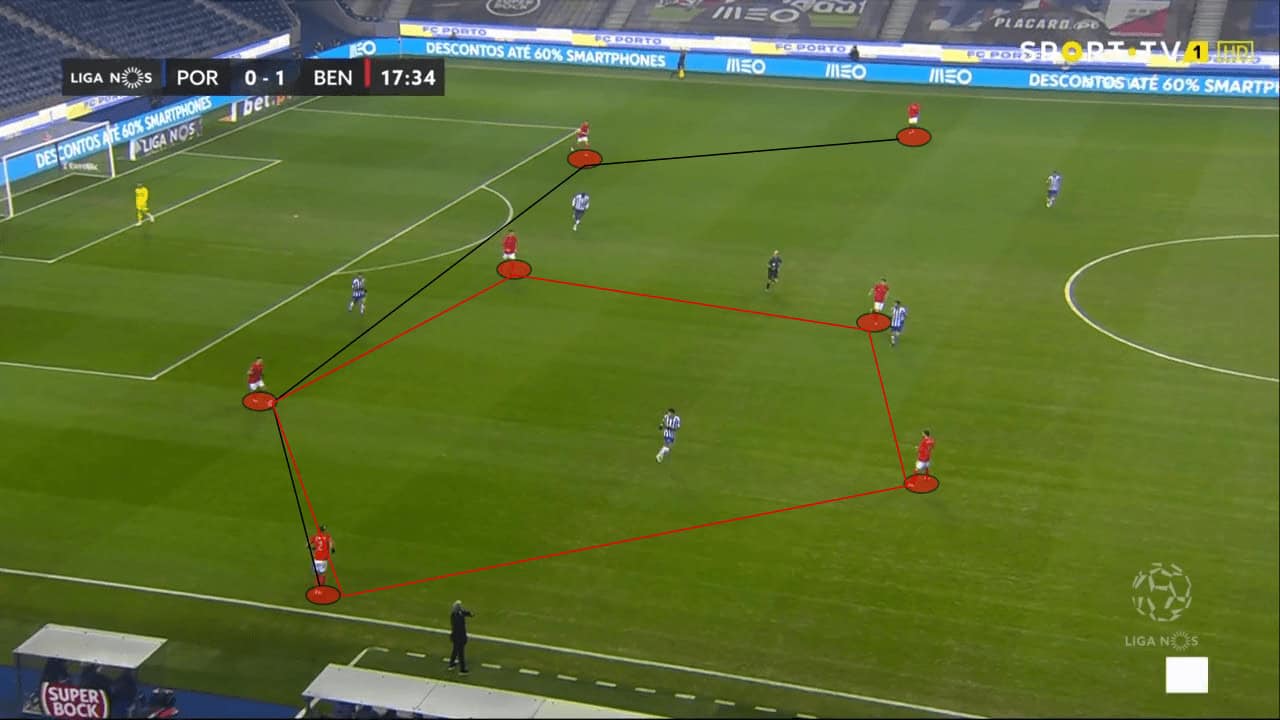
In the example below, we can see the line of four highlighted.
Furthermore, a pentagon of sorts is created with the ball carrier as the reference point.
This creates numerous passing lanes and becomes very difficult to defend.
If the ball is lost, they already have a significant number of players there to prevent immediate danger and recover it.
A variation with a line of three has also been used by Jorge Jesus, especially at Benfica.
Depending on the opposition’s pressing structure, this variation may be more effective.
Nonetheless, it is always good to have more options and variations.
In the example below, we see a backline of three and three players offering support to the ball carrier.

This trend is consistently seen throughout his teams.
With the ball, players are constantly offering support around the ball.
What makes this structure so effective is how fluid it tends to be.
While a few immediate players offer support, others will rotate with them and float around to disrupt the defensive organisation.
Against Arsenal, Benfica’s possession displayed this concept once again.
In this scenario, we can clearly see the numerical superiority it creates in the given area.
Below, they are able to create a 5v2 in this section and advance out of this zone.
By creating these overloads in possession, they are able to advance in a controlled fashion as a unit.

Jorge Jesus Verticality
In an oversimplified statement, Jorge Jesus’ teams are labelled as intensively attacking.
This heavy-metal style, which fans have enjoyed so much, is largely due to the directness and verticality of his teams.
This general verticality comprises several aspects.
First, the passing style of his teams tends to be direct and progressive, obviously.
Additionally, players constantly move behind defensive lines to create passing lanes and offer the desired vertical pass.
Another aspect concerns the structure shown above.
Combining is a significant aspect of his teams, and after breaking lines, immediately combining and moving the ball again is essential.
Movement behind the lines is essential for this verticality to work.
This movement, though, cannot be predictable and repetitive.
In order to do so, players are much more fluid among themselves.
Players will rotate among themselves and check for the ball in different areas.
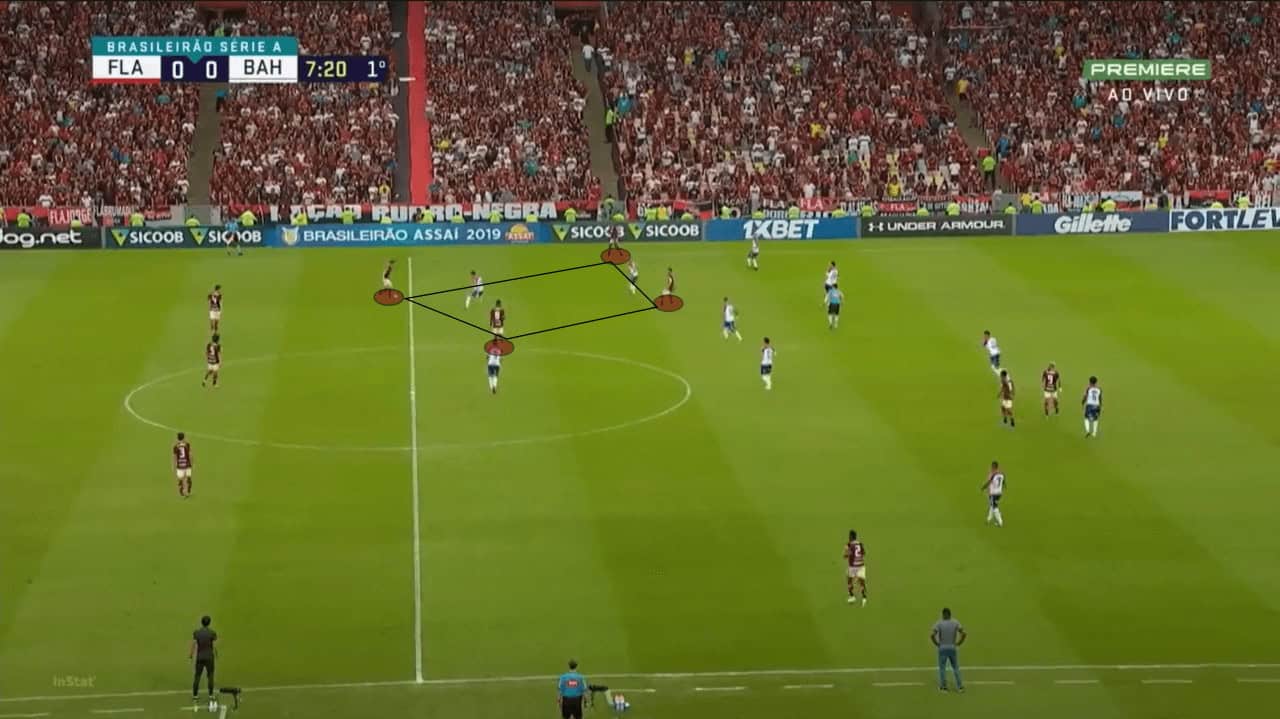
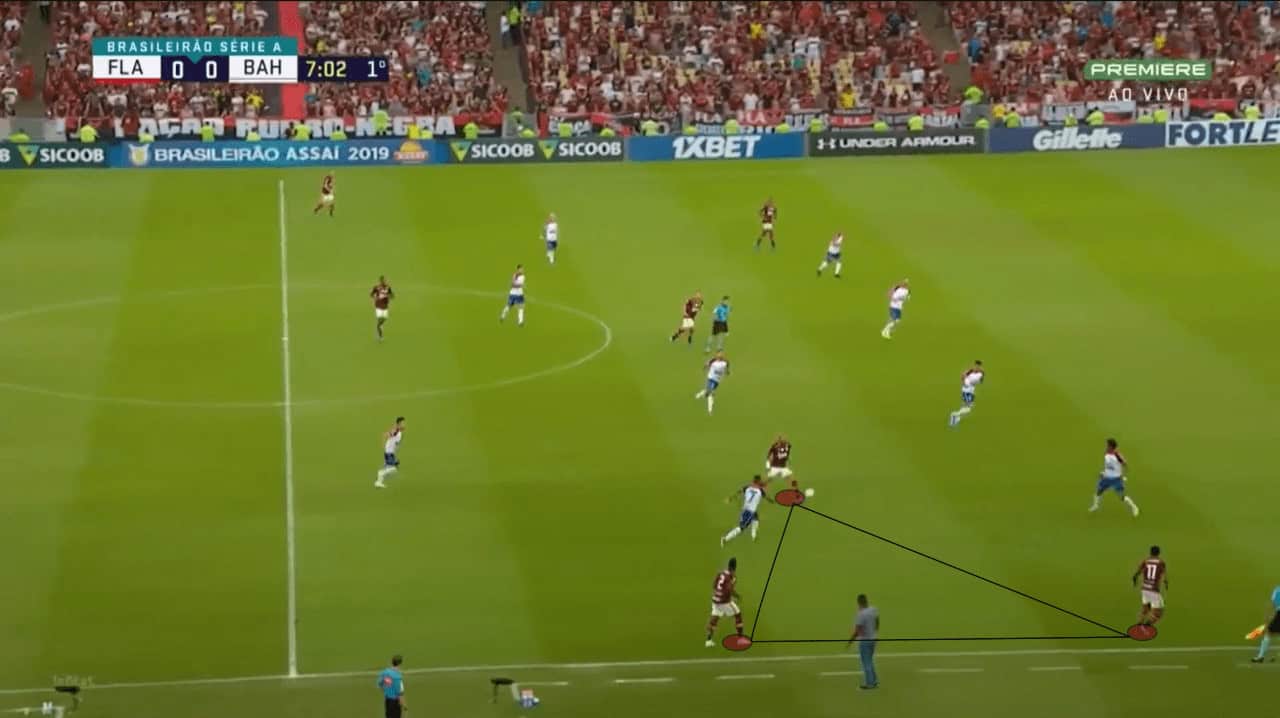
In the example below, the former Internazionale centre-forward Gabriel Barbosa checks for the ball in between the defensive midfield line.

After receiving it, he immediately turns to the wing, where there are two players already there.
He creates this triangulation and 3v2 on the wing, which is in line with their strategy.
With Benfica, a similar sequence can be looked at.
While the current Arsenal defender Nuno Tavares has the ball, a player checks in from deeper to receive the ball.
This trend is prevalent in Jorge Jesus’ teams, where players constantly check for the ball between the defensive lines.
If they don’t immediately receive it, they move again for another player to check in.
This constant movement is not only very hard to track, but it also disrupts the defensive organisation.
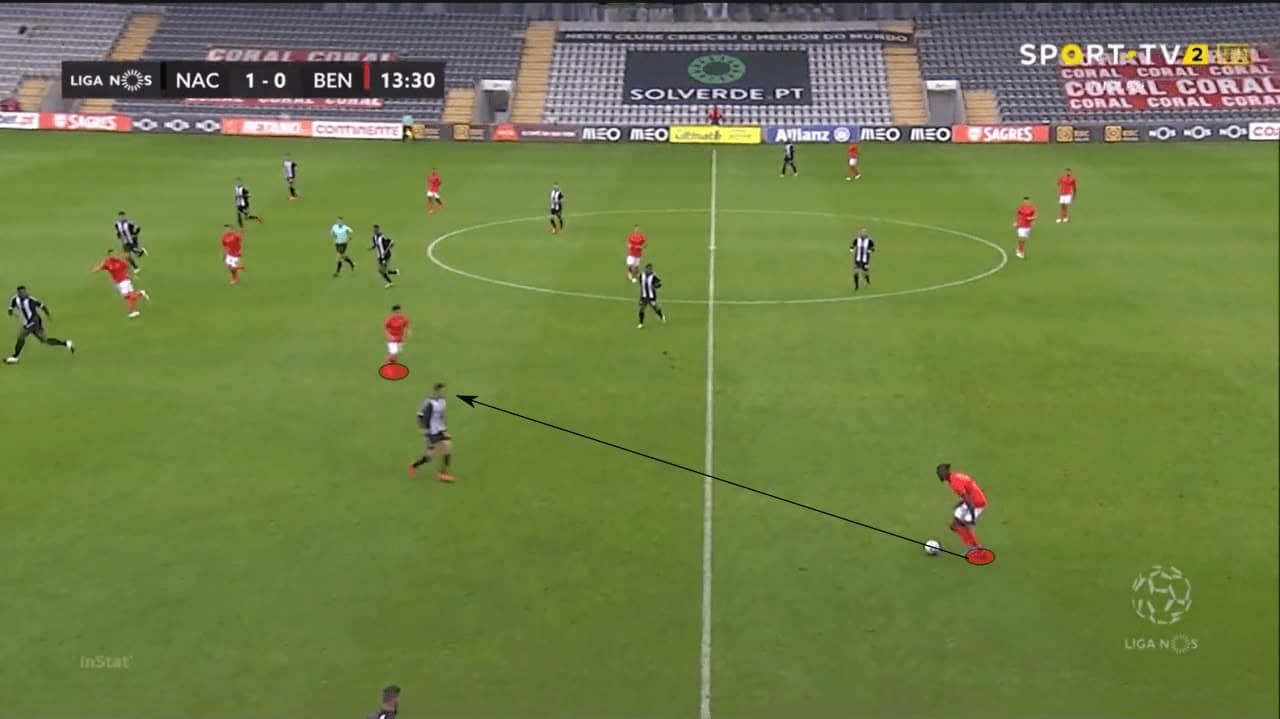
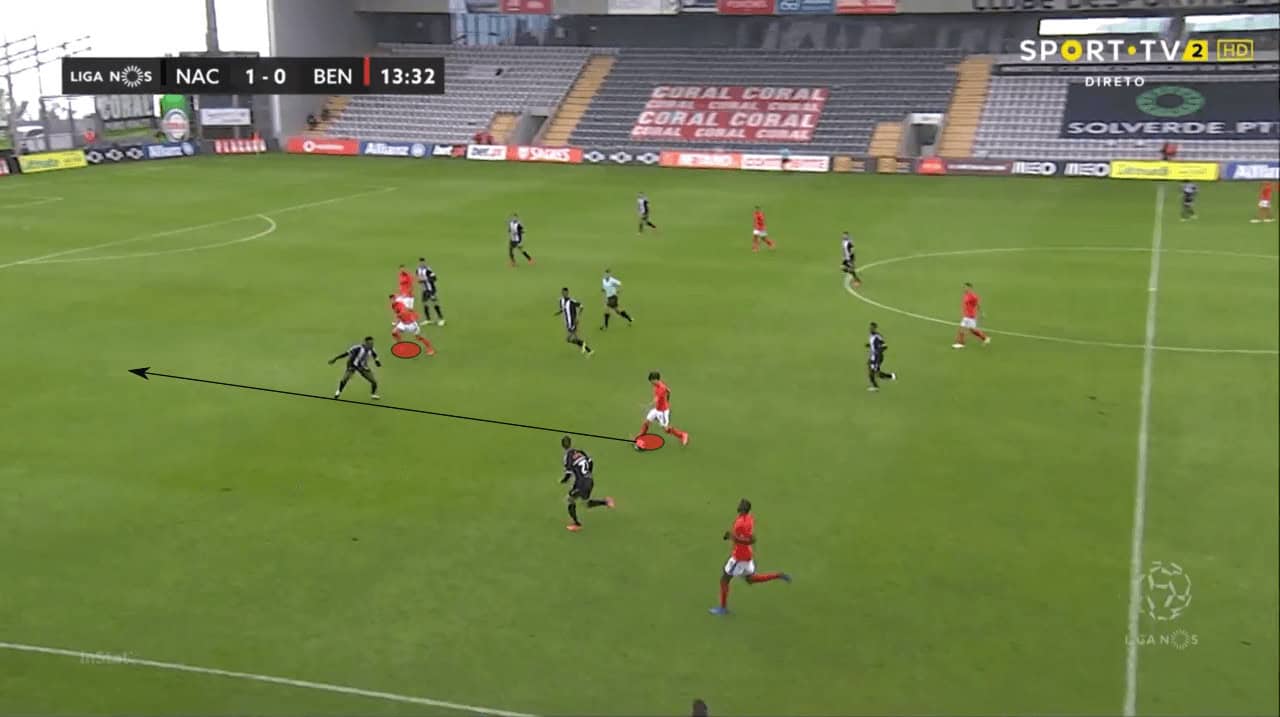
After receiving the ball, the player turns.
As soon as he turns, one of the forwards immediately makes a run and attacks the space behind.
With two passes, they progress from just before the midfield to the final third.
Undoubtedly, breaking lines with frequency and verticality is one of the main characteristics of the teams Jorge Jesus manages.
In the 2019 Brasileiro, for example, Flamengo averaged 79.18 progressive passes per 90, compared to 472.63 passes per 90.
However, they still maintain a high level of control.
At the same time, only 7.37% of their passes were long, with an average pass length of 19.17m.
This shows how they constantly look to break lines and be direct, but with a certain control rather than just launching it forward.
There are other concepts that characterise Jorge Jesus’ attacking system.
For instance, the constant search for space and the consequent willingness to attack this space.
As we’ve seen, Jesus prefers constant approximation around the ball.
As a result, this overload naturally attracts many defenders near the ball and creates a lot of space elsewhere.
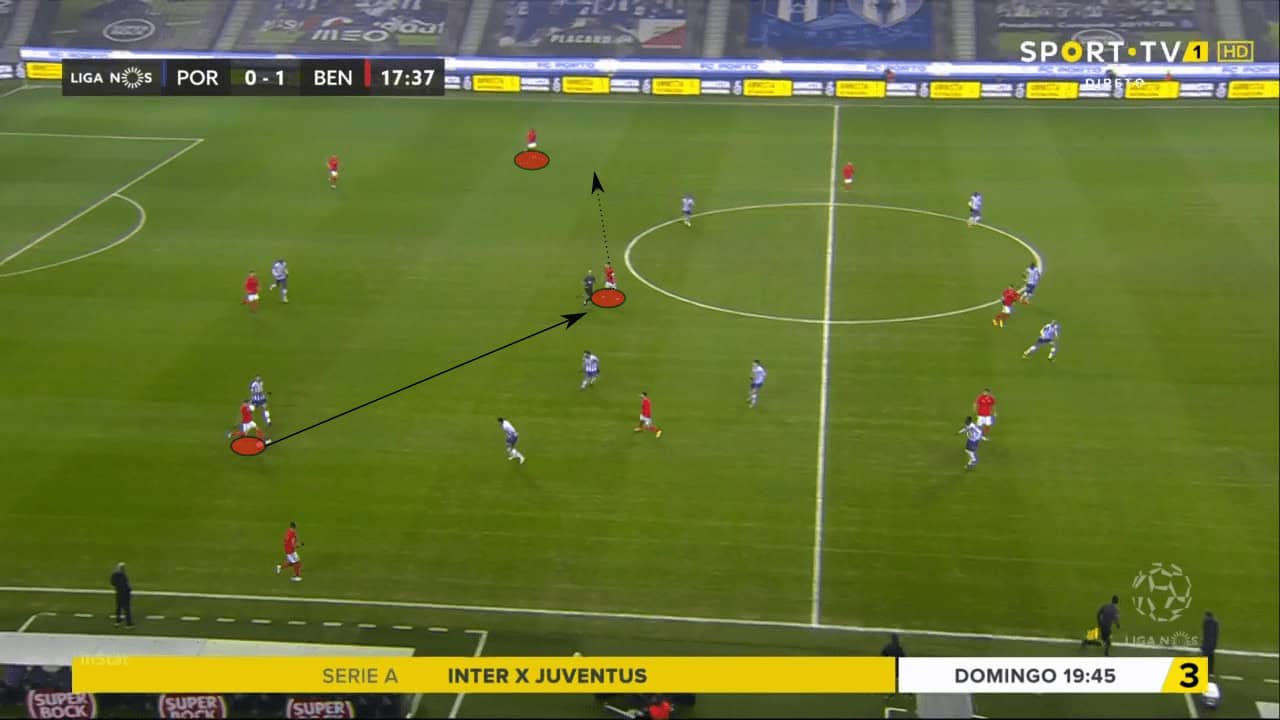
In the instance below, for example, the centre-back finds a midfielder who instantly switches it to the opposite fullback with a lot of space to attack.
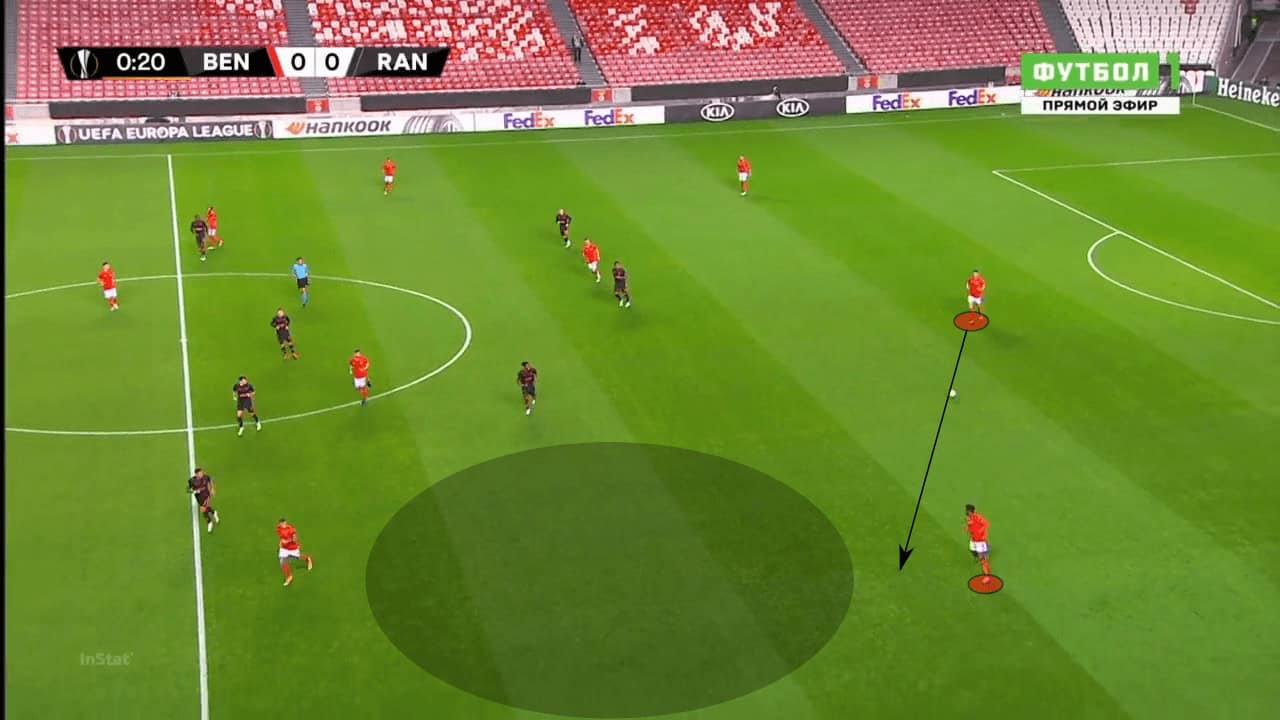
In this other example, the same concept is explored, now with three centre-backs.
As the ball gets switched to the wide centre-back, there is a lot of space ahead of him to attack.
He drives forward and makes a defender commit to him as soon as he receives it.
Another key aspect of the Portuguese attacking system is the frequent combinations.
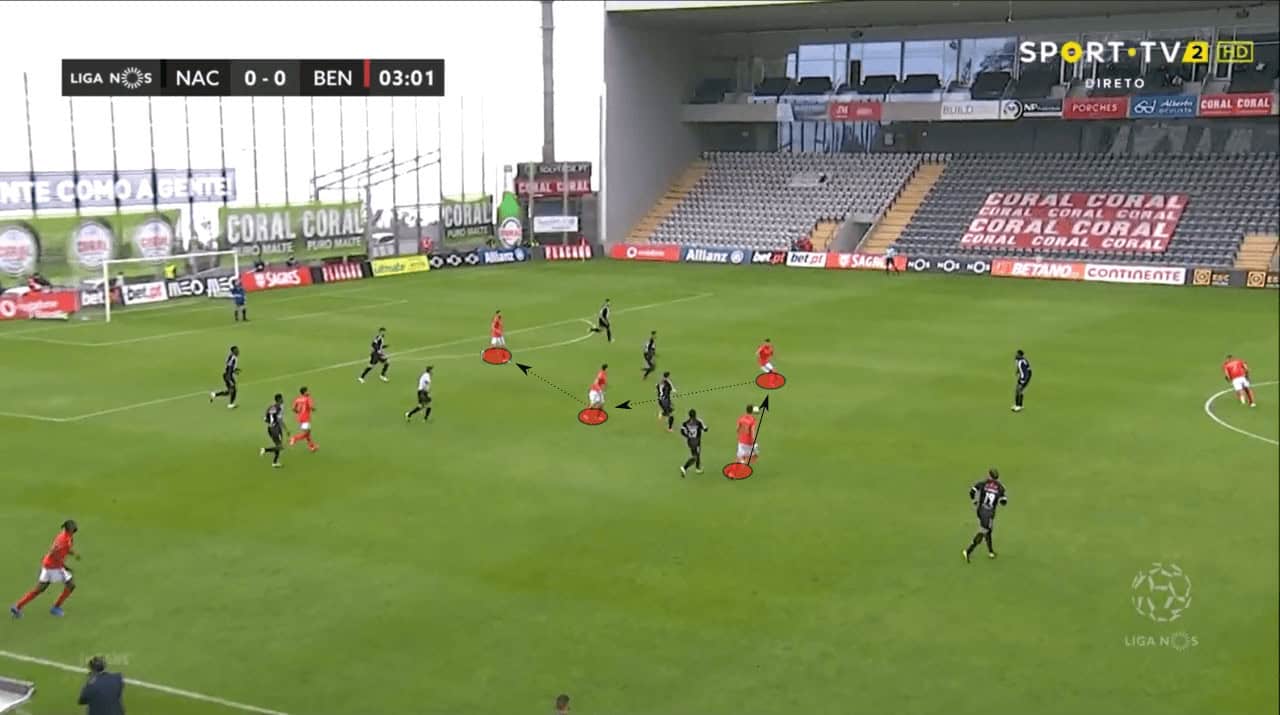
As players are often very close to each other, quickly combining is an effective way to progress through the defensive organisation.
In the example below, a quick combination of three passes allows Benfica to successfully find the centre-forward in a dangerous position.
Jorge Jesus Tactics At Flamengo
As in the attacking phase, Jorge Jesus’ defensive system is frequently labelled as very intense.
This is due to the aggressiveness and intensity of their high press.
Without the ball, the objective is to recover it as soon as possible and possibly create goal-scoring opportunities from this press.
In the 2019 Brasileiro, Flamengo maintained an impressive PPDA of 7.88.
Furthermore, they had the second-highest challenge intensity, only behind Jorge Sampaoli’s Santos.
One of their recovery maps in 2019 further illustrates how intense and advanced Jesus’ defensive system is.

The structure of their press is fairly simple.
While roughly maintaining a man-to-man organisation, they aim to compress and congest the opposition’s playing area.
After the opposition plays it to either side, the objective is to cut the other side off and pressure them using the touchline as an extra defender.
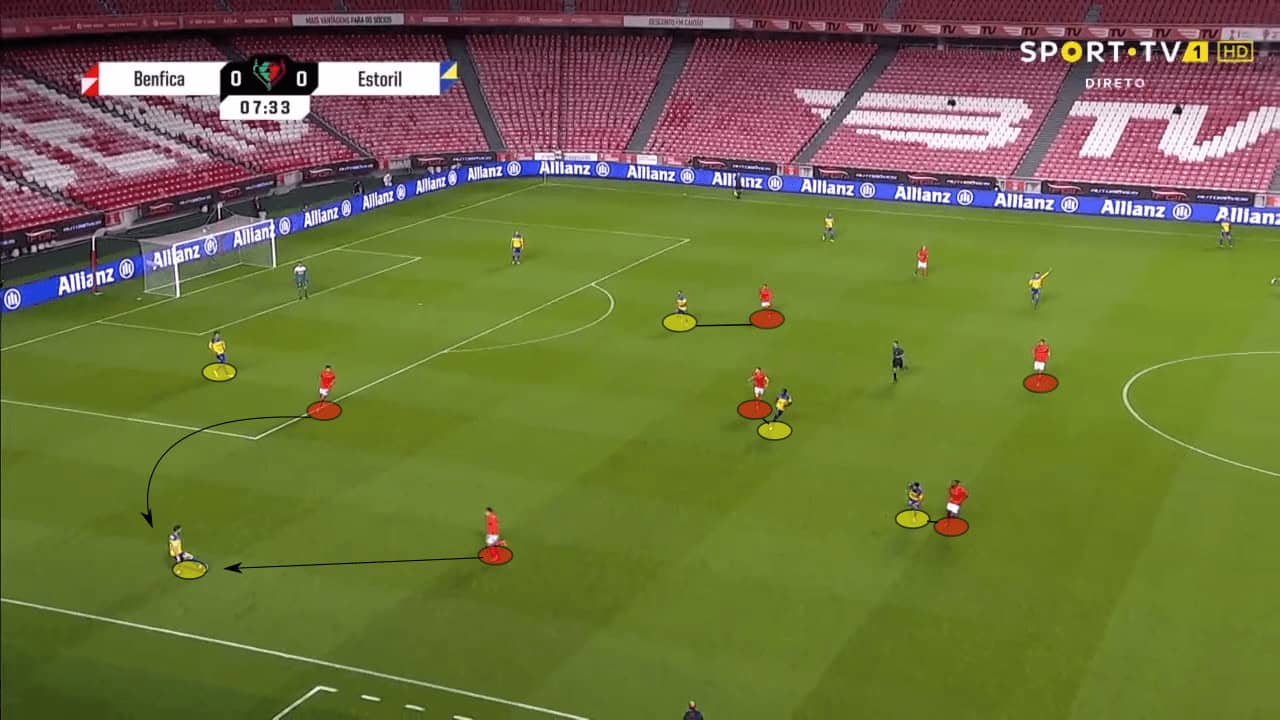
In the same match, another example can be looked at.
After the opposition plays it to the left side, Benfica shifts their whole defensive block to pressure them.
While two players press the player receiving the ball, the others aim to eliminate passing options by man-marking them.

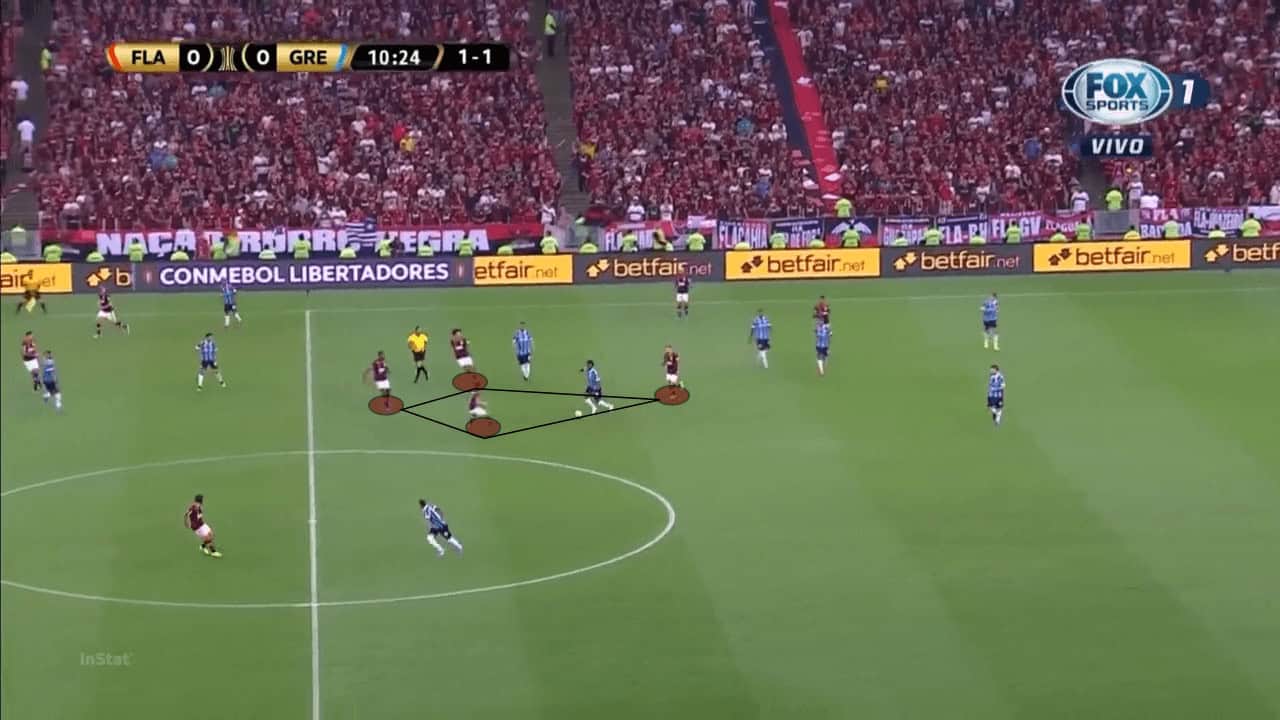
Counter-pressing is another significant aspect of Jesus’ teams.
It prevents, or at least delays, the opposition from launching a dangerous attack.
While it gives them the chance to recover the ball immediately, it also generates time for other players to get organised.
In the instance below, four players immediately rush Grêmio’s player after losing the ball.
Jorge Jesus
While specific details such as player roles, formations, and more will differ at Fener, Jesus will maintain the same tactics and principles he has used throughout his career.
Certain aspects, such as verticality, approximation, combinations, general attacking structure, and the high press, will definitely be seen in Jesus’ Fenerbahçe.
The expectations are very high, as Jesus is tasked with restoring glory to Şükrü Saracoğlu Stadium.
