
Benfica have always been known as a selling club, producing great young talents that are then sold for hefty fees, but can this be the year they also make a significant push in the Champions League?
Currently, they are second in Liga Portugal with 53 points, three points behind Sporting CP. However, they have one game in hand that could put them level with Sporting CP for first place, as they take on Barcelona in the Round of 16 of the UCL.
In this tactical analysis, we’ll look at Bruno Lage‘s tactics at SL Benfica this season, which have them pushing for a Portuguese title and possibly a long run in the UCL.
If they can get by Barcelona in the second leg, anything is possible, following a 1-0 defeat at home in the first leg through Raphinha‘s goal.
Bruno Lage Philosophy
Bruno Lage’s tactical philosophy at Benfica is built on fluid attacking play, high pressing, and quick transitions.
He likes his team to emphasise movement and intelligent positioning to create numerical superiority in key areas of the pitch.
Lage often deploys a 4-3-3 system that morphs into a 2-3-5 shape in possession, allowing for width and overloads in attacking zones.
He also likes to prioritise counterpressing immediately after losing possession, ensuring they remain on the front foot.
Defensively, Lage’s Benfica are compact, pressing aggressively to win the ball high up the pitch.
Benfica Build-Up Play

In the build-up play, it looks like a 3-3-4 formation, with a back three looking to progress the ball into the next phase.
The three midfielders in front consist of two players operating in the 8/10 area, while a single pivot acts as the link-up play connection in the build-up.
The four attackers at the top are positioned as two strikers and two wingers, who stay extremely wide, stretching the opposition’s defense when they are looking to build up.
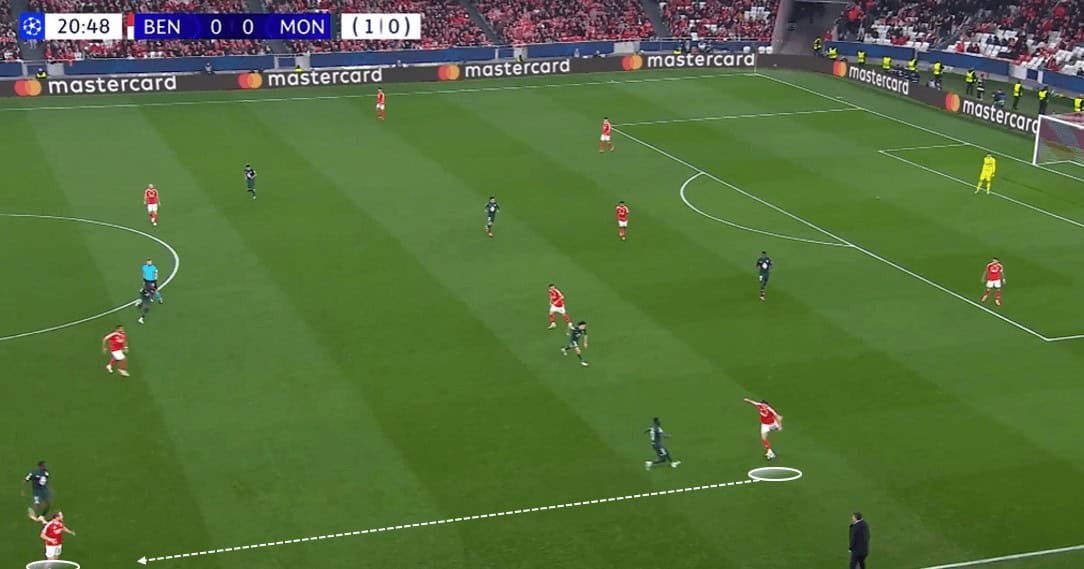
The layering in midfield is key in their build-up, with the 8 and 10 players positioned ahead of the pivot in the gaps.
This allows the pivot to play vertical passes straight into them, enabling a half-turn to break the opponent’s defensive lines.
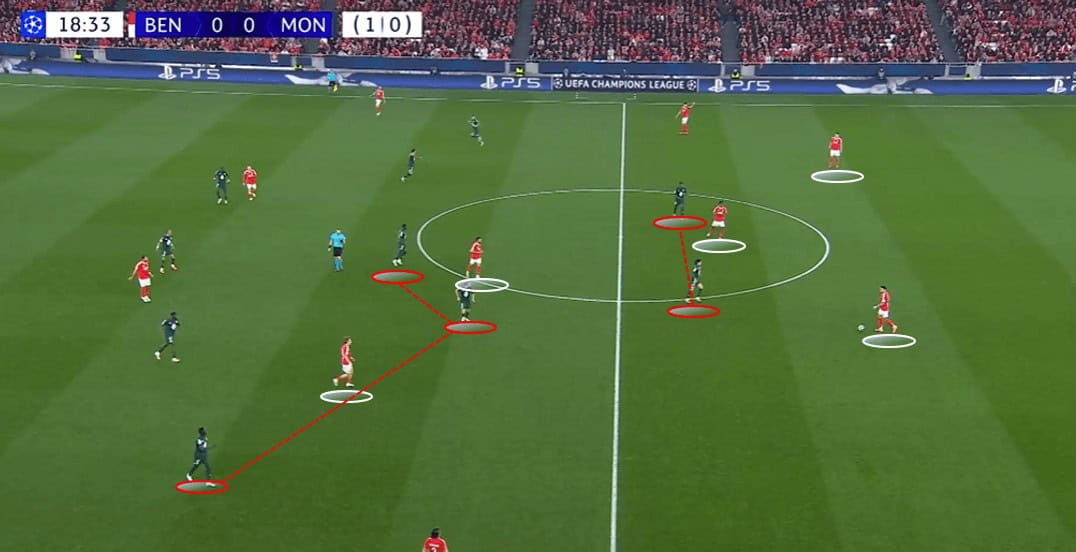
Lage style of play likes to have extremely wide full-backs, positioned so wide that they are given lots of time and green space ahead of them to drive into.
They can also play passes in between, which is how they scored against Monaco and Barcelona in their recent UCL matches.
As shown in the image above, the full-back can play a simple pass over the top when the opponent’s defensive line is stretched out.
This could be a key way to exploit and potentially destroy Barcelona’s high line.
4-4-2 Defensive Block
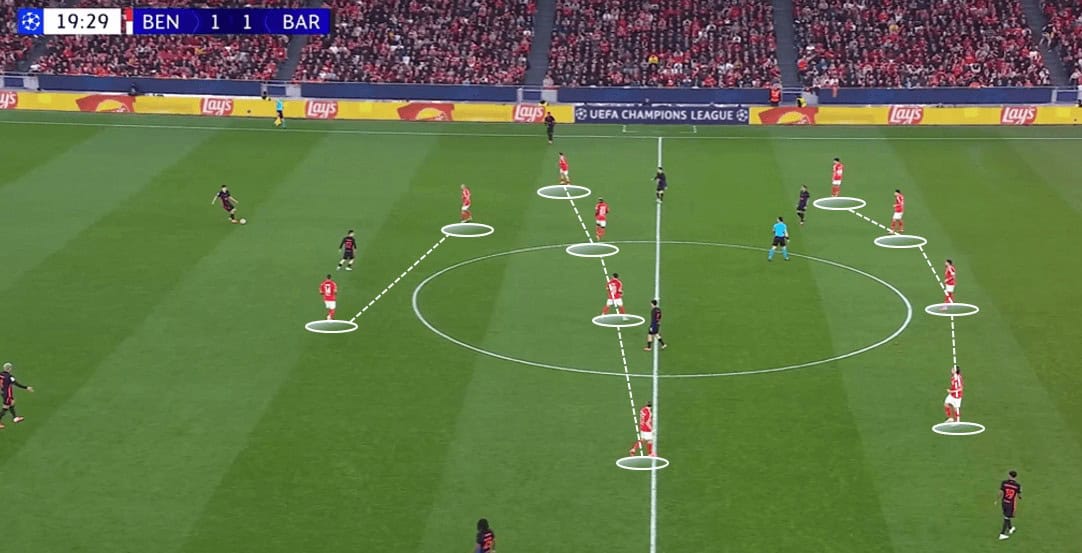
Like we mentioned before, Lage loves to have his team play with a high-intensity press, committing many numbers past the halfway line to try and win the ball back in a dangerous zone.
The image above shows six players past the halfway line, trying to win the ball back.
This means his player selection and recruitment focus on those with a high work rate.
If the opponent gets past this intense press, they must drop back into position, where they like to sit in a 4-4-2 block.
You can’t have lazy players in a system like this.
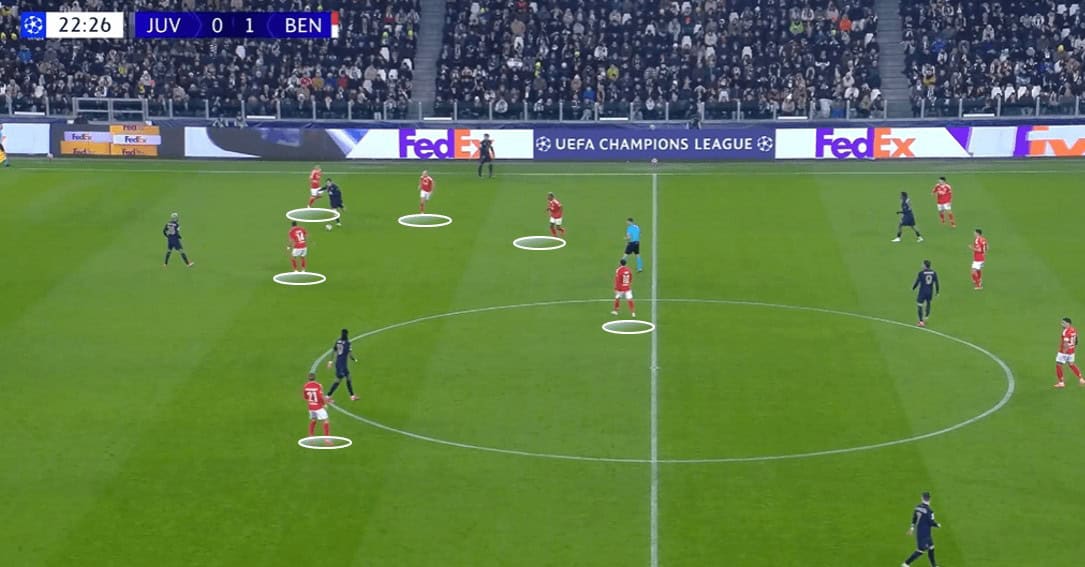
When behind the halfway line, they like to sit in a 4-4-2, with the two centre midfielders preferring to man-mark the opponent’s other midfielders.
However, they don’t use a wide 4-4-2 where the two wide midfielders stay in the wing areas.
Instead, they keep it more compact and central to shut down gaps in the middle.
This could be exploited in a match against Barca, where their wingers are very dangerous and could take advantage of the space out wide.
This was partly why they conceded five goals the last time they played Barcelona.
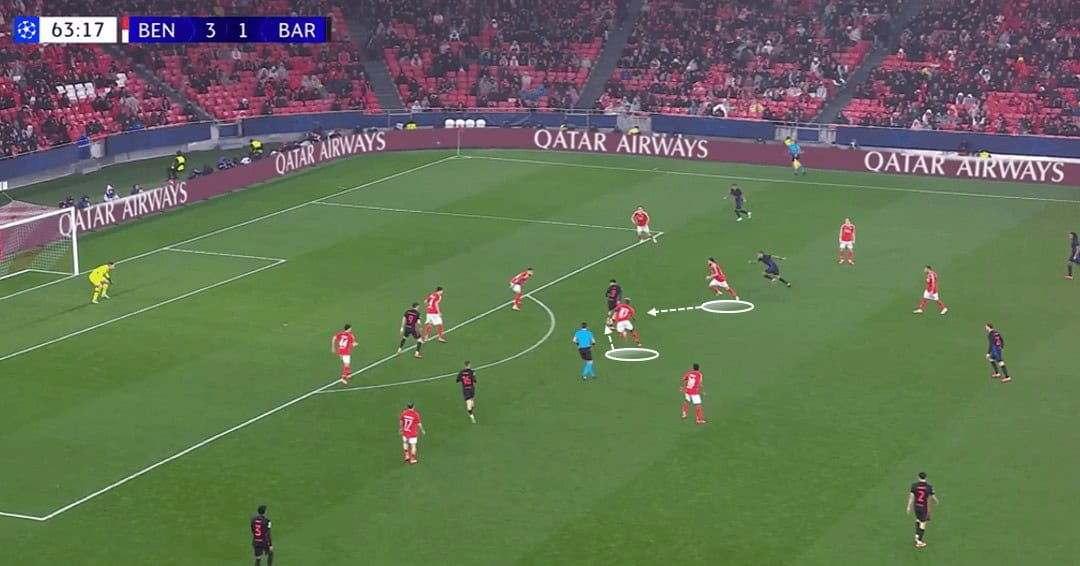
What makes their 4-4-2 so dangerous is how quickly the players pounce on weaknesses and heavy touches—even players from the backline like to step up and dispossess the opponent.
As shown in the image above, the centre-back likes to step into space and contest that area to win the ball back and initiate the counterattack.
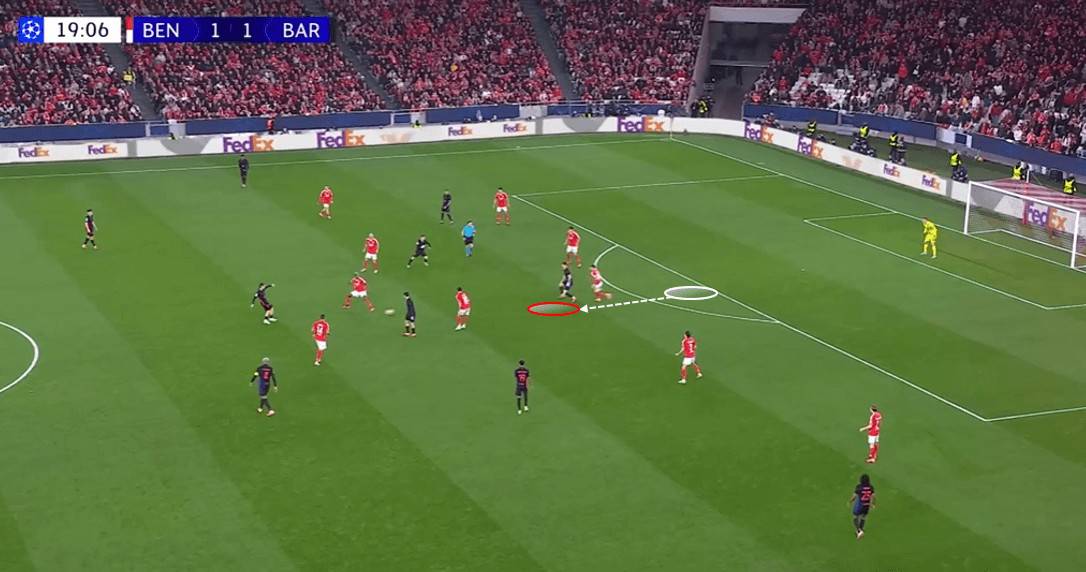
Not only does the backline step up into midfield, but the two center midfielders also like to track back aggressively.
One issue with Lage favoring high-intensity, aggressive players is the risk of committing too many fouls.
If they face a team that thrives on drawing contact, it could lead to the opponent getting many free kicks, which might become a problem.
Benfica Midfield Movement
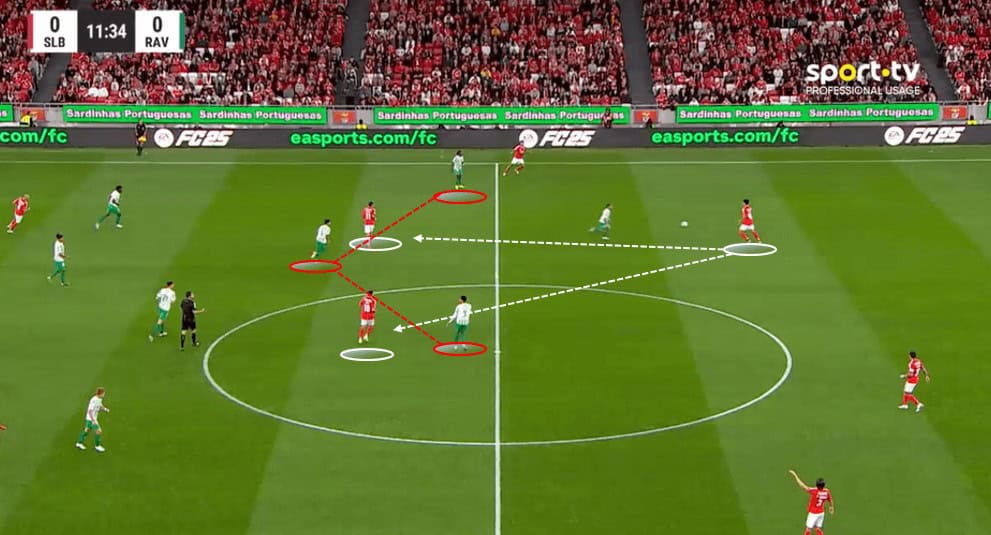
They use quick passing sequences in midfield, moving the ball rapidly to their attacking players.
What Lage likes in his counterattacking movements is having his players shift centrally to create numerical superiority in the number 9 area.
The white-circled players in the image move straight forward, causing chaos in the opponent’s defense, while the one in yellow holds the ball up until the runs are made, then releases.
Instead of drifting wide, they make central runs, as Lage prefers direct central movements in counterattacking situations.
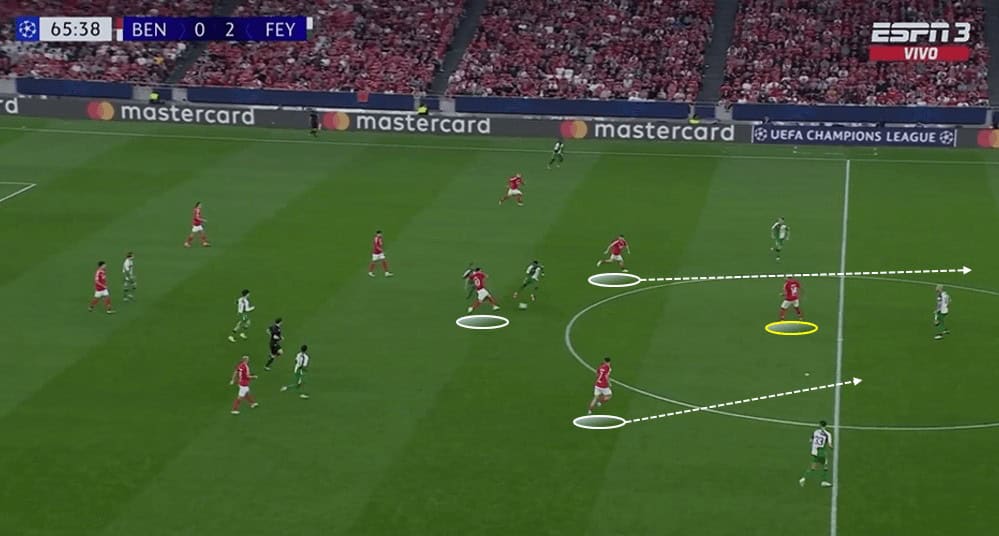
Lage likes to have his midfielders in the half-turn areas, sitting between two opponent players, creating a gap of space to receive and turn.
The midfielder can then play forward to the attacker.
Notice the two Benfica players in between those players circled in red.
Occupying these spaces in midfield constantly is what makes them so dangerous in exploiting open space on the half-turn.
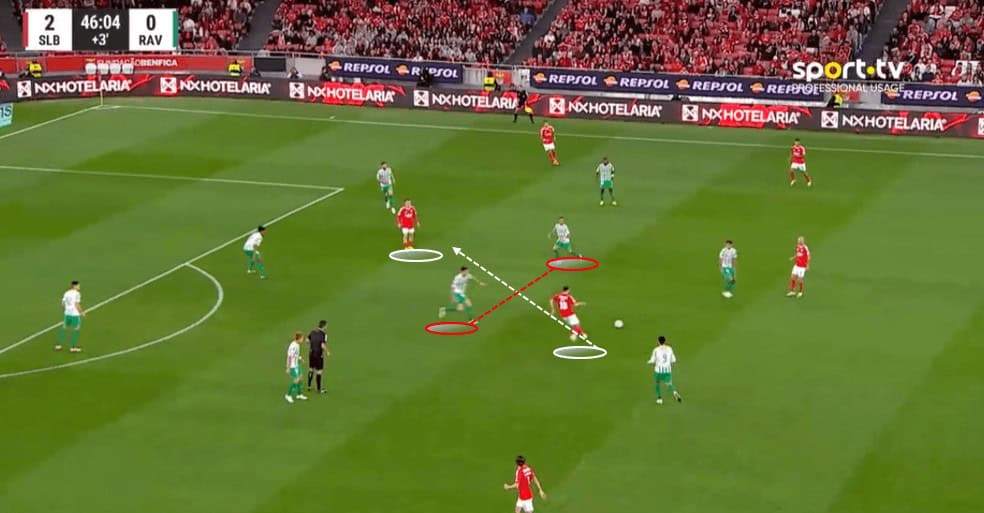
You can see it again, a bit higher up the field this time, but still midfielder movement, looking to play a quick one-touch pass to the player sitting in the open space, ready to turn and face the goal.
This is how they break down good opponents.
Bruno Lage Attacking Tactics
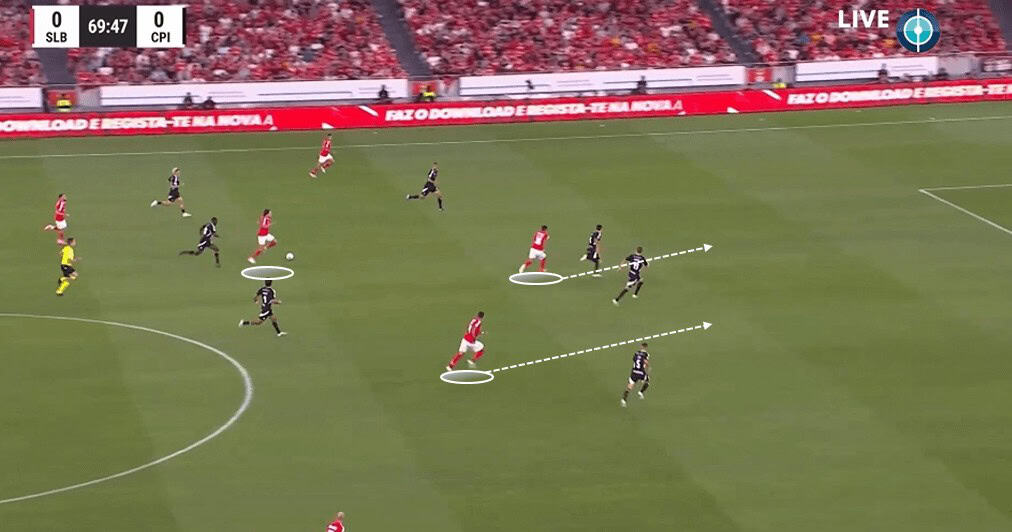
Wing-backs are key in this setup for Lage tactics, possibly even the most important piece of the entire team.
They are given a great deal of freedom, but also considerable responsibility.
Benfica wing-backs can be found making forward runs, attacking down the channel where the 9 or 10 would be.
Their play is so dangerous because their wing-backs are free to go wide, come central, and push forward in attacks.
It’s not one-dimensional.
As shown in the image above, we see the run made from the full-back into the 9 position.
The other players continue to run vertically forward, dragging the backline even further back, which gives the full-back more space to drive into.
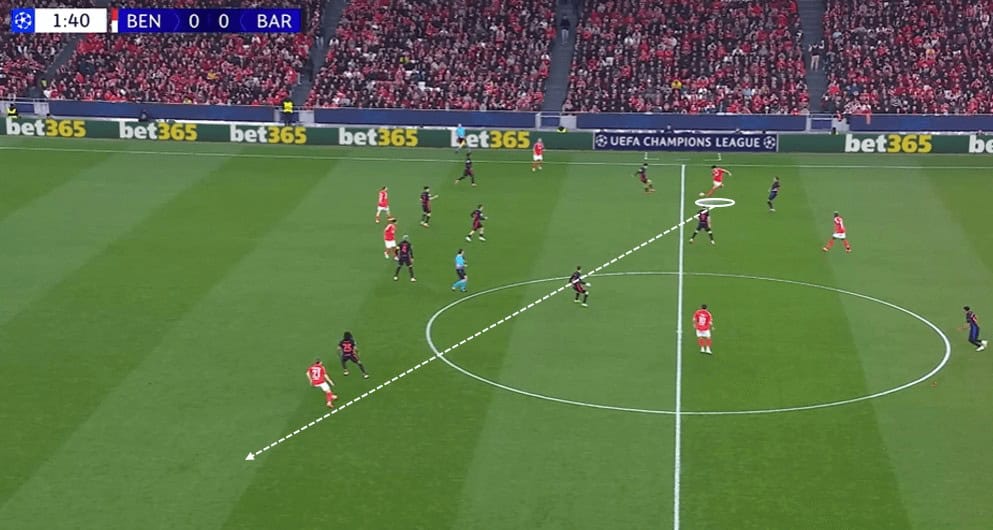
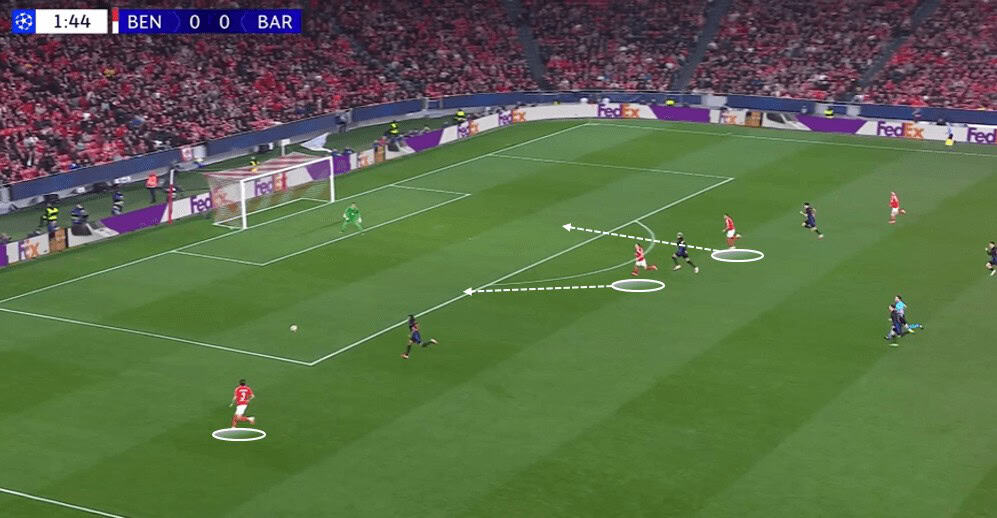
We can see how important the full-backs/wing-backs are once again, especially Álvaro Carreras, a wing-back who will go for a hefty fee in the future.
In the sequence of the two images above, we can see how these players are used further in the attack.
They are given so much space on the end as they look to overload one side of the pitch and search for the quick switch.
Since their full-backs are extremely wide, right next to the touchline, opponents will either waste a player marking that space or be numerically outnumbered elsewhere on the pitch.
This is crucial, leaving no choice but for the space to be open for the full-back.
Conclusion
So far this season, Benfica have scored 53 goals in 23 games, an average of 2.3 goals per match, with 18 goals conceded.
The goals conceded are a minor issue, but nothing abnormal.
However, their goals per match are extraordinary.
This season, they have been a constant threat, destroying teams like Atlético Madrid, Porto, Monaco, and Juventus.
Lage’s tactics have revitalised the team this season.
But it begs the question: what team will have Lage on their radar as their next coach?
This often occurs in the Portuguese league, where the best talent is often picked off.
Will history repeat itself here?
