
Many Arsenal fans will want to retain a sense of optimism as the 2024/25 Premier League season draws to a close.
However, even the most ardent of them will know that the weekend’s 1-1 draw with Manchester United has severely dented and likely ended their hopes of lifting the top-flight trophy for another campaign.
It was a result that left them 15 points behind leaders Liverpool and now looking over their shoulders at the chasing pack, with Nottingham Forest four points behind them and Chelsea only a further two back.
Once again, the biggest blow to those title aspirations has been their inability to sign a proven striker.
They are constantly linked with players who could fit that role but never seem to prioritise that position once the transfer window does open.
As a result, they have been left with only Gabriel Jesus and Kai Havertz as their striker options at this moment, and both are currently on the sidelines.
Whilst manager Mikel Arteta has, to his credit, tried to find a solution, using first Leandro Trossard and then Mikel Merino as the target player and then alternating Declan Rice and Merino in an advanced role at Old Trafford, none of those has had the desired effect.
Arsenal have dropped points in each of their last three league matches, and there is now increased pressure and expectation that the club will target a new goalscorer when the summer transfer window opens.
Fans are anxious to avoid being in this situation again.
With that in mind, it perhaps comes as no surprise that they have been linked with a host of potential targets, each of whom would bring different things to their play.
This data analysis and recruitment analysis will sift through some of them and examine which option would be the best, breaking down each player’s key statistics and explaining how they could fit into Arteta’s tactics.
The analysis will suggest alternative options the club could consider if the initial suggestions are rejected.
Arsenal Current Attacking Options
Before getting into that, though, it is important first to break down the data of those currently on Arsenal’s books.
When analysing the games of both Jesus and Havertz, there is no doubt that both are capable of delivering goals when on top form and can cause problems for opposing backlines, as has been proven on many occasions.
However, for various reasons, they do not appear to be long-term options in the striker role at the Emirates Stadium.
Gabriel Jesus Statistics 2024/2025

In Jesus’ case, he is undoubtedly a natural striker who likes to make runs into advanced areas of the pitch, with his aim always to get into areas where he can affect the game.
Given this, it comes as no surprise that he ranks so highly in the percentile bands for touches in the opposing penalty area per game.
However, the issue is that he is not someone who will stay in that central channel.
Instead, he likes to drift into wider positions at times and to play a role in Arsenal’s build-up play.
This is perhaps hindering his influence on their attacking play and is why he has struggled to convince Arsenal fans that he is a long-term solution inside the final third, with it clear to see in this graphic how he ranks highly for passes received, made and overall passing accuracy per game, but is well below the median point for goal contributions.
It would normally be of some comfort to see him sitting high in the bands for shots taken per game, which would at the very least suggest that he might not be creating chances for others but is at least testing opposing goalkeepers himself.
However, with him only netting seven times in his 27 appearances this season (and eight in the entirety of the previous one), even that part of his game has not looked strong enough.
It is yet another reason that he does not appear to be the striker that Arsenal needs.
Kai Havertz Statistics 2024/2025
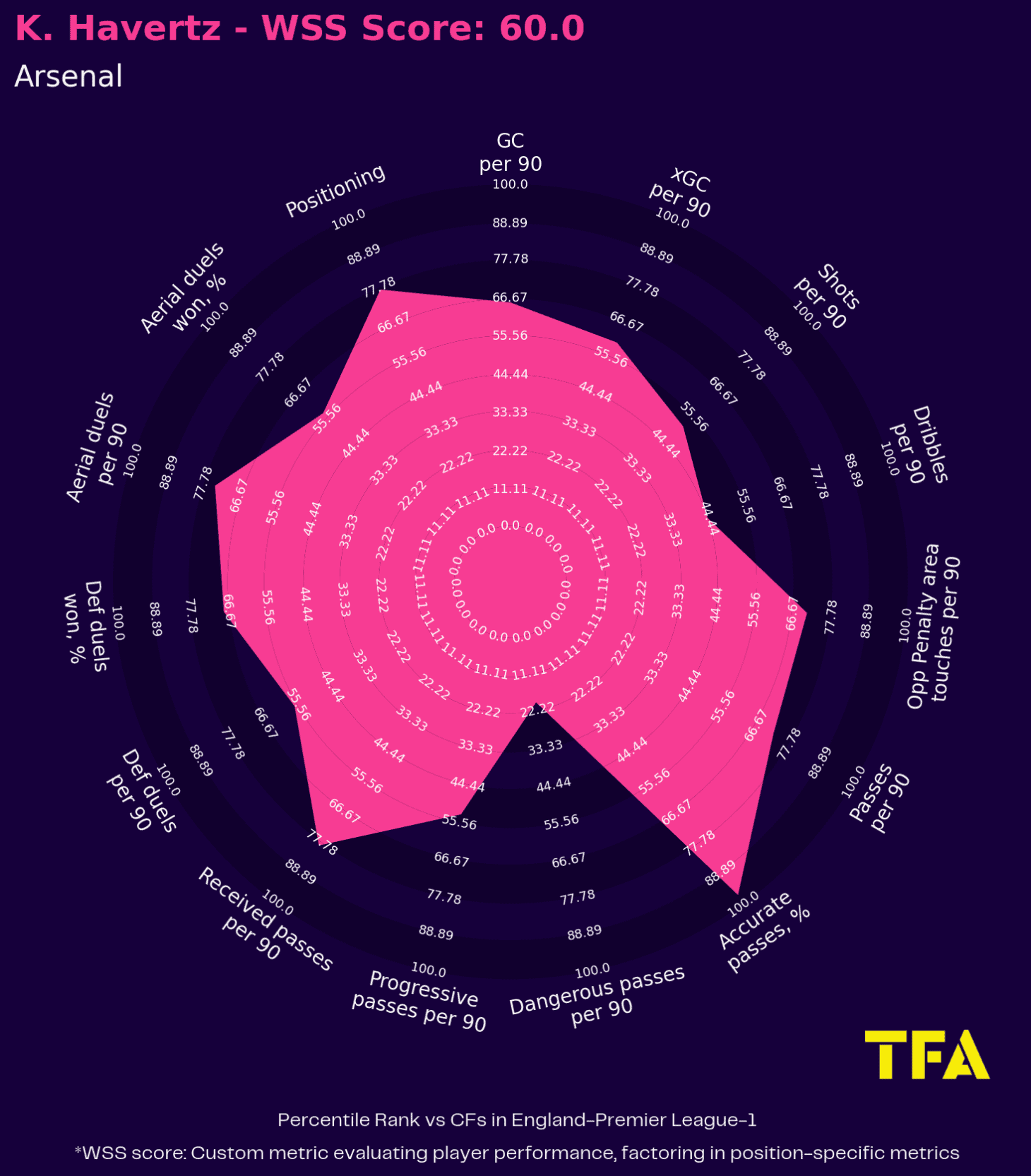
It is perhaps for that reason that Havertz has been the preferred selection in that role, and the former Chelsea player has proven that to be a wise decision as the campaign has progressed.
At the time of his injury, he had been enjoying his most prolific season in English football (and his second-best ever, behind his 2019/20 campaign with Bayer Leverkusen), having found the back of the net on 15 occasions.
What makes this even more commendable is that he has not had as many shots in percentile terms than Jesus, with this graphic showing how he sits lower in the bands than the former Manchester City player did.
Therefore, he is much more clinical when he gets into the right areas of the field, and the fact that he also ranks higher in positioning implies that he has a better awareness of where he can make things happen for his team.
However, what really needs to be highlighted is his goal-creation abilities.
As the graphic shows, he also ranks higher than Jesus did for goal contributions, which shows how he is a better all-around player in that role when it comes to what Arsenal wants from the person who handed that role.
When recalling how well Arsenal have got their wingers into goal-scoring positions, it shows how having Havertz in that role has allowed their attacking play to flow more smoothly and given them different weapons that they can use more frequently.
This, though, does not detract from the elephant in the room as far as Havertz is concerned, which is that he is not a striker by trade.
Yes, he can operate ably in that role, but he is only a “false nine” at best, and that is why this graphic shows him not entering the penalty area as often in percentile terms as Jesus does.
As a result, whilst he has proven to be a consistent goalscorer for them, Arsenal again cannot see him as a long-term solution to their current issue.
3 Conventional Players Arsenal Could Target
With that in mind, and with pleas for the club to sign a new striker this summer continuing to grow, this section of the analysis will highlight three players that the club have been linked with who could offer the offensive threat they have been looking for.
It will break down their statistics and show what each could bring to Arsenal’s play if Arteta’s side decides to move for their services.
Dušan Vlahović Statistics 2024/2025
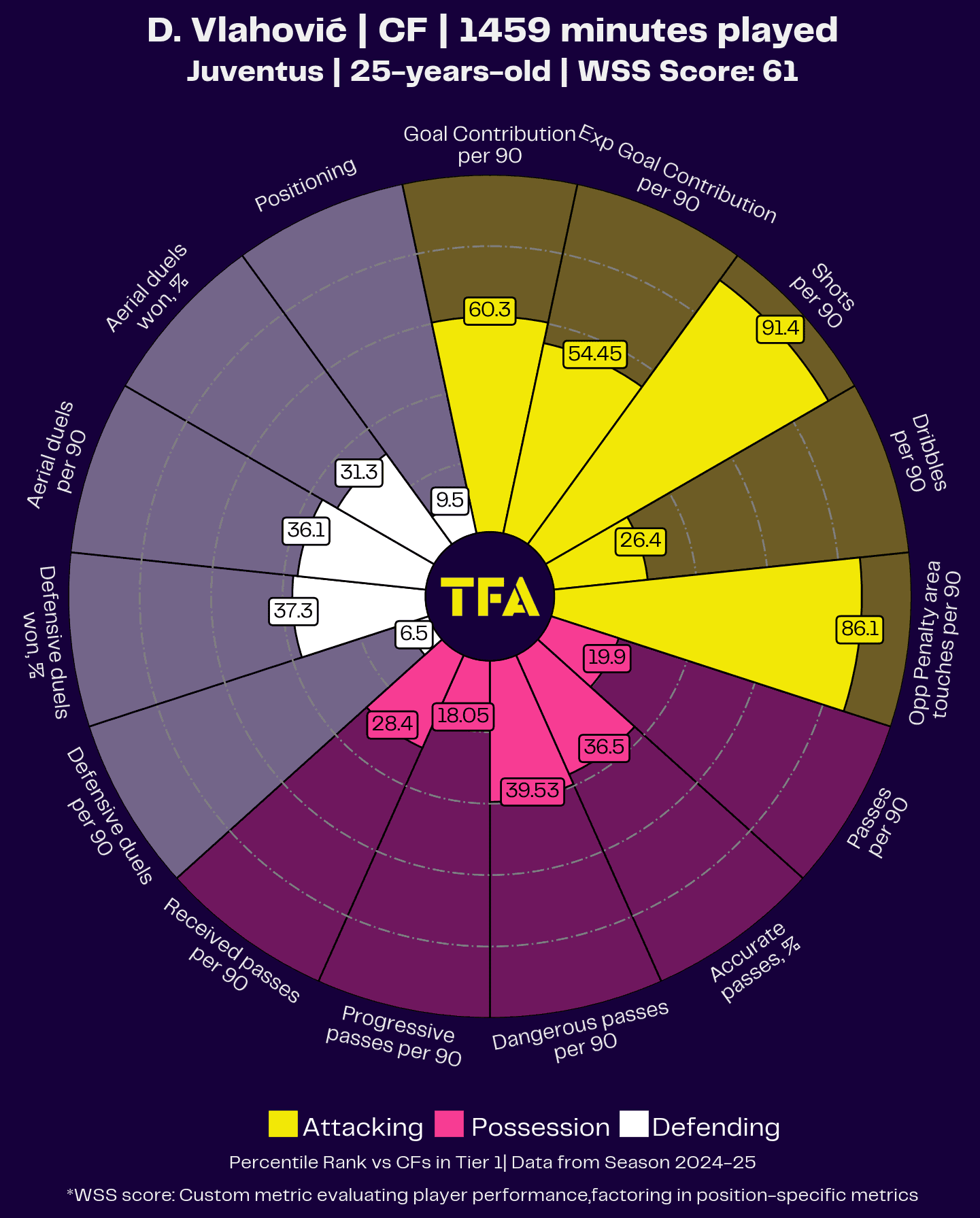
The first player they could look at is Juventus striker Dušan Vlahović, who has been a long-term target for Arsenal and has been consistently linked with the club whenever the question of signing a new striker arises.
The Serbia international might have been in poor goalscoring form this season in Serie A, having netted just nine times, but that does not mean he has not been working hard inside the final third.
As this graphic shows, Dusan Vlahovic ranks highly in percentile terms for both shots on goal and touches in the opposing penalty area per game compared to other strikers in Tier 1 leagues.
Therefore, this, combined with the fact that he has registered respectable tallies in previous campaigns (he scored 16 league goals last time out, although just 10 the season before that), shows that he might not be having his best season but is still capable of delivering when at the top of his game.
It is not only that that has led to Arsenal’s longstanding interest in him, though.
Other aspects of his game also make him an attractive prospect for them.
His movement off the ball has led to an exceptionally high volume of plaudits.
One of his main strengths on the field is his ability to make diagonal runs and execute sharp changes of direction, which create gaps for his teammates to exploit in the opposing back line.
Perhaps his game is deficient when he tries to pass the ball, as he sits below the median point for all passing statistics in this graphic.
This is not to say that Arsenal would not improve this if he did move to the Emirates Stadium this summer, with Juventus keen to move him on, but it is something that they should be aware of.
Victor Osimhen Statistics 2024/2025
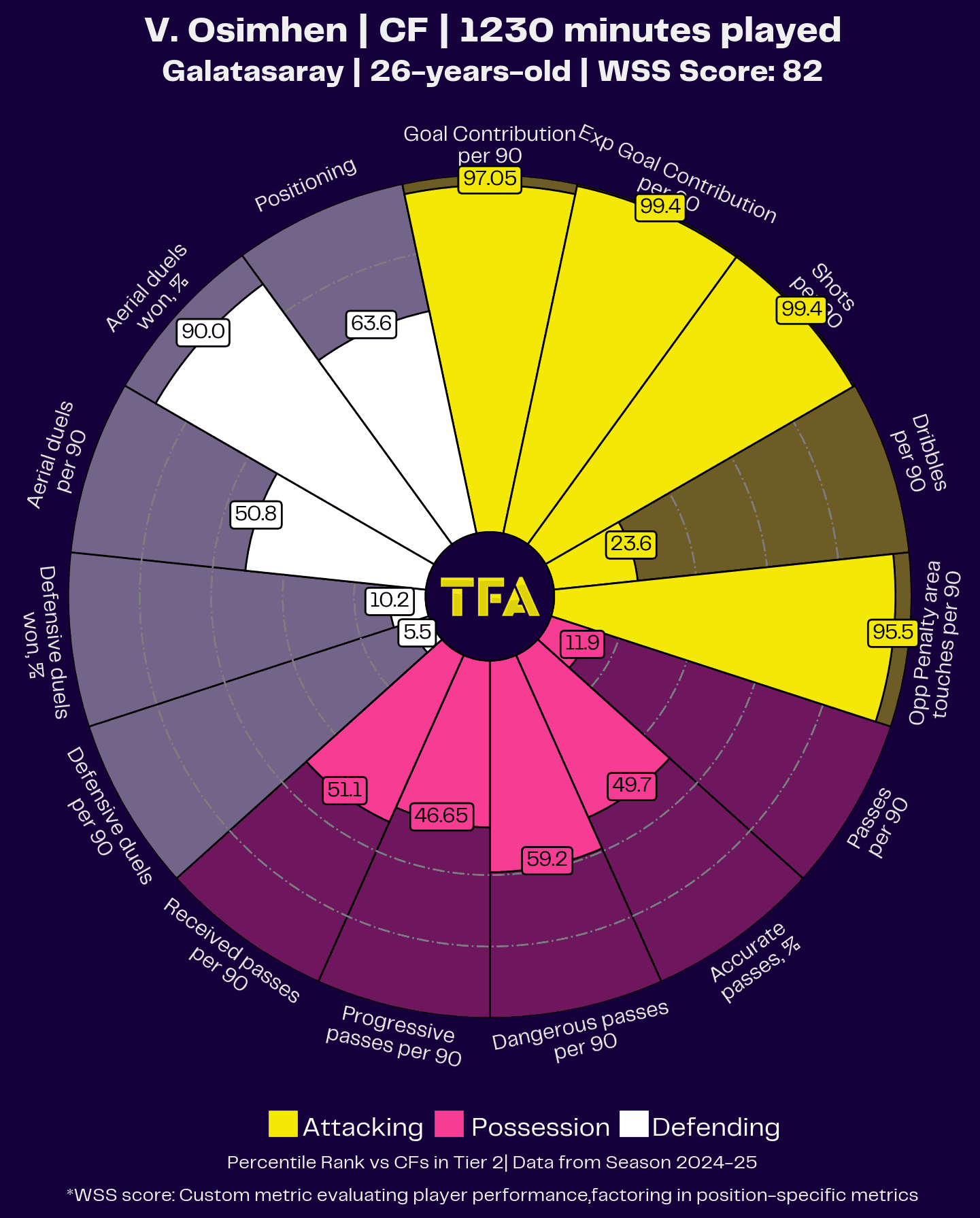
It is for that reason that a better option might be Victor Osimhen.
The Nigeria international appears to have no future at Napoli after leaving on loan in acrimonious circumstances last summer.
However, his form at Galatasaray this season has highlighted the value he brings to any team he plays in.
Whilst it is important to remember when breaking down his statistics in this graphic that the Süper Lig is a Tier 2 division (meaning those teams and leagues are not of the same quality as those in Tier 1), it should not detract from the impressive rankings that Osimhen has managed to attain so far.
What particularly stands out is his overall attacking threat, ranking within the top percentile for both shots and touches in the opposing penalty area per game, as well as for aerial duels competed in and won.
Therefore, he has the profile required to make life difficult for opposing backlines, and Galatasaray has built so much of their game plan around that.
Osimhen occupies the space around him, giving the likes of Mauro Icardi and Dries Mertens room to work with in transitional phases.
This is not to say, however, that Osimhen is a one-dimensional striker who is only effective in offering a final third presence and scoring goals.
On the contrary, he has developed several other elements of his play since moving to Turkey, one of which is his ability to bring others into the game.
As can be seen, he sits lower in the bands for passes made per game than Vlahović.
Still, he is ranked higher in terms of received passes, dangerous passes, progressive passes, and overall passing accuracy.
Therefore, if Arsenal were to decide that he is the ideal signing for them (and it would take a significant portion of their transfer budget to make him an Arsenal player), they would be getting someone who not only brings a natural goal-scoring touch and is stronger in the air than Vlahović would be, but also a forward who can bring others into the game too and who is rapidly improving that part of his play.
Benjamin Šeško Statistics 2024/2025
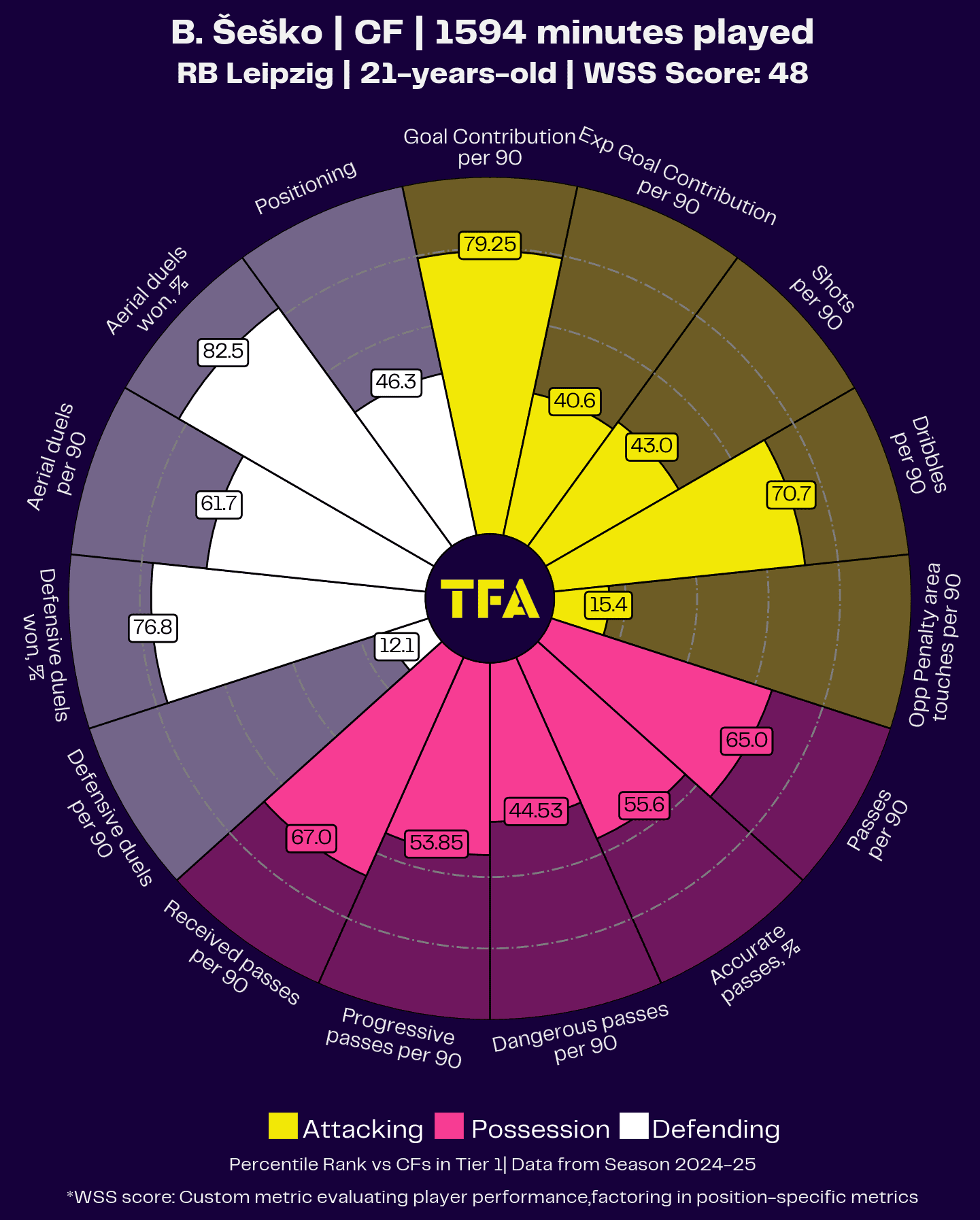
It’s possible that Arteta feels Osimhen is still too raw in that aspect and needs someone already well-equipped to fill in the gaps and be a more mobile attacker.
Given that he has relied on Havertz so much, it does seem as though that is the profile he wants at the top of the field, and it therefore comes as no surprise that the name Arsenal have been most linked to in recent days is RB Leipzig’s Benjamin Šeško.
The Slovenia forward has not been the most prolific goalscorer in the Bundesliga this season, having scored just 10 times to date, but his game has so much to offer that would suit Arsenal’s tactics.
Benjamin Sesko’s ability to create goals has attracted significant attention, and this graphic illustrates his high ranking in goal contributions per game, as well as respectable percentile figures for passes received and completed.
When you add that he sits very low in the bands for touches in the opposing penalty area, it is clear that he is not a striker who will occupy the goal area too often and won’t necessarily sit on the shoulder of the opposing back line.
Instead, he is likely to be seen in deeper spaces connecting the play in much the same way Arteta’s side has become used to from Havertz.
However, this is not to say that he would be too similar to the Germany midfielder.
Instead, Šeško combines that pace with an aerial threat, as shown by his ranking inside the top two bands for aerial duels won.
Therefore, he would bring together the best of all three potential options mooted in this section of the analysis, and it is likely for this reason that he appears to be Arsenal’s main target at this moment in time.
3 Alternative Players For Arsenal To Target
However, all three of these players have a drawback: the money it would take to encourage their current sides to part with them.
All three are incredibly highly rated and would not be sold to Arsenal for a low fee, so it might also be a good idea to explore alternatives for each.
Once again, this analysis will provide some assistance in that regard, now focusing on alternatives with similar profiles to all three of Vlahović, Osimhen, and Šeško and whom Arsenal could consider if any of they spurned them.
Liam Delap Statistics 2024/2025
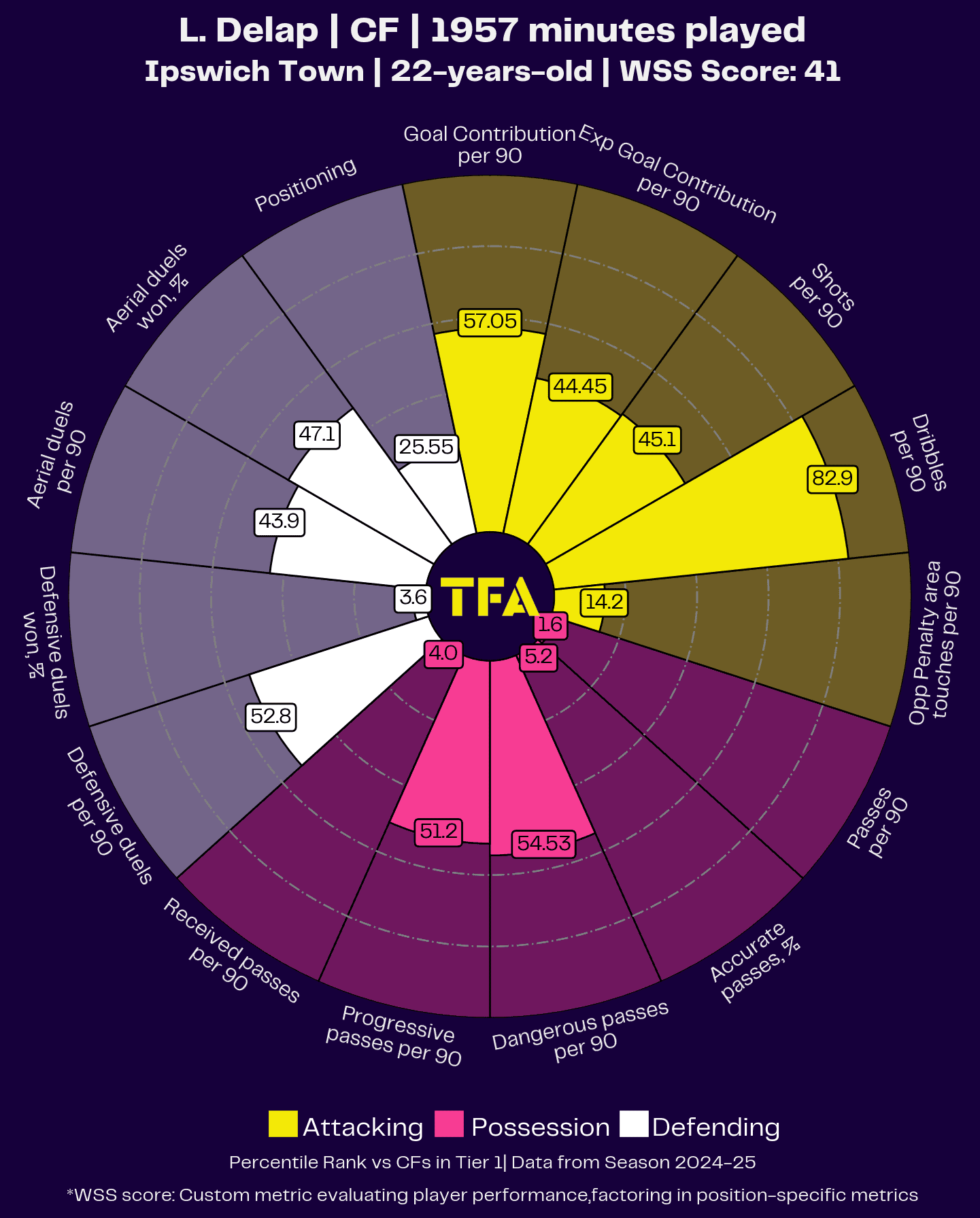
The first alternative is Liam Delap, who has been in fine form for Ipswich Town this season and who has made a mark on the Premier League after his permanent move to the promoted side from Manchester City.
Whilst he might not have had the same service as others in Tier 1 sides have enjoyed, given Ipswich’s struggles, he has still managed to rack up 10 goals for Kieran McKenna’s team so far.
Therefore, it comes as no surprise that he has been linked with a move to another side this summer should Ipswich fall back through the trapdoor at the end of the season.
What has really stood out about Delap’s game is his timing inside the final third.
He regularly gets into the right areas of the field at the right time, assuring his teammates that their efforts will turn into shots at goal and opponents a problem to deal with.
His statistics in this graphic reflect this, with him sitting around the median mark in percentile terms for aerial duels competed in and won, as well as dribbles per game.
Therefore, he is someone who can make things happen whenever he gets on the ball, as indicated by his above-average percentile number of progressive passes and dangerous passes made per game.
In terms of his overall profile, some reports compare him directly with Vlahović, and he has been linked with Juventus as a potential replacement if the Serbian departs Turin this summer.
That in itself highlights how well-regarded he is, and the fact that Ipswich may need to balance their books this summer if they return to the Championship means Delap could be on the market.
That, and the Premier League experience that he has now built up, could make him a cheaper alternative for Arsenal to consider.
Chris Wood Statistics 2024/2025
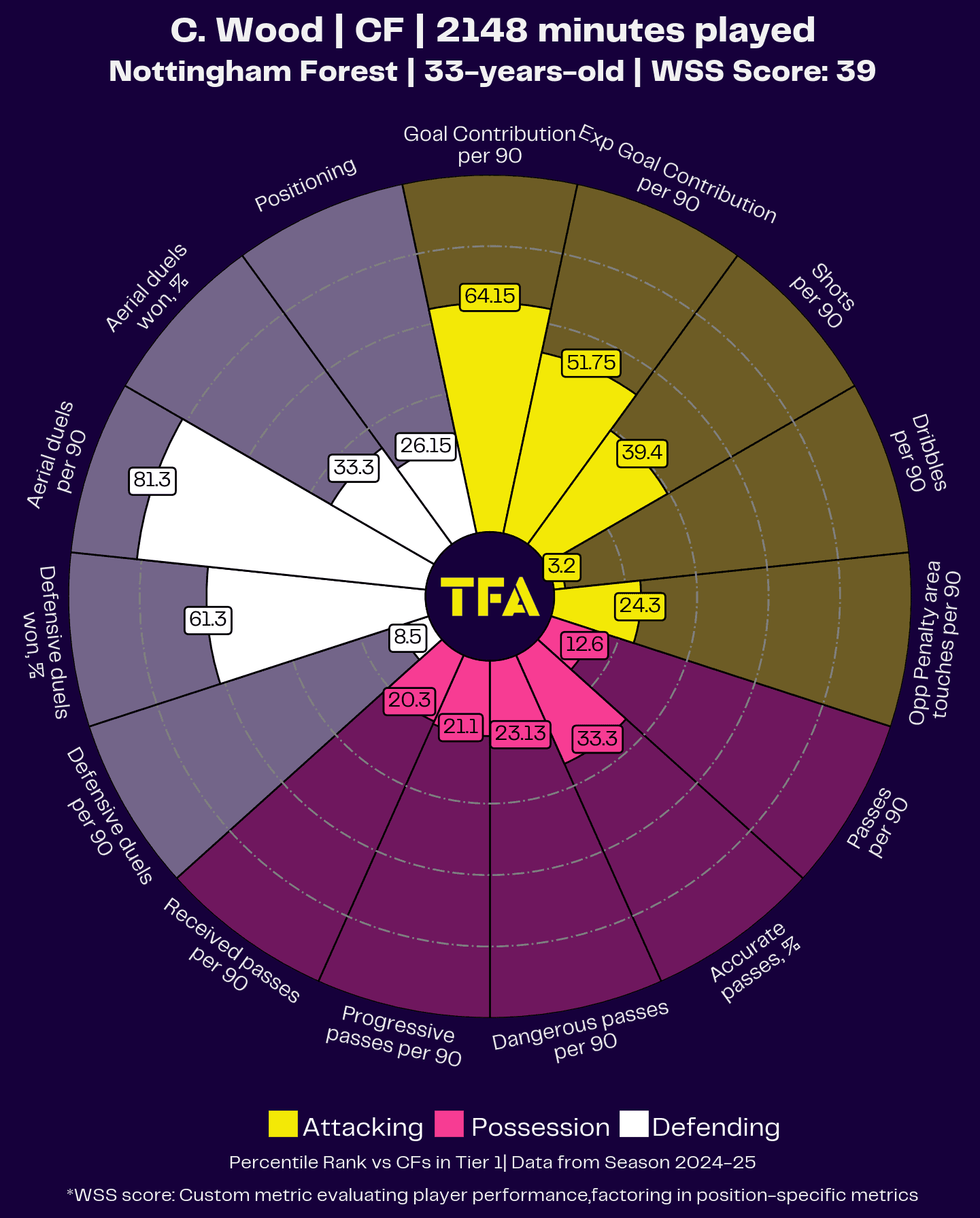
Whilst Delap is still just 22 and so at the beginning of his career, someone at the other end of the age scale that Arsenal could turn to is Chris Wood.
The New Zealand captain is not a player they have been linked with so far, but some have suggested that he could be an ideal signing for Arsenal.
In terms of attacking output, Wood has the goal threat that Arsenal needs.
His bringing the traditional “number nine” position back into fashion shows that he could be a good alternative to Osimhen.
He would give Nottingham Forest a similar presence around the field.
Given this, it perhaps will not shock many to learn that his strongest statistical asset in this graphic is his aerial presence, with him ranking within the top two percentile bands in which aerial duels compete.
He might not succeed in too many of them, but this once again highlights his imposing figure and ability to cause opponents problems.
Again, this draws comparisons between him and Osimhen and shows why Arsenal should keep him in mind.
The fact that he doesn’t rank as highly for passing is another similarity between the two.
Wood is also someone who is more inclined to shoot at goal himself than to look for a teammate.
This is not to say that he doesn’t contribute to goals, as that is another of his stronger statistics, but the fact that he has so far netted 18 times for Nottingham Forest means that scoring goals is his forte.
A couple of things could lead Arsenal not to consider him as a transfer option.
Firstly, his age suggests that he may only be a short-term solution to Arsenal’s attacking issues.
Secondly, Nottingham Forest would be unlikely to let their prized asset leave too cheaply, especially with the East Midlands side looking increasingly likely to be in the Champions League next season.
Nevertheless, some feel he is exactly what Arsenal are looking for in a striker.
At his age, any price he would cost would surely compare favourably with anything Napoli has quoted for Osimhen.
Viktor Gyökeres Statistics 2024/2025
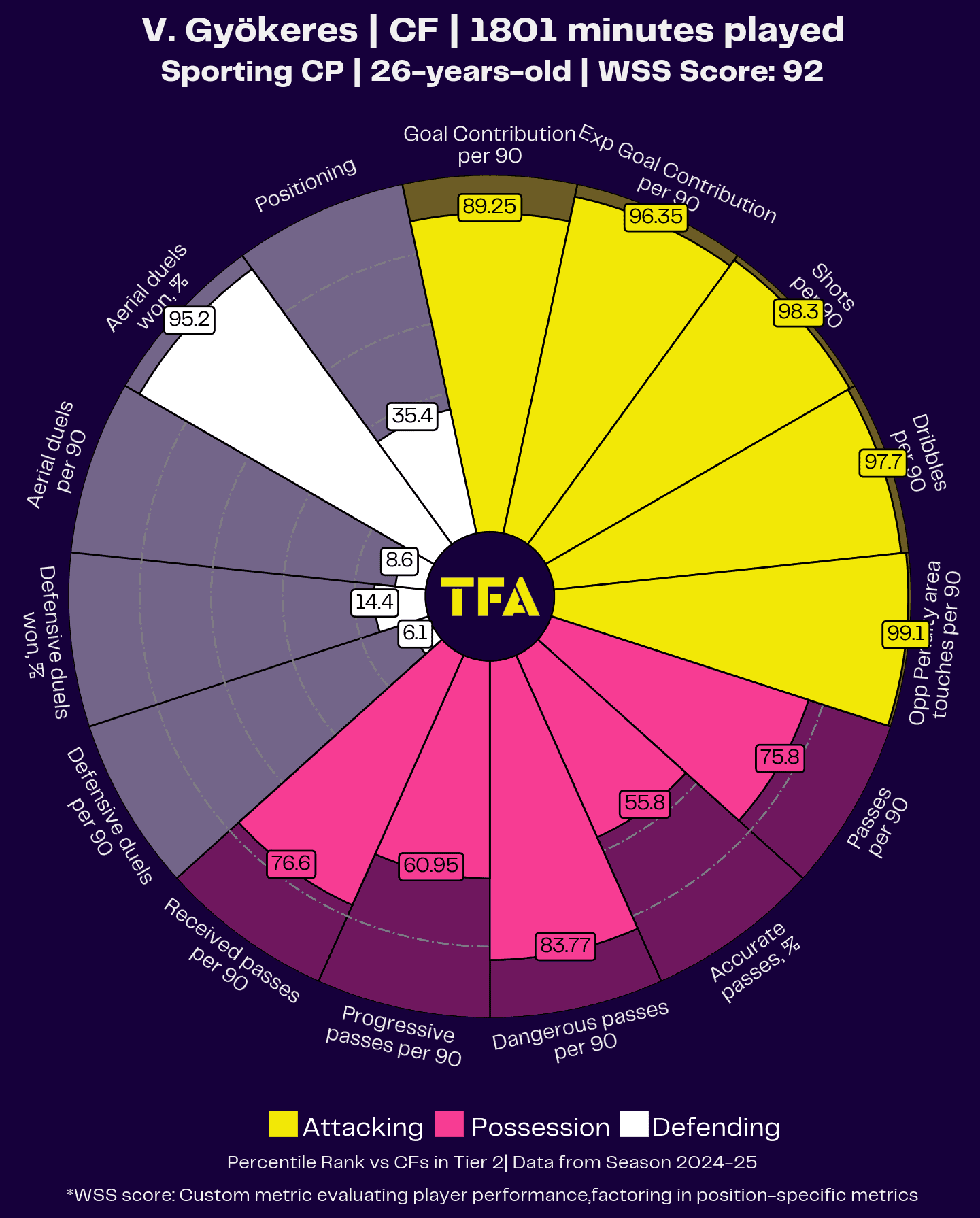
The final name that Arsenal could have in mind would not come any cheaper than those listed previously but who could perhaps bring an even better balance to their forward line.
Viktor Gyökeres has enjoyed a fruitful time since leaving Coventry City for Sporting Lisbon in 2023, becoming a key player in the side led by now-Manchester United head coach Ruben Amorim and one of the hottest properties in Europe as a result.
Whilst nothing concrete has been reported regarding interest from Arteta’s side, the Sweden striker’s statistics in this graphic indicate that he would not be all that different from Šeško in how he operates.
Again, it should be noted that his numbers compare to those of Tier 2 strikers, not Tier 1 league players.
However, there is still no getting away from the fact that he sits among the top band and is almost the best in his field in terms of shots and touches in the opposing penalty area per game.
Add in the fact that he is known for his timing inside the penalty area when balls are delivered into his vicinity, and he would undoubtedly add goals to Arsenal’s game.
He would give their opponents plenty to manage as they attempted to marshal Arteta’s side next season.
However, Gyökeres is also a significant aerial threat and ranks highly for received passes, dangerous passes and passes made, so he would not only be strong when the ball is on the ground but could also be used as a target player when Arsenal needed to resort to longer passes.
He could also involve himself in build-up play, which is what he has thrived at during his time with Sporting.
Time and time again, he has been seen drifting into wider spaces and manipulating defenders into engaging in 1-v-1 duels, from which he can either shoot at goal or set up an opportunity for a teammate.
This is not that dissimilar to Šeško, but where Gyökeres would differ from the Slovenian is his ability to balance that mobile presence with offering a target presence.
This is shown through him getting into the opposing penalty area even more in percentile terms, which means that he would bring more than Šeško to Arsenal’s play.
Therefore, he could be a good alternative for Arteta to turn to if a move for the Leipzig forward failed to materialise.
Conclusion
In conclusion, this tactical analysis has examined Arsenal and their current goalscoring issues in detail, highlighting their problems and a range of solutions that they could use to address them.
Whilst this analysis has presented a variety of potential players who could be solid fits for Arsenal’s model, it ultimately depends on what profile of player Arteta wants.
It has been clear that he and the club are on the hunt for something very specific, with Šeško the best overall fit from the first set of players suggested, yet turned down by Arteta previously due to reservations over aspects of his game.
Regardless of the direction Arsenal opts to take tactically, though, their run of mediocre results, which have put paid to their Premier League title hopes for another season, has surely shown them that they must act this summer.
Whilst Havertz had been a relatively consistent goalscorer before he picked up his injury, Arsenal will not challenge for silverware again without a consistent goalscoring striker in that role.
It is certainly something to keep a close eye on as the summer goes on.
