
That’s right, this is Part 2.
The initial article, “Rebuild or Ruin: A data analysis on transfer overhauls,” debuted on Total Football Analysis in October 2022.
As we near 2 ½ years since the original analysis, it’s time for an update.
The one difference from the previous data analysis to this one is that we will narrow our attention to just the Premier League.
We want to continue investigating the statistics that, between the two articles, date back to the 2017/18 campaign.
The content from the original article is well worth a read, and we’re building upon it here.
To quickly summarise that first data analysis, a combination of stability and gradual player movement led to the best results, at least for the majority of teams.
Will that original thesis hold up?
At least one Premier League club would like to have a word with us.
Premier League Clubs & Reliance On New Signings
Since that initial data analysis, we have collected another 2 ½ seasons worth of data.
One difference in approach between the two articles is that the previous strictly measured minutes contributed during the Premier League calendar.
This time, the database expanded to all competitive matches clubs played while competing in the EPL.
The rationale is that, over the totality of the season, we will get a more complete picture of which clubs have leaned most heavily on their new signings.
To put this analysis together, we built a database with each team’s transfer activity, noting the number of minutes each of the new signings contributed to their first season with their new club.
Both the incoming transfers and the minutes logged were taken from Transfermarkt.
We’re covering the 2022/23, 2023/24 and what we have so far from the 2024/25 campaigns.
Our first topic is looking at the 2022/23 season, points and the percentage of a team’s total minutes played by new signings.

Of the clubs that finished on the right side of that average line, only Manchester United and Tottenham received an above-average number of minutes from new signings.
At the top left, we find seven teams with an above-average number of points and 20% or fewer of the club’s total minutes played contributed by new signings.
In the bottom right, we have a Chelsea side that invested heavily in new personnel and failed to remain within striking distance of their ‘Big 6’ partners.
If the yellow points are not clear, know that those represent the three promoted teams for the campaign.
Impressively, all three clubs not only managed to stay up that season, but they are also still in the Premier League and are having great success, especially Nottingham Forest.
Forest is a club to keep tabs on as this data analysis progresses.
Their unique approach deviates from the norm and has worked incredibly well.
In 2023/24, Nottingham Forest’s new signing contribution dropped from 66% of available minutes to 52%.
Luton Town and Burnley, both newly promoted clubs, were the only ones with a higher percentage of minutes claimed by new signings.
Unfortunately for those two, as well as Sheffield United, which rounded out the promotion trio, the new signings did not allow them to stay in the Premier League.
They finished just behind Nottingham Forest.
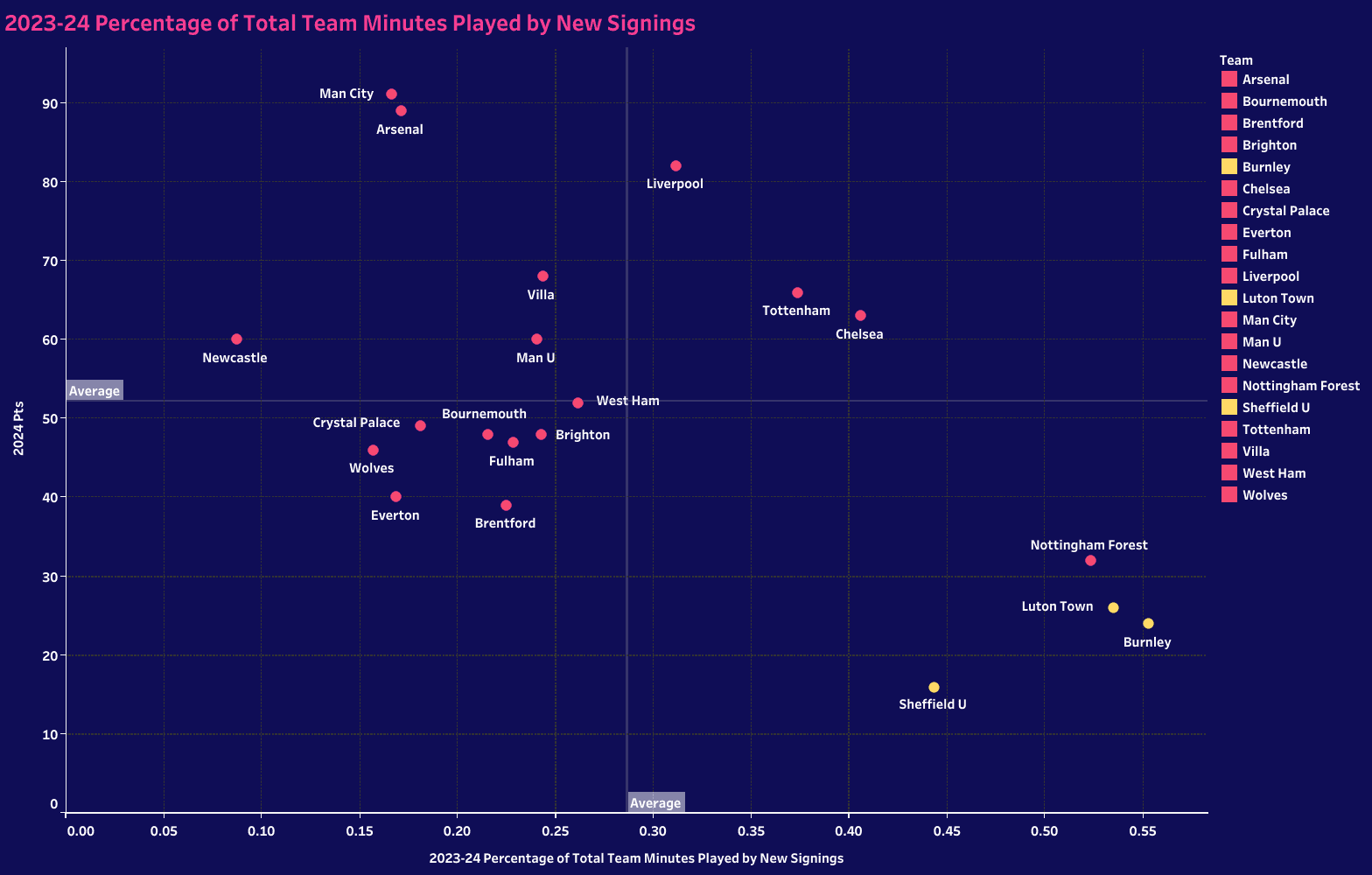
Once again, Manchester City and Arsenal finished one and two and had the lowest percentage of minutes contributed by new signings.
After Newcastle’s spending spree back in 2017/18, which saw 32% of total minutes go to new signings, the club has introduced new signings very slowly, relying more heavily than virtually any other Premier League club on the current pieces within the team.
New signings helped both Liverpool and Chelsea climb back up the table, while the number of teams in the bottom left quadrant greatly increased from the previous year.
In our current season, which at the time of writing finds all clubs with either 23 or 24 matches played in the Premier League calendar, stability seems to be the trend once again.
Liverpool have 1% of their available minutes from new signings, followed by Newcastle at 3% and Arsenal at 5%.
Of the top 10, seven are in the top left quadrant, receiving a below-average percentage of minutes contributed by new signings.
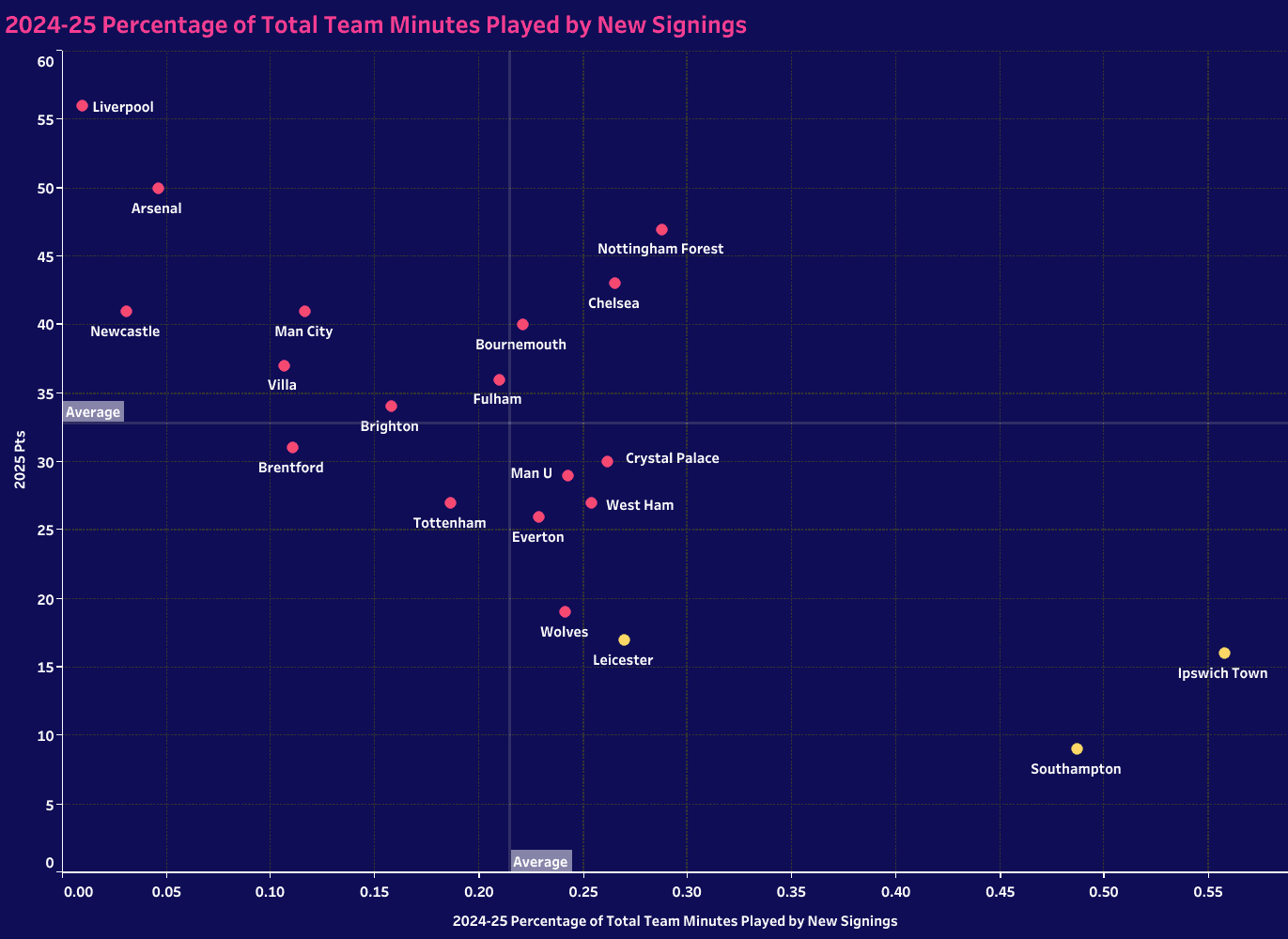
Chelsea has continued to bring in fresh faces and gradually move up the charts, but there is no more staggering change than the one we see in Nottingham Forest.
Thus far, 29% of total minutes have come from new signings, which is a significant drop from the previous two seasons.
After two years of squad building and a relentless drive to bring in new players, Nottingham Forest seem to be settling into the Premier League.
Whether they can finish the campaign in the top four or if they do fall off, the intensive build during their first two seasons back in the Premier League has put them in a position to lean more heavily on returning players.
That shift has certainly benefited the club thus far.
While Southampton and Ipswich Town attempted to copy the Nottingham Forest model, they had some work to do in the final fourteen matches to reach the magic number of 30 points.
Though we still have roughly one-third of the season to play, and several of these clubs, especially Manchester City, made significant additions in January, the pattern largely aligns with previous years.
EPL Table Movement By Year & Minutes By New Signings
We’ll continue to examine the percentage of minutes played by new signings but from a different perspective.
Specifically, we want to see if a team’s outcome improved or worsened from the previous year and see if there is any correlation with the percentage of minutes played by new signings.
Since three new clubs are promoted to the Premier League each season and will therefore not have a position in the table to fall back on, we have started each newly promoted club at 21.
In order to remain in the Premier League, they must improve their position by four or more.
A four-point improvement gets them to 17th in the table.
For all the returning clubs, the math is straightforward.
Again, starting with the 2022/23 campaign, the top left and bottom right quadrants are the most populated.
If we count City and Arsenal as top left quadrant teams, then 75% of the league falls in either the top left or the bottom right.
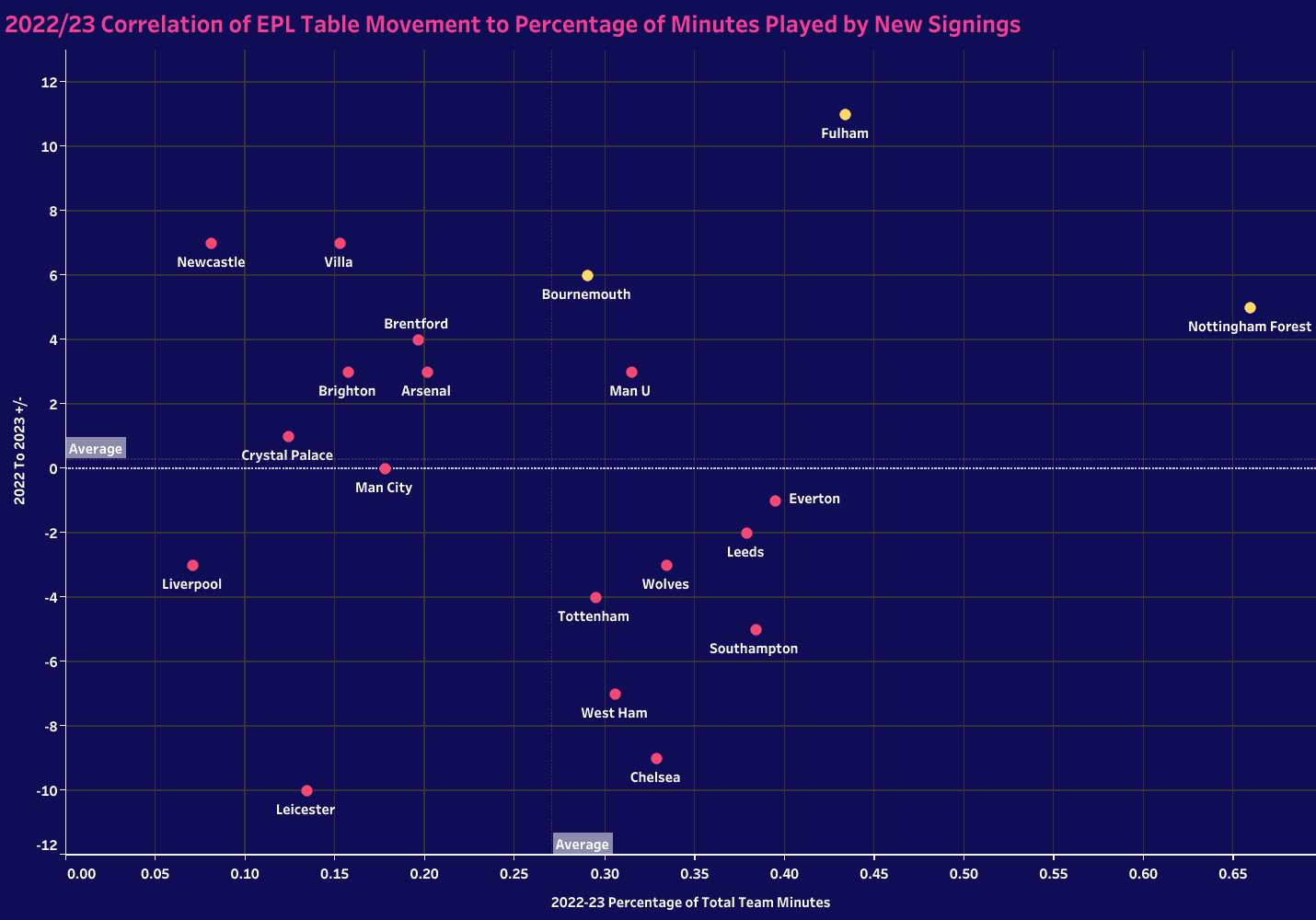
Of the clubs that allocated fewer minutes to new signings, only Liverpool and Leicester City performed worse than the previous season.
Meanwhile, of the returning clubs, only Manchester United managed to improve their position in the table while receiving 25% or more of their minutes from new signings.
Chelsea and West Ham saw significant drops in their table ranking while allocating more than 30% of total minutes to new signings.
2023/24 played out much differently.
No one wanted to be in that bottom right quadrant.
The average number of minutes given to new signings increased slightly across the league, with Chelsea, Tottenham, and Liverpool representing the ‘Big 6’ in the top right quadrant.
The three newly promoted teams joined them.
Again, they will always be in the top right because they simply can’t finish 21st, which is their initial starting spot.
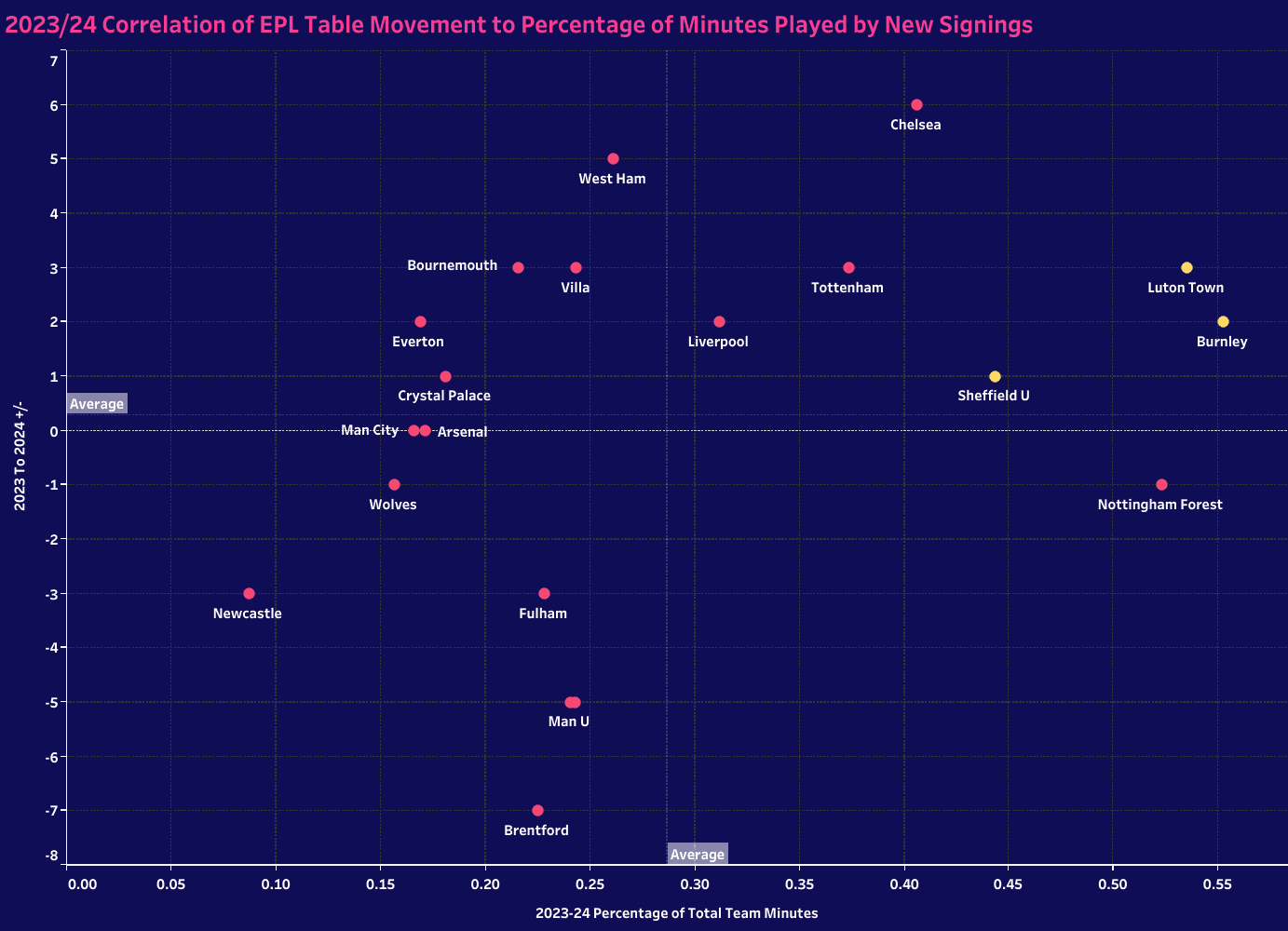
Much like Chelsea, West Ham’s big drop was met with a rebound, while Newcastle, Manchester United, and Brentford fell.
Fulham regressed, and Nottingham Forest survived once again while Bournemouth continued to climb.
Returning to the present, we won’t see much about the chart given that the January window has just closed, meaning that new signings will impact the percentages.
One note is to see how significantly the average line has moved to the left.
Sitting right around 21%, we should see movement to the more standard 27% to 30% range.
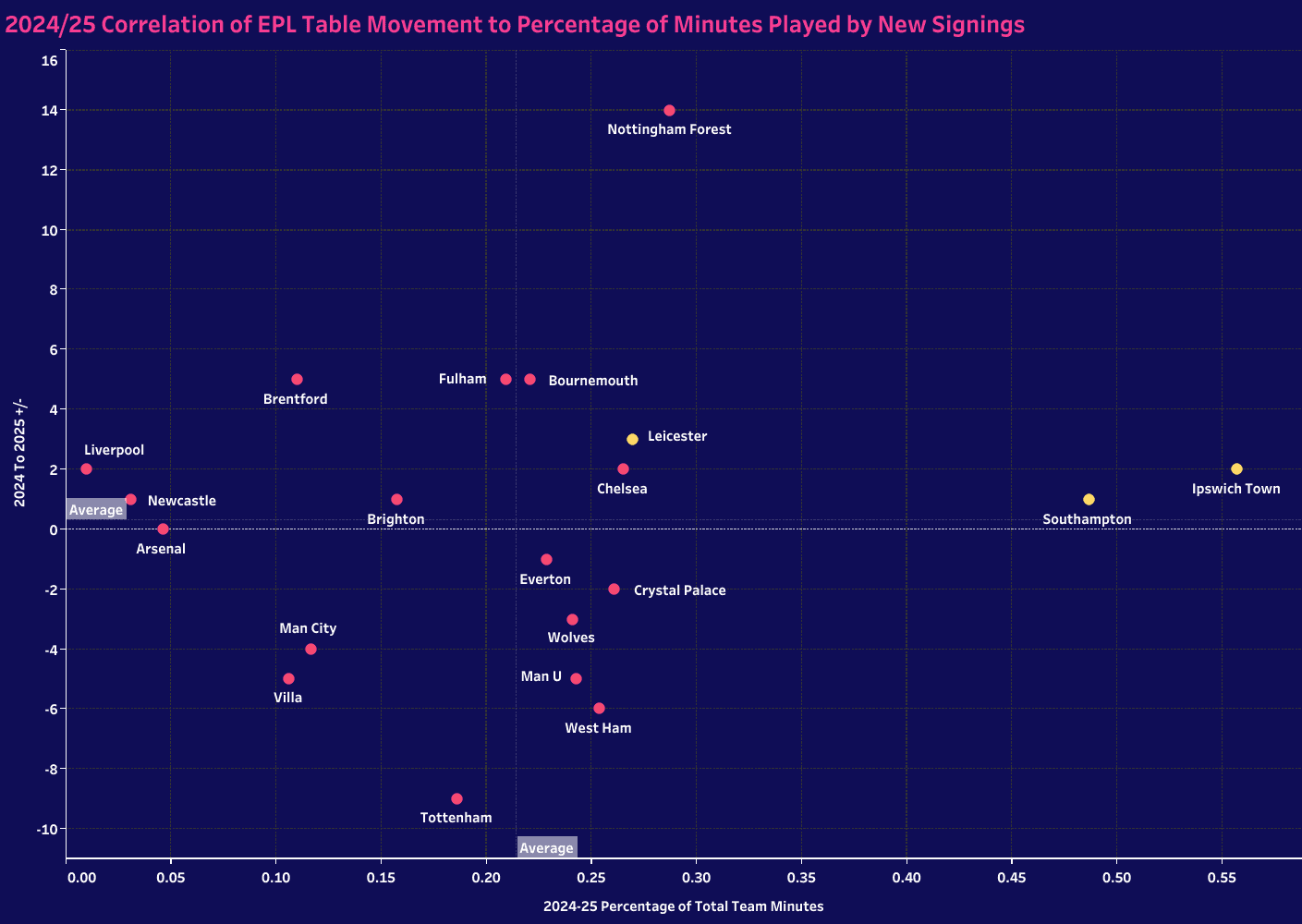
Manchester City’s response to their current struggles was to splash the cash in January, making significant additions to reload the squad.
The same can be said for Aston Villa.
Should each club’s January signings help them improve their position in the table, we’ll see movement toward the mean for both teams.
This is certainly an area to check on in May.
The Premier League Relegation Zone
For the newly promoted teams, the only goal is survival.
If they can do it in year one, they should have the same goal moving into year two.
Assume the ‘Big 6’ are relatively safe in the EPL and that Newcastle aren’t far from creating a Big 7.
Three out of 13 teams go down each year.
After the success of the newly promoted teams from 2022/23, the current trio and the ones before them have greatly struggled to compete and survive.
At the moment, all three of the current group are in the relegation zone.
We could very well have two consecutive years where all three promoted teams have gone right back down.
Since the Class of 2022/23 had so much success, It would make sense for newly promoted clubs to follow their models.
But finding those trends—that’s certainly a challenging task.
Looking at the number of new signings who earned Premier League minutes and the percentage of the team’s total minutes that they contributed, Nottingham Forest certainly takes the most extreme approach.
They essentially signed a new team.
Meanwhile, Bournemouth is joined by Leicester City at the bottom left, so fewer new signings and a lesser contribution by new players, and Fulham is at the bottom left of that central cluster.
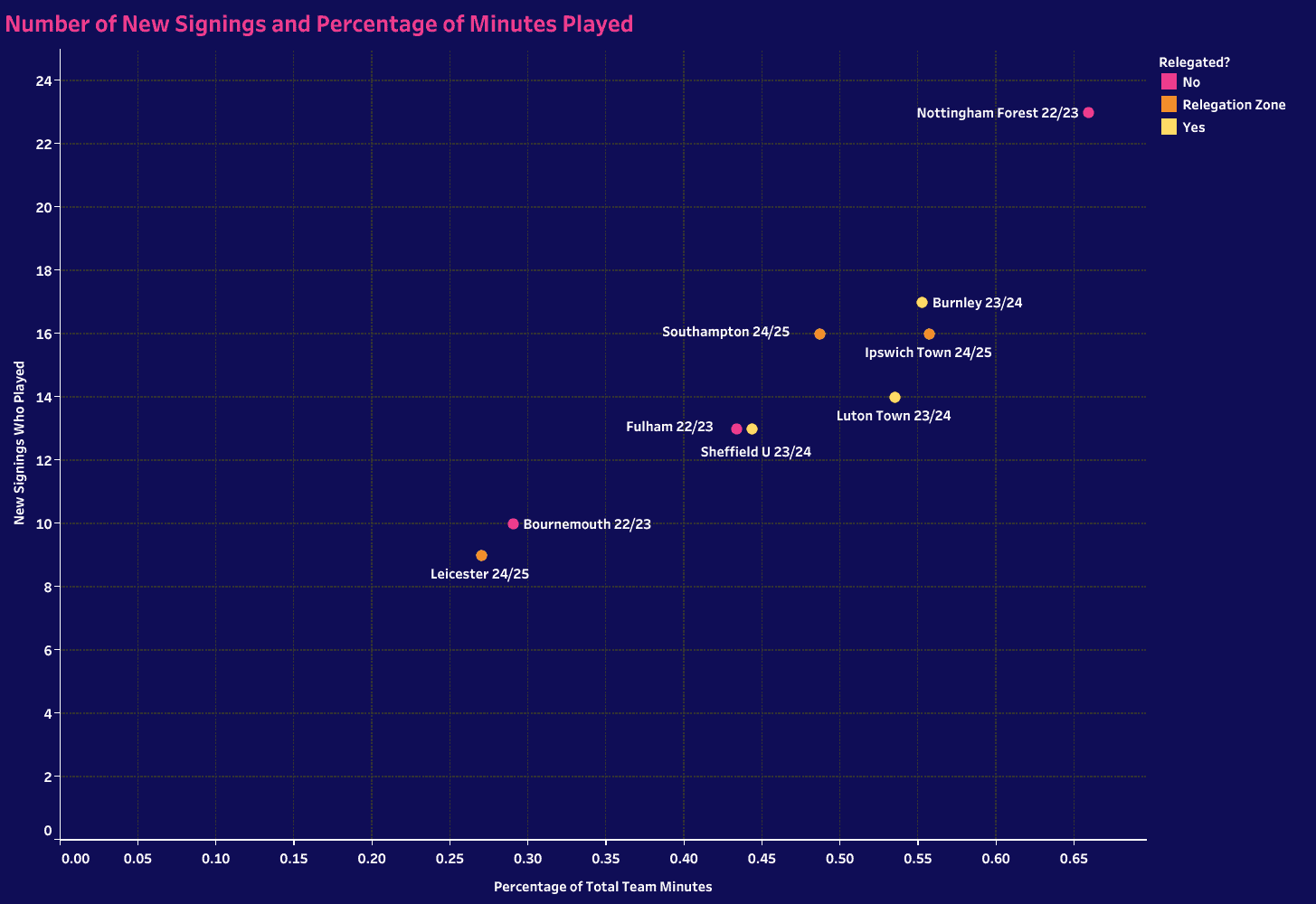
At the moment, we’re no closer to an answer than when we started this analysis.
Three very different models led to the 2022/23 team staying up.
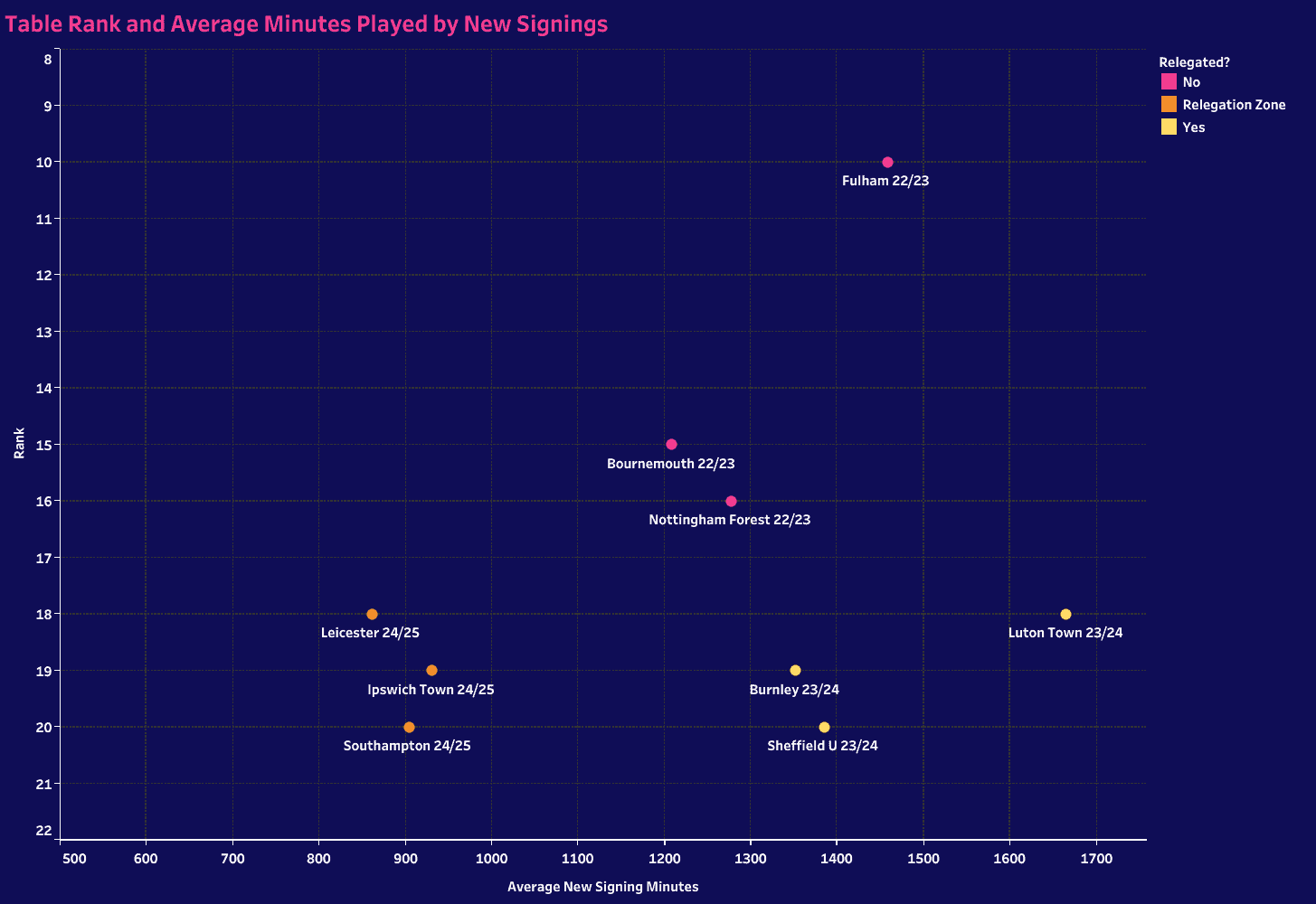
Taking a different approach, assessing the average number of minutes contributed by each new signing gives us a little more clarity, but still not enough to establish a trend.
All three 2022/23 clubs finished with an average of 1,200 and 1,500, but we also have to acknowledge that the current three teams still have 1/3 of the season to play.
Finally, we have the total number of minutes contributed by new signings paired with goal differential per game, which is exactly what it sounds like.
Taking each team’s goal differential, we divided it by the number of games played in the league.
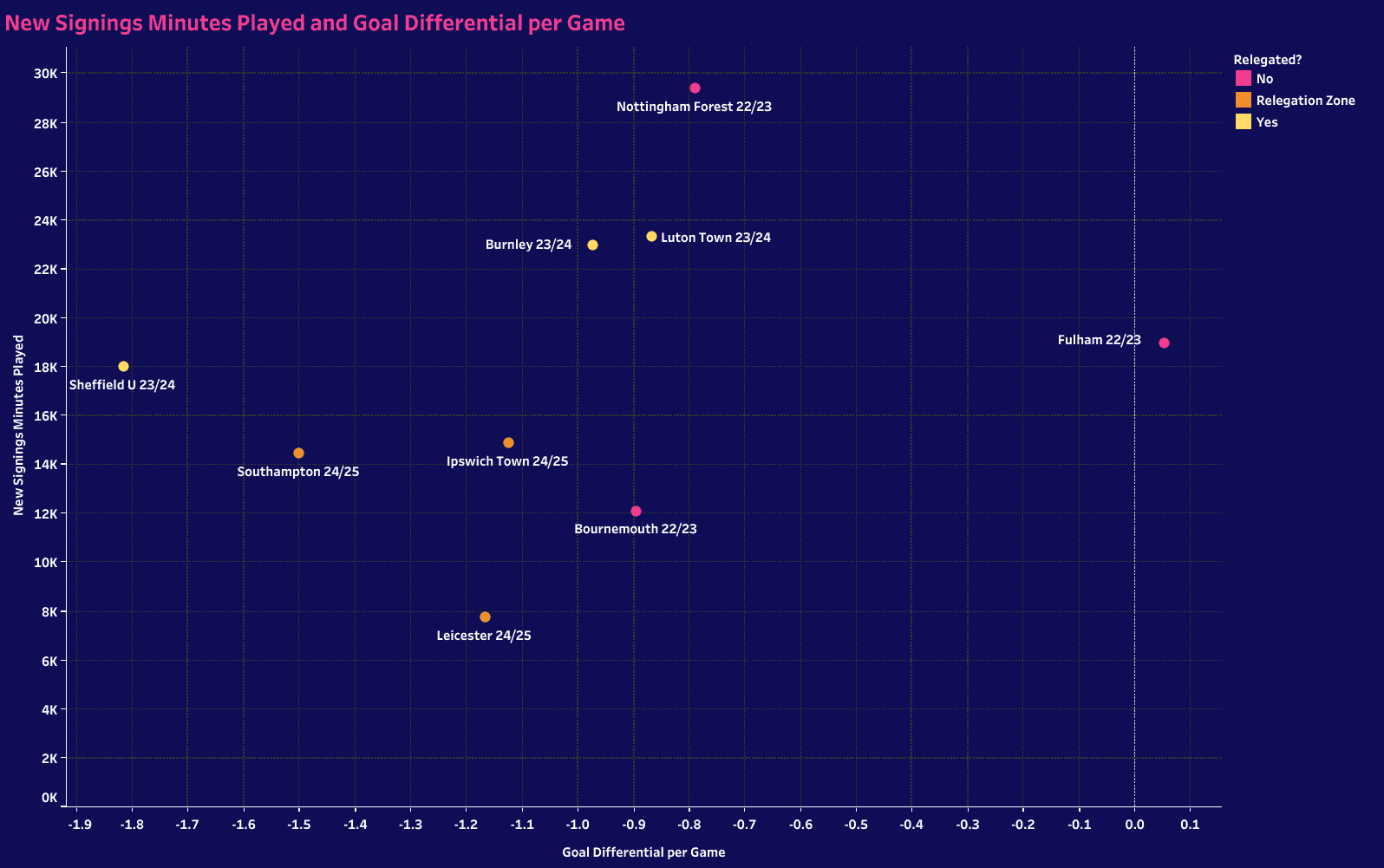
Again, we see three different approaches by those 2022/23 clubs.
Nottingham Forest’s complete rebuild was very different from Bournemouth’s stability-driven approach.
Meanwhile, Fulham split the difference between the two.
If there is one commonality between those three clubs, it’s that each kept their goal differential per game below -0.9, with Bournemouth cutting it close at -.89.
Luton Town is the only other club to fall below the threshold.
While there seems to be no one way to build a Premier League-ready squad, defensive performances seem to be important.
That may well influence both the tactics and the type of player recruited to the squad.
Conclusion
Back in that initial analysis, we concluded that cohesiveness with a gradual replenishment tended to produce the best results.
By and large, that theory still holds up.
While there are many ways to build or rebuild a squad with transfer market overhauls, a club’s status certainly factors in.
For the top teams, stability is incredibly important.
Stability is connected to an identity.
As players are gradually introduced into the squad, the identity remains, even as the team improves.
We have examples of aggressive, balanced, and more stable approaches leading to success for clubs at the other end of the spectrum.
Nottingham Forest offers an intriguing case study in squad building.
Chelsea, though at a different status and part of the table, has also aggressively rebuilt the team.
While Nottingham Forest seems to have found its rhythm, very suddenly, for that matter, Chelsea’s rebuild has taken more time, and it’s certainly at odds with their ‘Big 6’ colleagues.
Keep an eye on these anomalies, but as we close out the season, look for squad stability to continue producing the best results.
