
Is 3-4-3 A Good Formation?
The 3-4-3 is a formation that offers considerable flexibility in the defensive phase.
Teams can quickly turn their back three into a four or five.
This can be a tactical decision based on the opposition they are playing or by being fluid in the different phases of their opposition’s attack.
For example, if a team is playing a higher level of opposition, the wing-backs may always remain close to their centre-backs to quickly create a back-five.
If the team wants to press high, one or both wing-backs may be involved in the final third whilst recovering from joining the backline when the ball is nearer their goal.
This tactical fluidity that the formation allows can make it particularly appealing for teams like Sporting CP.
In this tactical theory, we will take a look at current Manchester United boss Rúben Amorim tactics while at Sporting CP, where he successfully used the 3-4-3 to dominate domestic games while competing in the Champions League against Europe’s best.
A 3-4-3 formation allows teams to be both high-pressing and overloaded at the back under sustained pressure.
This tactical analysis focuses on how teams press in the opposition half.
Examples of Sporting’s high press under Amorim will be analysed.
Also included in this analysis is former Premier League and Championship coach Steve Kean‘s implementation of a 3-4-3 mid-block.
Kean used these tactics whilst working with Scottish Premiership side Hibernian‘s U19s in their impressive UEFA Youth League run.
We will also analyse teams’ reactions to the first line of pressure being broken and offer suggestions for coaching a 3-4-3 press.
High pressing in a 3-4-3 Formation

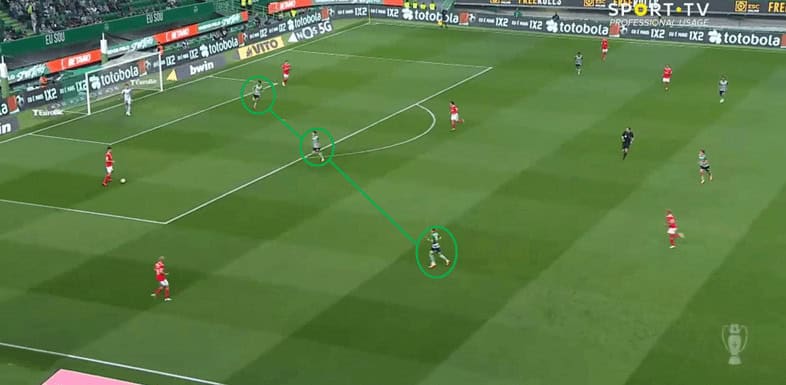
This tactical diagram is based on Sporting’s high press in a 3-4-3 against Benfica.
Sporting encourages the opposition to play down one side.
When the ball enters the wide area, Sporting severely overloads that side and attempts to trap their opponents.
The striker’s starting position makes it difficult for the centre-back to switch the play to the opposite centre-back.
When the ball is played to the full-back, Sporting’s ball-near wide forward presses underneath the ball.
Because his striker makes this pass predictable, the wide forward can affect the receiving player’s first touch and prevent him from playing forward.
The wing-back’s position concerns the positioning of the wide forward or midfielder.
In this example, Benfica’s left midfielder is high.
The wing-back remains part of a temporary back four to prevent his centre-backs from having to cover the wide area.
The ball-far wing-back tucks inside to an inverted position.
When the wing-back is pinned, the ball-near central midfielder tracks players into the wide area.
The ball-far midfielder shifts across to screen the central area in front of his backline.
This means the two central midfielders must have the athleticism to cover the entire width of the pitch between them.
The centre-forward helps protect against a square pass while being primed to press the centre-back’s first touch should he receive the ball back.
The ball-far wide forward also shifts across the pitch, covering the area where the opposition’s 6′ may attempt to receive the ball.
A vital part of coaching the defensive phase is ensuring that players know how to react when things go wrong.
The team must have a plan B if the opposition plays through or out of the initial press.
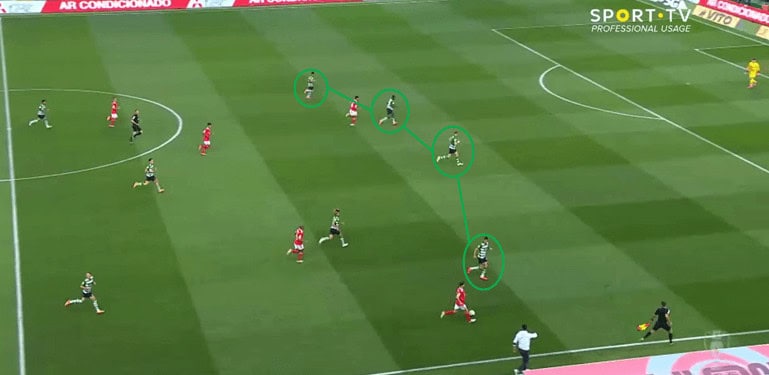
This picture shows the seconds after the scenario described in the previous tactical diagram.
In this example, Benfica have escaped Sporting’s press.
Significantly, when the ball is switched, Sporting does not overreact and charges directly at the ball.
Instead, they press in a diagonal line to protect their shape.
The line of central forward, (now) ball-near wide forward, and wing-back prevent a quick attack down the opposite side from where the ball has come.
This keeps the ball in front of Sporting’s pressing players and allows the rest of the team to drop diagonally behind the ball.
Even when both plan A and B have not achieved the desired outcome of winning the ball, Sporting implements a plan to prevent them from being exposed.
Due to the quality and press resistance of the opposition, rather than any particular tactical flaw, Benfica was able to play through the press.
This is inevitable at some point in a high-level game.
Although Sporting’s front players did not turn over the ball, their actions slowed the play down enough to allow the players behind to regroup.
When Benfica broke through, Sporting still had a defensive overload on the back line, which had become a back four.
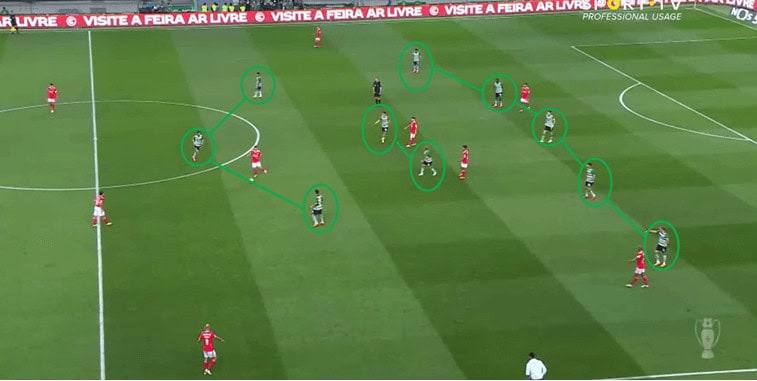
This overload again enabled them to slow the opposition down and, in this instance, forced them to play backwards.
With the opposition now enjoying relatively comfortable possession in Sporting’s half, Sporting’s 3-4-3 has become a secure 5-2-3.
Mid-block in a 3-4-3 Formation
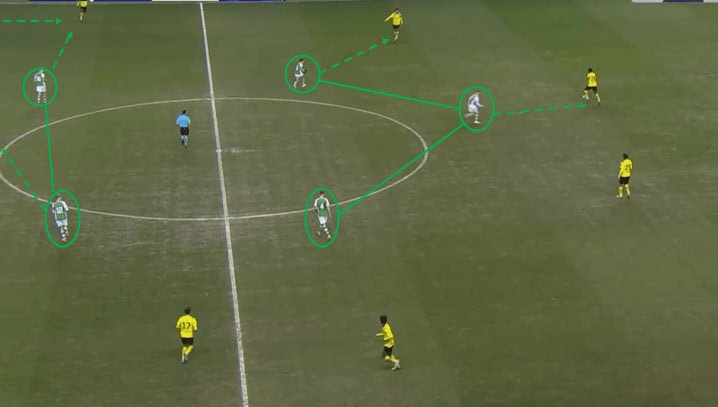
The above image shows Hibernian’s U19s in a 3-4-3 formation playing against Borussia Dortmund, the Bundesliga giants, in the UEFA Youth League.
Kean set his Hibs side up similarly to Sporting, only having them sit deeper in a mid-block.
Hibs’ front three formed a narrow triangle just outside the width of the centre circle.
The two central midfielders were positioned directly behind their two wide forwards, who were tucked in, creating a box.
The two wing-backs played behind the line of the central midfielders, forming a “C” shape with their three central defenders.
The narrowness of Hibs’ shape allowed Dortmund to play in the wide area.
As the above image shows, the central forward forced the direction of the next pass.
The striker was triggered to press as the centre-back took a forward touch with his outside foot.
Hibs’ strikers sprinted slightly to the defender’s left.
This prevented the defender from playing to his left side and made a pass to the right predictable.
This allowed the wide forward on that side to begin his sprint just as the ball was about to be played.
The wide forward angled his body towards the predicted receiver of the ball.
This allowed him to accelerate towards the receiver as soon as the ball was played.
At times, this meant the wide forward had his hips pointed to the side of the pitch, depending on the positioning of the opposition’s full-back.
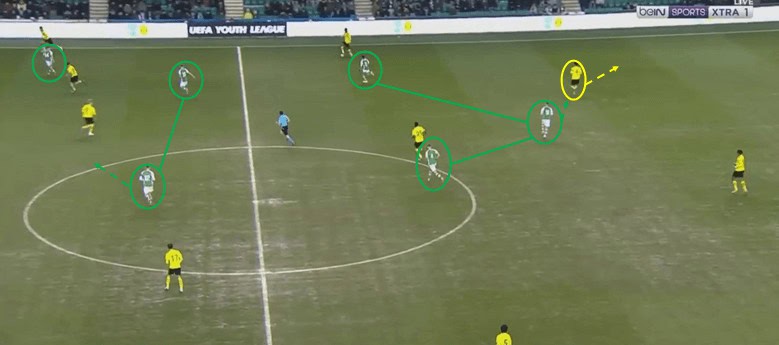
This example, from a different play, shows Hibs reacting to the ball being played into the wide area.
The ball-near forward intensely presses the full-back, with his striker covering the ball-near centre-back.
The striker provides the centre-back with just enough space that he might be tempted to drop back to receive the ball (shown in the image).
If he did, Hibs could quickly isolate the defender, cutting off all passing lanes and putting the defender in a risky situation.
Hibs’ ball-far forward references the opposition’s deepest midfielder.
Like Sporting, the wing-back’s positioning concerns the opposition’s wide forward’s positioning.
Here, Dortmund’s wide forward is threatening in behind, forcing the wing-back to track his run.
This means his defensive midfielder has to shift into the wide area to screen his centre-backs, with his midfield partner dropping behind him.
As with Sporting’s system, the central midfielders must cover the width of the pitch, requiring a high level of athleticism from the pair.
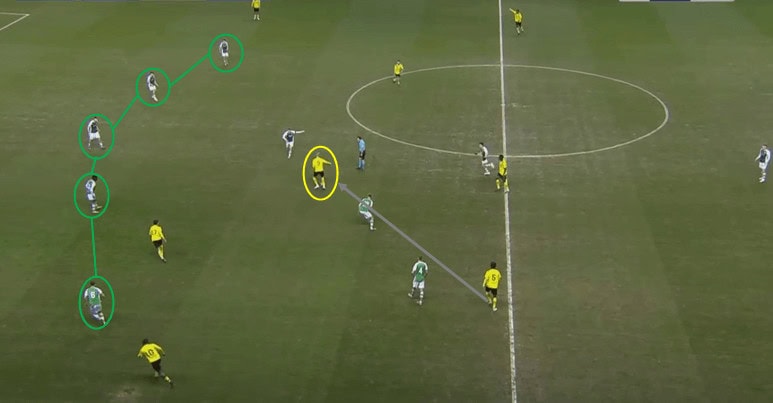
As can be expected when playing such high-level opposition, Dortmund managed, on occasion, to break down Hibs’ defensive block.
Having attempted to squeeze them out down one side, Dortmund managed to get their striker into a central position with the ball.
When scenarios like this occurred, Kean’s side was still relatively comfortable, with an intact back five and a defensive overload.
Even when Dortmund worked the ball into areas where they could attack the box, Hibs always crowded the penalty area.
Pressing passing sequence

The above exercise is a passing sequence that incorporates pressing actions.
The drill allows players to practice their arching runs when trying to force teams down one side.
This could be used as a stand-alone exercise or included as part of the warm-up.
The sequence begins with player “A” passing to player “C”.
Player “C” receives and takes a touch to the outside of the pole or mannequin before passing forward to player “D”.
The ball moves continuously around the outside of the square.
As the ball travels on the outside of the long side, the middle players, shown as “B” and “E, “press” the receiving player.
The rotation of the players is from A to B to C, etc.
The in-possession players should be encouraged to play quickly so as not to be caught by the defending player.
This should also keep the exercise moving at match intensity.
Initially, the pressing players are not allowed to touch the ball.
To progress the exercise, the pressing player can be allowed to steal the ball.
The activity can be made more complicated for the receiving players by having them dribble halfway towards the next station before releasing the ball.
Four cones (two yellow, two blue) are placed inside the square so the sequence can go in the opposite direction.
This allows the positioning of pressing players to be adjusted quickly.
Two balls can be introduced, depending on the required intensity.

For the first exercise, and as shown in the tactical diagram above, the trigger for the press is the centre-back playing the ball into the opposite centre-back.
As soon as the ball is released, the striker closes down the centre-back to apply pressure to his first touch.
The pressing player should close down the receiving player while keeping the ball from returning to its original location.
Depending on the team’s defensive set-up, the coach may want to exaggerate the arching motion of the pressing players (shown in option 1 above).
Alternatively, the striker may run more directly at the opponent’s inside foot, forcing him to the outside (option 2).
Widening the pressing movement may make it easier for a player to play around.
A straight, diagonal run can cause a player to go wide whilst protecting more of the centre of the pitch.
Most importantly, the forward must make the opposition’s next pass predictable.
This allows his teammates to shift across and jump to the next man after playing the ball.
Game related Rondo practice

This game-related practice aims for the in-possession team to attack freely and score small-sided goals.
The defending team must protect the small-sided goals and attack into the regular goal should they win possession.
If working on a mid-block, a line of engagement (pink line in image) should be used.
The attacking team is overloaded (7 Vs 5) to force more defensive actions and teach players to cover space, not opposition players.
The small-sided goals are positioned to emphasise the importance of protecting the middle of the pitch.
The out-of-possession team should also be encouraged to force the ball down one side.
This can be done by awarding points to the opposition for any switch of play that occurs after the line of engagement.
Whilst this analysis and training session has focused on the defensive phase, players need to know their first action when possession is regained.
For example, the defending team can be encouraged to play into their striker’s feet before making supporting movements and runs behind him.
To encourage high-speed counterattacks, coaches can limit the number of seconds or touches the (now attacking) team has to score a goal.
The game can progress to a full 11 Vs 11, where the defending team is coached on how to react when their press is broken.
Conclusion
While Amorim has tactically struggled to implement his vision at United, the 3-4-3 can offer a very fluid solution for teams.
The formation can allow them to press high while forming a solid shape with a back five when the ball reaches their defensive third.
One limiting factor for teams to be able to implement this is the distance it requires certain players to cover.
If central midfielders are expected to cover the width of the pitch, they have an extremely high level of endurance.
The key to a 3-4-3 press’s successful implementation is the initial movements of the press, making the opposition’s play predictable.
This predictability is what allows teams to trap their opponents down one side.
Once the ball is in these areas, the forwards and midfielders must overload the wide area and prevent their opposition from escaping.
