
The 2025 Africa Cup of Nations (AFCON) is set to kick off on 21st December 2025 in Morocco, running until 18 January 2026, and promises a thrilling spectacle of African football.
This edition of Africa’s premier international tournament features 24 national sides competing across multiple cities and world-class stadiums throughout the host nation.
Morocco, as hosts and one of the favourites, arrives with tremendous momentum, boasting an impressive winning streak and a passionate home support eager to claim a first AFCON title in nearly five decades.
The defending champions, Côte d’Ivoire, will also be in pursuit of back-to-back silverware, despite key injury setbacks.
Meanwhile, African heavyweights, including Egypt, Nigeria, Cameroon, and Algeria, bring rich histories and exciting squads teeming with promising talent and seasoned internationals.
In this AFCON data analysis, we will assess the title aspirations of these contenders, examining performance indicators, tactical strengths and key players likely to shape the outcome of AFCON 2025.
Top African Teams In 2025: Most Wins & Form Guide
Several African national teams have demonstrated strong winning records throughout the calendar year, reflecting both consistency and momentum as the tournament approaches.
Top African National Teams In 2025 By Number Of Wins

According to recent performance data, Morocco leads the way with 12 wins, the highest among the listed nations, underscoring their formidable form in 2025 and justifying their status as one of the pre-tournament favourites, further bolstered by home advantage and an accomplished squad including the return from injury of captain Achraf Hakimi.
Close behind, Senegal has registered 10 wins, highlighting the Lions of Teranga’s resilience and balance across competitive fixtures.
Their blend of experience and depth continues to make them a serious contender.
Algeria, with nine wins, and Egypt, with eight wins, have also enjoyed productive runs, with Egypt’s unbeaten qualification and strong recent performances adding to their reputation as perennial challengers.
Tunisia matches Egypt with eight wins, demonstrating competitive stability, while Nigeria and Côte d’Ivoire, each with six wins, show potential for deep tournament runs despite a slightly lower win tally.
Cameroon’s four victories suggest a less consistent campaign, though the Indomitable Lions remain capable of surprising opponents.
Overall, this combination of statistical success and tactical promise sets the stage for a highly unpredictable, intensely competitive AFCON 2025.
Morocco Tactical Superiority: Why The Atlas Lions Lead The AFCON 2025 Race
Across 2025, Morocco’s data profile makes them the most complete tactical unit heading into AFCON on home soil, and are predicted to be the favorites to win AFCON.
Morocco National Team – Performance Profile 2025
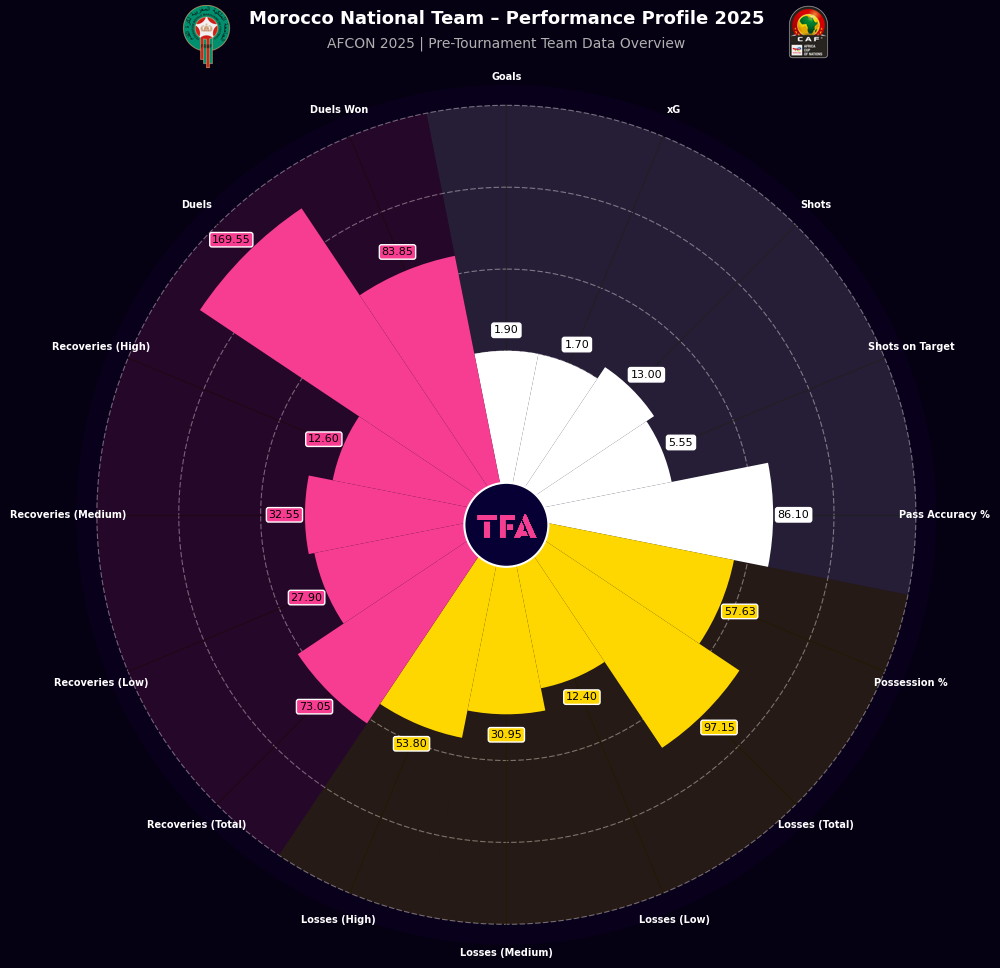
Averaging 1.90 goals per match from 1.70 xG, the Atlas Lions combine chance creation with efficient finishing, while conceding just 0.40 goals from 0.56 xG against, underlining elite defensive control.
Their attacking volume (13.0 shots, 5.55 on target) is matched by territorial dominance, reflected in 57.6% possession and a high-tempo circulation game of 509 passes per match at 86.1% accuracy.
Structurally, Morocco’s flexibility has been decisive.
The 4-1-4-1 and 4-3-3 have underpinned controlled build-up and sustained pressure, while situational switches to 4-4-2 have improved verticality and box occupation.
Defensive organisation remains a pillar; Morocco forces turnovers (recoveries skewed towards medium and high zones) and protects central spaces effectively, limiting opponents to 6.55 shots and 1.90 on target on average.
Their duel efficiency (83.9% won) further supports dominance in second balls and transitions.
Crucially, these patterns have held across competitions, World Cup qualifiers, friendlies, and continental fixtures, suggesting repeatability rather than form spikes.
With home advantage, tactical coherence, and a balanced attack-defence output, Morocco enters AFCON 2025 as the clearest favourites.
Senegal Tactical Identity: The Teranga Lions’ Balanced Threat At AFCON 2025
Senegal arrive at the 2025 Africa Cup of Nations with a squad that blends elite experience with dynamic attacking pace and midfield control, signalling a tactical approach built on balance and adaptability.
Under coach Pape Thiaw, the Teranga Lions maintain a core of seasoned internationals, including captain Kalidou Koulibaly, veteran goalkeeper Edouard Mendy, and forward Sadio Mané, who together offer leadership and high‑pressure experience on the continental stage.
Up front, Senegal boasts a varied and potent attacking line featuring Nicolas Jackson of Bayern Munich, Ismaïla Sarr of Crystal Palace, and the versatile Iliman Ndiaye of Everton, providing speed, physicality, and creative threat in wide and central areas.
The combative Idrissa Gana Gueye provides midfield stability, alongside emerging talents like Pape Matar Sarr of Tottenham Hotspur and promising young midfielder Lamine Camara, enhancing transitional play and ball retention.
Defensively, Koulibaly is flanked by athletic, physical defenders such as Moussa Niakhaté and Ismail Jakobs, which supports Senegal’s structural resilience.
Senegal National Team – Performance Profile 2025
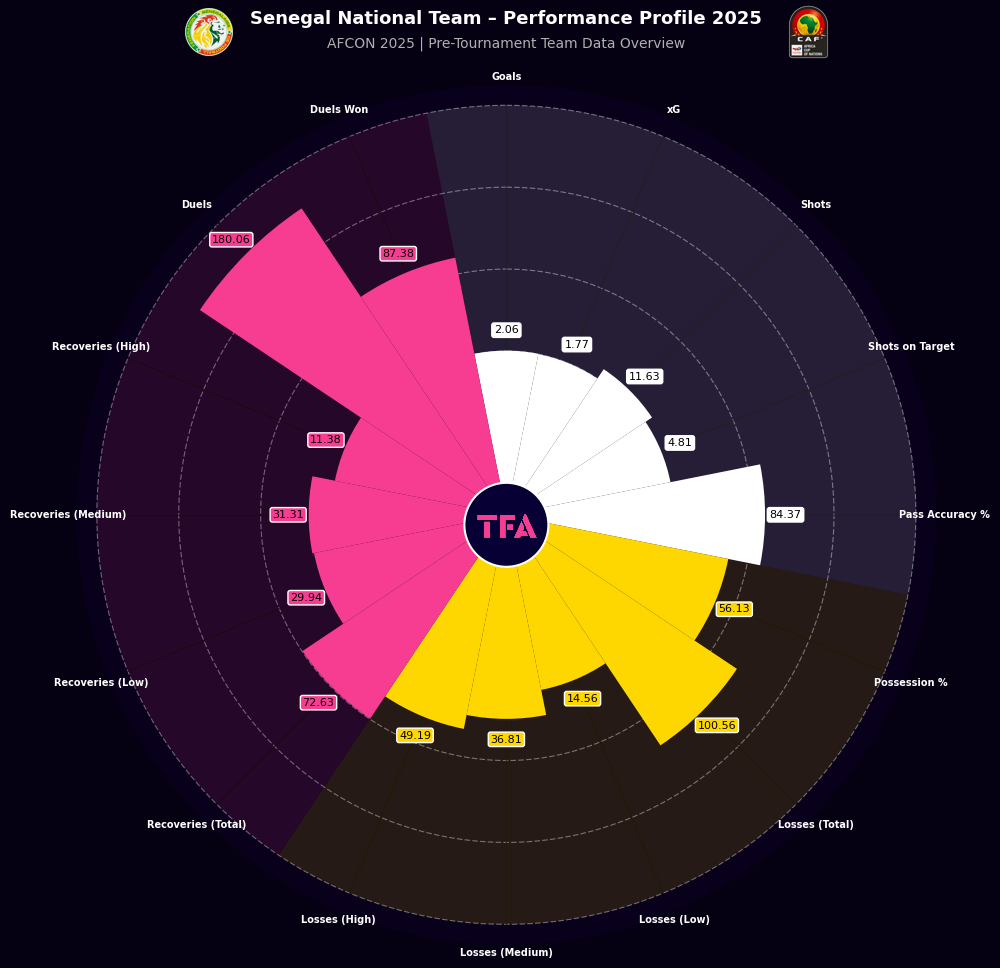
Senegal’s statistical profile across 2025 reflects their tactical balance, averaging 2.06 goals per match on 11.63 shots (4.81 on target), 56.13% possession, and strong passing accuracy (84.37%), while restricting opponents to just 7.44 shots per game and 33.61% possession.
Their recoveries are concentrated in medium and high zones, underpinning proactive pressing, and duel success remains high at 87.38%, demonstrating control in second balls and transitions.
AFCON 2025 Title Contenders: Goals & xG Analysis
The eight leading African national teams display a diverse mix of attacking efficiency and statistical promise heading into AFCON 2025.
AFCON 2025 – Goals vs Total xG – Big 8 African Teams
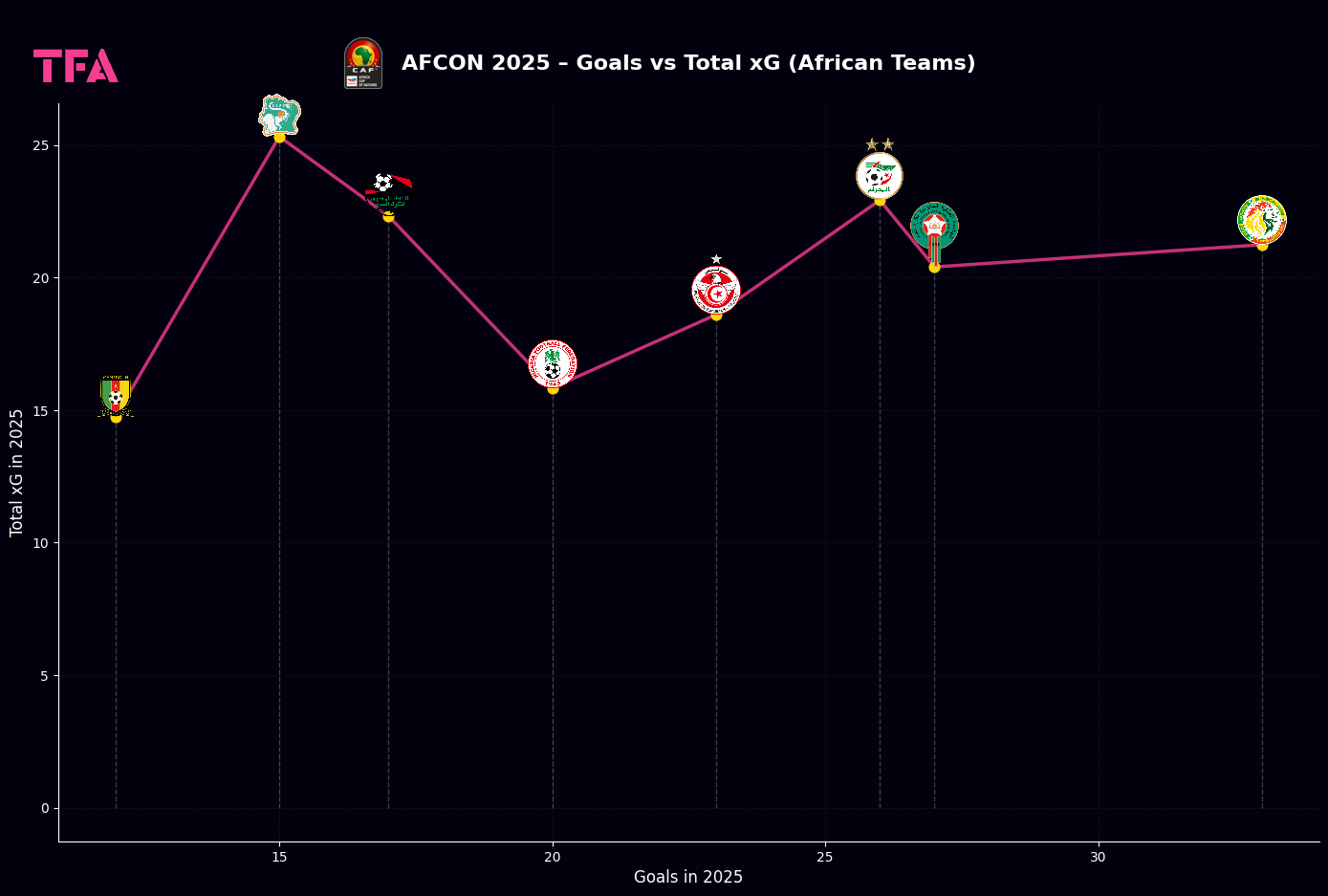
Senegal tops the goals chart with 33 strikes, converting a modest 1.77 xG per match into consistent output, reflecting clinical finishing and balanced forward play.
Morocco, despite scoring 27 goals from a slightly lower xG of 1.70, demonstrates tactical efficiency and home advantage, underlining their status as pre-tournament favourites.
Egypt and Algeria, with 17 and 26 goals respectively, exhibit a positive correlation between their xG totals (22.32 and 22.92) and actual goals, suggesting room for slight improvement in finishing.
Tunisia’s 23 goals from 18.6 total xG, Nigeria’s 20 from 15.84, Côte d’Ivoire’s 15 from 25.32, and Cameroon’s 12 from 14.76 reflect varying degrees of conversion efficiency, highlighting both potential threats and limitations.
Collectively, these metrics indicate a highly competitive attacking landscape among Africa’s elite sides.
Egypt Tactical Identity: The Pharaohs’ Blend Of Experience & Emerging Talent
Egypt arrives at AFCON 2025 with a squad that merges seasoned internationals with promising domestic talents, reflecting a tactical approach built on structured possession and measured attacking transitions.
Under coach Hossam Hassan, the Pharaohs lean on key European-based players to lead their ambitions, most notably Mohamed Salah of Liverpool and Omar Marmoush of Manchester City.
Salah, while not replicating his typically prolific form at Liverpool, carries substantial expectations to deliver decisive moments and provide leadership in attack.
Marmoush, despite his evident quality, has seen limited minutes early in the season due to injury, which restricts match sharpness but not his potential impact when fully fit.
Complementing them, striker Mostafa Mohamed and emerging domestic talents Mahmoud Saber and Ibrahim Adel inject dynamism and creativity, strengthening Egypt’s threat in both central and wide attacking areas.
In midfield, Egypt prioritises stability and efficient ball circulation, supported by disciplined defensive coverage.
Their 2025 statistical profile indicates a balanced, largely untested side, having faced comparatively lower-ranked opposition throughout the CAF World Cup qualifiers.
Egypt National Team – Performance Profile 2025
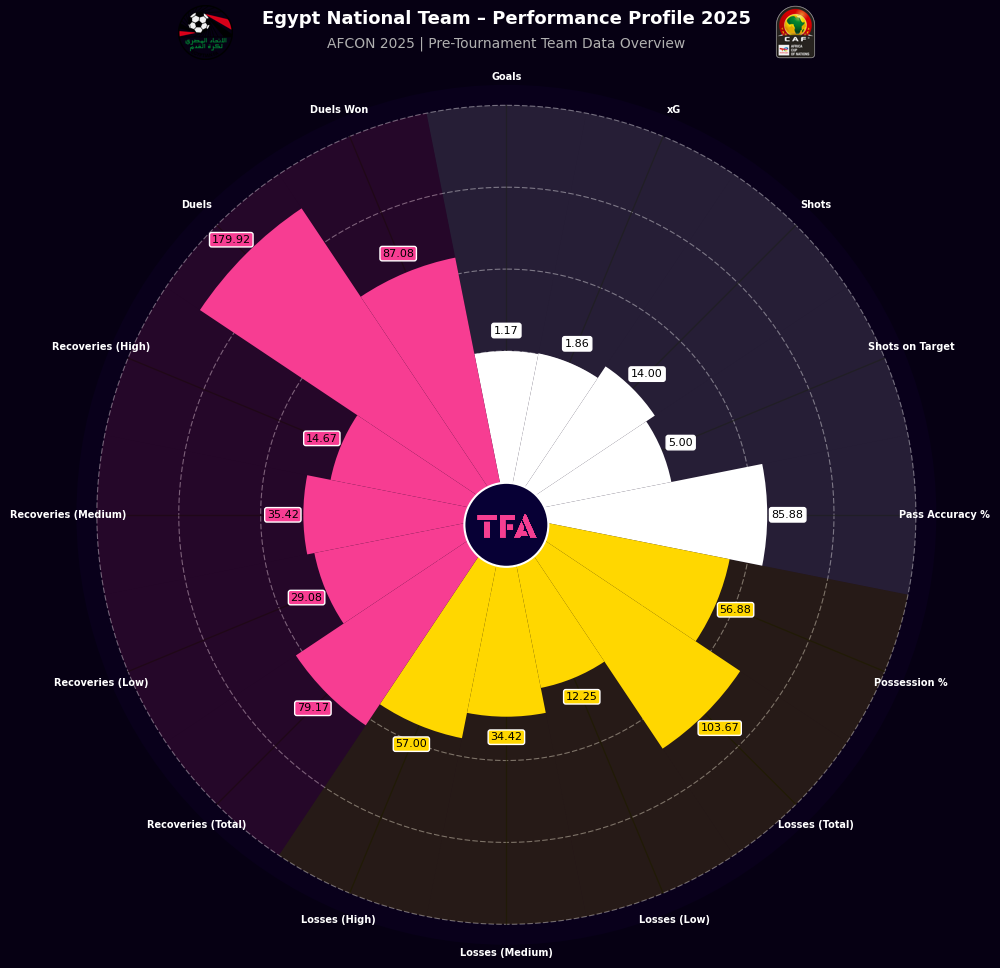
Average 1.17 goals per match from 1.86 xG, with 14 shots per game and five on target, while maintaining 56.88% possession and 85.88% passing accuracy.
Defensively, recoveries are focused in medium and high zones, signalling proactive pressing, with duel success at 87.08%, showing strong control in transitions.
Flexible 4-2-3-1 and 4-3-3 formations allow rapid adaptation to opponents’ strategies while maintaining structural balance.
With a mix of European experience and emerging local talent, Egypt enters AFCON 2025 prepared to challenge for the title, though their credentials remain to be tested against stronger continental opponents.
Central & North African Contenders: Cameroon, Côte d’Ivoire, Algeria & Tunisia At AFCON 2025
The quartet of Cameroon, Côte d’Ivoire, Algeria, and Tunisia presents diverse tactical profiles and attacking approaches heading into AFCON 2025, each bringing a blend of historical pedigree and statistical promise.
AFCON 2025 – Team Performance Comparison – Cameroon & Ivory Coast & Algeria & Tunisia
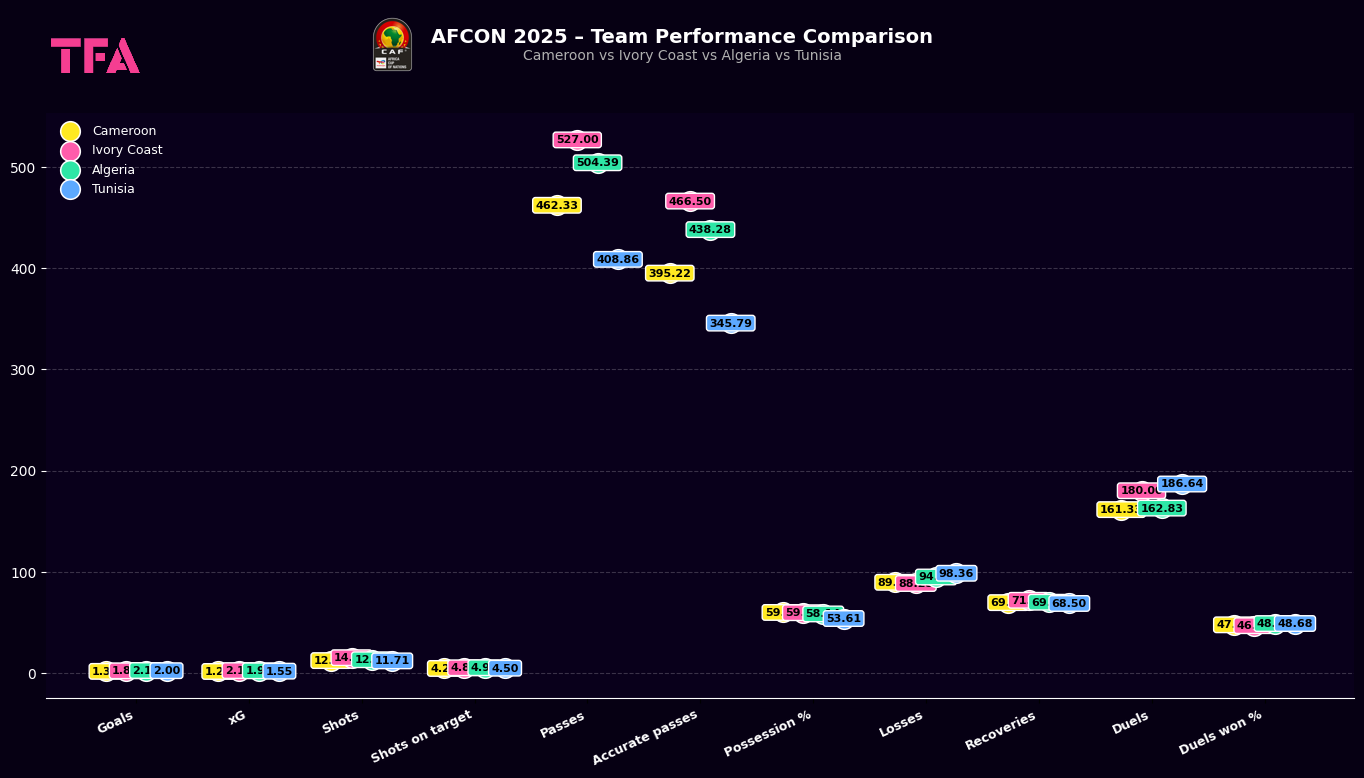
Cameroon displays moderate attacking efficiency, averaging around 1.3 goals per match from an xG of 1.2, creating a handful of shots per game with roughly a third on target.
Their passing is steady, supporting a possession rate close to 60%.
Physicality and resilience are key features, reflected in numerous duels and recoveries, underpinning a team built on work-rate and defensive solidity.
Côte d’Ivoire offers a slightly greater offensive threat, netting nearly 1.9 goals per game from an xG of 2.11.
They generate multiple shots on target and maintain structured possession through disciplined passing.
Their balance of duels won and recoveries highlights a team capable of combining attacking intent with defensive responsibility.
Algeria boasts the most productive attack of the four, scoring over two goals per match from an xG of 1.9, with a high proportion of their shots finding the target.
Efficient midfield distribution and possession around 58% enable controlled build-up and effective transitions, supported by strong duel success and consistent recoveries.
Tunisia relies on precise finishing and organised counter-attacks, converting two goals from an xG of 1.55.
Their passing and moderate possession complement high pressing intensity and active duel participation, reflecting a pragmatic yet proactive approach.
Collectively, these teams offer contrasting tactical blueprints, ensuring AFCON 2025 remains fiercely competitive beyond the traditional favourites.
Nigeria Title Credentials: The Super Eagles’ Challenge At AFCON 2025
Nigeria arrives in Morocco as one of the tournament’s more formidable contenders, blending experience with depth and attacking flair.
The Super Eagles have named a star‑studded 28‑man squad led by prolific forward Victor Osimhen and dynamic attacker Ademola Lookman, with both players among the continent’s standout talents.
Their roster also features Premier League and European mainstays such as Alex Iwobi, Wilfred Ndidi, Frank Onyeka, and Samuel Chukwueze, providing balance across midfield and defence.
Nigeria National Team – Performance Profile 2025
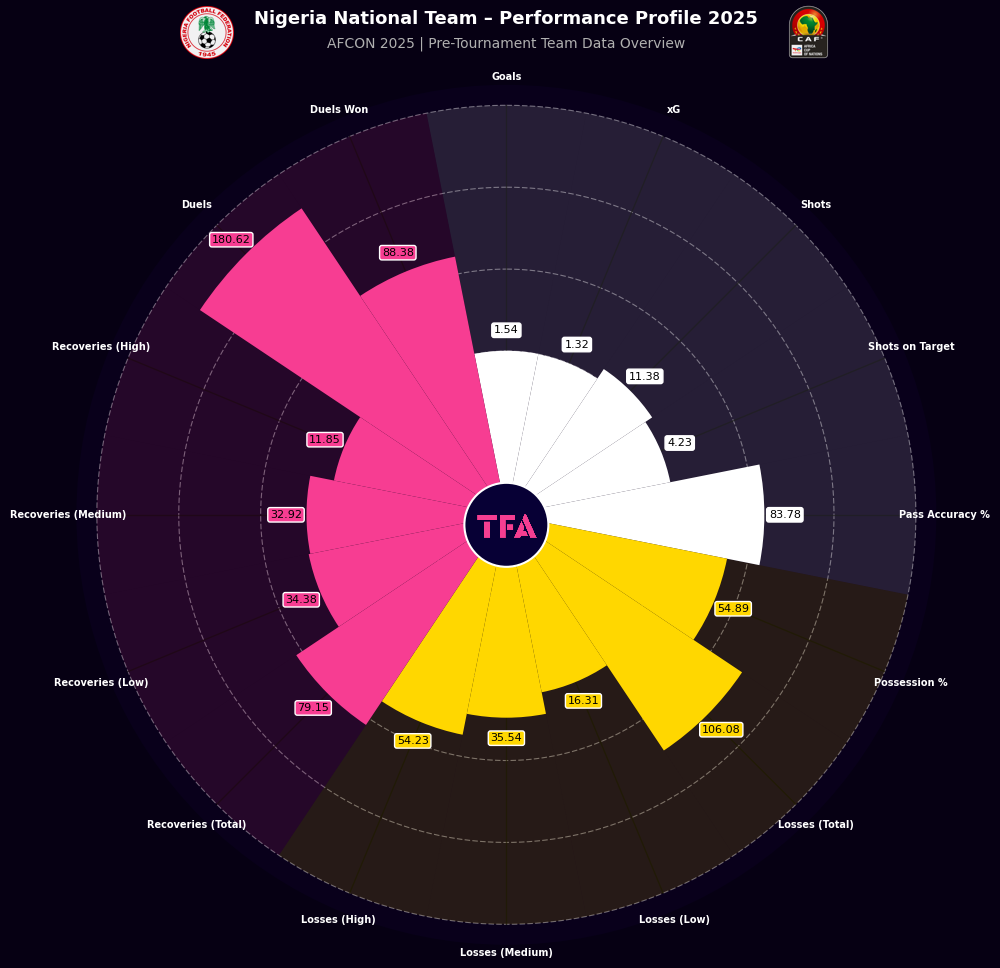
On the data front, Nigeria’s 2025 profile paints a picture of a strong attacking side averaging around 1.54 goals per match from 1.32 xG, with an average of over 11 shots per game and more than four on target.
Their ball progression and passing accuracy support a possession-oriented style, while proactive defensive efforts are evident in their recoveries and duel success rates.
This statistical balance underlines their capability to control matches and threaten on the break.
Combined with a rich AFCON history, including three previous titles and a runner‑up finish in the last edition, Nigeria’s blend of high‑calibre personnel and solid 2025 performance metrics marks them as genuine challengers for silverware.
Conclusion
AFCON 2025 promises to be an intensely competitive tournament, with multiple sides demonstrating both tactical sophistication and statistical prowess.
Morocco enters as clear favourites, combining home advantage with a balanced and efficient style across attack and defence.
Senegal, Egypt, Nigeria, Algeria, and Tunisia each offer distinctive strengths, from clinical finishing and structured possession to dynamic pressing and transitional play.
Historical pedigree, recent form, and squad depth indicate that no single team can be taken for granted, while data-driven insights highlight potential frontrunners and dark horses alike.
Ultimately, the tournament is set to deliver unpredictability, high-quality football, and a showcase of Africa’s elite talent.
