
France’s Ligue 1 is the self-styled ‘League of Talents’.
The French top-flight lives up to this moniker by constantly producing and showcasing some of the best young talents in world football.
On the summer deadline day, 18-year-old Eduardo Camavinga, one of the most high-profile and exciting talents to come through French football’s youth system in recent years, departed from Rennes to join La Liga giants Real Madrid for €31m.
Another one of the premier talents currently on display in Ligue 1 is Pape Matar Sarr (184cm/6’0”, 70kg/154lbs) of Metz.
Tottenham Hotspur signed the 18-year-old midfielder for €16.9m/£15.21m in the last week of the transfer window, with Sarr being sent back to Metz on loan for the 2021/22 campaign.
The Senegalese teenager joined Metz last September from renowned Senegal-based academy Génération Foot.
While discussing Sarr earlier this year, Metz’s current academy manager and former manager of Génération Foot, Olivier Perrin, declared that Sarr “will go very far” in football based on what the teenager has shown during his time working with Perrin thus far.
As Perrin also explained, and as is evident from Sarr’s time at Metz, he has got a versatile skill set.
It’s normal for a young player to ply his trade in several roles before settling in a particular position.
Still, in this same interview from earlier this year, Perrin highlighted the midfielder’s versatility as one of his game’s biggest positives.
While in Génération Foot, Sarr was primarily a ‘number 10’, he has mainly played in deeper midfield roles with Metz – either as a ‘6’ or an ‘8’.
More recently, Sarr was even deployed as a left-winger for Metz.
In this tactical analysis and scout report, we provide some insight into what Spurs can expect from their new signing who is set to arrive at the Tottenham Hotspur Stadium for the 2022/23 season.
Our scout report analyses the key strengths and weaknesses in Sarr’s game using data and video analysis of his role in Metz’s tactics.
We look at some notable traits within the teenager’s game and also explain where we believe the versatile midfielder may ultimately be best suited to playing as he progresses in his career.
Pape Matar Sarr Passing, movement, and dribbling abilities
Sarr has significant strengths and weaknesses on the ball.
Firstly, the 18-year-old doesn’t stand out a lot in terms of his passing.
Sarr performed pretty average across the board for passing metrics relative to other midfielders in Europe’s top five leagues for the last calendar year, including passes attempted, passes completed, passing distance, and progressive passes.
Per Wyscout, he didn’t play a lot of passes (48.32 per 90) on average last season, nor did he have a very impressive pass success percentage (86.7%).
However, both of these numbers depend on the team in which he plays and how possession-dominant they are—Metz is not very possession-dominant—as well as his particular role within that team.
For the most part, Sarr is a relatively safe passer.
He doesn’t break lines with his passing a lot, and tends to play a relatively large number of backwards and lateral passes, with a relatively low number of forward passes by comparison.
However, Sarr does switch play quite a lot.
He loves to attract pressure via his dribbling before switching play to a player who’s enjoying plenty of space partly because of his dribbling.
Per FBRef, Sarr ranks in the 80th percentile for switches relative to midfielders in Europe’s top five leagues in the last calendar year, playing 2.4 per 90 in that time.
Sarr will also play through balls to free up players closer to him when the opportunity presents itself after he attracts pressure and creates space for others via a dribble, though he does this relatively rarely compared to how often he switches play.
Again, Sarr isn’t a big risk-taker in general in terms of his passing, with the vast majority of his passes being safer.
Still, you can expect him to play riskier passes like these after attracting pressure on occasion, which is largely why his pass success rate isn’t stellar despite playing a large number of fairly safe passes.
The Metz midfielder played 6.05 progressive passes per 90 last season with 69.03% progressive pass accuracy.
Neither of these numbers ranks particularly highly amongst Ligue 1’s central midfielders, highlighting that Sarr, at present, isn’t one to contribute much in breaking the first/second line of pressure during build-up via his passing.
He also ranks in the 54th percentile among midfielders from the top five leagues for progressive passing over the last calendar year, which is fairly average.
His passing ability isn’t really at the level required right now for him to play the role of a deep passer in build-up, breaking lines with his passing and accurately finding teammates in more dangerous spaces ahead of him.
However, Sarr performs very well as a progressive ball carrier, which may be a more suitable role for him in terms of ball progression.
The Senegal international made an impressive 2.52 progressive runs per 90 in Ligue 1 last season, which ranks highly in this particular metric.
Additionally, Sarr ranks in the 89th percentile for progressive carries and the 93rd percentile for progressive carrying distance.
The midfielder loves to receive the ball and drive upfield with it on his own, taking on opposition players and trying to beat them 1v1.
He is a strong dribbler with a fairly unique technique, which we’ll examine later in this tactical analysis piece.
If Sarr receives the ball deep, expect him to try to dribble it past opposition players and upfield on his own rather than look to make a progressive pass.
In the ball progression phase, his carrying ability exceeds his passing ability, and he tends to be more successful when trying to progress play like this.

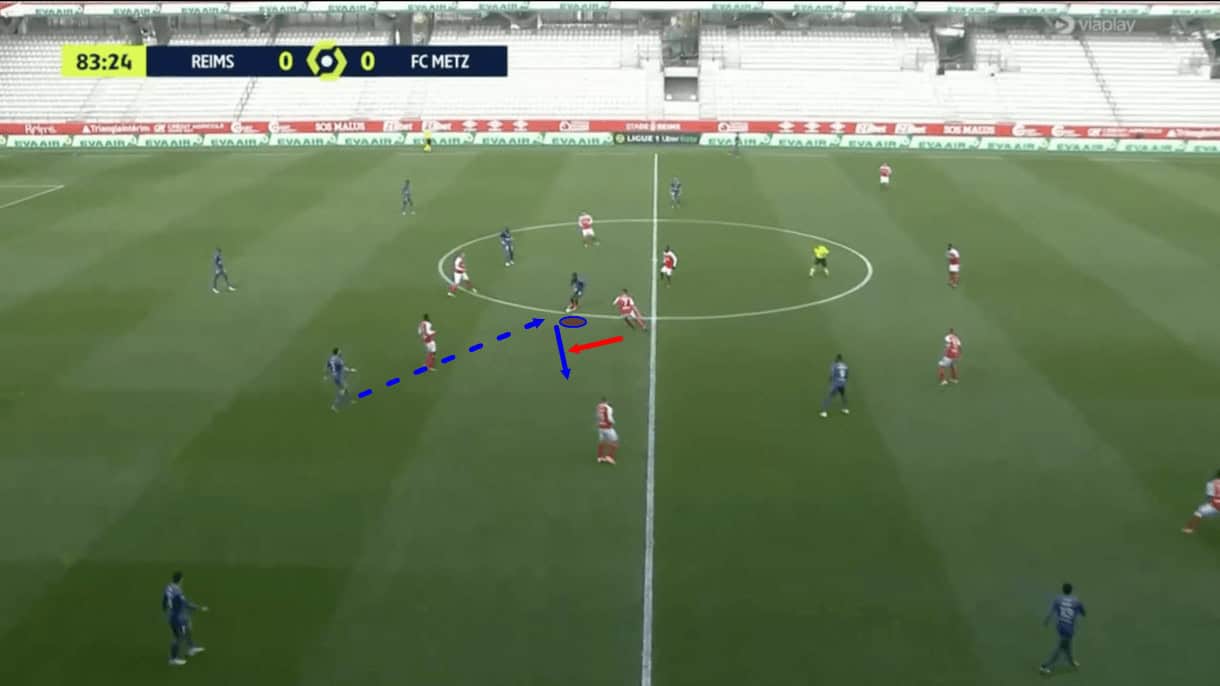
In figure 1, we see an example of Sarr occupying the left central midfield position during the build-up as Metz play the ball past the first line of pressure from the centre-backs into central midfield.
Just before this image, Sarr dropped and shifted slightly wider to find space and make himself available to the centre-back for this pass.
Sometimes last season, particularly early on in the campaign, Sarr occupied the holding midfield position.
However, he’s slowly moved further upfield as his time at Metz has progressed and this seems to suit him and his playing style better in all phases of play.
Ultimately, we feel that Sarr may be best suited to playing as an advanced ‘8’ with plenty of license to advance in attack.
He is good at roaming about and finding space in this left half-space position to receive progressive passes in build-up.
From here, he can receive with his back to goal and he’s generally very good at protecting the ball from opposition players pressing him by keeping his body between the man and the ball, making himself big and using his strength to retain possession.
Additionally, Sarr has really good technical ability in terms of his dribbling, which also helps him to retain possession when opposition players press him.
In a situation like the one in Figure 1, it’s common to see Sarr either play a pass into central midfield, potentially finding the holding midfielder with a safe pass, allowing them to then progress the ball forward with a riskier pass after receiving while facing forward, or try to turn and carry the ball forward himself, if possible.
Sarr is good at carrying the ball upfield over long distances, as we’ve established.
However, carrying the ball from deep does have its own dangers.
For instance, in Figure 2, we see Sarr just receiving a pass from the right centre-back while dropping deep to make himself available.
As he receives the pass, he’s surrounded by several opposition players.
Despite this, Sarr attempts to turn and drive forward with the ball.
The midfielder attempts to attack space to the left of the opposition’s midfield.
However, as he takes his first touch and moves the ball into the area he’s aiming to attack, he loses possession due to a heavy first touch, allowing the opposition’s left central midfielder to essentially pick his pocket and take possession away, starting a counter-attack from a dangerous position for his side.
It’s common to see Sarr take relatively heavy touches like this while carrying the ball.
He’s generally pretty quick so can make up the ground and keep himself between the opposition and the ball, but not always.
On occasion, his heavy touches can work against him and allow the opposition to steal possession away.
This is perhaps another reason why Sarr is better suited to playing in a more advanced role, at least for the moment, than a deeper role, as the risk of losing the ball due to a heavy touch in a deeper position, as we see in Figure 2, may be too great.
This is also partly a critique of decision-making, which is always going to be far from perfect in younger, inexperienced players and nothing to worry about.
If anything, it should be good news for Metz and Tottenham fans that Sarr has made these mistakes in the past and learned from them to better himself as he progresses in his career.
The midfielder’s technical talent, physical attributes and mental skills – like the ability to find space – are very impressive in a lot of key areas.
Decision-making is one potential area of improvement, but it’s to be expected at this point in his career and he is learning in ‘The League of Talents’.
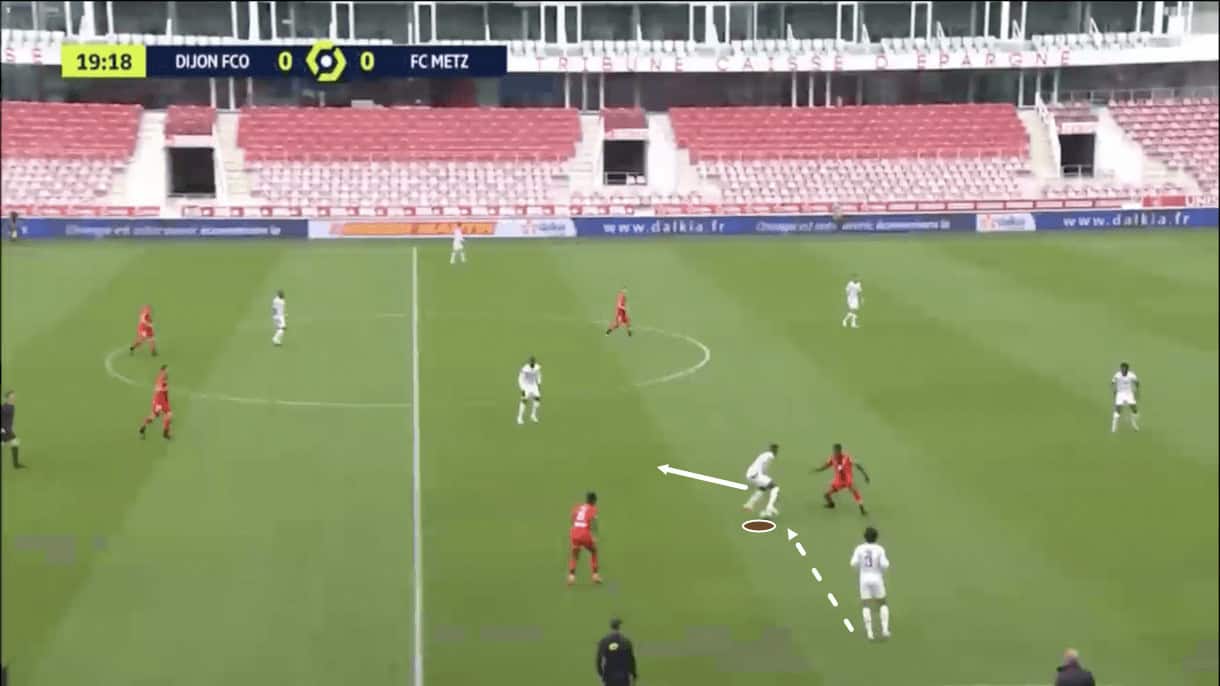
Figure 3 highlights another example of Sarr receiving the ball just inside his own half.
This time, he’s received the pass from the left wing-back.
Just before this image, when receiving the ball, Sarr was facing the left wing-back directly.
As the pass made its way to him, he began to turn inside to face central midfield, rotating around anti-clockwise.
While Sarr received the ball and turned, an opposition player pressed him. Seeing the direction of his movement, the player positioned himself between Sarr and the backline, anticipating that he was aiming to escape in this direction.
However, as play moves on, we see that Sarr actually makes a full 180, which leaves the opposition player in a helpless position. Sarr simply turns and passes the ball into central midfield before helping his team create a 3v2 overload in this area and progress further.
This passage of play shows an example of Sarr’s impressive hip mobility and agility.
He’s agile and great at using his hips by rotating them to help turn quickly and smoothly.
This can sometimes mislead opposition players, as we saw here, helping Sarr escape pressure and progress play.
As mentioned previously, Sarr is great at using his body and strength to protect the ball from opposition players.
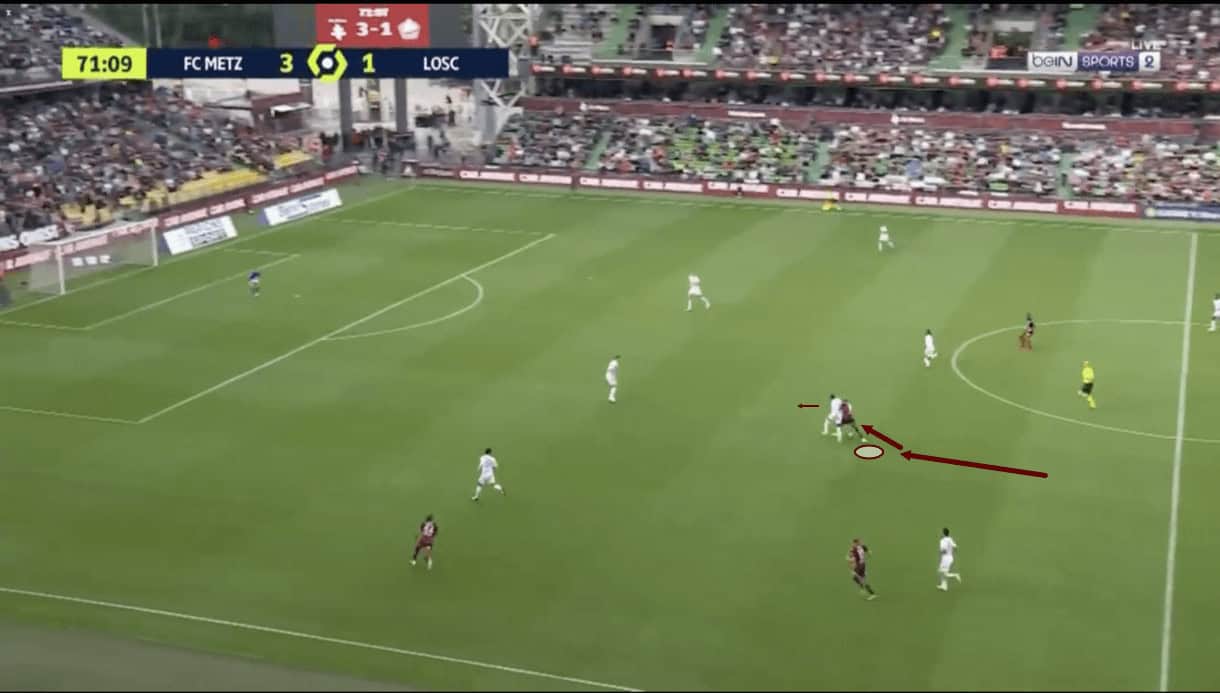
We see an example of this in action in Figure 4.
Just before this image, Sarr drove upfield with the ball, attracting pressure from the opposition player currently challenging him.
As this player approached, Sarr took a big step, planted his back foot firmly in the ground as he got his other leg around the ball, and pushed off.
He used his shoulder to outmuscle the opposition player and protect the ball while continuing his run.
This provides an example of how Sarr manages to get his body between the opposition and the ball to retain possession.
One of his most impressive attributes is his ability to use his strength on the ball to keep opposition players away.
He is challenging to beat for strength in situations like this.
While he can be dispossessed when taking a heavy touch, when he sees challenges coming and deliberately keeps the ball close, Sarr can make defenders bounce off of him in a physical 1v1 duel.

In figure 5, we see another example of Sarr finding some freedom in the left half-space while playing in the left central midfield position, similar to figure 1, but this time with Metz at a slightly more advanced stage of the attack.
Just before this image, Sarr was positioned wider and slightly deeper, out of the ball carrier’s line of sight and potential passing range, with an opposition player positioned between Sarr and the ball.
However, as mentioned earlier, Sarr is very good at roaming around while using his vision to find space in this more advanced central midfield position, which is how he ends up free to receive a pass here.
Enjoying plenty of space to receive, Sarr turns with relative ease when he receives possession and immediately gets his head up to spot the runners ahead of him while carrying the ball forward and attracting some pressure.
Metz’s left wing-back enjoys lots of space while running forward and Sarr attempts to play him through in behind.
As mentioned earlier in this peace, it’s common to see Sarr attract pressure while carrying before attempting to play a runner through in space ahead of him.
However, while right-footed Sarr intelligently aims to play the ball ahead of the runner, his pass has to curve towards the opposition right-back first, leading to an opposition interception before the pass is completed.
So, while Sarr demonstrated intelligent movement and some good vision here, the opposition defended this chance very well and exploited the fact that Sarr’s pass would inevitably get close to the defender before finding the left wing-back.
However, this does provide an example of Sarr’s threat from this advanced ‘8’ position.
He has demonstrated the ability to play teammates through behind the opposition’s backline from positions and situations like this during his time at Metz, which is something we expect to see develop further this season.
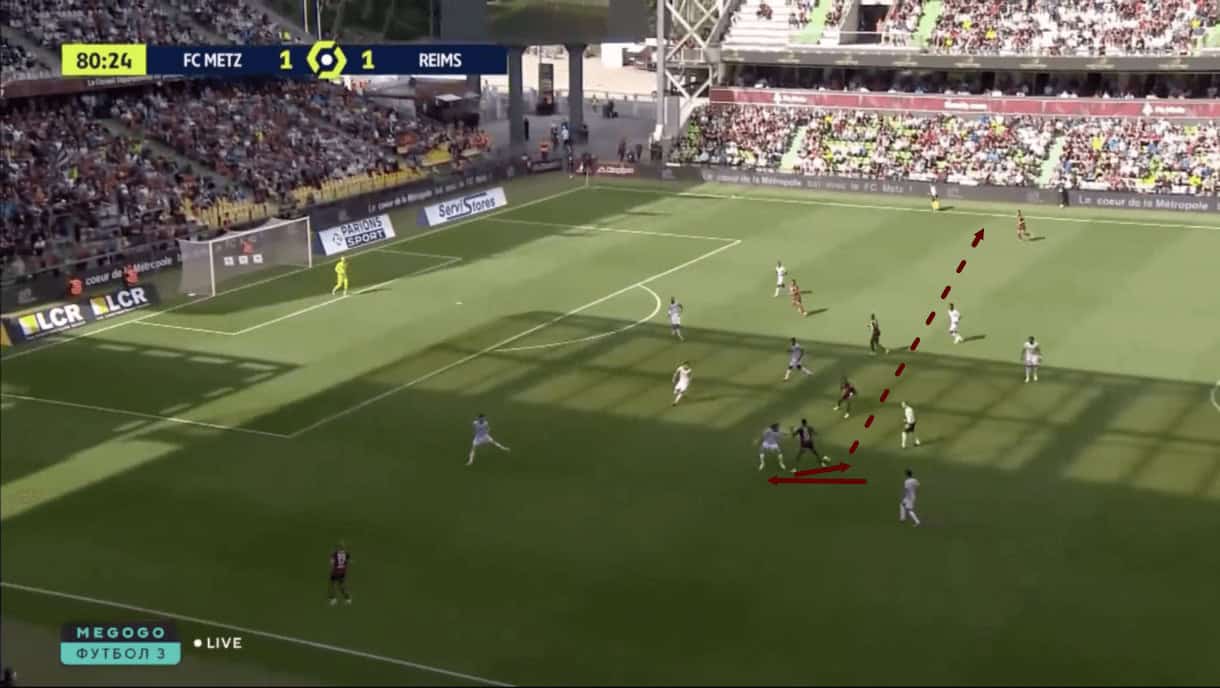
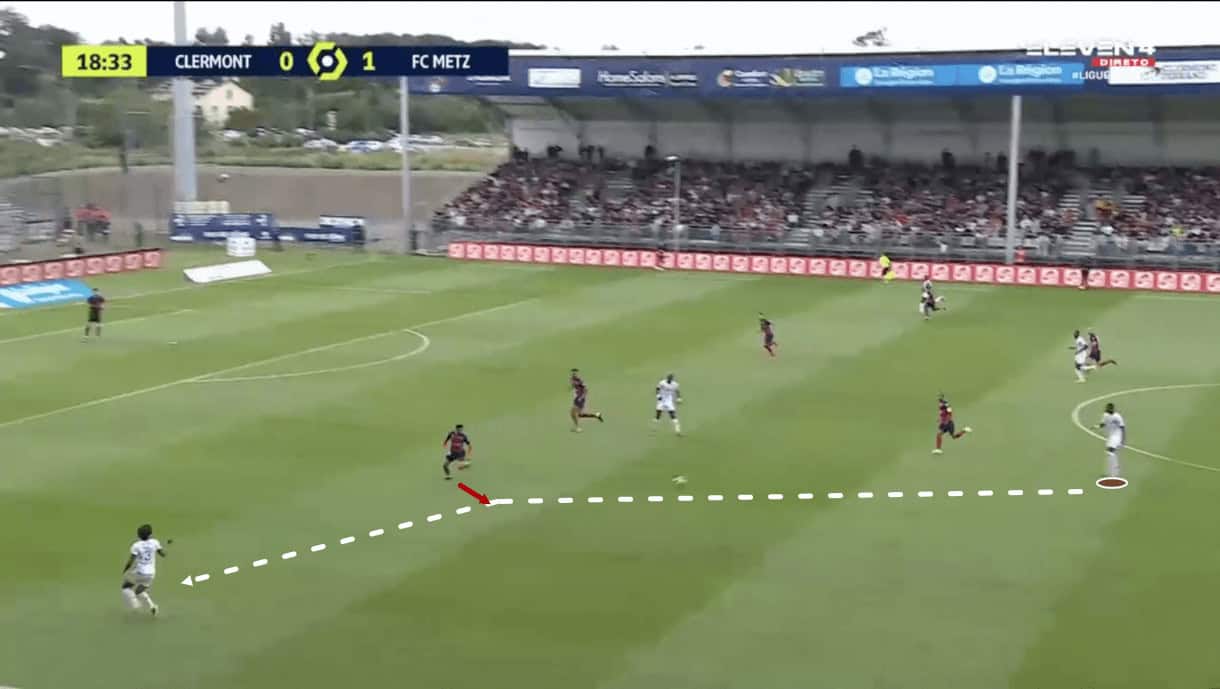
In Figure 7, we see an example of Sarr switching play, which he tries to do relatively frequently, as discussed earlier in this tactical analysis.
Firstly, just before this image, Sarr received a short pass in the left central midfield position that we see him occupying.
As he received the ball, he took a big step out towards the left wing with his left foot before quickly turning back inside, knocking the ball slightly more central, and getting his head up to switch play to the free man on the right wing.
Sarr’s initial feint towards the left wing was crucial in creating space for him to turn back inside and line up this switch.
This sent the opposition player pressing him out to this wing—again, highlighting Sarr’s ability to manipulate opposition players via his movement before quickly changing direction.
This time, his hip mobility played an important part again, as did his quick thinking.
Then, Sarr used his impressive vision to pick out this opportunity to switch, before playing the ball across the field to the free man.
While the previous passage of play we analysed highlighted Sarr playing a through ball after attracting pressure, this one highlighted Sarr’s tendency to switch play under pressure when space is available on the right wing.
This is a really common part of his game and an area in which he thrives thanks to his vision and technical ability, both in setting up and executing the switch.
While Sarr’s passing isn’t incredible overall, his ability to switch plays does help him set up opportunities for chance creation.
This kind of ball won’t often result in an assist, but it can lead to an assist for the receiver – or at least a shot assist.
All in all, Sarr is good at exploiting space.
He’s good at finding space in central midfield, creating space by attracting opposition players towards him, and exploiting space through passes like we saw him attempt in figures 6 and 7.
The ability to exploit space is a key strength for any midfielder, both in terms of technical and mental qualities and Sarr possesses plenty of it.
Pape Matar Sarr Defensive abilities
Sarr performs impressively in several key defensive metrics.
Specifically, Sarr ranks in the 90th percentile for dribblers tackled, the 80th percentile for successful pressures, and the 90th percentile for interceptions, all relative to midfielders from Europe’s top five leagues for the last calendar year.
The Senegal international is extremely active defensively.
He loves to be proactive and step up in midfield to win the ball back for his side when he sees the opportunity to do so, as opposed to dropping back and being more patient with his defending, which there’s nothing wrong with but it’s not Sarr’s game.
Regardless of whether his team is defending high or low, he is aggressive, likes to hunt for the ball if given the opportunity and generally regains possession successfully regularly.
Sarr performed 10.02 successful defensive actions per 90 last season, which ranks him impressively among Ligue 1’s central midfielders.
Additionally, he ended the 2020/21 campaign with a 64.12% defensive duel success rate, which is very good for a Ligue 1 midfielder.
Lastly, we already mentioned that Sarr performed impressively in terms of interceptions, which is true.
He made an impressive average of 4.66 interceptions per 90 minutes in France’s top flight last term.
From our analysis of what Sarr brings to his team on the ball, we know that he is a physically imposing player.
Of course, this also helps him succeed in defensive duels, where he has a high success rate.
However, Sarr demonstrates a good reading of the game to perform so many interceptions, with his interception-making ability arguably being even more impressive than his ability in defensive duels.
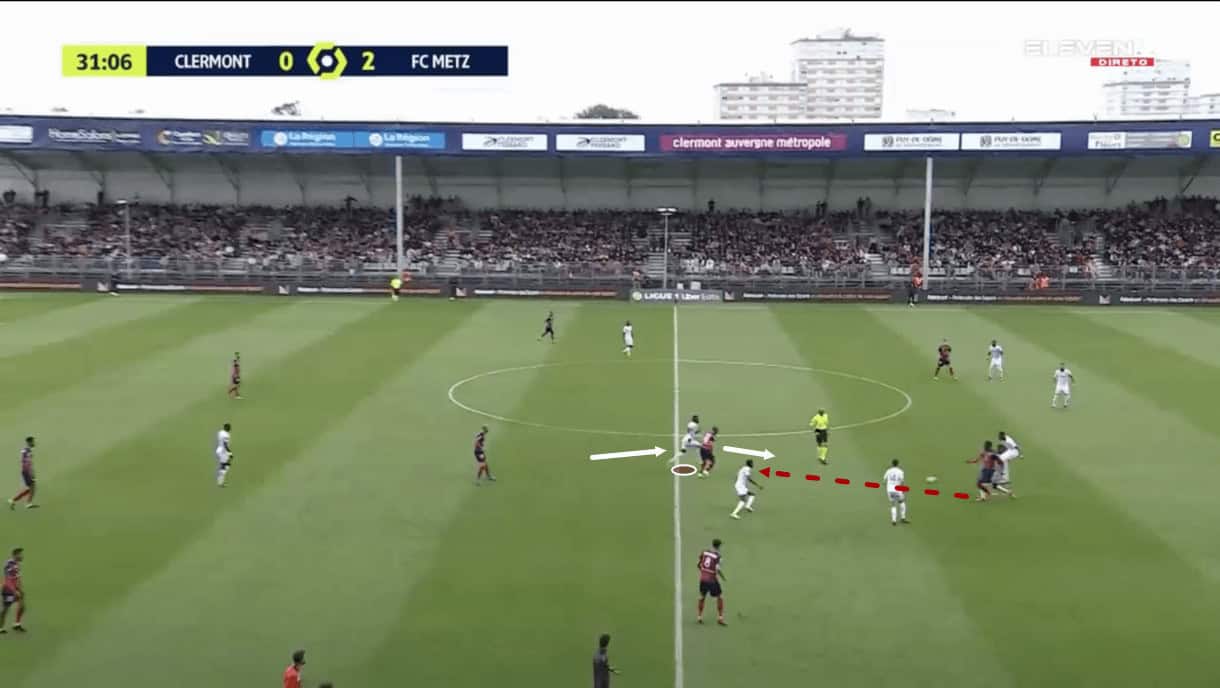
In figure 8, we see an example of a passage of play in which Sarr successfully made an interception in central midfield as the opposition attempted to play the ball backwards.
Just before this image, Sarr was sitting slightly deeper and the opposition forward, under pressure, spotted the player in front of Sarr as a potential pass receiver.
As a result, this pass was played.
However, Sarr spotted the danger and quickly sprung into action just as the ball left the passer’s foot.
As the play moves on from this image, we see Sarr get to the ball before the intended receiver, who continues to stand in this position, waiting for the ball while Sarr continues running and ultimately gets in front of him.
This is an example of Sarr’s impressive ability to read the game and his physical quickness.
He reacts well in situations like this, where the opposition has a chance to play through or just into central midfield. He springs into action, frequently occupying positions to pull off interceptions and prevent them from happening.
He is proactive about regaining possession, which can result in him getting drawn to the ball on occasion.
However, thanks to his technical defensive qualities, this often leads to him regaining possession.
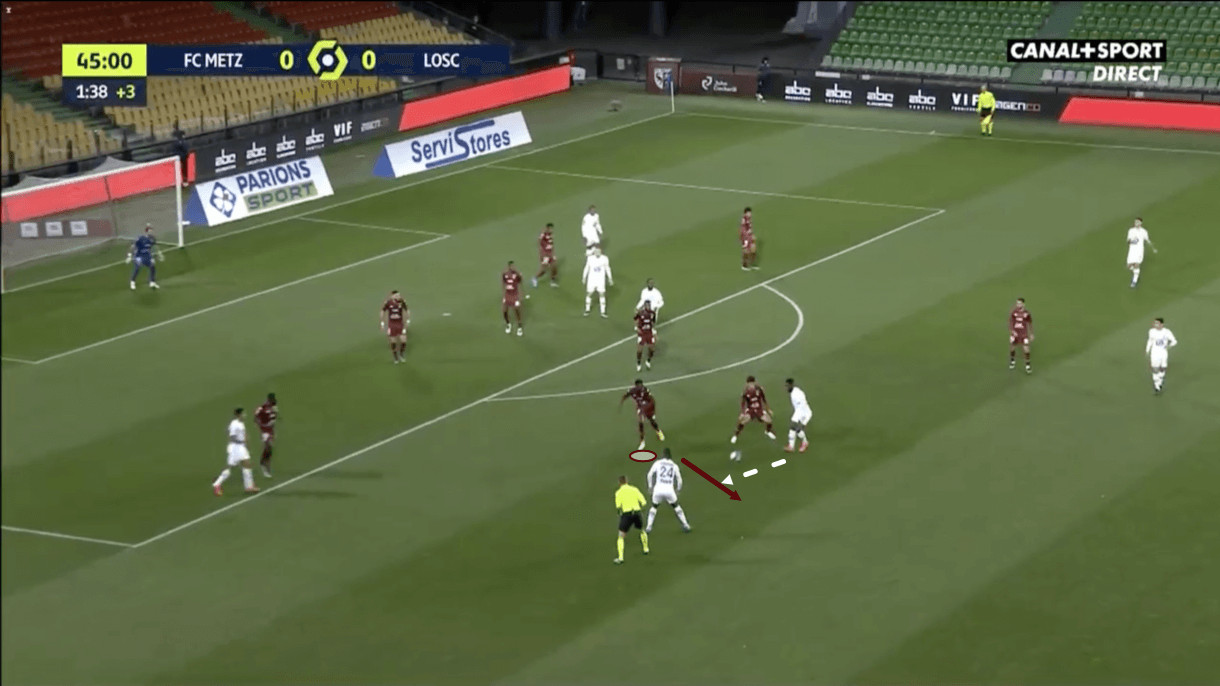
Figure 9 highlights another instance of Sarr making an interception.
However, on this occasion, Metz defends in a more organised low block than in the previous image.
Even in these instances when Metz, in general, are more organised, Sarr operates quite aggressively.
Here, as the opposition play the ball around in central midfield, searching for an opening they can exploit in Metz’s defensive structure, Sarr springs into action as a pass is played from one central midfielder to the other near to him which he deems getable.
As play moves on, the 18-year-old is proven correct.
He makes the interception, putting an end to this passage of play for the opposition and kickstarting a Metz counter-attack via a carry.
Sarr is always on alert on the edge of his side’s defensive structure.
He almost patrols around the edge of the defensive structure, waiting for an opportunity to pounce on a heavy touch or a slightly under-hit or misplaced pass.
When that opportunity comes, he never hesitates to jump in and attempt to steal back possession.
Similarly to when his team is in possession, Sarr is currently at his best when played in an advanced position when defending—in a low block, mid-block, or high block.
This could change in the future, as he’s still a young player with much to develop.
However, again, at present, this promotes the idea that he should play as an ‘8’ rather than a ‘6’.
In Figure 9, we see how Metz’s ‘6’ operates in a much more disciplined role, screening potential passes into an opposition player just on the edge of the box and sticking to him tightly while Sarr presses more aggressively.
Of course, Sarr could be given this role, but at present, he clearly likes to press aggressively and does this very well, so it may be better to use this ability and allow Sarr to defend, as we see in Figures 8 and 9.
The previous two passages of play highlight that Sarr is good at observing his surroundings, processing all of the information available to him on the pitch, and spotting danger.
This helps him intercept opposition passes, as shown in Figures 8 and 9, while it can also help him track runners in dangerous areas, as shown in Figure 10.
Here, an opposition midfielder is making a run to arrive late on the edge of the box to exploit space with Metz’s defenders mainly positioned inside the box.
If this player had been left unmarked, he could have enjoyed a lot of space on the edge of the box, from where he would present a significant threat to Metz’s goal.
However, Sarr intelligently and diligently spotted and tracked the run, arriving in this position between the ball carrier and the intended receiver in time to intercept the pass and regain possession, stopping a dangerous attack and kickstarting a counter-attack for his team.
This passage of play provides another great example of Sarr’s ability to read the game, spot danger and position himself intelligently to deal with it.
He is good at marking runners from midfield in situations like this and preventing them from hurting his team.
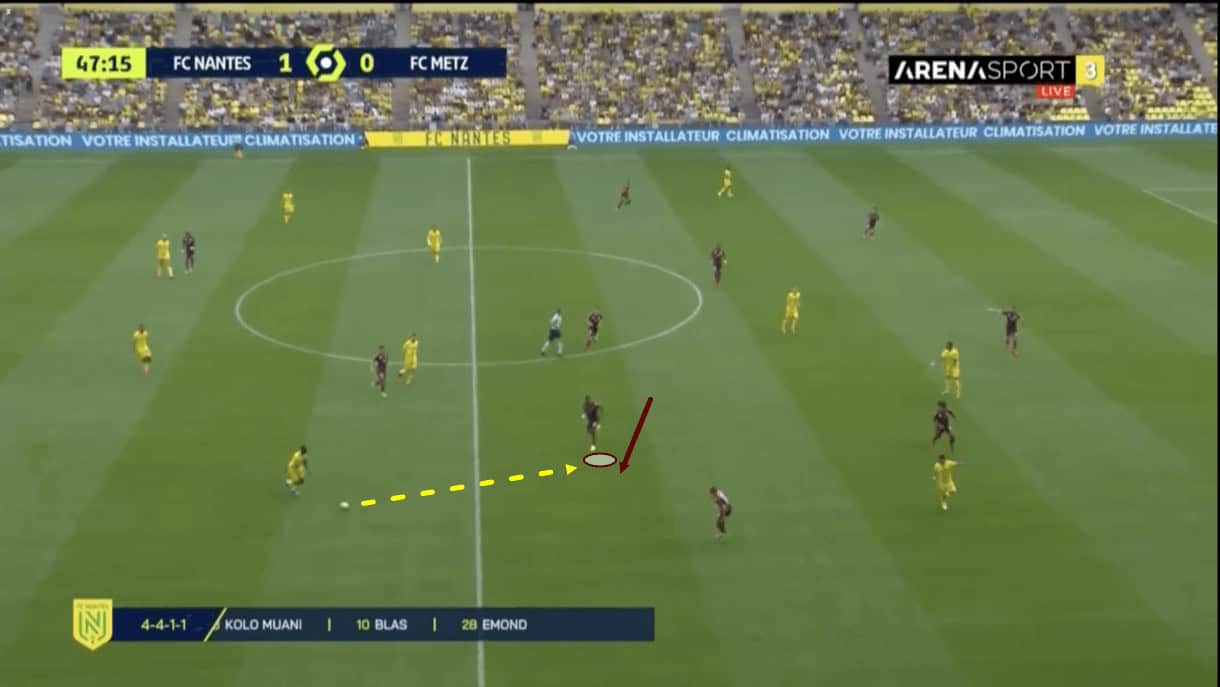
Sarr is also excellent at cutting off passing lanes through his positioning and intelligent reading of the game, as shown in Figure 11.
Just before this image, Sarr was positioned more centrally, while the opposition right-back received a pass from the right centre-back before shifting out into this wider position and lining up a pass to the centre-forward.
However, as figure 11 shows, Sarr spotted the danger, moved wider and cut off this passing lane perfectly.
As play moves on from figure 11, we see the opposition right-back still attempt to play this pass to the centre-forward hard along the ground, which leads to Sarr making the interception.
Again, we see how Sarr’s reading of the game, proactive style, and defensive positioning help his team to defend the centre of the pitch well.
He is good at marking, reading the game, performing interceptions, using his strength to outmuscle attackers, and cutting off passing lanes.
On the downside, he can be manipulated by intelligent attackers who exploit his proactive style, and he can be drawn into tackles by tricky dribblers who are happy to take him on 1v1.
He is good at defending 1v1, but some dribblers are very difficult to stop, so this is still risky.
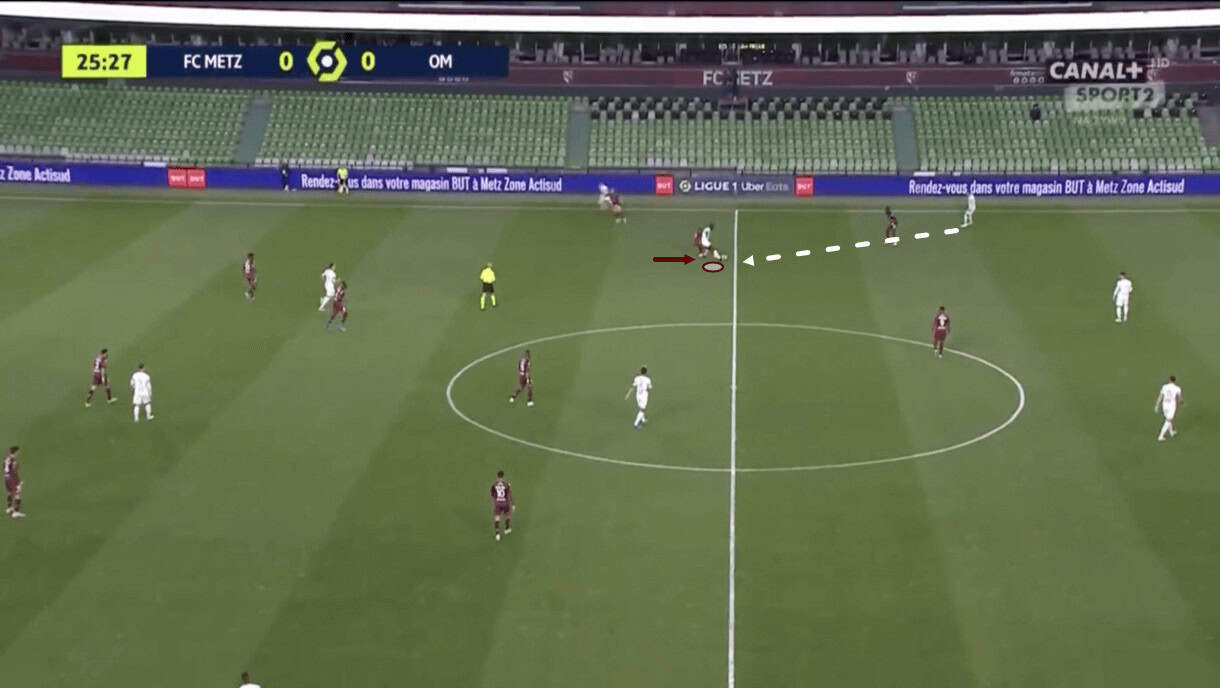
A couple of other things to note regarding Sarr’s defensive style – firstly, he is good at getting tight to players in central midfield when necessary and preventing them from turning, while he’s happy to let them try and back into him because he’s strong enough to hold his ground and force them backwards.
Additionally, as Figure 12 shows, he has fairly long legs, which he uses in these situations to reach around attackers and legally knock the ball out of their feet.
A lot of defenders would struggle to do this without giving away a foul, and while Sarr’s by no means immune to conceding fouls in situations like this, he tends to use his legs like this relatively often and generally does so quite successfully.
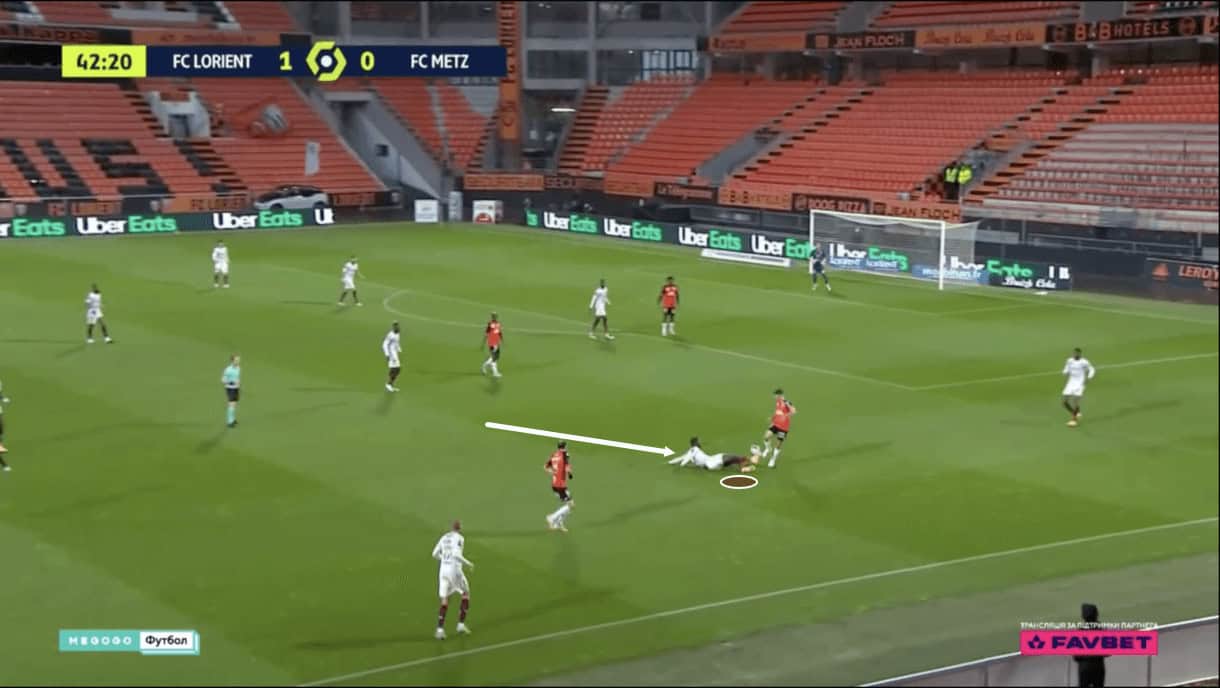
Our last point on Sarr’s defensive abilities will focus on slide tackles.
Sarr performed 0.86 slide tackles per 90 last season, which ranks him very high in this area among Ligue 1 midfielders.
We see an example of Sarr diving into a slide tackle in figure 13.
Just before this image, the opposition ball carrier received a pass facing away from Metz’s goal and took a fairly heavy touch.
Sarr saw this as an opportunity to regain possession and sprinted from midfield to perform this tackle.
This pays off on occasion, however, plenty of the time, Sarr’s slide tackles are unsuccessful and ultimately don’t help his team, as was the case here, as the opposition ball carrier was able to control the ball before Sarr arrived and drag it away from the tackler.
This allowed the opposition to get past Sarr and attack Metz’s box with one less defender momentarily.
So, we can see, again, how Sarr’s aggressiveness can be manipulated and turned against Metz at times, which is perhaps something for Sarr to work on but could be chalked down to a young player’s decision-making, to an extent, again.
Given that he is good at reading the game and positioning himself intelligently, though, it does seem unnecessary to dive in so much.
Pape Matar Sarr Shooting
Lastly, we’ll analyse Sarr’s shooting, which is a notable part of his game.
Sarr is a very active midfielder in terms of shooting.
He ranks in the 90th percentile for shots and the 83rd percentile for shots on target among midfielders from the top five leagues over the last calendar year.
However, Sarr does rank in just the 46th percentile for shots on target%, and his shot efficiency is up for question.
Some of Sarr’s shots do come from free-kicks.
However, he also does love to take on a long shot when the opportunity presents itself.
Last season, Sarr managed to score three league goals in 22 appearances, but it’d be very fair to say that luck played a major factor in at least two of those goals, with deflections playing a big part in the goals being scored, and it may be too soon to call Sarr a long-shot specialist based on last season’s return, especially as despite, obviously, aiming for the goal with all of his shots, plenty of Sarr’s long shots have ended up going very high and/or wide.
Again, we can point to Sarr’s decision-making with long shots as a potential area of improvement.
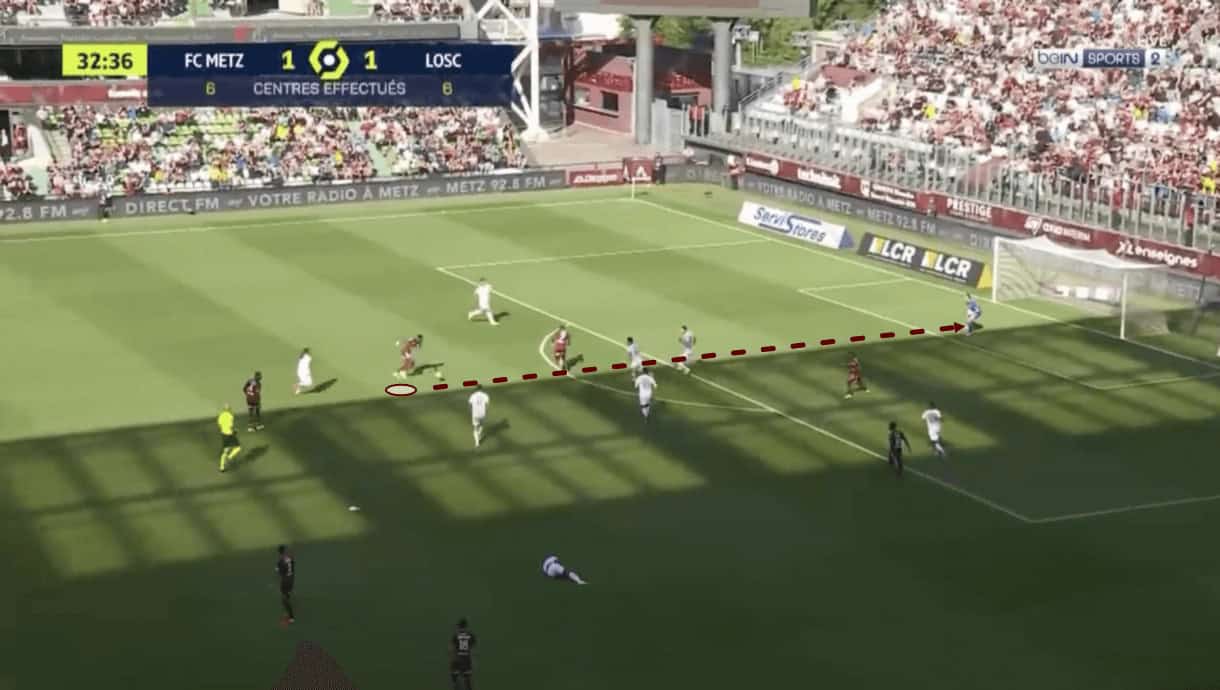
In figure 14, we see an example of Sarr hitting a long shot from a central position.
This shot was a very successful one.
The midfielder kept it low, hit it with a lot of power, and forced a save out of the ‘keeper.
This led to a corner, which is a good result, especially if a team wants to focus on taking advantage of set-pieces, but could just as easily have led to a rebound for an attacker to take advantage too.
Sarr is dangerous from this type of position, which is a valuable one if you are a player who’s comfortable with taking long shots.
Sarr is capable of putting a lot of power on his shots, which adds a good level of threat to these attempts as well.
He doesn’t always go for power over accuracy – the Senegal international often likes to try and bend shots into the top corner and frequently mixes up his shot style.
However, he has been more successful with the low, powerful shots from the position we see him occupy in Figure 14.
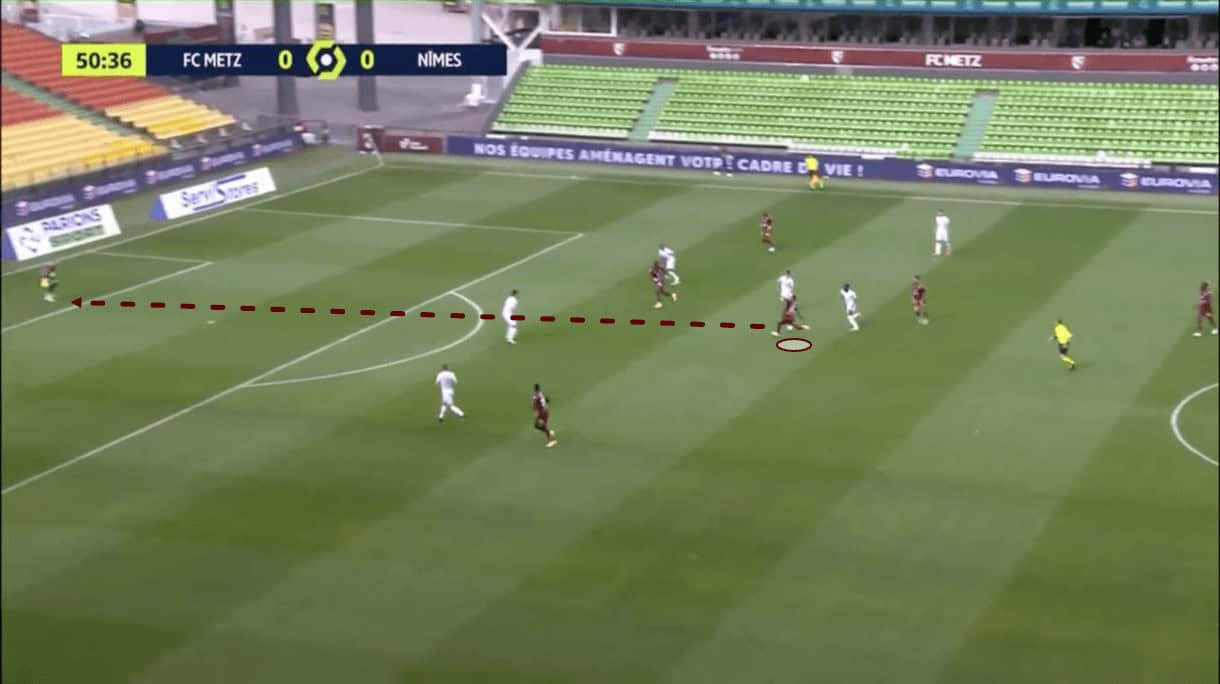
In figure 15, however, we see an example of Sarr hitting a long shot from further out, at more of an angle to the goal, and with his body at more of an awkward angle to be shooting from.
In Figure 14, Sarr gets his body over the ball and positions himself well to keep it down and hit it with power.
In Figure 15, though, he’s leaning back. While he’s attempting to focus on accuracy and bend more than power here, he doesn’t really set himself up correctly to hit the shot, doesn’t give himself enough room to swing his leg at the ball, and ultimately, this shot bounces before reaching the keeper and is easily collected.
These two images highlight the contrast that exists in Sarr’s long shots.
In our view, he can be a long-shot threat but needs to work on his decision-making and his technique in these situations.
He displays excellent technique sometimes, but poor technique on other occasions, so if Sarr can improve his efficiency and decision-making with long shots, then maybe this will prove to be a valuable part of his game.
However, at present, he is sometimes wasteful with long shots.
Conclusion
To conclude this scout report, we feel that Sarr may currently be best suited to the ‘8’ position.
He is an excellent ball carrier who turns well, displays agility, and uses his strength on the ball to drive his team upfield and protect possession.
Sarr can be viewed as more of a safe passer in general but does take risks with through balls and switches at times when he can take advantage of space created via his carry.
Defensively, Sarr is already really impressive.
He is best when defending aggressively, as he likes to hunt for the ball, seeking opportunities to proactively regain possession and start counter-attacking opportunities.
He’s good at reading the game, spotting danger, and marking opposition players, which helps him to make so many interceptions.
Additionally, Sarr is good at using his strength off the ball, which helps him win many defensive duels.
Sarr can be a long-shot threat but must work on his shot efficiency.
As a young player, he can improve his decision-making in several areas, which is completely normal.
He can also improve his passing, which is currently not a major part of his game.
He can take advantage of space when passing but struggles to pass in tighter areas.
While Sarr is a good carrier, he can take heavy touches and lose possession on occasion.
Meanwhile, he could draw more fouls with his dribbling as well, which currently isn’t a major part of his game.
So, perhaps Sarr could learn to draw fouls at times when taking heavy touches to reduce turnovers and add another facet to his dribbling game.
