
The FIFA U-20 World Cup Chile 2025 in Chile delivered a thrilling showcase of emerging talent, tactical innovation, and youthful energy.
The tournament culminated with Morocco lifting the trophy, a historic triumph that underlined African football’s growing influence on the global stage.
Beyond the drama and emotion, Chile 2025 offered invaluable insights into the next generation of elite footballers.
Through detailed data analysis, this report aims to spotlight the most outstanding performers whose metrics suggest genuine potential for success at the highest levels of European football.
By examining advanced statistics across key areas such as creativity, defensive contributions, and possession efficiency, this U20 World Cup scouting report identifies players who not only excelled in the tournament but also possess attributes suited to the modern game.
These findings provide a glimpse into tomorrow’s stars, players ready to make their mark beyond the youth stage.
Top 20 Defensive Performers At FIFA U20 World Cup Chile 2025
In analysing defensive performance at the FIFA U20 World Cup Chile 2025, we examined data from over 300 players across all participating nations to identify the tournament’s most efficient ball-winners and backline anchors.
The study focused on several key defensive metrics: defensive duels per 90 (measuring the frequency of direct defensive engagements), aerial duels per 90 (indicating a player’s involvement and effectiveness in aerial contests), interceptions per 90 (revealing anticipation and reading of play), shots blocked per 90 (reflecting defensive positioning and bravery), and sliding tackles per 90 (highlighting timing and recovery ability).
Together, these metrics provide a holistic view of defensive contribution, encompassing aggression, awareness, and tactical discipline.
Top 20 Defensive Performers Stats At FIFA U20 World Cup Chile 2025

Yann Wahaga, Joseph Hnaissillin & Wadria Hanye – New Caledonia
New Caledonia’s defensive line drew statistical attention throughout the tournament, largely thanks to the sheer volume of defensive work undertaken by Wahaga, Hnaissillin, and Hanye.
Wahaga led all players with 17.55 defensive actions per 90 and an 80.65% duel success rate, reflecting his constant involvement and willingness to engage opponents.
Hnaissillin followed closely with 16.41 defensive actions, 73.68% success, and a notable 7.96 interceptions per 90, showing intelligence and timing in his defensive reads.
Hanye complemented the pair with 15.39 defensive actions, 72.22% duel success, 8.39 interceptions, and 1.87 blocks, evidencing strong anticipation and positional awareness.
However, these impressive numbers must be placed within the proper tactical context.
Despite their high activity, New Caledonia conceded 20 goals over the course of the tournament, the joint-highest among teams reaching the group stage.
Their elevated defensive metrics partly reflected the team’s deep defensive shape and sustained exposure to opposition attacks, forcing repeated duels and recoveries inside their own third.
Líder Cáceres – Paraguay
Líder Cáceres was impressed with 14.90 defensive actions and 9.93 duels per 90, winning 81.25% of them, one of the tournament’s highest success rates.
His 4.97 aerial duels, with 37.5% success and 6.52 interceptions, show a versatile central presence who blends aerial involvement with positional intelligence, reflecting Paraguay’s structured defensive shape.
Taha Majni – Morocco
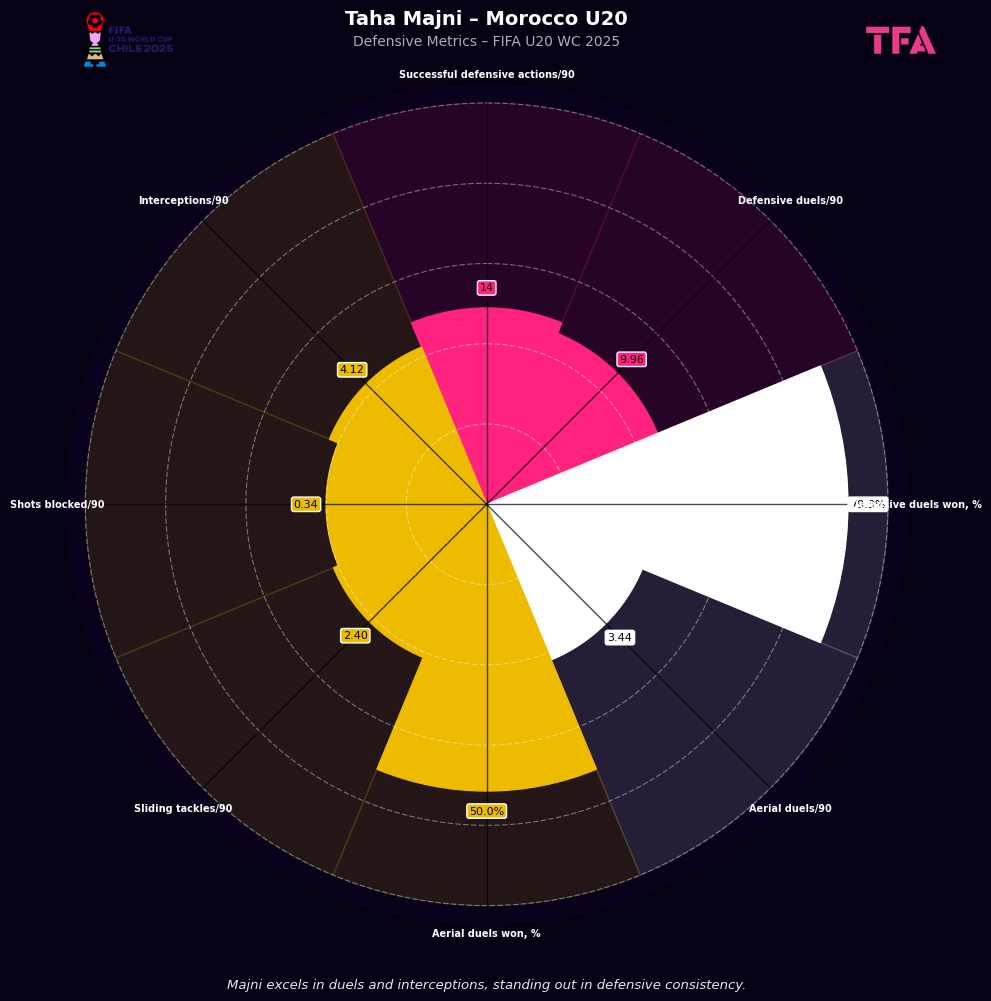
Taha Majni, a key figure in Morocco’s title-winning side, posted 14.43 defensive actions, 9.96 duels, and a strong 79.31% success rate.
With 3.44 aerial duels at 50%, 2.40 tackles, and 4.12 interceptions, he epitomised balance, winning key duels while maintaining composure in possession transitions, pivotal to Morocco’s resilient backline.
Taha Majni Defensive Metrics – FIFA U20 World Cup 2025
Bassam Hazazi – Saudi Arabia
Bassam Hazazi quietly delivered one of the tournament’s most underrated yet complete defensive displays.
Averaging 13.50 defensive actions, 12.86 duels, and 62.50% success, he also stood out with 3.21 aerial duels per 90 and a staggering 80% aerial success, the joint highest across all players.
His 1.61 tackles and 3.86 interceptions indicate intelligent timing and selective engagement, making him one of the tournament’s most balanced and composed defenders, well-suited to structured back-four systems. Elite Defensive Metrics, Statistical Outliers
Defensive Stats For The Top 20 Defenders At The FIFA U20 World Cup Chile 2025
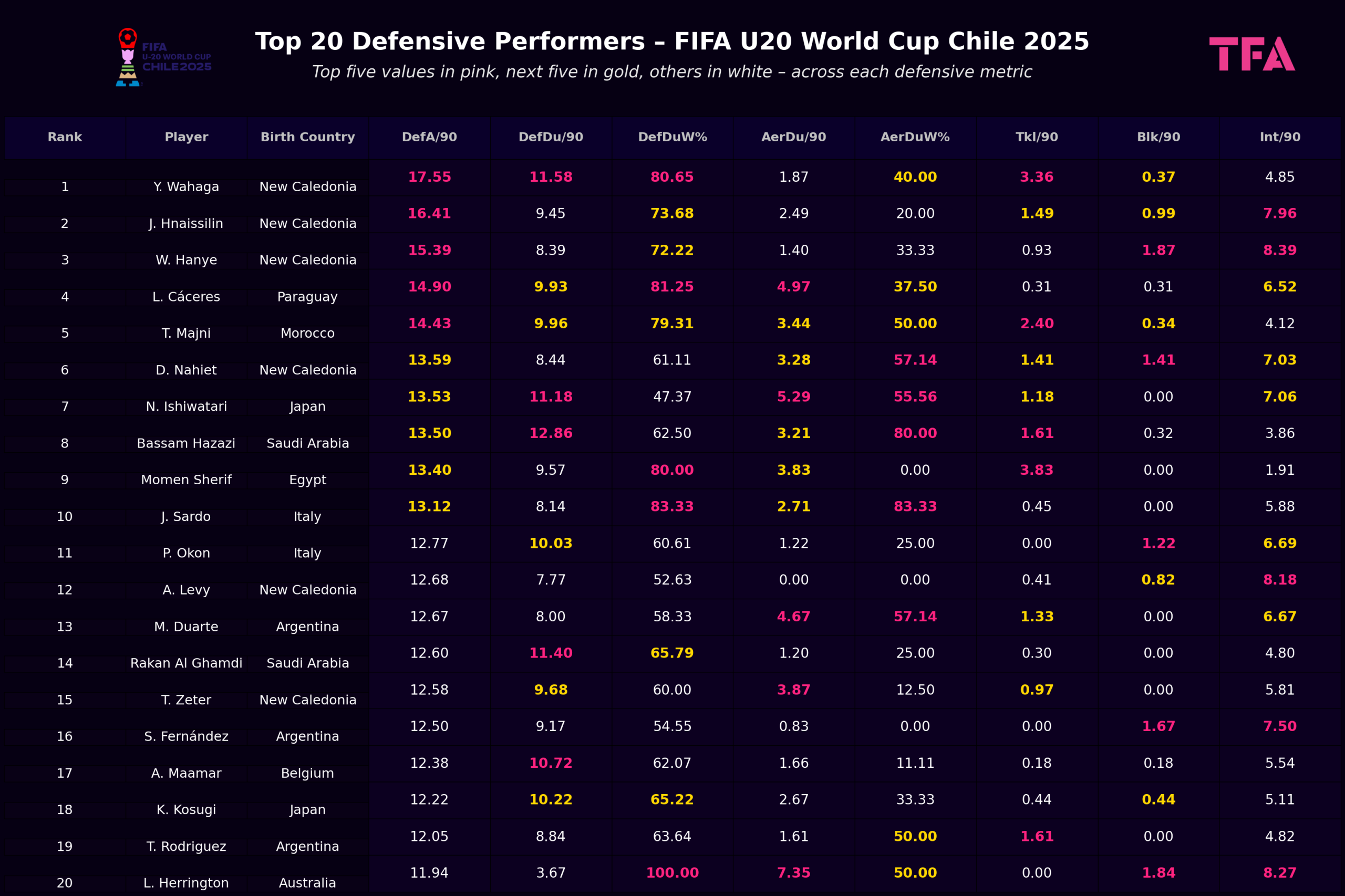
Beyond these top five, several players produced elite-level numbers highlighted in pink, marking them statistical outliers.
Momen Sherif (Egypt) impressed with 13.40 defensive actions and 3.83 tackles per 90, a sign of aggressive front-foot defending.
Sardo (Italy) recorded 13.12 defensive actions with an aerial duel success rate of 83.33%, underlining his strength in set-piece battles.
Meanwhile, Herrington (Australia) led all players with 100% defensive duel success and 7.35 aerial duels per 90, reflecting near-flawless timing and authority.
Collectively, these figures highlight defenders whose statistical efficiency and tactical clarity elevate them as genuine prospects for professional progression.
Top Attacking Performers At FIFA U20 World Cup Chile 2025
This study employed a comprehensive blend of advanced offensive metrics to identify the most effective attackers at the FIFA U20 World Cup Chile 2025.
Namely: Goals, Assists, Expected Goals (xG), Expected Assists (xA), Shots on Target Percentage (SOT%), Progressive Runs per 90 (ProgR/90), and Successful Dribbles Percentage (SuccDr% %).
Each indicator provides a specific lens through which to interpret attacking influence: Goals and Assists reveal the direct end product, while xG and xA estimate the quality of chances created and received, distinguishing sustainable performance from short-term variance.
SOT% indicates shooting precision and efficiency; ProgR/90 reflects vertical progression and penetration, while SuccDr% exposes a player’s ability to destabilise defences through 1-v-1 actions.
Top 20 Attacking Performers Stats At FIFA U20 World Cup Chile 2025
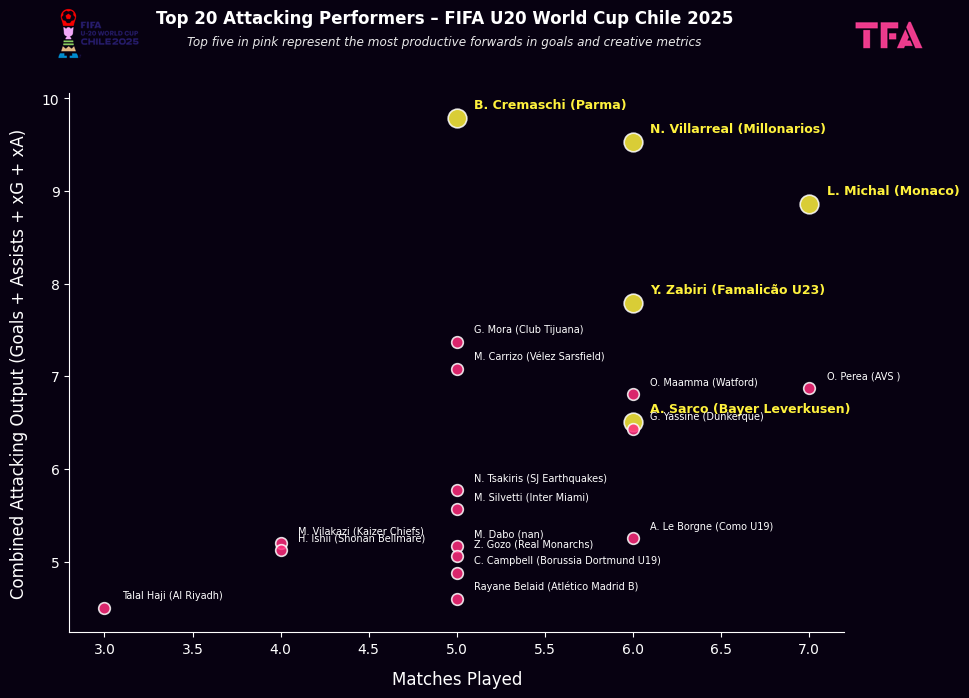
These parameters offer a multidimensional picture of attacking contribution, balancing output, efficiency, and tactical involvement within team structure.
Yassir Zabiri – Morocco (Famalicão)
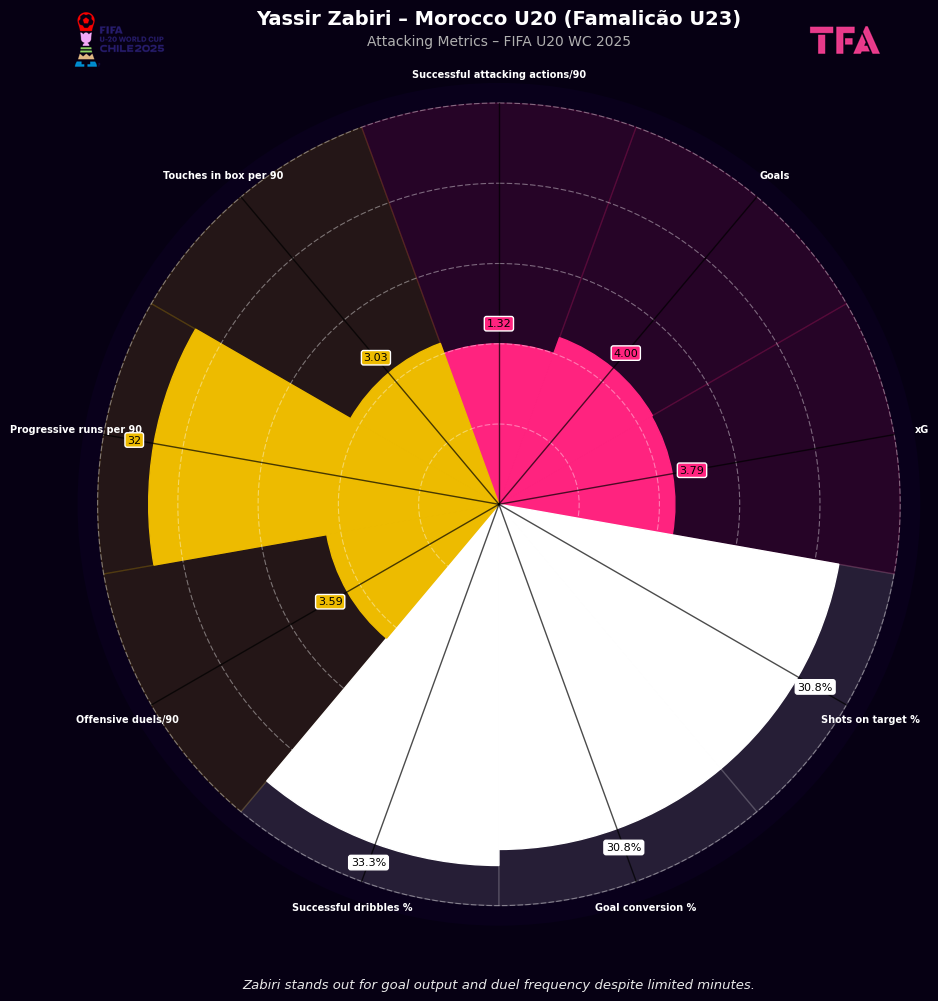
As a key figure in Morocco’s title-winning side, Yassir Zabiri’s attacking output embodied both precision and purpose.
With four goals and a tournament-leading xG of 3.79, he consistently positioned himself in high-value scoring zones, showcasing intelligent movement and finishing instinct.
Despite registering modest off-the-ball duel numbers (3.59 per 90), his 30.77% SOT accuracy and 6.13 progressive runs per 90 highlighted a forward who combined composure in the box with vertical intent in transitions.
Zabiri’s performances proved pivotal to Morocco’s tactical model, a disciplined, counterattacking structure in which his timing and sharpness in the final third turned limited chances into decisive outcomes.
Yassir Zabiri At Morocco Stats – FIFA U20 World Cup 2025
Benjamin Cremaschi – United States (Parma)
Parma’s dynamic midfielder Benjamin Cremaschi delivered an all-action attacking display, scoring five goals and adding 2 assists across 447 minutes.
His 69.23% SOT rate was among the highest in Chile 2025, underlining clinical finishing and decision-making under pressure.
Operating from advanced midfield zones (RCMF/LCMF), Cremaschi averaged 4.63 offensive duels per 90 and contributed 1.81 progressive runs, blending box arrivals with calculated ball-carrying.
His dual-threat capability, arriving late into scoring positions while sustaining possession, reflected tactical maturity beyond his years, confirming his profile as a modern, goalscoring midfielder on the American development pathway.
Néiser Villarreal – Colombia (Millonarios)
Néiser Villarreal emerged as Colombia’s most complete forward, netting five goals from an xG of 2.98 and recording 75% success in dribbles, the highest among top-five finishers.
His 5.47 offensive duels per 90 and 43.75% SOT accuracy reflect a striker capable of both initiating and finishing attacking moves.
Villarreal’s ability to hold play, drive through contact, and exploit half-spaces suited Colombia’s aggressive, direct transitions.
His statistical profile, high-end product, elite 1-v-1 success, and consistent shot creation point toward a physically dominant, technically secure centre-forward ready for senior football exposure.
Lucas Michal – France (Monaco)
Lucas Michal’s performances for France were defined by volume and consistency.
Scoring five goals from an xG of 3.66, he posted 6.32 offensive duels per 90, 53.33% SOT accuracy, and 1.42 progressive runs, reflecting a striker involved in all attacking phases.
His measured shot selection and intelligent link play enabled France to sustain pressure in the final third.
Michal’s numbers underline not only efficiency but adaptability, excelling in structured build-up and quick transitions.
With positional discipline and refined finishing technique, he emerged as one of Europe’s most polished attacking prospects in Chile 2025.
Alejo Sarco – Argentina (Bayer Leverkusen)
Alejo Sarco’s output blended flair with functionality.
The young Argentine tallied four goals from 2.39 xG, complemented by 7.88 offensive duels per 90 and 57.14% SOT accuracy.
Despite limited progressive runs (0.39 per 90), Sarco’s clinical finishing and intelligent positioning inside the penalty area were decisive in Argentina’s attacking sequences.
His efficiency in tight spaces and composure under defensive pressure mirrored the traits typical of South American forwards transitioning successfully to European football.
At just 19, his decision-making and movement mechanics indicate he is ready for top-level tactical systems, such as Bayer Leverkusen’s fluid front three.
Offensive Stats For Top 20 Attackers At FIFA U20 World Cup
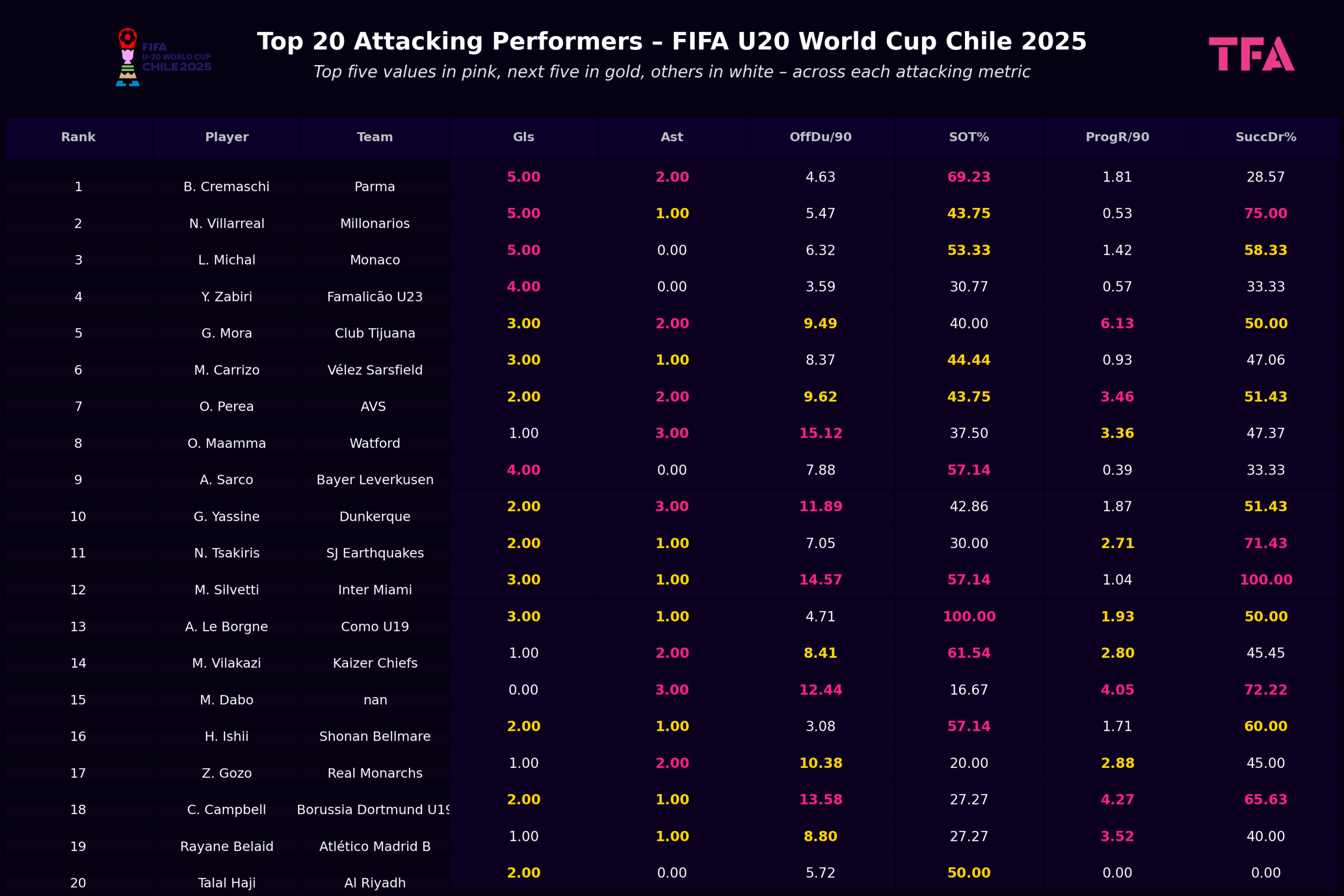
Elite Offensive Metrics – Statistical Outliers
Beyond these five standout names, several others produced exceptional data outputs marked in pink.
Gilberto Mora (Mexico), Maher Carrizo (Argentina), and Mateo Silvetti (Argentina) each contributed multi-goal returns with high involvement rates, Mora leading for progressive runs (9.49 per 90).
At the same time, Silvetti dominated offensive duels (14.57 per 90) with 57.14% shot accuracy.
Andréa Le Borgne (France) showcased elite composure in final actions with 100% SOT accuracy, and Othmane Maamma (Morocco) recorded 15.12 offensive duels per 90, the highest in the entire dataset.
Collectively, these statistical outliers underline the diversity of attacking excellence in Chile 2025, from high-volume creators to ruthless finishers.
They illustrate a tournament rich with adaptable forwards primed for senior-level transitions.
Conclusion
The 2025 FIFA U20 World Cup in Chile served as a powerful reminder of football’s constant evolution, revealing a new generation of players ready to redefine the game’s future.
From Morocco’s disciplined champions to individual standouts like Zabiri, Majni, and Cremaschi, the tournament highlighted how data-driven analysis can uncover both raw potential and tactical maturity.
The combination of physical attributes, technical skill, and statistical consistency shown across key performers suggests that several of these young players are already approaching senior-level readiness.
Moreover, the diversity of playing styles, from structured defensive resilience to creative attacking dynamism, reflects the global nature of modern football development.
As clubs and scouts increasingly rely on advanced metrics to inform recruitment, the lessons from Chile 2025 provide a valuable reference point.
These insights not only celebrate emerging stars but also forecast the future direction of elite football performance worldwide.
