
Italy hosted Germany for the first leg of the UEFA Nations League quarter-finals at the historic San Siro stadium in Milan.
The game ended 1-2 in Germany’s favor, which does not really reflect what happened.
Though Germany had more possession, Italy created more dangerous goal-scoring opportunities.
Still, Germany were more clinical in front of goal and made the most of their few chances to win the match.
Italy finished the group stage in second behind France with 13 points, four wins, one draw, and one loss.
In League A’s Group 2, Italy beat France 1-3 in France, which was a very positive start to the tournament.
Then they beat Israel 1-2 away.
Afterwards, the team drew against Belgium, beat Israel 4-1 at home, beat Belgium away, and then lost to France 1-3 despite playing at San Siro.
Following this match against Germany, the winner of the Italy-Germany tie will face Portugal or Denmark in the semi-finals.
On the other hand, Germany finished the League A group stage with 14 points, four wins and two draws, topping Group 3.
They opened the competition with a significant 5-0 win against Hungary, a 2-2 draw against the Netherlands, an away win against Bosnia and Herzegovina, a home win against the Netherlands, a 7-0 win against Bosnia and Herzegovina, and an away draw against Hungary.
Historically, the encounters between Italy and Germany have always been entertaining and very competitive, whether in the World Cup, the Euros, the Nations League, or even in friendly games.
This match did not break the rule, as the rhythm was very high throughout the game.
In this tactical analysis article on Italy’s match against Germany, we will present both teams’ lineups and formations.
The analysis will aim to identify the strengths and weaknesses of both teams in this match, as well as the tactics used by both head coaches.
Italy Vs Germany Lineups & Formations
Luciano Spalletti preferred to start the match in Italy’s typical 3-5-2 formation, yet with newer names in many positions, such as Moise Kean as a striker and Destiny Udogie in place of the injured Federico Dimarco.
The line-up was composed of Gianluigi Donnarumma as a goalkeeper, Giovanni Di Lorenzo, Alessandro Bastoni and Riccardo Calafiori as centre-backs, Destiny Udogie and Matteo Politano as wing-backs, Nicolò Rovella as a defensive midfielder, Milan’s Sandro Tonali and Inter Milan’s Nicolò Barella as central midfielders, with Moise Kean and Napoli’s Giacomo Raspadori forming the team’s attacking duo.
On the other hand, Julian Nagelsmann and his coaching staff opted for the 4-2-3-1 formation with Oliver Baumann as a goalkeeper, Real Madrid’s Antonio Rüdiger and Jonathan Tah as centre-backs, Bayern Munich’s Joshua Kimmich as a right-back, David Raum as a left-back, Leon Goretzka and Pascal Groß as central midfielders, Leroy Sané and Nadiem Amiri as wingers, with Jamal Musiala playing as an advanced playmaker behind the striker Jonathan Burkardt.
Italy’s Performance Vs Germany
Italy scored their first goal of the match early in the game thanks to a crucial long pass from Bastoni, which gave Italy numerical superiority on the right side.
Barella’s quick and accurate through pass to Politano made the difference.
That pass broke Germany’s defensive line and allowed Politano to serve Tonali, who intelligently made himself available inside Germany’s penalty box.
The tactic of leaving possession to Germany, especially during the first part of the first half, and launching counterattacks quickly and vertically as soon as the Azzurri intercepted the ball proved successful for them.
They scored their first goal after the second counterattack of the match.
This goal was scored thanks to Bastoni’s cross, Barella’s key pass, Politano’s quick decision-making, and, more importantly, Tonali’s advancing towards the box to create numerical superiority during a crucial counterattack.
This helped Politano find an unmarked player in that area, especially given that two defenders marked Kean.
Italy’s Crucial Counterattacking Action
 Although Italy failed to gain more possession even after scoring the first goal, they remained more dangerous than Germany.
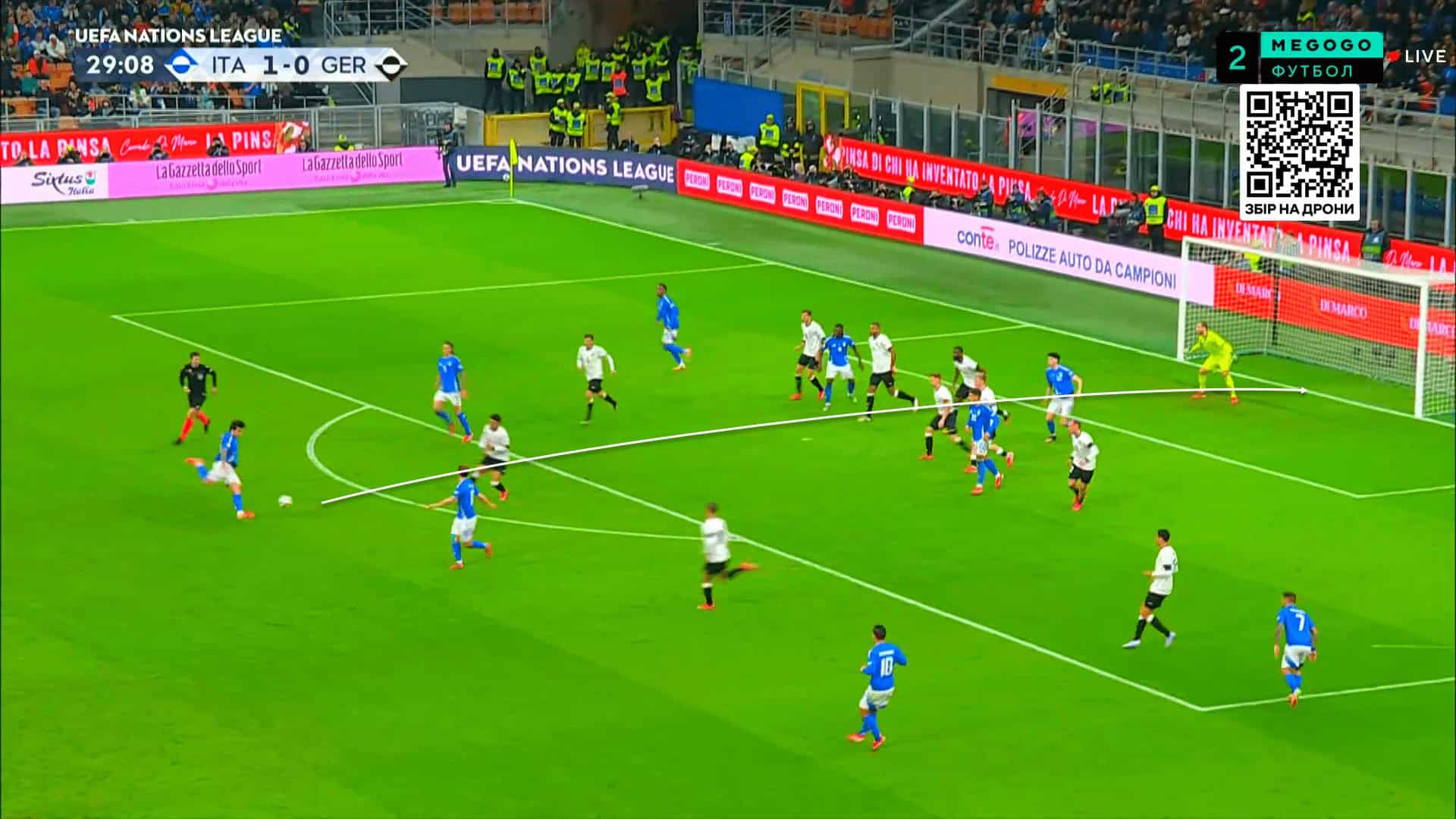
Tonali could have scored his second goal of the match by exploiting a second ball that was very inviting for a shot from a distance.
Unluckily for Italy, Tonali’s shot was saved by Baumann, even though the former Milan midfielder’s shot was powerful and well-oriented.
This action highlights Italy’s impactful midfield and the significant contributions of Tonali and Barella to the team’s attacks.
Both contributed tangibly to almost every attacking action and were available to provide the needed support, whether with or without the ball inside the final third.
Tonali’s Second Ball Attempt
 In addition to Tonali and Barella’s excellent form during this match, especially from a playmaking and attacking perspective, Italy were also very dangerous thanks to through passes at the back of Germany’s defence.
Raspadori and Kean’s movements without the ball tired their opponents and helped create chances from nowhere.
The following first-touch through pass from Politano highlights the quality of Napoli’s winger and his chemistry with Kean.
The latter was reactive enough to anticipate the direction of the pass, be ahead of his direct marker, reach the pass first, and shoot with power as the ball was still bouncing.
However, his shot was not angled enough to confuse the goalkeeper.
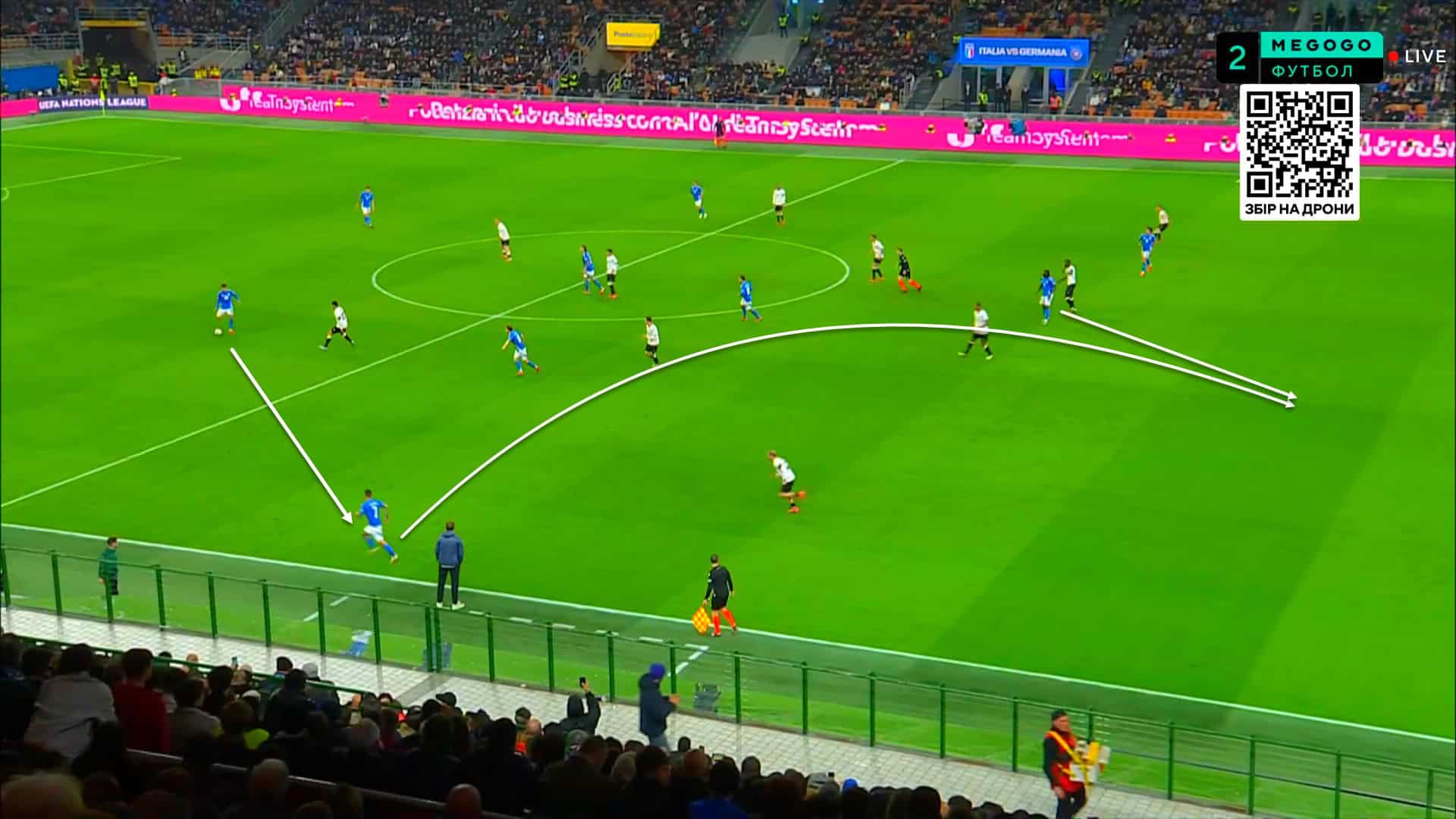
But once again, Italy successfully launched counterattacks from the wings after switching sides horizontally, then provided quick passes into the box.
Italy’s Dangerous Counterattacks
 At the start of the second half, we cannot ignore the action that led to conceding Germany’s first goal.
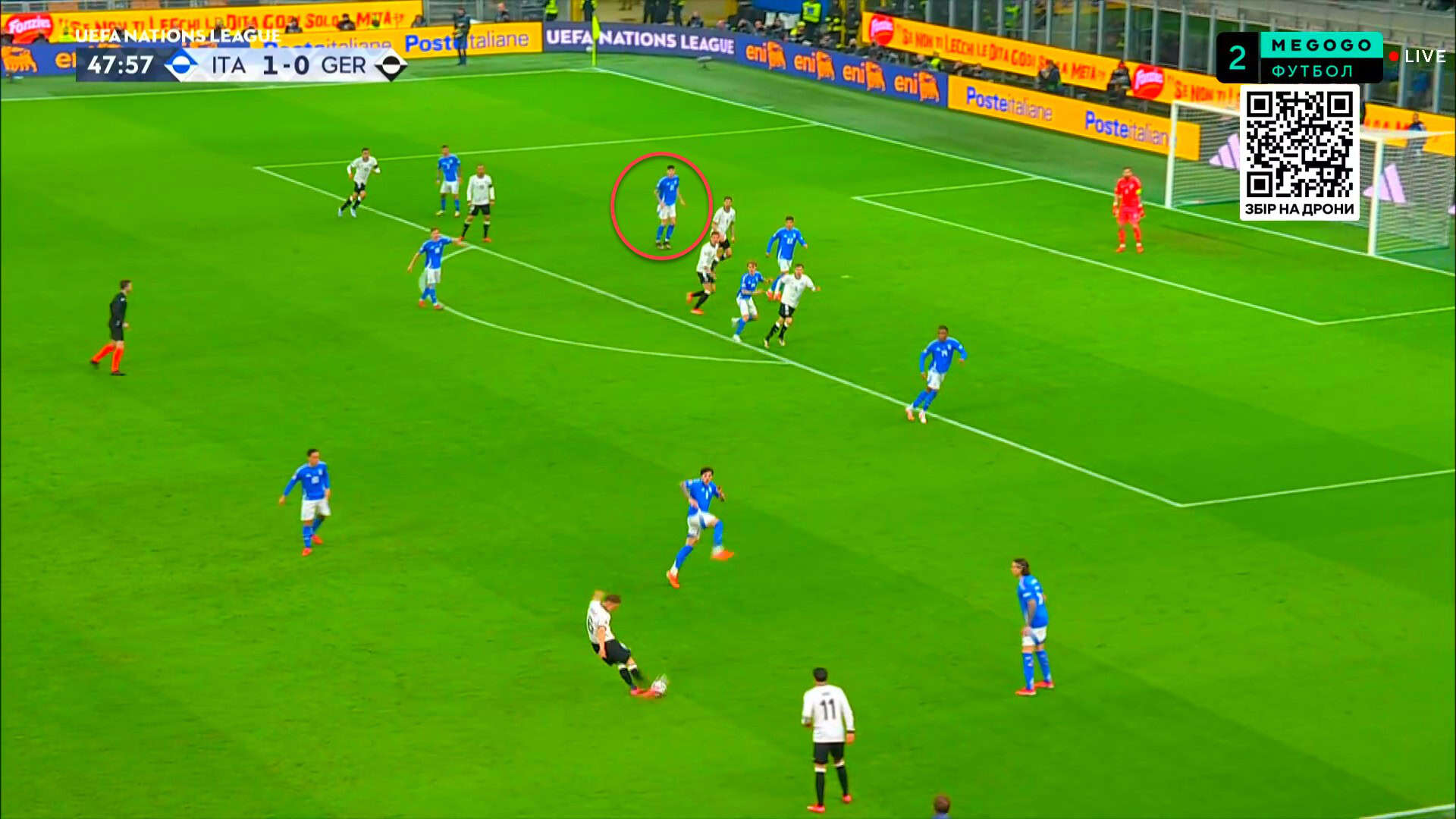
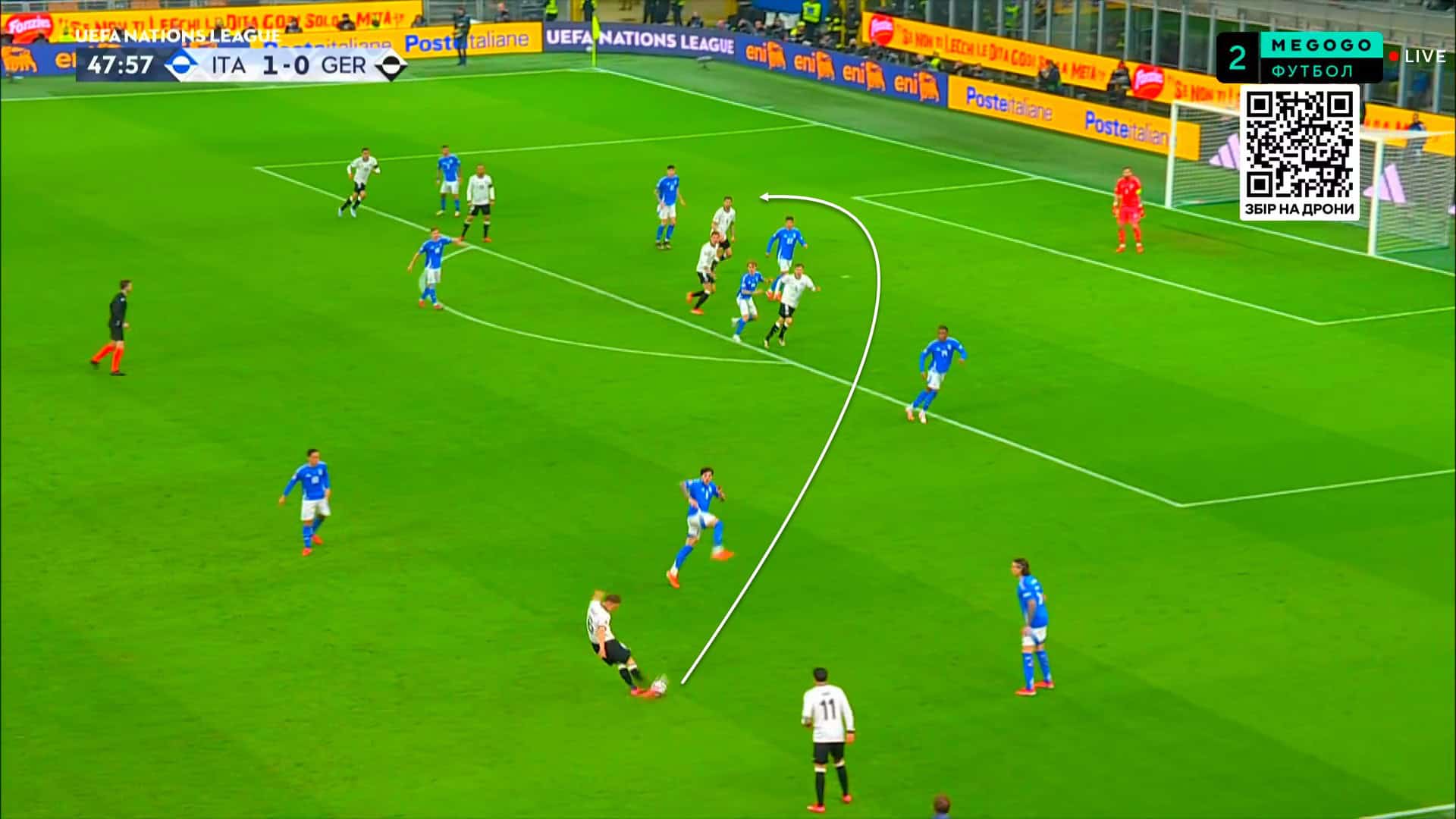
Italy’s defence can be considered responsible for conceding the goal, as there was a remarkable marking mistake during the play.
In the following picture, we can clearly see that Rovella was marking a player, Di Lorenzo was marking another, and Bastoni was standing without marking anyone, even though he had to mark the closest player to him (Kleindienst).
Italy’s Marking Mistake
 Following Germany’s goal, Italy created two dangerous opportunities in the 66th minute.
The first was a one-two combination between Tonali and Kean, with the latter’s powerful yet slightly high shot after he received Tonali’s creative back-heel pass.
The second was also created by Tonali, who provided a left-footed through pass to Raspadori, but the latter failed to finish properly as he was not capable of angling the ball near the far post.
Due to these missed chances and, more importantly, Italy’s defensive errors, especially in terms of marking, the Azzurri conceded a second goal from a corner kick.
Bastoni could have done much better to mark Goretzka, who escaped from Inter Milan’s defender when Kimmich was about to execute the corner kick.
And despite Barella and Lorenzo Lucca’s shots, Italy did not succeed in equalising, as Germany resisted their attacks and limited their danger in the last minutes.
Germany’s Comeback Vs Italy
Although Germany had a very negative first half, with poor possession and almost no created chances, and had conceded a goal and numerous opportunities, they were able to get back in the game as soon as the second half started.
In fact, Burkardt’s replacement with Tim Kleindienst made an instant impact, as Borussia Mönchengladbach’s striker succeeded in scoring the first opportunity he got following a very accurate cross from Kimmich.
Kleindienst’s excellent header highlights the striker’s excellent goalscoring skills and his ability to exploit such opportunities with crucial decision-making in terms of finishing.
Germany’s First Goal
 Following this goal, Germany conceded a few dangerous opportunities.
It risked conceding Italy’s second goal as they left too much space for Italy’s players’ penetrations from the wings and from the middle.
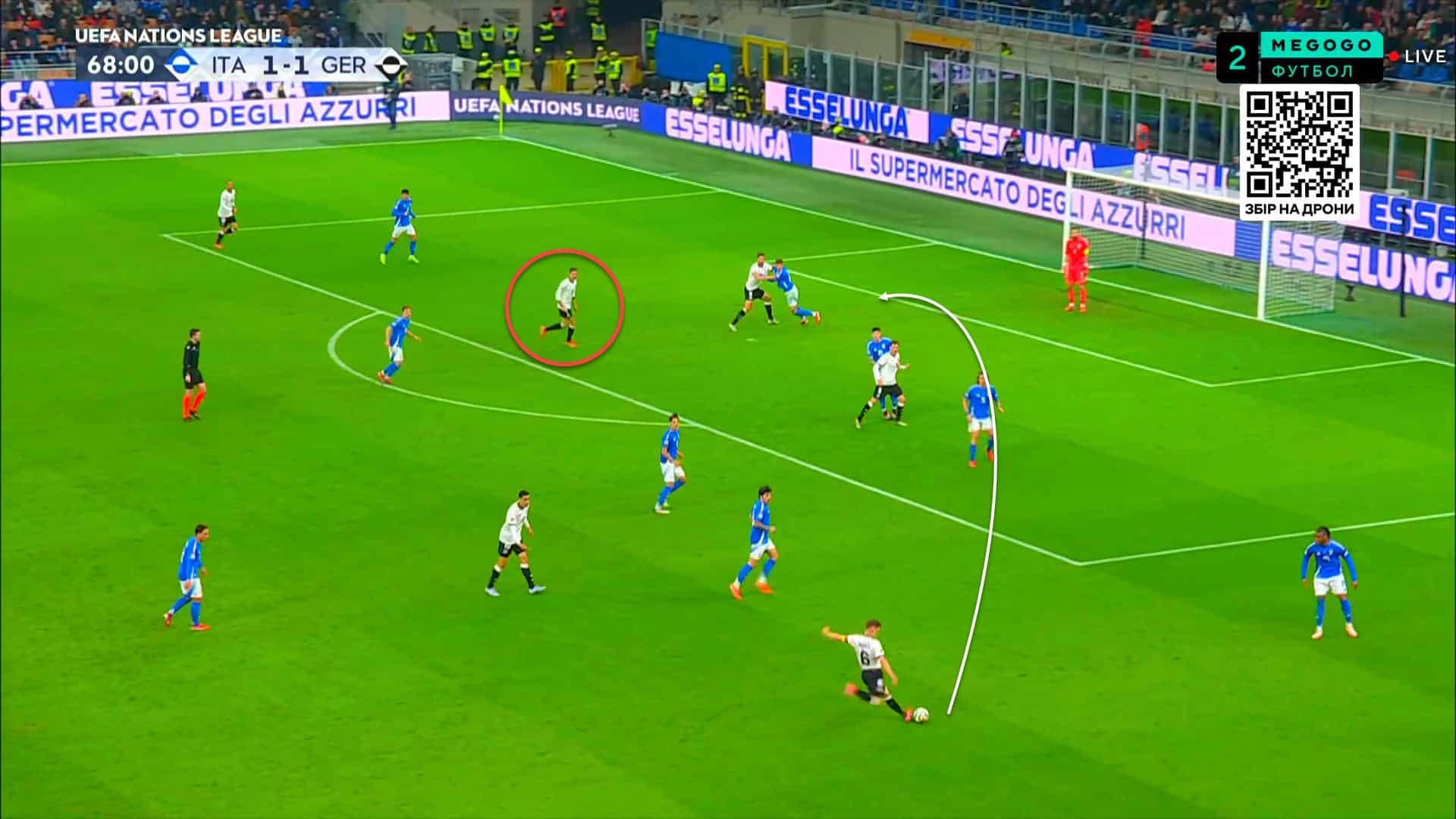
At the same time, they were also very close to scoring in the 68th minute when Kimmich repeated almost the same first-goal cross, this time towards Goretzka, who was unmarked inside the box but failed to orient his header accurately.
At this point, Germany became aware of Italy’s marking problem and started playing on it to oblige Italy’s defence into committing similar mistakes in their own box.
Germany’s Goalscoring Chance
 A few minutes later, Germany succeeded in exploiting Italy’s defensive weakness in this match, which was marking during crosses and set-pieces.
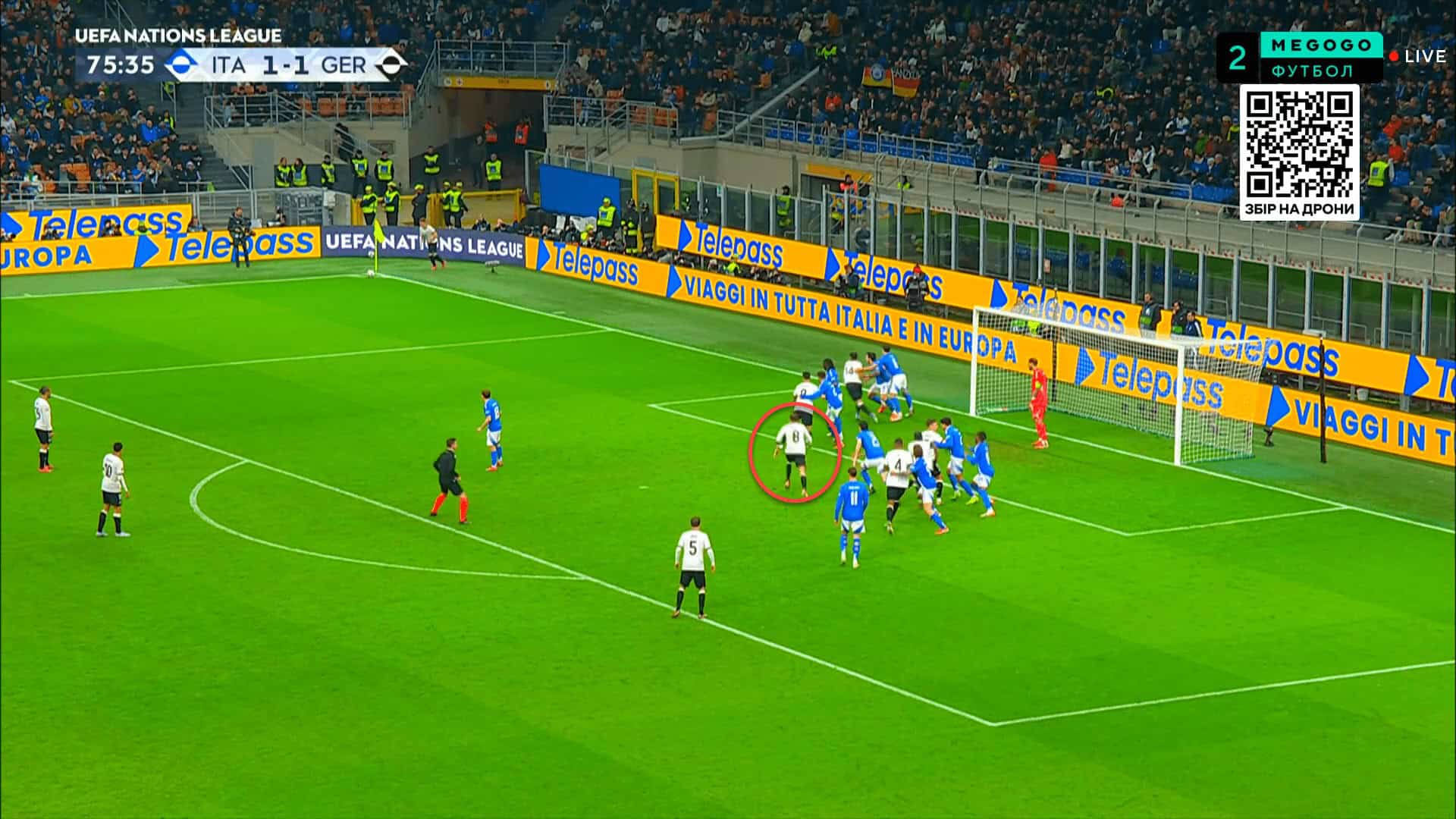
They were capable of scoring their second goal of the match from a corner taken by Kimmich and scored by Goretzka.
In fact, Goretzka was intelligent enough to confuse Bastoni with an unexpected run towards the near post.
He got himself unmarked and, thanks to his jump, succeeded in scoring a beautiful and valuable goal.
Germany’s Second Goal
 Conclusion
Italy started the match well and succeeded in creating a lot of danger, especially after scoring their first.
However, they failed to add the second one, despite the numerous dangerous opportunities they created.
At the same time, they paid for the few marking mistakes they committed, as Germany was intelligent enough to use these errors in their favour and, therefore, have the advantage in this Nations League quarter-finals’ first leg.
Everything will be possible in the second leg since both teams have everything needed to win, with a slight advantage for Germany, which will be playing at home with a one-goal advantage.
