
Total Football Analysis
Once.Sport
  • Football Analysis
    • Data Analysis
    • Formations
      • 2-2-4 Formation
      • 2-3-5 Formation
      • 3-1-4-2 Formation
      • 3-2-2-3 Formation
      • 3-2-4-1 Formation
      • 3-1-6 Formation
      • 3-3-4 Formation
      • 3-4-1-2 Formation
      • 3-4-2-1 Formation
      • 3-4-3 Formation
      • 3-5-1-1 Formation
      • 3-5-2 Formation
      • 4-1-4-1 Formation
      • 4-2-2-2 Formation
      • 4-2-3-1 Formation
      • 4-2-4 Formation
      • 4-3-1-2 Formation
      • 4-3-3 Formation
      • 4-4-2 Formation
      • 4-5-1 Formation
      • 5-3-2 Formation
      • 5-4-1 Formation
      • 6-3-1 Formation
    • Head Coach Analysis
    • Match Analysis
    • Player Analysis
    • Recruitment Analysis
    • Set Piece Analysis
    • Tactical Theory
    • Tactical Preview
    • Team Analysis
    • Training Analysis
    • Tactical Analysis
    • Scouting Report
  • Competition
    • ALL Competitions
    • English Premier League
    • Champions League
    • La Liga
    • Bundesliga
    • Serie A
    • Ligue 1
    • Eredivisie
    • EFL Championship
    • FIFA World Cup 2022
    • WEURO 2022
    • Women’s Super League
    • NWSL
    • Belgian First Division A
    • A-League
    • Liga Profesional de Argentina
    • Austrian Bundesliga
    • Campeonato Brasileiro Série A
    • DFB Pokal
    • 1. HNL
    • Danish Superliga
    • EFL League One
    • EFL League Two
    • FA Cup
    • EFL Cup
    • Indian Super League
    • K-League
    • J1 League
    • Liga MX
    • Copa América 2021
    • Copa del Rey
    • MLS
    • Eliteserien
    • Euro 2020
    • Primeira Liga
    • Scottish Premiership
    • Allsvenskan
    • Europa League
    • UEFA Nations League
    • Liga AUF Uruguaya
  • Coaches
    • All Coaches
    • Alfred Schreuder
    • Ange Postecoglou
    • Antonio Conte
    • Arne Slot
    • Bo Svensson
    • Brendan Rodgers
    • Bruno Lage
    • Carlo Ancelotti
    • Christophe Galtier
    • Claude Puel
    • Claudio Ranieri
    • David Moyes
    • Dean Smith
    • Diego Simeone
    • Domenico Tedesco
    • Frank Lampard
    • Eddie Howe
    • Edin Terzić
    • Emma Hayes
    • Erik ten Hag
    • Ernesto Valverde
    • Gennaro Gattuso
    • Gerardo Seoane
    • Gian Piero Gasperini
    • Giovanni van Bronckhorst
    • Graham Potter
    • Igor Tudor
    • Imanol Alguacil
    • Jesse Marsch
    • Jonas Eidevall
    • Jorge Sampaoli
    • José Bordalás
    • José Mourinho
    • Julen Lopetegui
    • Julian Nagelsmann
    • Julien Stéphan
    • Jürgen Klopp
    • Luciano Spalletti
    • Lucien Favre
    • Manuel Pellegrini
    • Marcelo Bielsa
    • Marco Rose
    • Marco Silva
    • Massimiliano Allegri
    • Mauricio Pochettino
    • Maurizio Sarri
    • Mikel Arteta
    • Niko Kovač
    • Nuno Espírito Santo
    • Oliver Glasner
    • Patrick Vieira
    • Paulo Fonseca
    • Pep Guardiola
    • Peter Bosz
    • Rafa Benítez
    • Ralf Rangnick
    • Ralph Hasenhüttl
    • Roger Schmidt
    • Roy Hodgson
    • Sean Dyche
    • Sérgio Conceição
    • Simone Inzaghi
    • Sonia Bompastor
    • Stefano Pioli
    • Steffen Baumgart
    • Steven Gerrard
    • Thiago Motta
    • Thomas Frank
    • Thomas Tuchel
    • Unai Emery
    • Vincenzo Italiano
    • Xavi
  • Teams
    • ALL Teams
    • AC Milan
    • Ajax Amsterdam
    • Arsenal
    • AS Monaco FC
    • Atalanta
    • Atlético Madrid
    • FC Barcelona
    • FC Bayern Munich
    • Borussia Dortmund
    • Celtic FC
    • Chelsea FC
    • Everton F.C.
    • Inter Milan
    • Juventus F.C.
    • Leeds United F.C.
    • Liverpool FC
    • Manchester City
    • Manchester United FC
    • Paris Saint-Germain
    • Rangers FC
    • RB Leipzig
    • Real Madrid CF
    • Tottenham Hotspur
    • West Ham United
  • Players
    • ALL Players
    • Alisson Becker
    • Bukayo Saka
    • Erling Haaland
    • Harry Kane
    • Jack Grealish
    • John Stones
    • Julián Alvarez
    • Kalvin Phillips
    • Kevin De Bruyne
    • Kyle Walker
    • Kylian Mbappé
    • Lamine Yamal
    • Lionel Messi
    • Luis Díaz
    • Mohamed Salah
    • Phil Foden
    • Virgil Van Dijk
  • Contact
  • Write For TFA
No Result
View All Result
No Result
View All Result
Total Football Analysis
No Result
View All Result
Home Analysis

UEFA EURO 2024 Semi-Finals: How man-orientation and a pendulum-pivot helped England to prevail over the Netherlands – tactical analysis

Jonas Bartsch by Jonas Bartsch
July 12, 2024
in Analysis, Euro 2024, Gareth Southgate, Match Analysis, Ronald Koeman
0
Euro 2024 semi-finals: Man-orientation and a pendulum-pivot: How England managed to prevail - tactical analysis tactics

England overloading again with Foden switching sides

The semi-finals of big tournaments like EURO 2024 are usually fought out between the four strongest teams. This year, however, the second semi-final features two teams facing off who have had some struggles over the last couple of weeks.

For the Netherlands and Ronald Koeman, there have been a lot of injury concerns during the tournament. Frenkie de Jong and Peer Koopmeiners were both injured just before the start of the Euros, and it hurt the Dutch. Being drawn into the ‘Group of Death’ with France, Austria and Poland, the Dutch barely managed to get out of the group stage by being one of the best third-placed teams. After the groups, Koeman’s men managed to convincingly beat Romania in the Round of 16 and scraped by an emotional Türkiye side to qualify for the semis.

On the other hand, England have been one of the biggest favourites to lift the trophy from the start of the Euros, and while their squad is loaded with talented players, their manager, Gareth Southgate, has had to face a lot of criticism for his work. Even though England managed to qualify for the semi-final in Dortmund, their performances have been rather lacklustre, and the English have been bailed out by the pure individual class of their superstars multiple times.

In this tactical analysis, we will provide an in-depth analysis of how England prevailed in the grand final in Berlin and how Gareth Southgate got the desired result against a formidable opponent in Ronald Koeman’s Dutchmen, with a focus on the Three Lions’ tactics.

England’s development in possession

For the past few weeks, the English team has been criticised extensively by pundits worldwide. Uninspiring play with the ball was one of the major points of criticism many experts used to describe Gareth Southgate’s style of play.

His men had struggles creating chances throughout the tournament. Their positional play has always focused on minimising risks. While they have been relatively solid defensively with that approach, their offence had to be sacrificed in some capacity. England have not scored multiple goals in regular time at the Euros. It has been very reliant on the brilliance of a couple of individual players to create goalscoring opportunities.

Against the Netherlands, however, England played a very dominant first half of football, especially in possession. Southgate adapted his tactics earlier in the tournament by switching to a back three instead of his usual back four, which opened up a bunch of new opportunities for his team.

England had multiple good opportunities during the first half yesterday, and a very good way to create those chances for them was to use a fundamental principle of modern football: Overload to isolate. While Bellingham was playing on the left and Foden was on the right, Foden tried to overload the left attacking flank most of the time. England were gaining a numbers advantage on that side of the field, but that wasn’t the only positive thing about it; they managed to get Bukayo Saka in isolated 1v1 situations on the far side of the field.

Euro 2024 semi-finals: Man-orientation and a pendulum-pivot: How England managed to prevail - tactical analysis tactics
England overloading the left side of the pitch, freeing up Harry Kane
Euro 2024 semi-finals: Man-orientation and a pendulum-pivot: How England managed to prevail - tactical analysis tactics
England overloading again, with Foden switching sides

Walker also pushed up into midfield to open up the opportunity to play a two-pass switch and have an out-option if the space was too condensed to make combinations. In the first image, the Dutchmen failed to rotate in their defensive shape, and Harry Kane was left wide open in a central position, which led to a decent attempt by the England captain that Verbruggen was barely able to save.

England were able to tear apart the Dutch defensive approach by overloading the left side because Koeman was trying to play a man-oriented press in midfield, with Tijiani Reijnders and Jerdy Schouten playing man coverage against Bellingham and Foden. This led to them chasing around the midfield with no chance of recovering the ball while leaving the far half-space completely vacated. Kobbie Mainoo was able to exploit these parts of the field well multiple times during the game while pushing forward.

Another advantage was their movement into the box after a switch. After playing the switch pass, all overloading playing were crowded together and were able to move into the box at the same time. With good off-the-ball movement, the Dutch defenders were not able to pick up every English attacker in the box.
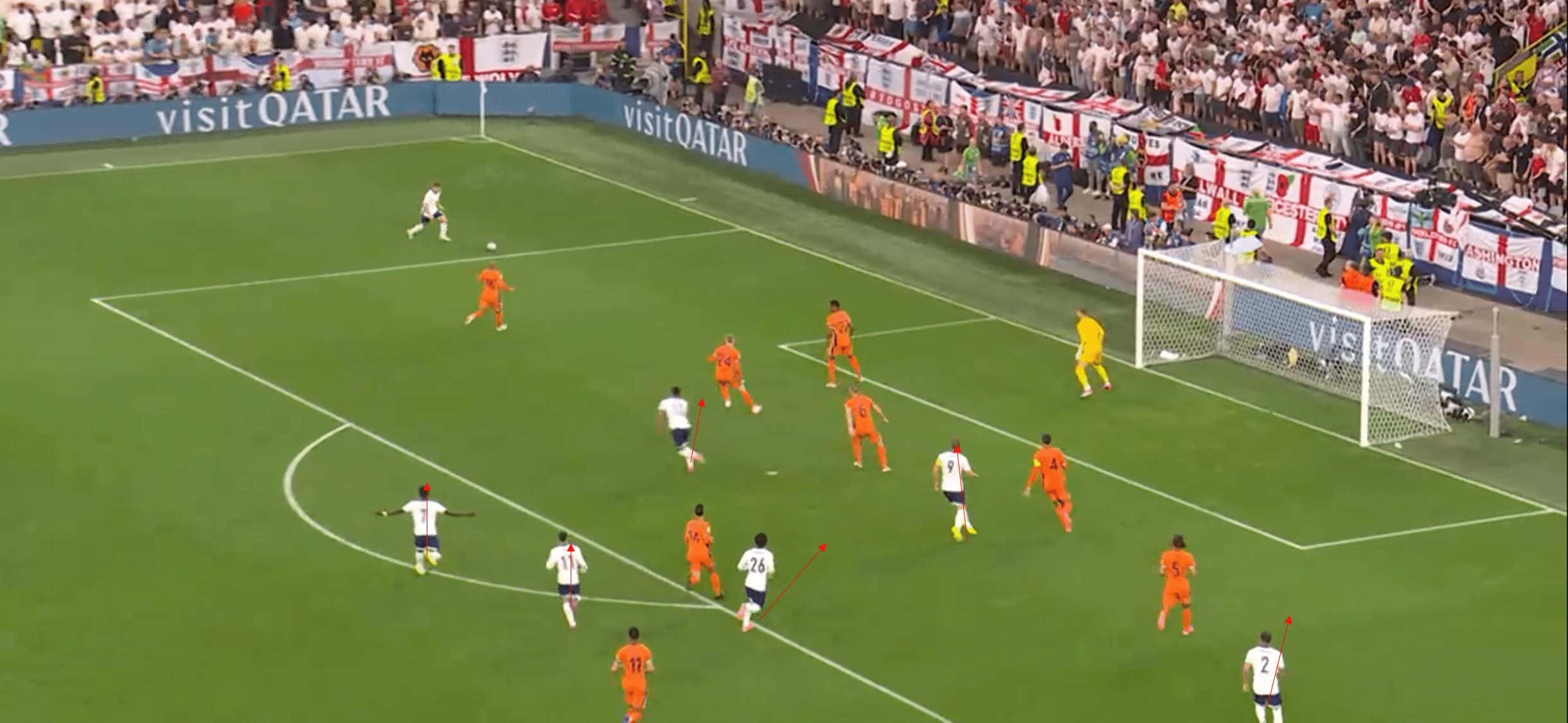
Euro 2024 semi-finals: Man-orientation and a pendulum-pivot: How England managed to prevail - tactical analysis tactics
Trippier crossing after a switch with England players swarming the box

In build-up-play, Southgate’s men could pick apart the Dutch man-oriented press as well by dominating the half-spaces. Players that were obviously pressed by the Dutch midfielders tried to drag them out of their position to allow Bellingham and Foden to receive the ball in the half-space and instantly turn towards the goal.
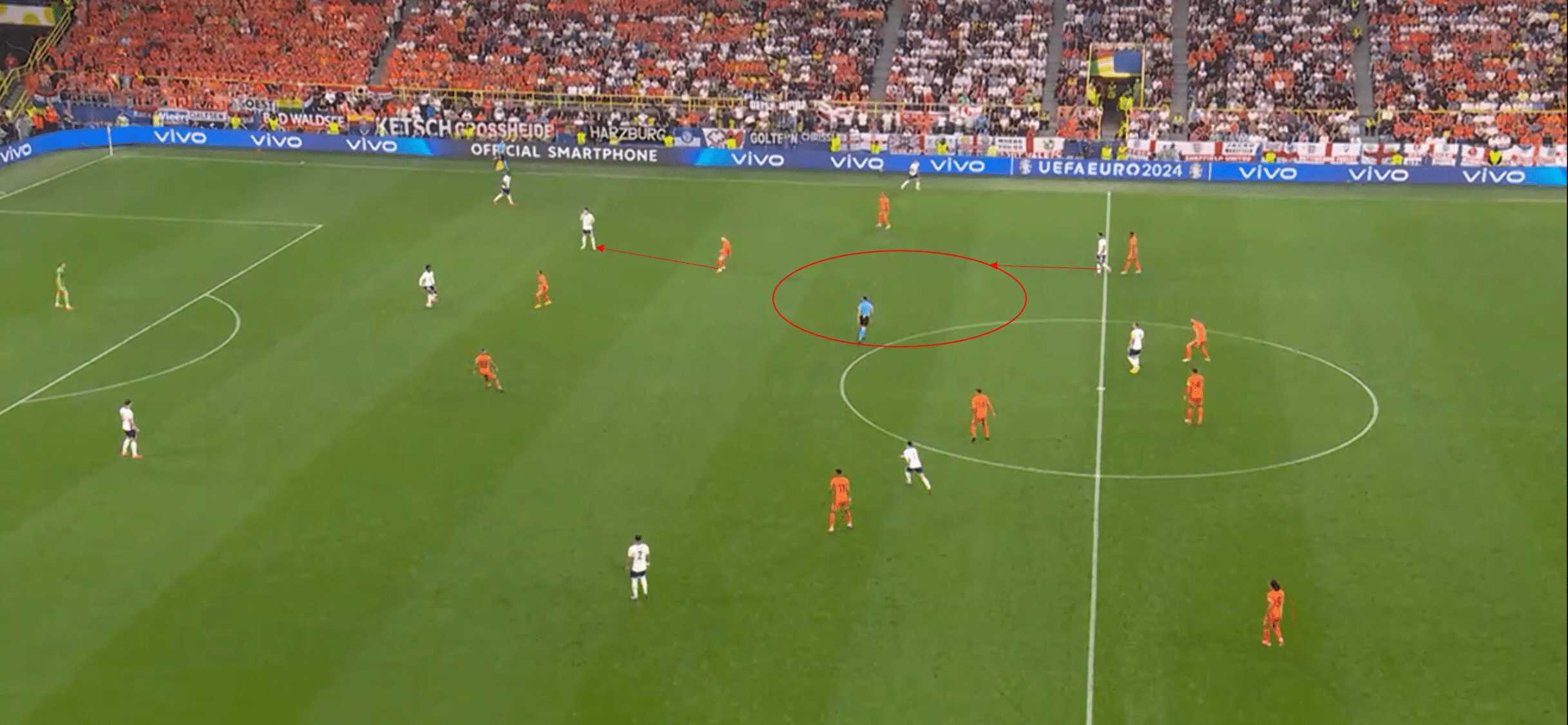
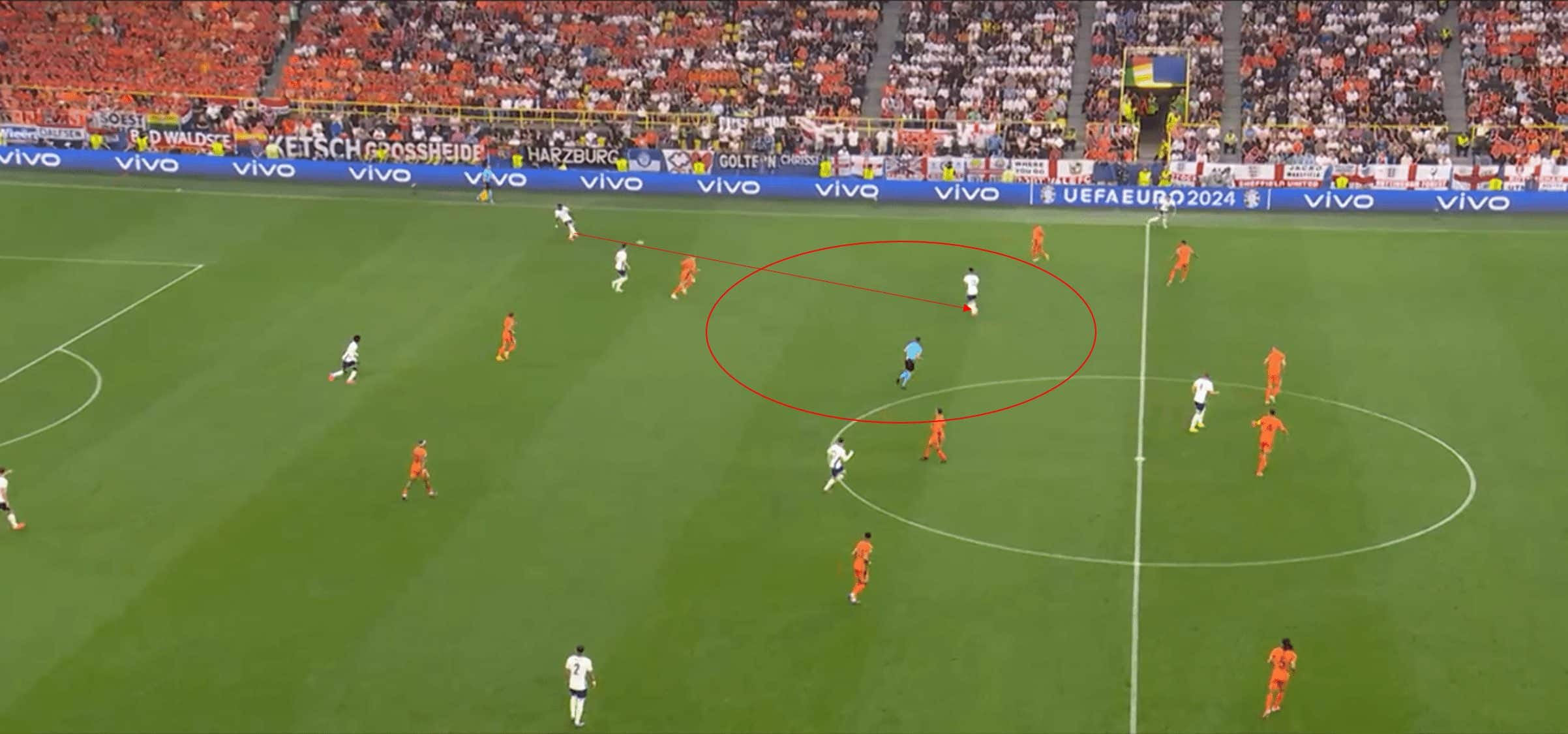
Euro 2024 semi-finals: Man-orientation and a pendulum-pivot: How England managed to prevail - tactical analysis tactics
Schouten pressing forward onto Rice, opening up space behind him
Euro 2024 semi-finals: Man-orientation and a pendulum-pivot: How England managed to prevail - tactical analysis tactics
Bellingham receiving the ball in the half-space, turning towards goal quickly

In this situation, Schouten is trying to press Declan Rice, who simply drops deep to pull Schouten out of his position. By playing through the third man in Guehi, England can easily exploit the space behind Schouten, and Bellingham can turn towards the goal after receiving the ball in space.

England created multiple chances like that because it enabled their best players, Bellingham and Foden, to use their strengths. Foden thrived yesterday and was able to have multiple good goalscoring chances out of these types of situations, including his signature shot hitting the left post.

Overall, England improved in possession, and their positional play allowed them to create more chances. But it also needs to be said that England really struggled again in the second half after Koeman made some adjustments to England’s game plan. So, while there was development, it still was a rather one-dimensional approach.

The Netherlands man-oriented press and pendulum pivot

The Dutchmen have had a rather up-and-down tournament so far at the Euros 2024. While they were having problems in the group stages and got picked apart defensively by France and Austria, they managed to beat Romania and Turkiye to advance into the semi-finals.

One major change was switching to a very man-oriented press while playing against the ball. That change worked wonders for the Netherlands in their game against Romania and Türkiye. Against England, however, it would have been a problem. Facing England’s 2-1 formation in midfield while playing with the same formation as well, a man-oriented press meant that one part of the double pivot always had to step up and leave his position. In this case, it was obvious that the defensive midfielder on the near side always had to step up. The defensive midfielder on the far side of the pitch dropped back into the defensive line to cover the deep runs England had shown to use during their last couple of games.
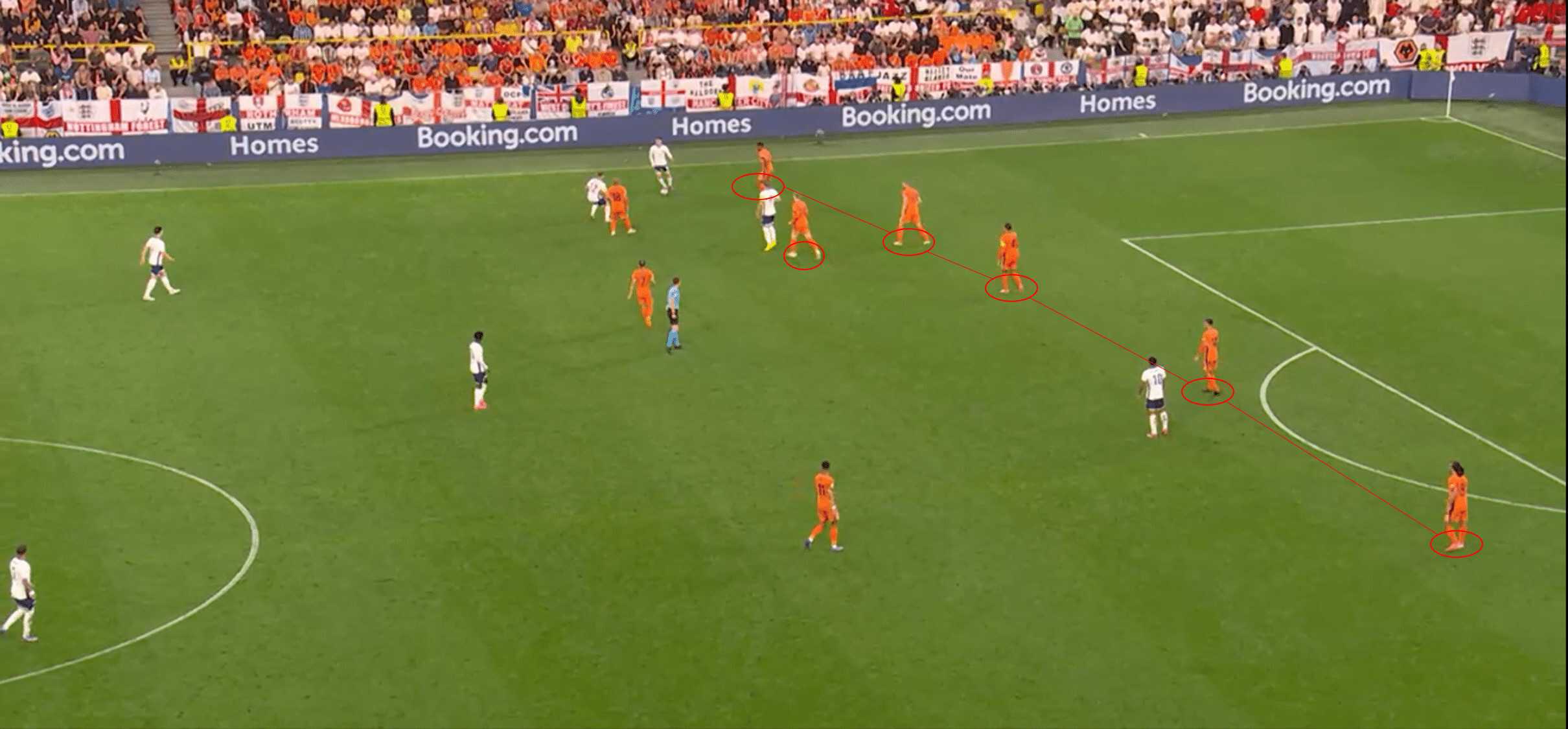
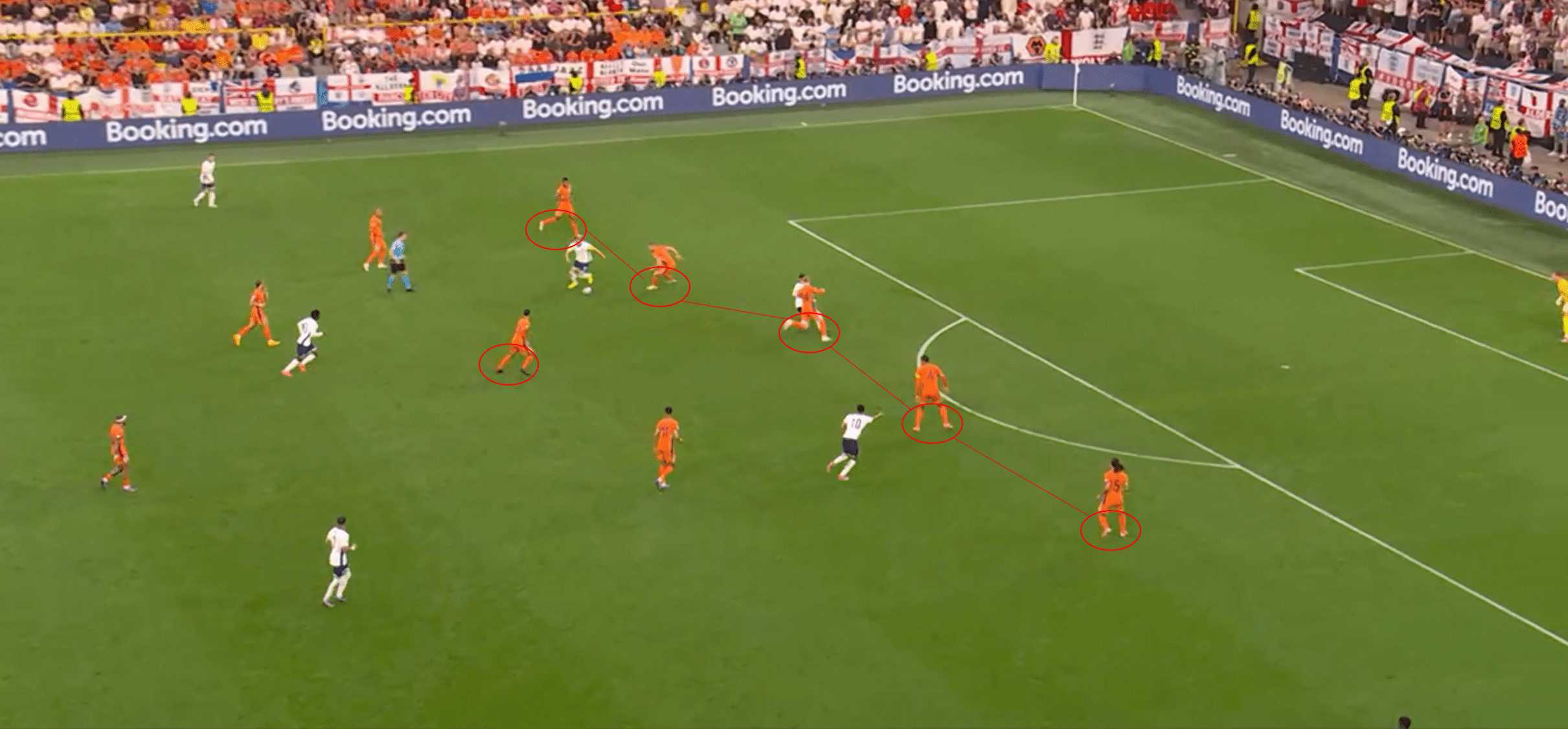
Euro 2024 semi-finals: Man-orientation and a pendulum-pivot: How England managed to prevail - tactical analysis tactics
Schouten pressing forward and Reijnders falling into the defensive line, creating a back-five
Euro 2024 semi-finals: Man-orientation and a pendulum-pivot: How England managed to prevail - tactical analysis tactics
Reijnders pressing forward, and Schouten covering in the defensive line

As seen in the pictures above, this meant that Schouten and Reijnders were constantly tasked with stepping up and falling back in opposing motion to each other. This created a pendulum effect in the Dutch formation, and it got balanced out according to where the ball was.

Additionally, the Dutch defenders played a very man-oriented defensive press. Every centre-back moved out of his position to cover the English attackers multiple times per game. This was used to try to prevent moments of individual class showing and force England to win the game through teamwork and a good performance.

While, in theory, it worked great, it really didn’t in the match. The English overload forced the Dutch midfield out of position multiple times and allowed receptions in between the lines for the English attacking midfielders.

In the second half of the game, Ronald Koeman stopped using the pendulum pivot, and the Netherlands were more compact defensively, which allowed fewer scoring opportunities for England overall. Unfortunately for the Dutch, in the additional time, the pendulum pivot would have helped cover the space in which Olli Watkins was running before he scored the winning goal. While it was a good decision to stop allowing Bellingham and especially Foden to receive the ball in open space, the moment Foden was subbed off, the pendulum pivot would have probably worked really well again. It could have edged out extra time for the Dutchmen.

Overall, Ronald Koeman and his staff had an interesting idea to stop the Englishmen from scoring, but the execution lacked finesse, and Gareth Southgate’s change of tactics in possession buried potential success for the Netherlands rather quickly.

Roaming strikers to beat man-oriented press

A fascinating tidbit about the game was the striker’s position. In the grand scheme of things, the position is gaining a lot of importance. While 12 years back, the false nine was gaining more and more traction, teams have returned to more traditional target men up front.

In this semi-final, however, both teams used their striker as a false nine once again. While Memphis Depay never was an actual number nine, Harry Kane is, even though he is great at dropping back into the midfield.

Both teams decided to play very man-oriented against the ball, especially in the defensive line. Man coverage per se isn’t something that is played a lot by teams at the highest level, but in terms of pressing, many national teams are using a man-oriented press simply because it is easier to implement in a short timeframe compared to a zone-oriented press, which is highly dependent on training.
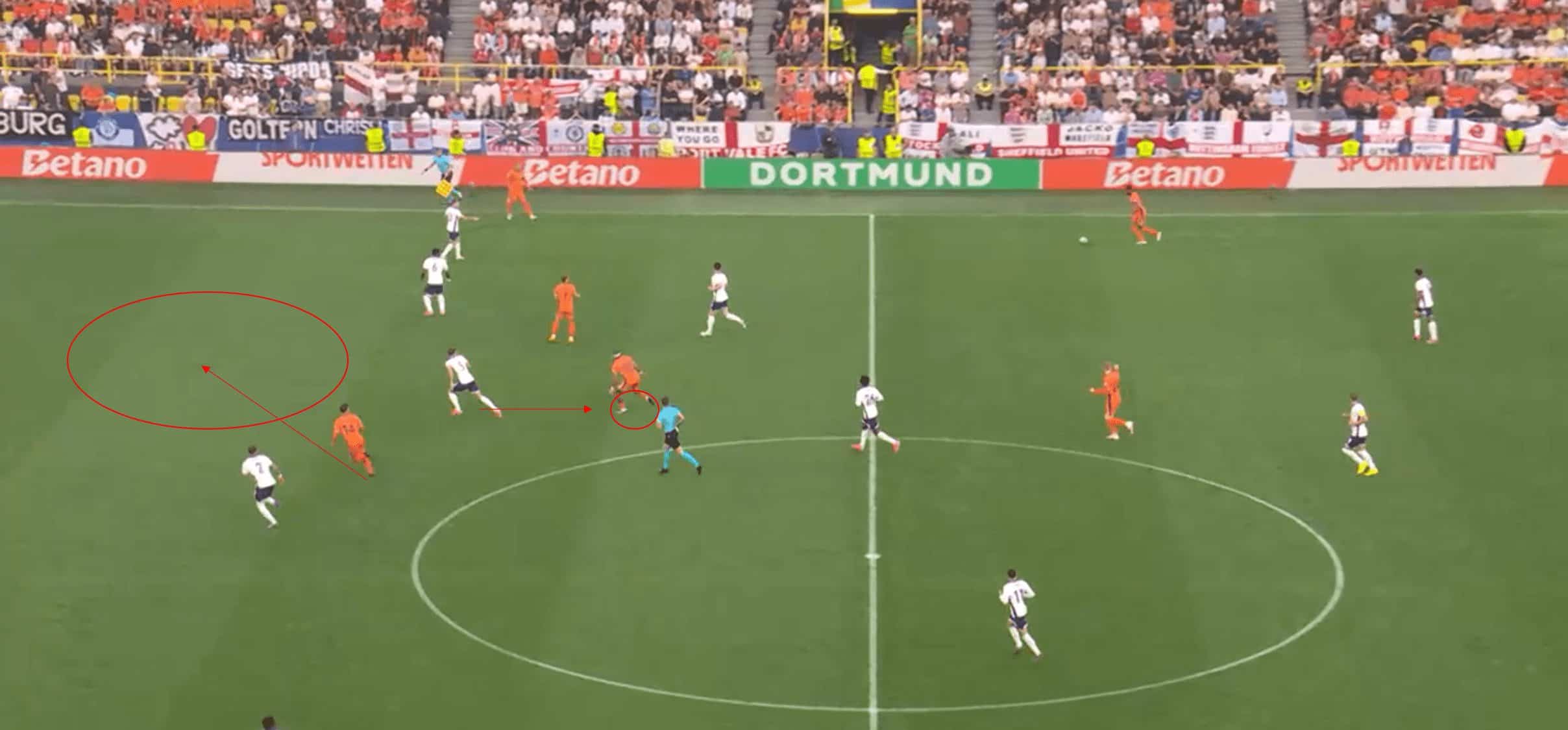
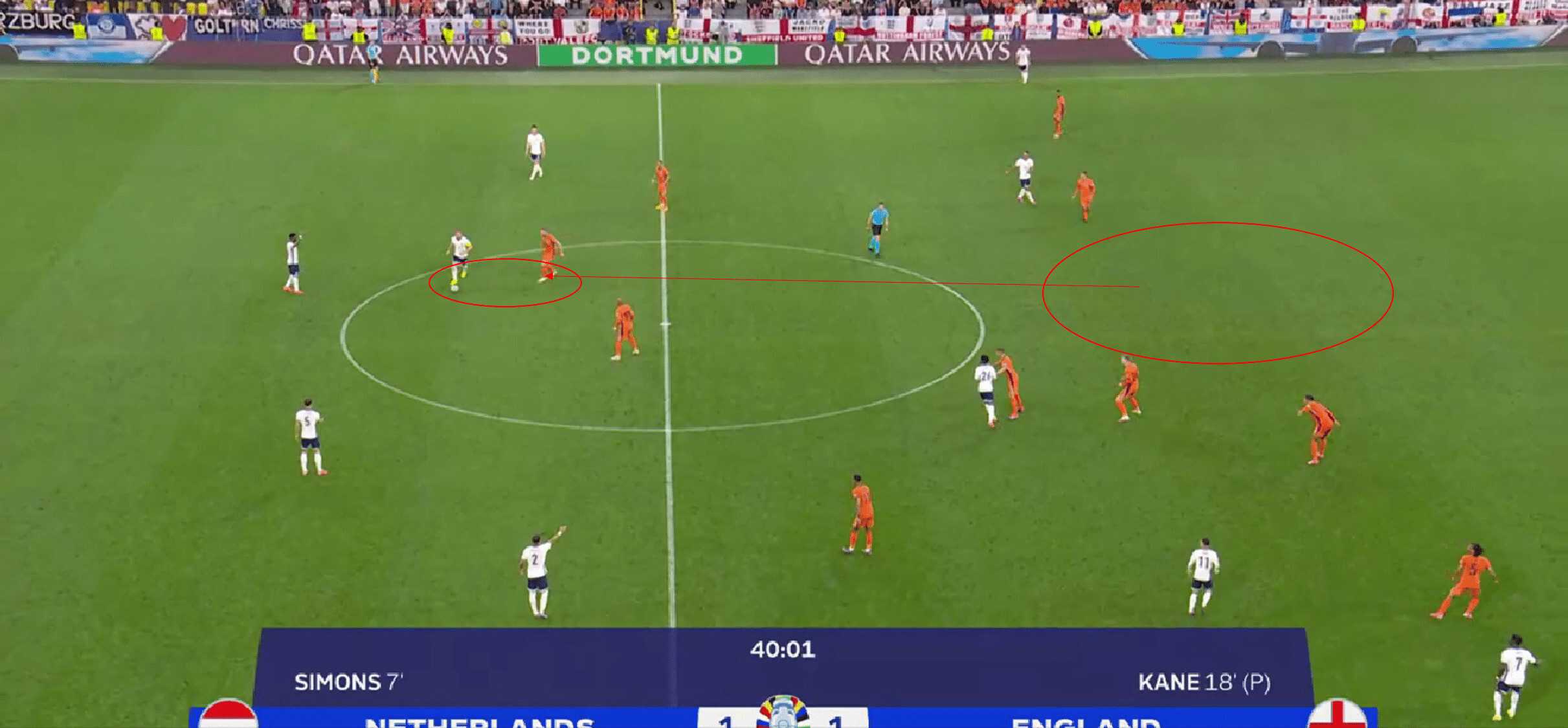
Euro 2024 semi-finals: Man-orientation and a pendulum-pivot: How England managed to prevail - tactical analysis tactics
Depay dropping into midfield, pulling Stones out of position
Euro 2024 semi-finals: Man-orientation and a pendulum-pivot: How England managed to prevail - tactical analysis tactics
Harry Kane dropped deep, pulling de Vrij into the opposing half, opening space in the last line

In both situations, the striker drops back deep into midfield, drags his assigned marker out of the defensive line, and creates a ton of space in an area where teams usually prioritise defence.

In the case of Depay dropping back, the situation even ended up as the lone goal for the Netherlands. Stones was dragged out of position, and the English defenders weren’t able to be compact and had to clear away the ball without control, forcing Rice into a duel with Simons, who won the ball and proceeded to score the goal.

In situations like these, simple football becomes problematic again. Obviously, it is impossible for national teams to have collective intelligence like a team at the club level. However, still, both defences struggled immensely that game by covering the most important zones on the pitch. Teams with better possession play would abuse this behaviour instantly.

Conclusion

In the end, England reached the grand final in Berlin on Sunday after once again scoring a late goal. While I still doubt the quality of England’s performances, Gareth Southgate has reached the second straight final of the European Championships, a historic achievement for the Three Lions.

Now, they are going to face a Spanish side that has won against the likes of Italy, Croatia, Germany, and France. Spain has shown to be a great team and has beaten multiple other top teams that have used different approaches to the games against Spain. Can England prevail once again? It is going to be tough. Luis de la Fuentes’s men are definitely going to be the favourites in the final.

But this English side has shown one thing time after time: resilience. Even when being critiqued, even when down against worse teams, even when the pressure is at its peak, the Englishmen have won their games and played hard up until the final whistle. This resilience, combined with their individual talent, will make them a tough opponent for La Furia Roja in what is going to be an exciting final on Sunday.

Previous Post

UEFA EURO 2024 Final: How set pieces could decide the European Champions – tactical preview

Next Post

Copa America 2024 Semi-Final: How Clinical Colombia Capitalized On Uruguay’s Errors – Tactical Analysis

Next Post
Copa America 2024: Uruguay vs. Colombia - tactical analysis tactics

Copa America 2024 Semi-Final: How Clinical Colombia Capitalized On Uruguay's Errors - Tactical Analysis

  • About Total Football Analysis
  • Contact Total Football Analysis
  • Write For Total Football Analysis
  • Advertise
  • Privacy Policy
  • Cancellation / Refund Policy
  • Resources
  • Terms Of Service

© 2026 Total Football Analysis

No Result
View All Result
  • Football Analysis
    • Data Analysis
    • Formations
      • 2-2-4 Formation
      • 2-3-5 Formation
      • 3-1-4-2 Formation
      • 3-2-2-3 Formation
      • 3-2-4-1 Formation
      • 3-1-6 Formation
      • 3-3-4 Formation
      • 3-4-1-2 Formation
      • 3-4-2-1 Formation
      • 3-4-3 Formation
      • 3-5-1-1 Formation
      • 3-5-2 Formation
      • 4-1-4-1 Formation
      • 4-2-2-2 Formation
      • 4-2-3-1 Formation
      • 4-2-4 Formation
      • 4-3-1-2 Formation
      • 4-3-3 Formation
      • 4-4-2 Formation
      • 4-5-1 Formation
      • 5-3-2 Formation
      • 5-4-1 Formation
      • 6-3-1 Formation
    • Head Coach Analysis
    • Match Analysis
    • Player Analysis
    • Recruitment Analysis
    • Set Piece Analysis
    • Tactical Theory
    • Tactical Preview
    • Team Analysis
    • Training Analysis
    • Tactical Analysis
    • Scouting Report
  • Competition
    • ALL Competitions
    • English Premier League
    • Champions League
    • La Liga
    • Bundesliga
    • Serie A
    • Ligue 1
    • Eredivisie
    • EFL Championship
    • FIFA World Cup 2022
    • WEURO 2022
    • Women’s Super League
    • NWSL
    • Belgian First Division A
    • A-League
    • Liga Profesional de Argentina
    • Austrian Bundesliga
    • Campeonato Brasileiro Série A
    • DFB Pokal
    • 1. HNL
    • Danish Superliga
    • EFL League One
    • EFL League Two
    • FA Cup
    • EFL Cup
    • Indian Super League
    • K-League
    • J1 League
    • Liga MX
    • Copa América 2021
    • Copa del Rey
    • MLS
    • Eliteserien
    • Euro 2020
    • Primeira Liga
    • Scottish Premiership
    • Allsvenskan
    • Europa League
    • UEFA Nations League
    • Liga AUF Uruguaya
  • Coaches
    • All Coaches
    • Alfred Schreuder
    • Ange Postecoglou
    • Antonio Conte
    • Arne Slot
    • Bo Svensson
    • Brendan Rodgers
    • Bruno Lage
    • Carlo Ancelotti
    • Christophe Galtier
    • Claude Puel
    • Claudio Ranieri
    • David Moyes
    • Dean Smith
    • Diego Simeone
    • Domenico Tedesco
    • Frank Lampard
    • Eddie Howe
    • Edin Terzić
    • Emma Hayes
    • Erik ten Hag
    • Ernesto Valverde
    • Gennaro Gattuso
    • Gerardo Seoane
    • Gian Piero Gasperini
    • Giovanni van Bronckhorst
    • Graham Potter
    • Igor Tudor
    • Imanol Alguacil
    • Jesse Marsch
    • Jonas Eidevall
    • Jorge Sampaoli
    • José Bordalás
    • José Mourinho
    • Julen Lopetegui
    • Julian Nagelsmann
    • Julien Stéphan
    • Jürgen Klopp
    • Luciano Spalletti
    • Lucien Favre
    • Manuel Pellegrini
    • Marcelo Bielsa
    • Marco Rose
    • Marco Silva
    • Massimiliano Allegri
    • Mauricio Pochettino
    • Maurizio Sarri
    • Mikel Arteta
    • Niko Kovač
    • Nuno Espírito Santo
    • Oliver Glasner
    • Patrick Vieira
    • Paulo Fonseca
    • Pep Guardiola
    • Peter Bosz
    • Rafa Benítez
    • Ralf Rangnick
    • Ralph Hasenhüttl
    • Roger Schmidt
    • Roy Hodgson
    • Sean Dyche
    • Sérgio Conceição
    • Simone Inzaghi
    • Sonia Bompastor
    • Stefano Pioli
    • Steffen Baumgart
    • Steven Gerrard
    • Thiago Motta
    • Thomas Frank
    • Thomas Tuchel
    • Unai Emery
    • Vincenzo Italiano
    • Xavi
  • Teams
    • ALL Teams
    • AC Milan
    • Ajax Amsterdam
    • Arsenal
    • AS Monaco FC
    • Atalanta
    • Atlético Madrid
    • FC Barcelona
    • FC Bayern Munich
    • Borussia Dortmund
    • Celtic FC
    • Chelsea FC
    • Everton F.C.
    • Inter Milan
    • Juventus F.C.
    • Leeds United F.C.
    • Liverpool FC
    • Manchester City
    • Manchester United FC
    • Paris Saint-Germain
    • Rangers FC
    • RB Leipzig
    • Real Madrid CF
    • Tottenham Hotspur
    • West Ham United
  • Players
    • ALL Players
    • Alisson Becker
    • Bukayo Saka
    • Erling Haaland
    • Harry Kane
    • Jack Grealish
    • John Stones
    • Julián Alvarez
    • Kalvin Phillips
    • Kevin De Bruyne
    • Kyle Walker
    • Kylian Mbappé
    • Lamine Yamal
    • Lionel Messi
    • Luis Díaz
    • Mohamed Salah
    • Phil Foden
    • Virgil Van Dijk
  • Contact
  • Write For TFA
  • Login

© 2026 Total Football Analysis