
Following their failure in UEFA Euro 2024, Italy have been trying to start a new chapter under the management of Luciano Spalletti.
Italy quickly turned the page on Euro 2024, starting its UEFA Nations League journey with an important 1-3 away win against France.
Then, they beat Israel away and drew 2-2 against Belgium in a complicated match at the Stadio Olimpico in Rome.
After that, they defeated Israel once again, this time 4-1, at the Bluenergy Stadium in Udine.
This latest win allowed Italy to top a tough Group B standings with four wins, a draw, and no losses.
Unfortunately for Italy, they failed to end their UEFA Nations League group stage with a win and therefore lost the first spot to France, losing 1-3 at San Siro.
The result was unacceptable, as France ended up topping the group despite their two-goal win margin.
However, we cannot argue that Italy played poorly or that they started underperforming again.
In fact, the latest game against France was very difficult for both teams, as the pace was high from the beginning.
France were intelligent enough to exploit Italy’s weak moments, especially at the start of the game.
They scored two crucial goals in the first half, complicating Italy’s task, who responded with one goal but failed to equalise.
The reaction shown and the numerous dangerous chances created in that match confirm that Italy did not underperform.
However, that does not exclude the fact that the Azzurri still have a lot of work to do in both phases.
They need to commit fewer mistakes against the top teams, with one of Portugal, Spain, or Germany waiting in the first knockout-phase match.
Even though Italy had the opportunity to top the group and face one of Croatia, Denmark or the Netherlands, the prospect of competing against Portugal, Spain, or Germany should not represent an issue.
It will be more beneficial for them to play against top teams to assess their progress better.
Moreover, Italy tends to play better when they face bigger teams and tend to underperform when they are the favourites.
Therefore, Italy should not overthink who they will face in the knockout round and focus more on improving their tactics and fixing what has not been positive during the group stage.
This tactical analysis and scout report will focus on Italy’s attacking and defensive phases.
We will highlight their improvements and also discuss what still needs improvement within the team.
The football analysis will also focus on Spalletti’s change of formation and player choices following Euro 2024.
Italy’s Back-Three Defence
Following Euro 2024, Spalletti focused on fixing his mistakes and made striking changes to his formation.
He started the UEFA Nations League with a 4-4-2 against France.
Even though this formation was effective against France, Luciano Spalletti opted to switch to the 3-5-2 against Israel.
With the integration of new names like Alessandro Buongiorno and Federico Gatti, and the reliance on Moise Kean up front alongside Giacomo Raspadori, Spalletti began forming a stronger, more compact, and more dangerous team with the 3-5-2 formation.
With defenders like Arsenal’s Riccardo Calafiori, Napoli’s Buongiorno, Inter Milan’s Alessandro Bastoni, and Napoli’s Giovanni Di Lorenzo as a centre-back when needed, Italy started to have a more solid defence.
Their trios made things more organised on the defensive level.
Moreover, with Federico Dimarco and Juventus’ Andrea Cambiaso retreating regularly to contribute in the defensive phase and mark wingers on their respective sides, as well as three midfielders always present and effective in terms of marking and ball interception inside the final third, Italy have started to concede fewer goals lately.
Their overall team balance has improved a lot.
Spalletti also made a few changes to the team’s midfield in the last four games, switching to the 3-5-1-1 formation, which uses three central midfielders and another who plays just below, or sometimes alongside, the main striker (Mateo Retegui).
This idea provides more security to the second line of defence, as someone like Nicolò Barella defends well in the out-of-possession phase.
This makes the formation a 3-6-1 when out of possession and sometimes a 5-4-1 when both Dimarco and Cambiaso retreat.
Depending on the match situation, these formation changes have been beneficial for Italy so far and have helped them become tough to beat.
To consolidate this idea, it is fair to say that France could beat Italy mainly through set-pieces and by exploiting Italy’s early issues.
Italy’s Formation Under Luciano Spalletti

Italy’s Attacking Improvements
So far, Italy’s xG has reached 1.56, and they’re scoring 1.67 goals per game — a positive number.
Italy shoots 11.67 times per 90 minutes, with 36.6% of its shots being on target, a statistic that highlights the high number of chances created per game under Luciano Spalletti’s style of play.
Moreover, Italy tends to hold 54.33% of possession against its opponents and often plays well with it.
Nevertheless, they need to avoid being slow in the build-up when facing quick teams because that can make things complicated for them.
It should also be said that Italy have developed a lot of chemistry between their players, who have been showing some excellent passing exchanges in almost every game.
This often creates dangerous opportunities for the Azzurre, especially during counterattacks.
Moreover, the numerical superiority in the attack and the ability of players like Sandro Tonali and Dimarco to finish or provide assists made it easier for Italy to score goals in recent games.
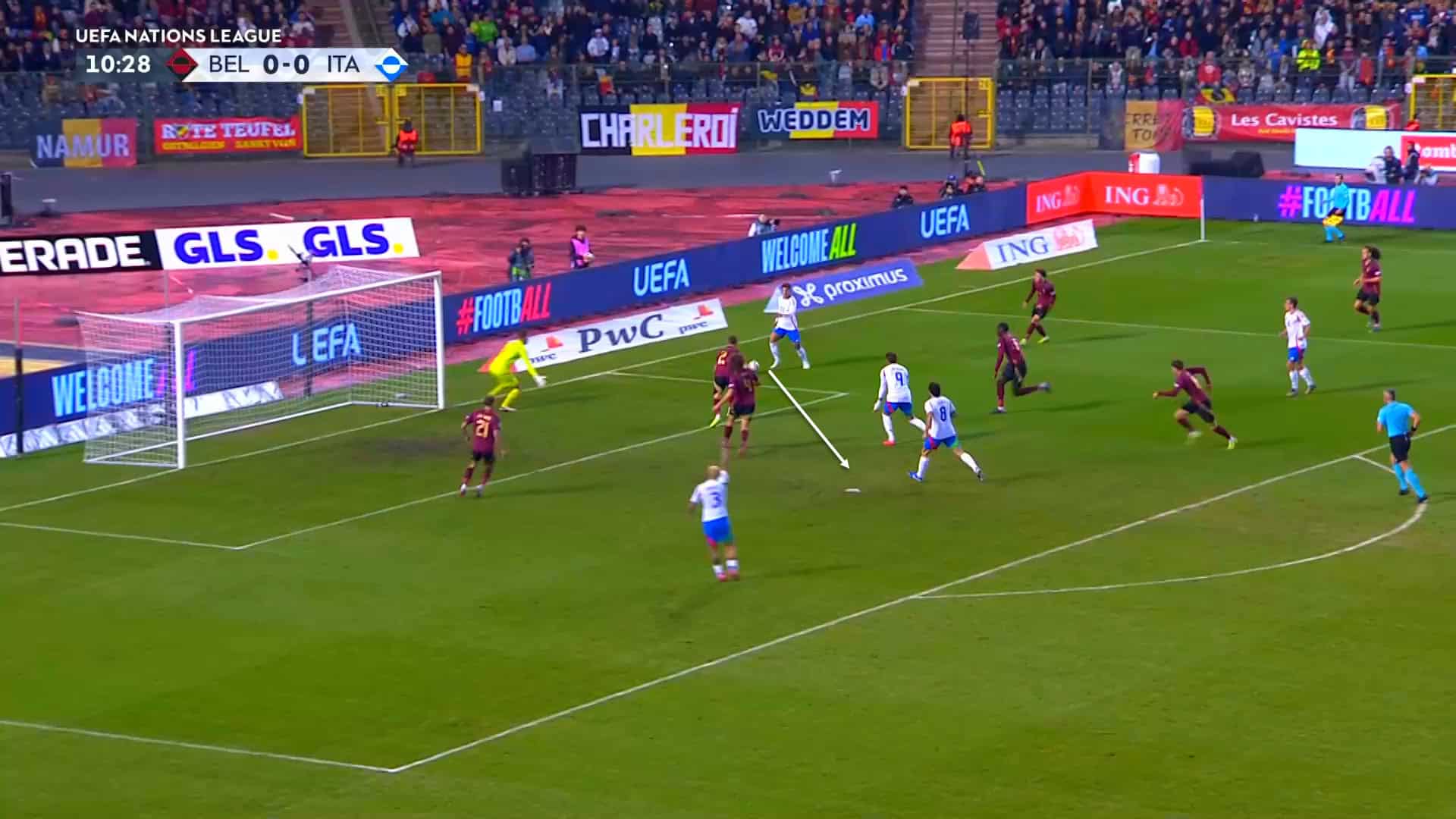
This goal against Belgium highlights the presence of Dimarco, Tonali, and Barella inside the box, who provide passing options and finish actions, especially when Retegui is being marked.
Italy’s Goal Against Belgium
In addition, Italy is actually exploiting set pieces better, as Raspadori, Barella, Tonali, and Dimarco are all excellent set-piece takers.
Furthermore, Di Lorenzo, Bastoni, Buongiorno, Retegui, and others are all excellent headers and aerial duels players.
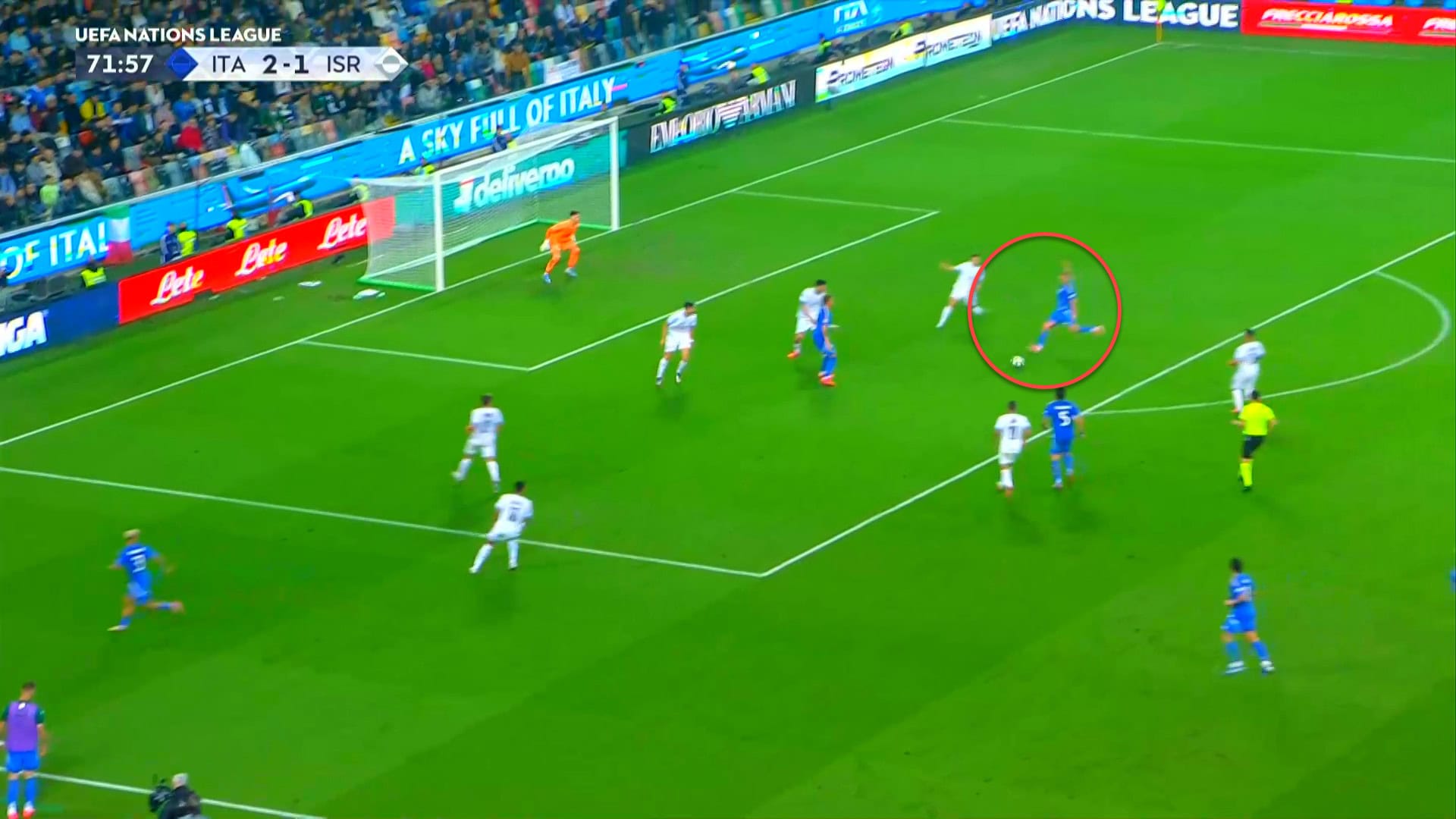
The addition of Frattesi, Barella, and Tonali inside the box in terms of finishing has been valuable since these players have been helping a lot by scoring goals from distance, like in the example below.
They can also penetrate without the ball behind Retegui and receive passes, as Retegui is often marked in that area.
Italy’s Goal Against Israel
Defenders like Calafiori, who has excellent vision and always knows how to support attacking actions, have been another critical factor in making Italy’s attacking phase more powerful.
He has already been crucial on numerous occasions when advancing with or without the ball.
Spalletti knew how to build on his remarkable solo effort in the Euro 2024 match against Croatia to make Calafiori more confident in his attacking contributions and to encourage him to attempt similar actions whenever possible.
At the same time, Dimarco and Cambiaso are becoming crucial to Luciano Spalletti’s tactics, as both players are vital in both the defensive and attacking phases.
More importantly, these two players are even more crucial during counter-attacks, as we saw their impact and role in such actions.
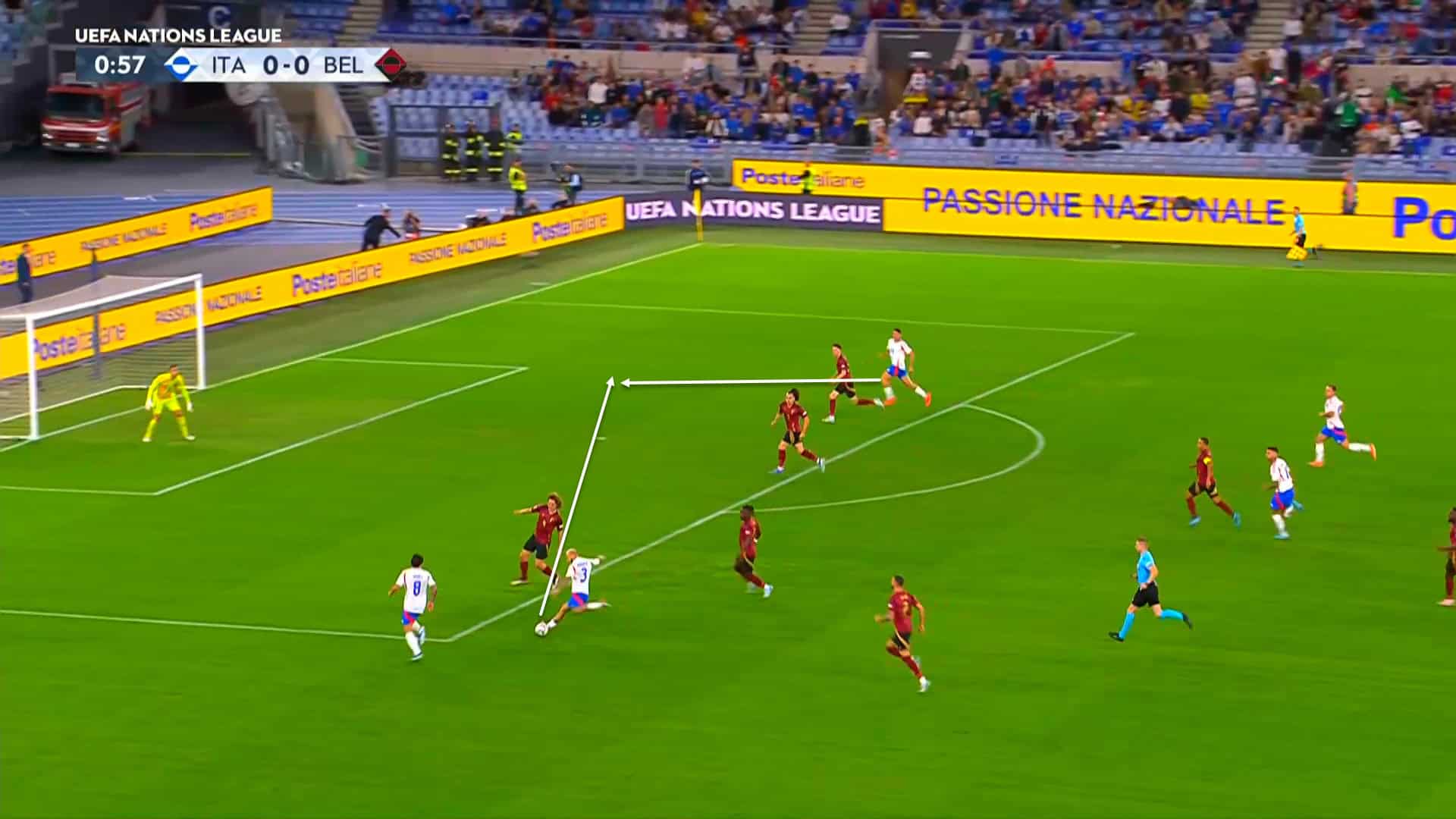
Using their pace, dribbling, and passing abilities, Dimarco and Cambiaso have even been able to finish actions by themselves, and the goal assisted by Dimarco and scored by Cambiaso can represent the perfect example of this duo’s threat.
Italy’s Goal Against Belgium
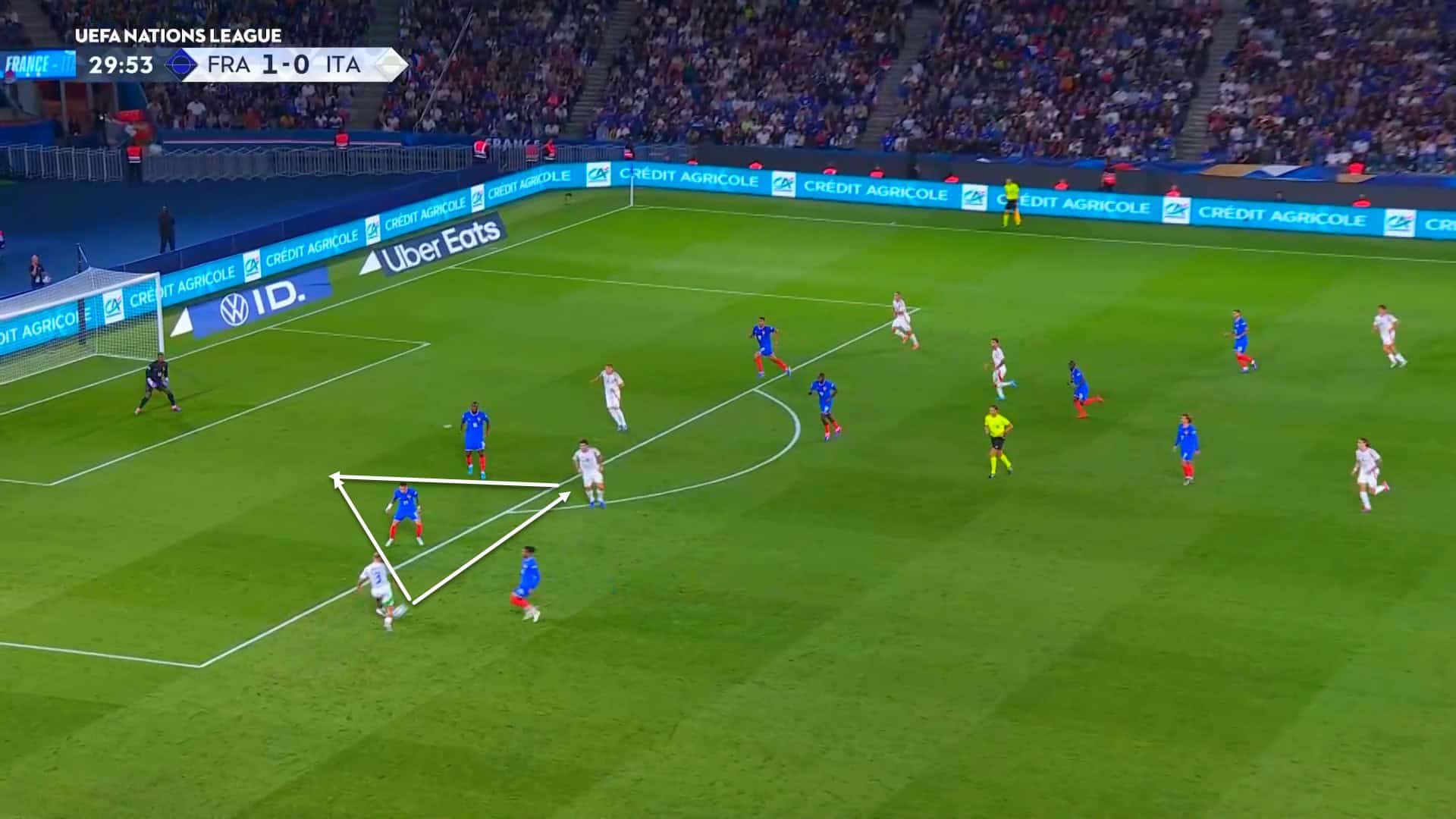
Using triangular combinations and relying on the excellent passing of Tonali, Barella, Dimarco, and others has been fruitful, as Italy has played beautiful football and picked up points.
Scoring goals like the following against France highlights that Italy’s attacking tactics have developed significantly since the Euro 2024 era.
The team began finding multiple goal-scoring options, and the players became quicker and more efficient in passing and movement between the lines.
This goal also emphasizes that many of this team’s players have excellent finishing ability and can score from many positions, as shooting from distance can surprise any opponent.
Italy’s Goal Against France
Italy’s Defensive Changes And Weaknesses
Luciano Spalletti recently opted for a back-three defence, and the result has been convincing.
The team has not dropped many points since the end of Euro 2024 and has lost only once against France.
The numerical superiority imposed by Luciano Spalletti’s coaching style, which involves using three centre-backs and Dimarco + Cambiaso supporting them in the defensive phase, in addition to at least two defenders usually present in front of the defence, has been very effective in defending well against teams like Belgium, as this plan reduced spaces for opponents.
Italy actually conceded 0.87 goals and 8.87 shots per game.
If we compare this average to other similar teams, we can argue that these are good averages for Italy.
However, they can be improved even further by limiting their defensive mistakes.
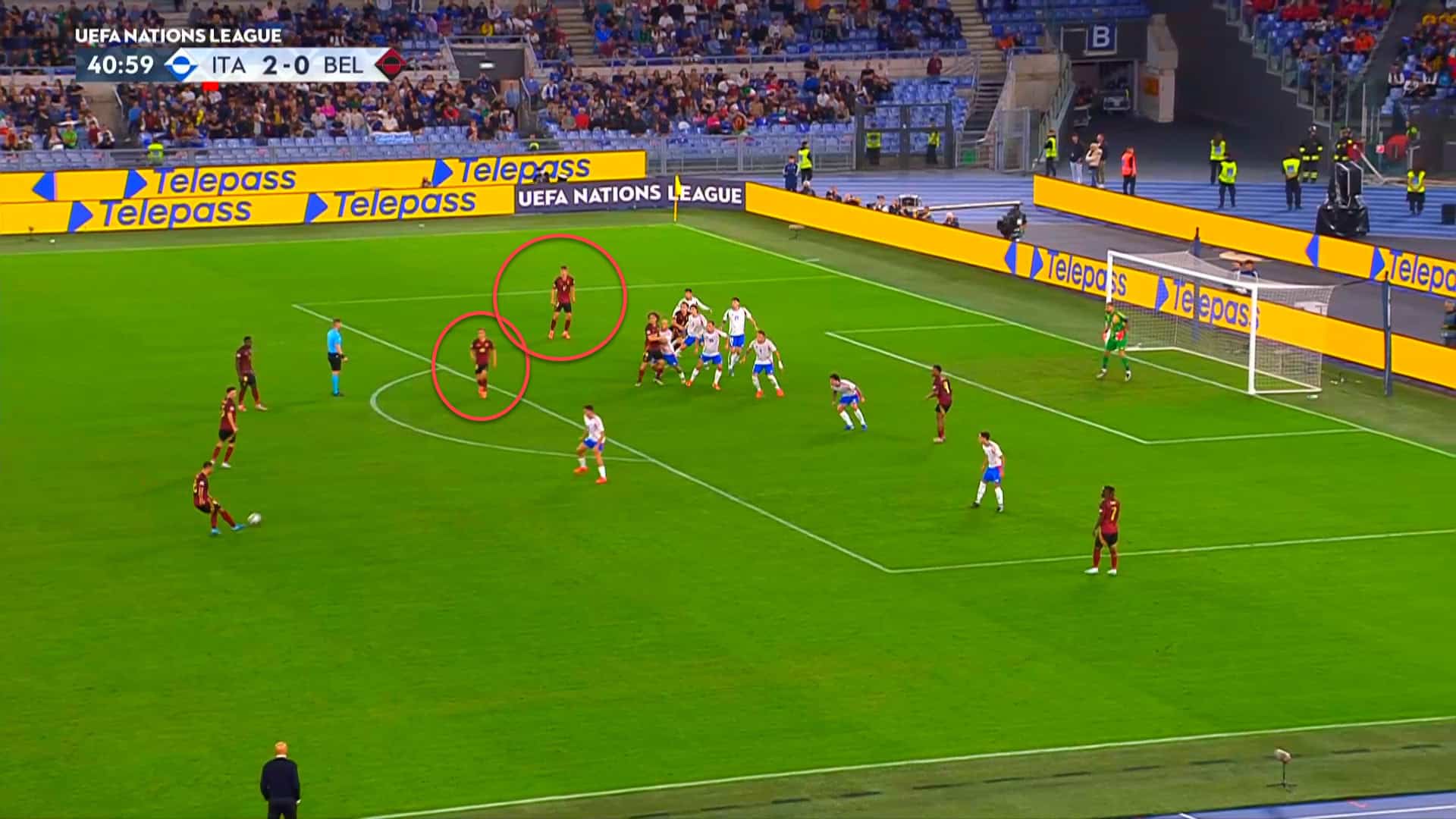
Italy have been poor when defending set-pieces and are conceding most of their goals due to bad marking during set-pieces or due to direct free-kicks.
The following conceded goal against Belgium highlights Italy’s set-piece defending issue and shows how the whole team was unaware of two unmarked players.
Italy’s defence should not repeat this type of error, as it is unacceptable to leave a lot of space and time to opponents during such dangerous set-pieces.
Italy’s Set-Piece Defending Issue
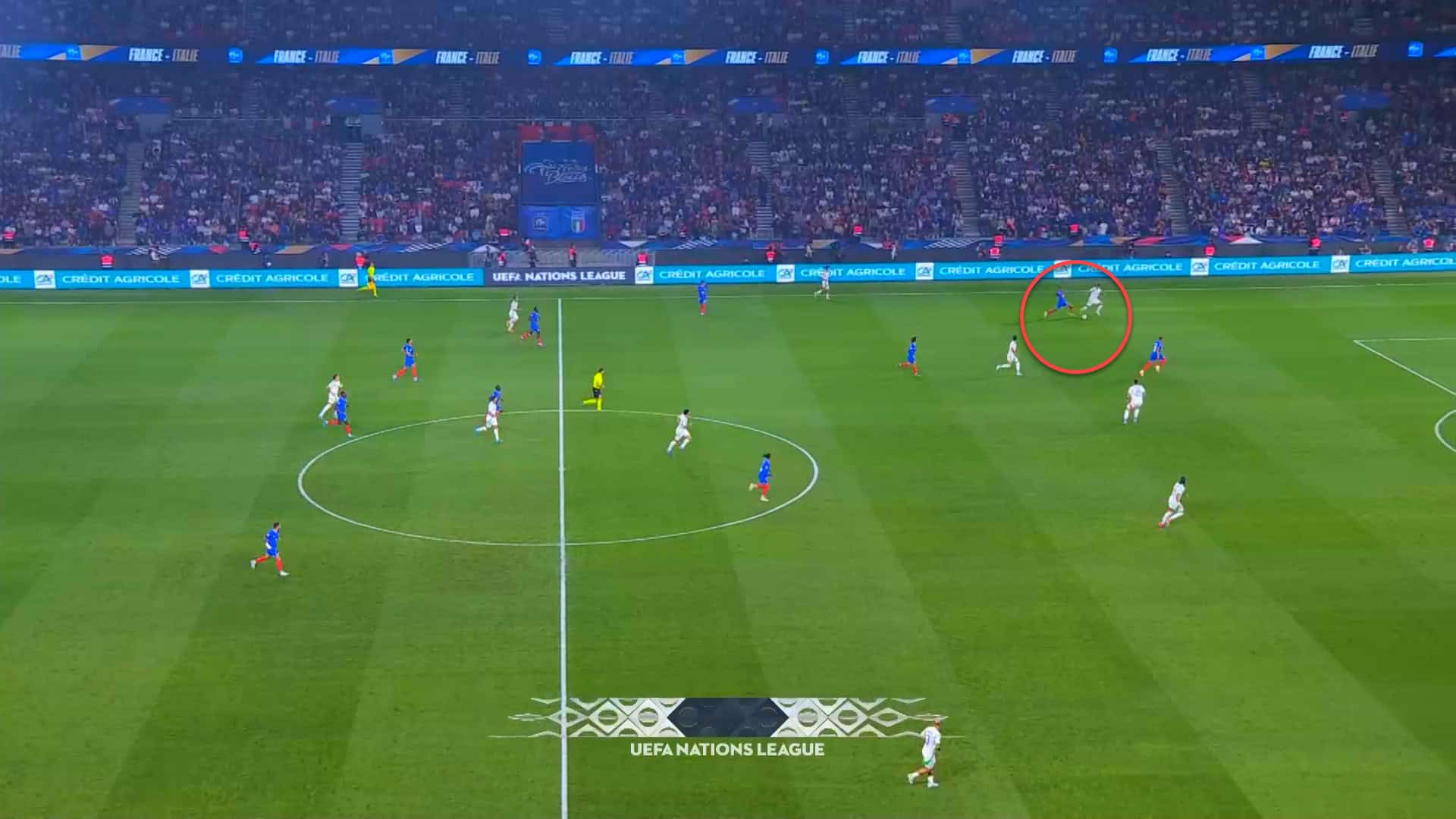
Moreover, Italy’s other remarkable defensive issue is its lack of concentration at the start of games and its recurrent errors during the first seconds of the match.
Italy tends to start slowly, unlike other teams that try to surprise opponents early with dangerous attacks.
Therefore, they are subject to high, aggressive pressure, which leads them to make mistakes.
Two similar actions occurred against France in the away and home games.
Italy conceded two goals due to concentration lapses that allowed France to score relatively easily.
Working better on the psychological level with the players and preparing them not to make this type of error at the start of the games will be crucial for Italy, as this has impacted their journey so far.
Italy’s First Minutes Issues
Conclusion
Italy have been playing some entertaining football during this post-Euro 2024 era, and the results have been following suit.
Things are very promising on the attacking front, and Spalletti should ensure they continue to progress by alternating the attacking plans and varying them further.
On the defensive side, however, eliminating first-minute errors and starting games properly will be very important for Italy.
Moreover, further training on collective and individual marking during set-pieces will be essential, as the team has been conceding most goals from such set-pieces.
