
Sunday Bundesliga games are reserved for teams that play in European competitions, so the league’s best teams typically play on Sundays.
This Sunday, VfB Stuttgart hosted 1. FSV Mainz 05 for the last game of the eighth matchday this season.
VfB Stuttgart and their head coach, Sebastian Hoeneß, have been on a roll lately.
They have won four straight Bundesliga games, shown great class, and climbed the table into the top four.
After winning the DFB-Pokal last season, the club qualified for the UEFA Europa League.
Still, their last two games in the competition were rather rough losses against FC Basel and Fenerbahce.
For Mainz and Bo Henriksen, things look a lot different.
While their season in the UEFA Conference League is off to a great start with two wins from two games, the team has only won one of the first seven Bundesliga games, placing them in the relegation zone.
Both teams approached the game differently.
Sebastian Hoeneß opted to rotate nearly his entire team, while Henriksen trusted his usual starting XI.
In this tactical analysis, we will examine the approaches of the two coaching staffs, how the game unfolded, and the tactical measures that decided the game in favour of VfB Stuttgart.
Stuttgart Early Dominance
The game wasn’t just a typical Bundesliga match with many different circumstances; looking at the current standings, it was also a face-off between two completely different approaches to the game.
Stuttgart have been one of the best teams in possession ever since Hoeneß took over the team in the midst of a rough relegation battle and turned things around within just a year.
The young German coach has been absorbing many of Pep Guardiola’s tactics, and it shows when his men have the ball at their feet.

Stuttgart always use a 3-2-5 shape while building up.
Their wing-backs push very high up the field into the attacking line, with two players in the half-spaces and one traditional striker.
THoneß’s play is very reminiscent of Manchester City in the Premier League, which often leads to them dominating possession.
And, as they do most of the time, Stuttgart was trying to establish possession from the start.
Even though their starting XI had many changes, they were able to push back Mainz from the start.
Mainz rarely even tried to attack Stuttgart in line one because they knew their team’s quality in these situations.
They often fell back into a midfield press and tried to attack when Stuttgart advanced into the Mainz half, especially with their three attackers.
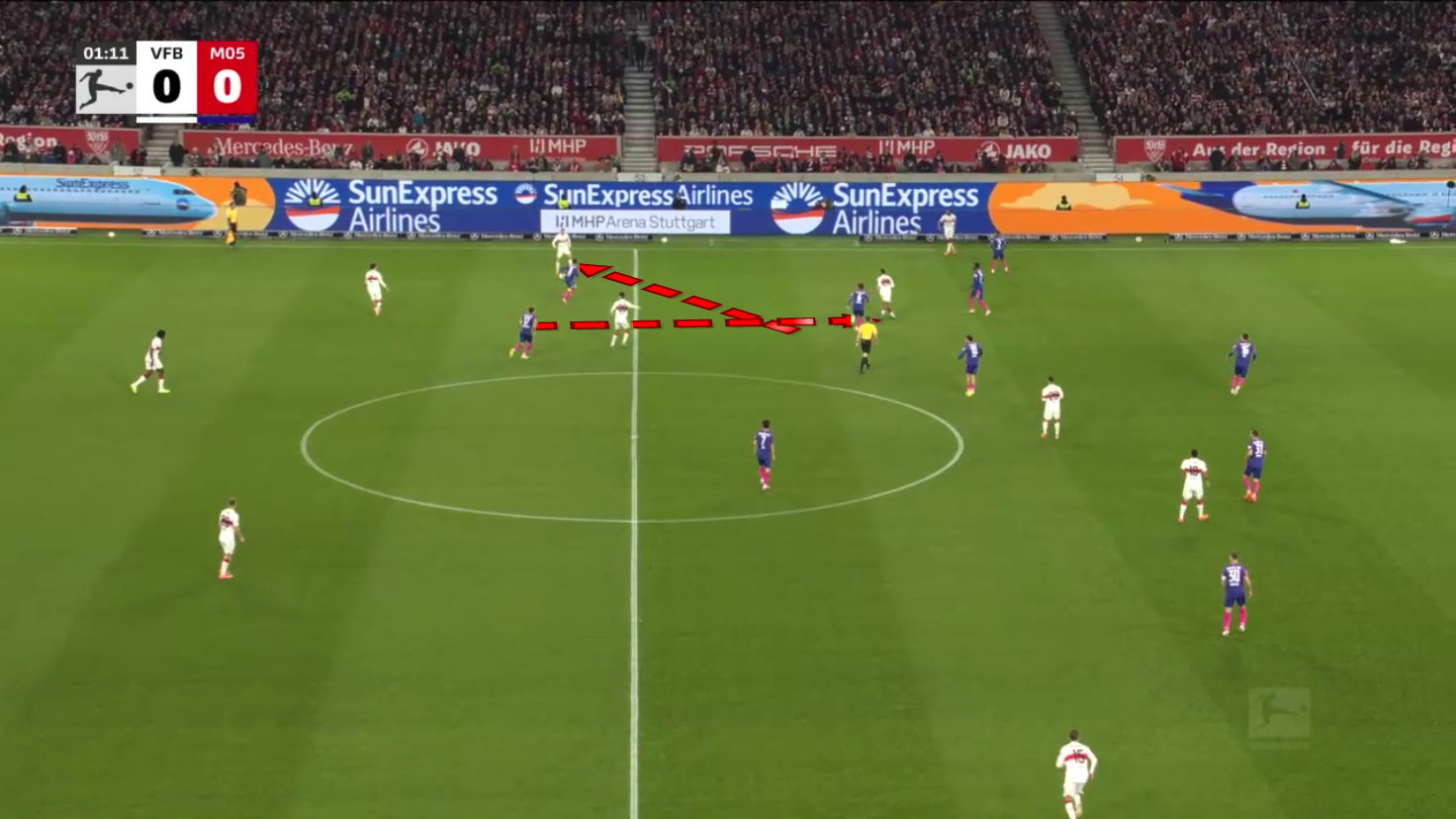
Hoeneß had his men play very patiently.
They tried to get into the attacking phase, but they never overforced their hand against an obnoxiously defending opponent.
Mainz tried to attack the back three with two of their three attackers in their 3-4-2-1 formation, with the far-sided player dropping diagonally back into midfield to prevent vertical passes towards Stuttgart’s double pivot.
While usually Hoeneß prefers to build through his holding midfielders, he gave both Atakan Karazor and Angelo Stiller some rest and focused on building through the wings from the get-go.
When they played towards the outside centre-back in the back three, the near-sided wing-back always dropped back towards the backline, while the far-sided wing-back always pushed very high up the field, putting pressure on the backline and forcing the defenders back a bit.
Then, the attacking midfielder dropped back diametrically towards the sideline.
Mainz tried to defend very man-oriented, especially when they were trying to cover the three Stuttgart attackers with the back-three.
Henriksen wanted his two centre-backs to defend forward very aggressively, even giving up position to do so.
With the players’ movements in the half-space, Hoeneß easily broke this coverage apart quickly and established some form of chaos in Mainz’s marking system.
Often, when they drop the attacking midfielder backwards, they still put pressure on the back three by vertically running their central midfielders into the vacated spaces.
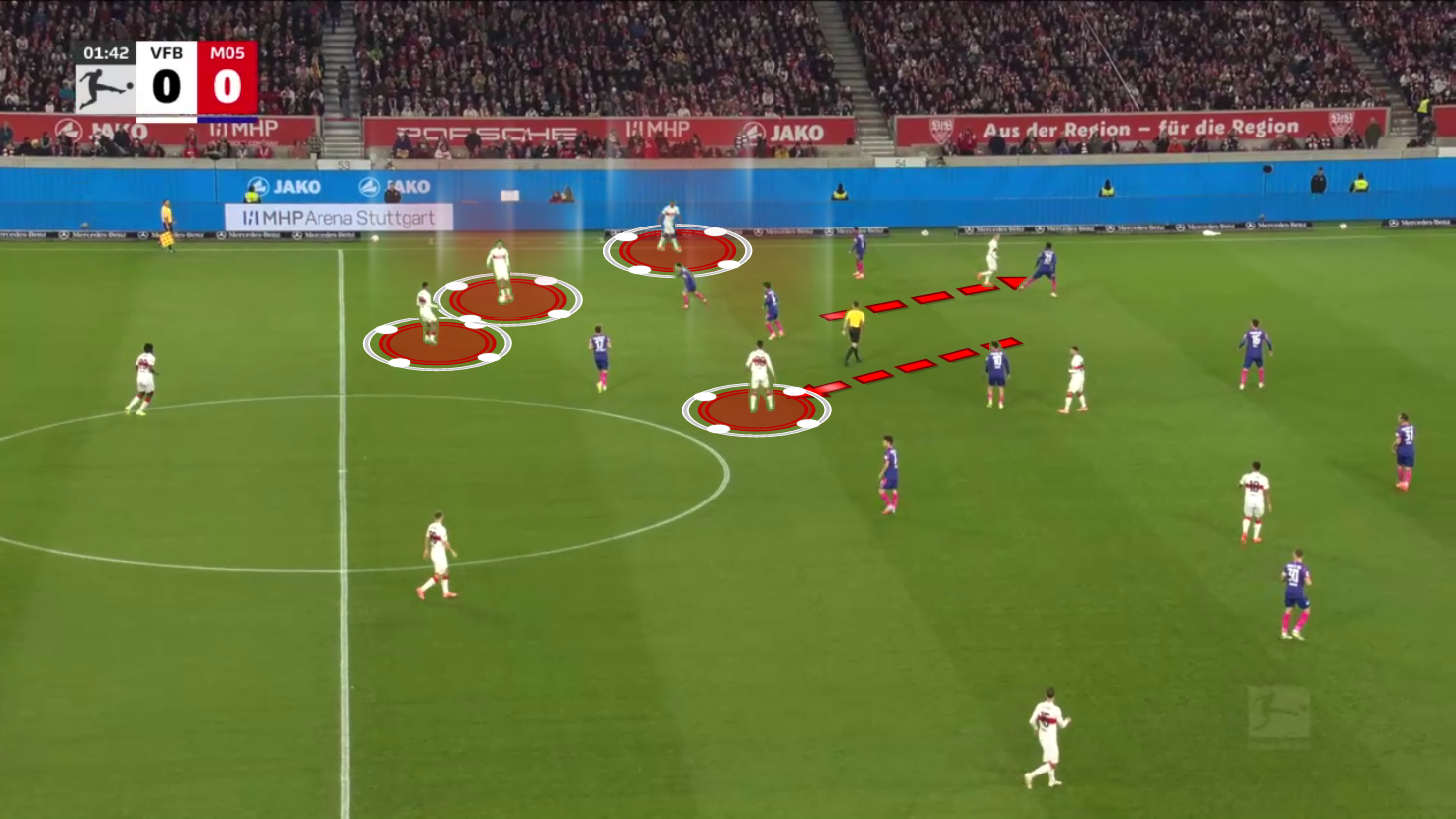
Overall, Stuttgart often overloaded their near-sided wing, especially on the left side, by dropping back the wing-back and the attacking midfielder, and even keeping the central midfielder close.
Against Henriksen’s man-marking, this drew the backline and some additional players forward, allowing Stuttgart to make some good diagonal runs towards that side in the space behind the backline.
Hoeneß established a nice vertical passing game with those runs and pushed Mainz back into their own half relatively easily, evading the pressure of their midfield press.
In the first couple of minutes of the game, Stuttgart completely dominated, and Mainz had no option but to fall back into a deep block and let Stuttgart get into their dangerous play in the final third.
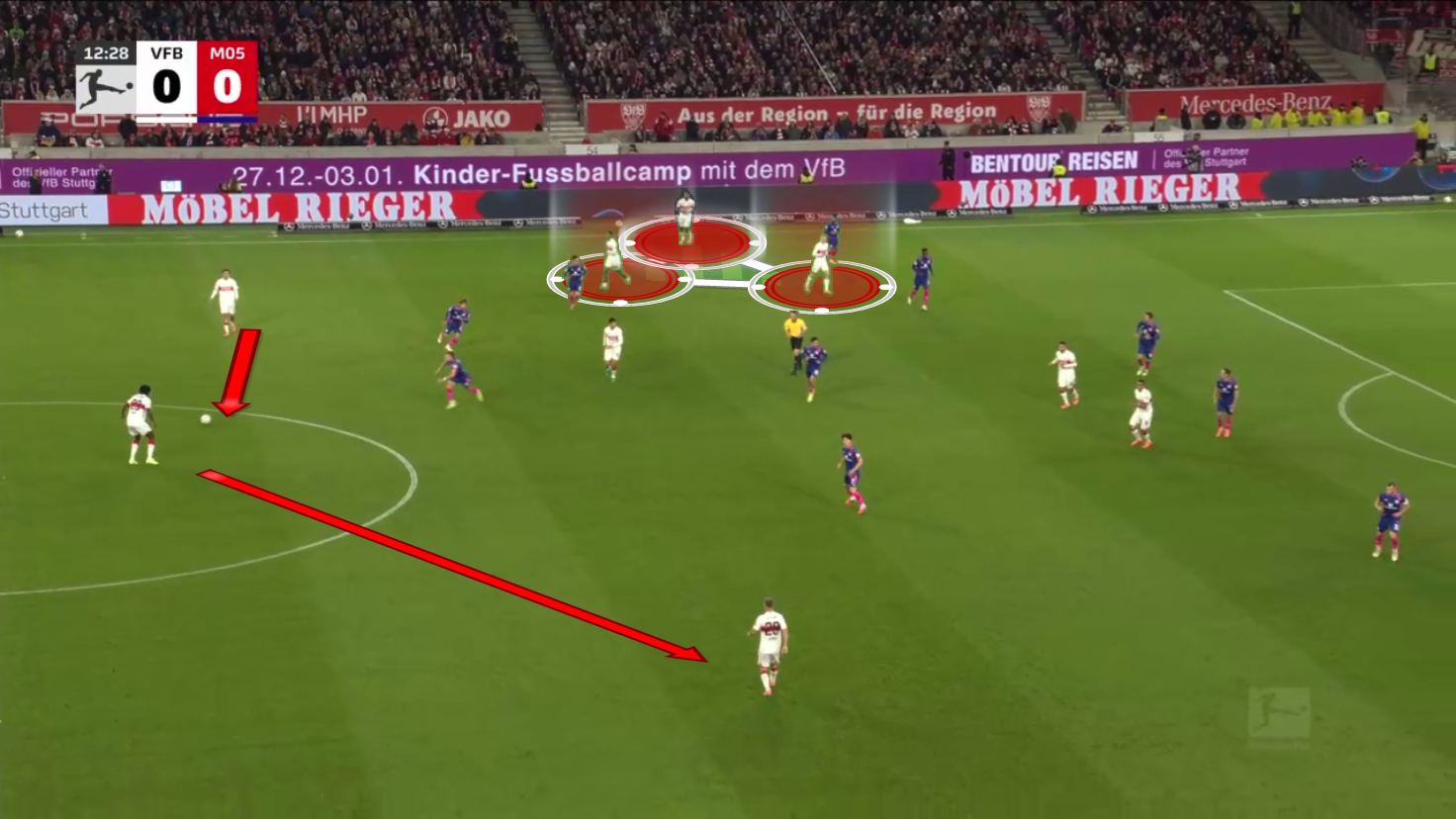
In the final third, Stuttgart kept the 3-2-5 shape, but now positioned the back-three in a very wide shape, allowing for switches through the central man in the backline at all times, and it helped them get the block moving and provoke some mistakes in the collective shifts from one side to the other by Mainz.
They tried to create opportunities through rotations in a triangle on the wings.
The wing-back, attacking midfielder in the half-space, and near-sided central midfielder formed a triangle on the wing and used it for many positional rotations.
The attacking midfielder triggered a rotation by any sort of movement, and the wing-back and midfielder reacted accordingly.
This allowed them to have a couple of decent breakthroughs into the red zone and the box, creating a bunch of shots in the first half.
Mainz Different Approach
On the other hand, Mainz did many things differently compared to Hoeneß and Stuttgart.
During their amazing run last season, Bo Henriksen’s men won their games with a very aggressive, high-intensity style of play.
Mainz prefer a simple playstyle.
They try to force many direct duels across the pitch, get into their counterpressing often, and show opponents how physical they can be.
Therefore, Henriksen approached this hard away game differently, focusing on defensive stability first and foremost.
As established earlier, Mainz dropped back into a midfield press from the start and tried to man-mark all the attackers, forcing duels across the condensed space.
When they had the ball, they did things a bit differently as well.
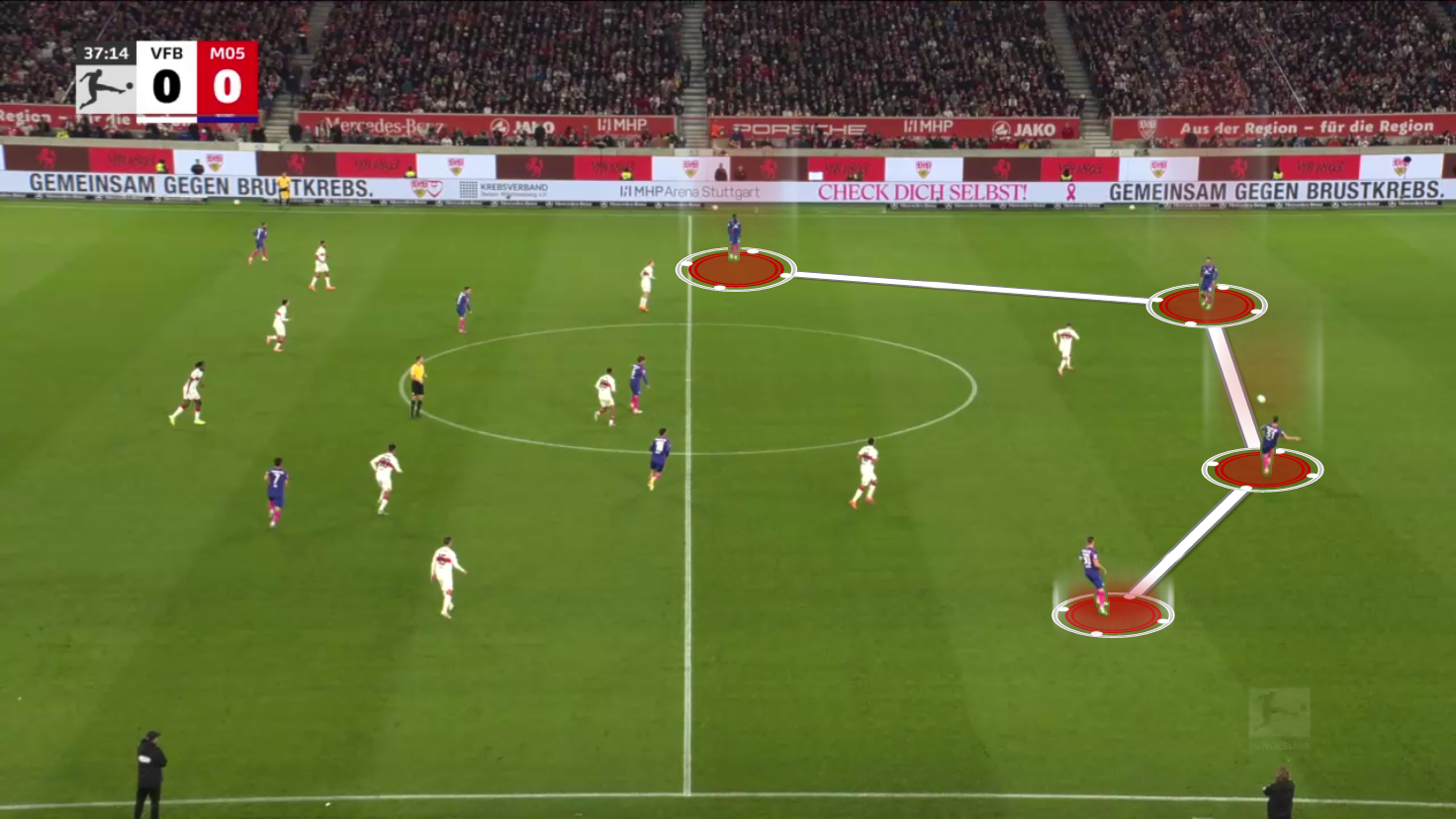
While Mainz also played with a 3-4-2-1 formation and therefore mirrored Stuttgart against the ball, they decided to build up with four defenders, which was a bit unnecessary in this game.
Stuttgart defended in a 4-4-2 shape throughout the game, dropping back four players against two strikers who attacked the ball; they were minus two higher up the pitch, and it showed.
Unfortunately, their backline’s lack of quality with the ball showed.
Even with the two-man numerical advantage, Mainz struggled to establish a solid passing game in their first line of play, but it didn’t matter anyway.
When they had the opportunity to do so, Henriksen’s team just punted the ball down the field.
Goalkeeper Robin Zentner played a lot of long balls when he received the ball from his defenders.
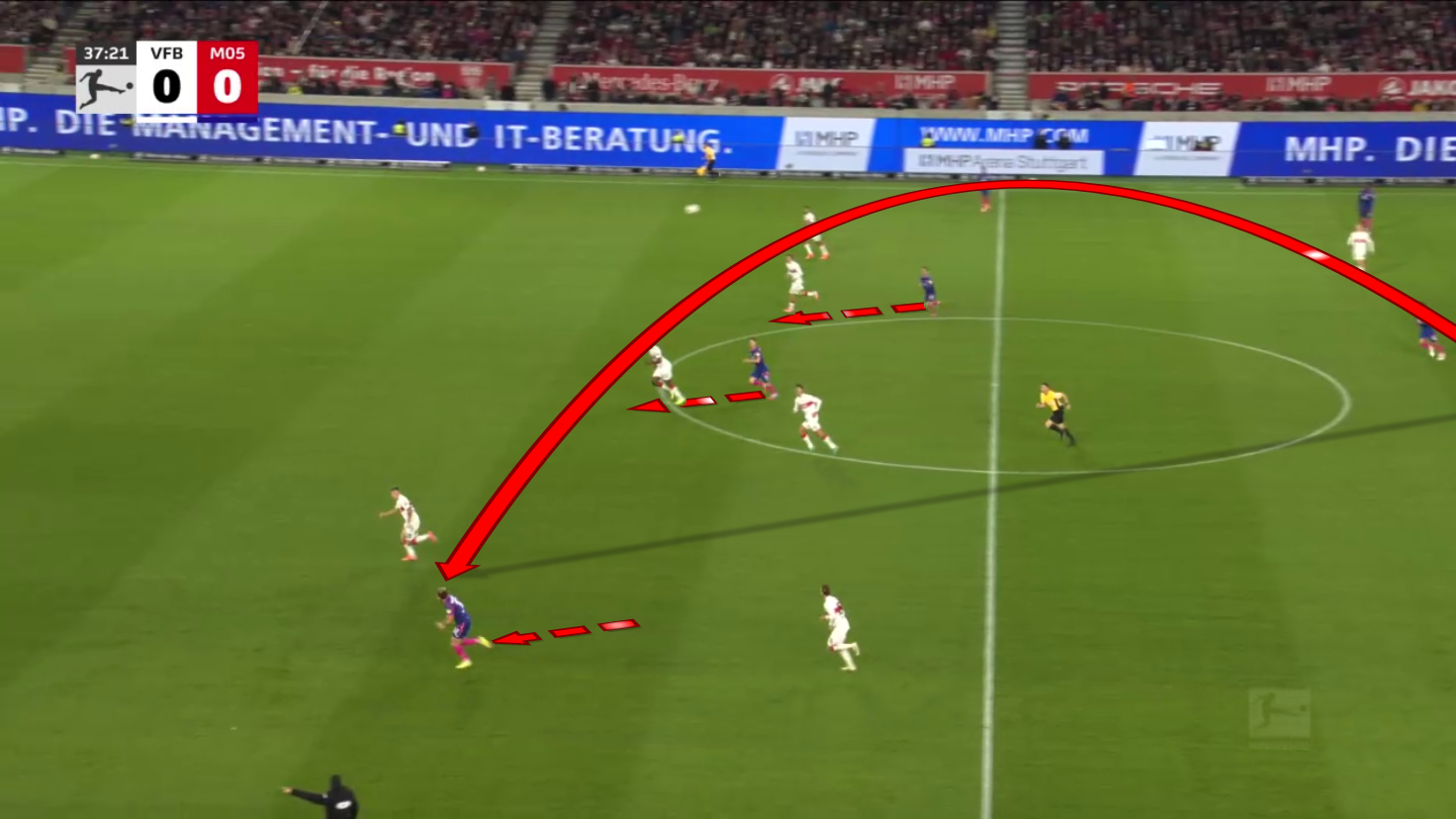
Instead of chipping the ball forward towards a target man, Mainz likes to really overshoot these types of passes, playing them over the backline, and getting all players into a chase-the-ball situation.
All Mainz players chase the ball down with high-intensity vertical runs, putting a lot of pressure on the Stuttgart defenders, who must defend with their backs to their own goal at a high tempo.
While they don’t do much with the long balls, they at least prevent their opponents’ controlled play, allowing them to get into their counterpress or win set pieces around the box.
In this situation, the defender was forced to clear the ball out of play under pressure for a Mainz corner, and that corner led to the penalty that put Mainz ahead.
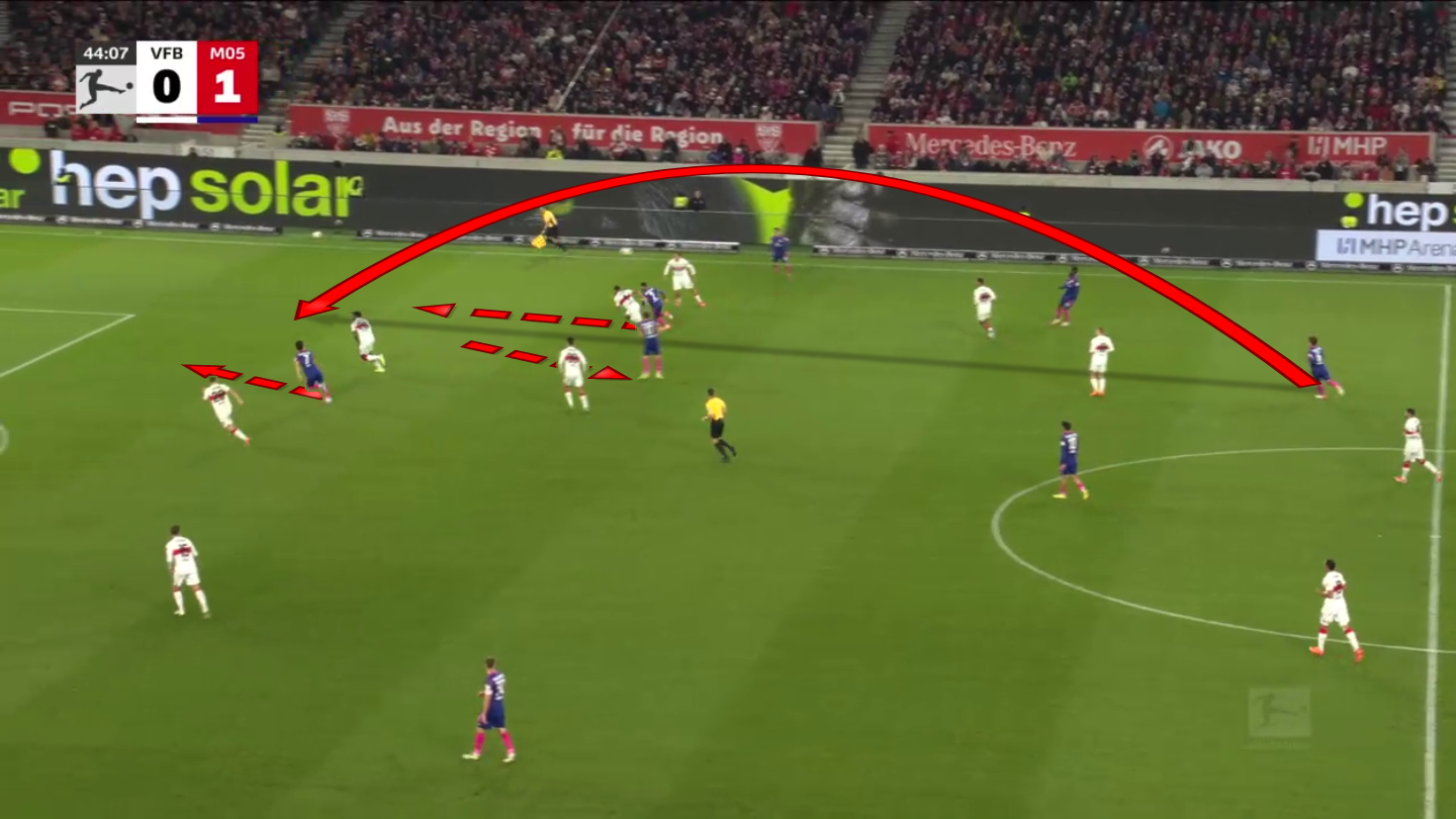
Even in their attacking play, Mainz often used this tactical measure.
It seemed like, at times, even the players didn’t believe they were able to play through the midfield, so they did the same thing very often.
The attacking player in the half-space dropped back into midfield, and the rest of the players were making vertical runs behind the backline, right behind that.
Then the centre-back just played the ball behind the backline, and once again the Mainz players went into chase mode, bringing high intensity to get the ball.
Still, Henriksen’s men struggled to create good opportunities for themselves, and without the penalty, they were incredibly harmless throughout the entire game.
In the end, the penalty scored by Nadiem Amiri remained their only shot on target in 90 minutes.
Second-Half Adjustments
Things did not change much after the half-time break.
Stuttgart dominated possession, and Mainz dropped back into a midfield press to defend without taking many risks.
Henriksen made a couple of adjustments, however, which neutralised the game for a good bit during those times.
Until the game-deciding goal, Mainz managed to hold Stuttgart away from their goal for a reasonable amount of time, and it started right in the first line of play.
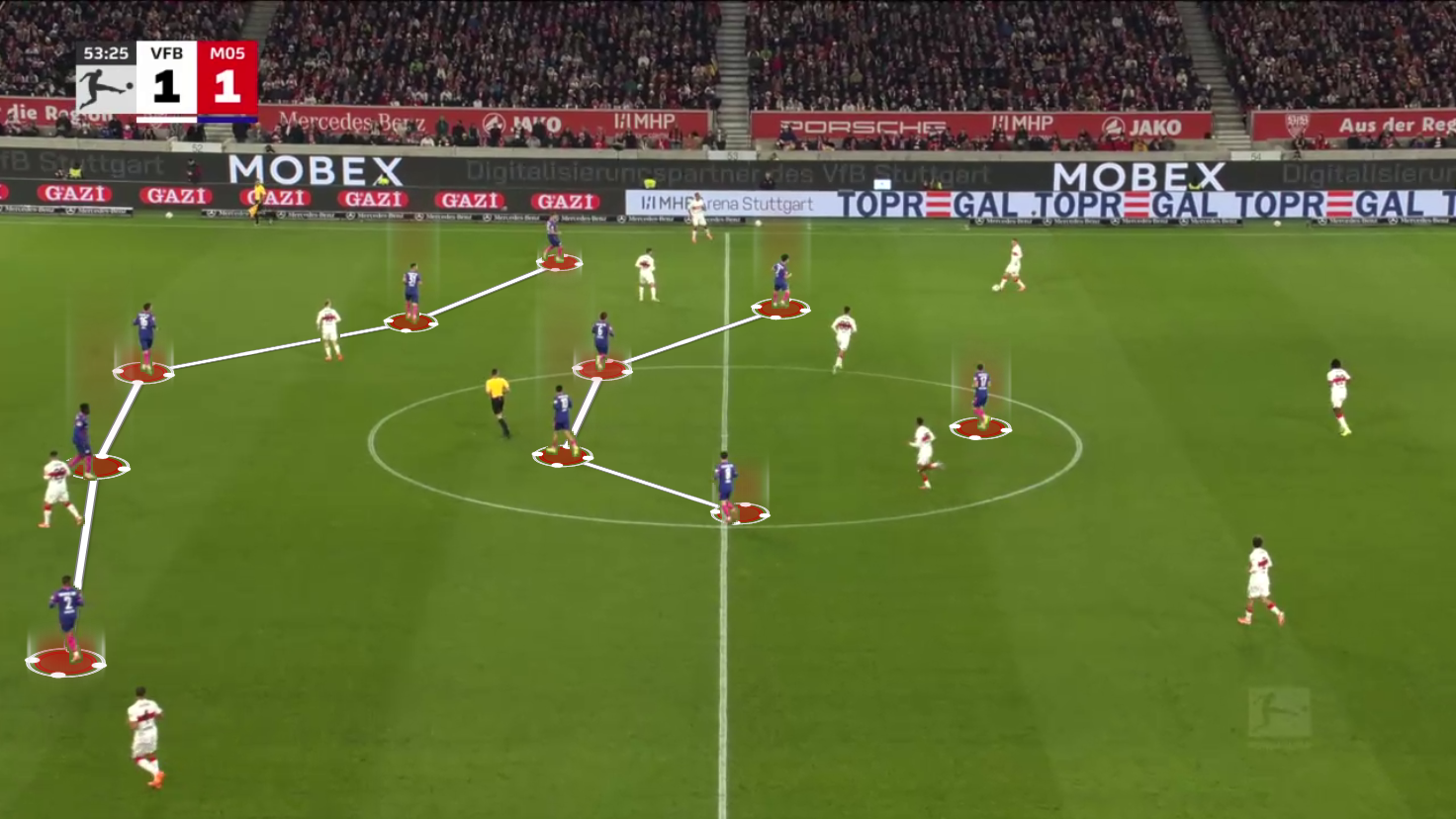
Henriksen now pressed out of a clear 5-4-1 shape, dropping both of his attacking midfielders backwards to create more width in their midfield.
This prevented passes into the half-spaces and allowed the centre-backs to stay back, no longer having to follow the attacking midfielders.
Mainz was more patient now, staying back more often, timing their triggers better, and refusing to attack too early, so they wouldn’t fall victim to the switches through the back three again.
Still, the attacking midfielders could pounce towards the centre-backs at all times, and therefore Mainz could push forward into the first line of pressure more often.
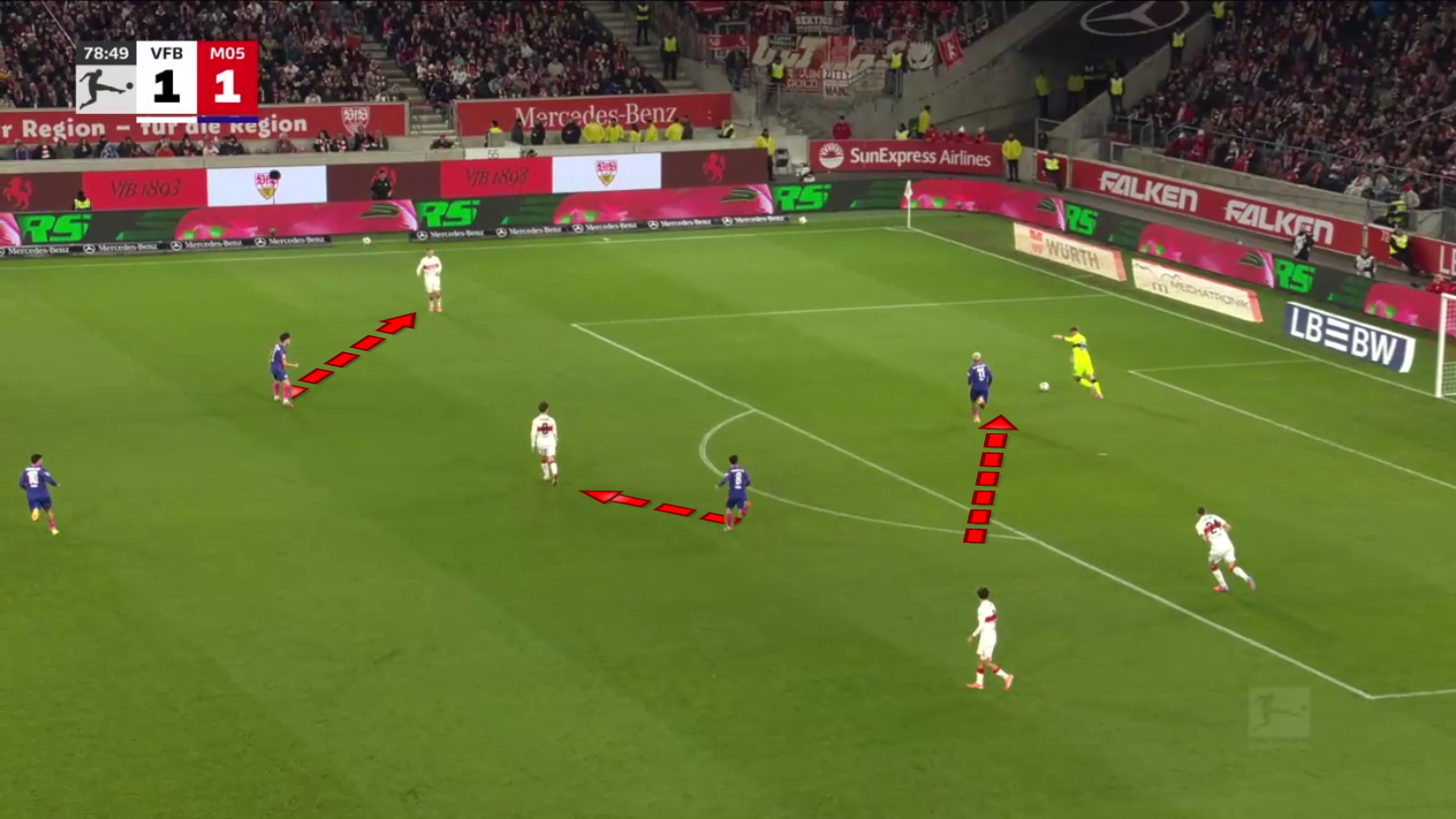
When they were able to go forward, they did so way better than in the first half.
Mainz pressed forward, and the striker now even pressed the goalkeeper, cutting off one side of play with his movement.
The attacking midfielders then pushed towards the side where Alexander Nübel wants to play the ball.
The far-sided midfielder now pushes towards Stuttgart’s holding midfielder, who stays back, and the near-sided attacking midfielder jumps to pounce towards the outside centre-back.
Mainz forced a lot of long balls with their new press, which increased their intensity and physicality.
It’s a bit ironic that precisely this situation led to the goal that lost them the game.
Nübel was forced to play another long ball here, and after two big mistakes and misjudgements in their midfield and backline, Deniz Undav finished off Stuttgart’s first real opportunity in the second half to win the game.
Conclusion
In the end, Stuttgart bounced back from their loss on Thursday and once again won a Bundesliga game, which puts them in third place at the moment after five straight league wins.
For Mainz, the situation now gets really dangerous.
Yes, their games on the international stages were alright, but with only one win in the Bundesliga, they really seem to get stuck in the back third of the league, and the longer you stay there, the harder it will be to get out of it.
Hoeneß can be happy with the way his team has played in this game, especially considering the rotation in the starting line-up.
Stuttgart seem to be back in great form once again, winning deservedly against Mainz at home.
