
There are few clubs in Germany comparable to FC Schalke 04.
As one of the oldest and most traditional clubs in Germany, with a very emotional and impatient fanbase, Schalke has been a key part of the Bundesliga for most of its history.
However, die Königsblauen also has a reputation as a club of chaos.
After multiple rough years and many bad player and coach signings, Schalke spiralled downwards towards the relegation zone and was relegated in 2021.
After a coaching change during that season, the club was promoted back to the Bundesliga, but after just one season in the top flight, Schalke had to go back to 2. Bundesliga.
Not even 10 years after magical nights in the UEFA Champions League with players like Manuel Neuer and Leon Goretzka playing for the team, Schalke hit rock bottom, finishing in the bottom half of the 2. Bundesliga two years in a row.
During the summer of 2025, Schalke made major changes, hiring Frank Baumann as a new CSO and Miron Muslić as manager.
So far, it’s worked.
After nine matchdays, Schalke currently sit in second place behind only SV Elversberg.
In a great position to fight for promotion back to the Bundesliga, Miron Muslić tactics created a new dynamic and enthusiasm for the club.
In this Schalke tactical analysis, we will examine how Muslić quickly transformed Schalke back into a good team, what defines their style of play, and what tactics the Austrian coach has brought to Gelsenkirchen.
Miron Muslić Perfectly Crafted Game Plans
Schalke is a bit of a special case when it comes to the values the club represents.
Due to its geographical location in the Ruhrgebiet, Schalke has always been a club for the working class.
With the region on a downward economic trajectory, football has become a very important part of life for people in Gelsenkirchen.
The fanbase is very emotional and integral to the club’s identity, and they expect a very clear playstyle from the players on the pitch.
Schalke is a “Malocherclub”, which means that instead of playing liquid football, the club’s identity revolves around high intensity, high work rate, and fighting it out on the pitch.
When Frank Baumann took over the club, he decided to hire a coach who would not just live with these circumstances but embrace them.

Schalke under Miron Muslić defines itself through its work against the ball.
Just like his Cercle Brugge team, Schalke are incredibly aggressive with their approach while pressing and have a very high intensity in their counterpress, making them one of the most intense teams in football right now.
Muslić has his men incredibly well prepared for what their opponent will do, and they adjust their approach accordingly while still maintaining their key principles against the ball.
It is incredibly hard to build up against Schalke; they consistently try to force duels all over the pitch and attack the backline aggressively.
The picture above shows the first real pressing situation in their game against Hannover 96.
After a throw-in, the team collectively moves forward as a unit, even attacking the goalkeeper, Nahuel Noll.
Usually, Muslić has his men press minus one, meaning they are always one player less than their opponent in the first line; if we include the goalkeeper, they are even two men down.
Moussa Sylla is attacking Noll in a way that cuts off two players and allows Schalke to get even more aggressive from here on out.
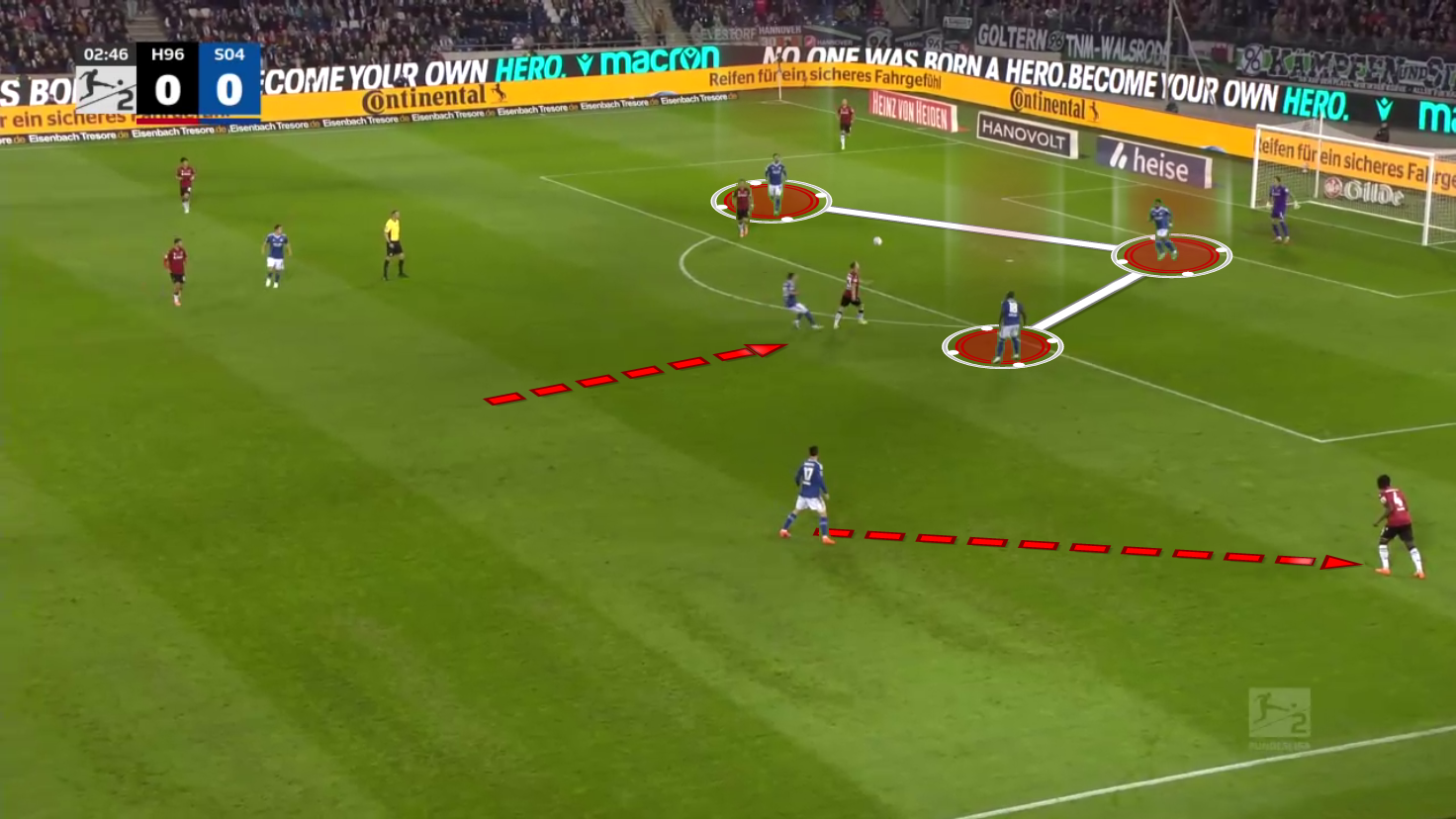
Hannover have a very interesting way of building up by moving their wing-backs into the half-spaces and dropping them towards the backline, but Schalke were prepared.
Muslić positioned his three attackers in his standard 5-2-3 formation, forming a very narrow triangle that cut off the passing option towards the centre of the field.
Adrian Gantenbein, now a near-sided wing-back, pushes up the field to instantly press the pass to the outside and take away Hannover’s last option.
In this case, Hannover tried to take the risky pass into the midfield, but with the holding midfielder covered, Muslić’s midfielders were able to step up into man coverage.
Now they forced a duel with the Hannover player facing his own goal.
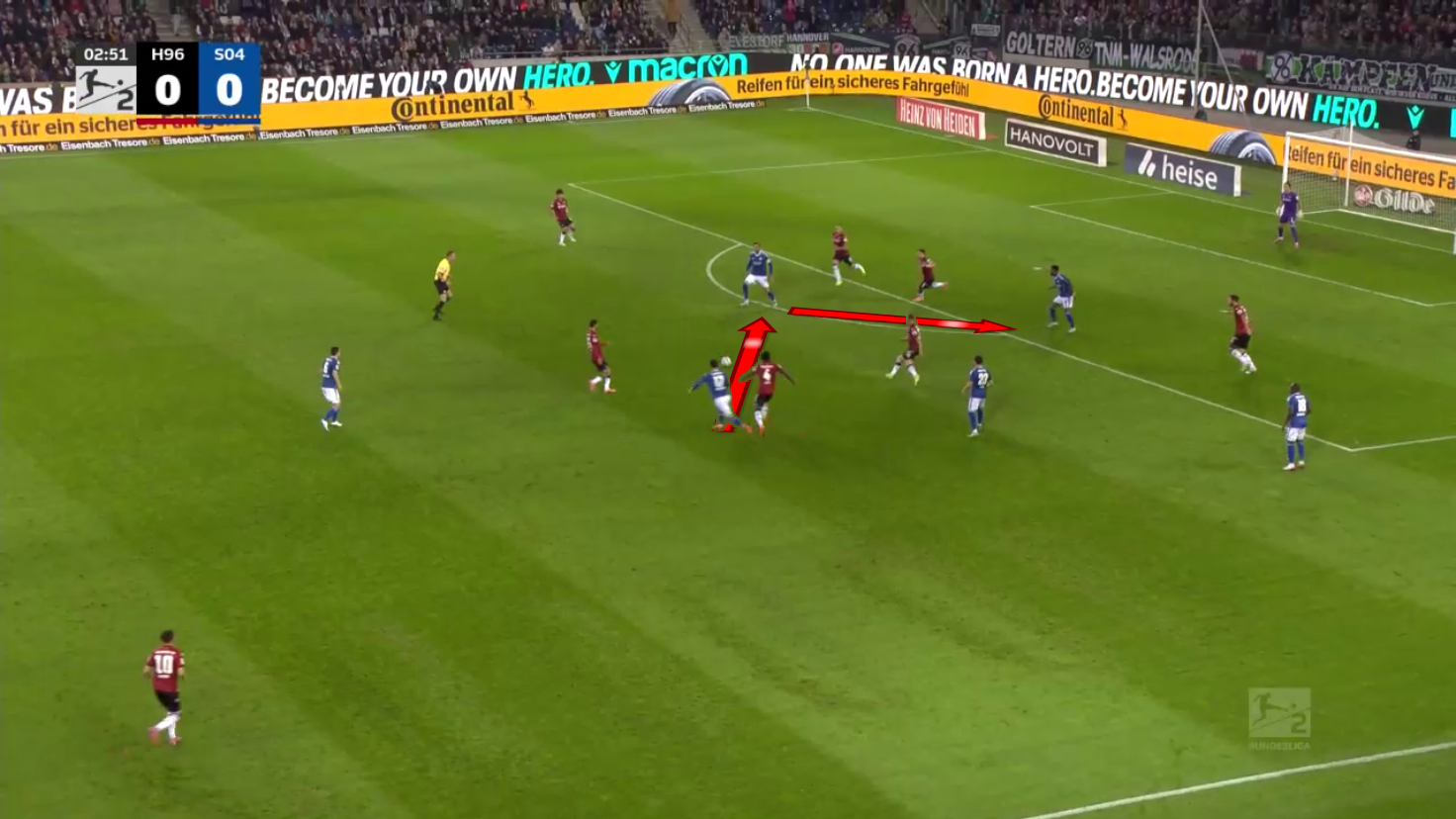
In the end, they forced a bad pass because the opponent was barely able to control the ball or scan the field.
From there on out, they were easily able to defend forward with the rest of the team, as the midfielders did, and to collect the ball through interceptions.
Muslić’s men then already have three strikers forward in a very central position, allowing them to play vertical passes forward quickly.
Most of the time, they try to find the player in the far-sided half-space and then try to play a deep-deep combination, finding another one of the strikers who is now making runs behind the backline.
In this case, they manage to play a diagonal pass and a second vertical pass forward quickly, finding Sylla behind the backline.
The striker gets the early lead for Schalke.
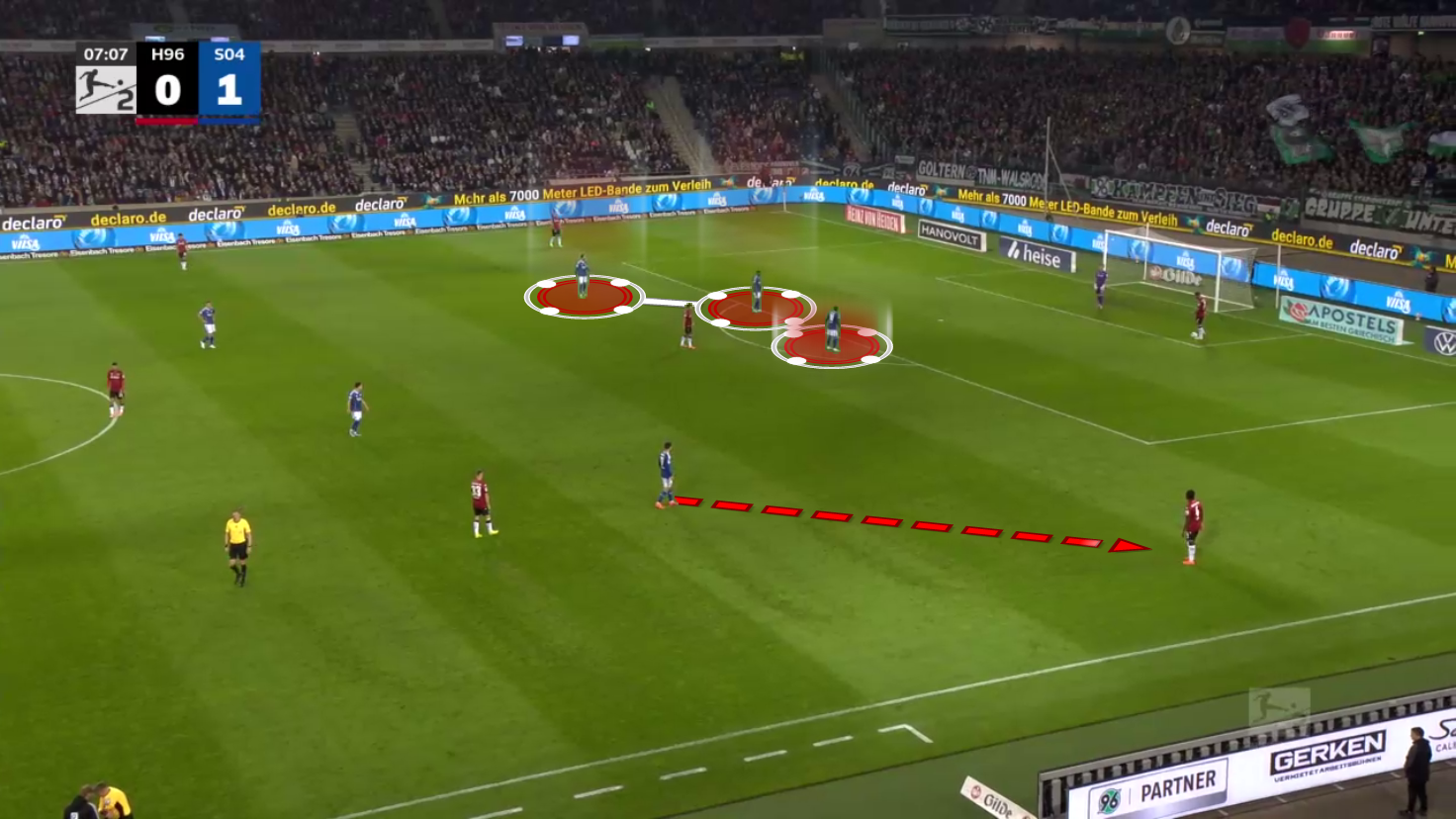 They kept these clear assignments throughout the first half, which worked wonders.
Muslić and his analysts once again had a perfect read on their opponents.
In the picture, they prevented passes into midfield with the narrow positioning of their strikers in the centre of the field, and Gantenbein was always in a very high position, ready to press the pass towards the outside immediately.
They were ready to take risks in these situations, especially behind Gantenbein, but by cleverly using their coverage shadows, they managed to create enough time for fixing the assignments.
Hannover completed only 75% of their passes in the opening minutes against Schalke, way less than in their other games.
The preparation of Muslić is incredibly interesting to watch.
It allows his team to even get into the position to play with high intensity.
His players are willing to follow his lead and make the necessary sacrifices, as Gantenbein does, covering a huge distance every time.
In their nine games, Schalke took the lead seven times, and often, it was because their game plan worked out perfectly for them.
With their work ethic against the ball, they never looked back, winning all seven of those games in the end.
Schalke are back to being a Malocherclub, and now their fans are back with their great support, even further strengthening the team’s energy on the pitch.
Controlling The Centre, Provoking Mistakes
Their work against the ball sets them apart, not just because of their aggressive attacking press but also because they have had a very clear plan for defending ever since Muslić took over the team.
Schalke controls the centre of the field as well as any team in football right now, and it’s impressive considering they only play with two midfielders and usually hold the width of the field with their full-backs, but we’ll get into that a bit later in this article.
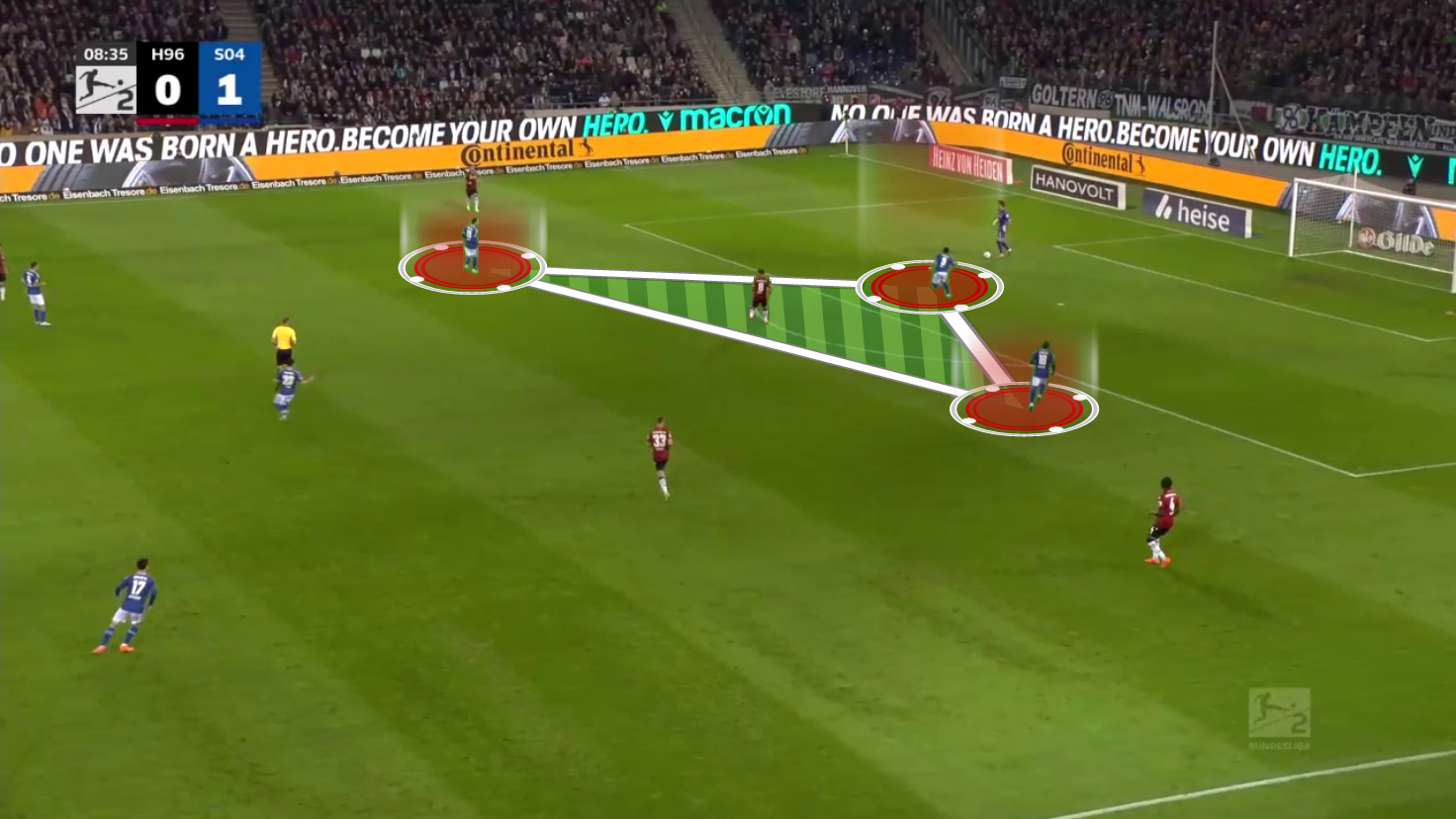
Just like against Hannover, they are consistently positioning their three attackers in a triangle, with the two outside strikers in the half-spaces, cutting off opponents’ holding midfielders from supply from their backline.
Schalke prevents passes from being played into the midfield most of the time.
They are always trying to play plus one in their backline, and to play their aggressive attacking press, they are kind of forced to position their strikers higher, so they have to work around a numerical advantage in midfield.
Therefore, the clever use of their attackers’ coverage shadow is key to Muslić preventing his midfielders from getting into trouble.
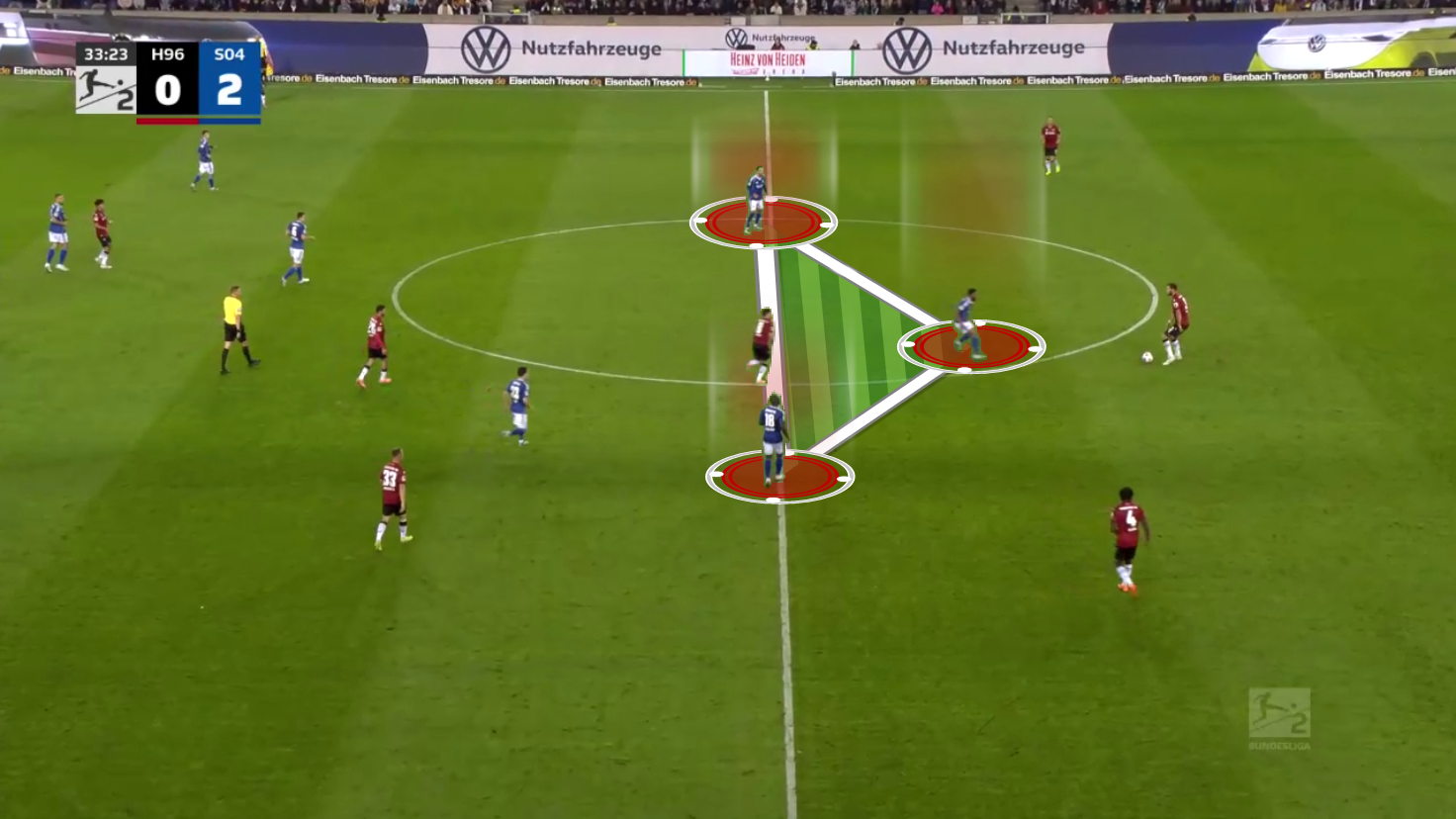
They use the same principle when they fall back and attack in their second line.
Schalke actively prevent opponents from playing vertical passes into midfield.
As the central striker, Sylla attacks the central defender in the build-up and tries to force the pass to the outside.
Most teams these days are building up in this Pep Guardiola-style 3-2-5 shape, and Schalke have found the perfect answer to that with their playstyle.
Muslić didn’t just prepare for each match; he obviously also did his homework, preparing for the league he was going to sign into.
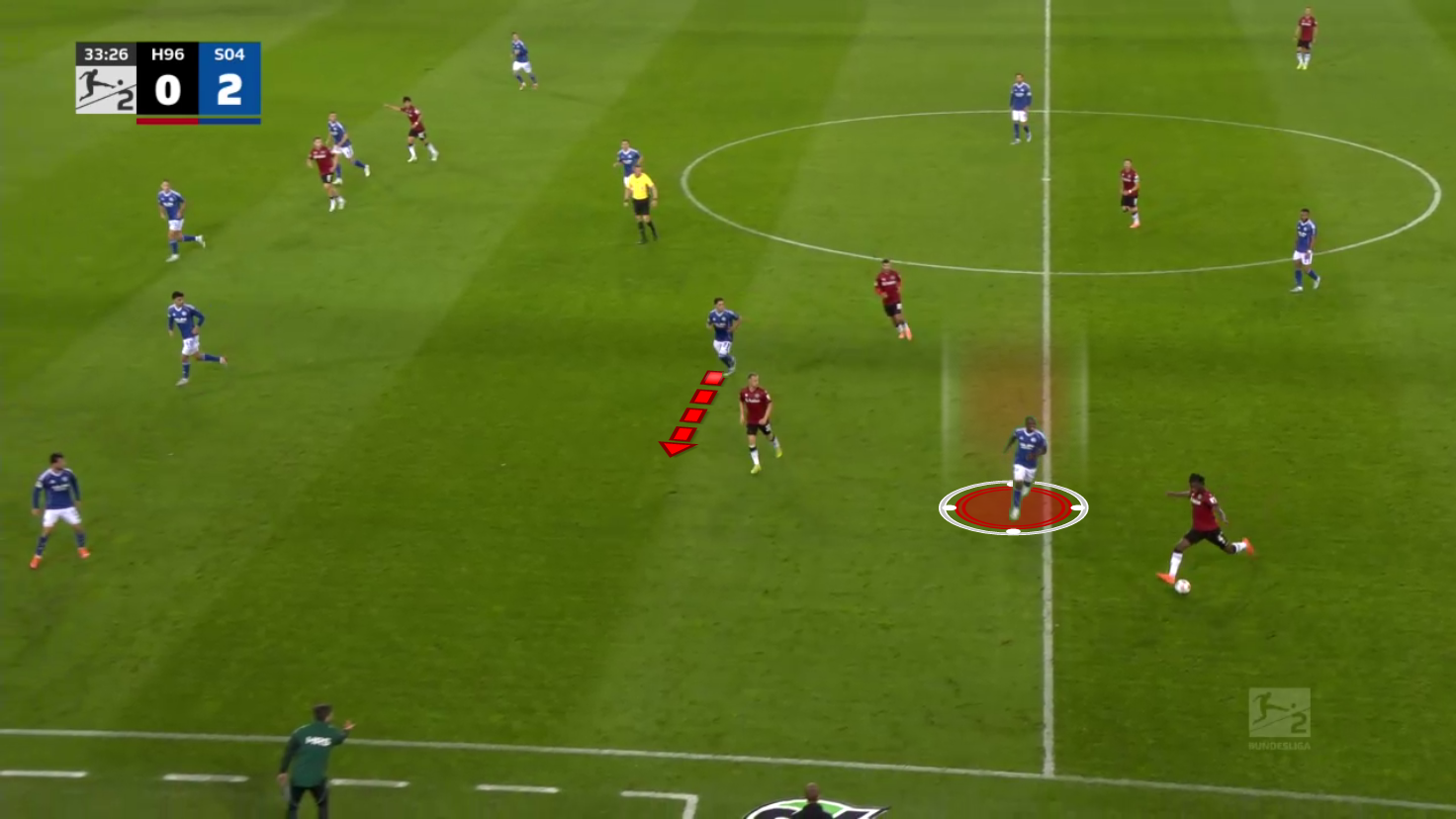
Schalke force their opponents outside, and from there on, they are ready to defend aggressively.
Many teams try to get their wide attacking players into 1-v-1 situations on the wing to create dynamism and progression for themselves.
Muslić overloads the wings defensively after the pass towards the outside, moving the near-sided midfielder towards the full-back, helping him double-team the player on the outside.
The near-sided attacker moves to the outside, pressing the backline, but once again, they are minus one.
He uses his coverage shadow to cut off the passing lane towards the centre.
Muslić is very consistent with preventing passes to that area at all costs.
While they often get pressure, it still isn’t a perfect defensive system.
In the situation we were examining here, they nearly conceded.
VAR took the goal back for an offside position, but it shows the one thing they struggle with: winning second balls in front of their backline.
Simplicity With The Ball
In terms of what they do with the ball, Miron Muslić style of play never valued possession a lot; he did not at Cercle, and he does not at Schalke.
His team ranks third-to-last in possession so far this season, and while they rank first in expected goals against, they are pretty average in goals and expected goals in 2. Bundesliga.
Schalke play the fewest passes, about 30 fewer than the next team, showing that they don’t even try to engage in a traditional build-up phase.
While playing only a few passes, they rank fourth in long passes per game, showing their idea under Muslić clearly: don’t play out the back —play it long.
This also leads to Schalke ranking dead last in completion percentage, just as Muslić’s teams did in Belgium.
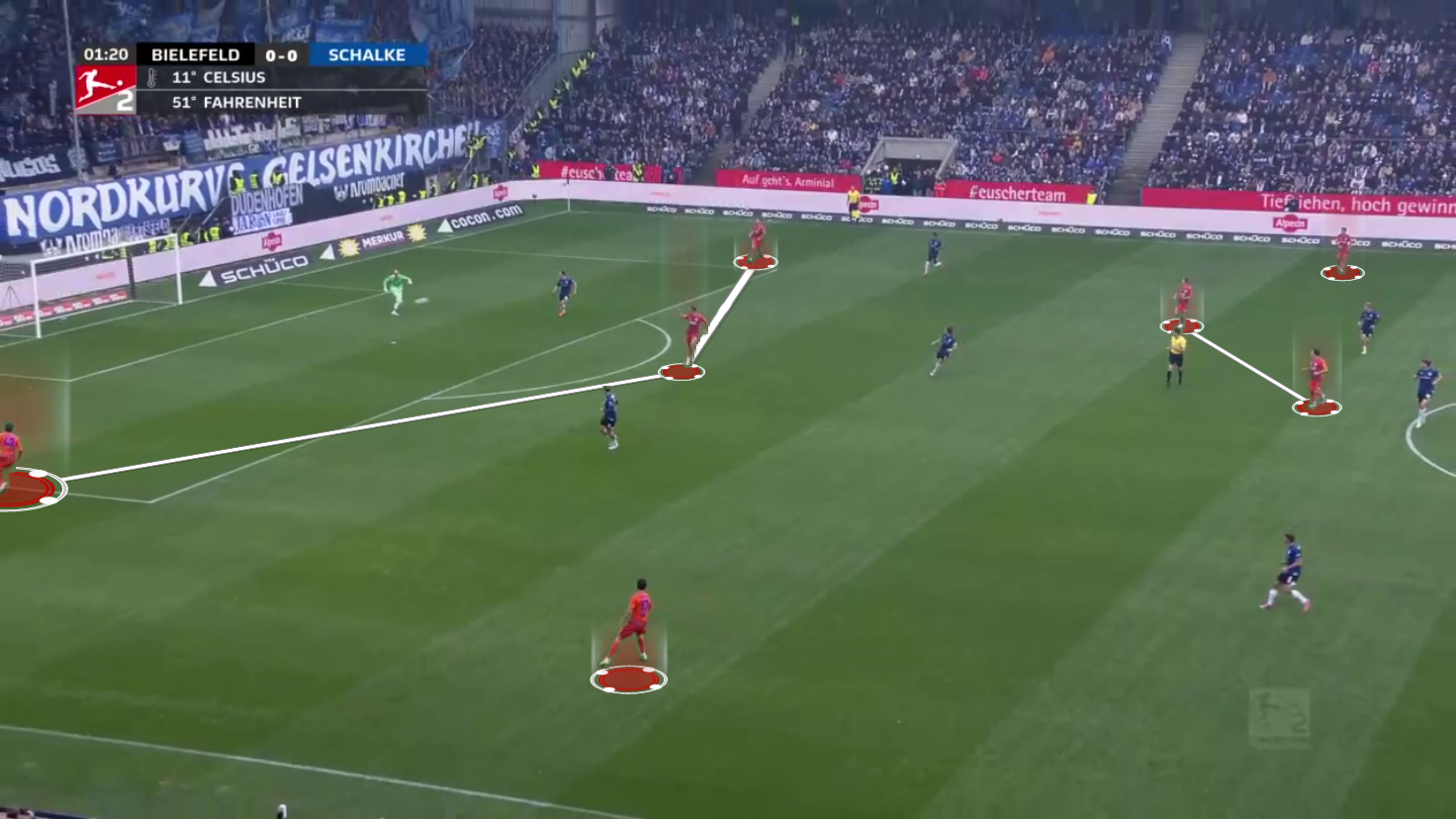
With the ball, Muslić prefers a 3-4-3 shape, pushing the centre-backs wide and maintaining width, especially with the wing-backs.
The double pivot is pushed forward, and it rarely drops back to receive short passes from the defenders, only when they really have to.
The wing-backs stay wide to drag out the opposition’s block, allowing for more space in the centre.
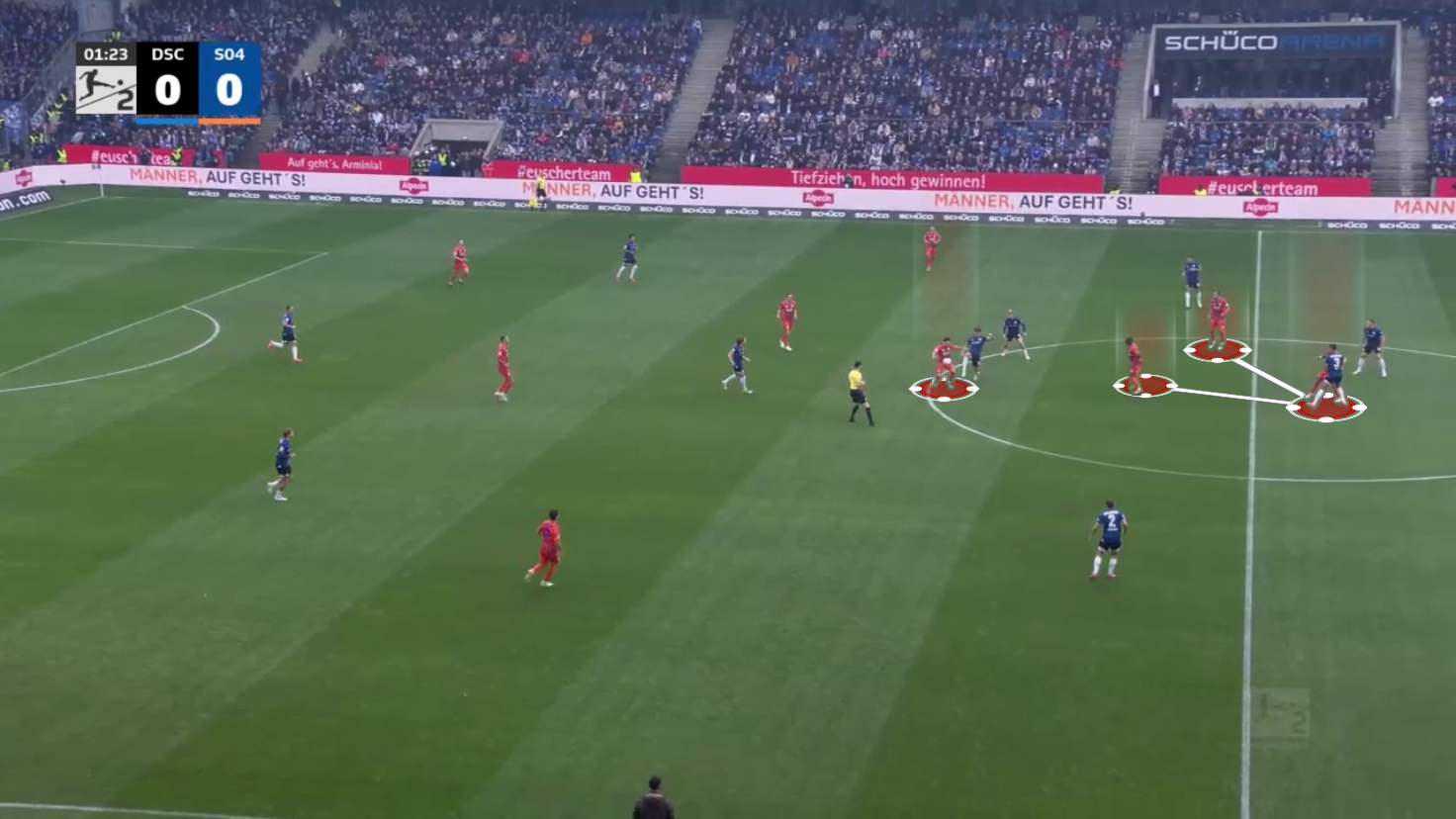
The three strikers now position themselves in a very narrow shape, while the defenders or even the goalkeeper punt the ball into this area.
Schalke play with very physical attackers most of the time, allowing them to get into many duels right in the heart of the pitch.
With their numerical advantage there, they often get to the ball.
The two midfielders are now in a very good position to retrieve any second balls, and Schalke does well to get forward that way.
The wingbacks are now the first passing option, providing width.
After receiving the ball, they can’t carry it forward and often cross it back to the three strikers.
If not, they are trying to find the striker in the far side of the half-space and, from there, attack as we saw in the first paragraph.
Muslić’s way of playing with the ball is relatively simple, but his team’s high intensity and physicality so far make it a real drag to defend against them, and they wear defences down.
Conclusion
Looking at how FC Schalke 04 play under Miron Muslić coaching style, we can see a focus on the phase against the ball.
Their counterpress is intense, they win a lot of second balls in the midfield, and their team has excellent physicality and pace, allowing them to be really intense over 90 minutes.
Schalke are currently the best team against the ball in the 2. Bundesliga.
Their press works really well; they know exactly what they need to do, where, and when.
They also defend really well in the midfield, and their centre-backs are really good at defending the box.
In the end, if they want to fight for promotion until the end of the season, their play with the ball needs to be a bit better.
They struggle to create enough opportunities, and it will cost them over the course of the season.
At the moment, it works out, but you can’t control the chaos.
Still, there is a new form of hope around the club, and Frank Baumann found the perfect match in Muslić.
