
Hannover 96 have been in the news in Germany for many different reasons over the last couple of years.
Investor Kind attempted to undermine the 50+1 rule in German football, but the fans strongly opposed this move and began boycotting the club.
Since their relegation in 2019, the club has failed to secure promotion back to the Bundesliga every single season.
This term, the club actively wants to pursue more than just being close to success.
They have actively worked the market, signing 16 new players for the money they got for selling their talented striker Nicolò Tresoldi to Club Brugge.
But they didn’t just overhaul their squad randomly; they did it with a clear purpose in mind.
The most important signing the club made this summer transfer window was their new head coach, Christian Titz.
Titz had been the manager of 1. FC Magedburg for 4.5 years and got them promoted from 3. Liga to the 2. Bundesliga.
Last season, they managed to finish fifth in a highly competitive league, ahead of Hannover 96.
The experienced coach did not just have a lot of success with Magedeburg, he also has a clear style of approaching the game, centred around possession, positional ‘rochades’ and a lot of passes.
In this tactical analysis, we will examine how Christian Titz managed his Magdeburg side, what we can expect him to bring to his new club, and how Hannover 96 will approach the new season.
Christian Titz Style Of Play
Movement In Attack
When considering what makes Christian Titz’s tactics so special, we must first consider his team’s play on the ball.
The manager wants his team to dominate possession, keep the ball moving within the team and attack out of long passing sequences with clear positional principles.
Last season, Magdeburg had one of the best attacks in the entire 2. Bundesliga, scoring 64 goals in 34 matches, so we will first examine that.
Titz prefers to progress the ball into the opposing half and then start an actual attacking phase in possession.
There are no fluent transitions between the build-up and further attacking phases for the coach.
Titz’s teams try to pin their opponents into a deep block and keep them moving around for a while, tiring them out and forcing them into a passive mindset.
From there on out, the team uses its positional principles to create space in the block and attack quickly with runs behind the defensive line and aggressive wing play.

Here we can see Magdeburg attacking against Jahn Regensburg this past season, a game in which Christian Titz’s team was heavily favoured.
They keep possession for a long period of time, and Regensburg do not even try to press the Magdeburg defenders anymore when they are on the ball.
Christian Titz now has his men push forward, forming an attacking line with five players against the four defenders in their opponent’s backline.
With the opponent pinned to their own box, the player in the near-sided half-space now drops back out of the attacking line and receives the ball right in front of the backline, causing problems.
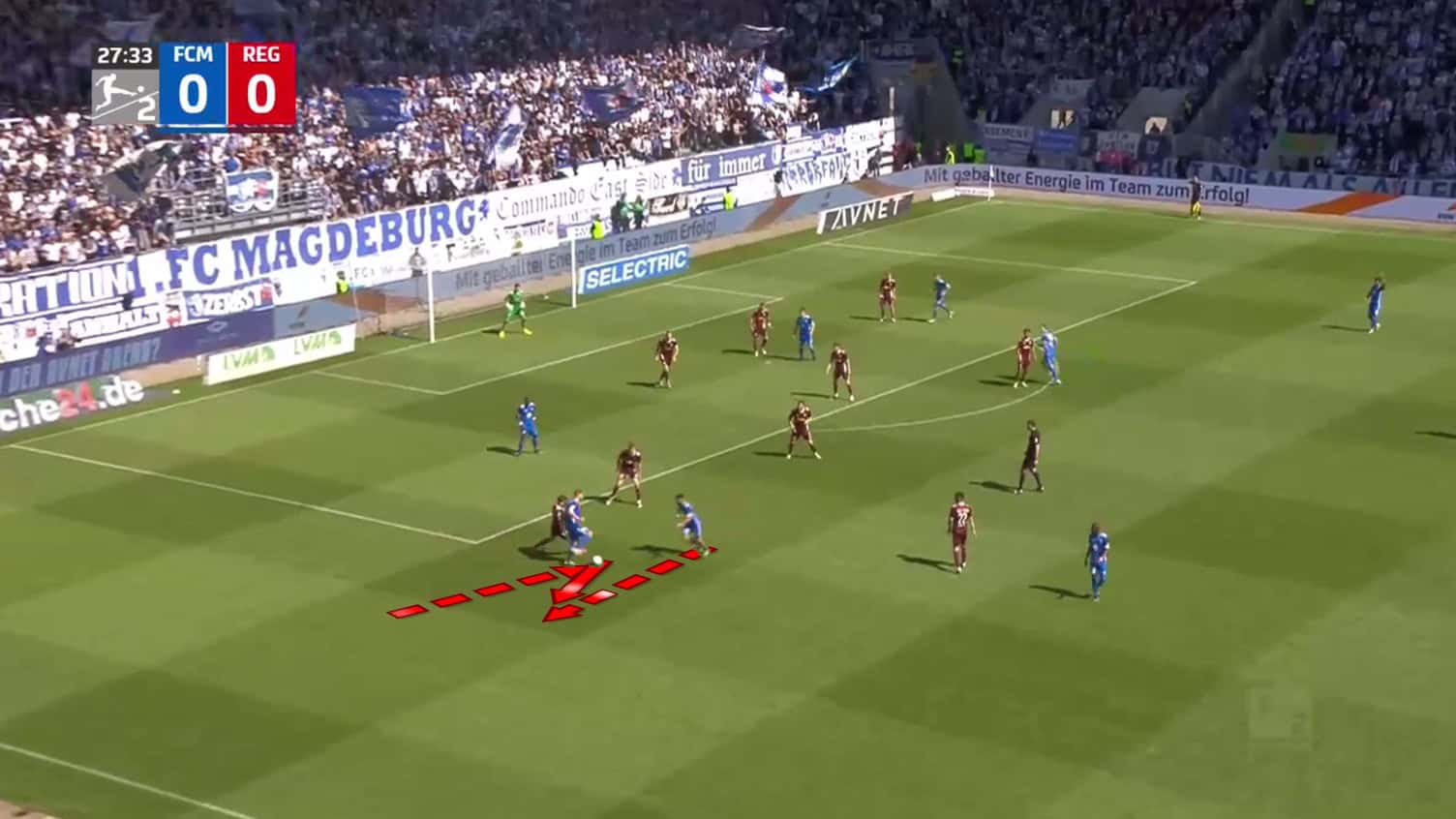
This forces the defence to rotate and start their defending press, which Magedburg had a clear plan against.
The winger now dribbles to the inside at the edge of the box, forcing the full-back to move with him to the inside and opening up the space on the left wing for his teammates.
With a counterrotating movement, the player from the half-space now moves towards the wing and receives the backheel pass from his teammate.
This enables him to receive the ball in acres of space on the left side and move into the box quickly without any defender nearby.
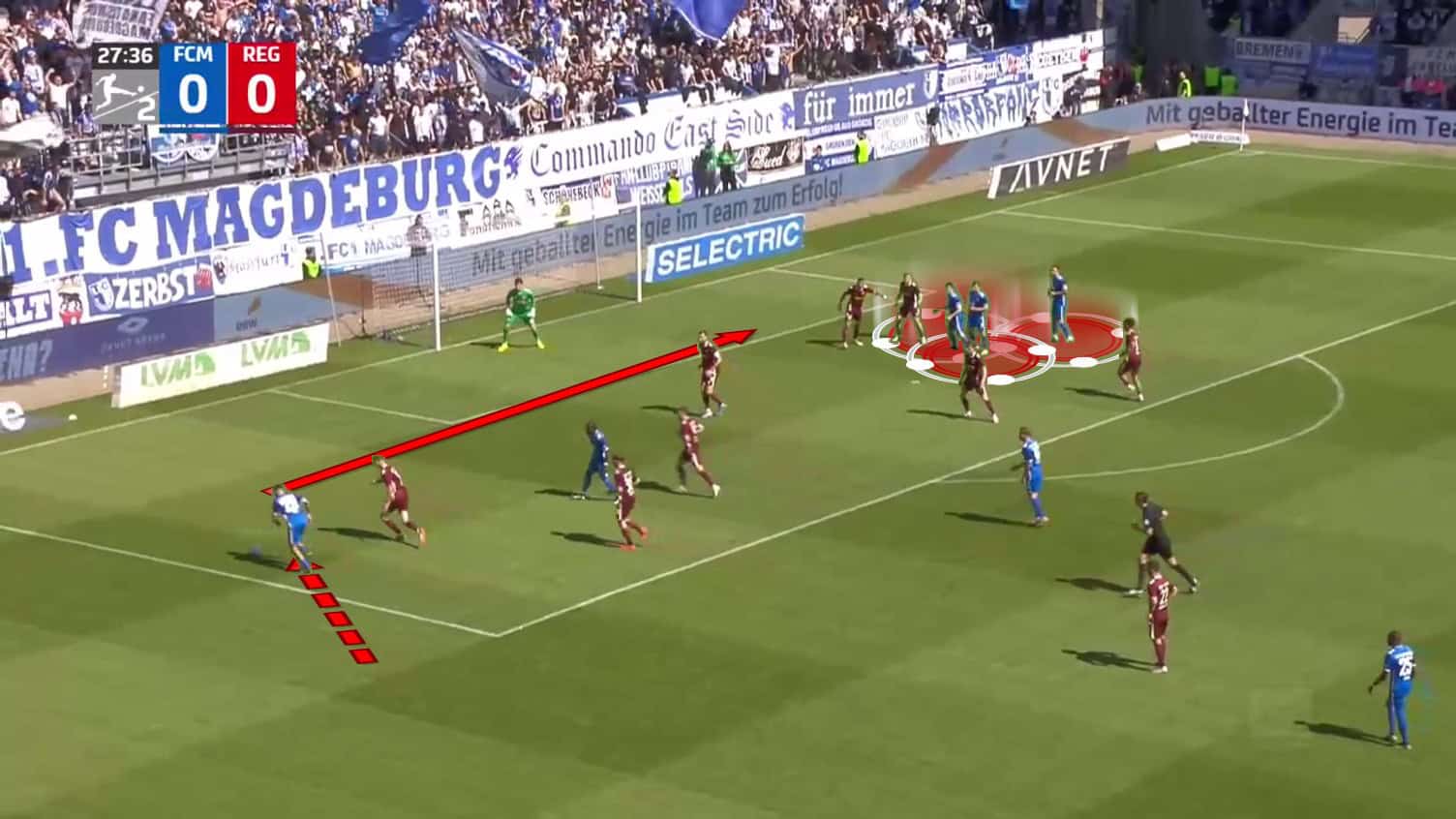
Christian Titz now created an opportunity for his players to win a take-on situation against an isolated centre-back in the box, which is the dream for most attacking players on the professional level.
Away from the ball, Titz also gives his players a clear plan for their movement in the box, allowing them to cross without even looking up once after the dribble.
After playing through the left side the entire time, the opposing defence obviously had to shift to that side of the field to try to prevent Magdeburg from scoring from there.
This means that the right side of the field is currently not the highest priority for the defenders.
Titz uses this to his advantage by having his players move towards the far side of the box often and overloading the second post.
This creates a 3-v-2 situation at the far post for the Magdeburg attackers, allowing them to start delayed runs and opening up one player.
From then on, Magdeburg often crossed to the second post, where the open player finds the net, as they did in this situation.
Christian Titz’s relatively simple principles allowed the team to be an attacking force while also staying in control of the ball for the majority of the time, a deadly combination that made Magedburg really successful last season.
Positional Play In The Build-Up Phase
Looking at the attacking play, the base of that is their play in possession.
Christian Titz has been a coach who valued possession in an environment where possession has become a tool rather than an ideal.
Even during his tenure in Hamburg at HSV, he wanted the team to keep control of the ball while fighting a rough relegation battle.
Last season, Magedburg held possession for an average of 59% in their games, an extremely high value, especially in a league dominated by counterpressing and counterattacking teams.
There have been many things that Christian Titz has done to allow his team to keep possession better than anyone else in the 2. Bundesliga over the last years (maybe Tim Walter’s HSV team was the only exception over that timeframe), and we will take a look at a couple of simple tweaks the coach used this past season.
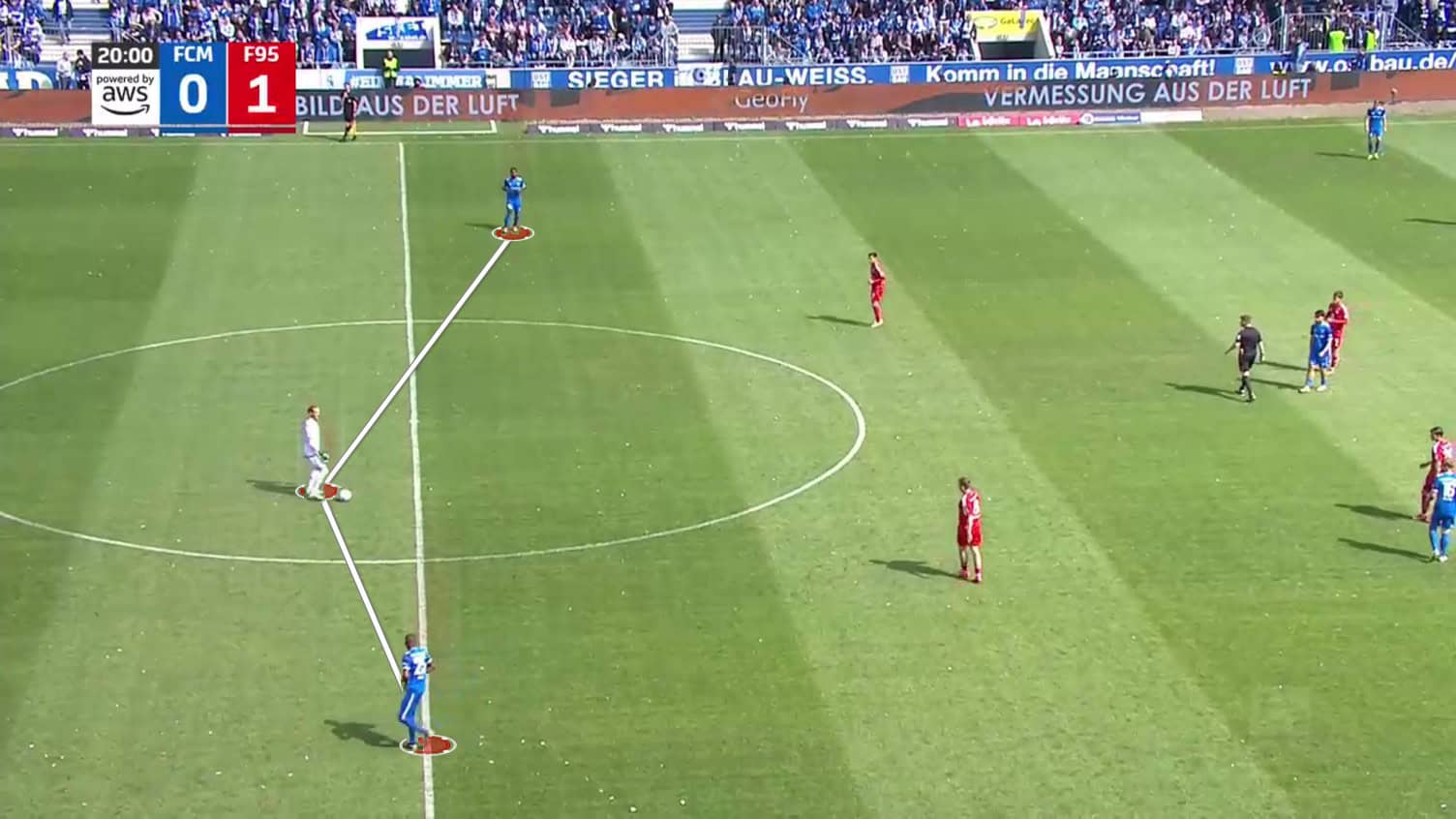
Magdeburg often started their build-up in a very high position on the field.
With their quality on the ball, they often managed to play through the opposing team’s attacking press.
Many teams opted not to press them high up the field anymore, and even if they did, the situation ended up like the picture above.
The first thing anyone will notice is the position of the goalkeeper, obviously.
Christian Titz actively uses his goalkeeper in the build-up phase of play to create a numerical advantage for his team.
The two centre-halves push outside towards the half-spaces, and the keeper moves forward, acting as a middle centre-back in a pseudo-back-three in these situations.
Looking at the picture, Fortuna Düsseldorf tried to press with a two-striker formation in this game, but by including the goalkeeper this high up the field in the passing game, Titz quickly took that plan away from them.
Another interesting thing is that their right centre-back in this situation is Silas Gnaka, who is their holding midfielder on paper.
Titz uses positional rochades way more frequently than other coaches do.
After playing passes, the centre-backs move forward, the midfielders drop back, the strikers drop into midfield, the winger moves into the centre, and so on.
Spaces always need to be filled, but it doesn’t matter which player is actually doing it, which makes Magdeburg rather unpredictable.
The third and last thing we can see in the picture is that Magedburg pushed their midfielders and players on the wing very high up the field to create space for the defenders to move forward and for the midfielders to move into.
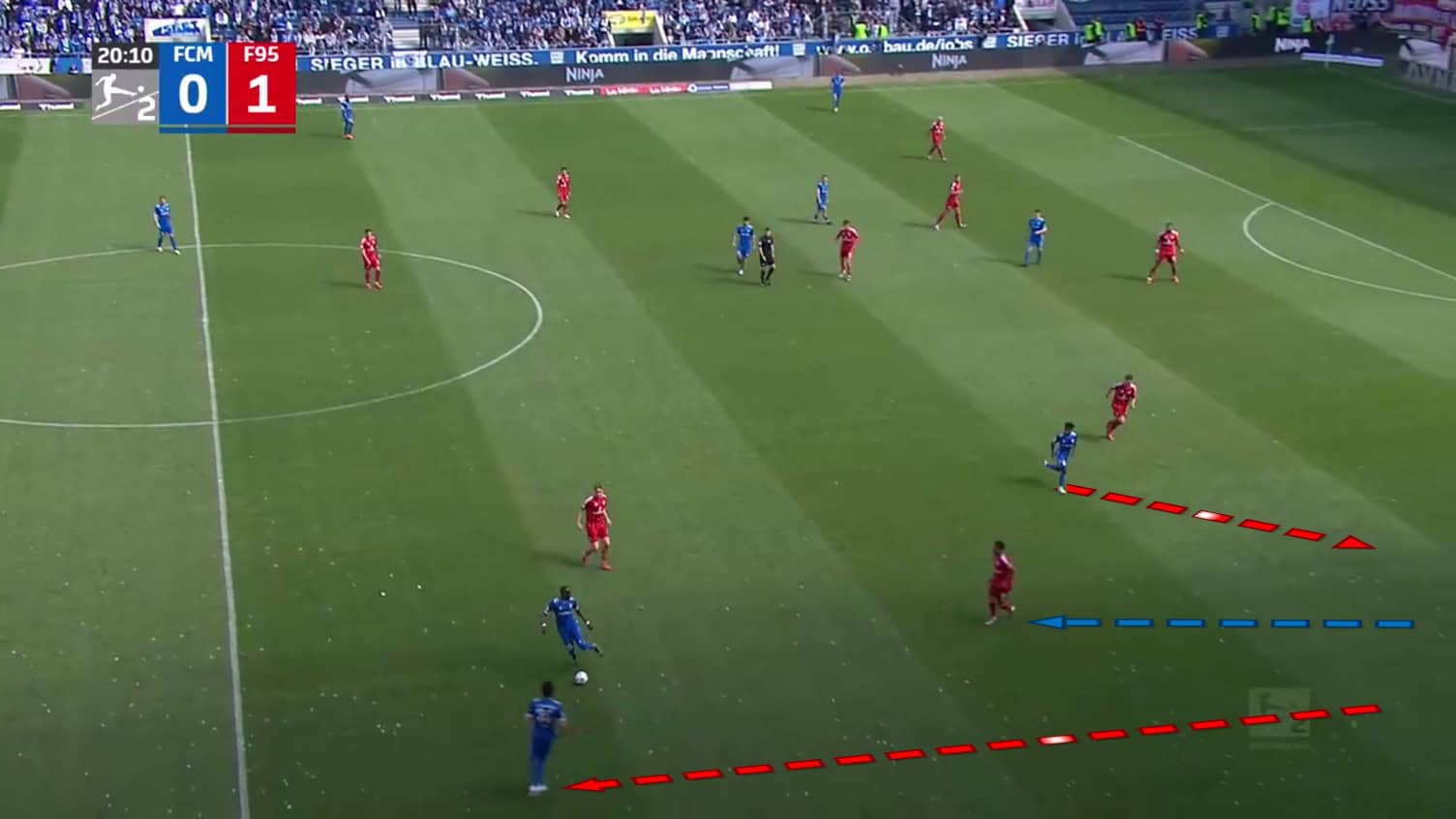
Out of these positions, Magdeburg start progressing the ball.
Once again, Titz is a huge fan of off-the-ball movement and uses it to open up space for his players.
Under Christian Titz’s tenure, Magdebug had a lot of width; therefore, the team often tried to play through the wings.
Here, the full-back moves back towards the centre-backs, dragging one defender forward and out of his position.
Now, one of the players in the centre of the field makes a diagonal run right behind the forward-moving defender, allowing him to be wide open here.
The passing window is not perfect here, so Magdeburg decided to switch play one more time.
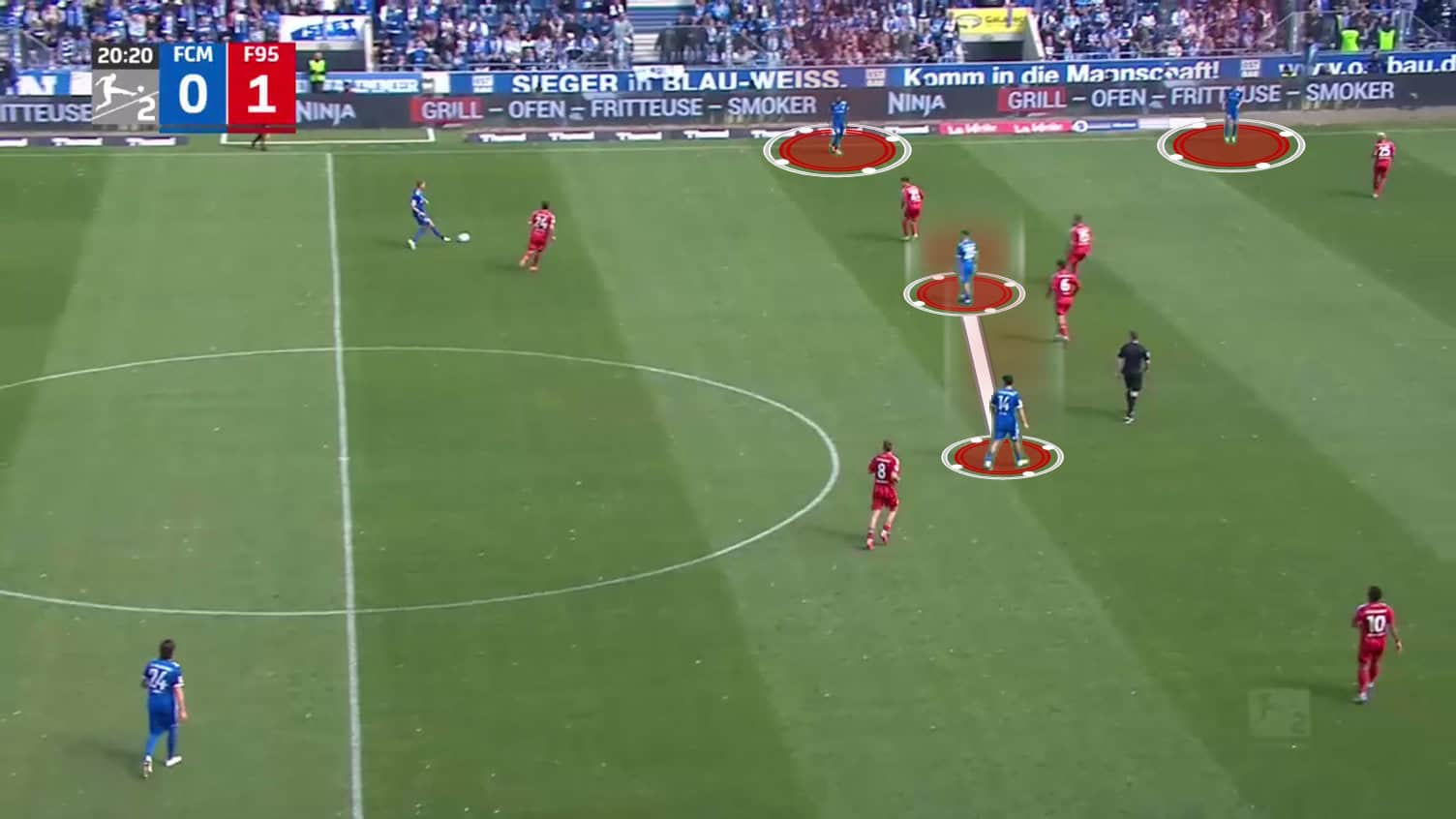
Another interesting thing is something we could see in the previous picture as well: Magedburg does not just have a lot of width in every situation; they also have two players on both wings at all times.
This drags the defenders out of their blocks and forces them to either maintain their numerical disadvantage on the wing or open up their centre a bit.
The rest of the players, especially the two central midfielders, are then in a very narrow shape, staying in the centre of the field.
This allows Magedeburg to control the most important areas of the pitch while also creating enough space for their players to make runs.
Christian Titz also uses this to overload the centre of the field and create advantages for his players there.
While this shape looks very unconventional, it worked wonders for Magdeburg.
They had some trouble with the rest of the defence and against counterattacks, but because they dominated most of the games with their quality on the ball, it did not matter as much.
First Look At A New Hannover 96 Under Christian Titz Tactics
Hannover 96 and Christian Titz’s season starts on Sunday at home against 1. FC Kaiserslautern, but in their pre-season friendlies, there was a lot to look at compared to last season.
In this paragraph, we will examine what Christian Titz has already brought to Hannover by analysing their game against Cagliari Calcio, when Hannover beat the Serie A team 2-0 at home.
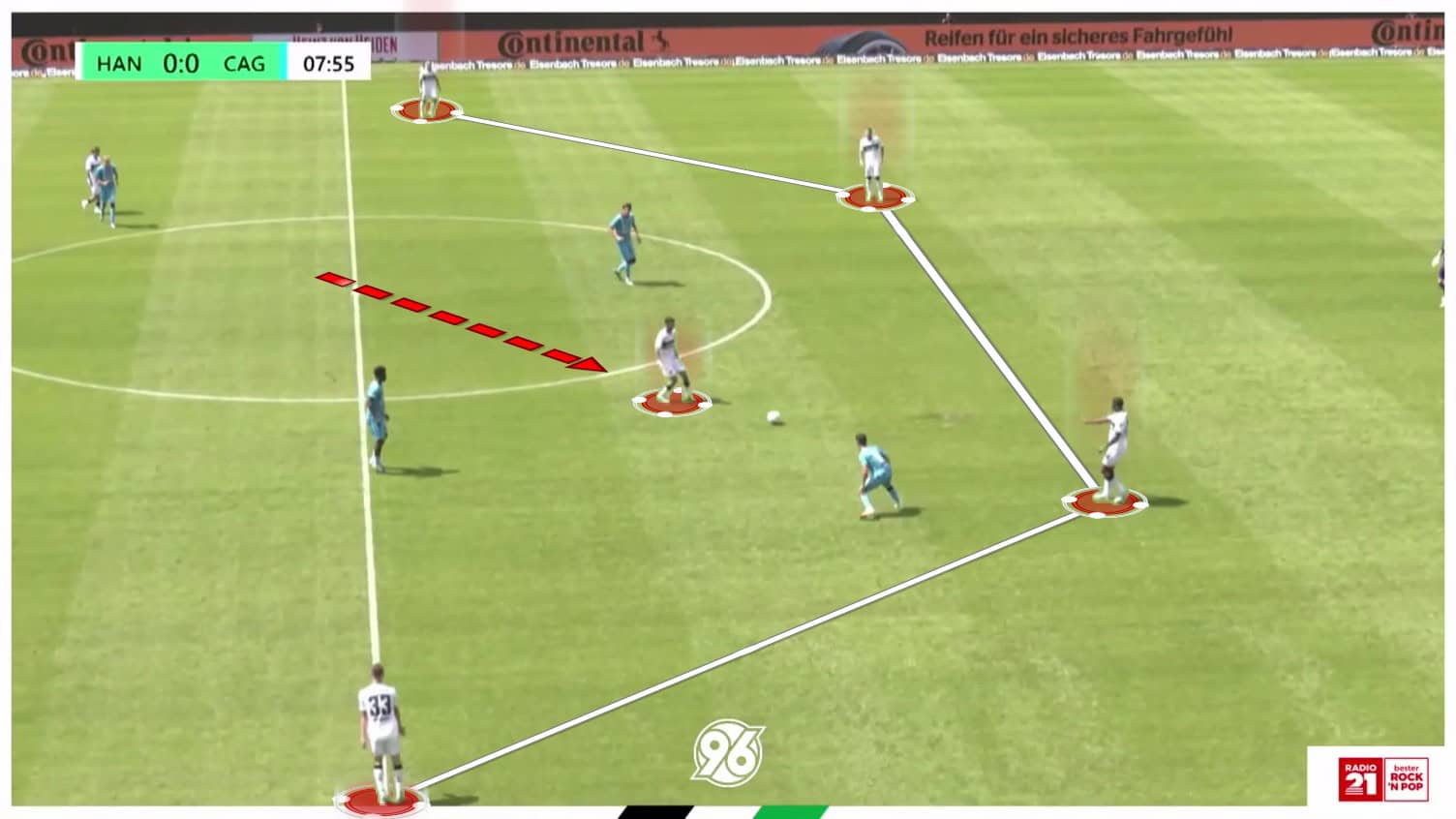 The first thing to notice is that Christian Titz did not bring his 3-4-3 formation to Hannover.
While he played with that formation at Magedburg over the last couple of years, Titz usually preferred a back-four over a back-three until last season, and he brought his 4-3-3 formation to Hannover now.
In the build-up, Hannover are shaping up and controlling the game in two different ways so far this season.
The picture above shows the first shape.
Instead of building up with a back-three, Hannover use all four defenders to gain a numerical advantage in the first line of play.
Some things stay the same as in Magedburg; Hannover have a lot of width here due to their full-backs being wide, and the midfield is pushed up the field to create space between the lines.
Titz’s men now easily control possession, and their holding midfielder is able to drop into the space in front of his backline to receive the ball in their opponent’s formation and instantly play a one-touch pass towards the fullback.
It’s a simple pattern, but Cagliari was barely able to hold its own against it for most of the game.
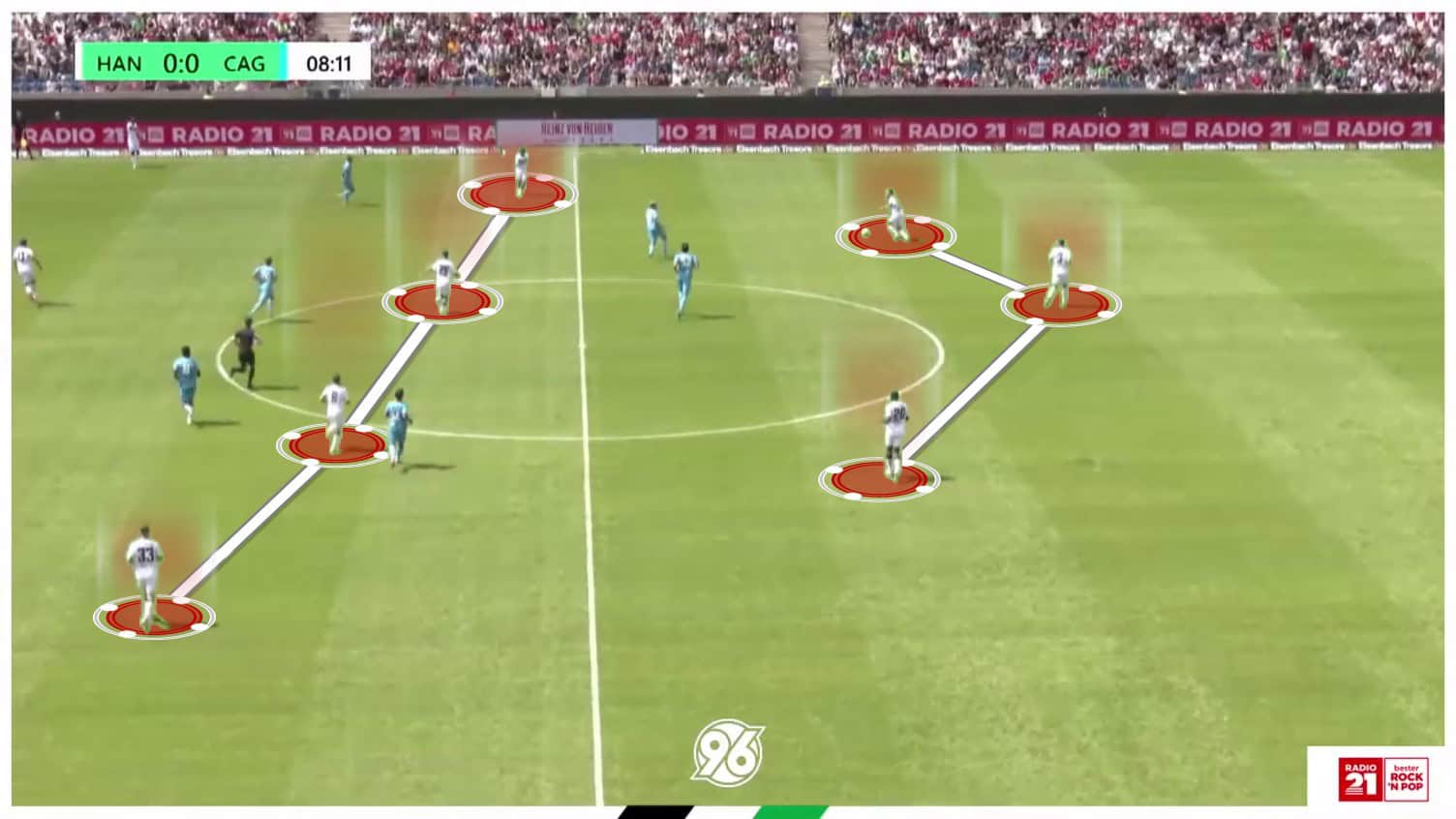
The second shape is reminiscent of the 3-4-3 formation Titz used in Magdeburg.
One full-back pushes up the field, and the other full-back drops back towards the centre-backs, creating a situational back-three.
Christian Titz is not involving his goalkeeper as much as he did in Magdeburg so far, so he had to find another way to create this shape.
The rest stays the same: two players on each wing, a lot of width, space between the lines, and the players in the centre staying in a narrow shape.
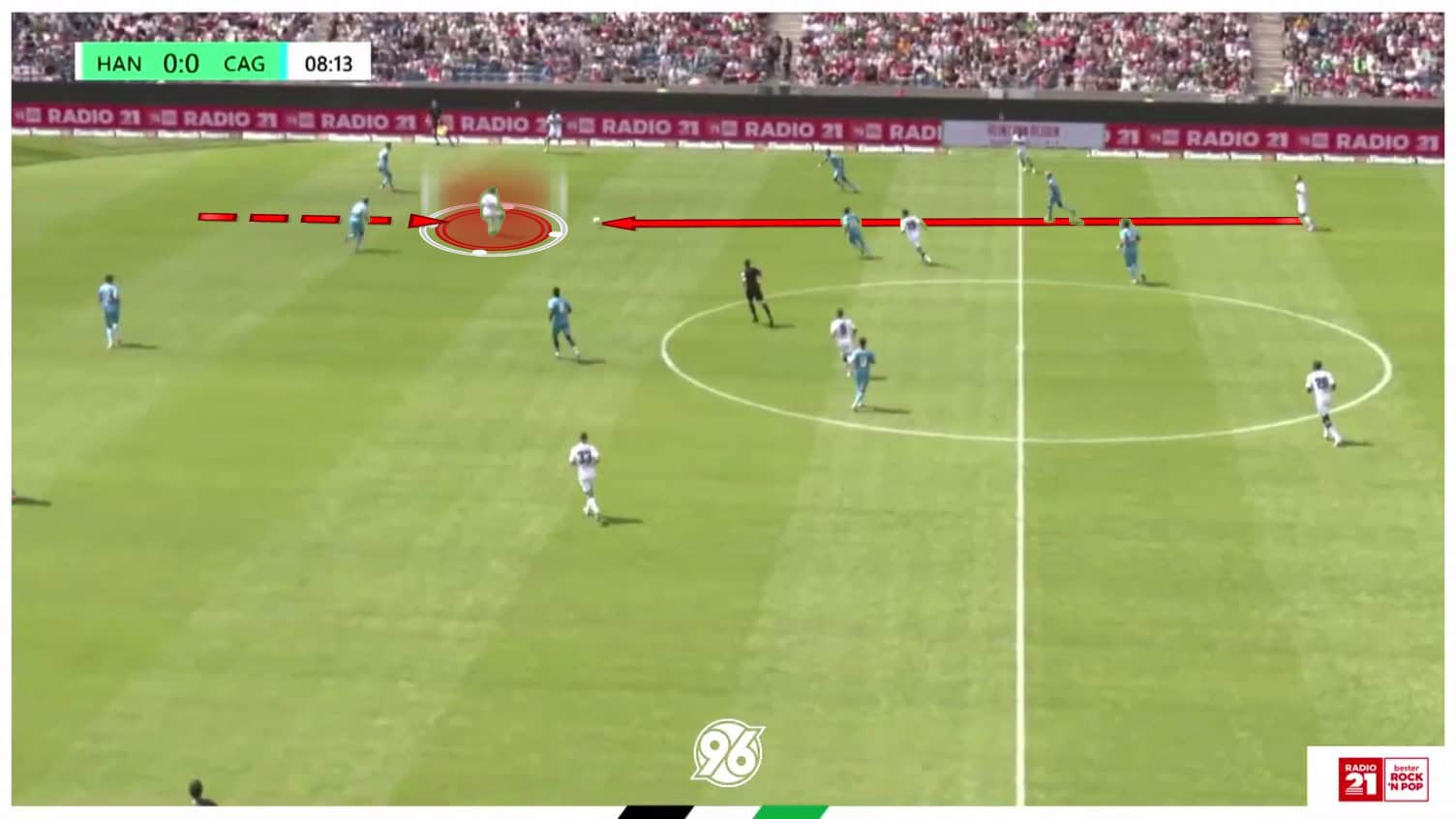
Out of this shape, Hannover was able to involve their striker quite heavily in the passing game, as seen in the picture above.
He just drops out of the attacking line.
Thanks to the width and the narrow double pivot, the opposing block is stretched out, allowing him to receive a vertical pass in the near-sided half space.
With just one pass, Hannover cut through the entire midfield and is now in a premium position to start their attacking phase.
While not everything is perfect at the moment, Hannover is trending in the right direction this pre-season.
Conclusion
After six rather unsuccessful seasons in the 2. Bundesliga, Hannover 96 are trying to get promoted back into the Bundesliga this season.
While they have been a decent team under Stefan Leitl for the past two seasons, they have never become a top team in the league.
With Christian Titz, the club now opted for an outlier in the German footballing cosmos, a coach who wants to dominate through possession and a good passing game.
They adjusted their squad, signing 16 new players who fit the ideas of their new coach, and by doing that, they also added a lot of individual quality.
Finnish striker Benjamin Källman is a player to look at this season.
After Martijn Kaars finished with 19 goals under Titz last season, Källmann is a very similar type of player but with a bit more individual class, which could become the difference maker for Hannover this season.
Unlike the last couple of seasons, there are no clear-cut promotion favourites in the 2. Bundesliga right now, but Hannover 96 positioned themselves as one of the teams that should be in the running until the end of the season with their summer transfer window so far.
