
Arsenal hosted Manchester United in Gameweek 23 of the 2025/2026 Premier League, losing 2-3.
Despite being dominant across ball possession (56%), expected goals (1.19), and total shots (15), the Gunners trailed for most of the game.
Their late equaliser was countered by Man United’s winner just a few minutes later.
After the result, the league leaders sit at just four points clear of Manchester City, who won their game.
Meanwhile, the Red Devils climb to fourth, leapfrogging the likes of Chelsea and Liverpool.
Through this tactical analysis, we aim to understand how Arsenal dominated the game and how Manchester United overcame the pressure to seal the win.
Arsenal Vs Manchester United Lineups & Formations
Let’s look at how Mikel Arteta and Michael Carrick fielded their squads.

The hosts, Arsenal, played in a 4-3-3 formation.
David Raya started in the goal, behind a back four of Jurriën Timber (right-back), William Saliba (right centre-back), Gabriel Magalhães (left centre-back), and Piero Hincapié (left-back).
Ben White replaced the latter after 58 minutes.
Martín Zubimendi played as the lone pivot with Declan Rice and skipper Martin Ødegaard above him.
Zubimendi and Ødegaard were replaced by Eberechi Eze (58’) and Mikel Merino (58’).
Gabriel Jesus played as the lone striker, as Leandro Trossard (left) and Bukayo Saka (right) played alongside him.
Jesus and Trossard were replaced by Viktor Gyökeres (58’) and Noni Madueke (75’).
The visitors, Manchester United, played in a 4-4-1-1 formation.
Senne Lammens started between the sticks.
The back four were Diogo Dalot (right-back), Harry Maguire (right centre-back), Lisandro Martínez (left centre-back), and Luke Shaw (left-back).
Casemiro and Kobbie Mainoo played as the double pivot.
Skipper Bruno Fernandes (centre attacking midfielder) played right behind Bryan Mbeumo (striker); Amad Diallo (right) and Patrick Dorgu (left) played as the wingers. Matheus Cunha (69’) came on for Mbeumo, Noussair Mazraoui (88’) came on for Diallo, and Benjamin Šeško (81’) came on for Dorgu.
Arsenal Dominant Performance
The Gunners were comfortable on the ball, achieving simple progression from build-up play.
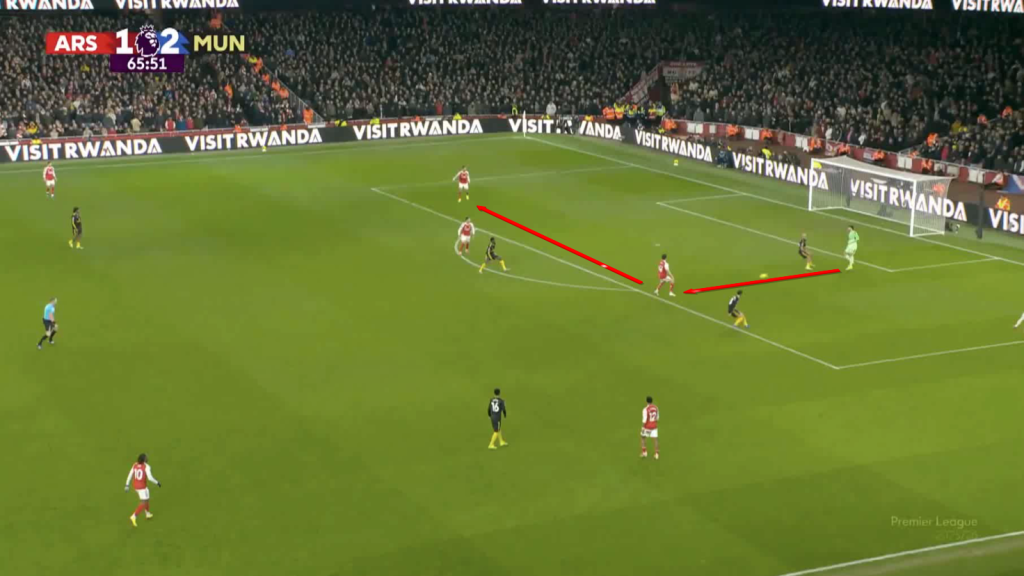
Arsenal frequently demonstrated their ability to bypass the first line of opponent press.
Zubimendi receives from Raya on the right side, and the hosts end up progressing in this situation.
There were multiple instances in which the passing lanes to the deeper midfielders were closed off; in these scenarios, the centre-backs ended up finding attacking players in the half-spaces.
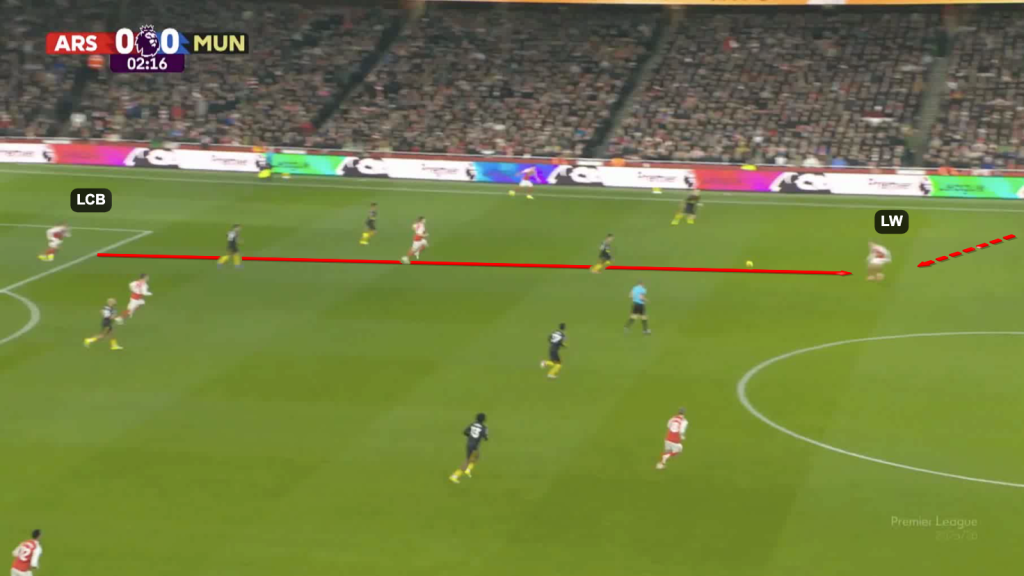
Gabriel plays a direct ground pass to Trossard, who drops into the half-space.
Arsenal’s wingers, who usually stayed wide, moved inwards to receive the ball; constant movement from players, especially in the attacking half, helped them stay unmarked and move the ball quickly.
It was common for Arteta’s side to establish a numerical superiority outside the opponent’s structure to avoid aggressive pressure.
Either Rice or Zubimendi was seen dropping deep to help circulate the ball.
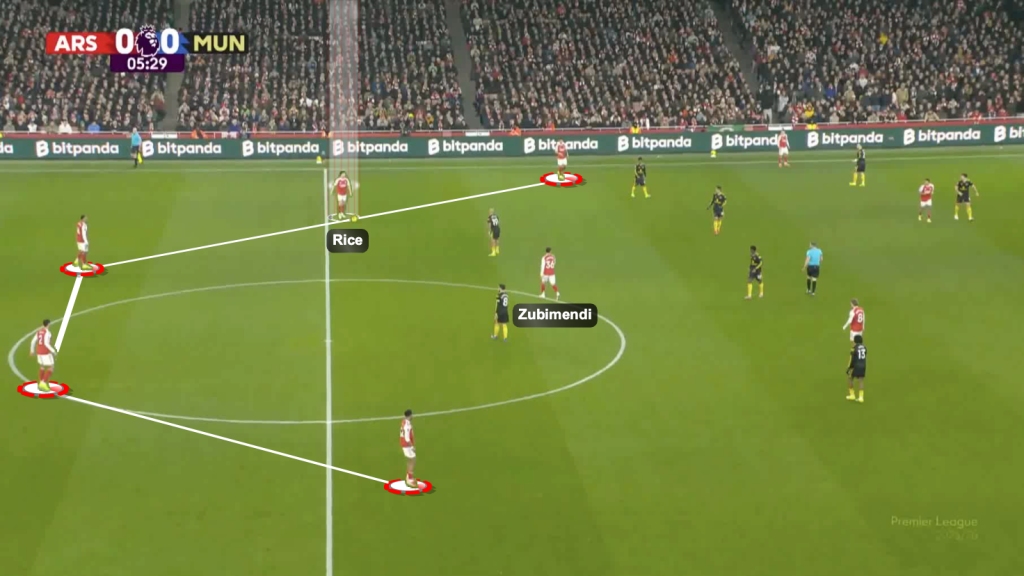
Rice most often dropped in the left half-space; meanwhile, Zubimendi stayed inside the structure.
This also allowed the full-backs to roam free higher up the pitch.
With the Englishman’s positioning, Arsenal attempted to play some penetrative passes from the left.
As a result, Man United players got dragged sideways to cut passing lanes in the half-space.
This opened the passing lane to Zubimendi time and again.
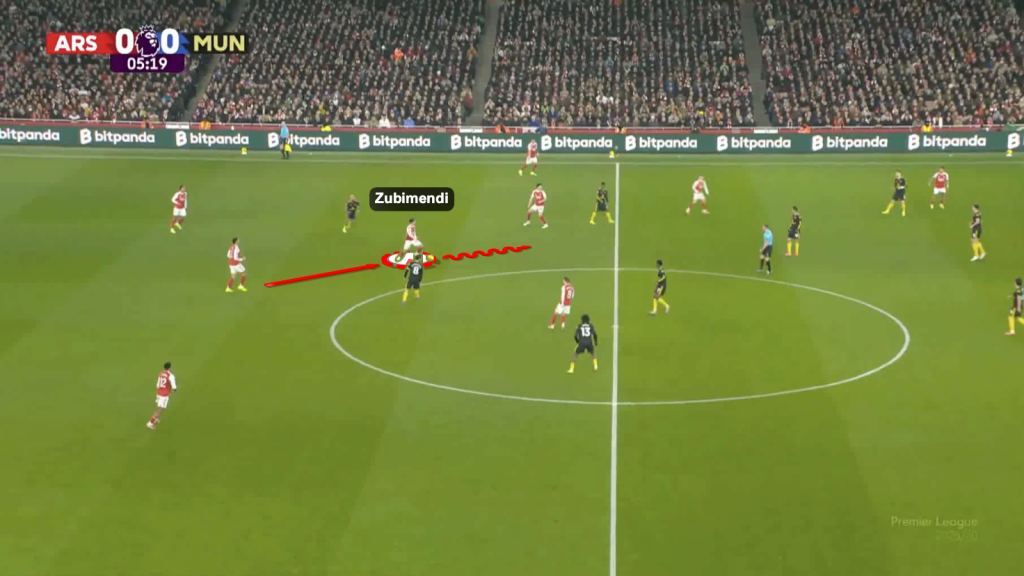
The Spaniard did not need to drop outside the structure in these situations; he positioned himself cleverly behind the first line of press to receive from the centre-backs.
Upon receiving the ball, there were multiple instances in which Mendy had no one king him.
Being aware of the advantage, he turned and either carried the ball forward or found a line-breaking pass.
Arsenal’s formation on paper was different from how they operated in the attacking half positionally.
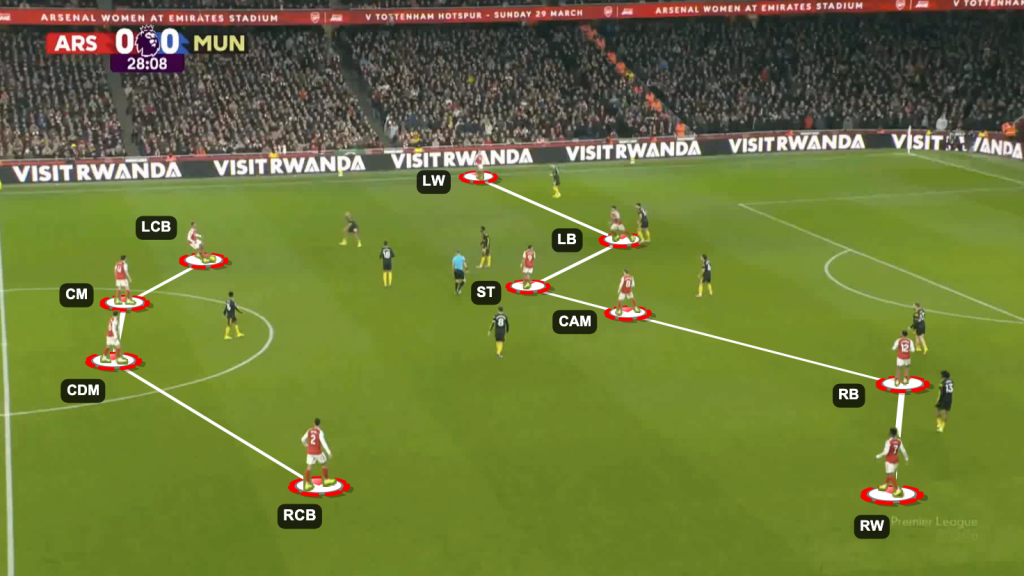
It was common to see both Zubimendi and Rice dropping between the centre-backs; this allowed them to stretch out and offer width.
Both backs were mostly seen inverting and operating in either half-space or, sometimes, the central channel, which meant the wingers had to offer width; apart from this, the striker (Jesus) and the attacking midfielder (Ødegaard) stayed in the central channel.
However, the positions were not rigid in any way.
While Arsenal were in possession, most of the outfield players stayed in motion.
After releasing the ball, the ball-carrier moved to a new space, which either created space for himself or a teammate.
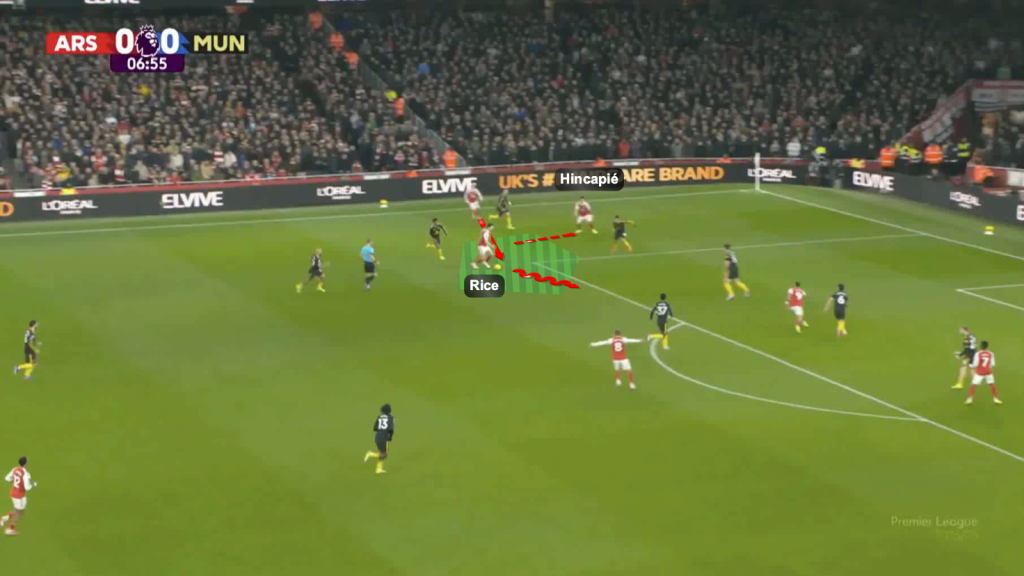
In this example, Rice receives a pass from the wide channel into the half-space in the attacking third.
However, the reason for this space opening up is Hincapié; the left-back makes a short burst down the line.
This drags a defender outside the area where Rice receives the ball.
Constant movement created space in multiple regions of the pitch for Arteta’s side.
This is a major reason they were able to control the game.
The full-backs staying in the half-space made a difference for the Gunners, as they could move the ball either inside or outside upon receiving a vertical pass.
This positioning was also a build-up to the opener from Arsenal.
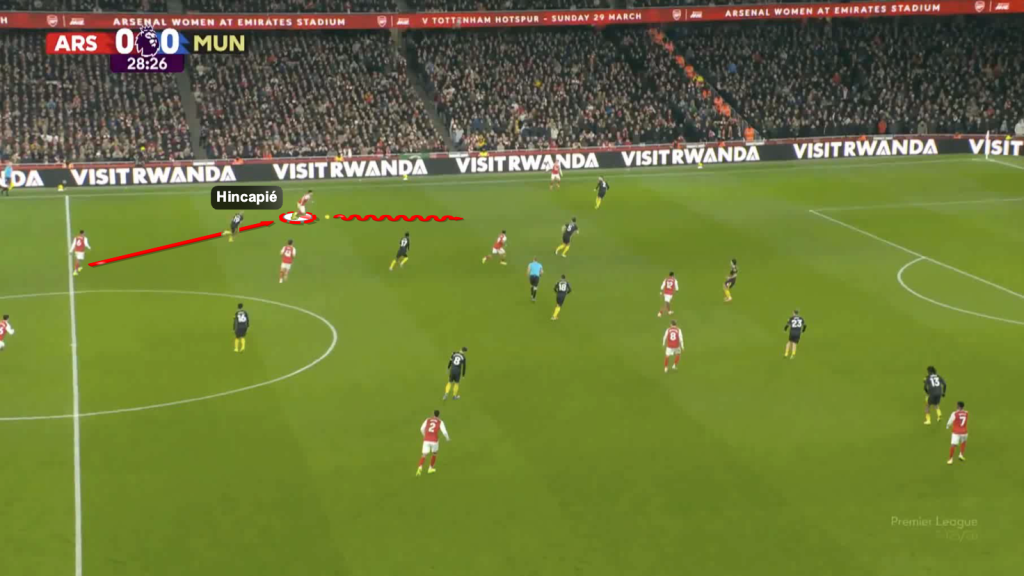
Hincapié receives the ball in the half-space with enough space to run into.
He swings in an early cross once he enters the defensive third.
The cross, although deflected by an opponent, ends up reaching the target.
At the end of the move, Timber was involved in guiding it into the net on the other side.
This shows how both full-backs moved in response to the situation.
To maintain the shape, other players covered for them.
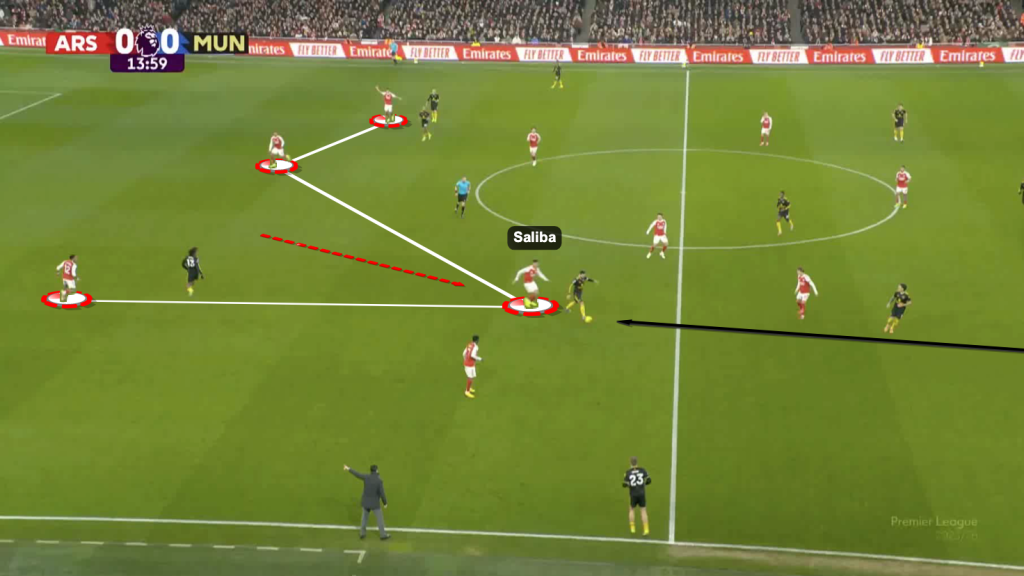
Defensively, the centre-backs were aggressive and did not hesitate in stepping up.
An opponent receives between the lines in the midfield third; Saliba steps up early to prevent him from turning and playing forward.
At the same moment, Arsenal wins the ball, and the defensive phase turns into a positive transition.
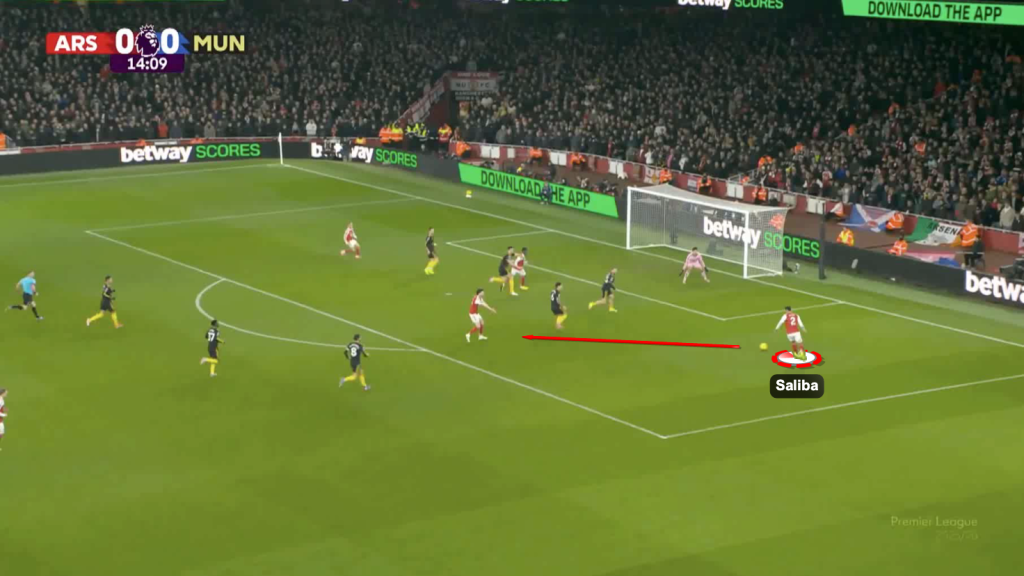
The centre-back participated in the attack and found himself inside the opponent’s penalty area, playing a cutback.
During the goal they conceded, they neglected the need for central support.
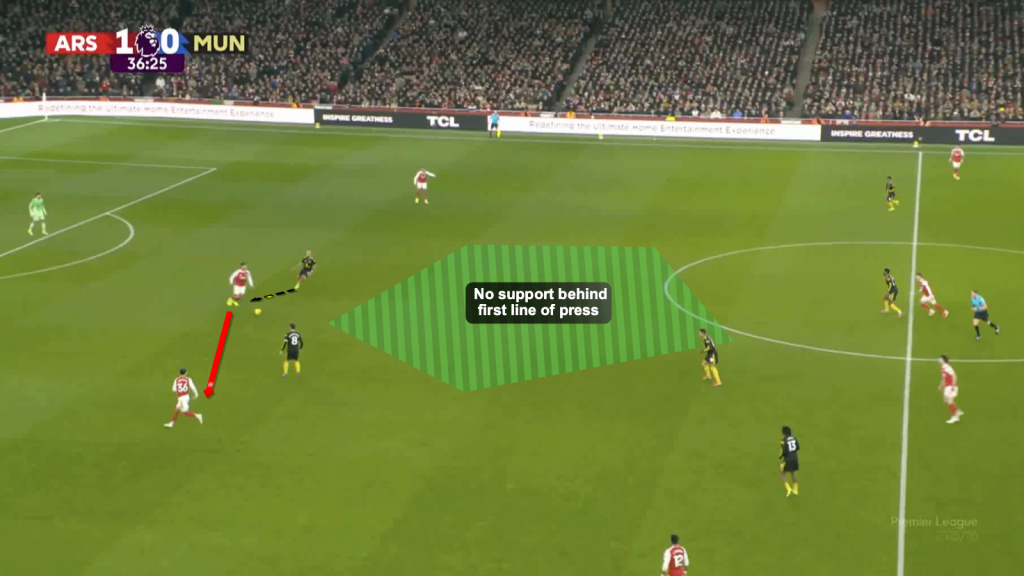
Zubimendi drops outside the structure to help.
However, no one occupies the space between the lines.
Since there is no vertical support, the Arsenal players outside the structure are forced to play sideways, and a mis-hit pass by Zubimendi costs them.
Mbeumo instantly capitalises and gets his goal by rounding the goalkeeper.
Manchester United Performance Against Arsenal
Attacking Phase
Although they did not have as much ball possession as the hosts, Man United had ideas up their sleeve.
They played third-man passes to give the third player more time and space with the ball.
The ball is not played directly to the pivot.
Fernandes drops into the wide channel to receive.
A chipped ball to him breaks the first line of press.
As the Portuguese sets the ball for Casemiro, the opponent closes in on Casemiro, and Casemiro gets surrounded by opponents.
This gives the Brazilian enough time to manoeuvre the ball and play a diagonal switch.
It was commonly seen from the United defenders to find vertical passes to attacking players.
Fernandes drops to receive the ball inside the opponent’s structure.
With an opponent rushing towards him, the Portuguese plays a first-touch pass to a teammate on the direct opponent’s blind side.
It was common to see Man United trying a short build-up.
The attackers dropped deep to receive the ball.
With the striker dropping in the half-space, Man United found some progressive passes through the lines.
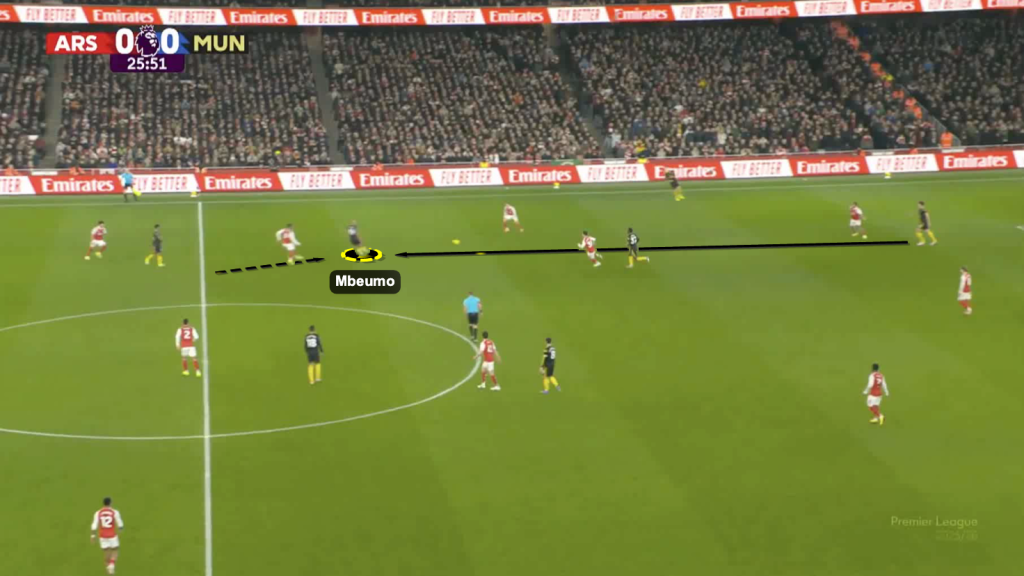
Mbeumo dropped in the right half-space to receive from his centre-back.
With an opposition centre-back following him closely.
The Cameroonian was forced to lay it back at a different angle to a different teammate.
United were also seen finding passes between the lines in the opponent’s half.
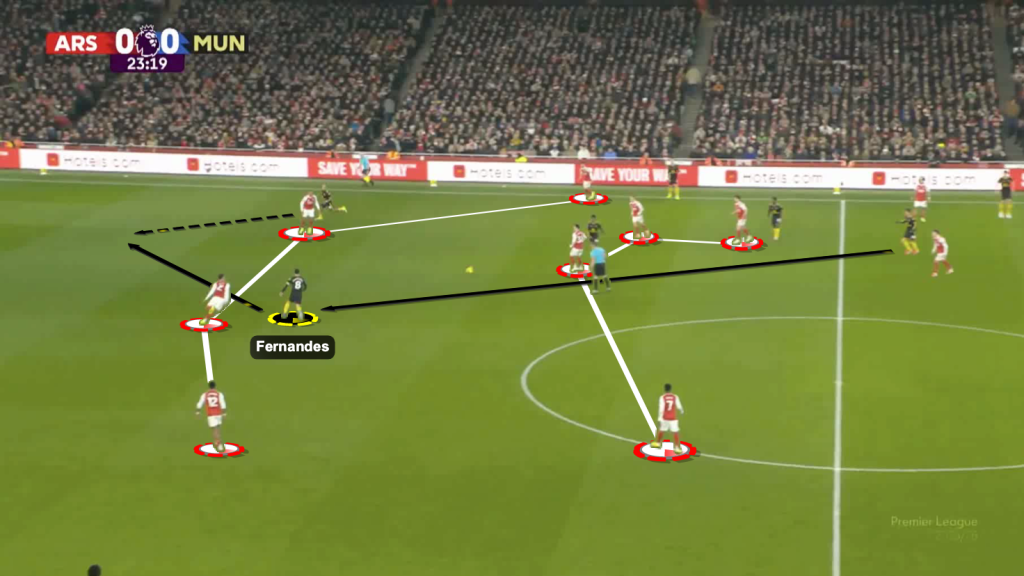
The Arsenal defence and midfield had plenty of space between them on several occasions.
Here, Bruno Fernandes receives a pass between the lines to release Mbeumo.
However, this solution was inconsistent.
There were times when the spaces were cramped up, and the only visible space was in the back, and I had to go long whenever the option was available.
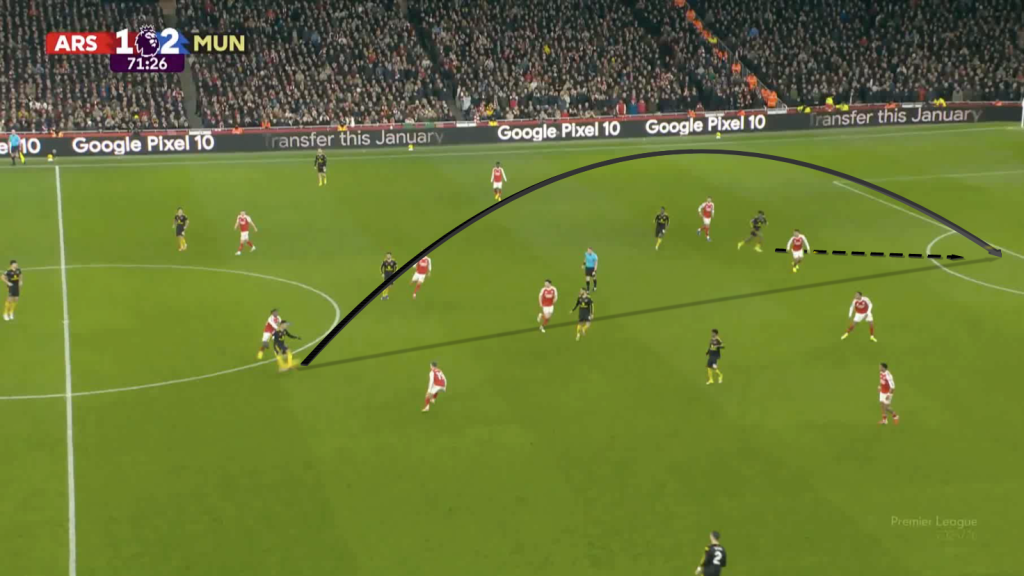
Casemiro plays a pass in-behind for Dorgu, as the Dane makes the run on his direct opponents’ blind-side.
Manchester United mixed it up in terms of attack, and it ended up in their favour as they scored two more goals in the second half.
United kept finding their wingers in the half-space, which ended up in a goal from Dorgu.
The Dane received in the half-space and proceeded to play a couple of one-twos with Bruno Fernandes before hitting it into the top corner from zone-14.
Arsenal leaving space between lines cost them in this situation.
The winning goal from the Red Devils also came from exploiting space between the lines.
Šeško wins the first contact from a long pass, Fernandes picks it up and starts driving wide.
Meanwhile, Cunha starts drifting infield, which is where he received the line-breaking pass from Mainoo.
Šeško’s influence is visible as he moves, dragging opponent centre-backs.
This opens space for the Brazilian.
Defensive Phase
With the Arsenal expected to dictate the play, United were supposed to defend with structure and discipline.
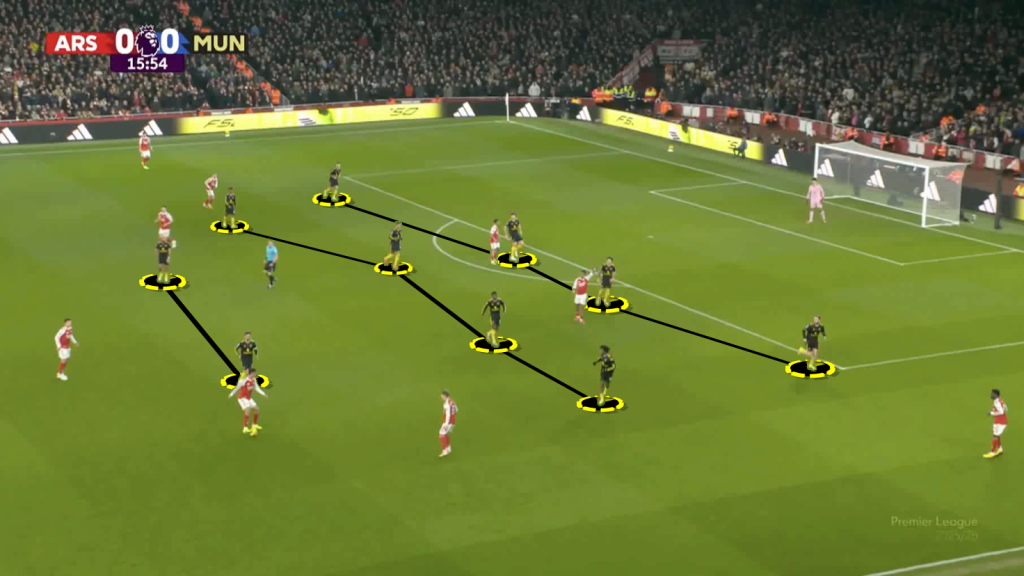 They demonstrated a compact 4-4-2 low block, leaving very little space between the lines.
Apart from the structure, they also showcased intent and hunger to keep their opponents out.
Whenever Arsenal got the ball into the attacking third in the wide channel, United made sure to defend in numbers.
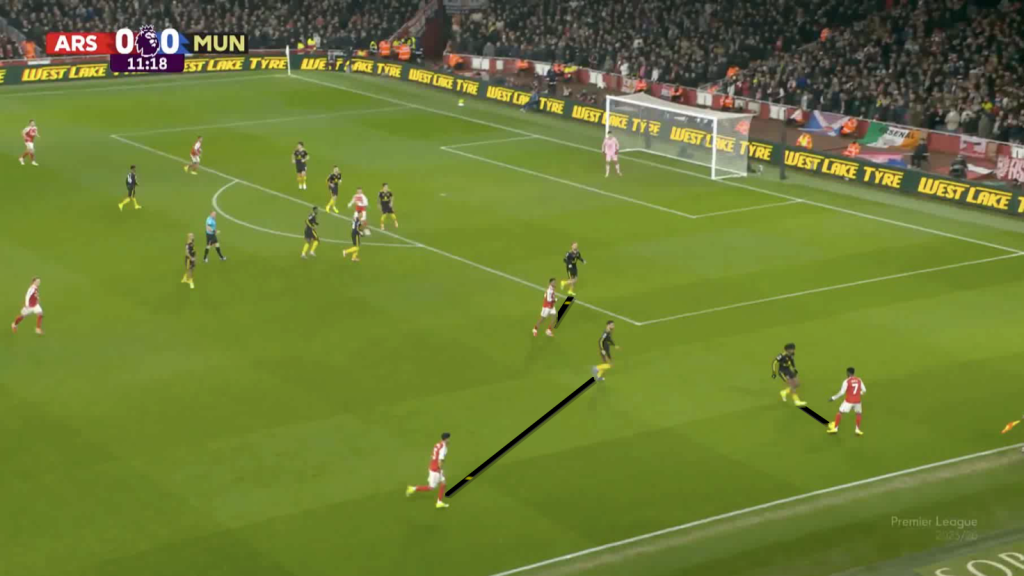
United match numbers by making it a 3v3 in the wide area.
As a result, the attempted cross from the ball-carrier is blocked.
Against skilled dribblers, United also made sure to double up.
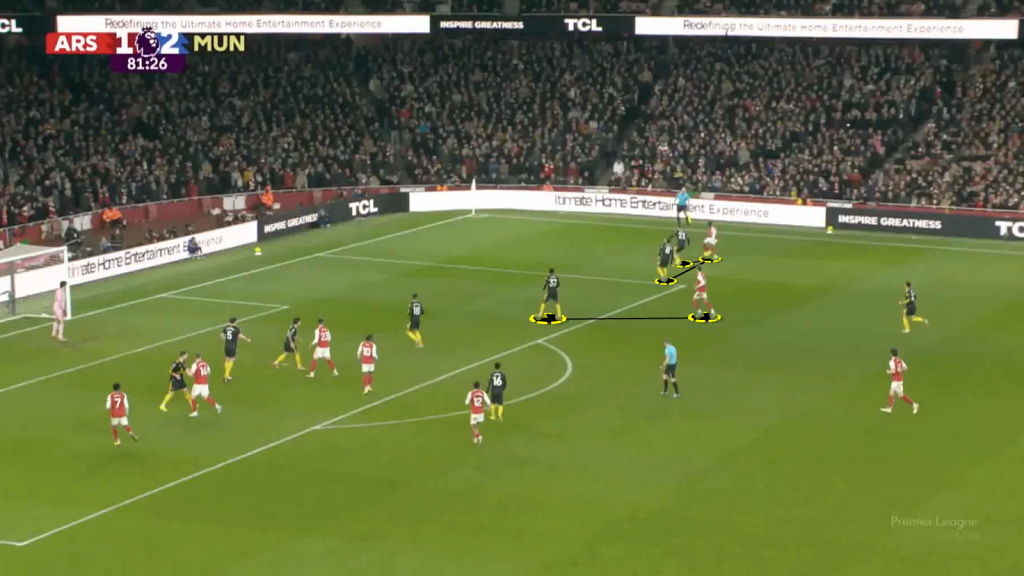
Double-teaming a skilful attacker made sense for the visitors, who are desperate to protect their lead.
Even underlapping runs were firmly tracked by centre-backs and pivots.
Therefore, Arsenal struggled to create from the wide area.
Man United did not attempt to press high regularly, which helped them save energy.
However, they acted on a trigger to force their opponents towards the wide area.
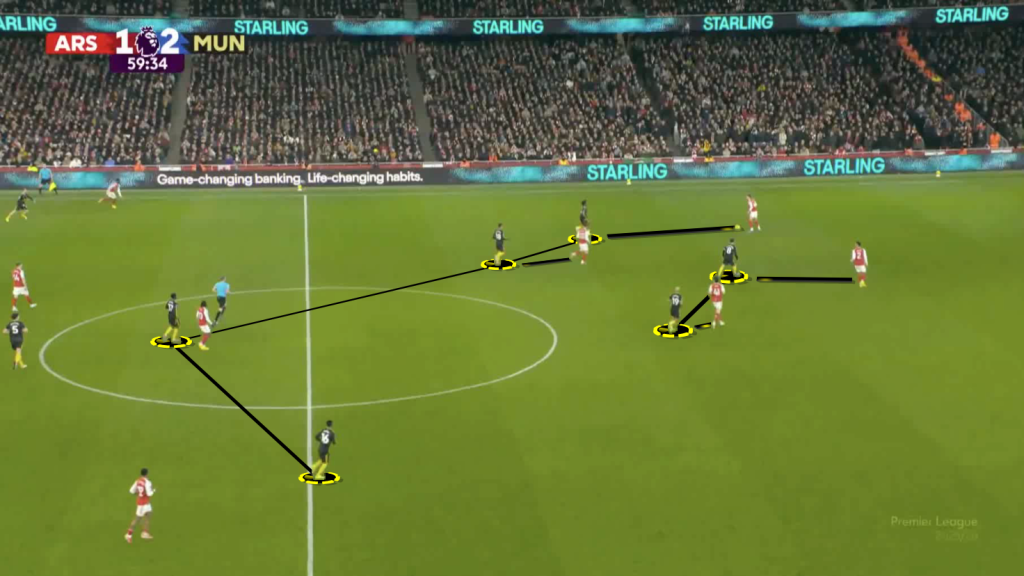
In their 4-4-2 defensive shape, United carries out a staggered press.
With man-orientations in the midfield third, Arsenal were forced to go wide.
If the first block of pressure was bypassed, the deeper midfielders shifted across to cover up and delay the attack.
Conclusion
Arsenal were proficient with the ball, carrying out build-up and progression effectively.
Their positional rotations, full-back inversions, and front-foot defending made life simpler in both the defence and midfield.
However, they left space between the lines on multiple occasions, which was exploited by Manchester United.
Apart from the build-up to Mbeumo’s goal, Arsenal always had options available to move the ball out of pressure.
The Red Devils maintained a compact defensive shape, which helped them in defending with numbers even in the wide channel.
This was also a reason why they had their attacking transition moments.
Manchester United scored their goals in the second half due to their ability to exploit the space between the lines.
