
Matheus Cunha was one of three marquee signings Manchester United made this past summer.
Alongside Bryan Mbeumo and Benjamin Šeško, Cunha was brought to Old Trafford in order to completely revamp Ruben Amorim’s forward line.
Thus far, Cunha has perhaps been the least impactful of the three summer signings, though it is very early days.
The Brazil international is yet to score a goal or provide an assist for the Red Devils, while Šeško and Mbeumo have opened their respective Old Trafford accounts.
Cunha was unfortunate to pull up injured in the first half of United’s dramatic 3-2 win over Burnley in late August with a hamstring issue, resulting in the ex-Wolves man playing fewer minutes than his fellow new arrivals in recent weeks.
In addition to Cunha, both Amad Diallo and Mason Mount have occupied the left forward role in Amorim’s front three so far this season, with Mount, in particular, appearing as a direct competitor to Cunha for a place in United’s starting XI, especially following the Englishman’s goal in United’s 2-0 win over Sunderland last weekend.
This has sparked some debate among fans over whether Cunha or Mount should be Amorim’s first choice in that position.
That leads into our Mason Mount vs Matheus Cunha player analysis and scout report.
This piece utilizes data analysis and video analysis to dissect the intricacies of Matheus Cunha’s and Mason Mount’s playing styles, highlighting similarities and differences between the two players.
We’ll look at where both men stand out and what qualities Ruben Amorim may be evaluating when choosing between the two left forward options.
Indeed, provided they stay fit for the majority of the campaign, both men are likely to play key roles for the Red Devils this term.
Amorim himself stated, “We need those guys really badly to be really competitive” when both emerged as temporary injury doubts in late August.
Our scout report analyzes what both men bring to the table for Manchester United and how they are critical to Amorim’s plans for 2025/2026.
Mason Mount Vs Matheus Cunha 2025/2026 Data Analysis
Our first section of analysis will briefly summarise both players’ key qualities in their respective roles for Manchester United this season, based on their early-season performances.
It’s worth mentioning that, as the season has started with a partially disrupted schedule due to injuries for both men, and since there haven’t been many games played yet, we are working with a fairly small sample size.
As a result, we’ll also consider data from last season to provide further context to the points made in our first section of analysis.
Using data collected from Wyscout, we’ve generated tables to compare the performance of Matheus Cunha and Mason Mount in several key metrics for attack, defence, and passing.
The standout performer in each metric is circled to highlight which player is outperforming the other in each category.
The data will be interpreted as we progress, and we will provide a brief summary of what the numbers effectively tell us about the two players.
Mason Mount Vs Matheus Cunha 2025/2026 Attacking Stats
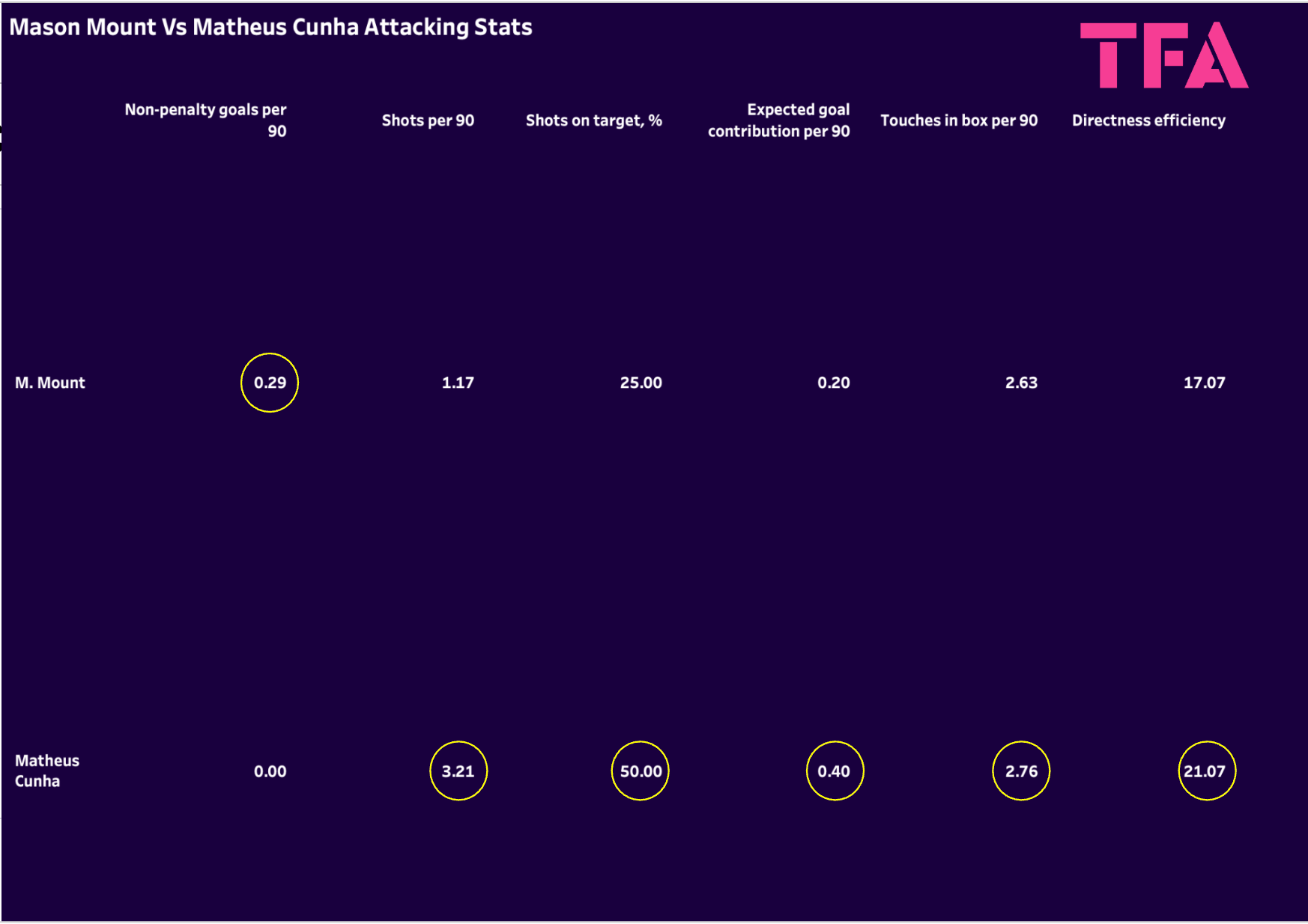
This table lays out both players’ respective performances in attack this season.
From the numbers above, it becomes clear that Cunha dominates this section in all areas but the one that matters most.
Although the Brazilian has yet to score for Manchester United, he shoots at a far higher volume than Mount and has progressed into the final third slightly more than his teammate this season.
Cunha also retains a healthy lead over Mount in the ‘directness efficiency’ custom metric at the end of our table, which measures attacking intent and verticality.
A higher score in that metric suggests that a player requires fewer touches to advance the ball forward with either a pass or a dribble.
Mason Mount Vs Matheus Cunha 2025/2026 Passing Stats
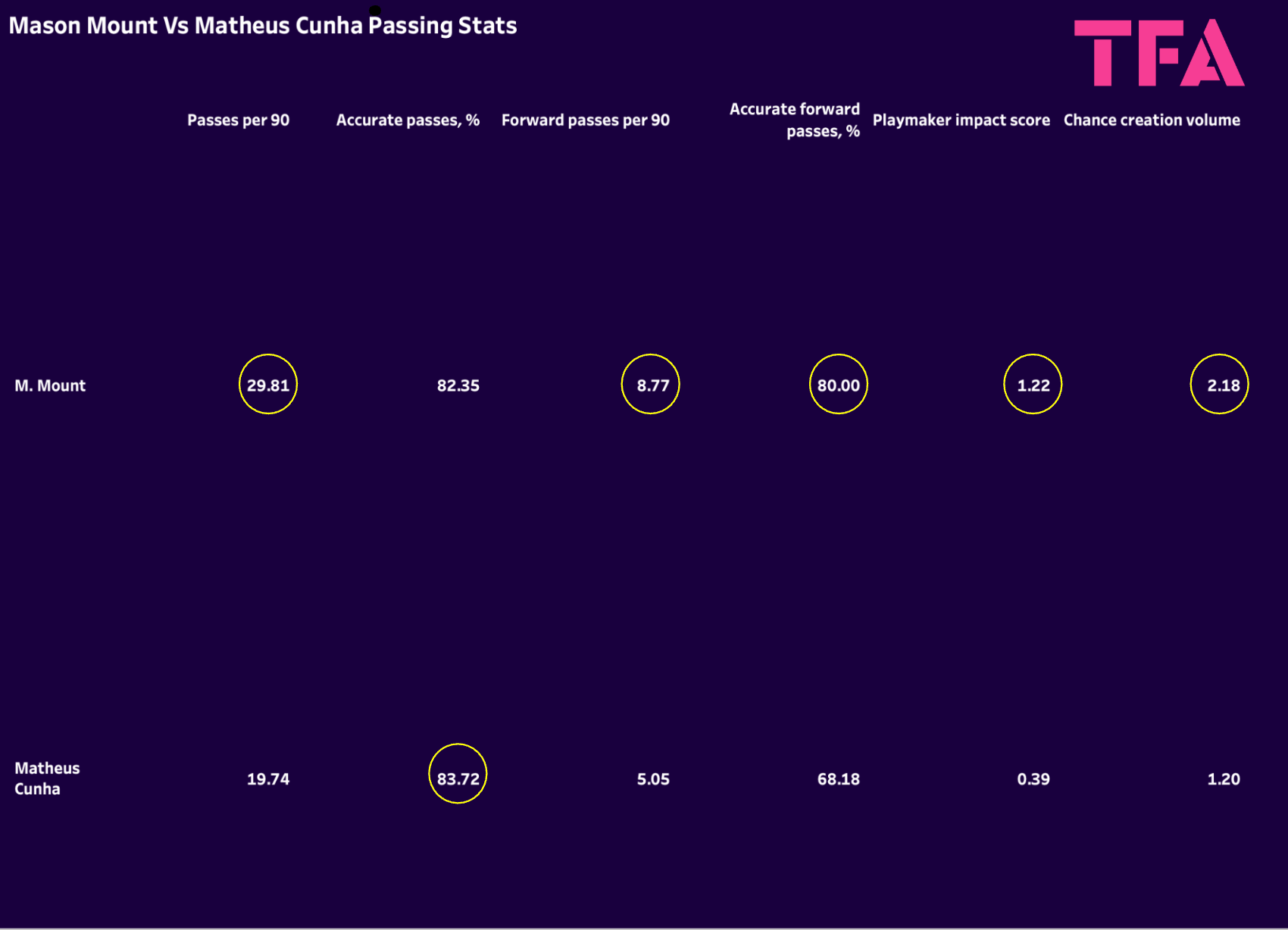
That leads us nicely into Figure 2, which compares the two players in terms of their passing.
In this particular section, Mount dominates in all metrics except pass accuracy.
Perhaps the major takeaway from this table is that Mount sees far greater involvement in possession than Cunha, as indicated by the Englishman’s approximately 50% higher number of passes per 90 minutes than the Brazilian.
In addition, 29.4% of Mount’s passes go forward compared to 25.6% of Cunha’s, yet Mount still boasts superior forward pass accuracy to his teammate.
Lastly, Mount performs much better than Cunha in each of the two custom metrics listed at the end of the table: Playmaker impact score and Chance creation volume.
A higher score in the former indicates a more creative/progressive passer, while the latter effectively just represents raw creation contribution, with a high score equating to a central role in the team’s chance creation.
Mason Mount Vs Matheus Cunha 2025/2026 Defending Stats
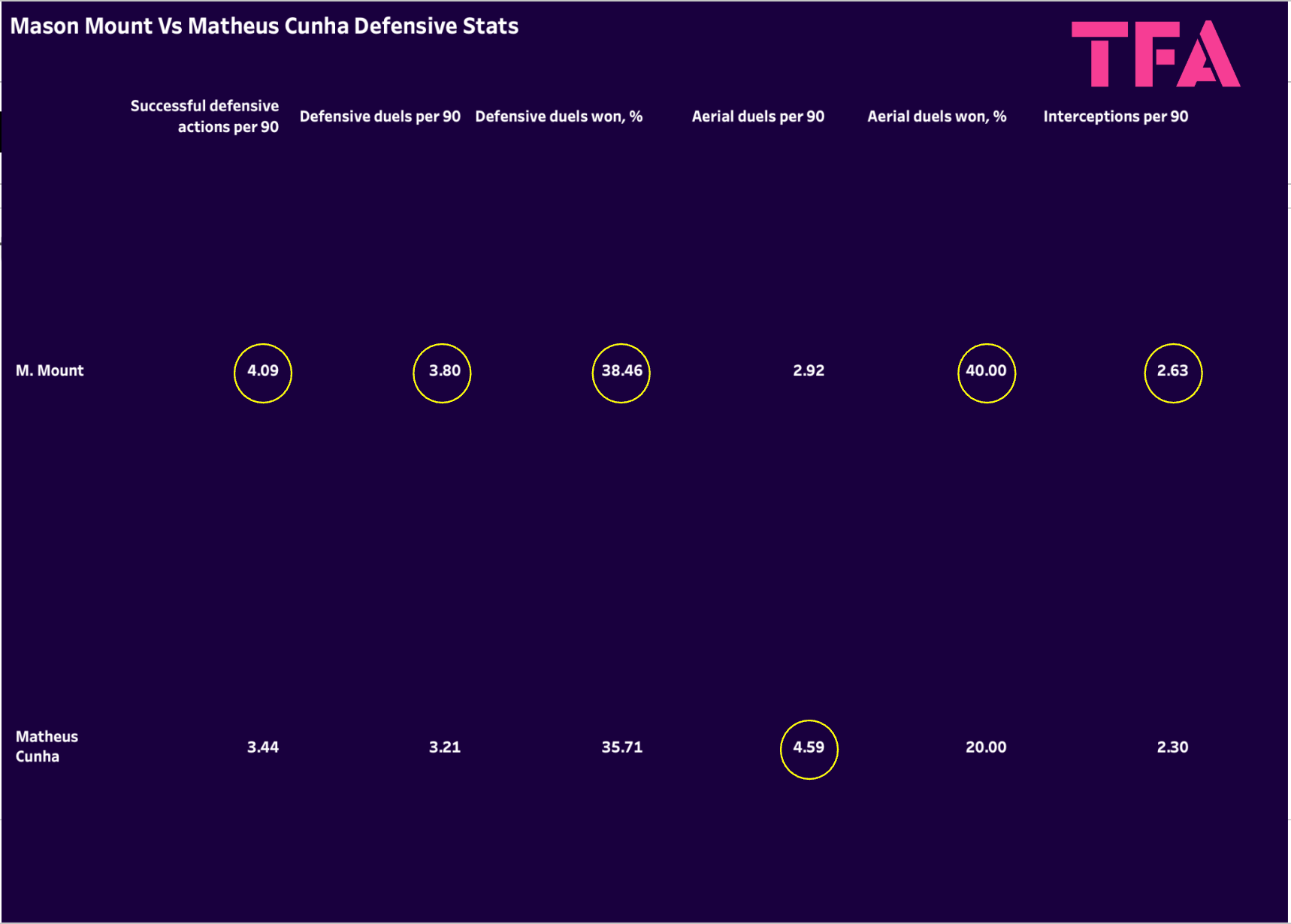
This third and final table focuses purely on defensive contribution, where, again, Mount just about takes first place in all metrics bar aerial duels per 90.
Mason Mount Vs Matheus Cunha 2024/2025 Pizza Charts
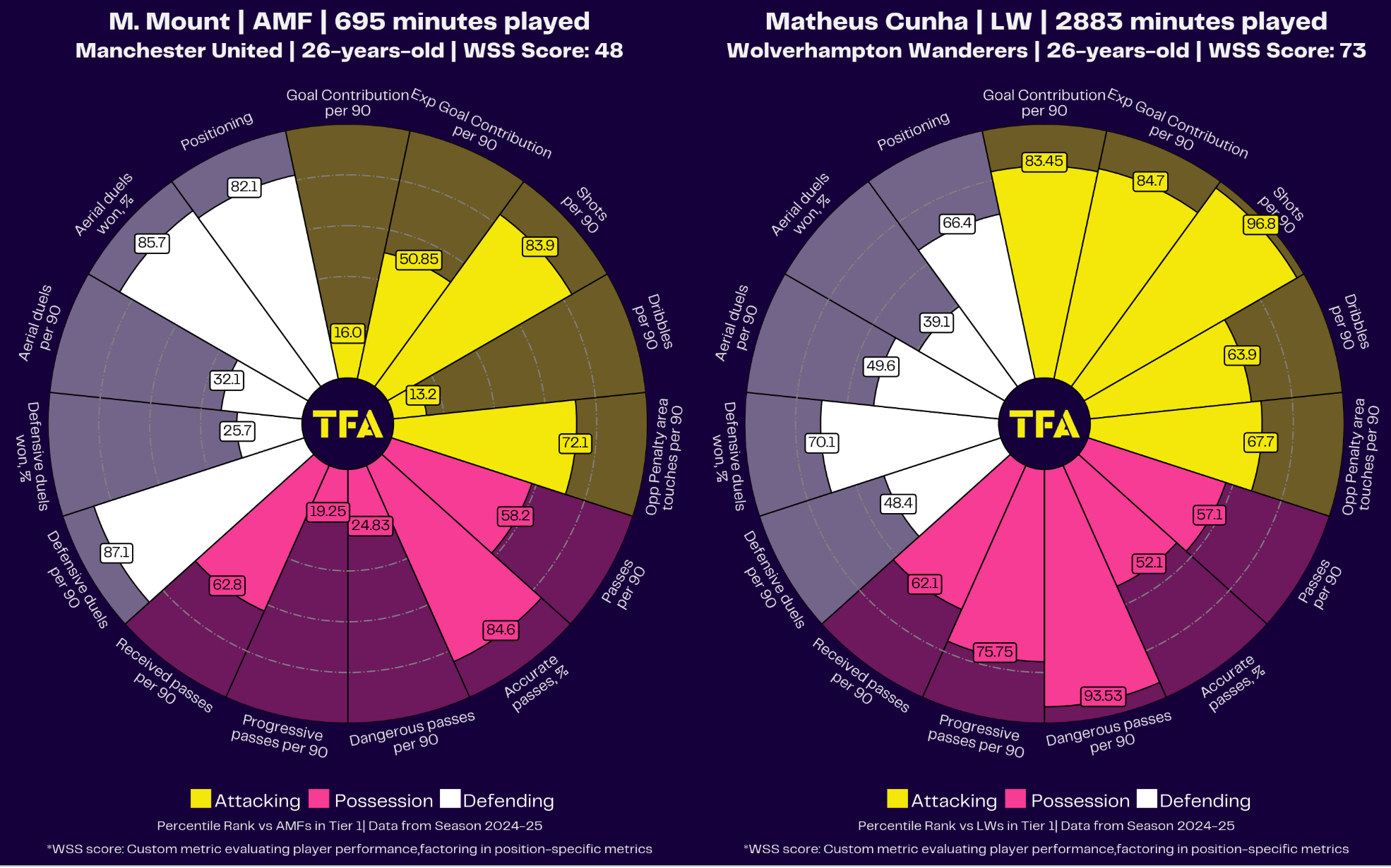
As is the case with the limited data from 2025/2026 used for the tables above, Figure 4 must also be analysed with the caveat of an imperfect sample, given the differences between Mount and Cunha’s positions and minutes during the 2024/2025 campaign and the fact that they were playing in different systems.
Nevertheless, we can use these pizza charts, in conjunction with the 2025/2026 data, to formulate a clear and comprehensive profile for each player.
Mason Mount is a hard worker without the ball.
That much is clear from watching him on the pitch, this season’s tables, and last season’s pizza chart.
The Man United playmaker is also happy to get heavily involved in possession and play a central role to his team’s chance creation.
When he’s out on the pitch, he will try to subtly lose his marker and occupy pockets of space in between the lines.
His teammates need to be constantly on the lookout for that movement, as finding Mount in space like this can prove key to unlocking a stubborn defence.
Mount could be crucial to United’s efforts against low-block defences thanks to his intelligent movement and technical quality under pressure when he is found in those valuable positions he likes to take up between the lines.
Mount’s intelligent positioning on the edge of the box, away from markers, against Sunderland last week, was the key to his opening goal at Old Trafford against the Black Cats.
Similar positioning and movement helped Mount score his only goal of last season for United versus Brentford, too.
As for Matheus Cunha, it’d be unfair to criticise him for his defensive contribution.
Yes, he falls somewhat short of Mount in that area, but he’s far from lazy and puts in a decent defensive shift in his own right with potential to grow in that area as a pressing asset from the front.
What you’d undoubtedly say about Cunha’s game is that he’s a high-volume shooter, which can be good and bad in this United forward line.
Bryan Mbeumo, on the right, is also a volume shot-taker.
At the same time, Benjamin Šeško, up front, has the potential to develop a reputation as a clinical finisher in the Premier League provided his movement and positioning improve and, crucially, he gets the service he needs.
United have been quite trigger-happy going forward so far this season, which is not a surprise to anyone who objectively analysed their summer recruitment and assessed how this new-look forward line would function in practice.
This has led to United generating the highest xG of any side in England’s top flight at this point in the season, but a low xG per shot.
Effectively, United have taken low-quality efforts at a high volume so far this term, and they’d do well to improve the standard of their average attempt on goal, even if that means passing up some of the half-chances they’re currently snatching at, in order to boost their goalscoring numbers.
United would benefit from more patience in possession, funneling higher-quality chances toward Šeško, similar to how Manchester City services Erling Haaland, but that may be a more natural next step with Mason Mount rather than a big summer signing like Matheus Cunha.
Cunha is also adapting to not being as central to everything at Manchester United as he was at Wolves, due to a change in his squad role and the team’s respective tactics.
Mount, on the other hand, is settled at Old Trafford despite his injury issues throughout his spell with the Red Devils.
Matheus Cunha Style Of Play: A Ball-Carrier & A Threat With Runs In Behind
Matheus Cunha will provide a significant threat for Ruben Amorim’s side when there’s space to attack in behind the defence.
Take a look at Figure 5, for example.
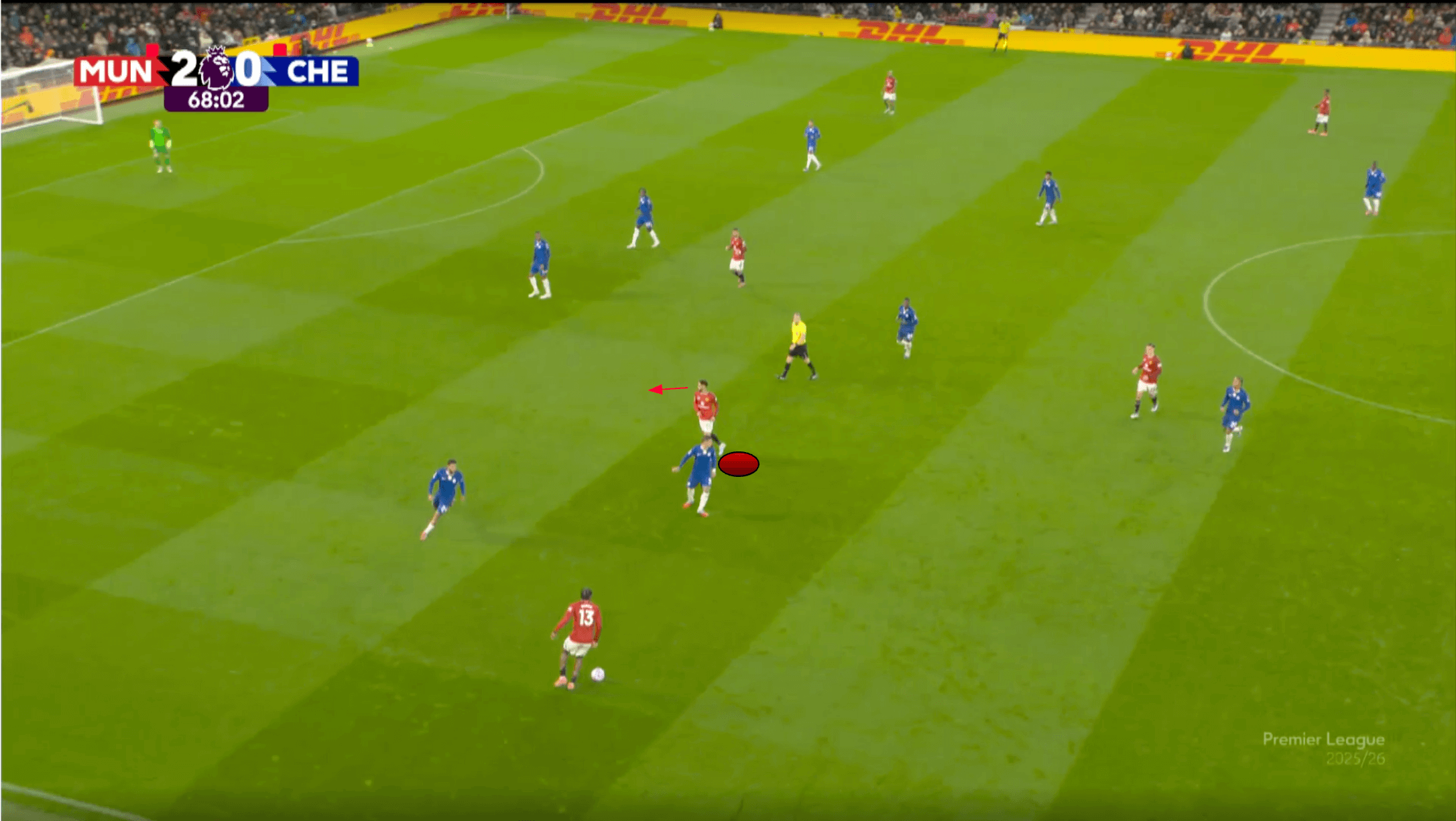
With Chelsea right-back Reece James drawn out to Patrick Dorgu in possession at left wing-back for Man United, Cunha scans slightly to his right and spots space which he can target behind the aggressive full-back.
This is the kind of situation that Cunha loves and where he’ll provide extra value to Mount.
He’s excellent at spotting opportunities to hurt the opposition with runs behind the backline and thrives when teammates can find him in those scenarios.
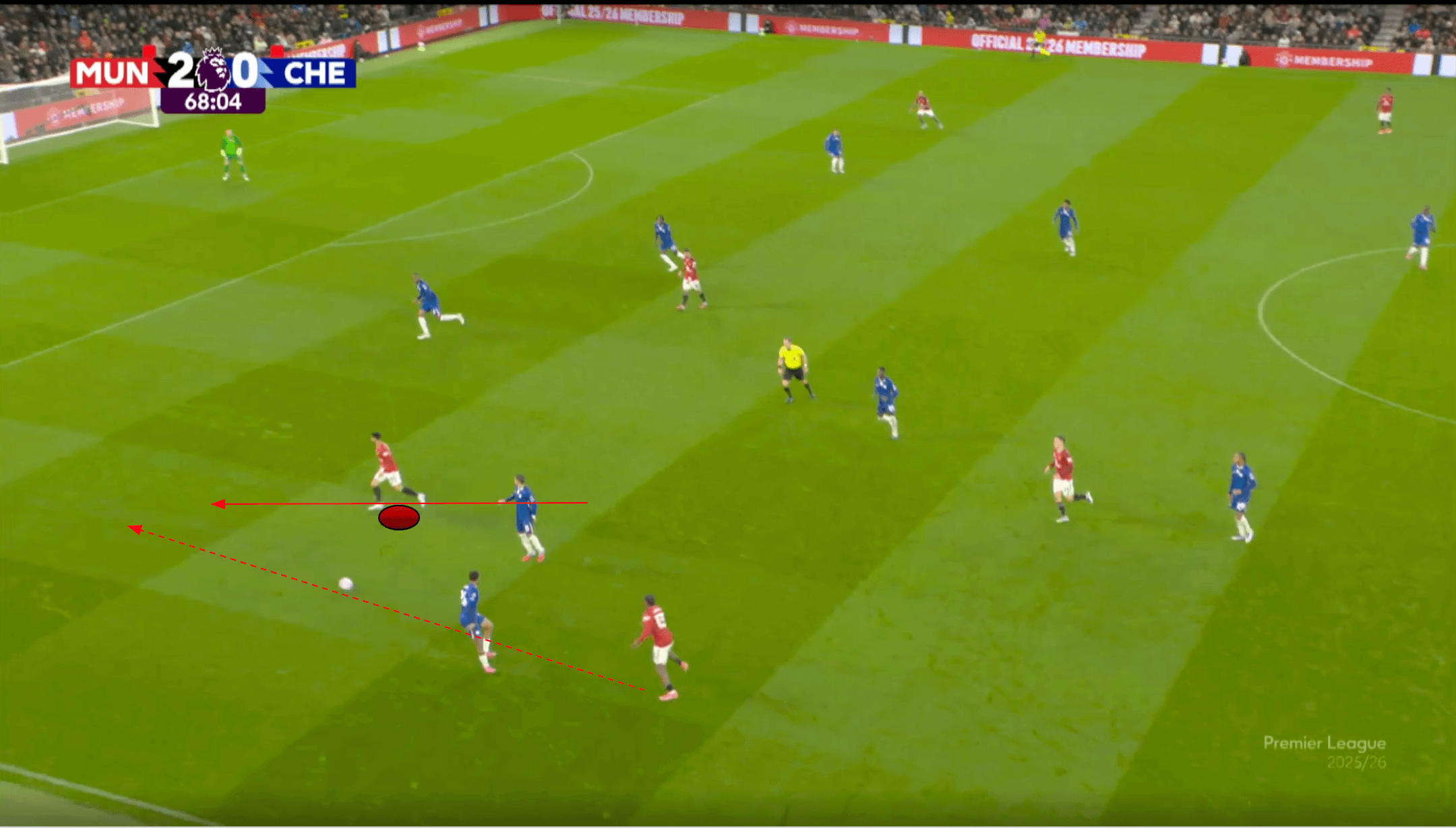
Dorgu’s through ball finds Cunha, who’s free and attacking the inviting space which has opened up nicely behind Reece James.
This sets Cunha up to collect the ball and carry towards Chelsea’s right centre-back, who now has a large space to defend with a potentially devastating dribbler running at him.
Cunha is a threat with his runs in behind and is a skilful dribbler, but he is also a very comfortable ball carrier.
Should Cunha drop and receive the ball to his feet in the middle third, expect him to try to immediately take players on while aiming to drive his team forward into the final third and beyond with the ball at his feet.
Mason Mount Style Of Play: Receiving To Feet & Progressive Passing
Mason Mount, on the other hand, is more likely to progress with passes and position himself to receive the ball to feet rather than position himself to receive a through pass into space.
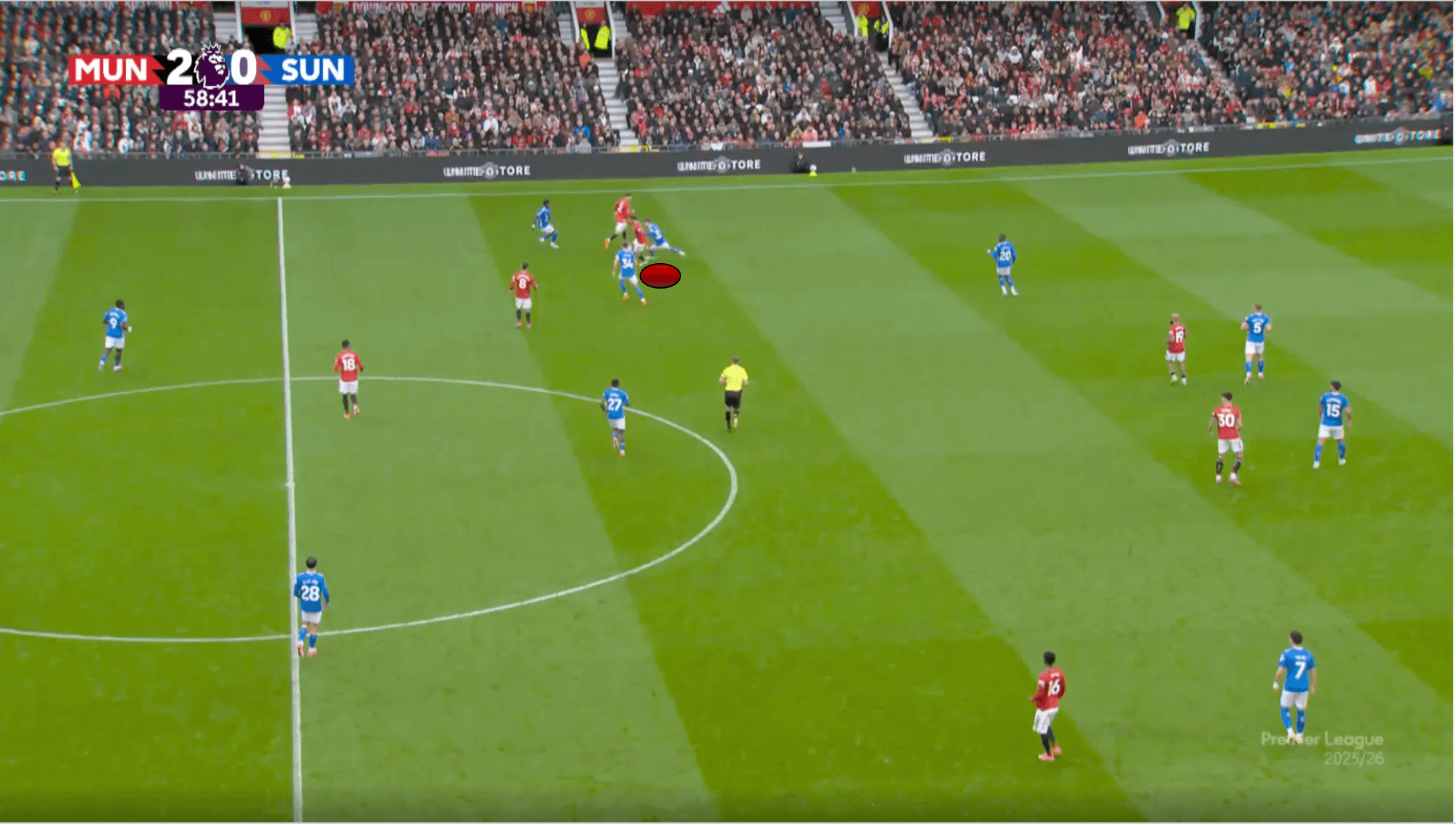
Take Figure 7, for example.
This is the kind of position Mason Mount is likely to find himself in fairly often, and in which you’ll rarely see Matheus Cunha.
If Cunha were in Mount’s place here, he’d likely be positioned higher and trying to receive while facing the opposition’s goal.
Mount likes to drop and receive with his back to goal, even with a defender on his back, while Cunha would like to be targeting space behind that defender.
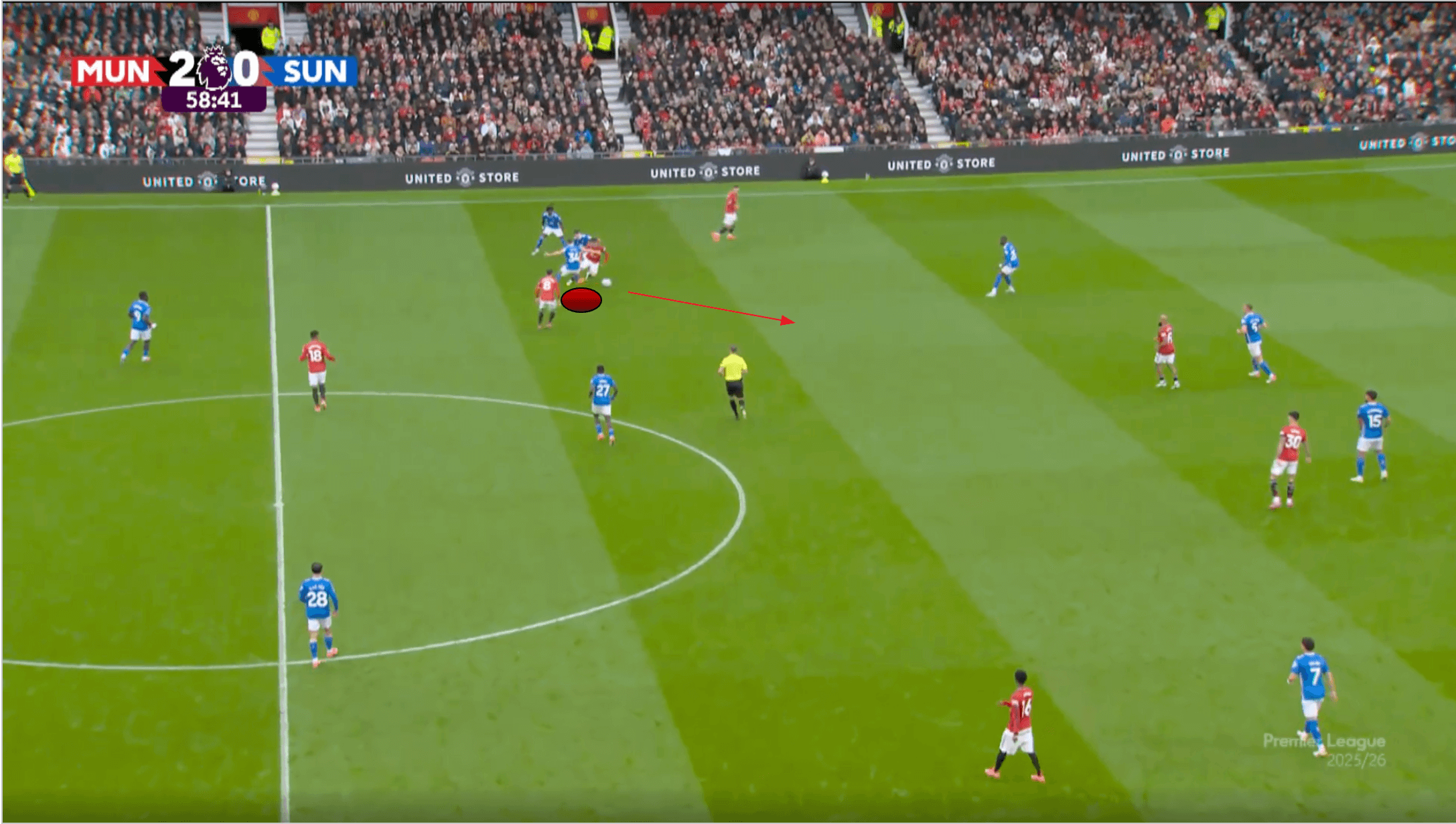
After receiving the ball to feet, Mount draws another Sunderland player to him, making it two defenders to beat.
Through this ‘gravity’, Mount creates space elsewhere.
Crucially, the Man United playmaker has to be able to beat the defenders and get out of this tight area to take advantage of the space he’s created.
He does this with an exquisite turn that showcases the 26-year-old’s agility and ball control.
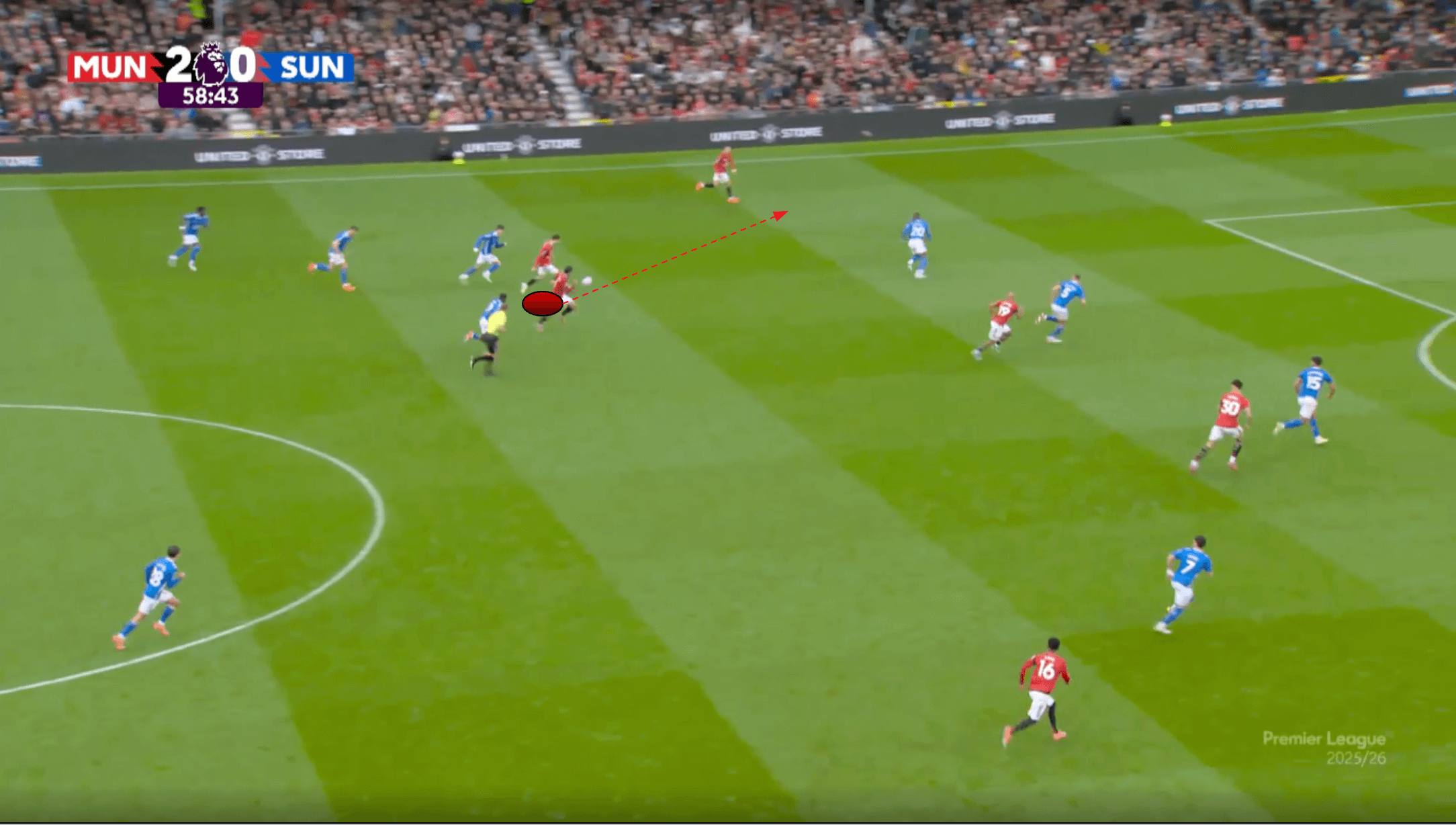
Now, Mount can carry off into space and play a through pass to a runner in the final third.
This shows another key difference between Mount and Cunha.
Mount initially positions himself to receive with his back to goal, drawing players towards him first before exiting into space and then playing a through pass to get his team into the final third.
It’d be more common to find Cunha setting himself up to receive the initial pass while facing forward and attacking some space.
Still, even if he were to receive in a deeper position, he’d look to receive in some space before carrying the ball forward into the final third and either taking it past a defender who approached him or drawing a couple of players towards him there before then looking to play it to a teammate who can take advantage of that space.
So Mount will use his gravity on initial reception, while Cunha will look to use it at the end of his probing carry into a dangerous zone.
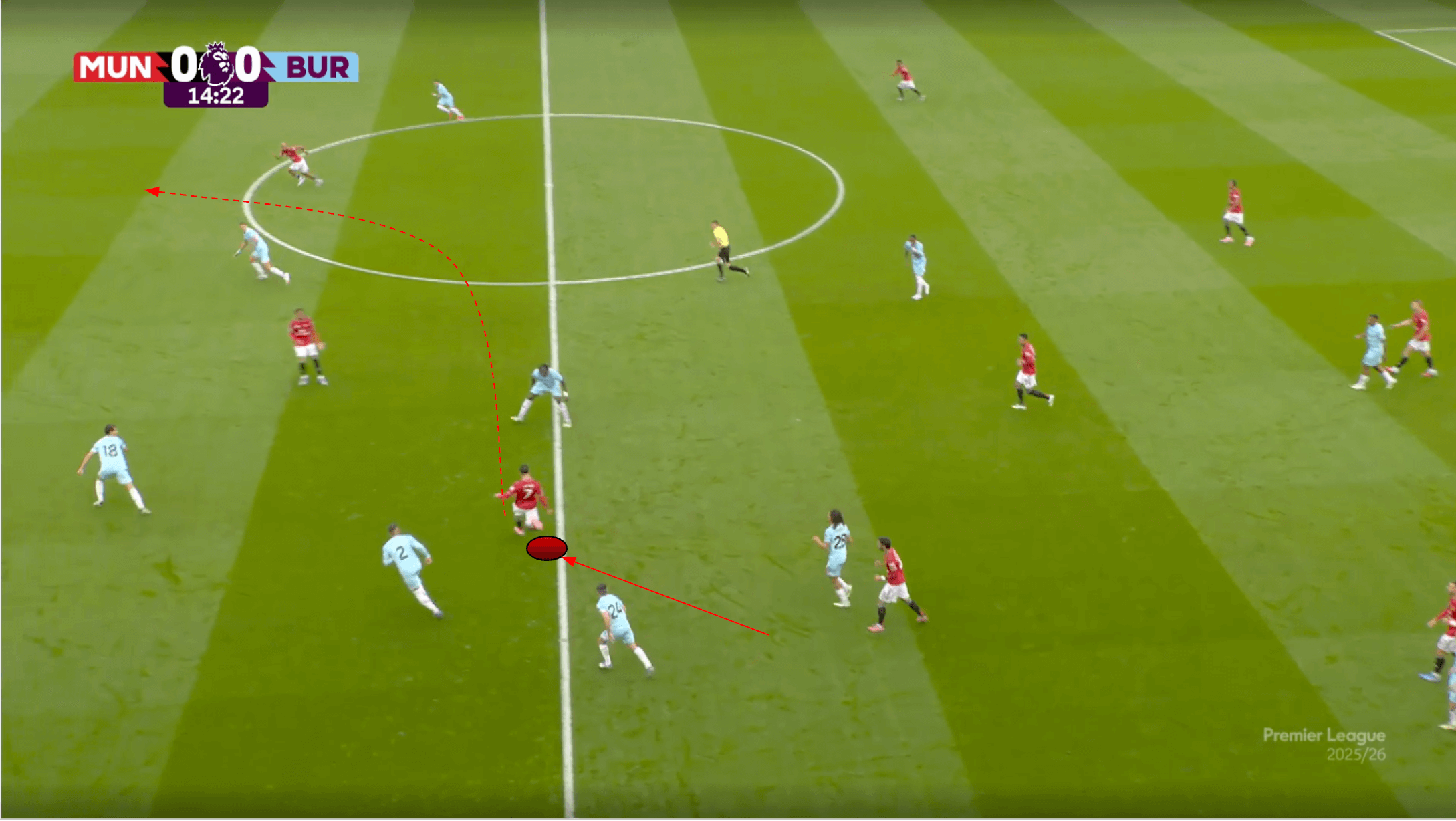
In Figure 10, we see Mount getting his head up and playing a lofted through pass in behind from the middle of the park, even with space ahead of him to potentially attack.
There’s nothing wrong with this decision; it is just another image that highlights a contrast between these two players.
Mount is likely to get his head up earlier and look for progressive passing options, recognising his vision and passing as key playmaking qualities.
Cunha would drive forward into the space himself, here, looking to attract defenders towards him before releasing or moving past them.
Conclusion
Should Manchester United start Mason Mount or Matheus Cunha?
Honestly, context is key when answering that question.
Both are potentially solid options depending on form, who else is in the starting XI, and the opposition.
Mount will likely provide you with more progressive passing and act as a more effective connector between the middle third and final third.
Conversely, Cunha is more direct, trigger-happy, and more of a progressive carrier than a progressive passer.
On one hand, Mount is likely to provide a very good option against low blocks when space is at a premium, going in behind.
A creator who can receive to feet in little pockets of space before picking the lock of an opposition defence to set up a target man like Šeško in valuable goalscoring positions is needed.
At the same time, Cunha’s dynamism could be critical in more transitional games and when space is there to attack in behind.
However, it’s not quite that simple either, and depending on form and confidence, both men could get sustained runs in the starting XI.
At the moment, coming off last week’s win over Sunderland, it feels like Mount is the form player and, thus, deserves to retain his spot for the time being.
However, if his standard drops, he’ll have a very worthy replacement chomping at the bit for his chance to show what he can do in Matheus Cunha.
In essence, Mount suits a positional, possession-oriented approach, while Cunha thrives when United can transition quickly into space.
At the very least, having both men vying for a place in the starting XI gives United welcome competition for places.
