
Xabi Alonso faces a tactical conundrum that strikes at the very heart of Real Madrid’s attacking identity: choosing between two world-class Brazilians who both thrive on the same flank.
Vinícius Júnior and Rodrygo have each built their reputations on dynamic, high-impact performances, yet their best football often comes when deployed on the left wing.
With Alonso’s arrival ushering in a more structured, possession-oriented system, the question of who should occupy that position has become increasingly pressing.
Rodrygo has been deployed on the right side for years under Carlo Ancelotti, a role that has often limited his natural rhythm and reduced his ability to impact the game.
Playing on the opposite flank forced him to adjust his body orientation, carry the ball longer distances, and cut inside more frequently to bring the ball to his stronger right foot, which hindered his instinctive final-third contribution.
However, when given the freedom to operate on the left, his creativity, composure, and direct goal involvement rise sharply.
Vinícius, meanwhile, remains Los Blancos‘ most explosive winger, a specialist in breaking lines and destabilising defensive structures through pace and unpredictability.
With Rodrygo proving just as influential when shifted to Vinícius’s territory, Alonso must determine whether coexistence is possible or whether the tactical balance of the side demands a sacrifice.
This Real Madrid data analysis examines the performances of both players when starting on the left wing, breaking down their attacking and passing metrics to reveal who excels statistically and how each interprets the role tactically within Madrid’s evolving system.
Real Madrid Left-Flank Bias: Analysing Attacking Distribution
Before Xabi Alonso’s arrival, Real Madrid’s attacking structure under Carlo Ancelotti during the 2024/2025 season was heavily weighted towards the left flank, the zone traditionally occupied by Vinícius Júnior.
Statistical breakdowns show that 42.4% of Madrid’s attacking sequences (134 attacks) originated from the left side, compared to just 28.5% through the centre (90 attacks) and 29.1% from the right (92 attacks).
Real Madrid Distribution Of Attacking Chances Created 2024/2025

This asymmetrical pattern reflects not only the tactical preference of Ancelotti’s system but also the influence of Vinícius as the team’s primary outlet for progression, chance creation, and penetration into the final third.
Interestingly, during December and January, when Vinícius was sidelined through injury, Rodrygo was shifted to that very flank, and his performances were remarkably productive.
Across those two months, he contributed to 40% of his total goal involvements for the entire season, registering both goals and assists at a rate far higher than when operating on the right.
His adaptability and efficiency highlighted how Madrid’s left channel naturally amplifies attacking output, regardless of the individual deployed there.
Attacking Efficiency On The Left: Comparing Vinícius & Rodrygo Output On The Left Wing At Real Madrid
When analysing both Vinícius Júnior and Rodrygo’s performances as left wingers throughout their time at Real Madrid, it becomes clear that each embodies an elite attacking profile, though expressed through distinctly different styles influenced by tactical instructions and positional context.
It is essential to note that Rodrygo has played considerably fewer matches on this flank, 181.1 full 90-minute matches compared to Vinícius’s 297.04; his underlying numbers reveal an impressive ability to adapt and deliver within that role.
Rodrygo Vs Vinícius Júnior: Left Wing Performance Comparison
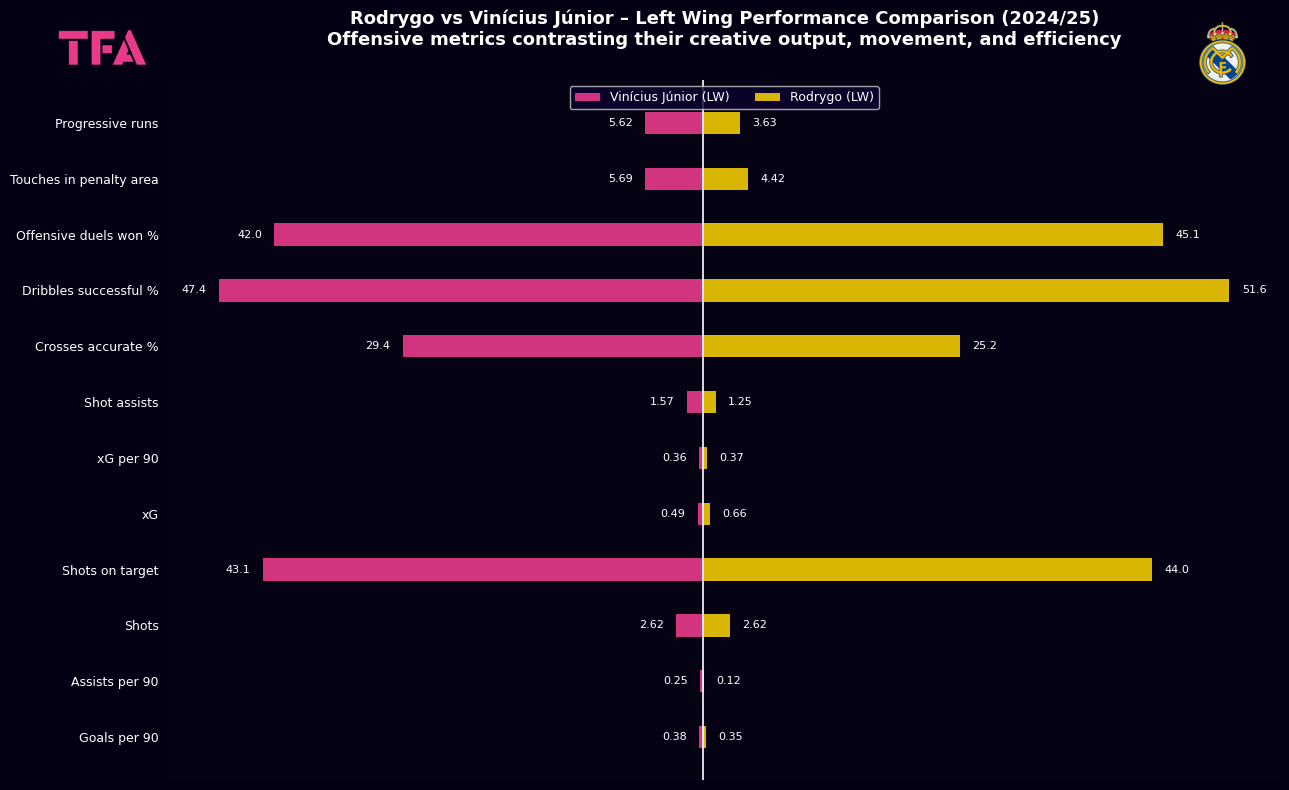
Rodrygo averages 0.35 goals and 0.12 assists per 90 minutes, registering 2.62 shots per match with 44% accuracy and producing an xG of 0.66 per 90.
This efficiency reflects his sharpness in front of goal, particularly when cutting inside onto his stronger right foot.
Moreover, his 51.6% dribble success rate and 45.1% success in offensive duels highlight his technical precision and ability to isolate and beat defenders effectively.
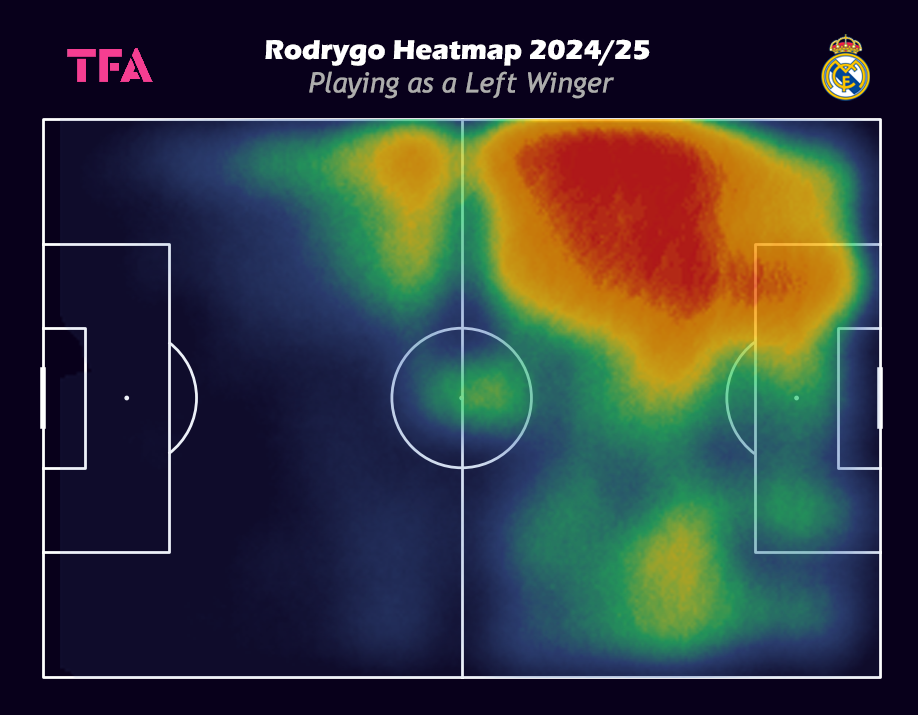
Rodrygo’s heat map strongly supports this analysis, revealing high activity and creativity concentrated in the left half-space and final third.
This further underscores that his most dynamic and productive football emerges when he is positioned on that flank.
Rodrygo Heat Map 2024/2025: Playing As A Left Winger
Vinícius, meanwhile, posts slightly higher attacking returns, with 0.38 goals and 0.25 assists per 90 minutes, showcasing his directness and impact in decisive actions.
His xG of 0.49 and xA of 0.36 per 90 underline his dual threat as both a creator and a finisher.
He delivers 2.7 crosses per game with 29.4% accuracy and remains Madrid’s most consistent wide outlet.
His 47.4% dribble success and 42% offensive duel rate further illustrate his explosive, high-risk style that thrives on pace and constant confrontation.
Their contrast defines balance. Rodrygo offers efficiency and composure, while Vinícius brings chaos and acceleration.
Together, they reflect two modern complementary interpretations of the left-wing role within Real Madrid’s attacking evolution.
Rodrygo 2024/2025 Contributions: Interpreting His Shot Map & Left-Sided Efficiency
Rodrygo’s 2024/2025 campaign offers a fascinating insight into how his natural attacking instincts remain closely tied to the left side of the pitch, even when he is officially deployed elsewhere.
Despite starting only a handful of matches on the left wing, primarily during Vinícius Júnior’s injury spell across December and January, and a few scattered appearances throughout the season, his shooting and xG data clearly highlight a strong left-sided bias.
Of 108 total shots, 39.6% were on target, producing 15 goals, eight of which originated from the left half of the pitch.
Notably, only five of his on-target efforts came from the right flank, his nominal starting position, with the overwhelming majority occurring from central or left-side zones.
Rodrygo Shot Map Locations 2024/2025 In All Competitions
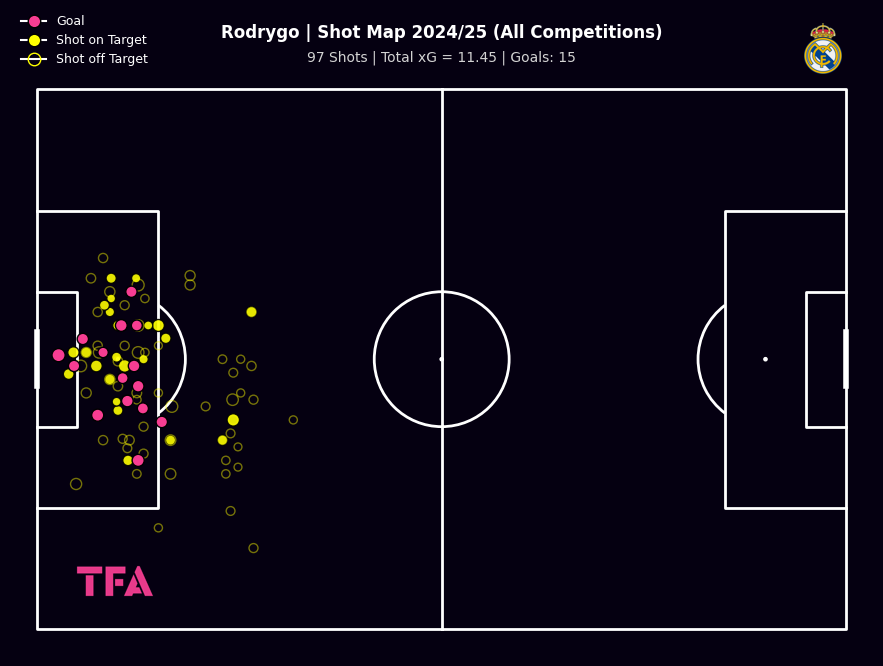
The 2024/2025 shot map perfectly visualises this pattern, showing how Rodrygo consistently drifts inward before striking with his stronger right foot.
This movement naturally aligns with his body orientation and decision-making rhythm.
Tactically, this positioning enhances both his xG quality and his ability to attack high-value spaces between the full-back and centre-back.
It also demonstrates how his instincts and spatial intelligence make him far more dangerous when cutting in from the left or operating within the inside channels.
Even when restricted by role, Rodrygo’s production remains heavily left-oriented, a data-backed testament to his adaptability and his innate suitability for Real Madrid’s left-wing dynamic.
Rodrygo Attacking Carries: Creating Threat & Progression Through Dynamic Ball Movement
Rodrygo’s attacking carries offer one of the clearest illustrations of his offensive intelligence and spatial awareness, as well as his ability to progress the ball with intent and transform movement into a tangible end-product.
In modern tactical systems, attacking carries that end in either a shot or a chance created are a vital indicator of direct involvement in final-third actions, reflecting a player’s capacity to break lines, manipulate defenders, and generate momentum.
For Rodrygo, this metric encapsulates his dual identity as a dribbler and a playmaker.
He is capable of accelerating through tight spaces while maintaining control and vision in the most crowded zones of the pitch.
As shown below, across the 2024/2025 season, Rodrygo completed 28 attacking carries that directly led to decisive outcomes.
Of these, 10 carries culminated in shots, producing three goals, notably, two of which came from the left side, an area he only occasionally occupied due to limited appearances in that role.
Rodrygo Shot-Creating Carries Real Madrid 2024/2025 Season
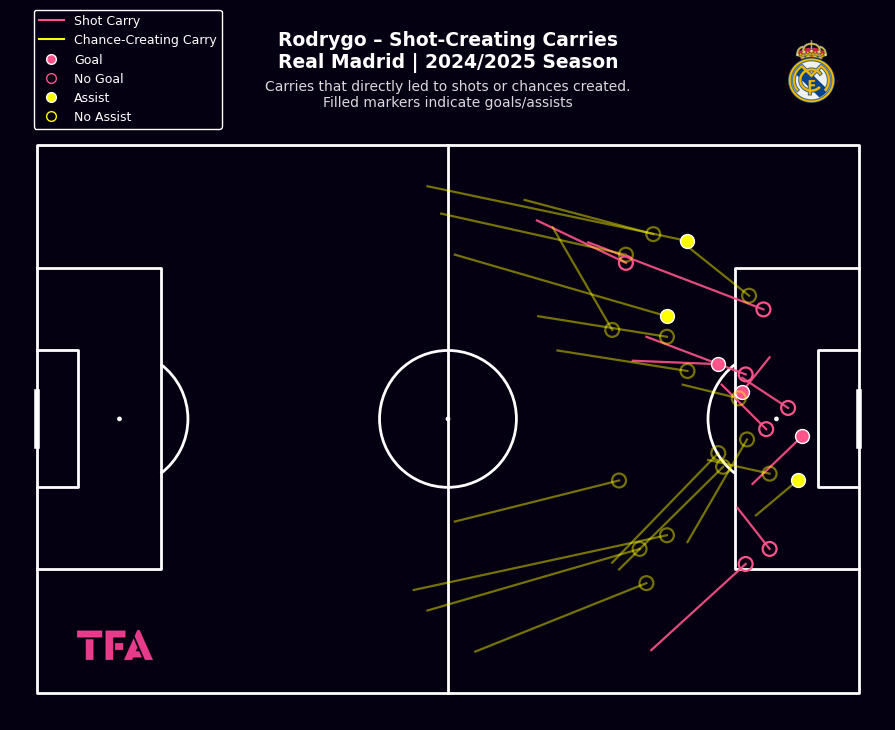
His tendency to cut inside before finishing on his stronger right foot was evident in these sequences, with seven of those shots originating from the left flank.
Meanwhile, 18 attacking carries resulted in key passes, generating three assists, all from the same left-sided channel.
The Rodrygo attacking carries map 2024/2025 vividly visualises this pattern, showing how his most productive movements emerge when operating in the inside-left corridor.
Despite not being his primary position, the data highlights that Rodrygo’s ability to drive the ball forward and convert progression into an end product is most dangerous when initiated from the left, reaffirming his natural alignment with Real Madrid’s most influential attacking zone.
This observation inevitably reignites the debate surrounding his rightful place in the starting lineup, particularly whether his dynamism, ball-carrying, and spatial awareness make him more deserving of the left-wing role permanently.
Given how his presence in that channel amplifies Madrid’s attacking fluidity and complements the movements of the striker, the argument for Rodrygo to be deployed as the team’s primary left winger becomes increasingly compelling.
Vinícius Júnior: The Irreplaceable Engine Of Real Madrid Left Wing
Vinícius Júnior remains the immovable force on Real Madrid’s left wing, not merely because of his extraordinary attacking output, but because of the rare tactical profile he offers within elite football.
His 2023/2024 campaign, in which he finished as a close contender for the Ballon d’Or but lost narrowly to Rodri, perfectly encapsulated his evolution from a raw, explosive winger into a world-class game-changer.
The Brazilian’s consistency, directness, and sheer attacking volume have made that flank his territory, setting a near-impossible benchmark for Rodrygo to displace.
While Rodrygo’s contributions on the left are statistically impressive and tactically refined, Vinícius offers something almost irreplaceable: the ability to carry the ball over immense distances, bypassing entire defensive blocks on his own.
Tactically, this trait transforms Madrid’s left side into both a creative and transitional engine.
As shown below, in the 5–2 win against Borussia Dortmund on 20 October 2024, Vinícius demonstrated precisely why he is indispensable.
Within ten seconds, he received the ball from Jude Bellingham near Madrid’s own box, surged past three pressing lines, and finished clinically.
Real Madrid Build-Up To Vinícius Júnior Goal Vs Borussia Dortmund
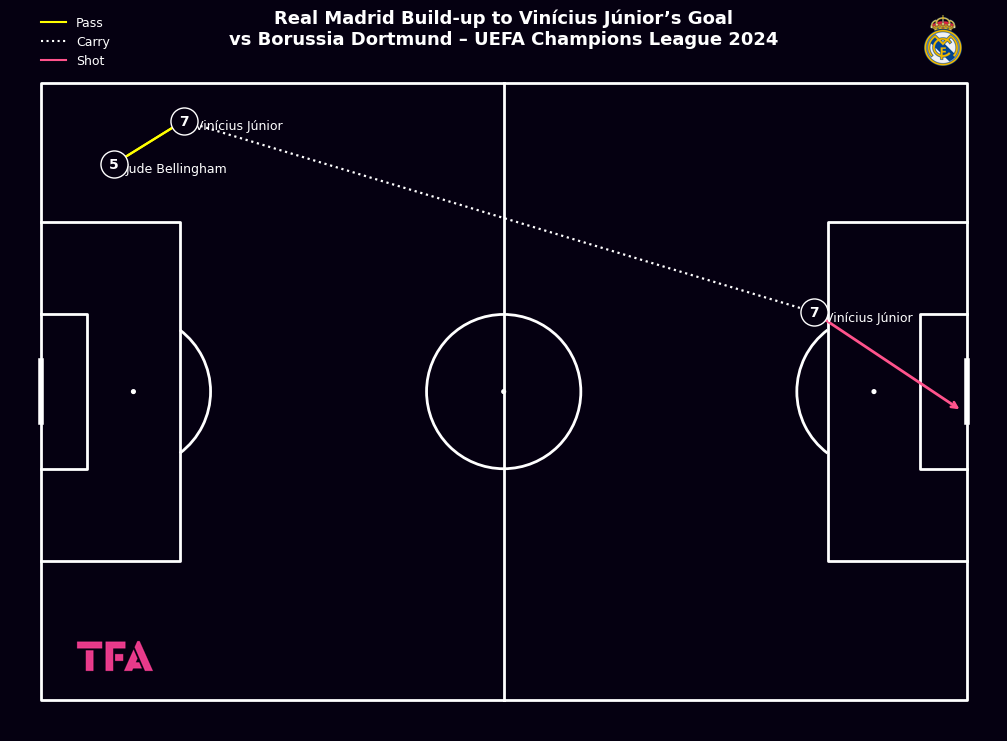
Such sequences redefine how Real Madrid breaks pressure and transition into attack, explaining why Xabi Alonso favours Vinícius as the primary left winger.
His capacity to generate progression single-handedly, a quality shared only with Lamine Yamal in Europe, gives Madrid verticality and unpredictability that even a technically gifted Rodrygo cannot replicate.
Defensive Responsibilities On The Left: Comparing Rodrygo & Vinícius Júnior Without The Ball
While both Brazilians are widely celebrated for their attacking brilliance, their defensive contributions when deployed on the left wing reveal equally telling tactical nuances.
Across their Real Madrid 2024/2025 season, the data adjusted per 90 minutes suggests that Rodrygo offers slightly greater defensive discipline and efficiency in specific areas, particularly in duels and recoveries within the opposition half.
Rodrygo Vs Vinícius Júnior: Left Wing Defensive Comparison
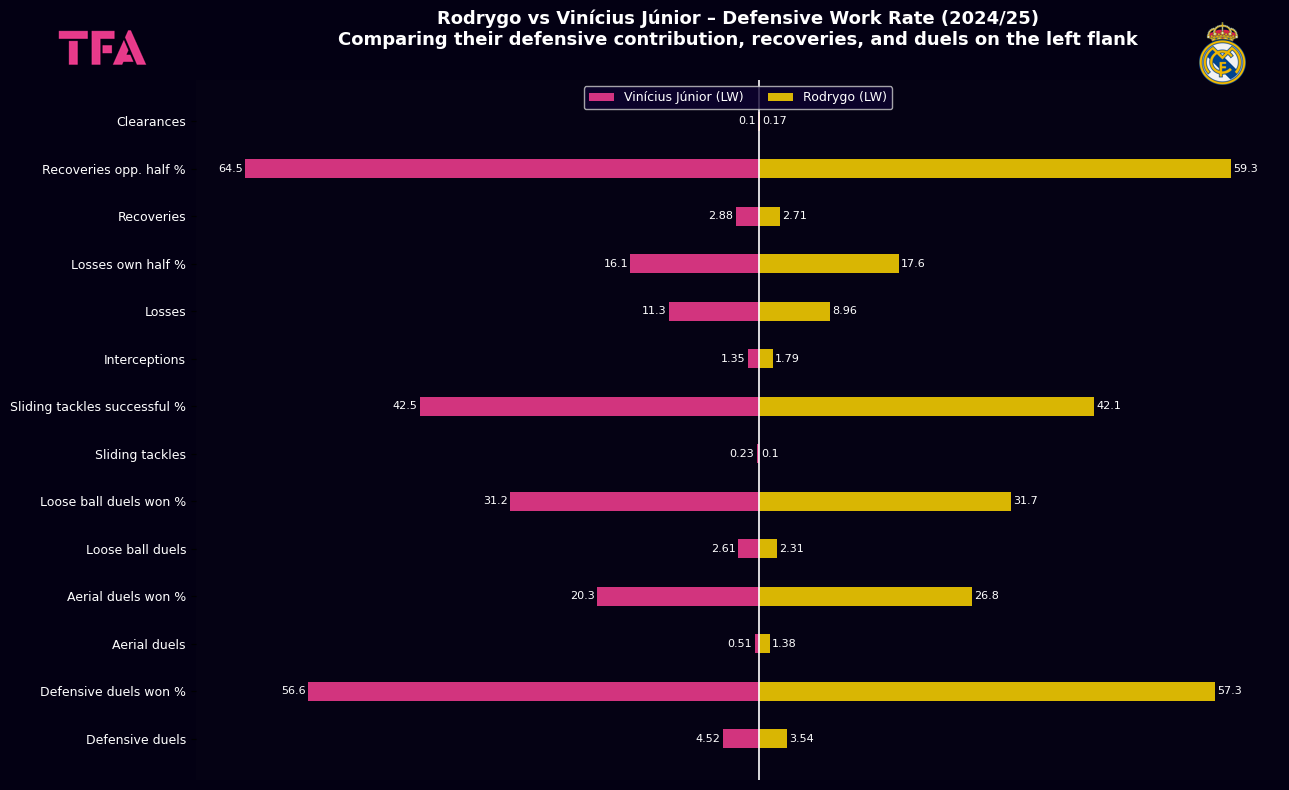
Rodrygo averages 3.54 defensive duels per 90 with a 57.3% success rate, numbers that underline his active engagement in defensive transitions and pressing actions.
This edge, though marginal, reflects his instinct to close down quickly and support his full-back in regaining possession, especially in high-press scenarios.
His 1.79 interceptions per 90 also demonstrate sharper anticipation when stepping into passing lanes, a quality that complements Madrid’s structured pressing approach under Xabi Alonso.
Perhaps most tellingly, his 59.3% recovery rate in the opposition half highlights his aggression and counterpressing awareness, crucial traits for a possession-oriented system that thrives on immediate ball recovery.
Vinícius, by contrast, contributes more through his intensity in retreat and direct defensive duels (4.52 per 90); his slightly lower recovery impact in advanced zones suggests a greater focus on positioning for transition rather than regaining possession.
This distinction matters tactically. Rodrygo’s compactness, anticipation, and pressing triggers provide defensive balance, particularly when Madrid face teams that build through wide overloads.
Though often overshadowed by his attacking flair, his defensive maturity subtly strengthens Madrid’s left side by linking recovery efforts with rapid attacking transitions, a quite significant dimension of his overall contribution.
Conclusion
The data paints a clear picture: Rodrygo’s best performances consistently arise when operating on the left, where his attacking carries, shooting patterns, and chance creation reach their peak.
Removing Vinícius from that role risks diluting Madrid’s most explosive transition weapon.
Alonso’s possession-oriented philosophy adds another layer of complexity, as maintaining both creative rhythm and defensive compactness on that flank requires more than just individual brilliance.
Ultimately, the challenge for Alonso in 2025/2026 lies not in choosing between the two Brazilians but in engineering coexistence without compromise.
Whether that means rotating based on opposition dynamics or reshaping Madrid’s attacking width altogether, his tactical evolution will define how successfully Real Madrid balance creativity, control, and chaos.
The left flank, long dominated by Vinícius, may yet become the battleground that shapes Alonso’s Madrid, a side still searching for equilibrium between flair and structure.
