
El Derbi Madrileño is always a massive story in the Spanish capital, and it was not different this past weekend when Atlético Madrid hosted Real Madrid for the first derby in La Liga this season.
For Atlético Madrid, the season didn’t get off to the greatest start.
After six games, long-time coach Diego Simeone and his team were stuck in the midfield of La Liga, only winning two of their games so far.
Los Rojiblancos also lost only one game, but they have drawn three games already.
They are looking for a way forward after a heartbreaking loss in stoppage time in the UEFA Champions League against Liverpool.
Real Madrid, on the other hand, are off to a great start under newly appointed manager and former midfielder Xabi Alonso.
Alonso has his team play inspired football, winning six games straight to start the season, which meant that Real were the favourites going into the week.
After both teams won their games during the week, it ought to be a spectacle anyhow, and the first real obstacle for Real this season.
In the end, Atlético won convincingly 5-2, being the better team for the majority of the game despite trailing 1-2 during the first half.
Simeone knew what his team had to do to hurt the new Real Madrid, and Atlético Madrid showcased why they are arguably the most obnoxious team to play against in world football.
In this tactical analysis, we will take a look at the tactics used by Diego Simeone and Xabi Alonso, how Atlético managed to hold off Rea,l and why the game unfolded the way it did.
Atlético Madrid Trying To Punish Real In The Box
Going into the game, Real were the team in better form.
However, as we all know, Atlético Madrid, under Diego Simeone management, love to be the underdog in these games, and they showed that they were ready to accept the role of the challenger even in a home game.
Simeone had a clear tactical plan to hurt Real in this game, knowing how they love to play in their backline and recognizing that Alonso loves to play with Dean Huijsen and Eder Militao in the centre of that line, he knew that they could exploit Real in the box.
While both Real Madrid’s centre-backs are good players, they lack physicality in the air.
Looking at what Simeone wants his players to look like, Atlético had the advantage in the air after crosses and utilised that heavily in this game.
The Argentinian decided to start Alexander Sørloth next to Julián Alvarez in attack this game.
With his impressive height of 1.95m and his strength and aerial ability, this proved crucial for Atlético Madrid.

Atlético never made a huge fuss about what they wanted to do in attack against Real Madrid, but it was still extremely difficult for their rival to defend against.
Simeone had his men play through the wings, always overloading the sides with one of the midfielders in their 4-4-2 formation.
Naturally, with a full-back, a winger on the sides, and one additional midfielder, Atlético Madrid were able to overload their flanks easily and managed to drag out the Real midfield more often than Alonso liked on Saturday.
With their three players on the wing, Simeone created a simple triangle and freed one man up through simple passing; then they simply crossed the ball into the box.
In the box, there were always the two strikers as well as the far-sided winger, pushing the Real backline into their own box and establishing a nice presence at the far post.
So, despite having a numerical advantage, Real’s defenders were forced into a passive position while defending.
From there on, Atlético played it rather simply.
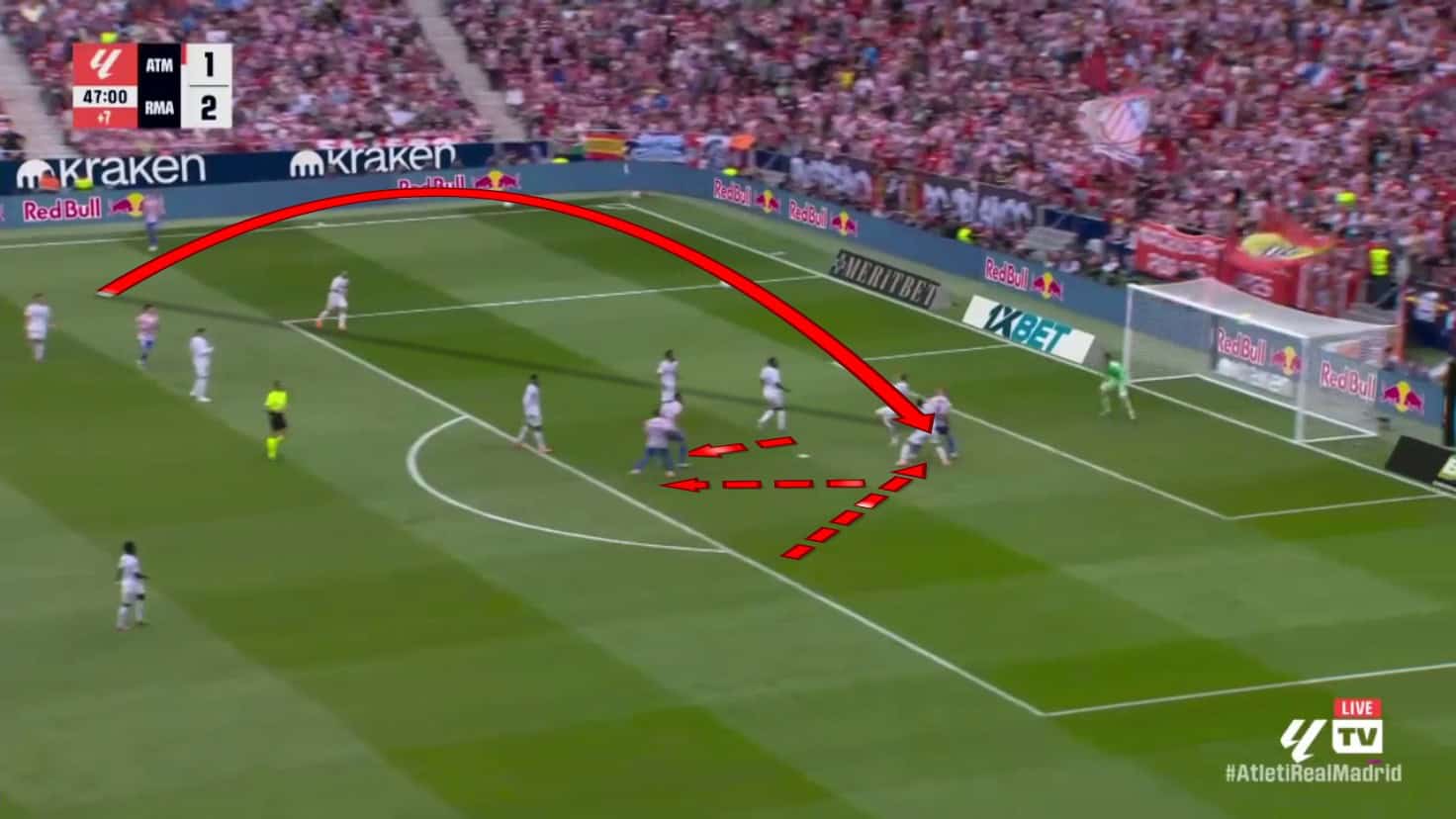
They always crossed the ball on the far post, right in the gap between Real’s far-sided centre-half and the far-sided full-back.
Alvarez and the other player in the box moved backwards to the edge of the area, which dragged out one centre-back and put them in a prime position to collect second balls.
The Norwegian striker, however, moved right into the gap in front of the full-back and used his body to jump into the centre-back; neither Militao nor Huijsen were able to really hold their own against this.
In this situation, Atlético Madrid managed to get the equaliser just seconds before the game went into half-time, changing the outlook of the contest.
Atlético Madrid Play Through The Wings
To get to the point of crossing the ball in like that, Atlético Madrid needed to play through their wings, and Simeone had his men do so in a very efficient manner.
Real dominated possession throughout the game, which was expected since Xabi Alonso style of play is typically very dependent on maintaining possession.
However, when Atlético had the ball, they were dangerous at almost all times because they knew exactly where they wanted to play through, which spaces they had an advantage in, and how they wanted to hurt Real.
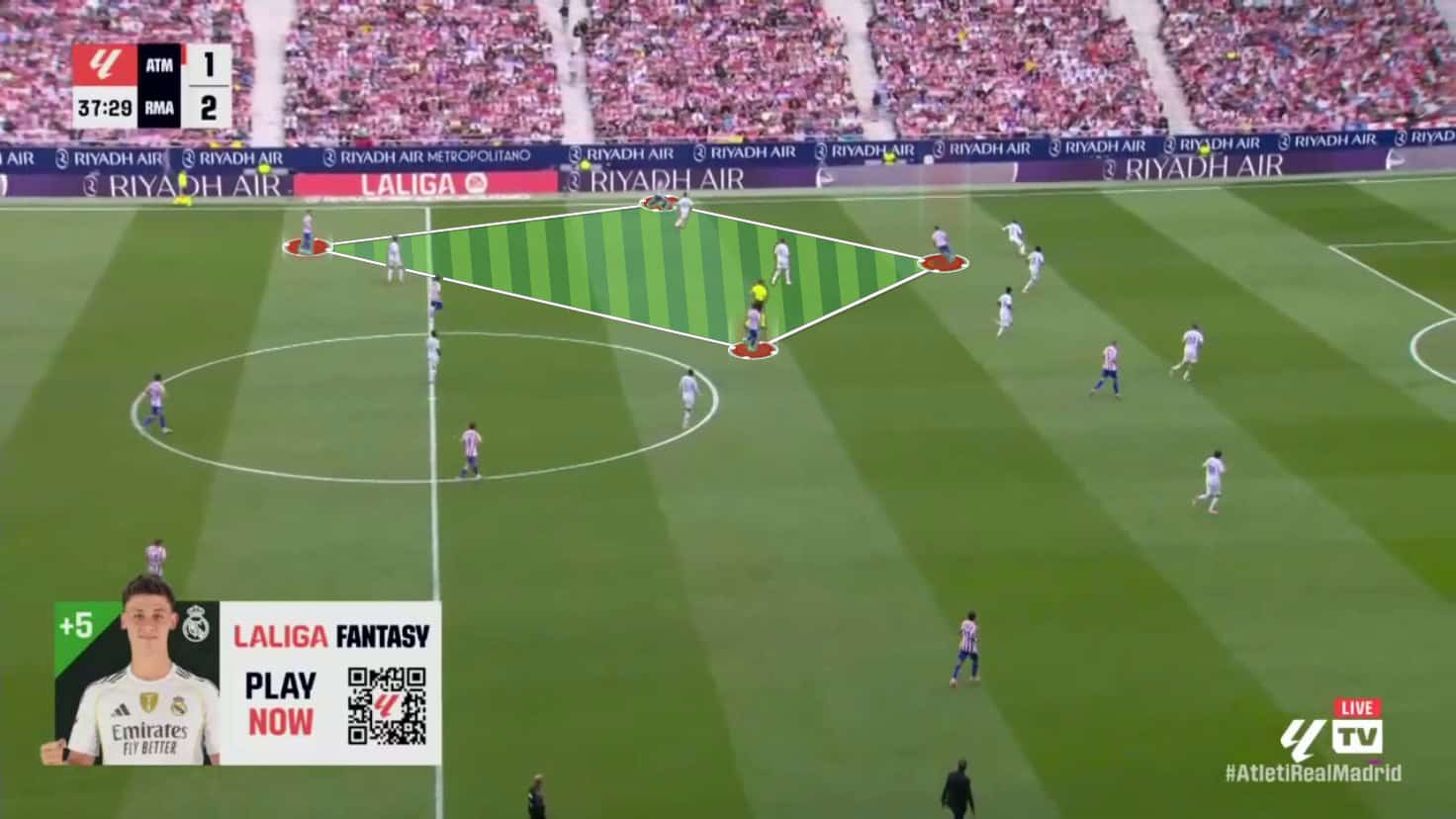
Once again, the start of it all was rather simple: They played the ball to their centre-back, and he started dribbling forward, often already crossing into the Real half or at least breaking the first line of pressure by just running past the lone striker in Alonso’s 4-3-3 formation.
After they got past the striker, they started to create big diamonds on the wing with their wingers pushing inwards, the full-backs pushing high up the field near the sideline, and Alvarez dropping back out of the attacking line to be the tip of the diamond.
From there on out, they always had options to pass the ball forward.
They were able to completely control the wings and stretch out the effective playing space, forcing a usually very narrow Real midfield into wider positions than they are accustomed to defending.
Atlético managed to find a solution to involve Alvarez frequently in this game, and with the striker’s form in the last matches, Real had a huge problem containing him.
What was interesting to see was their movement off the ball.
By creating bigger diamonds instead of keeping the distances short, Simeone allowed his team to move into spaces instead of just occupying them, giving them a huge advantage and the possibility to create tempo out of pretty much thin air at times, preventing Atlético from getting stuck in the half of Real Madrid with no options to attack.
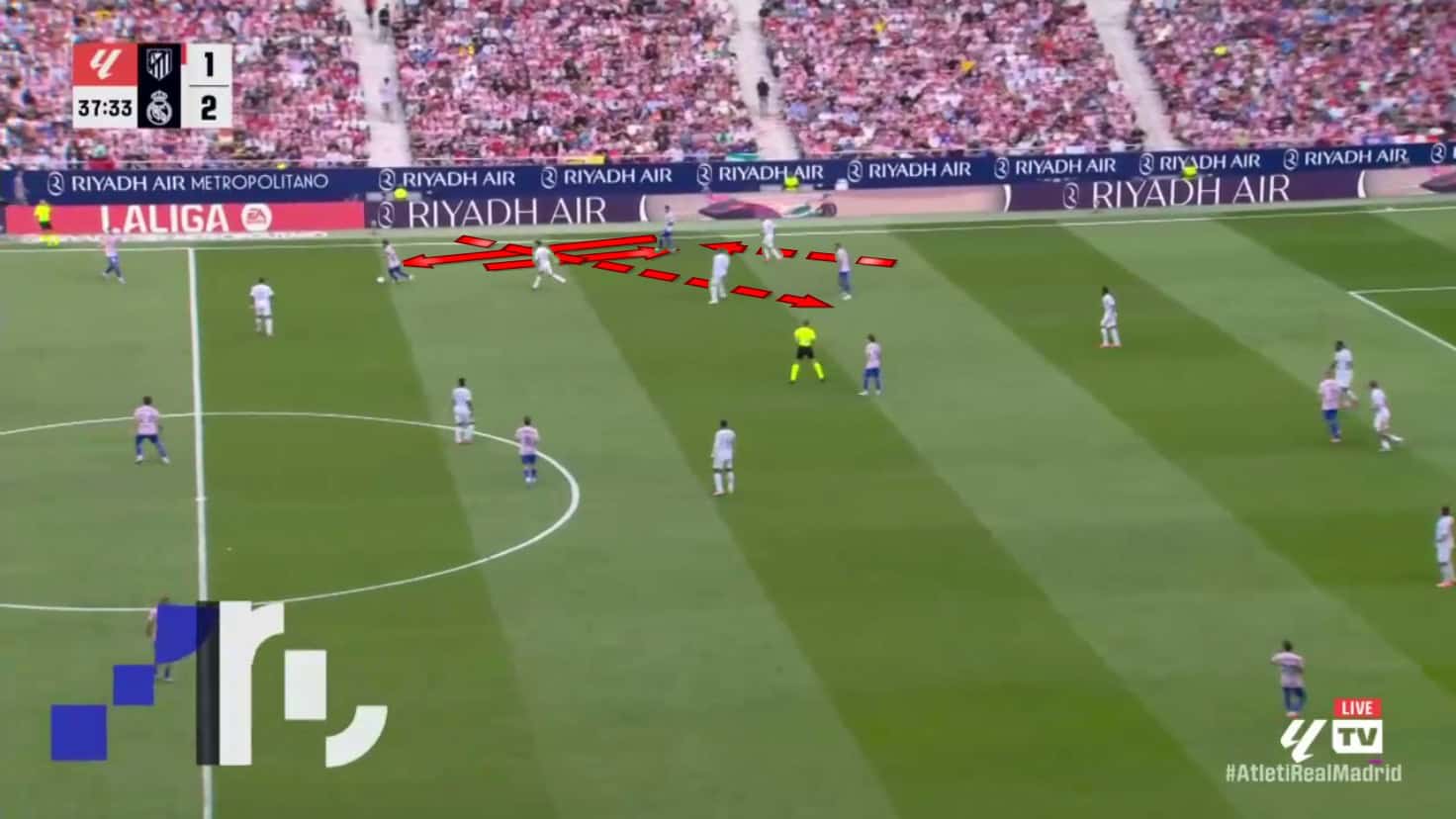
Often, they played the ball to the player near the sideline, but then the other players moved in opposing directions.
Alonso had his men play a man-marking system in these situations, and with those movements, Simeone was able to create a lot of chaos in terms of assignments for Real.
This allowed Atlético Madrid to find many through passes and open space on the wings, forcing their cross-heavy playstyle onto Xabi Alonso’s team for the entire game.
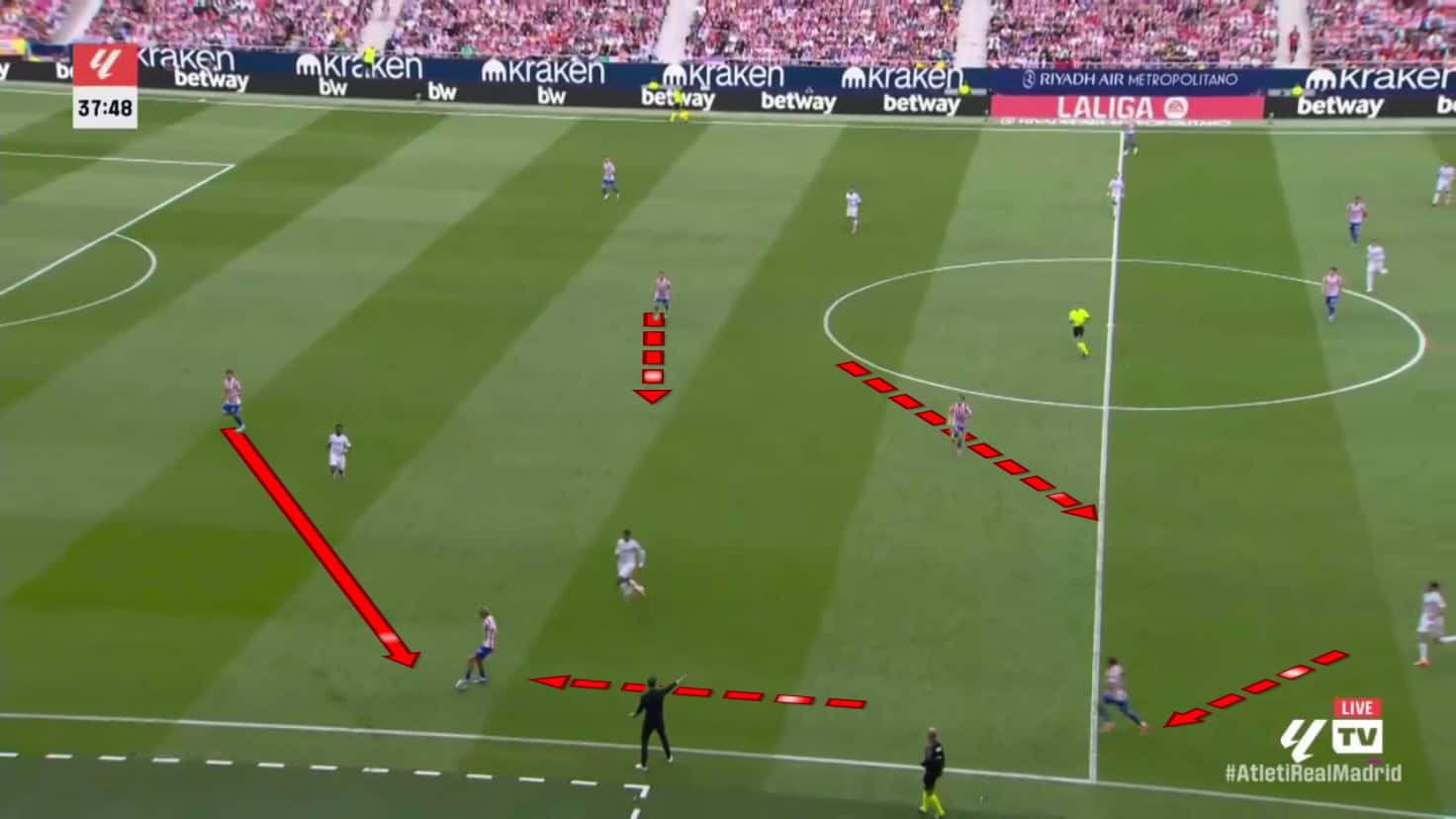
When Simeone’s team was not able to find progressive passing options, they often opted to switch play through their backline.
With their very wide shape, Real’s strikers and midfielders were forced to cover a great deal of distance.
With their aggression, they were still too trigger-happy with their pressing attempts in these situations, and Atlético could take advantage of that.
Often, Real pressed the pass to the full-back in these situations, but Simeone moved both players on the wing backwards, forcing Real to follow suit and overloading the wings as well.
This opened up a lot of space in midfield that the double pivot of Atlético Madrid were able to move into.
They moved a bit, opposed to and delayed each other, and therefore Real were never able to put real pressure on the backline.
This opened up numerous opportunities for Atlético Madrid.
As we can see in the picture above, they were able to play through the first line of press rather easily and from then on were in complete control of the centre of the field, with three players being wide open in this situation.
But in the end, Simeone had a clear plan, which led Atlético to refuse playing through the middle; they quickly switched play back to the far-sided winger, getting into a position to cross.
Atlético created numerous opportunities in this manner, as Real simply ran into a void while pressing, committing many men forward, but without having anything to show for it.
Real Struggles Against The Deep Block
In the end, Real were overwhelmed for the majority of the game, but still managed to stay in it through their individual class.
Despite not having anything going on for themselves throughout the first half of the game, they still managed to go up 2-1. The first goal was pure class by Kylian Mbappé, using his pace and finishing, and the second goal was created by Vinícius Júnior.
Arda Güler finished off the second attack from Real to go up.
However, these two goals were the only shots on target that Alonso’s men had in the entire game.
Atlético Madrid, on the other hand, created multiple good opportunities.
They dominated in the air, scoring two goals in the first half off crosses.
Then, after half-time, Julián Alvarez scored a penalty and a world-class free kick to put Atlético up two goals.
This forced Real to have even more possession and try to get back into the game by scoring a goal somehow, but Alonso’s men had no idea how to break through the deep block that Simeone had created.
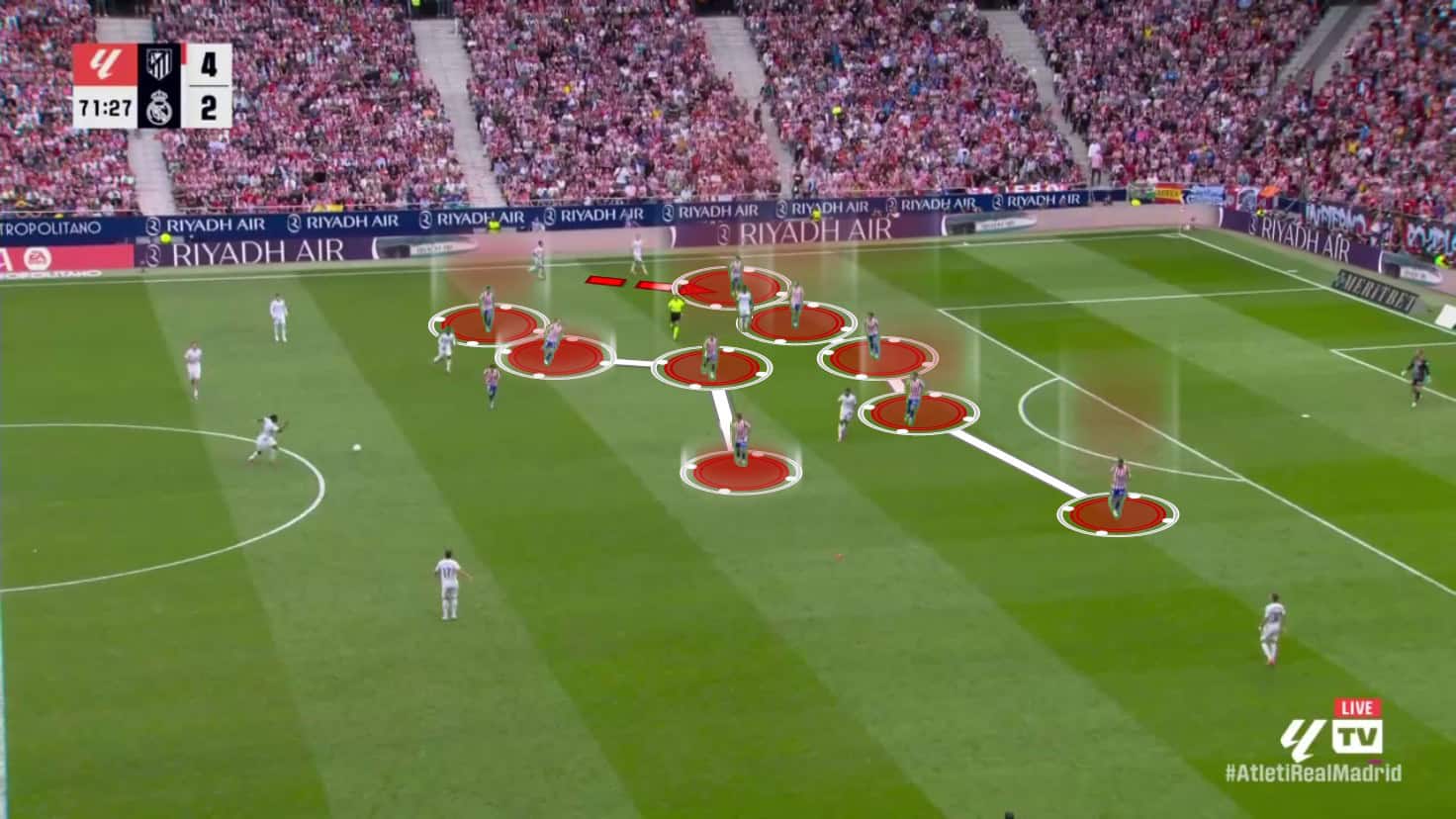
In the later phases of the game, Simeone often opted for a 5-4-1 shape, dropping Giuliano Simeone from the midfield into the backline, creating a back five to control the Real attackers, plus one.
They especially controlled the centre of the field, never really shifting their backline to one side.
They allowed isolated 1-v-1s on the wing but never committed out of their basic defensive shape, therefore taking Alonso’s attackers out of the game in the most crucial areas.
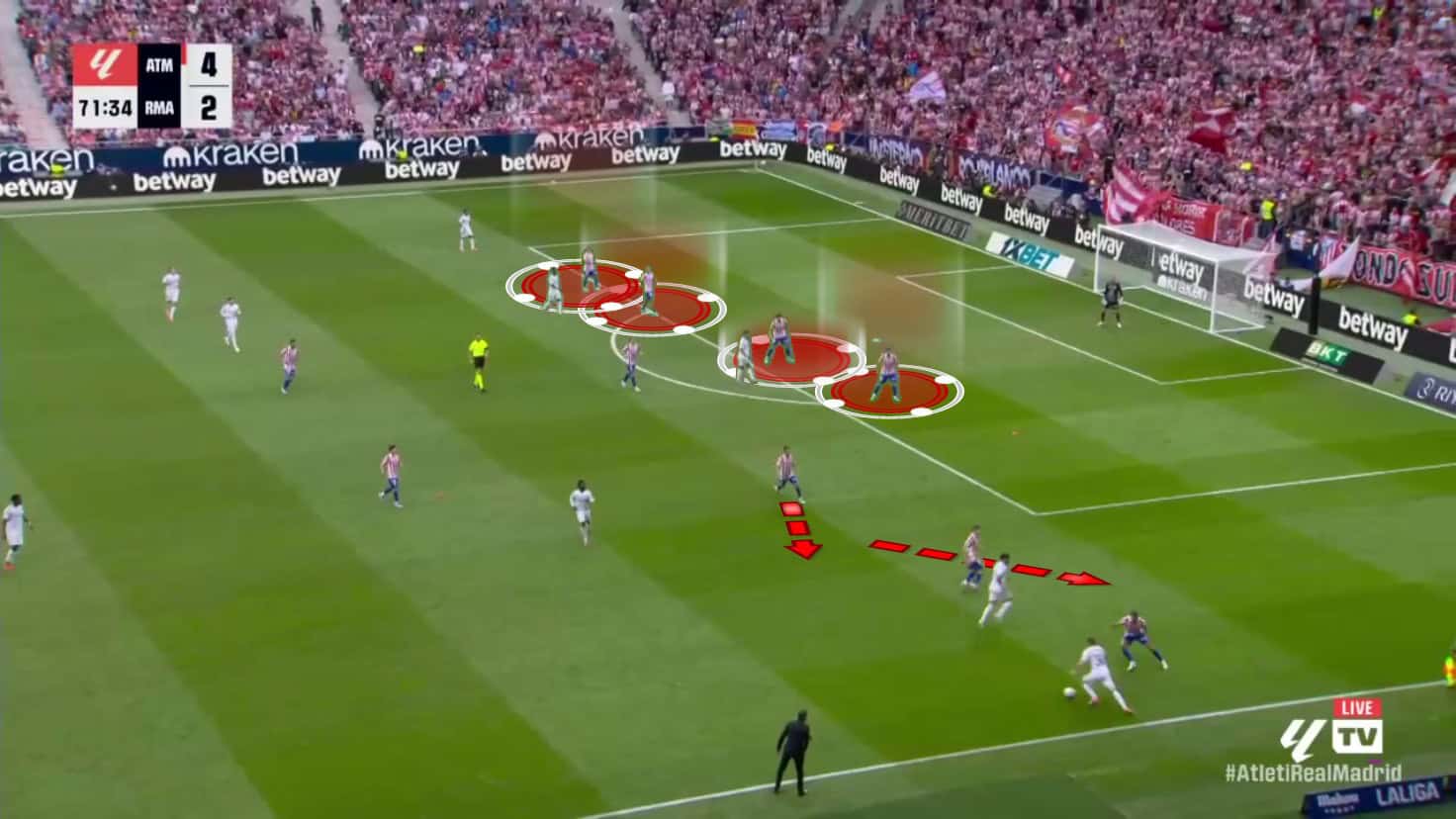
When Real tried to play through their wings, the four midfielders helped out the full-back, while the other four defenders stayed put in the box, ready to defend crosses into the centre of the field.
The midfielders covered the runs behind the full-back, effectively preventing Real from exploiting the space they managed to create and often forcing them into backwards passes.
Even excluding these tactical measures, Atlético’s players defended with high intensity and a clear plan, holding Real Madrid off for the entire second half and, in the end, even scoring a fifth on a counter.
Conclusion
Xabi Alonso’s tenure at Real Madrid was off to a good start, but as seen in the FIFA Club World Cup, when playing against really good teams, his playing style is not yet fully implemented in this Real Madrid squad, and it costs them.
Despite controlling possession, they were only occasionally able to create opportunities against a good defence.
Even when they were up, it never felt like they were the better team in this game.
For Atlético Madrid, the game was a much-needed turnaround after a rough start to the season.
Diego Simeone once again proved himself to be a tactical mastermind.
His team will always possess this dangerous underdog mentality, which makes them incredibly hard to play against in big games.
Looking at their problems so far, they have done well with less possession and control of the game, but when facing off against smaller sides, they still have a lot of work to do.
