
Barcelona hosted Real Sociedad in matchday seven of the 2025/2026 La Liga season, which ended in a narrow 2-1 victory for the Catalans.
With yet another domestic game where they had over 70% ball possession (75%), it was no surprise that Sociedad struggled to create opportunities and generated just a handful of chances.
The visitors were the ones to open the scoring from a counter-attacking situation at the half-hour mark.
However, it took the defending champions less than 15 minutes to get back on level terms through a corner.
Although the Blaugrana got the lead at the hour mark, they had spells of discomfort as Sociedad inflicted some pain in transition.
Through this tactical analysis, we aim to understand how Hansi Flick Barcelona penetrated Real Sociedad’s defensive structure and the ways Sociedad caused trouble for the Catalans.
Barcelona Vs Real Sociedad Lineups & Formations
Let’s examine how Hansi Flick and Sergio Francisco selected their squads.

Barcelona Lineup Vs Real Sociedad
The winners, Barcelona, played in a 4-2-3-1 formation.
Wojciech Szczęsny started in goal, behind a back four of Jules Koundé (right-back), skipper Ronald Araújo (right centre-back), Andreas Christensen (left centre-back), and Gerard Martín (left-back).
Martín came off for Eric García after 78 minutes.
Frenkie De Jong and Pedri played as the pivots.
The latter was subbed off for Marc Casadó after 90’+5.
The front four comprised Roony Bardghji (right-winger), Dro Fernández (centre attacking midfielder), Marcus Rashford (left-winger), and Robert Lewandowski (striker).
Dani Olmo came on for Fernández in the 46th minute, Bardghji was replaced by Lamine Yamal after 58 minutes, and Rashford made way for Ferran Torres on the 78th minute mark.
Real Sociedad Lineup Vs Barcelona
The visitors, Real Sociedad, played in a 4-1-4-1 formation.
Álex Remiro played between the sticks.
The back four had Álvaro Odriozola (right-back), Igor Zubeldia (right centre-back), Duje Ćaleta-Car (left centre-back), and Aihen Muñoz (left-back).
Sergio Gómez replaced Odriozola after 57 minutes.
Jon Gorrotxategi played as the single pivot.
Gonçalo Guedes (right-winger) and Ander Barrenetxea (left-winger) played in the wide areas; meanwhile, Pablo Marín and Beñat Turrientes played as the attacking midfielders.
Guedes was replaced by Takefusa Kubo (57′), Carlos Soler came on for Turrientes (66′), Marín made way for Brais Méndes (67′), and Barrenetxea was subbed off for Umar Sadiq (81′)
Captain Mikel Oyarzabal played as the lone striker.
Barcelona Attacking Tactics
In this section, we will look at the attacking features of Barcelona’s play.
Barca Build-Up & Ball Progression
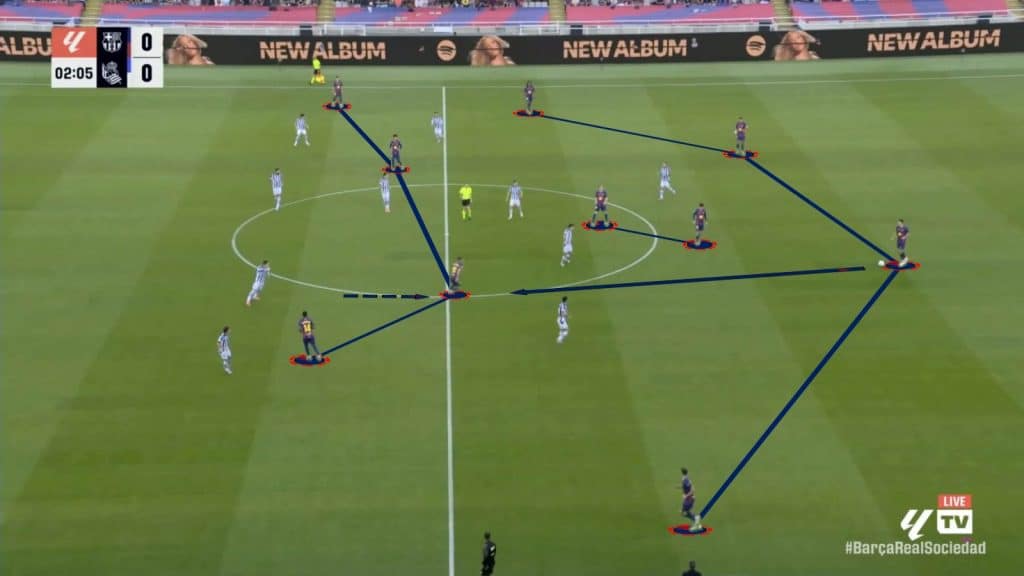
As the hosts played in a 4-2-3-1 formation, they typically adopted a 4-2-4 shape during the build-up and ball progression phases.
The striker (Robert Lewandowski) and the centre attacking midfielder (Dro Fernández) occupied the central channel.
Meanwhile, the wingers (Marcus Rashford and Roony Bardghji) occupied the half-spaces when the full-backs were in the wide channels.
The 4-2-4 shape is visible in the image above.
Lewandowski can be seen dropping to receive a vertical pass from Christensen.
Their principle of making the pitch as big as possible in possession made it difficult for the visitors to dispossess them by pressing high.
However, there were a few moments where Sociedad committed numbers up the pitch.
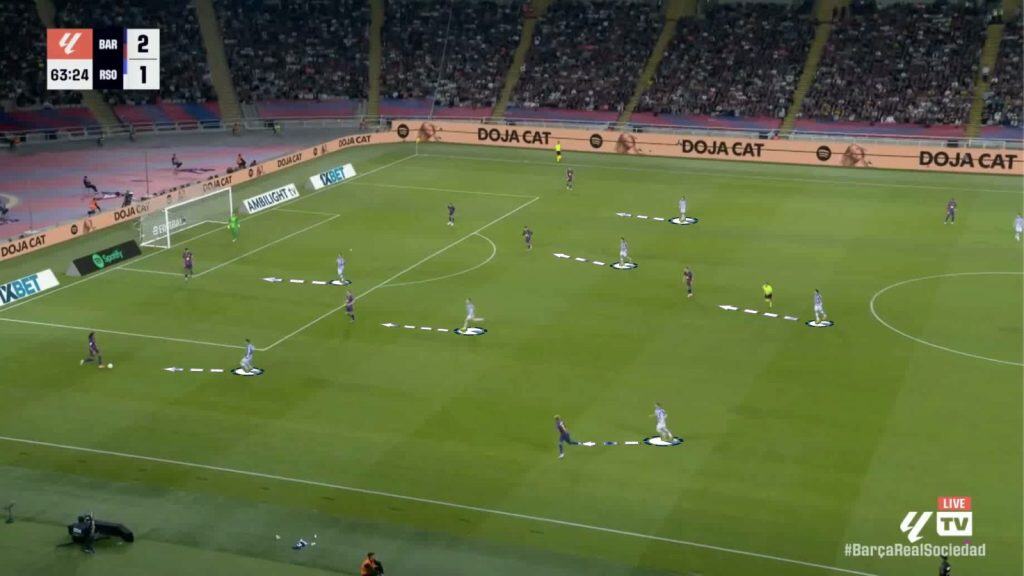
This was the case especially after Barça took the lead.
In the image here, Sociedad are in a high-press situation.
The idea behind it was to force the hosts into playing long.
However, Flick’s side were adept at finding space either around or through the lines of pressure.
It was textbook for the Catalans to break the first line of pressure, even inside their own defensive third.
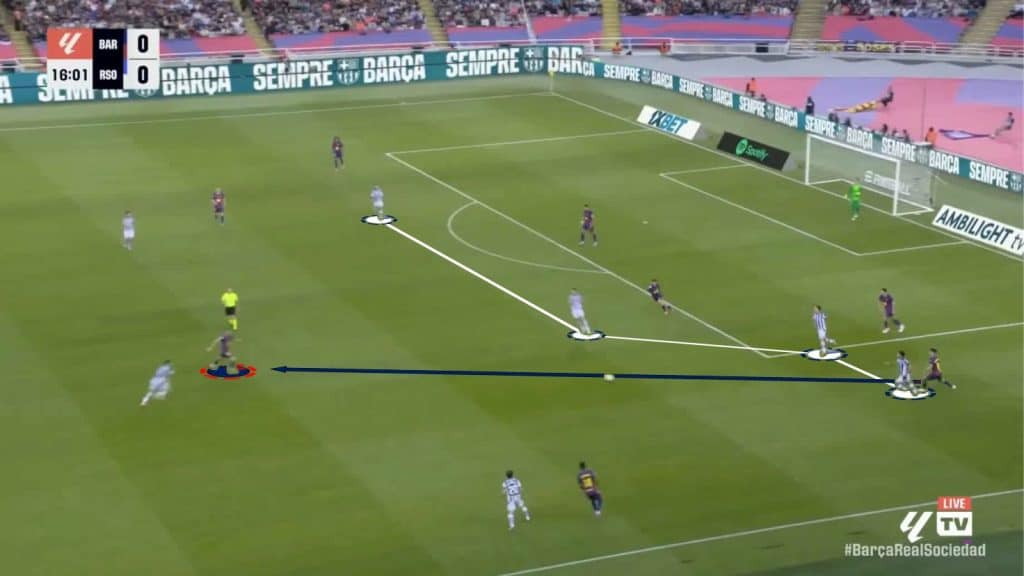
Here is an example of Barça playing through the press.
Gerard Martín takes a touch infield and finds Lewandowski, who is dropping into the midfield.
The Pole eventually gets fouled, and Barça regain possession.
When progressing in the midfield third, Barça attempted to involve their pivots to the maximum.
The visitors recognised this and decided to stay tight with De Jong and Pedri.
Their 4-1-4-1 defensive structure helped do so, as the two attacking midfielders could stay close to Barcelona’s midfield duo.
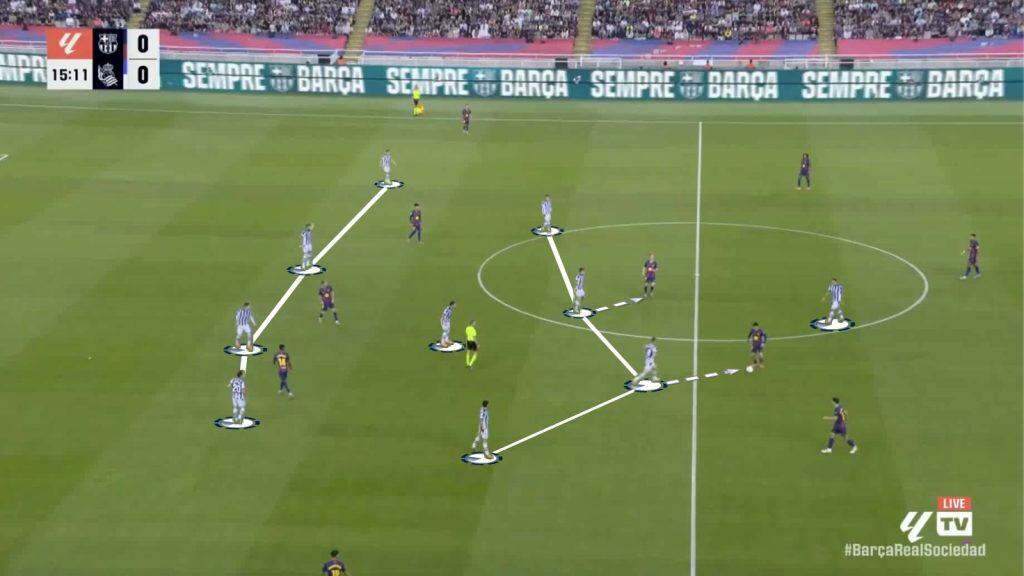
Here is an example: Pedri and De Jong are closely followed by Real Sociedad’s attacking midfielders.
This created a problem for the league leaders as they were forced to play wide.
However, the duo did not take long to find solutions.
Frenkie De Jong was often seen drifting wide to gain more space and time on the ball.
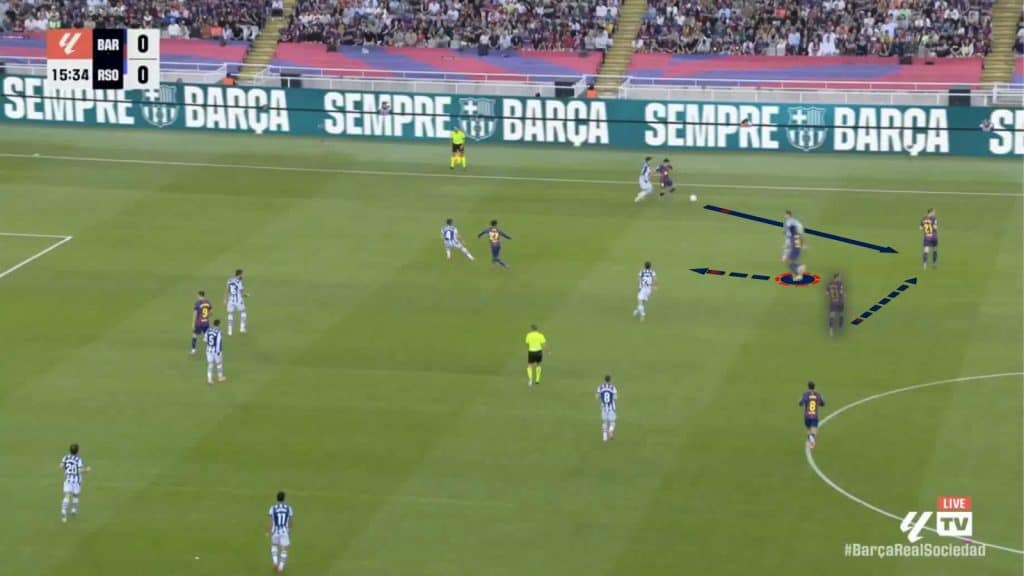
Here is an example of the same.
The ball is played to the winger; Jules Koundé starts moving up, dragging a defender with him.
This opens space for the Dutch midfielder to slide across and get on the ball.
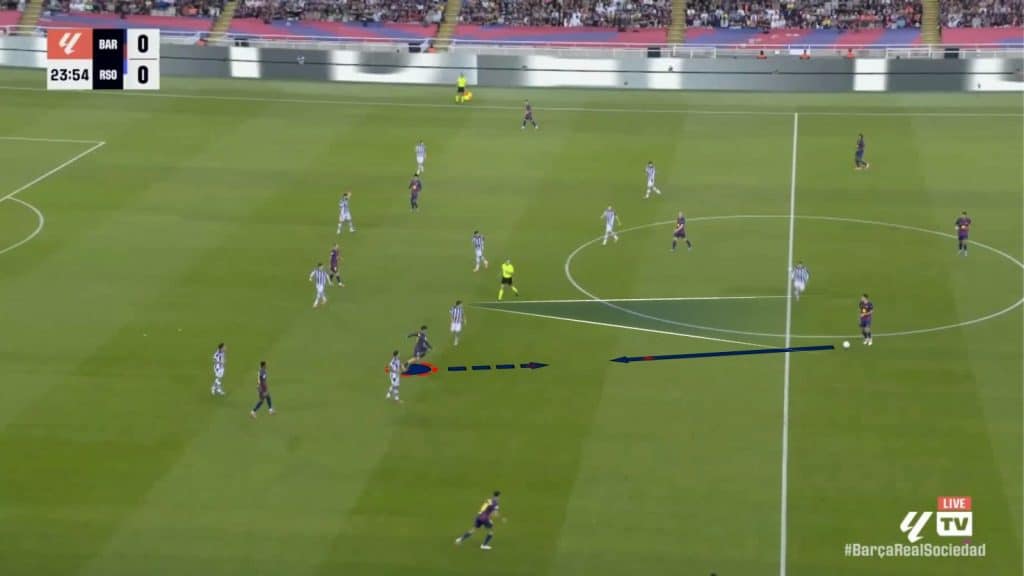
Pedri had a solution of his own.
Since he was staying outside the opponent’s structure, he was within the sight of his direct defender, so he started positioning himself higher (inside the pocket).
Whenever his teammate was shaping up to play a pass, Pedri dropped outside the structure and received to his feet.
This sudden movement helped him lose his marker for a moment, which was enough in the moments he had already seen where his next pass was.
In the image above, Pedri’s direct opponent is looking at the ball, which gives the Spaniard enough head-start to lose him and get on the ball.
One of the key reasons why Barcelona had so much possession is their awareness of spaces, which gives them the discretion to move the ball to the right areas and avoid clogged spaces where they might get dispossessed.
Moving the ball quickly in and out of tight spaces helped them with shifting play and slowing the game down when required.
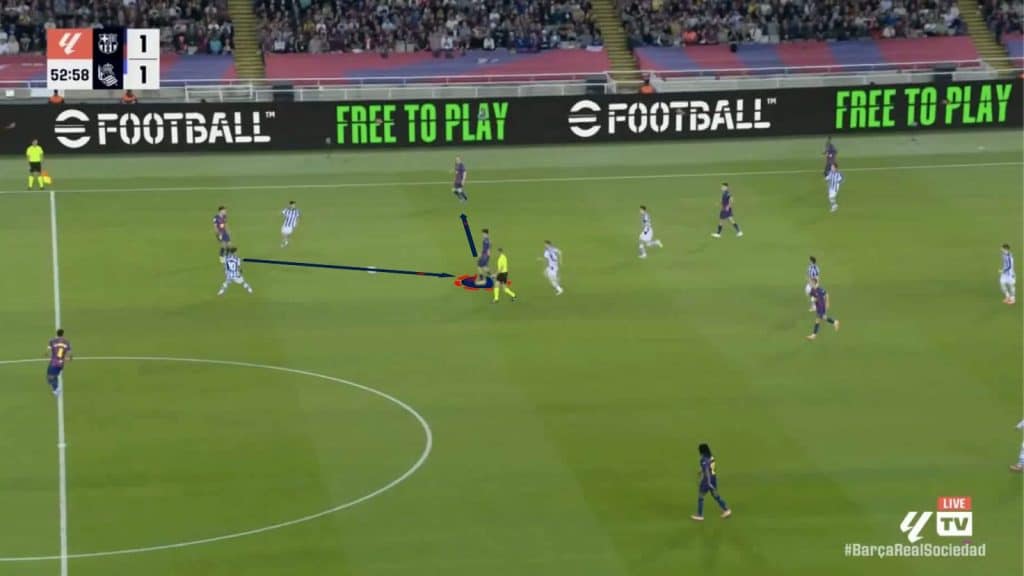
Here, Pedri receives in a tight space to lay it off to his full-back.
Once the opponents try to squeeze the wide area, Barça play it back to switch play.
Entering The Attacking Third
With Real Sociedad’s compact defensive shape, it was tricky for Barcelona to penetrate all the way.
However, the hosts ultimately made 74 final third entries.
A huge part of their success in this department can be attributed to the supporting angles and movement in relation to each other.
An interesting feature is how the Barça full-backs positioned themselves in the midfield third during the attacking phase.
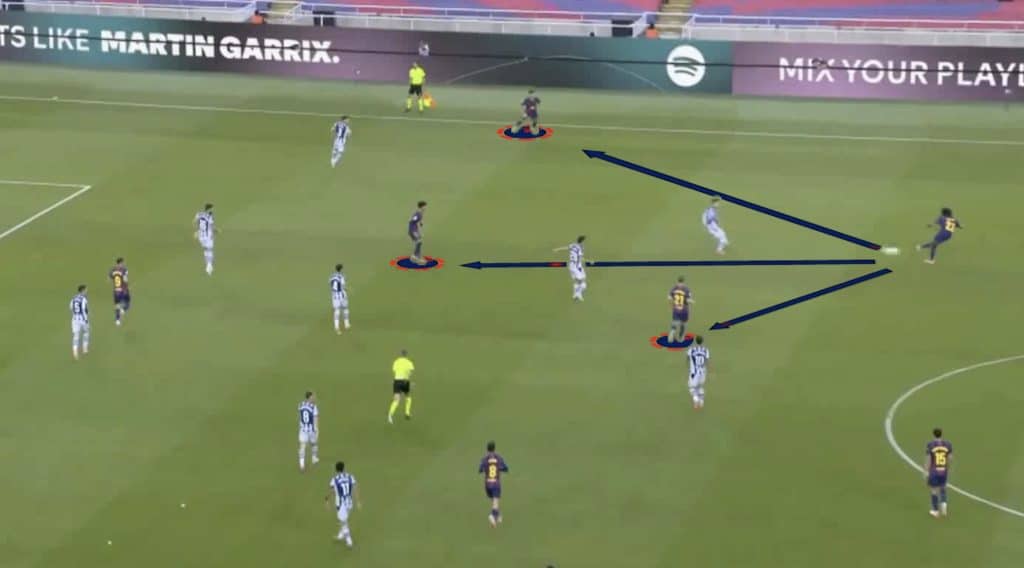
Here, we can see Koundé operating in the half-space.
This way, he has multiple options to play into.
If he operates in the wide channel in the same situation, he will have access to fewer options, and his pass down the line can be cut out easily.
This was a common theme throughout the game.
Whenever Barça had spells of possession, a diamond formation was imminent.
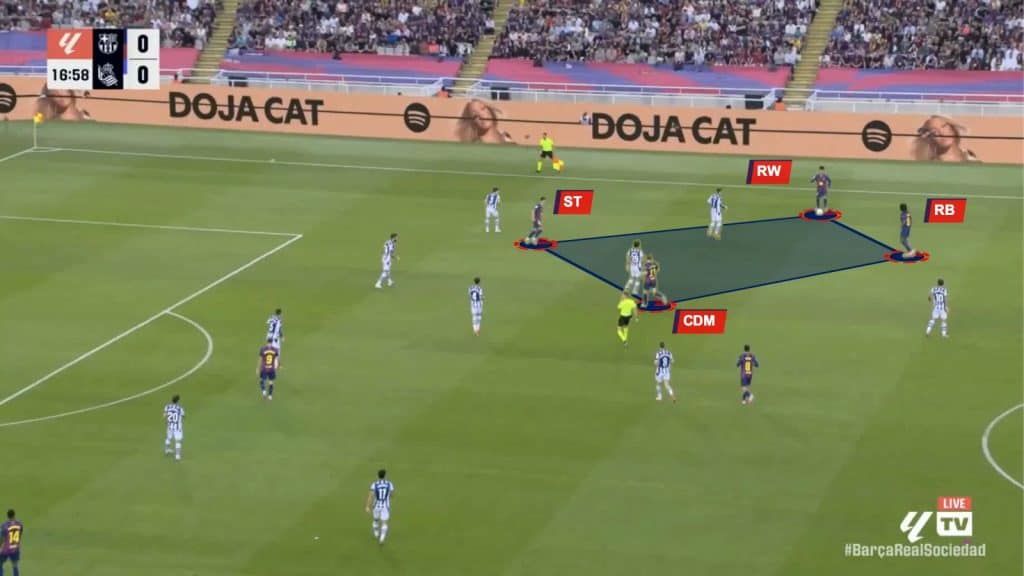
Here is an example: Bardghji has the ball in the wide channel.
His immediate options are Koundé (base of the diamond), Lewandowski (striker shifting across), and De Jong (pivot pushing high).
These diamonds were not limited to a full-back at the base.
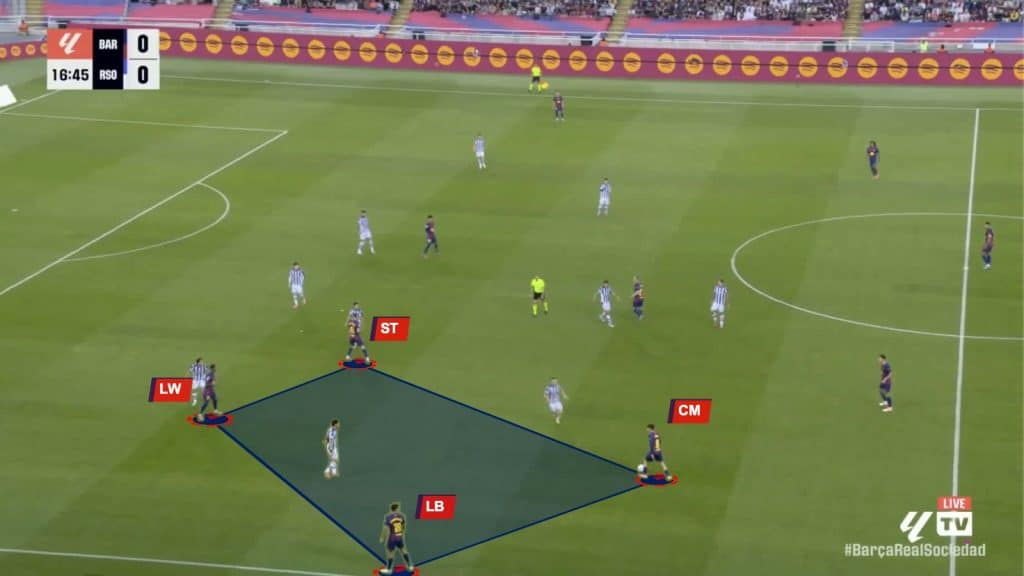
Here, Pedri is at the base, with Martín (left-back) in the wide channel and Rashford (left-winger) in the half-space, and Lewandowski shifting across to provide a central option.
Through this shape, the objective was to create an overload and progress the ball; meanwhile, shifting the play if the opponents match the numbers.
Barça achieved meaningful penetration through underlapping runs and third-man passes.
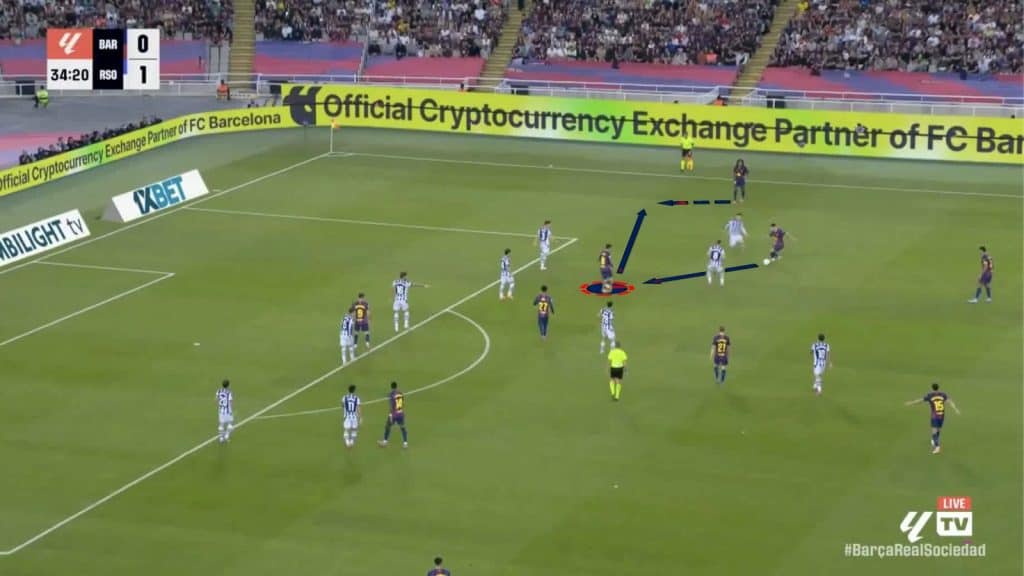
Here is an example of Barcelona going in to go out through a third-man combination.
Pedri receives in the half-space to lay it off to Koundé, who ends up crossing it.
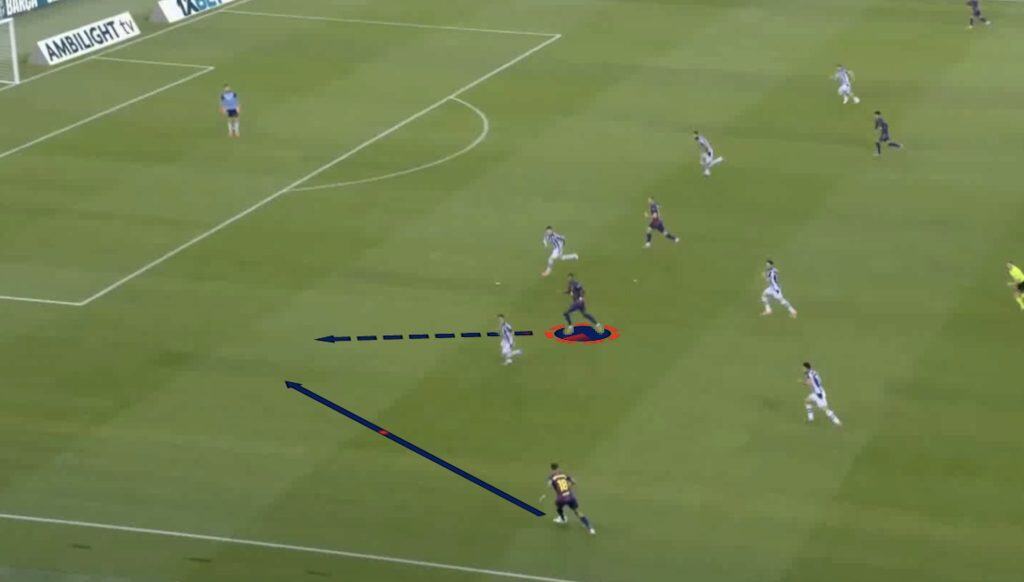
Here is a direct underlapping run from Rashford.
Runs like this disrupted Sociedad’s defensive structure, especially their backline.
With Barcelona’s extensive movement in the final third, the opponents were forced to quickly drop their line, often leaving space between the midfield and defensive lines.
Central players, such as Pedri, Olmo, and Lewandowski, were often seen receiving the ball between the lines on multiple occasions.
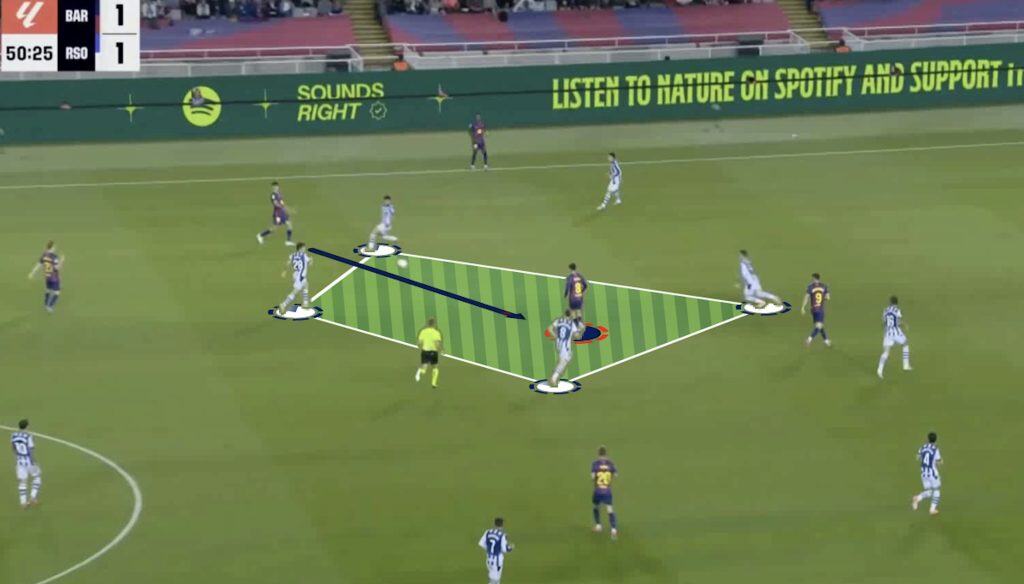
Here, Pedri receives in a pocket between Sociedad’s defenders and midfielders.
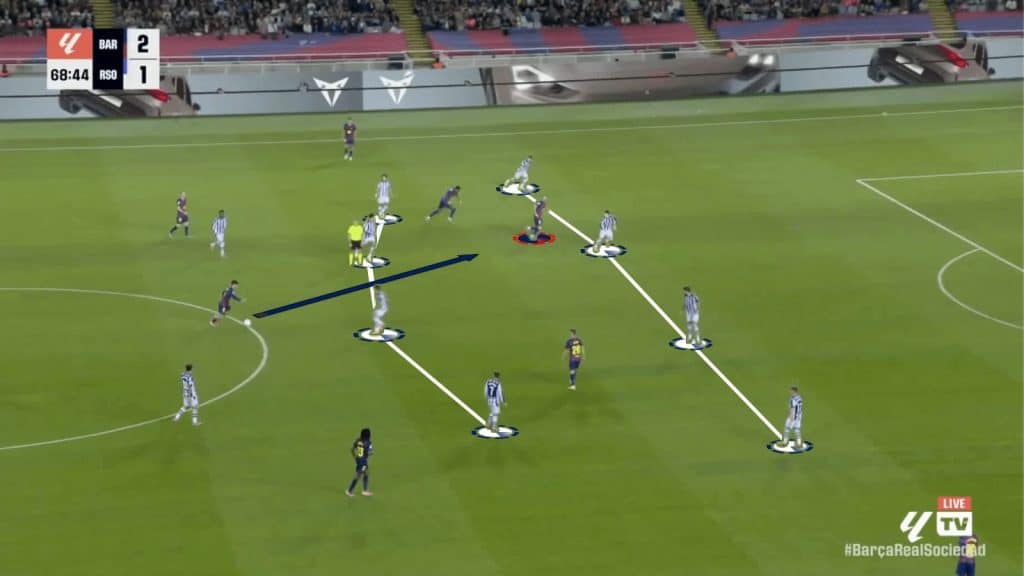
Pedri finds Lewandowski between the lines.
With Rashford making a forward run, Real Sociedad’s backline starts to drop.
This gives Lewandowski enough time and space to receive on the turn.
Barca Crossing & Shooting
Barça also attempted a few crosses, one of which resulted in a goal that secured the winner.
Barcelona were quick to counterpress when they lost possession in the attacking third.
Once they won it back, Lamine Yamal showcased individual brilliance in beating his direct opponent to cross the ball for Lewandowski’s headed finish.
Here, after Koundé gave the ball away, Barcelona won it back in the next few seconds.
Yamal identifies the space behind his direct opponent and artfully knocks it past him to provide the assist.
Shooting was a prominent feature of this game, as Barcelona recorded 22 shots, 12 of which were on target.
Most of these shots came from the central channel.
They were the result of cutting inside, cutbacks, link-up play, or low crosses.
Here, Rashford found the right moment to drop a couple of yards, play a short one-two to change the angle, and have a shot.
Lewandowski’s movement also benefits him as he drags a defender who could potentially have blocked his shot.
Barcelona Defending Tactics
In this section, we will look at the defensive features of Barcelona’s play.
Barca Defending In Opponent’s Half
Barça engaged in a high press whenever Sociedad attempted to play out from the back.
The idea was to force them into playing long balls, so that the Catalans could win the first contact.
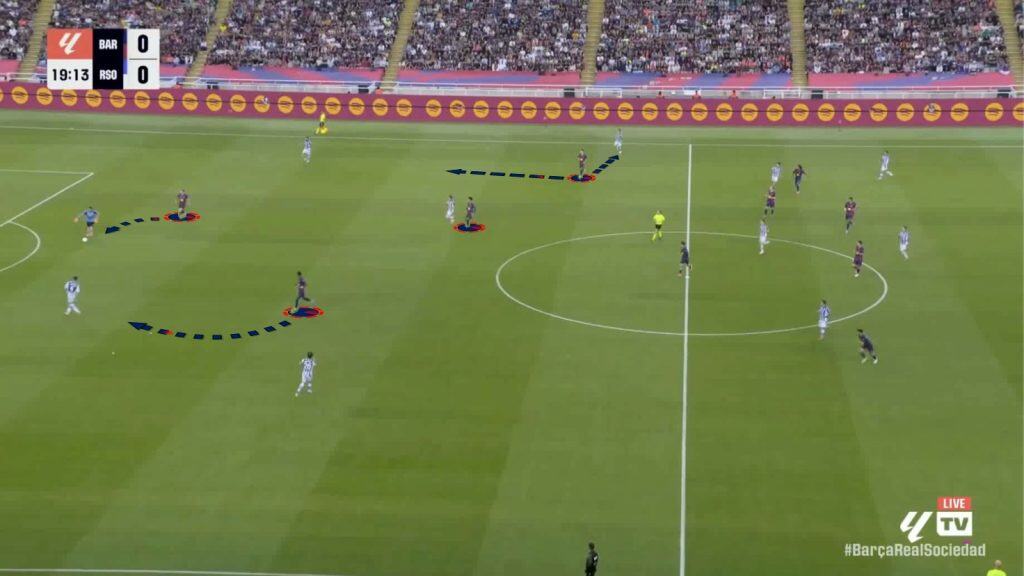
Here is an example: The Sociedad goalkeeper is in possession right outside his penalty area.
Barcelona executes a high press, cutting off short options.
The Blaugrana were also adamant in squeezing their opponents in the wide areas to regain possession.
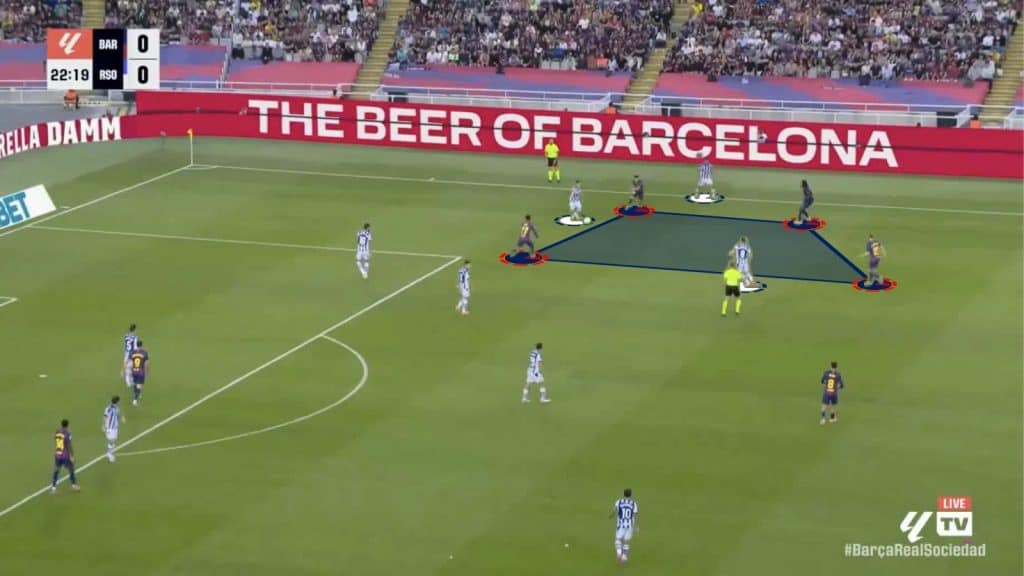
Here, Barcelona have outnumbered the opponent in the wide area.
The deepest Barça player in the mix, Frenkie De Jong, cuts the vertical passing lane.
These collective actions helped them start attacks high up the pitch, or recycle possession while keeping the opponent away from goal.
Barca Defending In Their Own Half
Despite having minimal ball possession, Real Sociedad gave the hosts a few scares.
For the most part, Barça were comfortable on the ball and did not commit errors in their own half.
However, the few moments when they did, Sergio Fransisco’s side finished the move with a shot.
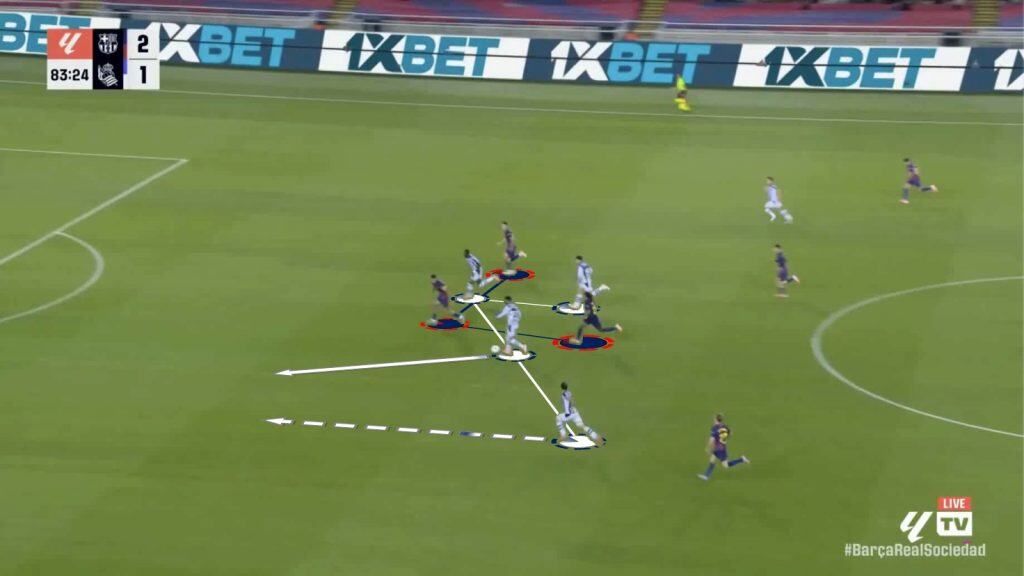
In this situation, Koundé lost the ball in his own half.
Sociedad proceeded to hit Barcelona with a 4-v-3 counterattack.
The move ended with Takefusa Kubo hitting the post from inside the box.
Apart from this, Barça’s backline struggled to defend the space between the six-yard box and the penalty spot.
Sociedad played a few low crosses along said passage, one of which resulted in Odriozola’s goal.
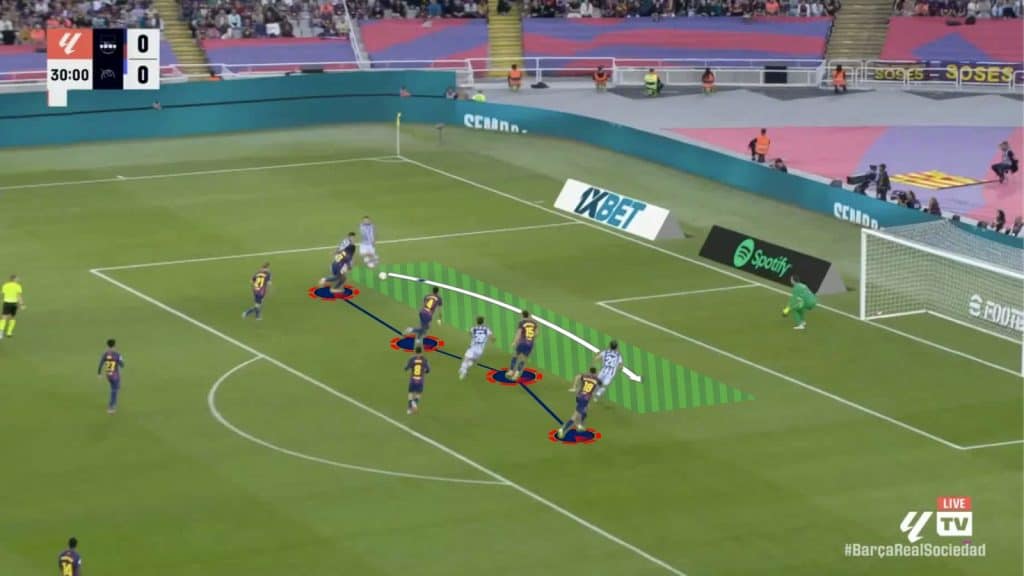
Here, Ander Barrenetxea knocks the ball past Jules Koundé to expose the space left by the Catalan backline.
A low cross meets Odriozola’s run at the back post for the opening goal of the night.
There were multiple scares like this one for Hansi Flick’s men.
Here, Sociedad’s winger and full-back make opposite movements.
Koundé gets dragged towards the ball.
None of the Barcelona players from the central zone slides for cover.
The full-back ends up playing a similar low cross.
Fortunately, in this case for Barcelona, nobody gets on the end of it.
On occasion, Sociedad exploited the gaps in Barcelona’s backline.
With multiple runners in-behind, Barcelona struggled to track them without losing their shape.
In the example above, Barça face two runners darting in-behind.
The first runner drags Christensen out of position, which opens a passing lane into the second runner’s path.
If either De Jong or Araújo shifts across, the lane is secure again.
However, they fail to cut it out, and the second runner receives in-behind.
Conclusion
Barcelona were comfortable in possession, moving the ball side to side, in and out of tight spaces, and progressing through formations of triangles and diamonds.
Hansi Flick’s side made several final third entries and had shots attempted through underlaps, combination plays, crosses, and cutbacks.
However, the Spanish champions had defensive lapses on multiple occasions, allowing their opposition convincing chances, including low crosses between the goalkeeper and defenders, overlaps, underlaps, cutbacks, and runners in behind.
Barcelona were prudent in terms of game management, along with luck favouring them in certain situations.
Hansi Flick will be satisfied with the three points.
However, he will need his side to step up in the defensive phase in the upcoming games.
