
The 2025/2026 La Liga campaign arrives as a defining chapter for Barcelona under the stewardship of Hansi Flick, following a season that provoked as many questions as it did answers.
Flick’s arrival last year signalled a decisive break from recent managerial patterns, embedding a philosophy grounded in high defensive lines, pressing intensity, and transitional sharpness.
Yet, as with any radical shift in footballing identity, the process has been one of experimentation, adaptation, and uneven results.
The tactical framework Flick has sought to establish reflects both his Bayern Munich legacy and his desire to recalibrate Barcelona’s traditional positional play.
The hallmark has been an aggressively high defensive unit, seeking to compress space, force hurried decisions, and dominate territory.
By using a synchronised offside trap as a central weapon, Barcelona repeatedly attempted to strangle opposition attacks before they reached the final third.
This calculated gamble, however, has carried both rewards and vulnerabilities, exposing gaps against teams willing to stretch play with direct runs or aerial deliveries.
In this data analysis, the report will examine how Barcelona’s tactical identity under Hansi Flick management translated into measurable performance patterns across multiple phases of play.
Central to this study is the evaluation of the high defensive line and offside trap, where statistical outputs such as offsides forced and defensive duels highlight both dominance and risk.
The analysis then shifts to pressing efficiency and the sustainability of maintaining an aggressive line over the course of a demanding season, before exploring the mechanics of build-up play and the evolving role of Barcelona’s defensive core in ball progression.
Finally, attention is given to the attacking dimension, measuring direct and fast attacks, vertical passing dynamics, and finishing efficiency through the lens of goals, xG, and shot conversion.
Together, these layers of statistical evidence provide a comprehensive tactical portrait of a side navigating the fine balance between tradition and innovation, offering insights into how Barça can consolidate Flick’s philosophy in the decisive 2025/2026 campaign.
Barcelona Offside Trap Efficiency Under Hansi Flick Tactics: Tactical Insights From 2024/2025
Hansi Flick’s arrival at Barcelona marked a clear tactical shift towards a consistently high defensive line, a philosophy aimed at compressing the pitch and maintaining intense pressure in the opponent’s half.
The defensive quartet of Iñigo Martínez, Pau Cubarsí, Alejandro Balde, and Jules Koundé became the backbone of this approach, relying on synchronised movement and sharp anticipation to spring the offside trap.
Ranking Of The Teams Most Frequently Caught Offside Against Barcelona
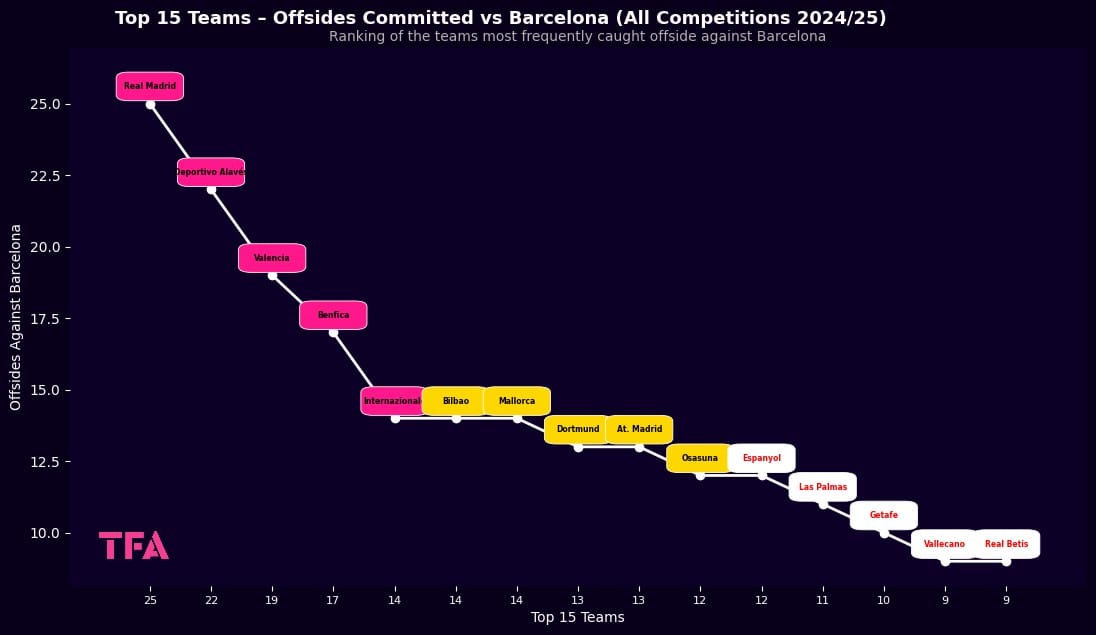
Across all competitions in 2024/2025, Barcelona caught their opponents offside on 115 occasions, with 75 in La Liga, 25 in the Copa del Rey, and 15 in the Spanish Super Cup.
The most striking statistic came against arch-rivals Real Madrid, who were flagged offside an extraordinary 25 times in just four encounters, 12 in the first league meeting, five in the return fixture, seven in the Copa del Rey final, and a further one in the Spanish Super Cup final.
This consistent disruption of Los Blancos‘ attacking rhythm directly prevented several clear scoring opportunities, underlining the precision and timing of Barcelona’s high defensive line.
European fixtures also provided a stern examination of the offside trap.
Benfica, for instance, were caught nine times in one match and three in the other, while Inter Milan fell victim to the flag on nine occasions across their two clashes.
Even elite continental sides such as FC Bayern, Borussia Dortmund, and Atalanta struggled to adjust, illustrating how well-drilled the defensive unit was in maintaining line discipline under Hansi Flick’s guidance.
From a tactical perspective, these numbers underline Barcelona’s dominance in controlling space.
With an average of 3.1 offsides forced per match, well above the La Liga average of 1.9, the Blaugrana consistently disrupted the flow of attacking moves before they reached dangerous zones.
Cubarsí’s composure in stepping up at the right moment, combined with Balde’s recovery pace on the flank, proved essential in ensuring the trap was both aggressive and secure.
The risk-reward balance, however, was evident.
On 14 occasions, opponents broke through the trap, leading to high xG chances.
Flick’s calculated gamble paid off last season, but with Iñigo Martínez departing and the introduction of goalkeeper Joan García, renowned for his distribution but less tested in sweeping clear long balls, there may be a transitional adjustment period.
The challenge for 2025/2026 will be to maintain these high numbers without becoming vulnerable to well-timed diagonal balls.
If the forward press falters, the space behind will remain the most tempting invitation for Barcelona’s rivals.
Pressing Efficiency & Defensive Line Sustainability Under Hansi Flick Tactics
Barcelona’s 2024/2025 season under Hansi Flick provides a fascinating statistical canvas to assess the effectiveness of their pressing and defensive organisation, especially when projecting into the 2025/2026 campaign.
Barcelona Key Defensive Metrics Per Match

The side conceded 1.23 goals per match, a figure that reflects a relatively secure back line, yet one heavily influenced by the quality of pressing higher up the pitch.
The average of 8.2 shots against with only 41.2% of them on target suggests that when the press was executed with precision, opponents were forced into rushed or low-quality efforts.
Flick’s model relied upon maintaining an aggressive high line, as seen in the 8.33 PPDA, signalling sustained attempts to disrupt build-up phases early.
However, pressing efficiency was not solely about intensity but also about recovery actions.
Barcelona averaged 58.67 defensive duels per game with a respectable 62.8% win rate, a balance that illustrates a proactive defensive unit capable of stifling transitions when the first press was bypassed.
Yet, aerially, they were vulnerable: just 46.6% success in 23.58 duels per match, leaving clear openings when long balls were used to escape the press.
This often forced the back line into desperate actions, reflected in 12.06 clearances per game, an indicator that the high line sometimes struggled under direct pressure.
The transitional phase revealed both promise and concern.
With an average of 34.12 interceptions, Barcelona demonstrated anticipation and compact spacing when the collective press clicked.
However, the modest success in sliding tackles (just 50.7% from 3.53 attempts) highlighted inconsistency in timing and recovery against rapid counters.
The tactical dilemma for 2025/2026 revolves around sustaining the high line without overexposure in aerial or last-ditch situations.
If Flick can improve aerial resilience while sharpening recovery tackles, the pressing model has the potential to transform from merely energetic into structurally dominant.
This statistical blend paints a side on the cusp: effective in limiting shots and disrupting rhythm, yet vulnerable in specific defensive mechanics.
The evolution of their pressing efficiency will likely dictate whether Barcelona can impose sustained territorial control in the upcoming campaign.
Build-Up Play & The Evolving Role Of Barcelona Defensive Core
Barcelona’s approach to build-up play has always been anchored in controlled passing structures, and the 2024/2025 numbers reinforce this philosophy.
Key Build-Up Metrics Per Match

The team averages 606.7 passes per match with an impressive 88.5% accuracy, highlighting the reliance on possession as a defensive and offensive tool.
What stands out is the balance between circulation and progression.
While lateral passes remain high at 240 per game with 92.6% accuracy, the side also manages 173.3 forward passes at 80% accuracy, showing a deliberate effort to advance play while retaining stability.
This duality ensures that Barcelona are not simply recycling possession but actively searching for progression through the thirds.
A critical dimension in this system is the use of progressive passes, where Barcelona average 74.3 per game with 79% success.
Such figures demonstrate the capacity to consistently break opposition lines, often initiated by defenders or the deep midfield pivot.
The role of a player such as Frenkie de Jong is particularly vital: his ability to receive under pressure and turn progression into structured attacks complements the high volume of short-to-medium exchanges (average pass length of 17.66 metres) that Barcelona favour.
By acting as the bridge between defence and attack, the pivot reduces reliance on risky long balls, of which the side attempts only 35.4 per match at 57% accuracy.
The introduction of Joan García adds another dimension.
While primarily evaluated for his shot-stopping ability (75.5% save rate), García’s distribution could redefine Barcelona’s build-up.
He attempted over 1,000 passes last season, completing 526, with a relatively low launch percentage of 37.6% and an average length of 34.8 metres.
This indicates a goalkeeper comfortable initiating play through shorter distributions rather than defaulting to long clearances.
His 197 throws underline his inclination to accelerate transitions with controlled restarts.
In tactical terms, this profile allows Barcelona to sustain a higher defensive line, safe in the knowledge that García’s passing range can stretch the first phase of build-up while maintaining possession security.
Direct & Fast Attacks: Barcelona Search For Vertical Threats
Barcelona’s 2024/2025 season under Hansi Flick was marked by a gradual evolution in their attacking identity.
Moments of direct and fast attacks were carefully blended into the club’s traditional positional dominance.
Barcelona: Direct & Fast Attacks 2024/2025 Under Hansi Flick Tactics

The statistical profile offers a compelling window into this tactical balance.
The side averaged 2.85 goals per match, closely aligned with an xG of 2.37, which signals both clinical finishing and an ability to generate high-quality chances beyond pure expected returns.
With 16.12 shots per game and a 41.7% accuracy rate, Barcelona sustained a steady volume of attempts, but what matters tactically is how these shots were distributed across phases of play.
Only 28.7% of the 34.12 positional attacks per game culminated in shots, illustrating the challenge of turning prolonged possession into a genuine end-product against low blocks.
This figure highlights both the patience and the structural issues of a team often forced to recycle circulation before carving out opportunities.
In contrast, the numbers behind direct play tell a more dynamic story.
Barcelona registered 1.58 counterattacks per match, with an impressive 57.6% resulting in shots, underlining the efficiency of their transitional play.
This sharp contrast to positional efficiency suggests that Flick’s men were often more dangerous when space was available, capable of bypassing compact structures with verticality and pace.
Wide play also featured as a complement to their direct attacking model.
The team attempted 15.85 crosses per game, though accuracy stood at 30.7%, which indicates a moderate but limited return from flank deliveries.
However, more telling are the 73.09 offensive duels contested per match, of which 41.7% were won.
This reflects Barcelona’s insistence on destabilising opponents through 1v1s, often critical in initiating fast breaks or sustaining momentum in transitional moments.
Collectively, these numbers point to a side increasingly adept at blending structured possession with direct attacking bursts.
The efficiency of counterattacks compared to positional sequences demonstrates that Barcelona’s vertical transitions may well become a defining feature under Flick, especially when tasked with breaking stalemates against deep-lying opponents.
Barcelona Vertical & Wide Dynamics Under Hansi Flick Tactics
The statistical profile of Barcelona under Hansi Flick during the 2024/2025 season highlights a team increasingly adept at combining central progression with wide threats.
Their passing metrics suggest a balance between control and penetration, underlining Flick’s tactical emphasis on structured possession that nevertheless seeks to break lines efficiently.
Comparing Volume Vs Accuracy Across Vertical & Wide Progression Metrics

On average, FC Barcelona attempt 173.33 forward passes per match, with an accuracy of 80%.
This figure reflects a consistent intent to move the ball vertically, often through midfield channels, where Flick relies on midfielders and drops forward to accelerate play.
Complementing this central progression is the reliance on lateral circulation.
Barcelona register 240 lateral passes per match, boasting a 92.6% accuracy, demonstrating their ability to patiently recycle possession until gaps appear.
This mechanism allows the wingers to remain high and wide, stretching defensive blocks and preparing the ground for incisive actions.
The presence of 35.41 long passes per match, albeit at a more modest 57% success rate, shows Flick’s readiness to bypass midfield density when necessary, particularly when exploiting spaces behind high defensive lines.
Crucially, the penetration into advanced zones stands out.
Barcelona average 69.74 passes into the final third per game, with 81.4% accuracy, reflecting structured but ambitious attempts to supply forwards between the lines.
Progressive passing further amplifies this picture, with 74.35 progressive passes at a 79% completion rate, indicating a consistent pattern of advancing possession with purpose rather than sterile circulation.
These numbers underline the blend of positional patience and vertical aggression in Flick’s model.
Tactically, the role of the wingers and central striker becomes essential.
The wide players stretch the pitch, creating corridors for progressive passes, while the striker’s movement pins defenders and generates channels for midfield runners.
This is what transforms statistical volume into real chance creation, linking Flick’s disciplined structure with Barcelona’s traditional attacking flair.
The data reveals a side capable of threatening from both the flanks and central corridors, making them unpredictable and multifaceted in their approach.
Finishing Efficiency: Barcelona 2024/2025 Under Hansi Flick Tactics
Barcelona’s attacking framework in the 2024/2025 season under Hansi Flick illustrates a side that generates volume but also reveals much about the quality and conversion of their finishing.
Goals Vs xG & Attacking Dynamics Across Multiple Phases

Averaging 2.85 goals per match from an expected goals tally of 2.37, the team consistently outperforms its xG by nearly half a goal per game.
This suggests a level of finishing efficiency that goes beyond pure chance, underpinned by individual quality in the final third and a structured system that maximises shot quality.
Yet, the overall volume of 16.12 shots per game with a relatively modest 41.7% accuracy rate highlights a tactical balance: Barcelona are not among Europe’s most clinical sides in terms of raw accuracy, but their ability to generate high-value situations ensures efficiency in outcome.
Breaking this down further, positional play remains the cornerstone of Flick’s system.
Barcelona average 34.12 positional attacks per match, with only 28.7% culminating in shots.
This reflects a measured approach, prioritising ball circulation and probing before committing to shooting opportunities.
The efficiency here lies not in volume but in selecting when to break the line.
By contrast, their 1.58 counterattacks per game, of which a striking 57.6% result in shots, underlines the effectiveness of transitions, where the quality of chances is inherently higher due to disrupted defensive structures.
Crossing remains less of a decisive weapon, with 15.85 crosses per game and just 30.7% accuracy.
This further suggests that Flick’s Barcelona favours controlled central progression over wide delivery.
Meanwhile, their aggressive involvement in duels, averaging 73.09 offensive duels per match with a 41.7% success rate, reflects a commitment to sustaining pressure and regaining possession high, ensuring a steady stream of opportunities even when accuracy in front of goal falters.
Ultimately, Barcelona’s finishing efficiency stems from a balance of structured positional play, lethal transitional attacks, and the technical prowess of their forwards.
Outperforming xG consistently illustrates that Flick’s system not only creates opportunities but enables the attackers to exceed expected returns, a hallmark of sides capable of sustaining elite-level attacking output.
Conclusion
As Barcelona look ahead to the continuation of Hansi Flick’s tenure, the tactical picture is one of both potential and tension.
The foundations of a recognisable identity are clearly visible: a high defensive line orchestrated through synchronised movement, pressing structures that demand relentless energy, and attacking patterns designed to marry patient possession with sudden vertical thrusts.
Yet footballing identities are not forged in a single season, and the coming campaign will determine whether this framework matures into dominance or exposes inherent fault lines.
The challenge lies in refining balance.
While disruptive to opponents, the high line requires impeccable cohesion and near-perfect timing; any lapse risks undoing the collective effort.
Similarly, the pressing game demands rotation, stamina, and clarity in trigger points if it is to remain a strength rather than a liability.
Opponents have already begun to adapt, targeting aerial duels and diagonal passes as methods of bypassing the press, forcing Barcelona into moments of reactive defending.
Flick must therefore engineer tactical flexibility, ensuring that aggression does not become predictable.
Offensively, the evolution is more encouraging.
Barcelona’s capacity to blend positional patience with incisive countermovements suggests a template capable of unsettling both deep and expansive opponents.
The integration of new personnel, particularly in defence and goalkeeping, offers opportunities to expand build-up patterns and sharpen the speed of transition.
Yet here, too, refinement will be key: crossing remains an underdeveloped weapon, and the final third still relies heavily on moments of individual brilliance rather than consistently automated mechanisms.
Ultimately, Barcelona under Flick stand at a crossroads.
The identity is ambitious and bold, aligned with the club’s ethos of dominance through structure and control.
But its long-term success will depend not on isolated flashes of efficiency, but on the capacity to consolidate, adapt, and evolve.
Therefore, the 2025/2026 season promises to be less about experimentation and more about proof: whether Barcelona can transform Flick’s tactical blueprint into a sustainable pathway back to European supremacy.
