
Frenkie de Jong’s future has been a topic of huge debate for the better part of a month. After a breakthrough season with Ajax in 2018/19, winning the league and cup double while also being an instrumental figure in the team’s run to the Champions League semi-finals, he signed for Barcelona for an initial fee worth €75 million in the summer of 2019.
He joined the Catalan club in a period of transition and turbulence, both on and off the pitch. With the team being far from its best shape, witnessing several managerial changes and financial uncertainty, de Jong never really hit the dazzling heights of his Ajax days under Erik ten Hag. Nevertheless, across three seasons at the Nou Camp, he has been a key player in Barca’s midfield and has established himself as one of the best midfielders in the world at 25 years of age.
Frenkie loves Barcelona, leaving was never in his plans. But the club’s financial constraints mean that they need to free up cash and de Jong is one of their most saleable assets.
Here is where Manchester United come into the equation. New boss Erik ten Hag wishes to reunite with the Dutch midfielder and build his new-look United team around him, having arguably guided de Jong to produce his best football during their 18 months together in Amsterdam.
Anyone who watches football can see that the Red Devils have a big weakness in the middle of the park, a problem that dates back to before Sir Alex Ferguson’s retirement. Ferguson’s final midfield signing was Anderson, and that was in 2007/08, five seasons before he retired. Since then, United have spent a combined £324.1 million on eight different central midfielders (Marouane Fellaini, Ander Herrera, Morgan Schneiderlin, Bastian Schweinsteiger, Paul Pogba, Nemanja Matic, Fred, and Donny van de Beek.) One or two at most can be classified as successful signings. While only Fred and van de Beek now remain.
This tactical analysis and scout report will look at whether de Jong can be the start of the midfield revolution under ten Hag if his reported €65 million move goes through. The analysis highlights his style of play and his different roles at Ajax and Barcelona, and how he can potentially fit into United’s style and tactics.
Style of play
De Jong is a very versatile player, he mainly operates in a single or double pivot and can also play in a three-man midfield as the left or right-sided midfielder. In general, he is a very technical player. De Jong brings a calming presence to the team with his ability to maintain possession, play neat and tidy passes and advance the ball up the pitch. He is the string-puller who makes his team tick.
The Dutchman especially excels in sides that are set up to dominate possession and overcome deep defensive blocks. He is comfortable playing one-touch passes but also likes to hold the ball and scan the pitch around him before releasing it.

The 25-year-old had a 91% pass completion and an 82% long pass completion in La Liga last season. He also averaged 5.22 progressive passes per 90 along with 7.24 progressive carries. The stats also support the eye test that de Jong is an elite ball progressor.
When de Jong receives and turns, he looks to drive at opponents before reversing the ball back through the gap that has just been vacated. Absorbing pressure to free up his teammates is a signature Frenkie maneuver.
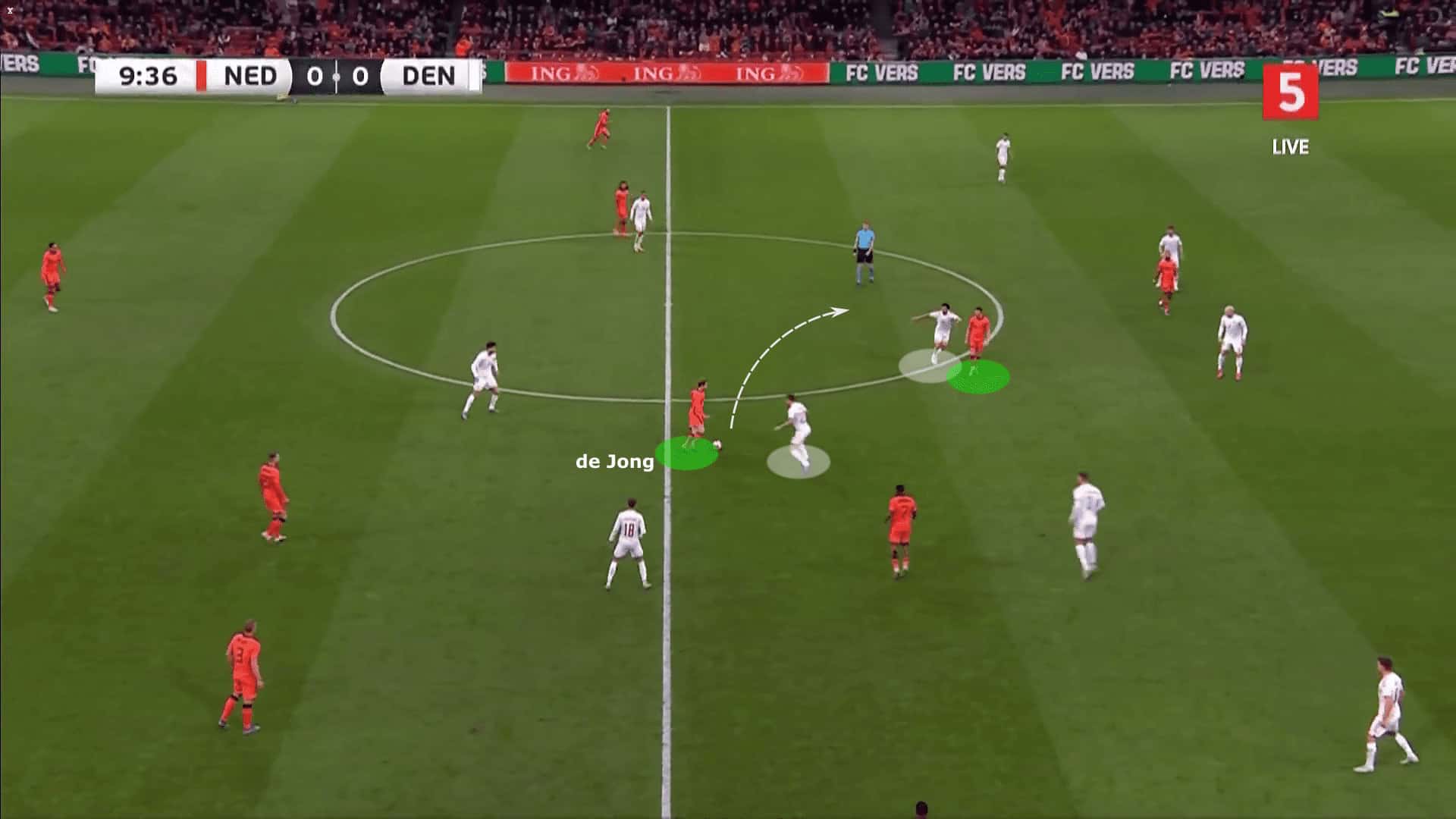
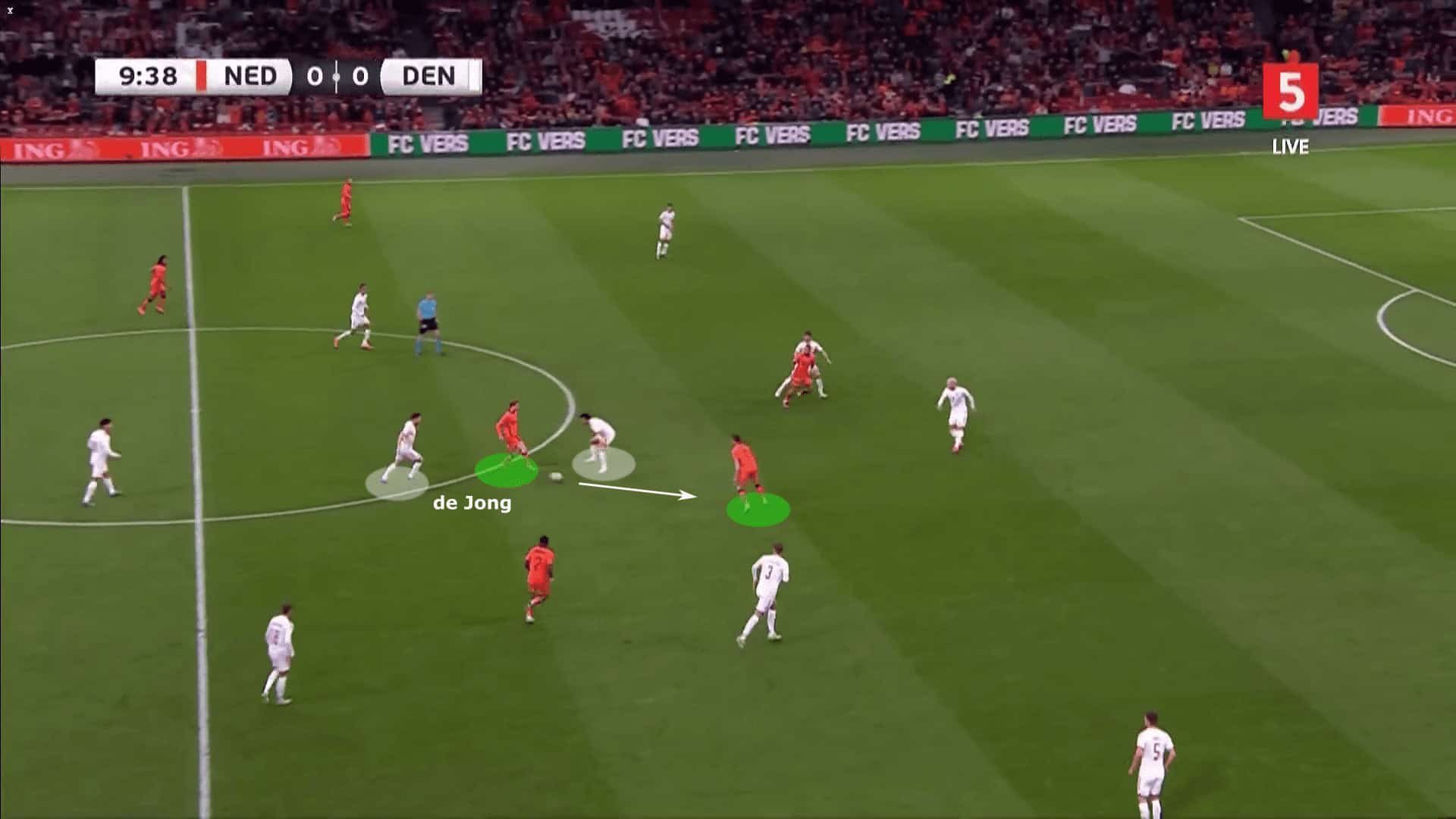
An increasingly exciting aspect of De Jong’s approach is his awareness of when to execute penetrative runs. He recognises when to advance and when to remain disciplined and hold his position.
“When I am on the pitch, I play on intuition, but I think a lot about the game as well,” said de Jong.
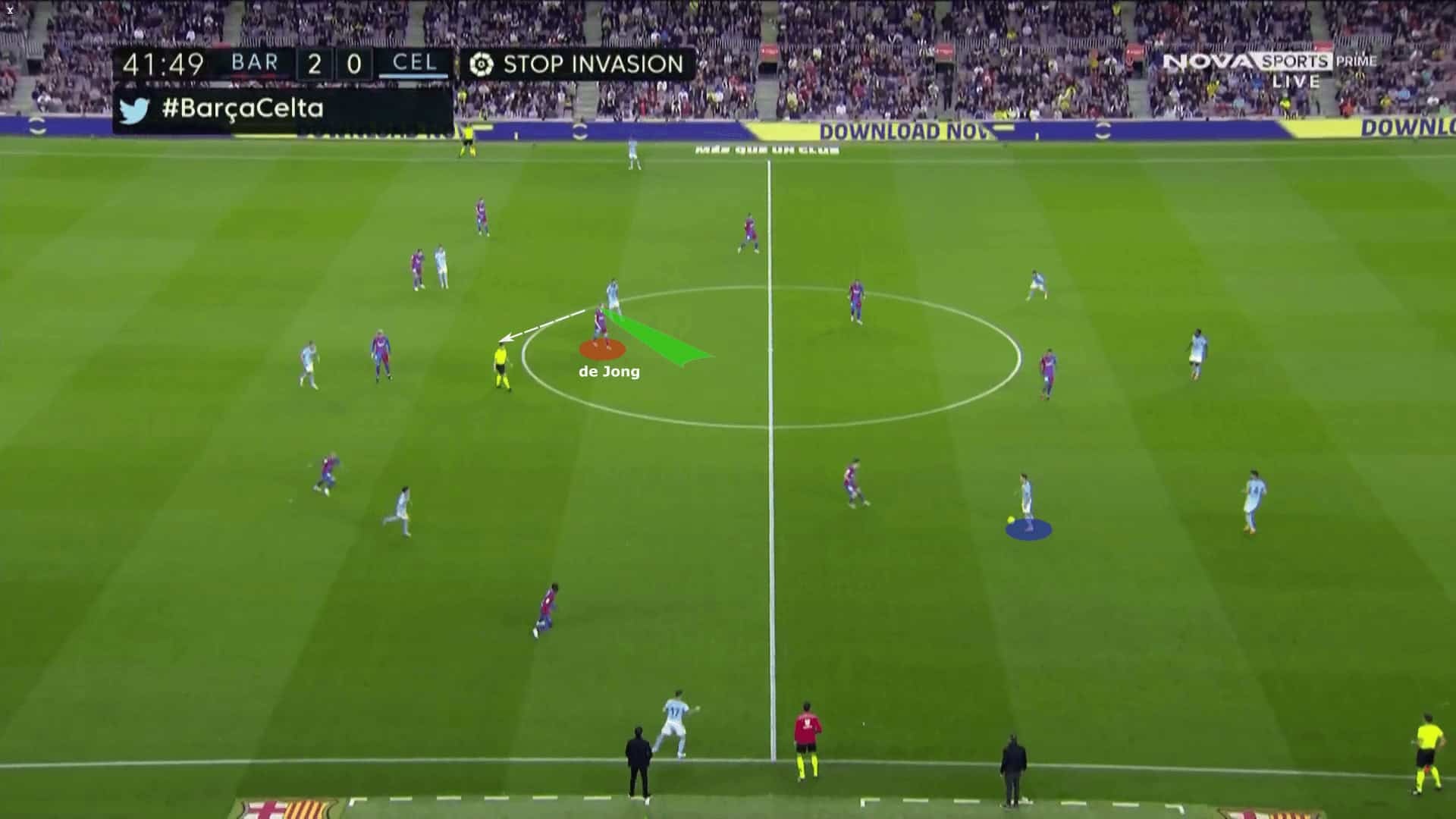
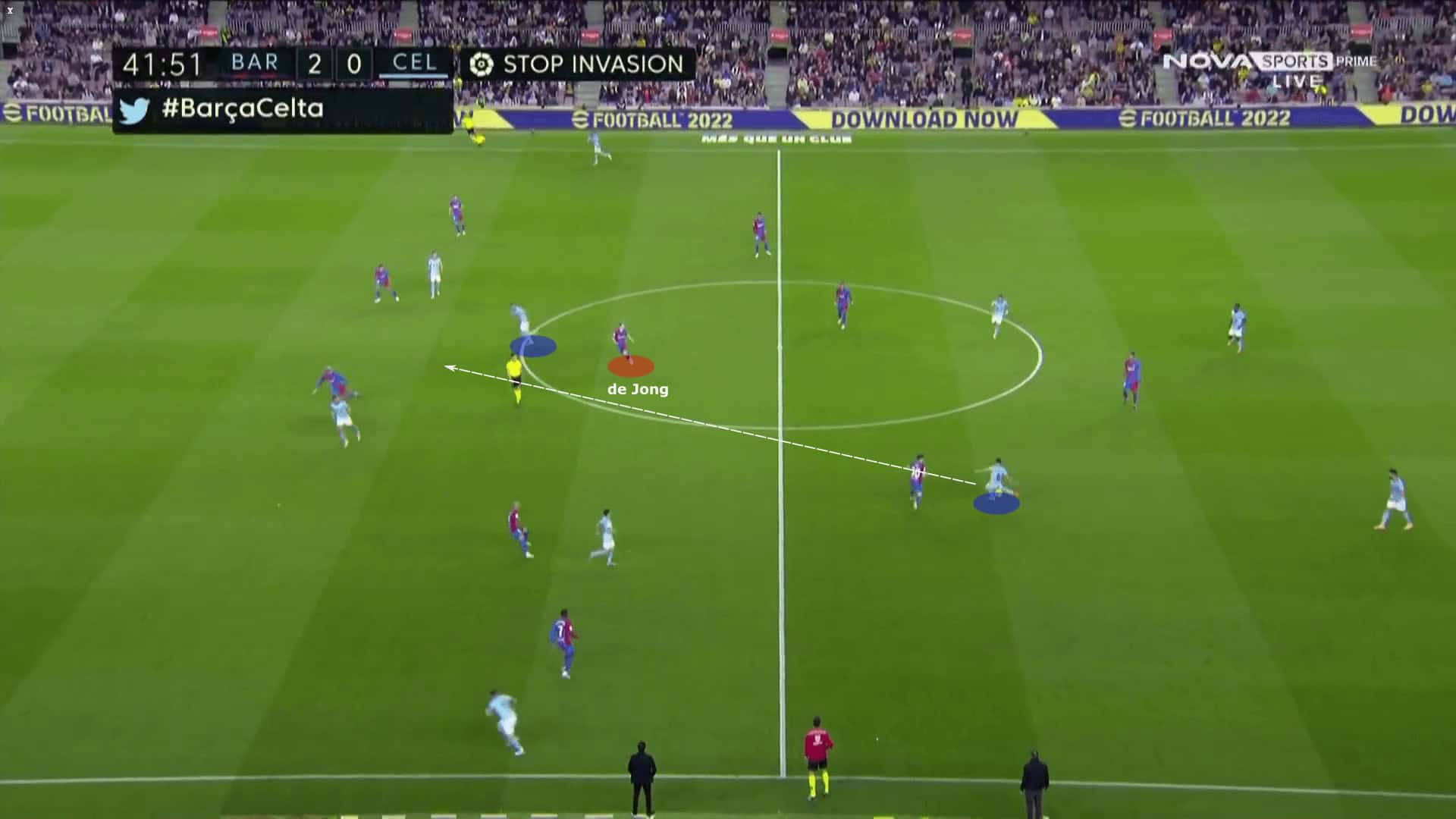
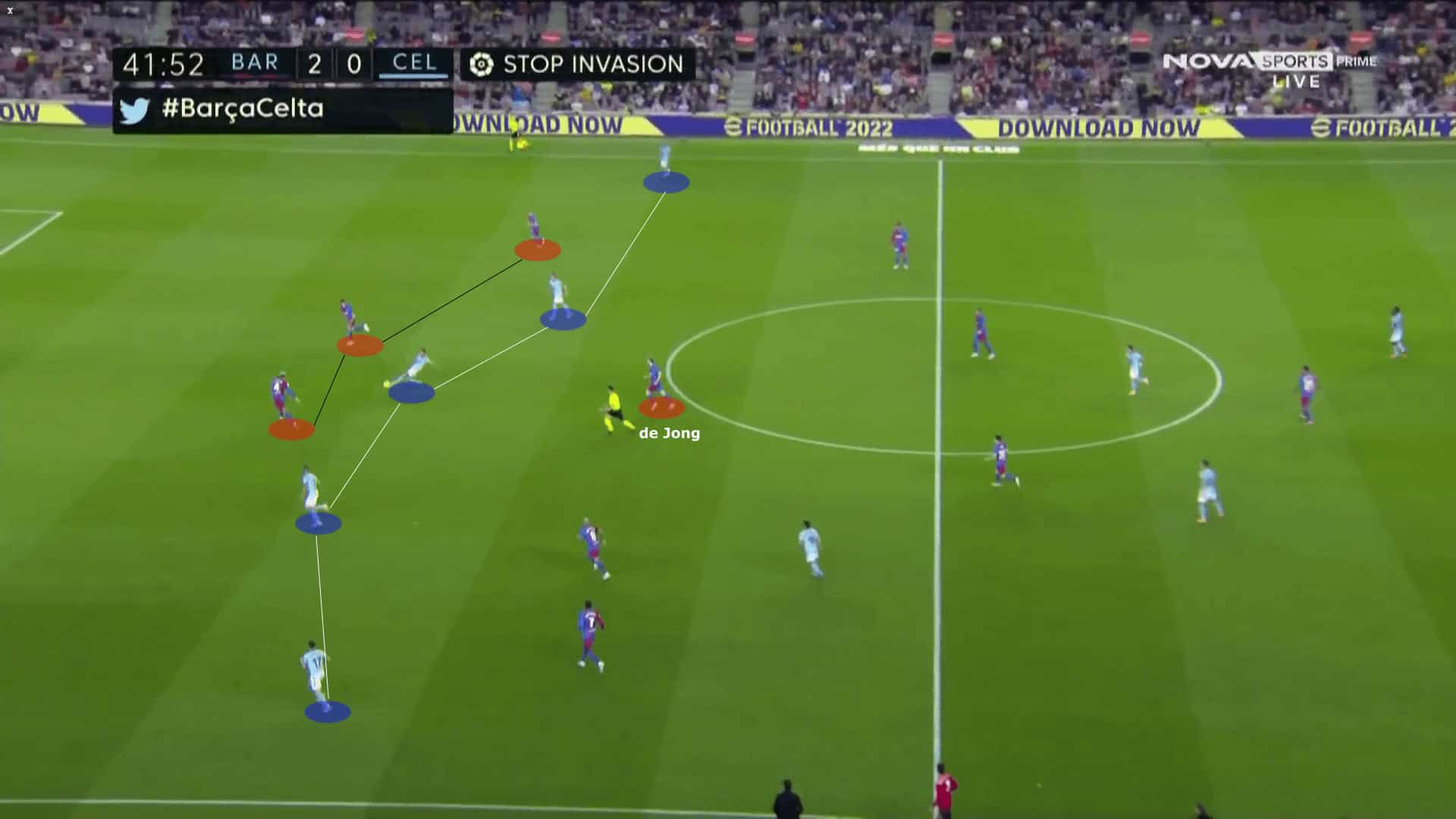
One of de Jong’s main assets is his ball control and ability to escape possession in tight spaces, even when pressed by multiple players.
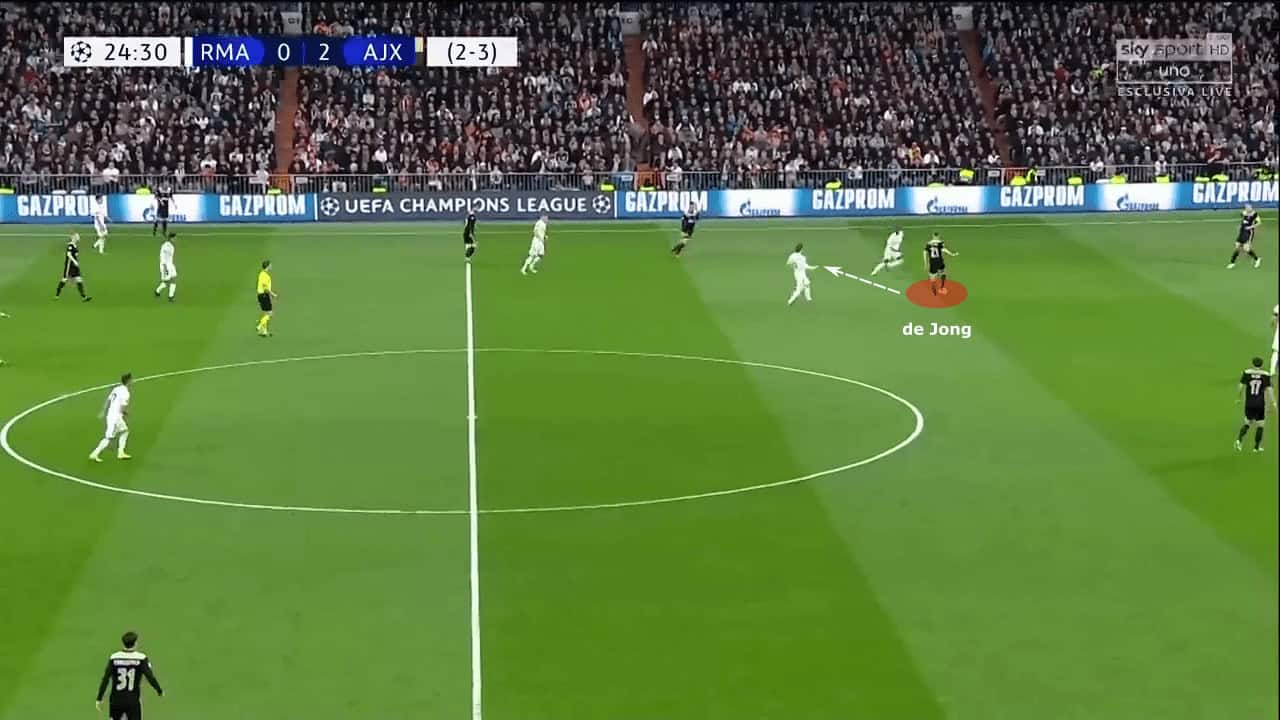
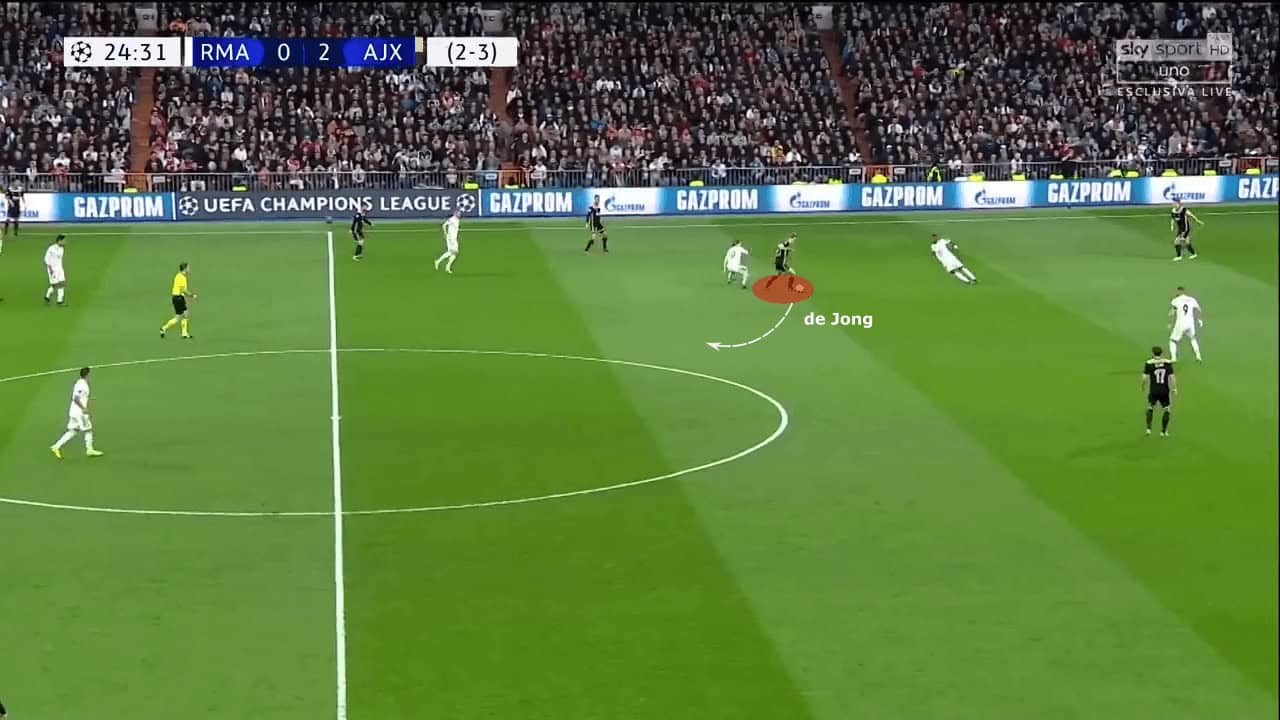
He receives the ball and is pressed by Modric and Vinicius. He opens up his body to the outside but makes a sudden movement in between the two players, taking out Vinicius.
Then with a slick body feint, he shifts backwards, loses Modric, and drives through the open space.
Defensively, he ranks in the bottom 10% in Europe’s top five leagues in terms of tackling. His anticipation and timing of where the ball will land saves him from constantly going to ground for tackles. This is also down to his box-to-box role at Barcelona. He ranked 4th in the Ajax squad in tackles with 3.5 per 90 in 2018/19, playing a more deep-lying playmaker role under ten Hag.
But it’s safe to say that de Jong does struggle in some defensive situations; especially in his awareness and work rate out of possession. He is sometimes rash during transitional moments, which is a concern against elite opponents.
Role at Ajax under ten Hag
In three seasons at Ajax, de Jong operated 12 times as a centre-back, 50 as a defensive midfielder, and 12 in a more central role.
In 2018/19, Ajax lined up in a 4-2-3-1 with Donny van de Beek as an attacking midfielder and Frenkie de Jong partnered by Lasse Schone in the midfield pivot.
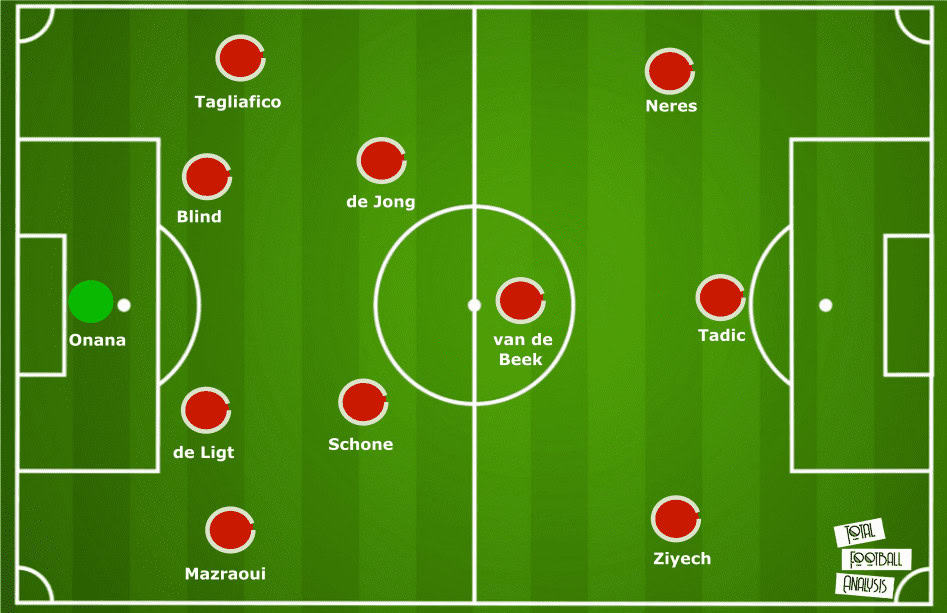
From this position, de Jong was the heartbeat of the Eredivisie champions. The main progression in the defensive third and mid-third was carried out by him, whether from progressive passes or progressive carries.
Ten Hag realized he had to discover the best role for de Jong to properly showcase that talent, noting that his quality is how he “makes the forwards perform better“.
Ten Hag used him mainly as a defensive midfielder, but that works a little differently at Ajax. He used him as a playmaker from deep.
Very often, he would drop in between the centre-backs to dictate the flow of the game. The goalkeeper would use him as an outlet. De Jong was the player who broke the first line of pressure and moved the ball forward with incisive, line-breaking passes.
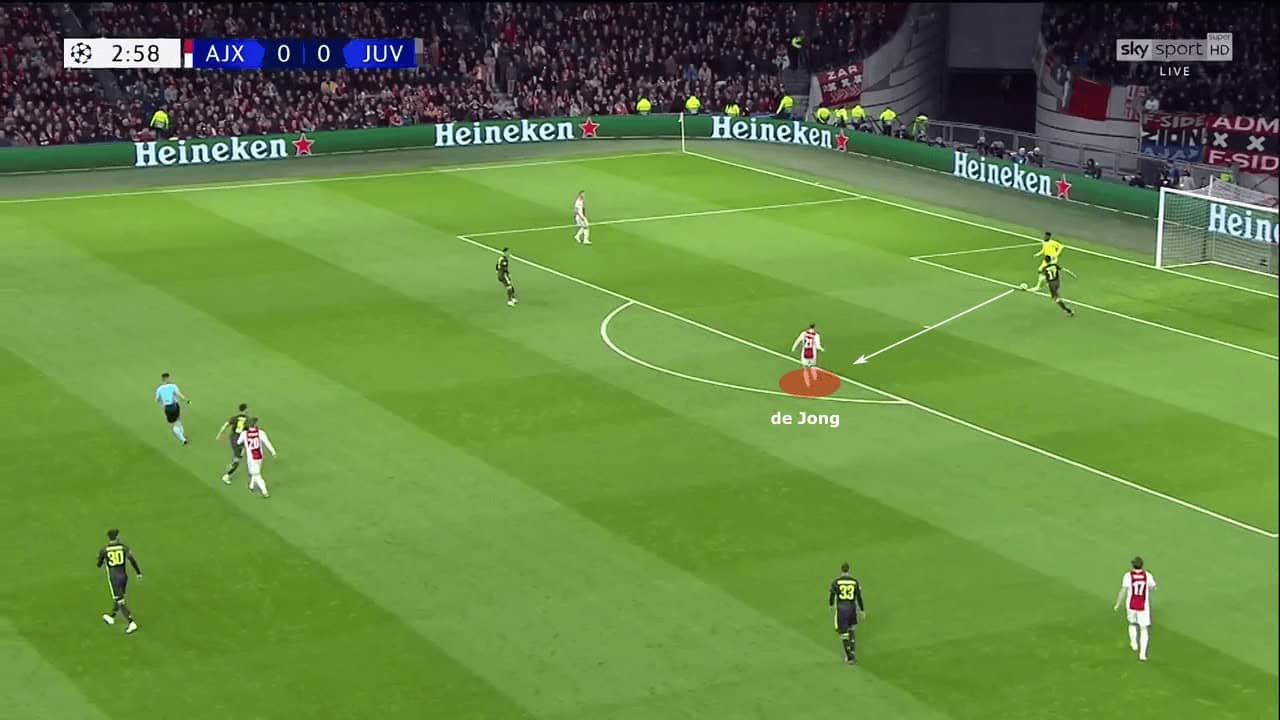
Once he collects the ball and turns, a 4v3 advantage is then created.
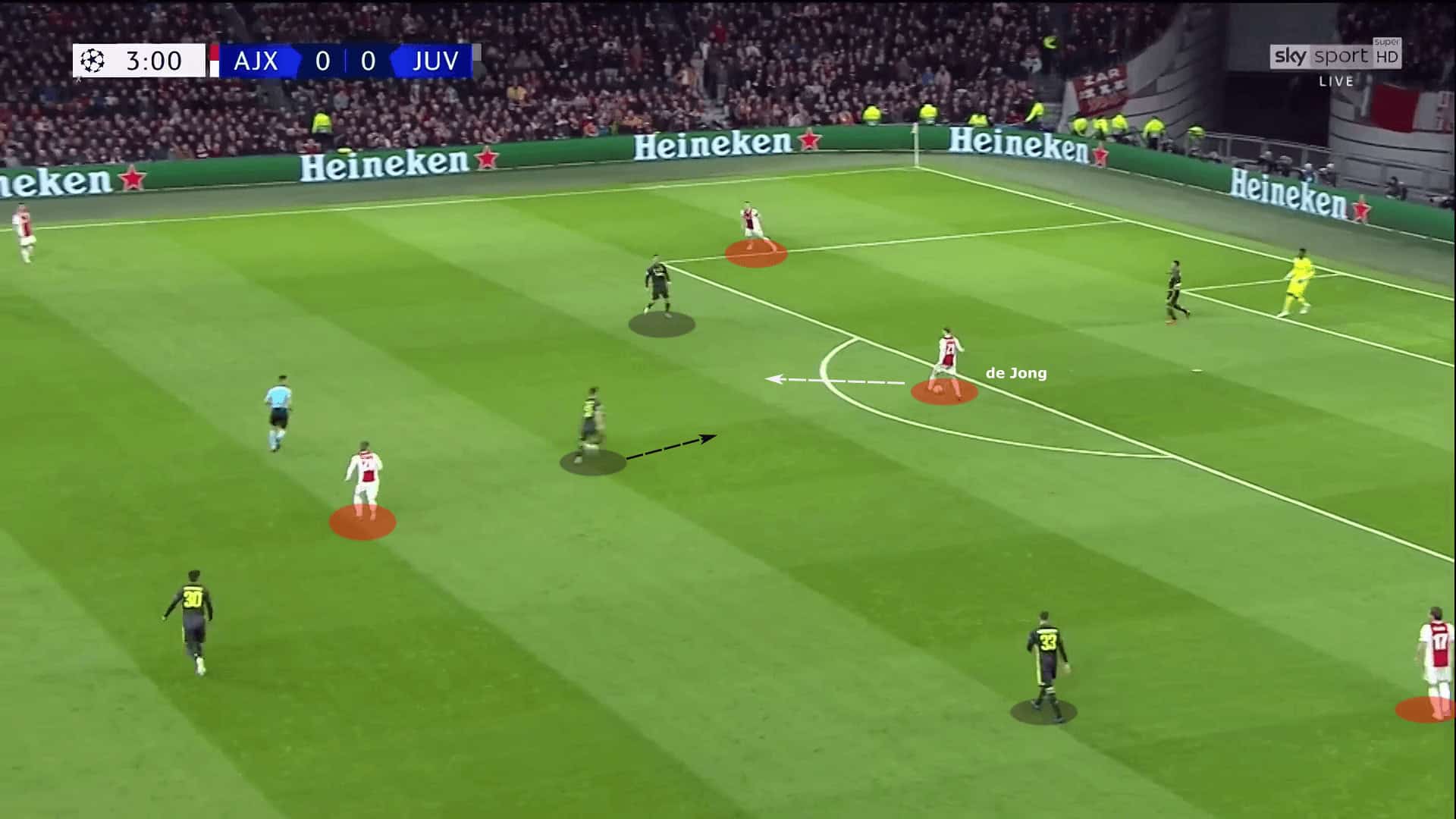
De Jong can then either perform his trademark drop of the shoulder and drive forward with the ball or pick out the extra man.
During his final season at Ajax, de Jong averaged 80 passes per game and performed more take-ons than every other player bar Hakim Ziyech.
Role at Barcelona
In his three seasons at Barcelona, he played in central defence nine times, as a holding midfielder on 36 occasions and a central midfielder 93 times.
He has been deployed further up the pitch at the Blaugrana, playing as the right or left-sided midfielder in their 4-3-3.
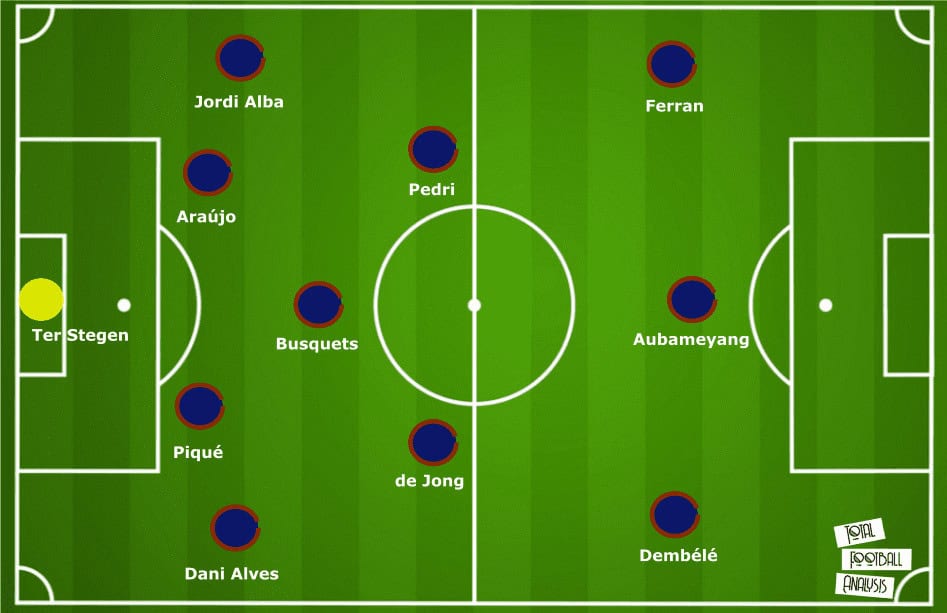
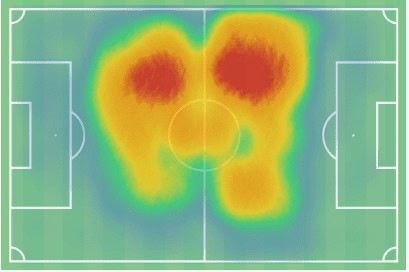
When bought in July 2019, de Jong was dubbed as the natural successor for Sergio Busquets. Three years in, and Busquets does not yet need succeeding, leaving de Jong, who was born to play behind the ball, to play in front of it as one of Barcelona’s advanced midfielders.
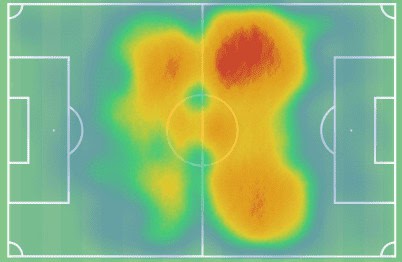
Comparing this heatmap to the Ajax one, it is evident how de Jong’s influence in the mid and final third has increased while his impact in the build-up phase in and around the defenders has diminished.
De Jong is mostly situated around the halfway line looking to be on the end of the line-breaking passes rather than being the one supplying them – Busquets is tasked with that role.
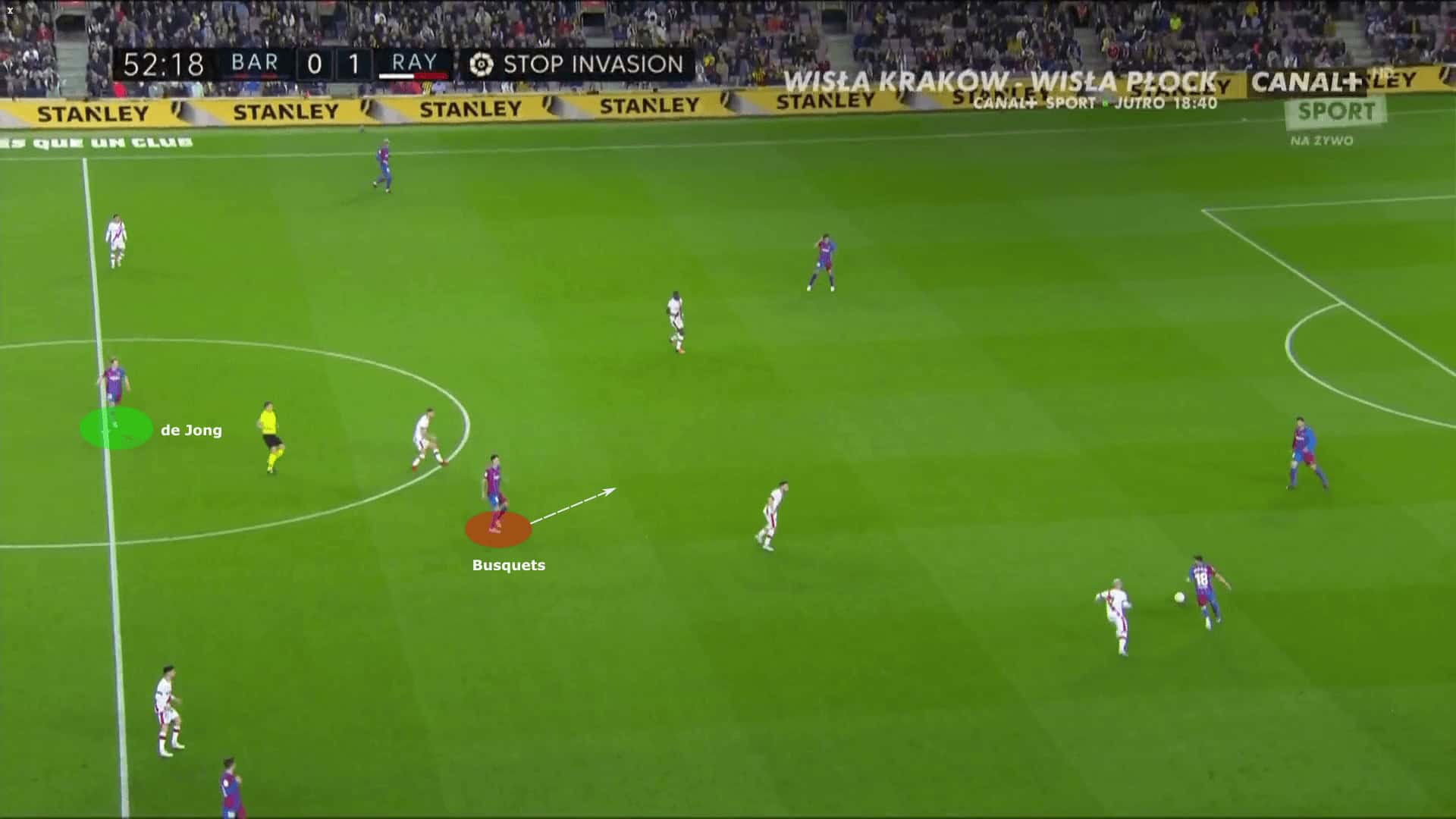
Due to this, de Jong has been more involved in the attacking phase of the game, scoring 4 goals and 6 assists in all competitions last season. He also averaged 1.93 touches in the opposition box per game this season compared to 0.97 touches in 2018/19 with Ajax.
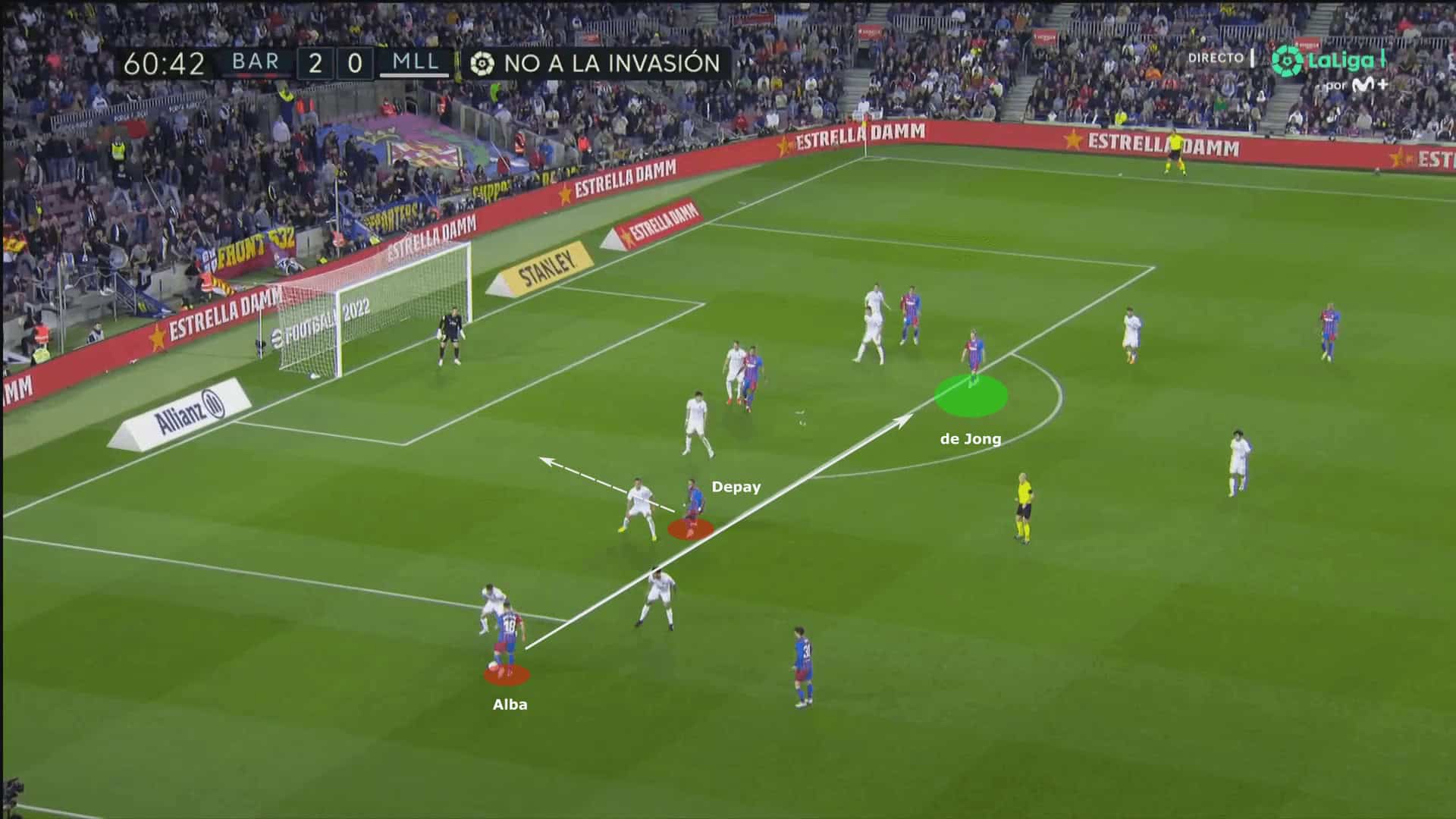
Further up the pitch, he would be on the edge of the area, not taking shots, but moving the ball on again, putting players into really neat positions inside the box, switching the play and using the wide areas.

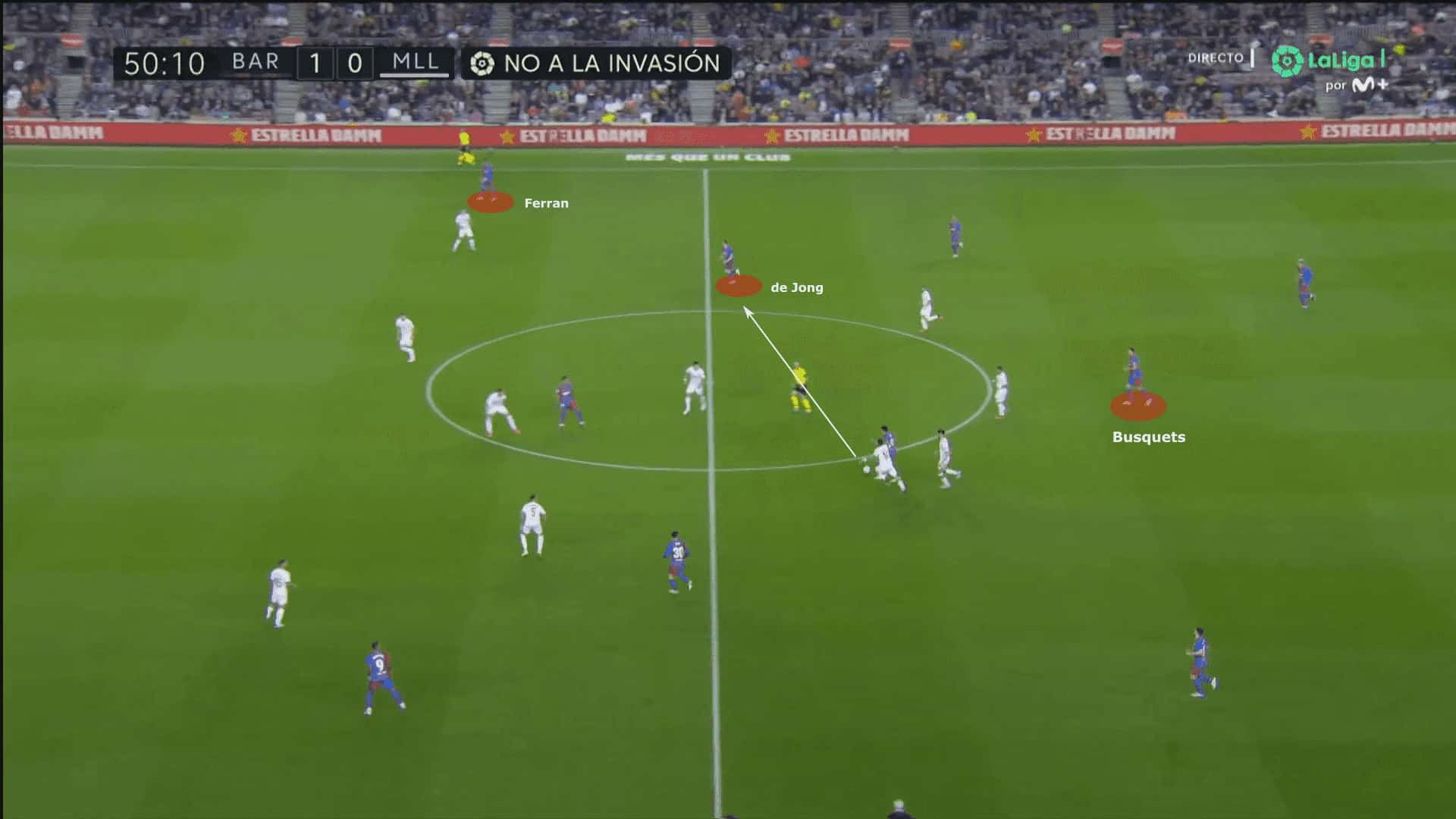
Below is another example of de Jong receiving the ball around the halfway line, penetrating forward to attract defenders, and releasing Ferran Torres in behind the back-line.

An area he needs to improve: “I don’t score much. Often I’ll dribble into a shooting position around the penalty area, but then I’ll pass. People say, ‘Why don’t you shoot?’ and I’ll think, ‘Next match I will’, but then I pass again. I think it mostly has to be a mental switch. I want to score, but I don’t really want to score. What I like much more is football itself, and playing the ball, and putting someone else in position to score.”
Despite showcasing his talent at his current club on a regular basis and keeping his place in the team under Xavi, de Jong’s preferred position is the deep-lying playmaker role – where he enjoys his freedom on the ball and is given the opportunity to dictate the tempo of games.
Potential role at Manchester United
Last season, United struggled to control games; an area former interim manager Ralf Rangnick stressed on repeatedly during his tenure. They averaged 52% possession in the league, the club’s lowest in the Premier League era. The side is very disjointed, they lack the quality, discipline and composure required to be able to successfully build up from the back, control the tempo and win the ball back quickly.
De Jong, if signed, will bring some sanity to a pretty chaotic midfield. United’s midfield is in desperate need of calmness and class – Fred and Bruno Fernandes have developed reputations for turning the ball over and making rash decisions.
The main question is: where will de Jong play? And who will play alongside him?
While de Jong might probably be the best profile to solve United’s issues in ball progression, he is probably going to need help alongside him to win the ball back. Frenkie is clearly in the top 10 midfielders for progressive actions, but he’s also in the bottom 5 for on-ground ball-winning actions. He can give you great progression but needs a ball-winner beside him to balance the midfield.
This means that it is hugely unlikely that he will be deployed as a holding midfielder or a 6 in a 4-3-3, but it’s possible.
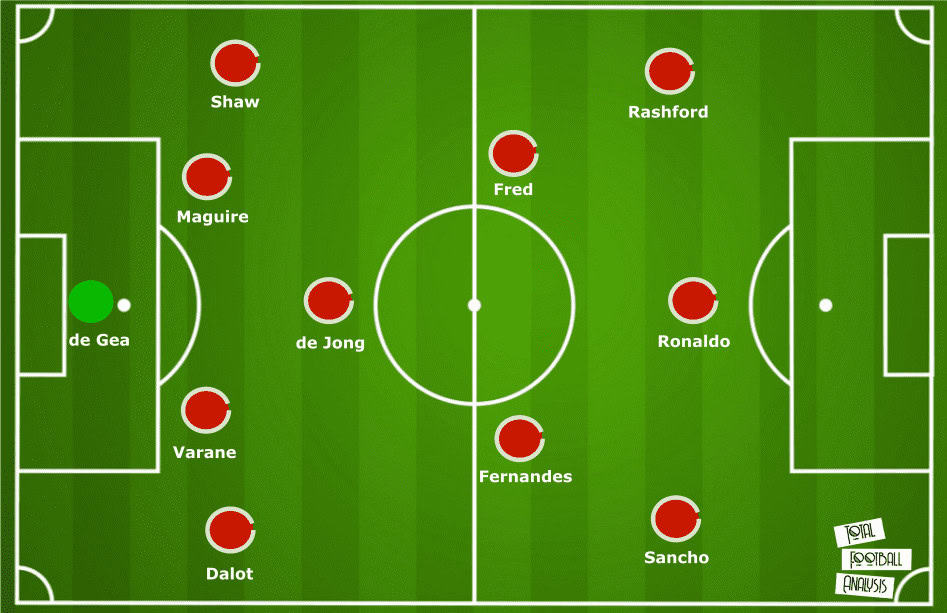
“So if you put him on 6, he’s away too often. But you need to give him freedom, otherwise, you can’t get the best out of him. It wasn’t an easy puzzle, so I decided to play with two number 6s and only one attacking mid. And in this way, we can also dominate the half-space, and force opponents to choose” stated ten Hag regarding his Ajax side of 2018/19.
This 4-2-3-1 system can be replicated at United with either Fred or Scott McTominay alongside de Jong. Fernandes or van de Beek will compete for the attacking midfield spot. It is likely ten Hag will set up this way as it better suits the players’ profiles and strengths.
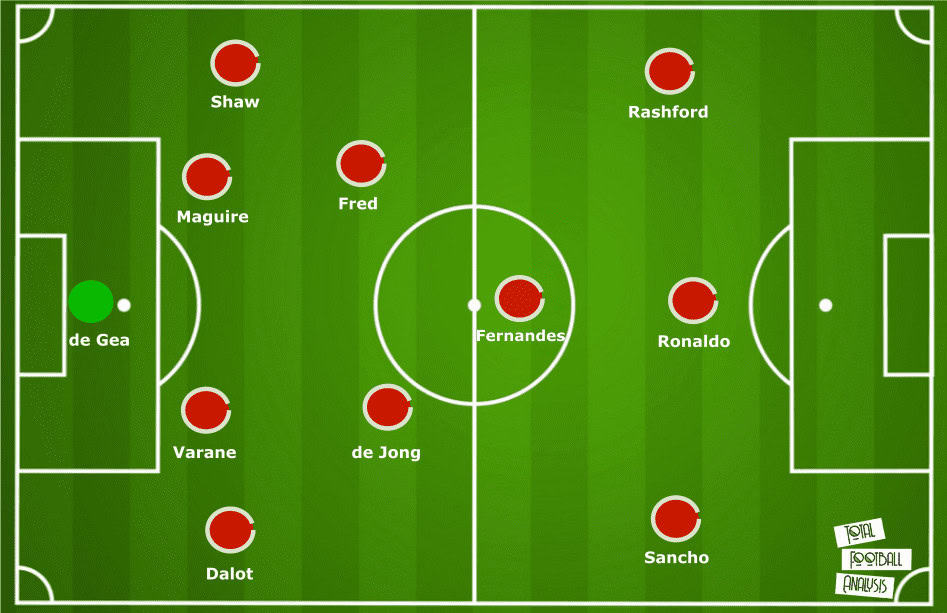
But do United need to sign a new proven ball-winner to complement de Jong and get the best out of him? Let’s look at McTominay and Fred’s profiles.
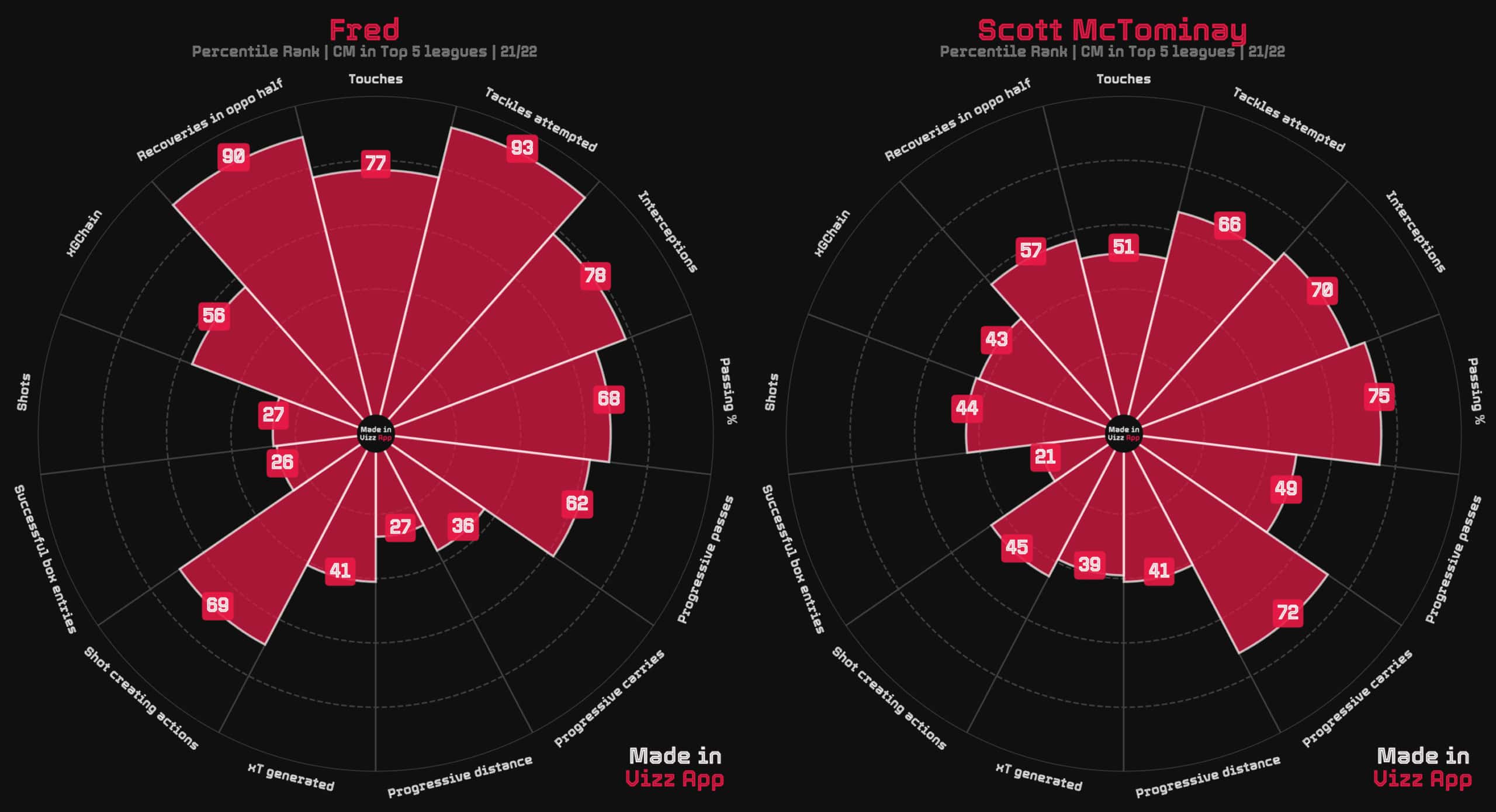
Both players offer much more than de Jong defensively, especially Fred with his high energy, attempting 5.35 tackles and making 1.43 interceptions per game. McTominay is more of a destroyer and is regarded as a box-to-box midfielder. United, however, cannot rely on him to start every match if they are to re-establish themselves as a top-four side.
Even though a Fred – de Jong partnership has a chance of working out, the Red Devils really should look at signing another midfielder if they are to compete with Liverpool and Manchester City. Fred, while being a good ball-winner, lacks the positional discipline required from a no.6. The Brazilian is better as an 8 than a 6, as his role for the National team has proven.
United should invest money in a defensive midfielder who can partner with de Jong and help improve their defensive transitional issues – something McTominay and Fred have failed to achieve so far.
Conclusion
As it stands, Frenkie de Jong is Manchester United’s number one summer transfer target. Erik ten Hag desperately wants to reunite with the midfield maestro and build the new-look United midfield around him.
As per reports, Manchester United have reached a broad agreement over a €65m (£56m) fee, plus add-ons, with Barcelona for the Netherlands midfielder. A deal is edging closer.
“He will be remembered if he leaves Barcelona this summer as the right man at the wrong time,” says Alan Feehely, editor of Football España.
