
The distribution of power in the Bundesliga appears to be set for another season, with Bayern Munich and Vincent Kompany dominating the league once again.
Behind them, things are shaping up a bit differently than people expected, with two teams chasing FC Bayern after the team struggled last season.
Borussia Dortmund are coming off a disappointing campaign, having reached the UEFA Champions League Final the year prior.
Following Nuri Şahin’s dismissal and Niko Kovač‘s appointment as manager, the team turned around its season and secured fourth place in the Bundesliga on the final day of the campaign.
This season, after a shaky 3-3 draw against FC St. Pauli to start the season, BVB won four straight league games without conceding a goal, drew away at Juventus, and won their first home game in the Champions League this year, convincingly against Athletic Bilbao.
For RB Leipzig, the coaching change happened after the 2024/2025 season.
After a disappointing campaign and missing out on European football for the first time since their promotion to the Bundesliga, the club hired former Werder Bremen boss Ole Werner as their new manager.
The young, yet experienced, manager had to cope with losing his star players Xavi Simons, Benjamin Šeško, and Lois Openda this summer, but started the Bundesliga season well.
On Saturday, the two teams clashed in the Signal Iduna Park in Dortmund, fighting for the title of Bayern hunter number 1.
In this tactical analysis, we will examine how the match unfolded, the tactics employed by Niko Kovač and Ole Werner, and whether the 1-1 draw was a fair result.
Borussia Dortmund Vs RB Leipzig Formations & Players Used
Niko Kovač brought a lot of ideas to Dortmund, but mainly, his 3-4-2-1 formation works out really well for them.
Gregor Kobel once again started in goal after not conceding in four straight Bundesliga games, with Waldemar Anton, captain Nico Schlotterbeck, and Ramy Bensebaini playing as the back-three in front of him.
Once again, the two wingbacks were Brazilian Yan Couto and young Swedish sensation Daniel Svensson.
In midfield, Marcel Sabitzer and Felix Nmecha formed a double pivot in front of their backline, with Maximilian Beier and in-form Karim Adeyemi playing as the two attacking midfielders for the Croatian coach.
The lone striker to top off the formation was Serhou Guirassy, the lifeline of Borussia Dortmund.
On the other hand, Ole Werner also brought about significant changes to RB Leipzig, abandoning the back-three formation of the previous season and establishing a 4-3-3 system, a formation he had already employed at Holstein Kiel to begin his career.
Péter Gulácsi remains Werner’s starting goalkeeper this season, despite a close call with the young Belgian Martin Vandevoort.
The four defenders were skipper David Raum on the left, Castello Lukeba as the left centre-back, Willi Orban as the right centre-back, and Ridle Baku as right-back after getting his call-up from Julian Nagelsmann for the German national team.
In midfield, Nicolas Seiwald played as a holding midfielder, with Assan Ouedraogo and Christoph Baumgartner playing as the two central midfielders in front of him.
The newly-formed attacking line this season consisted of Romulo in central attack, with Antonio Nusa and Johan Bakayoko playing on the wings, after Yan Diomande missed the bus to the away game and was therefore rotated to the bench by Werner.
RB Leipzig Dominating With Their Press
The game started with high intensity, but not with many goal-scoring opportunities right away.
Borussia Dortmund attempted to gain control of the game by maintaining possession, but RB Leipzig quickly disrupted that plan with effective defensive work.
Ole Werner had a clear plan for his team in all situations.
While they didn’t control possession, they managed to get their foot into the game better than BVB did.

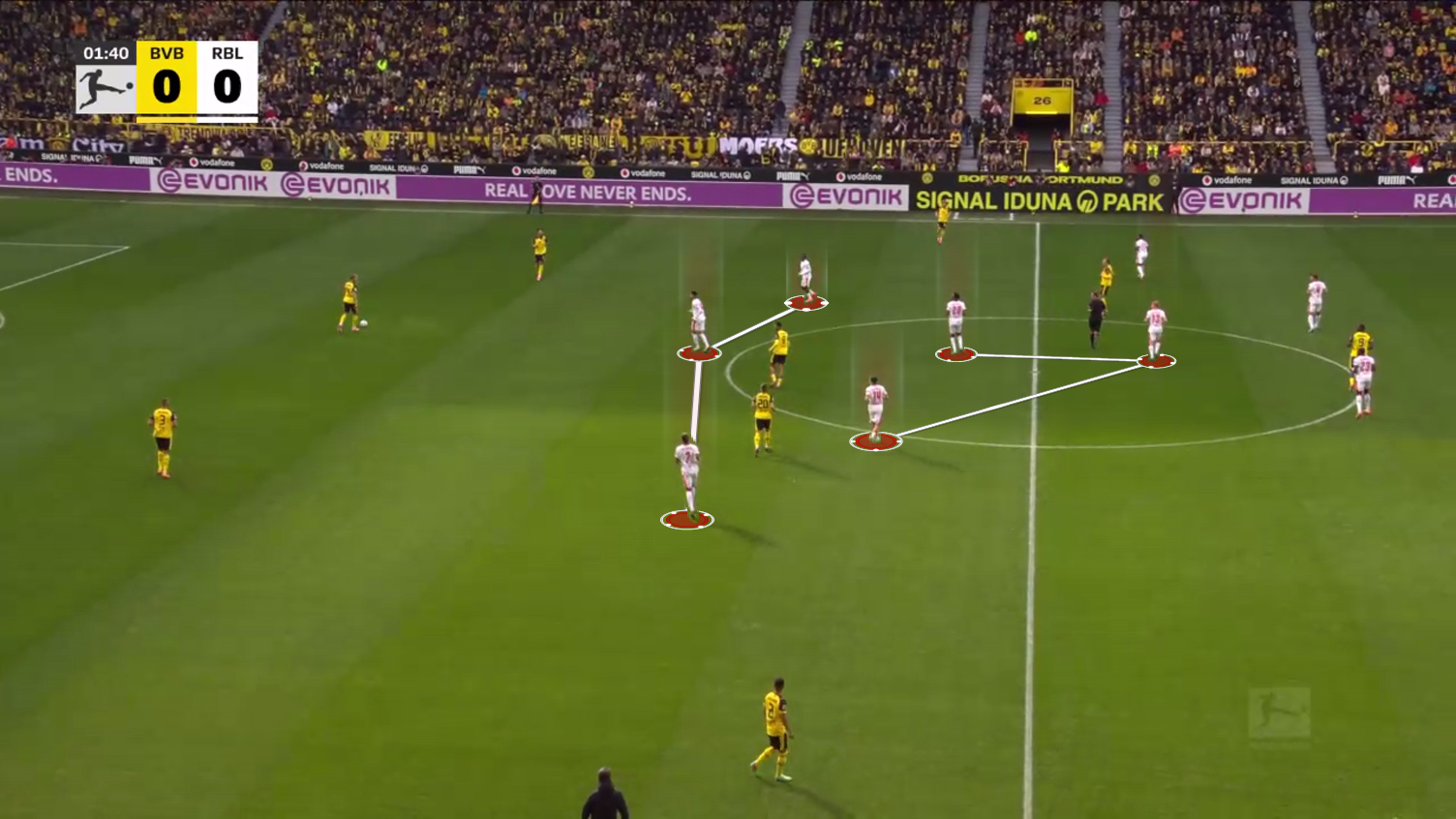
In Line 1, Dortmund consistently attempted to play out from the back with four defenders and their two midfielders, but Leipzig were well-prepared for it.
Instead of staying in their 4-3-3 formation, they pushed Nusa into the attacking line and Baumgartner to the left side, forming a 4-4-2 shape.
This allowed them to quickly press the first pass of BVB.
Kovač had his men play the first pass from the centre-back to the goalkeeper, and Werner had his men pounce on these passes immediately.
The near-sided striker triggered the press right after the pass had been played, completely cutting off that side of play.
The other striker then pressed the centre-back.
It was a 2-v-2 with man-marking in the midfield.
The two outside midfielders controlled the two full-backs, allowing RB to press every possible pass from there on.
BVB struggled immensely with playing through that and were forced into many long balls in line 1, allowing Werner’s team to prevent them from establishing possession.
In Line 2, RB again shaped up in their basic 4-3-3 formation with a holding midfielder.
Unlike in line 1, BVB builds up with their back-three in line 2 and with their 4-3-3 formation, RB were able to control all three centre-backs with one attacker.
Overall, their shape was very narrow.
They controlled the centre of the pitch, prevented the centre-back from dribbling into midfield, and cut off the passing lanes towards the double pivot, forcing Dortmund to build up through their wings.
Instead of aggressively man-marking in the midfield, they now positioned the two central midfielders in the gaps between their attackers, cutting off the option for vertical passes in the channel towards the two attacking midfielders.
Seiwald covered the space in front of the backline.
Dortmund lacked ideas to break through the midfield press at the start of the game.
Therefore, RB Leipzig were also able to establish a lot of security there, forcing BVB to play through their wingbacks most of the time.
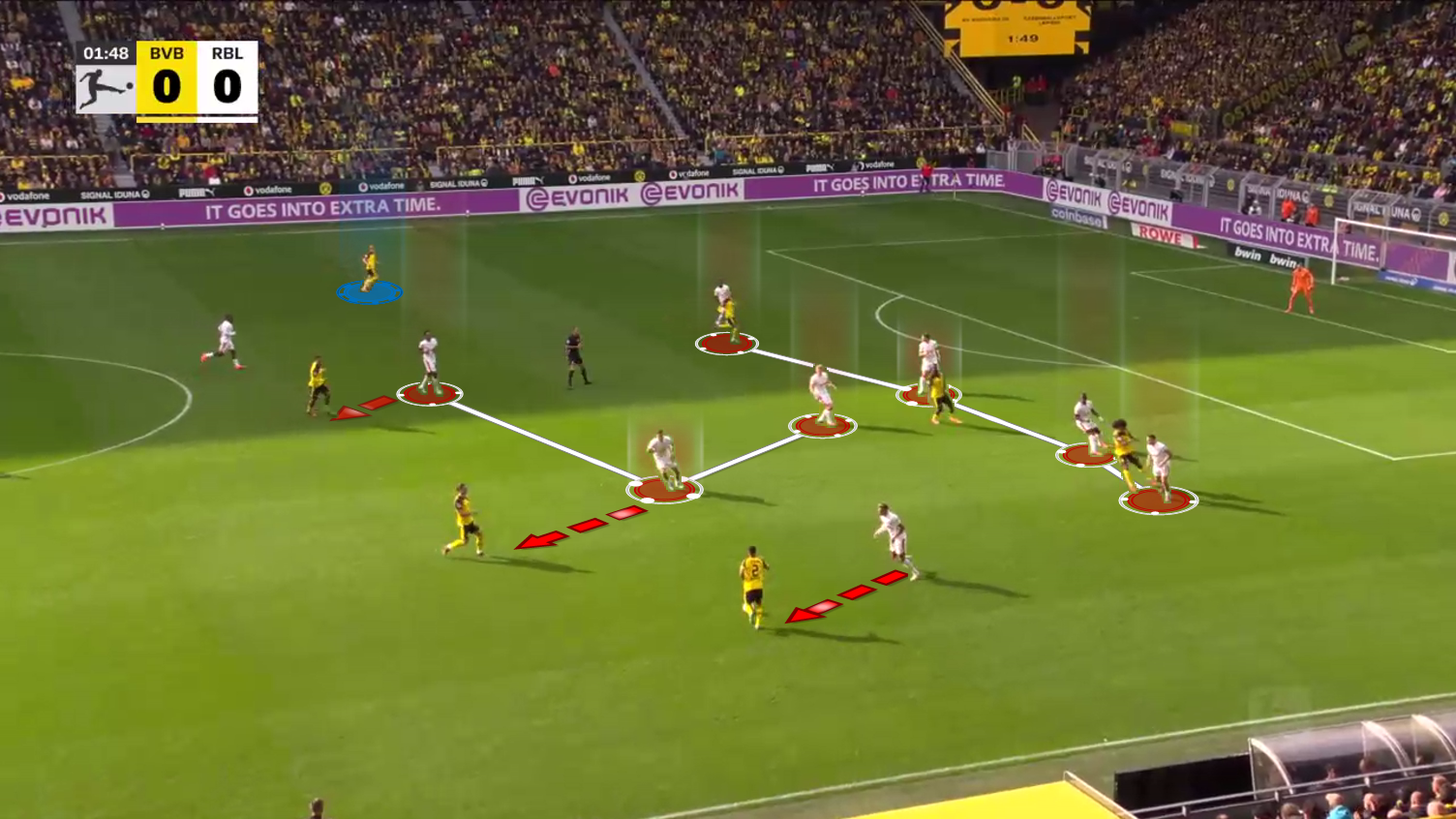
When Dortmund was forced to play through their wingers, Werner had his men revert to the man-marking most of the time.
Once again, the two central midfielders controlled the two Dortmund midfielders.
The two wingers dropped back to create a 4-1-4-1 and pressed the wing-backs.
The back four was able to play plus one against the three attackers, with Seiwald being the open man to protect the space in front of the backline and collect second balls.
Through their defensive stability, Leipzig managed to force Dortmund into numerous losses, and with their quick players, they were able to exploit them on the counter.
They got in front early after Dortmund defended a long chipped ball badly, with Baumgartner scoring the lead.
However, they later gave it away after Svensson broke through on the left side for once, and Couto was able to finish from the penalty spot.
Romulo scored another counter but was called back for offside, so the game was nearing half-time with a 1-1 draw.
Dortmund Defending Well
Overall, the first half did not see many goal-scoring opportunities.
RB Leipzig looked dangerous on the counter, but Borussia Dortmund defended really well against them in possession.
Just like Ole Werner, Niko Kovač had his men very well prepared for what they were going to face off against.
They knew how to approach defending this pacey and intense team.
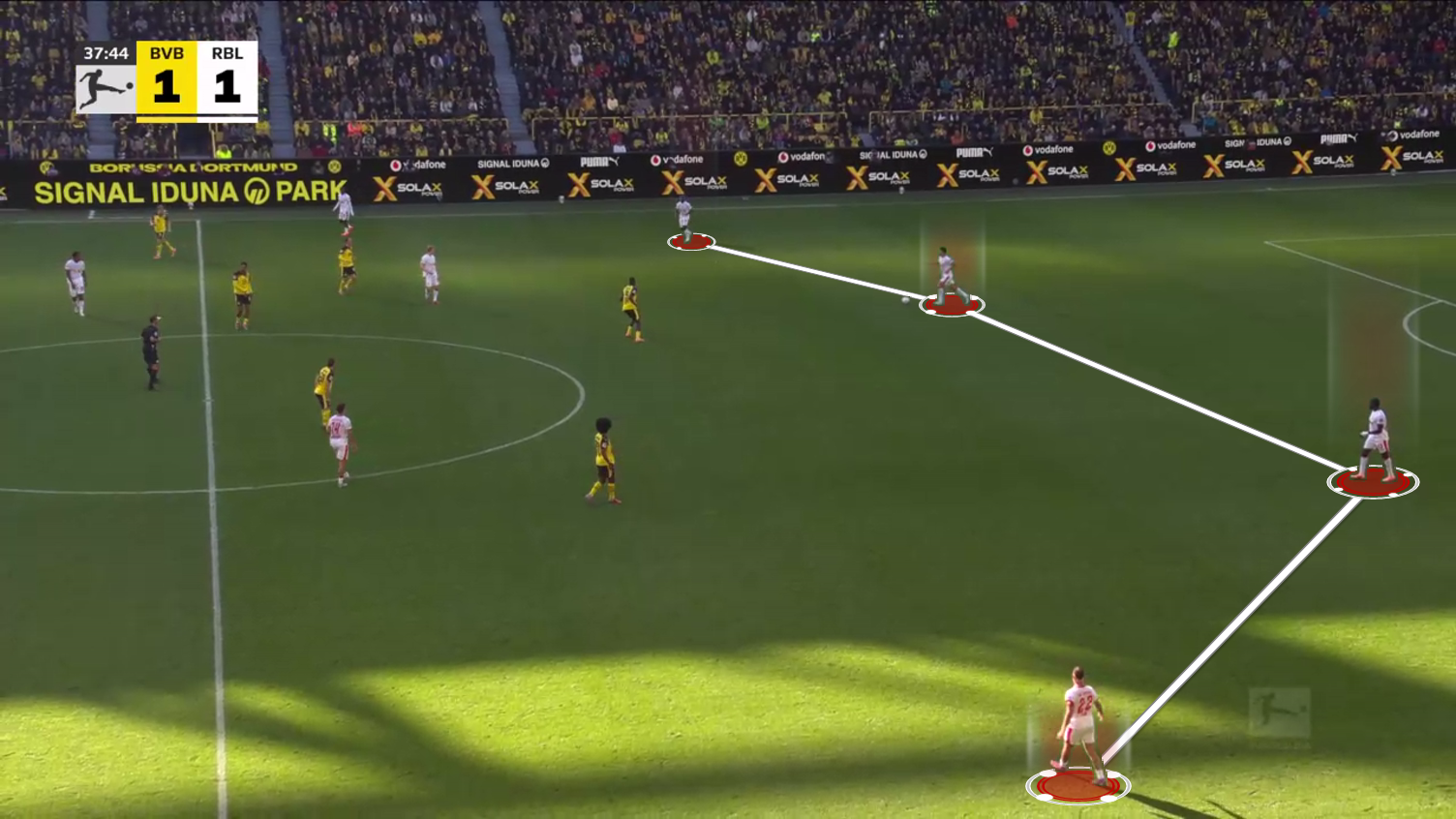
Ole Werner had his men build up with their back four in both lines, with the full-backs positioned very wide and the centre-backs on the edge at all times.
Dortmund stayed incredibly patient at all times and never triggered their press too early, knowing they needed to cope with the numerical disadvantage in central midfield.
Kovač used his double pivot to cover Seiwald and Baumgartner, while Ouedraogo tried to find space between the lines.
His teammates were rarely able to find him because BVB defended the channels very well.
They never got too stretched out by the full-backs and were able to hold their block solid in the centre, also preventing RB Leipzig from doing much with the ball.
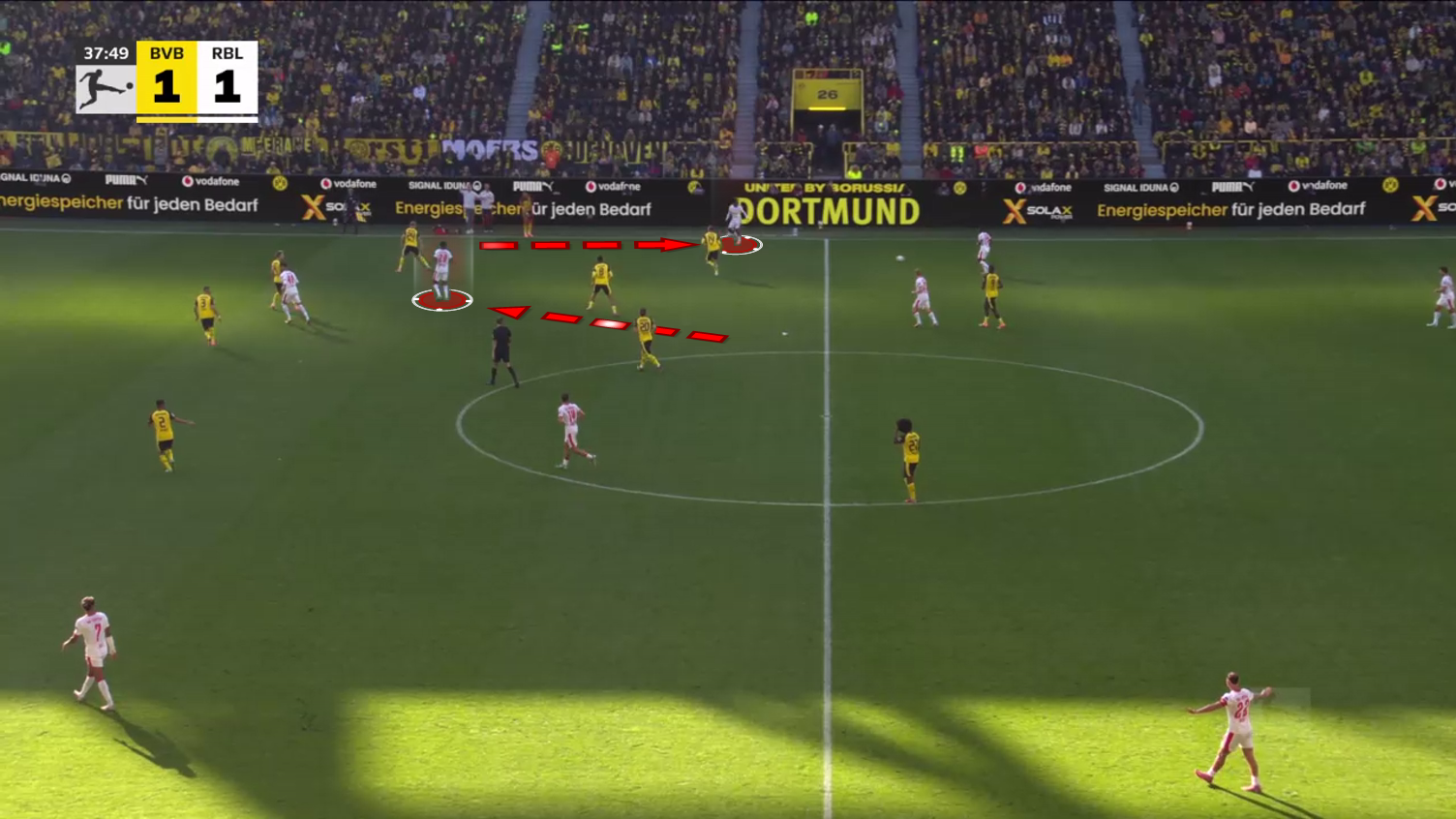
Ole Werner is a fan of a rather clearly structured way of playing in possession; his Werder teams always knew what to do, and he gets his players into good positions according to their strengths.
However, he does not leave much responsibility in the build-up and transitional phases to his players.
Kovač knew that, and he analysed Werner’s style of play well, being prepared for the young coach’s opposing movements in midfield.
They often played through Baku on the right side, with Bakayoko dropping back to receive a short pass.
At the same time, Ouedraogo was moving up the pitch in the space behind the midfielders, ready to receive between the lines, and striker Romulu was ready to make a run behind the defender following Bakayoko.
The BVB players were well-prepared for this and never got dragged out of their positions too early or without adequate coverage.
This forced Leipzig to play under pressure often, which led to many Leipzig losses.
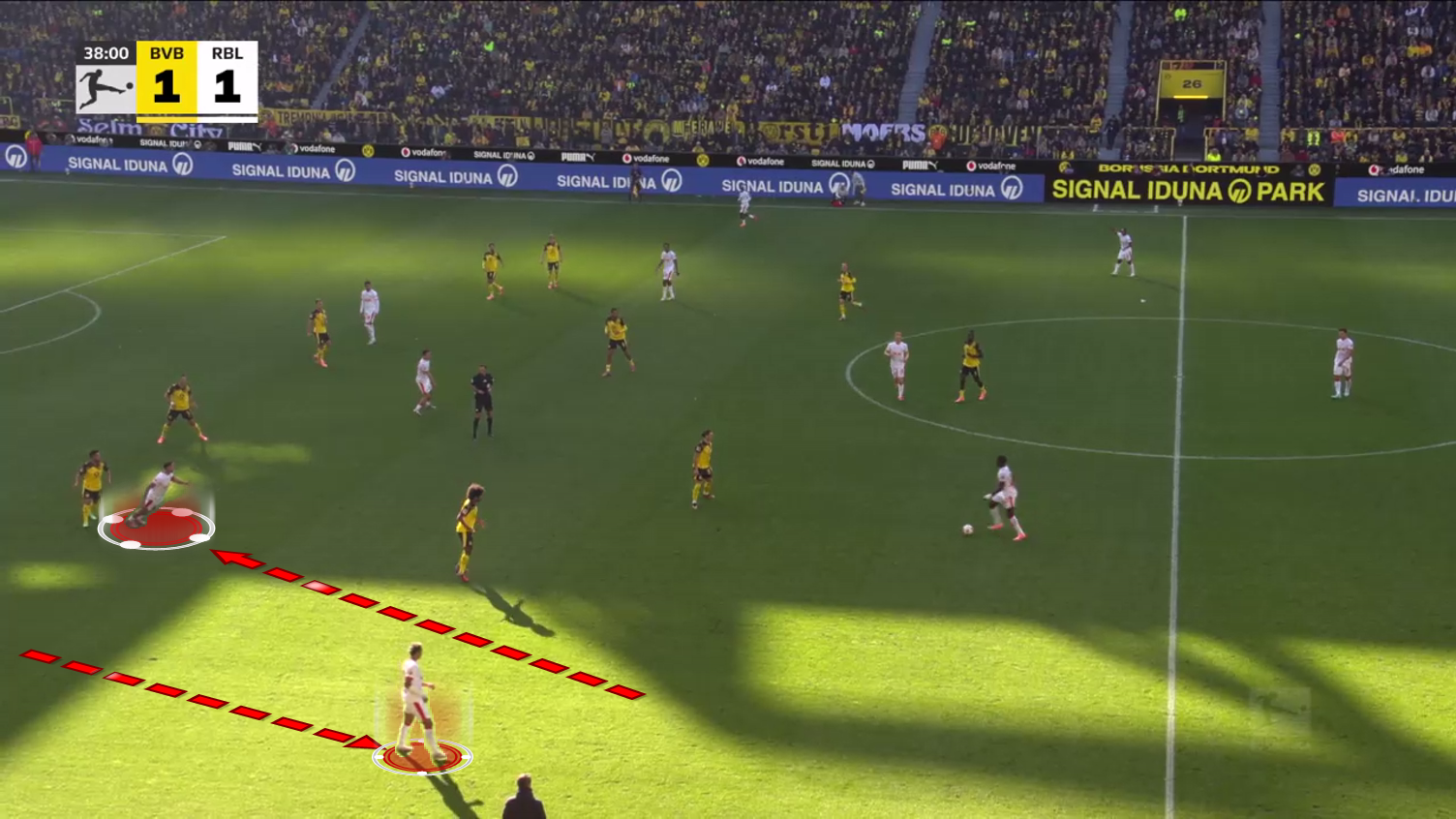
Leipzig found more success on the left side, where they played with a bit more variation.
They also dropped the winger back towards the fullback, but they did not play through Raum; instead, he moved up the field to receive passes in the final third and utilize his dangerous crossing ability to hurt Dortmund, with Romulo making far-sided runs into the box.
They found Raum rather often, but the captain did not have a great first half.
Werner’s team also managed to find more solutions to Baumgartner between the lines compared to Ouedraogo on the other side, so it was no wonder their goal also came from a pass to the left side.
More Risk After Half-Time
In the second half, both teams made significant adjustments to their opponent’s defense, which led both coaches to the same conclusion: defend more aggressively and take more risks.
Coming out of halftime, RB Leipzig looked incredibly dangerous.
After the restart, they quickly picked up the pace and intensity, creating three good opportunities while playing through the higher Dortmund press.
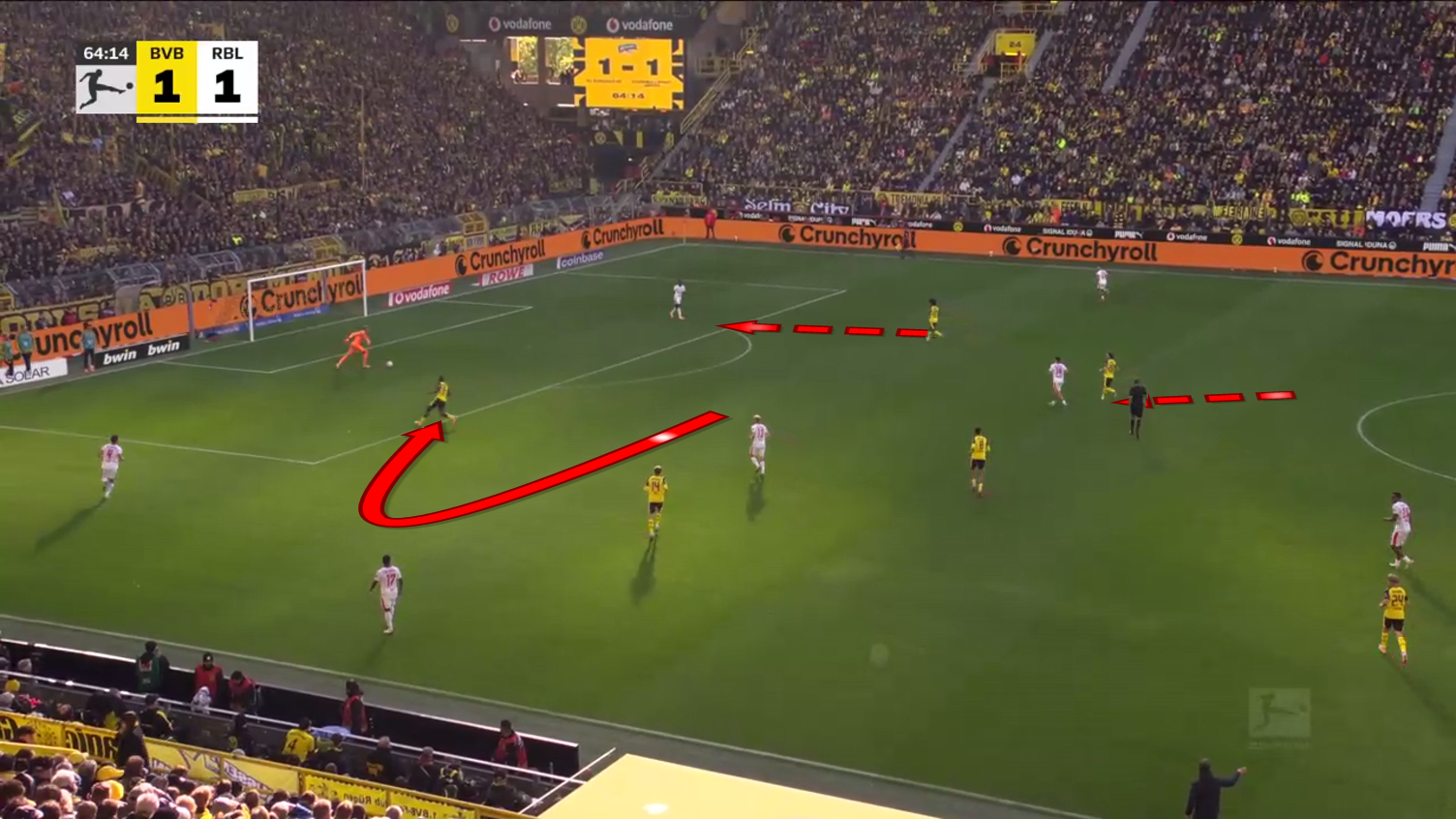
Kovač’s men weren’t as patient anymore, triggering their press higher up the pitch and more frequently than in the first half.
Guirassy often curved his runs now to attack the goalkeeper and cut off one side of play, with Adeyemi and Beier now controlling the two centre-backs.
The double pivot now also pressed forward, controlling Leipzig’s three midfielders together with the now far-sided attacking midfielder, in this case Maxi Beier.
They left one full-back open, trying to force Gulacsi into the tough pass towards him, and then pressing near the sideline.
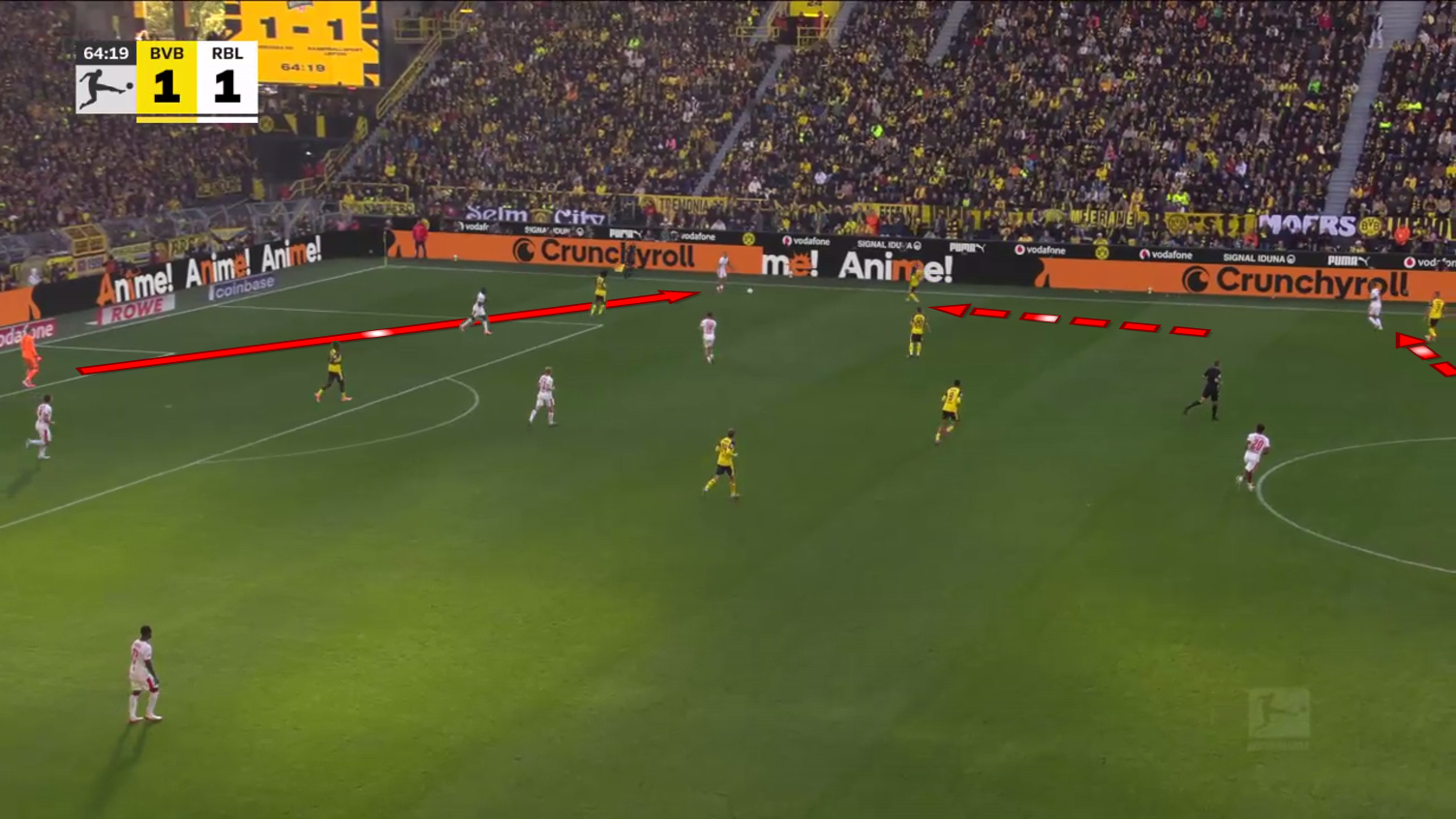
Now, Gulasci was the one who had to play more long balls all of a sudden.
If he played it short, he chipped it to the full-back.
Dortmund now aggressively shifted to that side as a collective, creating a numerical advantage there and being able to put more pressure higher up the field.
In these situations, Seiwald showed a lot of class and often got his team out of pressure, but otherwise, they struggled significantly with beating the press.
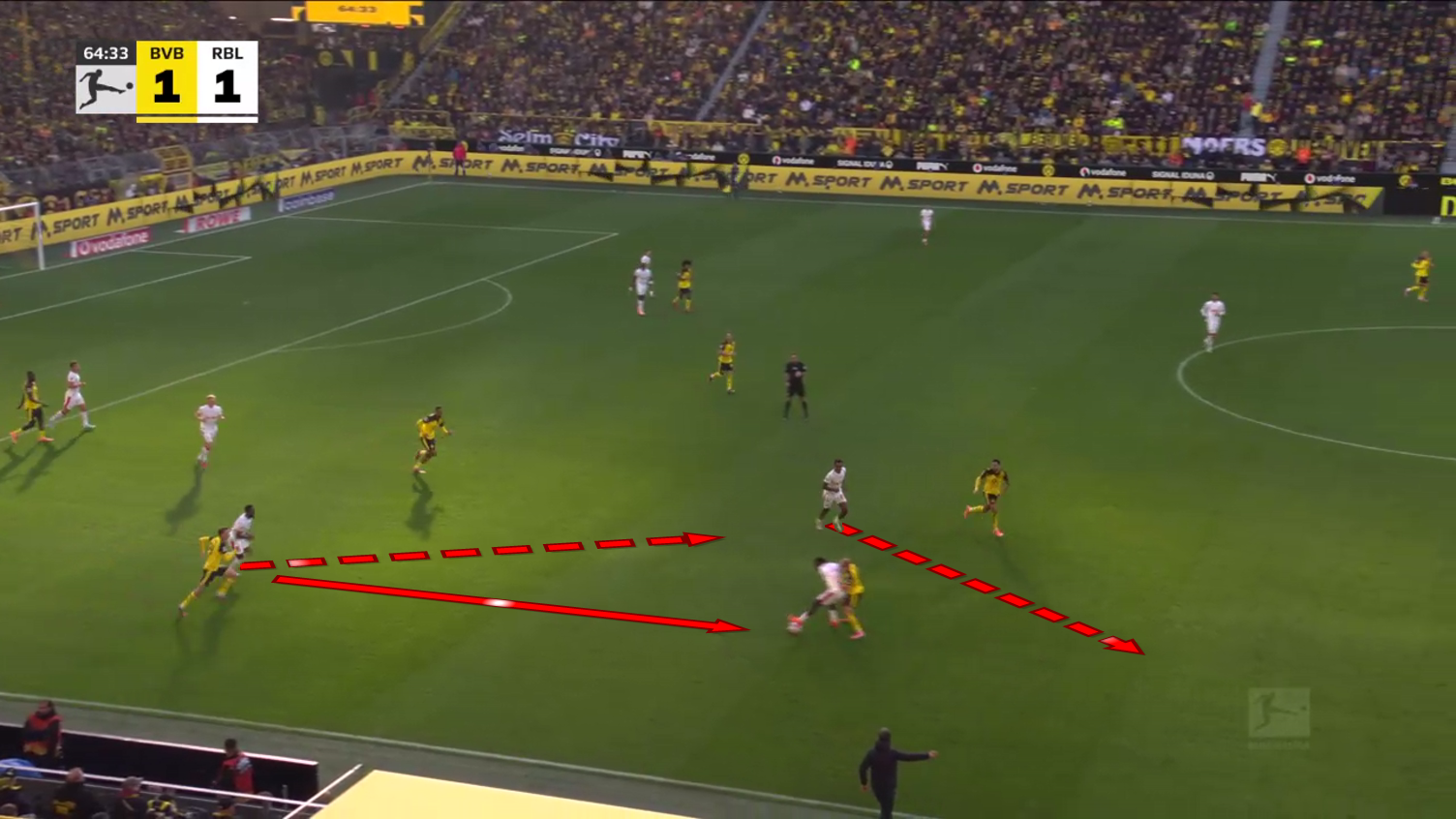
However, if they managed to beat the press, they were easily able to exploit the high backline of Dortmund with their pacey attackers.
Often, they played with vertical passes through the wings.
Baku played the ball straight down the line to the backdropping Bakayoko and moved inwards, while midfielder Ouedraogo now sprints down the line into the space behind Bakayoko, once again opposing movements.
Bakayoko showcased good hold-up play in these situations and was able to get the ball back to Baku more often than not. From there on, Werner’s men used their pace to hurt Dortmund.
But Kovač’s men got a grip about seventy minutes into the game, and their press started to work better.
BVB had a couple of good opportunities for the last few minutes, but just like Leipzig at the start of the second half, they wasted them carelessly, and the game ended in a draw.
Conclusion
The 1-1 draw is a relatively fair result, even though RB Leipzig looked more dangerous throughout the game.
Both coaches prepared their teams well, and both teams defended really well in the first half.
This resulted in a game with limited good opportunities, but both teams managed to score a goal.
In the second half, Werner and Kovač both attempted to take more risks, and both teams had opportunities, but failed to convert them, ultimately giving the final edge to neither.
The draw showcased both teams’ abilities, and I think both teams will stay in the top four until the end of the season.
However, after the FC Bayern win later on Saturday, one point does not really help either team chase down the giant from the South.
