
For the longest time, the footballing power in Hamburg was rather easily settled.
Hamburger SV was the city’s biggest club, while FC St. Pauli was the little brother that no one really believed in.
Despite having a fascinating history and a fair bit of success in the 2. Bundesliga, St. Pauli never really impressed in the Bundesliga for the longest time, never playing more than three consecutive seasons in the German top flight.
When the club managed to get promoted back to the Bundesliga after 13 years in 2024, expectations were rather low for that reason.
Young head coach Fabian Hürzeler decided to leave the club after the promotion, joining Brighton & Hove Albion in the Premier League, and top scorer Marcel Hartel joined St. Louis in MLS, so the outlook wasn’t great.
Still, under the new coach, Alexander Blessin, St. Pauli impressed in their first season back in the Bundesliga, avoiding relegation and even fielding the second-best defence in the league, second only to champion FC Bayern.
While this meant that some of their players received interest from bigger clubs and decided to leave, it also allowed the club to really invest in its squad for the first time in years.
Now, after three matchdays, St. Pauli and Blessin sit in fourth place in the Bundesliga with seven points from those games.
They decisively beat rival Hamburger SV in their stadium.
In this St. Pauli tactical analysis, we will examine Alexander Blessin tactics at St. Pauli, what they are doing well to start the season, and what we can expect from the team moving forward.
Alexander Blessin Tactics
Looking back at last season, it was rather obvious why St. Pauli under Alexander Blessin management managed to stay up.
As stated earlier, the team conceded only 41 goals in the 34 Bundesliga matches last season, ranking second in the league behind Bayern Munich.
Of course, their defensive ability secured them most of their points.
What’s interesting about their defensive work is that, unlike how you would expect a freshly promoted team to defend, St. Pauli did not just fall behind the ball into a deep block but played with a rather efficient attacking and midfield press for most of the season.
It’s not surprising considering their coach, Blessin, comes from a Red Bull background at Leipzig and from the expanded coaching tree of Ralf Rangnick.
However, it was still interesting to see an underdog play this aggressively.
There are a lot of interesting ideas to unpack in their press, and the team once again showed their proficiency against the ball in the game against FC Augsburg last weekend.
Blessin usually lines his team up in a 3-4-3 formation, but ever since the backend of last season, he has played with a false nine in Daniel Sinani, and it even shows against the ball.
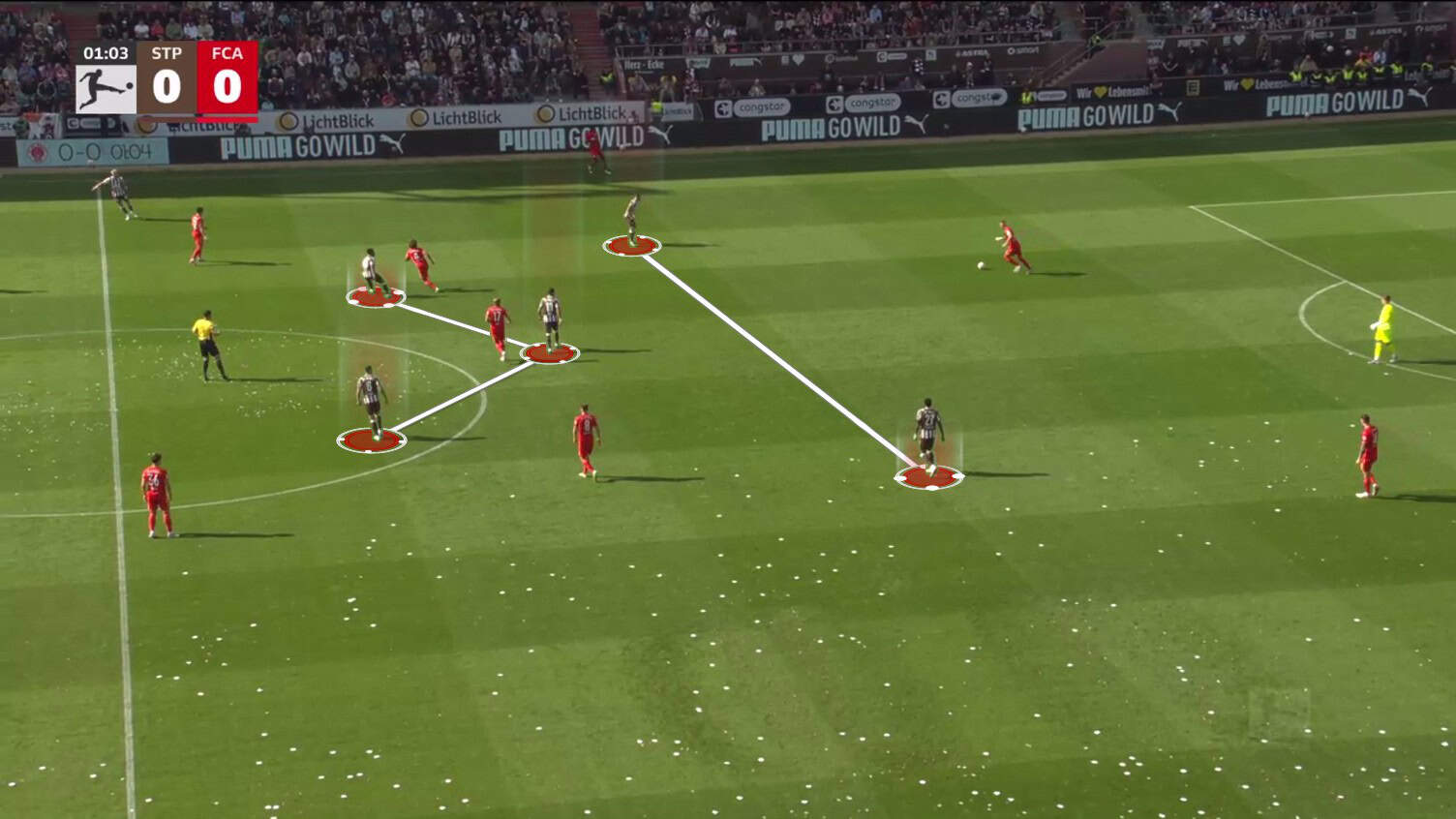
Looking at what they did against Augsburg, if they were forced to attack in the second line, the team actually shaped up in a 5-2-1-2 formation with Sinani falling back into the midfield.
The two strikers now stayed rather wide, positioning themselves in the half-space, while the now three-man midfield was playing man-coverage against the three opposing midfielders, pretty much closing off the centre of the field and even preventing vertical passes down the channel in the half-spaces.
Another very positive thing about their play in these situations was their patience.
Blessin has given his players clear tasks and pressing triggers.
The players understand the importance of stability, so they rarely make mistakes by triggering their press in the wrong situations.
Instead, they keep their block closed and limit their opponents’ options.
St. Pauli is not a team that falls for teams that attract the press and get dragged out of position; they know exactly what they need to do to win their games, and it shows.
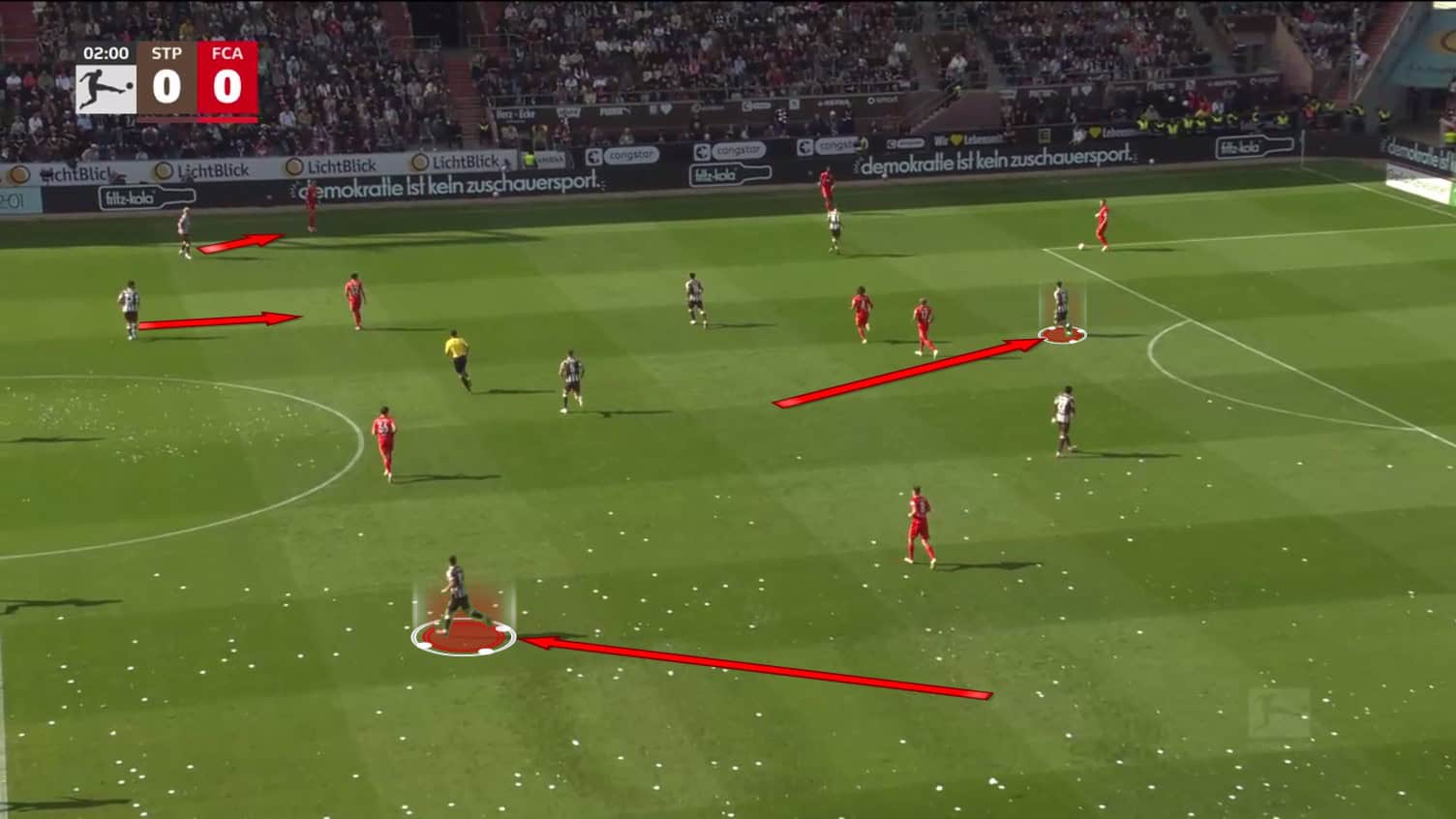
What’s interesting is that if they get the chance to push forward into their first line of press, Sinani is always the one triggering them to push up the field by moving back into his striker position and attacking one of the centre-backs.
He cuts off one side of the pitch, effectively forcing passes to the full-backs.
Blessin has his men prepared for those situations.
Looking at what happens on the field, the picture above shows the two midfielders still man-marking the double pivot of Augsburg, the near-sided wing-back pushing forward, and even the near-sided centre-back moving forward.
Both are ready to press the players on the wing and in the half-space quickly.
Still, they are not overcommitting to their press, with one side of the field being cut off, the far-sided wing-back is moving back into the backline, covering the space behind the midfielders.
The two players on the double pivot are also not too aggressive, playing in space rather than getting dragged out completely.
The far-sided one always secures the near-sided player by playing a couple of metres behind him diagonally, preventing switches to the far-sided half-space.
St. Pauli are vulnerable to switches in these situations, but opposing teams need to have a lot of quality on the ball in their first line of play to get out of these situations quickly enough to use that to their advantage.
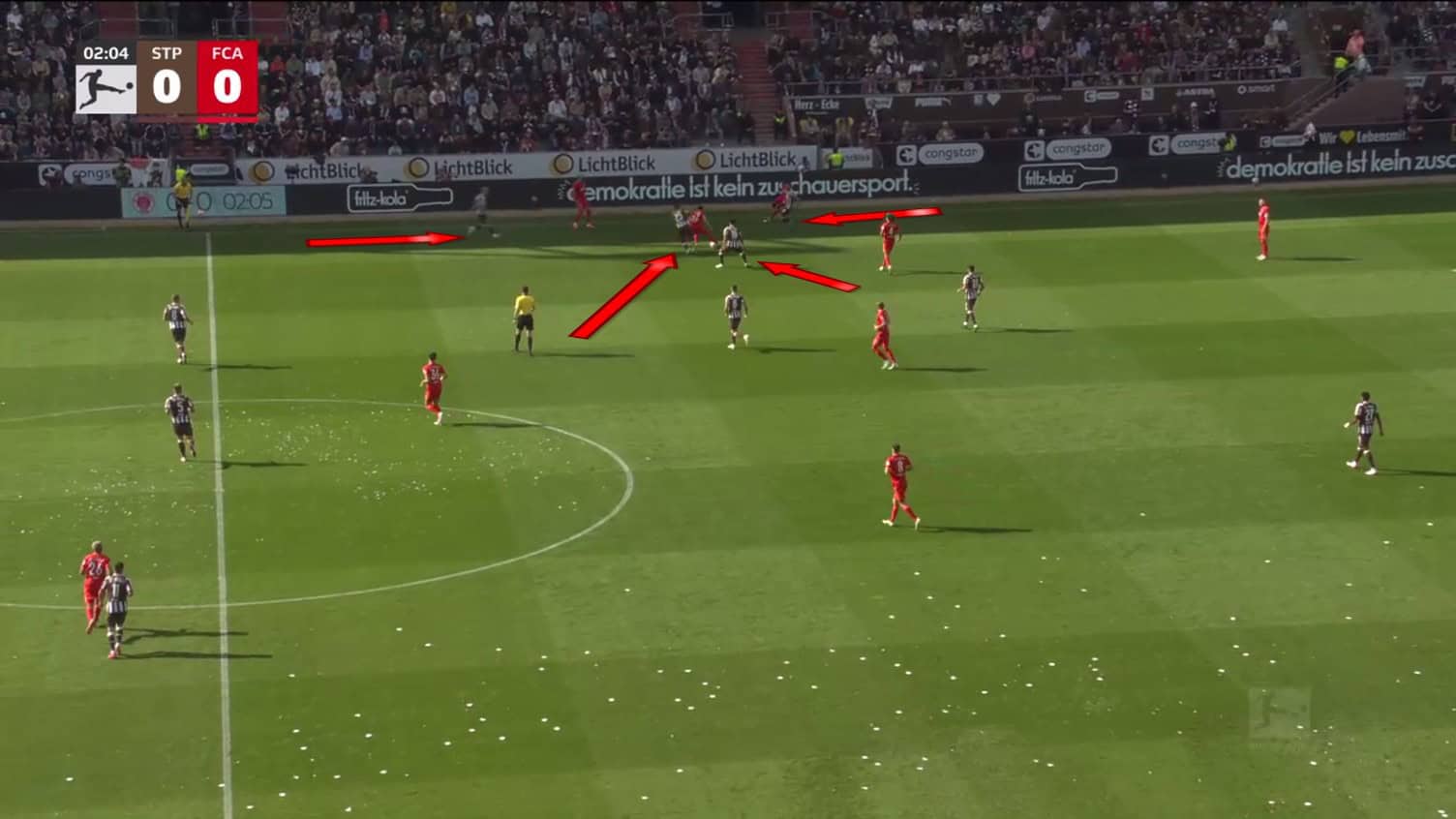
In the end, most situations end with their opponents passing to their full-back on the wing, and that’s the most decisive trigger for Blessin’s men to start pressing aggressively.
It’s a rather traditional trigger, but it works very well for the team from Hamburg; the sideline is cutting off options on one side, while the options in the field are now being pressed by the Pauli players on the jump.
There is no passing option for Augsburg left here; St. Pauli will always manage to get into a duel and even has the numerical advantage on that side of the field, resulting in them often winning the ball there.
It’s impressive to see that Alexander Blessin hasn’t just carried over their strong defensive approach over the summer; he even managed to add more finesse to it, and now, once again, he has formed a very good pressing team.
While they conceded three goals in their opening game against Borussia Dortmund, St. Pauli held HSV to zero goals and Augsburg to just one goal, eventually winning both games.
This proves that their defensive approach is effective in crucial games.
Alexander Blessin Weaknesses
Despite being a strong defensive unit, St. Pauli and Alexander Blessin only managed to finish 14th in the final Bundesliga table this past season and only collected 32 points through 34 games, which is not that impressive.
Their elite defensive work makes it rather obvious in which areas they struggled last season; their attacking play was horrendous at times.
In the end, Blessin’s men only managed to score 28 goals, so not even one goal per game, which is simply not good enough.
To add insult to injury, their best attacking player, Morgan Guilavogui, had to return to RC Lens in France, leaving them with a huge hole in their attack.
The club reacted in the summer transfer window, signing three attacking players: two strikers, Martijn Kaars and Andréas Hountoundji, and attacking midfielder Mathias Pereira Lage.
Additionally, after Philipp Treu‘s departure, the team signed two new full-backs, Louis Oppie and Arkadiusz Pyrka, in an effort to add more attacking power from their full-back positions.
Blessin knew he had to make tactical improvements as well, but the team was still one of the worst in the league in terms of individual class, so the coach suggested getting back to basics and keeping things simple yet efficient.
What’s really interesting is the fact that St. Pauli managed to have more possession in every game so far this season, even against Borussia Dortmund or away at HSV.
Blessin is a Red Bull coach through and through, so for him to coach a team that actively wants possession is something that wasn’t really expected before the season started.
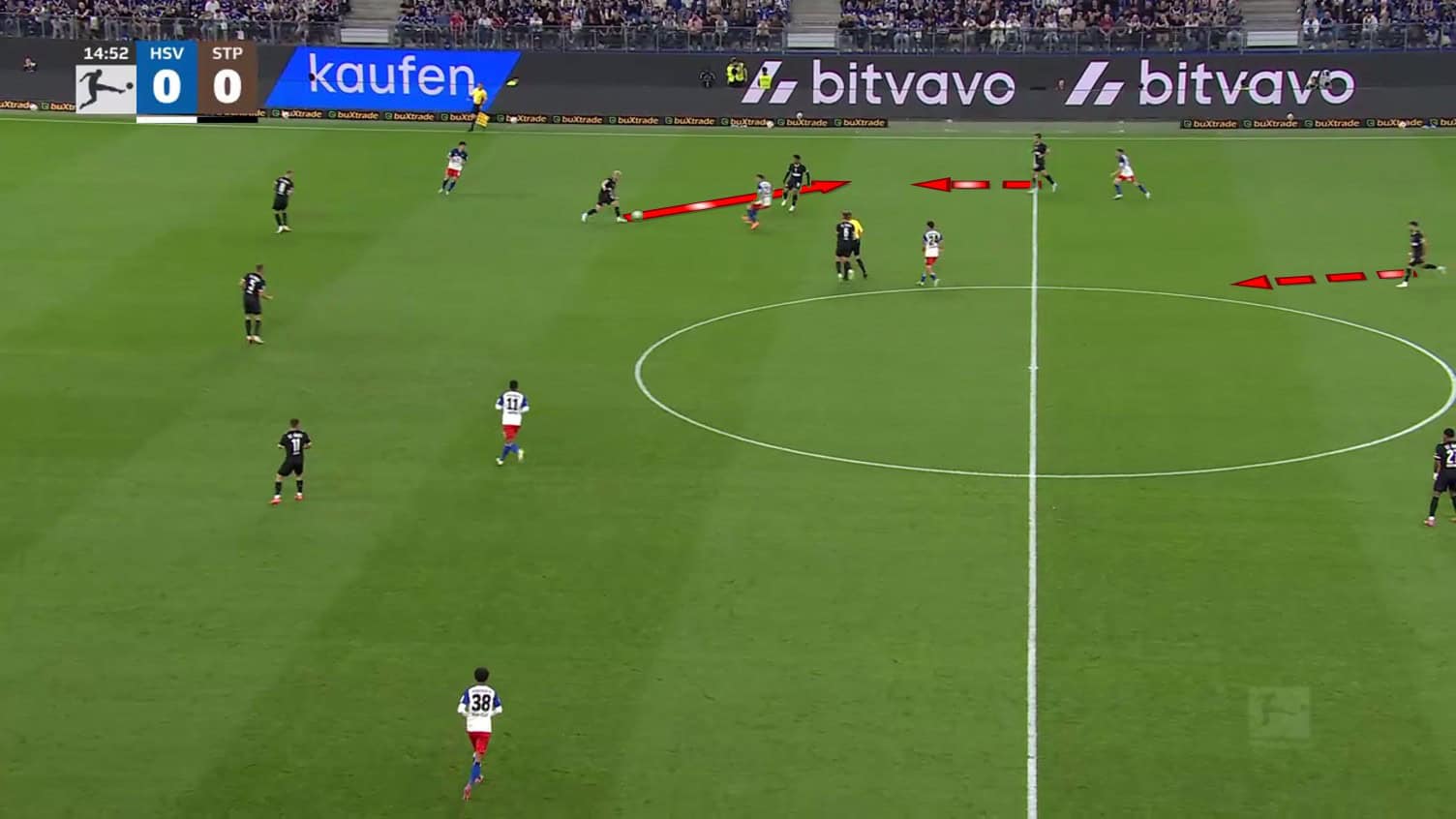
Examining the team’s ball handling, it’s actually rather straightforward.
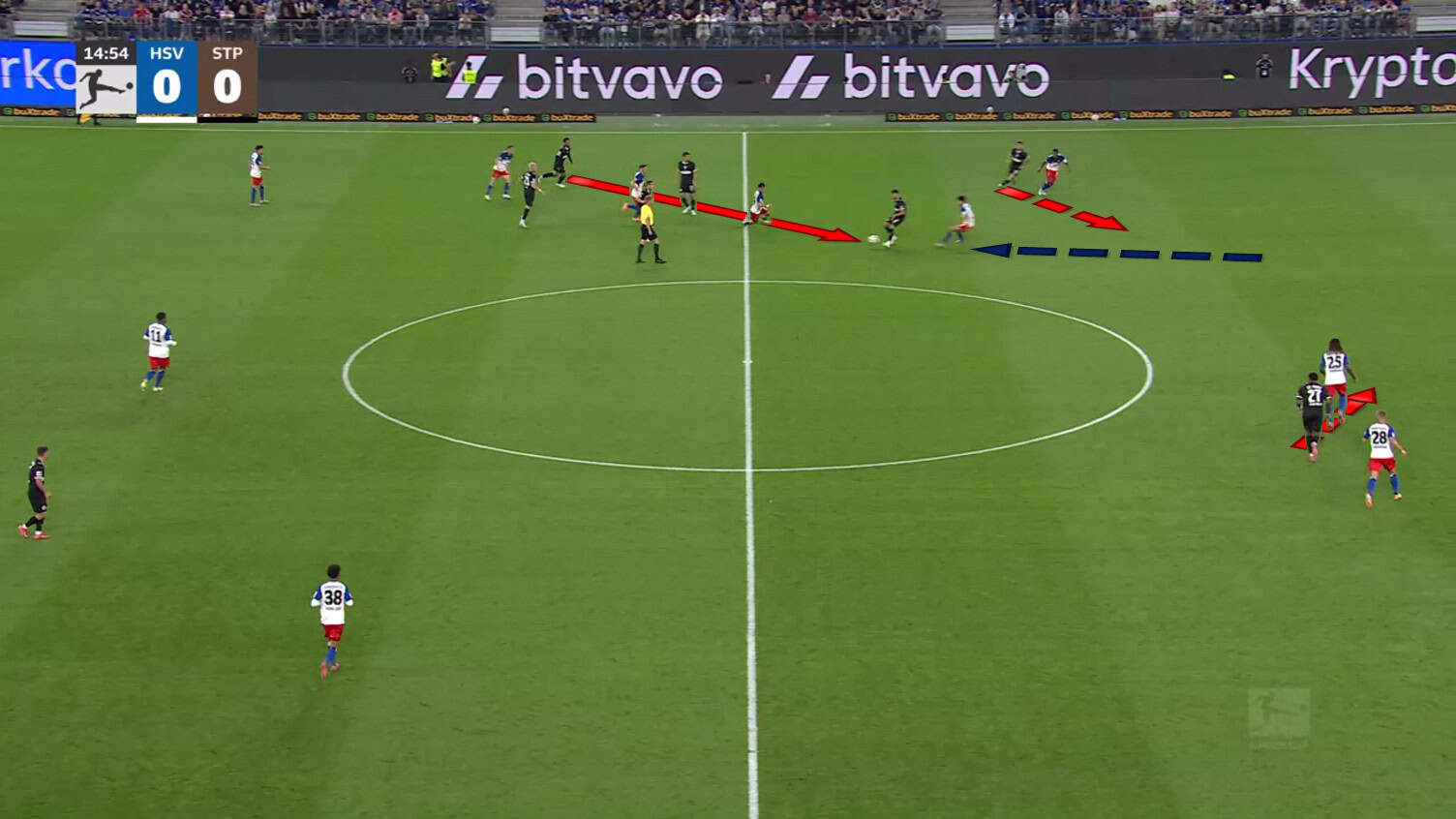
The first step is always overloading one side.
We can see Oppie with the ball at his feet on the left side, so multiple players drop back and move to that side of the field, gaining a numerical advantage in that area.
The second thing that happens is the central player in the attacking line dropping back right behind the midfield in between the lines, always offering a line-breaking option as well.
The two players around the player with the ball are coming very close, but they are holding a set distance between them: short enough to attract the opposing players into a pressing attempt and long enough to play a pass between them and the players marking them.
These two principles are the key to what Blessin wants his men to do. In these situations, they often play vertical, line-breaking passes and then play quick lay-offs to the two players who have dropped back because they are now running with their faces towards the goal, ready to collect the lay-offs behind the line of press.
As stated in the preceding paragraph, the central player in the attacking line typically plays as a false-nine; most of the time, it’s Sinani, but occasionally, other players occupy the same position.
The false nine now drops back into midfield, forcing the opposing defence to react.
One centre-back either opens up the block and follows him into midfield, or the attacker can just turn towards goal right in front of the backline.
The remaining attacking players are now making delayed runs into the space behind the backline.
If a centre-back steps up, they run diagonally into the space behind him; if not, they wait until Sinani turns and then attack that space, pushing the backline further back and allowing their teammates to move into the final third.
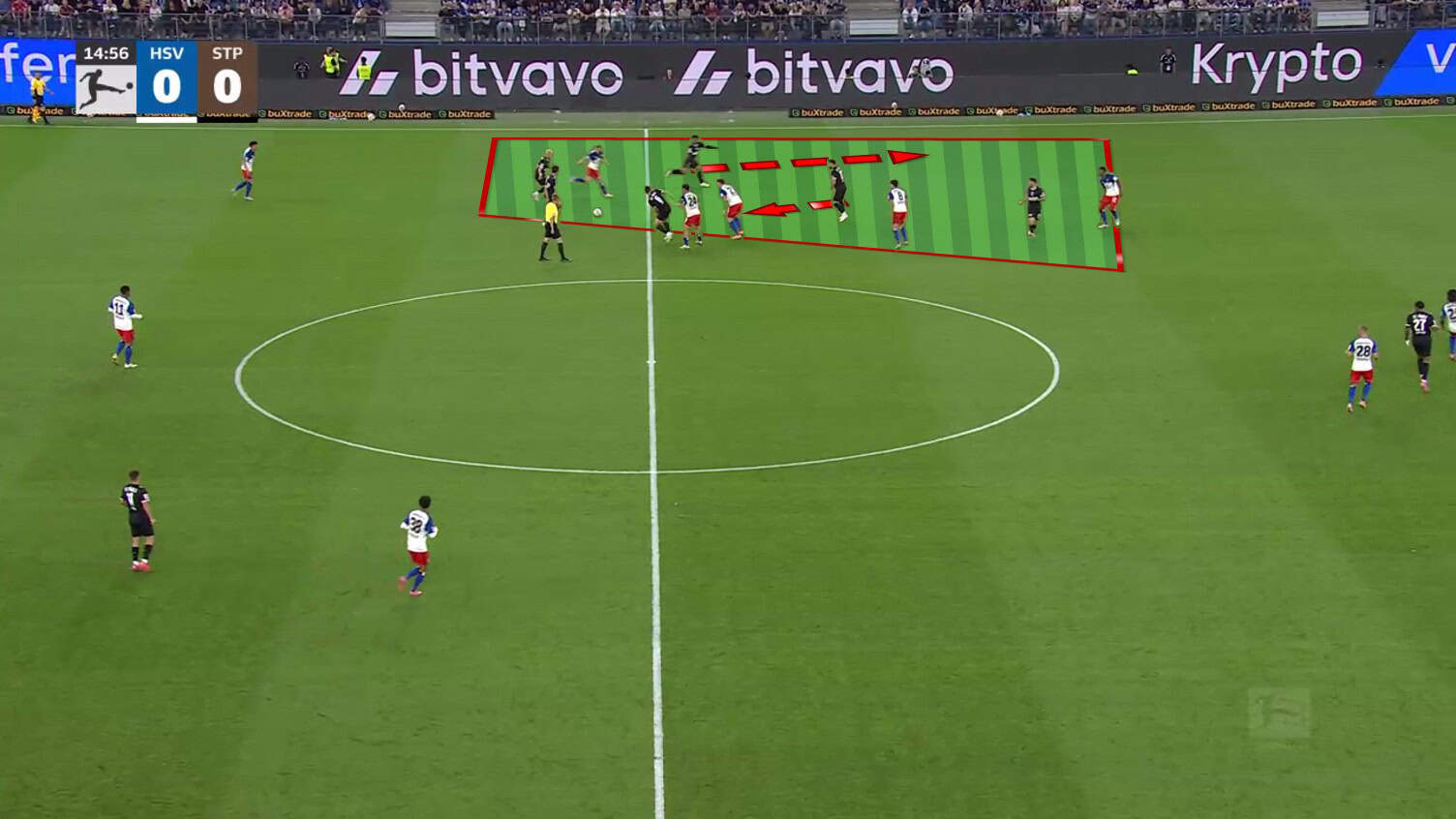
In the end, Blessin’s men always do the same thing, as we can see in the picture above.
Heavily overload one side in a condensed space, form a very narrow diamond with another player in the shadow of the player in the tip of the diamond and then use vertical passes and opposing movements to break the lines.
It’s rather basic football, but it helped the team a lot with ball security when attacking and allowed them to find more solutions that do not rely on a long ball, even though St. Pauli still plays these passes rather often.
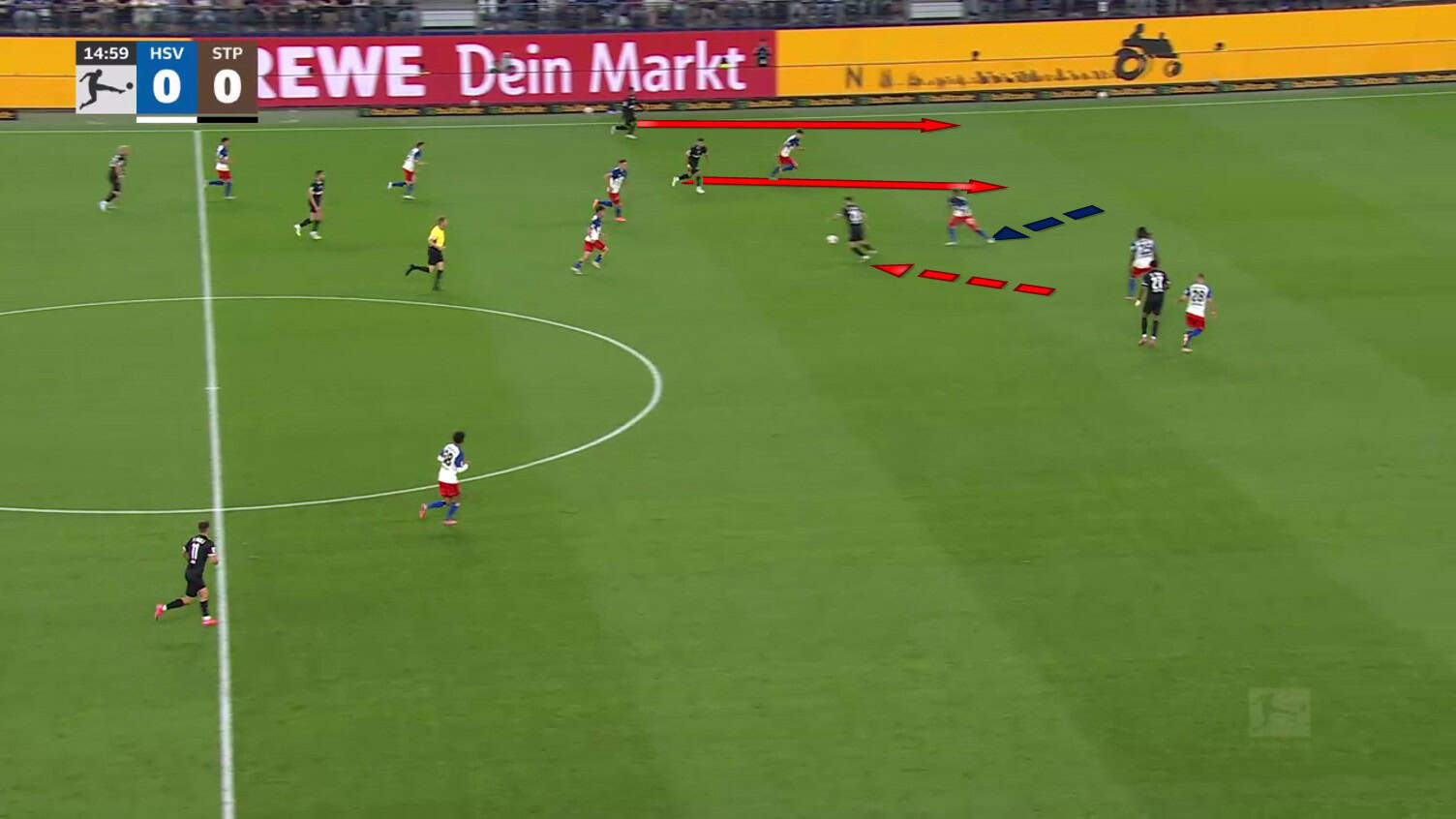
These principles can be stringed together a pretty much infinite number of times.
The picture above shows that the first situation didn’t allow them to find a vertical pass because Sinani made a rather bad decision, but it doesn’t matter.
Now, Pereira Lage is the central player in the attacking line.
He drops back into midfield, forcing another HSV defender to step up to defend him.
The other players are now making runs behind the line.
The last remaining striker is in the centre of the pitch, and Sinani and Oppie are now making runs down the left flank.
In the end, Pereira Lage also makes a terrible decision and plays a bad pass, taking all the dynamism out of the promising attack.
That still is a huge problem for St. Pauli and Blessin.
Yes, their principles work, and yes, they look far better and more confident on the ball so far this season, but in the end, the lack of individual class holds them back.
They might have scored seven goals so far this season, but two of them were the result of penalties.
Against Augsburg, they scored a rebound from a penalty and a direct free-kick, so no goal from open play for Blessin and his men.
In the end, the 2.9 non-penalty expected Goals rank fourth to last in the Bundesliga through three matchdays, so while they look better, they still struggle to create good opportunities.
Without the tad of luck they currently have on their side, their attack could end up being a huge problem for them again going forward.
St. Pauli Vs Hambuger SV
Still, their performance in the derby against HSV was very impressive.
In addition to the tactics outlined in this article, it showed the pragmatic side of the team and Alexander Blessin.
They came into a hostile environment against an opponent who wanted to celebrate their first home game back in the Bundesliga after a long wait in the derby, and the team never looked fazed by that.
They showed a nice mental resilience that they will need as the season progresses.
Looking at Blessin’s pragmatic approach, tactics and positional play don’t always need to be overly complicated.
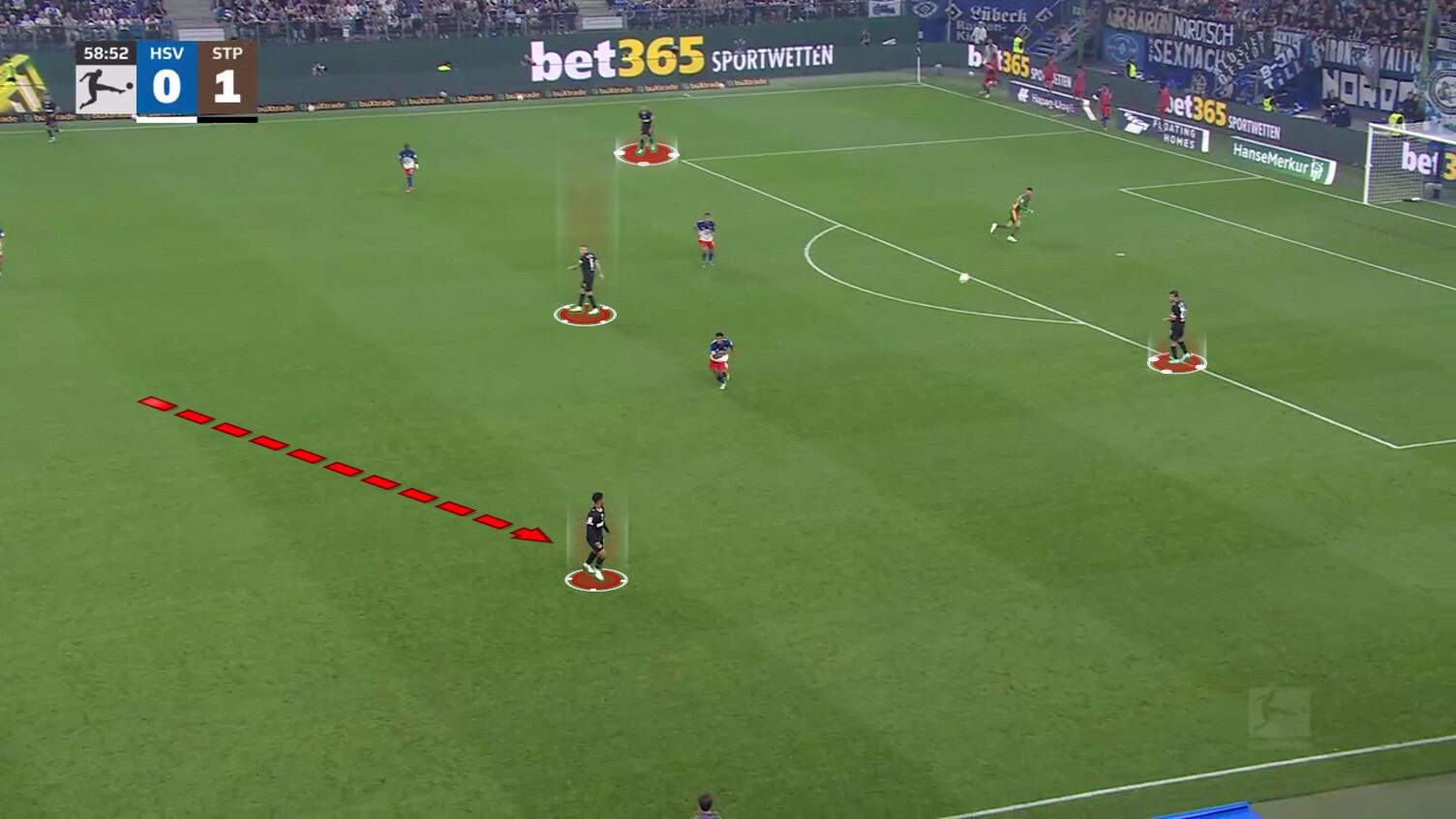
The star signing of the summer for St. Pauli was Joel Chima Fujita, a young Japanese midfielder with a very dynamic playstyle and a knack for finding vertical passes, a great fit for what they want to do.
So how do they get them in the game, knowing their opponents will try to limit his opportunities?
Against HSV, they did it in a very simple way.
They kept their back-three close to the goalkeeper when he had the ball, dragging three HSV players forward already.
The rest of the team pushed up the field, creating a lot of space between the first and second lines of play.
They then simply used Fujita’s pace to get him into those opened-up spaces and played him the ball; the distances the HSV players had to cover were way too big to actually get to him.
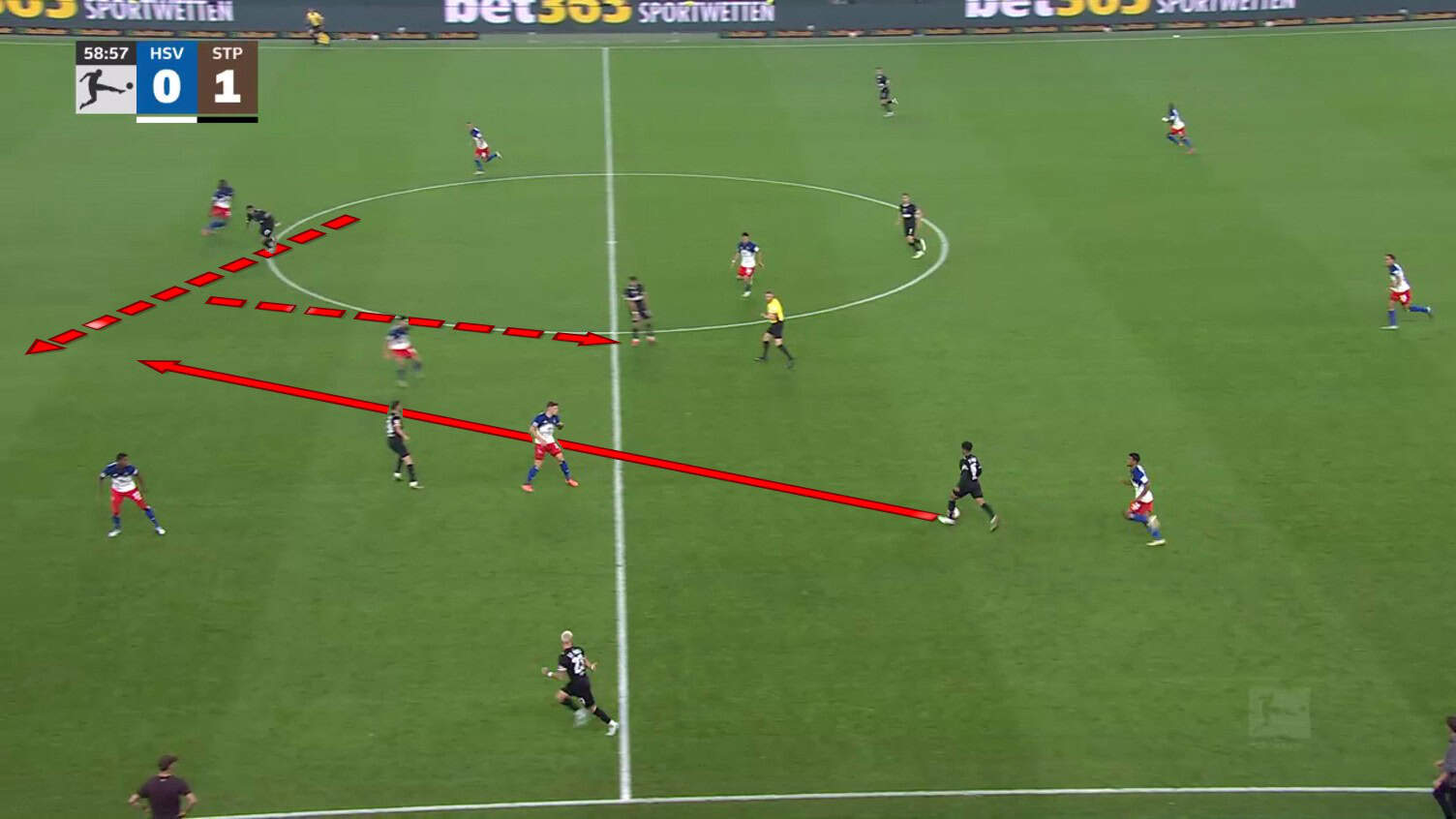
Then, they just did what they always do: Sinani drops out of the attacking line, dragging one defender with him, creating a diamond in the midfield.
Striker Hountondji then makes the run in the space behind the forward-moving defender, and Fujita plays a beautiful vertical through ball right in the path of his striker.
The Frenchman then just stays cool in front of the goal, getting past the keeper and finishing the opportunity in a very impressive way from close to the touchline.
Two passes were enough to completely move from one end of the pitch to the other, and they easily got their best players involved.
It was just very minimalistic and pragmatic coaching by Blessin.
Conclusion
Overall, Alexander Blessin managed to take the next step with his St. Pauli team.
Despite their struggles last season and the loss of multiple key players during the summer transfer window, they appear to be a decent Bundesliga team again this season.
However, I think their start to the season is not as great as it looks on paper.
Yes, the team improved, their tactical approach works, and seven points are impressive, but you have to take them with a grain of salt.
Against Dortmund, they were losing (and deservingly so) until a 20-year-old centre-back made a huge mistake in his second Bundesliga game, gifting them a way back into the game.
Against HSV, they looked impressive, but truth be told, Hamburger SV currently look like the worst team in the league.
With their man-oriented marking system, they were the perfect victim for Blessin’s new tactics.
And against FC Augsburg, it was an even game, decided by a penalty and a direct free kick.
So, while they improved, FC St. Pauli still need to prove that their current run is more than just a good stretch of form.
It will be interesting to see how teams adapt to Alexander Blessin’s Saint Pauli tactics and what new answers he will find for himself.
