
Who Is Senne Lammens?
Manchester United finalised the signing of 23-year-old Senne Lammens (193cm/6’4”, 92kg/202lbs) from Belgian Pro League side Royal Antwerp on Deadline Day for €21m.
Lammens is still relatively unknown, having made just one Belgian Pro League appearance before 2024/2025, when he became first-choice for Royal Antwerp.
One of the most reported Senne Lammens stats since his signing for the Red Devils is that Lammens had the highest number of ‘prevented goals’ based on xG faced in the top-10 leagues last season.
Still, there’s no guarantee the young goalkeeper will maintain that level of shot-stopping over the long term, nor does it reveal anything about his style of play.
This Senne Lammens scout report utilises data analysis to profile the new Manchester United keeper and provide readers with an understanding of Senne Lammens playing style.
How Good Is Senne Lammens?
Senne Lammens has earned a reputation as one of Belgium’s most promising up-and-coming goalkeepers.
Having represented his country at youth levels, Lammens is yet to make his senior debut for the Belgian national team, but has been included in matchday squads for Rudi Garcia’s side.
The pizza chart below provides an overview of Senne Lammens’ game, condensing his key strengths and weaknesses into a digestible viz.
All data is sourced from Wyscout; the pizza chart displays Lammens’ performance in relevant metrics for the goalkeeper position based on Lammens’ performances with Royal Antwerp in the Belgian Pro League last season.
The mean is 50, with a higher number indicating above-average performance in that particular metric.
This pizza chart compares Lammens’ data with that of other goalkeepers in leagues of a similar level to the Belgian Pro League in 2024/2025.
Senne Lammens Stats 2024/2025

On top of the key goalkeeping stats of a relatively high save rate and plenty of clean sheets, speaking to Lammens’ ability to keep the ball out of his net, the data displays that Lammens was heavily involved in possession for Royal Antwerp last season and came out off his line quite a bit.
What Is Senne Lammens Style Of Play?
To profile Senne Lammens, we used data from Europe’s top-five leagues, plus the Belgian Pro League, Dutch Eredivisie, Portuguese Primeira Liga, and EFL Championship.
From those nine leagues, 297 goalkeepers, including the new Man United stopper, accumulated at least 1000 minutes last term.
We created three clusters to separate our set of goalkeepers into three distinct ‘types’: Cluster 1 corresponds with pure shot-stoppers (pink), Cluster 2 features distribution-focused GKs (white), and Cluster 3 has our sweeper-keepers (yellow).
See the mean for each ‘cluster’ below, for reference.
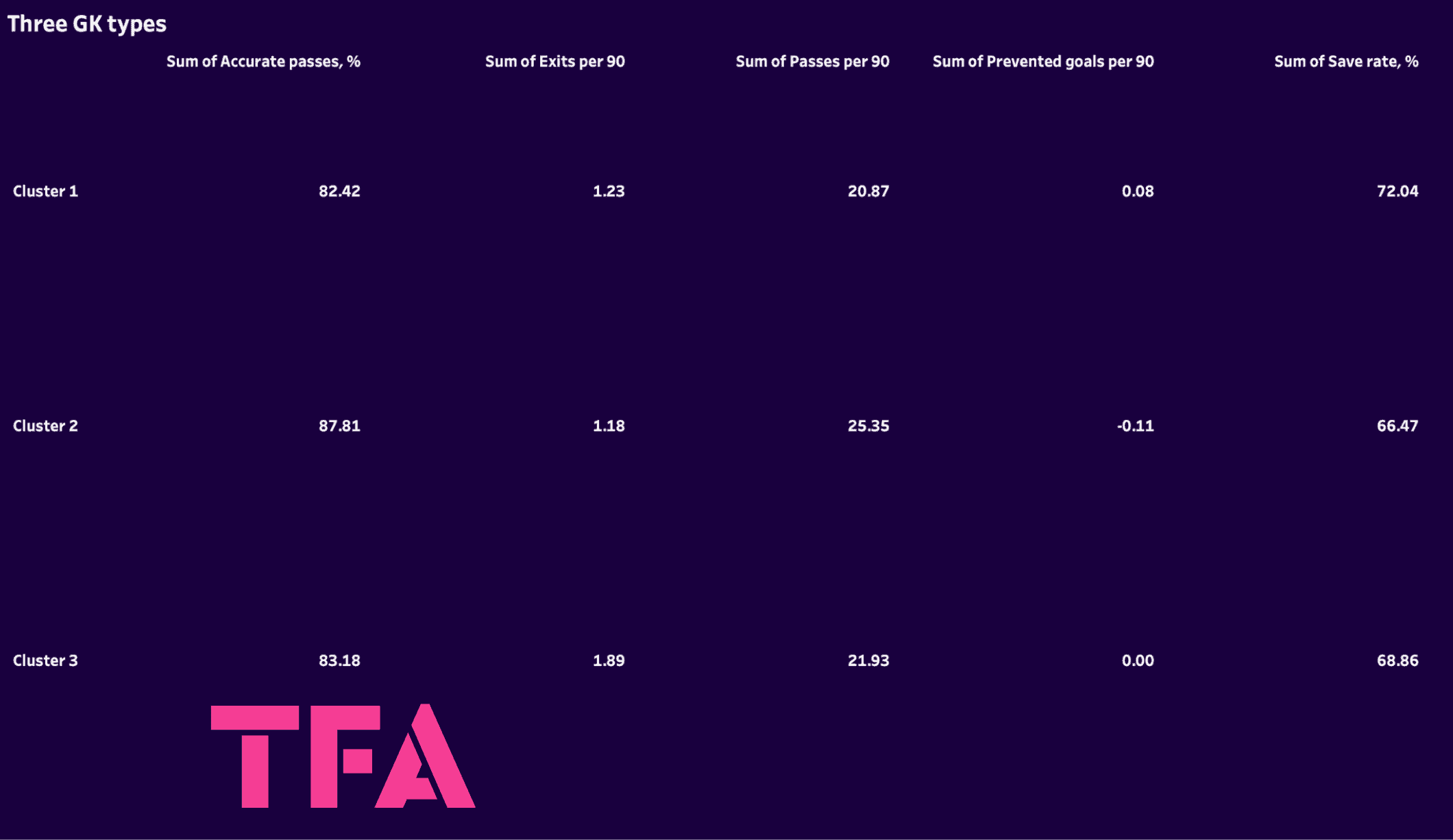
Of course, there can be some overlap between clusters.
Someone who most closely aligns with the ‘sweeper-keeper’ model could also be comfortable with the ball at their feet, while someone we categorise as a distribution-focused GK could also be very commanding in the penalty area, for instance.
The main purpose of clustering in this case is to narrow down Lammens’ stylistic profile, contextualise his game when compared with other goalkeepers in Europe’s best leagues, and provide a clearer, simpler idea of exactly what Manchester United are getting here.
Senne Lammens lands in the sweeper-keeper bucket.
This means Manchester United have bought a young ‘keeper who’s comfortable coming off his line, sweeping up behind a high backline and engaging attackers in 1-v-1s.
Lammens is not a traditional ‘shot-stopper’ profile despite his high prevented goals numbers.
However, Lammens’ sweeper-keeper nature is the modern ideal in elite football, setting United up well for the long term should Lammens settle well in England, continue developing well, and live up to his potential.
Senne Lammens Shot-Stopping
With that said, the data still shows that Lammens hung with the best of them when it came to keeping the ball out of his net last term, pulling off an enormous number of saves while also facing a relatively high number of shots.
The xGA and shots faced numbers in our pizza chart, shown in Figure 1, show a low percentile rank because, in those particular cases, a high percentile rank equates to a lower xGA or fewer shots faced.
Staggeringly, Royal Antwerp faced the most shots (558) of any side in the Belgian Pro League in 2024/2025.
Although that was the case, Lammens’ goalkeeping helped their goals conceded at 52, which was below the league average and crucial in helping the 145-year-old club to a fifth-place finish, far more than you’d expect from the team that allowed opponents more shots than any other!
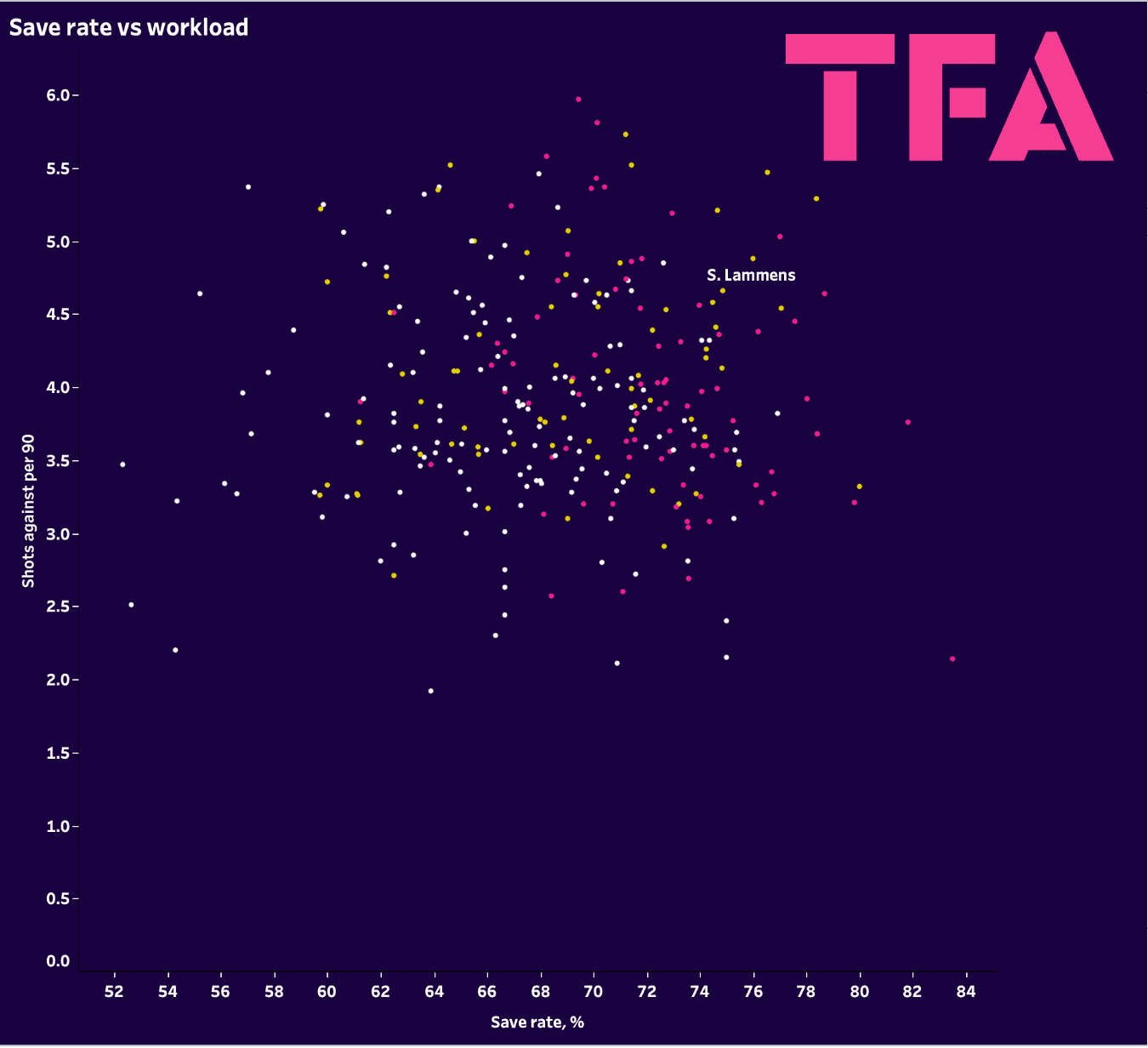
Again, Lammens is not a traditional shot-stopper, but his methods are highly effective at keeping the ball out of the net.
He sits right in the top-right quadrant of the scatter above, highlighting his ability to prevent goals last term under a heavy workload.
From watching Lammens’ goalkeeping last term, the main standout in the 193cm goalkeeper’s game is probably his lightning-fast reflexes, which can help him to pull off double or even triple saves and react like a cat when required.
His size also helps with his diving and reach, but for me, his reflexes were the main standout, which contributed to his high save rate.
Senne Lammens Command Of Area
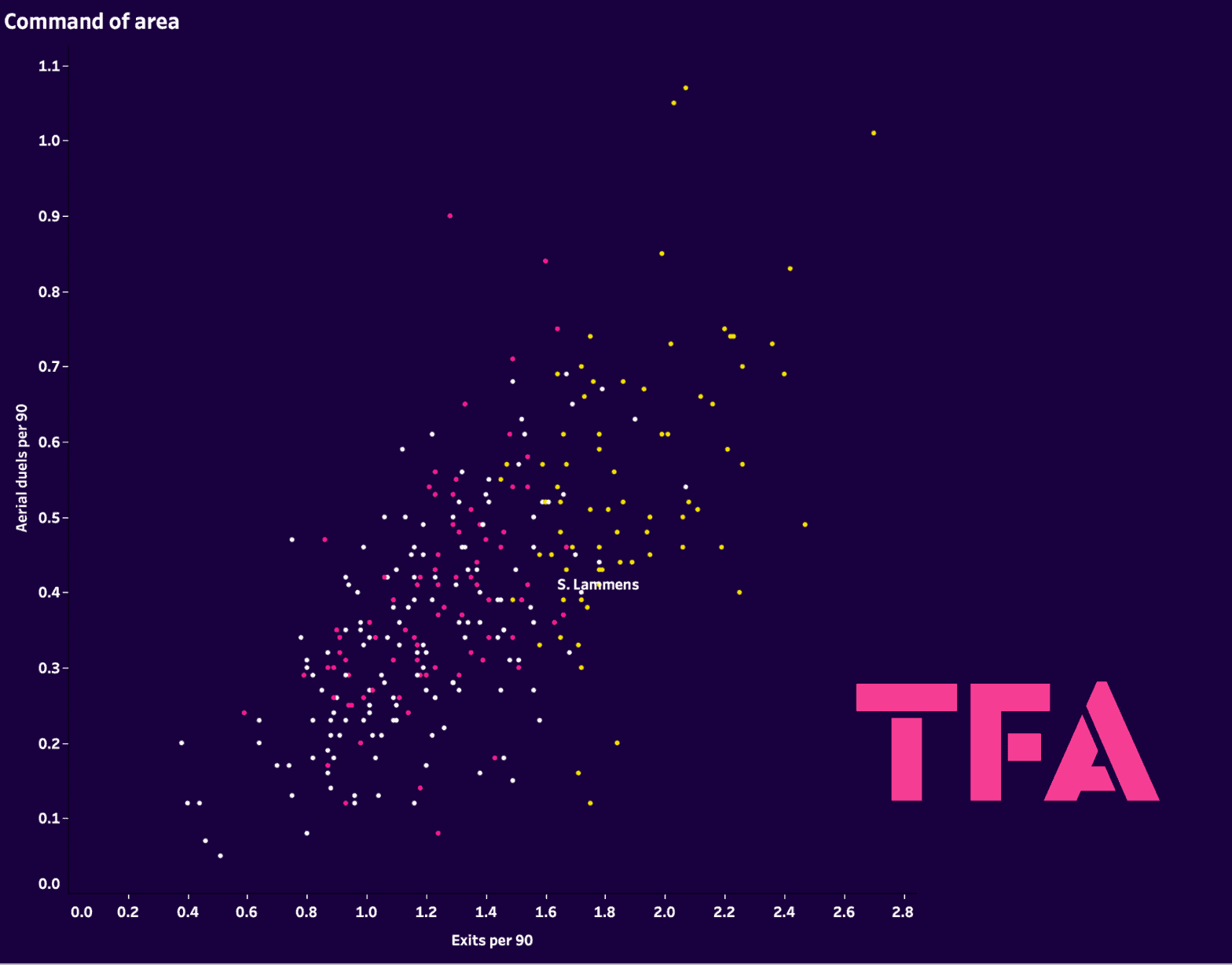
Among goalkeepers in our ‘sweeper-keeper’ subset, Lammens is one of the least commanding.
He probably has a fair bit of room for improvement in terms of being a real presence in his box, thinking about his adaptation to the highly physical and set-piece-savvy Premier League.
Testing the new United man aerially could be a smart route for opponents.
He mainly stands out for his comfort and confidence in coming off his line to close down attackers in 1-v-1s and sweep up behind a high backline.
United likely targeted Lammens because they wanted to instil a long-term high-pressing philosophy and needed a goalkeeper who could help them play that way effectively.
Lammens is not the best sweeper-keeper in the world at this moment in time, so expectations will have to be tempered for the goalkeeper who has just one proper season of senior football under his belt, in earnest.
He is, at the very least, the right type of player if that’s United’s goal, however.
This could be an encouraging sign for fans regarding the club’s recruitment, presuming this long-term plan is, in fact, in place.
Senne Lammens Distribution
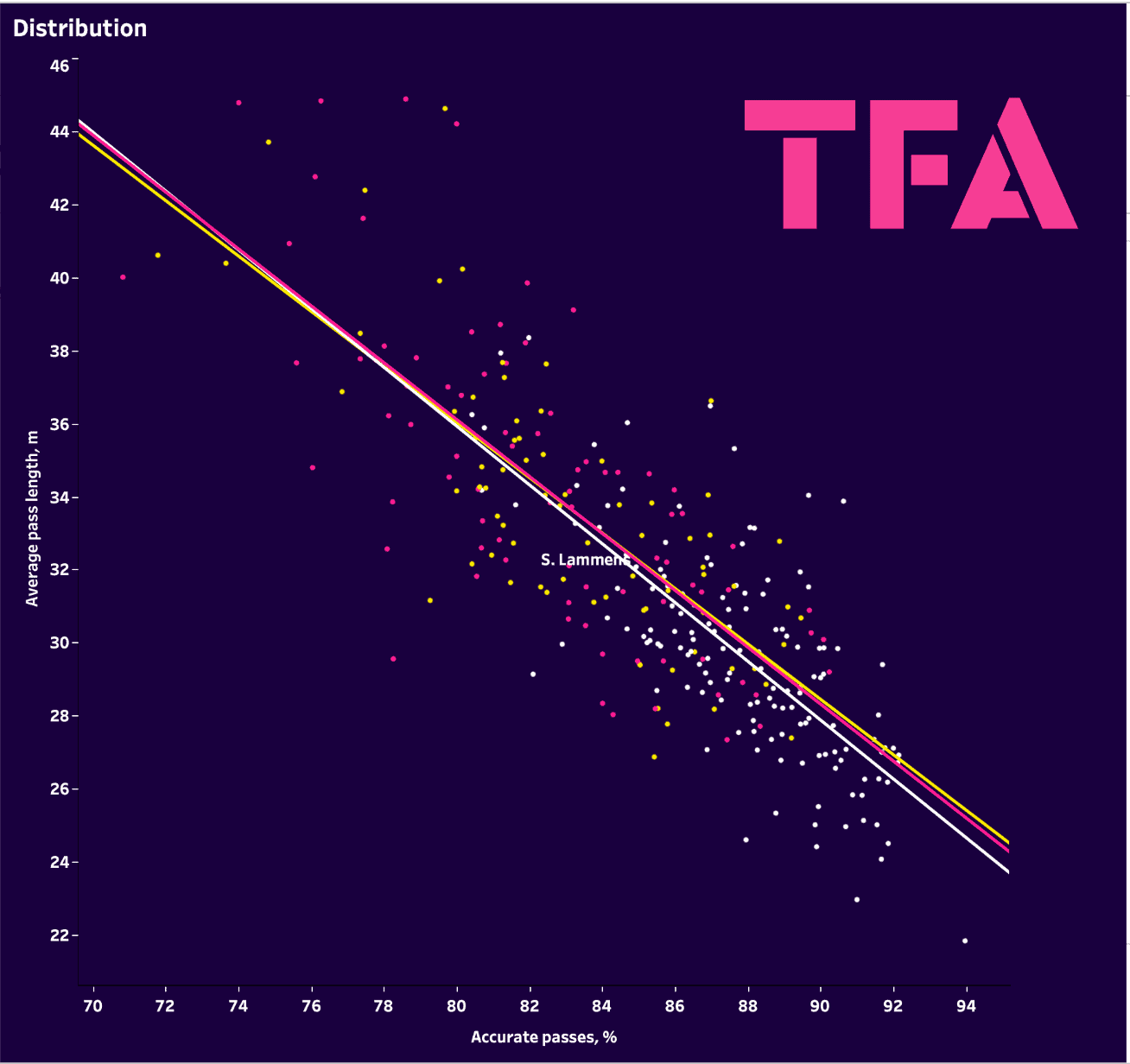
Each cluster is represented with its own linear regression line, highlighting the trade-off between pass length and accuracy.
Across all clusters, the trade-off between longer passing and less accurate passing is clear.
Distributors (white) group strongly in the bottom right, which is not surprising and reflects their preference for shorter, highly accurate passing.
We find Lammens in the middle of the road, slightly below the regression line (shorter passes than average for a sweeper-keeper).
In essence, Lammens has a mix of passing range in his locker, though there is scope for the player to improve both his distribution quality and consistency on the ball.
His current ability on the ball could be another avenue for high-pressing teams to test the Premier League newcomer.
Conclusion
Will Senne Lammens succeed at Manchester United?
In addition to the obvious personal responsibility, which will largely depend on whether United have a long-term plan and intend to stick to it, by recruiting the right profiles for the way they want to play.
One of the main criticisms of Man United over the last decade has been their poor recruitment and long-term planning.
With regard to the current squad, commentators and critics constantly point out that the team is something of a mish-mash with different players recruited under various managers, all of whom had different styles of play in mind to one another.
Removing that variation and maintaining consistency in style and long-term planning will be crucial to the club’s recruitment.
To sign a goalkeeper, they need to determine the type of goalkeeper they require.
To know that, they need to know what type of team they want to be and how they want to play.
Manchester United might have made an intelligent signing in Senne Lammens if he’s going to be given time to develop in the role that he belongs.
Nobody should want Senne Lammens to sign for a year or two before a new coach comes in who wants to play a certain way, which Lammens doesn’t fit at all.
This inconsistency in style, born from reactive moves by the club’s decision-makers and poor long-term planning, has been one of the key issues at Old Trafford since Sir Alex Ferguson’s departure.
So, what happens with Senne Lammens in the medium-term future will likely be a good indicator of whether United are moving on from that disjointedness or not.
Senne Lammens is a very exciting young sweeper-keeper with potential to be one of Europe’s elite between the sticks.
Potential is a dangerous word, though, and Lammens’ sample size at the senior level is very low.
As sweeper-keepers go, he’s definitely comfortable coming off his line and dealing with 1-v-1s, as well as having fast reactions.
Still, he’s not quite ‘there’ yet in terms of his ultimate development and will need patience in that regard.
Lammens’ success at Old Trafford could tell us more about Manchester United than Lammens himself.
