
Manchester City have lost three games in a row for the first time since April 2018.
Their local rivals, Manchester United, will look to make that happen again on Sunday, when the Red Devils travel to the Etihad Stadium for gameweek four of the 2025/2026 Premier League campaign.
Pep Guardiola’s side are coming into Sunday’s game off the back of two straight Premier League defeats; the first coming versus Thomas Frank’s Tottenham Hotspur, a game they lost by two at home, and the second coming against Fabian Hürzeler’s Brighton & Hove Albion, which finished 2-1 to the Seagulls at the Amex.
Guardiola will have had two weeks to reflect on those two losses by the time they host Ruben Amorim’s side this weekend.
It hasn’t been smooth sailing for Man United start of the 2025/2026 campaign either.
The Red Devils have won just one of their opening three EPL games this term, that win coming in their most recent fixture, where they scraped past newly promoted Burnley in a back-and-forth 3-2 thriller.
This game was entertaining for neutrals but far from comforting for Man United supporters.
Amorim’s side will hope to capitalise on City’s recent form and compound their misery by delivering a statement victory on Sunday.
This tactical analysis piece will be a Manchester Derby tactical preview.
We will focus primarily on Manchester City tactical weaknesses at present and turn our attention specifically to how Ruben Amorim tactics can take advantage of those issues.
City can be vulnerable when their press is dragged high and wide.
Based on the way in which recent opposition have got at City, we’re going to highlight certain profiles in the Man United setup who can help the Red Devils overcome the challenge of Manchester City.
Manchester City Tactical Weaknesses 2025/2026
Much of what was discussed last season regarding Manchester City’s weaknesses remains true for the Cityzens this term.
After holding City to a 2-2 draw last December, Crystal Palace boss Oliver Glasner highlighted a lack of intensity, space around the pivot and set-pieces as the main ways in which opponents can get at Man City.
Specifically, Glasner is quoted as saying: “When we get our runners into pace and get the space, it’s not so easy to defend us. It was part of the idea to come into these spaces, and one thing was long balls and going for long balls.”

Glasner ended up overseeing Crystal Palace’s famous 1-0 victory over Man City in last season’s FA Cup Final, so he seems a logical reference when it comes to tackling Pep Guardiola’s side right now.
Above, we see Chris Richards on the ball for Palace in the build-up phase during the 2024/2025 FA Cup Final.
The right centre-back draws pressure from Jérémy Doku, which in turn attracts all of City’s pressing shape to that side of the pitch and draws bodies upfield, notably those of City’s ball-near full-back and ball-near central midfielder (Bernardo Silva, in this case).
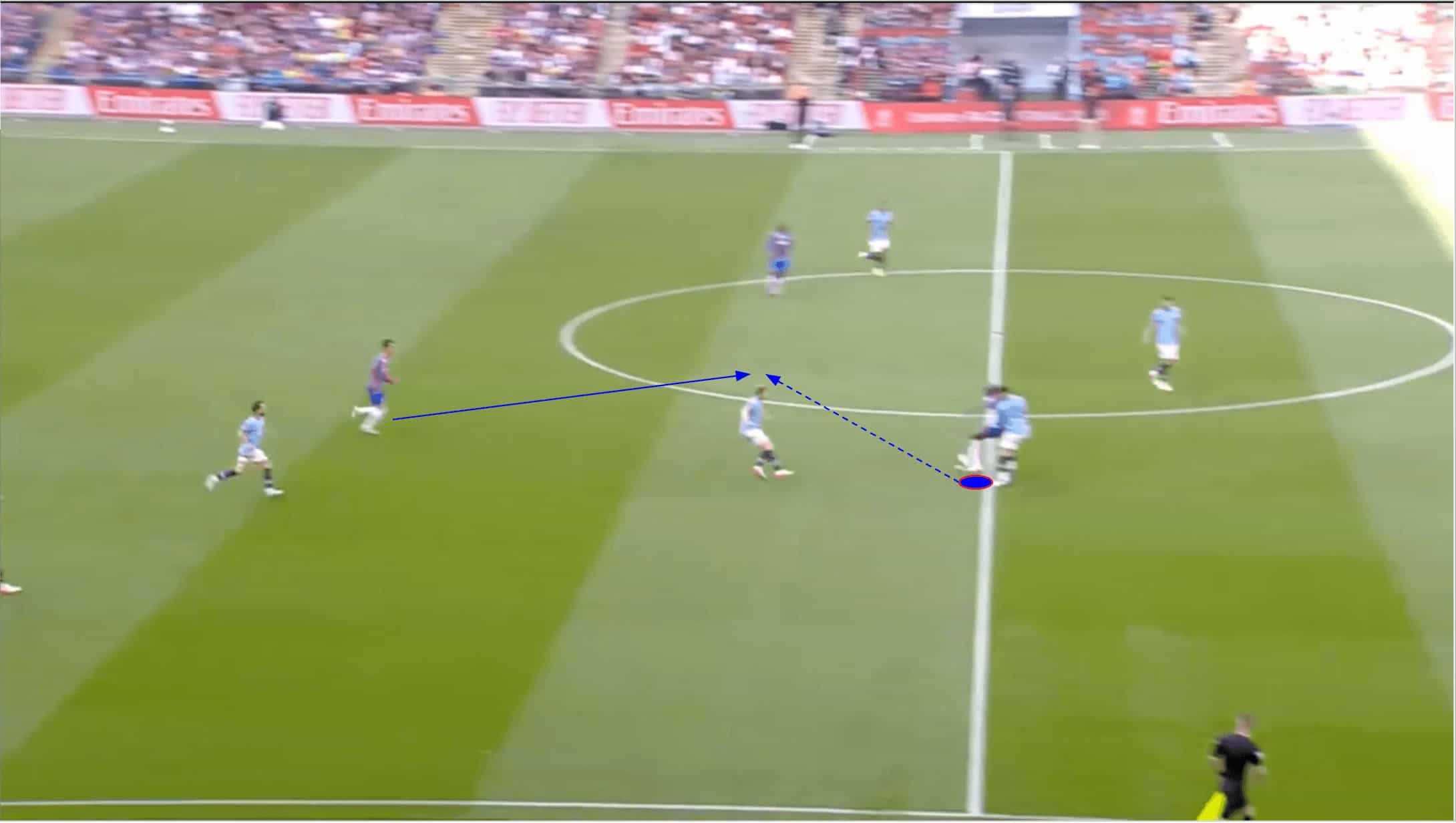
Richards plays the long ball forward to Jean-Philippe Mateta, who holds the ball up exquisitely and delivers the pass into the path of oncoming runner Daichi Kamada.
Kamada attacks the space around Kevin De Bruyne, who’d been left to defend the space in front of the three remaining defenders (ball-near full-back Nico O’Reilly had been drawn high) by himself due to the aforementioned press from his midfield partner, Bernardo Silva.
Palace ended up playing the ball through to runners attacking space and exposing City’s weakened backline to score what would be the only goal of the game.
Six months after the Oliver Glasner quote above, his team relied on the same principles to get one over on Pep Guardiola’s side.
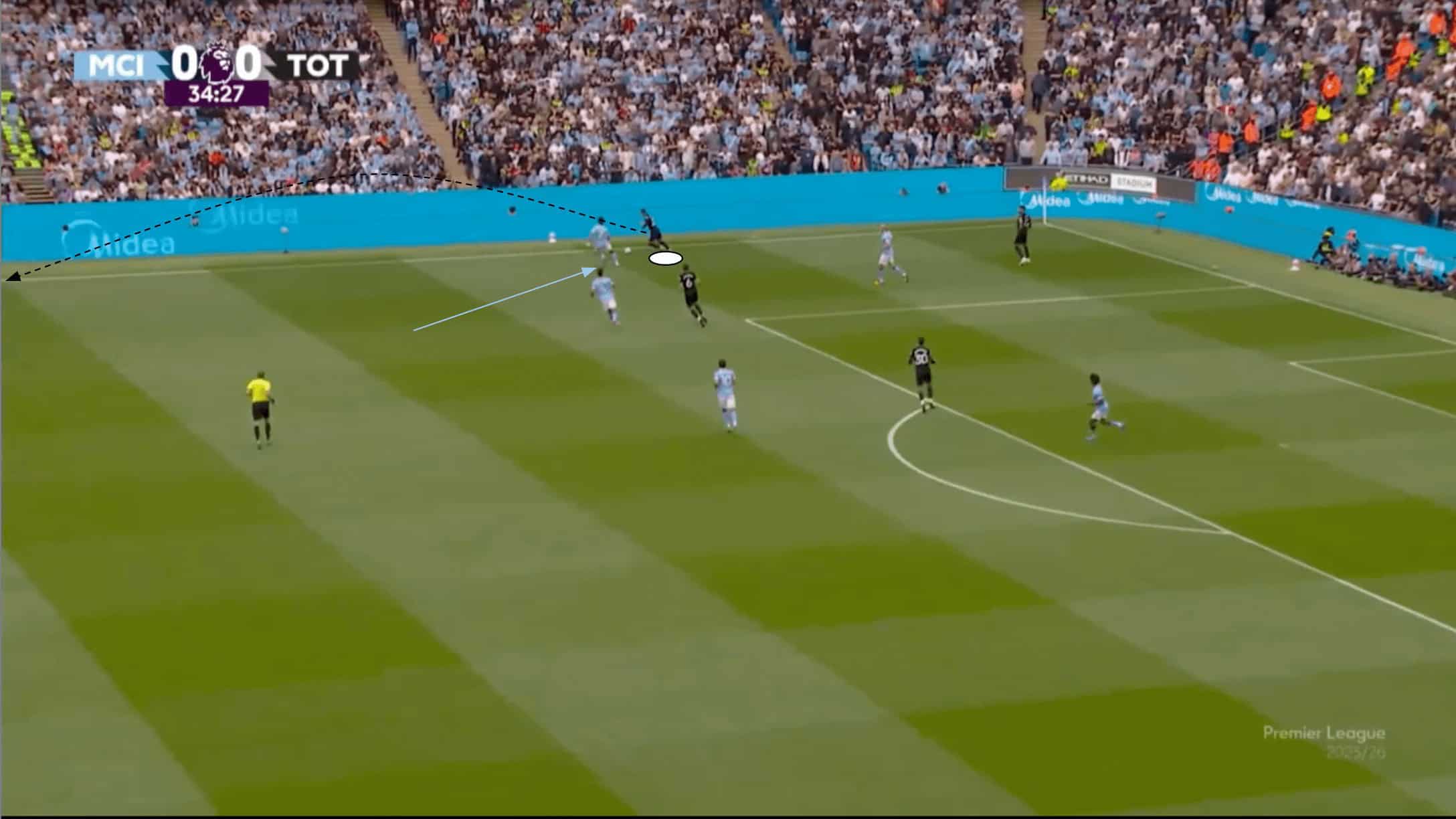
The same issues have carried over into this season and have successfully been exploited by City’s opponents.
Take Figure 3, for example.
Spurs right-back Pedro Porro has picked the ball up out wide, which draws City’s press towards him.
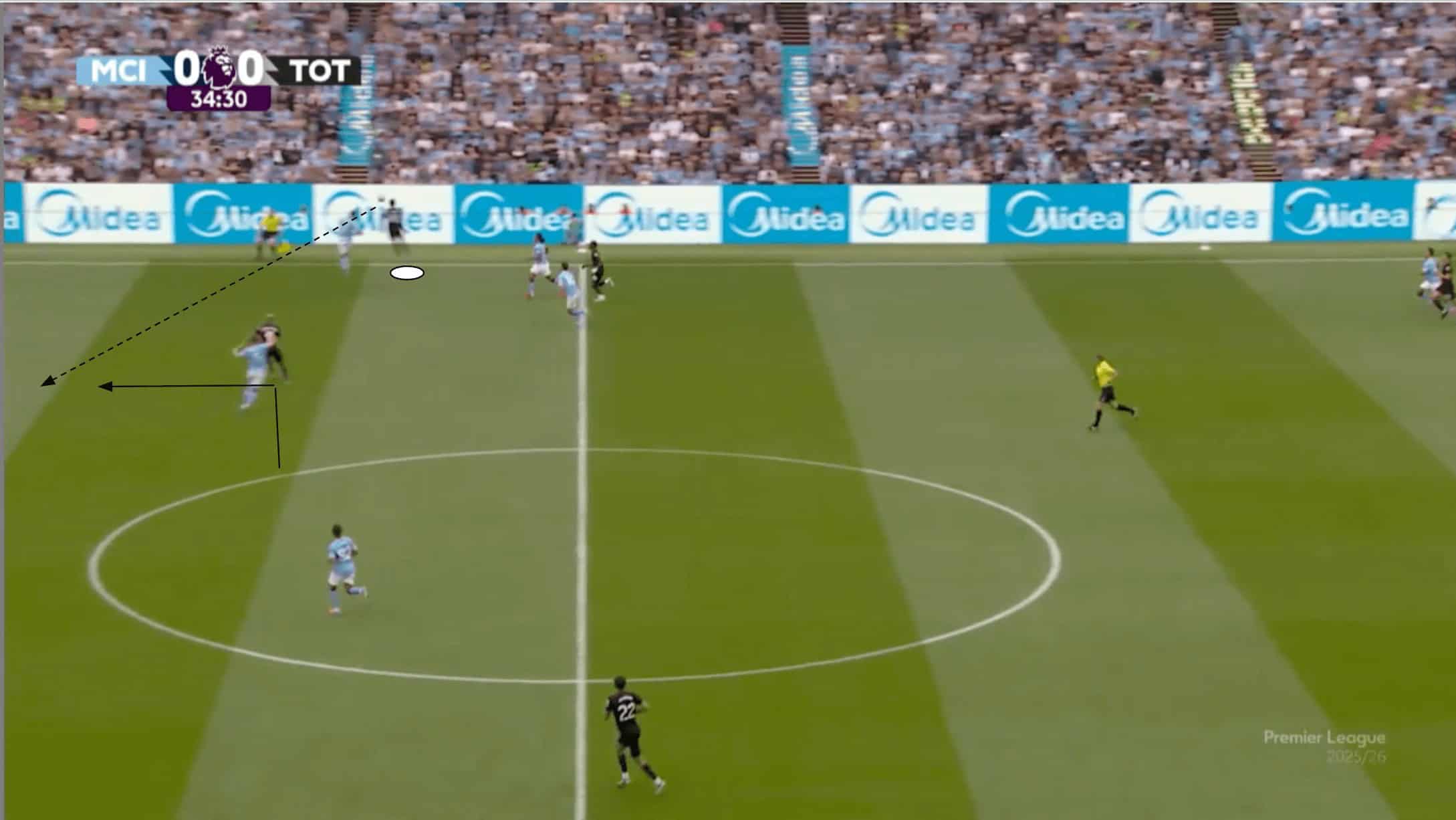
Porro plays the long ball forward, targeting space behind City’s right-back.
Pape Matar Sarr wins the aerial duel and knocks the ball on for Richarlison to chase in behind.
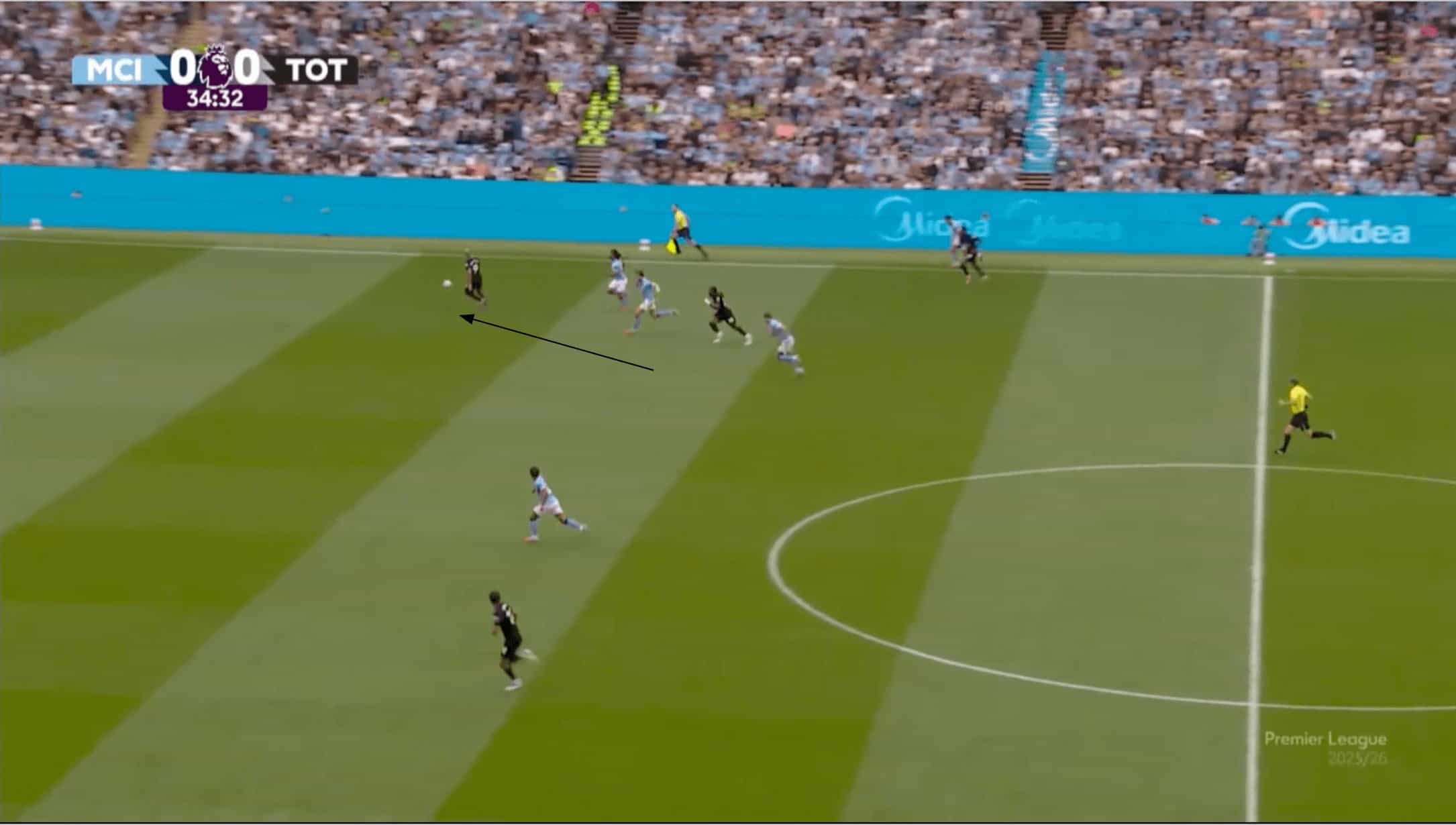
Richarlison carries into space and plays the ball across goal for Brennan Johnson to finish and put the North London side a goal up.
This example shows two things:
- Man City still open themselves up too much when pressing high against a wide build-up.
- In addition to the space around the holding midfielder, Man City’s desire to use the offside trap and defend with a very high line can be a target.
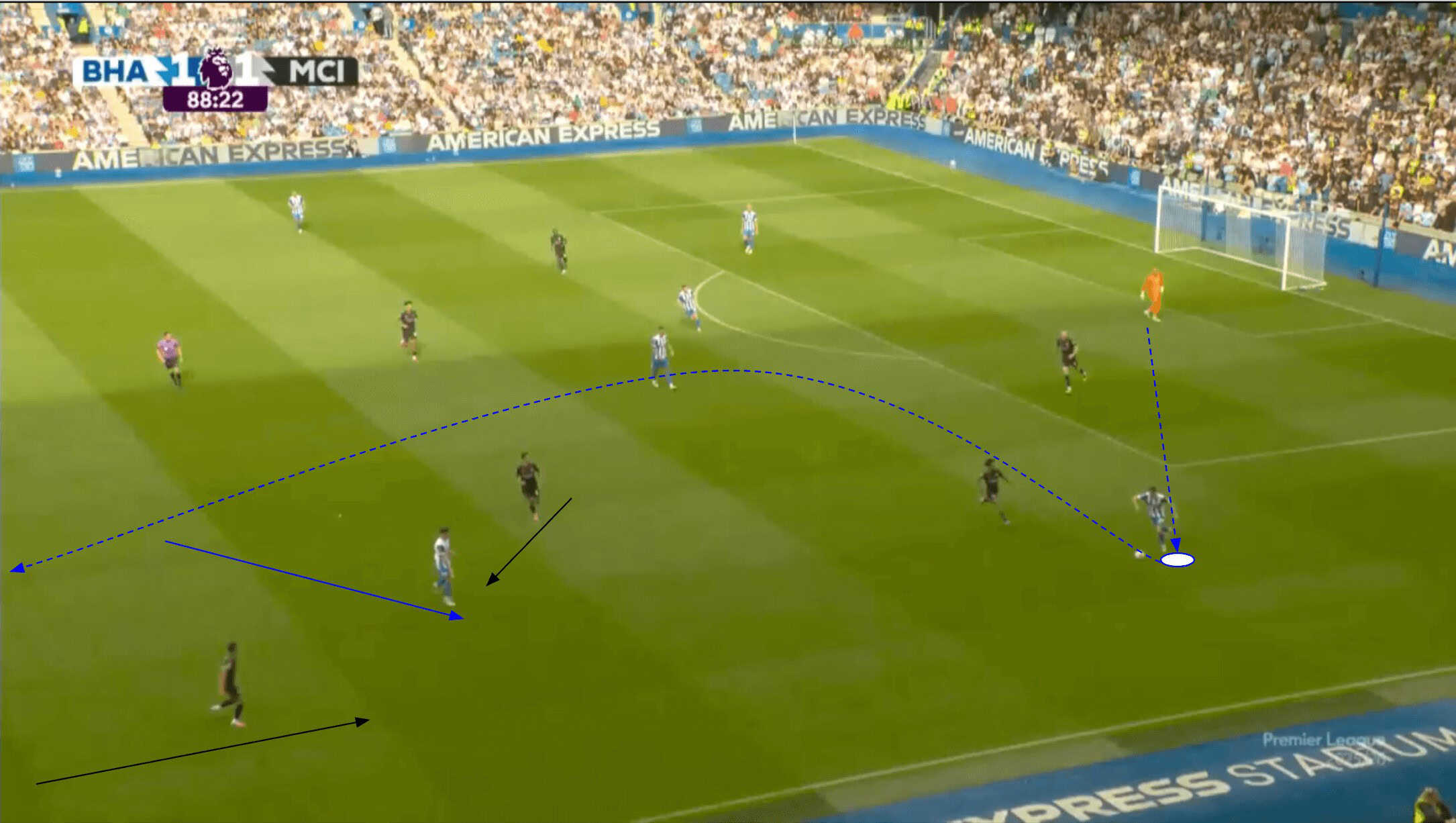
It was a fairly similar story for Brighton as they sought what would ultimately prove to be the winning goal versus Manchester City last time out.
Above, we see the City press drawn wide, which attracts the two ‘8s’ and the ball-near full-back towards the ball-carrier.
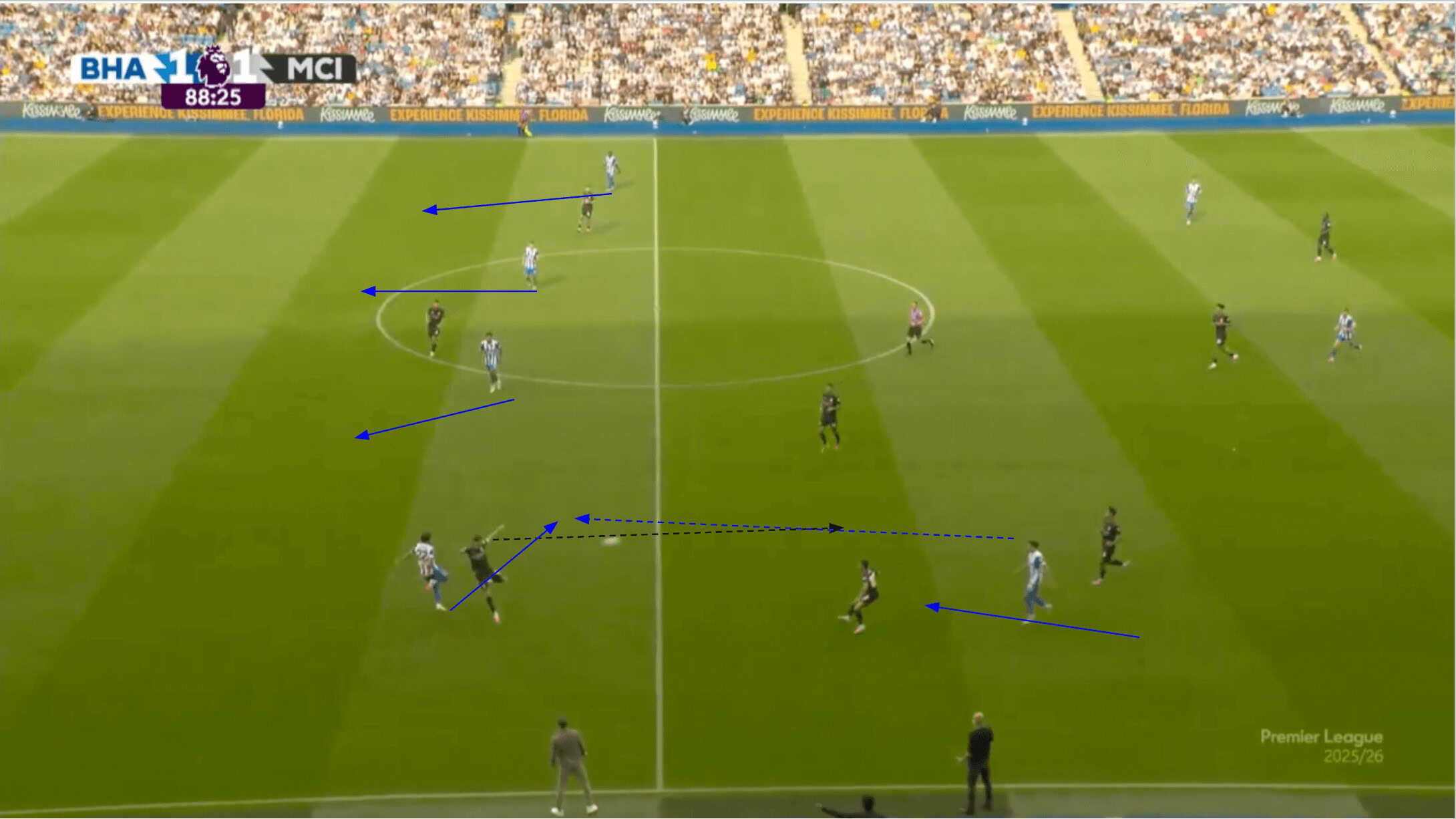
On this occasion, John Stones won the aerial ball for City, but Brighton won the second ball through intensity and alertness in midfield.
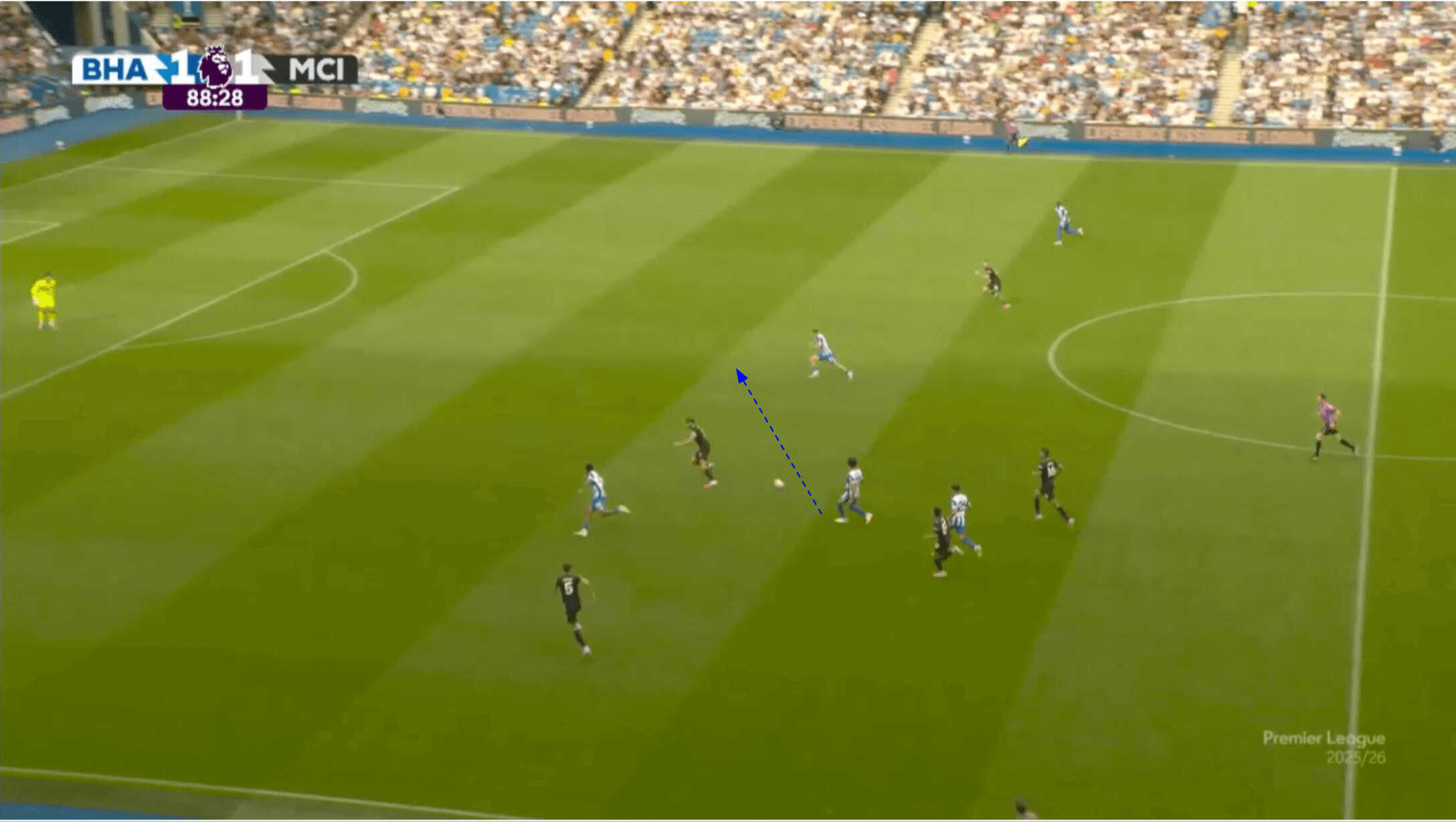
This enables Brighton to overload City’s backline and charge towards goal to score the winner.
Man City love control and possession; they hate chaos and unpredictability.
If you can at least beat their first line of pressure and create a loose ball in midfield, they can be beaten for intensity, as Glasner pointed out.
When playing against City after they’ve been drawn into a high press and their defensive structure has been weakened, winning a loose ball in midfield and running at that underloaded defence is very dangerous, as has been proven in each of the Cityzens’ last two games.
How Can Manchester United Expose Manchester City Tactical Weaknesses?
So, with those tactical issues clarified, let’s turn our attention to Sunday’s game and how Manchester United, specifically, can strategically target Manchester City’s weaknesses.
Looking at the best way to play against City from a Manchester United perspective, there are probably four ‘keys’ to exposing the aforementioned weaknesses:
- A target man/aerial outlet.
- Aggressive runners to attack second balls.
- Wide runners to attack space in behind.
- A playmaker to hit accurate long balls.
For me, with regard to Man United’s lineup on Sunday, fulfilling these criteria means:
- Benjamin Šeško starts up front.
- Bryan Mbeumo plays on the right wing, and it’ll be important to get Matheus Cunha match-ready to play off the centre-forward from the left as well.
- Any combination of Amad Diallo, Patrick Dorgu and Diogo Dalot can play at wing-back with the instructions of stretching Man City’s defence high and wide, looking to get in behind and exploit the space there at every opportunity.
- Bruno Fernandes will, predictably, have a key role to play in pulling the strings from deep and in the middle of the park.
It might seem obvious that some of these key players would be crucial to United’s chances of winning, but it’s not just their presence on the pitch that will be important, but also the role they’re set to play within Amorim’s tactical setup versus City.
To elaborate, a target man will give Manchester United an outlet when they need to quickly get the ball upfield and hit Man City in transition.
Šeško can provide that, having competed in enough aerial duels to land in the 57th percentile (above average) for aerial duel volume among centre-forwards in Europe’s top-five leagues with RB Leipzig last season.
He won the majority of them, putting him in the 90th percentile for aerial duels won %.
Šeško is also a threat in terms of running in behind and targeting free space, which will keep one or two City centre-backs occupied at all times, potentially opening up space for other runners if he can’t find space himself.
At times, Šeško drifts away from the no. 9 position into wide channels, and that may also work here.
However, he needs to be constantly getting into aerial duels to try and help his team get upfield in settled possession and in transition.
Mbeumo and Cunha are active without the ball and love to press the opposition’s backline directly and aggressively.
They’ll thrive in the chaos City prefer to avoid, and they will be United’s best chance of exploiting the space around the holding midfielder by pressing the second ball.
They could also potentially offer a threat running in behind and the ability to carry the ball at pace, should they pick the ball up in space around City’s pivot.
Their commitment to pressing directly and aggressively without the ball throughout the game and their activity in the half-spaces/area around the City pivot will be critical.
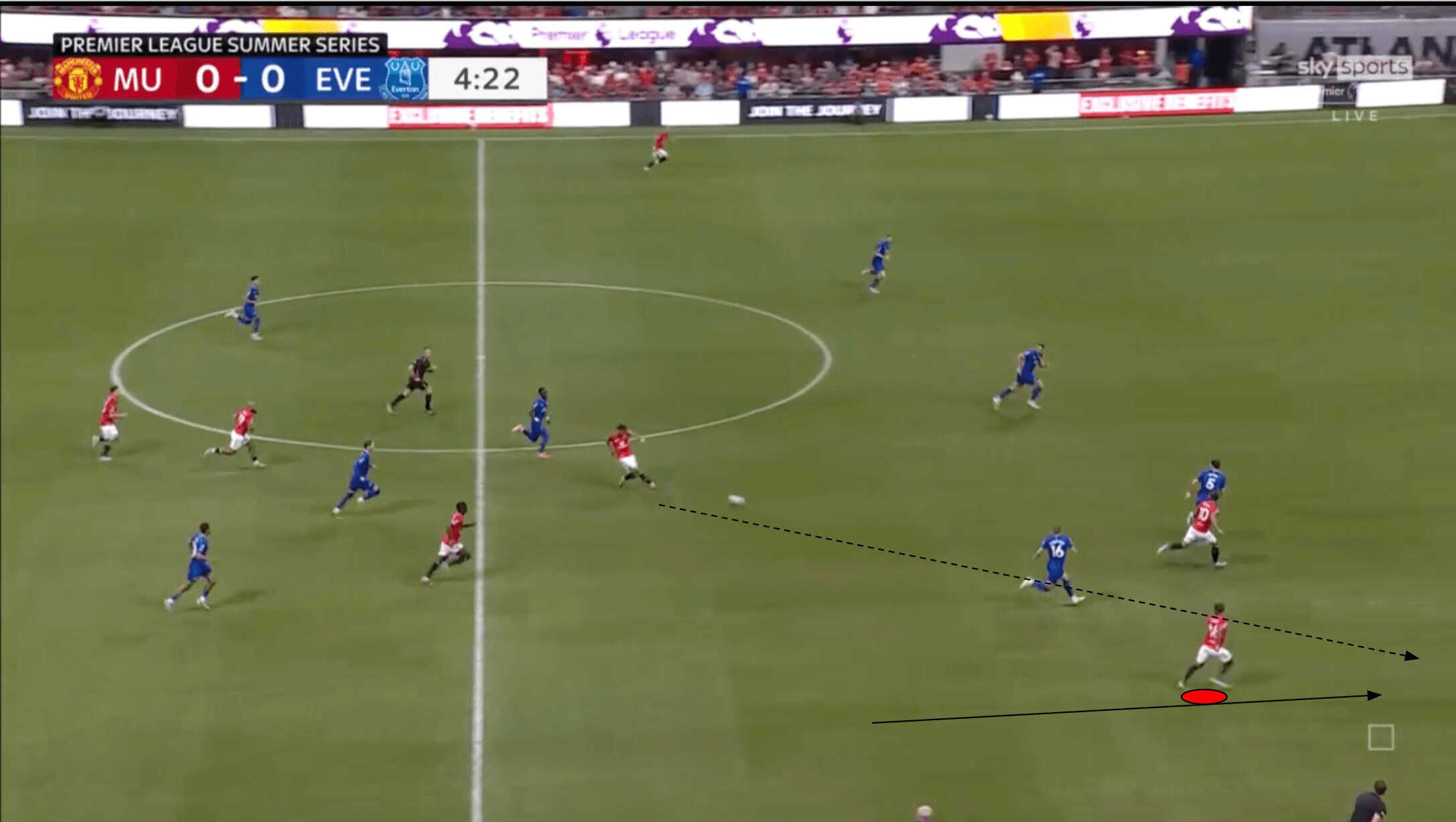
Amad Diallo is an attacking threat from wide on the right wing, also offering the potential to carry the ball inside.
He’s clearly been making the kinds of penetrative runs into space from wide, which could cause trouble for City of late, making him a solid option on the right wing.
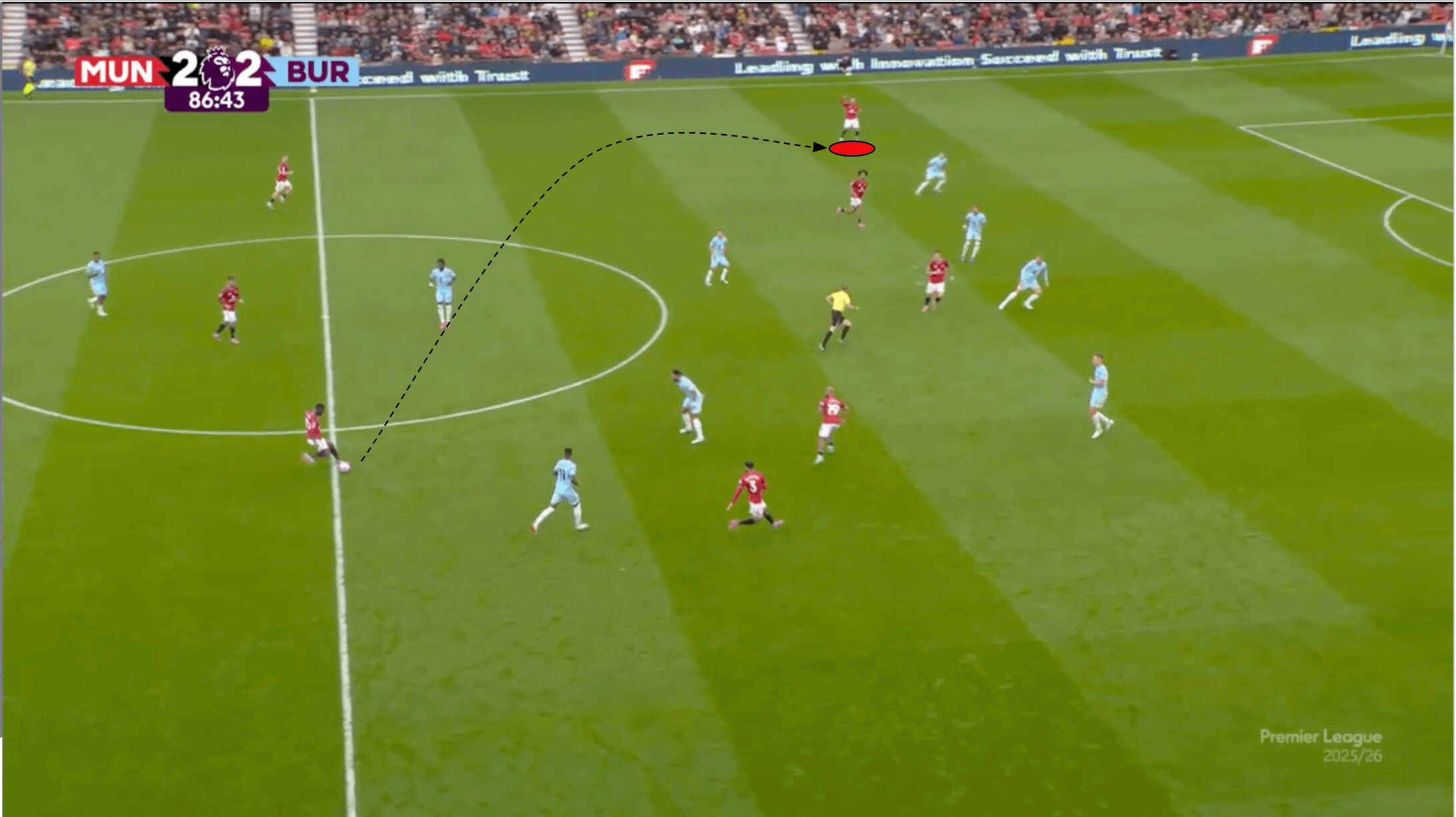
Diogo Dalot, meanwhile, offers versatility in being able to play on either the right or the left.
He’s comfortable positioning himself high and wide to stretch the opposition’s backline or place himself in a great position to receive with space to progress into.
As for Bruno Fernandes, the Red Devils captain generated 9.06 xA last season, which is the most of any central midfielder in the Premier League despite United’s atrocious form last term.
He also played the most long passes of any central midfielder in England’s top flight, 7.29, which equals 13.5% of his total passes going long.
He has the passing range and vision to put the ball on Šeško’s head, creating an opportunity for the forward to hold the ball up, knock it down for a teammate to exploit space around the City pivot or knock it on for a runner moving in behind, as well as send the ball into space for runners like Dalot or Amad Diallo to chase or break lines and find the likes of Mbeumo or Cunha in the half-spaces which City may struggle to cover, especially in transition.
While there’s a lot of debate around whether Fernandes should be deeper or more advanced, in this game, it’ll be more important to get him involved early on in possession, possibly drifting wider at times as the wing-backs push on.
Conclusion
Overall, City have shown weaknesses in defending when drawn high and wide in the build-up, so United may do well to get Fernandes into positions where he can help the team exploit City’s weaknesses in those phases through his passing range.
Šeško, mainly through his aerial contribution.
Mbeumo, Cunha, and two of Dalot, Diallo, and Dorgu will also have key roles to play in exploiting City’s resulting structural weaknesses around the pivot and attack space behind their high line.
This is a broad outline of how the mentioned profiles and setup give Manchester United the best chance of beating Manchester City by capitalising on the same issues exploited by Crystal Palace, Spurs and Brighton.
