
We began this series intending to dissect Manchester City‘s in-possession approach for 2025/2026.
First, we explored the build-up, analysing the ideas of Pep Guardiola and his new assistant Pep Lijnders, particularly against man-marking high-pressing schemes, which is a common trend these days.
Then, we examined their progression phase and the objectives they pursue against different defensive structures.
In these two phases, we went into significant detail, making it a journey quite similar to Man City‘s path toward the final third.
This represents Pep Guardiola’s most favourable phase.
Here, his team operates close to the opposition goal, maximising goalscoring opportunities.
At the same time, this phase is further from his own goal, thus reducing the likelihood of conceding, which adds a layer of safety.
Now, with Pep Lijnders alongside Guardiola, we explore Man City’s in-possession tactics in the final third using examples from their 2025 FIFA Club World Cup campaign against Wydad, Juventus, and Al-Hilal.
Manchester City Final Third Tactics Vs Wydad

In this match against Wydad AC, Manchester City lined up with Ederson in goal.
Vitor Reis and Nathan Aké operated as the centre-backs, flanked by Rico Lewis on the right and Nico O’Reilly on the left as full-backs.
Tijjani Reijnders started as the six, with Phil Foden and Omar Marmoush playing as the right and left eights respectively—a switch from what we see on the board, which had Rayan Cherki listed in that role.
Instead, Cherki featured as the centre-forward.
Savinho and Jérémy Doku occupied the right and left-wing positions on the flanks.
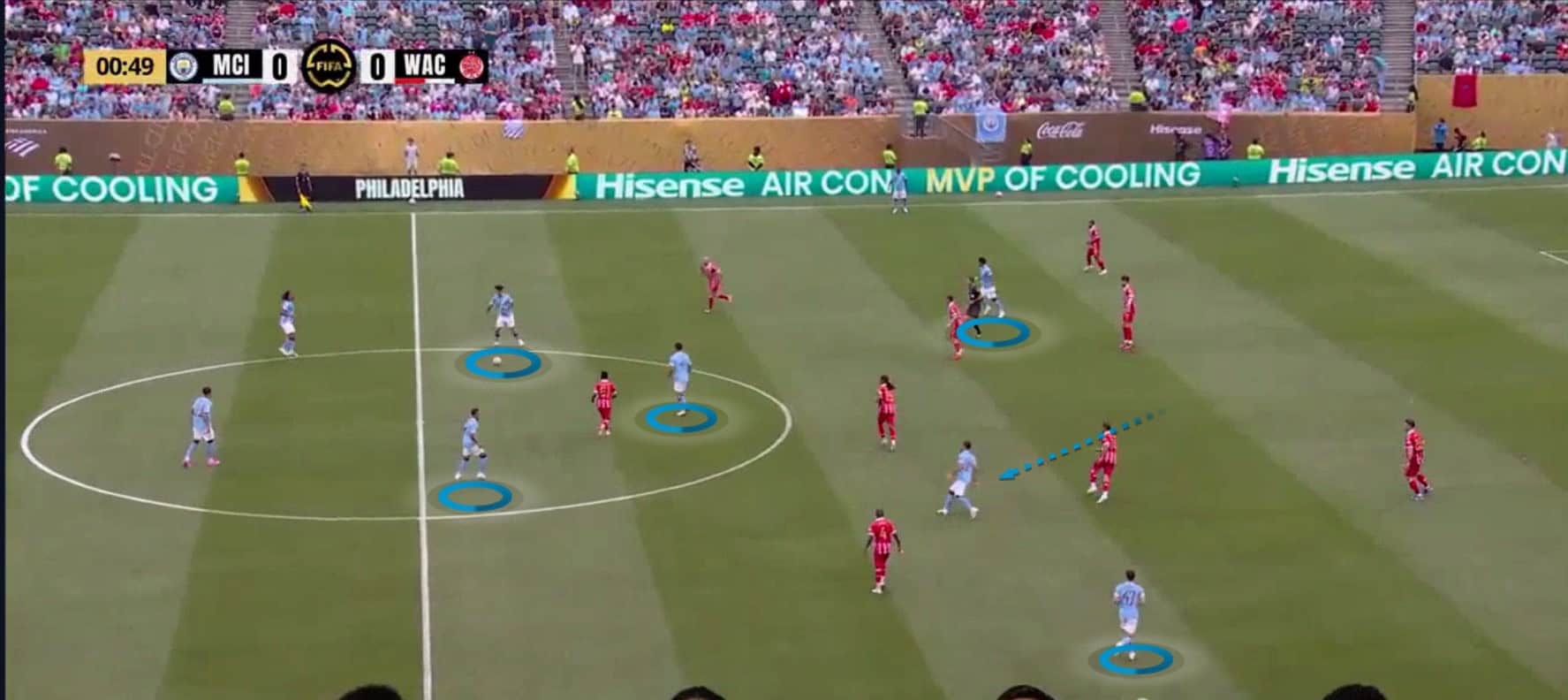 In the figure above, Man City operate in the final third with a 2-3 structure.
Reis and Ake form the first line, while Lewis, O’Reilly, and Rejinders make up the second, with the latter positioned more advanced than his two counterparts.
Foden and Marmoush function as the two eights, occupying the half-spaces but capable of drifting wide and dropping deeper.
Cherki serves as the centre-forward, frequently dropping into deeper positions.
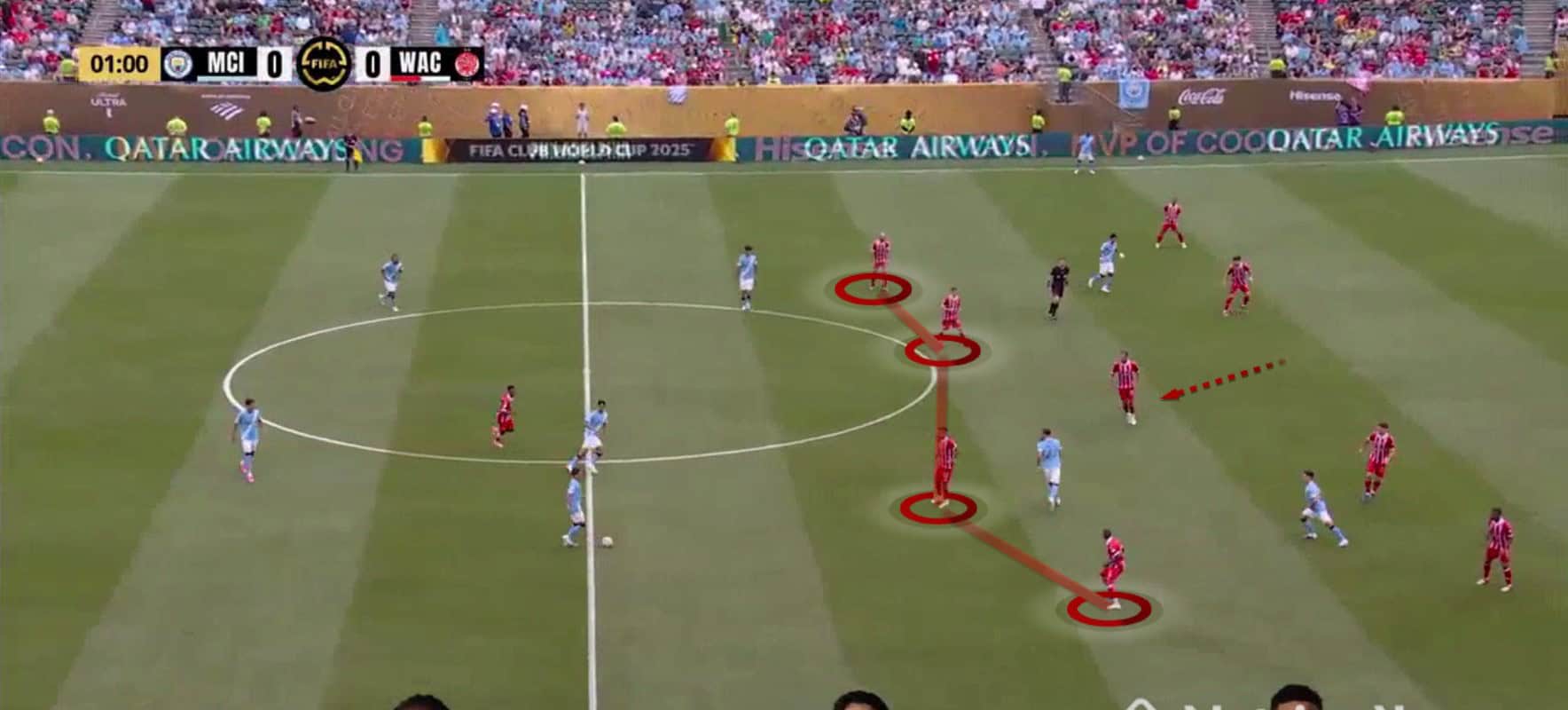 Wydad maintain similar second-line principles to those seen in their progression phase, remaining narrow and closing passing lanes between them when the ball is central.
Additionally, central centre-back Abdelmounaim Boutouil occasionally steps forward to track Cherki’s movements.
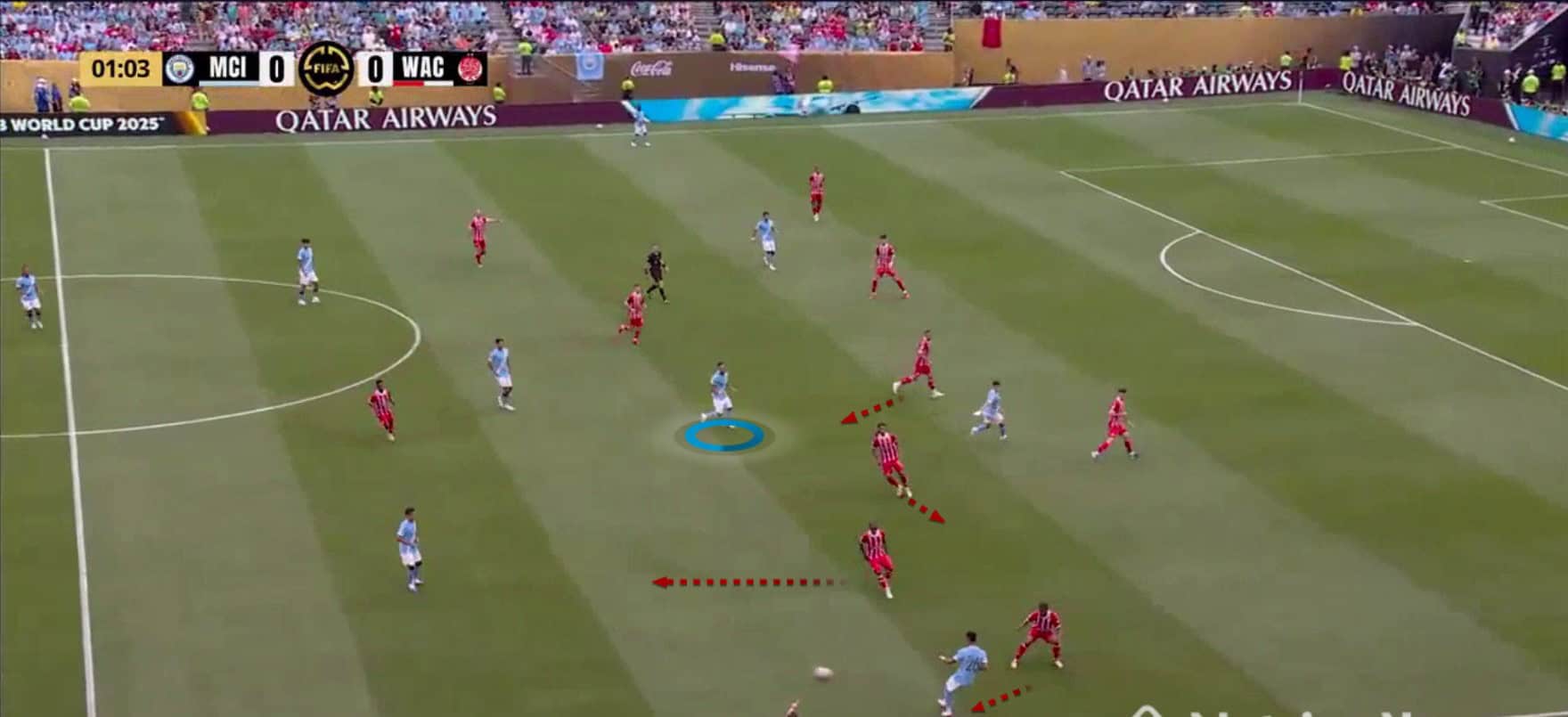 In contrast, Man City look to play the ball wide to winger Savinho.
This prompts not only Mohamed Moufid to press Savinho, but also a collective shift from Wydad’s players.
Thembinkosi Lorch moves closer, either to create a 2-v-1 against Savinho or to be ready to press Lewis if he receives the ball.
El Mehdi El Moubarik, the left-sided number six, shifts across behind them, while Boutouil stays ready to follow Cherki.
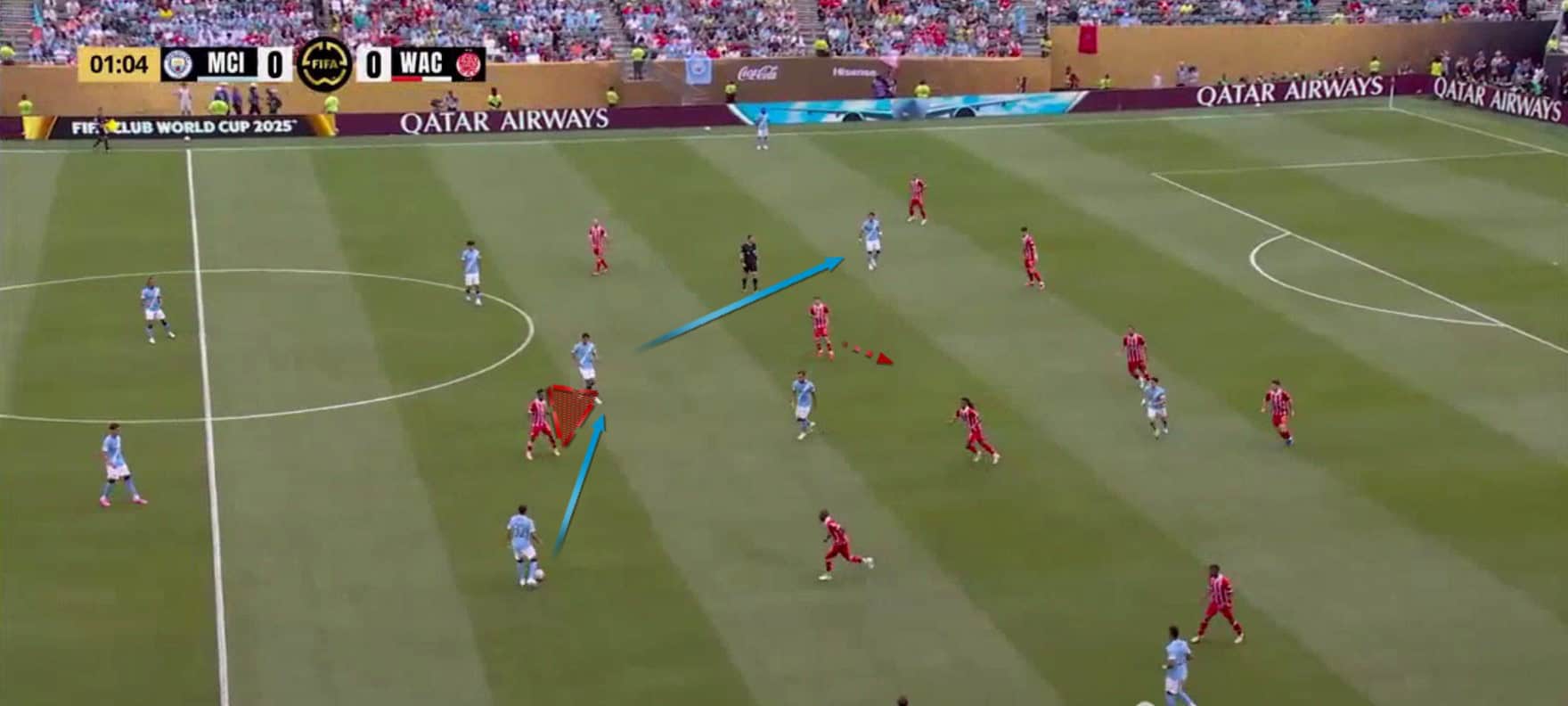 Additionally, Oussama Zemraoui, the right-sided number six, shifts across to maintain compactness in Wydad’s defensive shape.
Man City aim to find Marmoush, the far-sided number eight, in the half-space during this shift, particularly when Nordin Amrabat is drawn towards O’Reilly, creating an opening for the pass.
In this sequence, Reijnders attempts to move out of Cassius Mailula‘s cover to receive the ball and then play it to Marmoush, but Mailula tracks him closely, preventing the pass.
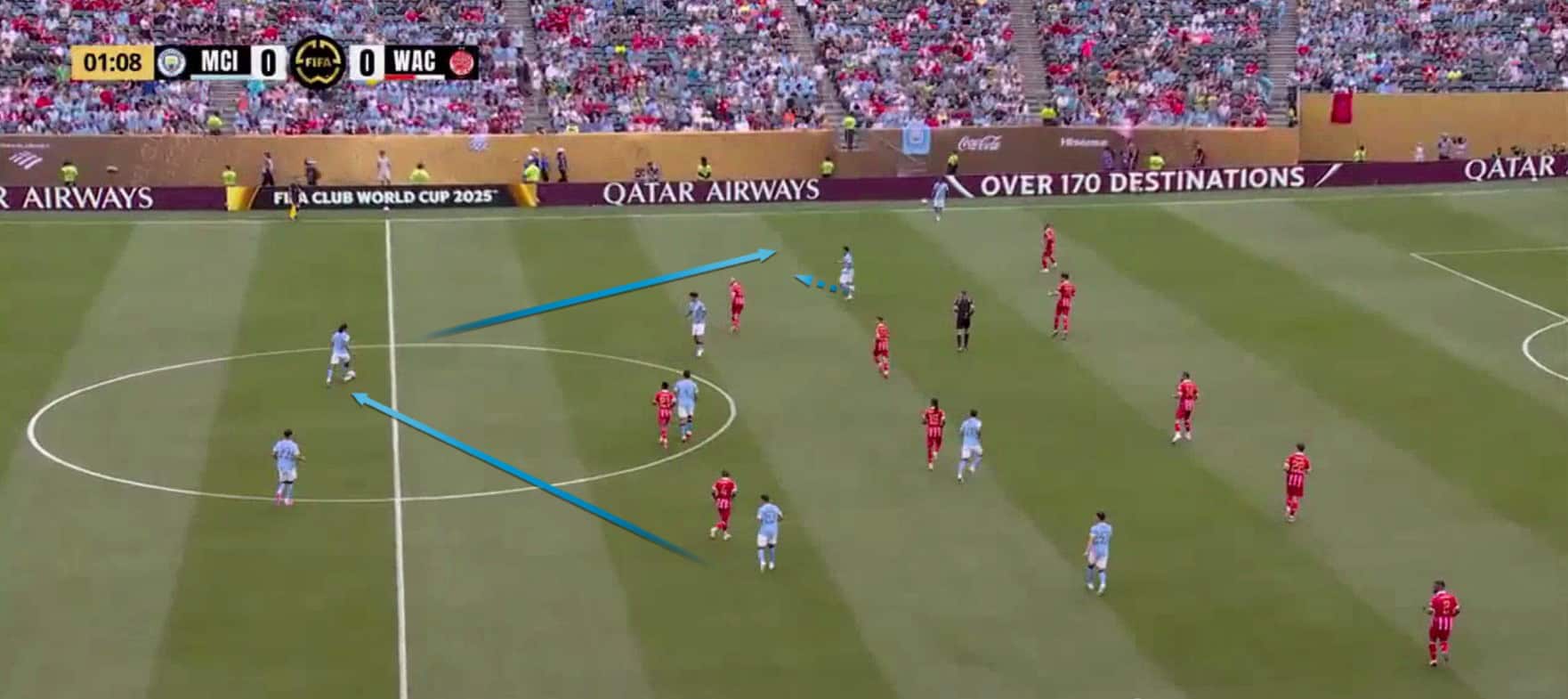 Man City maintain composure in possession, patiently working the ball while seeking to recreate the same scenario, potentially from the opposite flank.
In this instance, Aké is too far to find Doku directly, so Marmoush drops to connect the play.
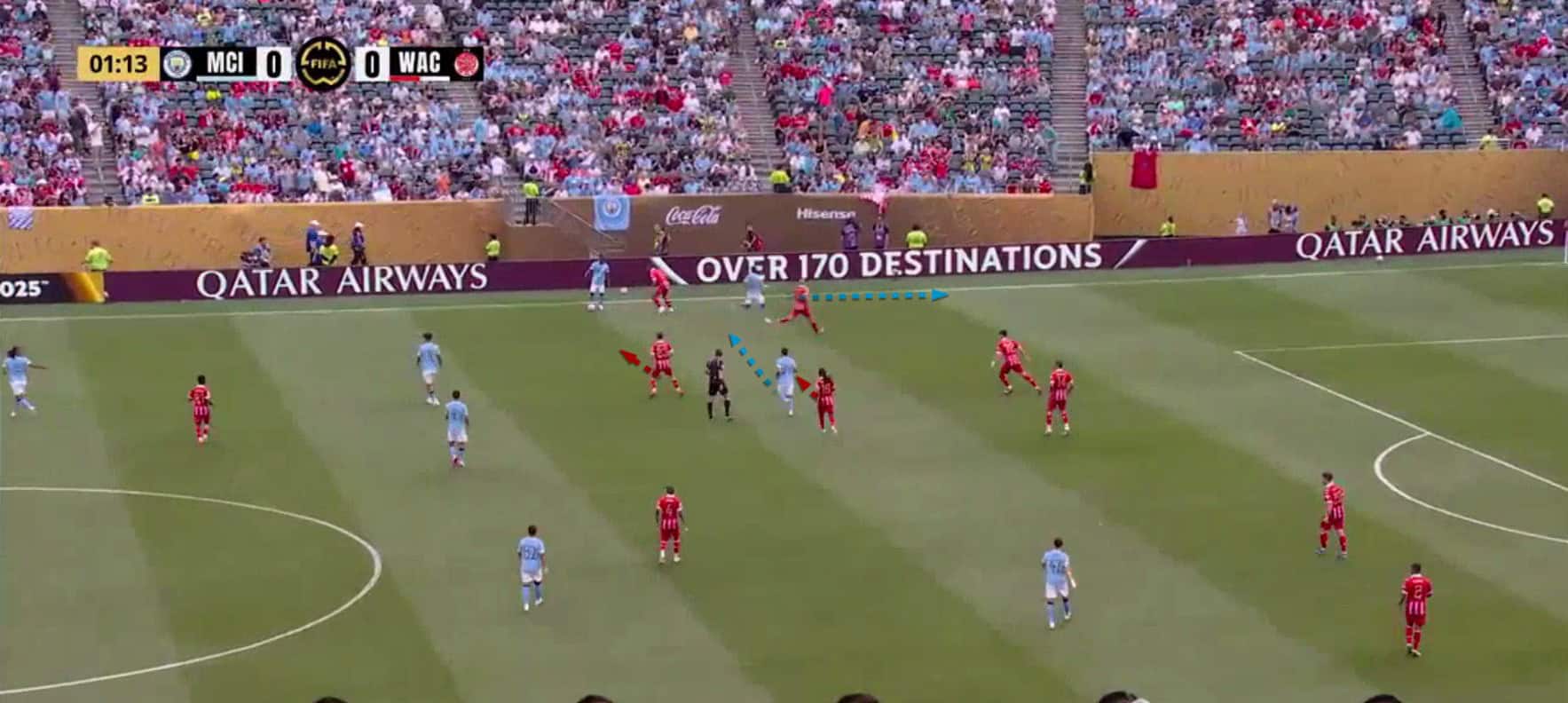 To draw Wydad’s defenders into shifting, Marmoush makes a run that pulls Amrabat.
The near-side six, Zemraoui, moves towards the ball, preparing to press O’Reilly, while Boutouil holds his position instead of tracking Cherki, leaving El Moubarik to follow him.
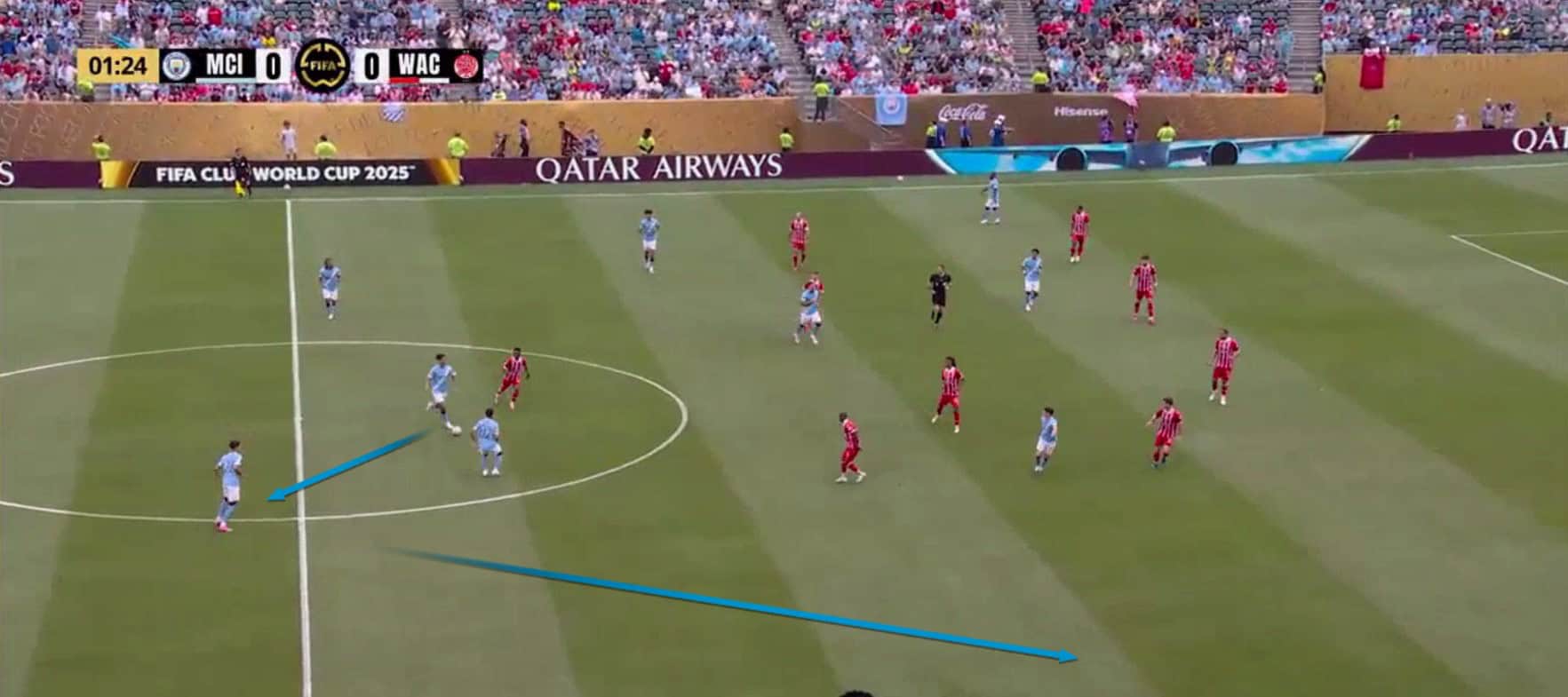 However, Manchester City managed to escape the pressure as Reijnders was the free man.
With the ball now in the centre and Wydad’s midfield line maintaining the same shape, Reijnders uses Reis to find Savinho with a pass wide to the wing.
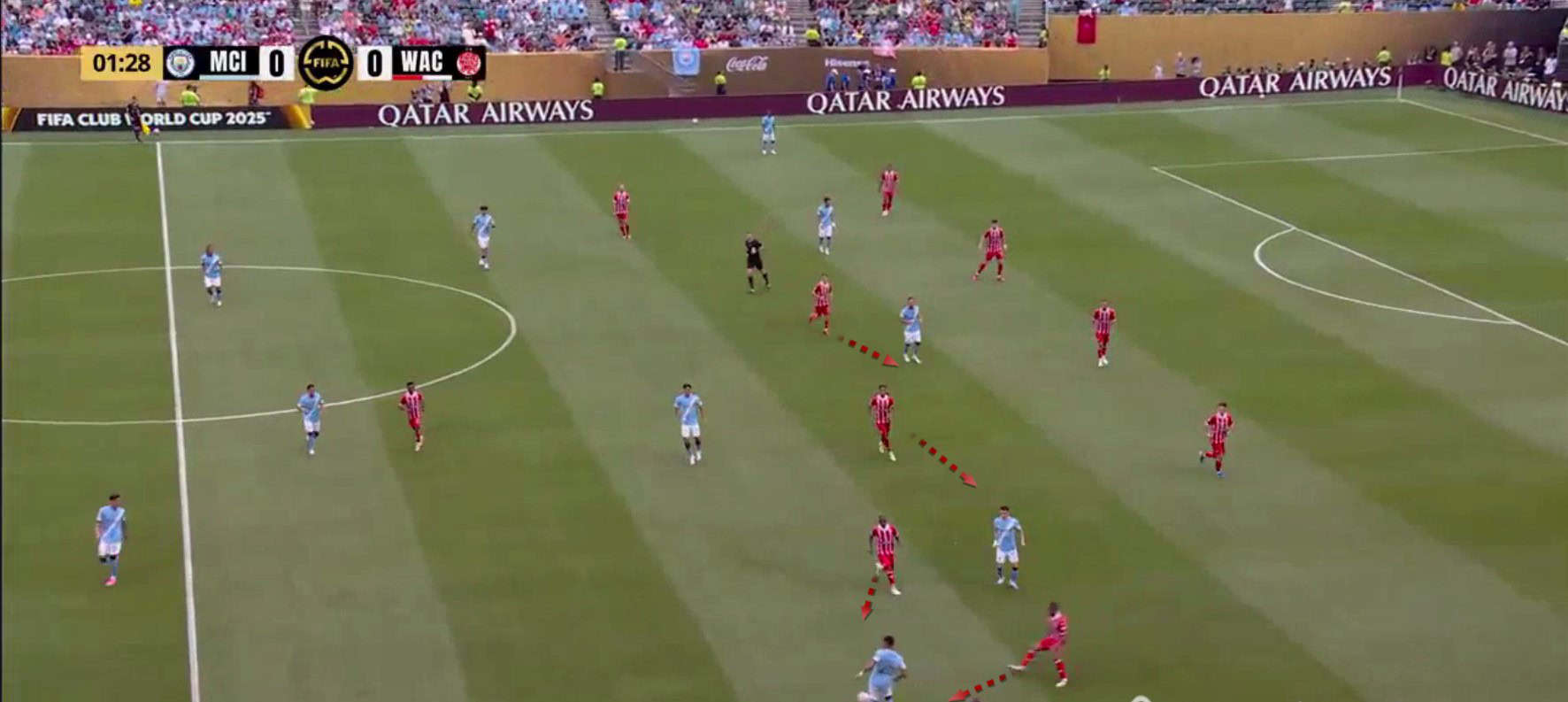 With the ball wide, Pep Guardiola’s side faces Wydad’s same defensive scheme.
Their aim is once again to locate the free far-sided eight.
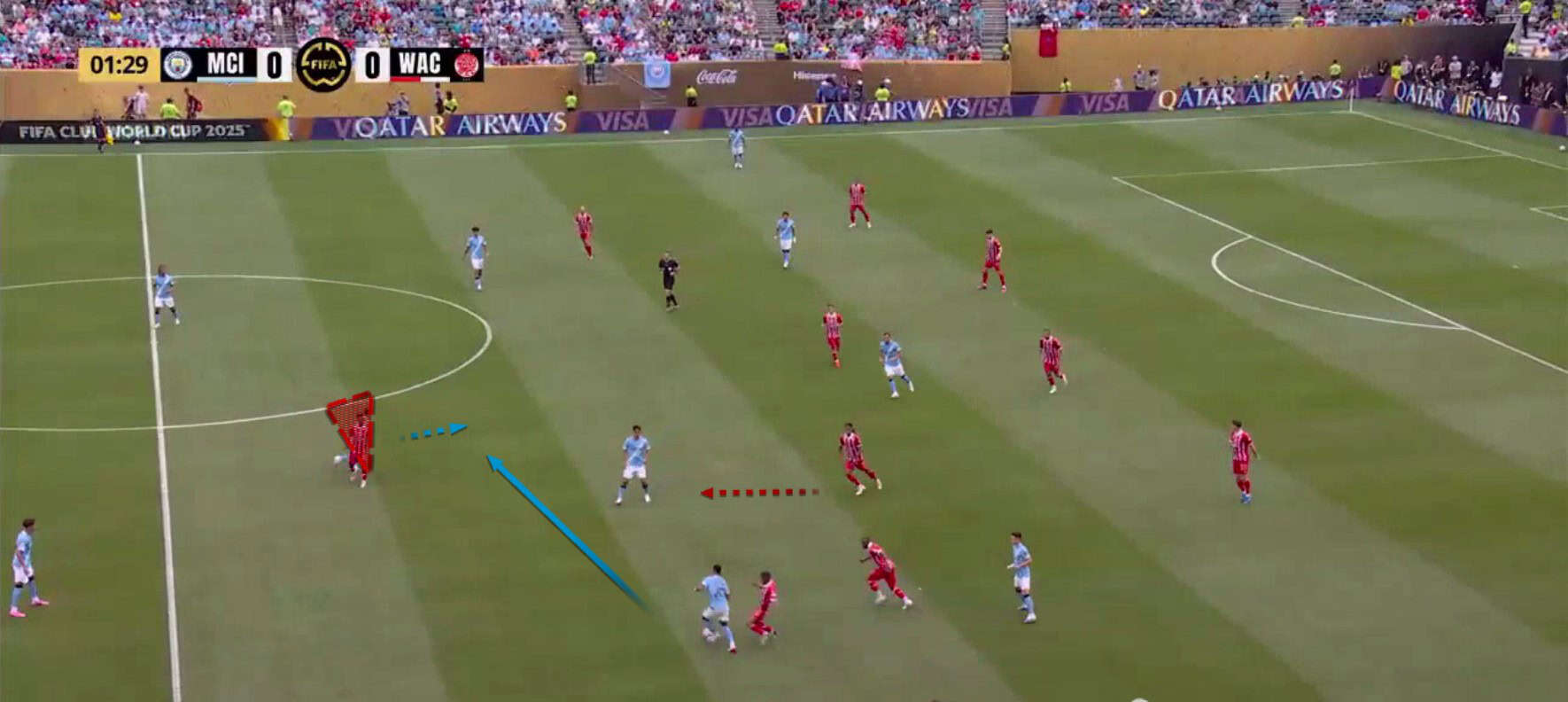 Reijnders positions himself so that El Moubarik cannot intercept the pass.
This time, to avoid being shadowed as Reijnders was earlier, Lewis moves to escape Mailula’s cover.
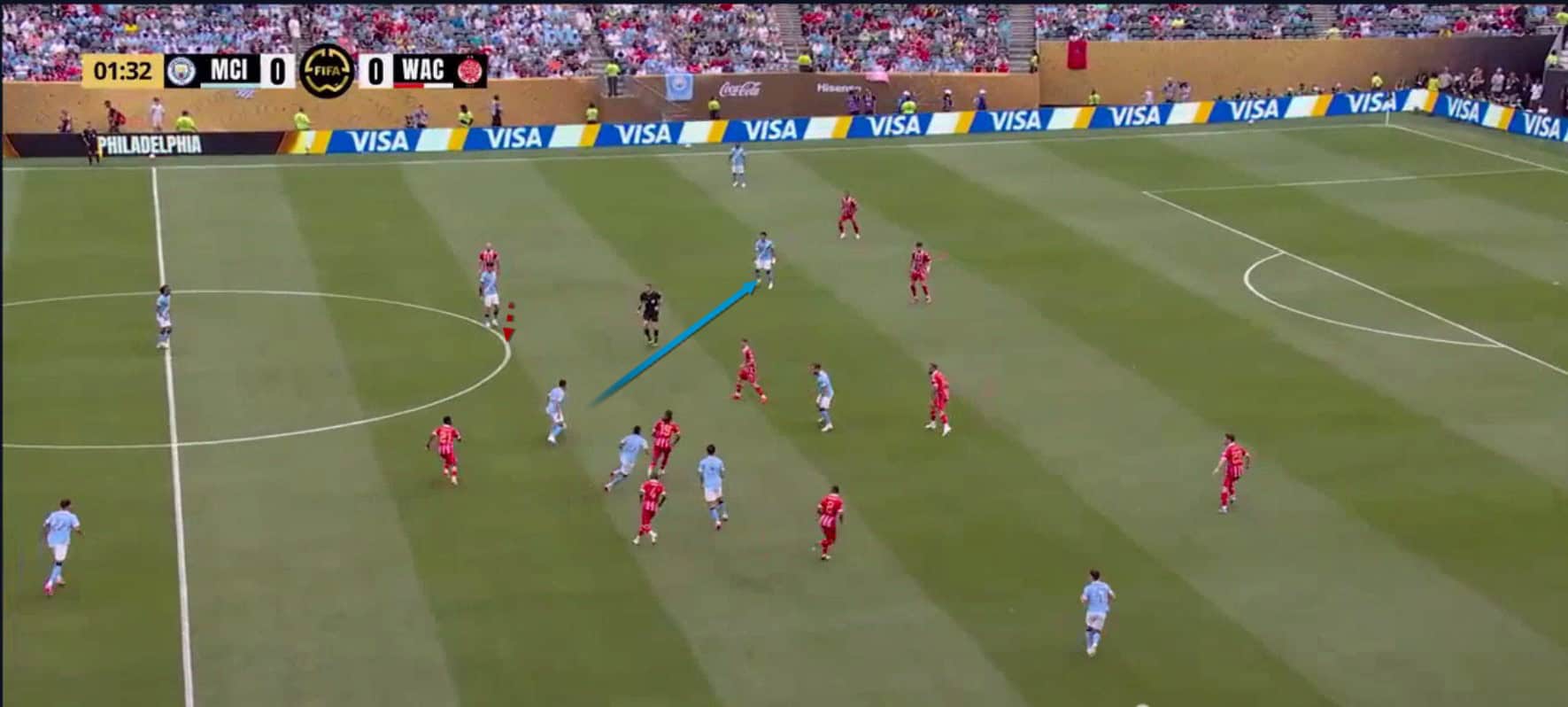 With Amrabat drawn towards O’Reilly, the passing lane to Marmoush opens.
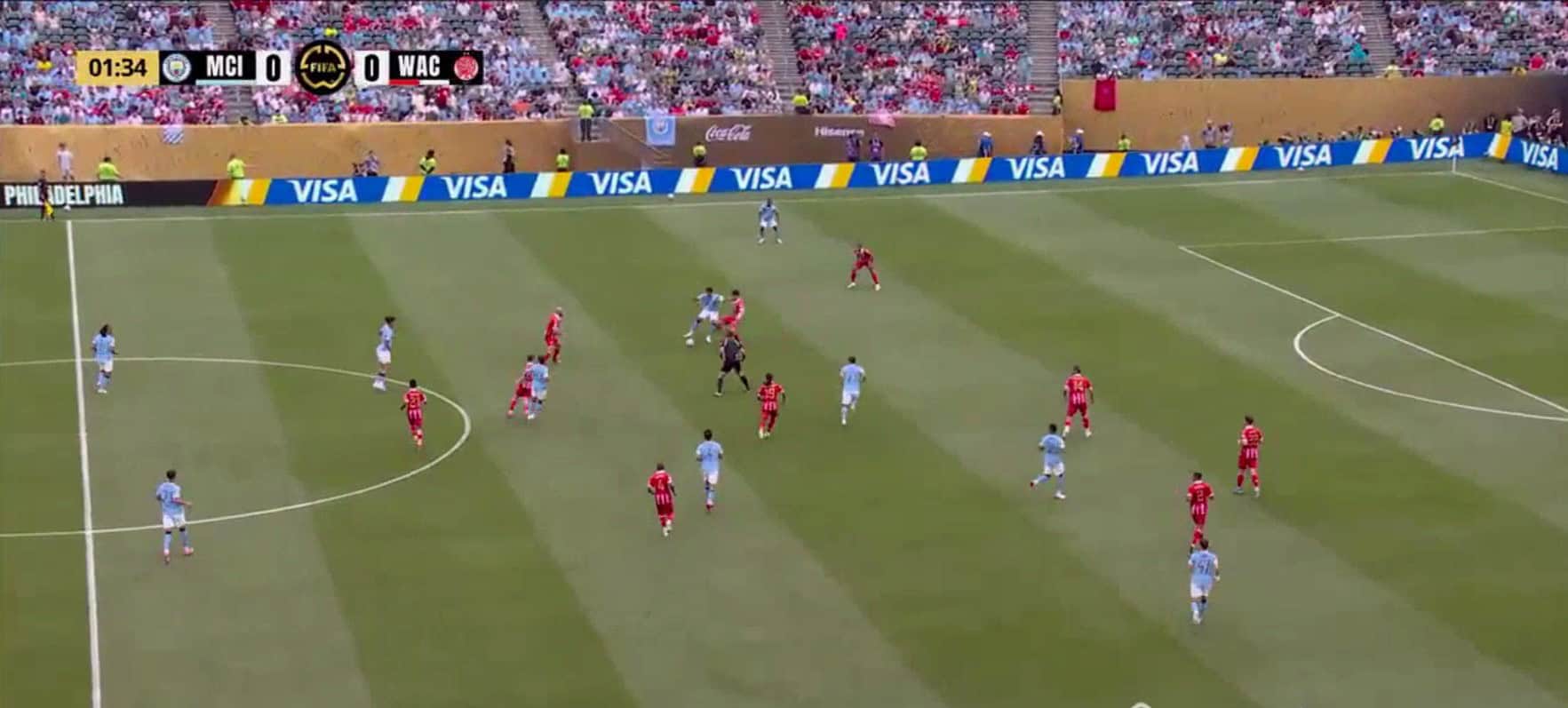 Lewis delayed the pass, allowing right centre-back Guilherme Ferreira to step forward and intercept.
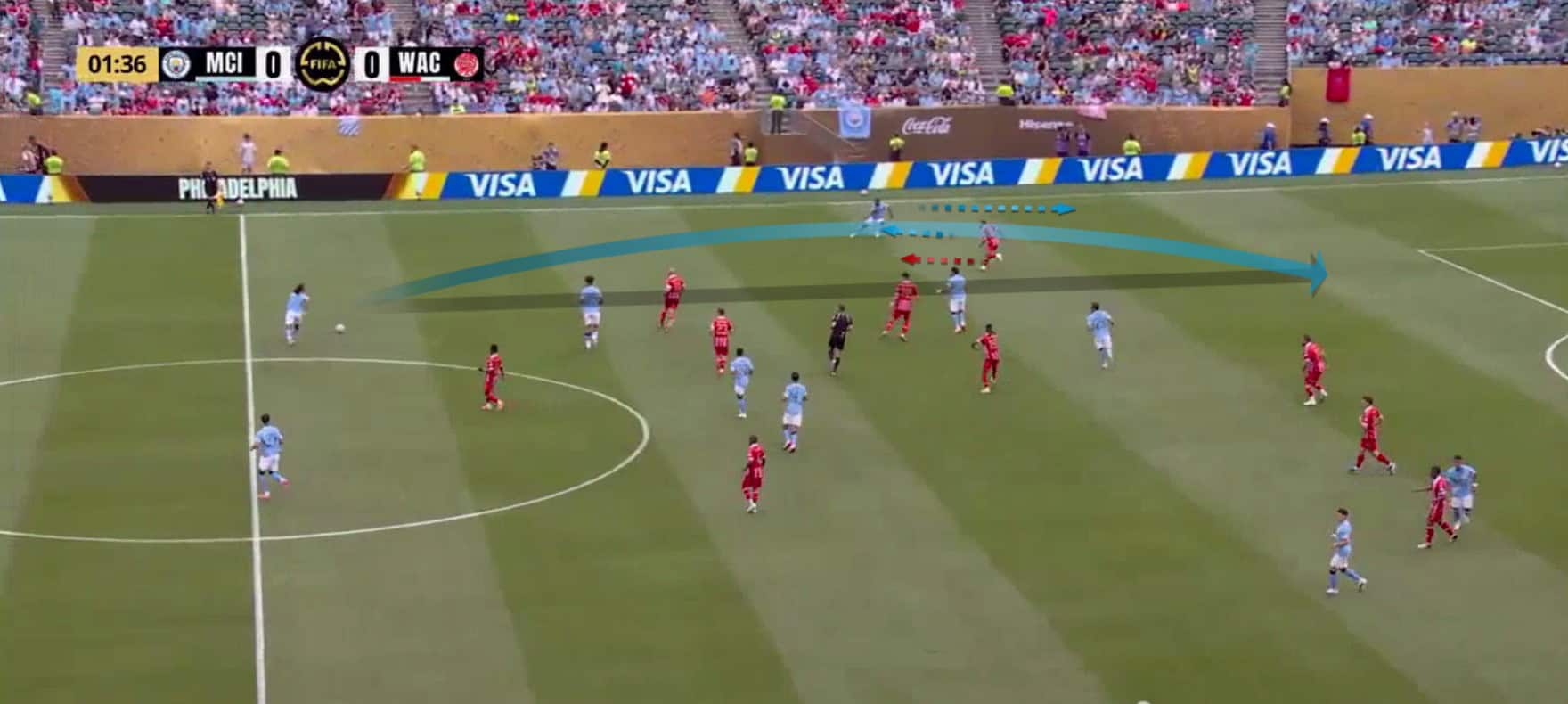 However, the situation favours Man City, with Ake recovering possession.
Pep Guardiola’s side then looks to exploit another attacking option against Wydad’s defensive shape, a long ball in behind.
Doku initially drops deep before Ake plays the pass, drawing right wing-back Fahd Moufi with him.
As Ake prepares to release the ball, Doku quickly spins to the opposite side of Moufi, exploiting his poor body shape and making it difficult for him to react.
Doku’s acceleration further amplifies the advantage.
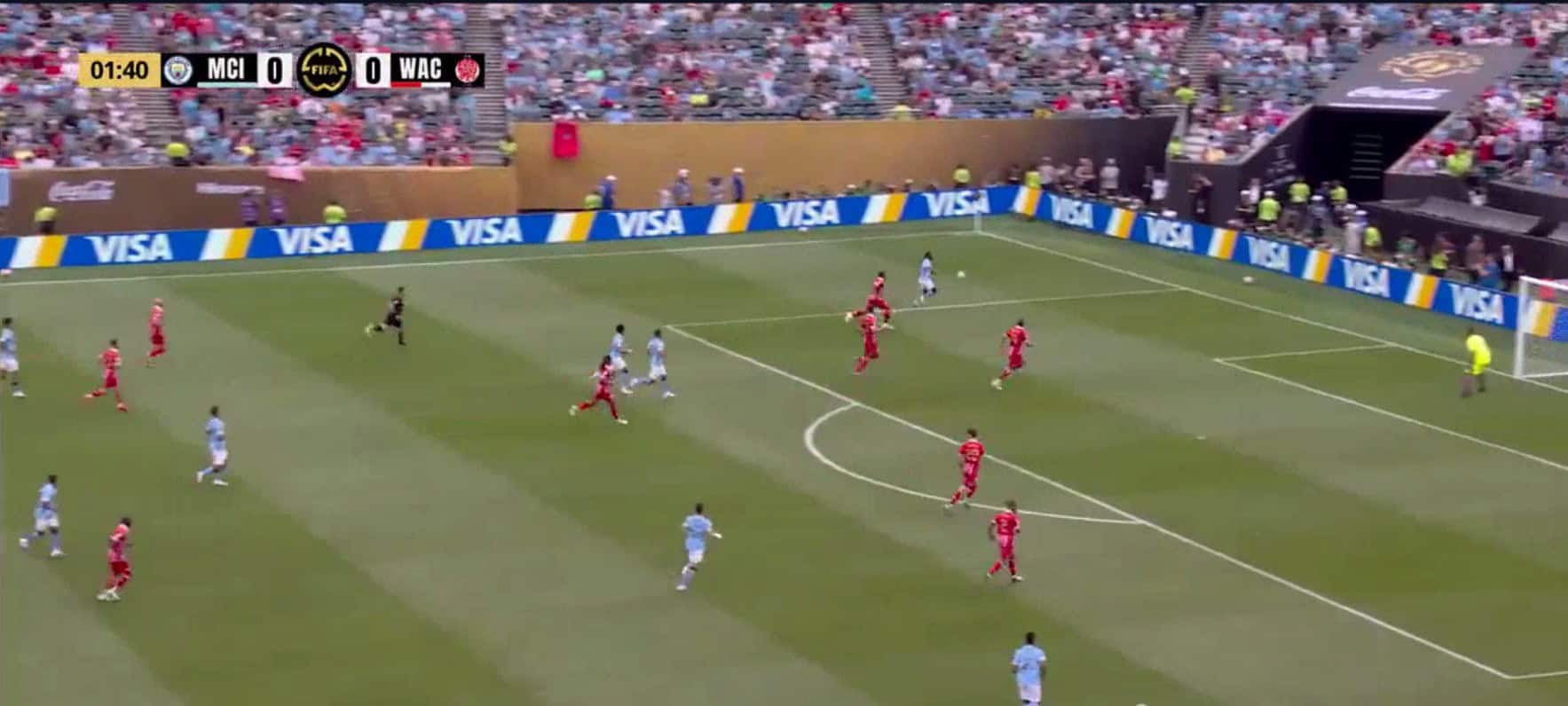 Doku receives the ball and immediately delivers a cross into the penalty area.
This one will lead to Man City’s opening goal.
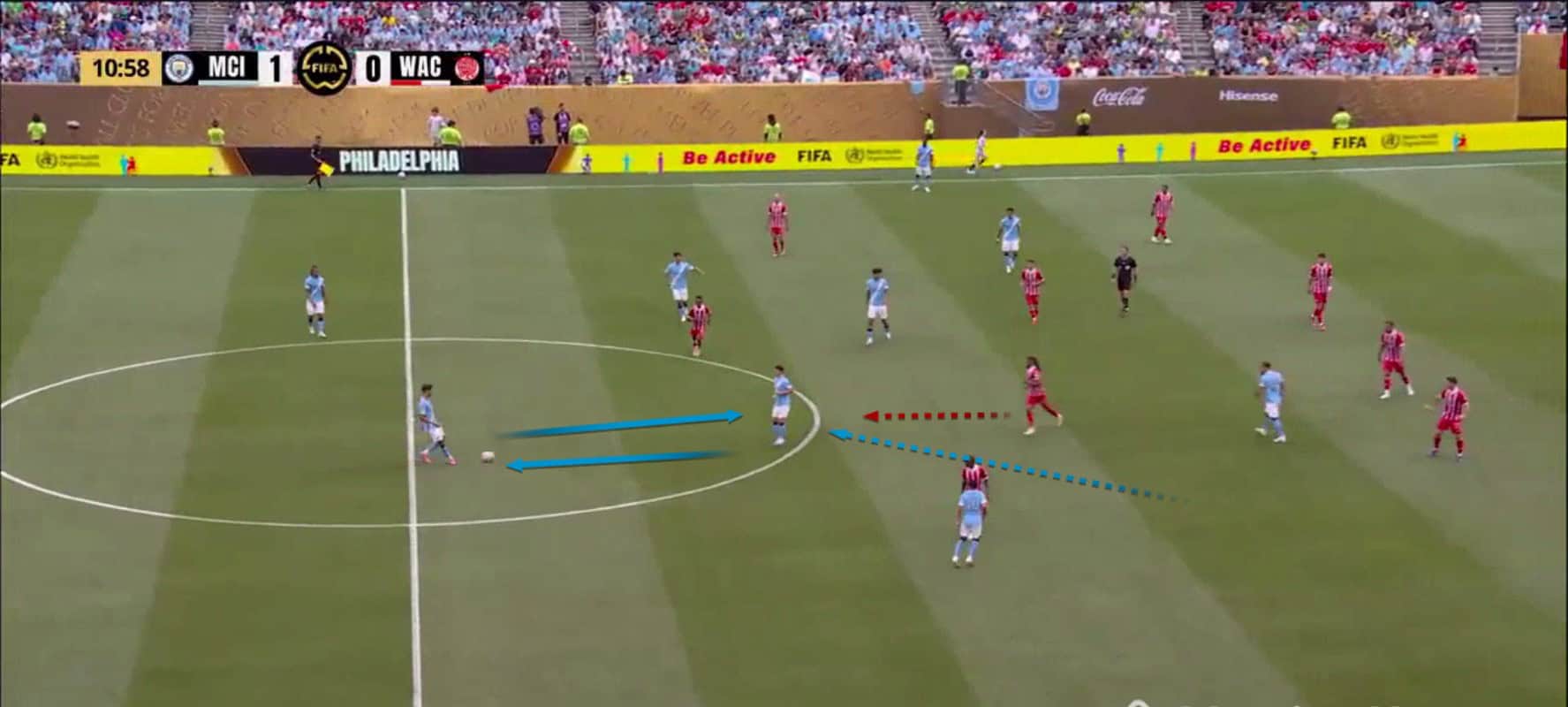 Man City paired creating space for eights with another tactic to unsettle Wydad’s low block.
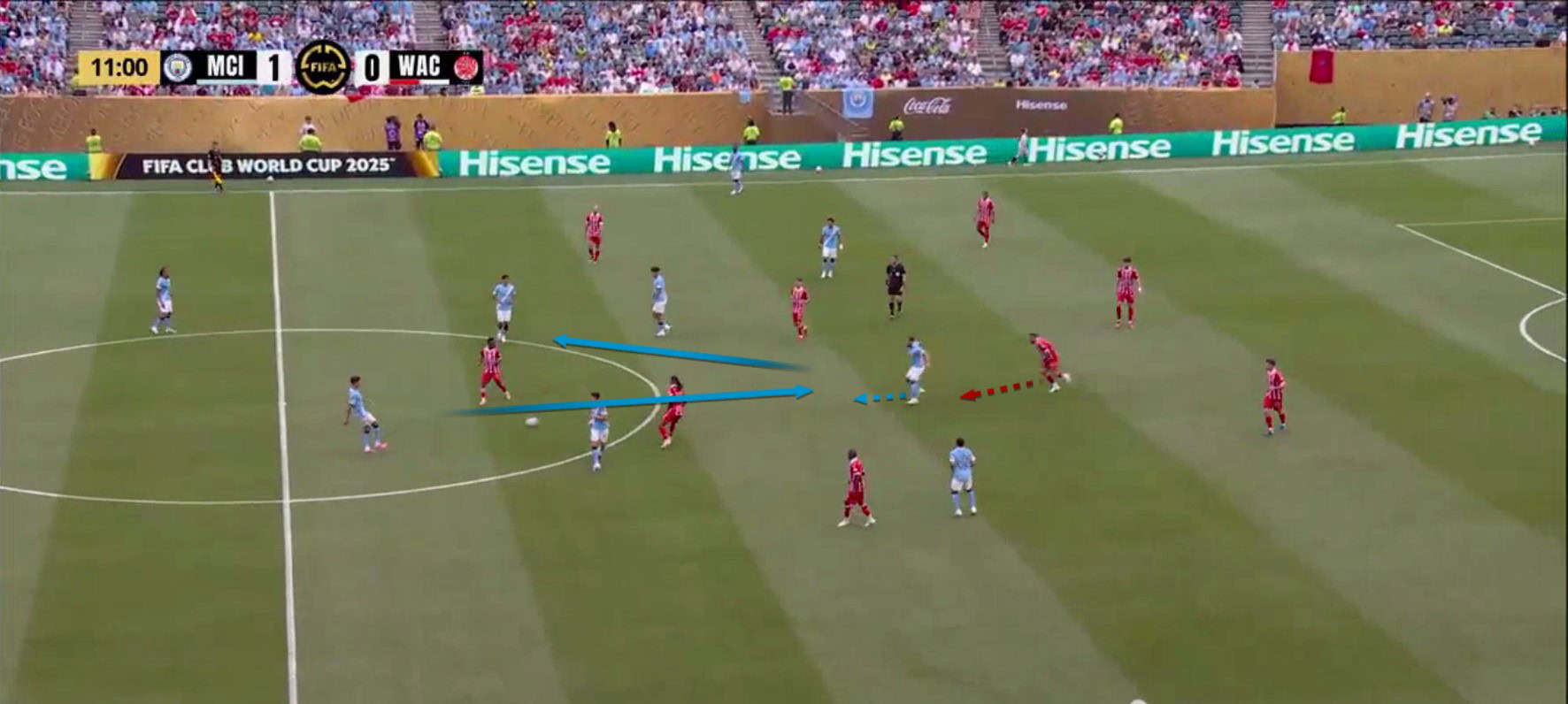 In the figure above, Foden drops, plays back to Reis, pulling El Moubarik.
Cherki repeats the move, drawing Boutouil.
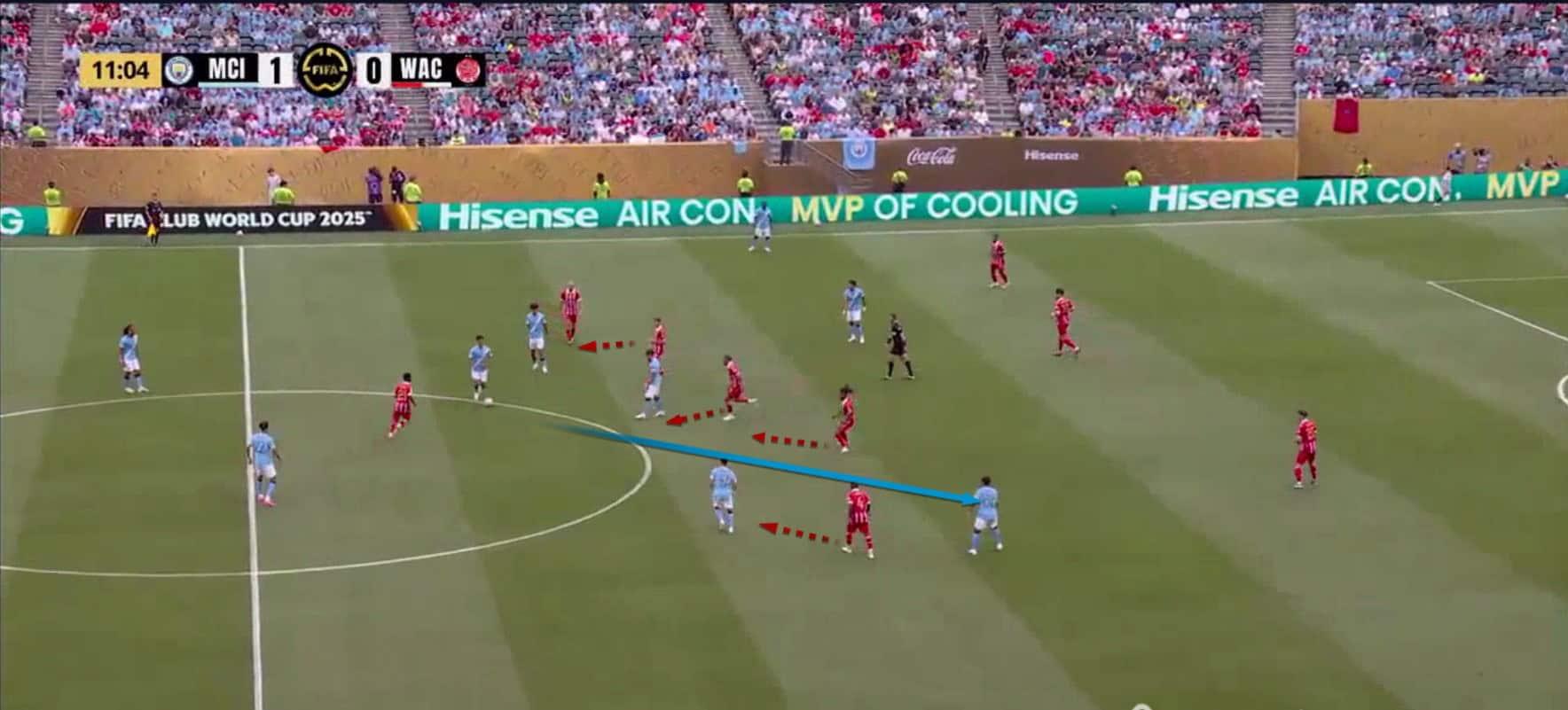 Lewis advances high.
With El Moubarik dropping into his zone, and Foden pulling Lorch slightly out of position, a passing lane to Lewis opens up.
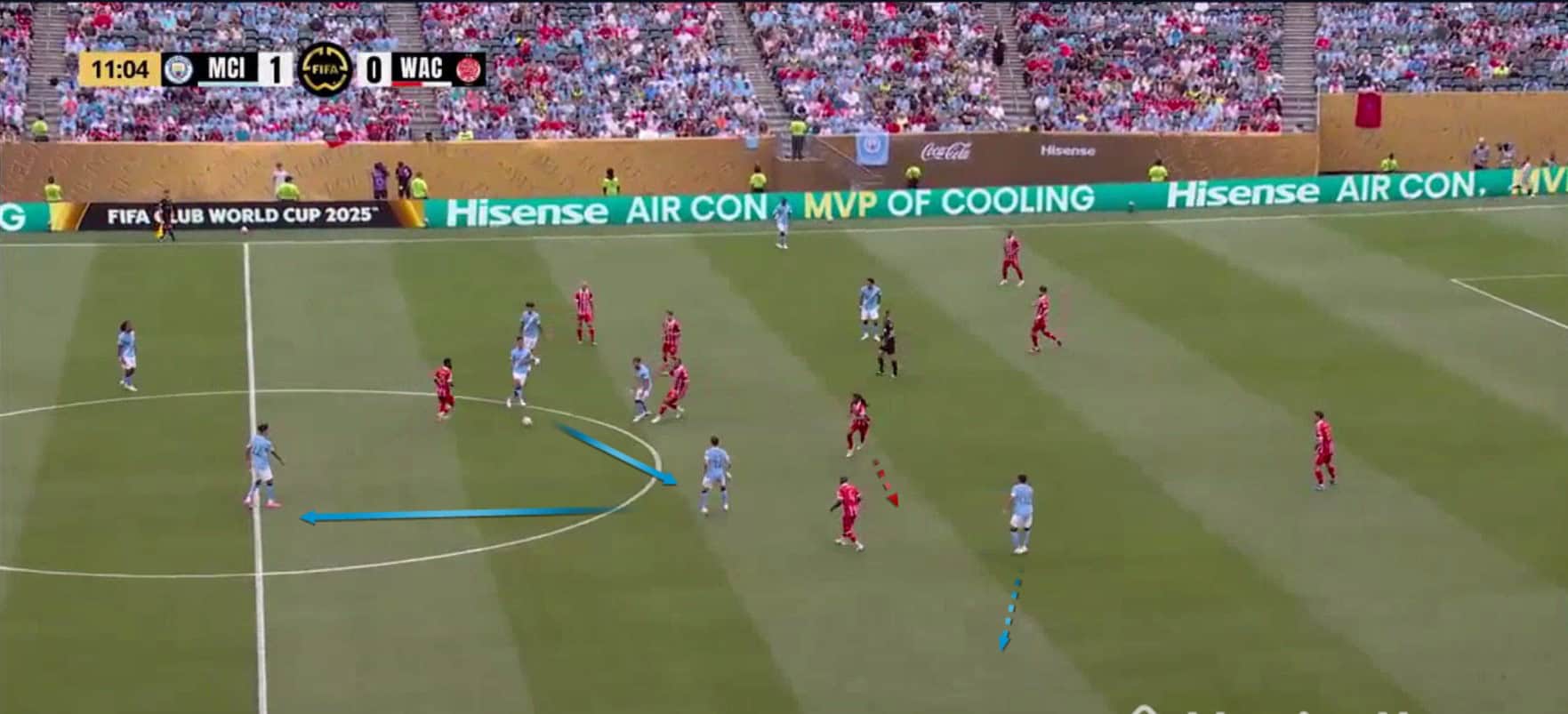 However, Reijnders opts for a safer choice, recognising that El Moubarik has adjusted his positioning well enough to potentially intercept the pass.
However, here, the eight, now Lewis, can exploit the space created as Lorch moves wide.
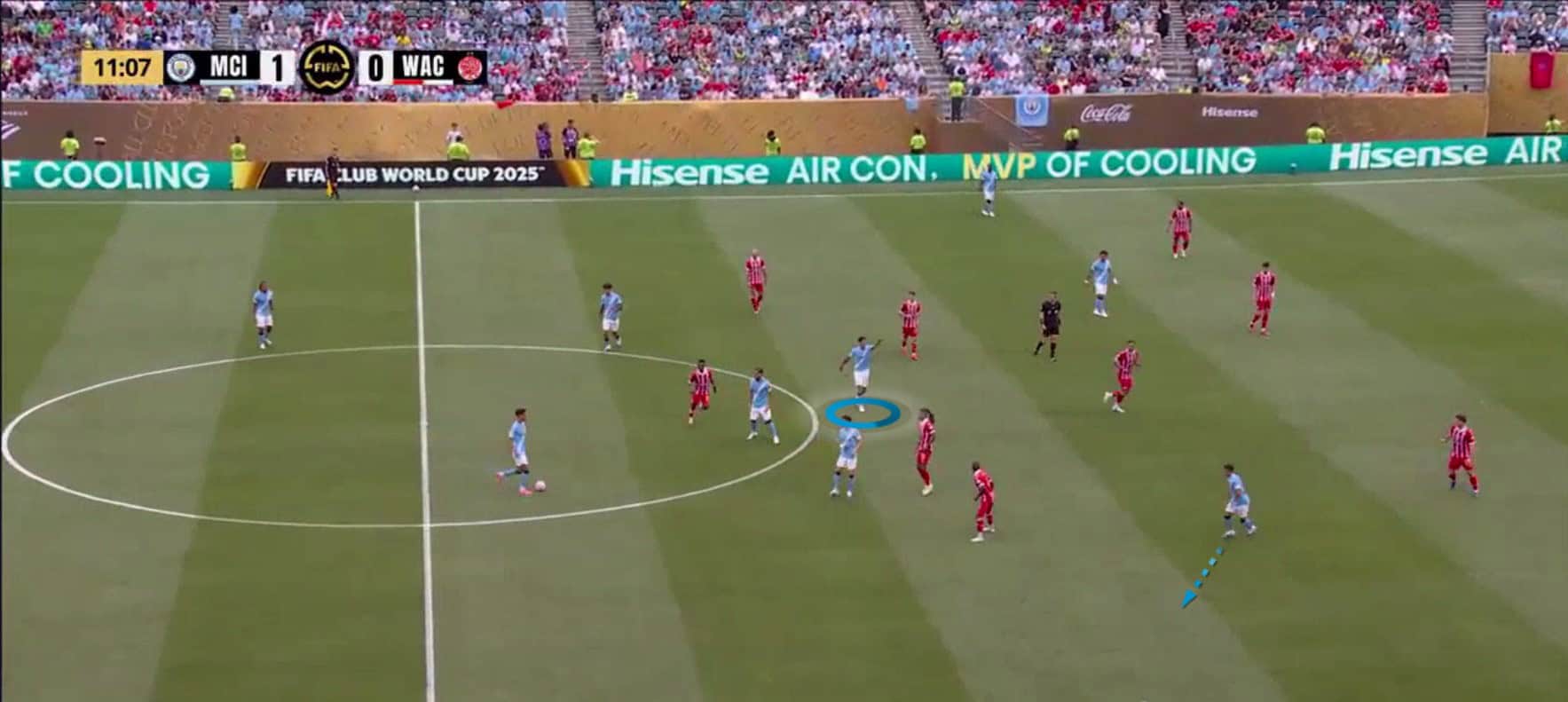 With wide positioning, Lewis provides an opportunity to receive the ball.
Reijnders is visibly signalling for him to shift wide and collect the pass.
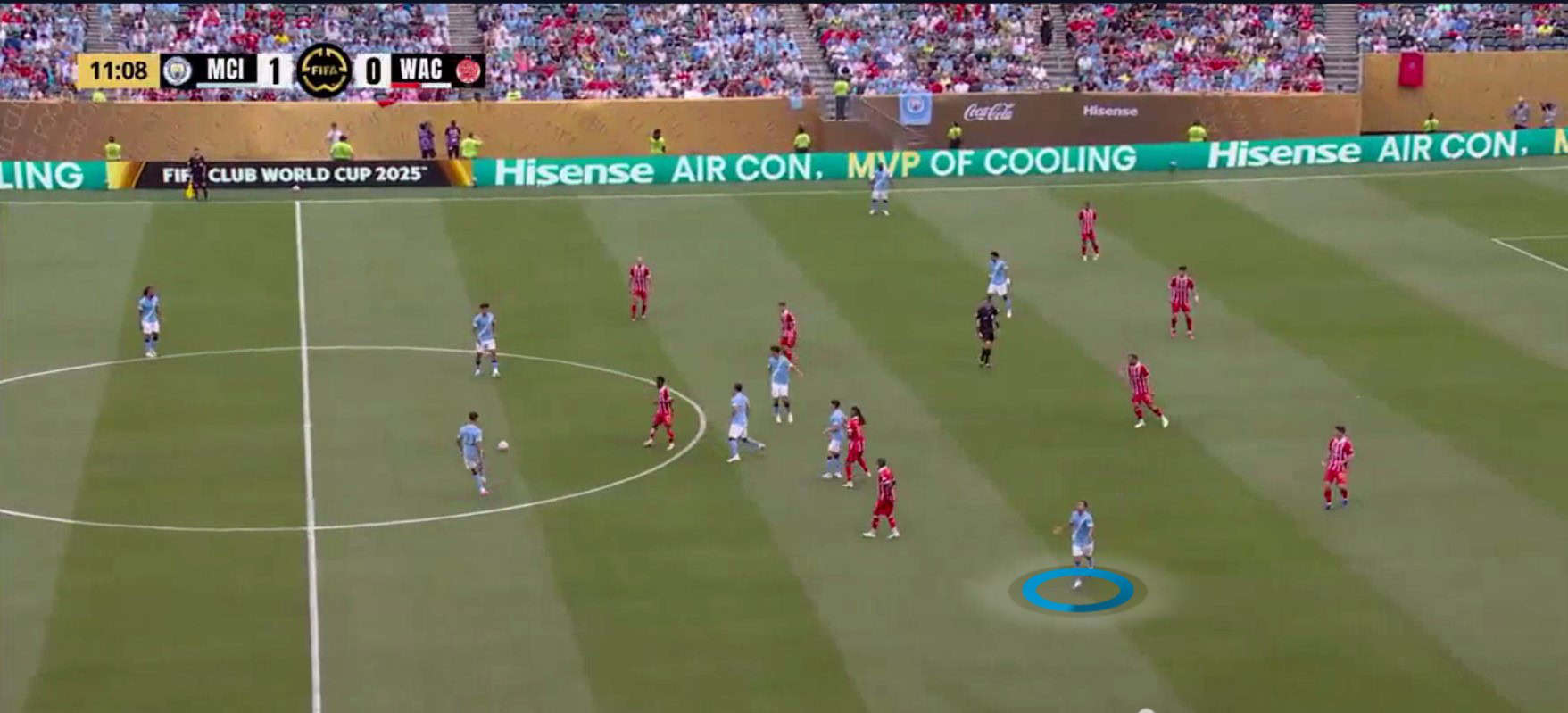 Lewis shows frustration as Reis passes to O’Reilly.
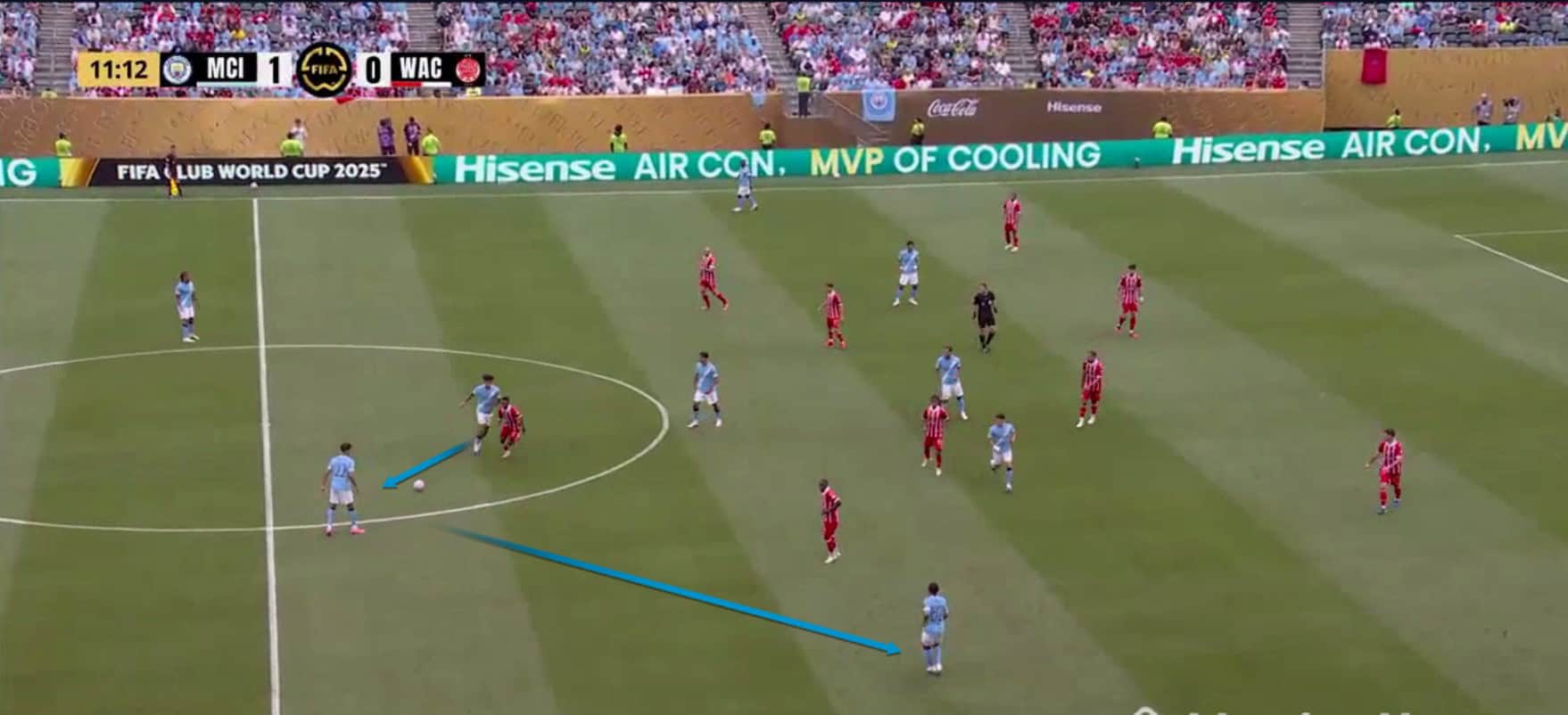 However, Man City can now restart their planned sequence.
O’Reilly passes to Reis before making a forward run.
Ries receives, draws Mailula towards him, and then releases the pass to Lewis in a wide position.
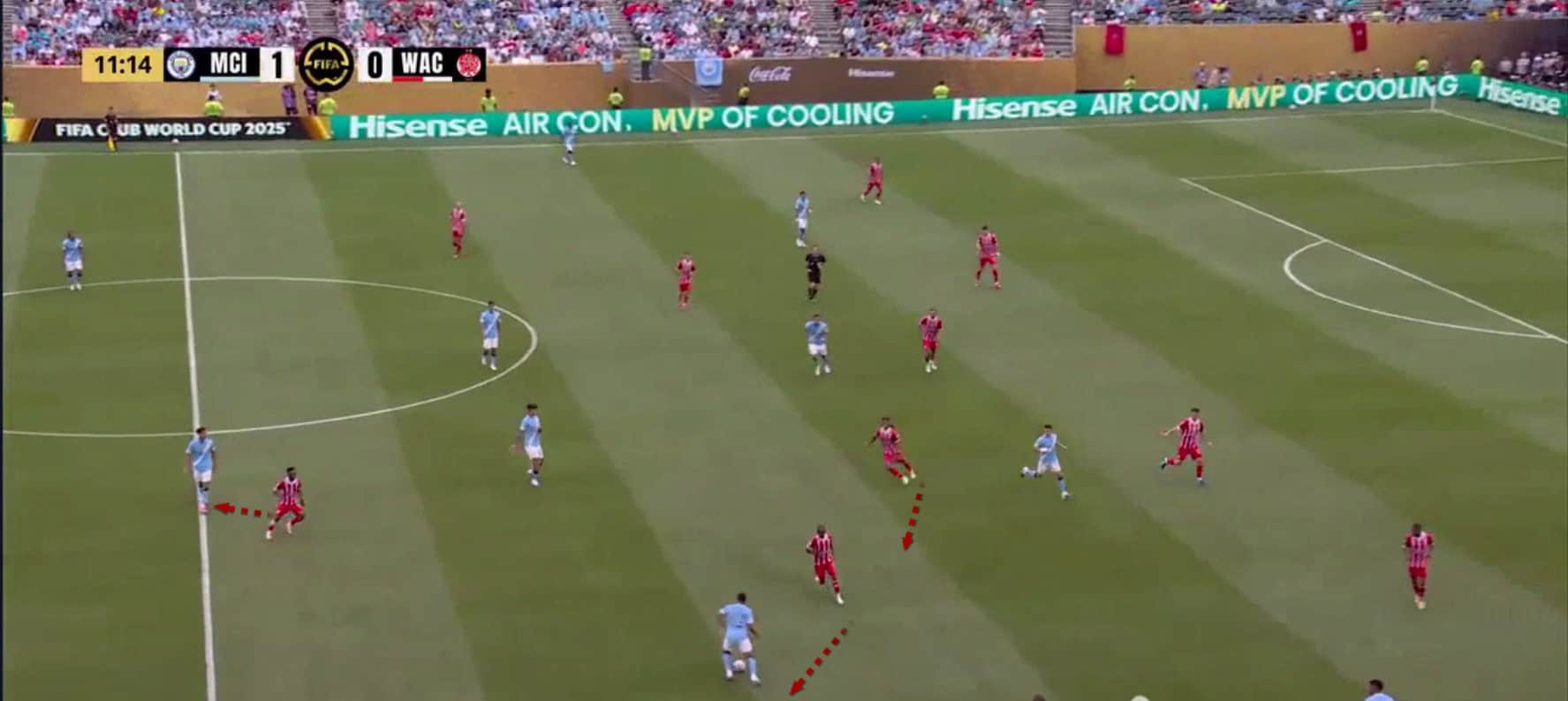 Wydad’s defensive block shows the same pattern.
With Mailula positioned close to Reis, this creates a straightforward passing option for O’Reilly to receive in space.
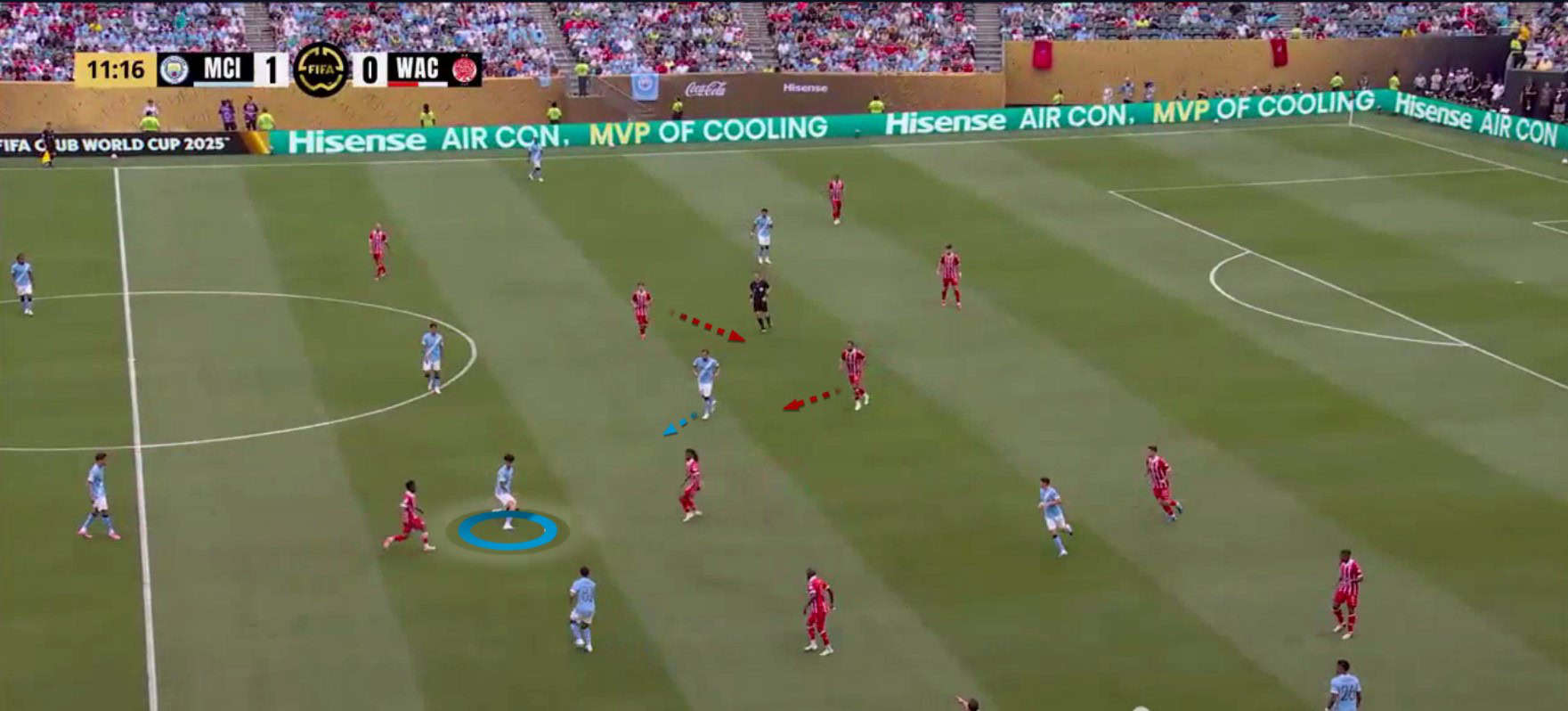 O’Reilly turns while receiving as Cherki moves towards the ball, drawing Boutouil out of position and forcing Zemraoui to shift inside.
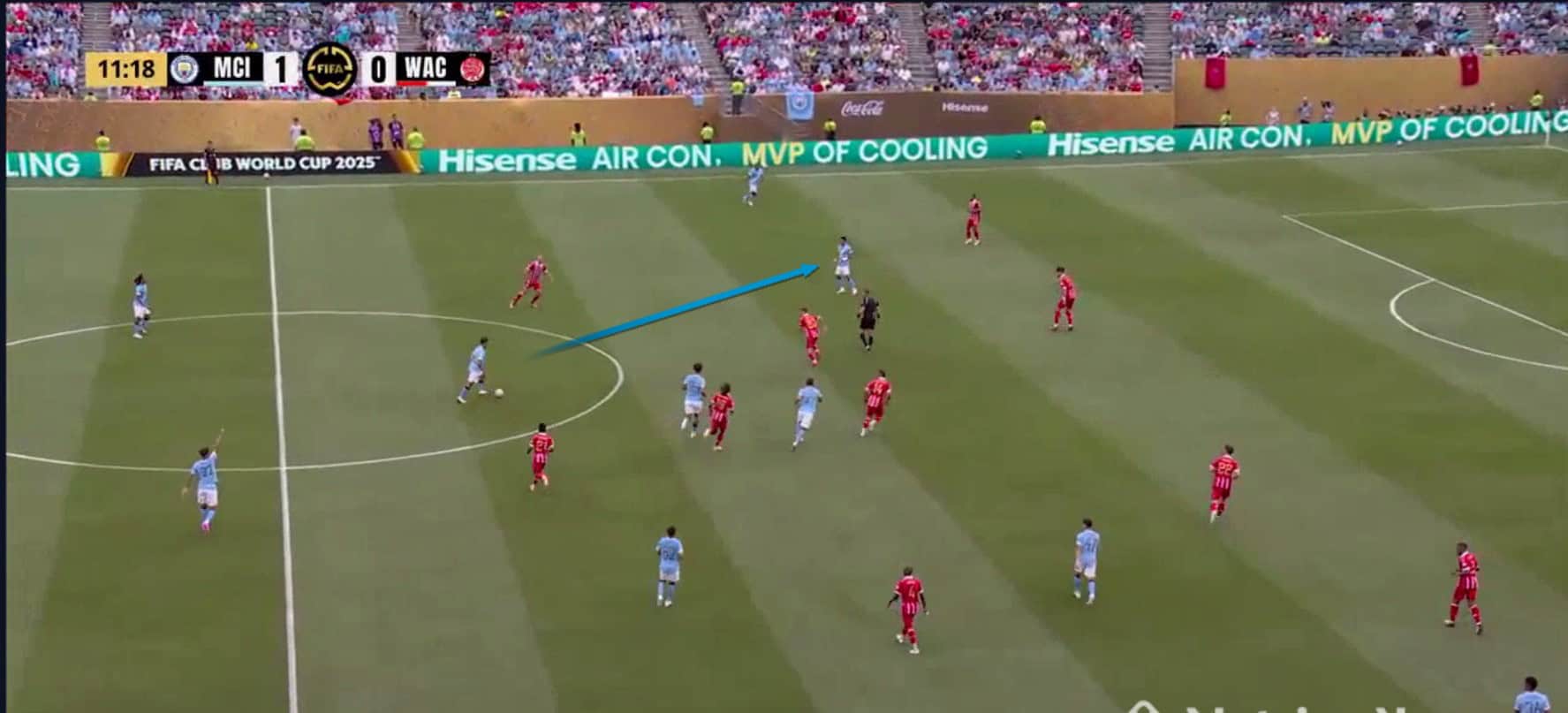 This movement creates space for a direct pass to Marmoush.
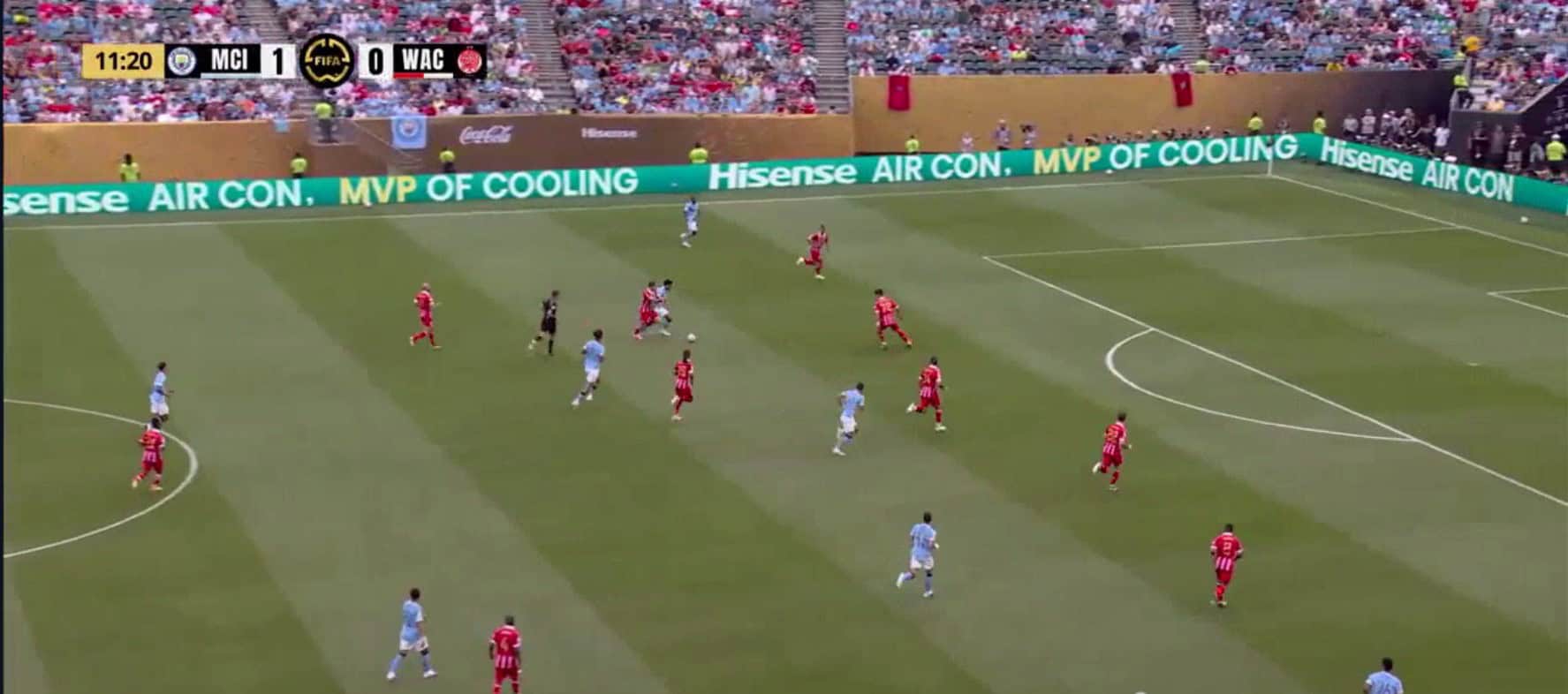 Marmoush receives the ball free this time and carries it forward.
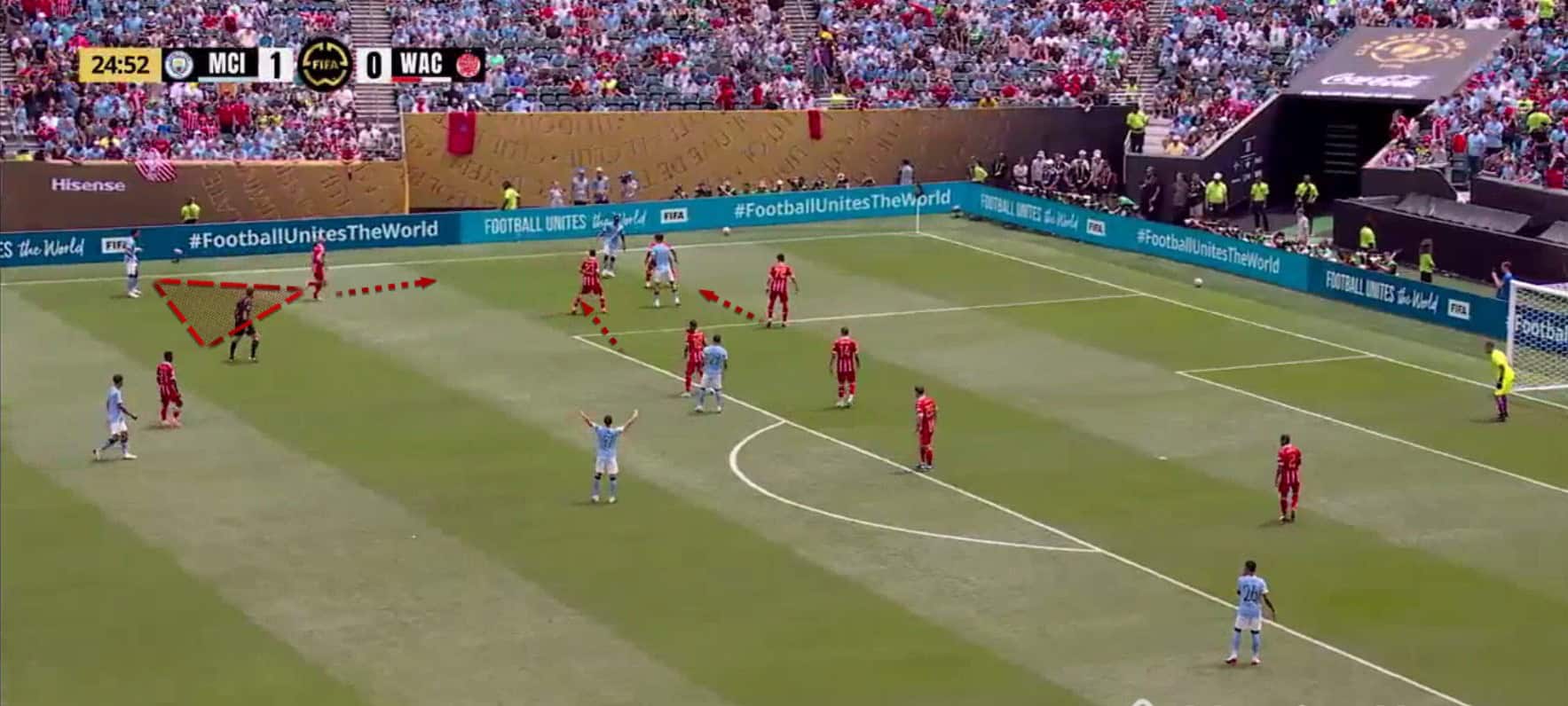 In the final third, Man City focus heavily on two key sub-phases: box attacking and attacking wing play, which represent the last gateways for Pep Guardiola’s side to unlock in order to reach the back of the net.
In this situation, Marmoush and Doku are positioned near the touchline, with O’Reilly stationed at the edge of the box on Marmoush’s side (the latter two having just switched roles).
For Wydad, Moufi marks Doku, while Amrabat shifts towards the ball without directly engaging, instead blocking the passing lane to Marmoush.
Right centre-back Ferreira steps across to cover the ball, while the near-side six drops in to create a 2-v-1 against Doku.
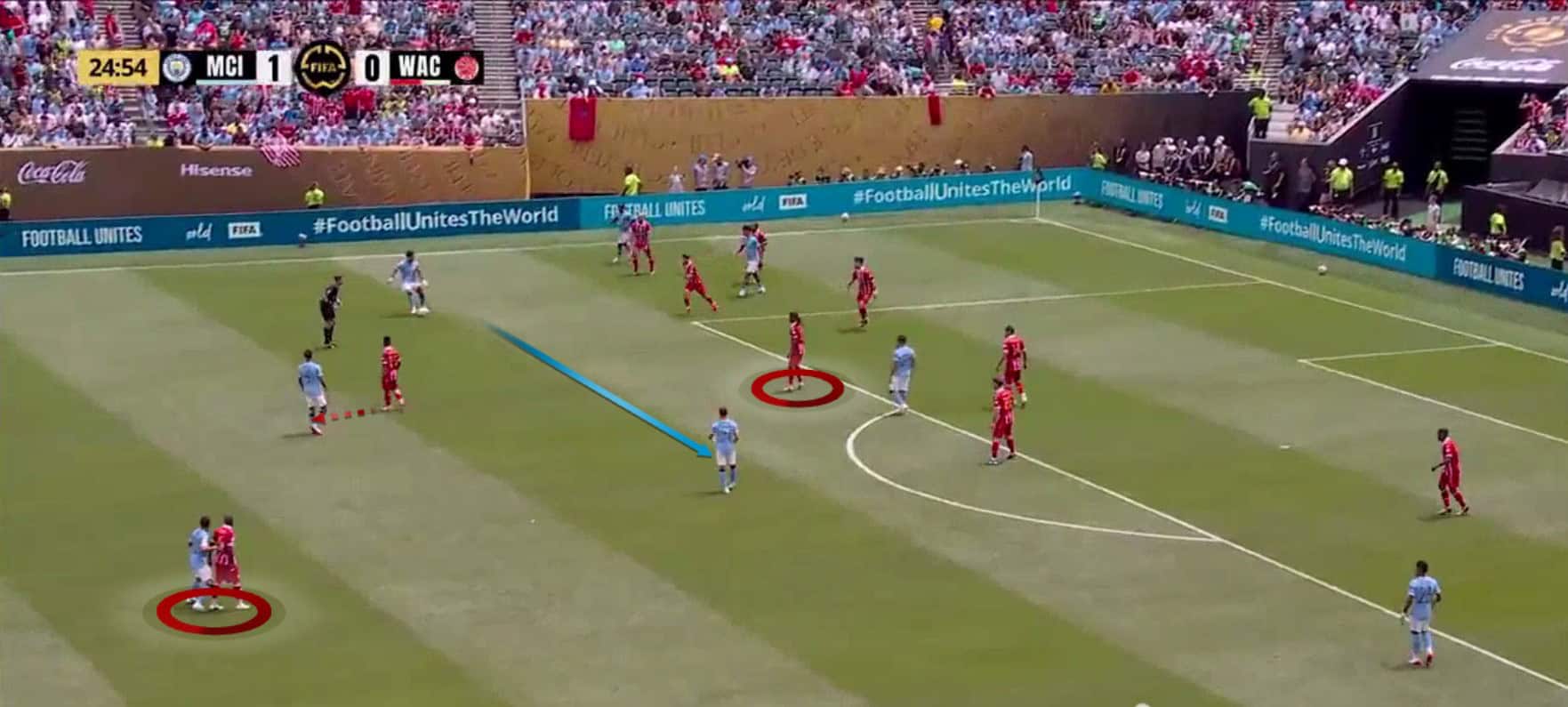 This sequence forces the far-side six to drop deeper, providing zonal coverage at the edge of the box.
With Mailula tracking Reijnders and Lorch staying tight to Lewis, now both of Wydad’s players are positioned away from the box’s edge.
As Marmoush moves out of Amrabat’s cover shadow to receive Doku’s pass, the passing lane to Foden, who’s now unmarked at the edge of the box, becomes open.
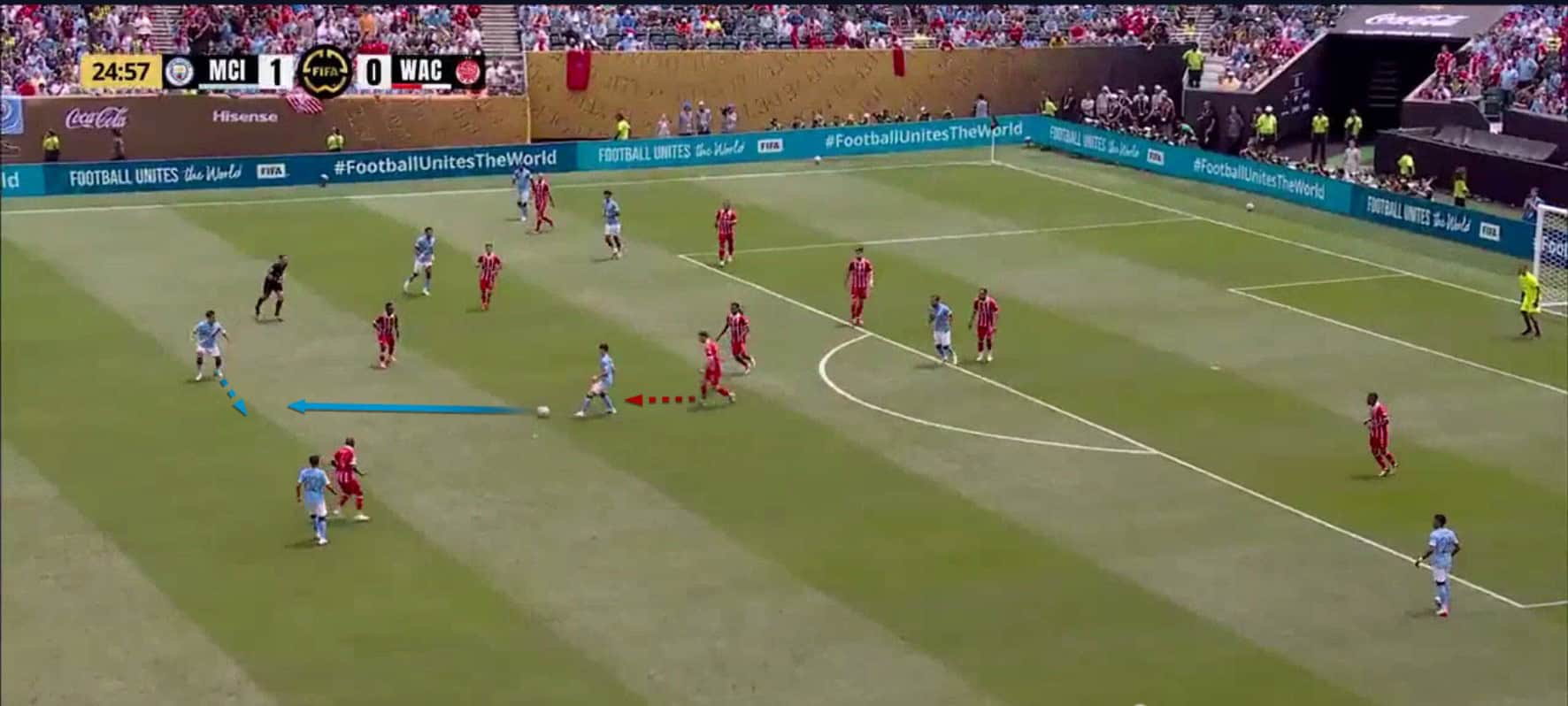 Now, even one of the centre-backs rushes to press Foden, a simple movement from Reijnders creates the option to receive his pass.
From there, Reijnders can quickly switch play to Savinho on the opposite flank.
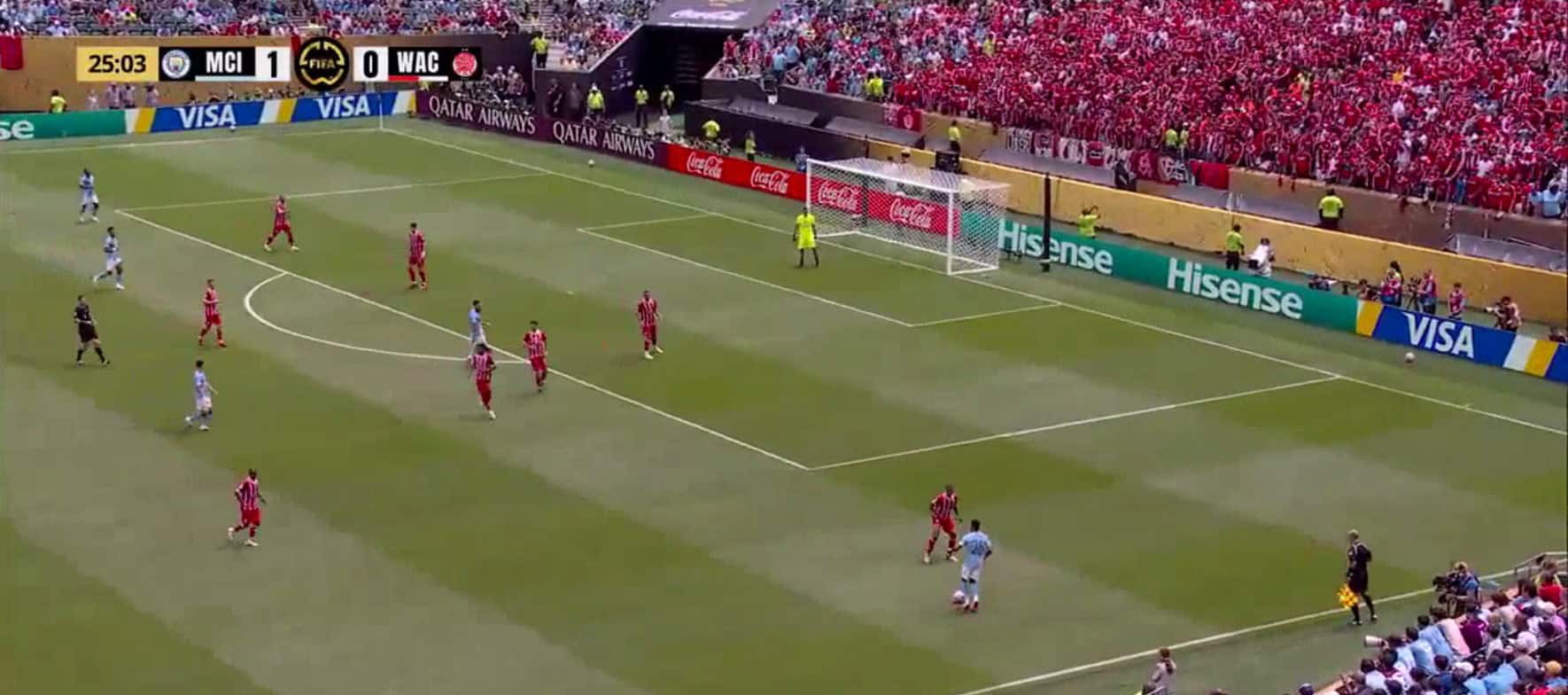 Savinho receives the ball on the wing in a 1-v-1 situation, which he actively seeks to exploit.
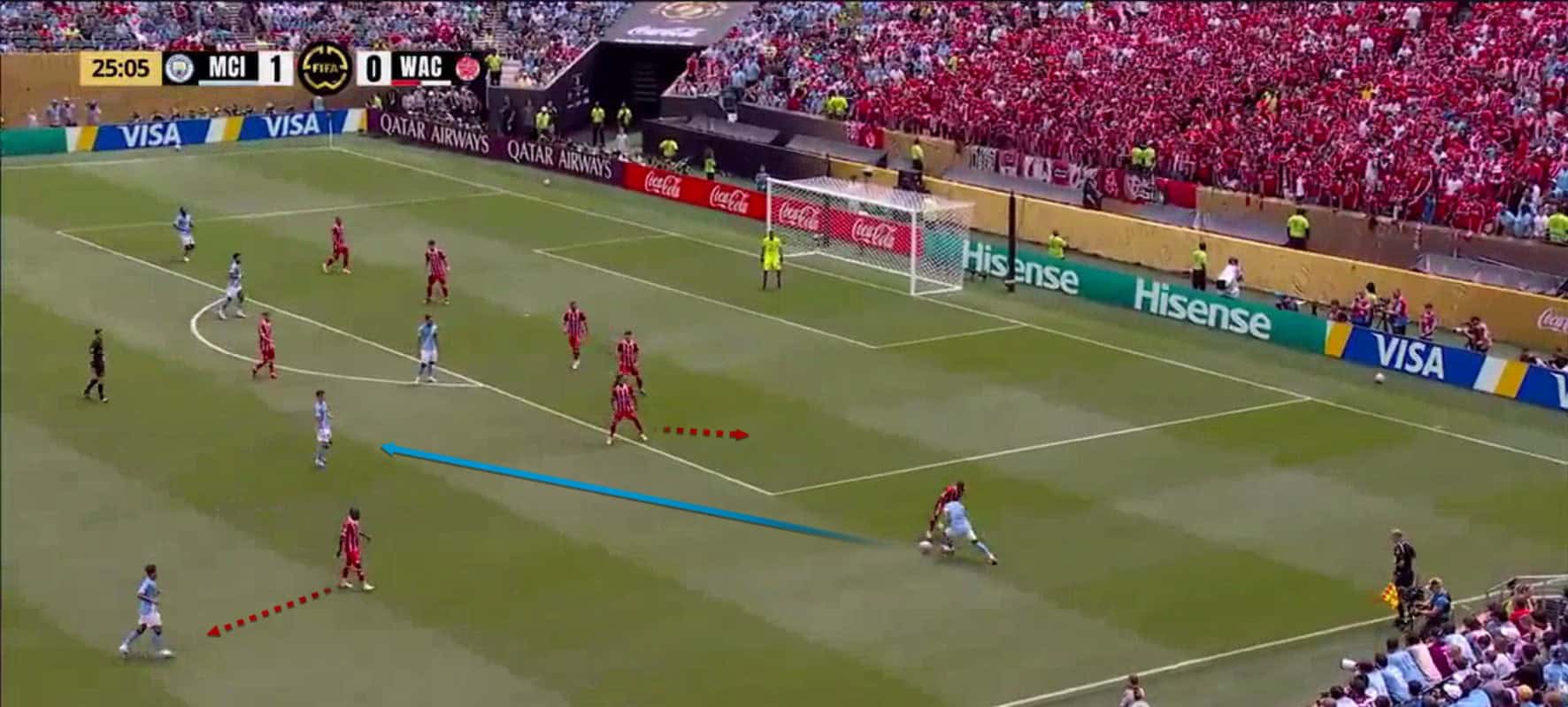 Lorch leaves Moufid alone against Savinho.
The near-side six, El Moubarik, now shifts to cover the space left behind wing-back Moufid.
This movement allows Savinho, who tucks inside, to spot and find Foden unmarked.
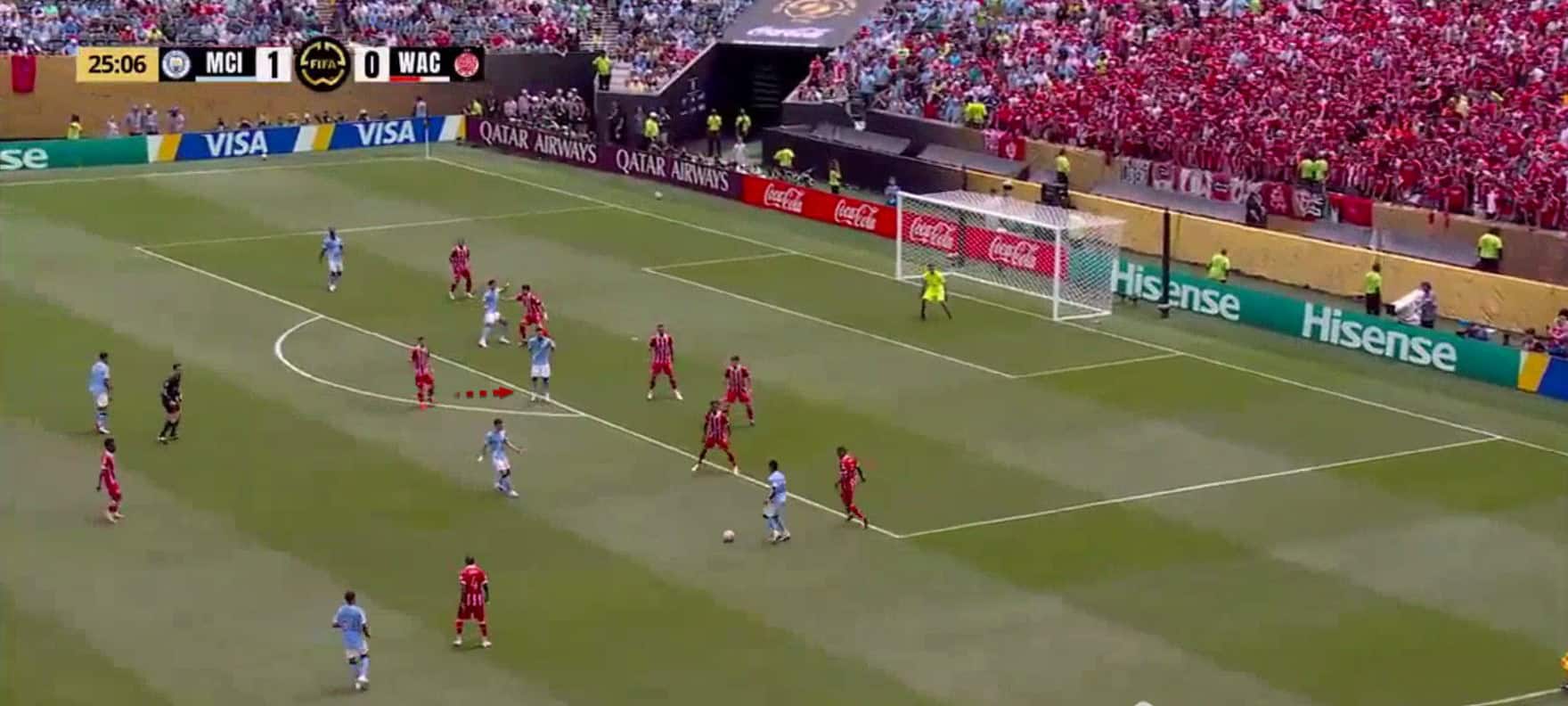 The far-side six, Zemraoui, drops deeper to protect his zone, while Cherki moves closer to the ball.
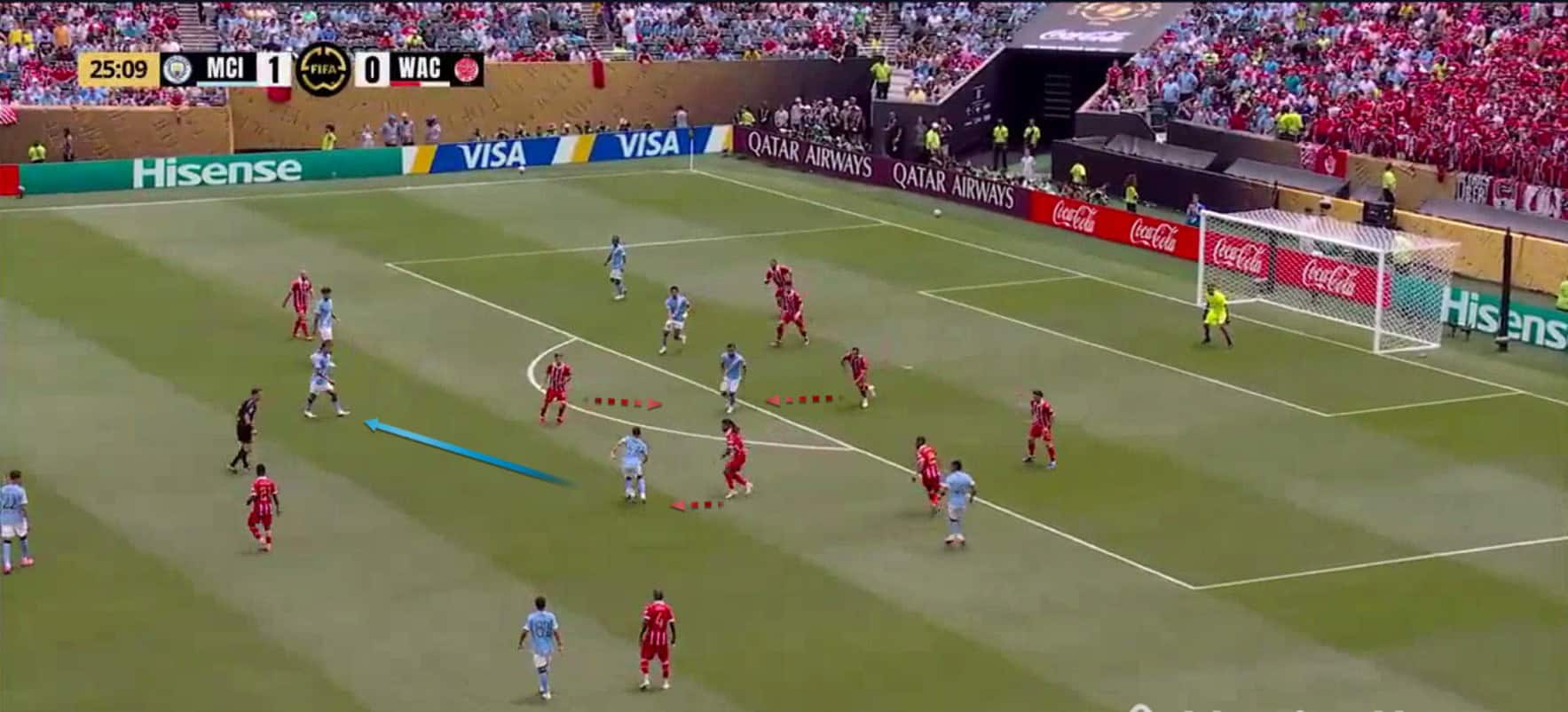 Cherki’s positioning not only draws Boutouil towards him but also forces Zemraoui to remain central to block the passing lane.
This movement helps create space for a pass to Rejinders.
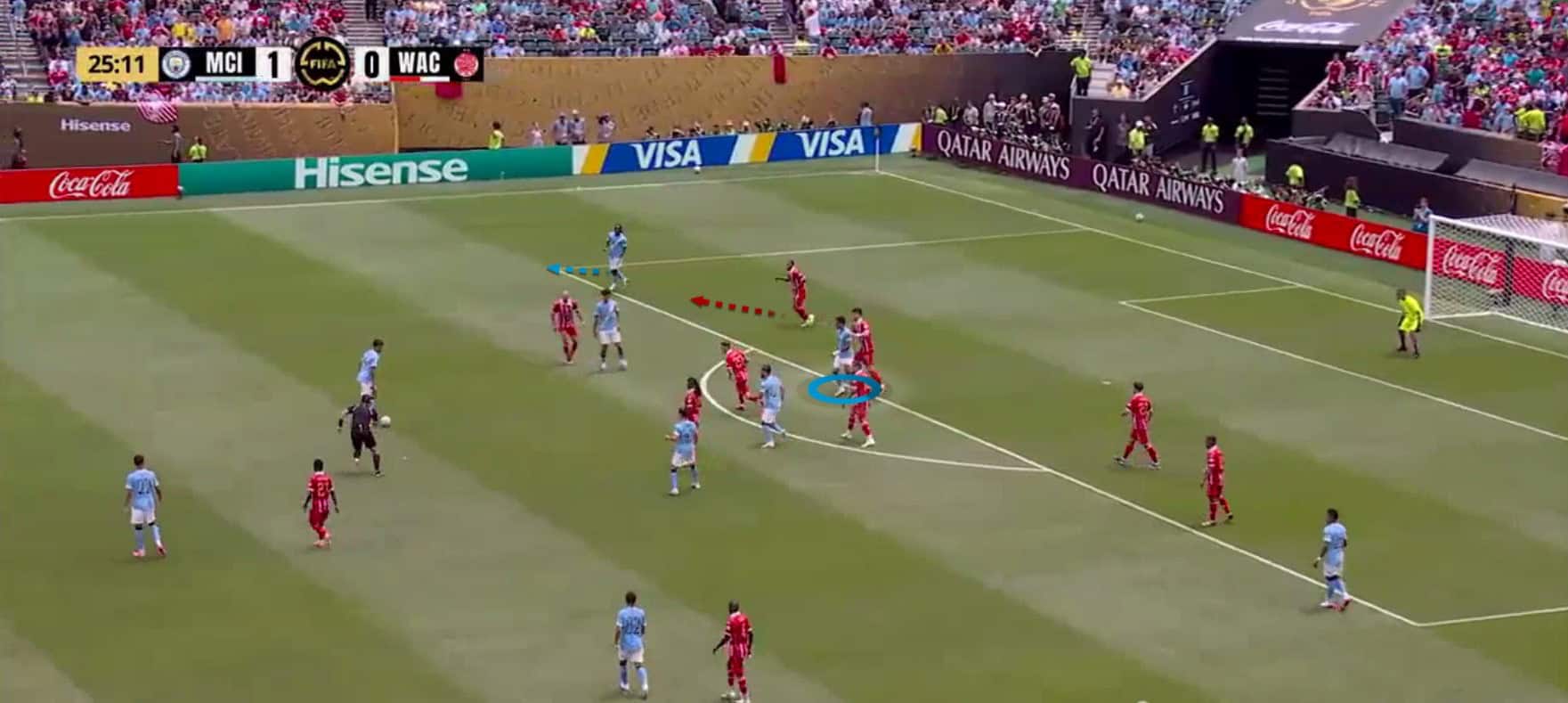 Doku begins to drift out of the box, pulling Moufi with him.
At the same time, Marmoush’s central run draws Ferreira inside, widening the gap between Moufi and Ferreira.
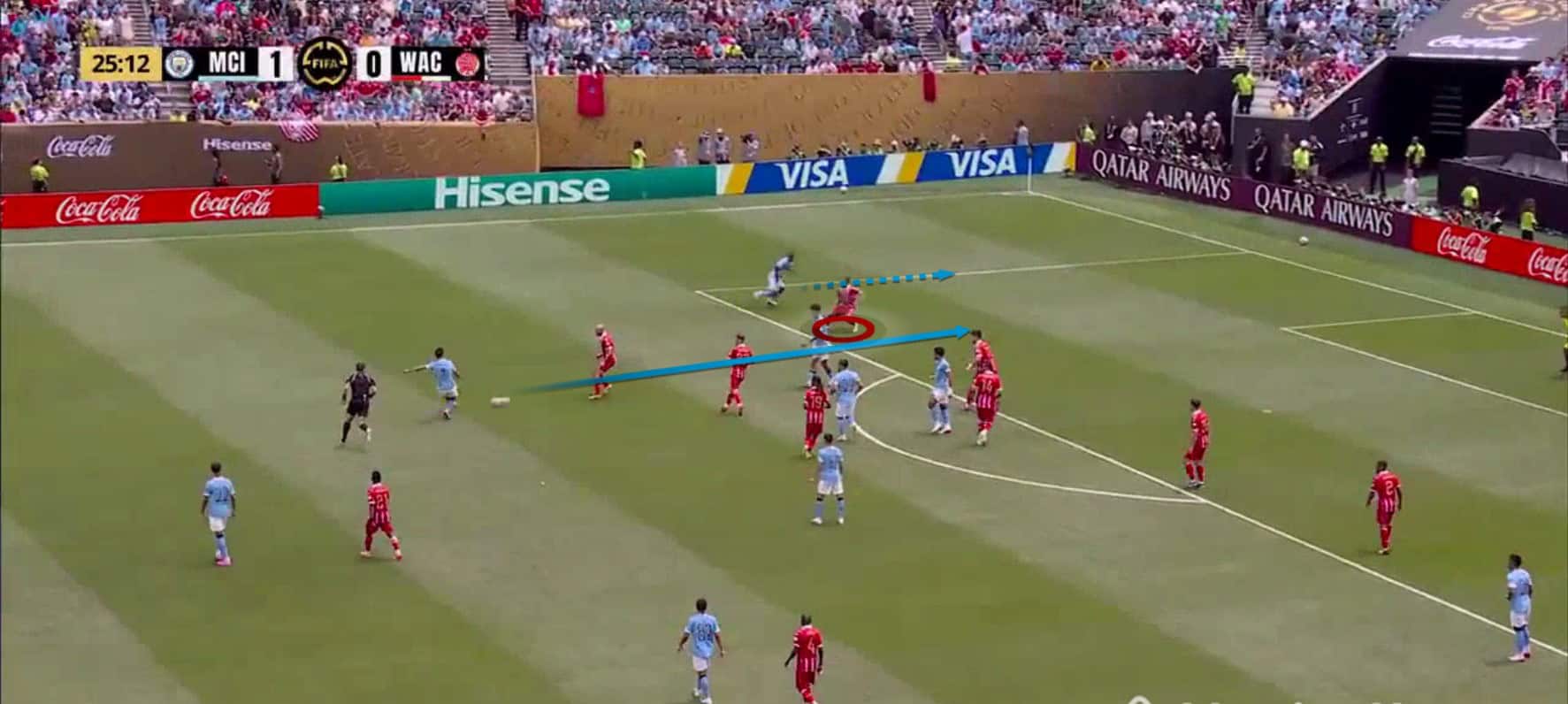 Reijnders can now play a pass, through the space between Moufi and Ferreira, and into the space behind the defensive line for Doku, who times his run against the defender’s movement.
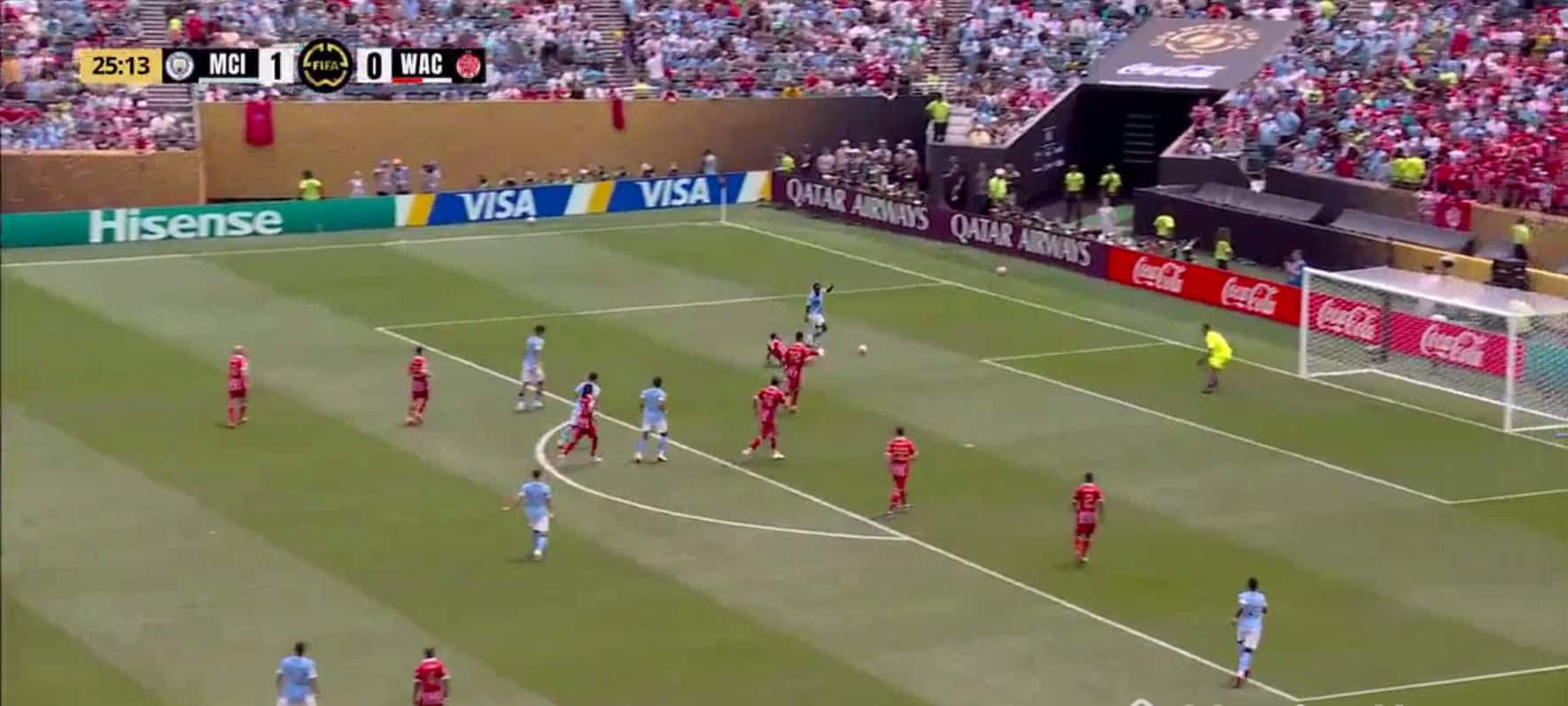 At the final moment, the defender adjusted his body position, allowing him to intercept the pass.
That was some of Man City’s Ideas to dominate the final third against Wydad.
Now what about the Juventus game?
Manchester City Final Third Tactics Vs Juventus
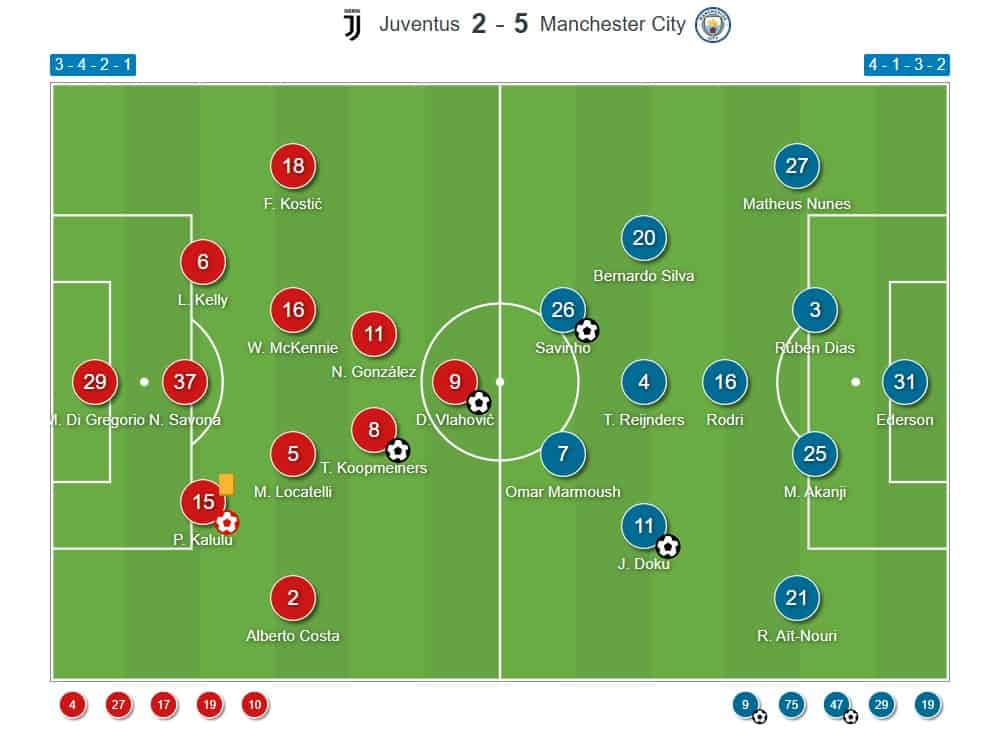
Juventus start this game with Michele Di Gregorio in goal and a defensive line of five defenders: Pierre Kalulu (right centre-back), Nicolò Savona (central centre-back), Lloyd Kelly (left centre-back), Alberto Costa (right wing‑back), and Filip Kostić (left wing‑back).
Manuel Locatelli (right central midfielder) and Weston McKennie (left central midfielder) are in the midfield, with Nicolás González (right winger), Teun Koopmeiners (left winger) on the outside.
Up front, Juventus played Dušan Vlahović (centre-forward).
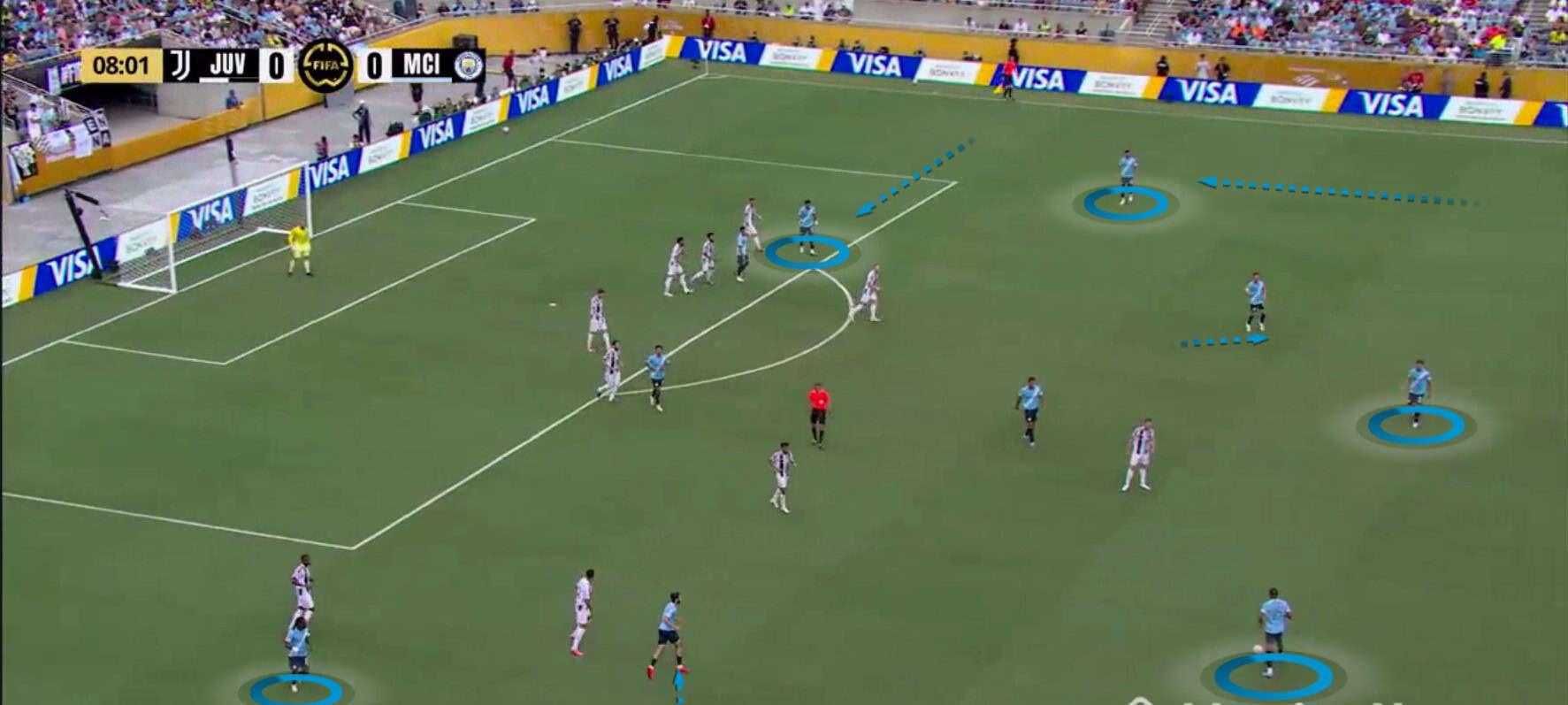 Against Juventus, the final-third phase was almost played inside or near the edge of the penalty area.
In this match, City deployed a 2-3 structure.
Rúben Dias and Manuel Akanji are the right and left centre-backs from the first line, with Rodri as the six, Bernardo Silva positioned on the right side of the second line, and Rayan Aït-Nouri on the left.
Matheus Nunes and Doku maintained width, while Savinho and Reijnders operated in the right and left half-spaces respectively, with Marmoush leading the line as the centre-forward.
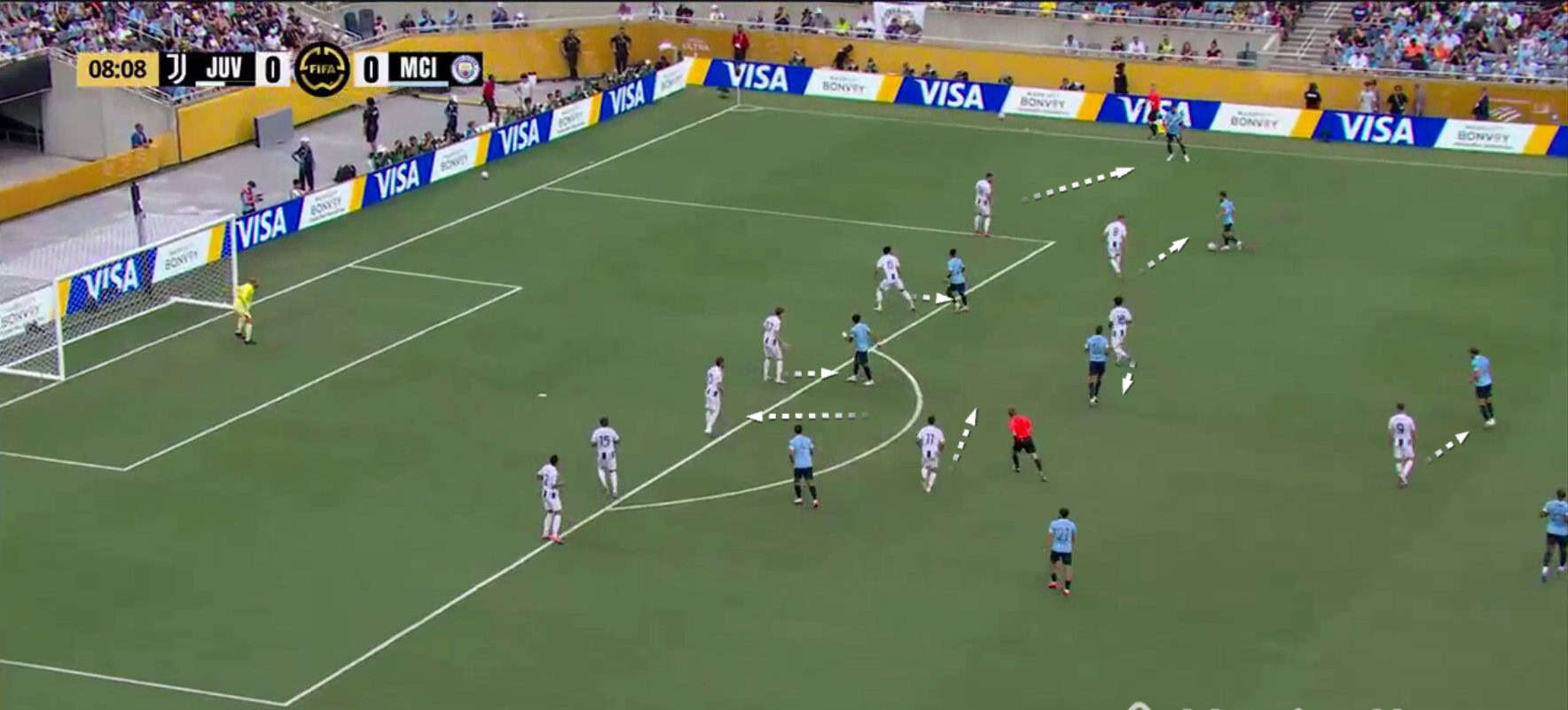 Juventus lined up in a 5-4-1 structure, with notable adjustments in their box defending.
When there was a potential crossing situation, Manuel Locatelli dropped into the back line as a sixth defender.
This movement prompted the right-winger, González, to tuck inside, covering the central area at the edge of the box.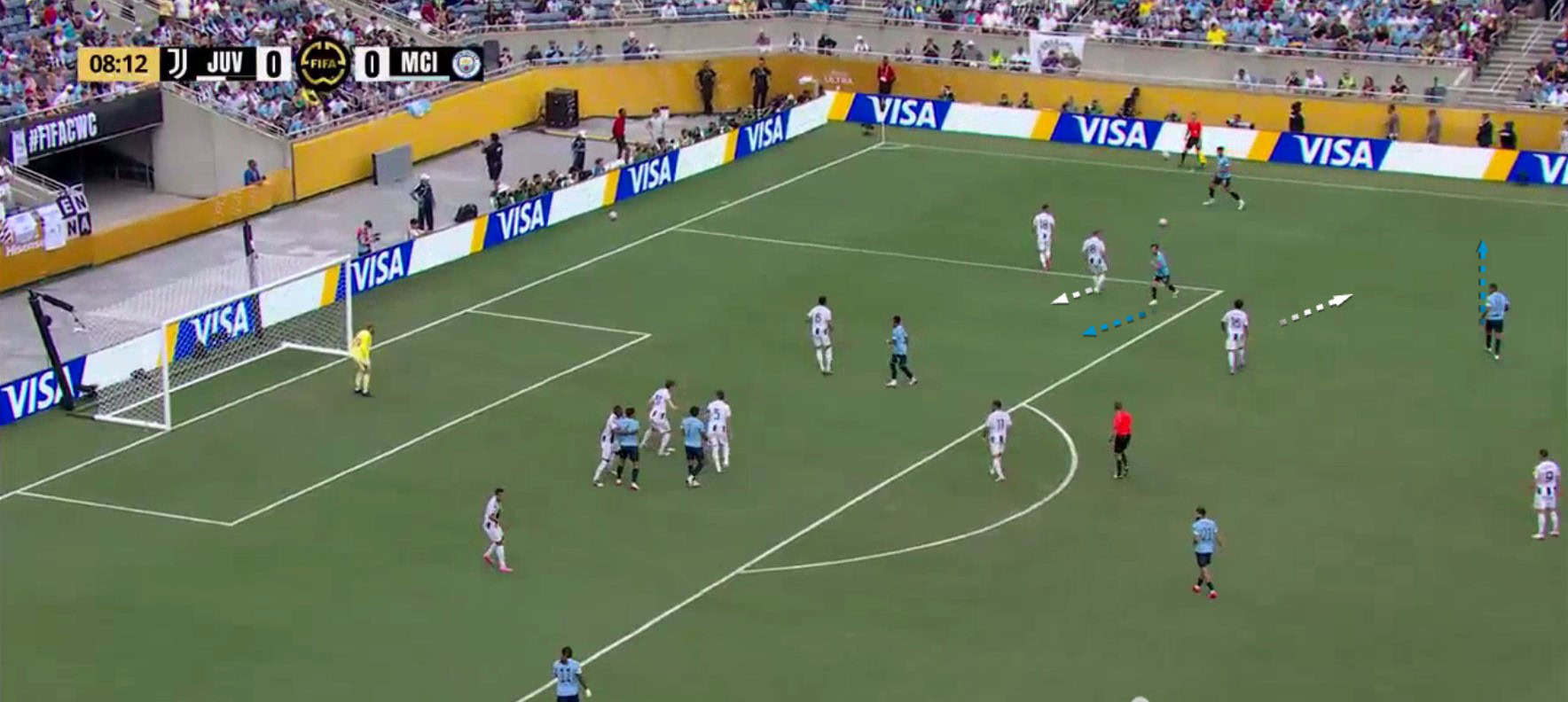 With Juventus applying a man-marking approach, Savinho positioned himself inside the box, closely tracked by his marker.
Silva played a pass to Nunes before moving into the box to drag his defender away.
Similarly, when Rodri drifted wide, Weston McKennie followed him.
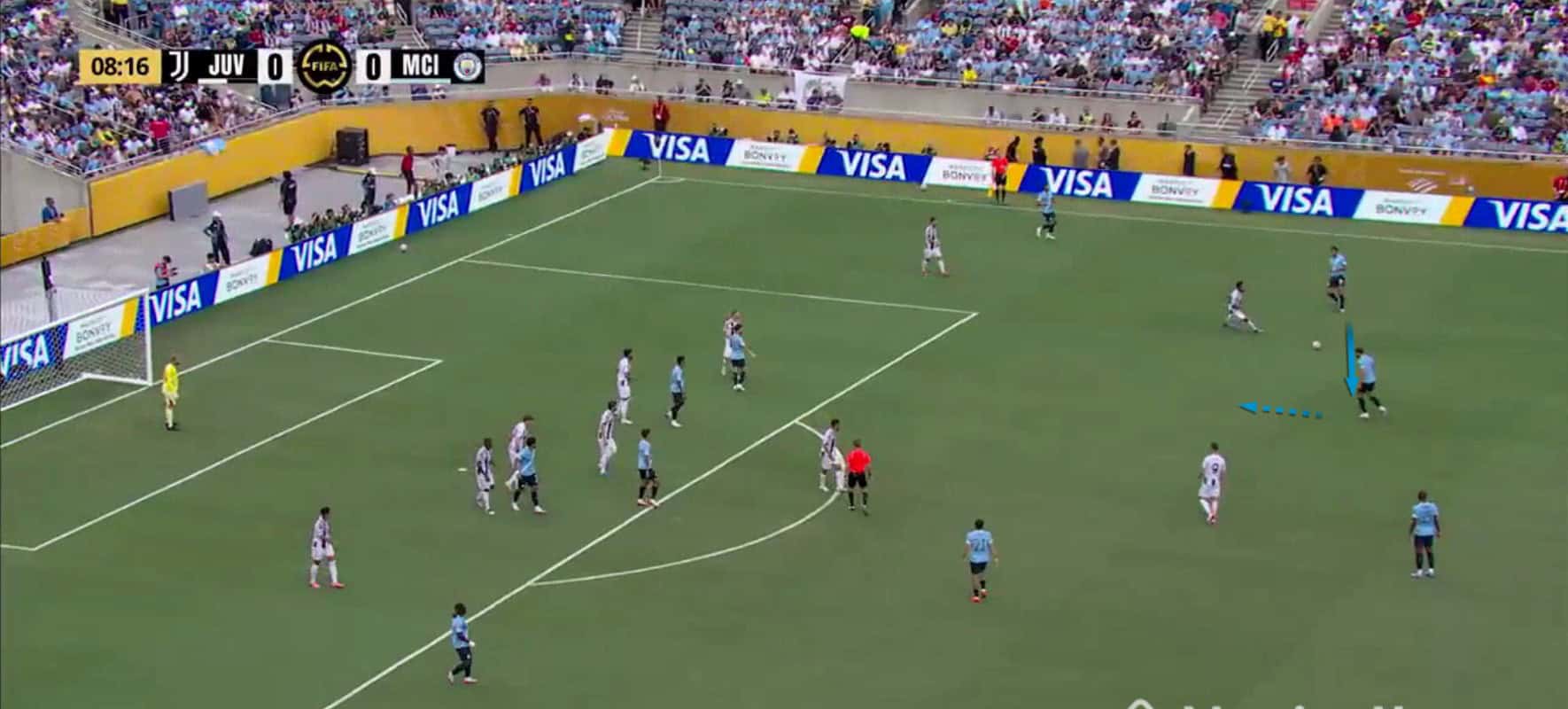 With Dušan Vlahović positioned between the centre-backs, Rúben Dias emerged as the free player and had the space to carry the ball forward.
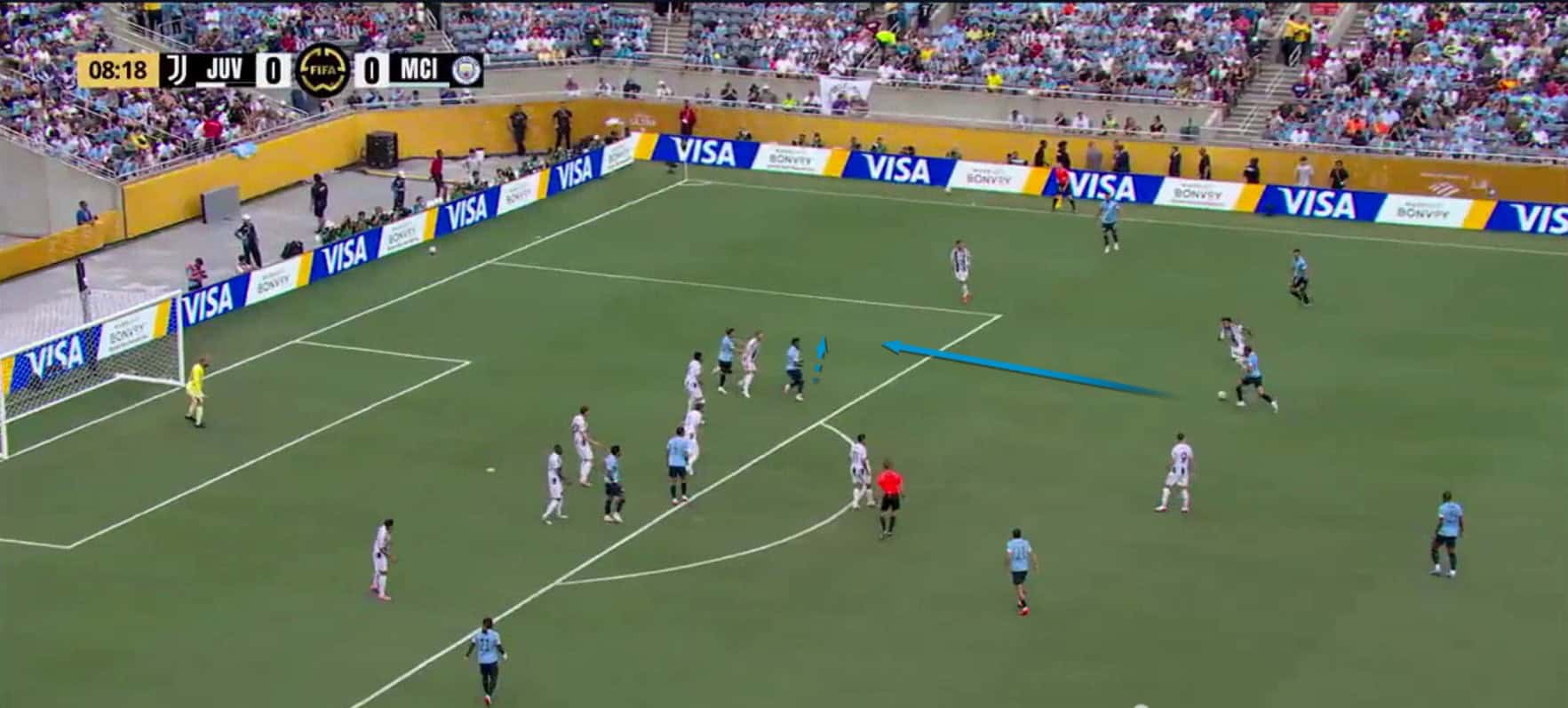 Savinho moves to distract his marker and positions himself to receive in the space created by Bernardo Silva’s earlier run.
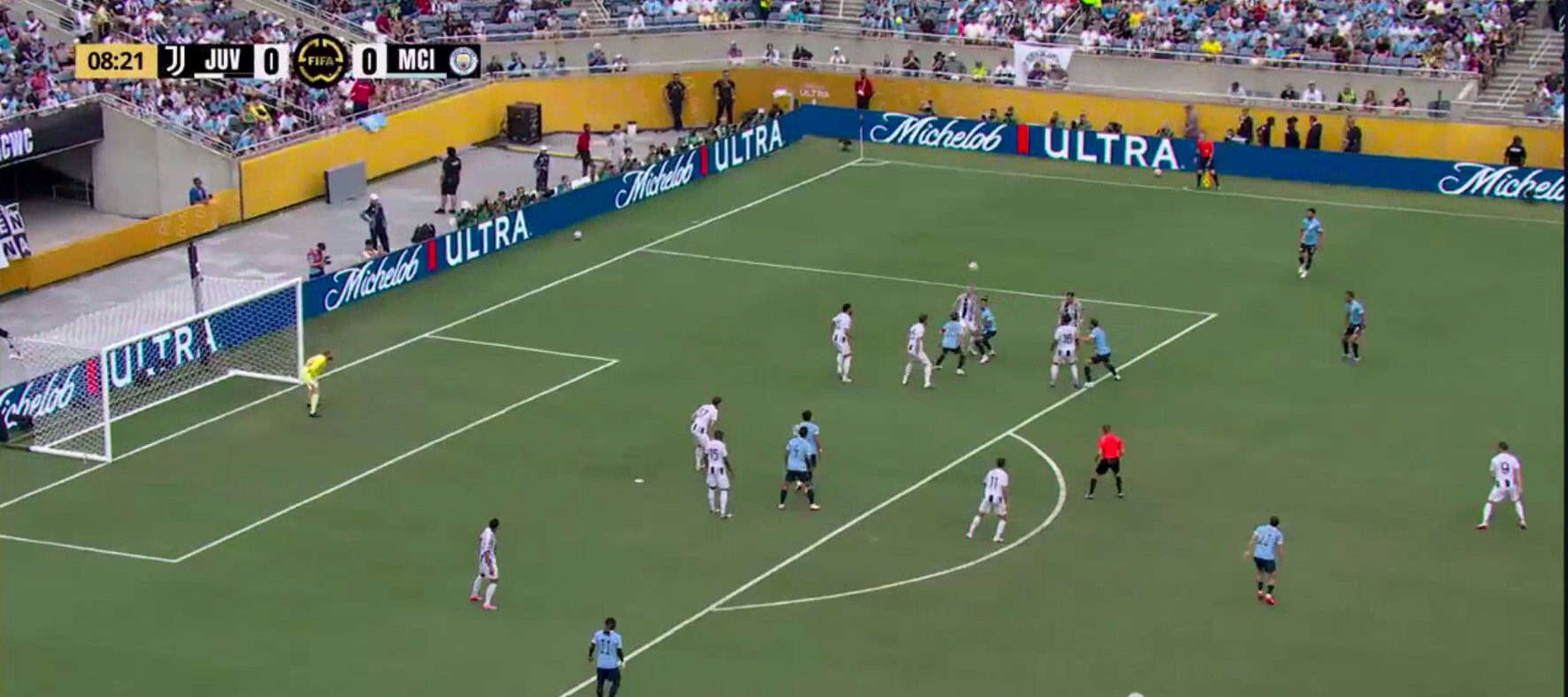 However, Savinho was unable to receive the ball.
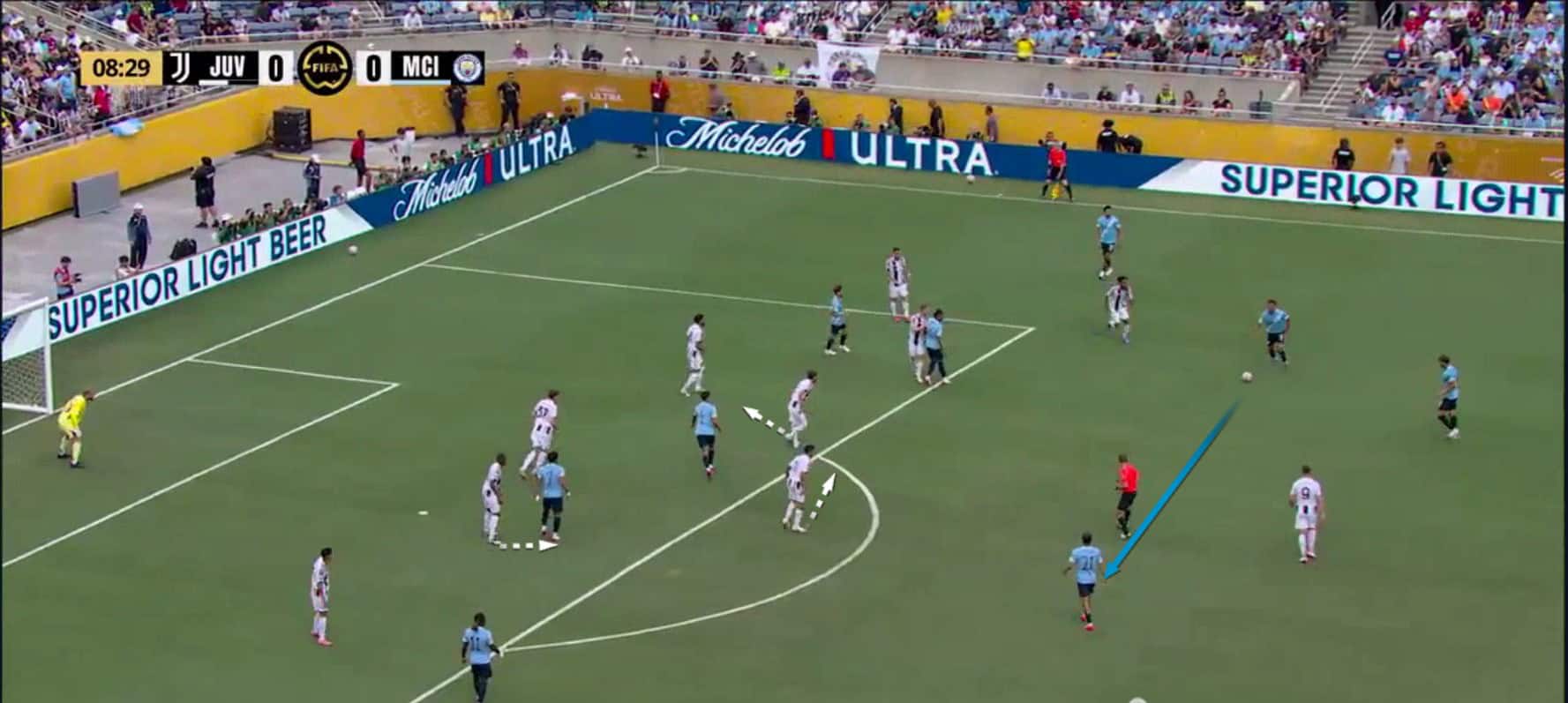 Man City regained possession and prepared to launch another wave of attack.
Once again, Locatelli dropped into the box while González moved centrally, leaving the passing lane from Rodri to Aït-Nouri open.
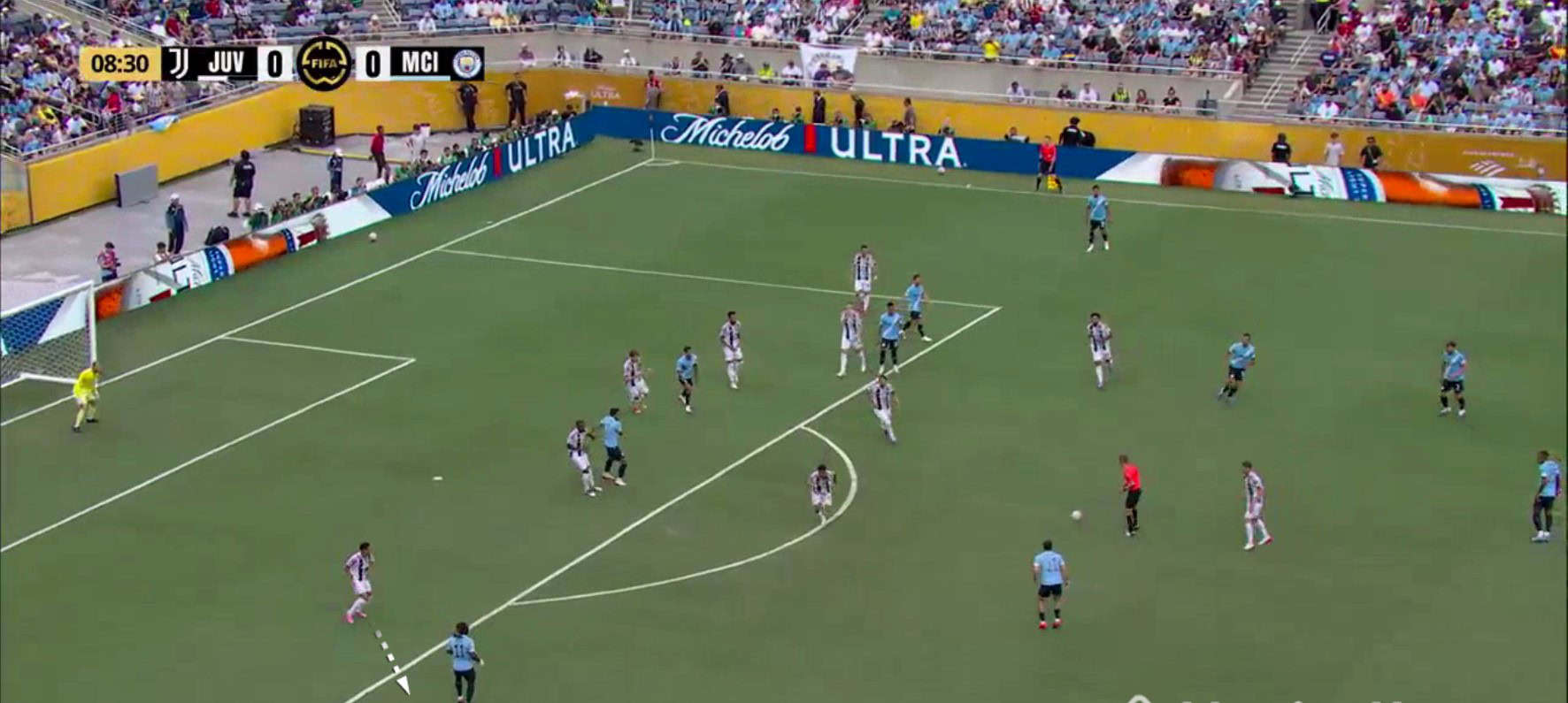 As the ball travelled to Aït-Nouri, Doku once again moved out of the box, dragging his marker with him.
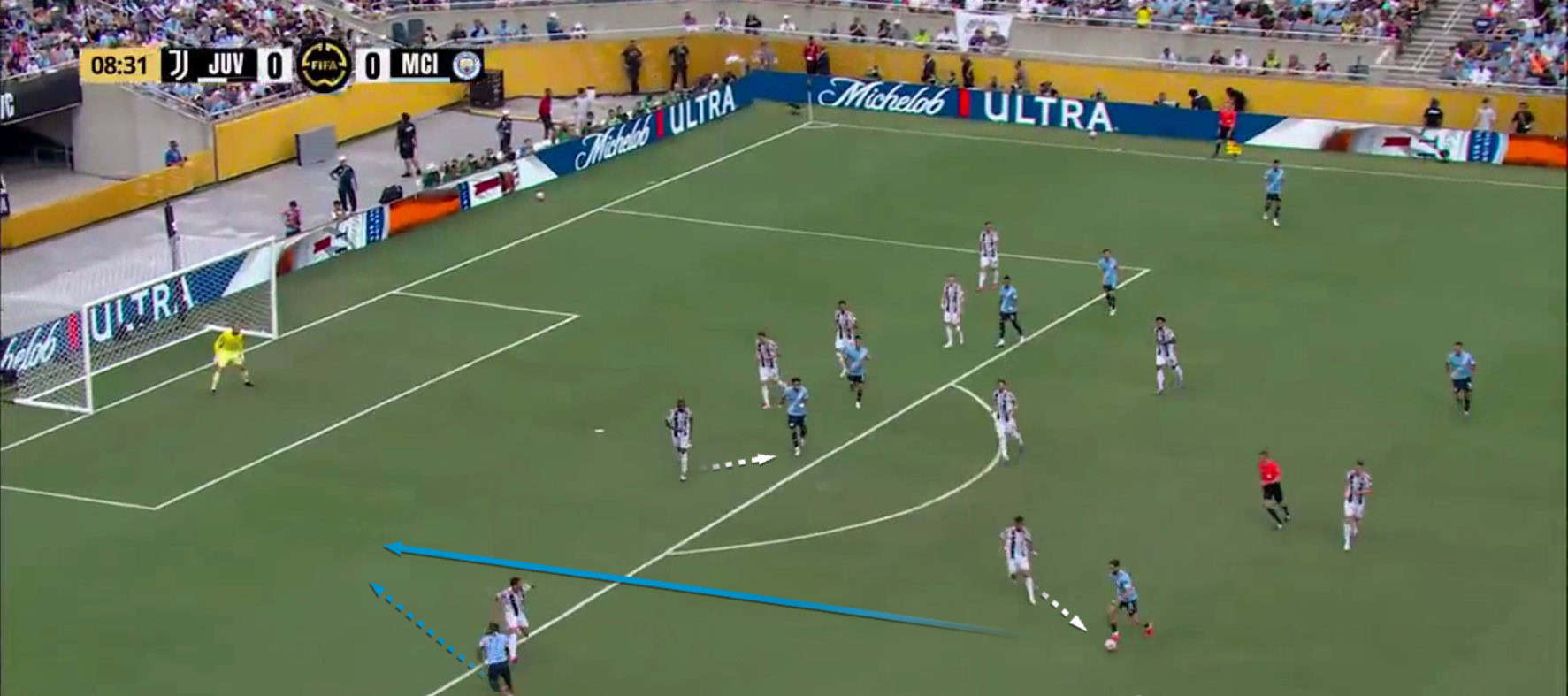 Marmoush, following a similar role to his positioning against Wydad, attempted to drag the near-side centre-back, creating more space for Aït-Nouri to pass into for Doku behind the defensive line.
Meanwhile, Doku made his trademark run on the opposite side of the defender.
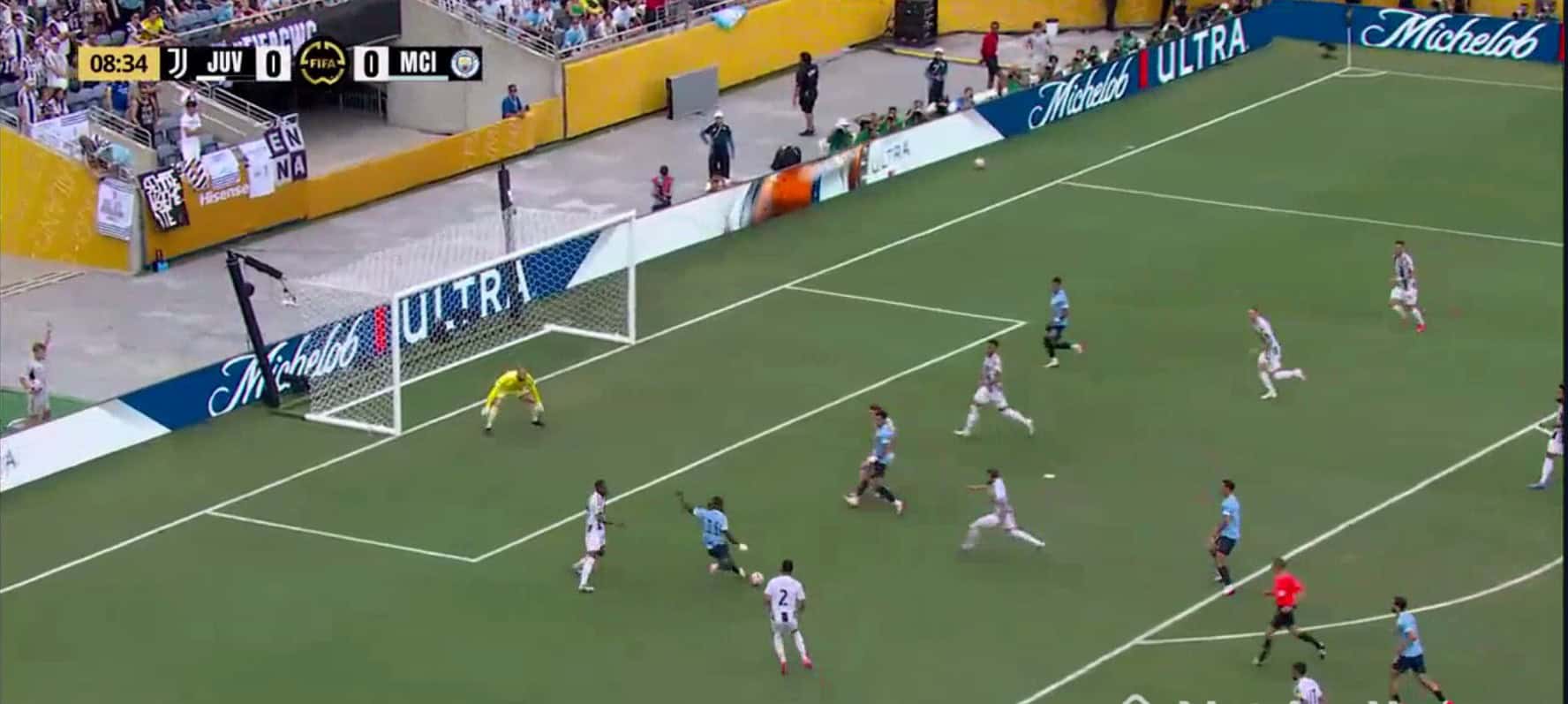 Doku reached a position that suited him, and even with Kalulu attempting to close him down, he overcame the challenge in a 1-v-1 situation and scored.
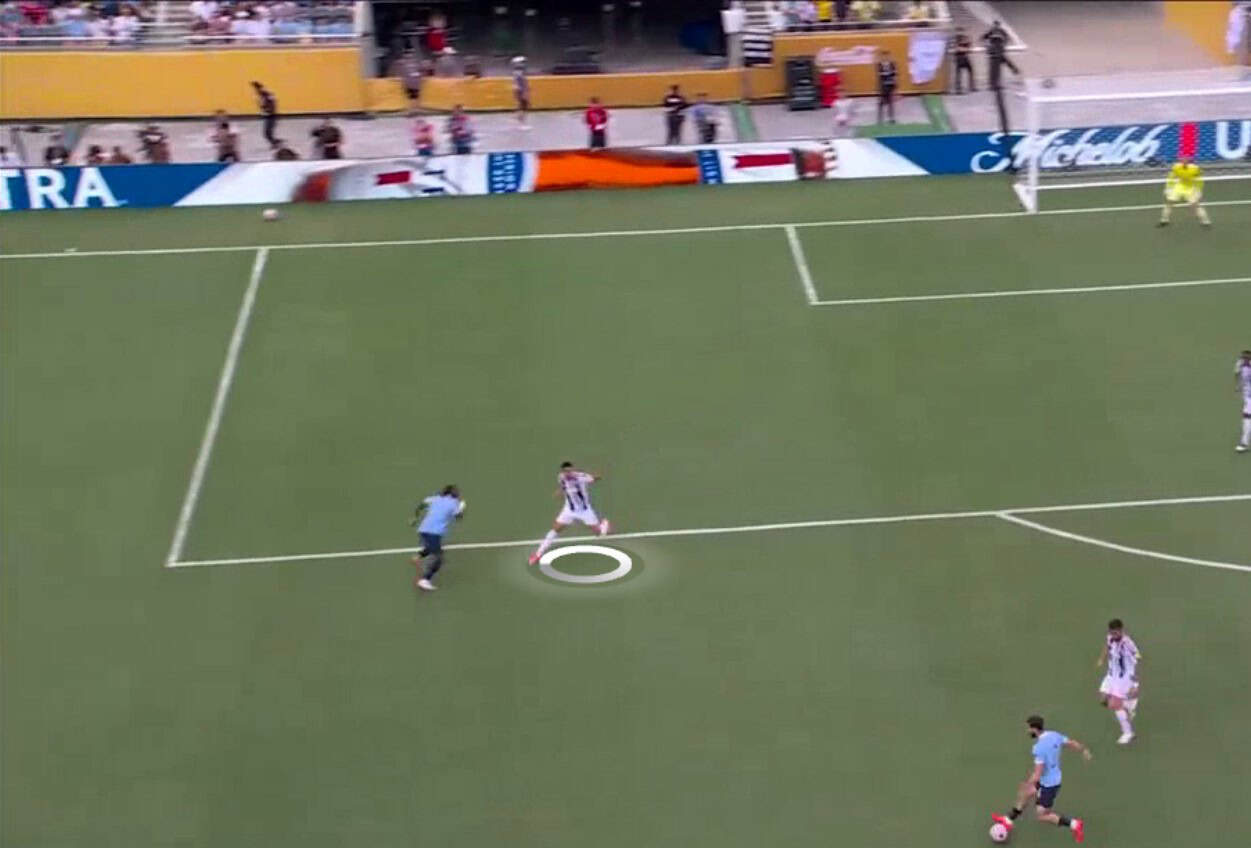 Doku’s pace and acceleration consistently create significant problems for opposing defenders, especially with their poor body shape, so Pep Guardiola’s team aims to create scenarios that allow Doku to exploit his best qualities.
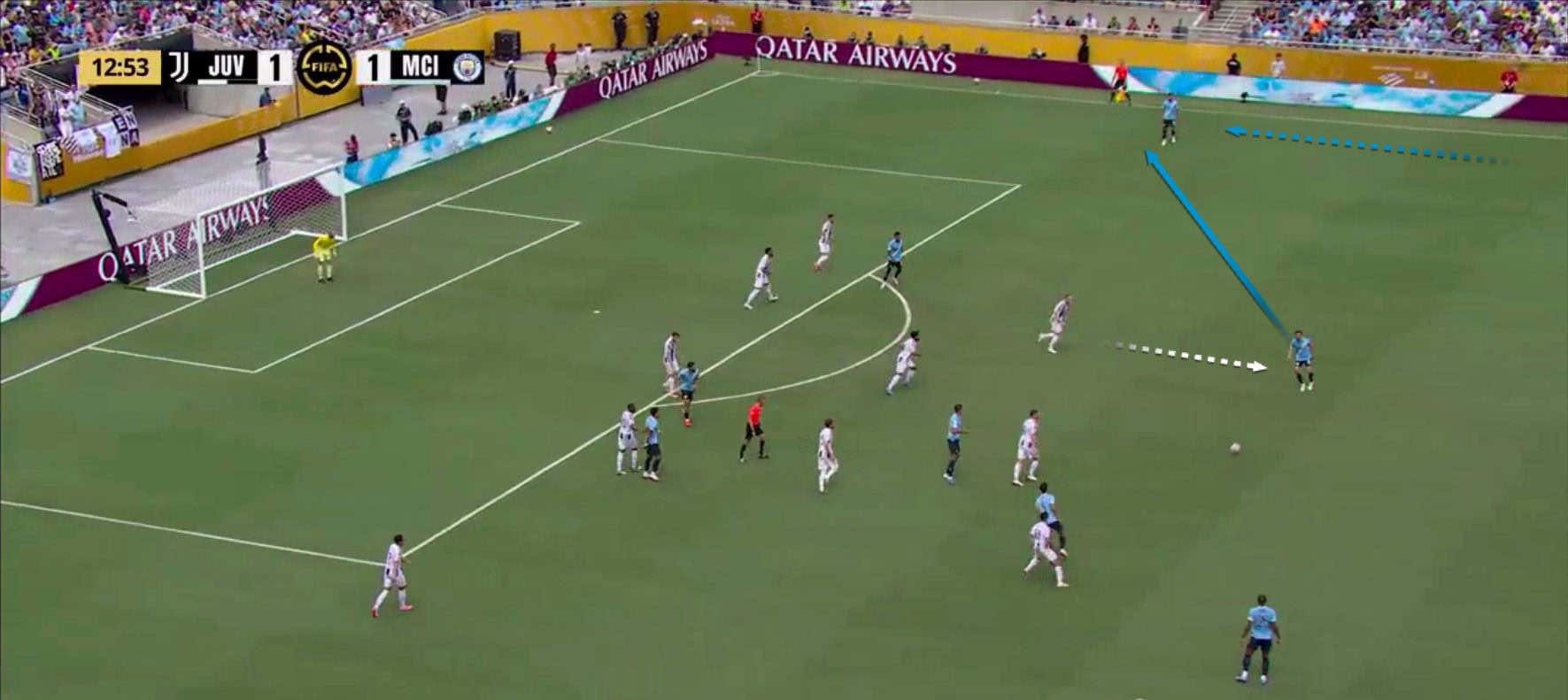 In another sequence, Silva moves inside to receive the ball, creating space to play it wide to Nunes.
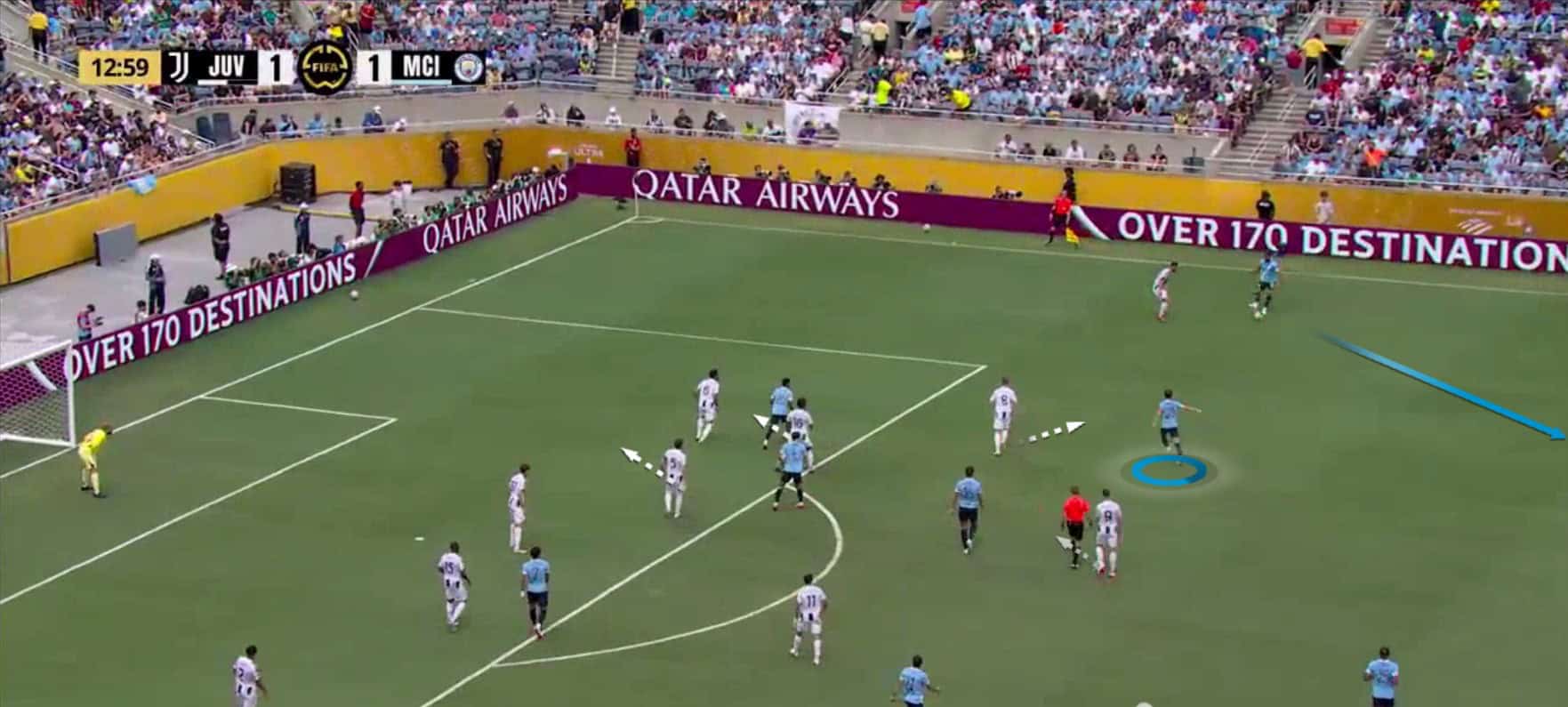 Again, with Locatelli getting into the box, Koopmeiners with Sliva, the wing-back, Kostić goes for Nunes, and Vlahović moves more towards the box.
Now, Man City uses the free player, Dias.
Silva waves to Nunes to pass to him.
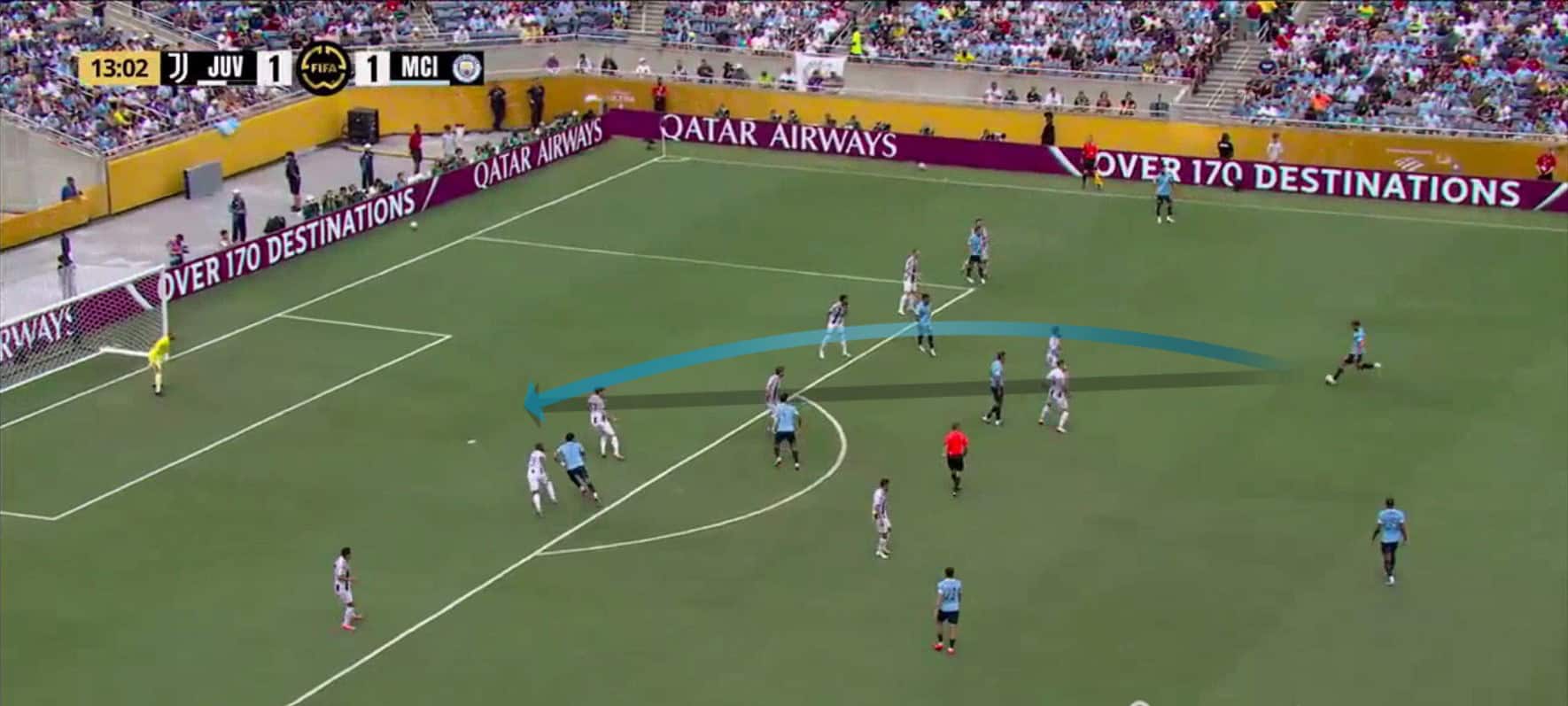 This time, one of Pep Guardiola’s strategies to attack the box is highlighted: Dias, positioned in the half-space, delivers an early cross to Marmoush, who is inside the penalty area.
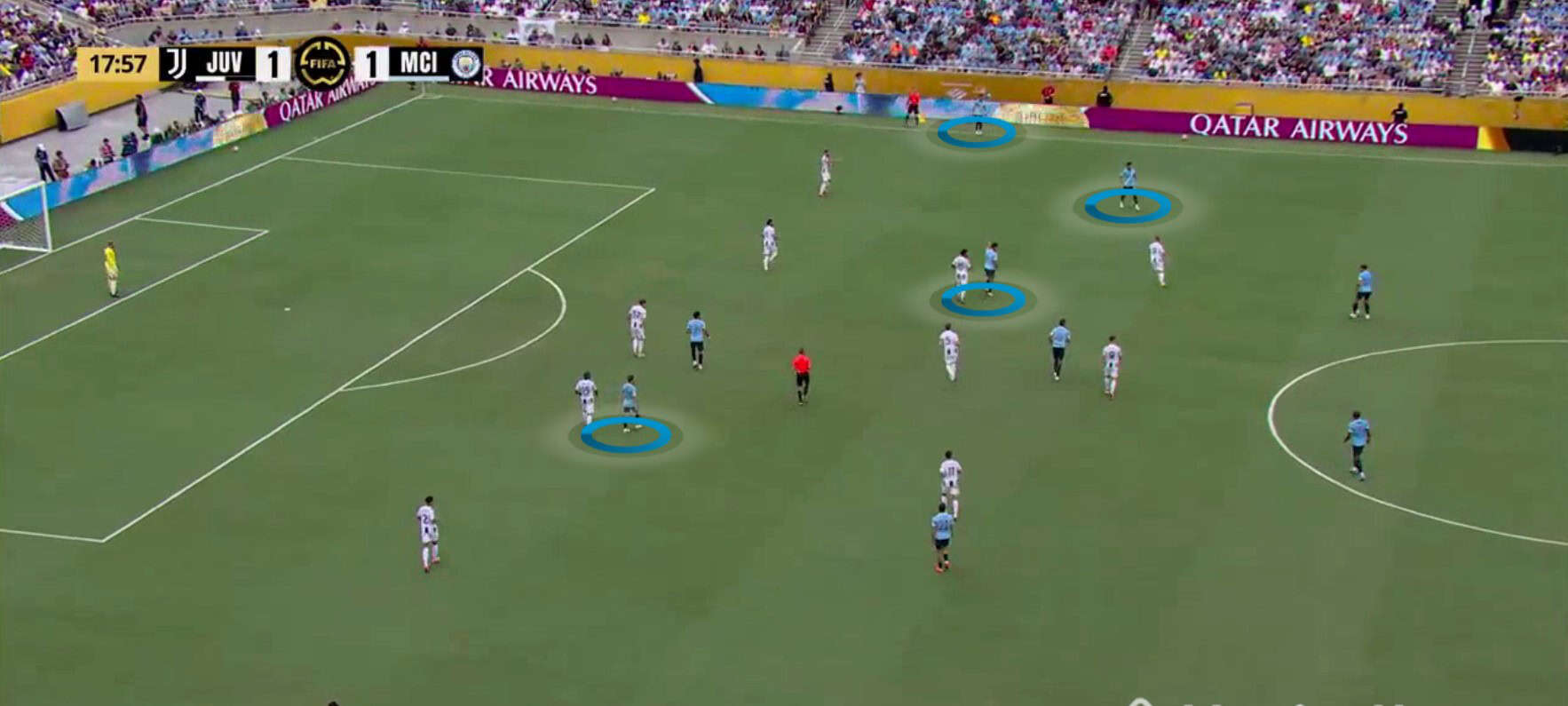 From this moment, Nunes, Savinho, and Silva switched roles, with Savinho holding the width and Nunes occupying the second line on the right side, while Silva operated as an eight in the half-space.
Man City players demonstrate flexibility and the freedom to exchange roles while maintaining organisational structure, as seen with Silva switching positions with Rejinders (just in this one).
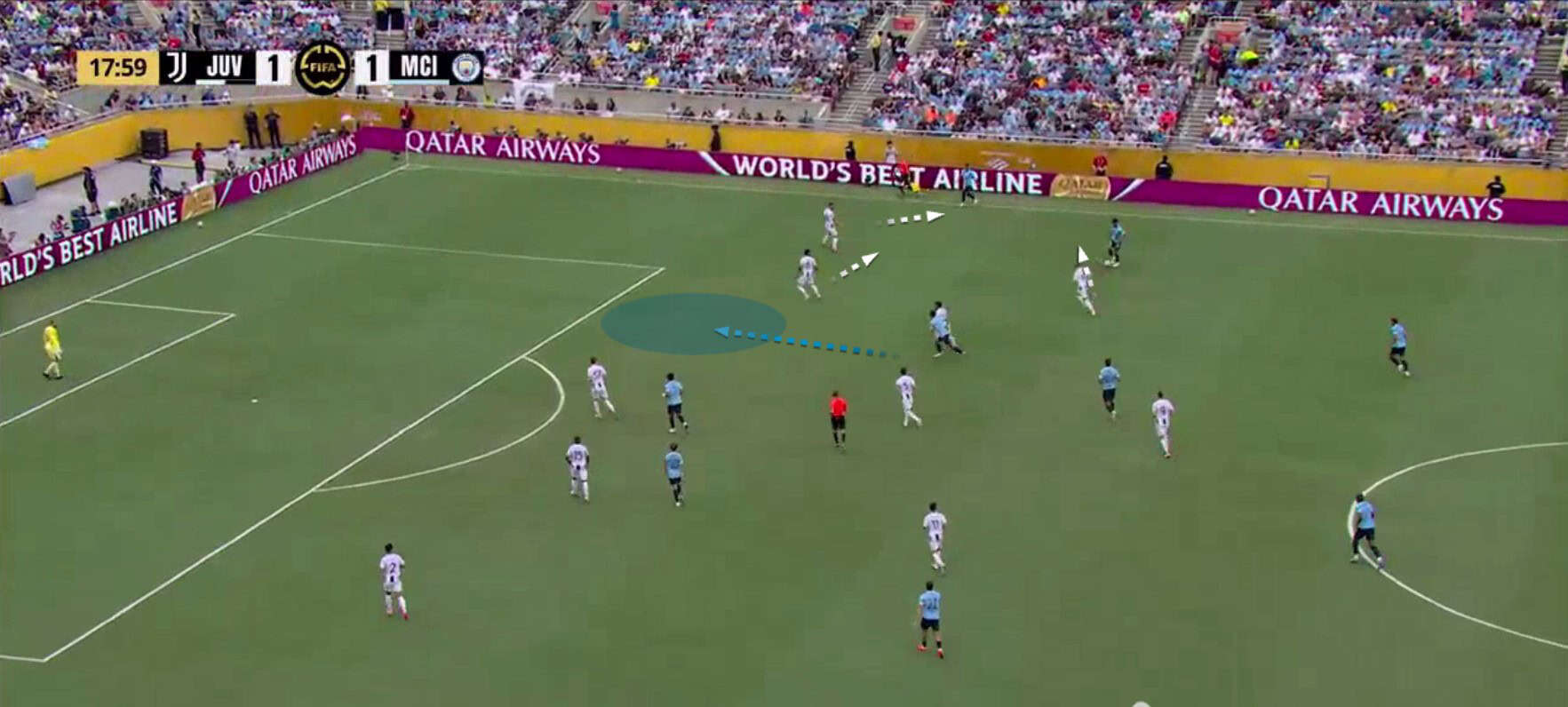 Juventus aim to add an extra player near Savinho to prevent a 1-v-1 situation with Kostić.
They assign the nearest centre-back, Kelly, to support Kostić if Nunes passes to Savinho.
Kelly’s movement, however, opens space behind him, particularly as Savona remains with Marmoush.
Manchester City exploit this gap, with Rejinders making a run into the space.
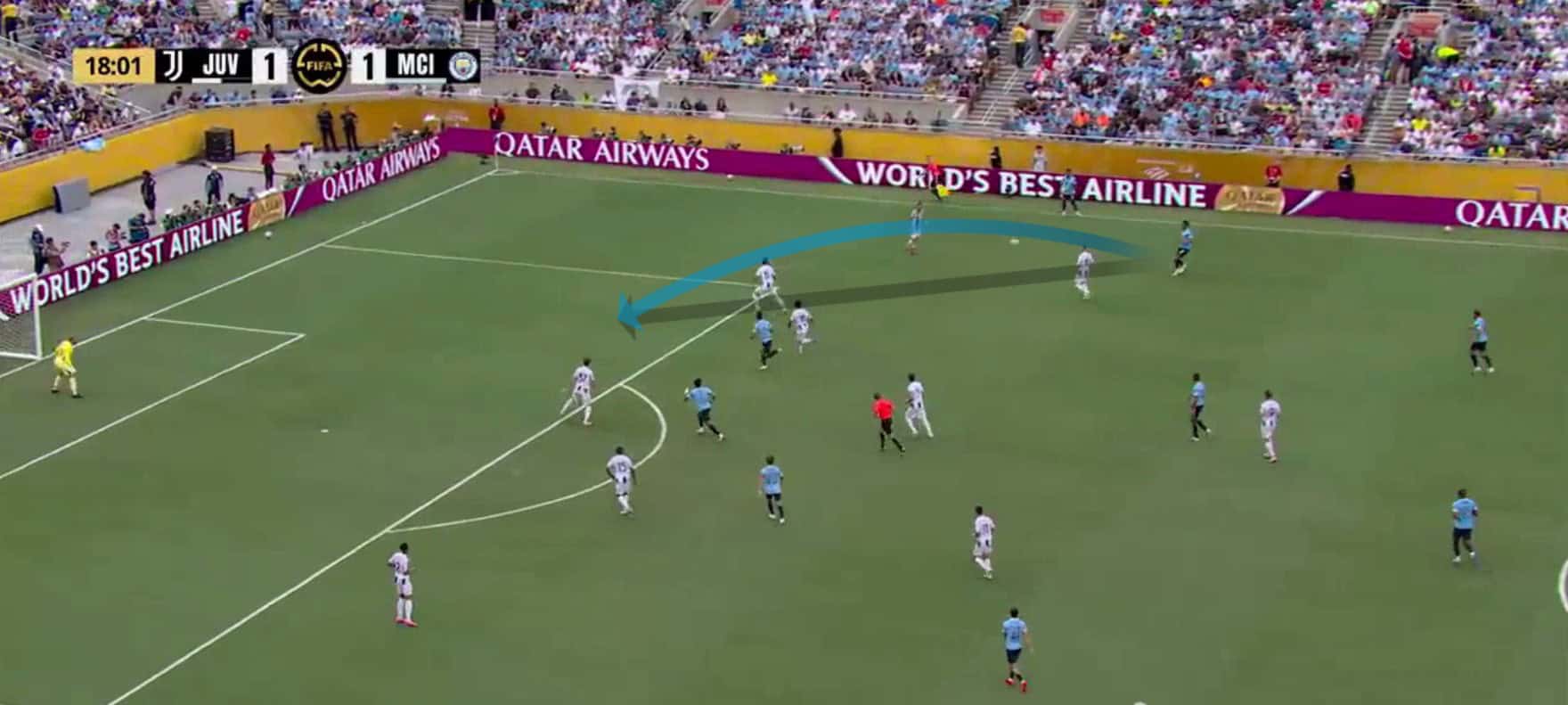 Nunes identifies Rejinders’ run and attempts to play him in, but McKennie tracks Rejinders closely and intercepts the pass.
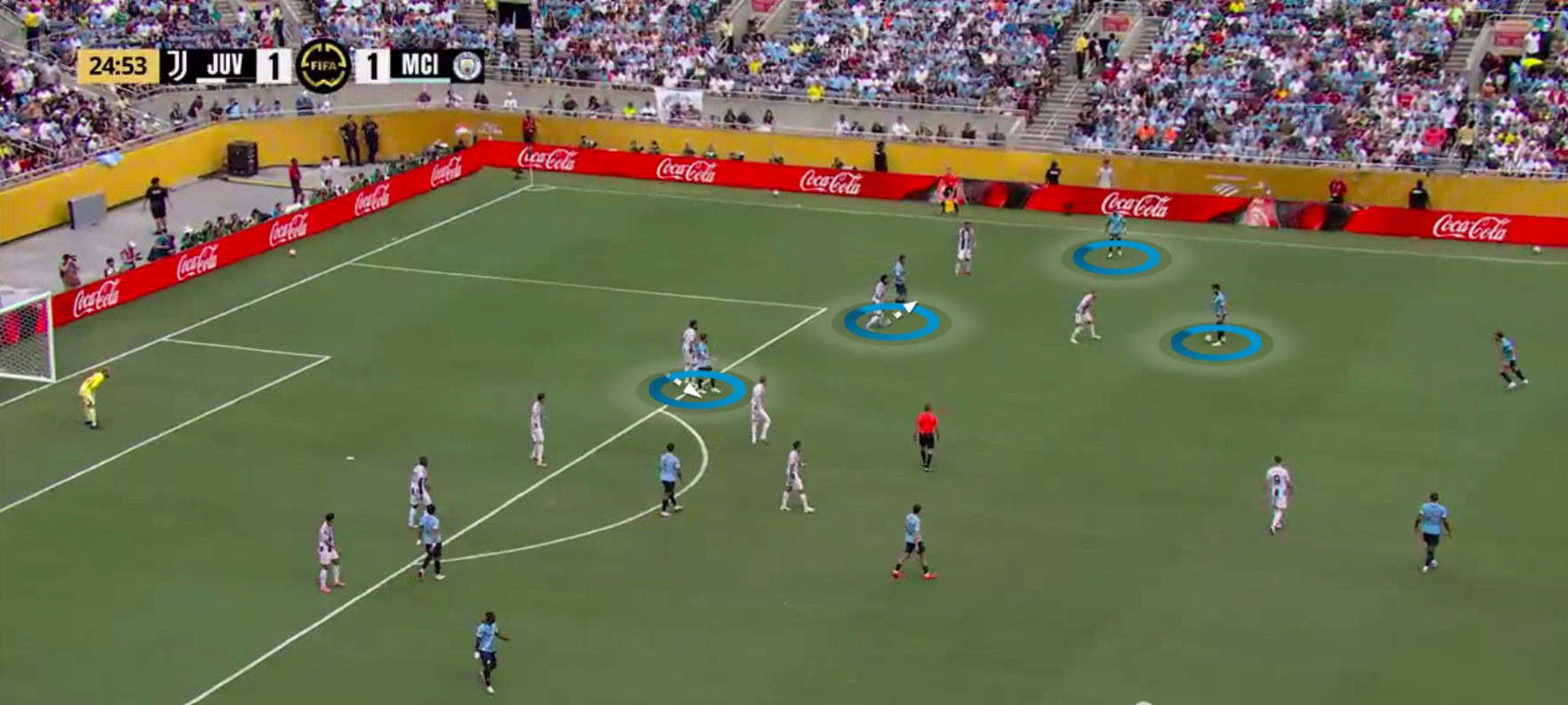 Man City attempt an alternative method to exploit space by pinning Juventus’ last line of defenders.
Rodri moves into a higher position, drawing McKennie with him to the space that they want to vacate.
Simultaneously, Kostić tracks Savinho, Kelly follows Silva, and Koopmeiners presses Nunes, who retains possession.
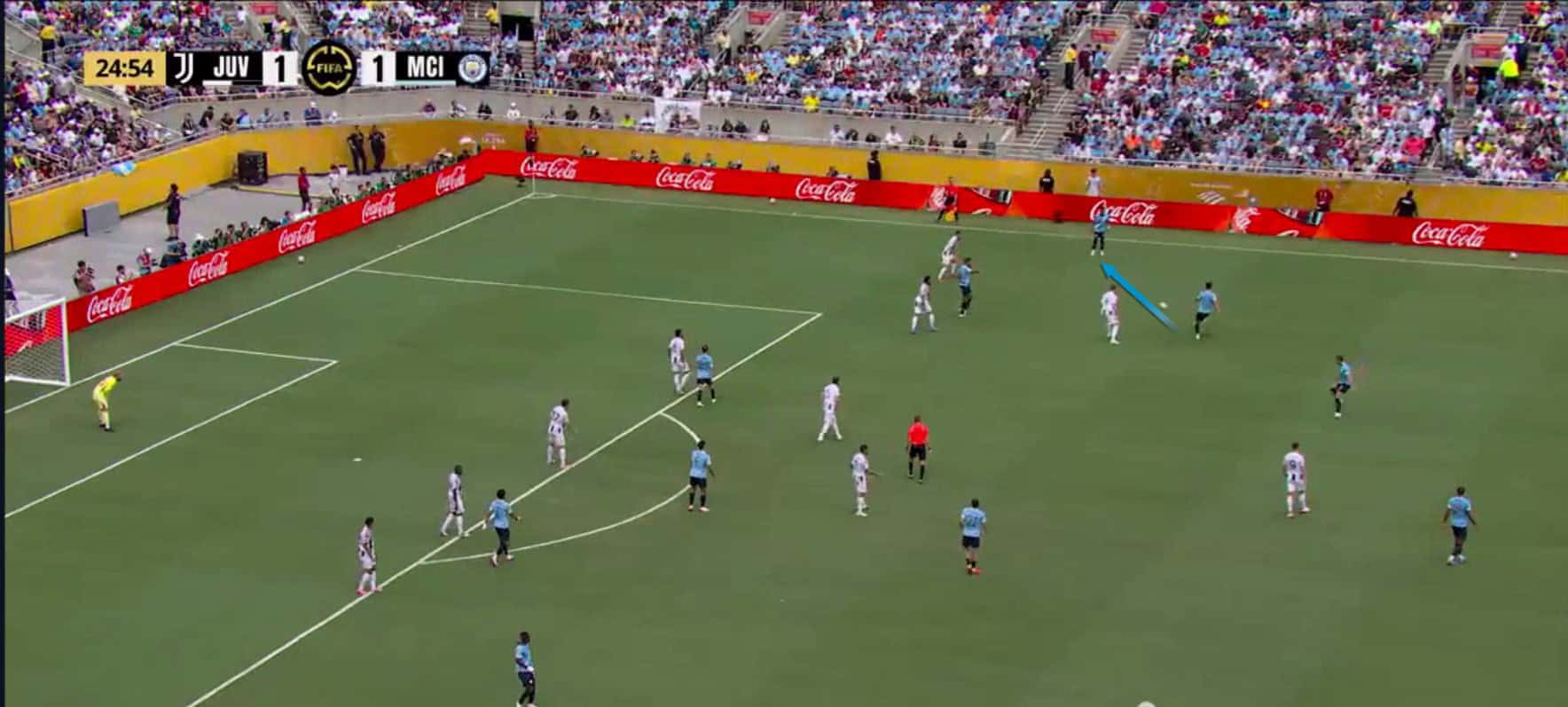 Nunes delivers the ball to Savinho.
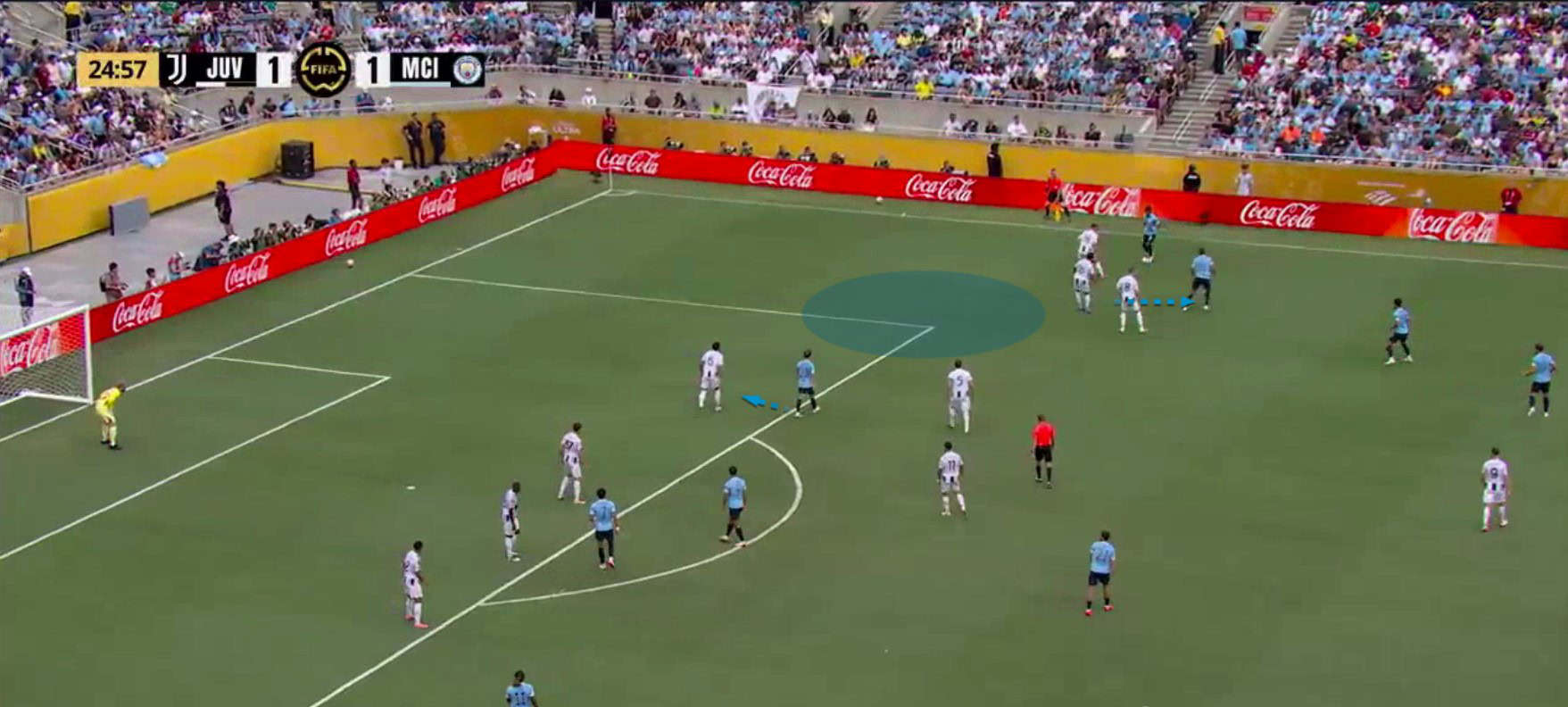 Rodri moves towards the touch line, suggesting he might receive the ball, which drags McKennie away from the space between Kostić, the left wing-back, and Kelly, the left centre-back.
Juventus attempt to double up on Savinho, prompting Koopmeiners to move closer to the ball to be with Rodri, while McKennie can assist Kostić with Savinho.
Silva is positioned near Kelly, enlarging the available space for City to exploit.
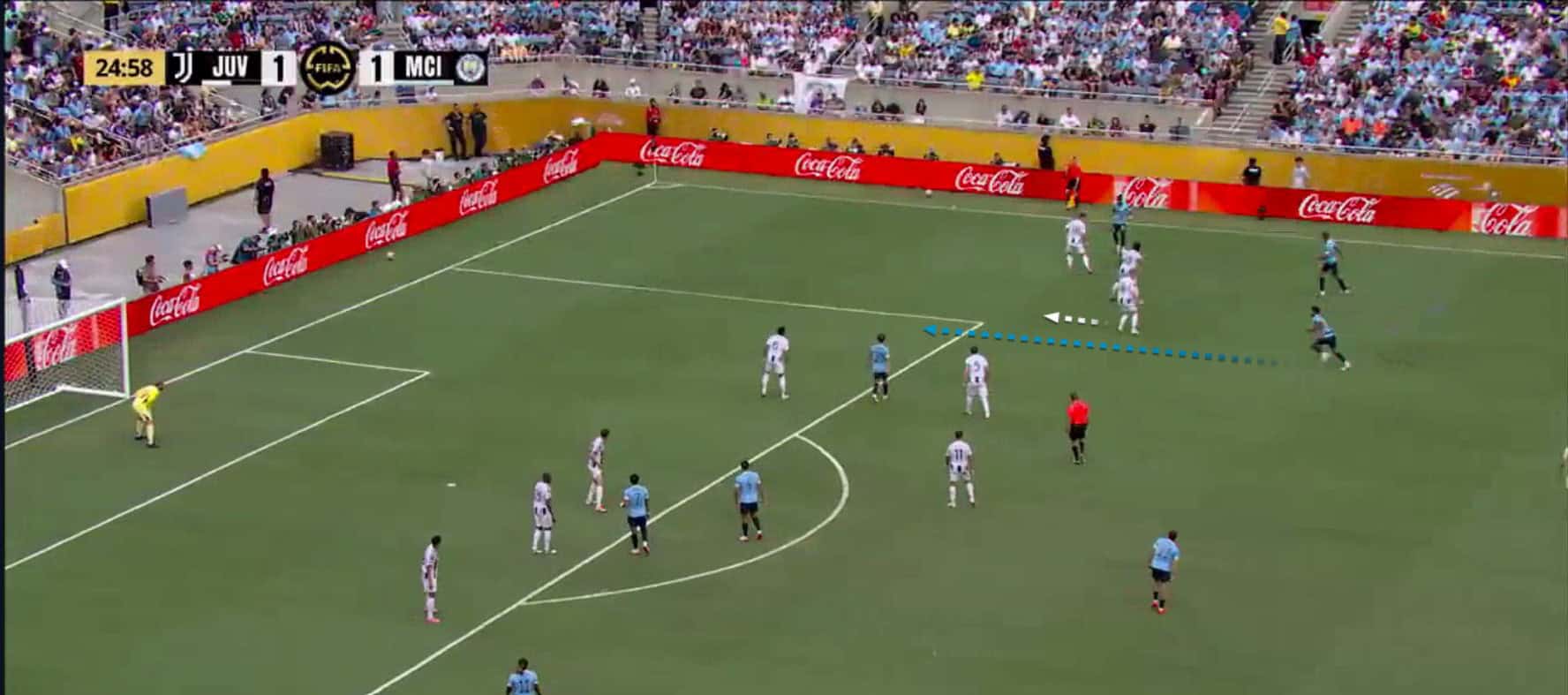 McKennie, the left-sided six, is positioned near the ball, while Koopmeiners also focuses on the ball, giving it more attention than to Nunes.
As Nunes begins his acceleration, Koopmeiners only observes him, leaving the space ahead open for City to exploit.
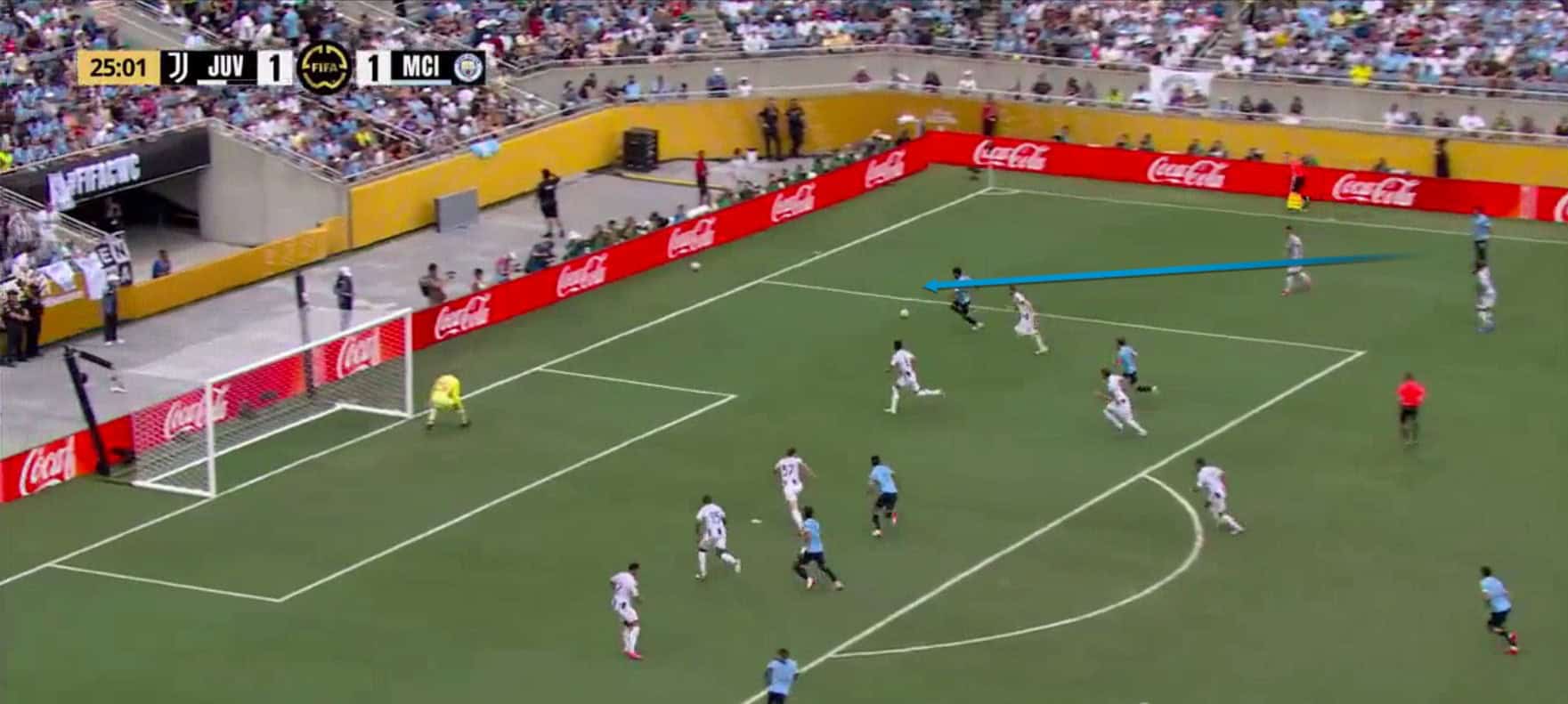 Savinho finds Nunes with that throw-pass into the space.
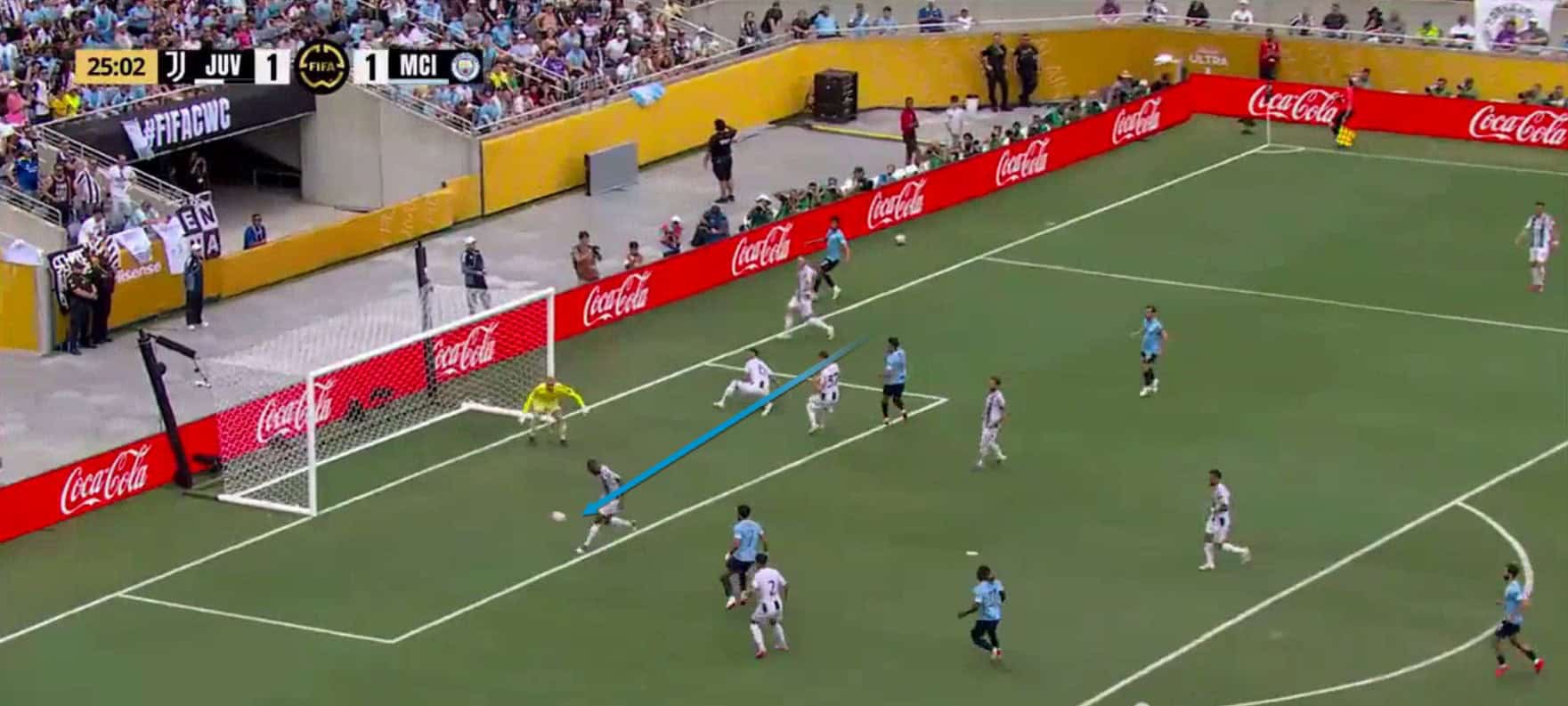 Nunes makes the cross, and with an on-goal, Kalulu gives Pep Guardiola’s team their second goal.
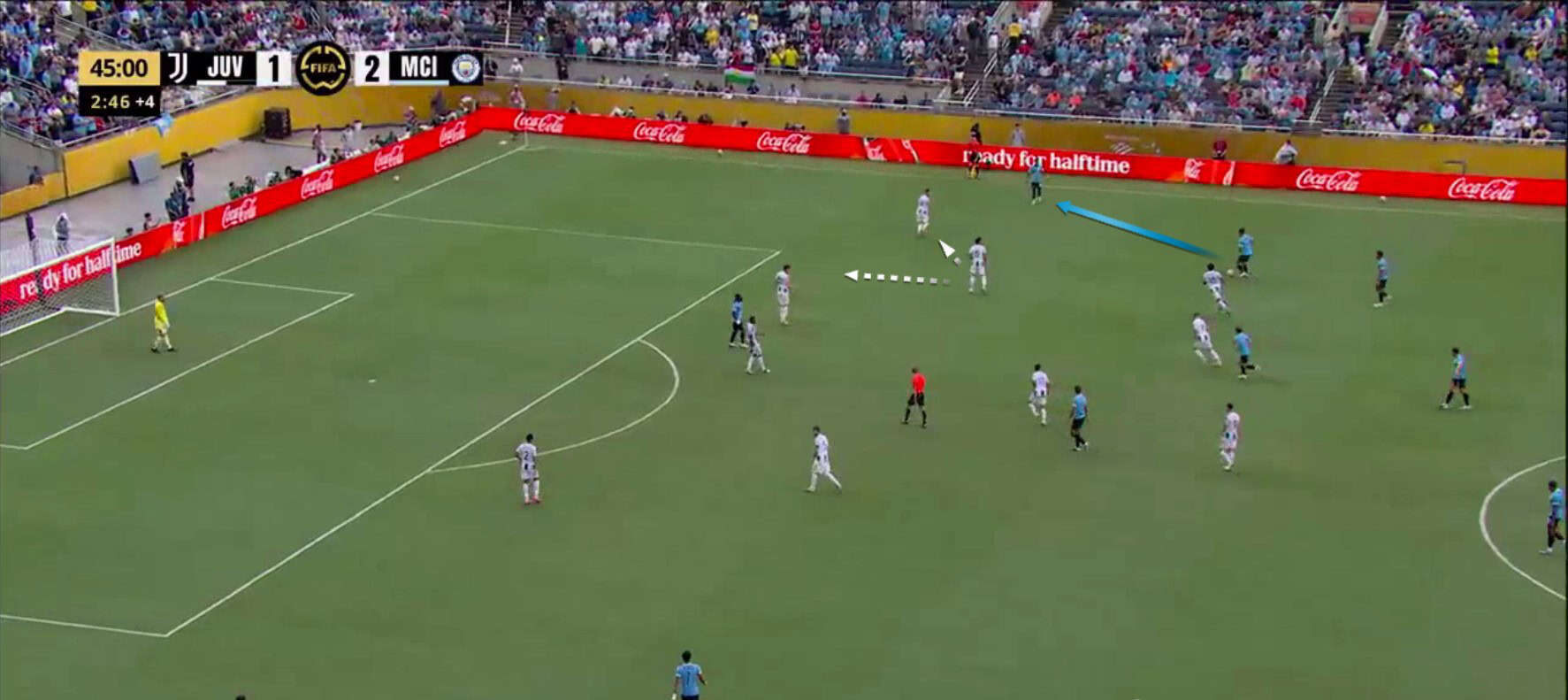 When Juventus chose to cover the space instead of focusing on Savinho, they left Kostić in a 1-v-1 situation against him.
Here, Kelly shows no intention to provide support.
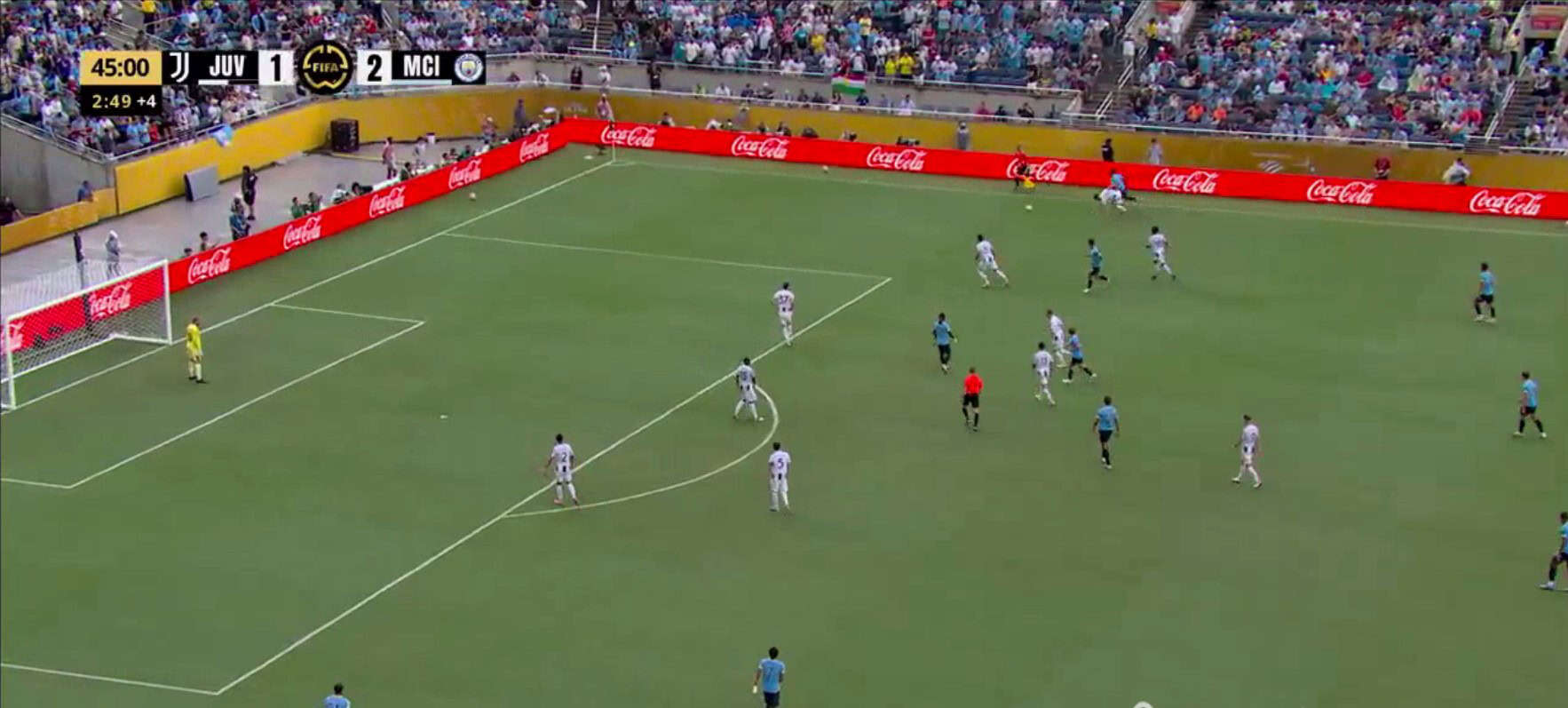 Savinho takes advantage of this situation.
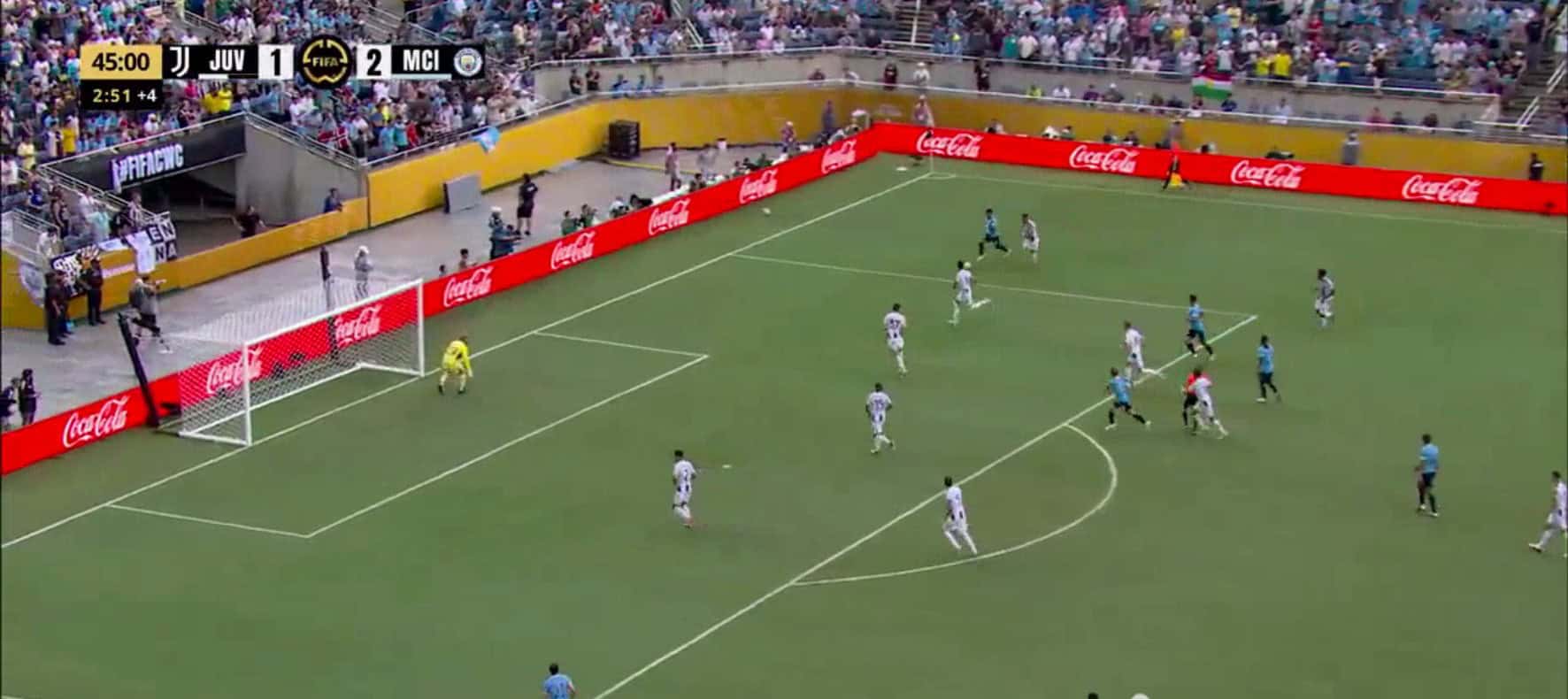 He dribbles past Kostić, which is one of the things Man City want at the end: to put their wingers in these situations with an advantage.
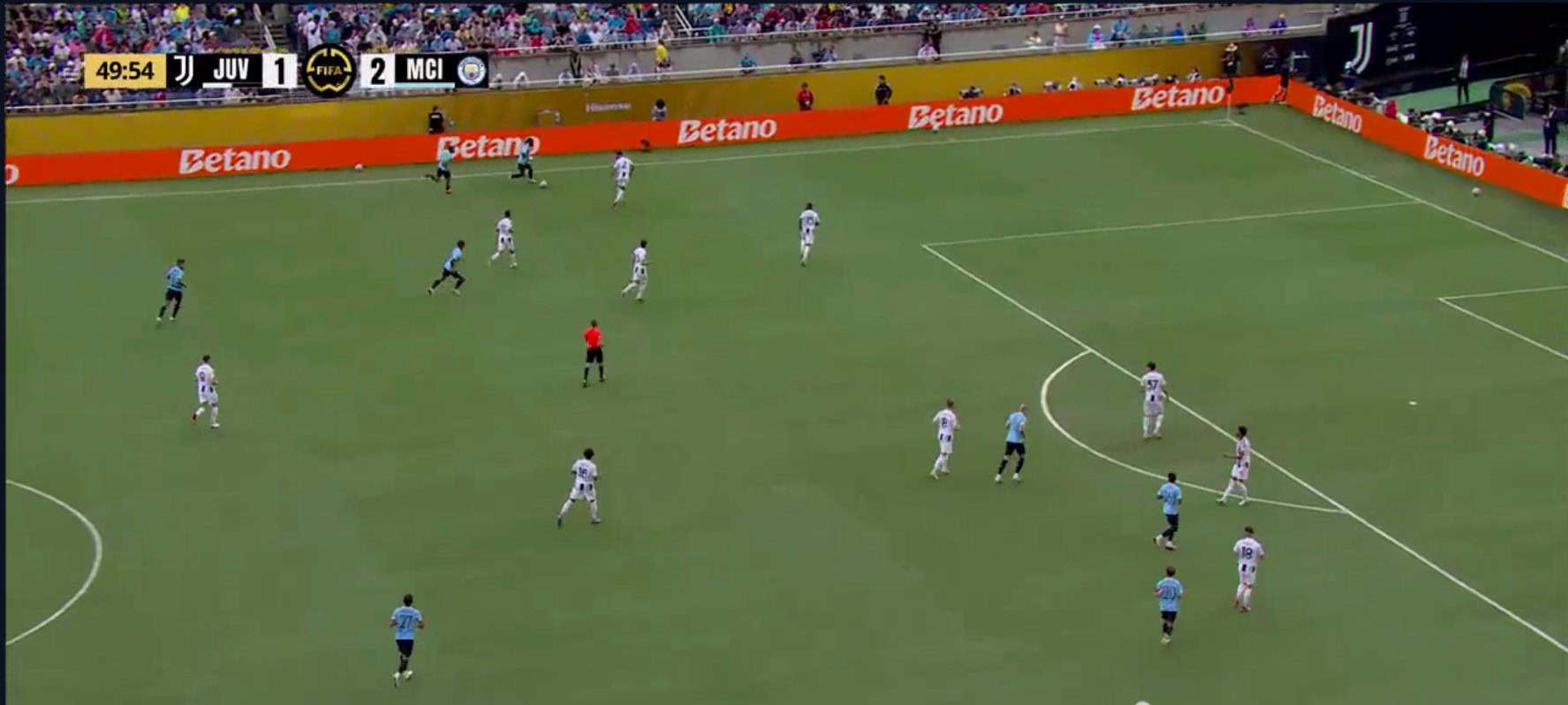 Another one, where Doku carries the ball toward Costa, prompting González to step up to support the defence, while Kalulu mirrors the movement to maintain defensive balance.
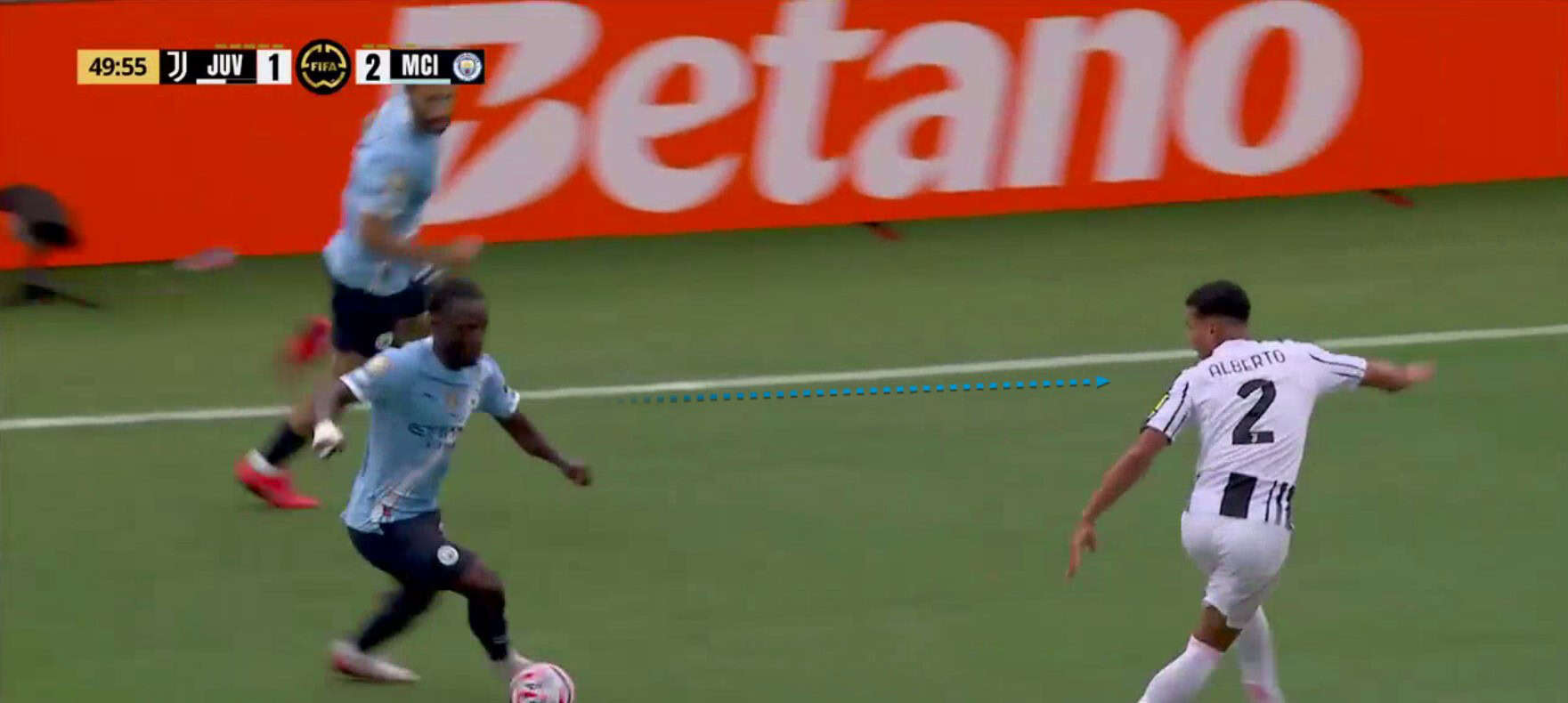 With Aït-Nouri making an overlapping run, Costa is forced to open the inside angle to Doku, ensuring he can cover Aït-Nouri if the ball is played to him.
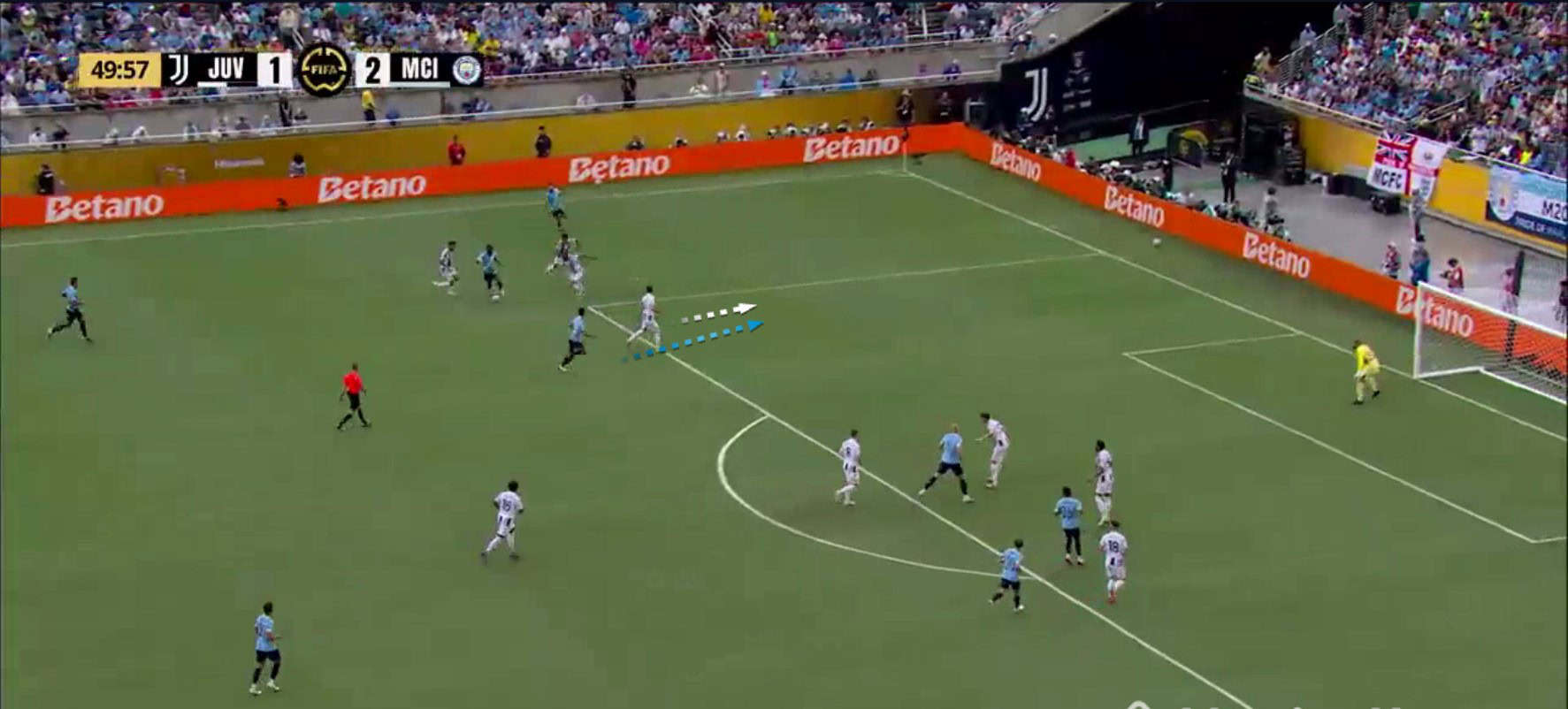 This creates the exact opportunity Doku needs, providing a slight angle to run through.
González has not yet reached him, and Locatelli follows Rejinders into the space created behind Kalulu.
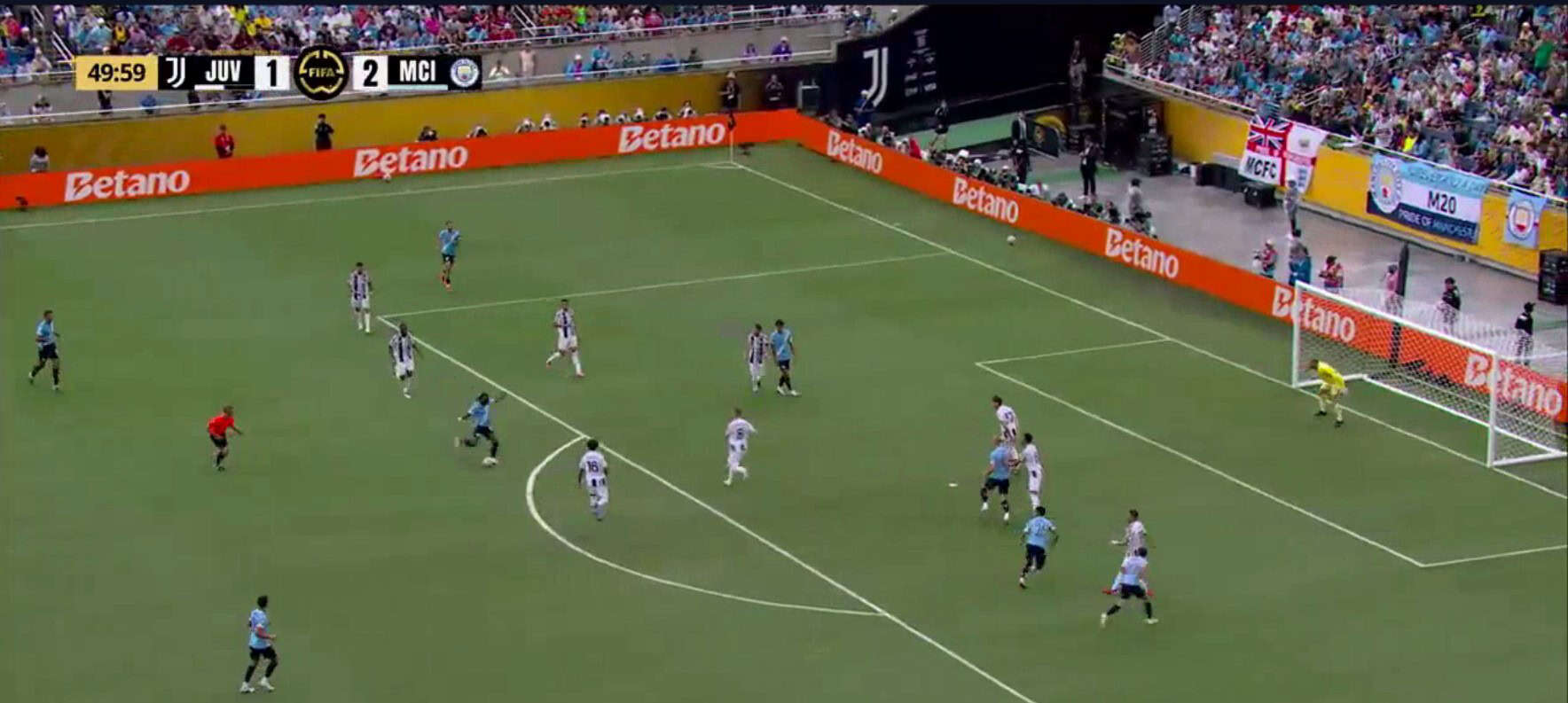 Doku capitalises on the created space, using the slight angle and the positioning of defenders to dribble effectively and reach a prime location to shoot.
Manchester City Final Third Tactics Vs Al-Hilal
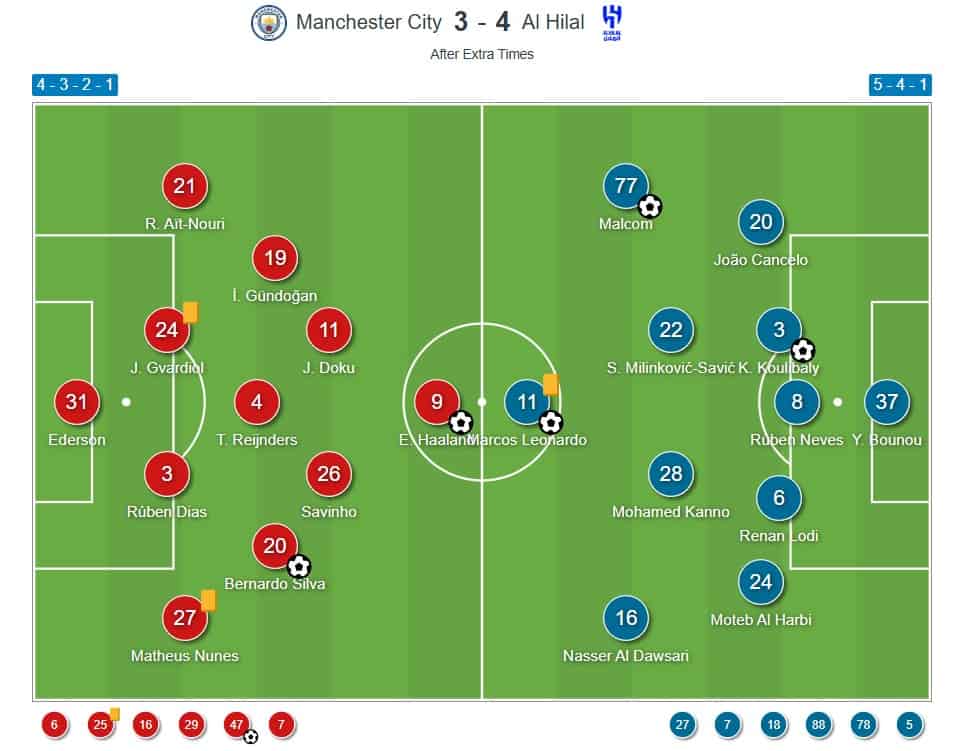 Al Hilal start with goalkeeper Yassine Bounou.
Their defenders are João Cancelo (right wing‑back), Kalidou Koulibaly (right centre-back), Rúben Neves (central centre-back), Renan Lodi (left centre-back), and Moteb Al-Harbi (left wing‑back).
In midfield, they lined up Sergej Milinković-Savić (right central midfielder), Mohamed Kanno (left central midfielder), Nasser Al-Dawsari (left winger), and Malcom (right winger).
Marcos Leonardo lined up as the centre-forward.
In this match against Al Hilal, Manchester City made several adjustments to their starting XI.
Joško Gvardiol replaced Manuel Akanji as the left centre-back.
İlkay Gündoğan was introduced as the left eight, with Tijjani Reijnders dropping deeper to operate as the six in place of Rodri.
Additionally, Erling Haaland started as the centre-forward.
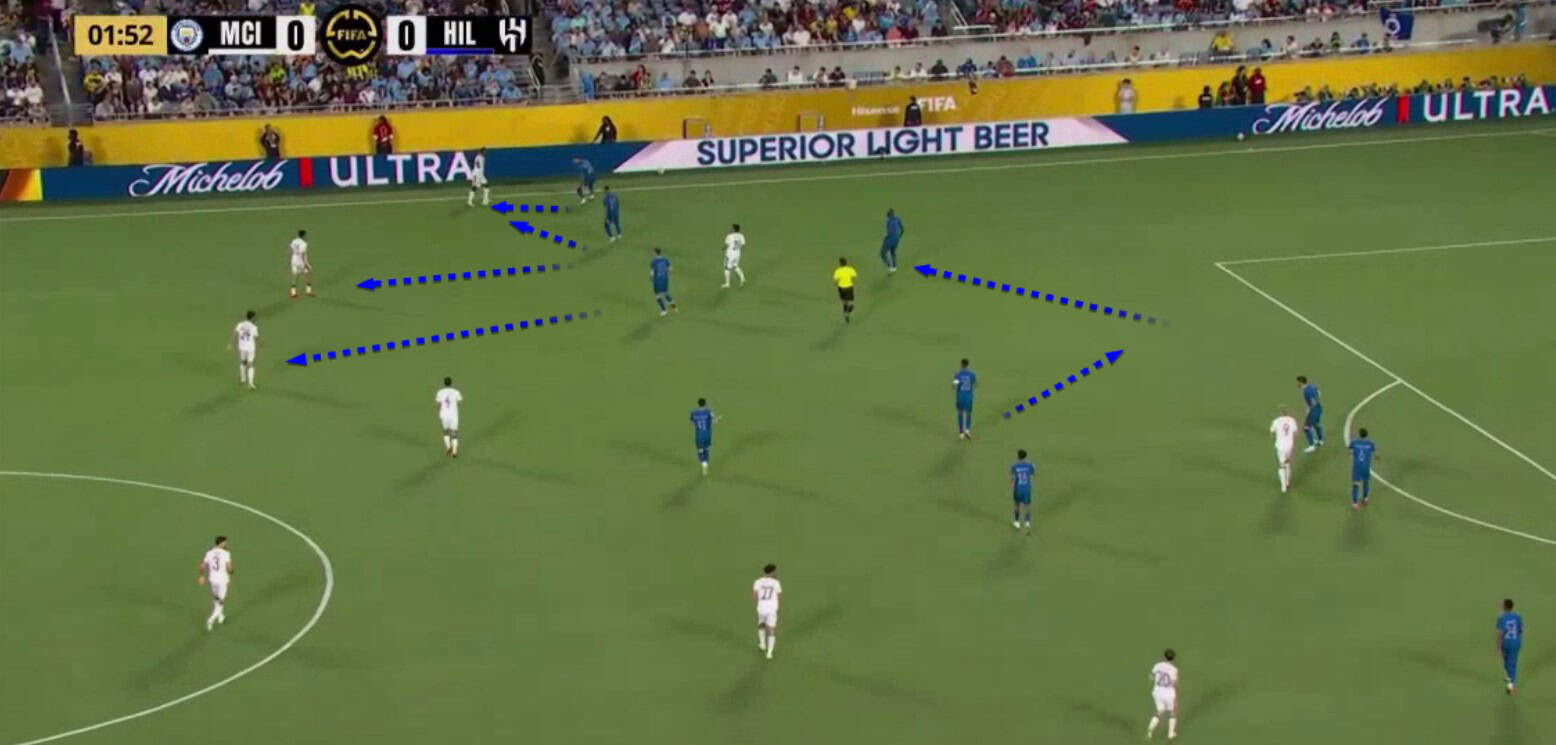 To address the threat of Man City’s wingers in 1v1 situations, and to avoid the fate of Wydad and Juventus, Simone Inzaghi positions right wing-back Cancelo against Doku, supported by winger Malcom.
Malcom must also be prepared to press Aït-Nouri if he receives the ball, while Milinković-Savić drops to cover the near ball-side half-space and is ready to press Gvardiol if he gets possession.
To reinforce the wing defensively, Koulibaly, the right centre-back, stays close to the ball, either following Gündoğan if he approaches or preventing Doku from exploiting space to dribble inside.
Now, what about the space behind the centre-back?
Inzaghi assigns the six Kanno to cover both sides and maintain defensive balance.
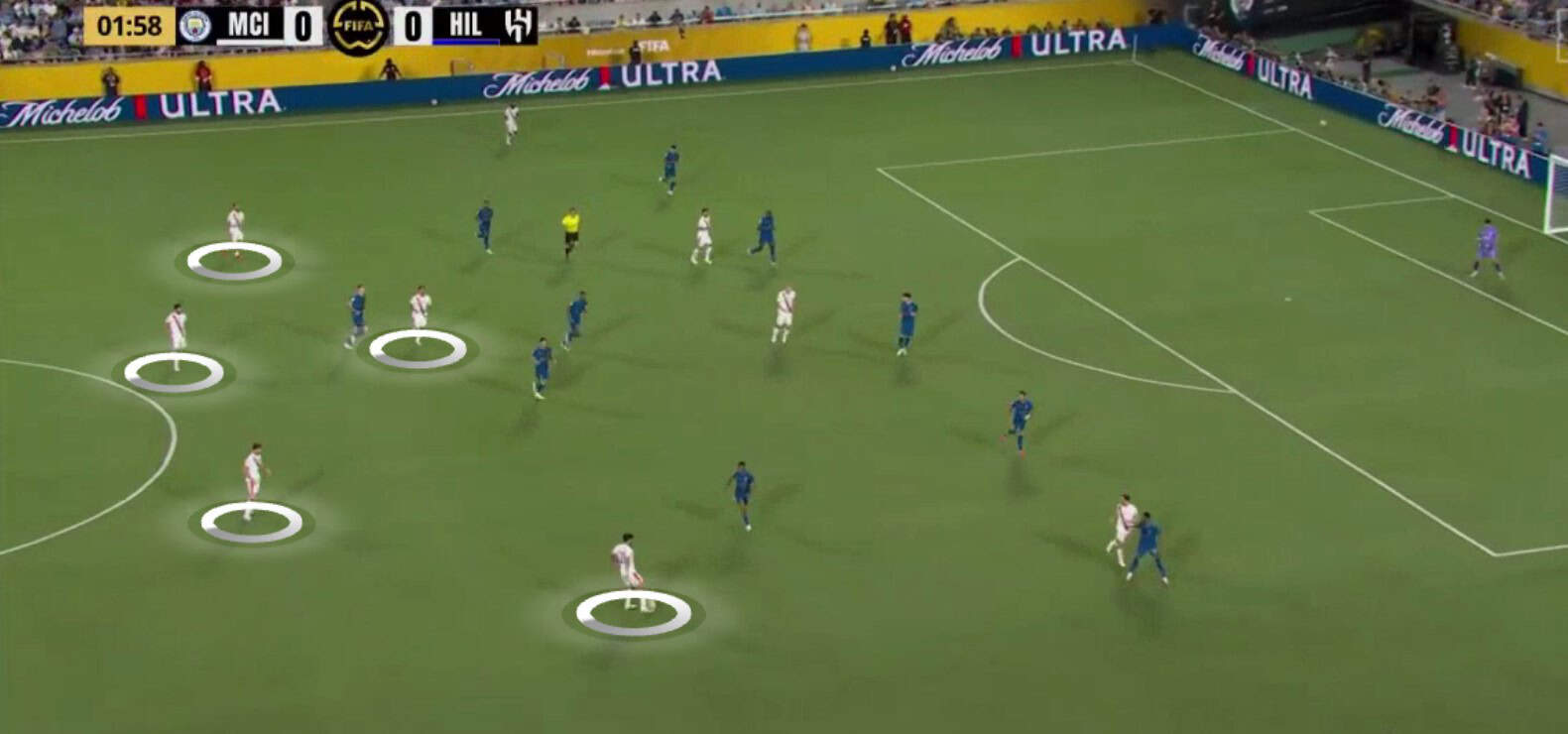 In this phase, Man City maintains their usual shape, with Dias and Gvardiol forming the first line, and Nunes, Rejinders, and Aït-Nouri positioned in the second line.
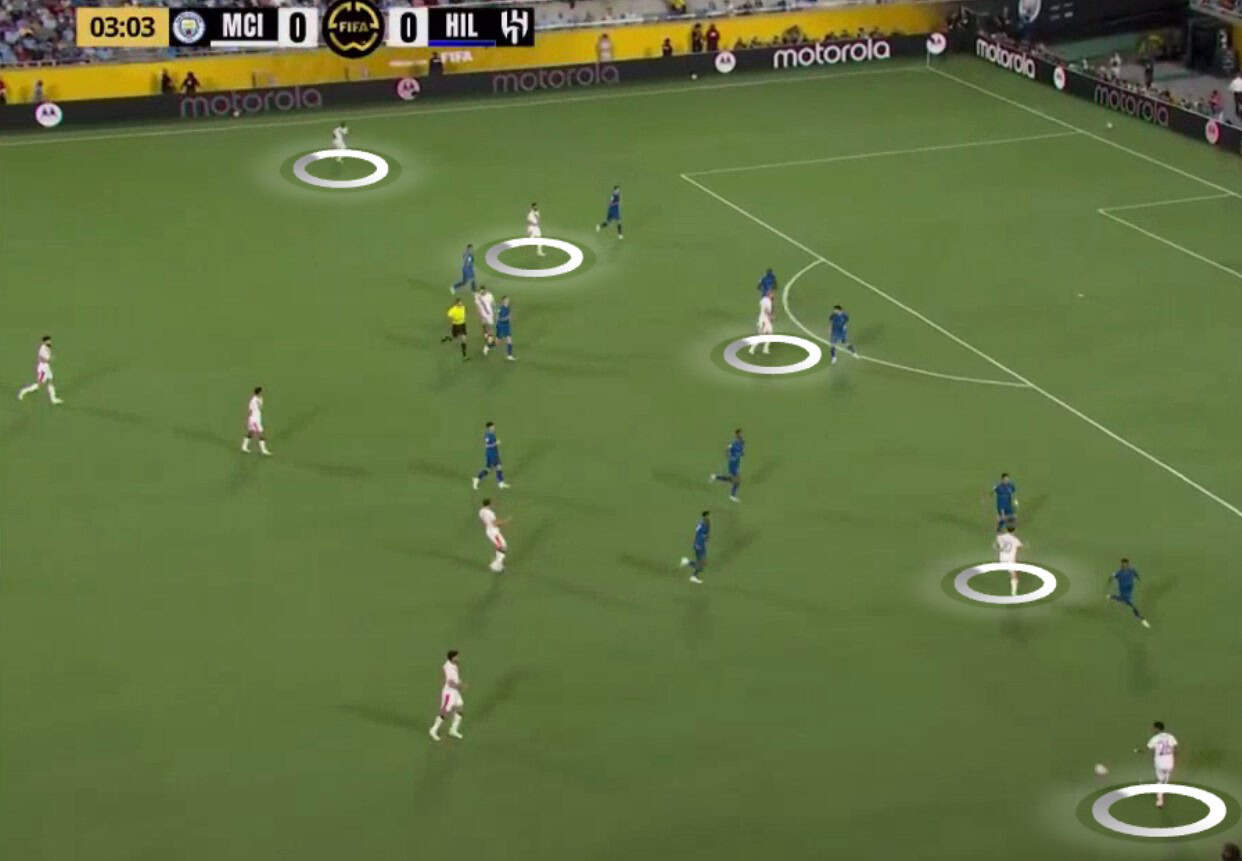 In the last line, Man City positions five players, while the eights, Silva and Gündoğan, occupy high positions in the half-spaces.
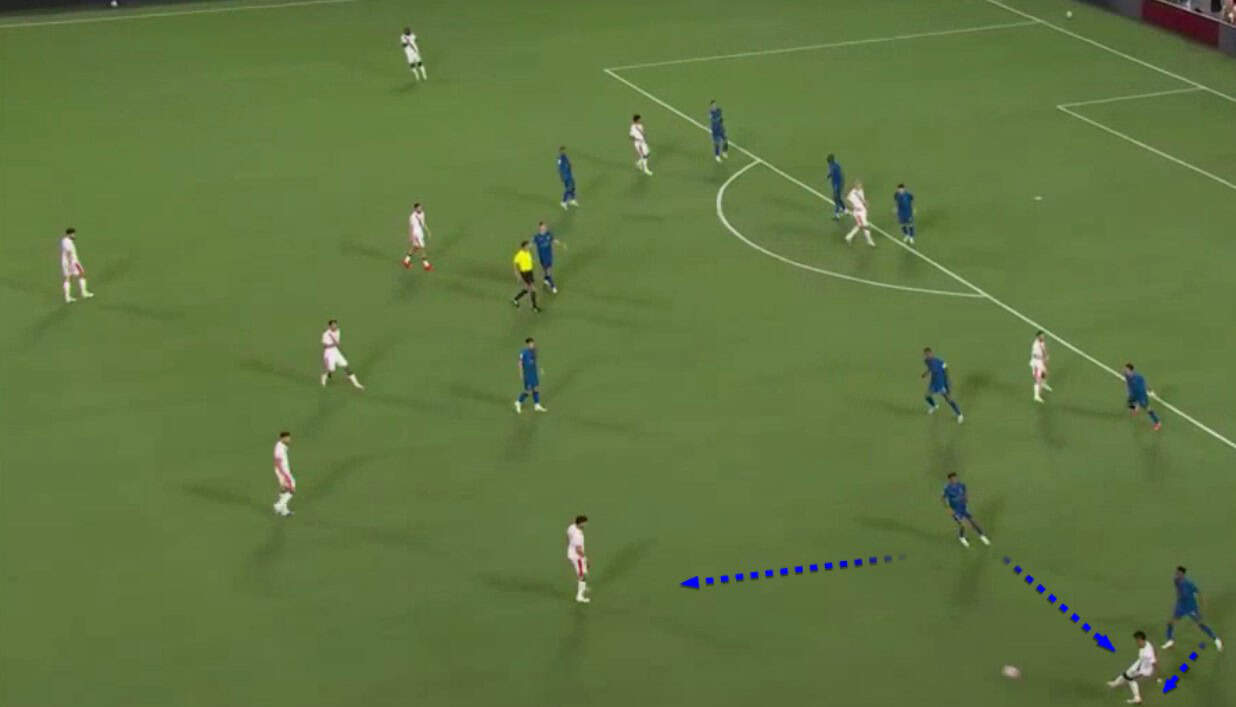 Lodi, the left centre-back, Al-Harbi, the left wing-back, and Al-Dawsari, the left winger, all maintain the same roles as their teammates on the right side.
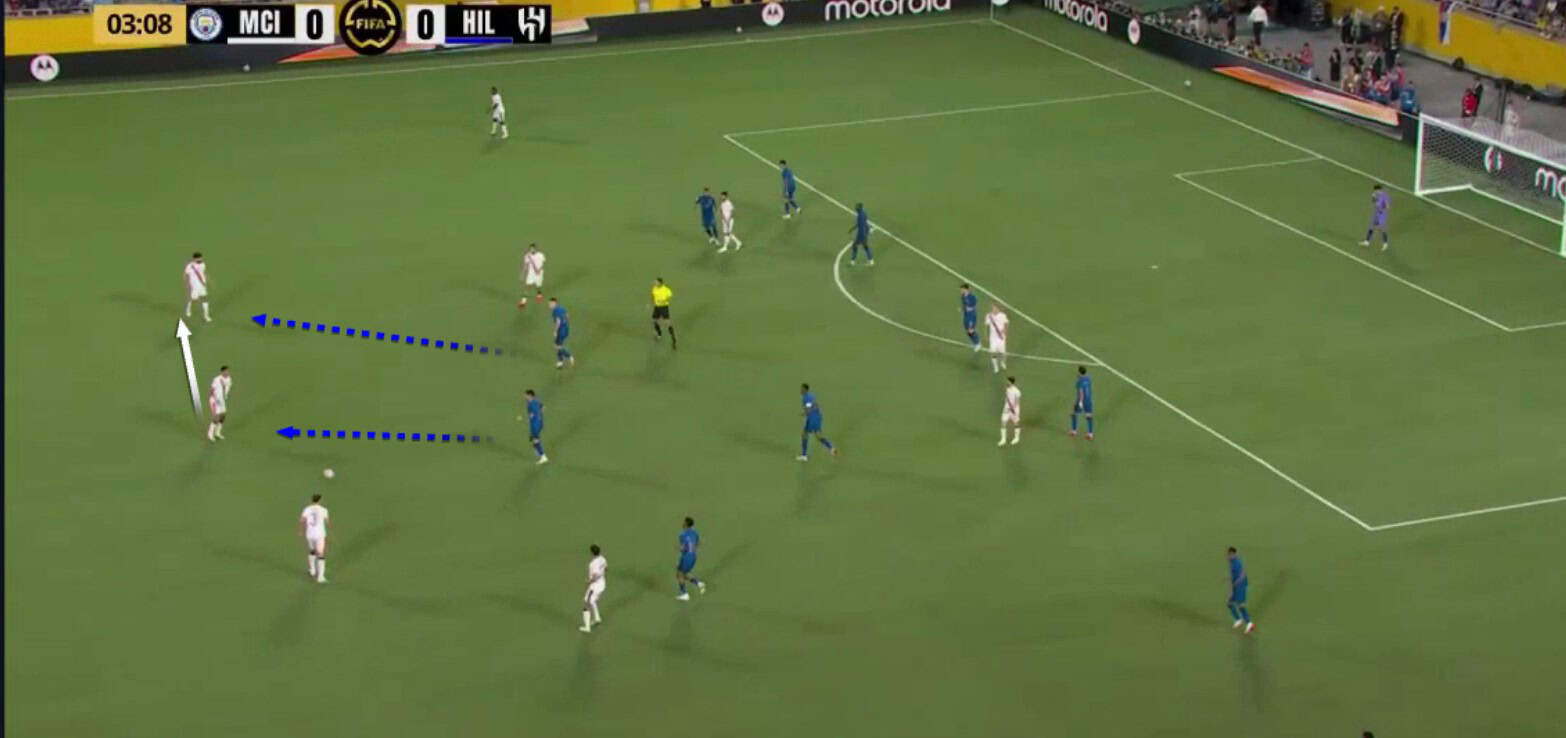 Pep Guardiola’s team tries to react quickly.
Leonardo from Al-Hilal is tasked with shadowing Rejinders in the second line, preventing passes from Dias and Gvardiol.
When Rejinders drops into the first line, Leonardo presses him, while Milinković-Savić maintains his usual role to press Gvardiol.
Kanno, originally covering Lodi on the left, now has to shift across to replicate the coverage on the other side.
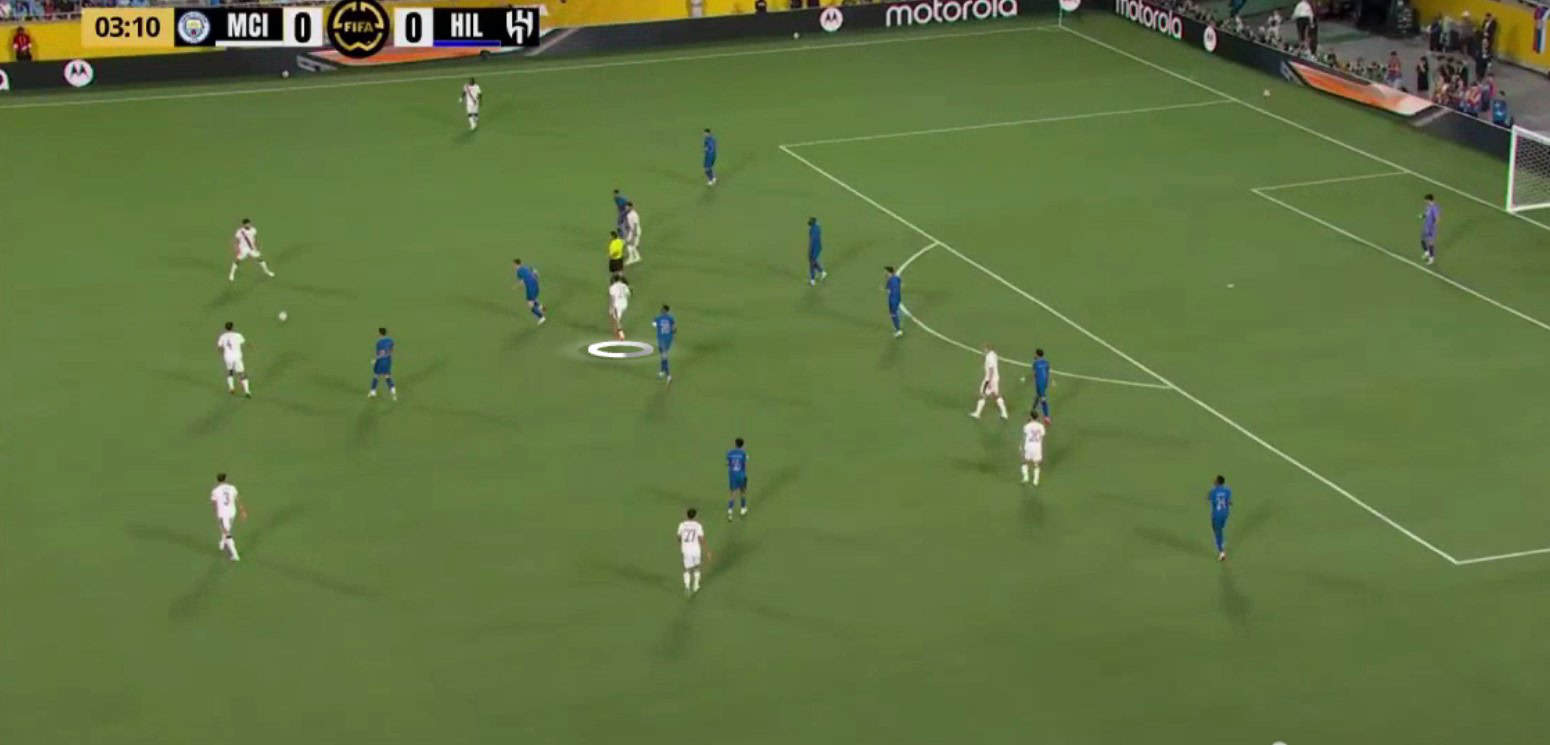 As Aït-Nouri moves more centrally, Malcom follows him slightly, which enlarges the space between Malcom and Cancelo if he intends to support against Doku.
Additionally, Kanno is now positioned behind Aït-Nouri.
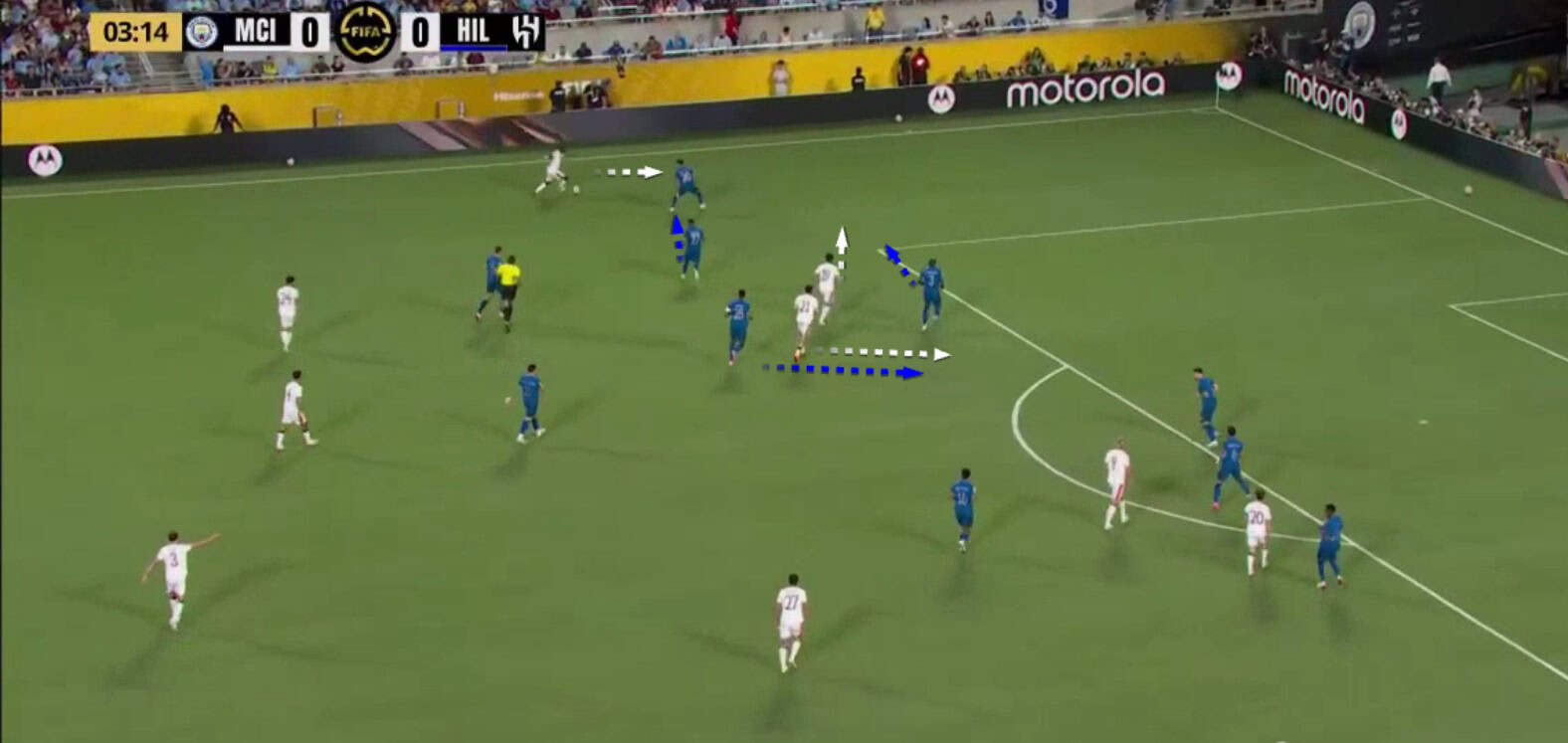 Gündoğan moves closer to the ball, prompting Koulibaly to approach the ball as well.
At this moment, Aït-Nouri is better positioned to run into the space than Kanno, who is supposed to cover it, since Aït-Nouri is already nearby.
In contrast, Kanno must cover the distance from one side to the other.
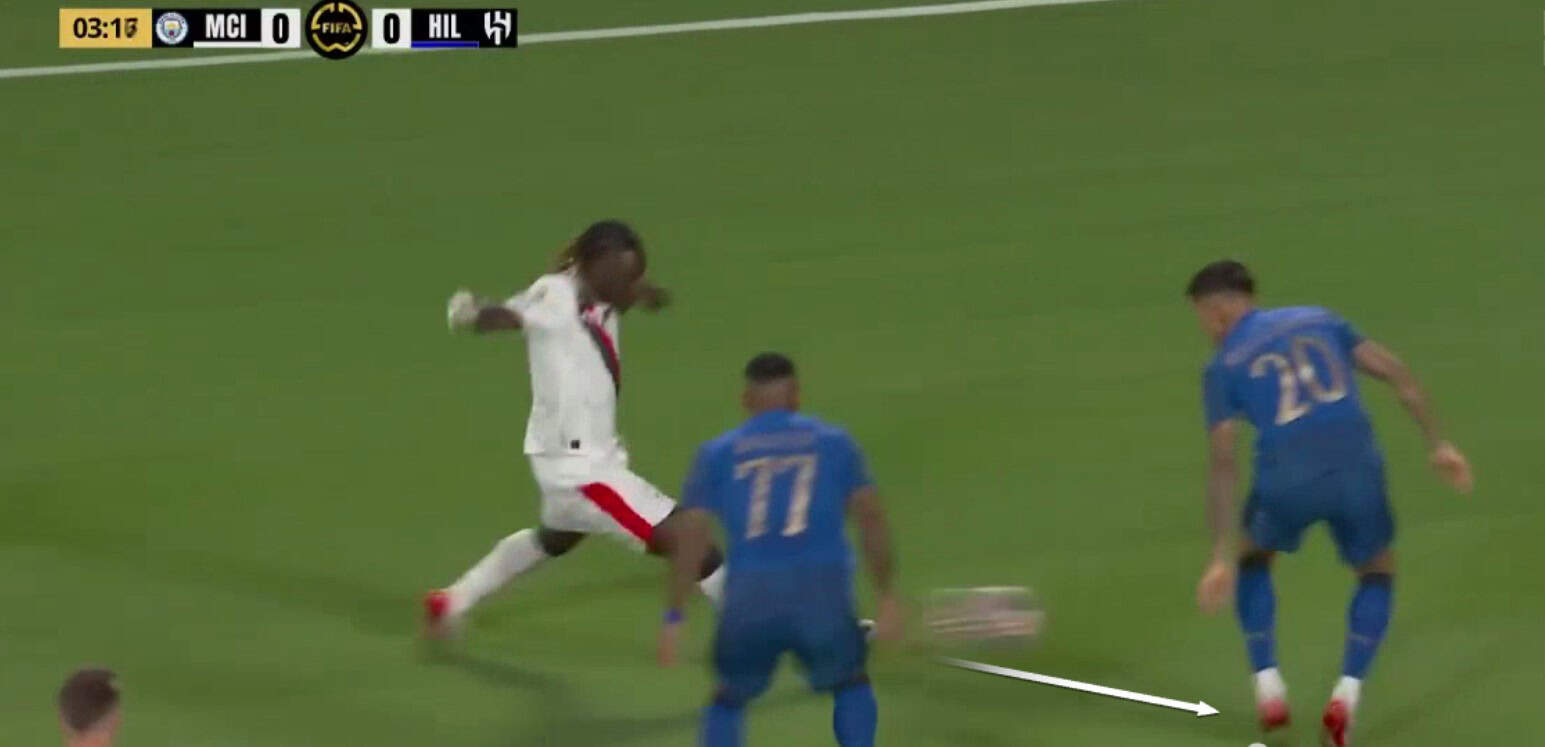 Because the angle between Cancelo and Malcom remains open, with Malcom slightly away, Doku finds a clear passing lane to exploit.
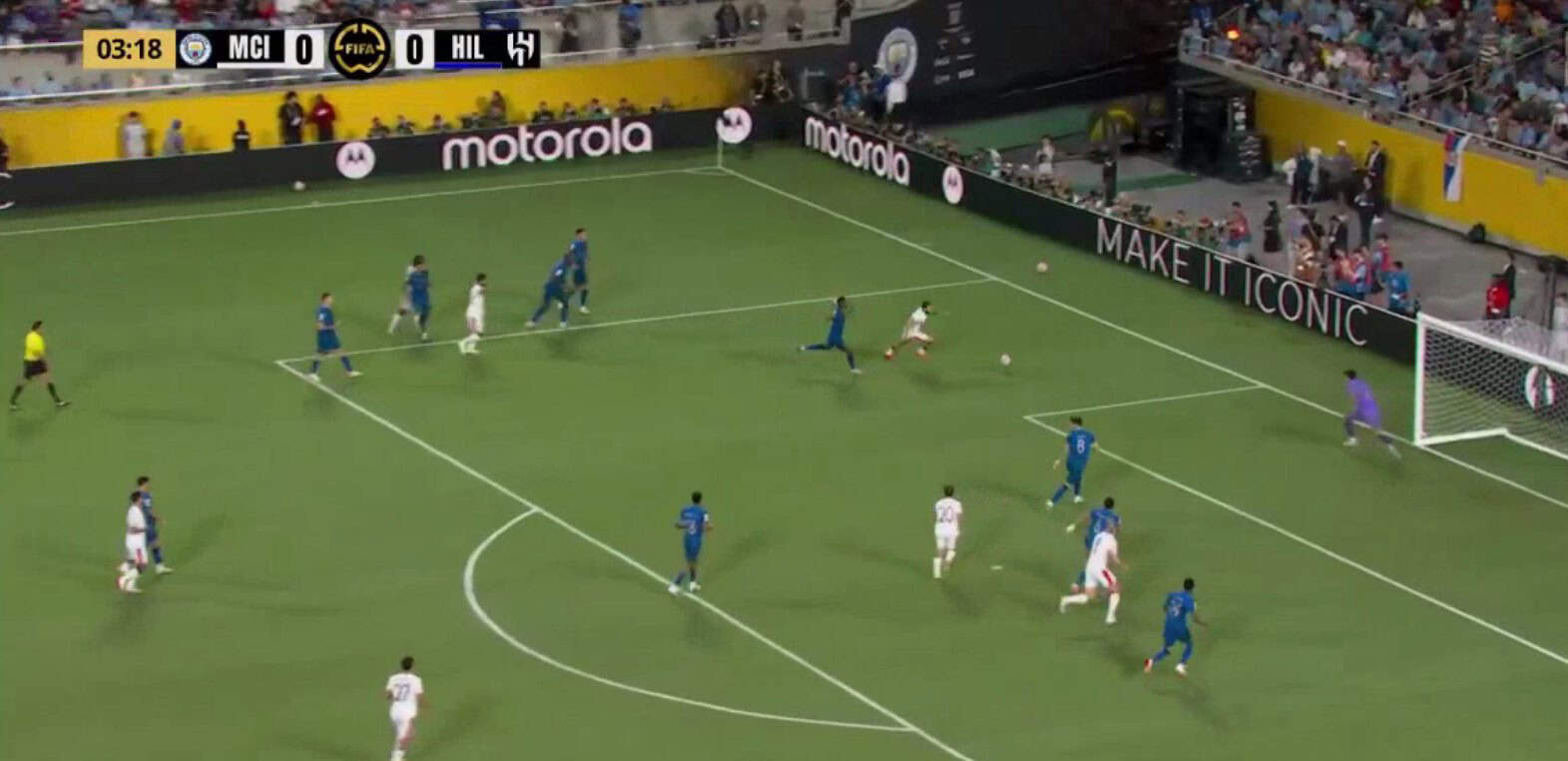 Nouri positioned himself well to create a dangerous opportunity, but the pass intended for him was too long to be effective.
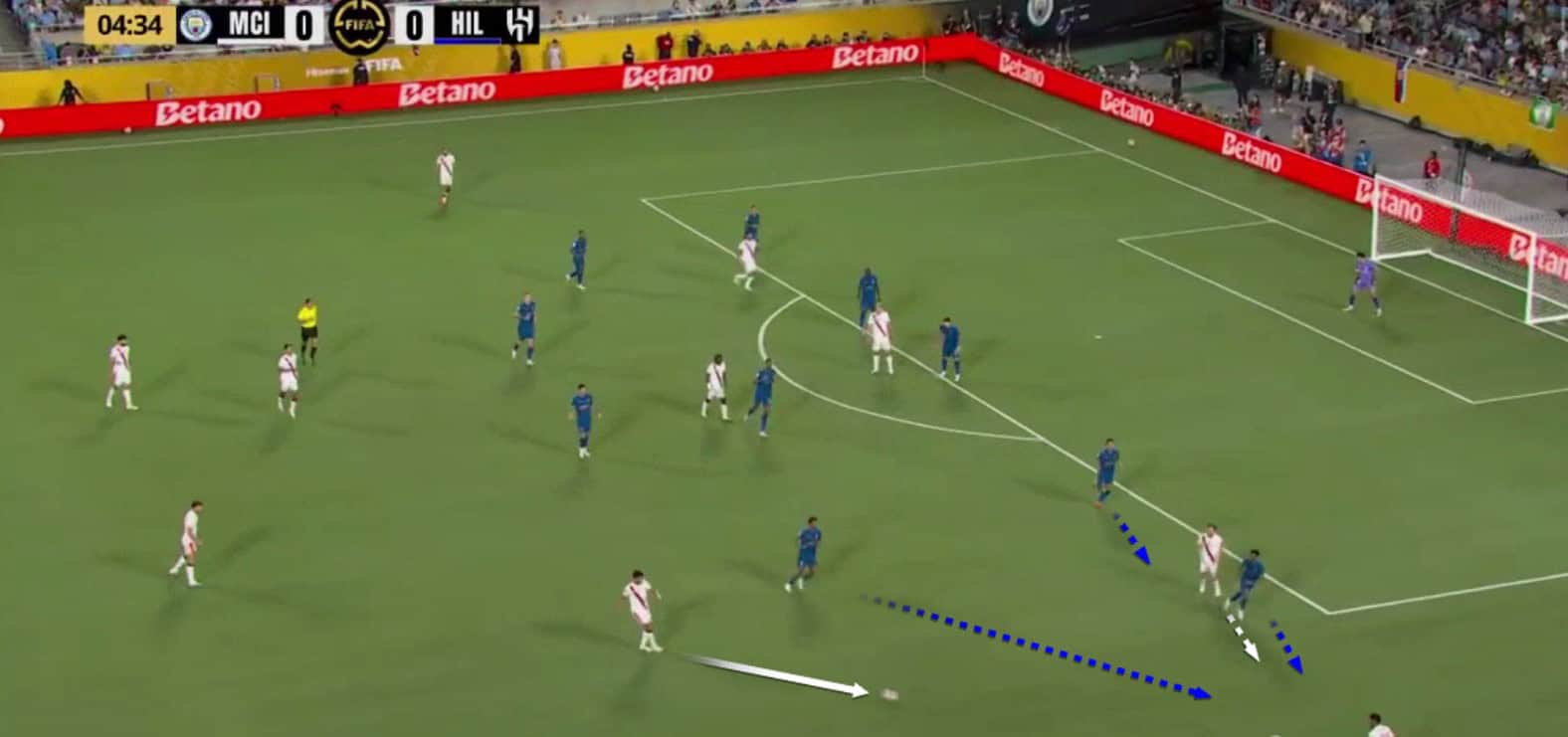 However, that doesn’t always work in Man City’s favour, particularly when Kanno is already in position and they are unable to force him to shift between the two sides as before.
Here, Silva moves toward the ball, ensuring Lodi follows him, while all Al-Hilal players remain in their usual positions.
Nunes passes to Savinho.
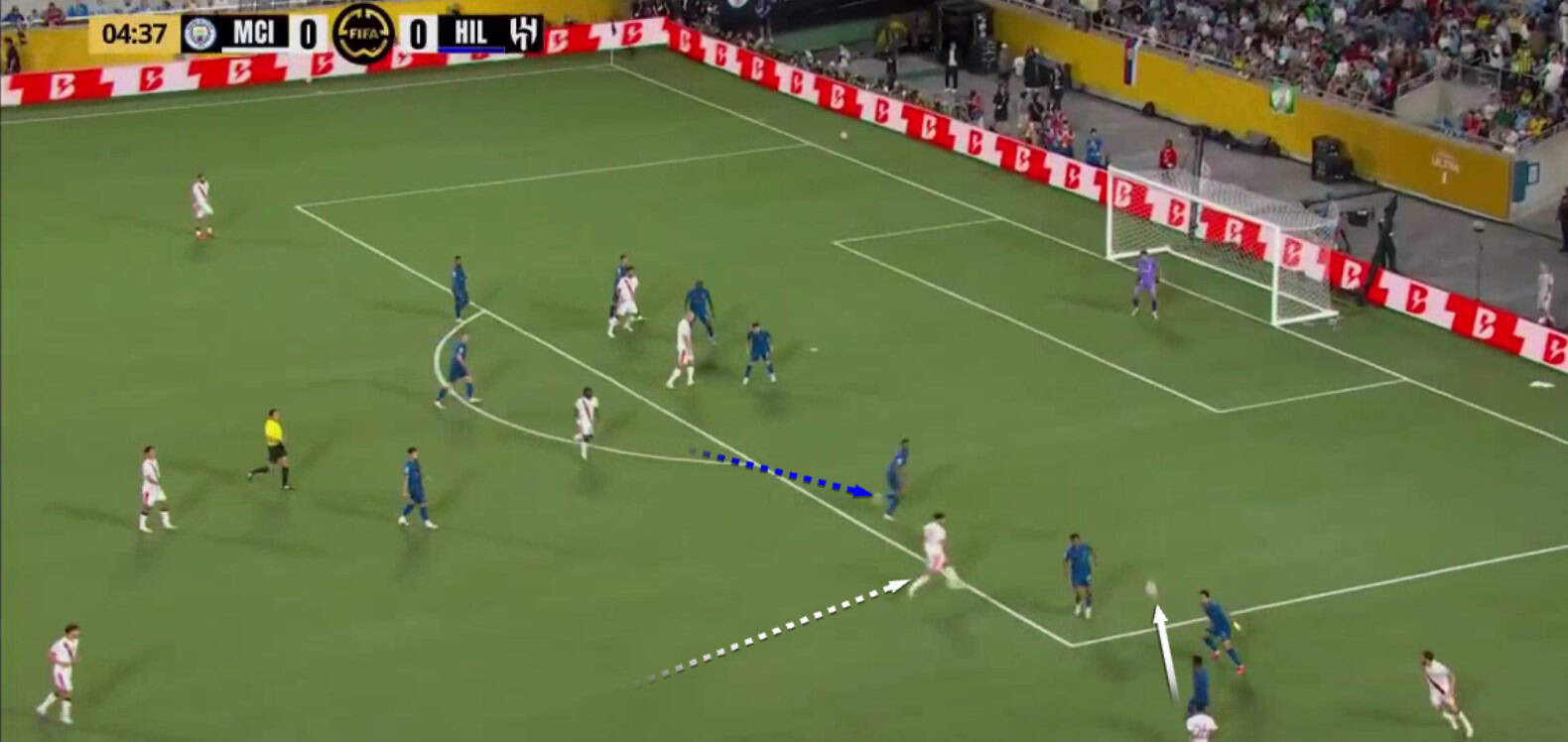 Nunes runs into the open space and positions himself to receive Savinho’s pass.
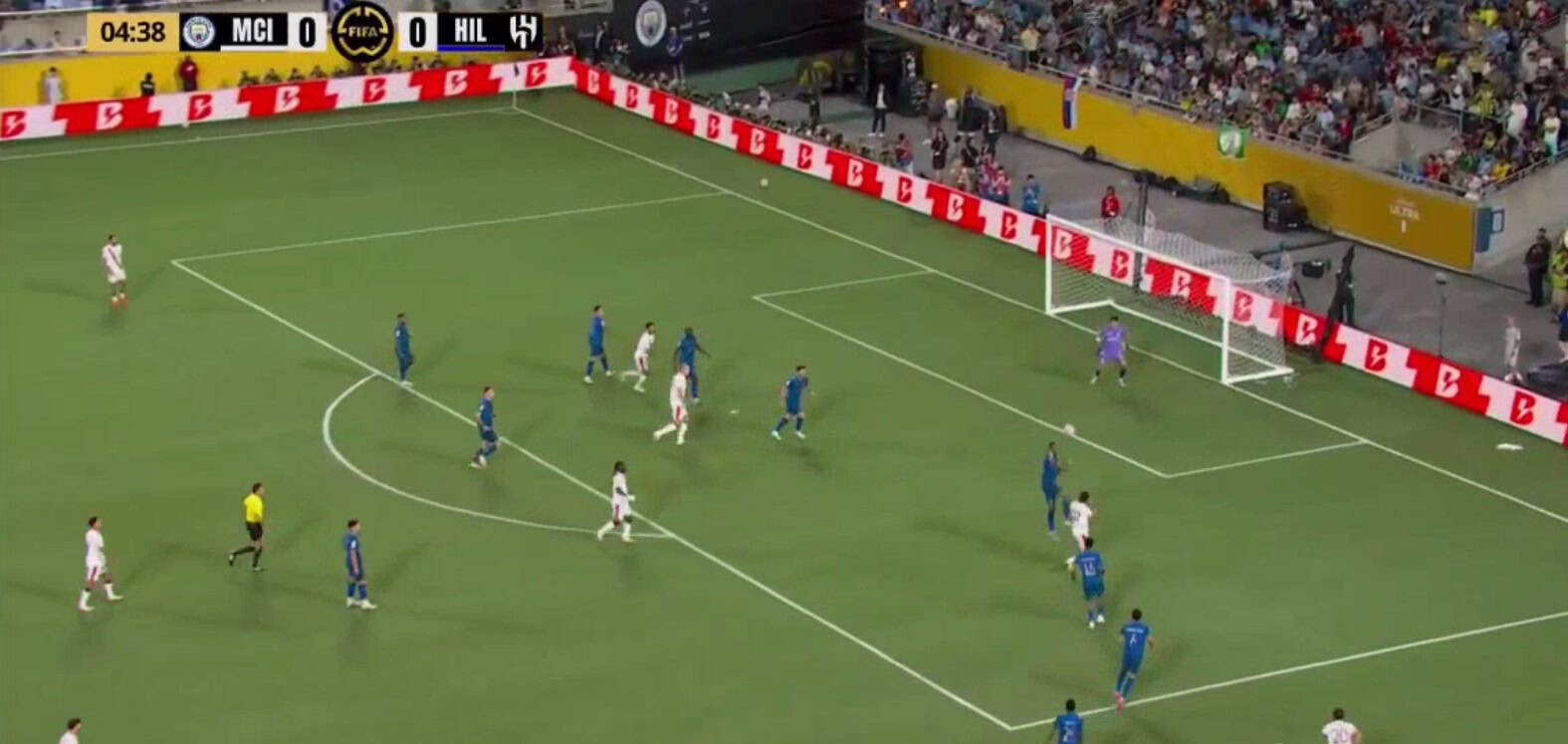 Kanno is already in position and ready to intercept the pass before it reaches Nunes.
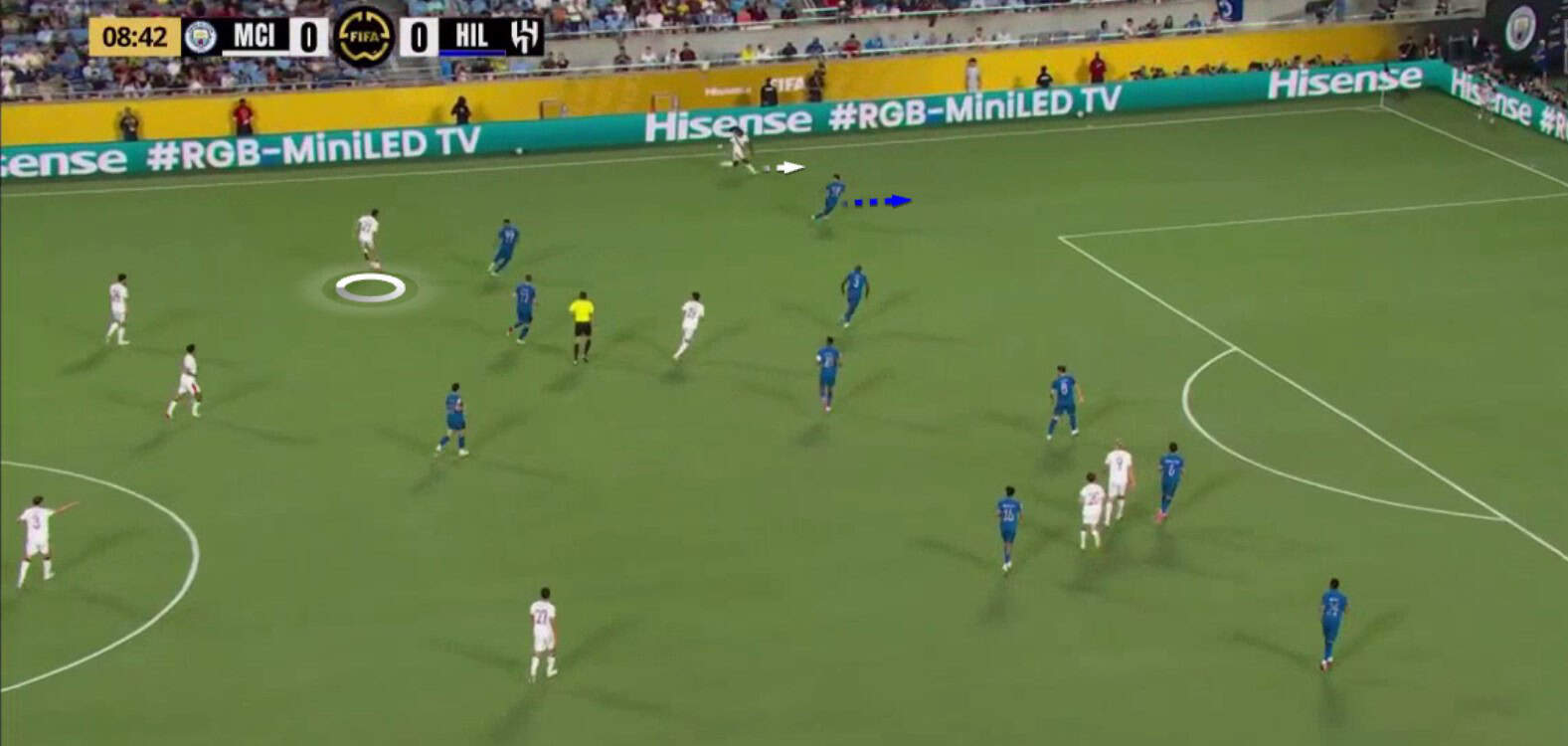 Man City look for another solution.
Nouri holds the ball to drag Malcom, making it harder for him to support Cancelo when the ball goes to Doku.
Doku uses a body feint to gain a fraction of a second to receive.
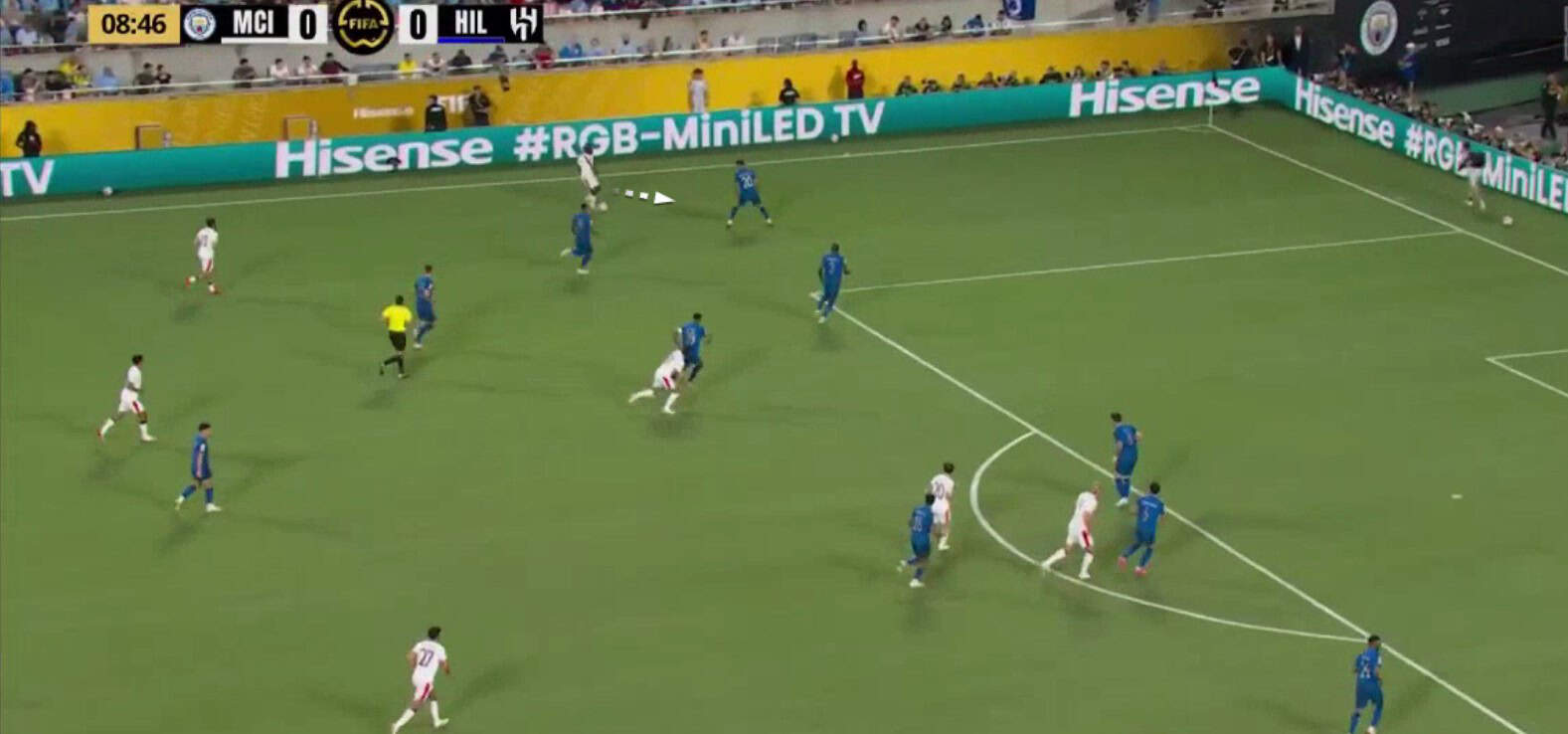 Doku carries the ball forward as Malcom approaches to press him.
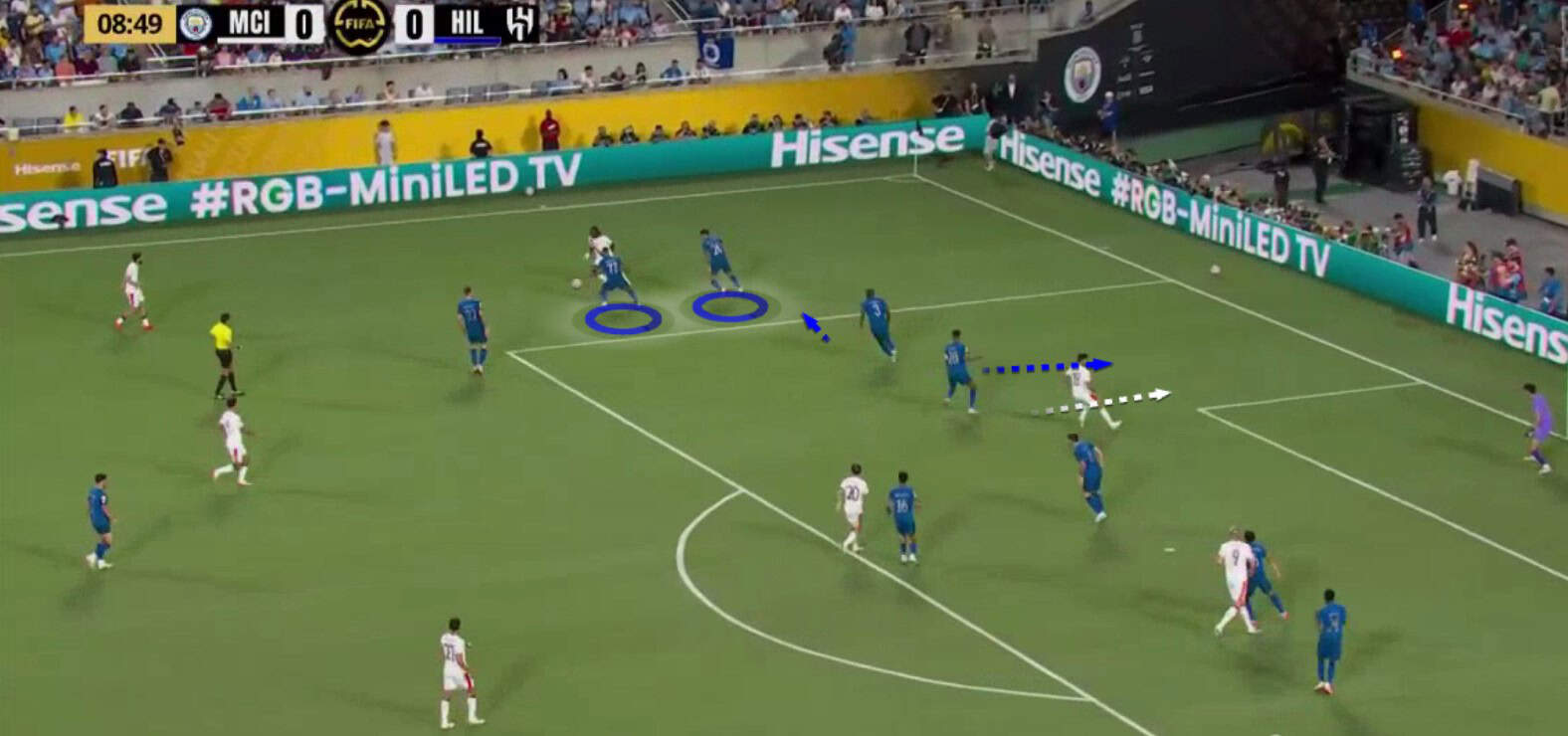 If Doku finds an opportunity to dribble past the defenders, it works in Man City’s favour.
Even if not, the team values this forward run as it helps advance play and restart attacks from a higher position.
Al-Hilal maintains the same roles, while Doku waits to ensure Malcom is pulled away from Aït-Nouri before receiving the pass.
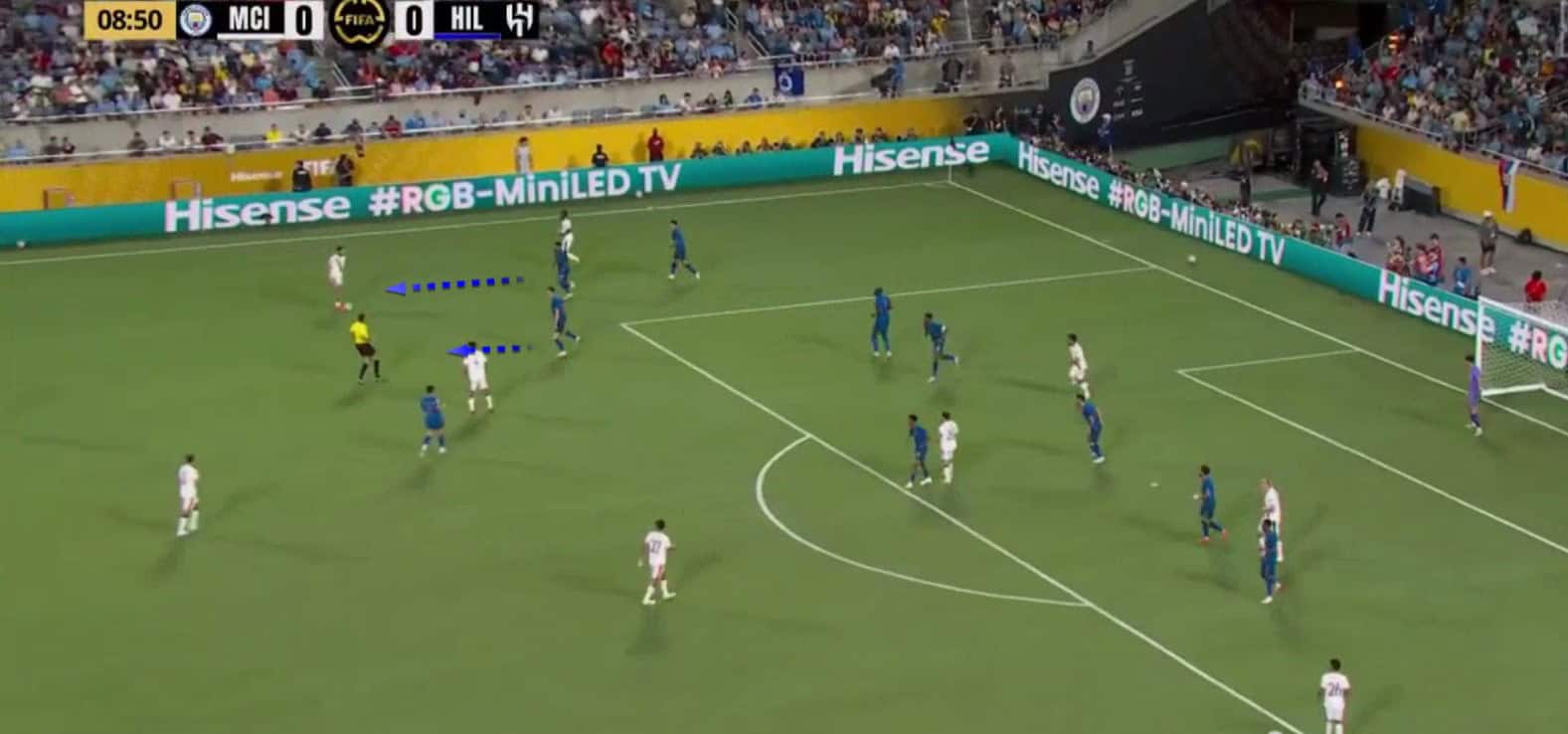 With Aït-Nouri receiving towards the centre of the field, with his right foot, it appears he may pass to Gvardiol or Rejinders.
Milinković-Savić advances to be ready to press Gvardiol or intercept a pass to Rejinders.
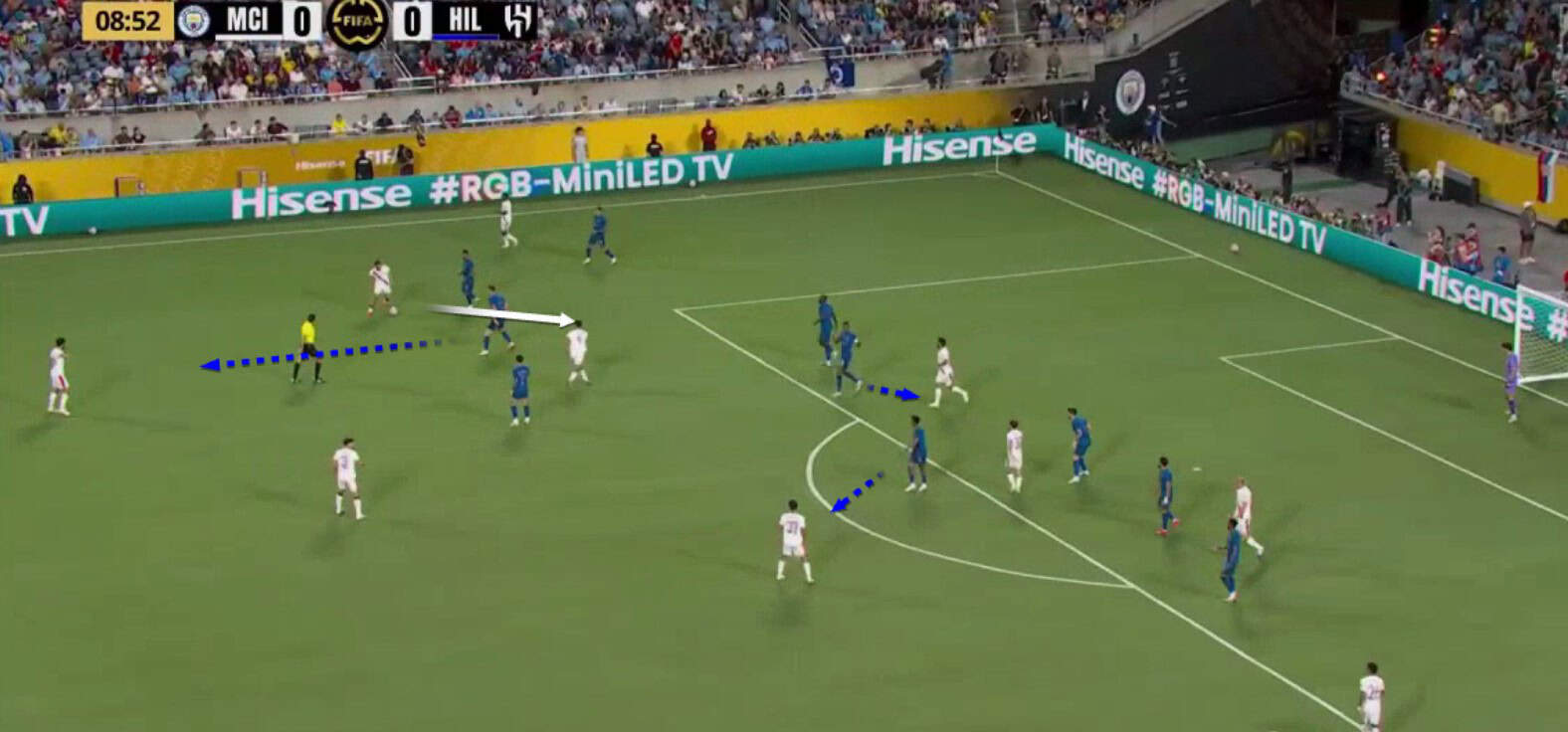 All of that opens an angle for Aït-Nouri to pass to Rejinders, who moves out of Milinković-Savić’s shadow.
Koulibaly is already drawn away, and Kanno is occupied covering Gündoğan.
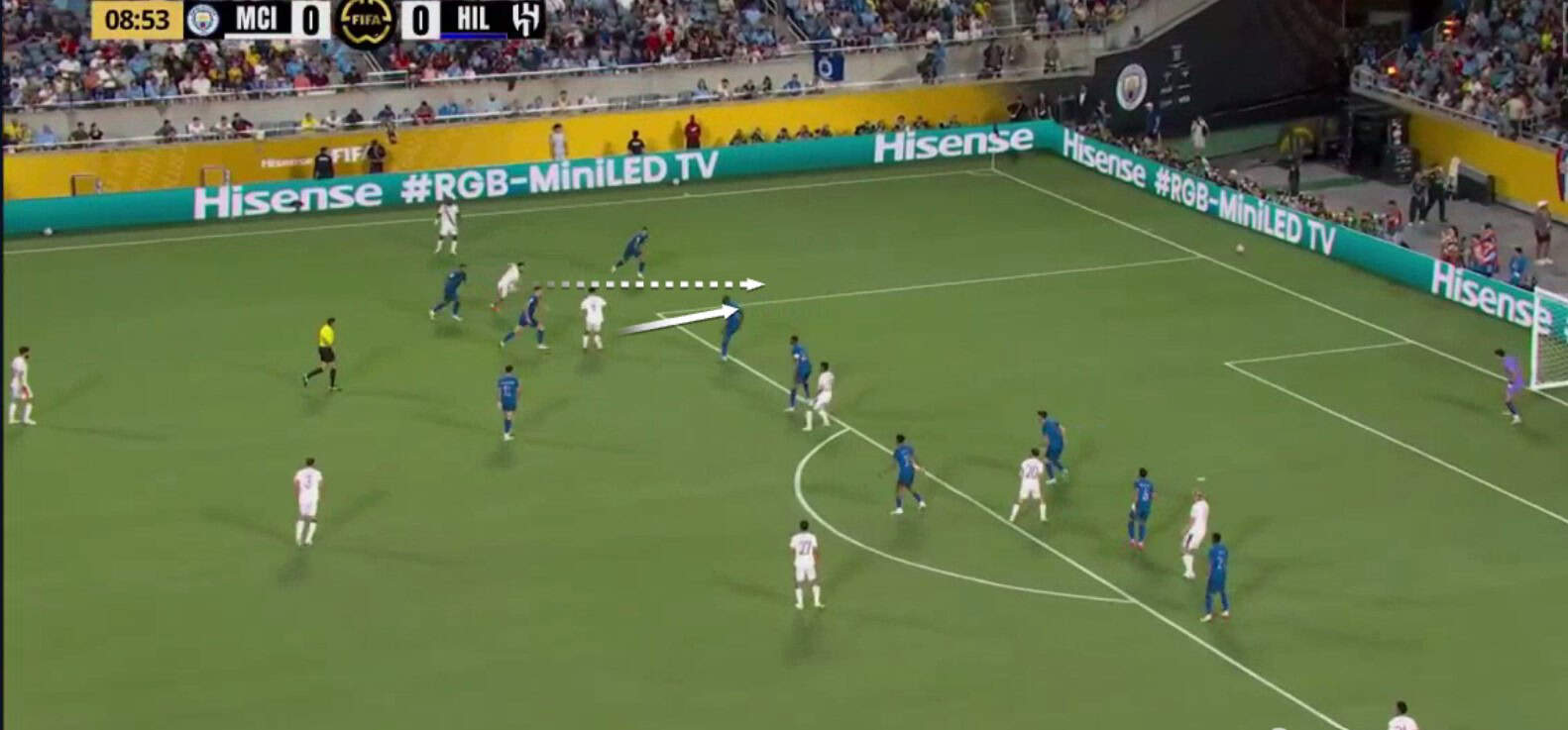 Rejinders is free to receive Aït-Nouri’s pass and can play it into the space that Cancelo has created by moving to follow Doku.
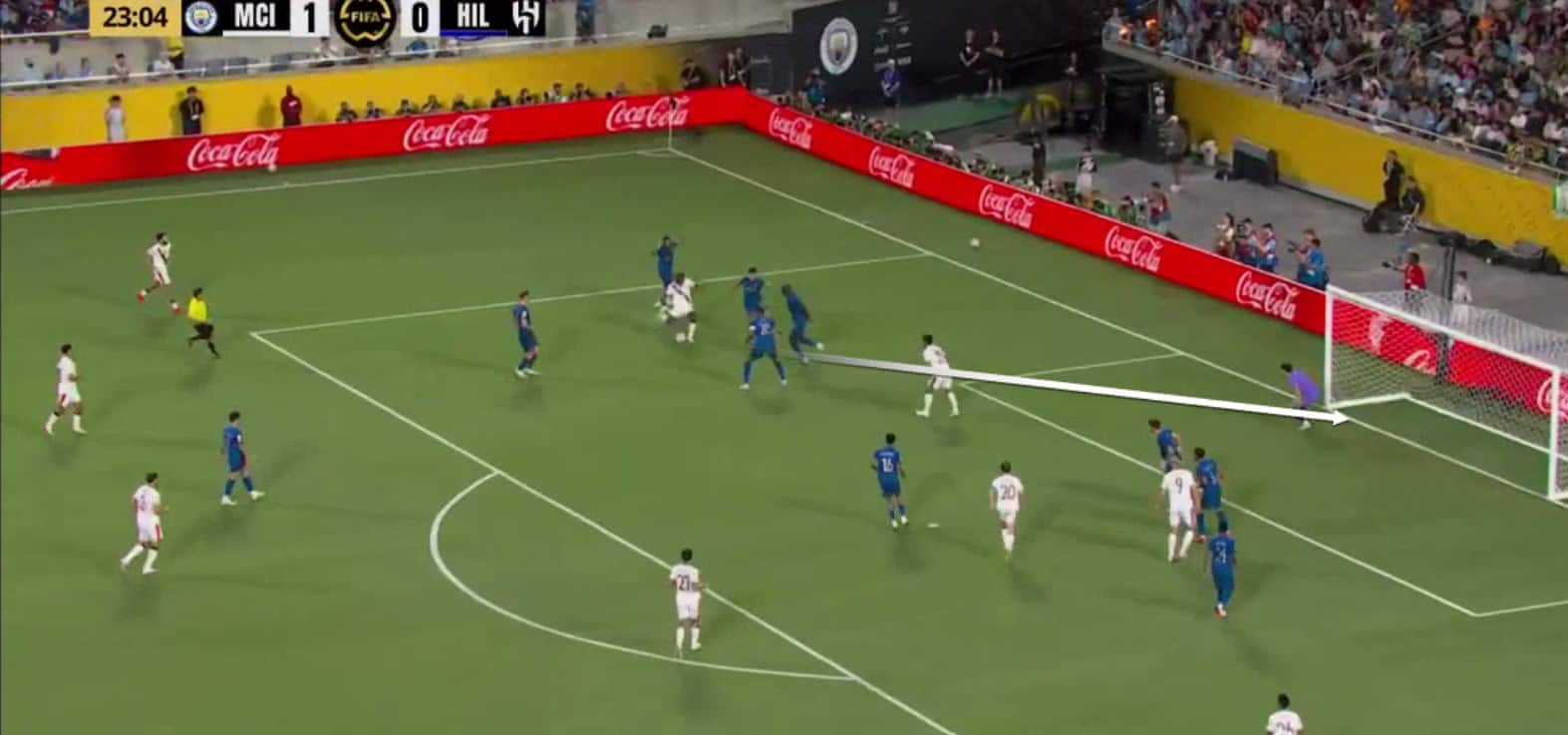
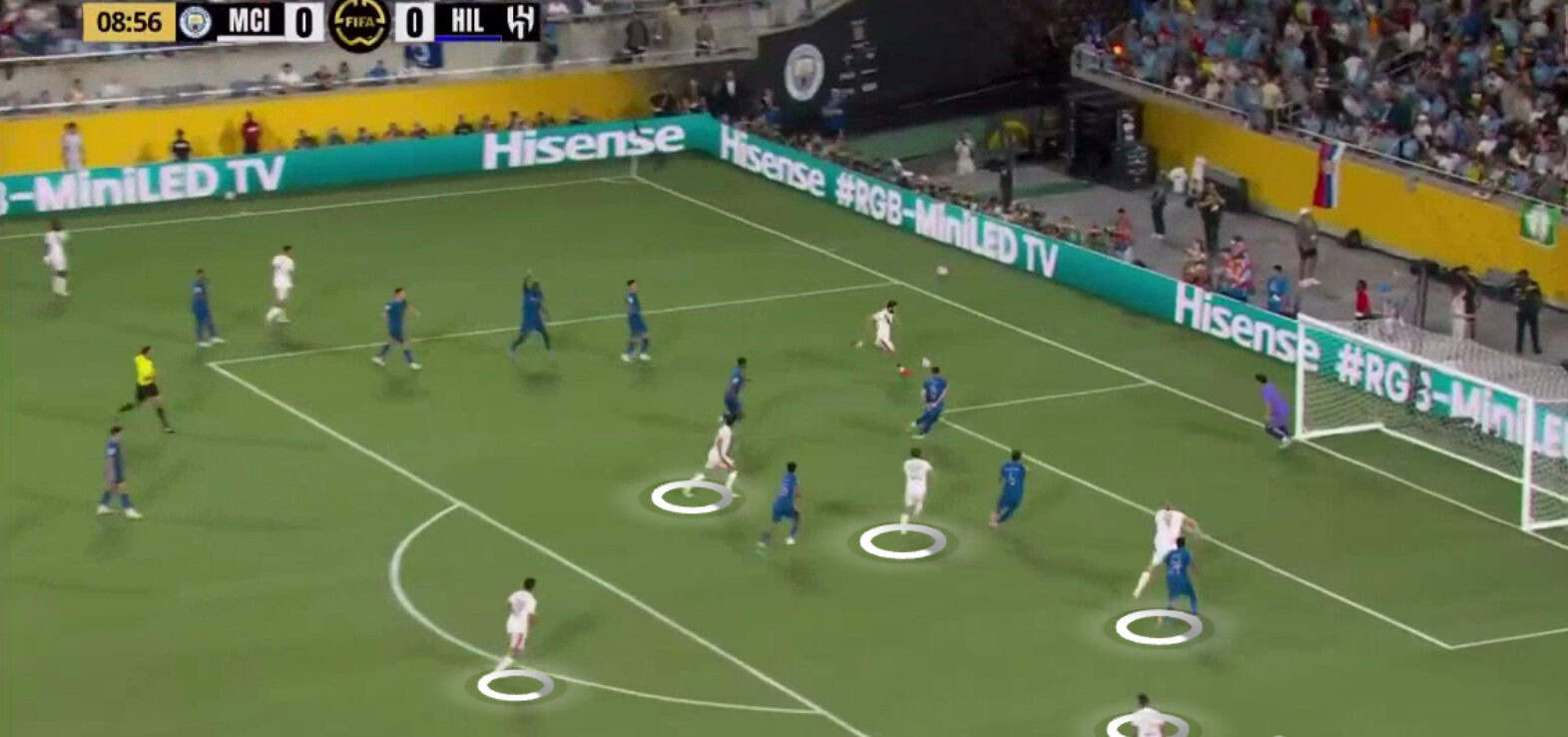 Nouri executes the pass accurately this time, sending it around the six-yard box and penalty spot, where Man City has a strong presence.
From this situation, Pep Guardiola’s team scored their first goal.
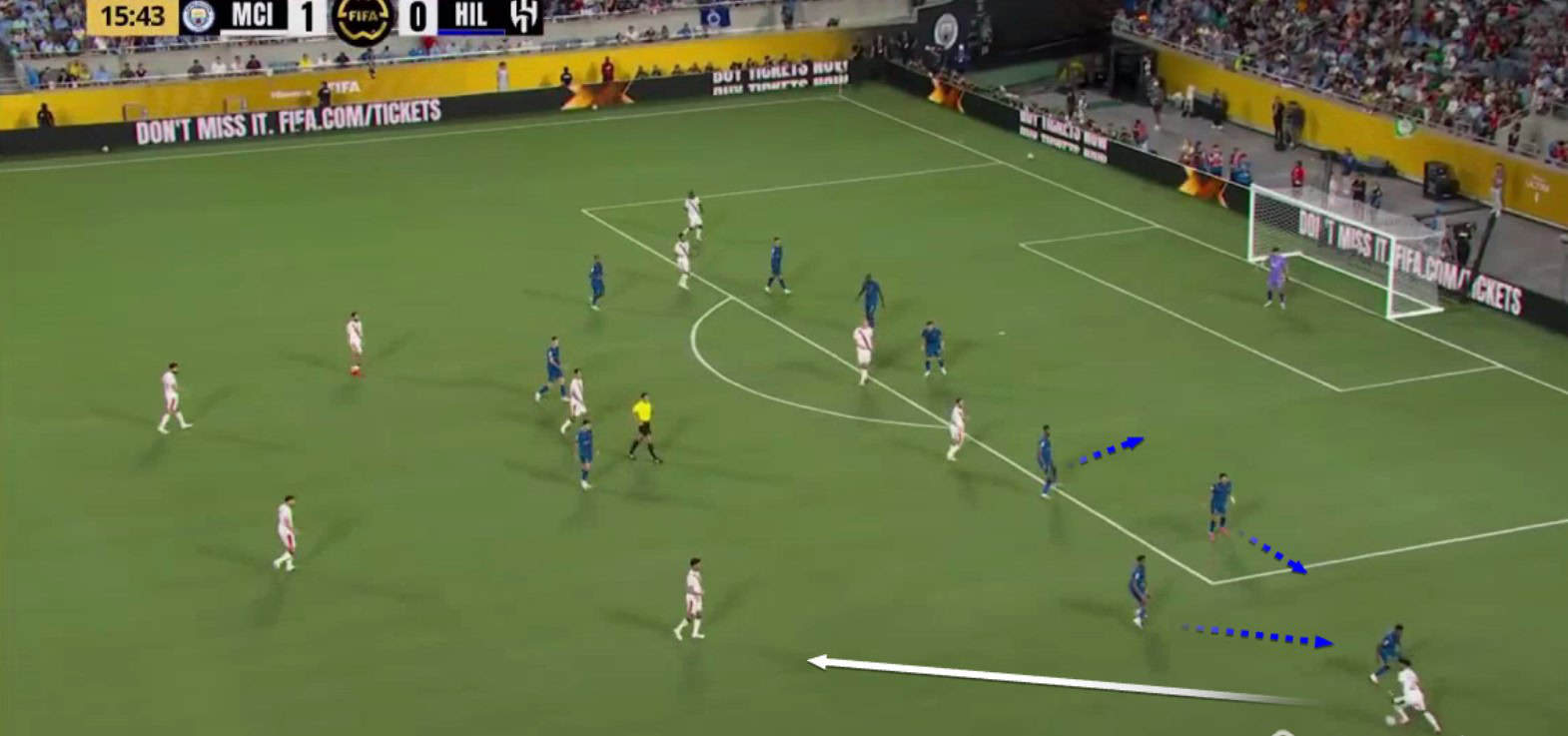 Man City now aim to manipulate Al-Hilal’s wing-play with a new approach.
Nunes receives Savinho’s pass and positions as if he will play with his left foot, hinting at a switch to the opposite side.
Al-Hilal defenders respond by preparing to shift, shown by the movements of Kinno, Lodi, and Al-Harbi.
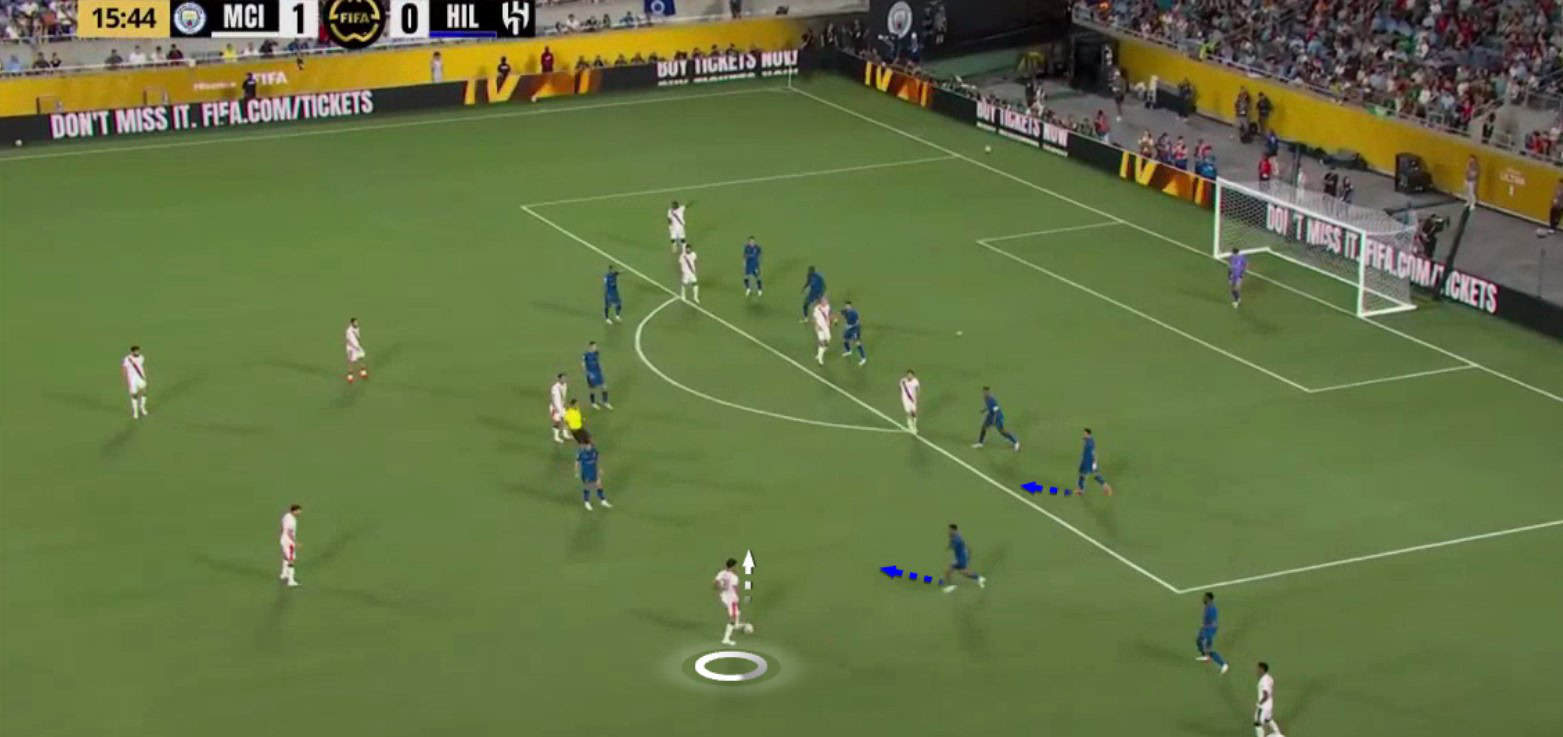 Nunes quickly changes direction and delivers the ball into the space opened by Al-Hilal’s shifting, particularly taking advantage of Lodi’s movement.
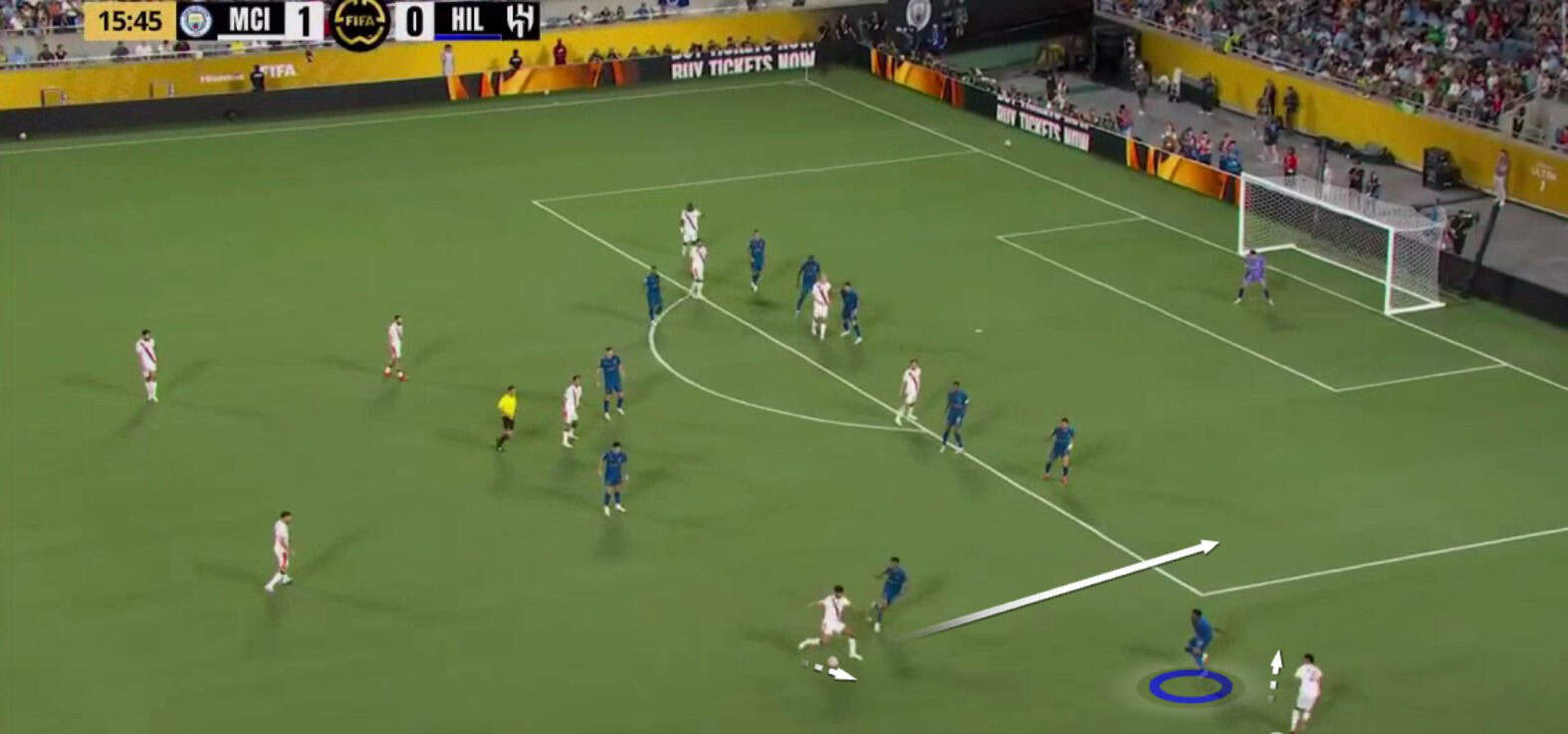 This pass targets Savinho, who runs in behind and exploits the poor body positioning of Al-Hilal’s left-back, Al-Harbi.
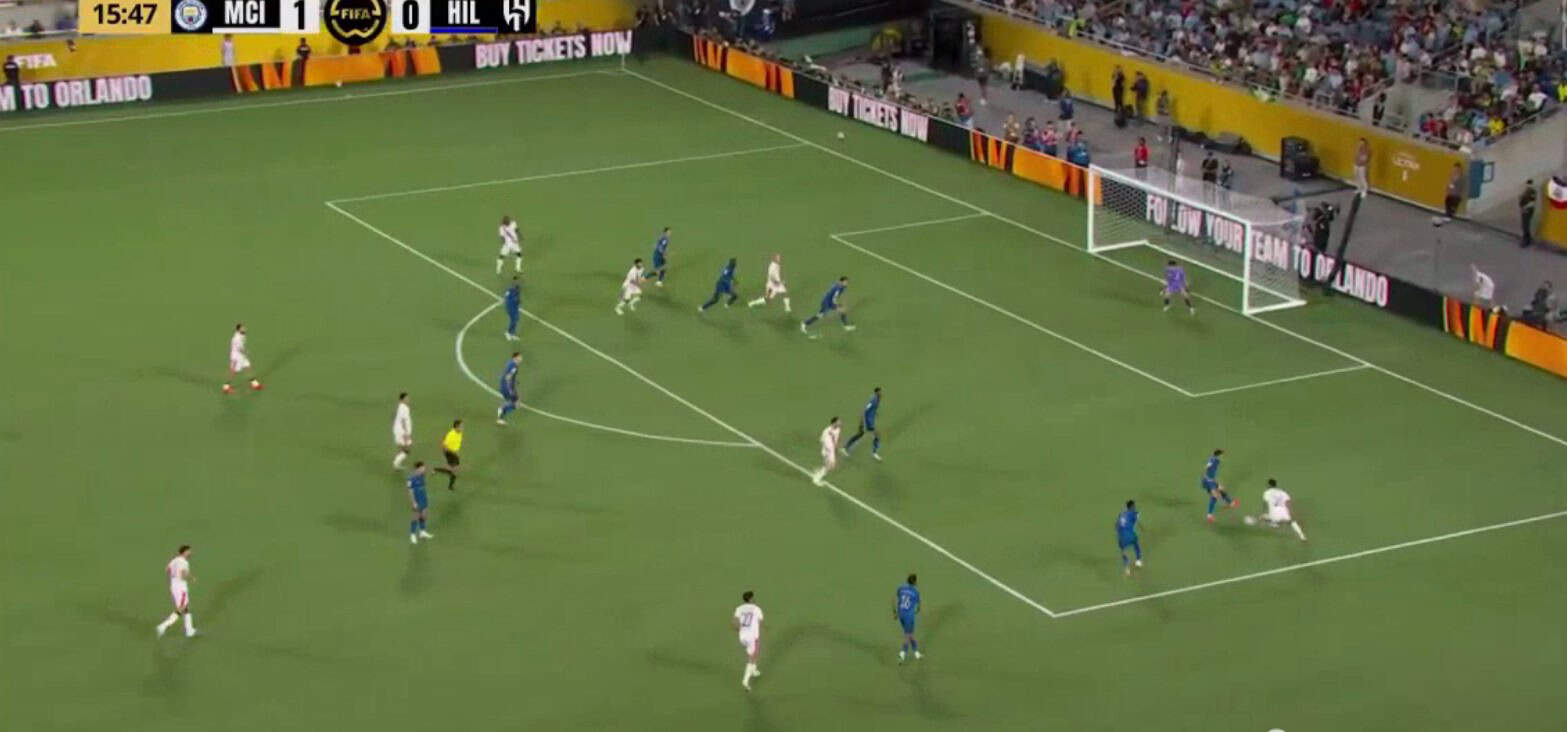 However, Savinho is unable to bypass Lodi, who effectively blocks his path.
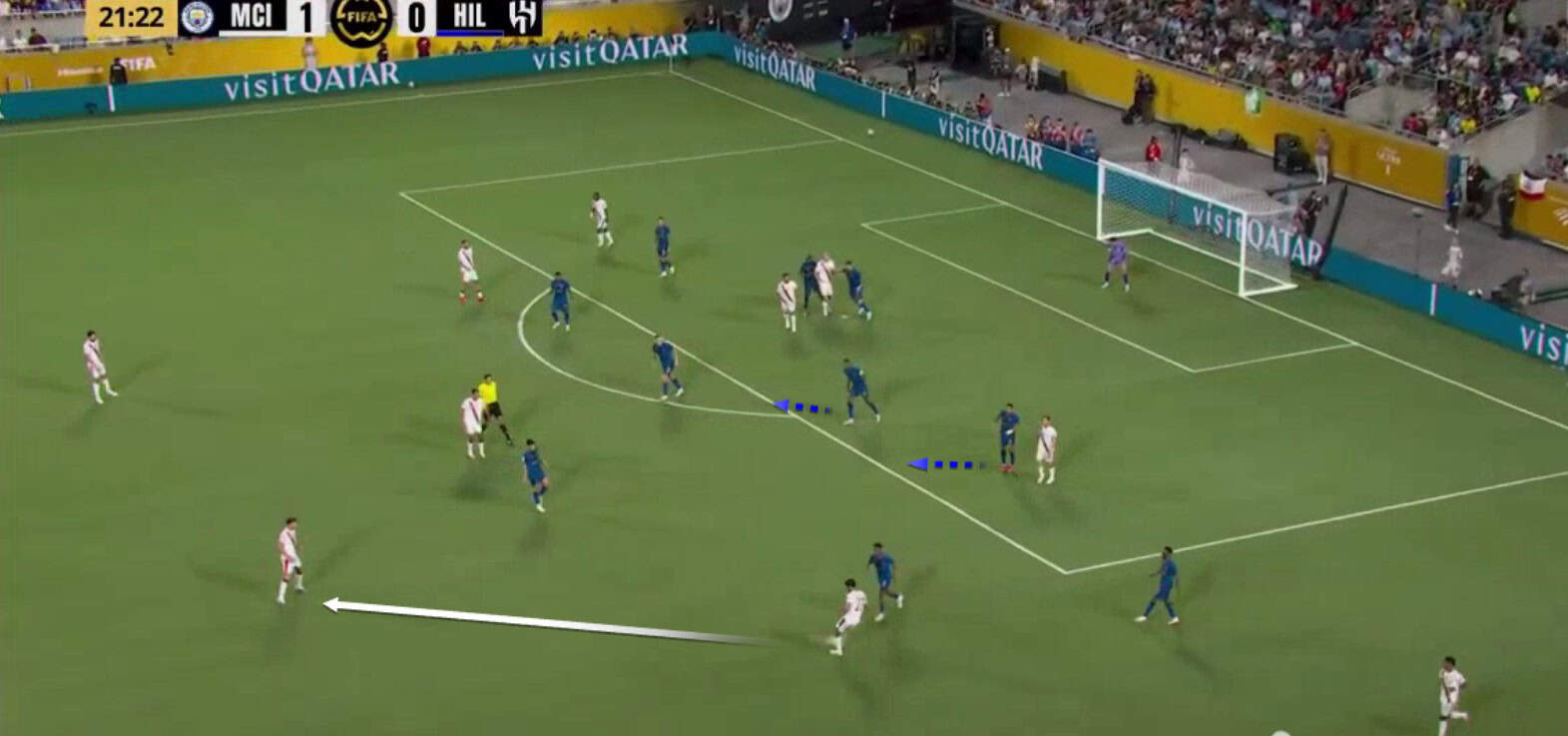 In this action, Nunes passes to Dias, prompting Al-Hilal defenders to start shifting in response.
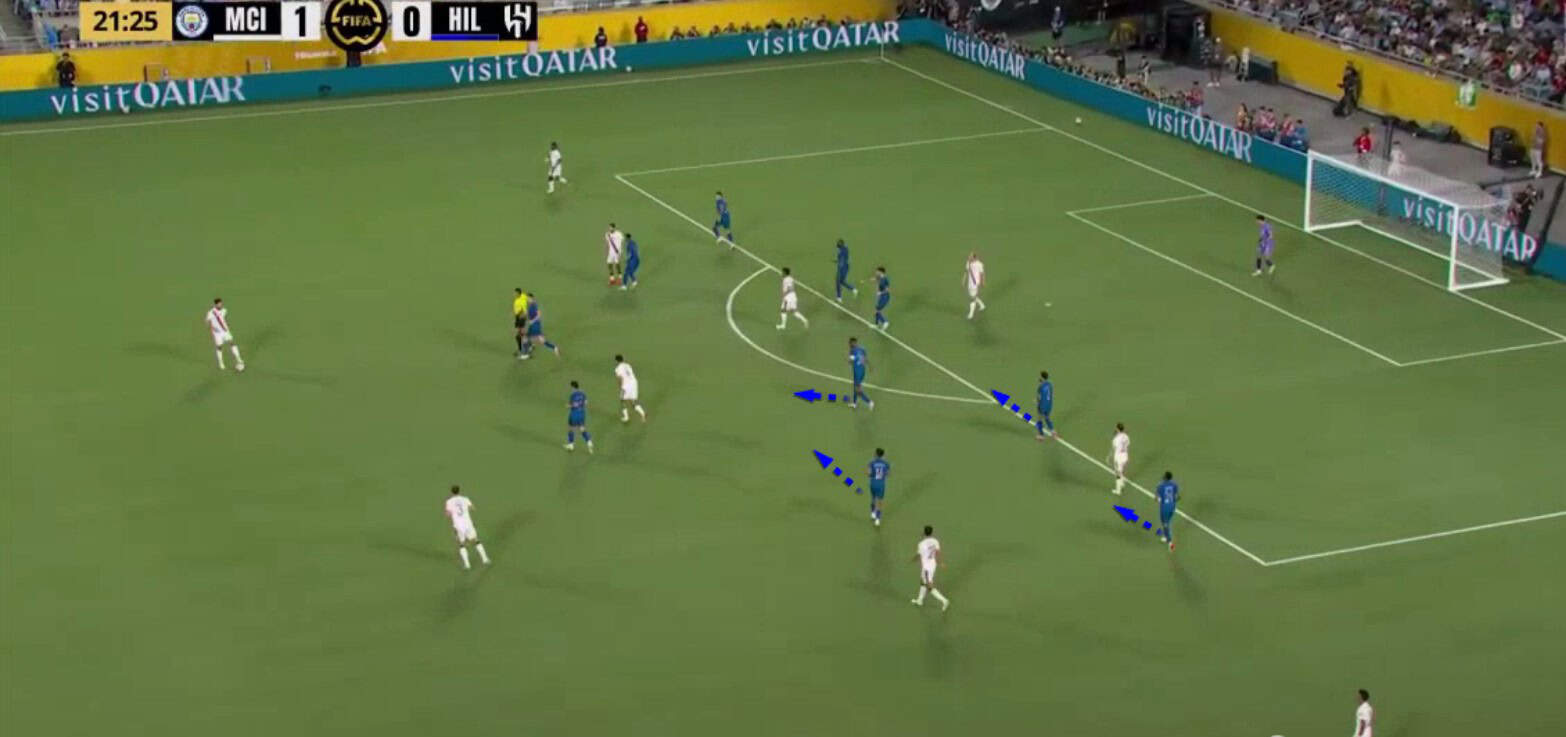 Dias passes to Gvardiol, causing the entire Al-Hilal defensive block to shift in response.
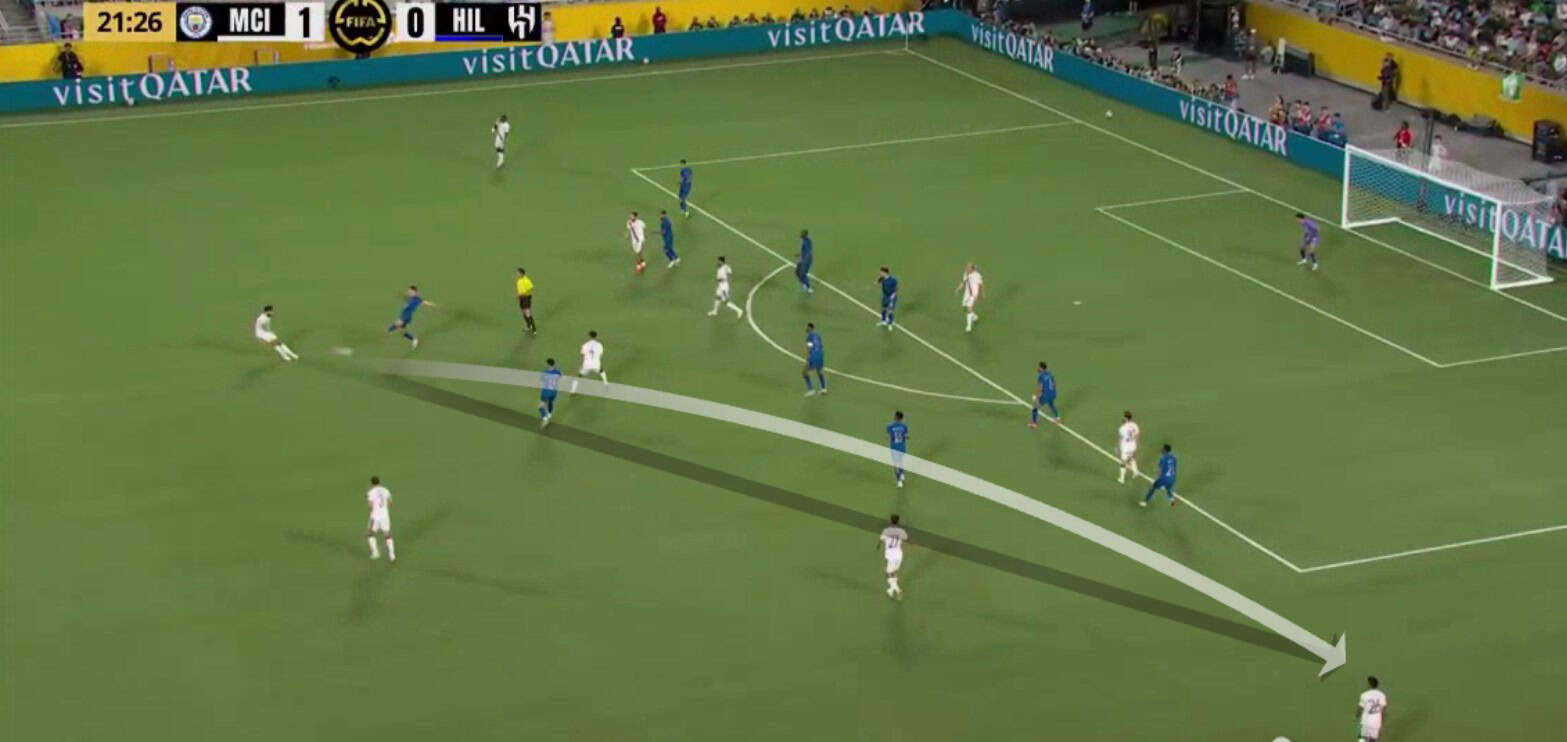 Gvardiol plays a diagonal long ball to Savinho, who receives it with time and space.
He exploits the shift in Al-Hilal’s defensive block to create a potential attacking opportunity.
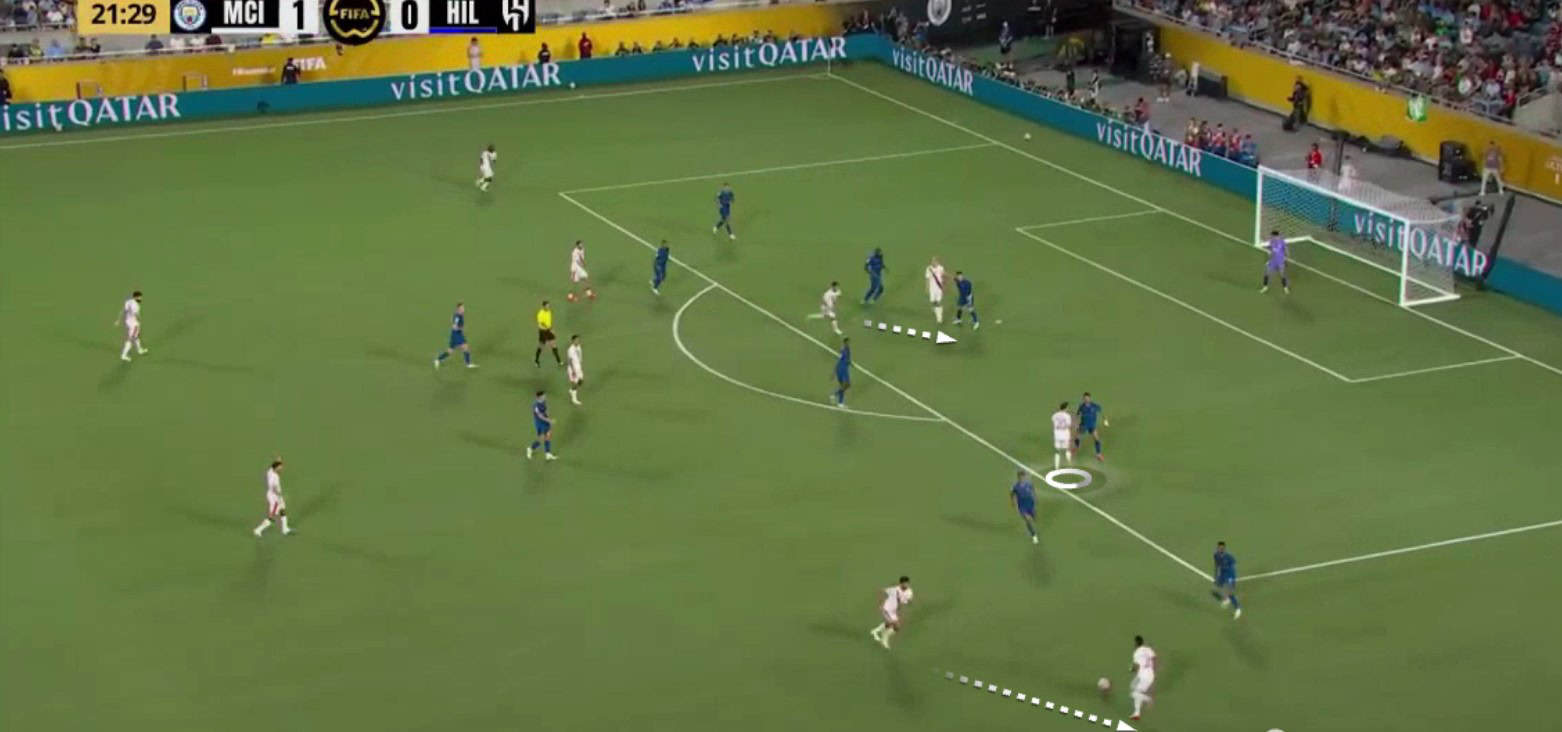 Savinho tucks inside while Silva drags Lodi with him.
Gündoğan initiates a run from the far side, and Nunes makes an overlapping run to create passing options and stretch Al-Hilal’s defensive shape.
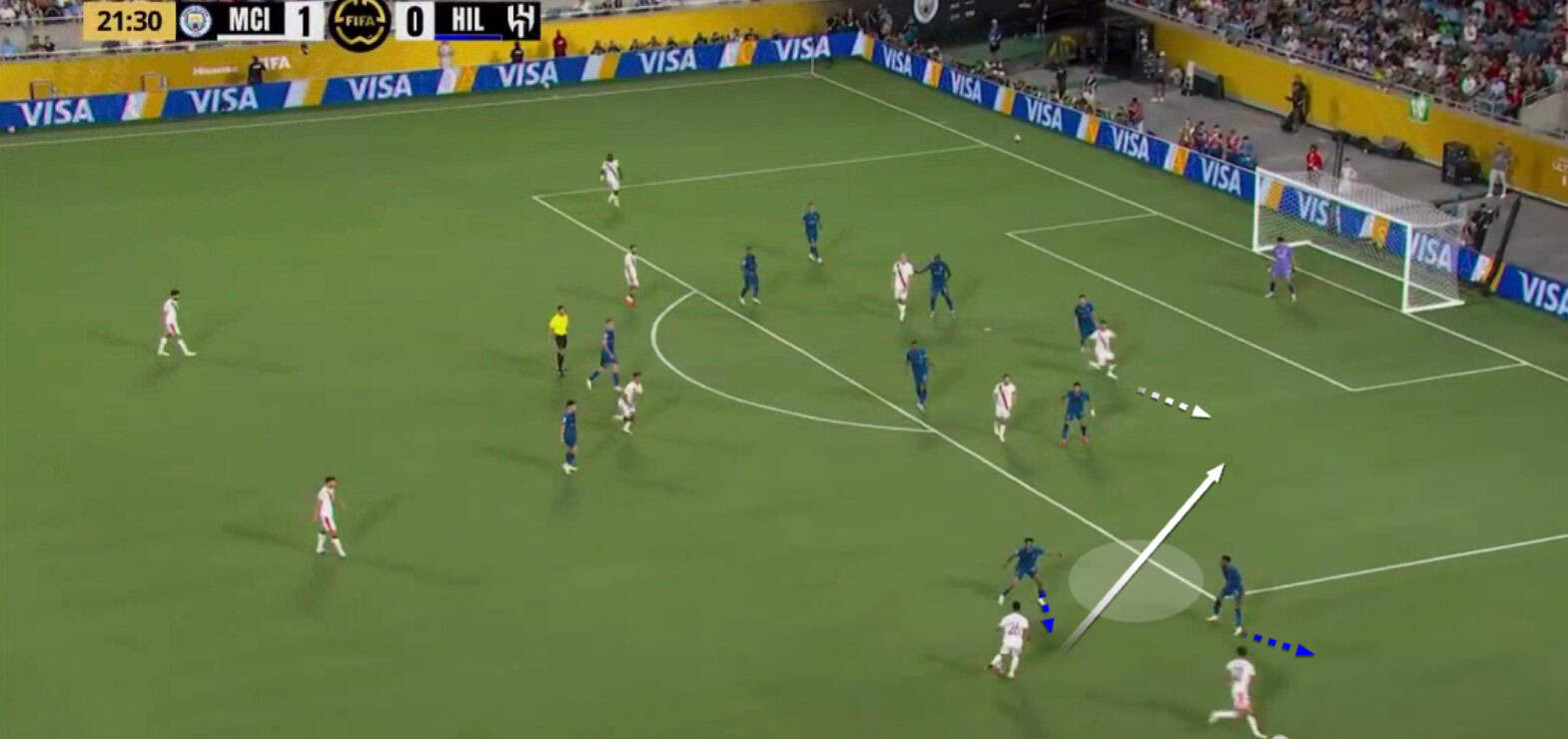 Nunes’ run forces Al-Hilal defenders to adjust their positions, switching roles with him and Savinho.
This movement creates a pocket of space for Savinho to play a pass between the defenders to Gündoğan.
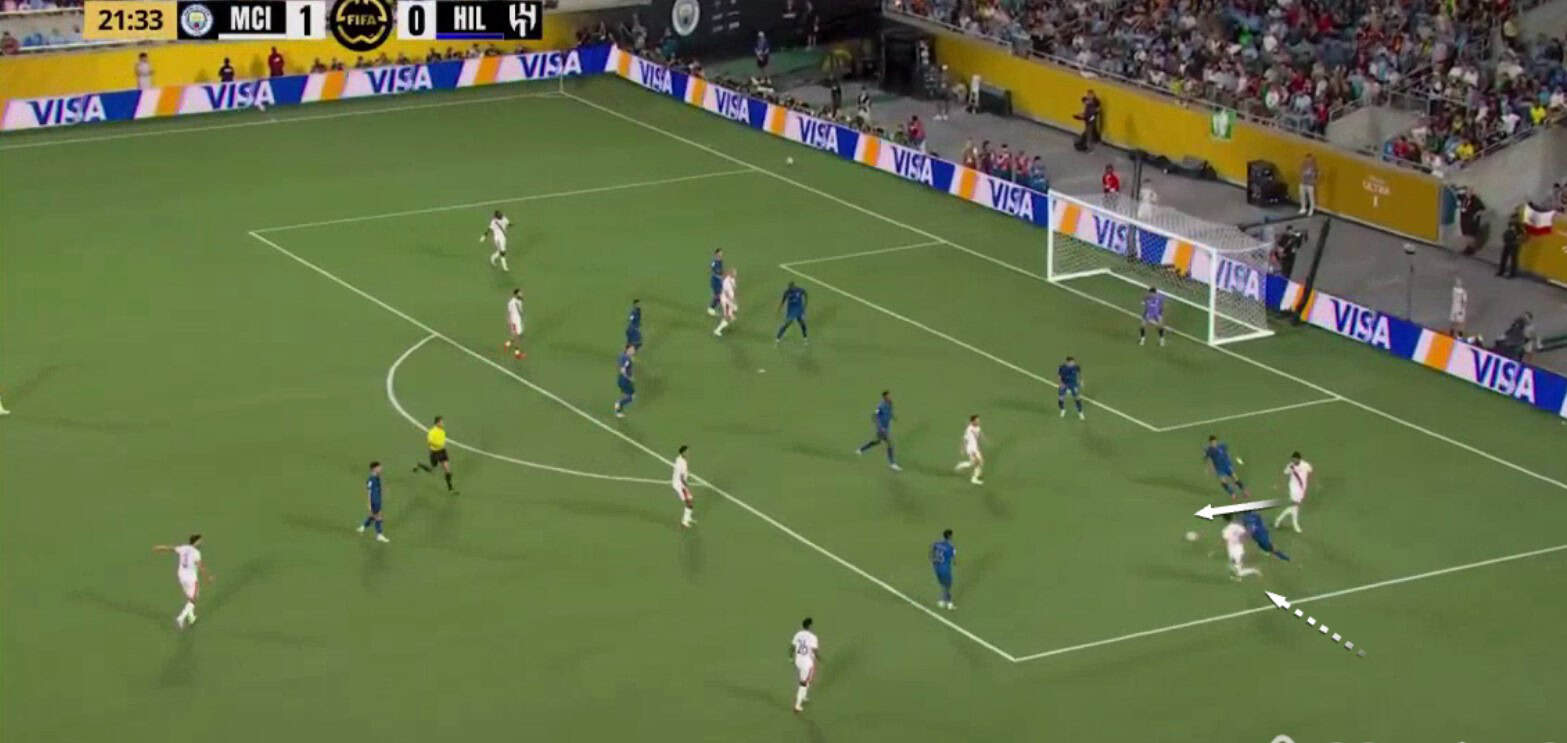 Gündoğan finds himself in a tight spot, with his back to the goal and surrounded by multiple defenders.
To support him, Nunes continues his run, positioning himself for a layoff.
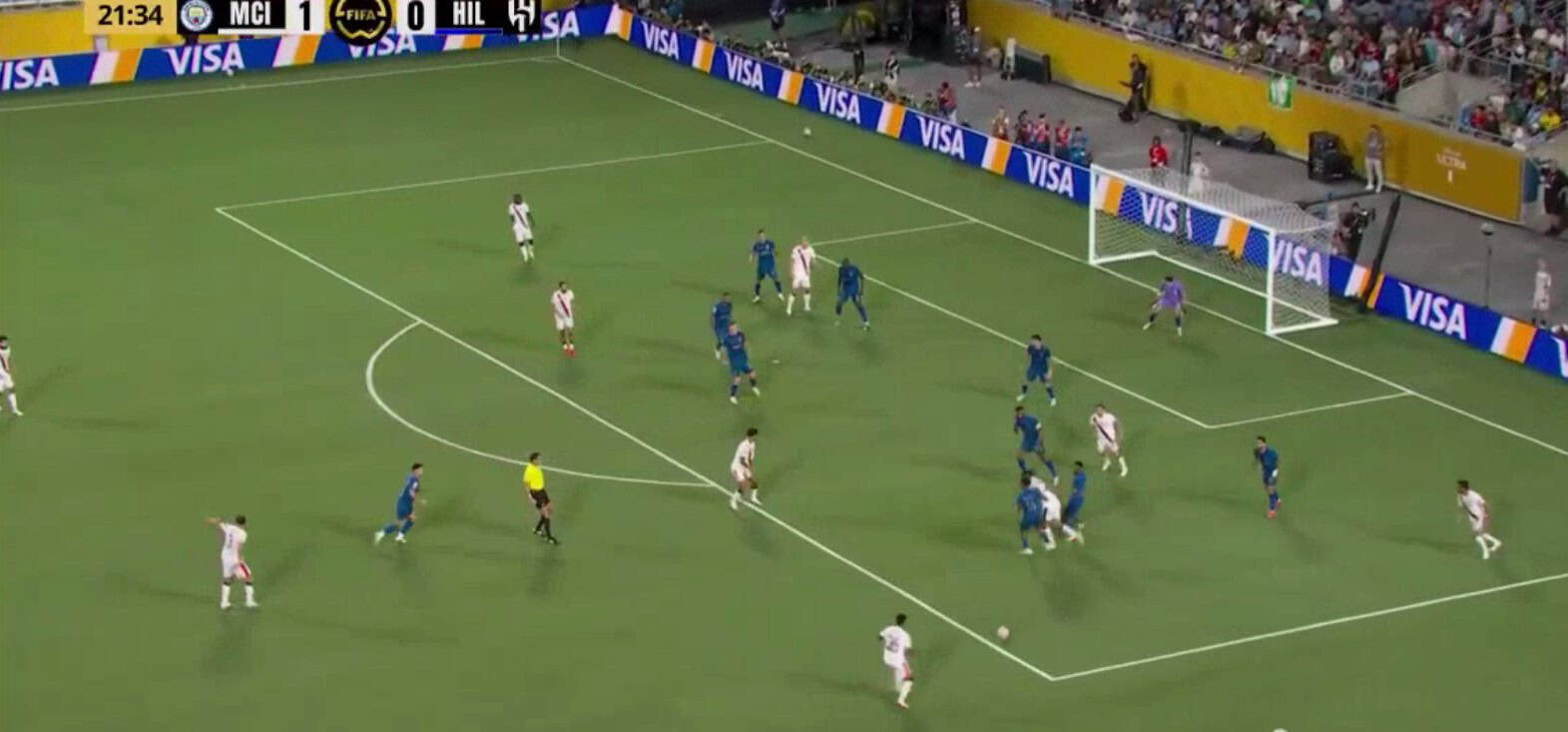 Nunes is unable to reach the layoff, and the ball instead goes to Savinho, who takes the shot and completes the action.
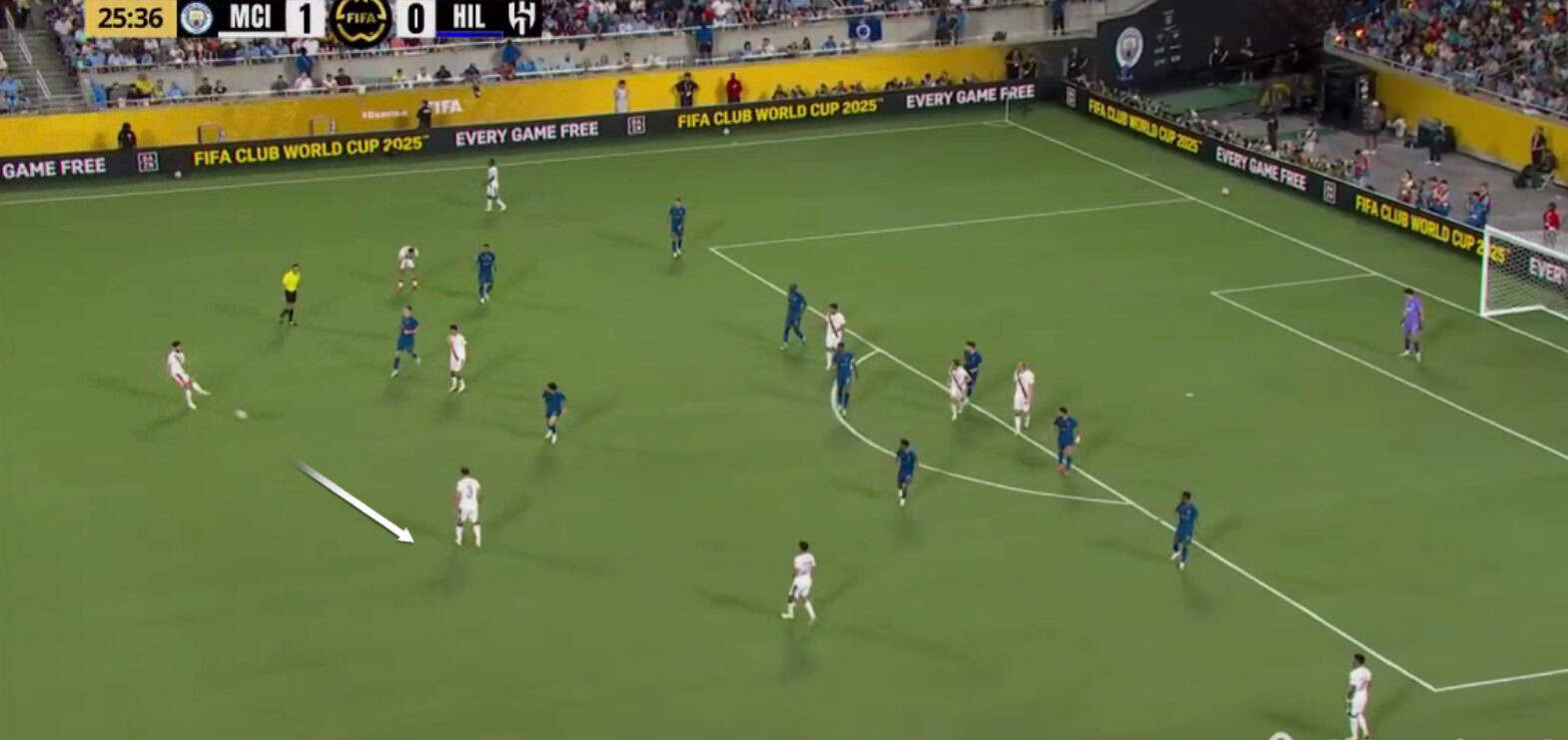 So far, Man City has found effective solutions to penetrate Al-Hilal’s block.
However, the sequence doesn’t always go in their favour.
Here, Gvardiol passes to Dias, with Rejinders positioned in front of them.
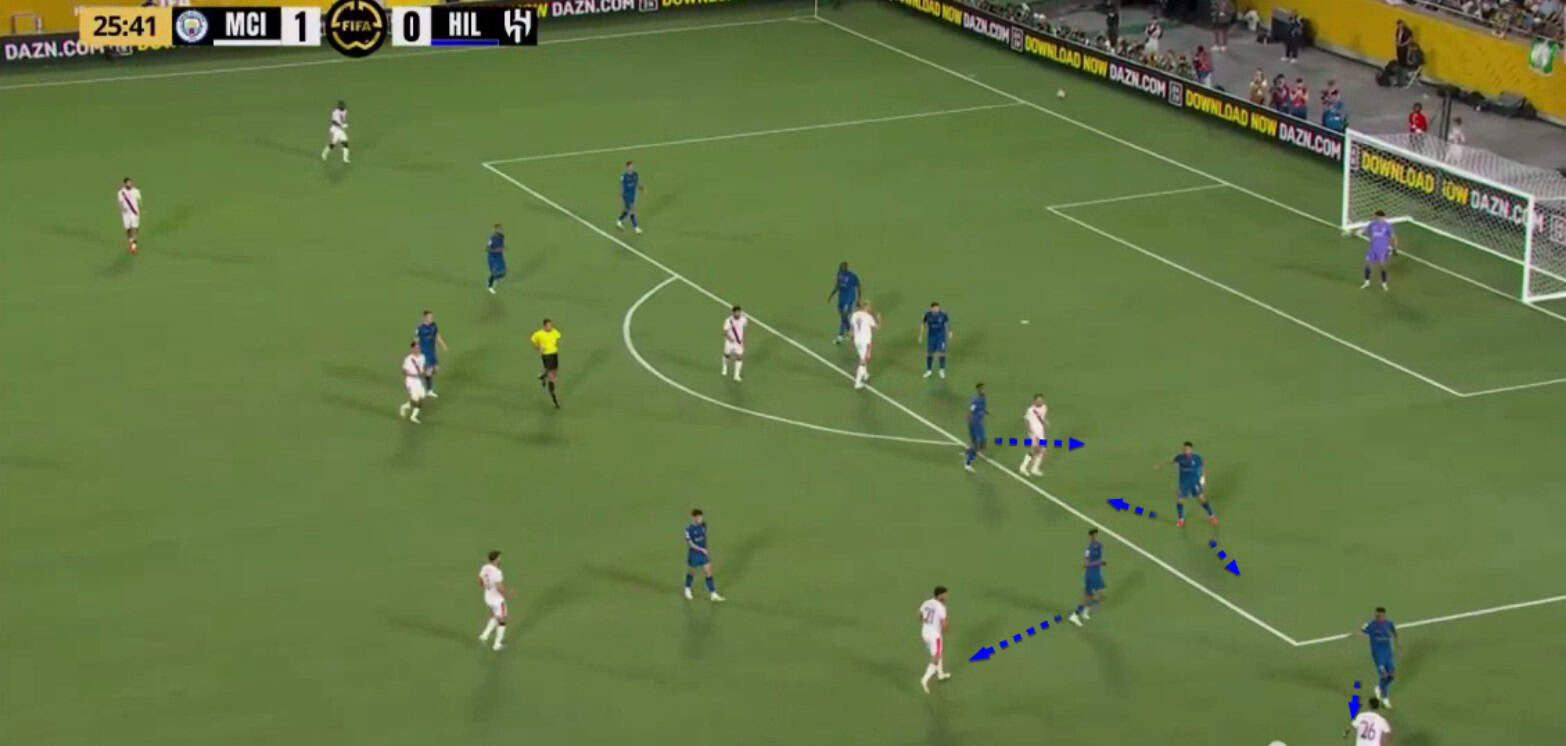 Now, Al-Hilal defenders maintain a solid structure and control the situation according to their plan.
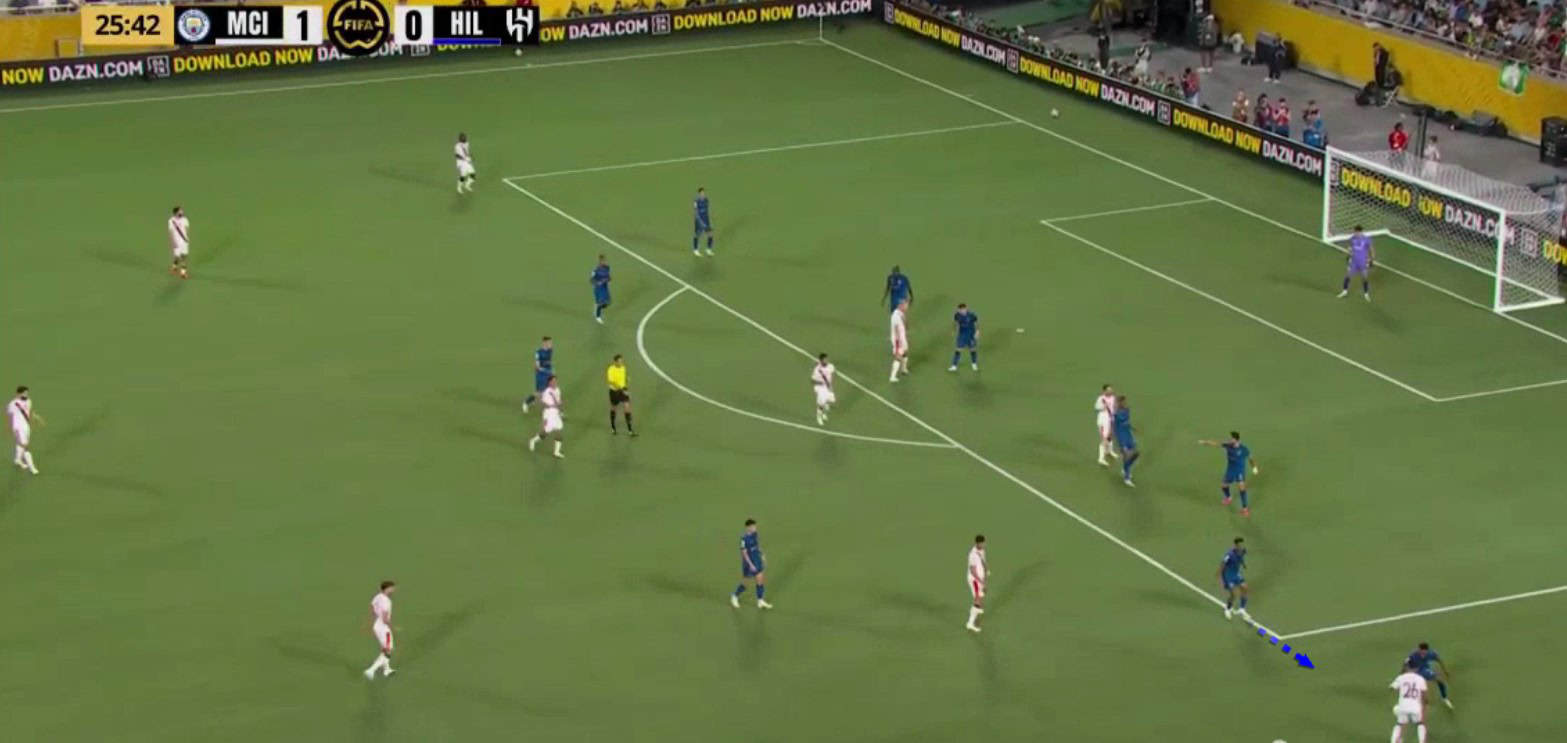 The winger moves closer to the wing-back to provide support against Savinho, which opens a passing lane for Nunes.
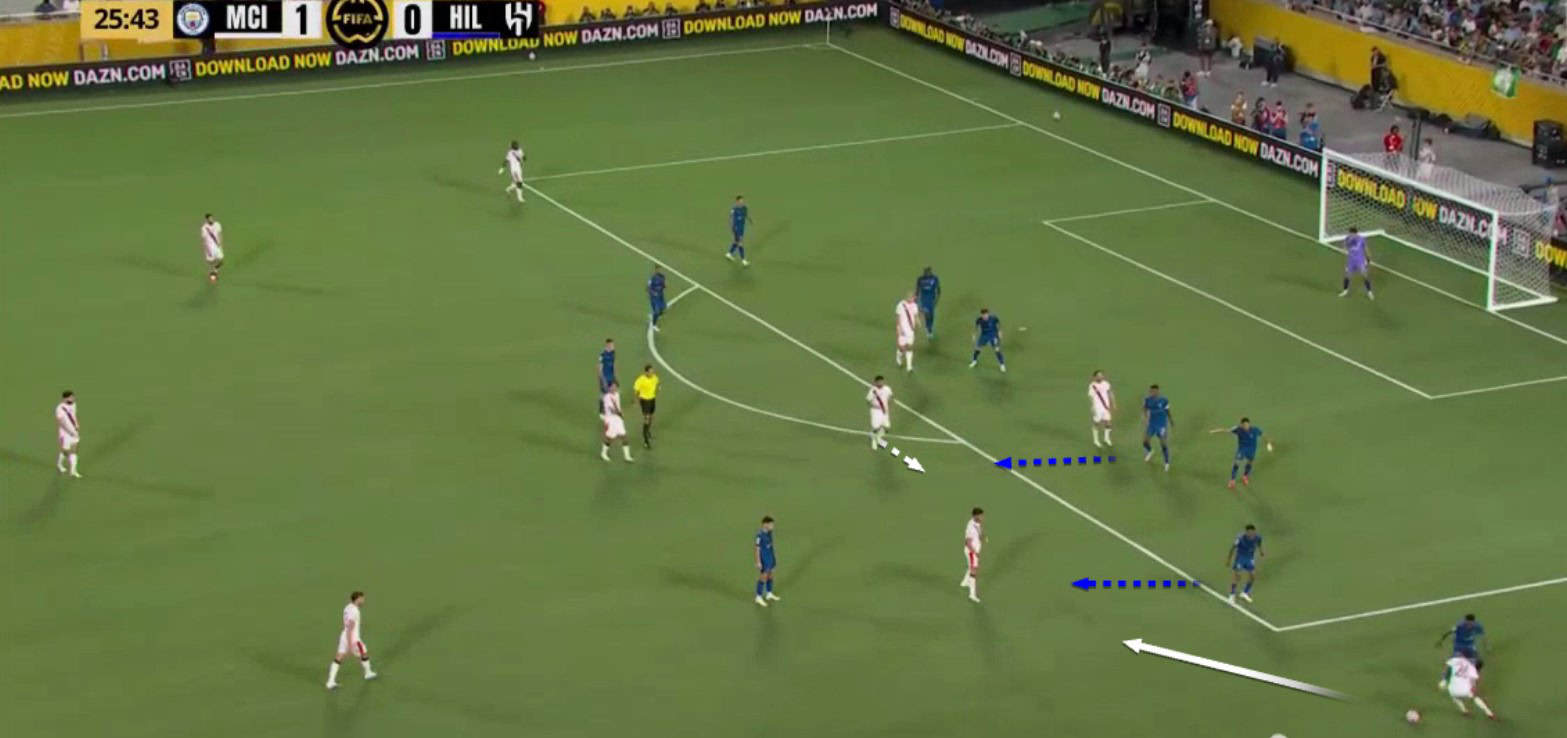 As Gündoğan moves closer to the ball side, he becomes a viable option for Nunes.
However, Lodi anticipates the situation and signals Kinno to cover Gündoğan, leaving Silva for him.
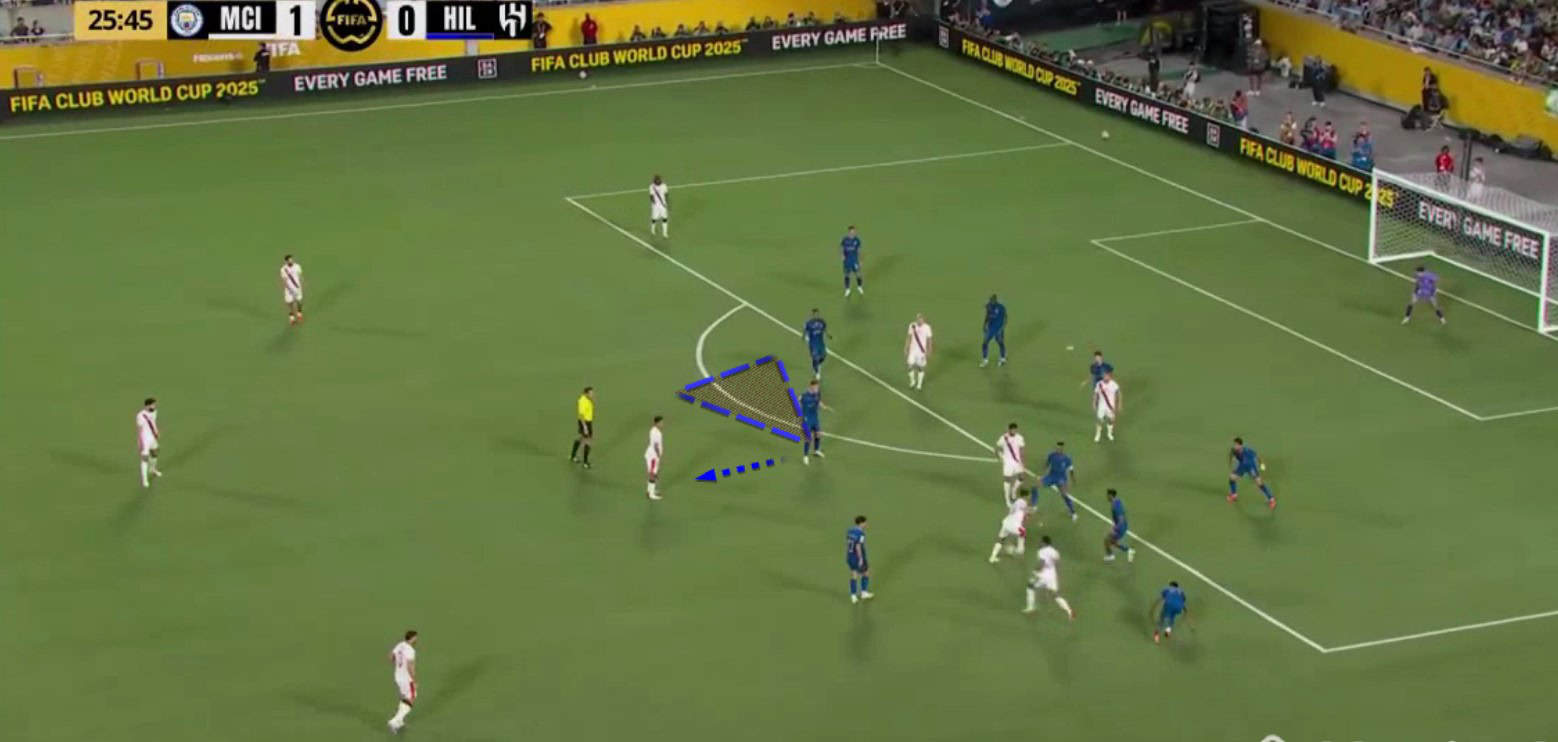 Al-Hilal also aims to block the horizontal pass, a key Man City tactic to create opportunities for a throw-pass to Doku on the opposite side, as seen against Juventus.
Milinković-Savić positions on the edge of the box to intercept and be ready to press Rejinders.
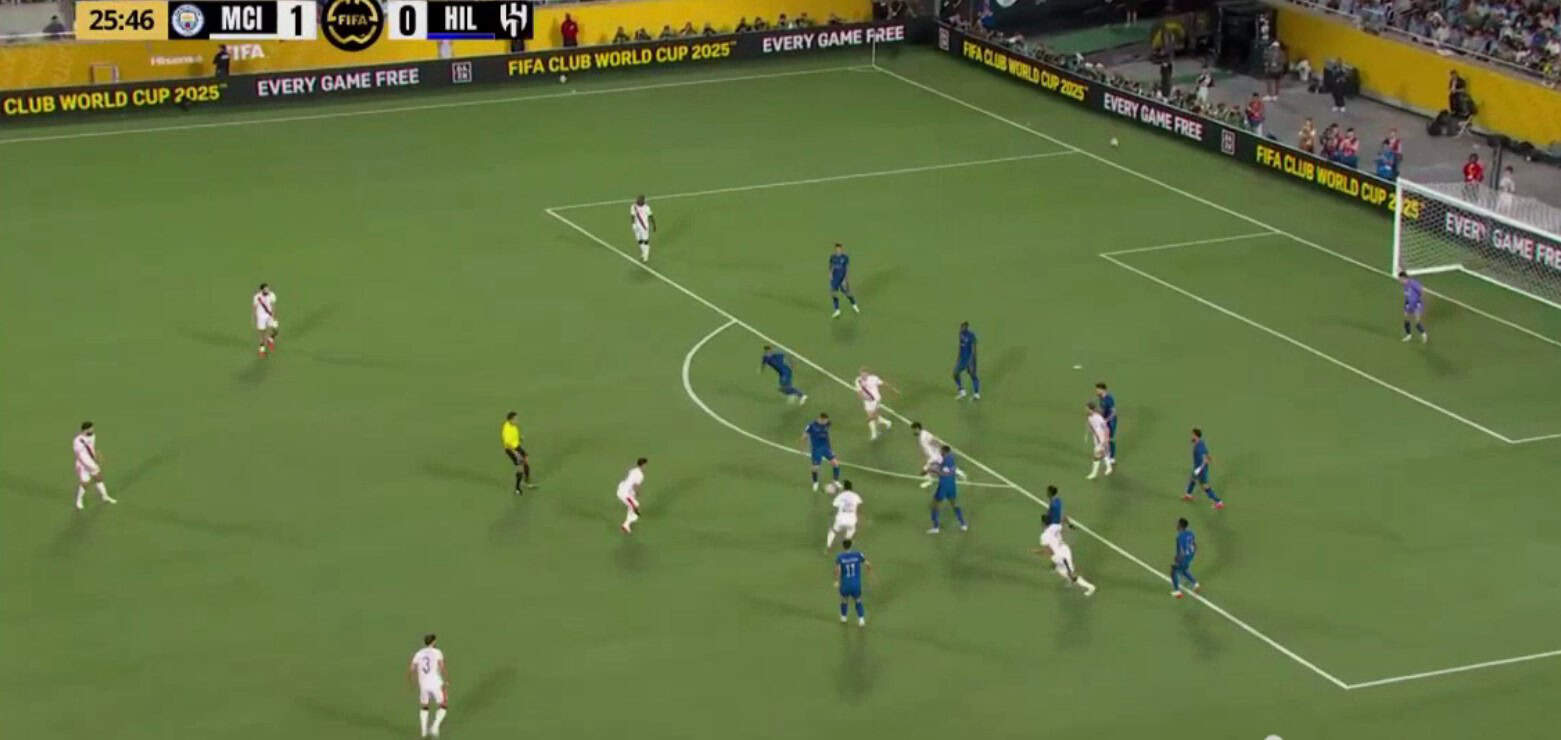 This phase concludes with the ball remaining with Milinković-Savić.
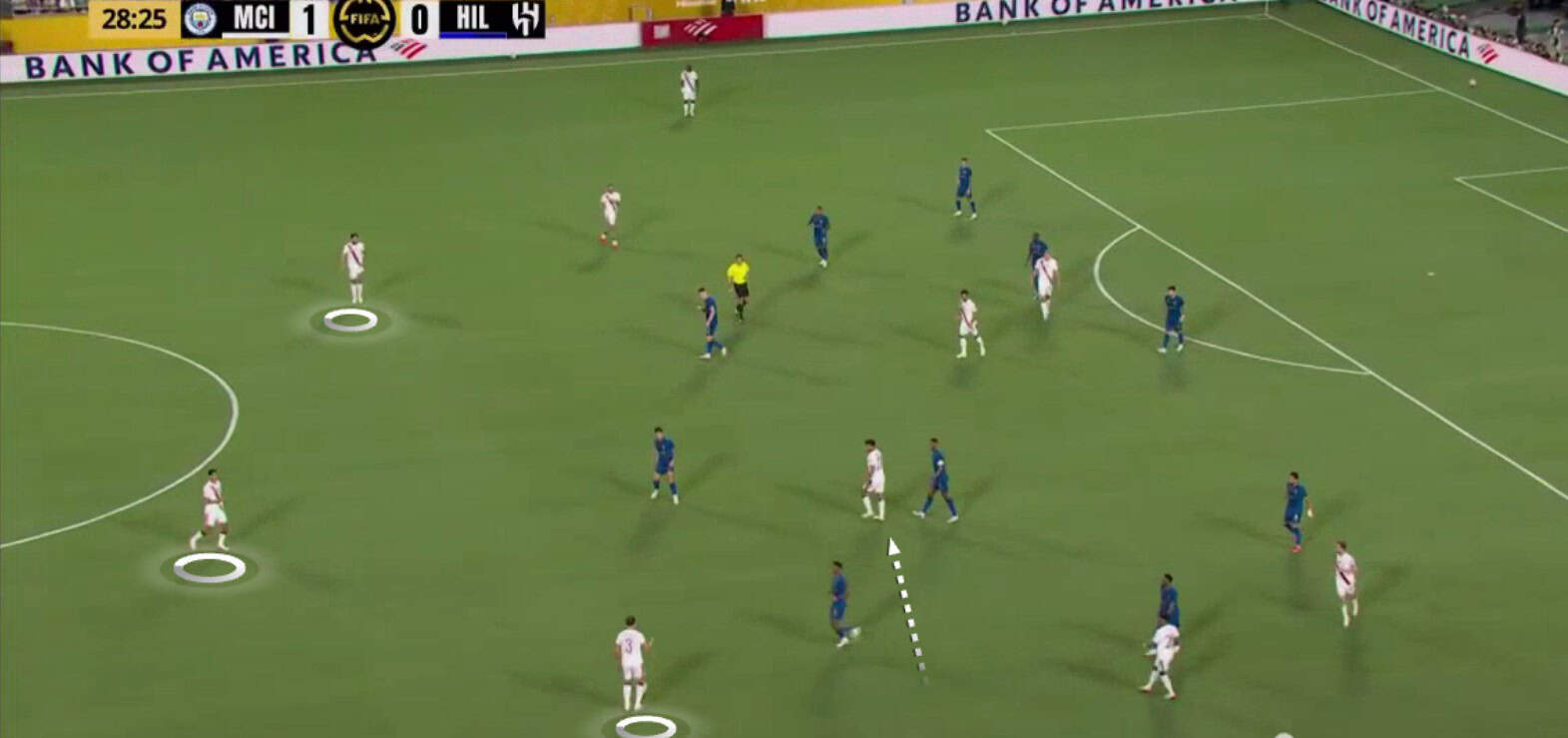 Pep Guardiola’s team looks for a new solution by adjusting positions.
Rejinders drops back between Dias and Gvardiol, opening options to go wider, while Nunes moves centrally.
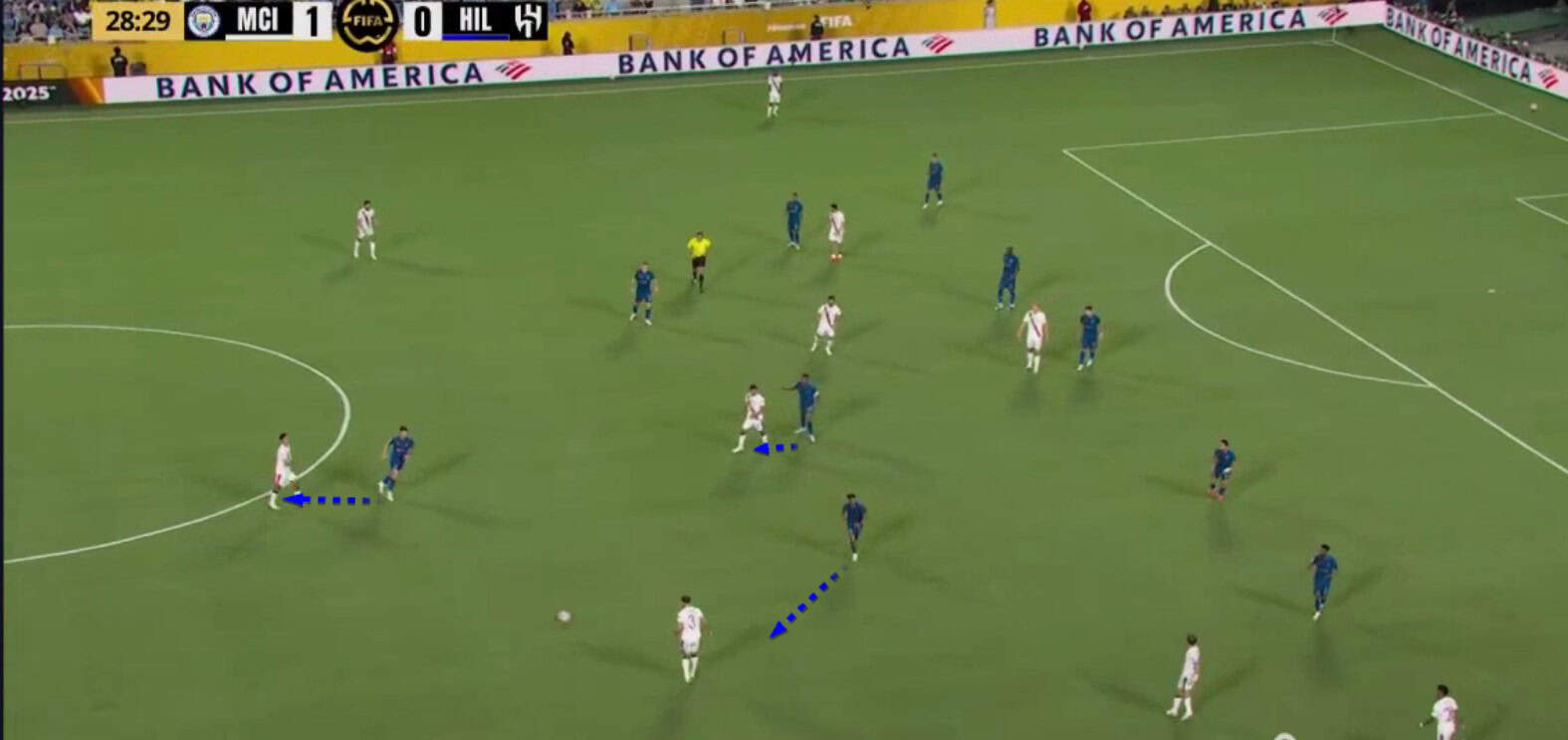 This positional adjustment impacts Al-Hilal’s structure.
Leonardo presses Rejinders, Nunes moves inside, Kinno covers to prevent a pass to him, and Al-Dawsari steps up to press Dias.
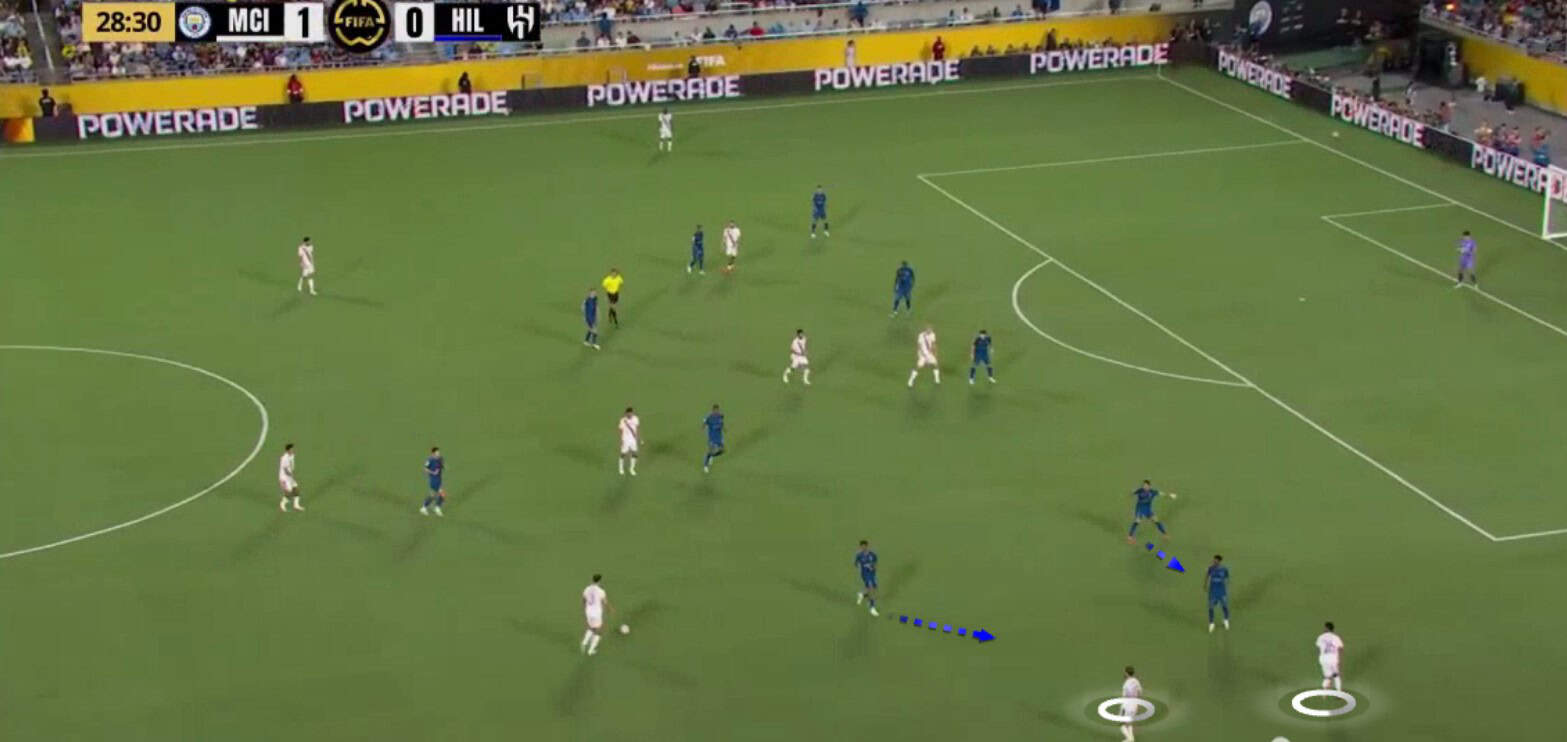 With Silva and Savinho switching positions, Al-Hilal’s left winger is restricted from fully pressing Dias.
Leaving Silva free would create a dangerous situation because Lodi stays back.
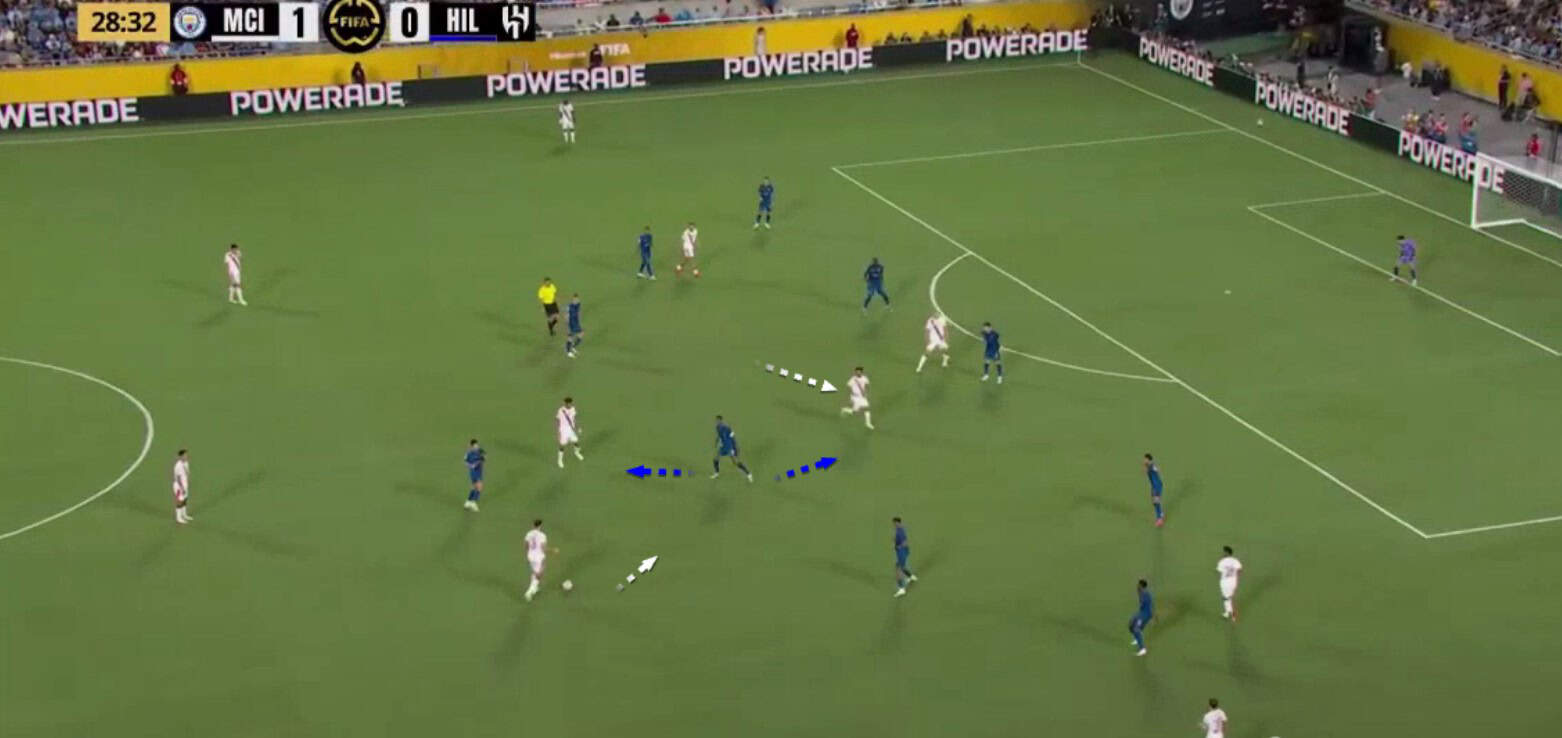 Gündoğan’s movement from the far side forces Kinno into a difficult position—he must balance his attention between Gündoğan and Nunes.
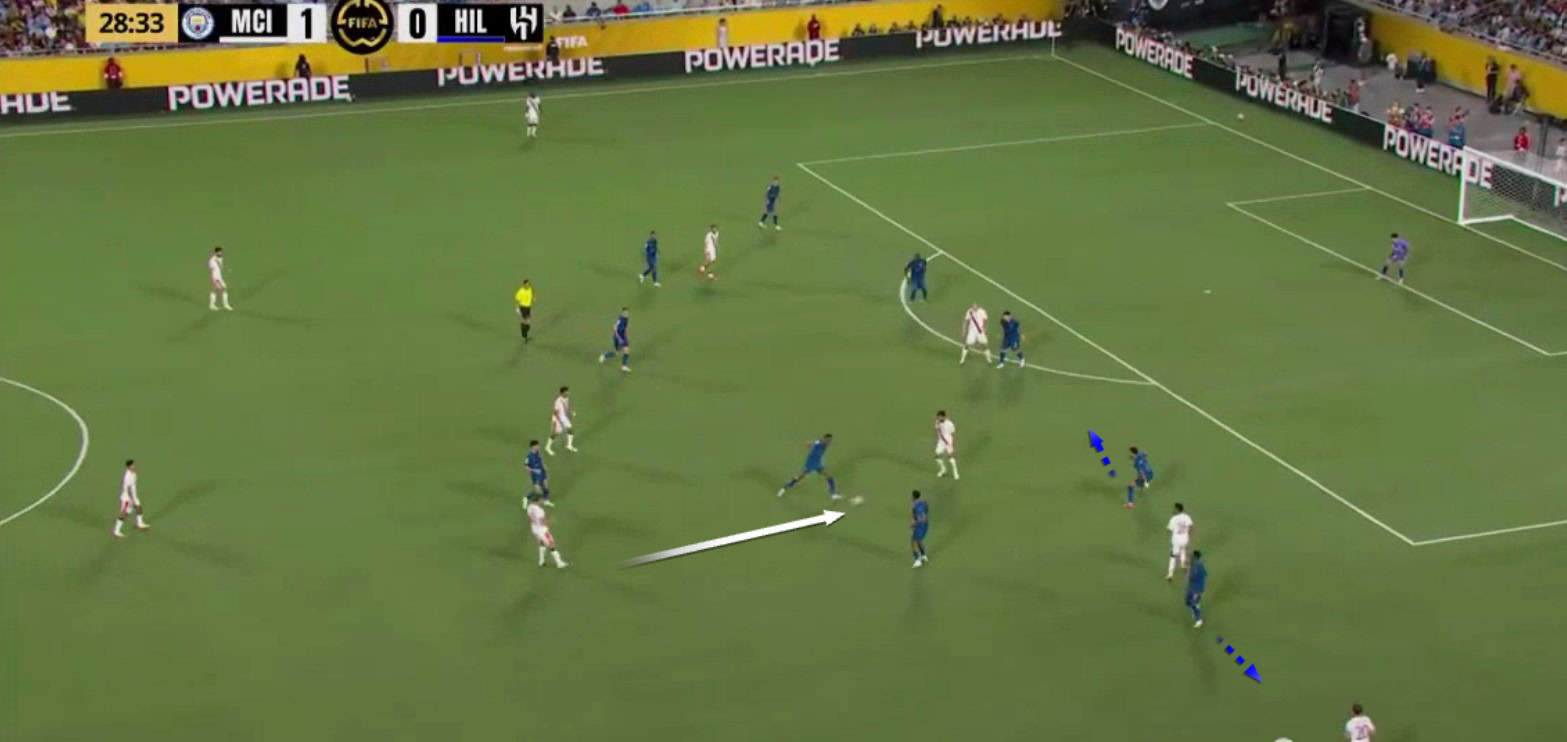 This movement opens a pass to Gündoğan.
Normally, Lodi would be marking Savinho and the left wing-back covering Silva, but Lodi is caught between Savinho and Gündoğan, allowing Gündoğan to receive the ball freely.
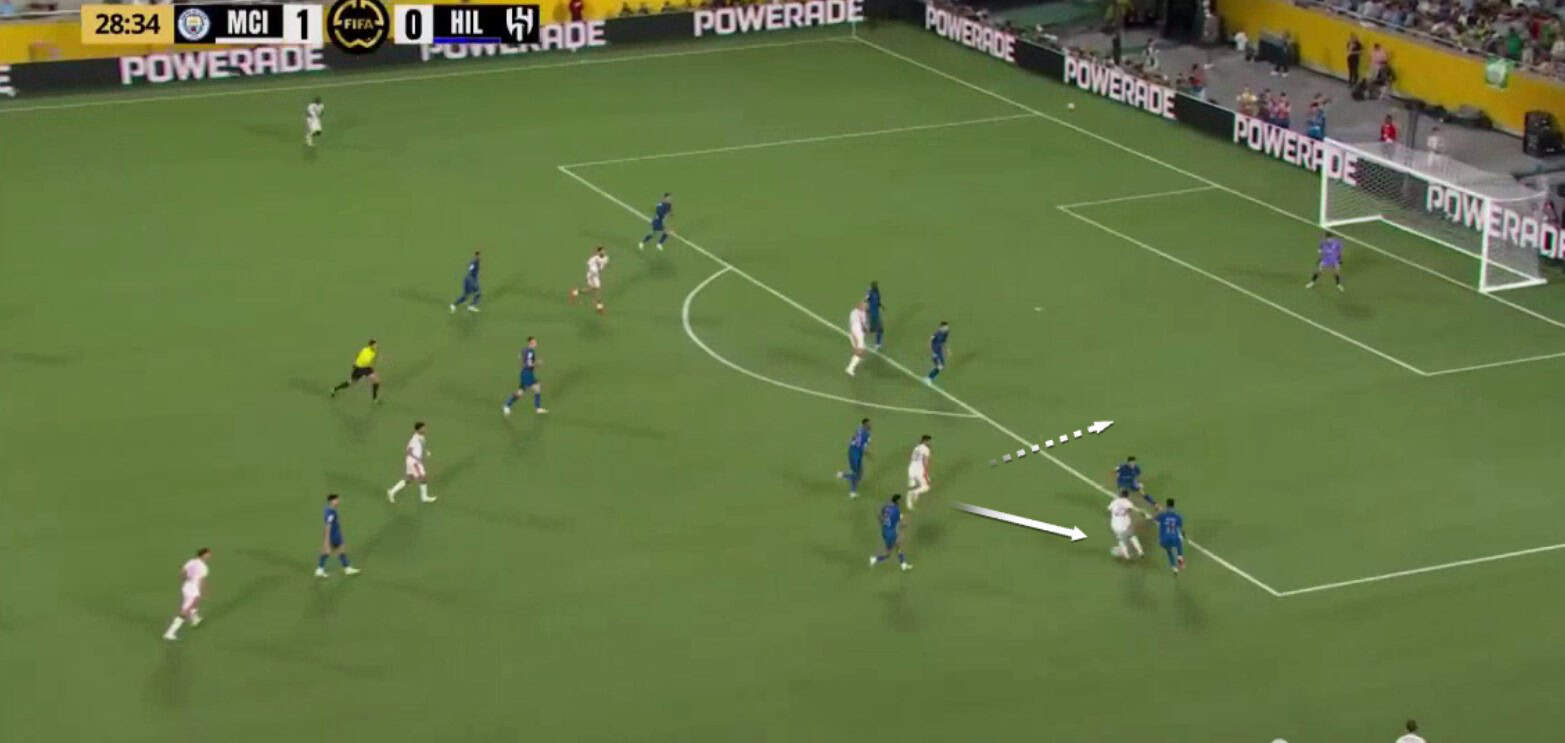 Gündoğan passes to Savinho and immediately makes a forward run into the space left behind Lodi.
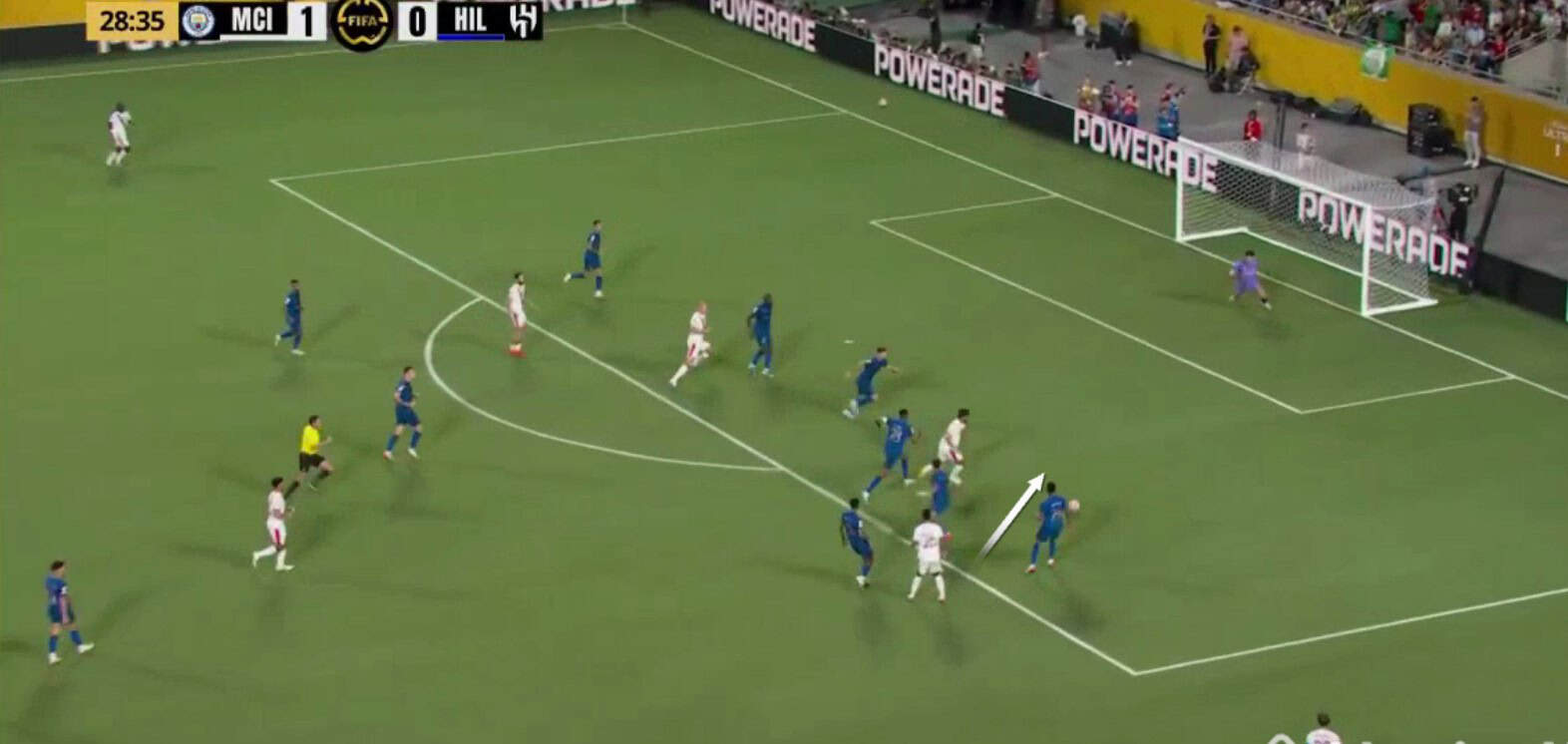 Gündoğan receives the pass and faces the Al-Hilal goalkeeper.
Despite the opportunity, he is unable to convert it into a goal.
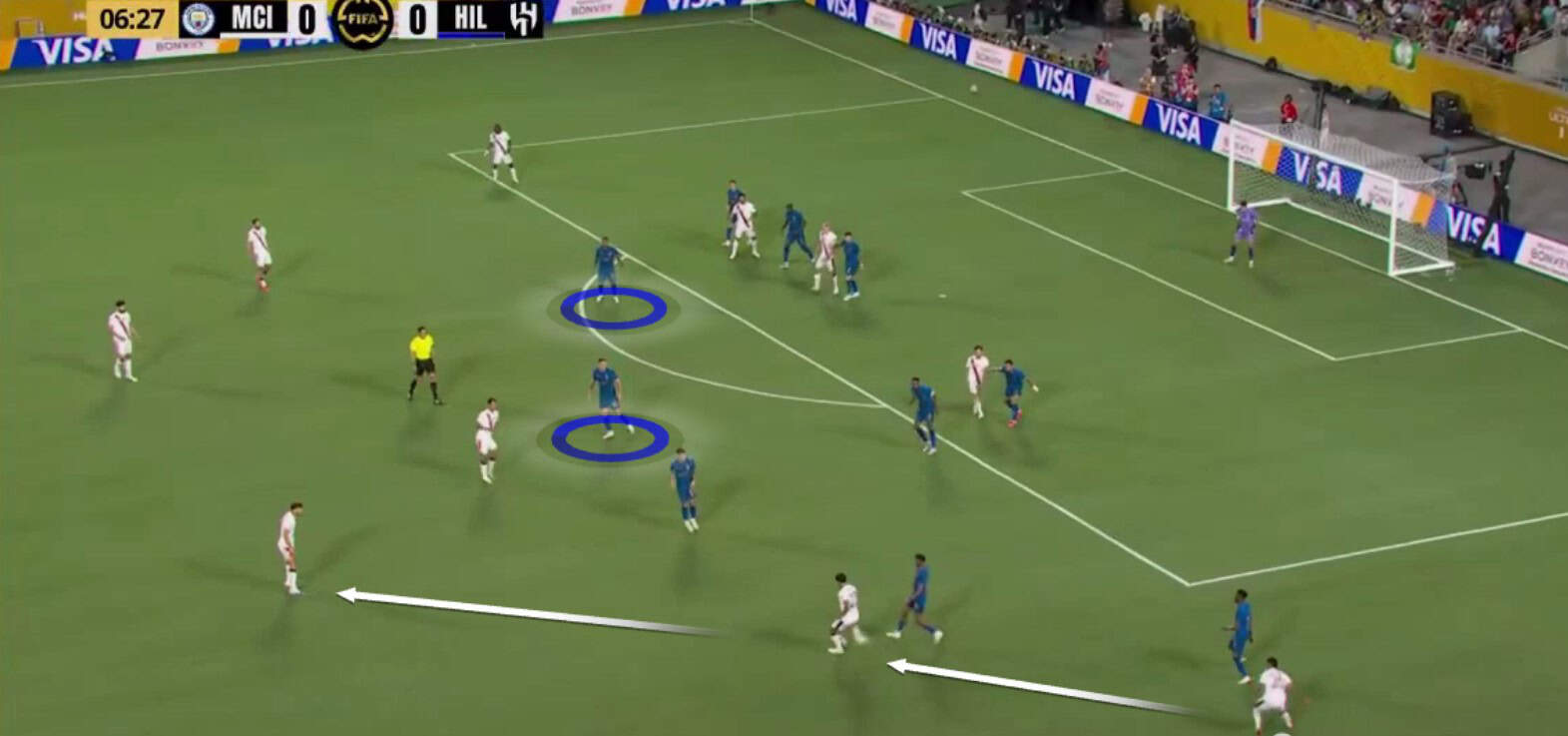 Another tactic Guardiola’s team employs is creating 1v1 situations for their skilled players.
Here, with Malcom and Milinković-Savić moving inside, Man City switches the play from one side to the other.
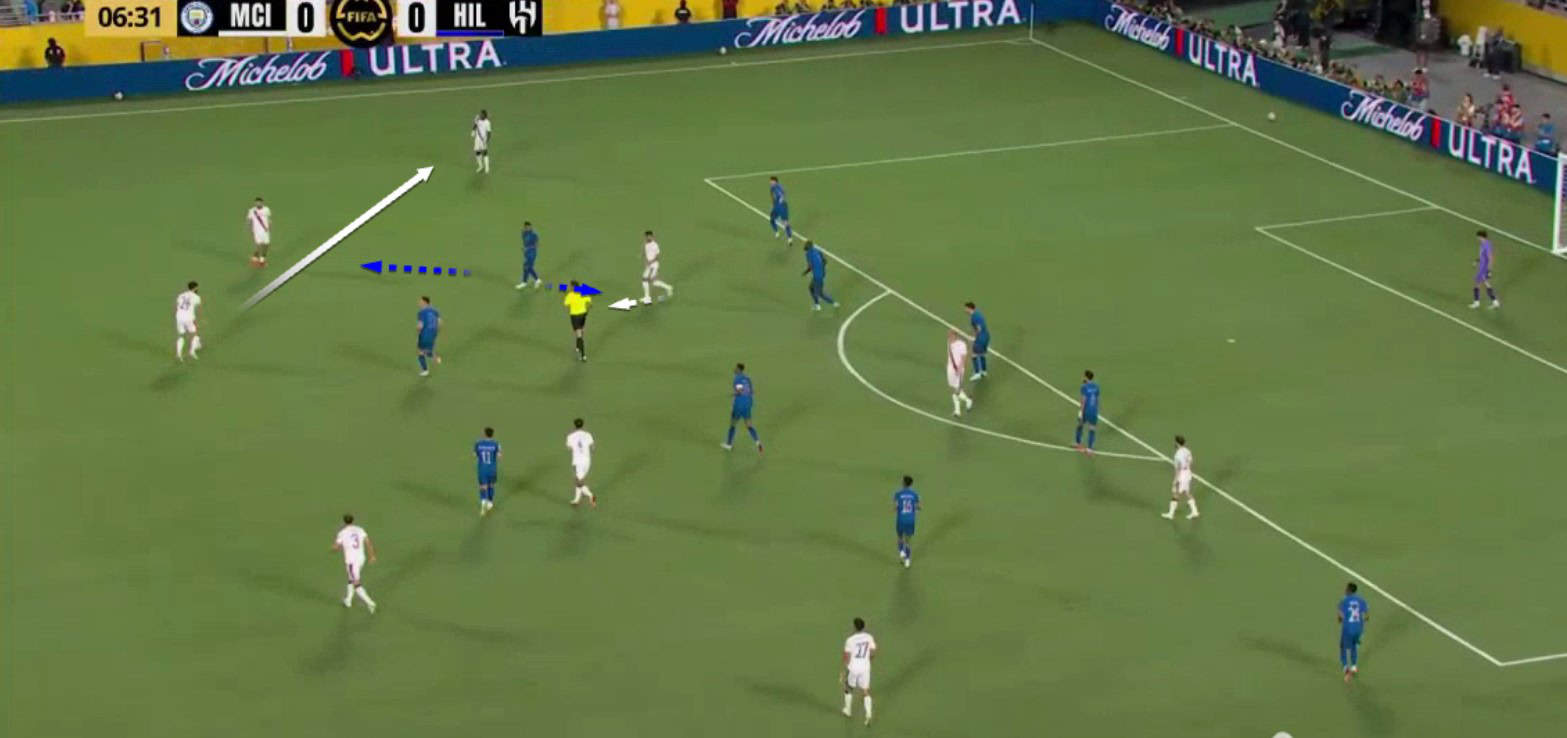 Gvardiol receives the ball and quickly plays it to Doku, who is free.
To give Doku a few extra seconds, Gündoğan drops slightly, delaying Malcom from reaching Cancelo to support him against Doku.
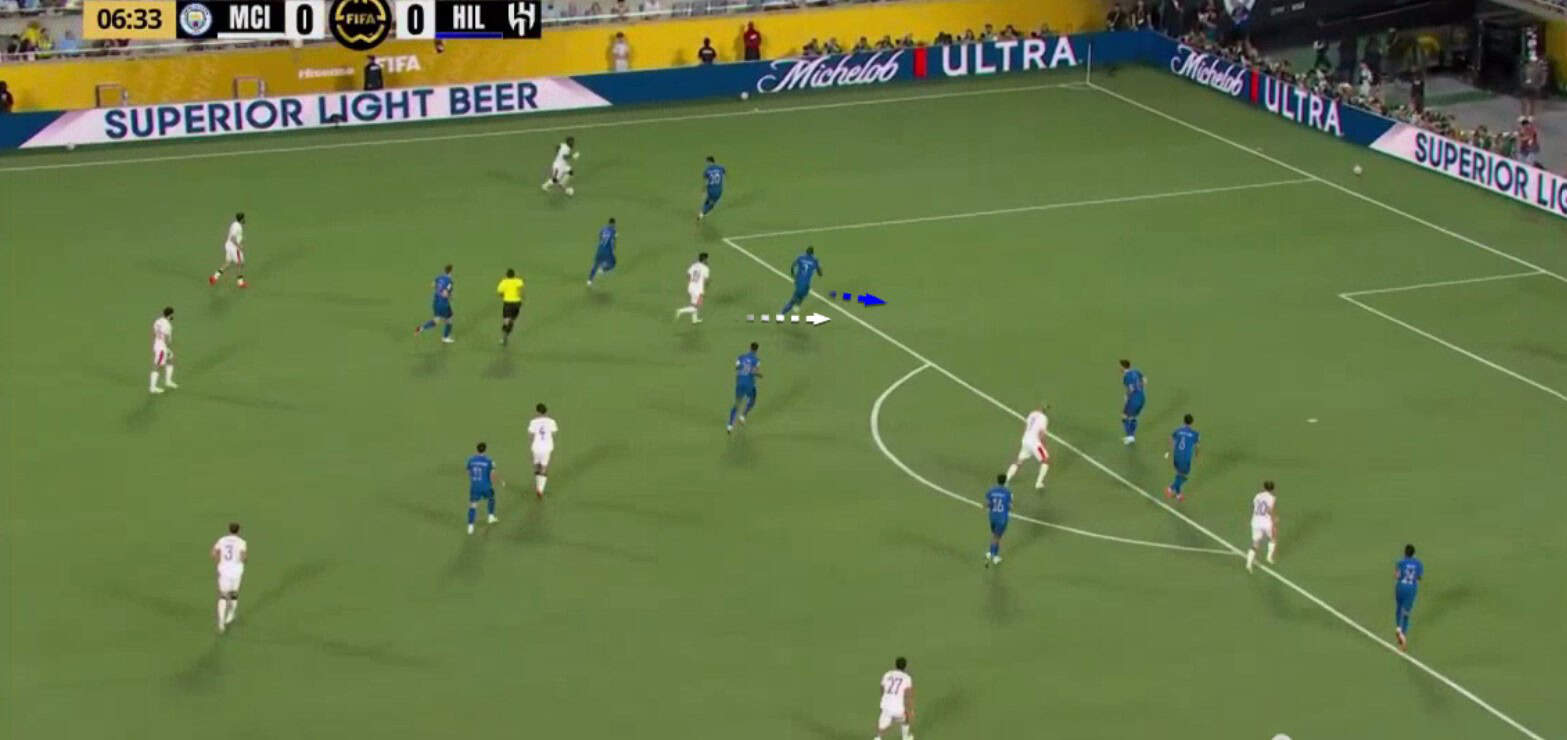 Doku receives the ball and accelerates towards Cancelo, aiming to bypass him before Malcom arrives.
Gündoğan, occupying a role similar to Koulibaly, drags him away from the action to create space.
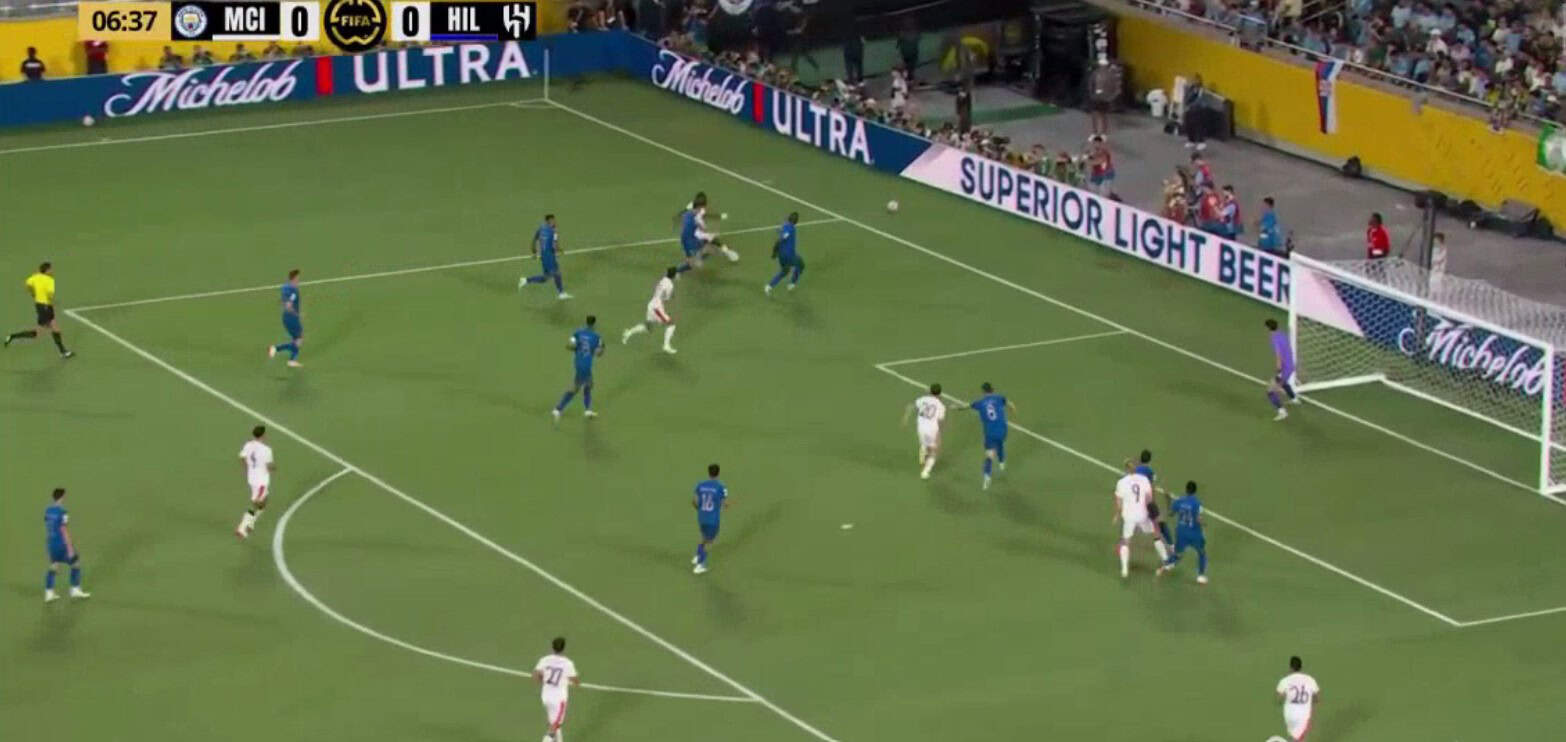 Doku fails to find an inside angle and is forced wide, unable to exploit the situation effectively this time.
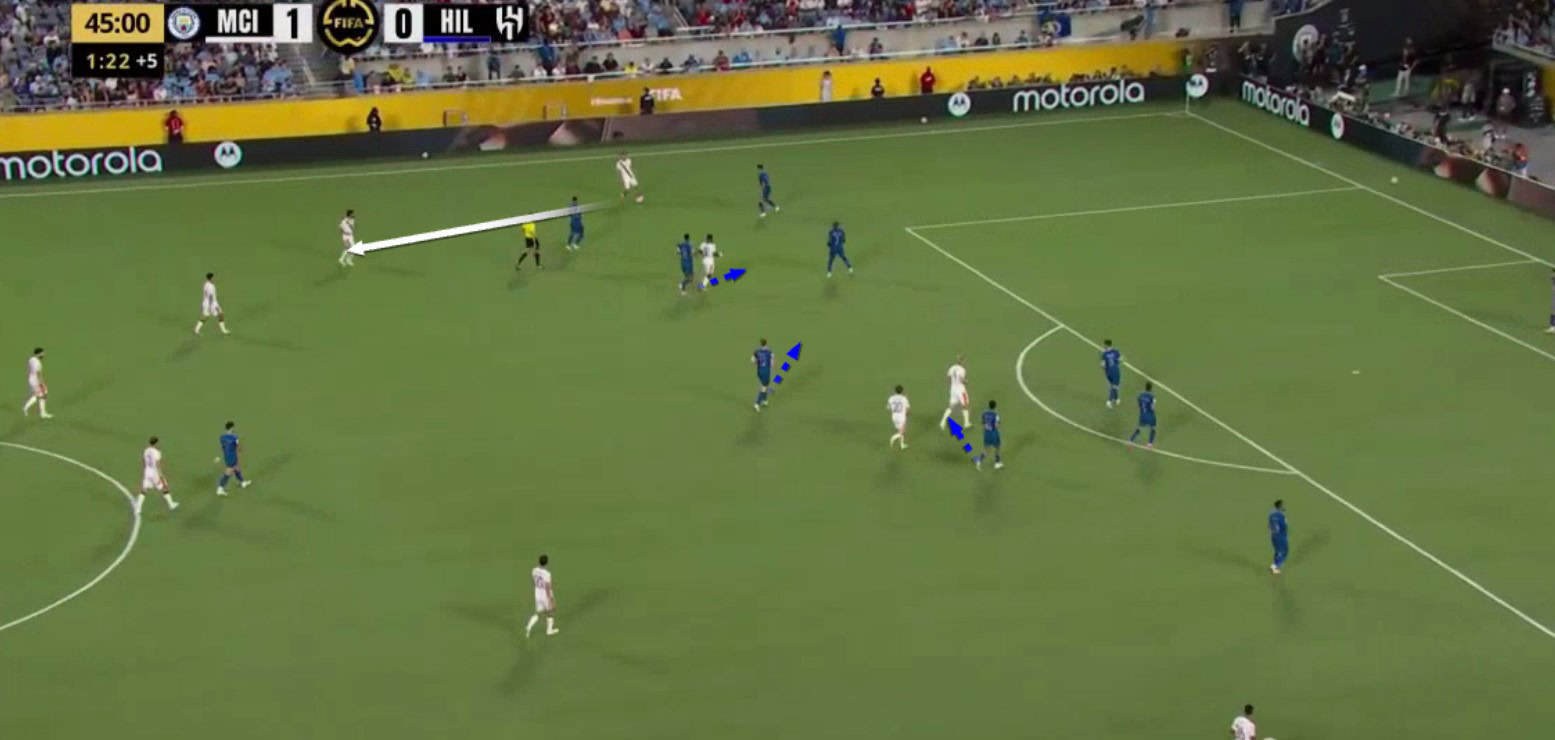 Man City attempt the same approach on the opposite side, drawing Al-Hilal’s defensive shift on one flank before switching play to the isolated far side.
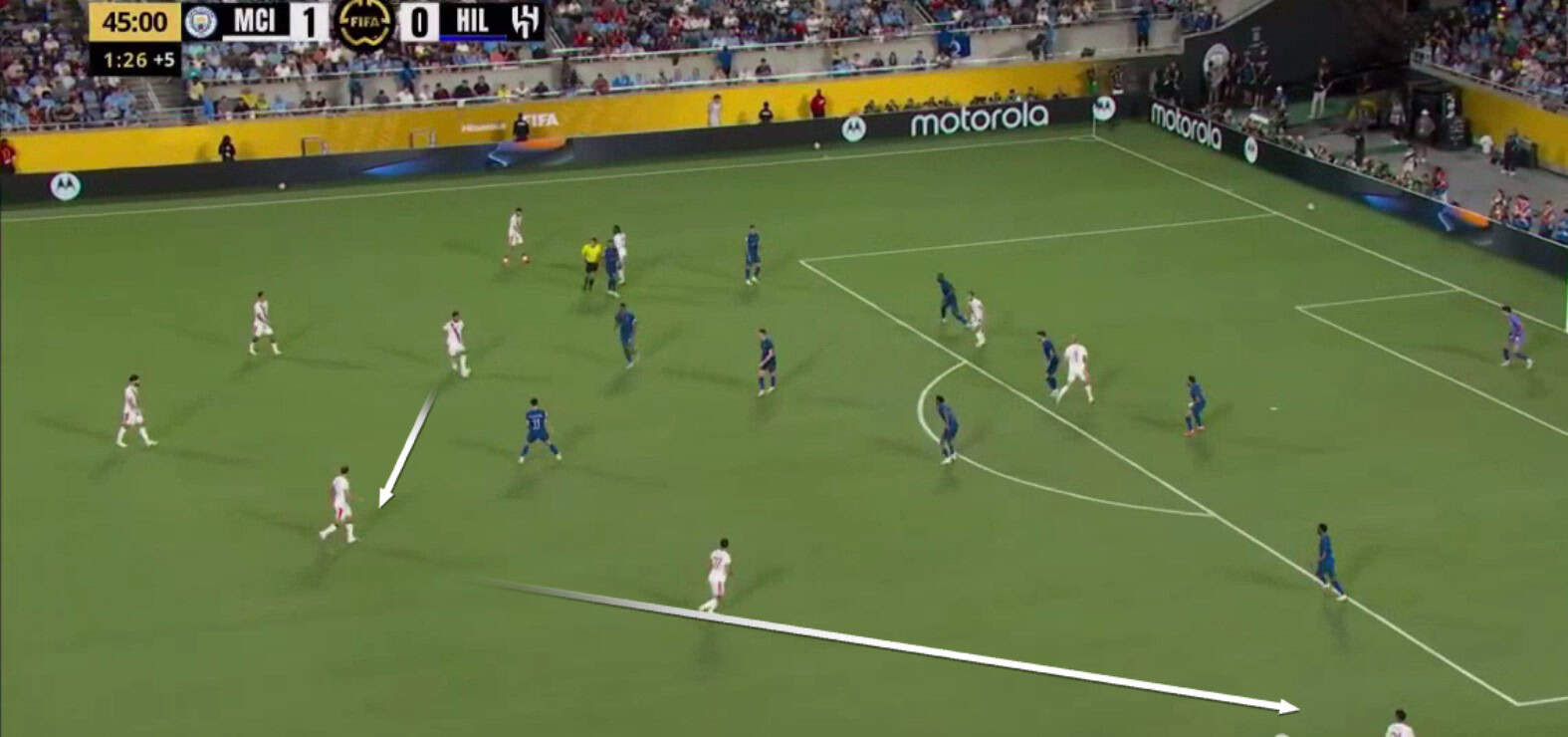 Dias receives the ball and quickly plays it out to Savinho on the wing, maintaining Man City’s progression and width.
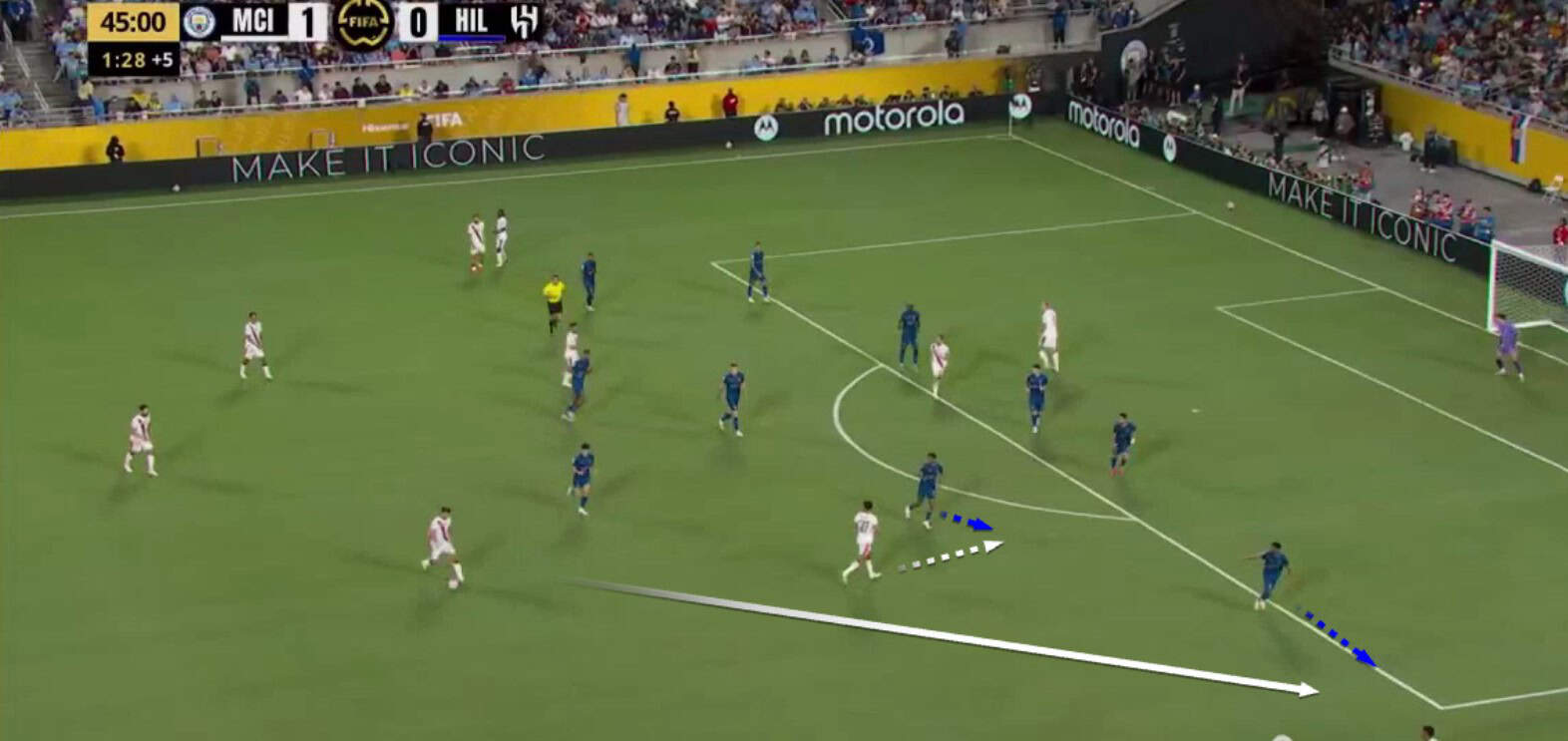 Nunes makes a run into the half-space to isolate Savinho, complicating the support from the Al-Hilal winger to their wing-back against Savinho.
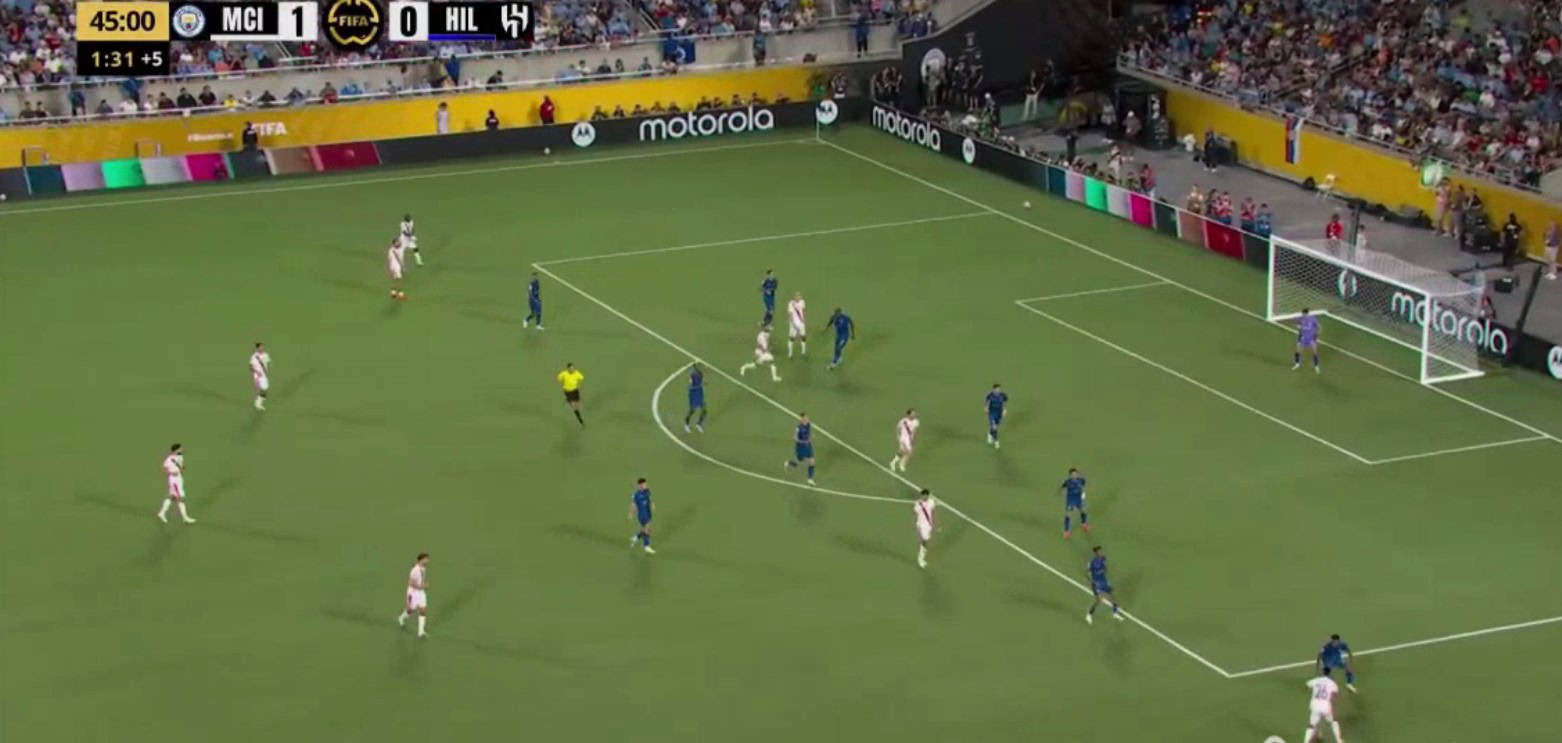 Savinho receives the ball on the wing and begins his dribble, aiming to exploit the space created by Nunes’ movement and challenge the isolated defender.
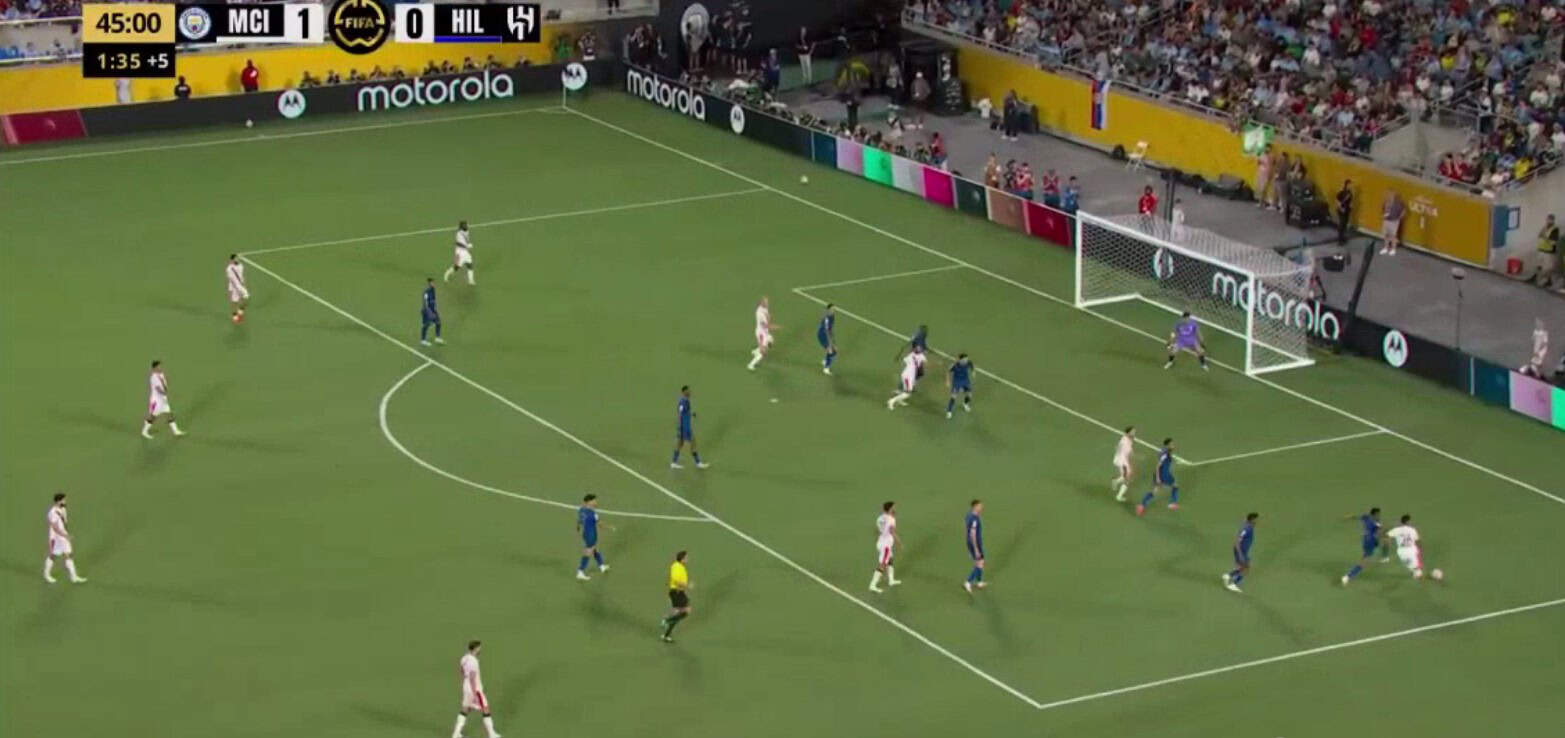 This time, Savinho completes a successful dribble and positions himself to deliver a cross from inside the box.
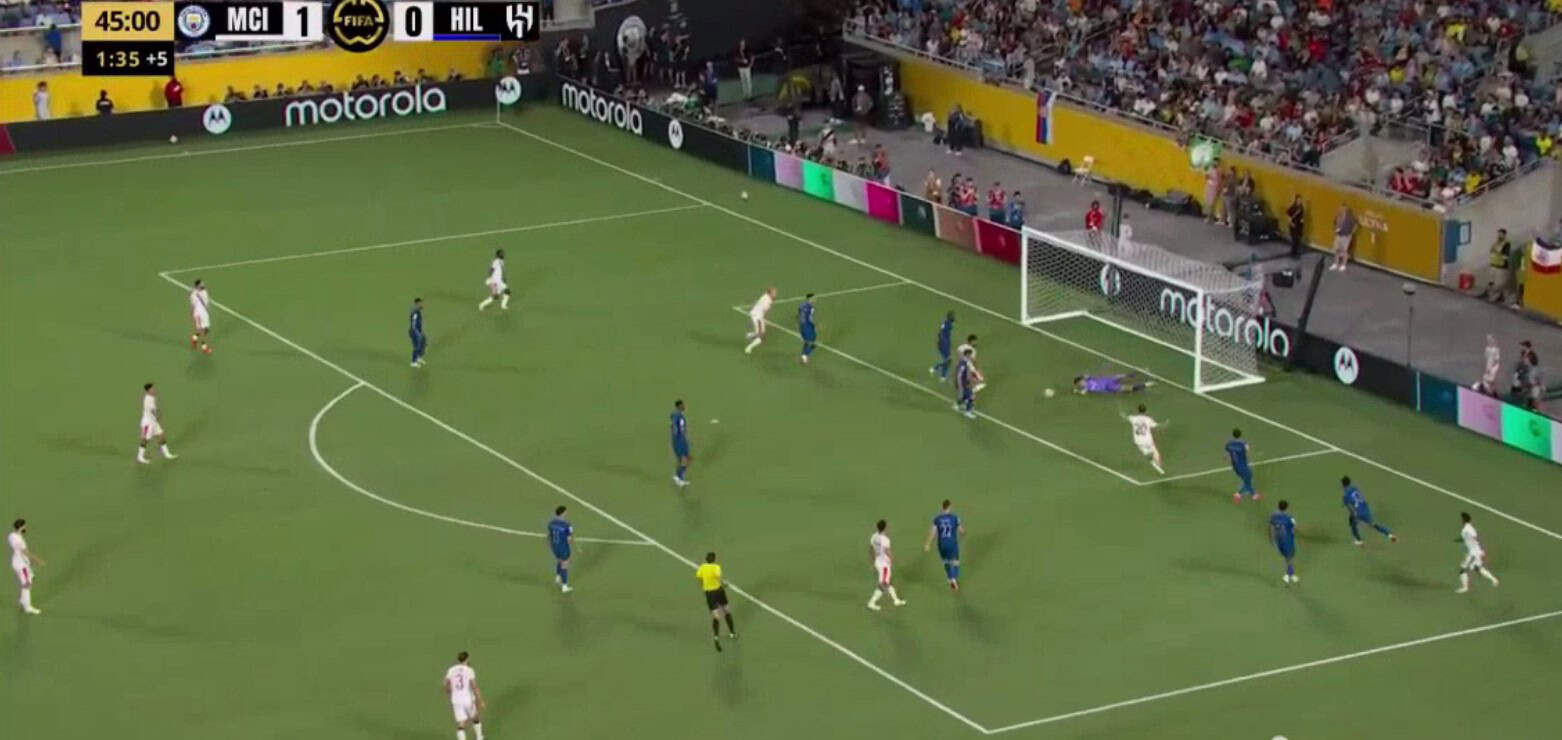 Pep Guardiola’s team nearly converted this opportunity into a direct shot on goal.
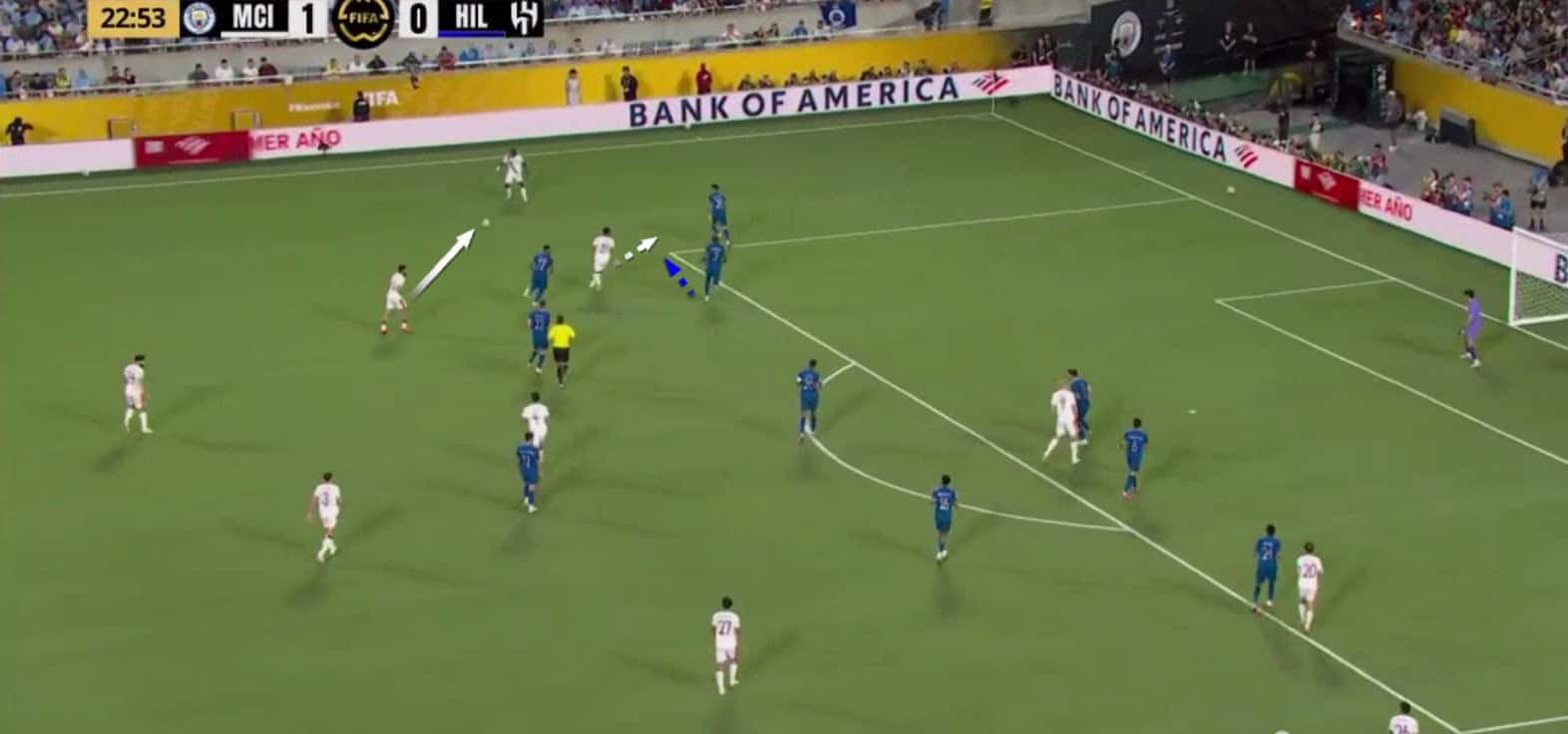 Man City and Doku remain persistent.
Nouri passes to Doku, while Gündoğan moves toward the ball, drawing Koulibaly out of position, towards the ball.
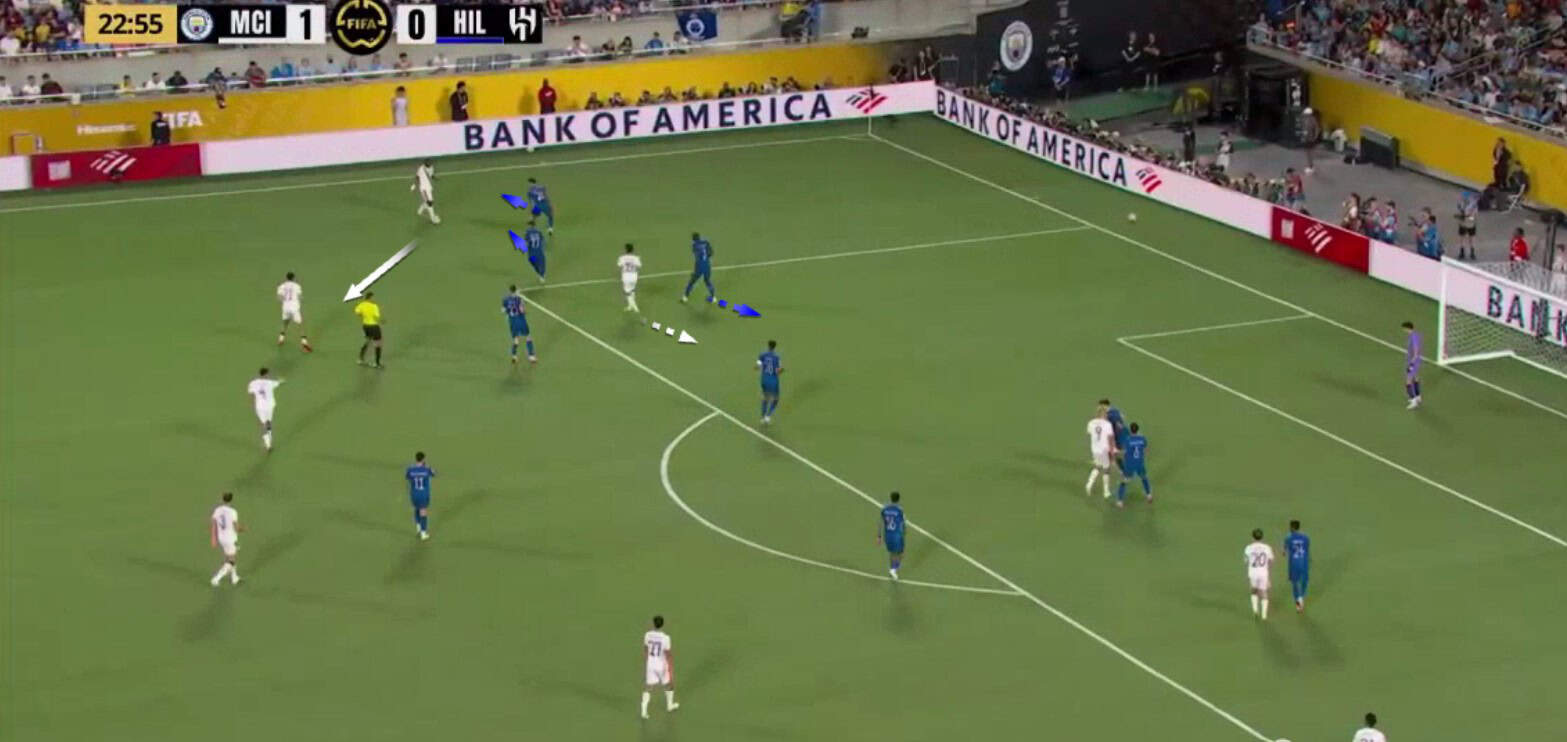 Doku receives the ball and ensures that both Cancelo and Malcom are dragged out of position before passing to Aït-Nouri.
Gündoğan begins to move away, forcing Koulibaly to follow him.
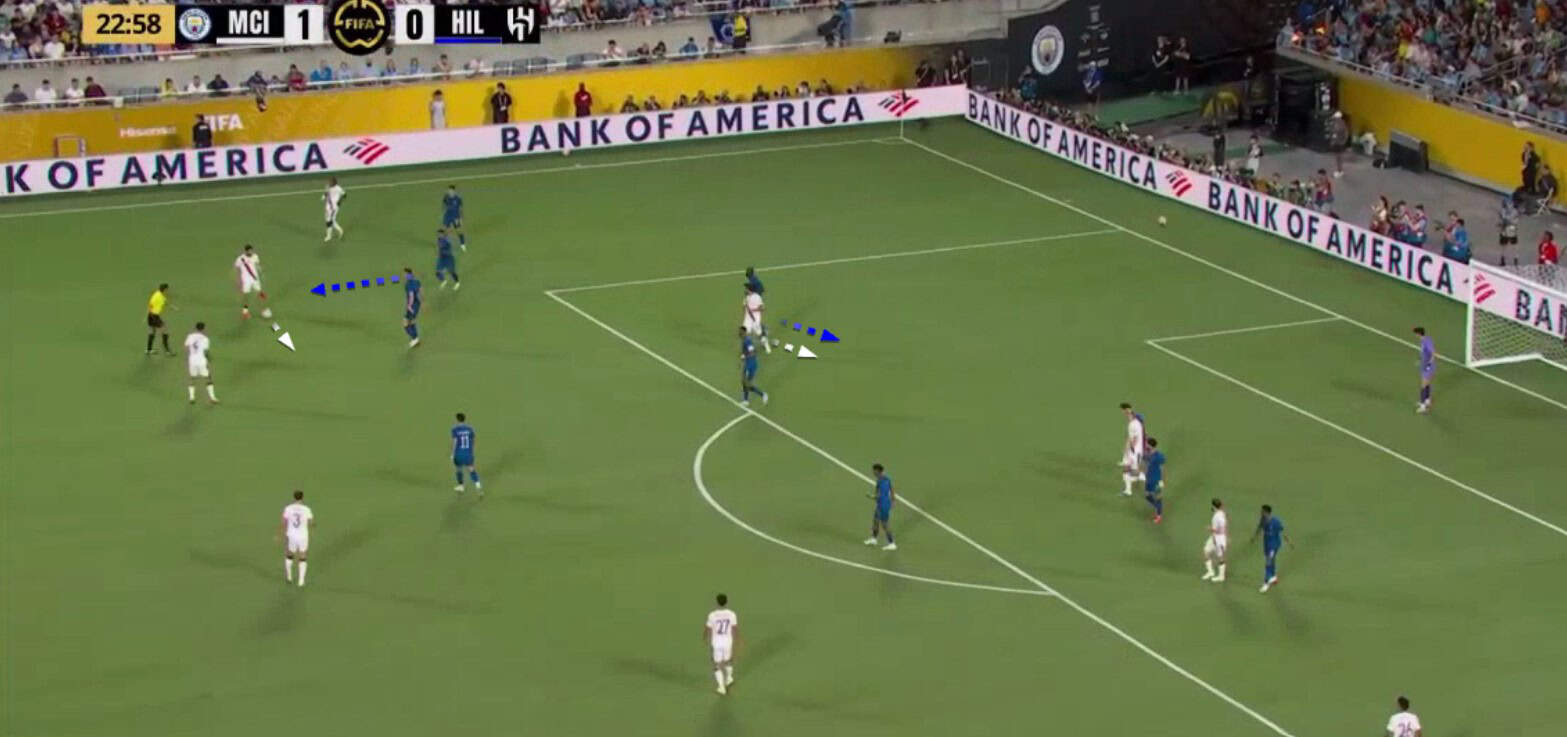 Again, Aït-Nouri receives the ball in the centre of the pitch, suggesting a pass to Rejinders, while Malcom moves to press him.
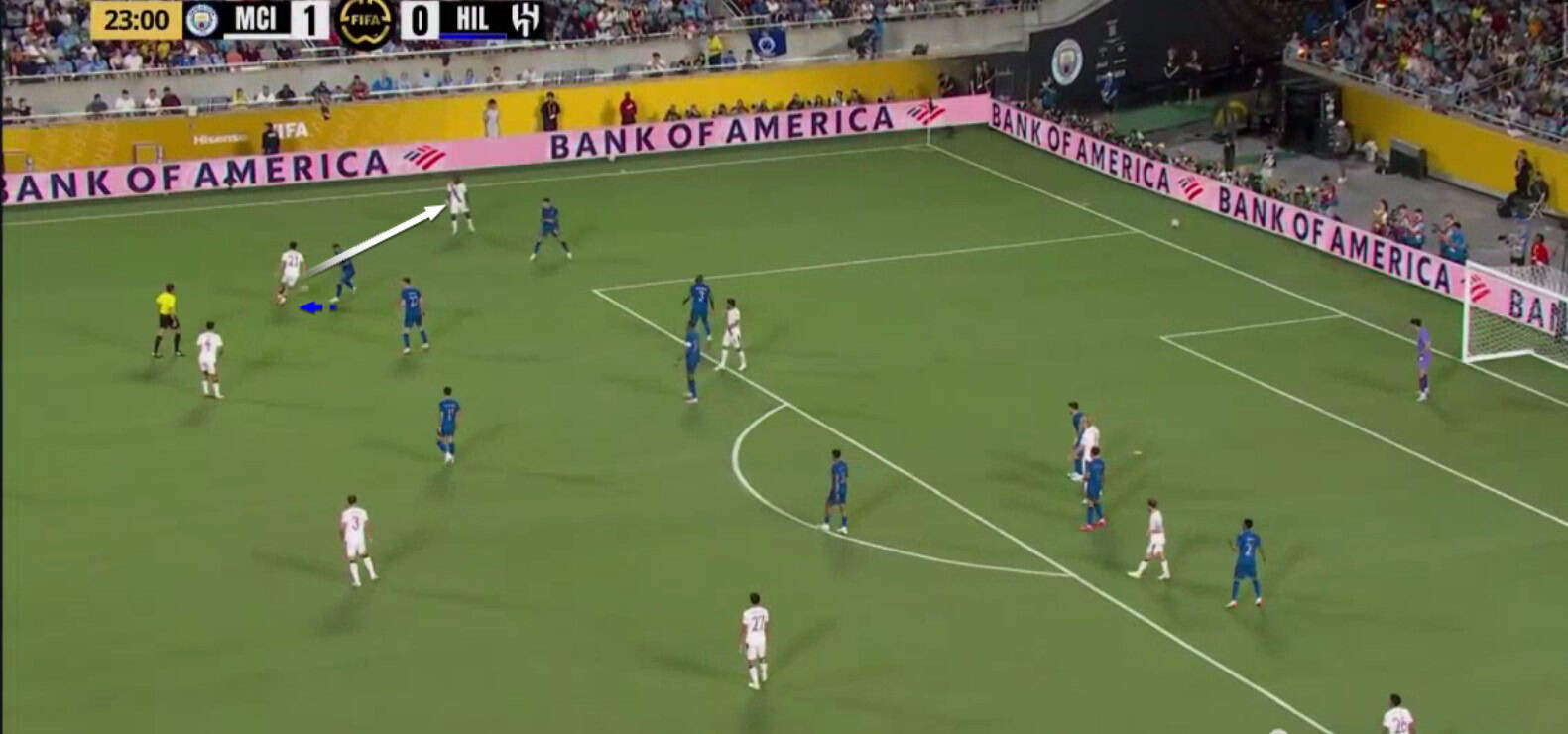 Nouri waits for Malcom to close in, then quickly changes direction and plays the ball to Doku.
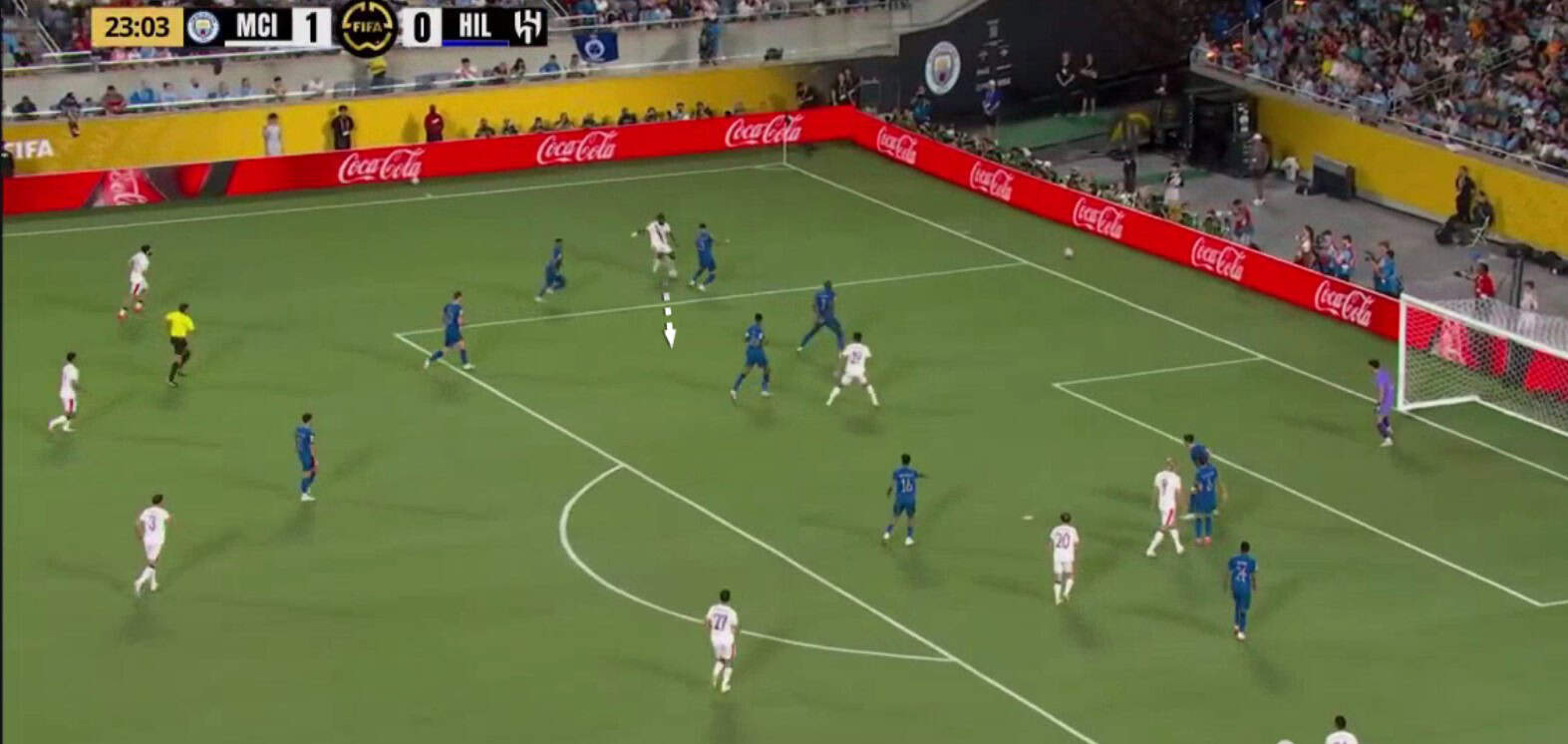 This time, Doku faces Cancelo in a 1v1 and finds an angle to cut inside.
 After that, Doku finds himself in a perfect position to shoot, but once again, he fails to score.
Al-Hilal played an impressive game against Man City, demonstrating that they had studied Guardiola’s team thoroughly, understanding the key weapons that caused problems for teams like Wydad and Juventus.
Simone Inzaghi implemented strong plans to try and neutralise these threats.
That said, Man City’s loss does not reflect poor performance.
They managed to create clear chances and reach Al-Hilal’s goal multiple times.
The numbers back this up, particularly the xG.
The xG for this game tells an interesting story.
In the first half, which ended 1-1, Man City had an xG of 2.02 compared to Al-Hilal’s 0.30.
By the end of the second half, which finished 2-2 and before extra time, it rose to 3.8 for Man City and 1.8 for Al-Hilal.
After the first half of extra time, ending 3-3, the xG was 4.2 for Man City and 2.0 for Al-Hilal.
While xG can highlight certain moments or areas that influenced the game, particularly in this instance, when we look at the timeline of the game, it also clearly shows that Guardiola’s team created high-quality, dangerous chances throughout the match.
Conclusion
As mentioned at the start of this series, this is a focused, detailed analysis of Man City, with the arrival of Pep Lijnders next to Pep Guardiola in the FIFA Club World Cup and right before the season.
This series has set the stage for Man City’s in-possession tactics in 2025/2026, providing expert in-depth insight into what to expect from the new Citizens with Pep Guardiola and Pep Lijnders at the helm.
Now, it’s time to sit back and observe how their style will continue to evolve throughout the 2025/2026 season.
