
Igor Tudor guided Juventus back to the UEFA Champions League after taking over from Thiago Motta near the end of the 2024/2025 season.
He breathed new life into the squad, and Juventus lost only one of their remaining nine matches, allowing them to secure fourth place on the final day.
Tudor has managed some elite clubs during his career.
The 47-year-old has recently worked at Olympique de Marseille and SS Lazio and was an assistant under Andrea Pirlo when he was in charge of Juventus.
Thiago Motta’s tactics got stale, and the goals were starting to dry up for Juventus, with his build-up no longer being effective.
Tudor changed things in terms of formation and tactics for I Bianconeri, which has gotten them good results, but there are still some concerning signs.
Now, they are coming off a thrashing at the hands of Manchester City at the 2025 FIFA Club World Cup, and the question marks going forward will be whether Juventus are truly back to being one of Serie A’s elite clubs in 2025/2026.
That’s what our tactical analysis is here to explore and determine if Juve are actually better off under Igor Tudor tactics compared to Thiago Motta.
Igor Tudor Build Up Tactics
Motta was a big fan of relationism and had Juventus dominating possession in Serie A.
During his tenure, Juventus averaged almost 60% possession, but this often didn’t lead to many high-quality chances.
They racked up goals and expected goals against lower-tier competition, but in 15 matches against the top half of Serie A, Juventus created only 15.8 expected goals.
What Igor Tudor did was change Juventus away from that extreme possession style of play and made them into a more direct team.
He switched them to a 3-4-3 formation, with the buildup being a 4-2 base, sometimes a 5-2, bringing Michele Di Gregorio out as a +1.

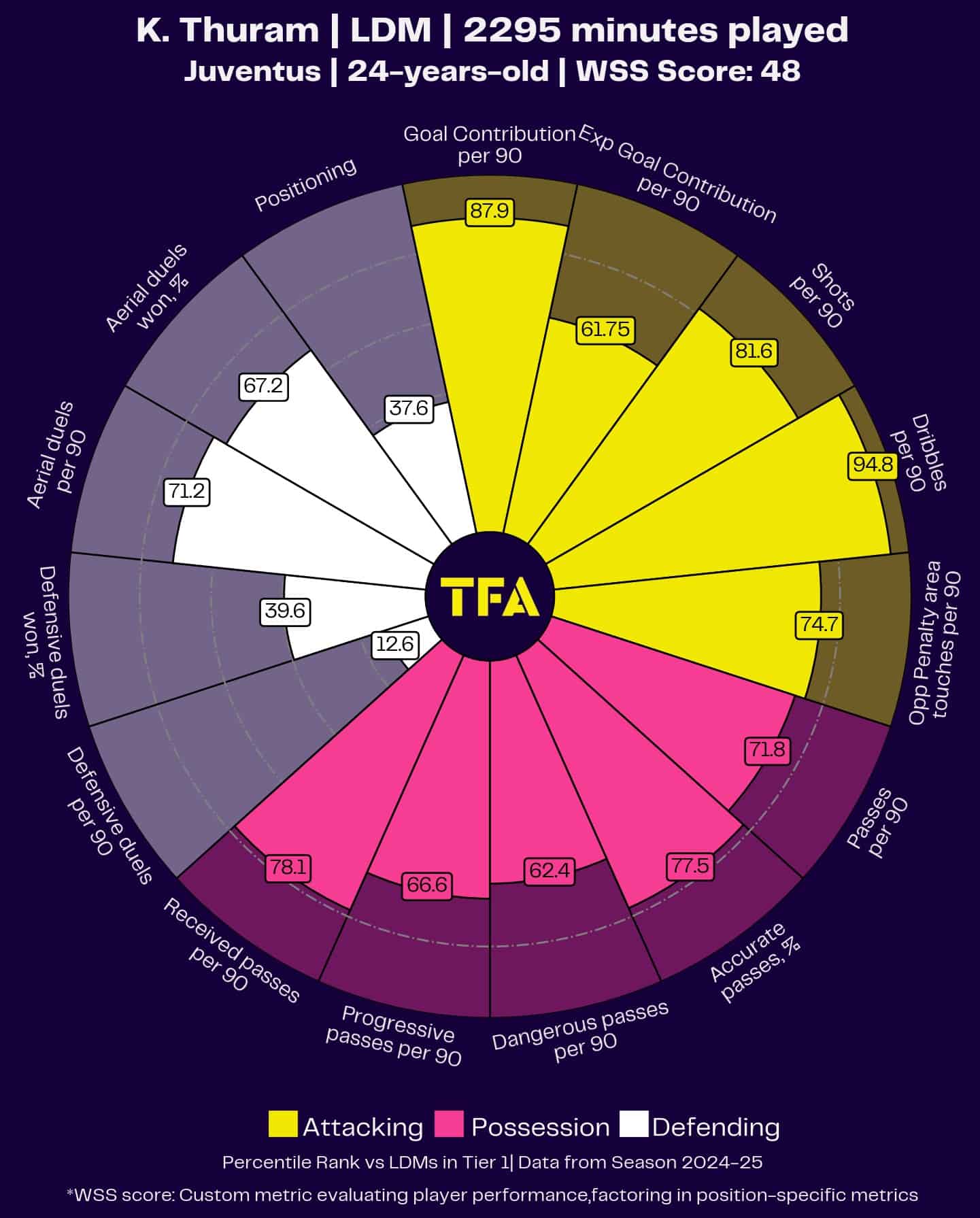
Khéphren Thuram is the key to making this whole system work, thanks to his ability to play in a single pivot or a double pivot alongside Manuel Locatelli.
His ability to receive the ball, turn, and progress the ball up the pitch allows the dual number 10s in the system to push further up the pitch.

Thuram ranked in the 95th percentile against other midfielders in Europe’s top five leagues in the number of dribbles per 90 minutes and also ranks highly in receiving progressive passes.
Khéphren Thuram Radar Chart
With the 4-2 or 5-2 base, the ball is initially passed to the full-back, who has one of two standard options.
They will either look to play the ball back centrally to one of the double pivot midfielders, finding space, or have the strikers drop deep to receive the ball and create space behind.
Juventus are retaining less possession (52.3% vs. 58.7%) under Tudor, with a greater emphasis on moving the ball forward quickly; however, this hasn’t altered their underlying numbers.
Tudor also loves to use Teun Koopmeiners to drop into the half spaces to receive the ball and advance it.
He’s in the 96th percentile for progressive passes received among Europe’s top-five leagues.
However, playing through the middle of the pitch has been a struggle, and the ball often ends up out wide, specifically on the left side.
Juventus led Serie A, with 40% of their attacks coming down the left flank because that is where their most dangerous attacker, Kenan Yıldız, operates.
While Yıldız ranks very highly in terms of successful take-ons, his output is nowhere near elite, as he ranks in the bottom 25% of wingers for xG + xGA per 90 minutes in Europe’s top five leagues.
That, in a sense, is the beginning of Juventus’ problems when it comes to attacking opponents in the final third.
Igor Tudor Struggles In The Final Third
While building out from the back and playing more directly have been successful under Tudor, Juventus are still struggling greatly in the final third.
I mentioned above the low number of expected goals they had against good competition in Serie A.
It’s gotten a little worse under Tudor.
Of his final nine matches in charge, Juventus created 10.7 expected goals, but only three of those matches came against teams in the top half of Serie A.
Those three matches were against Lazio, Bologna, and Roma, and Tudor’s side created only 2.4 expected goals in total.
There are several reasons why this is happening.
First, in a typical 3-4-3 system, the full-backs pushing forward to aid the attack and send in crosses is crucial.
That is not happening under Tudor, because they completed only 12 crosses into the penalty area.
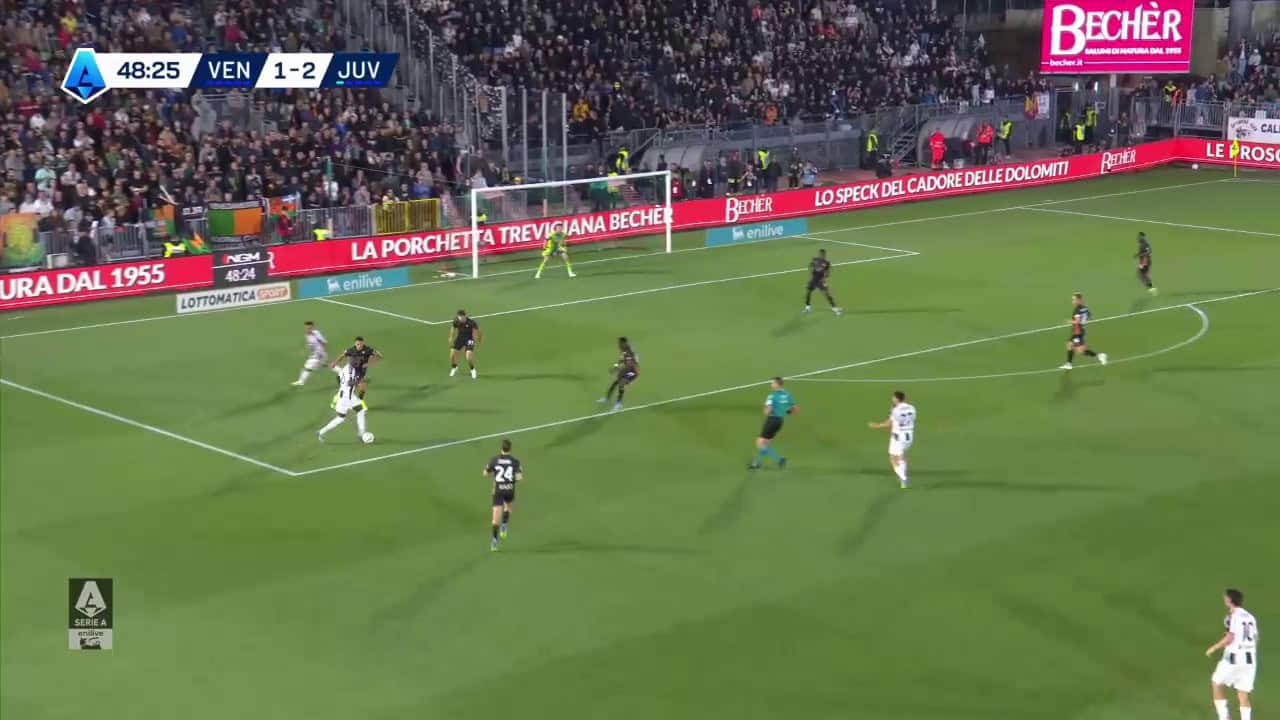
You can see that Tudor is trying to have his team overload the middle, like the situation here against Lazio.
However, they are finding no way through the centre, and even with the full-backs providing width, Juventus aren’t effective in creating high-quality chances from out wide.

They have two good aerial threats in Randal Kolo Muani and Dušan Vlahović.
Still, there are often times like this when the strikers drift out wide to try and create overloads, and nobody is in the box, so this highlights why wide chance creation should be an area of focus for Igor Tudor moving into the 2025/2026 campaign.
Under Tudor tactics, Juventus’ average xG per shot is 0.09, which would place them in the bottom five of Serie A if this trend continued for a full season.
Igor Tudor High Press Tactics
Igor Tudor has encouraged Juventus to press high up the pitch in a man-to-man fashion, as seen in the situation below against Al-Ain.
 They even scored off a high turnover against Man City on Thursday, but there really hasn’t been much of a difference in the data.
Under Thiago Motta, Juventus averaged double-digit high regains per match, but under Tudor, they averaged only 7.8 per 90 minutes.
Additionally, their PPDA has changed minimally, decreasing from 9.9 under Motta to 9.2 under Tudor.
It certainly adds another element to Juventus’ out-of-possession play.
It is vital to their ability to dominate lesser competition, but the data suggests they still have a long way to go.
Igor Tudor Low Block Tactics
One thing that has been true for Juventus since Massimiliano Allegri took over is that they are among the better low-block defending teams in Europe’s top five leagues.
For all of their offensive struggles under Motta, Juventus allowed only 0.92 xG per 90 minutes in Serie A.
While Tudor has changed the formation to a 3-4-3, which allows them to defend in a back five and makes it difficult for the opposition to overload the last line of defence, the defensive numbers have remained solid.
In his final nine matches in charge, Juventus conceded only 7.3 expected goals, which was the second-best record in Serie A during that time frame.
It’s a very compact structure designed to prevent the opponent from playing through the middle of the pitch.

However, there were many instances against Manchester City on Thursday where Juventus got completely pinned into their own box and were so passive that it allowed Manchester City to really do whatever they wanted in the final third as there wasn’t much of a threat of getting hurt in transition.
In this scenario, Juventus get pushed back into their own penalty area, trying to reduce the space and not allow City any high-quality chances.
Still, there is really no route for them to hit Pep Guardiola’s side on the counterattack.

This type of defensive shape will be successful in Serie A, but when Juventus plays elite competition, such as Real Madrid, who are next, with numerous elite technical players against low blocks, it will not be as effective.
Conclusion
So, has Igor Tudor made Juventus better tactically?
I would say no.
He has changed the system to allow them to defend in a back five easily, press opponents high up the pitch, and play more directly through the wide channels, all of which are great.
However, the data would suggest that Juventus is no better and maybe even a little bit worse under Tudor’s management than under Thiago Motta.
They sure were impressive, scoring nine goals against Wydad Casablanca and Al-Ain.
However, the 5-2 thrashing at the hands of Manchester City in the Club World Cup certainly leaves us with more questions than answers about how Tudor can transform Juventus back into a Serie A title contender, rather than a team fighting for a Champions League spot.
They will take on Xabi Alonso’s Real Madrid in the Round of 16, which will be a great test to see whether they had a bad day at the office against Manchester City or whether Igor Tudor’s system is not suited to effective play against the elite teams in Europe.
