
Only five players have made their debut for the Argentinian national team before turning 18 years old.
Ernesto Brown and Gootlob Weiss made their debuts at 17 in 1902 and 1903, respectively, not in modern football.
Jorge Cecchi made his debut in 1980 at 17 as well.
Diego Maradona remains the youngest player to have represented Argentina.
Maradona made his debut just months after his 16th birthday in 1977.
Since June 6, 2025, the club now officially has its fifth member, Franco Mastantuono.
Born in 2007, the young winger was subbed on in the 84th minute of a 1-0 win against Chile in the FIFA World Cup qualifiers, making his debut at just 17 years and nine months of age.
Unlike his peers, Mastantuono has gained media interest for over a year.
The winger has been starting games for River Plate, one of the two biggest clubs in Argentina, since he turned 16 and has been a regular starter and key player at just 17.
Lionel Scaloni was not the only one who recognised the River Plate Academy product’s immense talent.
For the past few months, almost all of the top European teams have been chasing the up-and-coming star’s signature.
In the end, Mastantuono narrowed his choices down to either Paris Saint-Germain or Real Madrid and is now expected to sign for the club from the Spanish capital.
Real wanted to sign him so badly that they flew to Argentina to guarantee the signature.
They are now expected to use the release clause in his contract to pay €45m for Mastantuono to play for Los Blancos.
In this player analysis and scout report, we will examine Mastantuono’s immense talent, why Real Madrid were so keen on signing the 17-year-old for this kind of money, and how he has already impacted the play of his current club, Club Atlético River Plate.
Franco Mastantuono Cutting Inside
Joining Real Madrid means receiving much more attention and pressure from the media and fans worldwide.
Franco Mastantuono will receive this attention from now on, and he will soon be compared to Barcelona’s Lamine Yamal.
Mastantuono is just about a month younger than Yamal, but there are many similarities.
Both play on the right wing, both are left-footed, both take on a significant amount of responsibility for their clubs, and both enjoy cutting inside.
Looking at Mastantuono’s play, he is not a typical winger overall, but he’s still a really good one.
Compared to other wingers, Mastantuono lacks pace.
While he is not slow at all, he lacks the last gear other wingers have; he can’t simply outrun opposing defenders, but he makes up for it with many other abilities.
Mastantuono’s biggest strength is what we Germans call “Vororientierung“, which has no direct translation into English, but can be described as attacking anticipation.
Despite his age, he always knows where his opponents are and where the pressure will come from; he easily gets past overaggressive defenders near the sideline regularly and picks up the pace from there.

Looking at this situation, Mastantuono has just evaded a pressing defender with a nice turn near the sideline and is now moving forward with the ball at his feet.
He might not be faster than the defenders, but with his good first move, he got enough of a head start to go down the line and can now roam freely.
As stated before, the starlet now likes to cut inside onto his strong left foot.
He gets his body between the ball and the defender and moves towards the centre of the pitch, going past the defender who followed him and moving against the direction of the shift the backline is currently making.
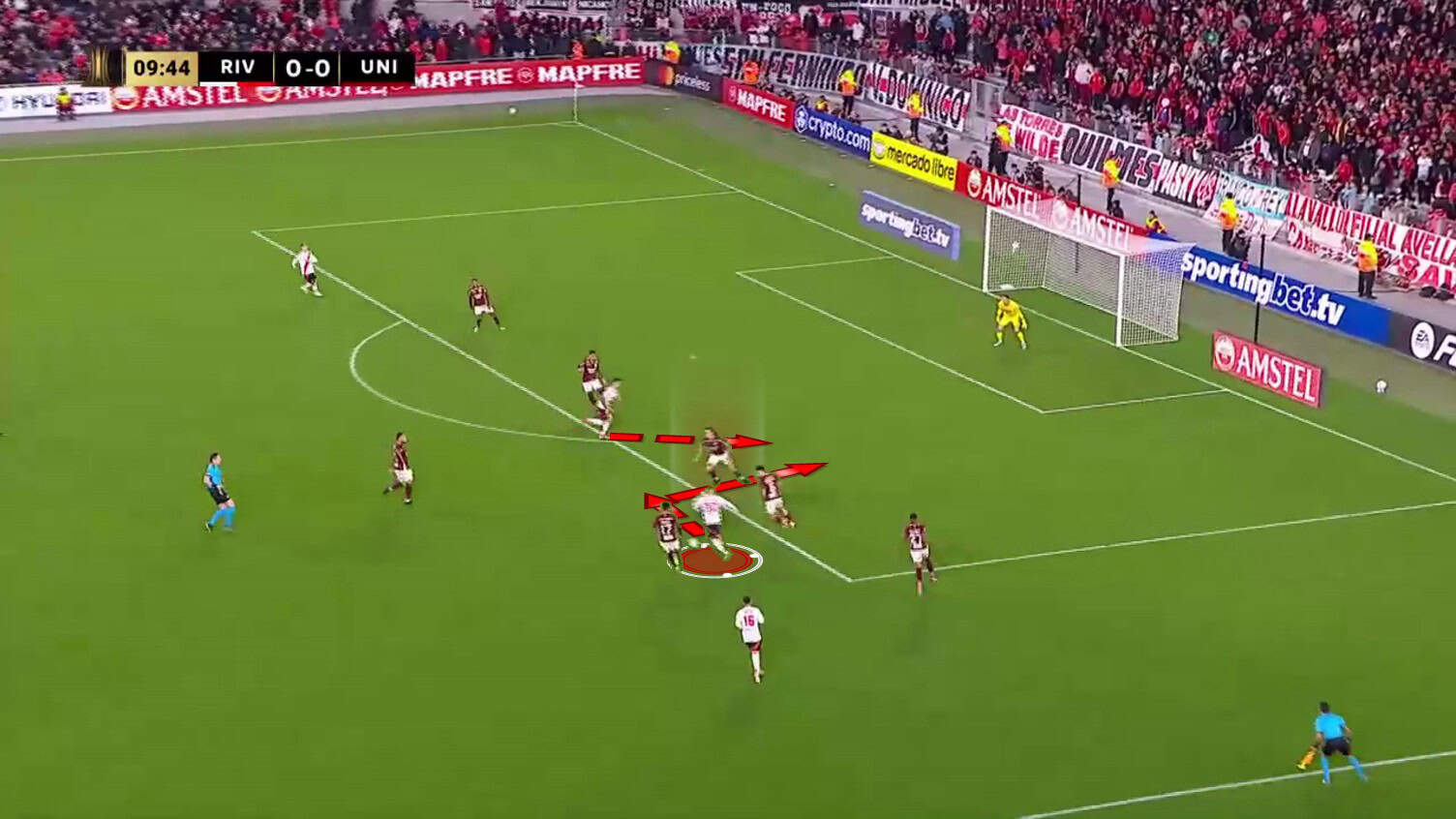
With his great change of direction ability, Mastantuono easily gets to the edge of the box, but what he does now is what really makes him so special.
Three defenders might surround him, but he keeps his head up, orients himself early on in the situation, and threads the ball through the gap between the two defenders within a split second, right into the path of his striker.
These situations, where Mastantuono cuts inside, attract the attention of the opposing backline, and then plays a through-ball into the box right through the heart of the defence, happen on a regular basis, and he creates many opportunities for his teammates like that.
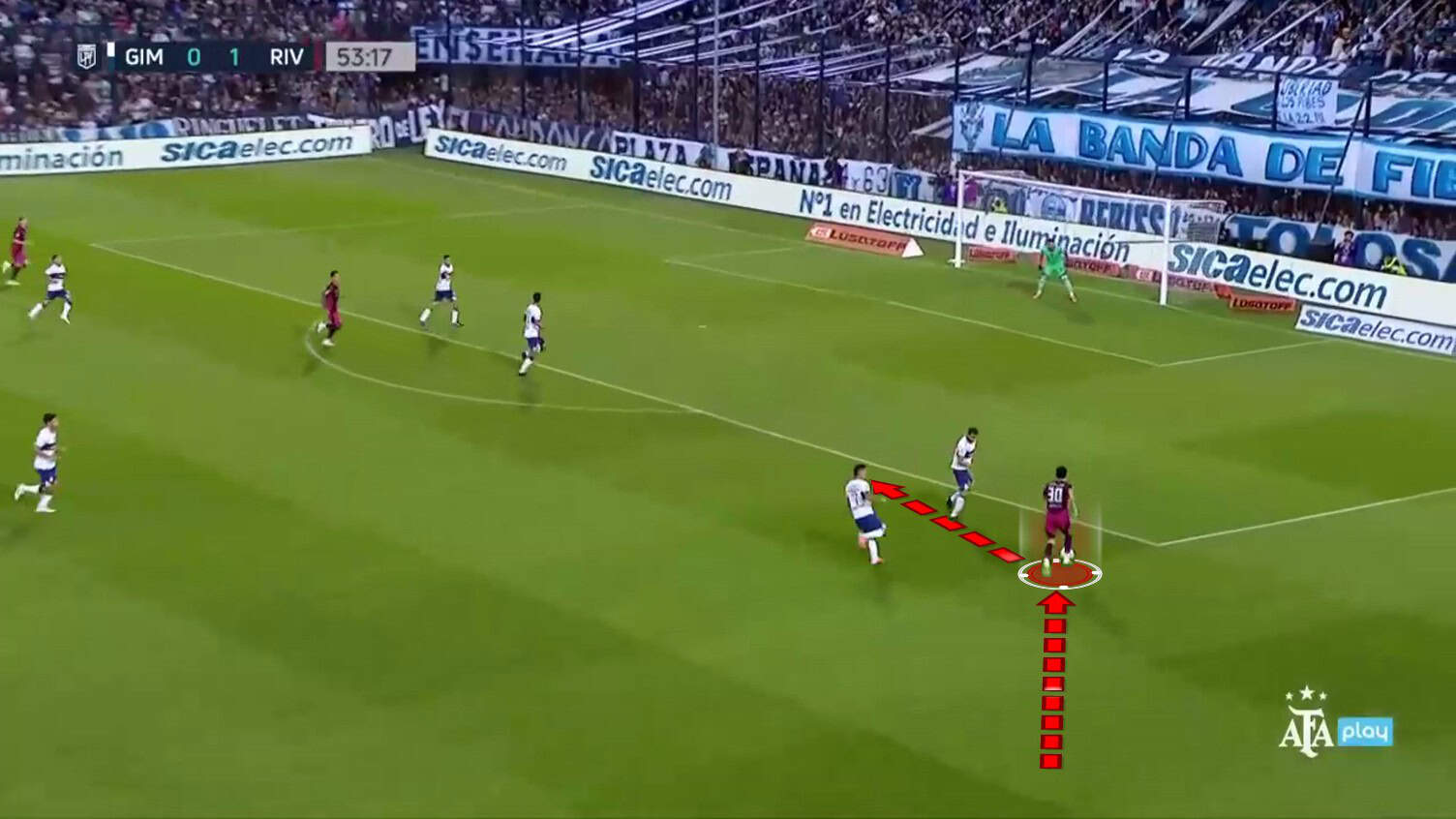
However, the young Argentinian can create not only for his teammates but also for himself.
In the picture above, we see another situation in which Mastantuono receives the ball out wide and now dribbles towards the backline.
The defenders don’t even try to cover his right foot; they are already expecting the cut to the inside because that’s what he does best.
Still, Mastantuono manages to control the tempo of the situation, stays patient, gets the defender in front of him off-balance, puts his body between the ball and the second defender, and is now able to cut inside despite getting double-teamed.
The defenders know what move he is looking for.
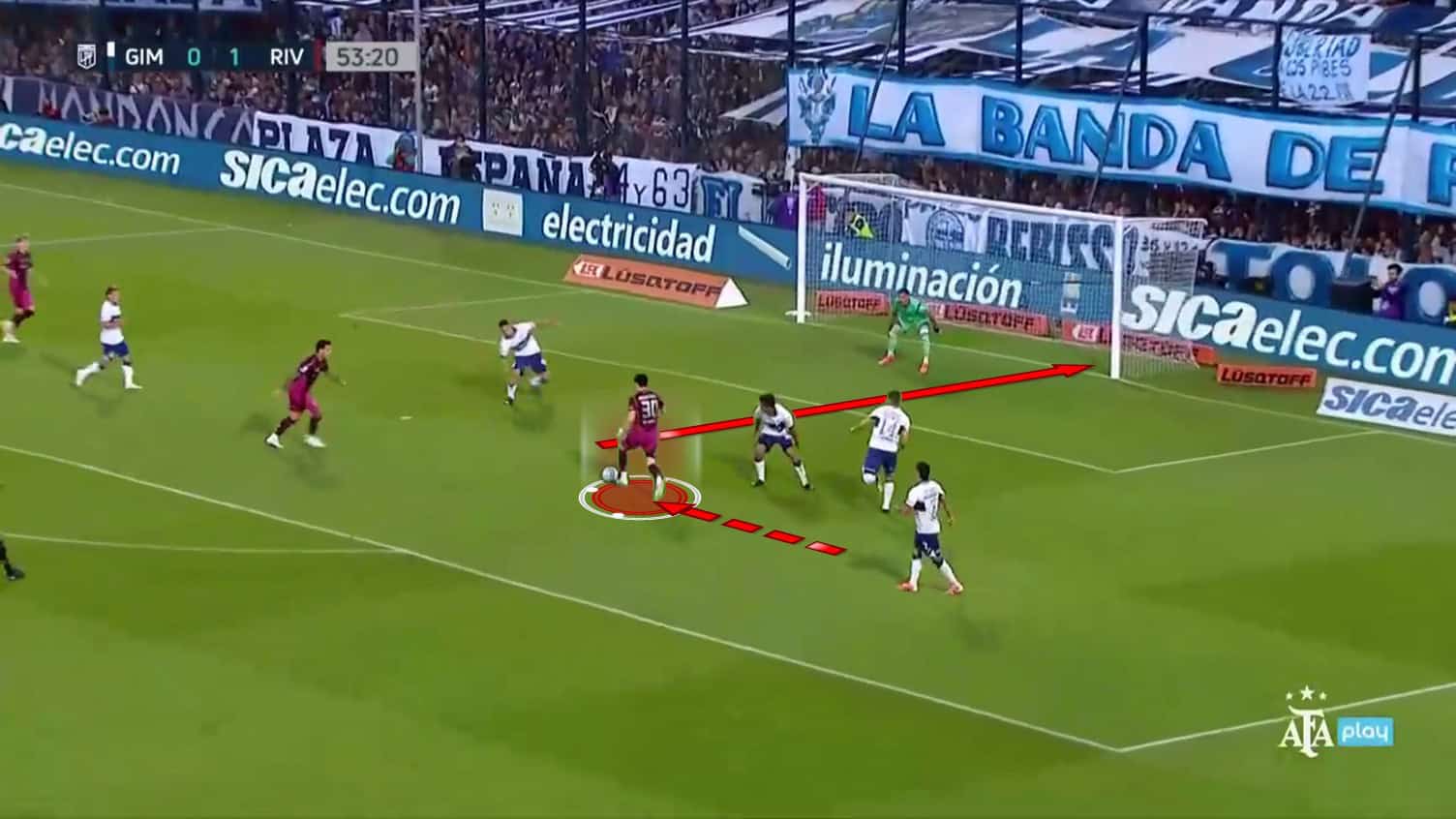
The situation continues in the box, where he once again stays patient, gets past an overly aggressive defender by simply taking a bit of tempo out of the situation, and then finishes with his left foot into the bottom right corner; an unsavable shot.
While he might not be as fast as other wingers, his ability to control the tempo of situations with subtle changes of pace and his change of direction are excellent.
Mastantuono is able to bring his strengths onto the pitch even against more experienced defenders.
However, these two situations also highlight Mastantuono’s two biggest problems in attacking play: his right foot is particularly weak, and defenders are aware of it, making him somewhat predictable in many situations.
He will need to work on that against better defenders in La Liga while still maintaining his strengths.
Franco Mastantuono Movement After Playing
Another key factor in Franco Mastantuono‘s game is his movement off the ball and his ability to maintain the game’s tempo.
While many young players struggle with spacing and positional play at the professional level, Mastantuono cleverly utilises his presence and movements to create space for his teammates and facilitate fluid combinations in the midfield.
While he often receives the ball out wide, he still manages to have a significant impact on the game overall and can pick apart opposing deep blocks with his agility and movement.
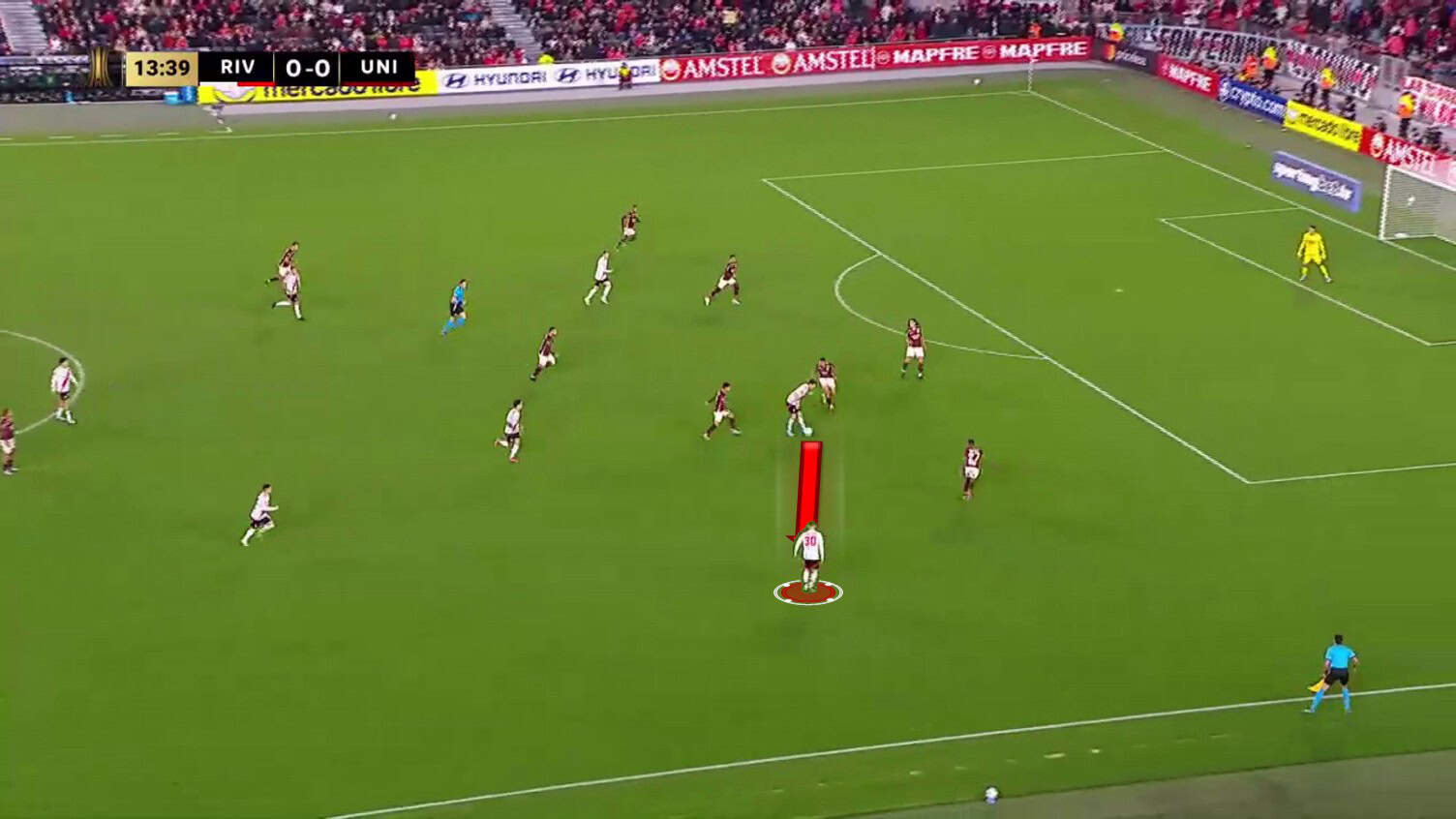
Here, we can see a typical situation for River Plate in attack.
As one of the better and most experienced teams in Argentina, River Plate often faces opponents who defend deep in their own half and are not particularly trying to attack beyond their own goal.
In these situations, Mastantuono is constantly dropping onto the wing, away from the crowded centre of the field, allowing his teammates to find him with passes to the outside and receive the ball in space.
This forces the opposing block to shift to the right-hand side in order to regain control of the situation.
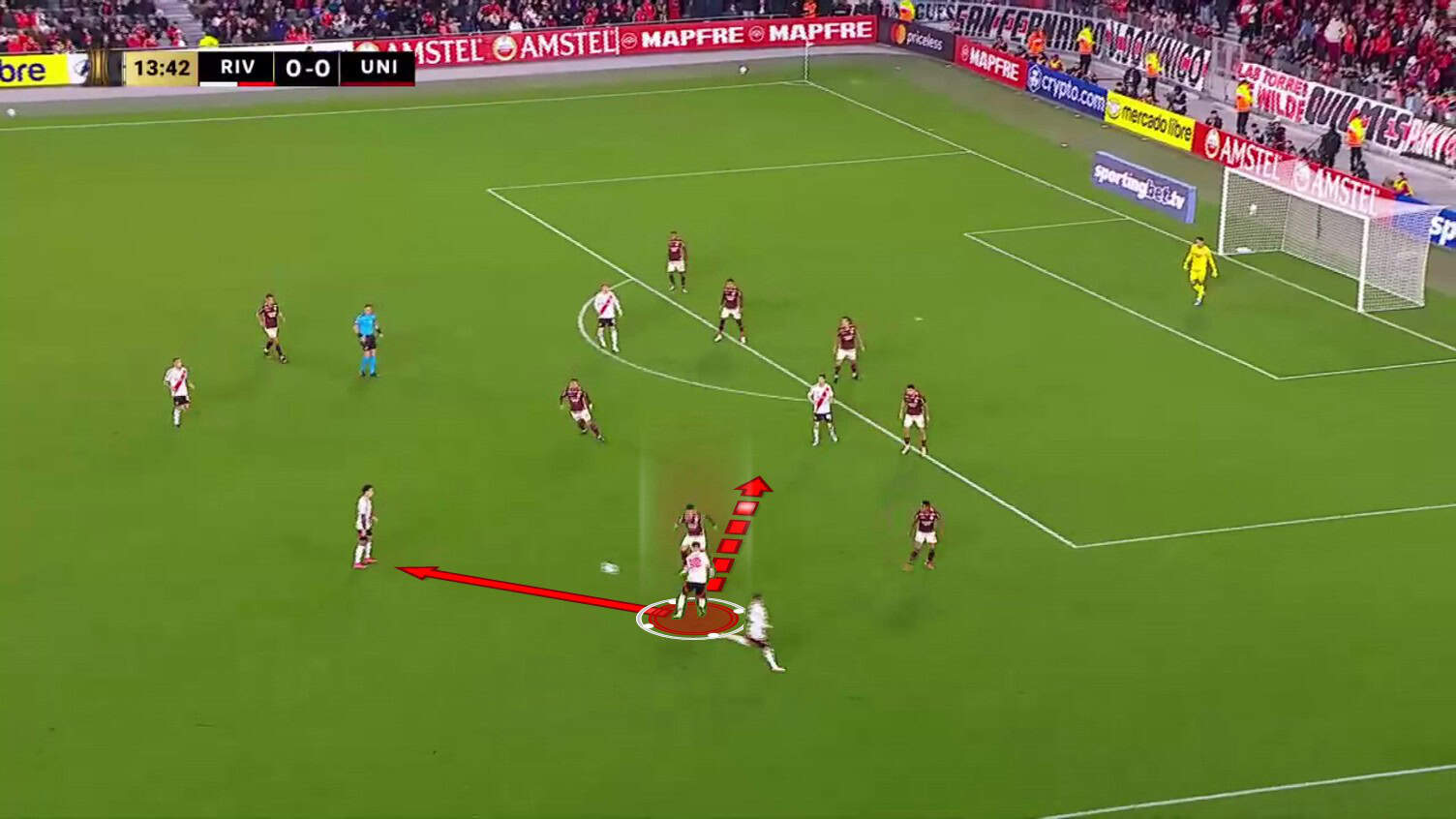
Mastantuono uses that to his advantage.
He often looks back to the inside with his first touch and pass, simply to play the ball against the direction of the block’s movement.
What’s even more important is what he does after the pass.
As we can see in the picture above, Mastantuono is not standing still after the pass.
He attracted the attention of one central midfielder, dragged him out of position, and now makes a run right into the space that this defender vacated in the block.
This allows River Plate to find a solution inside the deep block, which should prevent them from passing to the inside and creating chaos and disarray.
He then uses his great first touch to control the ball right at the edge of the box, where River Plate wanted to play towards.
With these movements, Mastantuono is always able to find space and create opportunities for vertical passes to his teammates, which is crucial for teams that often face a deep block, as Real Madrid does.
Franco Mastantuono In The Half Space
What makes Franco Mastantuono really special is that he is more than a traditional winger.
He also has qualities as an attacking midfielder, although this position is not as in demand as it was a couple of years ago.
Mastantuono is excellent at finding space, and while he excels when receiving on the outside, he might be even better when he can receive in the half-space.
This makes the young Argentinian extremely versatile in the attacking phase, allowing his coach, Marcelo Gallardo, to position him in various spots on the pitch and still be highly effective.
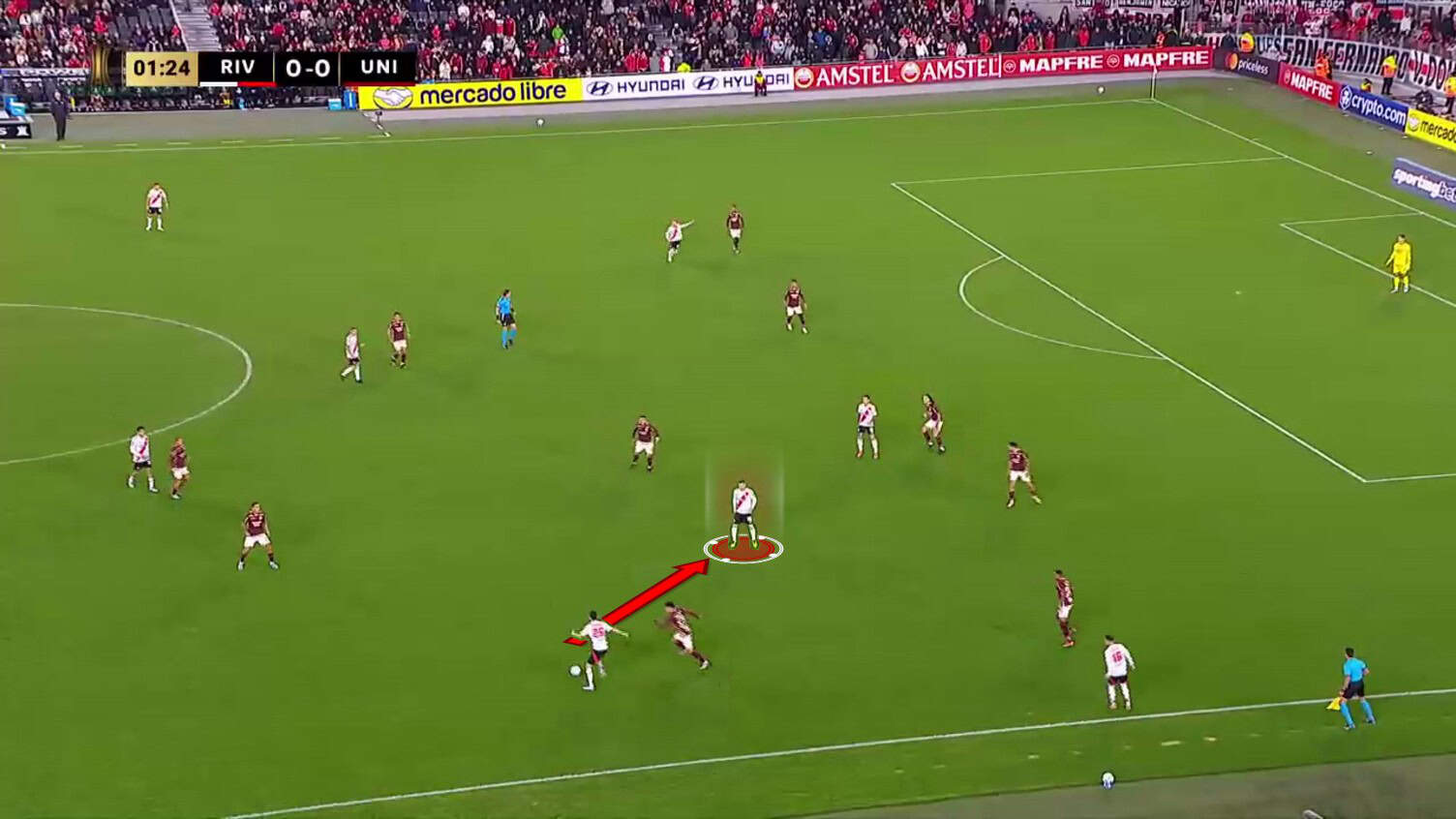
Examining this situation, River Plate primarily uses Mastantuono as an attacking midfielder when their right side is the ball-near side.
One midfielder is dropping back to the outside, and the right back is pushing up the field to provide width, which allows the right winger to move a bit to the inside and find open space in the gaps between the midfielders or between the lines.
While he is still great at getting open in space in these situations, his body position is often closed off, meaning his back is turned towards the goal; this is something he will need to work on.
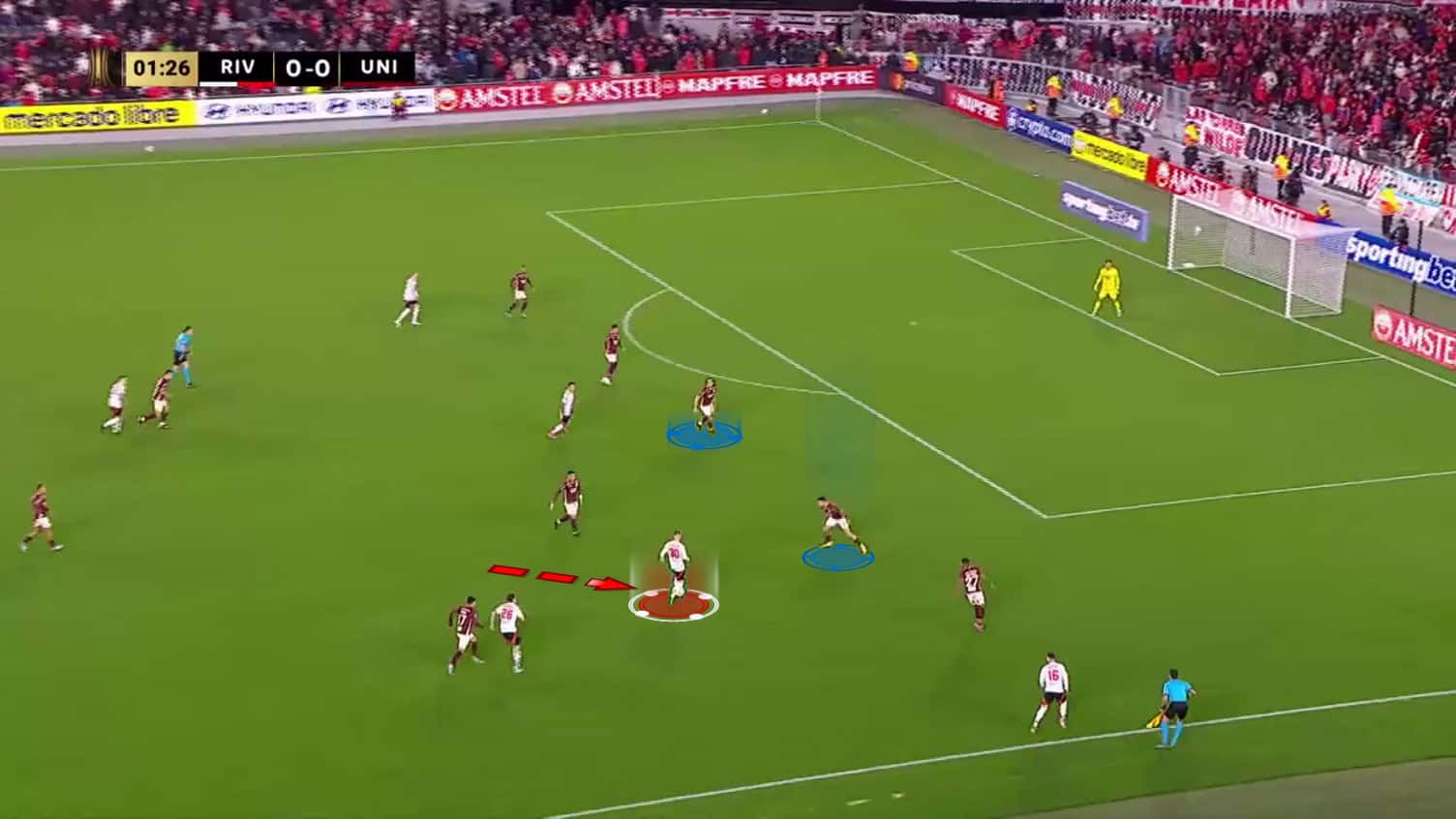
Still, he receives the pass here and is able to turn around with his first touch, once again away from the only defender near him, which means that he is moving towards the outside a bit.
Then, Mastantuono once again showcases his ability to dictate the tempo of the game and slows the game down for a bit.
Still, with his first move and his threat from around these areas, he now has two defenders locked onto him; both blue-marked centre-backs in the picture are now only looking at the young attacker.
He then cuts a bit to the inside, forcing the defenders to step out of their position and break apart the block and the last line of defence.
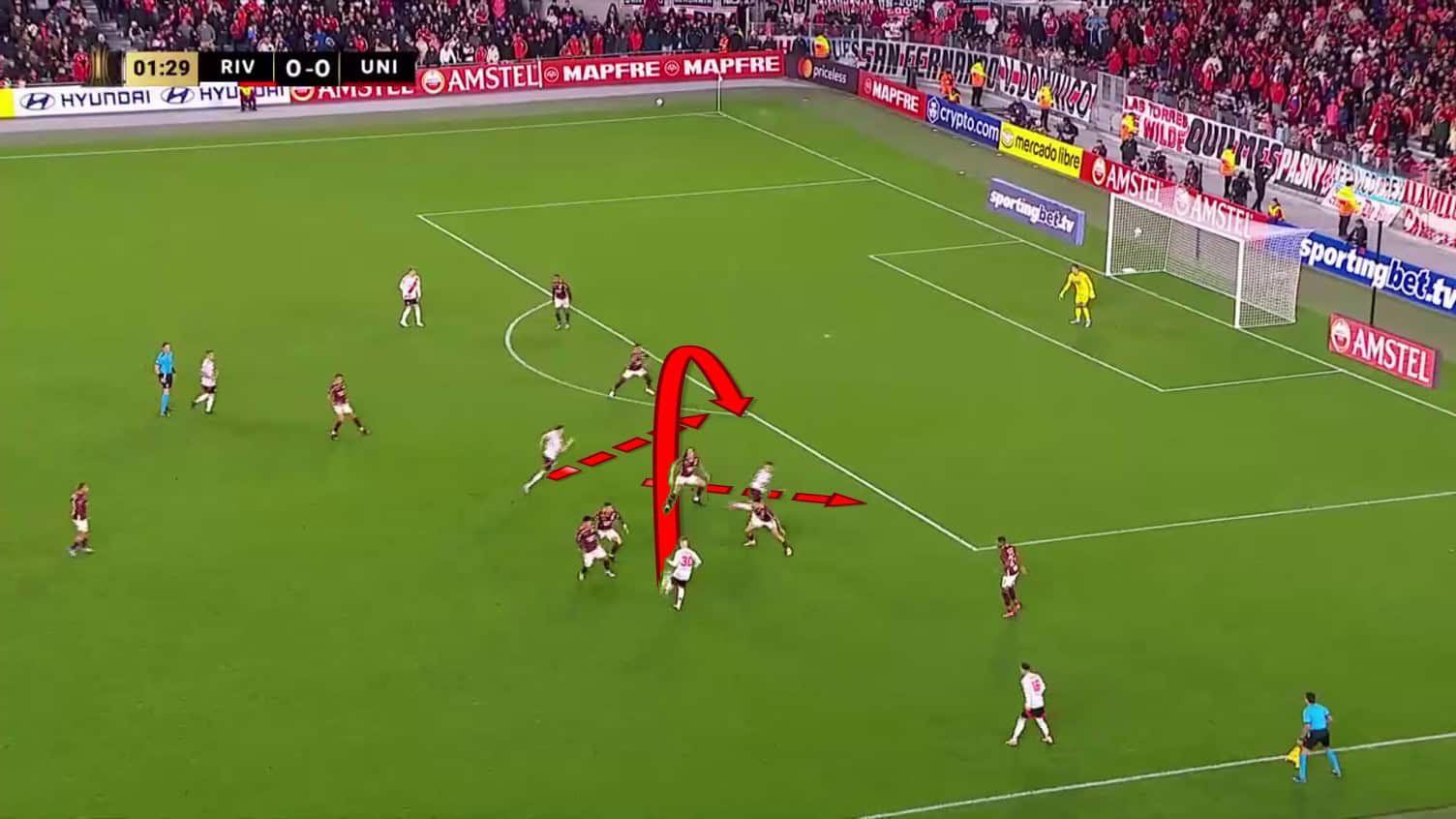
With these two defenders stepping up, Mastantuono’s teammates are offering runs behind the defensive line and threatening the space behind the backline.
The rising star showcases his technical proficiency in this situation with his next step, chipping the ball over the two defenders and right into the path of his midfielder’s run.
With situations like these, Mastantuono proves to be incredibly versatile in the attacking phase and showcases the ability to create from anywhere on the pitch.
While Franco Mastantuono’s dribbling style may be somewhat predictable, his overall game enables him to excel in any situation.
Conclusion
We have examined Franco Mastantuono playing style and strengths here, but a couple of other things need to be mentioned as well.
One thing is that he is an elite set-piece taker.
Free kicks, penalties, corners—it doesn’t matter; Mastantuono is good at all of them.
His free kick against Boca Juniors made headlines a couple of weeks back.
This also raises another point: He is assuming so much responsibility at just 17 years of age, joining an incredibly experienced team.
Mastantuono is not just an incredibly talented footballer; he is also a great human being and teammate, able to shoulder pressure and improve his teammates.
Ultimately, the step to Real Madrid will be a big one.
There will be more attention from the media, increased pressure to win, and additional pressure from his teammates, but given what Mastantuono has shown so far in his young career, I have no doubts that he will be able to make an impact.
The one thing that bugs me a bit is his position.
I personally don’t see him as a right-winger in a 4-3-3.
While we’ve discussed his strengths at length, his work against the ball still needs improvement, and I doubt that Trent Alexander-Arnold will be the one providing stability behind him.
But for now, Franco Mastantuono will be playing the Club World Cup with River Plate, so we can still enjoy his last games as a River Plate player and learn more about him.
