
Germany reached the semi-finals of the UEFA Nations League but were knocked out by Portugal before losing to France in the third-place playoff.
The DFB-Elf performance combined a promising style of play with a feeling that many aspects and choices can be improved ahead of bigger occasions, most notably the World Cup Qualifiers and the 2026 FIFA World Cup itself.
We cannot say that the performances under Julian Nagelsmann management represent a failure since he has helped the Germans reach an advanced stage in the UEFA Nations League.
Nevertheless, Germany’s performance against France confirmed that many improvements are needed, especially in the attacking phase.
Although Germany gave the impression of dominating the game, they were unable to score.
Therefore, this tactical analysis article will identify Germany’s attacking issues and explore potential short- and long-term solutions for Julian Nagelsmann’s men.
Germany Current Attacking Tactical Issues
Under the management of Nagelsmann, Germany have been using various formations depending on the opponent and the match plan, including the 4-2-3-1 formation, the 3-4-2-1 formation, the 4-1-3-2 formation, and the 5-4-1 formation.
This directly impacts the team’s attacking strategy, as it does not maintain continuity in the team’s attacking tactics and does not reinforce the chemistry among the attacking players.
For instance, playing with two strikers in a match and then switching to two wingers and a main striker can automatically disrupt the chemistry between those two strikers.
Ahead of tougher encounters and tournaments, Nagelsmann will need to settle on a plan A for his attacking organisation and a plan B for emergency reasons or specific opponents.
Limiting the attacking organisation in terms of player roles is crucial to ensure more fluid play and make things easier for the players.
This also means that switching the attacking organisation almost every match makes things very complicated for the players, who might find it hard to grasp what is needed of them.
More importantly, these recurrent changes make it difficult for players to predict each other’s next moves or to understand one another automatically.
This quick understanding between players is very important, especially for national teams, whose players do not always work together for the entire year but only occasionally.
That makes it even more fundamental not to change the attacking organisation much, gradually building the chemistry between the attacking players.
The Best Possible Attacking Organisation For Germany
As mentioned above, Nagelsmann tactics have been employing various formations recently and frequently switching his attacking players, which confirms his indecision about what works best for the current Germany.
The indecision also confirms that he is not yet convinced by any of the attempted organisations or players.
At the same time, not giving the necessary time to such organisations or player choices automatically means they are destined not to be convinced and will not change.
Therefore, Germany’s key solution is to identify the most suitable attacking organisation for the coming period and rely on it for a defined period.
It will be crucial to maintain no more than 1 or 2 formations for the upcoming period.
The 4-2-3-1 formation is better suited for Germany’s players, especially in terms of attacking, as they have many remarkable wingers, a reliable advanced playmaker, and several options for the striker role.
And since the options for the striker role are not yet convincing, given that Nagelsmann has not yet relied on a single striker for consecutive games and prefers to keep experimenting with options, it would be wiser to opt for a formation relying on a single striker and not two, until a first-choice striker is confirmed.
Germany Potential Solution In The 4-2-2-2 Formation
At the same time, Nagelsmann can prepare his players for a Plan B formation that relies on two strikers and can be used when needed.
This formation can be either the 4-1-3-2 or the 4-2-2-2, with the understanding that the 4-1-3-2 can be risky from a defensive perspective.
At the same time, the 4-2-2-2 would be more solid defensively, yet very attacking as well.

Furthermore, the striker role has been problematic for Germany during the latest period.
Nagelsmann has been using numerous names such as Tim Kleindienst, Nick Woltemade, Niclas Füllkrug, Deniz Undav, Serge Gnabry and Kai Havertz.
Germany Problematic Striker Changes
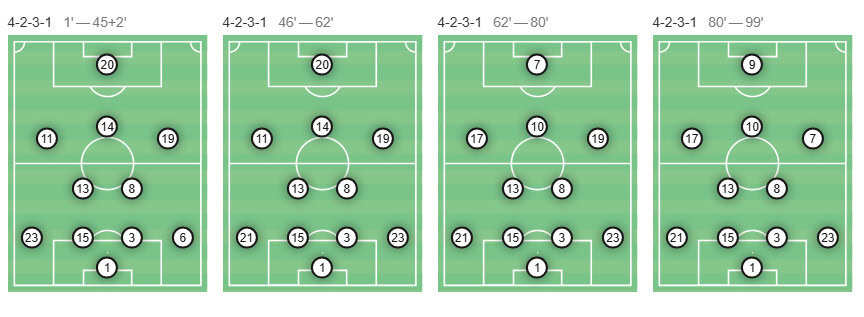
The following graphic highlights the problematic decision-making regarding this position, as Nagelsmann changed his main striker three times in a single match.
What is even more disturbing is that these changes could have been avoided mainly because experimenting with a winger like Gnabry or Havertz in the striker position of a team like Germany, when you already have plenty of natural strikers at your disposal, raises many questions about making such decisions.
Germany Possible Attacking Improvements
From a tactical perspective, Germany’s attack has considerable potential that is not being fully exploited and can be better utilised to enhance the team’s attacking performances in the near future.
These improvements include finishing, final passes and the ability to win duels inside the final third.
In addition, wingers’ actions and movements should be better organised to avoid concentrating players in the same areas and to distribute them across the field, creating the necessary space for strikers.
Although many of Germany’s attacking players are very good dribblers with reliable speed, we feel that their speed and dribbling abilities are not impactful on the pitch, and that their play is not organised.
A number of attacking plans should be adopted, utilising these wingers in specific areas to allow them to cross or cut inside, and then following them with specific strikers or midfielders coming from behind to create unpredictable, well-structured actions.
Germany Lack Of Striker Movement & Passing Issues
In the following example of an attacking action of Germany when they met France, we can notice the hesitation from the ball holder and the potential receiver of the pass, who did not try to advance to receive the ball while running, but waited and remained static because he was not certain that he would receive such a through pass.
On the other hand, Leon Goretzka was hesitant about his passing option and ultimately did not provide a through pass, instead opting for a simple pass that slowed down the pace of the attack.
It is true that Füllkrug then passed it to Nick Woltemade, who shot on target.
However, the example highlights Germany’s struggle to attack quickly, as they do not have specific pre-prepared plans and tend to improvise frequently.
This makes defences close them down more efficiently and limit their danger with less effort.
In this action, it would have been much more surprising and impactful against France’s defence to opt for a through pass following Füllkrug’s movement without the ball to exploit that space left between the defensive line and the goalkeeper.
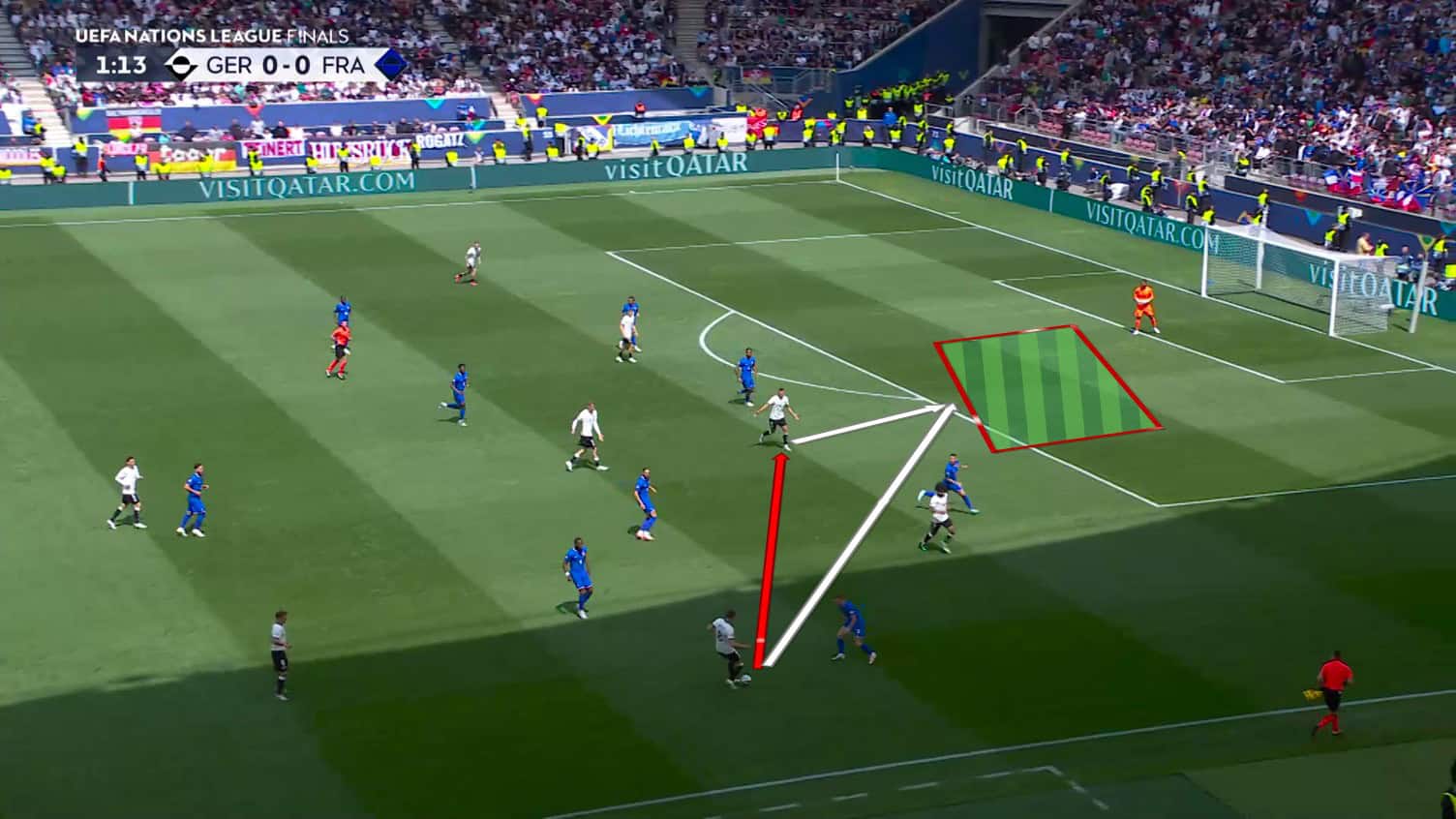
Füllkrug’s decision to remain static and avoid running without the ball highlights the problematic movements of strikers in the box, which can create space and open up dangerous passing opportunities for teammates.
Working on such aspects would make Germany’s attacking performances much more dangerous, no matter which names are used for the striker role(s).
Germany Finishing Issues
Furthermore, addressing the finishing issue within the team will be crucial, as Germany’s current squad has shown they are missing chances in a disappointing way that does not align with their abilities as world-class players representing a prestigious team like Germany.
During the same action shown above, Woltemade’s handling of the ball he received put him in a one-on-one situation with the goalkeeper, which looked strange since he made the worst possible decision when shooting, directing the ball exactly where the goalkeeper was standing.
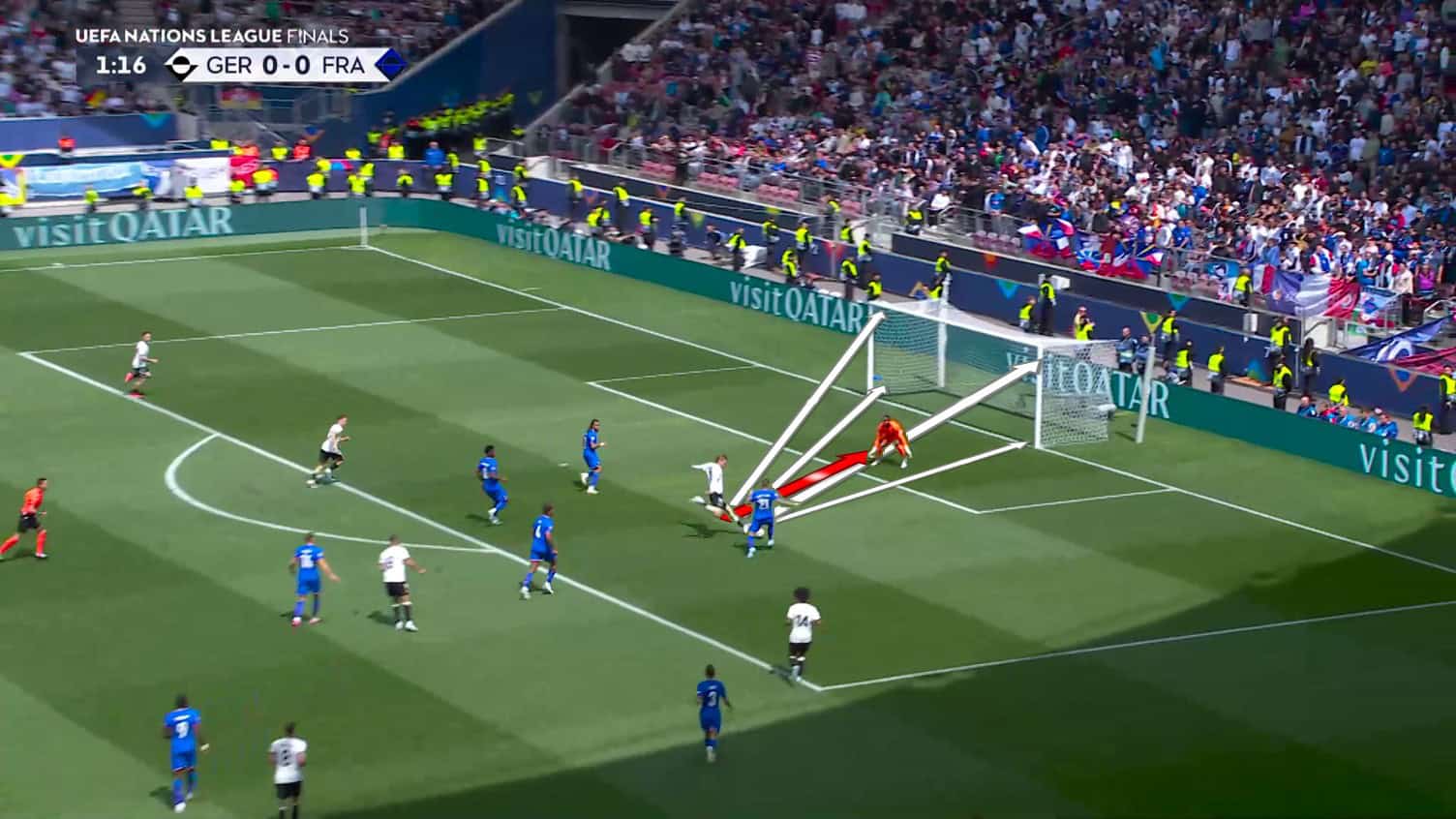
Since such finishing problems are becoming recurrent within the team, the coaching staff have two solutions: Either working intensively with the attacking players on finishing and decision-making inside the box or opting for more crucial players inside the box.
Germany Potential Attacking Changes
The most important topic to address during this period is the selection of a striker for Germany’s future encounters. Relying on different strikers in each half would be disturbing for the whole team.
In this regard, whether using the 4-2-3-1 or 4-2-2-2 formation, it will be crucial to select a plan A striker and a plan B striker.
Füllkrug scores 0.51 goals per match, has an xG of 0.49, and attempts 2.27 shots per game.
Woltemade scores 0.52 goals per match and has an xG reaching 0.47, with 2.14 shots per match.
Deniz Undav’s scoring rate is 0.56, and his xG is 0.55; he attempts 3.49 shots per match.
This favours the duo of Undav and Woltemade, with Tim Kleindienst and Füllkrug as backup options, especially considering that a player of Woltemade’s height is much needed, particularly during set-pieces.
Therefore, it will be important to work with Woltemade on finishing and improving his movements without the ball to make him a much more decisive goalscorer.
Making him the team’s main striker would be the best actual solution for Germany since they do not have better players at the moment.
At the same time, it would be beneficial for the team to use Undav, Tim Kleindienst, or Füllkrug as backup options to replace Woltemade whenever needed, or to play alongside him when switching to the 4-2-2-2 formation.
If one or two of these strikers do not fit Nagelsmann’s playing system, plan C would be to give Jonathan Burkardt more time.
He would represent a reliable alternative if these strikers are out of form.
Reliance on these names simultaneously, without giving any of them the time to confirm their abilities or build the confidence needed, should be avoided.
Therefore, making long-term choices and relying on plans A, B, and C will be important.
If using the 4-2-3-1 formation, it would be advantageous to select Jamal Musiala as a first-choice advanced playmaker, as he is one of the best German players in this role.
The second option for this position would be Julian Brandt, who is also a talented and experienced advanced playmaker.
And for the wingers, Germany does not have a problem at all in these positions since there are plenty of excellent wingers at Nagelsmann’s disposal.
That said, it will also be important to rely on plans A, B, and C for these roles to guarantee continuity and chemistry within the attacking trio.
Names like Leroy Sané and Serge Gnabry deserve the two wingers’ roles as they are quick enough and can create danger, whether by dribbling and cutting inside or by crossing.
The second choice would be Kai Havertz, a natural winger rather than a striker, and Karim Adeyemi, a very promising winger who needs attention and playing time to become a world-class player in the near future.
Florian Wirtz remains a valid option for the wings, too, but he needs to earn his starting spot.
Conclusion
Germany will need to make significant tactical adjustments from an attacking perspective to improve their performances ahead of major tournaments.
These changes will need to be based on clear attacking plans and instructions, as well as targeted player choices with clear preferences, to ensure consistency and continuity in both individual and collective performances.
