
Florentino Luís is a 25-year-old defensive midfielder, currently playing for SL Benfica.
He has been one of the most consistent performers in Liga Portugal over the last three seasons.
Born in Angola, he moved to the Lisbon region of Portugal with his family at a very young age, where his football journey began.
His first steps in organised sport came through futsal, competing at regional level for GR Tercena, where he quickly stood out for his intelligence and composure on the ball.
After two years, he shifted his focus to football and joined Real Sport Clube, where he stayed only one season before joining Benfica at the age of 10.
From that point onward, he completed his entire development at the Seixal Academy, where he was regarded as one of the most talented players of his generation.
His rise through the ranks was steady and impressive.
He became a regular figure in all of Portugal’s youth national teams and played a key role in winning the U17 and U19 European Championships.
In the 2018/2019 season, after two strong years with Benfica B, Luís was promoted to the first team by Bruno Lage, who had just taken over as head coach from Rui Vitória.
Still just 19 years old, he made 11 appearances in the league during the second half of the campaign, contributing significantly to Benfica’s title win.
The following season, he featured in 18 matches, but after Lage left the club, his influence and playing time started to decline.
Looking for consistent minutes, Luís moved on loan to AS Monaco for the 2020/2021 season.
There, he found opportunities limited behind Aurélien Tchouaméni (now at Real Madrid), playing just 11 matches in all competitions.
The following season, he was loaned again, this time to Getafe in La Liga, where he made 24 appearances and played over 1,100 minutes, although he still did not secure a guaranteed starting role.
Everything changed with the arrival of Roger Schmidt in the summer of 2022.
The German coach quickly recognised Luís’ qualities and trusted him with a central role in midfield.
In the 2022/2023 season, he played 54 matches out of a possible 55, becoming a cornerstone in Benfica’s structure.
That level of consistency continued into the next two seasons, with 45 appearances in 2023/2024 and 43 more in 2024/2025.
During this period, Luís evolved into one of the most tactically intelligent and reliable defensive midfielders in the Portuguese league, consistently performing well in the UEFA Champions League.
His ability to win the ball cleanly, anticipate play, and control space has caught the eye of top clubs across Europe.
Liverpool, Manchester United, Arsenal, Barcelona, Bayern Munich, Everton, Nottingham Forest, Fulham, and most recently, Napoli, have all been linked with potential transfers.
Despite his growing interest and proven performance level, a transfer abroad has never materialised.
Why hasn’t Luís made the move to a top-five European league yet, despite being on the radar of so many elite teams?
And now, with his prime years approaching, is he finally ready to step onto the biggest stages in world football and prove himself as one of the best in his role?
To provide a complete answer, this scout report will explore his career trajectory, tactical attributes, and potential fit in the top leagues.
Listen to this article free on the Total Football Analysis Podcast via Spotify, Apple Podcast, or RSS.
Florentino Luís Style Of Play
Florentino Luís is, and always has been, a defensive midfielder by nature.
From a young age, his game was built around intelligence, anticipation, and control, both with and without the ball.
Out of possession, he stands out for his exceptional positioning, ability to read the game several seconds ahead, and outstanding capacity to recover possession cleanly and efficiently.
He excels in covering space, screening the back line, and closing passing lanes with minimal need for physical contact, relying instead on his timing, footwork, and awareness.
On the ball, Luís shows composure under pressure, clean technique in passing, and a preference for simplicity.
During his development years, Luís was primarily used as the deepest midfielder in a three-man midfield, often deployed as the lone pivot, which allowed him to focus more on his defensive tasks and control the game from deeper zones.
However, he was also comfortable operating in a double pivot system or even slightly higher as a central midfielder, showing that he can adapt to all three central roles depending on tactical needs.
This tactical flexibility was tested extensively during his time with Benfica B between 2016 and 2019.
During that period, the team regularly alternated between a 4-3-3 and a 4-4-2 shape, with Luís thriving in both, albeit particularly in the deepest role where his positional discipline and ball-winning qualities stood out.
His breakthrough with the senior team came in the 2018/2019 season, when Bruno Lage introduced him into the Benfica first team in a 4-4-2 formation, slotting him into the double pivot.
This tactical setup carried into the following season, allowing him to continue developing his understanding of that role.
During his loan spells, he was again trusted as a defensive midfielder.
He featured in a double pivot at AS Monaco, although opportunities were limited behind Tchouaméni.
Later at Getafe, he operated in all three midfield roles within a 3-5-2 shape, adapting his game to La Liga’s tactical and technical demands.
It was under Roger Schmidt, though, that Luís truly established himself.
Playing in a 4-2-3-1 structure, consistently paired with a more attack-minded midfield partner, he was given the ideal platform to shine.
He protected the backline, dominated central spaces, and dictated the tempo during the build-up phase.

Roger Schmidt system, centred around intense pressing and structured possession, brought out the best of his skill set, and he maintained this level over three consecutive seasons.
But wasn’t Luís always this player?
And did he need a coach like Roger Schmidt and the long-awaited regularity to unlock the talent that had always been there?
We will explore that further in the next section.
Understanding Florentino Luís Through the Numbers
To better understand Florentino Luís statistically, we selected five defensive and five offensive metrics from the 2024/2025 season.
We compared them to players in similar roles across Europe’s top five leagues, particularly Rodri, Declan Rice, Joshua Kimmich, Aurélien Tchouaméni, and Bruno Guimarães, to assess whether Luís’ numbers reflect the level required to compete among Europe’s elite.
This comparison will allow us to evaluate his current level and highlight the areas where he stands out, or still has room to grow.
Next, we will examine his statistical profile over the previous seasons, starting with his senior debut.
This longitudinal analysis will help us understand whether this version of Luís has always existed and, if so, whether a lack of trust or misusage may have delayed his rise to the top.
Let’s now dive into the comparison with the world’s top defensive midfielders.
This analysis is based on data from the 2024/2025 season for all players, with one exception: for Rodri, we used his metrics from the 2023/2024 campaign, as he was absent for much of the current season due to injury.
This will help us understand how Luís compares to the very best in his position.
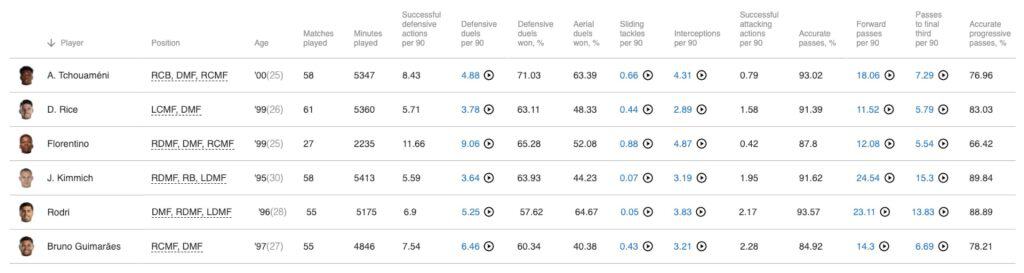
Florentino Luís Defensive Metrics
1. Successful defensive actions per 90 – Luís leads the group with 11.66, significantly ahead of the rest.
Tchouaméni comes second with 8.43, Bruno Guimarães comes third with 7.54, while Rodri, Rice and Kimmich sit between 5.5 and 6.9.
Luís is the most active defensive midfielder among the six in terms of defensive interventions per game.
2. Defensive duels per 90 & % won – Luís registers 9.06 duels per game, the highest, with a solid 65.28% success rate.
Bruno Guimarães follows with 6.46.
In contrast, Tchouaméni, despite having the highest success rate (71.03%), engages less often (4.88).
Luís combines volume and efficiency, something only a few midfielders can match.
3. Aerial duels won% % – Luís stands at 52.08%, behind Rodri (64.67%) and Tchouaméni (63.39%), but above Rice (48.33%), Kimmich (44.23%), and Guimarães (40.38%).
This is an area where he shows average performance and room for growth.
4. Sliding tackles per 90 – With 0.88 per game, Luís is the most aggressive.
Kimmich and Rodri attempt far fewer (0.07 and 0.05, respectively).
This reflects a more intense and risk-oriented defensive style.
5. Interceptions per 90 – Luís tops the list again with 4.87, ahead of Tchouaméni (4.31) and Rodri (3.83).
Exceptional anticipation and positioning are clear strengths.
Florentino Luís Offensive Metrics
1 . Accurate passes% % – Luís registers a strong 87.8% passing accuracy, which places him above Bruno Guimarães (84.92%) and close to the 90% benchmark often associated with elite midfielders.
Although he doesn’t yet reach the exceptional levels of Rodri (93.57%), Kimmich (91.62%) or Rice (91.39%), his consistency under pressure and ability to retain possession show that he is a reliable presence in build-up play.
2. Forward passes per 90 – With 12.08 forward passes per 90 minutes, Luís outperforms Declan Rice (11.52) and is very close to Bruno Guimarães (14.3).
While he doesn’t reach the top-end volumes seen with Rodri (23.11) or Kimmich (24.54), it’s clear that he contributes to progression, albeit with a more cautious approach.
3 . Passes to final third per 90 – Luís completes 5.54 passes into the final third per 90, placing him on par with Rice (5.79), and very close to Tchouaméni (7.29) and Bruno Guimarães (6.69).
Although he’s far from Rodri (13.83) and Kimmich (15.3), who operate in possession-dominant systems and assume more creative responsibilities, Luís still ensures his team advances with purpose when opportunities arise.
4. Accurate progressive passes% %—This is an area where Luís can still evolve.
With 66.42% accuracy in progressive passes, he trails behind Rodri (88.89%) and Kimmich (89.84%), who are masters at advancing play while minimising turnovers.
Improving precision in these high-value passes will be key for Luís to elevate his overall impact with the ball, particularly if he aims to thrive at a club where controlled possession is vital.
5. Successful attacking actions per 90 – At 0.42, Luís’ output is very close to Tchouaméni’s (0.79), reflecting the more defensive nature of their roles.
These numbers are naturally lower than Bruno Guimarães (2.28) or Rodri (2.17), who are more involved in offensive build-up and final-third actions.
Luís’ job, however, is often to regain the ball and quickly distribute it to more advanced teammates, a vital, if less glamorous, contribution to the team’s structure.
To conclude this statistical comparison, when measured against some of the best defensive midfielders in world football, Florentino Luís presents a compelling case in several key areas.
Defensively, he is among the most active and highly effective, leading in defensive actions per 90 minutes, defensive duels, and interceptions.
His numbers demonstrate both consistency and intensity, painting the picture of a true ball-winner, a player who thrives in disrupting play and regaining control for his team.
On the ball, while Luís doesn’t yet reach the elite creative standards of players like Rodri or Kimmich, he shows steady performance and clear potential.
He already surpasses players like Declan Rice and Bruno Guimarães in key passing areas and contributes actively to build-up play, albeit with a more conservative approach.
His lower metrics in progressive passing accuracy and final-third impact reveal areas for development if he is to become a more complete midfielder, capable of thriving in teams that dominate possession and rely on control in all phases.
Although he is still only 25, Luís’ statistical profile positions him as a top-tier defensive anchor who could comfortably play at the highest level of European football.
We now shift our focus to a longitudinal analysis of Florentino Luís’ career.
By examining his performance season by season since his senior debut, we aim to determine whether the qualities he displays today were consistently present, and if his rise was hindered by tactical setups, coaching choices, or a lack of consistent trust and playing time.
Let’s explore how Luís has evolved throughout his senior career.
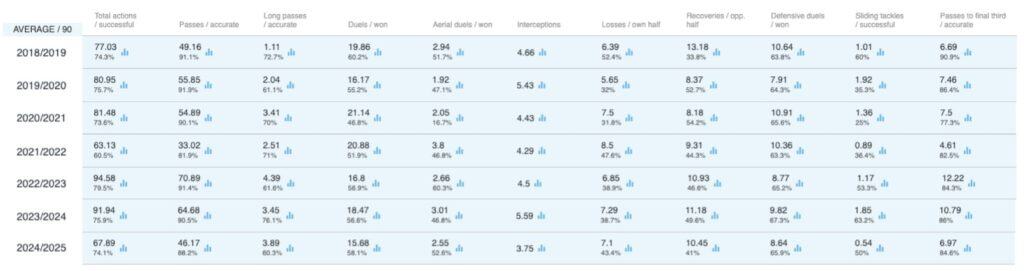
This deeper view enables us to understand how his numbers have evolved over time, and whether the potential he demonstrates today has always been present, simply waiting for the right context to be revealed.
Florentino Luís 2018/2019: The Breakthrough
Luís’ debut season saw him perform at a promising level.
He averaged 77.03 total actions per 90 minutes, with a strong 74.3% success rate, and recorded 19.86 duels per 90 minutes, winning an impressive 60.2%.
This highlights his already active and combative defensive approach.
His interception numbers (4.66) and recoveries in the opposition half (13.18) were also remarkable for a 19-year-old.
Despite limited long passing volume (1.11 per 90), his accuracy in passes to the final third stood at 90.9%, showing composure in progression.
Florentino Luís 2019/2020: The Follow-Up
In his second full season, his overall involvement increased (80.95 actions/90), and his passing metrics improved across the board.
He registered 55.85 accurate passes per 90 and attempted more long balls (2.04), while maintaining a solid duel success rate (55.2%).
He also posted 5.43 interceptions per 90, reinforcing his ability to read the game.
Though recoveries in the opposition half dropped (8.37), the data still reflected a strong defensive anchor.
Florentino Luís 2020/2021: Less Game Time, Same Stability
Luís continued to produce solid numbers, especially in duels (21.14 per 90) and recoveries.
His long passing frequency saw a sharp rise (3.41 per 90) while keeping decent accuracy.
Still, he remained consistent with 10.91 defensive duels per 90 and 54.2% recovery success in the opposition half.
Florentino Luís 2021/2022: The Least Productive Season
This campaign marked a statistical dip, likely linked to his rotational role at Getafe.
Luís averaged only 63.13 actions per 90, with just 33.02 accurate passes and lower output in interceptions, recoveries, and duel volume.
It was also his worst season in terms of possession losses and progressive contribution, suggesting he wasn’t used in a system that fully utilised his strengths.
Florentino Luís 2022/2023: The Renaissance
Under Roger Schmidt coaching style at Benfica, Luís flourished.
He reached his highest involvement (94.58 total actions) and registered 70.89 accurate passes per game.
His long passing and passing to the final third peaked (4.39 and 12.22, respectively) alongside very strong recovery numbers (10.93).
His defensive duel success stayed consistent (65.2%), and he became one of Europe’s most complete holding midfielders.
Florentino Luís 2023/2024: Maintaining The Standard
Luís maintained a very high level in 2023/2024.
He averaged 91.94 actions per 90 and 64.68 passes, with improvements in duel success (18.47 per 90).
His interceptions peaked (5.59), as did his recoveries in the opposition half (11.18), showing defensive leadership and spatial awareness.
He also recorded one of his best passing-to-final-third stats (10.79, with 86% accuracy), proving his growth in progression.
Florentino Luís 2024/2025: Reduced Volume, Similar Efficiency
In the most recent season, his total involvement dropped (67.89 actions) due to squad rotation.
Still, his accuracy in long passes and passes to the final third remained high (60.3% and 84.6% respectively), while defensive numbers like duels won (58.1%) and recoveries (10.45) stayed solid.
Though he wasn’t as dominant statistically, the consistency of his profile remains evident.
This longitudinal overview reveals a clear trend.
When Luís was given trust and continuity, as in 2018/2019, 2022/2023, and 2023/2024, his numbers reflect elite-level performance.
The 2021/2022 season stands out as an anomaly due to limited use and role misfits, while the latest dip in 2024/2025 is also due to squad rotation.
The consistency in his passing, duels, and defensive contributions over the years proves that the talent was always there; what changed was opportunity, tactical context, and trust from the manager.
Florentino Luís, statistically, has shown he can operate at the level of Europe’s best, and may still have another gear to reach.
Florentino Luís Out Of Possession: Pressing, Positioning, Duels & Defensive Intelligence
Florentino Luís has built his reputation primarily through his work without the ball; he consistently demonstrates elite-level defensive instincts and execution, making him one of Europe’s most reliable holding midfielders.
This section breaks down his game out of possession into four key components.
Florentino Luís Recoveries After Pressing
Luís is an aggressive presser who frequently initiates pressure high up the pitch.
His timing and anticipation allow him to intercept passes or force opponents into rushed decisions.
He reads triggers effectively and commits to pressing actions with intensity and discipline.
Once the ball is lost, he immediately engages to recover possession, often regaining control in dangerous areas.
This makes him instrumental in counter-pressing moments, especially in teams prioritising fast recoveries.
Florentino Luís Defensive Positioning
Positionally, Luís excels in maintaining a balance between covering passing lanes and protecting the backline.
He constantly scans his surroundings, ensuring he is in the right place to block or intercept.
His spatial awareness enables him to cut out through balls and anticipate the progression of play.
He is particularly effective when sitting in front of the defence, narrowing spaces and dictating the opponent’s passing options.
He maintains composure and discipline in a low block or during transitional moments.
Florentino Luís Duels & Tackles
Luís is one of the most active midfielders in Europe in terms of defensive duels per 90.
He competes with tenacity and uses his timing to win tackles cleanly, avoiding fouls.
In one-on-one situations, he often forces opponents backwards or isolates them from support.
He uses his body well to shield the ball and can recover it even when slightly out of position.
His tackling technique is controlled but assertive, making him effective both in open play and tight areas.
Florentino Luís Defensive Intelligence
What truly sets Luís apart is his game intelligence on the defensive side.
He recognises patterns and adjusts his positioning accordingly, often making interventions before the danger fully develops.
He understands when to step up, when to hold his line, and when to cover teammates.
Luís rarely overcommits and shows maturity in choosing his defensive actions.
This cerebral approach to defending allows him to anchor the midfield with confidence and control.
Florentino Luís In Possession: Build-Up, Progression, Creation & Final Third
While Florentino Luís is primarily known for his defensive qualities, his contribution in possession is an important aspect of his profile and has steadily evolved in recent seasons.
Although not a naturally creative or flashy midfielder, his intelligence, positioning, and passing security provide a reliable base in Benfica’s build-up and progression phases.
To better understand his offensive contribution, we will break this section down into four key subtopics: build-up play, ball progression, chance creation and final third involvement, and finally, his decision-making on the ball.
Florentino Luís Build-Up Play
Florentino Luís plays a crucial role in Benfica’s first phase of construction.
He frequently drops near the centre-backs and full-backs to provide a passing outlet and help progress the ball from deep.
His positioning and composure allow him to circulate possession effectively and absorb early pressure from the opponent’s first line.
He prioritises security and tempo control in this role rather than taking unnecessary risks.
Florentino Luís Ball Progression
When looking to move the ball forward, Luís tends to favour short-to-mid range vertical passes.
He is not a high-volume line-breaker, but he shows intelligence in identifying gaps and timing his passes well.
He also contributes by carrying the ball through open space when pressure is light, maintaining balance and control.
This makes him a functional and reliable progressive option, especially when the team is not pressed aggressively.
Florentino Luís Chance Creation & Involvement In The Final Third
Luís is not typically involved in the final actions or creation of chances; his offensive impact is more indirect, through ball recoveries and connecting passes that help the team advance into the final third.
He rarely attempts risky through balls or crosses, and doesn’t often position himself close to goalscoring zones.
Still, his quick and clean ball distribution ensures the attacking players receive the ball in favourable conditions.
Florentino Luís Decision-Making & On-Ball Intelligence
Luís’ decision-making with the ball is generally safe and consistent.
He reads pressing triggers well and often avoids getting caught in difficult areas.
His body orientation and scanning habits allow him to assess nearby options and play to the free man quickly.
Although he doesn’t play with high levels of creativity or flair, his intelligence allows him to fulfil his role with minimal error.
Ideal Clubs For Florentino Luís Transfer In Europe’s Top-Five Leagues
Florentino Luís Transfer To Liverpool
With Arne Slot taking over from Jürgen Klopp, Liverpool’s midfield underwent notable changes during the 2024/2025 season.
Slot transformed Ryan Gravenberch from a box-to-box midfielder to a complete defensive midfielder, often deploying him as the deepest player in a 4-3-3 setup.
In this role, Gravenberch acted as the single pivot, granting greater offensive freedom to Alexis Mac Allister and Dominik Szoboszlai.
In matches where Liverpool adopted a 4-2-3-1 formation, the Dutchman shared defensive responsibilities with Mac Allister, forming a more balanced double pivot.
However, with Wataru Endō’s departure expected and no other true defensive midfielder in the current squad, Liverpool clearly lacks depth in this key area.
The potential arrival of Florian Wirtz would address the advanced midfield role, not the defensive one, making it even more necessary to sign a specialist ball-winner.
Florentino Luís could be the ideal solution.
He would offer Arne Slot both a natural rotation option for Gravenberch in the 4-3-3 and a reliable partner in the 4-2-3-1 double pivot.
With the arrivals of Jeremie Frimpong and possibly Milos Kerkez, a structural shift to a 3-4-3 system could be on the horizon.
Luís would also fit naturally into a midfield duo tasked with providing defensive stability in that setup.
With a midfield unit built around Luís, Gravenberch, Szoboszlai, Mac Allister, Wirtz and Curtis Jones, the Reds would have both technical quality and tactical flexibility to compete on all fronts.
Florentino Luís Transfer To Tottenham Hotspur
With Ange Postecoglou’s departure already confirmed and Thomas Frank potentially set to be the next Tottenham Hotspur manager, it remains unclear how the team will line up tactically in 2025/2026.
What is clear, however, is that they are in urgent need of a defensive midfielder.
While their options in more advanced midfield roles are solid—James Maddison, Pape Sarr, Yves Bissouma, Lucas Bergvall, and even Dejan Kulusevski have featured centrally—there is a clear lack of natural ball-winners.
Rodrigo Bentancur, despite being technically gifted and composed under pressure, lacks the defensive dominance required to anchor the midfield alone.
Archie Gray, recently signed and full of potential, is still just 19 and cannot yet be trusted with sole responsibility in such a demanding position.
Spurs finished the season as the fifth-most scored-on side in the Premier League — a telling indicator of the need for better control in defensive transitions and central protection.
Florentino Luís would represent a valuable solution.
Regardless of the new manager’s tactical preferences, his presence would bring much-needed balance and structure to a midfield that too often lacks resistance without the ball.
He could play as the deepest midfielder in a 4-3-3, providing cover behind more attack-minded players, or operate alongside Gray or Bentancur in a double pivot.
His ball-winning ability, positional discipline, and consistency make him a perfect candidate to stabilise the midfield while allowing others to thrive higher up the pitch.
In a squad needing restructuring, Luís could be a foundational piece around which to rebuild.
Florentino Luís Transfer To AC Milan
In their pursuit of returning to former glory, AC Milan is assembling a squad packed with exciting attacking talent.
With names like Rafael Leão, Samuel Chukwueze, Christian Pulisic, and Santiago Giménez, they possess plenty of firepower up front.
Defensively, they are equally solid, boasting a backline filled with players entering or already in their prime, including Strahinja Pavlović, Malick Thiaw, Matteo Gabbia, Fikayo Tomori, and Theo Hernández.
However, with Tijjani Reijnders expected to depart for Manchester City, the midfield is looking thin.
The current options, Youssouf Fofana, Yunus Musah, and the less-used Ruben Loftus-Cheek and Warren Bondo, are not enough to sustain a full season of high-level competition.
A midfield overhaul is clearly on the horizon.
Florentino Luís could be a highly valuable addition for I Rossoneri.
Depending on the tactical system adopted by the new manager, he would be an ideal partner for Fofana in a double pivot or a reliable anchor in a midfield three.
His defensive solidity and positional discipline would bring balance to a side loaded with offensive quality, allowing Milan’s stars to shine with more security behind them.
Conclusion
Over the past three seasons, Florentino Luís has transformed into one of European football’s most reliable defensive midfielders.
After years of fluctuating opportunities and two loan spells that brought limited progression, the trust placed in him by Roger Schmidt at Benfica proved decisive.
Operating at the heart of a possession-oriented and high-pressing team, Florentino responded with consistency, tactical discipline, and defensive excellence.
Statistically, he has demonstrated his ability to dominate central spaces without the ball, consistently leading elite defensive metrics across multiple seasons.
His anticipation, timing in duels, and ability to recover possession under pressure make him a specialist in his role.
While his passing game still shows room for refinement, especially in terms of progressive passes and attacking involvement, his evolution in possession has been steady and tangible.
Comparisons with Europe’s best defensive midfielders show that, although not yet at the creative level of players like Rodri or Kimmich, Luís has matched or surpassed them in defensive output and narrowed the gap with the ball.
Beyond the numbers, his tactical intelligence, positional awareness, and reading of the game suggest a player who would adapt well to different systems and leagues.
Several top clubs need a defensive anchor, and with Luís now approaching his prime, the moment to step onto a bigger stage may finally have arrived.
Whether as a single pivot, part of a midfield duo, or anchoring a 3-4-3 shape, Florentino Luís has proven he is ready to compete and excel at the highest level.
The talent was always there, and now, so is the maturity, consistency, and readiness.
Luís is no longer just a prospect.
He is a top-level midfielder, waiting for his next step.
