
Following in the footsteps of great French talents like Manchester United‘s Paul Pogba or Chelsea‘s N’Golo Kante, Aurelien Tchouameni is set to take Europe by storm.
The 22-year-old Monaco midfielder has been on an upward spiral for the last couple of seasons and it’s all likely to culminate with an explosive summer transfer window.
If recent reports are to be believed, Tchouaméni is on the radar of footballing titans such as Real Madrid, Liverpool and Arsenal and could be in line for a lucrative move away from Ligue 1.
But what’s so special about the young talent that Europe has suddenly gone crazy about him?
This tactical analysis will give you a full scout report on Tchouaméni, analysing his profile within Monaco’s tactics and using analysis to see what makes him who he is.
Aurélien Tchouaméni Player overview
Aurélien Tchouaméni is a 22-year-old midfielder currently plying his trade at Monaco.
The versatile youngster can play both as a lone pivot in the number 6 role or as an interior in a more box-to-box number 8 role.
Still, at his current club, he has mostly been deployed on the left side of a double pivot.
However, this diverse profile is only one part of what makes him an in-demand player on the market.
Looking at his statistical overview in the following table, we can see some of Tchouaméni’s main attributes, which are interestingly well-balanced.
The 22-year-old is very good in all phases of play, easily contributing to the attack, defence, transitions, and build-up play, as the data show.

While he is profiled chiefly as an athletic ball-winner who sits in front of the defence, that isn’t the only aspect of his versatile skill set.
Tchouaméni can be the more conservative ball-recycler but he is also very dangerous when given the licence to roam in a more advanced interior role.
Standing at 187cm (6’2′) and weighing 81kg, the young Monaco talent is a big physical presence who uses his frame extremely well to protect the ball and brush off defenders.
At the same time, this incredible athleticism is complemented nicely by a very technical nature, best seen in his long, disguised passes from deep.
With enough time and space on the ball, Tchouaméni can be the creative force during attacks, especially from the left half-space from where he often deploys crosses into the box.
Defensively, he is an excellent tackler and interceptor of the ball and regularly tops the metrics across Europe’s best leagues.
Yes, his incredible athleticism helps, but for a 22-year-old player, the Frenchman reads the game at a high level and can predict sequences and passing channels, giving him enough time to react.
Similarly, he’s very aggressive but knows when to press high and when to drop deeper to cover for his teammates.
This is very important for a player many see as the lone single pivot of the future.
Aurélien Tchouaméni Positioning & movement
The first aspect of Tchouaméni’s profile I want to touch upon is his general positioning and movement.
As part of a double pivot, the 22-year-old will often be positioned deeper, just in front of the defence, or even as part of a back three if the situation demands it.
Given his excellent reading of the game, technical quality and athleticism, he can break lines and create through different means from deep positions on the pitch.
Similarly to someone like Barcelona’s Frenkie de Jong, Tchouaméni is sometimes difficult to stop when he goes into a full run due to his physique and power.
The Frenchman has very long legs, which means he runs in long strides over large distances, resulting in a very pacey sprint.
But that doesn’t mean he’s not effective over short distances, and this is where his added agility—despite his stature—often comes into play.
Before we discuss that in more detail later in this tactical analysis, let’s consult Tchouaméni’s heatmap for the current season across all competitions.

Looking at the map, we can see the player’s box-to-box nature.
He likes to occupy both deep and advanced areas, mostly located in the middle third of the pitch.
Still, the map is warmest just before the halfway line, meaning Tchouaméni usually sits deeper and to the sides, which isn’t a big surprise given Monaco’s double-pivot system.
However, the fact that he is so active across the middle third shows that the 22-year-old also likes to move up and join the attack.
He often acts as the link between the midfield and the forward line, connecting thirds well.
In this section of the scout report, I’d like to touch upon his initial positioning and how he transitions and moves with the ball.
As already alluded to in the early part of the analysis, Tchouaméni often starts deep but will then move up to occupy more advanced areas where he can link up with his teammates.
The next image shows this tendency quite well, explaining the shape of his heatmap, which we’ve seen earlier, too.
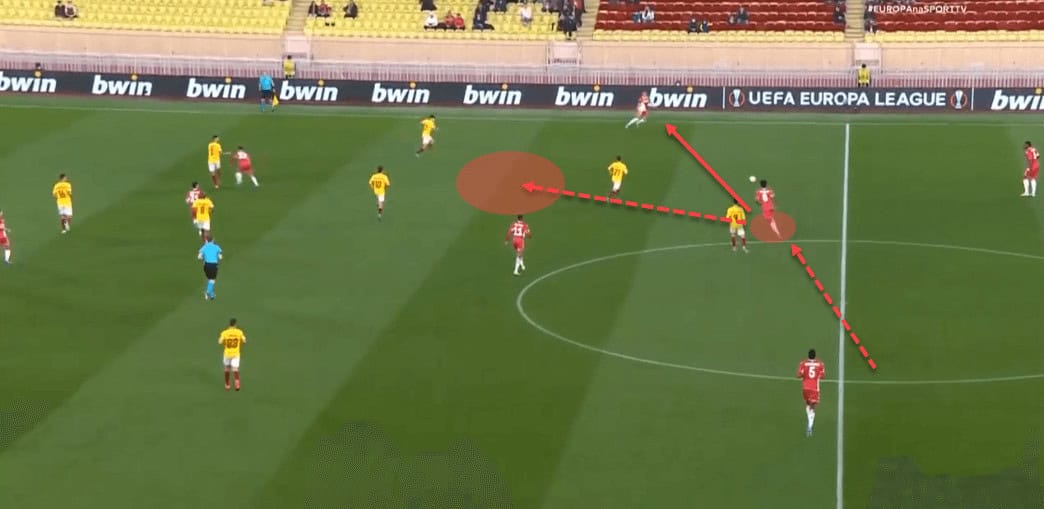
Tchouaméni stars deep as part of the backline three but as soon as he receives the ball, he starts moving with it quickly.
Monaco would often have the youngster deep to bypass the press or to create overloads in the first phase and the Frenchman is efficient when it comes to his basics.
Generally, he moves well to escape the cover shadow of his markers and even if he receives pressure, his frame and technical quality make him quite press-resistant in tight areas of the pitch.
In this particular example, however, Tchouaméni starts to run with the ball, which he often does too, and waits until the opposition’s block has started moving.
One of the main aspects of progressors who often exit with the ball is the timing of their release of the ball.
Tchouaméni is very good at recognising when to deploy the pass for maximum effect.
He waits for the opposition to break their formation or commit to engaging before playing the ball into his teammate.
A similar thing also happens in the analysed sequence, as Tchouaméni forces the defenders to jump, freeing up the space behind their backs that can be exploited.
It’s also interesting that the midfielder himself often moves into those vacated spaces, showing his tendency to move up rather than sitting back at all times.
While this is a valuable trait to have in a double-pivot, it does pose the question of whether he’d be as effective as a single-pivot when he’d often not be afforded as much freedom to advance at will.
Luckily, the nature of his profile means that the progressive runs aren’t the only or the defining part of his toolkit.
However, it is often how he beats pressure and then links up with his teammates higher up the pitch.
Let’s explore some examples to understand this part of his player profile better.
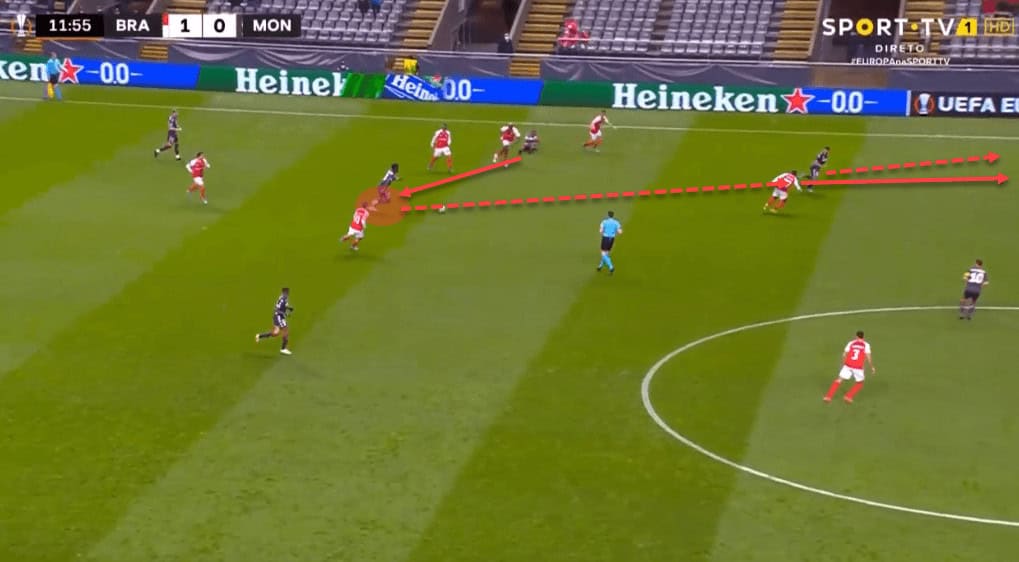
Here, Monaco is transitioning into an attack, and Tchouaméni takes a very heavy touch, sending him into a stride forward.
This is done by design and it’s here that his long strides and added athleticism can create the separation between him and the marker chasing him.
But these kinds of sequences are often accompanied by Tchouaméni linking up with one of his teammates higher up the pitch.
The youngster has the ability to find runners with his passing—we’ll see this in the next section of this scout report—but also the awareness and vision to recognise which move to make next.
Even though his physique sometimes makes him feel lanky, Tchouaméni is also very agile and quite nimble on his feet.
This can be seen in the following example, which follows the same lines as the previous ones.
Once again, Monaco is on the attack, and Tchouaméni has to withstand the immediate pressure and distribute the ball forward.
However, this time, he gets rid of the marker more creatively.
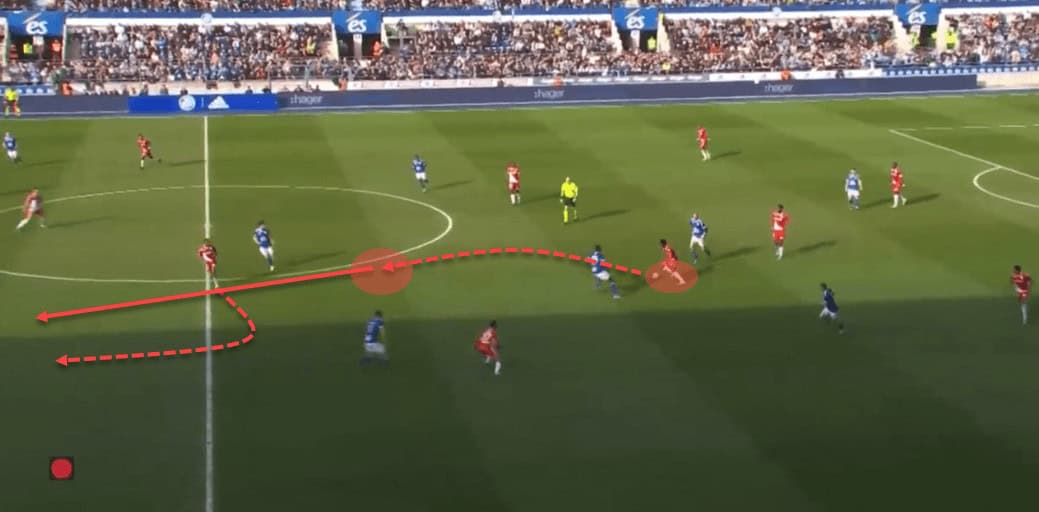
Tchouaméni does a slight feint, leaving the defender wrong-footed and quickly bursts into the space next to him.
This is a very impressive trait, and it’s usually more often associated with short dribblers with a low centre of gravity.
However, Tchouaméni is very agile and has this short-distance burst of speed that often translates into a full-blown long stride sprint that’s very difficult to stop.
There is still some room for growth in his progressive runs but all of it is more related to age and learning to use his body to his advantage.
Given his lanky stature, Tchouaméni can sometimes fumble his runs, losing the ball in his stride.
But these occasions aren’t repetitive enough to be fully depicted as a big flaw in his profile.
What I have noticed concerning his movement in particular, however, is the tendency to come short for the ball.
Sometimes, despite his awareness of opening passing channels for his backline, Tchouaméni does not pick the optimal area to occupy relative to his teammates.
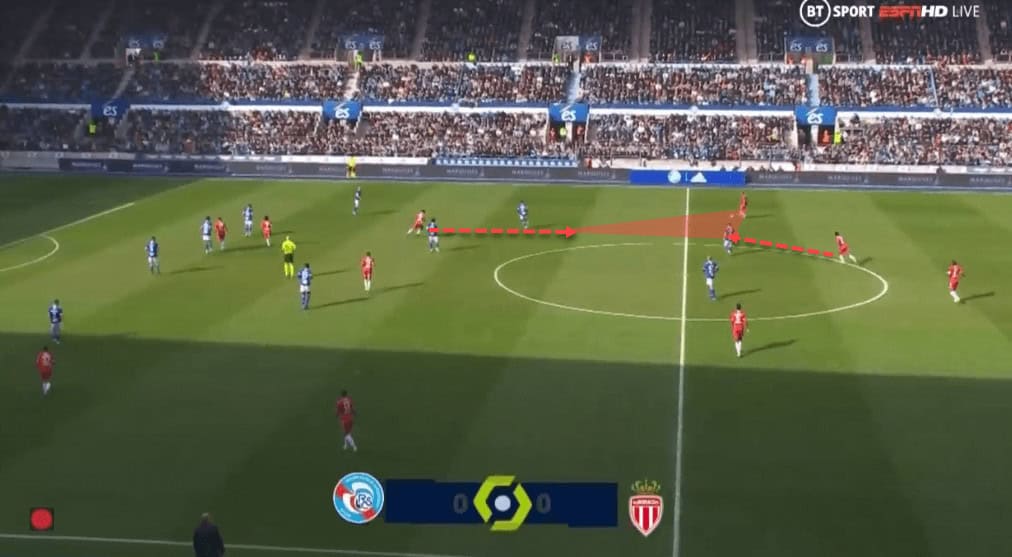
This is a good example as moving into the congested area at the same time as his teammate wasn’t the optimal decision for that particular sequence.
However, despite Monaco having three players essentially occupying the same small zone, the French outfit still manages to get the ball forward, mounting an attack down the flanks.
Aurélien Tchouaméni Passing ability
As a defensive midfielder, it is very important a player is comfortable with the ball at his feet and can reliably be used as an option in all situations.
Luckily, Tchouaméni, despite his age, is indeed such a player.
The 22-year-old’s short and medium-range passing is excellent while the long-range distribution can be used in switches of play, transitions and for finding runners behind the opposition’s backline.
Overall, his passing repertoire is nothing short of impressive.
Watching him play, I can sense that he feels secure on the ball, and his weight, speed, and timing of his passes are all at an extremely high level.
Tchouaméni will often drop deep to receive and then either recycle/retain possession or immediately aim to progress play.
The next graph depicts four of his pass maps, which tell us more about the youngster’s possession tendencies.

One way to describe the maps is definitely ‘busy’.
Tchouaméni is active all across the pitch, aiming to help out in the first phase of build-up, in the final third, and in transitions.
His passing is good enough for all of it as well, once again confirming the initial statement on the sheer versatility of the French talent’s profile.
With regard to his short and medium-range passes, Tchouaméni is often precise and can progress the play cleanly.
However, the one thing I’ve noticed about his technique is that he tends to take unnecessary touches at times, slowing down or stalling the tempo and inviting pressure from the opposition.
This, too, can be caused by taking a touch that doesn’t take him away from the congested area but rather into it.
While he may have the technical and physical qualities to emerge victorious from such situations, this is far from the optimal choice.
Still, all of that can and will likely get ironed out with coaching as he develops.
Overall, his control and receiving of the ball are of a high level.
At his best, it won’t take him more than two touches to see and exploit a positive channel that instantly progresses the play.
We can see that in the following example.
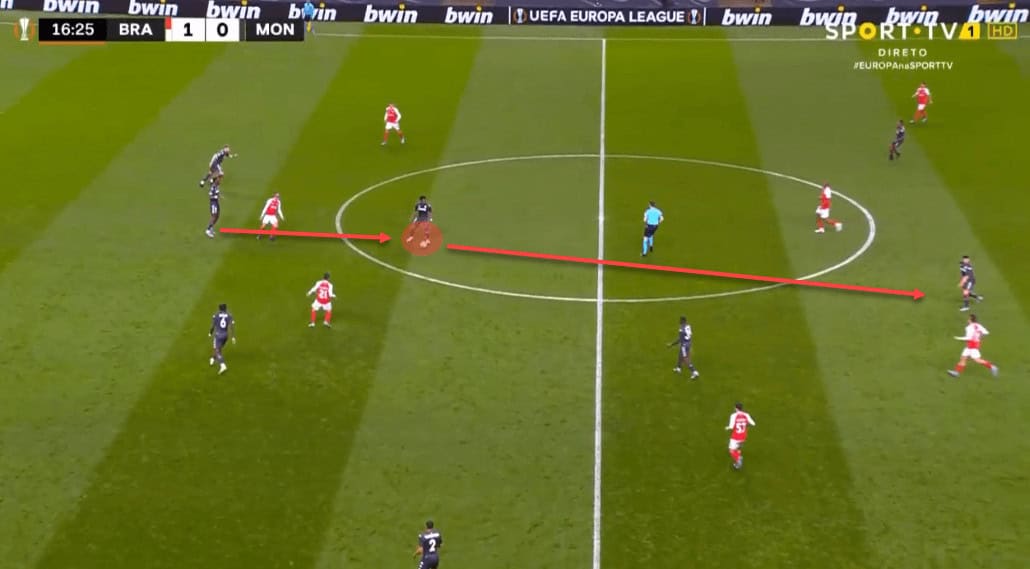
Here, Tchouaméni receives the ball directly from the backline, controls it with his weak foot, and sets it up for an instant forward pass, which he deploys with his right.
The pass finds its mark and is well hit too, which can sometimes be an issue, especially with central passes through tight corridors.
Tchouaméni generally adds great weight to his balls but can under or overhit them when looking for riskier channels, often in central and more dangerous zones.
This is further complicated by the (lack of) use of his weak foot.
Tchouaméni is heavily right-footed and prefers to shuffle the ball to his dominant right side rather than attempt some passes with his left.
Sometimes, however, he can use his frame to mitigate this problem, shielding the ball and giving himself the time and the separation needed to find a better angle.
We can see this in the example that follows.
Tchouaméni fights for the loose ball. Even though he had options to his right had he attempted a left-footed pass, he opted to turn and put himself between the ball and the defender, allowing for a right-footed pass to a different teammate.
While there is nothing wrong with this as using your frame to your advantage is an excellent sign, it does mean his heavy right-footedness can be exploited and targeted by the opposition.
Tchouaméni can still deploy simple passes with his left but working on it more would make his profile far more complete.
That said, if there is something he does exceptionally well in terms of passing, it’s finding targets over long distances.
Tchouaméni loves to distribute the ball over the top in several areas and uses a couple of different techniques while doing it.
Let’s start with the deepest position, which is distributed directly from the backline.
This is a very good use of his skill set as playing as one of the centre-backs gives Tchouaméni the chance to face the pitch forward.
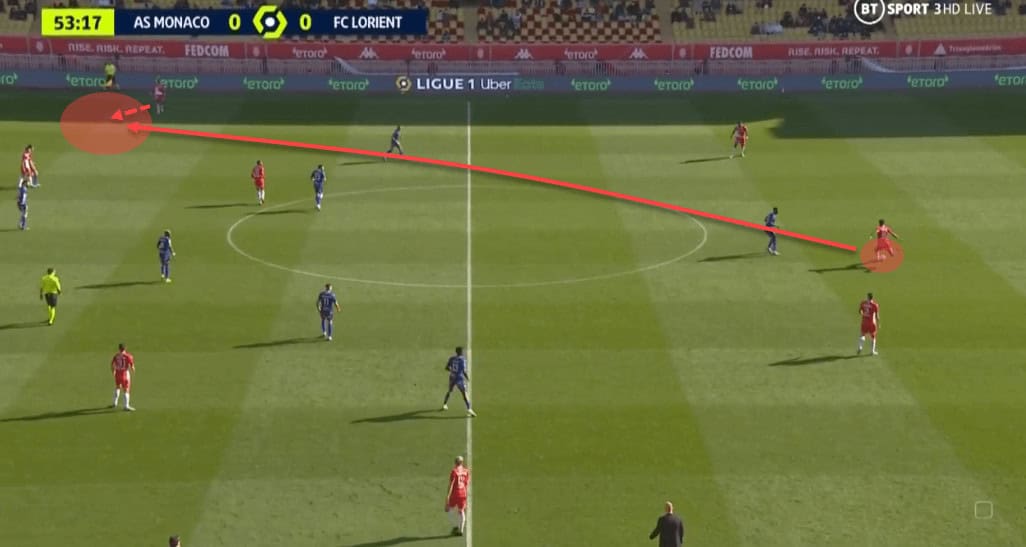
In the latest example, we see exactly that.
The young midfielder has dropped into the backline to ease progression from the first line and fully utilise his vision and exceptional passing ability.
In this particular sequence, maintaining a higher position would’ve been even more beneficial, given that Monaco already had numerical superiority even without Tchouaméni dropping deep.
However, this way, the youngster was given more space and time as the opposition was more likely to collapse between the lines with numbers on both sides of the ball.
The other area he likes to occupy while distributing is just ahead of the backline and mostly to the left side.
There, he can open his body to use the right foot and make these switches faster and more efficiently.
Naturally, his accuracy is at the highest level when aiming for targets that hug the touchline and want the ball to be in the feet, i.e., static targets.
But this doesn’t mean he’s inefficient when finding runners from the deep.
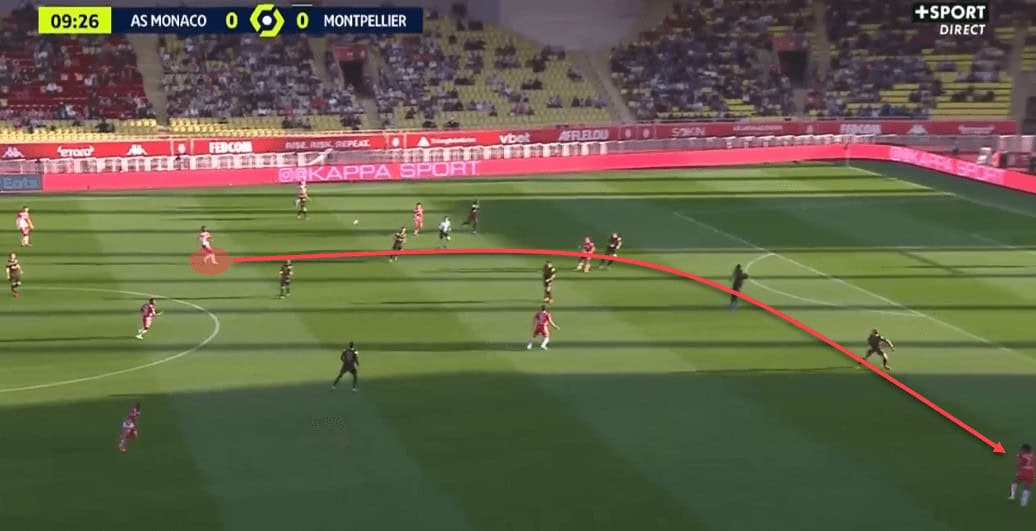
These long balls are often played across his body, allowing for more power and accuracy.
However, the most impressive aspect of such passes is the added deception.
Tchouaméni is a master of disguised passes. He points his body in one direction and then delivers the ball somewhere else.
This can be done in deeper areas, too, but is an especially effective weapon when hiding true intentions within the final third.
A great example of that can be seen in the following image.
We can see Tchouaméni has taken up a deeper position just at the entrance to the final third and is looking to playmaker from there.
Even though his body is positioned to play in the direction he’s facing, the young midfielder pulls an incredible pass out of his hat to surprise the opposition.
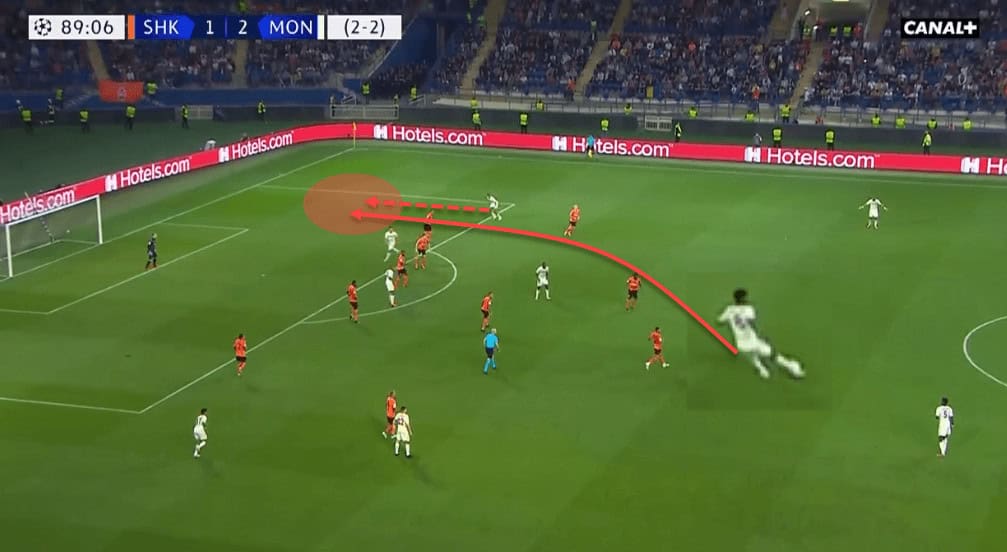
Notice his body positioning and how he curves the pass to hide the true direction of the ball.
It’s quite impressive that he can do that and still retain the accuracy and perfect weight on the passes.
Aurélien Tchouaméni Defensive contribution
The final part of Tchouaméni’s player profile we’ll analyse in this scout report is his defensive contribution.
As the statistical section in the introduction to this tactical analysis shows, the 22-year-old midfielder is an astute defender and an effective ball-winner.
This comes as a result of his athleticism but also through excellent game reading and recognition of when to push and press and when to drop down to cover.
Having this ability and decision-making at a young age bodes well for the future.
Of course, not everything around Tchouaméni’s decision-making is perfect, as we’ve seen in the previous sections of the analysis, but having the foundations firmly set is an excellent first step.
In this section, however, we’ll focus on his awareness and aggressiveness in duelling.
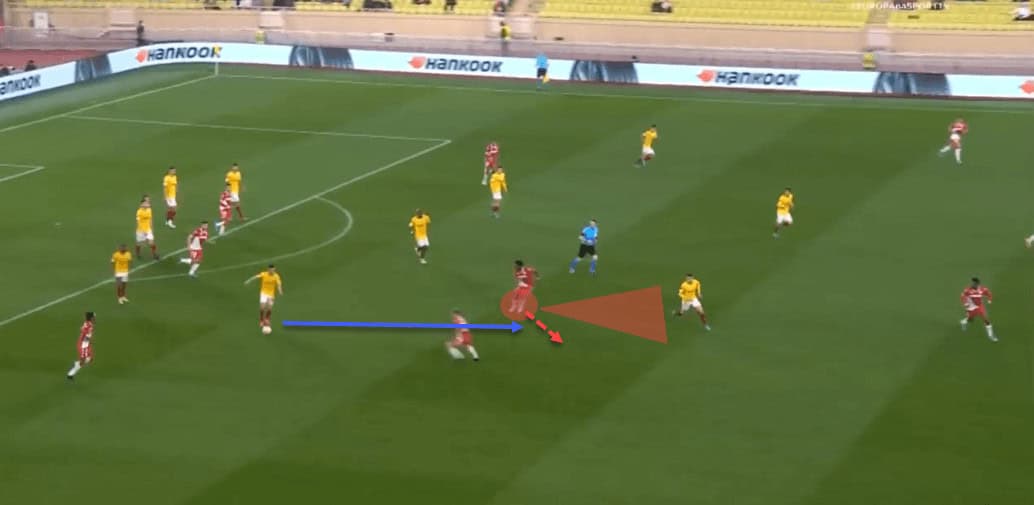
The first example in this part of the scout report shows the Frenchman’s reading of the game and adhering to his markers.
I’ve noticed that he often tightly man-marks the attackers in his area but also often aims to get in front of them to block passing lanes or just win duels.
Here is such an example.
This is also where we have to mention his scanning.
Tchouaméni constantly scans his surroundings, both offensively and defensively, to keep track of players in his vicinity, whether that’s teammates or opposition.
In this instance, he knows where the opposition player is at all times and knows how to move to close the passing channel towards him.
As a result, he intercepts the ball that could’ve started a dangerous attack.
This isn’t an isolated case either and the best way to determine that is through stats.
With 7.89 PAdj interceptions this season in Ligue 1, Tchouaméni ranks in the top 20% of all midfielders in that category, and the same can be said for his defensive duels won and aerial duels as well while his overall duels (offensive and defensive) put him in the top 10%.
But all of that is due to his awareness, not so much because of the physical aspect, as with most elite defenders.
Here’s another example of Tchouaméni predicting a channel opening before the opposition makes the pass; he then rushes to intercept with a sliding tackle.
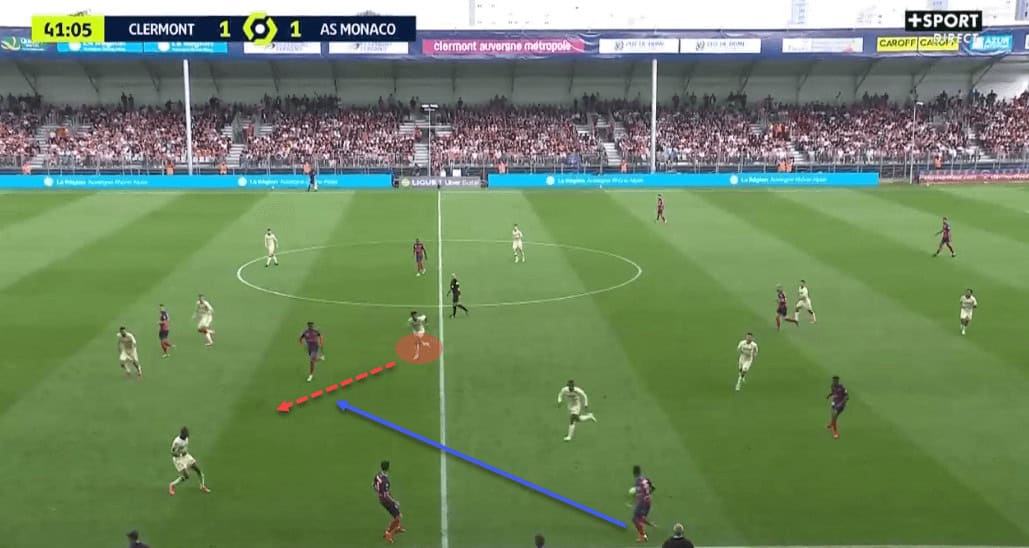
Sliding tackles are a powerful tool when executed well and Tchouaméni does it often and on a high level.
This is in line with his aggressive nature as the young talent likes to step forward in front of the attackers to get to the ball first.
Many defenders do it, especially aggressive centre-backs who exit their line often; similarly to sliding tackles, it’s risky but rewarding when done well.
Tchouaméni uses it for duelling and having a frame and athleticism to back it up helps a lot in such scenarios.
In the following sequence, for example, he pushes past the attacker to get to the ball first from a slightly deeper position.
Again, this is something we’ll see often, in both the offensive and defensive phases of play.
When Monaco is attacking, Tchouaméni sometimes steps towards the ball from a deep position and immediately plays the next pass.
Similarly, while defending, he will rush out to meet the opposition’s pass in front of the player the pass was meant to hit.
Here’s an example.
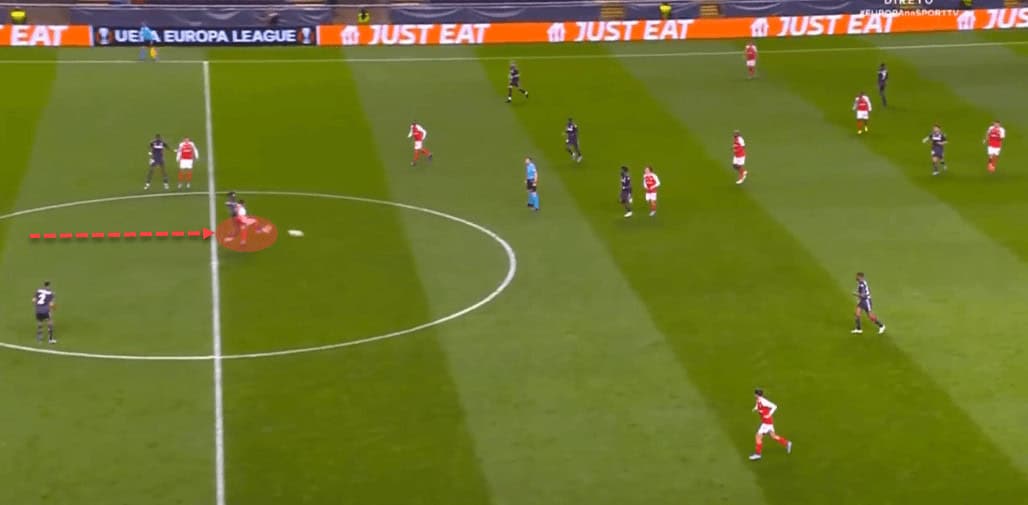
These challenges are also often about reading the play well and getting the timing right.
At times, it’s very easy to miss the ball and find yourself in no man’s land as a result of it.
It happens to Tchouaméni too but not very often.
Again, this should improve with experience, but even when a challenge goes sour, his athleticism gives him an edge in tracking back, and his stature helps him overpower the opposition.
Tchouaméni often uses his hands and gets his body between the ball and the attacker, preventing any chance of advancing.
A promising sign he’s proficient at it is the number of fouls he makes.
At only 1.38 per 90 minutes, it puts him at the 54.5th percentile, meaning almost 50% of Ligue 1’s midfielders foul more often than him.
This is an impressive feat for a player who excels at breaking up opposition attacks and who resorts to tactical fouling when necessary.
Our final example shows more of that aggressiveness we discussed, only this time it’s portrayed in an aerial duel.
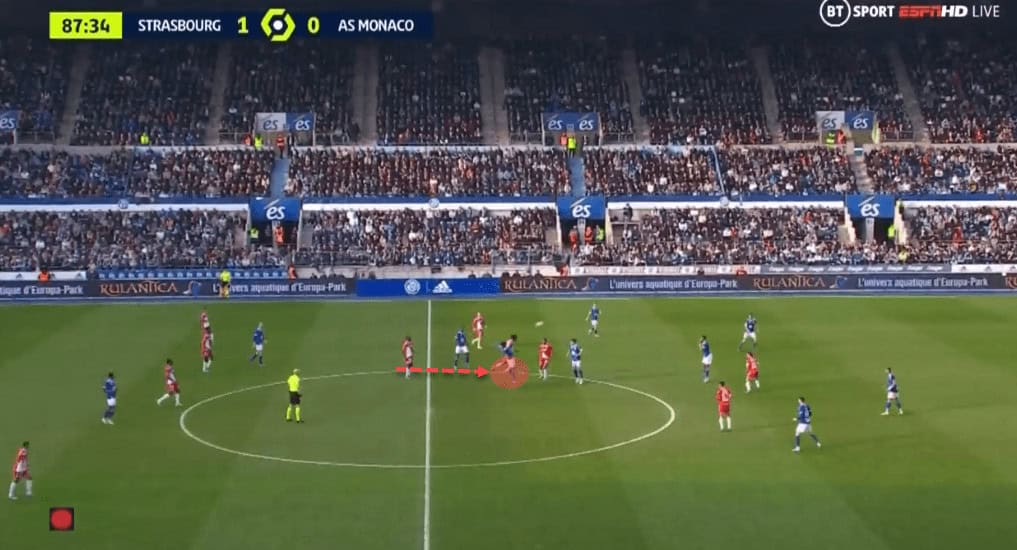
Just as was the case with exits during ground duels, a high level of risk is present with aerial duels as well.
When executed well and when Tchouaméni can get in front of the opposition to head the ball away (or into the net), this tactic works like a charm.
But if you misjudge the flight of the ball and get the timing wrong, it can backfire quickly.
Conclusion
Aurélien Tchouaméni is a top prospect just waiting to get snatched by one of the European titans of the game.
His profile is extremely well-rounded and complemented by an impressive blend of athleticism and technical prowess.
Similarly, the 22-year-old Monaco star is versatile in what he does and can occupy several different positions on the pitch to a high standard.
Of course, being so young, he’s far from complete and this can sometimes be seen in his movement, passing and decision-making.
None of the kinks in his profile, however, represent critical flaws that can’t be improved with proper coaching.
This could indeed be the summer he makes a lucrative move.
Needless to say, it would definitely be warranted too.
