
After Nuno Espirito Santo was sacked, Antonio Conte arrived at Spurs, hoping to rejuvenate the North London side.
With Antonio Conte’s entry comes his customary back-three system.
That said, the Italian coach’s specific formation was still unknown.
Conte’s Inter used a 3-5-2 formation, while during his previous spell in the Premier League with Chelsea, Conte employed a 3-4-3 formation.
The newly appointed coach decided to use the latter, as Harry Kane, Heung-Min Son, and Lucas Moura were deemed a strong fit as a front three.
Life in (North) London started well.
He won his first match in the Europa Conference League and has three wins and a draw in his first five matches.
As weeks passed, and the honeymoon period was undoubtedly over, Spurs’ top form dwindled.
They lost to Chelsea at Stamford Bridge and at home to Southampton and Wolves back-to-back.
One common denominator regarding those two home defeats was Spurs’ right-hand side, which showcased a significant weakness.
In comes Dejan Kulusevski, a 21-year-old Swedish international, formerly of Juventus and Parma.
The Swede failed to impress during his time in Turin, but he swapped Italy for England’s capital.
The young forward has not looked back, adding a new dimension to Spurs.
Within Kulusevski’s first 12 games, he has accumulated nine-goal contributions and has gelled well with Kane and Son.
This tactical analysis and scout report will discuss Lucas Moura’s advantages and disadvantages and explain why the addition of Dejan Kulusevski has been a catalyst for the Spurs.
In addition, I will examine Liverpool’s and Spurs’ front threes to see whether they share some similarities.
The pros and cons of Lucas Moura
When evaluating Lucas Moura’s game, the first point that must be echoed is his dribbling and technical talent.
It is not surprising to see a player who obtains such skill be playing at such a high level.
Additionally, Moura works hard.
He gives his all to the team and adds vigour and work rate to his team.

A player who is skilled on his feet while working a shift is the type of combination a manager will welcome with open arms.
Lucas Moura’s issue is his lack of ball security, which significantly impacts the quality of attacks a team can produce.
As mentioned previously, Moura is a technically proficient footballer—but only in a select category.
His first touch is incredibly heavy, sometimes preventing Spurs from sustaining attacks within the final third of the pitch.
In addition, his poor quality first touch can also be quite noticeable during counter-attacking situations.
While not secure on the ball, Moura struggles to be productive when he does have a clear grasp of it.
Standard stats would agree with this notion, having not scored more than 4 goals in the last three seasons.
In a creative sense, five assists are his highest tally, dating back to the 2014/15 season in Paris.
This is with 1.59 key passes per game, which is quite average, and an expected 0.18 non-penalty goal per game.
Moura’s most noticeable issue within Antonio Conte’s Spurs is his lack of identity within the front three.
The roles of both Heung-Min Son and Harry Kane are distinguished; Kane will drop slightly deeper into space, looking for Son to run in behind.
Lucas Moura is not a true goal scorer here; his statistics showcase this.
Moura does not have the creative capability needed to allow Harry Kane not to drop so deeply consistently.
Overall, consistency and production are lacking for all of Lucas’ hard work and moments of magic.
Dejan Kulusevski’s revival
Before making his January transfer from Juventus to Tottenham Hotspur, Kulusevski was not in the best form.
Due to the large number of managers who entered and left Juventus, Kulusevski was constantly placed in different positions.
The latest of many managers at Juventus Massimiliano Allegri did not favour the Swede and left him as an option on the bench.
Spurs director of football Fabio Paratici decided to return to his old club and take advantage of the situation.
Most Spurs fans were optimistic regarding Kuluseviski’s impact on this Spurs team, but most would not have thought he would hit the ground running as well as he has done so far into the season.
Dejan Kulusevski is a right-winger by trade but can play in various positions, such as a number ten or a striker.
As he is left-footed, he likes to cut inside from the right-hand side.
His being left-footed is quite essential, as this is one of the main reasons he combines so well with Son and Kane.
Kulusevski adds something to the attacking line-up Spurs have not been afforded since the days of Christian Eriksen: cuteness in and around the penalty area.
Lucas Moura was quite wasteful in the final third, and this criticism cannot be placed on Kulusevski.
The 21-year-old right-winger is a creative player.
He prefers to pass rather than take a shot at a goal.
Having that left-footer in a team that can play at different angles and create different issues can add quite an amount of variance to an attack.
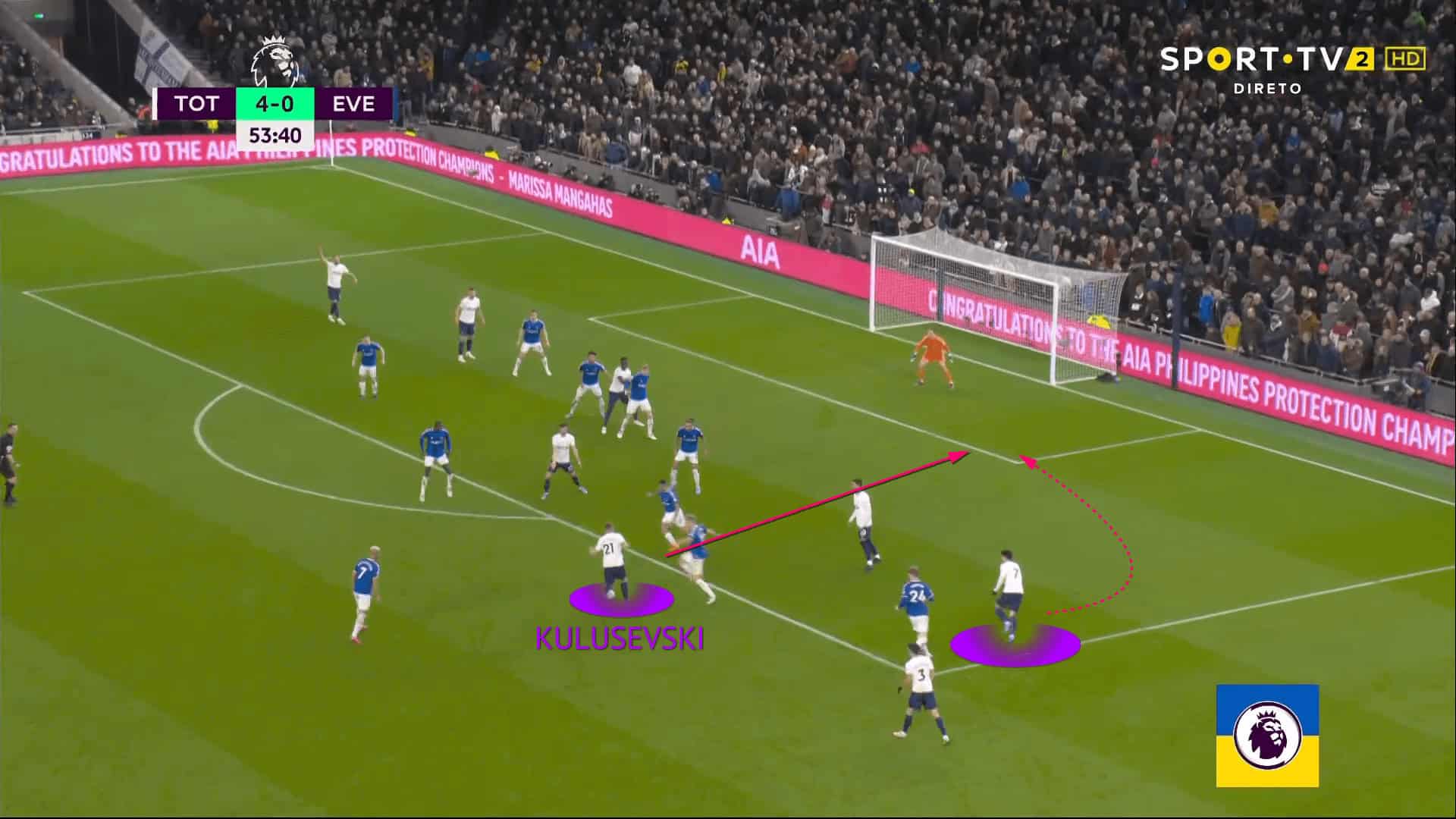
Furthermore, at 6’1″, Kulusevski has a rangy frame and uses it to good effect.
He can securely hold up the ball and retain it securely in the final third.
Kulusevski can create and combine while keeping attacks alive and adding to the goal tally.
Swede’s introduction adds balance to the front three rather than carnage.
The differences between the two forwards can be displayed through their actions within similar areas of the field.
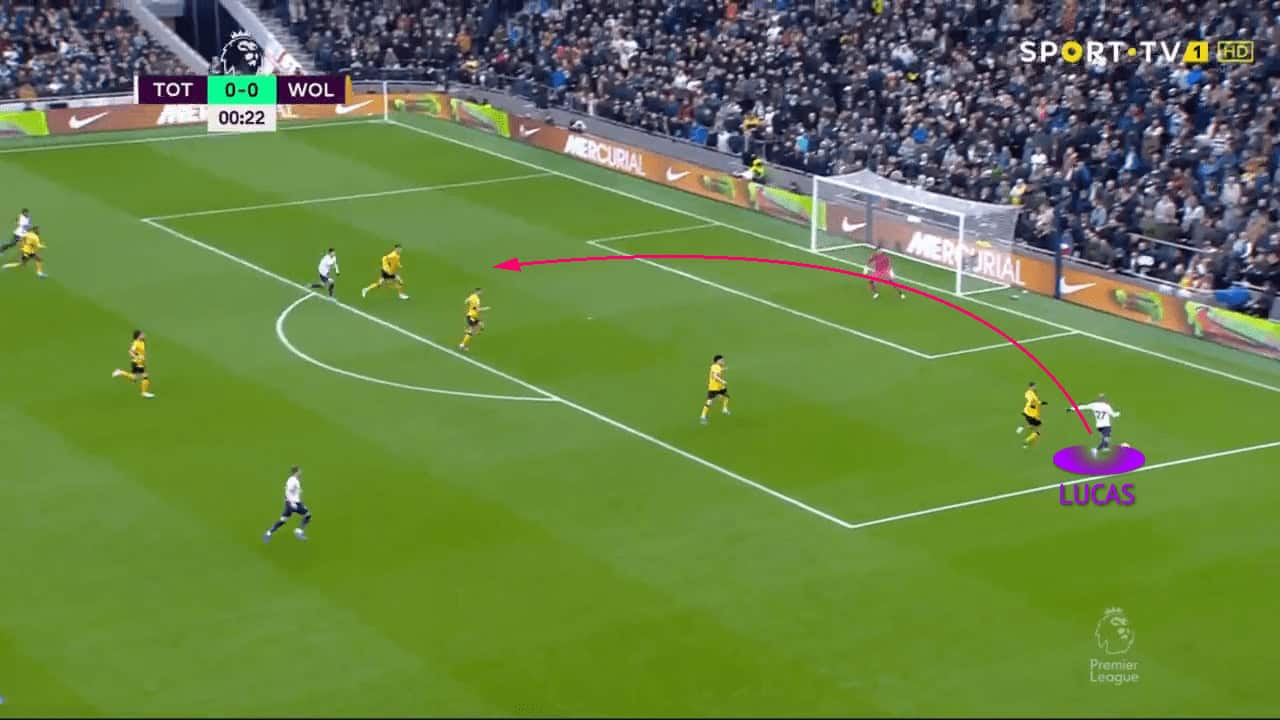
Lucas is contested just inside the opposition’s box, 1v1.
If Lucas had surveyed his surroundings, he would have noticed the lack of options inside the area, resulting in his being patient and keeping the attack alive.
Instead, he slips a hopeful yet impractical cross, resulting in an unsuccessful attack.
Here, Dejan Kulusevski is in the same position in possession, which Tyrone Mings contested this time.
The difference demonstrated by Kulusevski compared to Lucas is that Kulusevski takes a slight look up, noticing that attacking options ahead are limited.
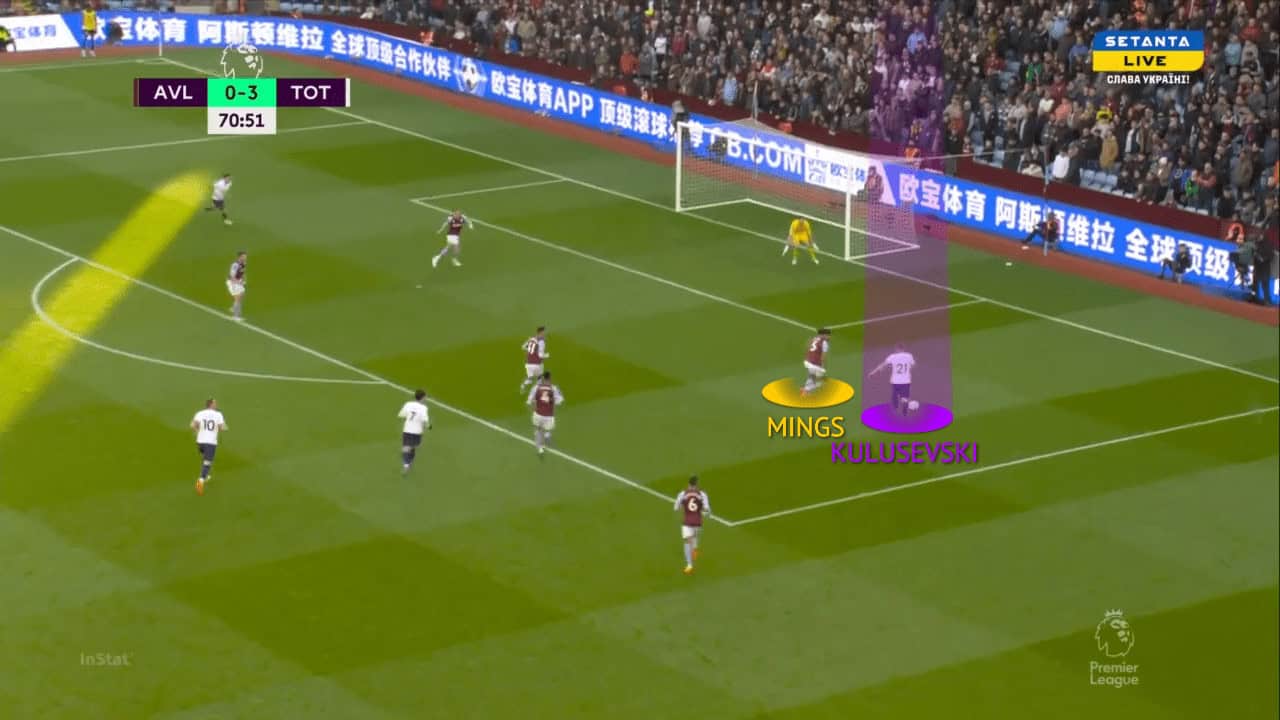
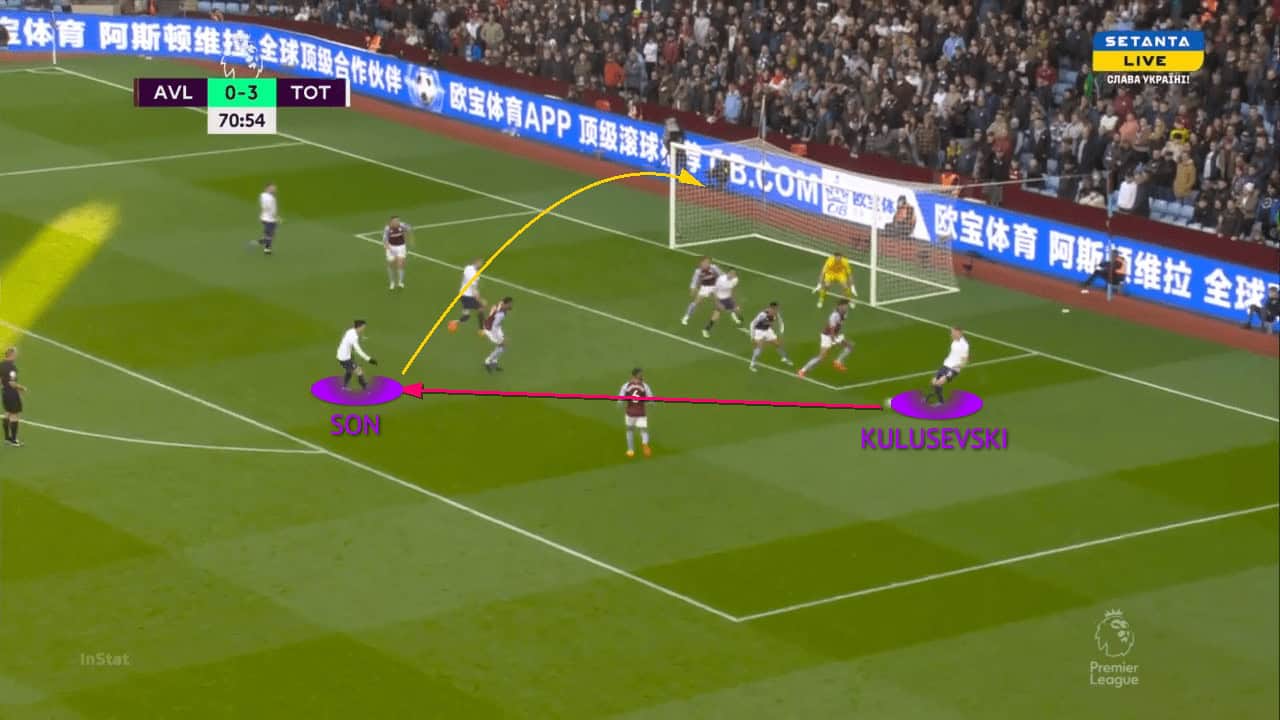
Instead of a hopeful cross, the Swede slows down the attack and cuts inside to buy time, allowing his fellow attacks to penetrate the penalty area.
When the time is right, he plays a nicely weighted ball to Heung-Min Son, who converts.
While adding the needed composure in the final third also adds functionality to Antonio Conte’s 3-4-3.
With the balance he adds to the Son and Kane lead attack, his combination play has also added value to the right wing-back position.
Before Matt Doherty’s injury, the Irishmen and Kulusevski formed a brilliant partnership on the right-hand side and could more adequately progress the ball forward.
This new partnership has made the Spurs more stable.
During previous matches, opposition teams acknowledged the Spurs’ wing-back imbalance and defended one side, leaving the right-hand side open.
These tactics are impossible, and Antonio Conte’s Tottenham now has a dual-threat element.
Spurs’ front three vs Liverpool’s front three
Ever since Dejan Kulusevski’s arrival and the formation of Spurs’ top-notch attack, the debate has already begun about which front three reign supreme.
Real comparisons can be made between the two attacking line-ups from different viewpoints.
Diogo Jota has been featured as Liverpool’s centre-forward but has featured chiefly as an all-rounder with the eye of an old-school poacher.
Harry Kane’s game has transformed over the last couple of years.
Kane’s all-around game is still ever-present, but Kane’s dropping into deeper spaces has become more constant, and his connection with Son has become even stronger.
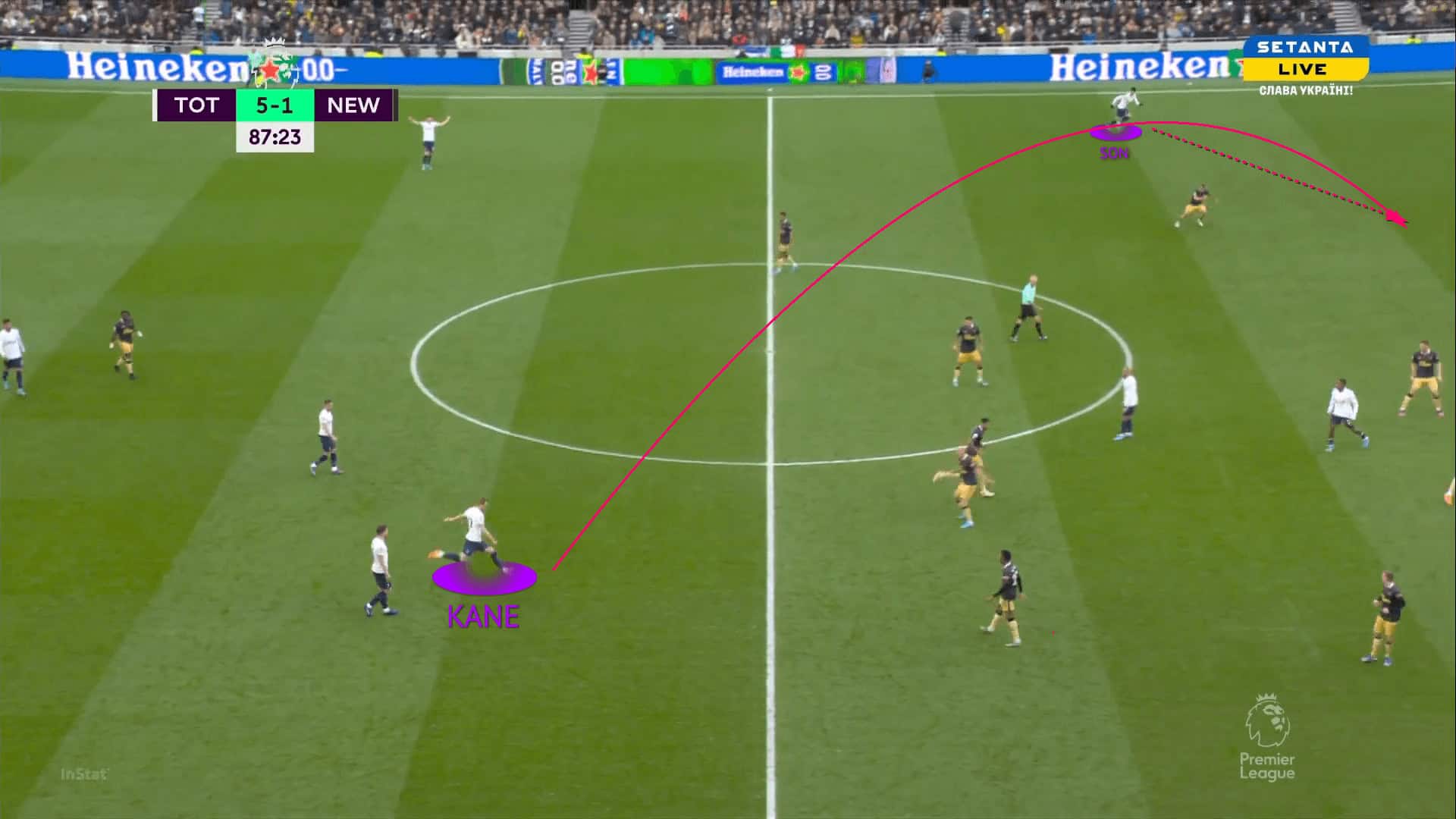
Heung-Min Son and Sadio Mane share many commonalities.
Both players are stars in their positions on the left wing.
Both players look to drive in from the left side and either create for others or score for themselves.
So far this season, Sadio Mane has scored 14 goals, slightly behind Heung-Min Son, as the South Korean has scored 17, the second-highest in the Premier League.
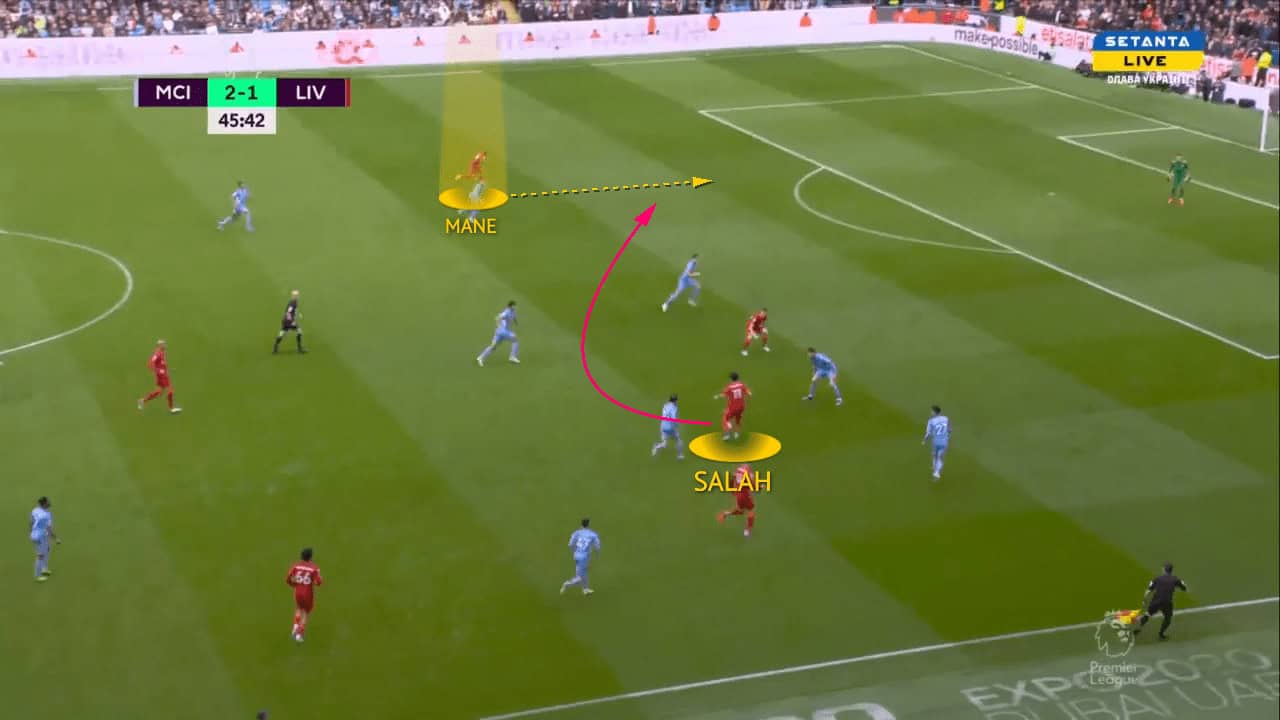
Here we have Mo Salah in possession, located in the right half-space.
Sadio Mane occupies the same position of Heung-Min Son, high and wide on the left side, making a darting run to the back post.
Lastly, there is a comparison between Dejan Kulusevski and Mohammed Salah.
These two players are similar in a sense; simultaneously, they are pretty different.
Both right-wingers are left-footed and tend to cut inside.
That said, Kulusevski does not have the same speed Mo Salah possesses and plays at a slightly slower tempo.
Salah plays a perfect rhythm, knowing the right times to speed up and when to slow down and add a sense of calm to an attack.
Conclusion
Antonio Conte’s Spurs have been weird and wonderful; with new January signing Dejan Kulusevski adding to the attacking talent they already had at their disposal.
While Spurs have finally found their right-winger, a position they have not succeeded in for a while, how they finally got there has not been simple.
During the early segment of Conte’s reign, Lucas Moura was Spurs’ third attacker next to Son and Kane and started quite well with good performances against Vitesse and Norwich City.
But soon, his form began to dwindle, leaving a massive hole for the third spot within the attacking trio.
The profile Lucas presents is not complimentary with both Son and Kane.
This is the key difference between Lucas and Kulusevski; the Swede adds a certain dimension the Brazilian cannot.
Dejan Kulusevski will correctly use the clear passing lanes that are usually ignored or not seen or the appropriate touch needed in a tight and confined area instead of possibly wasting them by the former.
This is not to indicate that Lucas Moura is a poor player; quite the contrary.
Lucas can play and contribute, but Dejan Kulusevski extinguishes carnage and replaces it with balance.
