
This tactical analysis explores Vasco Matos‘ work at CD Santa Clara during their outstanding 2024/2025 Portuguese League season.
After winning promotion as champions of Liga Portugal 2 in the previous campaign, Santa Clara made an immediate impact upon returning to the top flight, finishing in a remarkable fifth place and securing qualification for the UEFA Conference League.
This achievement is even more impressive because Santa Clara retained the core of the squad that had competed in the second division.
The most frequently used starting eleven remained largely unchanged, providing a sense of continuity and tactical familiarity that proved essential in the club’s seamless transition to the top tier.
Under Matos’ guidance, the Azorean side finished behind only the traditional big three: Benfica, Porto, and Sporting CP, as well as Braga, while outperforming established top-half teams such as Vitória SC and Famalicão.
This success was no accident: it was the result of Vasco Matos’s clearly defined tactical structure, intelligent in-game management, and a collective mentality instilled by the coach.
This Vasco Matos analysis breaks down the key tactical principles that defined Matos’ tactics, from their in-possession structure to pressing mechanisms and key player roles, and how these contributed to one of the most impressive seasons in the club’s history.
CD Santa Clara Identity: Stability & Continuity
One of the key factors behind Santa Clara’s success in 2024/2025 has been the remarkable stability and continuity implemented by Vasco Matos, not only throughout the season but also from one year to the next.
After achieving promotion in 2023/2024 as champions of Liga Portugal 2, Matos maintained both his tactical blueprint and the core of the squad, creating a strong identity that adapted seamlessly to the demands of the top flight.
Santa Clara operated with clear structural consistency, utilising a 5-4-1 formation out of possession and transitioning into a 3-4-3 formation in possession.
This model allowed the team to remain defensively compact without the ball, while offering width and depth through wing-backs and interior wingers when building attacks.
This shape was used in both seasons, demonstrating tactical conviction and strong internal development processes.


The squad was carefully assembled, with a significant number of players coming from either lower tiers of Portuguese football or arriving as young prospects from Brazil, particularly from clubs with strong youth development backgrounds.
No fewer than 17 players from the second division campaign remained part of the first division squad, most of them maintaining or even strengthening their role in the team.
In goal, Gabriel Batista, a 26-year-old Brazilian who developed at Flamengo, remained the undisputed starter.
The defensive line retained key names such as Lucas Soares (27, Brazilian, developed at Cruzeiro, arrived in Portugal’s third tier and climbed the football pyramid to the top), Luis Rocha (38, Portuguese, who spent most of his career in Liga Portugal 2), Sidney Lima (28, Brazilian, who arrived in Portugal via the third division), and MT (24, Brazilian, developed at Vasco da Gama).
Diogo Calila (right wing-back, a regular substitute in both seasons) also continued to play a consistent role.
The midfield duo also showed strong continuity.
Adriano Firmino (25, Brazilian, developed at Cruzeiro) played as a defensive anchor across both seasons and was one of the team’s most frequently used players.
The more advanced midfield spot was shared by Serginho (25, Portuguese, who five years ago was playing in the 5th tier with GD Joane and has since progressed through every level of Portuguese football), Pedro Ferreira (27, Portuguese, developed at Sporting CP, never featured for the senior team, played in Liga Portugal 2 and the Danish top flight), and Klismahn (25, Brazilian, who arrived in Portugal to play in the U23 league and later featured in Liga 3).
In the more advanced roles, the inside wingers or number 10s, several players split time and responsibilities, notably Ricardinho (26, recruited from the Portuguese third division), Vinícius Lopes (26, Brazilian, developed at Goiás, also played for Botafogo), Gabriel Silva (23, developed at Palmeiras, recently recognised as the fastest player in the world), and Bruno Almeida (28, with a background in the Portuguese third and second divisions).
All four were present in both squads and provided versatility and dynamism between the lines.
At striker, Alisson Safira, a key figure in the second division, started the 2024/2025 season as the main centre-forward before being sold in January at a profit.
After his departure, Vinícius Lopes and Gabriel Silva (inside wingers) alternated alongside João Costa (a young striker signed from FC Alverca after finishing as top scorer in the Portuguese third tier).
This long-term squad continuity and consistent tactical framework laid the foundation for a collective understanding that exceeded expectations, not just in terms of performance, but in how Santa Clara competed with and outperformed more resourced and experienced sides in the league.
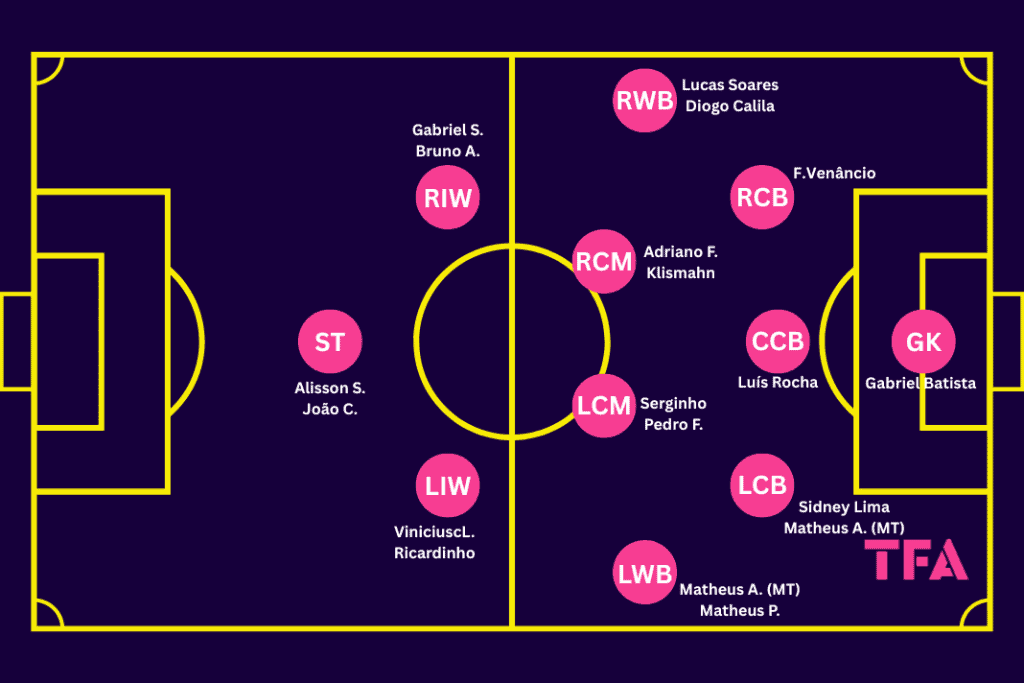
With this well-established tactical structure and a cohesive group of players, Santa Clara was able to express a clear identity in possession.
Their ability to control different phases of the game was not based on overwhelming individual talent but rather on collective mechanisms, disciplined spacing, and intelligent occupation of key zones.
In the following section, we will break down how Vasco Matos’ side built their attacks, progressed through the thirds, and created chances, all within the flexible yet consistent framework of their 3-4-3 system.
CD Santa Clara In Possession: Build-Up, Progression & Final Third
Santa Clara’s offensive play was built on the ability to oscillate between short, supported combinations and quick, vertical progressions.
The team often alternated between controlled circulation in deeper areas and sudden acceleration through dynamic forward runs from the wingers, striker or wing-backs.
A recurring pattern in their attacking strategy involved attracting pressure by inviting the opponent to step higher, before exploiting the space left behind the defensive line.
This approach required high synchronisation between players and a clear understanding of timing, enabling Santa Clara to break lines effectively without compromising structural balance.
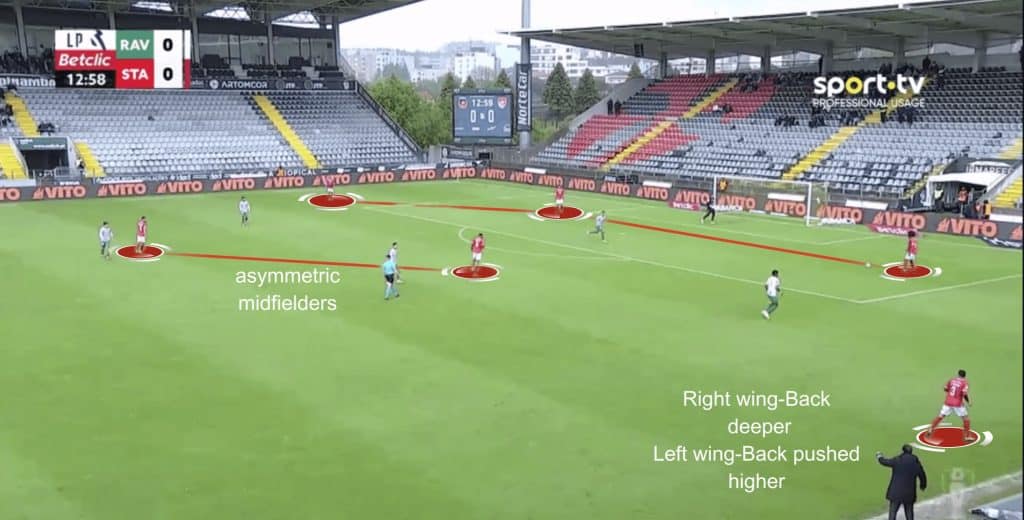
In goal-kick situations, Santa Clara adopted an asymmetrical build-up shape that supported both short circulation and direct access to advanced areas.
The ball would start at the feet of Gabriel Batista, with the central centre-back dropping to his right and the left-sided centre-back positioning himself to Batista’s left.
The right-sided centre-back pushed wider, acting almost like a right-back in a four-man line, while on the opposite flank, the left wing-back dropped deeper to offer width without depth.
Meanwhile, the right wing-back stayed higher and wider, providing immediate verticality along the right touchline.
This staggered positional structure enabled the team to manage the opposition press effectively and open progressive passing lanes across different heights and widths.
The two central midfielders also reflected this asymmetric principle.
Adriano Firmino, acting as the deepest midfielder, positioned himself closer to the defensive line to support circulation and provide security.
His midfield partner occupied a more advanced line, giving the team both an additional forward passing option and presence to contest second balls whenever the build-up became more direct.
The positioning of the front three was adapted to the profile of the players selected.
The striker stretched the opposing defensive line, pinned the centre-backs, and prevented them from stepping into midfield to press.
This created more time and space for the inside wingers to operate.
When Ricardinho or Bruno Almeida played in these roles, their focus was on dropping into the half-spaces to receive between the lines and combine.
When Gabriel Silva or Vinícius Lopes featured, they played more vertically, timing runs in behind to exploit space left by the defensive line.
With Safira or João Costa as the reference in attack, the team was also capable of using more direct solutions.
These moments were carefully orchestrated, aiming to find the striker directly and then attack the second ball zone or with forward runs from the wingers.
The team clearly intended to use these situations as triggers for fast progression rather than as isolated or improvised actions.
This dual capacity, to build through short, controlled possession or access space directly and play from second balls, gave Santa Clara flexibility without losing identity.
When the ball was progressed slightly higher up the pitch, Santa Clara maintained the same structural and positional principles seen during goal-kick situations.
The behaviours remained consistent, reflecting a well-rehearsed model that didn’t rely on improvisation but instead on synchronised movement and clear reference points.
The back three continued to offer width and balance in circulation, with the wing-backs stretching the pitch and the double pivot ensuring stability and progression.
The asymmetry in positioning remained, both in the build-up line and in midfield.
In the attacking line, the inside wingers positioned themselves to either drop between the lines or attack depth, depending on their profile and on the Wing-backs’ position.
At the same time, the striker maintained his role of occupying the centre-backs and keeping the opposition’s last line pinned.
This allowed the team to circulate the ball patiently while creating conditions to exploit space between or behind lines.
This balance became a hallmark of Vasco Matos’ in-possession organisation.
When the striker was not Alisson Safira or João Costa, the team’s behaviour in this phase showed subtle variations.
In many matches, that central role was filled by one of the inside wingers, usually Vinícius Lopes or Gabriel Silva, who adapted the attacking dynamic to suit their different playing styles.
Rather than acting as traditional target men, these players frequently dropped between the lines to offer an additional connection in midfield or looked to exploit the space behind the defensive line through well-timed runs.
Their mobility added fluidity to the front line and encouraged more rotations between the forward and inside winger positions without compromising the team’s overall structure.
This structure is visible in the images below, which illustrate Santa Clara’s positioning once the ball had advanced beyond the initial build-up zone.
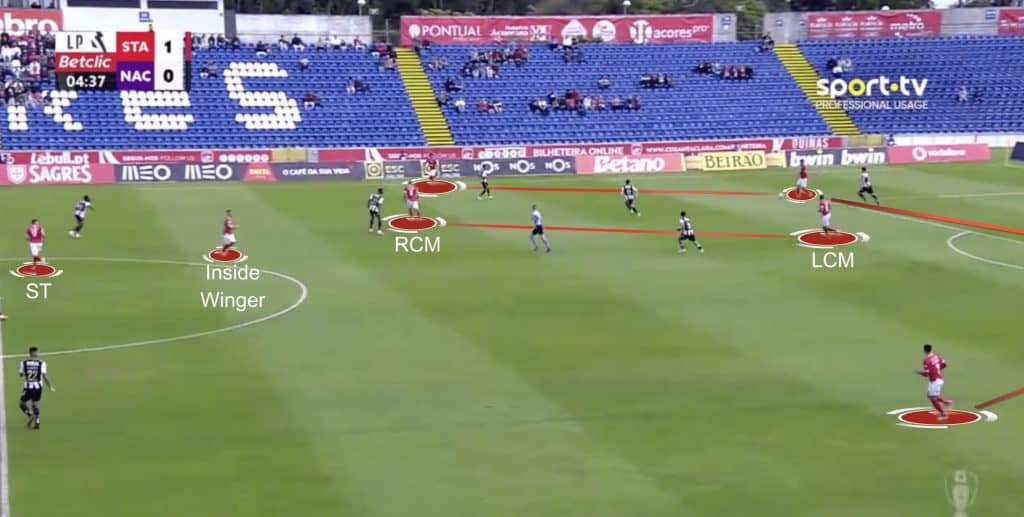
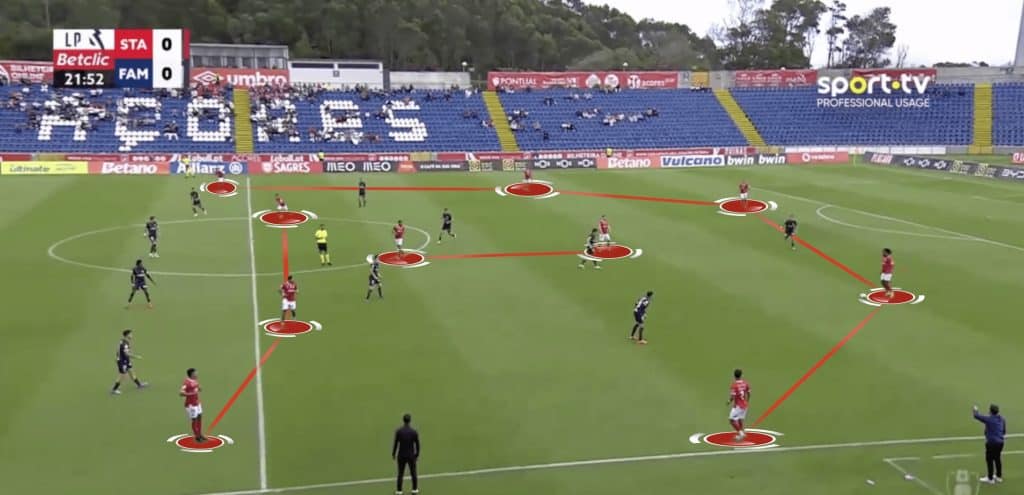
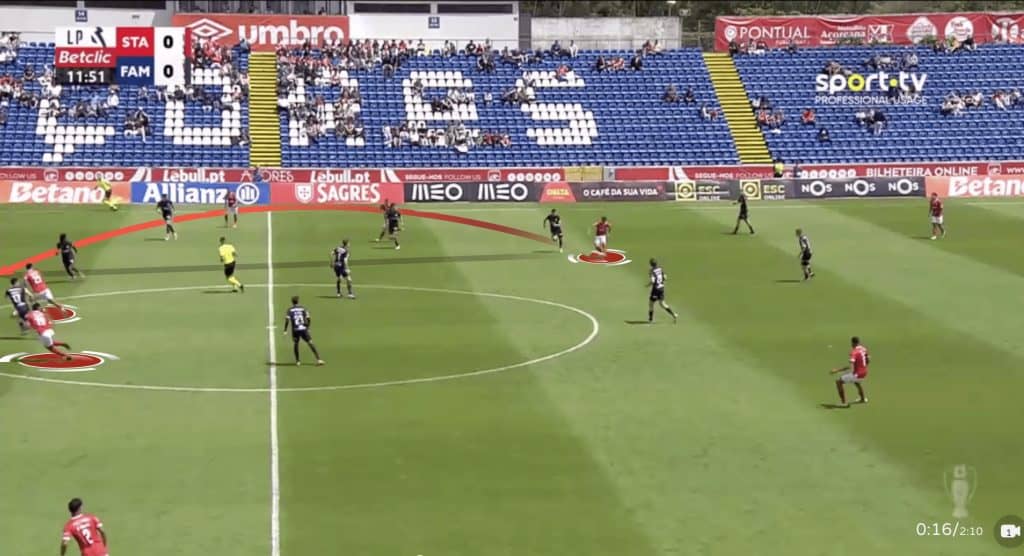
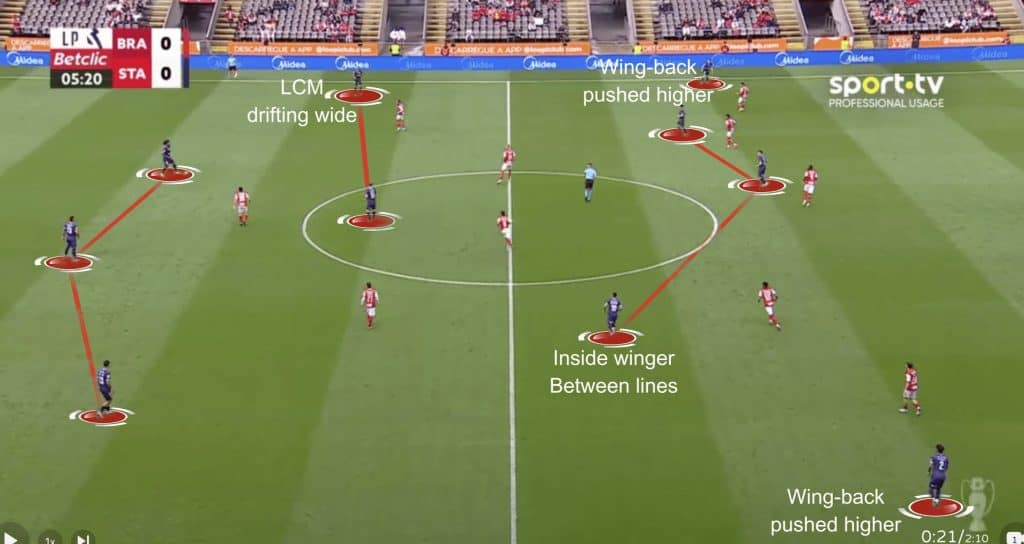
When Santa Clara managed to reach the opposition’s half and final third with controlled possession, particularly against teams defending in medium or low blocks who avoided pressing high to deny space in behind, their positional structure adapted accordingly.
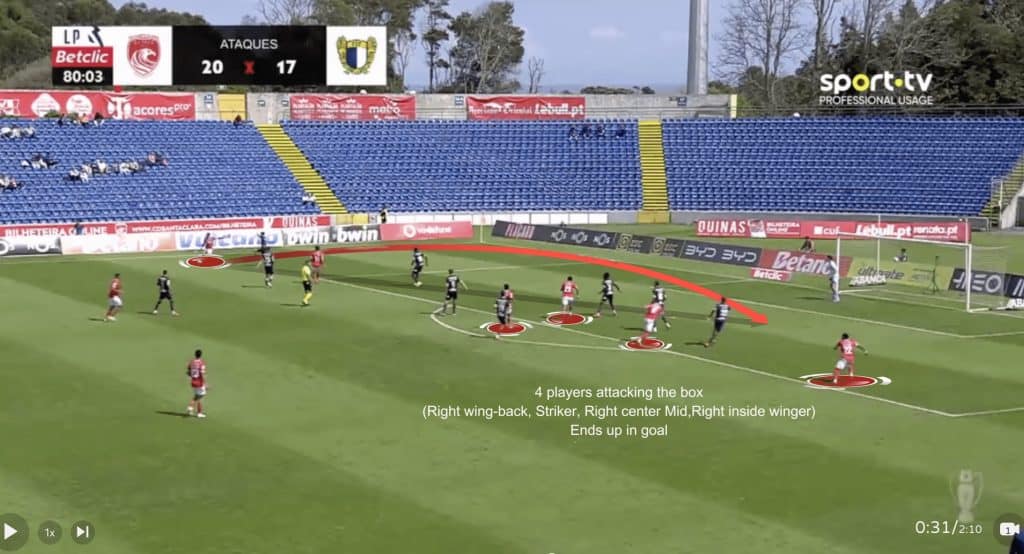
The wing-backs pushed high and wide, providing both width and depth to stretch the defensive line, while the two inside wingers positioned themselves between the lines, looking to receive the ball at their feet but also timing runs into the box.
These runs were often triggered by crosses from wide areas or by progressive passes from teammates in central zones.
In midfield, the roles of the two central players became more defined.
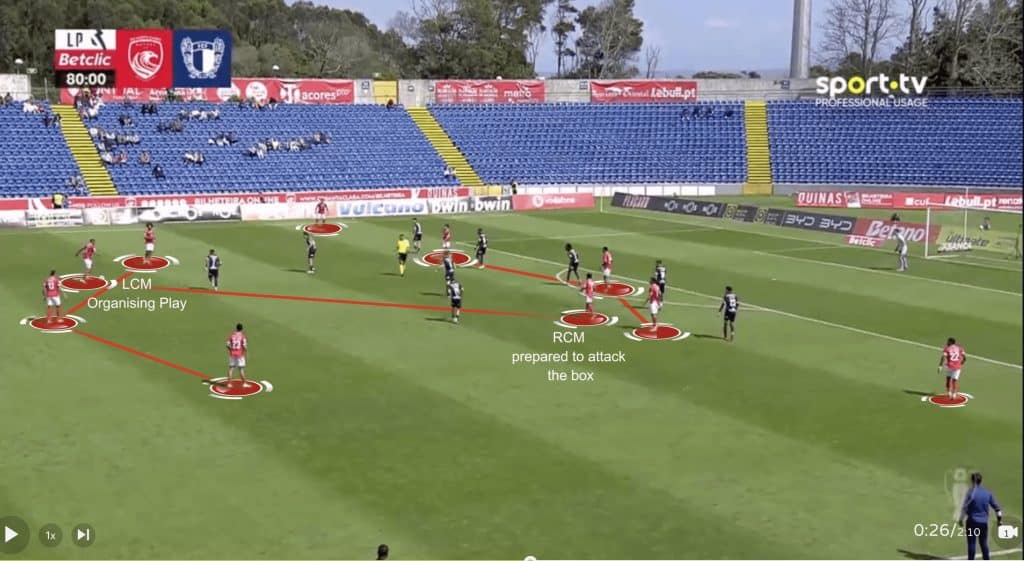
One, usually Adriano Firmino, stayed deeper as the main organiser, occasionally drifting wide to maintain circulation and control, while the other positioned himself slightly more advanced to offer a passing lane closer to the edge of the block.
This separation between the midfielders was particularly visible in the final third.
In contrast, in midfield circulation, the pair tended to stay closer together, albeit with a clear distinction in vertical height and function.
CD Santa Clara Out Of Possession: Defensive Shape & Pressing
Santa Clara’s defensive organisation under Vasco Matos was built on intelligent positioning, collective awareness and tactical flexibility rather than high-intensity, suffocating pressure.
The team did not aim to overwhelm opponents with aggressive pressing in every moment but rather to control space and guide the opponent’s build-up into specific areas, particularly the flanks, while always protecting the central corridor.
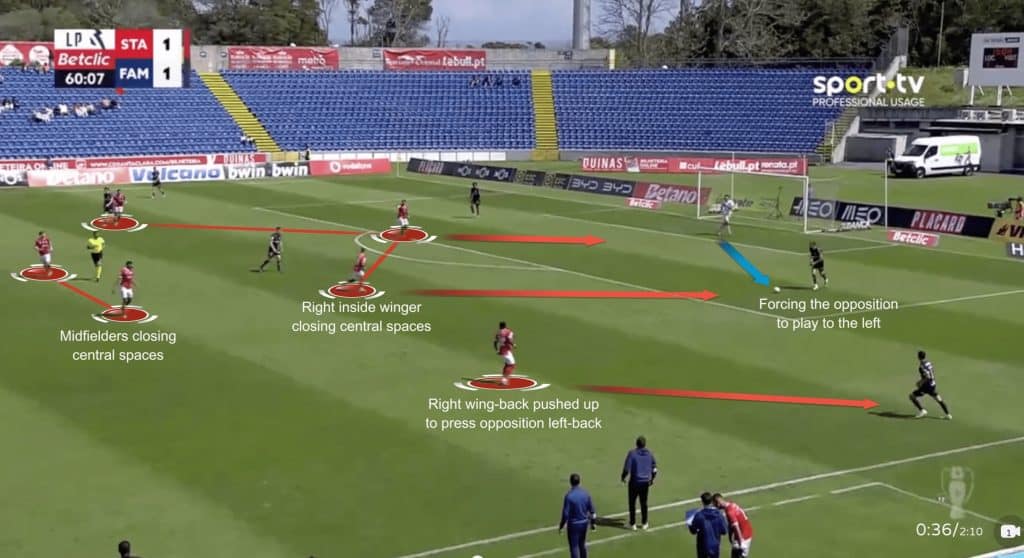
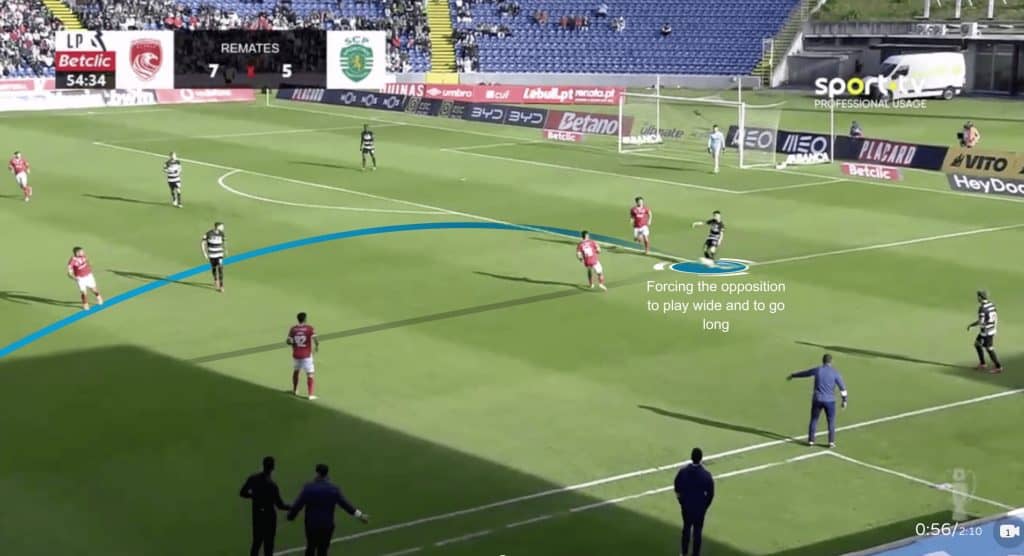
The pressing approach typically involved a calculated effort to direct play wide, closing central lanes through compact midfield positioning and coordinated movements.
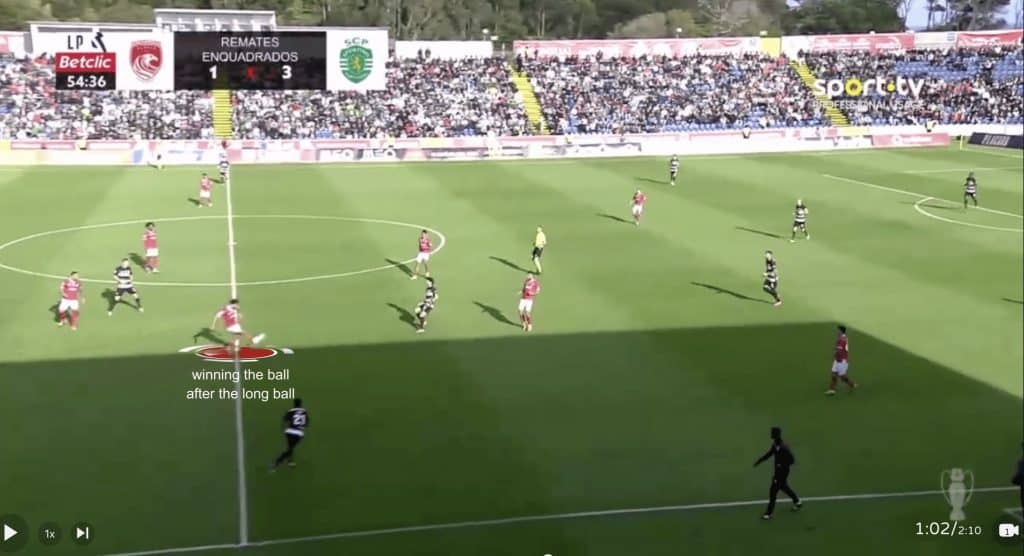
Once the ball was forced to the flank, Santa Clara’s players would increase their intensity, looking to either trap the opponent near the touchline or provoke a long ball under pressure.
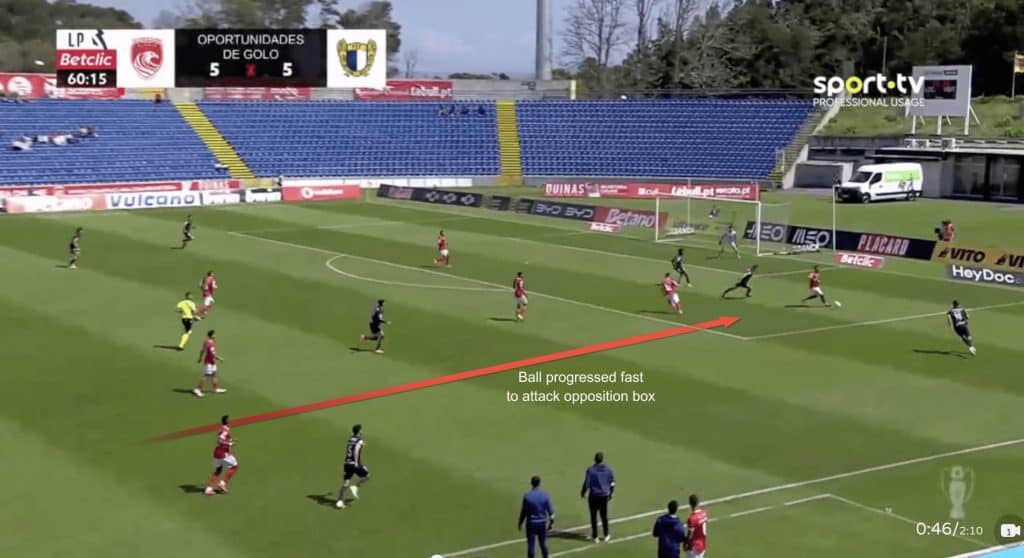
In aerial duels following forced long passes, the team showed excellent positioning and anticipation, regularly winning second balls and launching quick transitions into the final third.
When opponents attempted to build through central areas despite the congestion, Santa Clara responded with immediate aggression, closing down passing lanes and committing numbers to recover the ball quickly and break forward with pace.
This pressing system was also flexible.
Vasco Matos adjusted player positioning and responsibilities based on the opponent’s structure.
The team’s defensive base remained the same, starting from a 1-5-4-1 or 1-3-4-3 shape, but certain movements would shift slightly to counteract the opposition’s plan better.
This adaptability can be clearly seen in two examples: one against Famalicão and the other against Sporting.
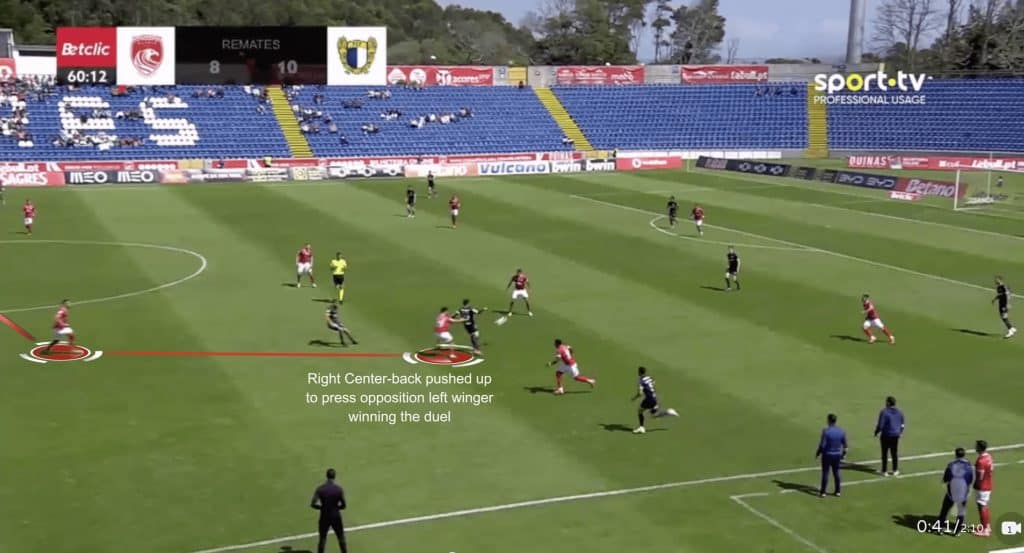
In the match against Famalicão, who built up from goal kicks in a clear 1-4-2-3-1 structure, Santa Clara’s right wing-back stepped out to press the opposition left-back, while the right winger tucked inside to mark the interior midfielder.
This adjustment was made to close central spaces early and prevent progression through midfield.
As a result, the right centre-back was also required to step out with the Famalicão winger, ensuring vertical compactness and covering the second line.
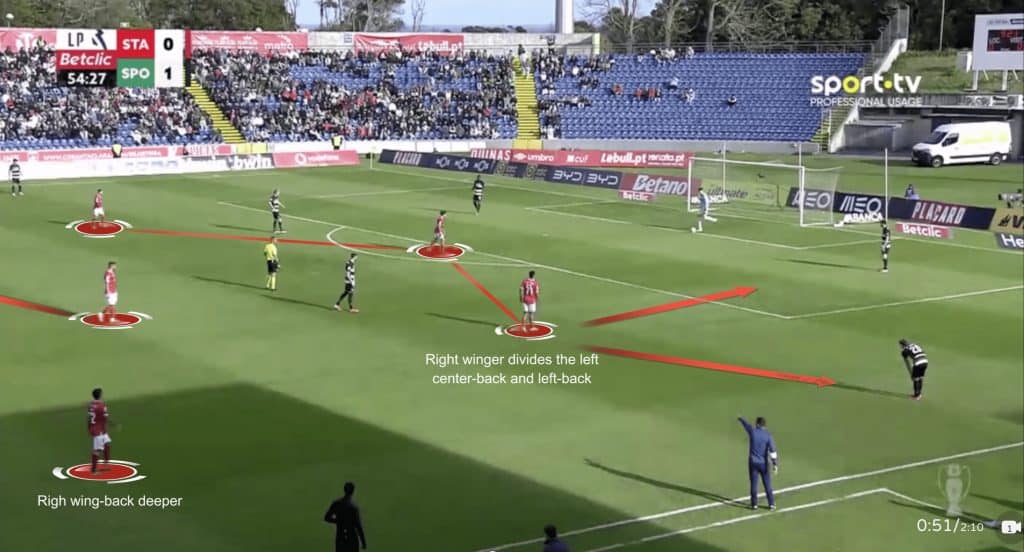
Against Sporting, the roles were slightly different; the right winger pressed the full-back, while the wing-back stayed deeper, showing that, despite a stable defensive structure, Matos made context-specific adjustments to ensure adequate pressure.
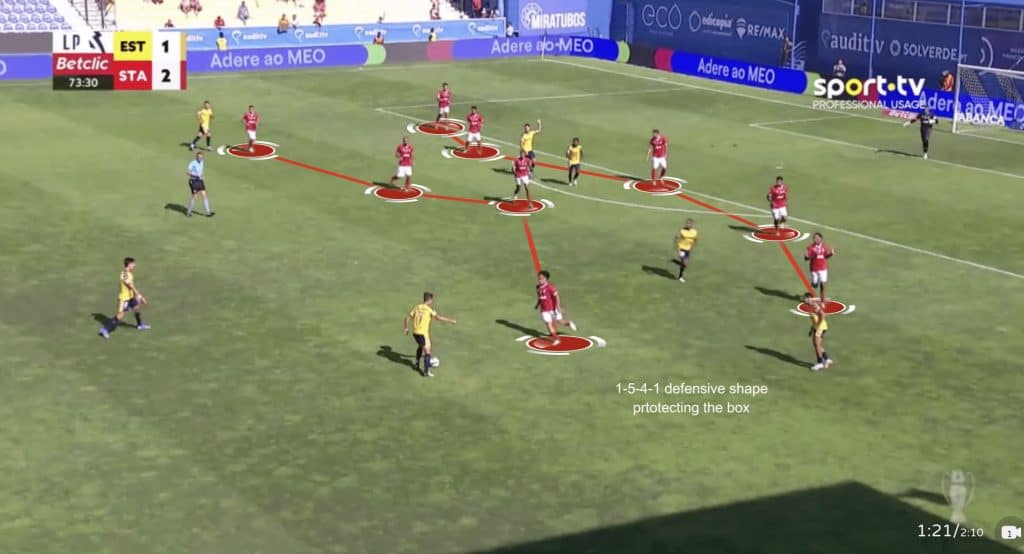
When the first line of pressure was bypassed, either due to opponent quality, set-piece situations, or general turnover, Santa Clara quickly dropped into their 1-5-4-1 defensive block.
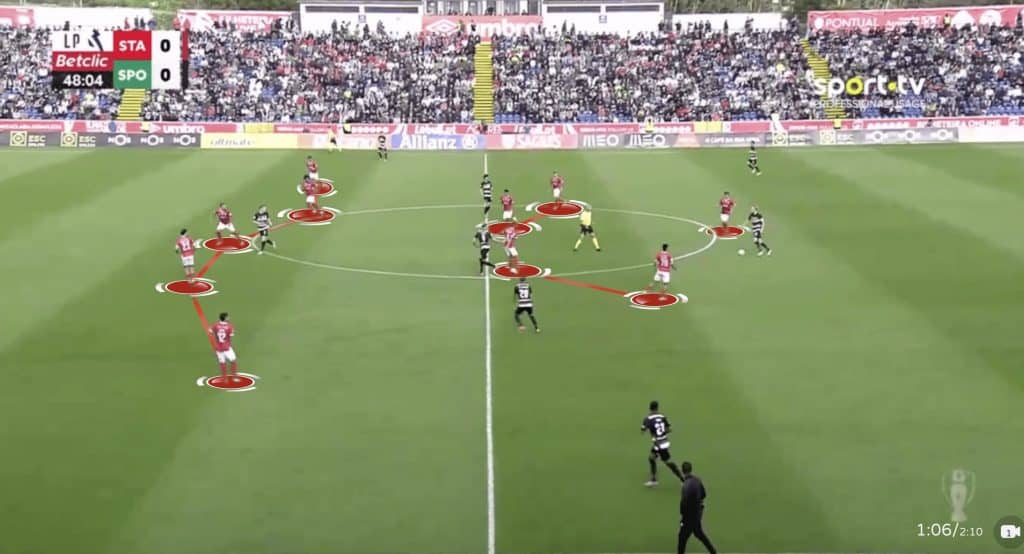
This shape was clearly defined.
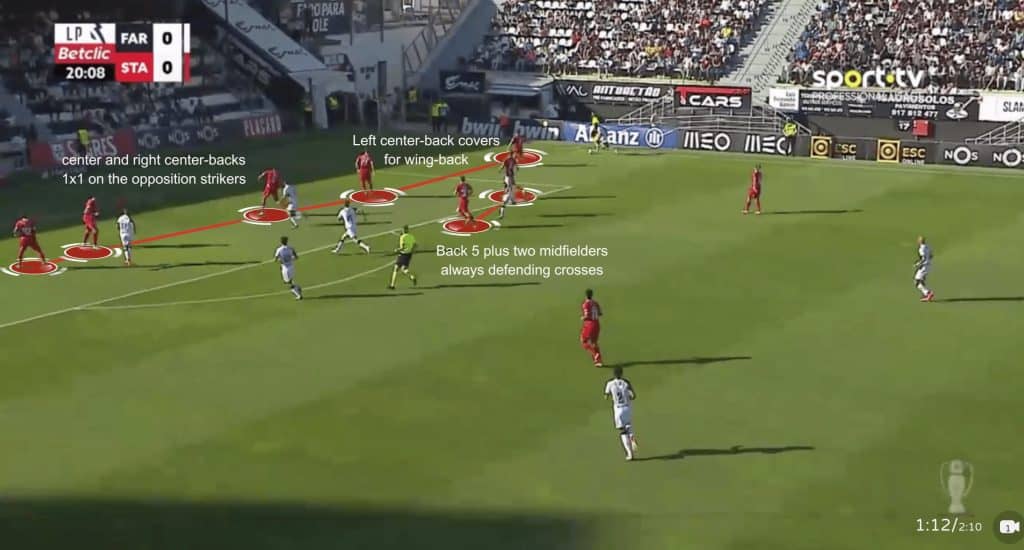
The back five maintained horizontal discipline, while the midfield four stayed narrow to continue protecting central access.
The inside wingers pinched in to block interior lanes.
At the same time, the wing-backs positioned themselves outside to protect the wide channels, stepping forward aggressively if the ball was played into those areas.
This approach forced most opponents to progress into the final third via wide areas rather than centrally.
As a result, many attacking moves against Santa Clara ended in crosses rather than clear-cut chances from central combinations.
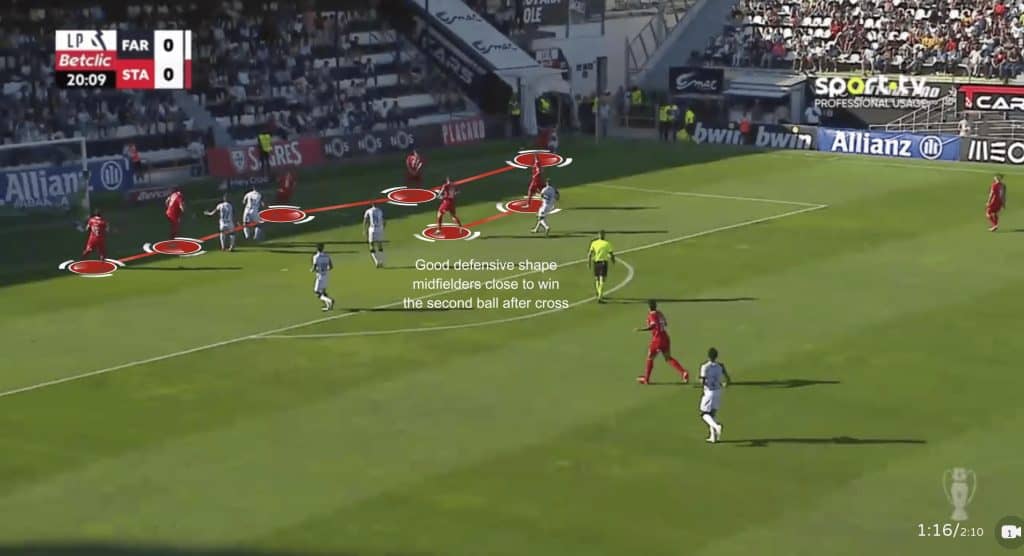
The team’s compactness and aerial strength, particularly through its centre-backs, wing-backs, and defensive midfielders, enabled it to defend these situations effectively.
Their organisation in and around the box, combined with their ability to win second balls, helped Santa Clara finish the season with the fifth-best defensive record in the league, a testament to the collective discipline and tactical clarity instilled by Vasco Matos.
CD Santa Clara Transitions: Offensive & Defensive Reactions
The offensive transition phase was a vital component of Santa Clara’s attacking model.
Due to their consistent use of a compact 1-5-4-1 defensive block, opponents frequently struggled to break through centrally, and this solid structure naturally created numerous opportunities to recover the ball in well-defined zones.
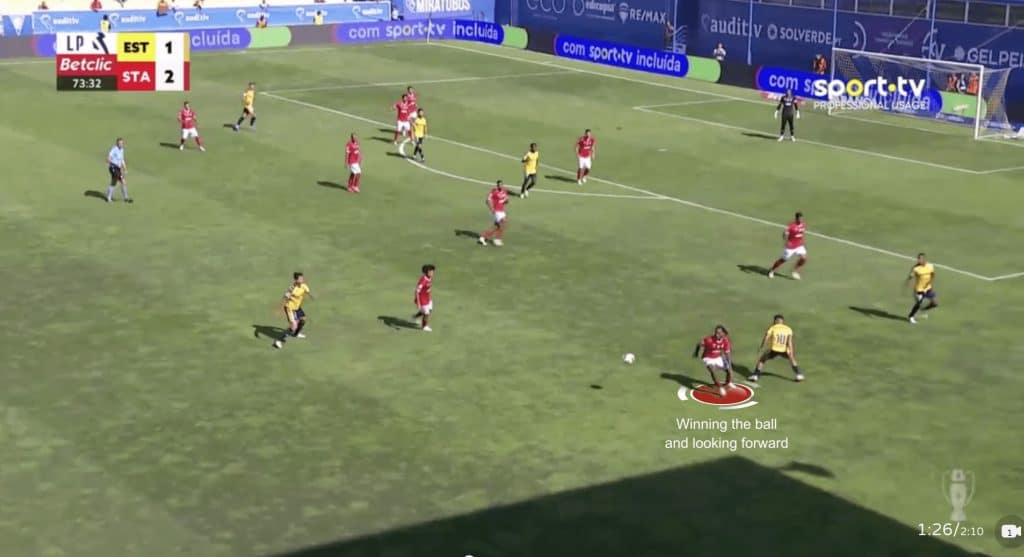
These moments of recovery were immediately converted into attacking actions, with Santa Clara showing a clear and well-rehearsed plan to exploit the space left behind by the opponent.
Central to this phase were Gabriel Silva and Vinícius Lopes, two of the team’s most dynamic players in forward areas, both wingers possess exceptional speed and acceleration, which makes them ideal outlets in transition.
Gabriel Silva stood out, recently recorded as the fastest player in world football, reaching a speed of over 40 km/h in an official match.
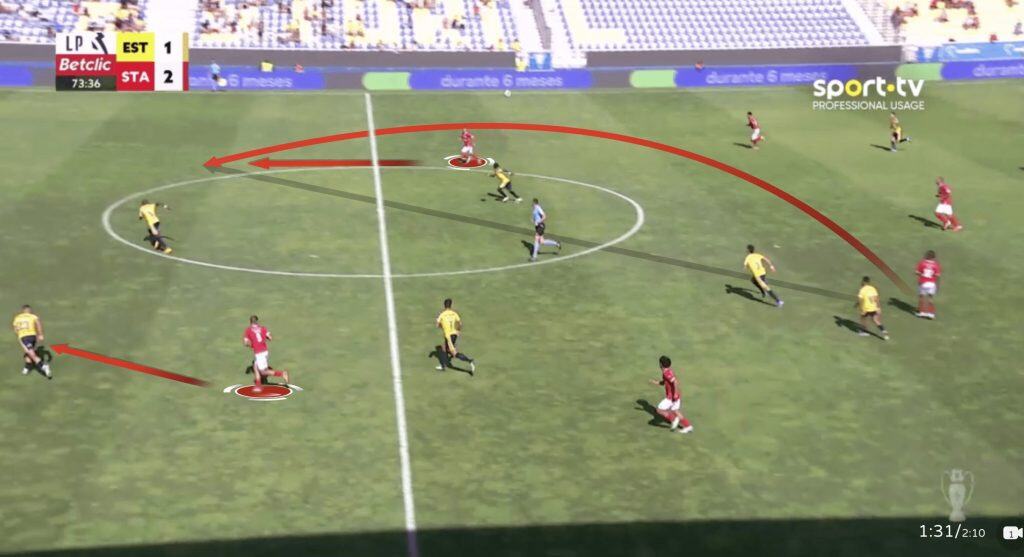
Upon regaining possession, teammates would often look to launch one of these two players into space with immediate, vertical passes, aiming to catch the opponent’s back line out of shape and unable to reset.
The team’s ability to move quickly from recovery to progression relied on both individual qualities and collective awareness.
The midfielders played an important role in triggering these moments, either by winning the ball directly or quickly finding the feet or path of one of the advanced players.
Whether acting as a target or making supporting runs, the striker helped stretch the pitch and create space for wide players to attack into.
These transitions were not chaotic but rather part of a well-structured attacking identity rooted in discipline, spacing, and timing.
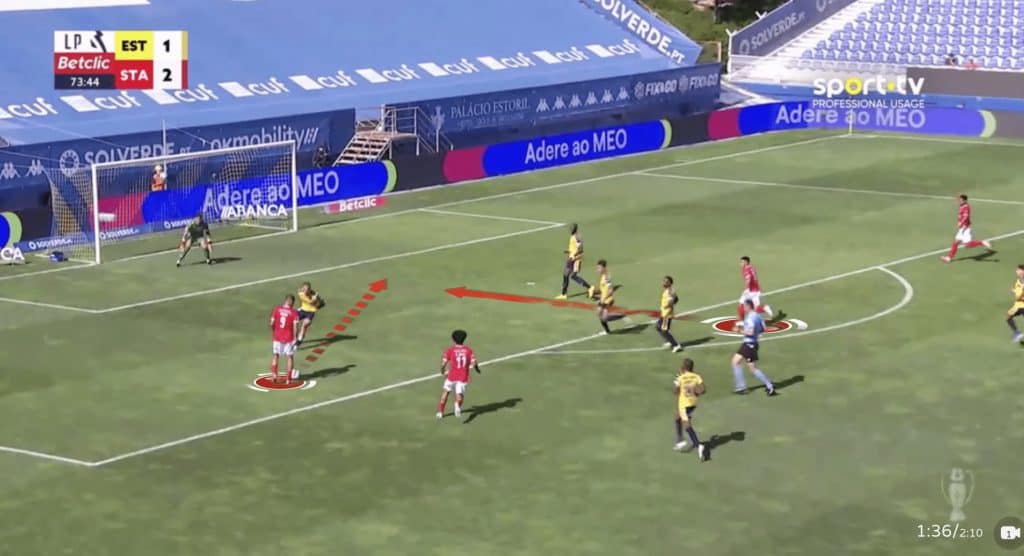
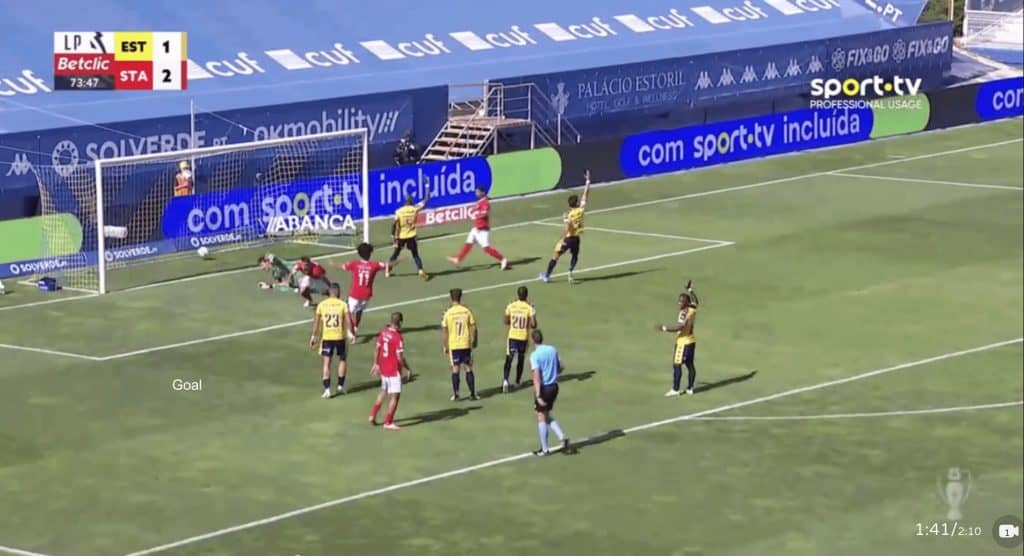
This dynamic is evident in the sequence shown below, where the team recovers the ball and immediately exploits the space behind the opposition’s defensive line, resulting in a goal.
While Santa Clara showed strong organisation in most phases of play, the defensive transition remains an area with room for improvement.
In general, the team demonstrated good awareness in reacting to ball losses; however, certain game contexts and structural imbalances occasionally left them vulnerable in this phase.
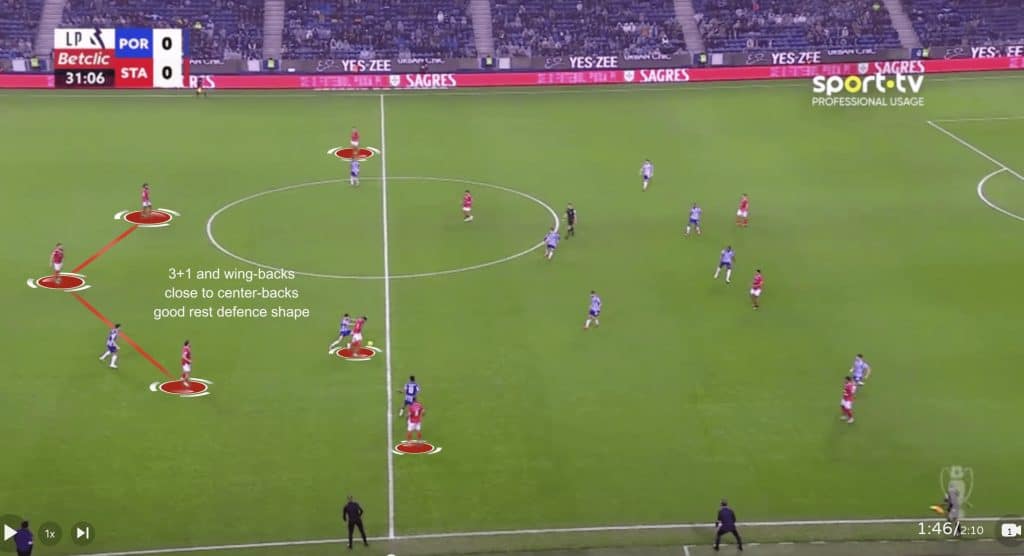
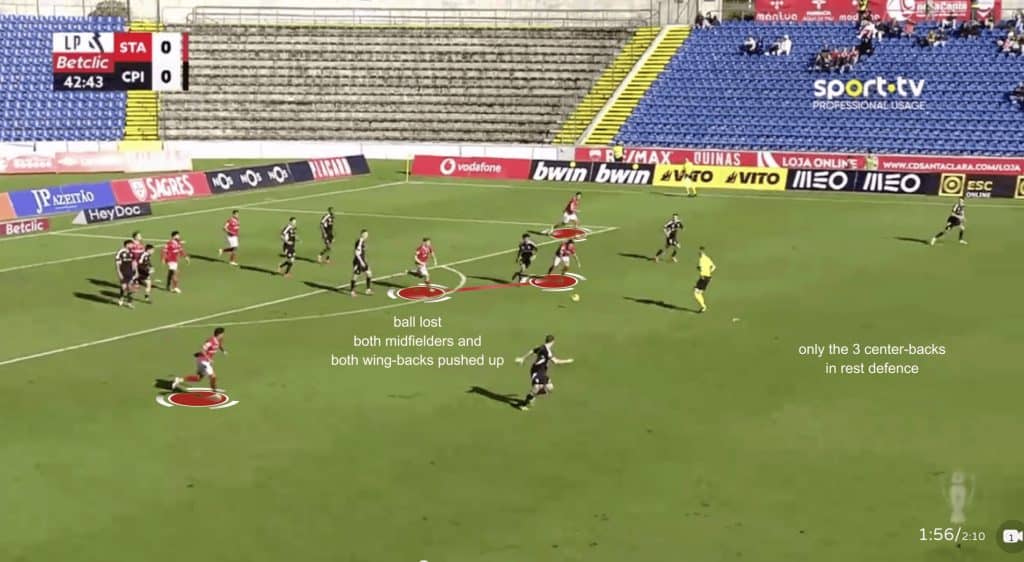
Typically, Santa Clara’s rest defence was built on a 3+1 structure, with the three centre-backs holding their positions and one midfielder, usually Adriano Firmino, staying behind the ball to provide cover.
In these situations, especially when the wing-backs were not overly advanced, the team managed to react quickly to turnovers, applying pressure near the ball or immediately retreating into their compact 1-5-4-1 block.
This allowed them to prevent counterattacks and regain control before the opponent could exploit the space.
However, there were also moments when this balance was lost.
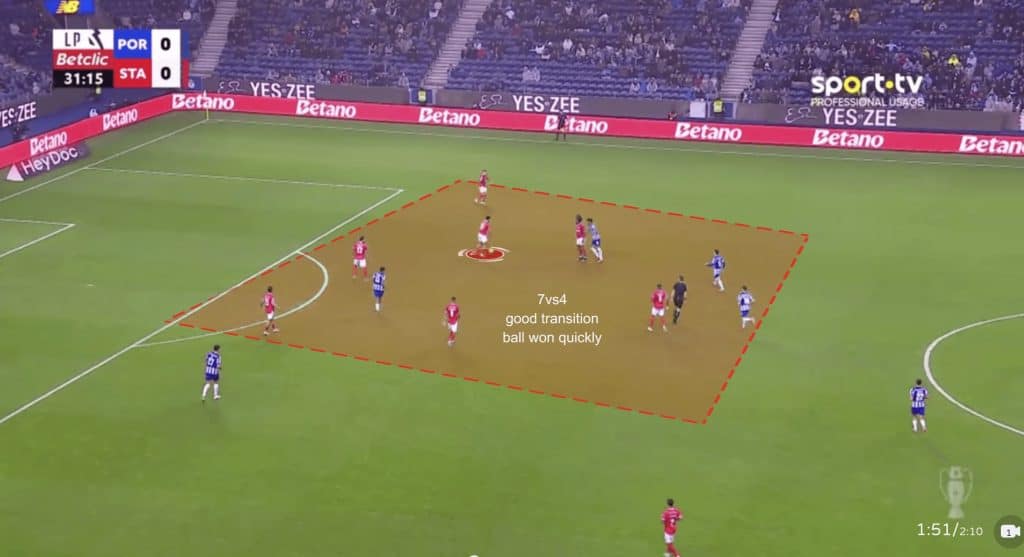
In certain scenarios, such as when the team was trailing, chasing a late winner, or simply playing with increased attacking confidence, both wing-backs would push forward simultaneously.
Even the midfielders would step higher to support the attack.
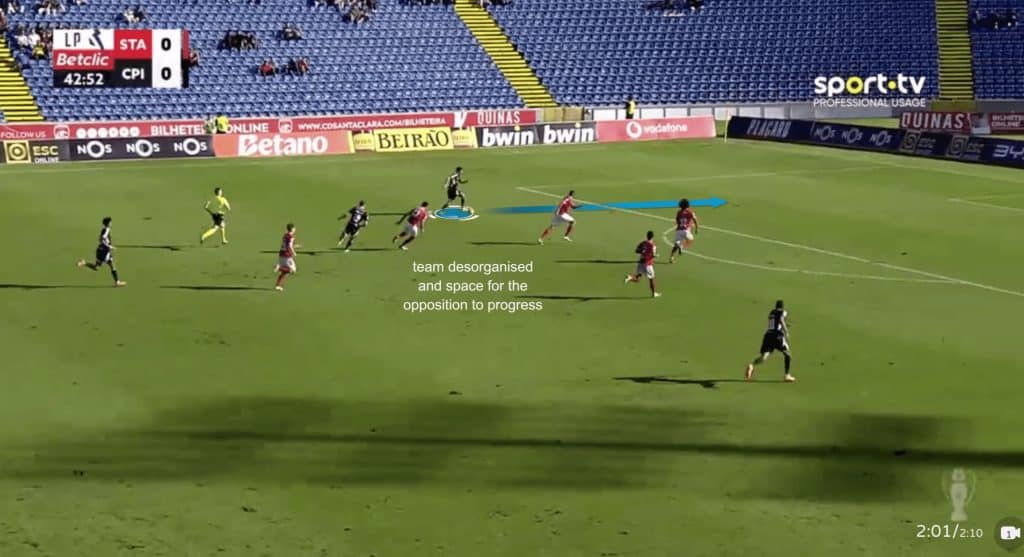
In these cases, the rest of the defence was reduced to just the three centre-backs, leaving large gaps between lines and exposing the team to quick counters.
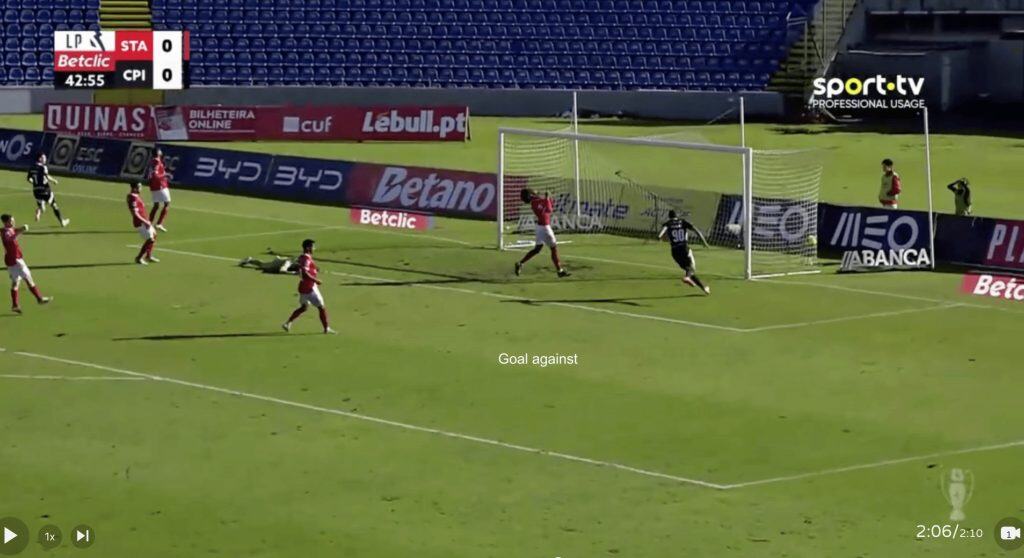
These moments of exposure occasionally led to dangerous situations, particularly against teams with pace and direct attacking patterns.
While not a recurring flaw, it represented a tactical vulnerability that opponents could target when Santa Clara committed more numbers forward.
The images below illustrate two contrasting situations: one showing a well-structured defensive transition with the 3+1 in place, and the other showing a more vulnerable setup with only the back three available to deal with a counterattack.
CD Santa Clara Set-Pieces
Santa Clara demonstrated consistent competence on both ends of the pitch in set-piece situations.
Offensively, the team capitalised on its physical presence and structured routines, scoring five goals from dead-ball situations throughout the season.
Defensively, they were equally solid, conceding just two goals from set-pieces, a reflection of strong organisation and individual discipline inside the box.
One of the key factors behind this success was the aerial strength and physical profile of the players involved.
Centre-backs Luis Rocha and Sidney Lima, as well as Adriano Firmino and MT, provided a solid foundation in both the attacking and defensive phases.
They regularly won aerial duels and cleared danger.
The team’s structure during defensive corners and free kicks often mixed zonal and man-oriented marking.
In attack, the delivery targeted zones occupied by the most dominant headers, frequently creating opportunities from second balls or flick-ons.
Santa Clara’s ability to maintain balance and focus in these moments contributed directly to their defensive solidity and their offensive threat, making set-pieces a reliable source of advantage throughout the season.
Conclusion
Vasco Matos has built a well-defined tactical identity at Santa Clara, rooted in structure, organisation and adaptability.
From a solid base that remained consistent across two consecutive seasons, including after promotion to the top flight, the team was able to implement a game model that balanced defensive discipline with purposeful attacking transitions and collective intelligence in possession.
Operating within a flexible 3-4-3 shape, Santa Clara demonstrated control in all phases of play.
Their compact 5-4-1 defensive block forced opponents wide, while their offensive transitions, often led by the explosive pace of Gabriel Silva and Vinícius Lopes, consistently created danger.
In possession, the team moved with structure and intent, alternating between short combinations and quick vertical attacks, and showing maturity in managing different game contexts.
Set-pieces added another layer of strength, with solid execution on both sides of the ball.
The few vulnerabilities seen in defensive transitions largely stemmed from specific match scenarios and can be corrected with minor adjustments.
Finishing fifth in the league and securing European qualification in their first season back in Liga Portugal is a remarkable achievement and a clear sign that Santa Clara, under Vasco Matos, has not only returned to the top level but is now a team with a tactical identity and competitive edge to stay.
