
Maurizio Sarri re-joins Lazio for a second spell, as announced by the club, following a 15-month break from coaching after leaving I Biancocelesti in March 2024.
His first spell with the club started in the summer of 2021 and lasted until March 2024.
He achieved historic results with the team, notably a second-place finish in Serie A in the 2022/2023 season.
The team’s fans are generally very pleased with this appointment.
They believe in Sarri’s ability to lead the team back to the top of Serie A and to compete regularly in the UEFA Champions League.
Following the end of Marco Baroni’s journey with the team at the end of this season, the club and its fans agree that the results have not been as successful as needed, given that Lazio failed to secure a European competition ticket, finishing in seventh place.
It is also agreed that the choice of Sarri comes to rescue the team from remaining in lower spots in Serie A or escaping the battle with the big teams, with the belief that Sarri is the coach who can lead them back to domestic success and achieve unprecedented results on a European level.
Lazio decided to appoint an experienced head coach who knows Lazio very well and will not need time to adapt to the specifics of Serie A.
This will help them win a lot of time ahead of the new season and start it in the best possible way, as they will have the time needed to prepare, experiment with the players, and get them used to Maurizio Sarri tactics.
In fact, Sarri has already worked with many of the existing players within Lazio’s squad, and this will be very time-saving for everyone.
Moreover, having the time and ability to discuss with the management which players to try buying and which ones will not be in the team’s plans will help Sarri build the team from scratch according to his preferences, but without destroying the core.
In this tactical analysis article, we will examine Sarri coaching style and application within the current Lazio squad.
The analysis will also discuss the available player choices and Lazio’s needs from the transfer window to reinforce the squad.
Maurizio Sarri Ideas & Playing Style
Sarri is a veteran head coach who has a long history of management in Serie A.
Given that he was a player for amateur teams and a banker at the same time, he did not initially have the chance to coach a Serie A or Serie B team as he was neither renowned as a football player nor experienced as a head coach.
That’s why his coaching career began in 1990 with Stia in the Seconda Categoria (the eighth level of the Italian football league system).
The following year, he was appointed head coach for Faellese and helped the team advance to the “Promozione,” the sixth level in the system.
After two years with Faellese, he helped both of Cavriglia and Antella reach the Eccellenza, the fifth level in the Italian league system.
This progressive climb through the Italian league levels helped Sarri develop significantly and learn a great deal during the process, while winning and confirming his ability to promote teams from one level to another in a short time.
Afterwards, he coached all of Valdema, Tegoleto, and then Sansovino, having promoted Sansovino to Serie D in his first season with them.
He also reached the playoffs with them and achieved remarkable successes with that team to attract the interest of Serie C2 side, Sangiovannese.
Sarri stayed for two seasons at Sangiovannese and helped them reach Serie C1.
In 2005, he moved to Pescara to coach a Serie B side for the first time, helping them avoid relegation.
He then moved to several other lower league sides, without achieving considerable success.
In 2012, Sarri was appointed manager of Empoli and led the team to Serie A after a ten-year absence, while proposing a convincing attacking style of football.
A few years later, Sarri was brought to Napoli and created a new playing style for the team that was very attractive to watch.
Sarri’s Napoli reached the second spot and were very close to winning the league title, but the battle with Juventus was not successful in the end, despite finishing the first part of the season at the top of the standings.
Sarri kept battling Juventus until the 2017/2018 season when they finished second behind I Bianconeri, despite losing key players in the meantime and knowing how to replace them effectively.
Sarri’s journey with Napoli ended that term, and he joined Chelsea for one season before getting back to Italy through the door of Juventus, with whom he won the Serie A title.
During most, if not all, of these extended coaching experiences, Sarri has consistently employed the 4-3-3 formation.
He believes that it is the one formation that helps him achieve his goals on the pitch and attain the maximum potential of the players according to his plans.
In other words, Sarri always imposes his playing style and attempts to make the necessary adjustments in terms of players’ positions and transfers to fit his system and the roles he needs on the pitch.
This also means that he does not just cope with what he finds or try to change things progressively, but rather immediately and in a radical way.
In fact, Sarri employs the 4-3-3 formation to achieve a particular, spectacular, and possession-based style of football that most of his teams succeed in mastering within a short period.
His ultimate success indeed happened at Napoli, the team with which “Sarriball” became renowned throughout the footballing world.
It is a playing style that relies on quick vertical possession, which breaks defensive lines, and that requires continuous and intelligent player movements without the ball in addition to accurate passing.
Sarri values accurate key passing between the lines and considers it a high priority in his training and player choices.
That also explains why he relies on specific players and significantly improves their value, while overlooking other players who, despite being good, lack the skills necessary for his strategy.
To confirm this, we can cite the example of Sarri’s goalkeeper choices and argue that he always prefers goalkeepers with outstanding passing skills in order to participate in the vertical passing plan and be useful in the build-up in a way that initiates the team’s attack properly and not just with a simple pass to one of the defenders.
Maurizio Sarri Vertical Passing System
The following picture highlights Sarri’s usage of goalkeepers in fastening the preferred vertical passing process to break line very quickly and be able to create the space needed at the back of the opposing defensive line.
This goal action was created mainly thanks to the goalkeeper Ivan Provedel’s vertical pass to his midfield teammate, who, in turn, passed the ball quickly to the winger, who made the movement to receive the ball centrally.
This quick vertical exchange allowed the winger to get some free space and have the possibility to pass to the right-winger, who crossed the ball to Valentín Castellanos to finish the action inside the net.

Sarri’s attacking system relies heavily on the players’ first touch and their ability to be quick, whether in terms of making passing decisions or executing such passes and movements.
The idea is also to have players move forward to provide a passing option, while other players come closer to each other to draw the opponent to a specific area.
Then, players exchange passes in that area before passing to the teammate who moved forward in space.
This type of action is consistently noticeable in Sarri’s teams’ play, and it has proven its effectiveness on numerous occasions and with the various teams he has coached.
The rate of efficiency varies according to the type of players in Sarri’s team and their ability to grasp and interpret his ideas accurately.
His tactics also heavily rely on the central midfielders’ attacking input.
He usually instructs them to be present inside the final third when attacking, using the half-spaces and drawing opponents to those areas to free up space for the wingers and the striker.
Therefore, Sarri must have very agile and quick midfielders who are capable of playing under pressure, moving without the ball, and passing effectively.
Maurizio Sarri Exploitation Of Spaces
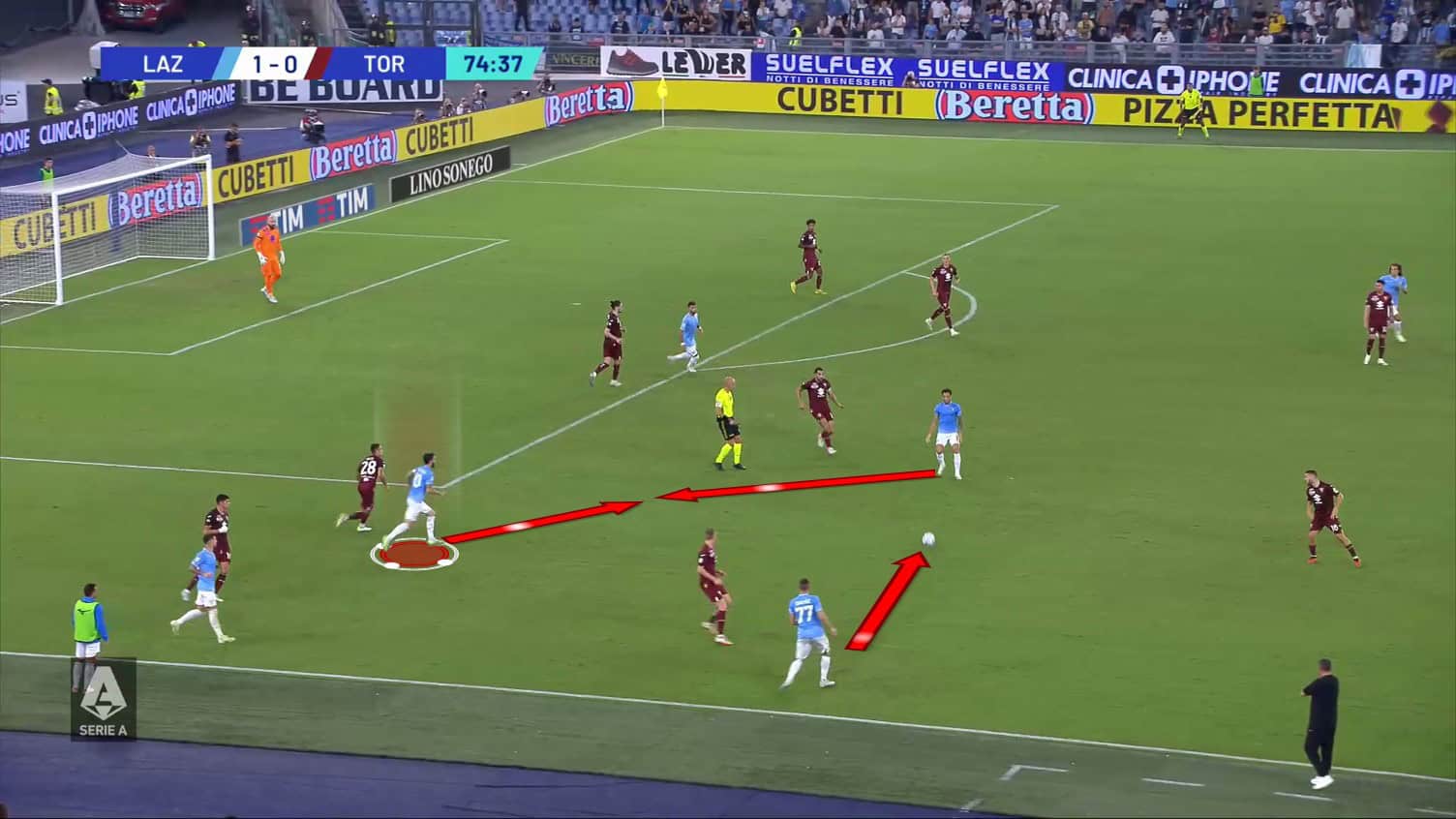
The following picture highlights his efficient use of Luis Alberto in attack.
Alberto often moves between the lines and provides passing options in key areas, like below.
As soon as he provides the pass, he moves to search for another passing option for his teammates and helps in one-two combinations and sometimes in triangular exchanges with two teammates.
Furthermore, Sarri is known for using repetitive training exercises that help players become accustomed to his playing method, enabling them to develop a habit of solving problems in specific ways and build strong chemistry with one another.
The aim is always to reach a level of chemistry that allows them to understand each other quickly and opt for the same solution while doing what is needed to make that solution work.
This system proved its efficiency and can work with Lazio’s current team.
The idea is also to reduce the players’ thinking time and make them more rapid in problem-solving, especially when it comes to passing.
Maurizio Sarri High Pressing
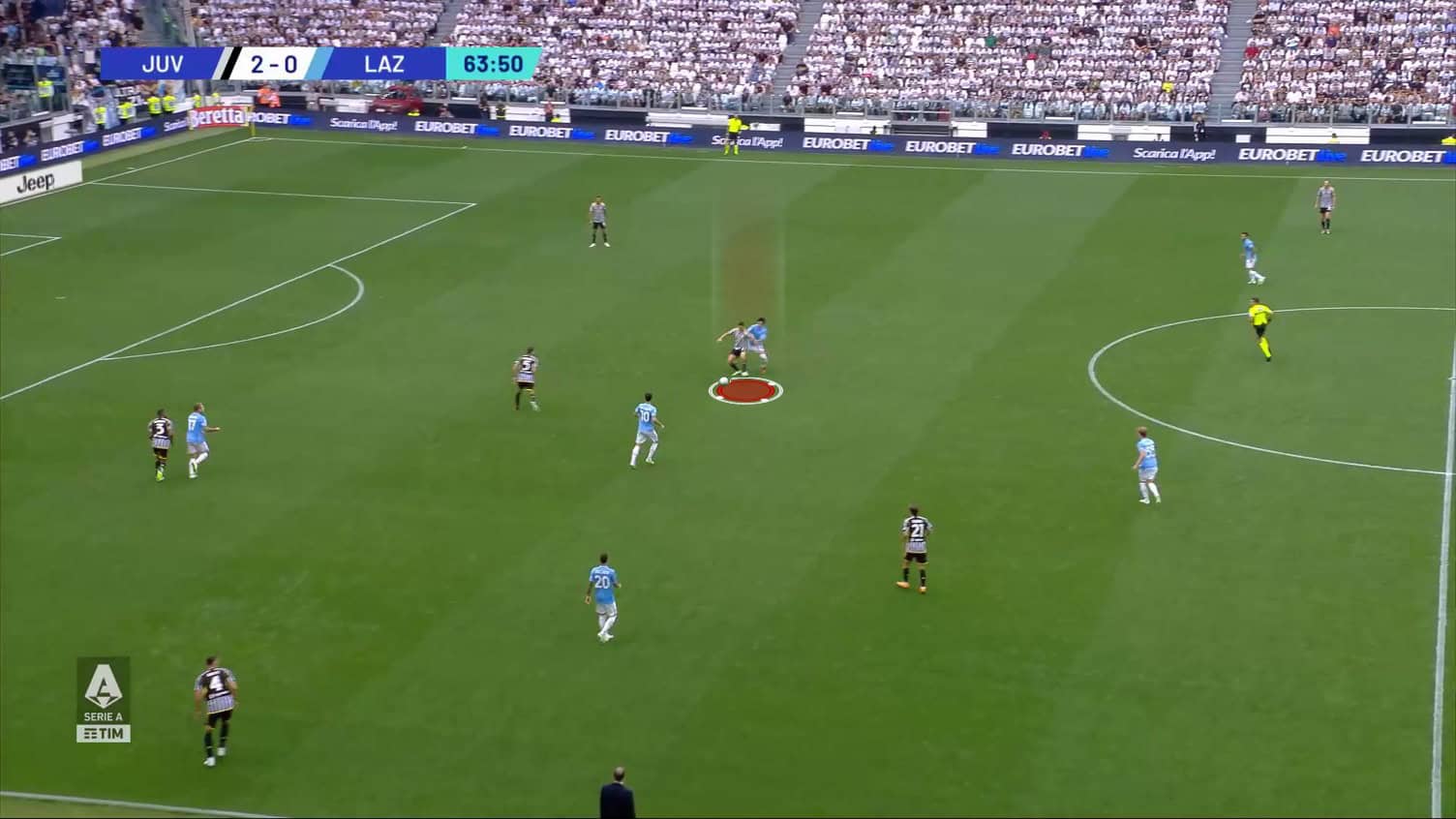
Another tactic that was noticed in Sarri’s playing style is his reliance on intelligent high pressure to push the opponent into committing mistakes in their own half.
This occurred against big teams like Inter Milan and Juventus when Sarri was coaching Lazio, which demonstrates the effectiveness of this high-pressing technique.
Maurizio Sarri Potential Player Choices & Preferences
Sarri will undoubtedly need to make some adjustments and changes to the current Lazio team and lineup.
For the goalkeeper role, Provedel will most likely lose his starting spot progressively as he did not have a solid season in 2024/2025.
He was ranked 19th in Serie A in terms of crucial saves.
That’s why it will be very probable to use the second goalkeeper, Christos Mandas, more frequently if Lazio does not sign a new goalkeeper.
If Lazio are looking to buy a new goalkeeper, the most suitable choices would be Venezia’s Ionuț Radu, who was the best-ranked goalkeeper last season in terms of crucial saves, or Sassuolo’s Stefano Turati, who is also a promising goalkeeper and can cope well with Sarri’s playmaking demands.
For the defensive line, both Alessio Romagnoli and Mario Gila will be confirmed as starting centre-backs as they are suitable to Sarri’s tactics.
At the same time, valuable backup options will be needed for Lazio, despite not participating in European competitions, especially as Gila might be transferred to another team during the summer.
One of the key defensive players who can excel under Sarri’s management at Lazio is Cagliari’s Yerry Mina, who was the best in terms of defensive duels won.
As a left-back, Nuno Tavares is the expected starting player in this position, as he possesses all the qualities necessary to succeed with Sarri.
The only aspect to keep an eye on is his high number of injuries per season, which could impact the team.
That’s why it would be wise to try signing a reliable backup left-back for Tavares.
The options can certainly vary, but names like Junior Firpo or Giorgos Kyriakopoulos seem very suitable to Sarri’s Lazio.
For the right-back role, both Elseid Hysaj and Adam Marušić will be competing for a starting spot, and Sarri will not have any issues with this decision.
In midfield, Sarri will more likely be relying on Nicolò Rovella for the defensive midfielder role, with both Mattéo Guendouzi and Matías Vecino as central midfielders, knowing that he had already worked with these players and trusts in their abilities.
Fisayo Dele-Bashiru can also be one of Sarri’s secret weapons because he has the physical abilities and techniques needed to convince Sarri and earn a starting spot.
He can play both as a right or left central midfielder and is very dangerous when penetrating the final third.
Attacking-wise, Mattia Zaccagni will undoubtedly remain the starter for the left-winger role.
Gutav Isaksen will be the right winger, as he suits Sarri’s attacking ideas, especially for the right winger position.
Lazio might choose Idrissa Touré as a potential backup to replace Zaccagni.
After his outstanding season with Pisa, why not let him continue to develop even further under Sarri’s management?
As a substitute for Isaksen, Gaetano Oristanio would be the most suitable low-cost signing to replace Isaksen during the season and become one of Sarri’s plan B weapons.
For the striker role, Taty Castellanos will certainly be the main striker for Sarri’s Lazio as he is the perfect player for the striker position at the moment.
With a few years of experience in Serie A, Castellanos has the potential to become even more impactful and clinical with Lazio, especially given his working experience with Sarri, which will allow both of them to gain precious time.
Therefore, Boulaye Dia will be the backup option for the striker role, knowing that he is on his second season of loan from Salernitana.
Conclusion
The second chapter of Sarri’s mission with Lazio has just started, and this adventure promises to be more successful than the initial one.
Unlike in the past, there seem to be fewer conflicts and disagreements between the management and the sporting direction.
With the correct player choices and summer signings, Sarri can lead Lazio back to battling for the top Serie A spots.
He possesses the playing style and tactics necessary to make Lazio more formidable than it was last season.
