
When Werder Bremen announced Ole Werner‘s departure, many outsiders were surprised by Die Grün-Weißen CSO Clemens Fritz‘s decision.
The young German coach took over Werder at the club’s darkest time in 2021.
After getting relegated, the team was stuck in the second division’s midfield, and the situation looked dire.
But Werner took over the struggling squad and instantly turned things around.
Werder went on a winning streak and eventually secured promotion at the end of the season, making their return to the Bundesliga after just one season.
After promotion, Werner managed to secure a mid-table finish in their first season back and then narrowly missed out on European football with Werder over the last two campaigns.
Still, there was some friction between Werder and Werner regarding the development of youth players and squad planning.
Therefore, the coach decided not to sign a new contract with the club, which ultimately led to his release.
A bit to the East of Bremen, RB Leipzig were looking for a new coach after firing Marco Rose during the season.
With many options not working out, the club decided to hire Ole Werner as their new head coach, but things did not fall into place as simply as they would’ve liked.
While still under contract for one more year in Bremen, Werder still wanted a fee for their former manager, and it took weeks for the two clubs to reach an agreement.
Now, one of Germany’s most talented young coaches will coach one of the Bundesliga’s most interesting projects.
In this tactical analysis and head coach analysis, we will examine what Ole Werner tactics will bring to Die Roten Bullen, what he built his success on at Werder Bremen, and what we can expect from RB Leipzig next season.
Ole Werner Vertical Build-Up Tactics
Looking at the club that Ole Werner will join, one can see that it already has an established culture and identity.
Considering the squad planning and the players already in place, Werner will need to adjust his playing style to match the Red Bull style of play.
Considering he has not been at any Red Bull-owned club, this could become a bit of a problem, but with his pragmatic approach, Werner’s Werder teams have been rather Red Bull-ish over the last couple of seasons.
Werder has been an incredibly vertical team in terms of their passing game.
Especially in build-up, they are always looking to break the lines with their passes quickly.
Werner preferred to play with a back-three during his entire time at the club, but during build-up, one midfielder or one wing-back drops to form a back-four.
Werder is always incredibly patient when they have the ball in their first line of play.
They rarely try to trigger play on their own and love to attract the opposing team’s press and exploit the space behind it.

Here we can see a perfect example of Werder’s build-up play under Werner.
The entire situation started with goalkeeper Michael Zetterer, who was heavily involved in their passing game.
Zetterer passed the ball out to the right side, where Werder decided not to trigger play and passed it back towards their right centre-back.
This now attracts the press of RB Leipzig, and their entire block moves forward and towards the right side of Werder.
In these situations, their holding midfielder drops back towards the defenders and tries to keep passing distances short.
Werder now switches play through their central centre-back, and they show great composure in these situations, staying on the ball and playing precise passes.
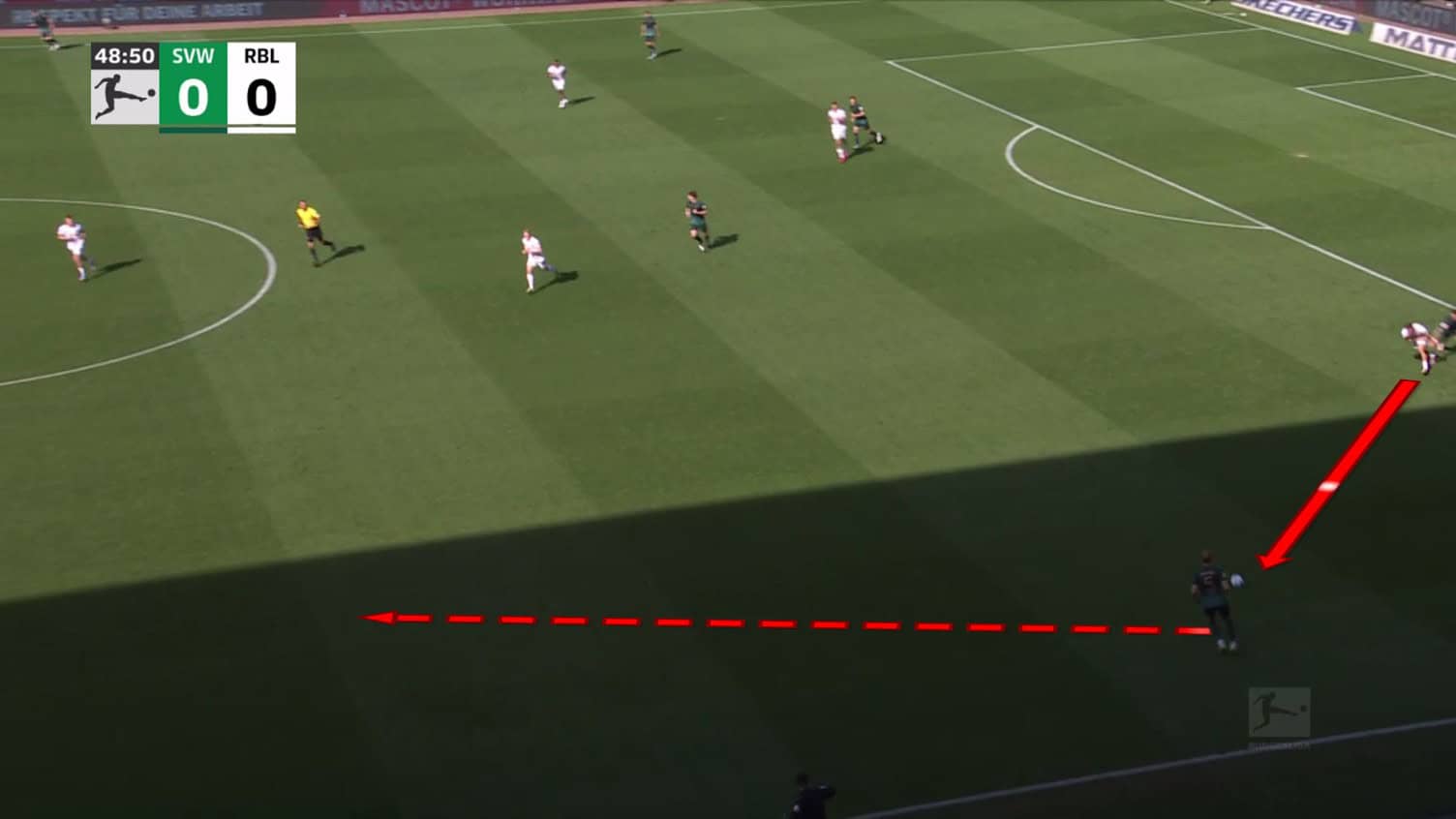
With them attracting the press to their right side, they opened up their left centre-back, Amos Pieper, who positioned himself near the sideline.
Captain Marco Friedl now plays the pass outwards to Pieper, who instantly uses his first touch to move forward into the vacated space.
With just five passes, Werder created an opportunity for their player to carry the ball forward past their opponent’s first line of press.
This patience was great to watch for Werder under Werner, and he managed to set his team up perfectly for their attacks.
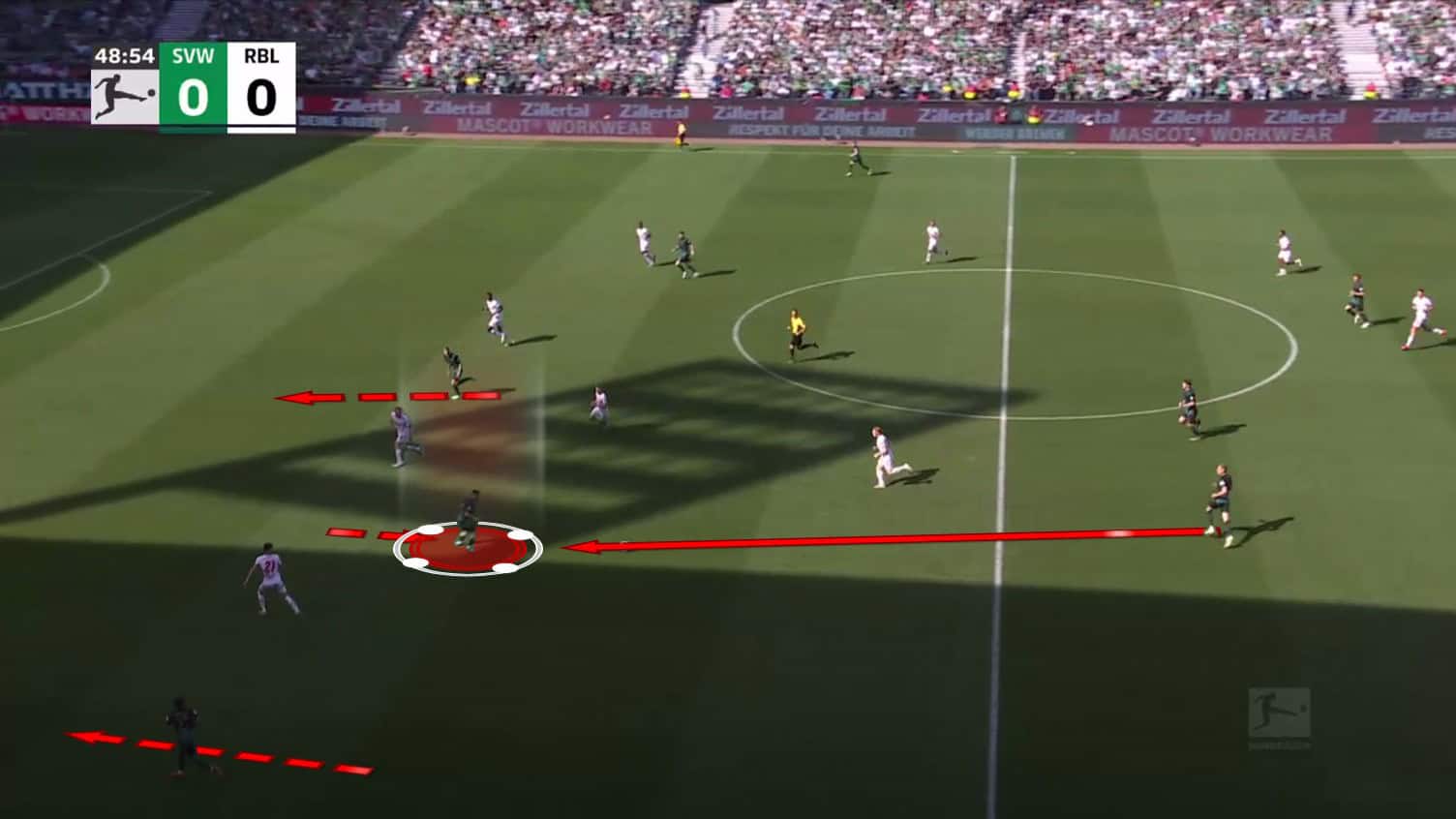
Pieper carried the ball forward into midfield, and Leipzig had to scramble backwards to regain their defensive shape.
Werder uses this to instantly attack the backline of Leipzig.
In this situation, left wing-back Felix Agu and striker Oliver Burke are making runs behind the defensive line to the left and right of Pieper, pushing the backline back.
Now they involve their key player, Romano Schmid.
He moves against the direction of Burke and Agu and drops back into the space in front of the backline of RB Leipzig to receive a vertical pass from Pieper.
He can then instantly turn around towards the goal and involve Felix Agu on the wing.
Just one run and one vertical pass to the near-sided half-space, and Werner has his team in the final third.
It’s very efficient and very Red Bull-ish.
Presence In The Box
Looking at how the situation in the first paragraph ends, Schmid crosses the ball into the box, and Leipzig are able to defend that easily.
Still, Werder had the fourth-most crosses into the penalty area in the last Bundesliga season.
Werder were not really looking for quick combinations.
Werner had his team play fairly straightforward football: attract the press, carry the ball past it, look to find Schmid between the lines, prepare for a cross, and then cross it.
This made Werder a fairly fast-paced attacking team last season, and this is one of the reasons why I believe Werner is an excellent fit for RB Leipzig, who also prefer a fast-paced attacking style.
Werder was also quite successful after their crosses, but not necessarily because of their strikers, but rather due to their presence in the box.
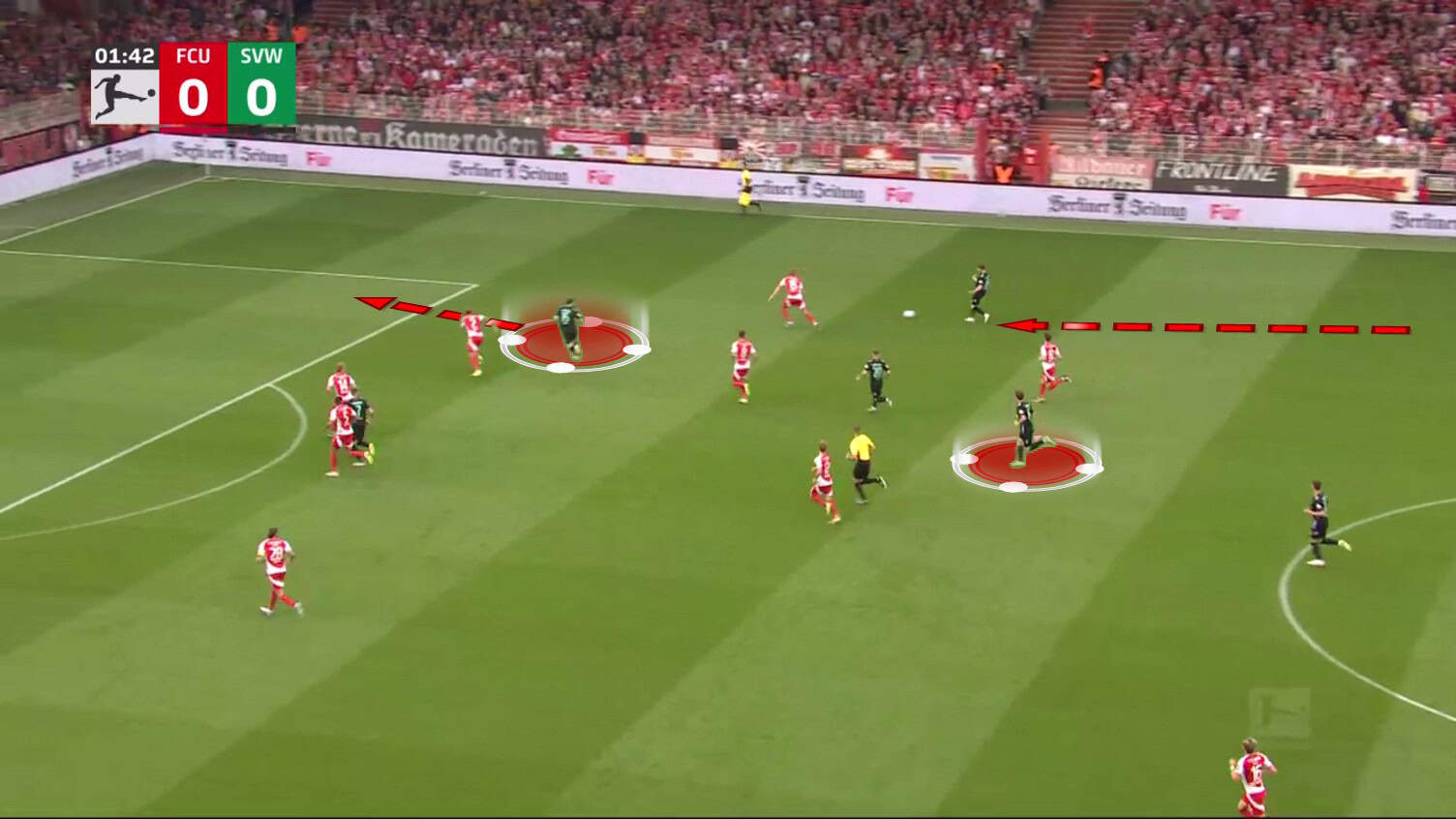
Examining a typical Werder attack from this past season, we can see this situation early in the game against Union Berlin.
Once again, they attracted the press to one side, switched play over to the right side, and the player there, this time right-back Mitchell Weiser, carried the ball forward until he got pressed by a defender.
Weiser carries the ball deep into the Union half this time, so there was no need to involve Schmid, who was open between the lines once again.
Union knew the pattern and tried to prevent the pass to Schmid, but this opened up another opportunity for Werder.
Why play many passes when few do the trick?
Striker Burke once again uses his pace to make a run behind the backline, and with the Union midfielders stepping up to defend, Schmid, there is a bit of space opening up for him.
Weiser threads the ball through towards Burke here, who now finds himself at the right edge of the box.
Jens Stage, highlighted in midfield, is one player we need to look at here.
The Danish midfielder is not even trying to receive the ball from his wing-back, but instead, he has already moved forward in the midfield, which we will keep in mind for later.
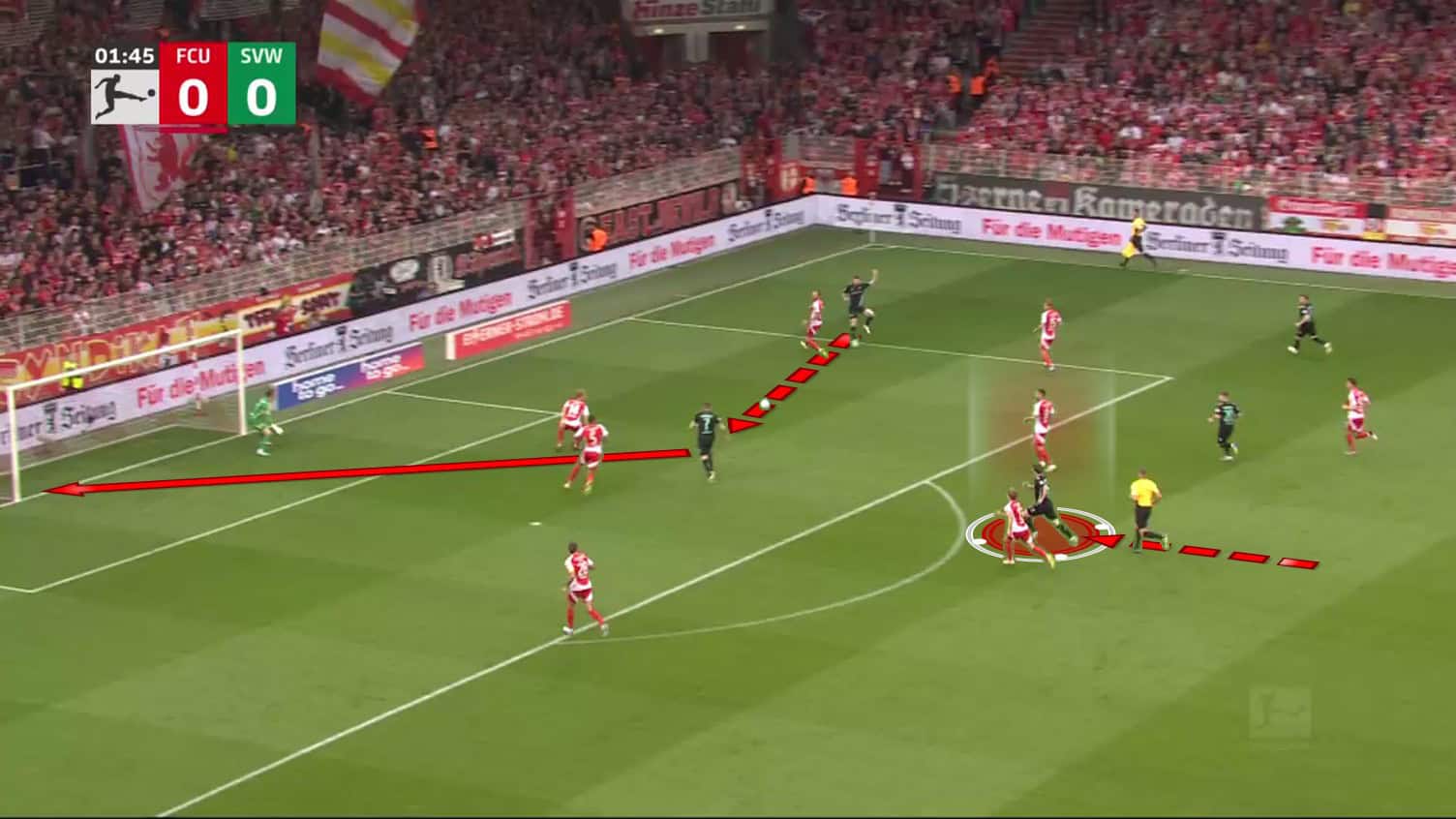
From then on, Werner wants his men to just cross it.
Burke does it here, and Werner implemented clear principles regarding the timing and whereabouts of the runs in the box.
Usually, Werder have multiple players in the box, especially the wing-backs and midfielders, who are way more in the box than other teams.
But this time, because of how quickly the attack developed, striker Marvin Ducksch finds himself alone against two defenders.
Still, he knows that he needs to get open for the cutback and receives it from Burke.
He places the shot to the far post and hits the post.
Stage seeps moving forward here, and now at the edge of the box.
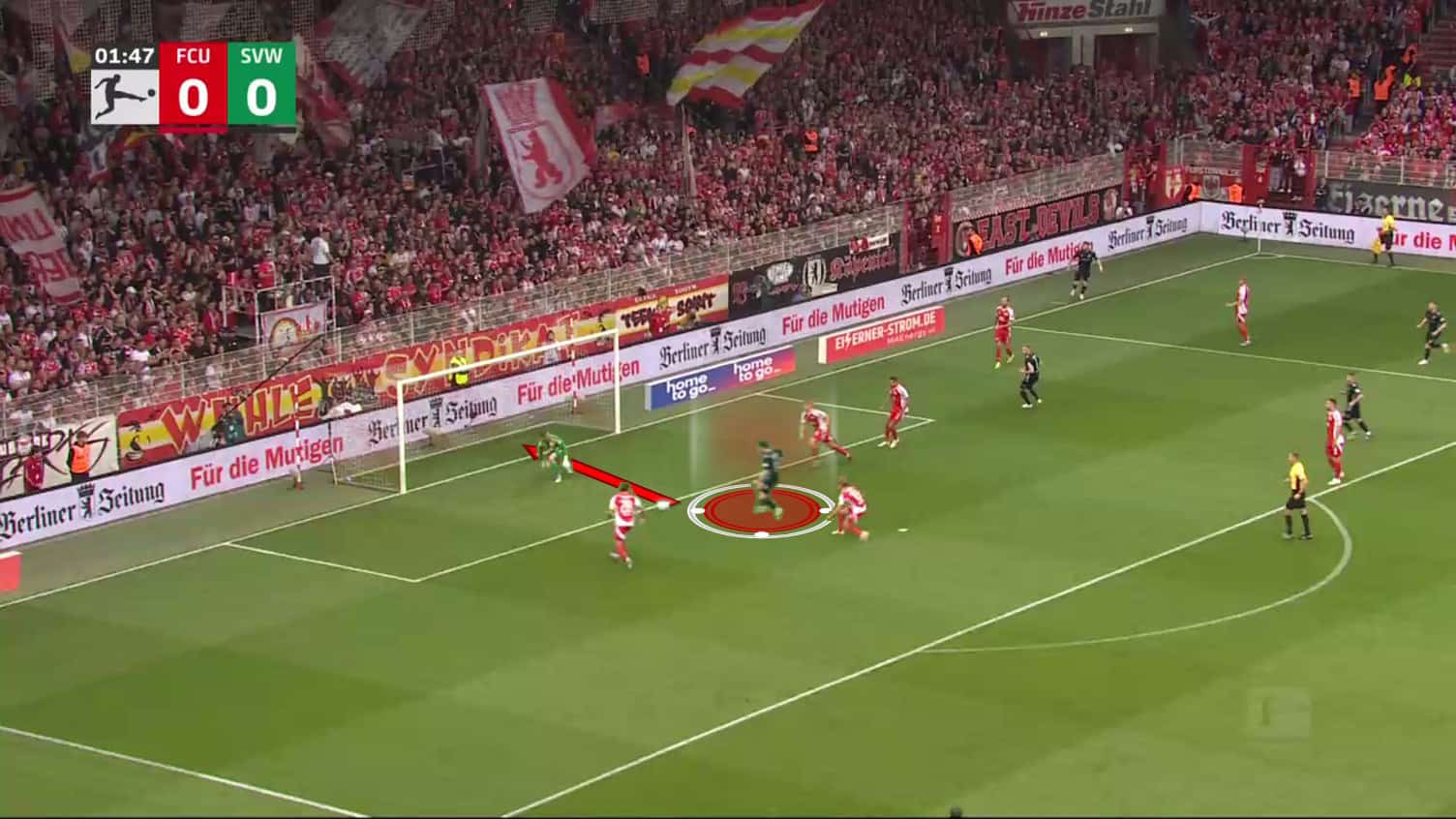
From there on, the ball comes back into play from the post.
But once again, instead of the Union players with the numerical advantage in that area, Jens Stage gets to the ball and finishes it to give Werder the lead.
Looking at the entire situation, Stage never stops running into the box and never hesitates to go for the second ball.
Despite playing as part of a double pivot, Stage scored 10 goals and assisted five more, showing his quality in the final third.
Werner allowed him to play to his strengths, as he did with Mitchell Weiser and Felix Agu.
This gave Werder a great numerical presence in the box, and he established great positional play there as well.
This allowed Werder to thrive with their wing play, and their crosses found someone in the box most of the time.
Werner and his team did a great job building a clear identity.
Ole Werner Counterpress
The Red Bull clubs have a clear identity, centred around the playstyle created by Ralf Rangnick for Red Bull Salzburg in the past.
While RB Leipzig are looking more and more to stray away from this very specific way of playing the game, the club still lives and breathes the DNA of this sort of football and therefore, to this day, Leipzig’s way of playing the game is centred around their counterpress.
Therefore, a new coach needs to be able to coach his team in that regard, and Ole Werner has proven at Werder Bremen that he can do exactly that.
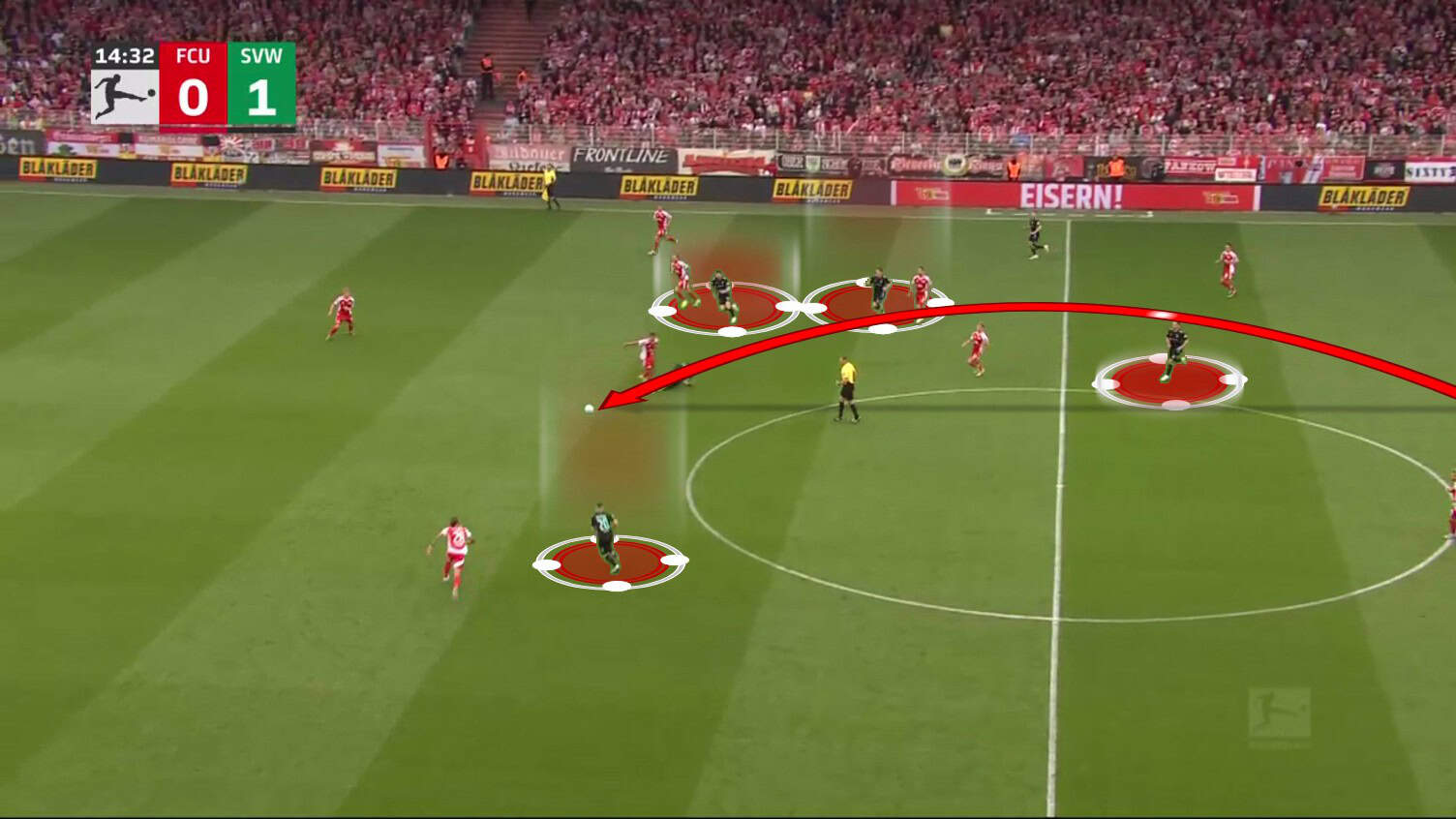
What has been impressive about Werder under Werner is the fact that they always knew what to do in any given situation.
They were never a perfect team and often had flaws in their tactical approach to the game, but the players always knew exactly what to do.
Looking at the situation above, Werder were forced to play a long ball, something they did not really like to do, simply because they lacked a clear target man up front.
Ducksch is not able to hold up the ball here, and it drops open in the midfield.
Werder is already positioned in a way that allows them to control space in the centre, and they are using that quickly.
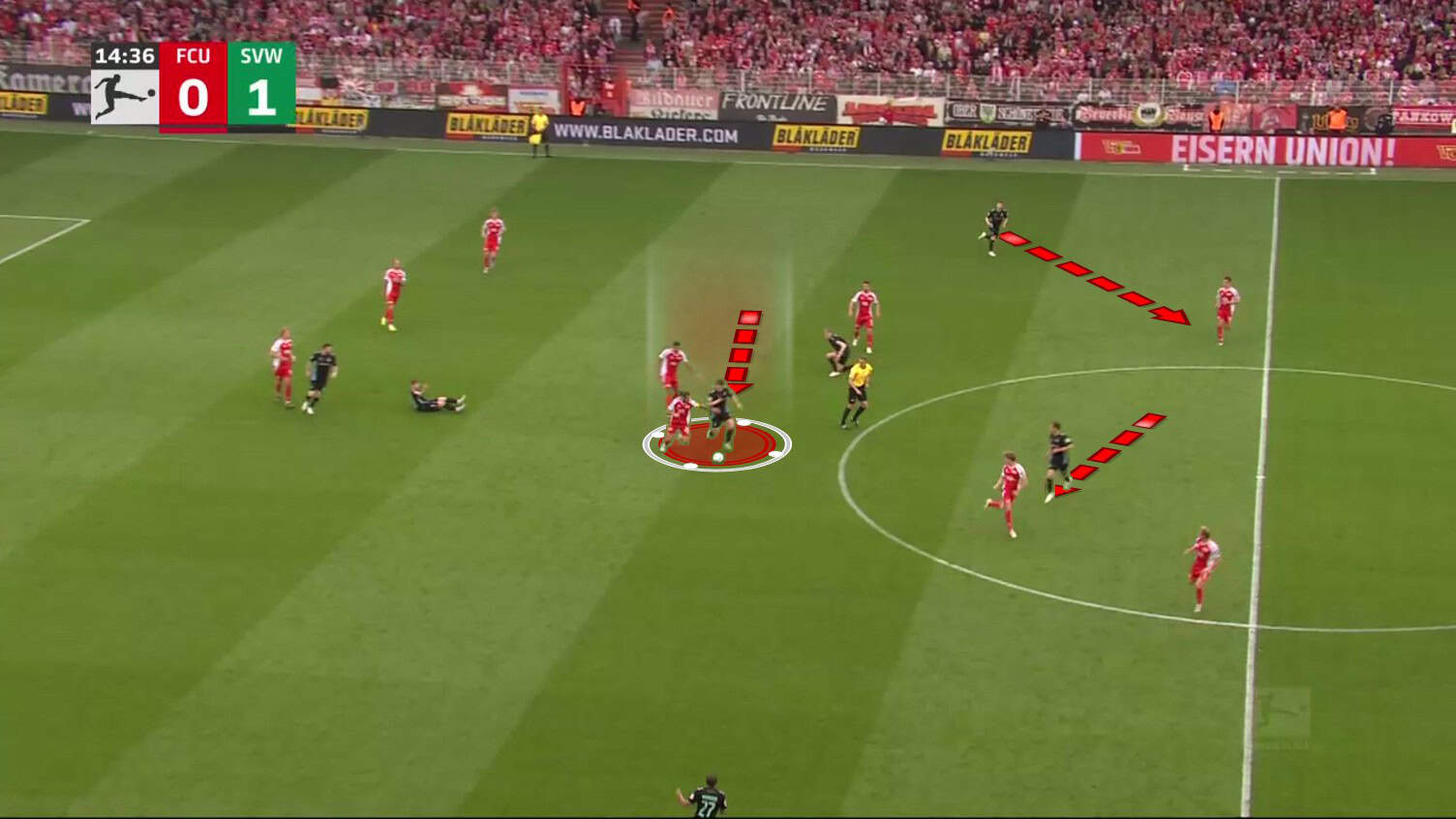
After the ball is poked free, the Werder players are instantly moving towards the side of the pitch.
Romano Schmid is the first to get a touch on the ball and can’t control it, so Union get possession for a very short amount of time.
However, the other Werder players instantly eliminate the nearest passing options, and Stage gets into a duel with the Union player and wins the ball back with his physicality.
From there on, Werder explodes again into a fast-paced counterattack.
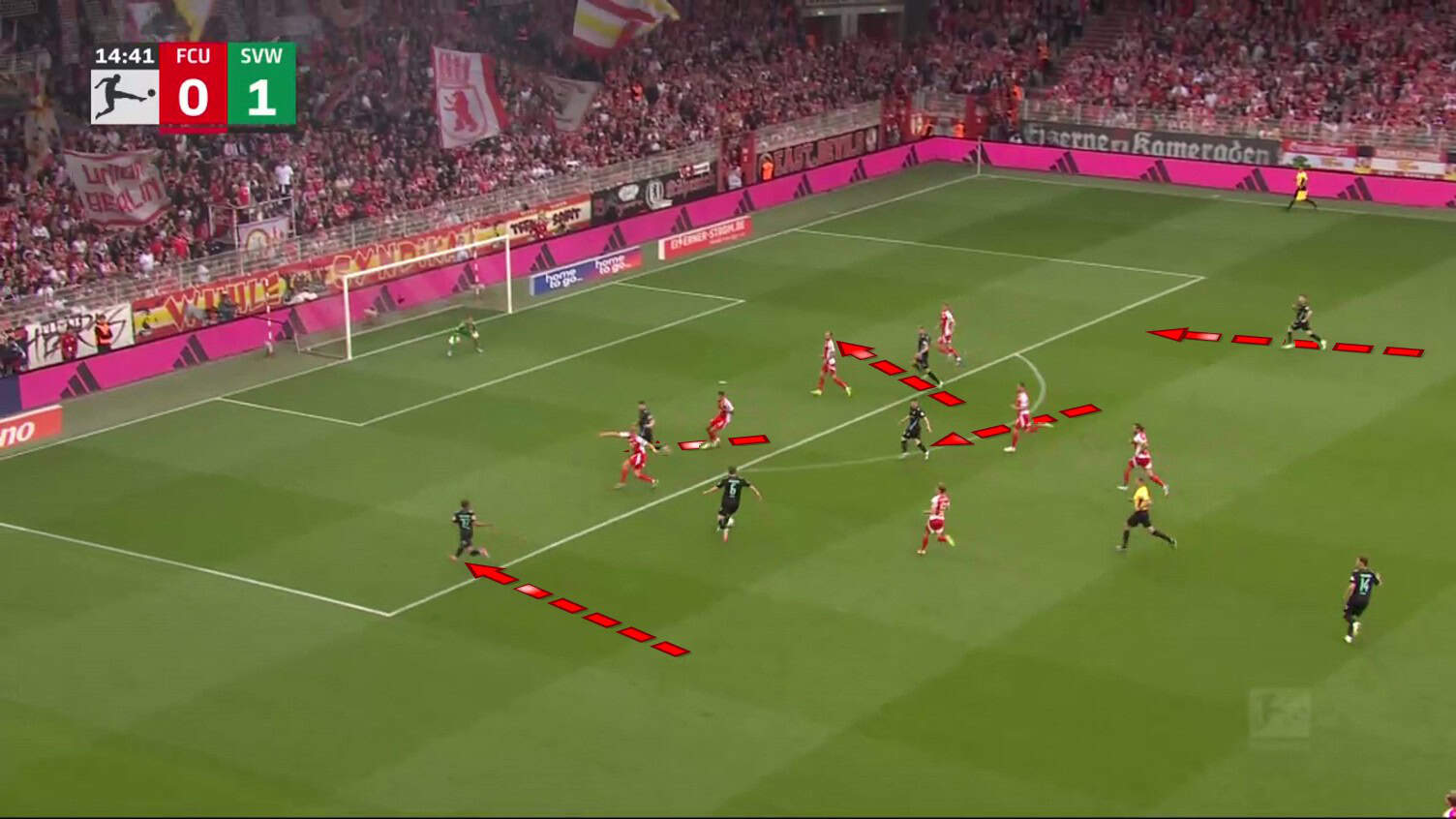
Once again, we can see the same pattern of attack that Werner implemented at Werder and that all the players know in their sleep: Agu and Burke are making runs into the space behind Union’s backline to push them backwards.
Weiser and Ducksch are making delayed runs into the box to use their momentum to beat out the defenders to the ball, and Schmid drops to the near side and tries to receive between the lines.
This gives Stage many passing options, and Werder is in full control of the situation here, with a lot of off-the-ball movement and no real pressure on the ball at the edge of the box.
Union try to convert the runs into the box but forgets to press the ball here.
Stage, in splendid form, scores an absolute screamer here, giving Werder an early 2-0 lead.
Werder has a clear plan at all times and a great attacking pattern that allows them to attack out of every situation rapidly.
Even their counterpress works great for them; they have just been a decent football team overall last season.
Conclusion
Just looking at their squad and their expectations, Ole Werner massively outperformed everything you could imagine with this Werder squad over the last two seasons.
I think the team does not receive enough flowers, while no Werder player really stands out; however, they are a great team with no real weak spots and a couple of very good players, such as Marco Friedl or Jens Stage.
With his clear principles in their attacks, Ole Werner established a rather fast-paced attacking style via the wings in Bremen.
That is something that RB Leipzig lacked over the last couple of seasons, and it will be a bit of a return to the roots for them.
Additionally, with a clear focus on the counterpress, Werner will provide another spark to help Leipzig regain their old identity, which has been very successful over the last couple of weeks.
A couple of weeks ago, I was writing a piece about the next RB Leipzig coach.
Ole Werner was one of my three candidates; the only one without any experience in the Red Bull system.
I still believe that Werner, with his coaching style and personality, will be an excellent fit for RB Leipzig and will undoubtedly bring short-term success to the club.
One question remains: Can Ole Werner develop young players into stars?
The answer at Werder Bremen was no, and that would be a massive problem for the culture that Red Bull tries to establish in Leipzig.
But Ole Werner is one of the most talented coaches in Germany, in my opinion.
Therefore, we can expect development from the young but still experienced coach as well.
It will be interesting to see how he handles that type of pressure next season.
