
Defending crosses is one of the most detailed tactical analysis topics, with numerous differences between different teams and coaches’ ideas.
The details of defending crosses begin with each defender’s ability to either mark an attacker or cover a specific space.
It differs from defending with either four or five defenders due to the width of the defensive line.
Each possibility for the defenders inside the box has its advantages and disadvantages.
This tactical theory will explain various tactical approaches and executions for a back-four system defending crosses employed by different teams, including US Lecce, Aston Villa, SC Freiburg, and Rayo Vallecano, during the 2024/2025 season.
Listen to this article free on the Total Football Analysis Podcast via Spotify, Apple Podcast, or RSS.
US Lecce Zonal Defence
Marco Giampaolo, the US Lecce coach last season, is one of the few coaches in Italy who has adopted the fully zonal defence philosophy.
He polished this style during his most successful era at UC Sampdoria from 2016/2017 to 2018/2019.
Despite that, the coach made some changes by occasionally prioritising mixed defence (man-marking and zonal defence) against proper opponents.
The fully-zonal defence in box defending or defending crosses means that each defender from the three players inside the box (two centre-backs and one full-back) is responsible for covering a specific area.
When the ball enters the last 20 meters of the field at the side area, the defenders start to move towards the goal, and they move diagonally to apply the funnel principle (narrowing the distance between each other).
Additionally, in this philosophy, defenders prioritise the ball and maintain a full-body orientation toward it.
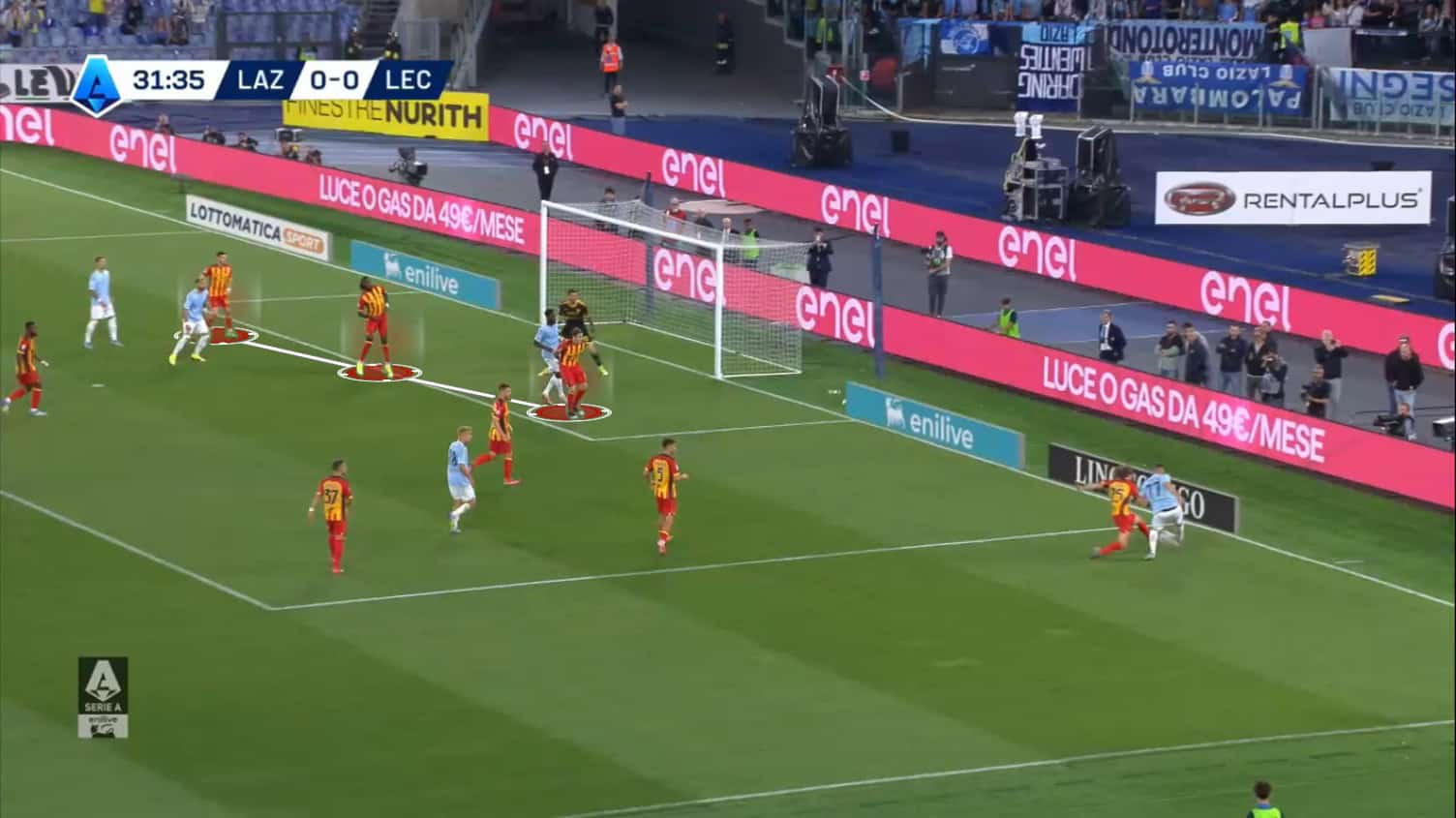
In the image below, we can see the positioning of each defender from US Lecce against SS Lazio; the defenders cover the three spaces in front of the goal (near post, centre space, and far post).
Giampaolo has a vital principle when defending with a fully zonal defence: the negative diagonal line.
This means the defenders will form an outward diagonal line.

US Lecce Zonal Defence Advantages & Disadvantages
Zonal defence has many advantages, including protecting the most essential spaces inside the box and allowing teammates to be covered from the defensive line due to its narrowing.
Another advantage is the ability to protect the depth more effectively, due to the deep positioning of the line.
Regarding the negative diagonal line, this shape gives the goalkeeper more space to intervene if the ball has been played behind the defensive line.
As shown in the image below, the negative diagonal line is where each defender is responsible for the space beside and in front of himself.
The positioning of the third and fourth defenders can keep the attackers away from the goal.
On the other hand, there are disadvantages to the zone defence system and the negative diagonal line principle.
The first is that the system requires great harmony from the defenders, as the movement of one may affect the others.
The second disadvantage is that the attacker may play the ball more easily, as there will be fewer contacts with the defenders.
The third disadvantage is related to the fourth defender, the defender who is responsible for the space in front of him, but who will protect the space behind him?
Therefore, some coaches consider letting the winger get back to protect that area if an attacker moves into it.
US Lecce Mixed Defence
As we mentioned earlier, Giampaolo made some changes last season against specific teams; one of these teams was SSC Napoli, with Antonio Conte, in Gameweek 35.
Giampaolo made a slight adjustment to his system to accommodate the opponent, who has two of the best players inside the box, Romelu Lukaku and Scott McTominay.
The two Napolitano players enter the box very early to wait for the crosses; one moves to the near post and the other to the far post.
So, Giampaolo told the defender who will face Lukaku to mark him.
In contrast, the defender beside him defends with the space reference but keeps near Lukaku’s marker to reduce his space and make the situation two versus one, not one versus one.
While the other defender from the three defenders in the box marks McTominay.
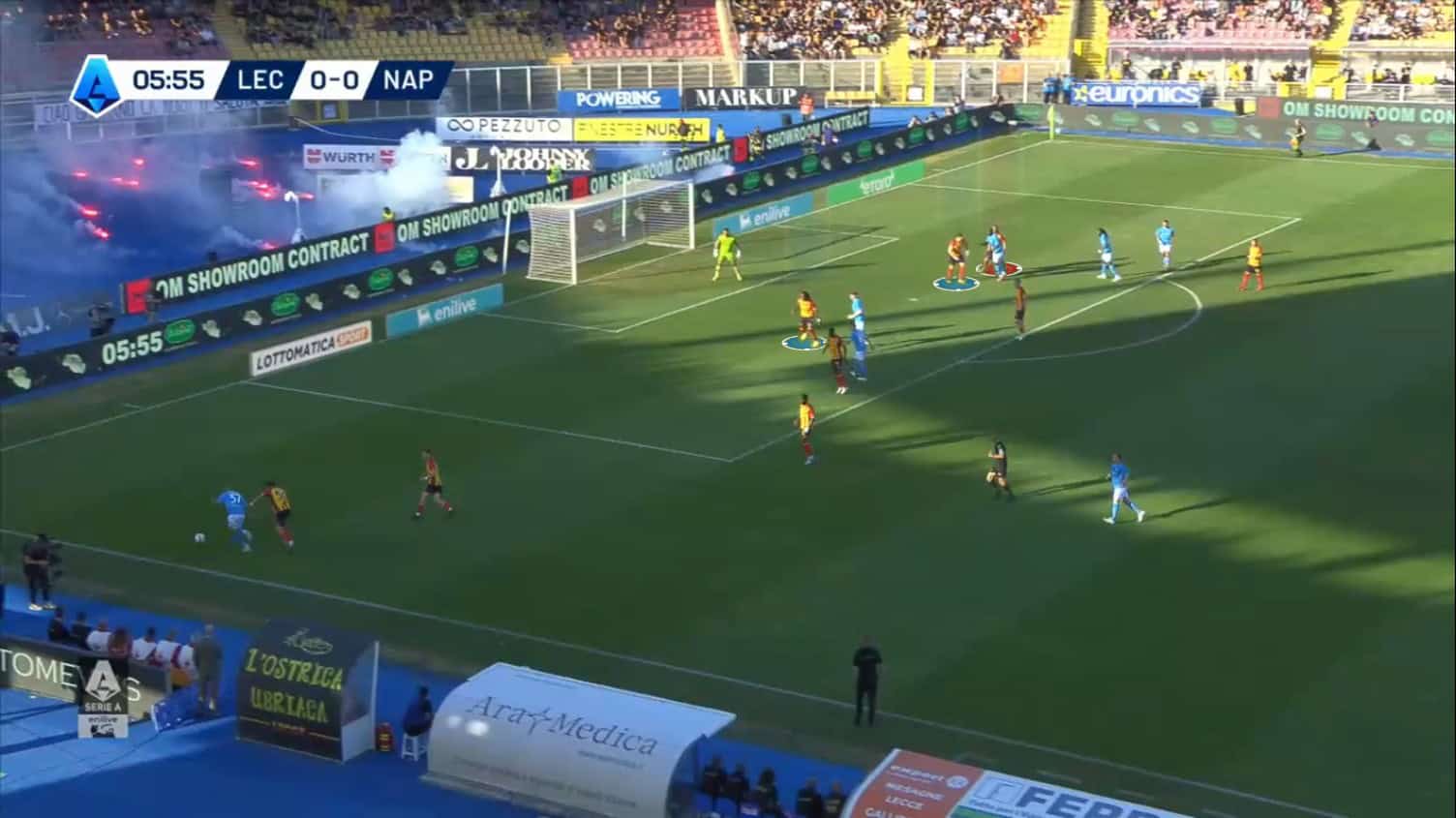
The image below shows that the third and fourth defenders defend against Lukaku by marking him from the third defender, highlighted in blue, and by positioning the fourth defender, highlighted in red, near Lukaku to reduce his space.
In contrast, the second defender, highlighted in blue, marks McTominay.
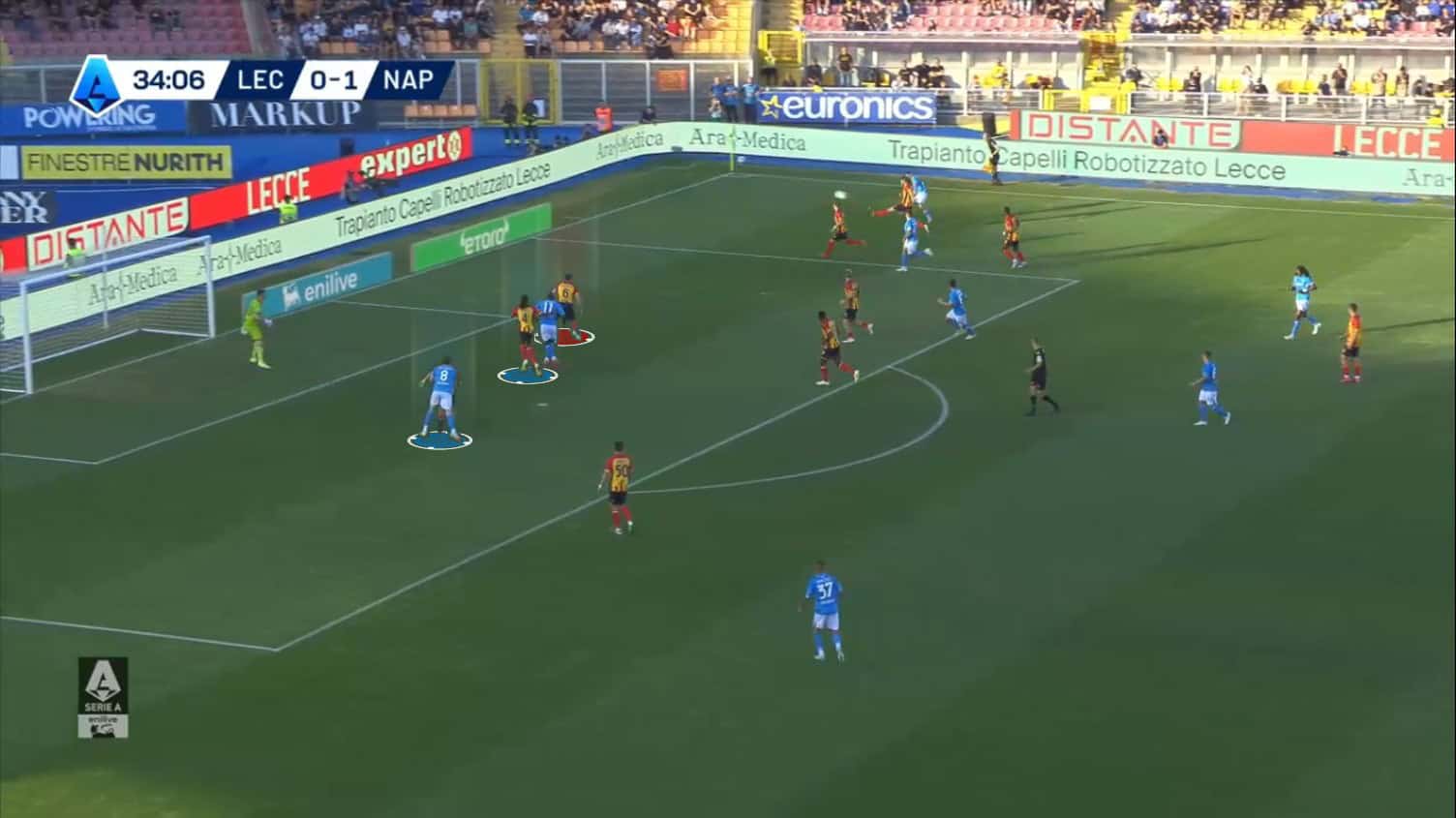
The following image shows an example of Lukaku attacking the near post while McTominay attacks the far post.
The situation will differ as the third defender, highlighted in blue, will mark Lukaku.
In contrast, the second defender, highlighted in red, covers the near post space and gets near Lukaku’s marker.
The fourth defender, who is highlighted in blue, marks McTominay.
Aston Villa Mixed Defence
Let’s head towards the Aston Villa team, which also defends with a mixed defence system, but it is different from the one used by US Lecce against SSC Napoli.
Unai Emery utilises the three defenders inside the box as follows: The second defender always defends as a zonal defender, protecting the near post area.
Additionally, the second defender maintains a deeper position to safeguard against crosses that go behind the defensive line.
The situation for the third and fourth defenders is different; the second defender marks the attacker who enters his space and moves with him vertically and horizontally.
Regarding the fourth defender, he also marks the winger, whether the winger enters the box early or late.
If the winger entered early, the defender would mark him; if he entered late, he would wait for him with a higher position and an open body orientation to see him and the ball.
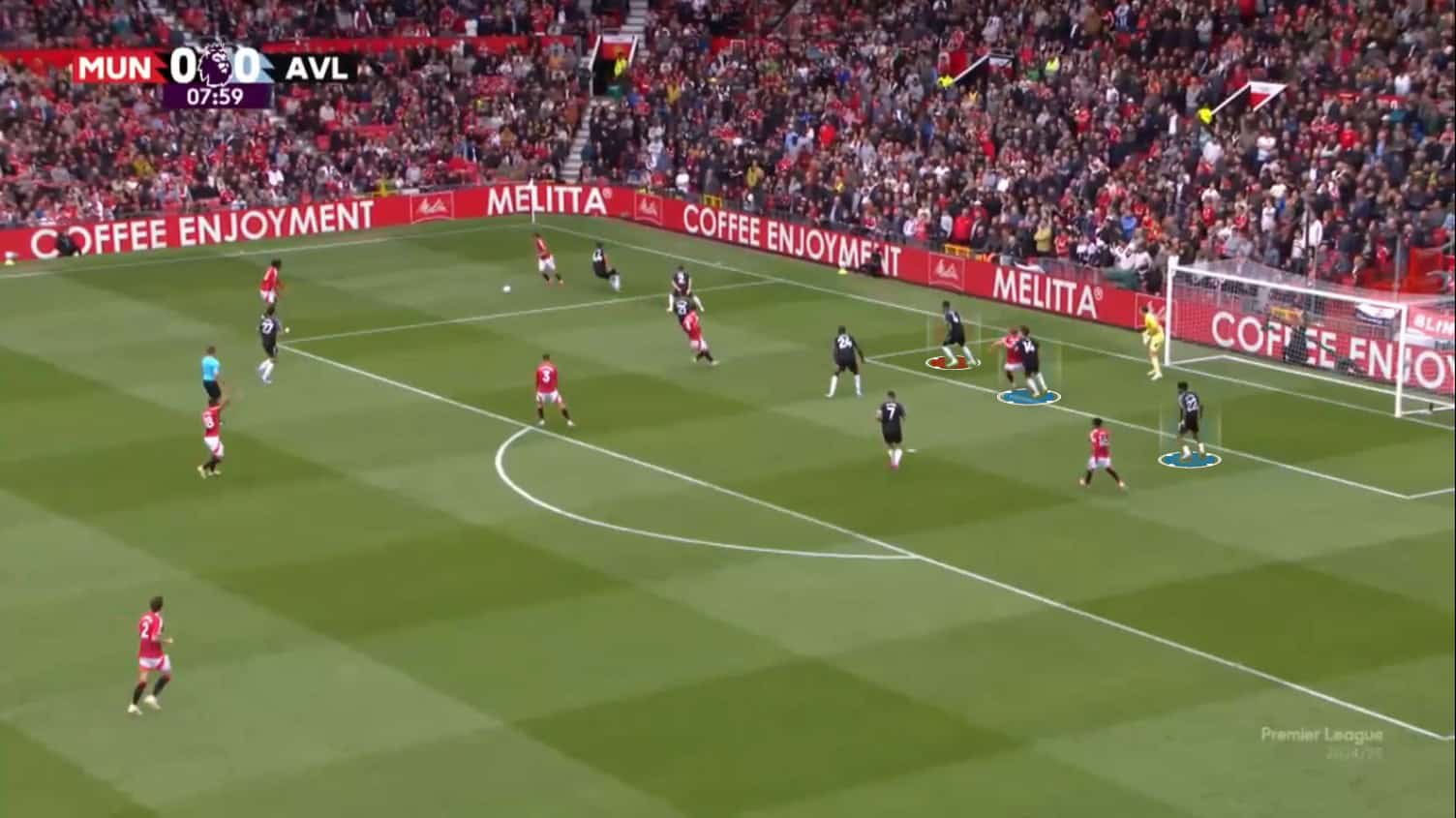
The image below illustrates the defenders’ situation and positioning in a mixed defence.
The second defender, highlighted in red, protects the near post with a deeper position.
In contrast, the third defender, highlighted in blue, marks the attacker, and the fourth defender, highlighted in blue, marks the winger.
Aston Villa Mixed Defence Advantages & Disadvantages
The idea of marking the attacker whenever he enters the defender’s space, combined with the defender’s open body orientation, allows him to focus on the attacker and the ball alternately.
Also, when the defender marks the attacker, he bothers him and prevents him from playing the ball easily.
On the other hand, the defender can be pulled away from the depth while moving with the attacker, allowing another opponent player to penetrate the free space.
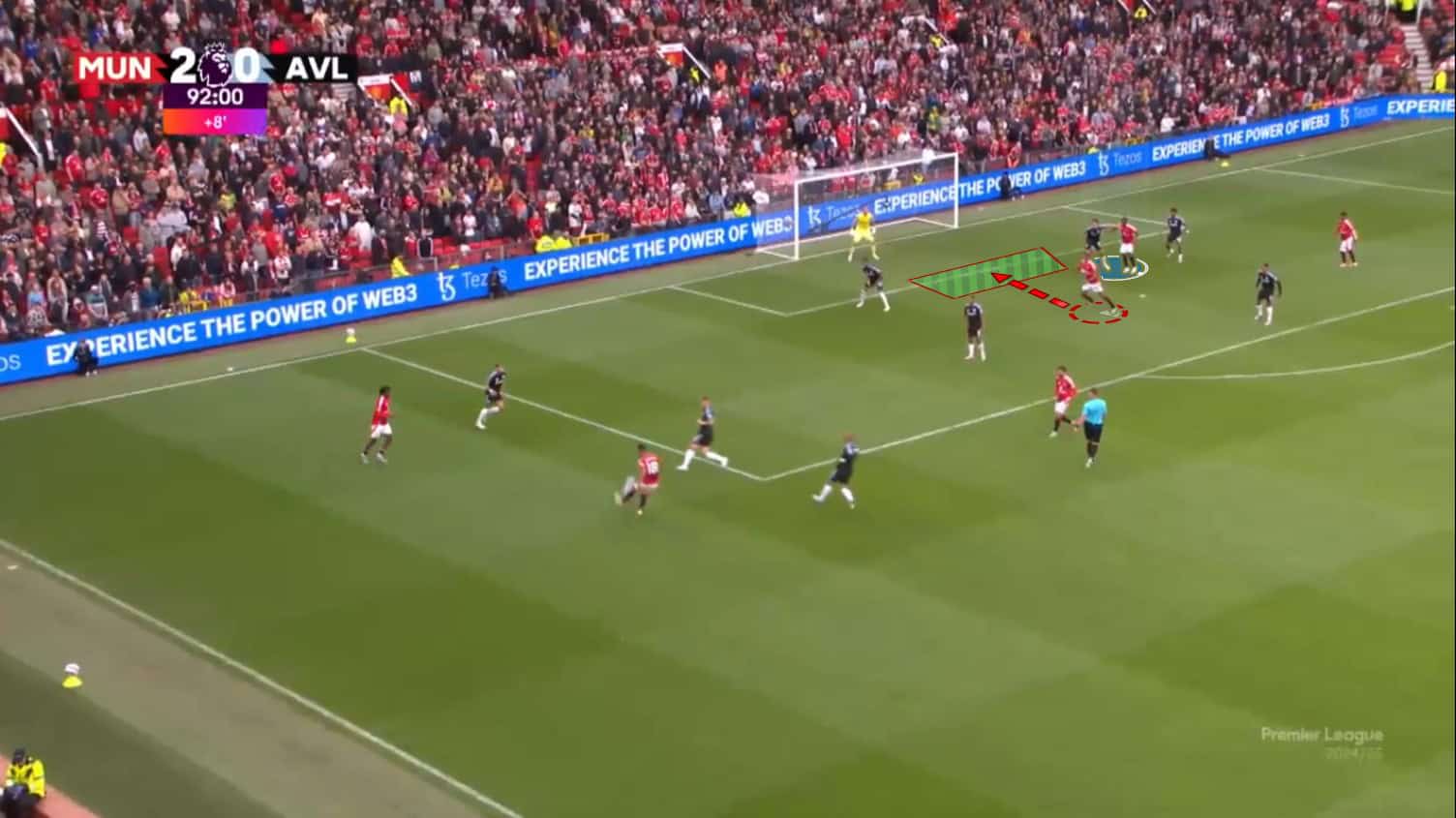
As shown in the following image, the third defender from Aston Villa marks the Manchester United attacker.
At the same time, another attacker enters the box in the highlighted space between the second and third defenders.
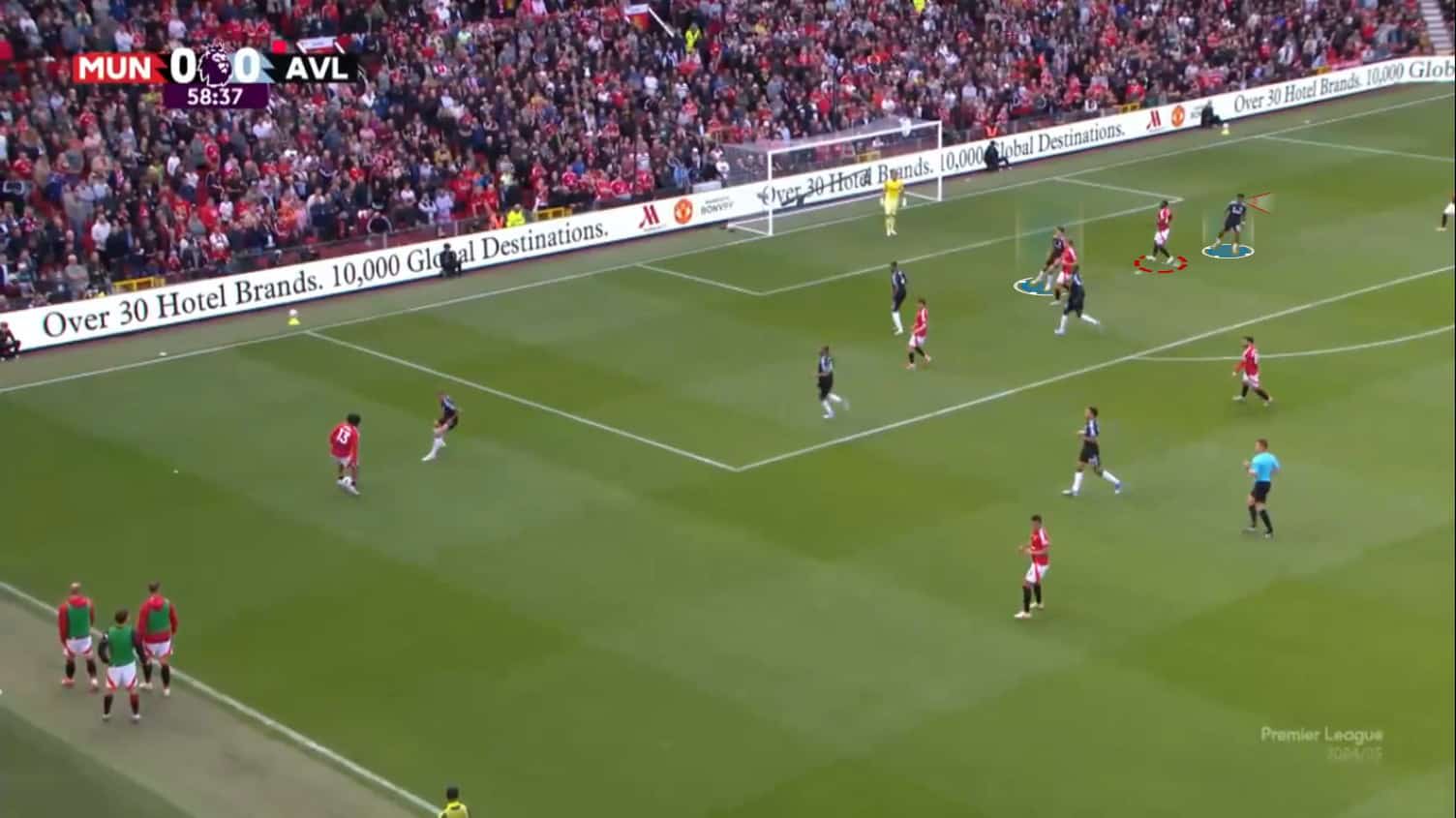
Additionally, the following image shows a similar situation in which the third defender marks his attacker.
In contrast, the fourth defender orients his body towards his direct marker, Manchester United’s right-winger.
In that moment, another attacker, highlighted in red, penetrates the free space beside the fourth defender and behind the third defender, who follows his attacker.
One disadvantage of man-marking occurs when two attackers enter the defender’s space.
If the defender marks one of them and moves away with him, the other will be free.
That may be an advantage for zonal defence, as the defenders protect the most dangerous spaces and leave the less hazardous spaces for attackers.
SC Freiburg & Rayo Vallecano Man-Marking Defence
Our last defending system is full man-marking, which means all defenders mark the attackers man-to-man, individually.
I will use two teams as examples for that system: the German team SC Freiburg, under Julian Schuster, and the Spanish team Rayo Vallecano, with Íñigo Pérez.
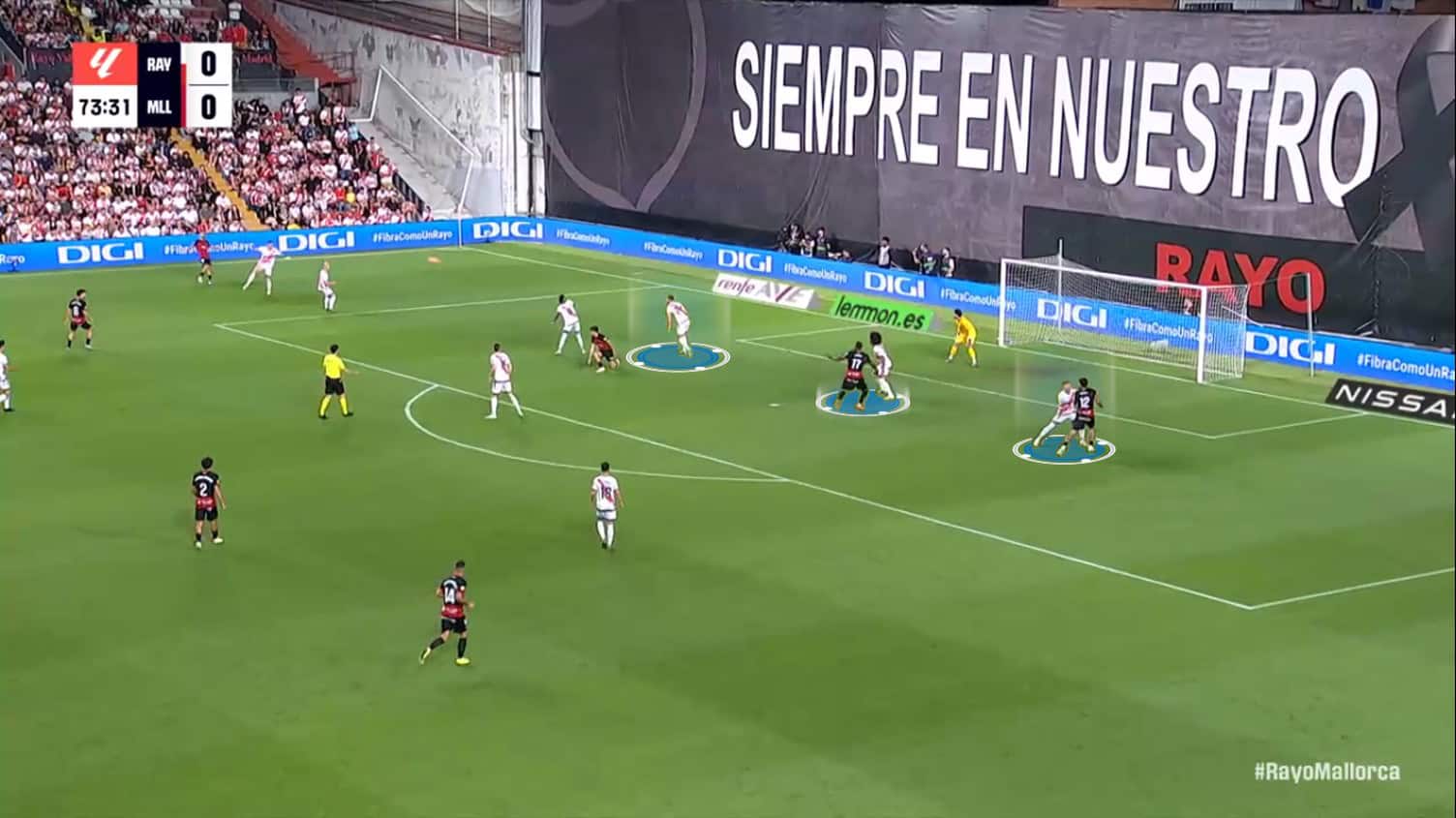
The two teams utilise the man-marking system as follows: each defender marks the attacker who is facing them, with the ability to move with them wherever they move inside the box.
Each defender marks the attacker, even though he entered the box late, the defender steps forward, keeping him away from the goal.
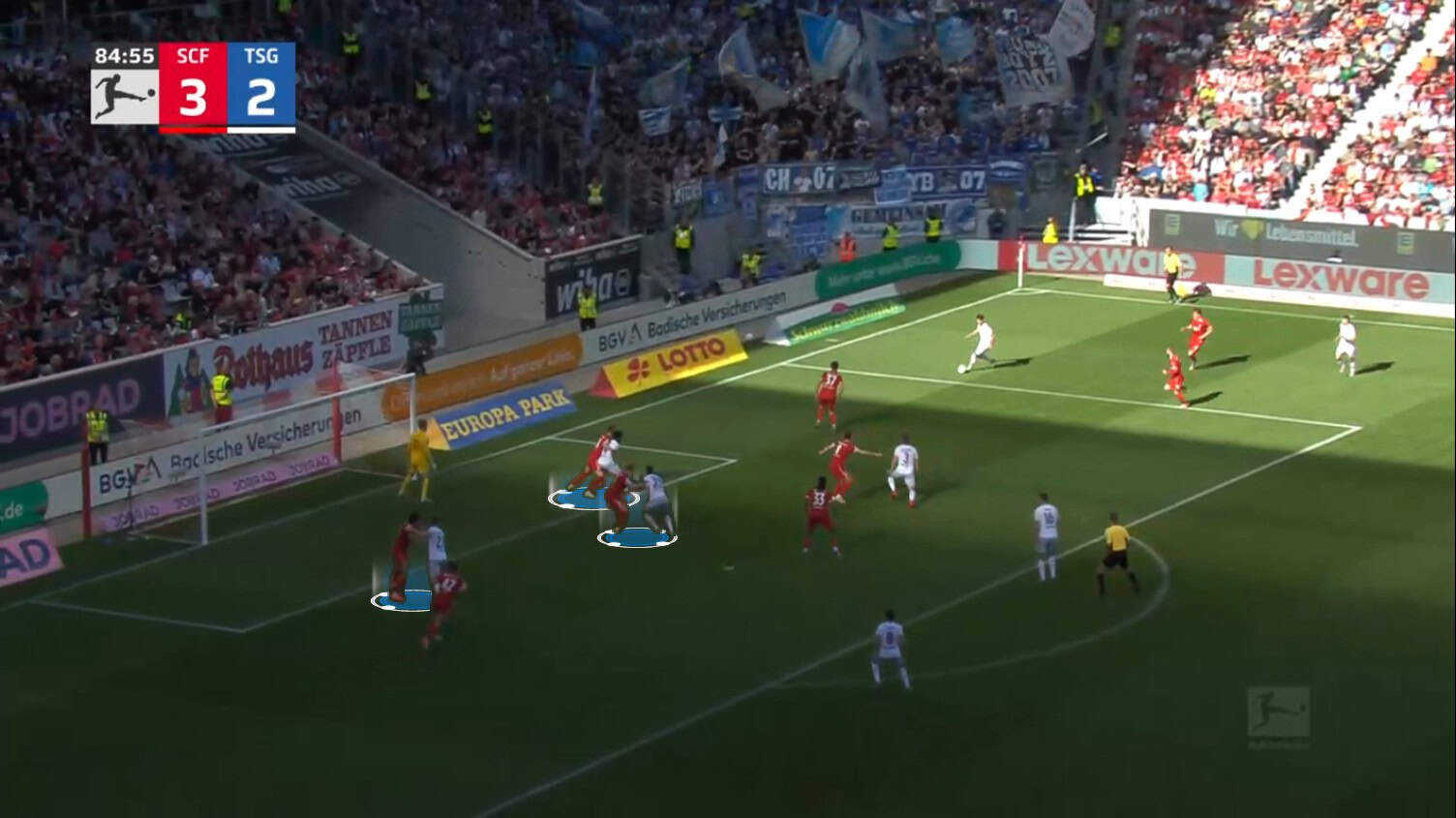
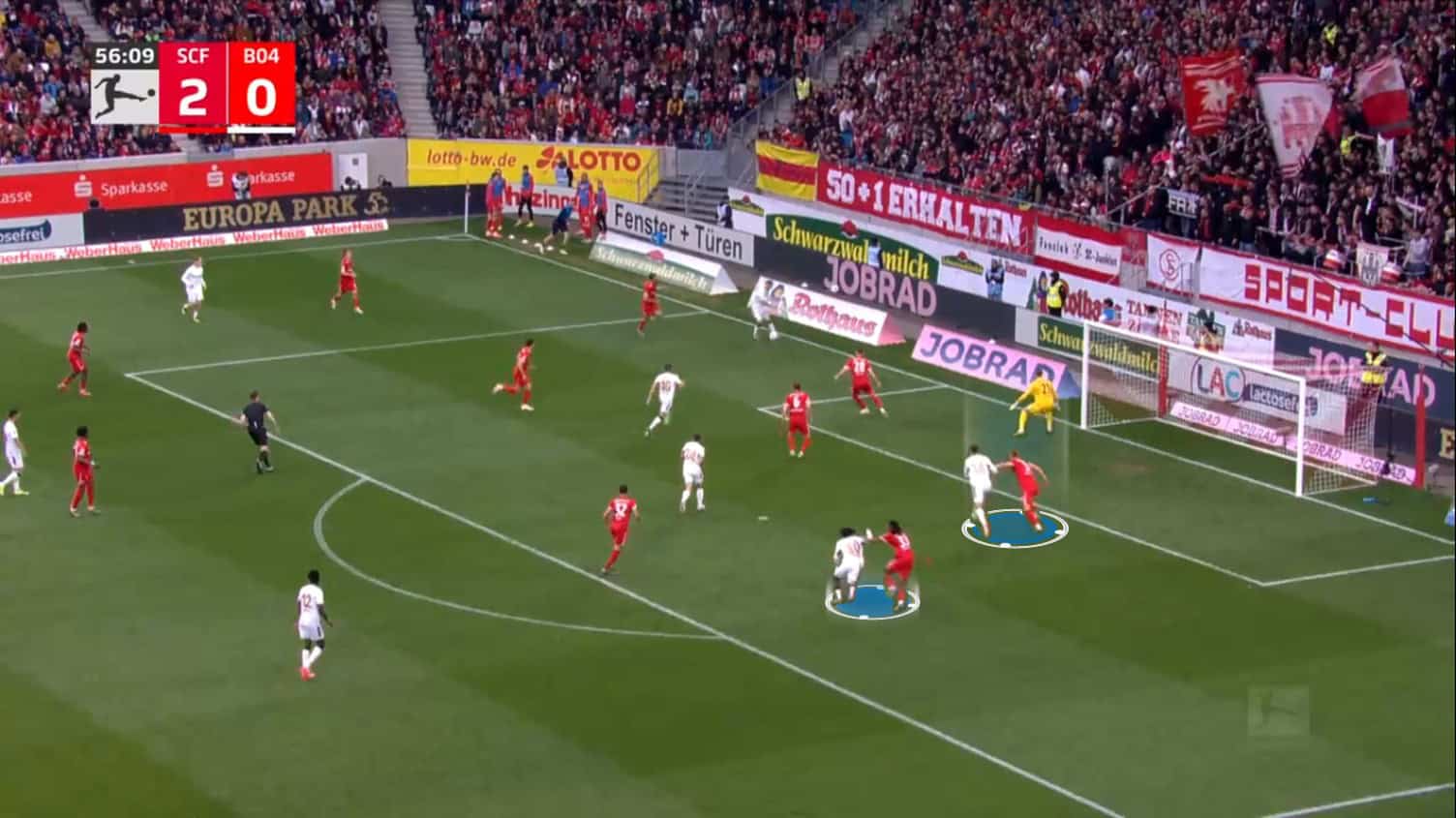
The following image shows a cross-defending situation for SC Freiburg against TSG 1899 Hoffenheim.
The three defenders inside the box mark the attackers tightly, using their hands to push the attackers to prevent them from reaching the ball before them.
Also, the defenders can use their hands to identify the attackers’ positions, without losing sight of the ball.
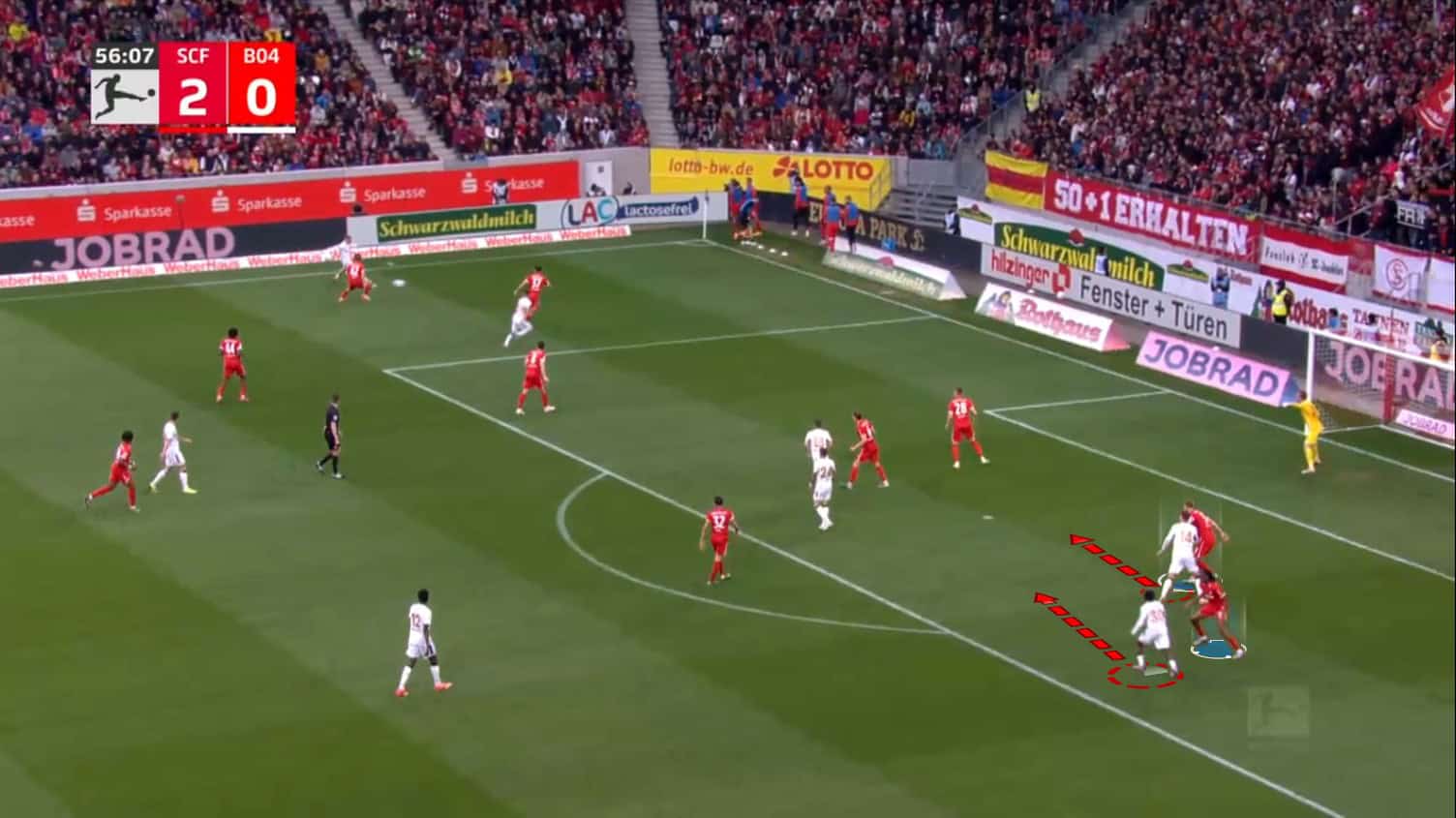
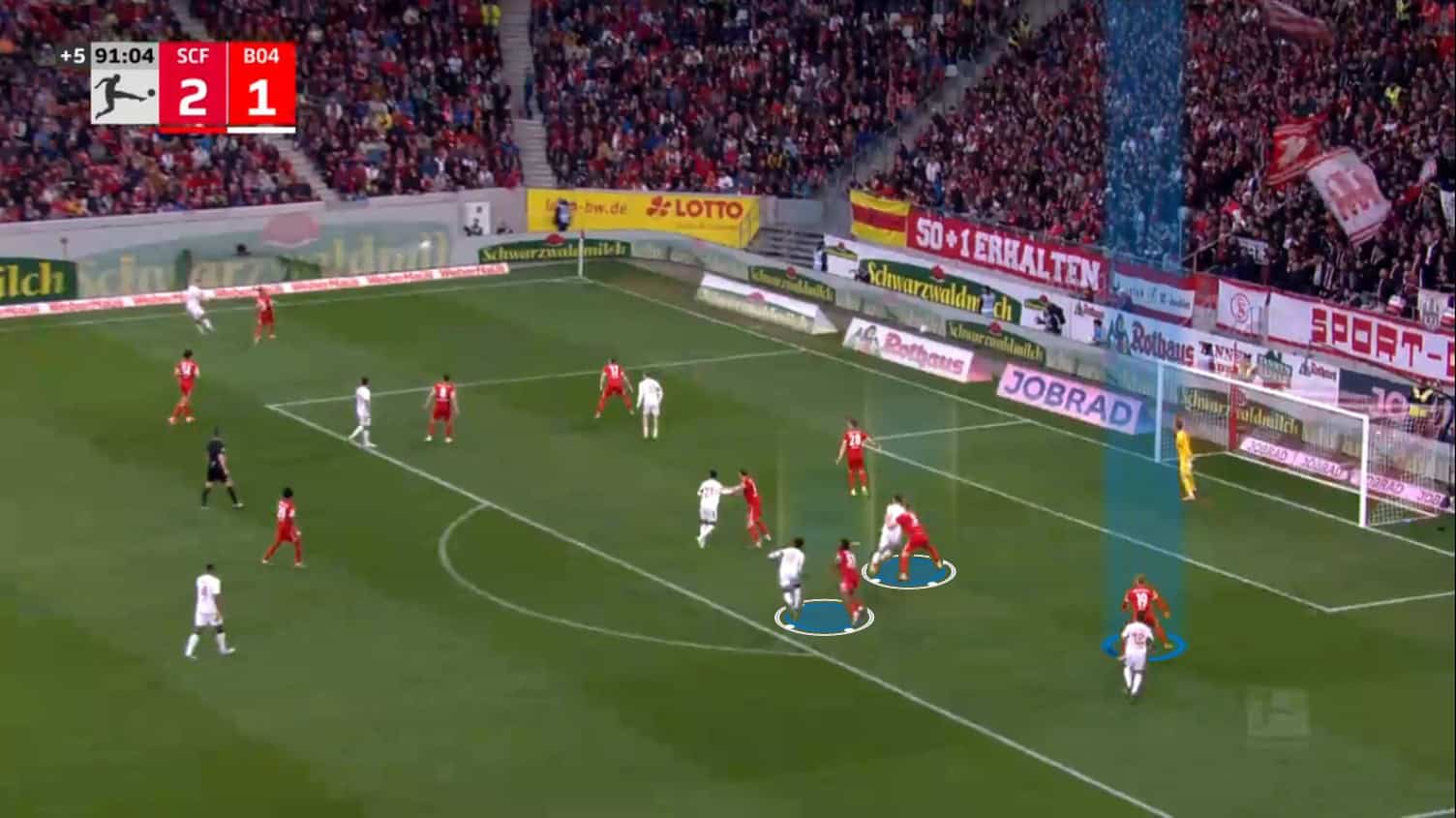
The following two images from the SC Freiburg match against Bayer Leverkusen provide another example.
They show how the defender marks the attacker very early and moves with him horizontally.
The fourth defender, highlighted in blue, pushes forward towards the winger and moves with him when he cuts inside.
The same applies to the third defender, who follows the attacker’s movements.
SC Freiburg & Rayo Vallecano Man-Marking Defence Advantages & Disadvantages
This system helps both teams to mark all attackers inside the box, preventing them from playing the ball easily.
Additionally, both coaches for SC Freiburg and Rayo Vallecano, Schuster and Pérez, instruct their wingers to get back to mark the players who enter the area after the far post, which allows the fourth defender to move freely with his marker inside, as shown in the image below.
The spotlighted winger of SC Freiburg gets back with Bayer Leverkusen wide player.
On the other hand, this system is risky because the defenders push forward towards the attackers, which creates a larger space behind them.
So, if the attackers succeeded in escaping from the defenders, they would be able to attack the ample space.
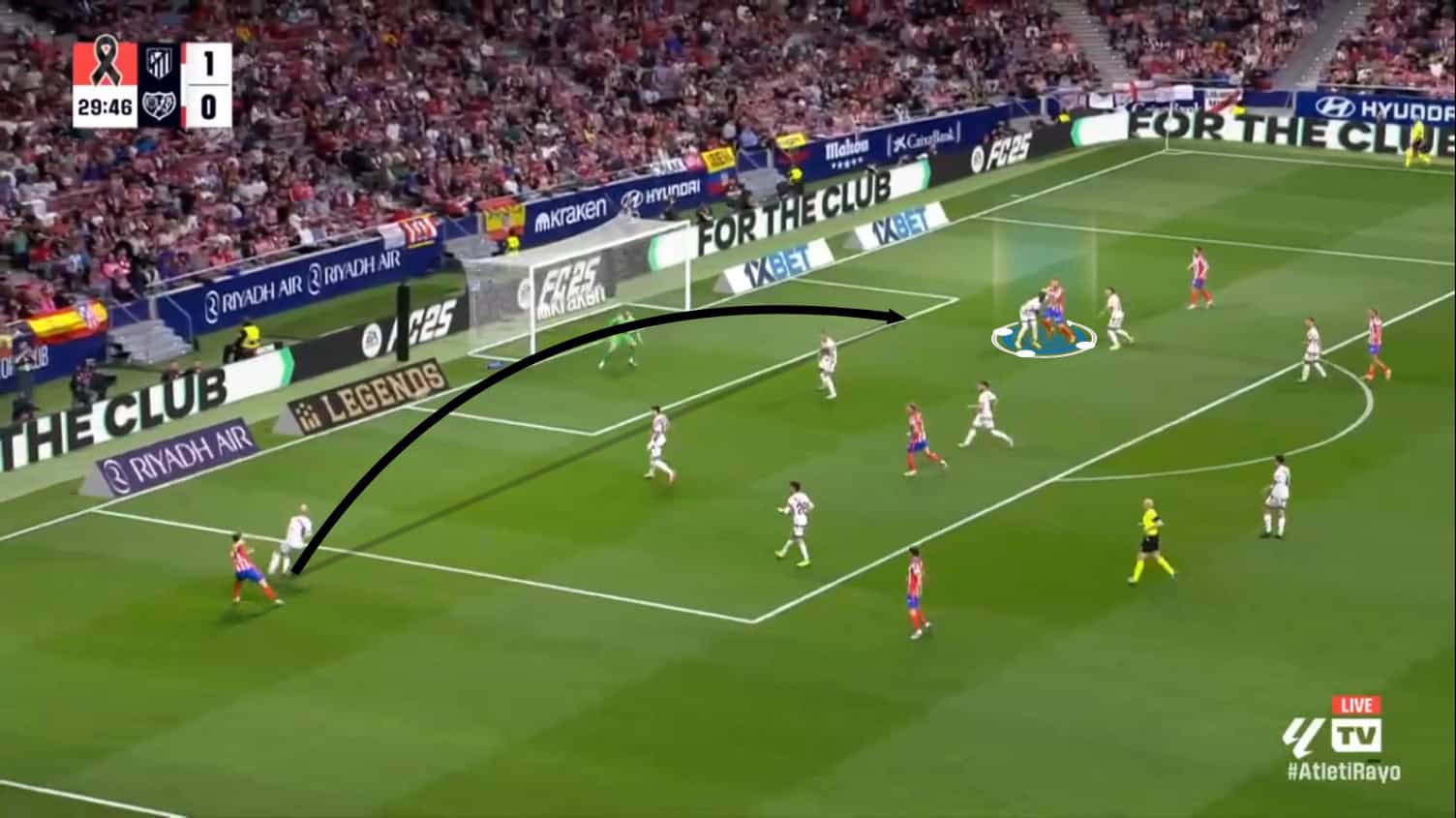
The close contact between the defender and the attacker may favour the attacker because the attacker faces the goal, while the defender faces the ball and the attacker.
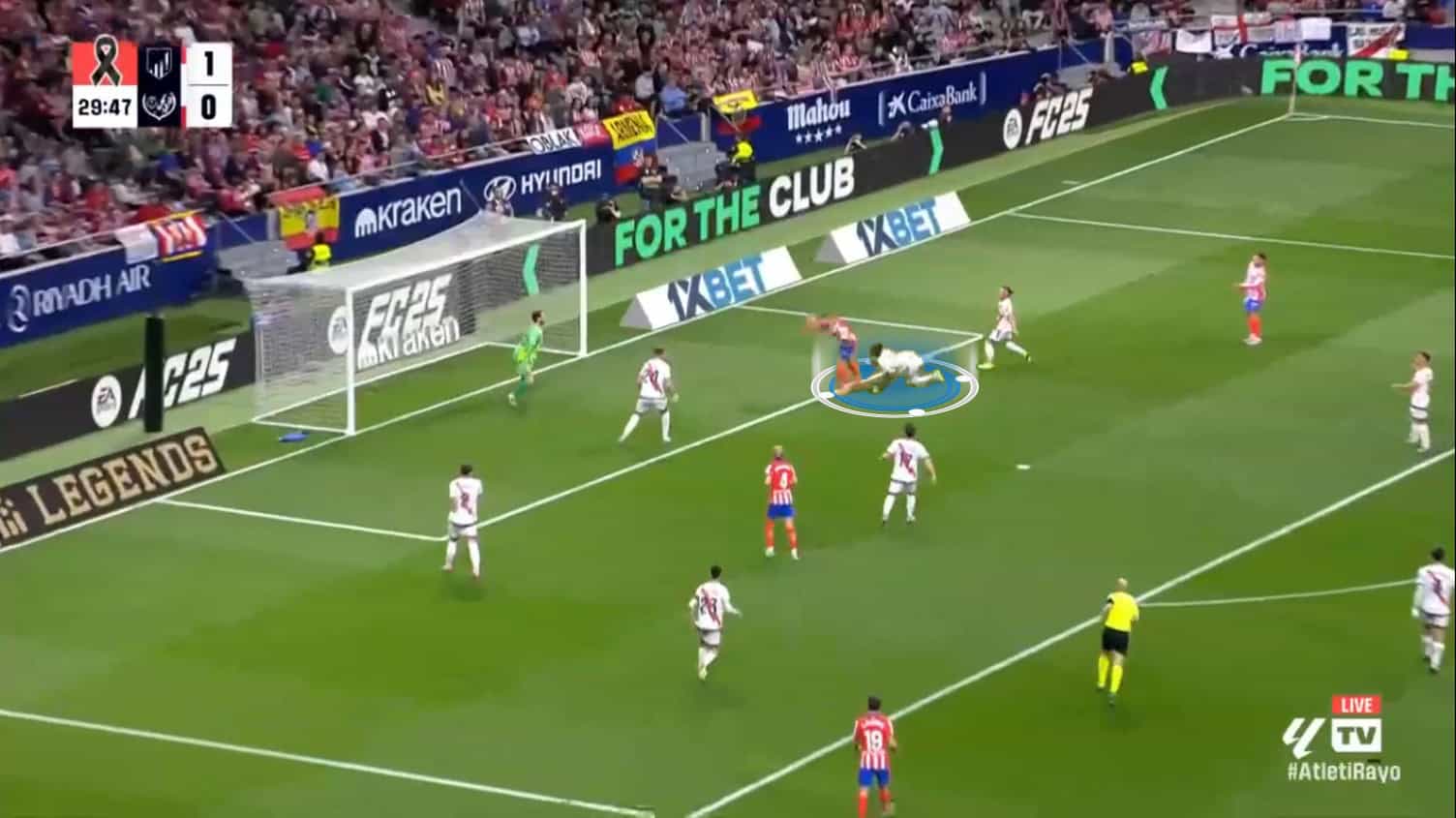
The body rotation from the defender to the attacker will take some time, allowing the attacker to gain acceleration and bypass the defender, especially when the defender fully orients his body to the attacker, as shown in the following images from the Rayo Vallecano match against Atlético Madrid.
The third defender stays very close to the attacker and is fully body-oriented toward him, so the attacker was able to bypass the defender, who was off balance due to his body position.
Conclusion
The system used to defend crosses is related to the team’s system in the low block phase of defence.
The further the defenders are from the goal, or the more stretched the defensive line is, the longer it takes them to return to their depth, and vice versa.
Therefore, it is logical to find a team like US Lecce positioning their defenders closer to the goal due to Giampoalo’s philosophy of protecting the depth more.
This is in contrast to teams like Rayo Vallecano with Pérez, whose defenders proactively move out of the box, enabling them to mark attackers far from the goal in crosses.
