
Total Football Analysis
Once.Sport
  • Football Analysis
    • Data Analysis
    • Formations
      • 2-2-4 Formation
      • 2-3-5 Formation
      • 3-1-4-2 Formation
      • 3-2-2-3 Formation
      • 3-2-4-1 Formation
      • 3-1-6 Formation
      • 3-3-4 Formation
      • 3-4-1-2 Formation
      • 3-4-2-1 Formation
      • 3-4-3 Formation
      • 3-5-1-1 Formation
      • 3-5-2 Formation
      • 4-1-4-1 Formation
      • 4-2-2-2 Formation
      • 4-2-3-1 Formation
      • 4-2-4 Formation
      • 4-3-1-2 Formation
      • 4-3-3 Formation
      • 4-4-2 Formation
      • 4-5-1 Formation
      • 5-3-2 Formation
      • 5-4-1 Formation
      • 6-3-1 Formation
    • Head Coach Analysis
    • Match Analysis
    • Player Analysis
    • Recruitment Analysis
    • Set Piece Analysis
    • Tactical Theory
    • Tactical Preview
    • Team Analysis
    • Training Analysis
    • Tactical Analysis
    • Scouting Report
  • Competition
    • ALL Competitions
    • English Premier League
    • Champions League
    • La Liga
    • Bundesliga
    • Serie A
    • Ligue 1
    • Eredivisie
    • EFL Championship
    • FIFA World Cup 2022
    • WEURO 2022
    • Women’s Super League
    • NWSL
    • Belgian First Division A
    • A-League
    • Liga Profesional de Argentina
    • Austrian Bundesliga
    • Campeonato Brasileiro Série A
    • DFB Pokal
    • 1. HNL
    • Danish Superliga
    • EFL League One
    • EFL League Two
    • FA Cup
    • EFL Cup
    • Indian Super League
    • K-League
    • J1 League
    • Liga MX
    • Copa América 2021
    • Copa del Rey
    • MLS
    • Eliteserien
    • Euro 2020
    • Primeira Liga
    • Scottish Premiership
    • Allsvenskan
    • Europa League
    • UEFA Nations League
    • Liga AUF Uruguaya
  • Coaches
    • All Coaches
    • Alfred Schreuder
    • Ange Postecoglou
    • Antonio Conte
    • Arne Slot
    • Bo Svensson
    • Brendan Rodgers
    • Bruno Lage
    • Carlo Ancelotti
    • Christophe Galtier
    • Claude Puel
    • Claudio Ranieri
    • David Moyes
    • Dean Smith
    • Diego Simeone
    • Domenico Tedesco
    • Frank Lampard
    • Eddie Howe
    • Edin Terzić
    • Emma Hayes
    • Erik ten Hag
    • Ernesto Valverde
    • Gennaro Gattuso
    • Gerardo Seoane
    • Gian Piero Gasperini
    • Giovanni van Bronckhorst
    • Graham Potter
    • Igor Tudor
    • Imanol Alguacil
    • Jesse Marsch
    • Jonas Eidevall
    • Jorge Sampaoli
    • José Bordalás
    • José Mourinho
    • Julen Lopetegui
    • Julian Nagelsmann
    • Julien Stéphan
    • Jürgen Klopp
    • Luciano Spalletti
    • Lucien Favre
    • Manuel Pellegrini
    • Marcelo Bielsa
    • Marco Rose
    • Marco Silva
    • Massimiliano Allegri
    • Mauricio Pochettino
    • Maurizio Sarri
    • Mikel Arteta
    • Niko Kovač
    • Nuno Espírito Santo
    • Oliver Glasner
    • Patrick Vieira
    • Paulo Fonseca
    • Pep Guardiola
    • Peter Bosz
    • Rafa Benítez
    • Ralf Rangnick
    • Ralph Hasenhüttl
    • Roger Schmidt
    • Roy Hodgson
    • Sean Dyche
    • Sérgio Conceição
    • Simone Inzaghi
    • Sonia Bompastor
    • Stefano Pioli
    • Steffen Baumgart
    • Steven Gerrard
    • Thiago Motta
    • Thomas Frank
    • Thomas Tuchel
    • Unai Emery
    • Vincenzo Italiano
    • Xavi
  • Teams
    • ALL Teams
    • AC Milan
    • Ajax Amsterdam
    • Arsenal
    • AS Monaco FC
    • Atalanta
    • Atlético Madrid
    • FC Barcelona
    • FC Bayern Munich
    • Borussia Dortmund
    • Celtic FC
    • Chelsea FC
    • Everton F.C.
    • Inter Milan
    • Juventus F.C.
    • Leeds United F.C.
    • Liverpool FC
    • Manchester City
    • Manchester United FC
    • Paris Saint-Germain
    • Rangers FC
    • RB Leipzig
    • Real Madrid CF
    • Tottenham Hotspur
    • West Ham United
  • Players
    • ALL Players
    • Alisson Becker
    • Bukayo Saka
    • Erling Haaland
    • Harry Kane
    • Jack Grealish
    • John Stones
    • Julián Alvarez
    • Kalvin Phillips
    • Kevin De Bruyne
    • Kyle Walker
    • Kylian Mbappé
    • Lamine Yamal
    • Lionel Messi
    • Luis Díaz
    • Mohamed Salah
    • Phil Foden
    • Virgil Van Dijk
  • Contact
  • Write For TFA
No Result
View All Result
No Result
View All Result
Total Football Analysis
No Result
View All Result
Home Analysis

Unai Emery & Austin MacPhee Set-Piece Tactics At Aston Villa 2024/2025 – Set-Piece Analysis

Karim El-Shesheiny by Karim El-Shesheiny
March 12, 2025
in Analysis, Aston Villa FC, Austin MacPhee, Marco Asensio, Premier League, Set Piece Analysis, Tactical Analysis, Unai Emery
0
Austin MacPhee Aston Villa Corner Tactics 2024-2025

The competition intensifies on all fronts in the Premier League over time as we gradually approach the finish line.

The competition we’re referring to is not only for the title or relegation but also for qualification to European competitions.

It’s enough to know that the gap between fourth place and eleventh place is only 10 points.

At this stage of the season, the importance of details becomes clear, as each team strives to outsmart its opponents by any means necessary.

One of the most notable details is set pieces.

Aston Villa occupies eighth place with 45 points, just four points behind Chelsea, who are in fourth place.

The Villans are one of the most impressive teams in the Premier League when it comes to set-pieces.

They sit in first place for the most goals scored from set-pieces this season, with 13 so far.

They hope to continue this approach as it could help them in the UEFA Champions League qualification battle.

You might say that this could be luck, but the statistics also confirm this excellence.

Aston Villa has the second-highest xG (expected goals) from set-pieces in the league, with 13.1 goals, just behind Arsenal, who have 13.24.

In addition, Aston Villa heavily rely on set-pieces in their attack, having scored 13 goals from a total of 41 from set-pieces, which accounts for nearly 32%.

This is unsurprising, as Aston Villa have a specialist in set-pieces in their coaching team, Austin MacPhee—one of the most renowned in his field, whose presence in Unai Emery‘s coaching team is highly evident during set-pieces.

In this tactical analysis, we will discuss Aston Villa’s tactics under MacPhee for corners, which are one of their key strengths.

We will also explain how they manipulate the opposition, always putting them in a situation where they must choose between two options.

Aston Villa Short Corners

When watching Aston Villa’s corners, you immediately get the sense that something unusual is happening as you notice hesitation in the defensive decisions of the opposition players.

You’re right; Villa do indeed put their opponents in multiple minds.

In this article, we will discuss how they position their opponents in a situation where they must choose between defending the short corners or the near post and the space ahead of it.

It is a common problem because many teams prefer to defend short corners by using one short-option defender to save players in the box.

To defend the cross, instructions are given to a specific player to help the short-option defender as the ball is passed, creating a 2v2 situation.

The problem is that the player who comes to support usually comes from the near post because it is the nearest point to the ball. Therefore, if the attacking team uses some short-corner manipulations, it will cause problems.

Let’s clarify that!

As shown below, Chelsea defend with four-man markers (green), a short-option defender (blue), a rebound defender (orange), and four-man markers.

It is clear that Chelsea’s man-markers are dragged six yards away from the area around the penalty spot.

Three stand behind the zonal line, while the fourth stands on the edge of the six-yard line on the far post.

Hence, the rebound defender starts near the penalty spot, with Marco Asensio not leaving this huge area empty.

When the ball is played short, he will move to defend the edge of the box, leaving him vulnerable to scoring a goal.

austin-macphee-set-piece-tactics-at-aston-villa-tactical-analysis-tactics

Let’s see how Aston Villa dealt with this defensive scheme.

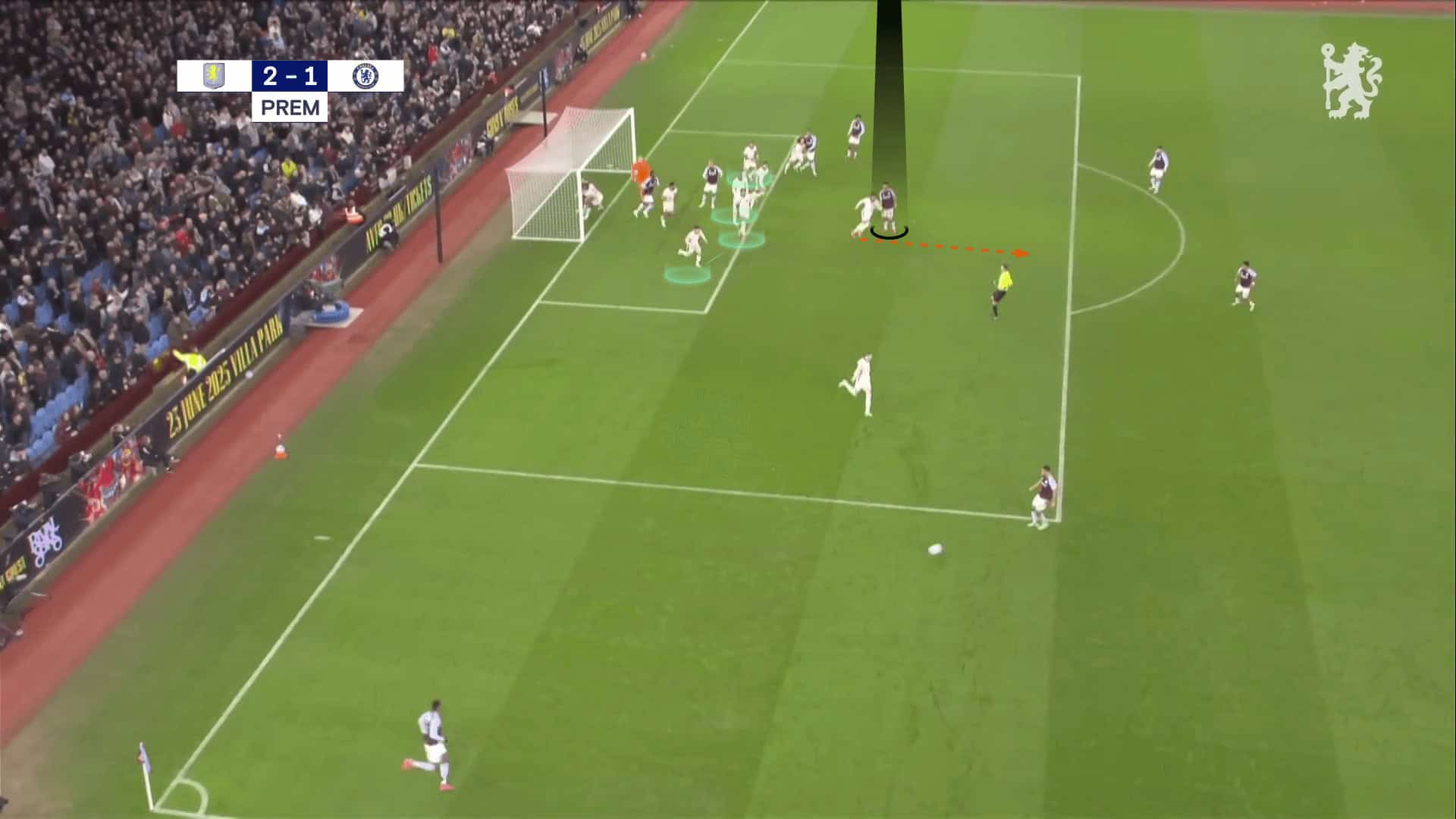
As in the photo below, the short-option defender goes to defend the short corner, but he finds himself in a 2v1 situation.

You can see him pointing to the first zonal defender to help him check that the rebound defender goes to the edge of the box.

The first zonal defender hesitates to go that high, leaving the near post, especially since the attackers behind the line move toward the far post, drawing the line’s attention and attempting to shift it toward the far post.

There is also an additional benefit for the attackers behind the line, which involves ensuring that the taker becomes onside when they receive the pass back from the short-option attacker by dragging the man markers behind the line who tries to go forward, thereby making the taker offside.
austin-macphee-set-piece-tactics-at-aston-villa-tactical-analysis-tactics

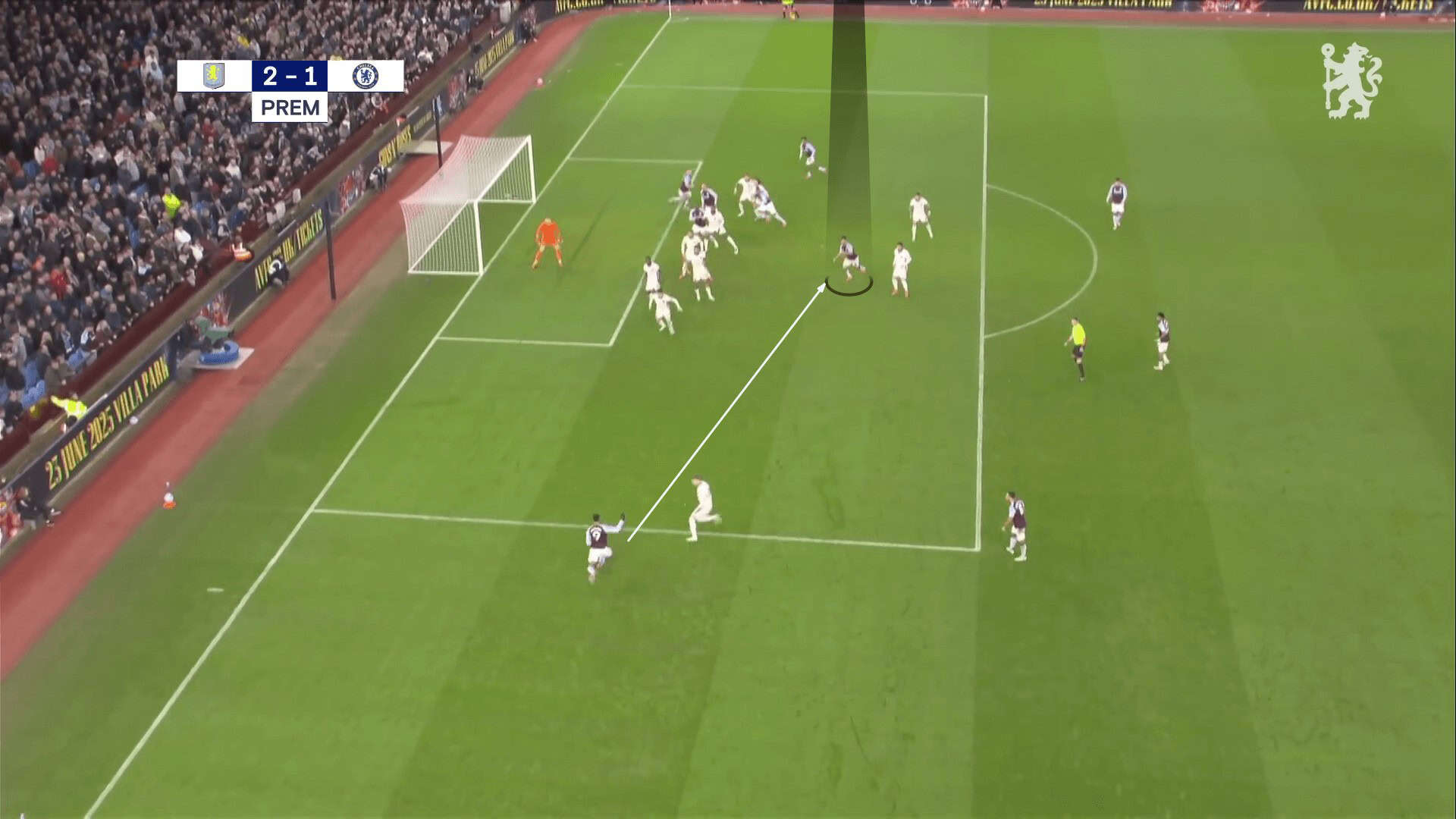
As shown below, the pass is easily played to the taker due to the 2v1 situation.

In the end, he sends a cut-back pass to Asensio, who puts it into the net.
austin-macphee-set-piece-tactics-at-aston-villa-tactical-analysis-tactics

You can then ask about how they react when the opponent puts two defenders to defend the short corner.

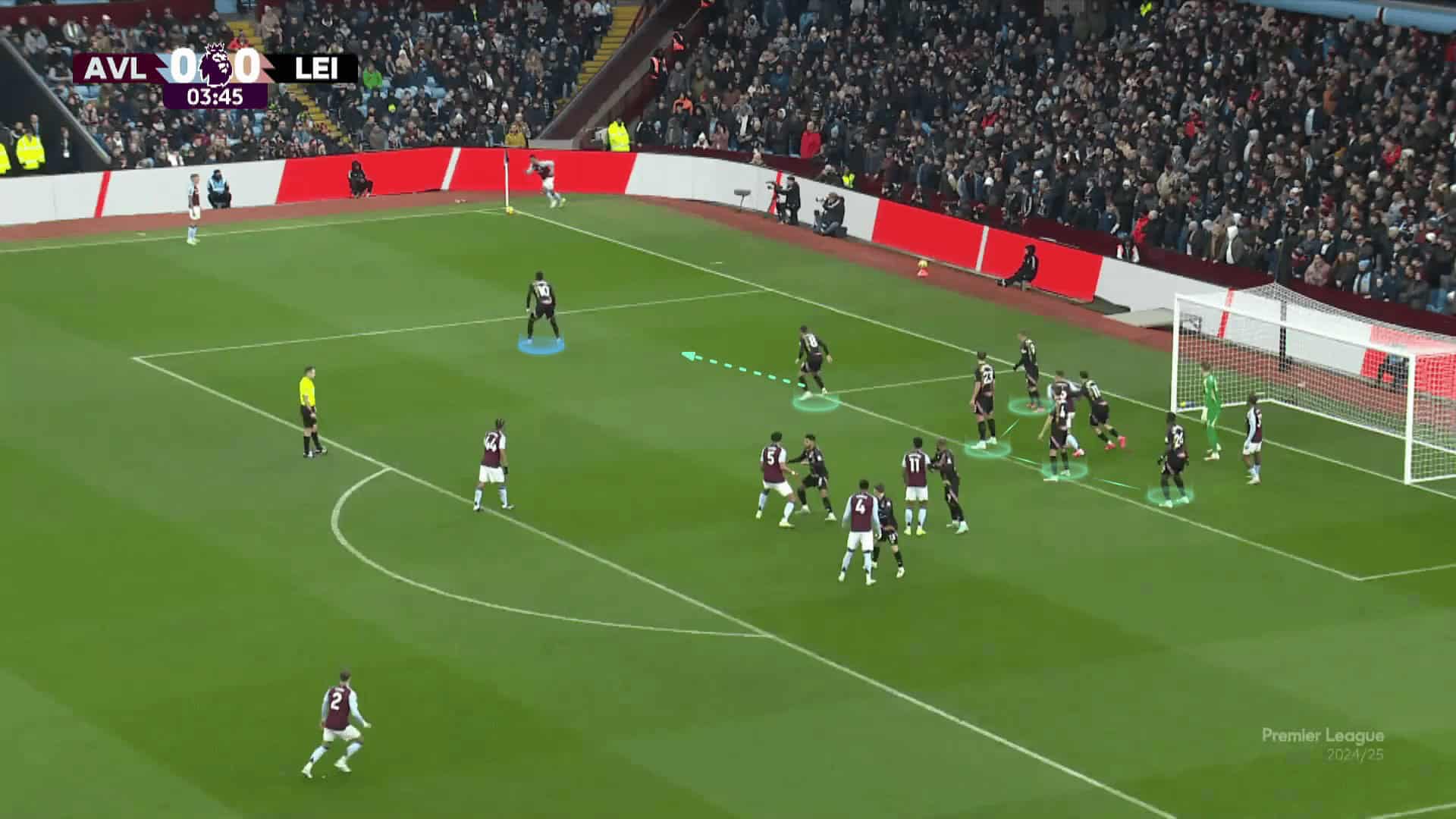
As shown below, Leicester City defend with five zonal defenders.

The first one starts closer to the taker to be ready to defend the area ahead of the near post and to assist in short corners, as well.
austin-macphee-set-piece-tactics-at-aston-villa-tactical-analysis-tactics

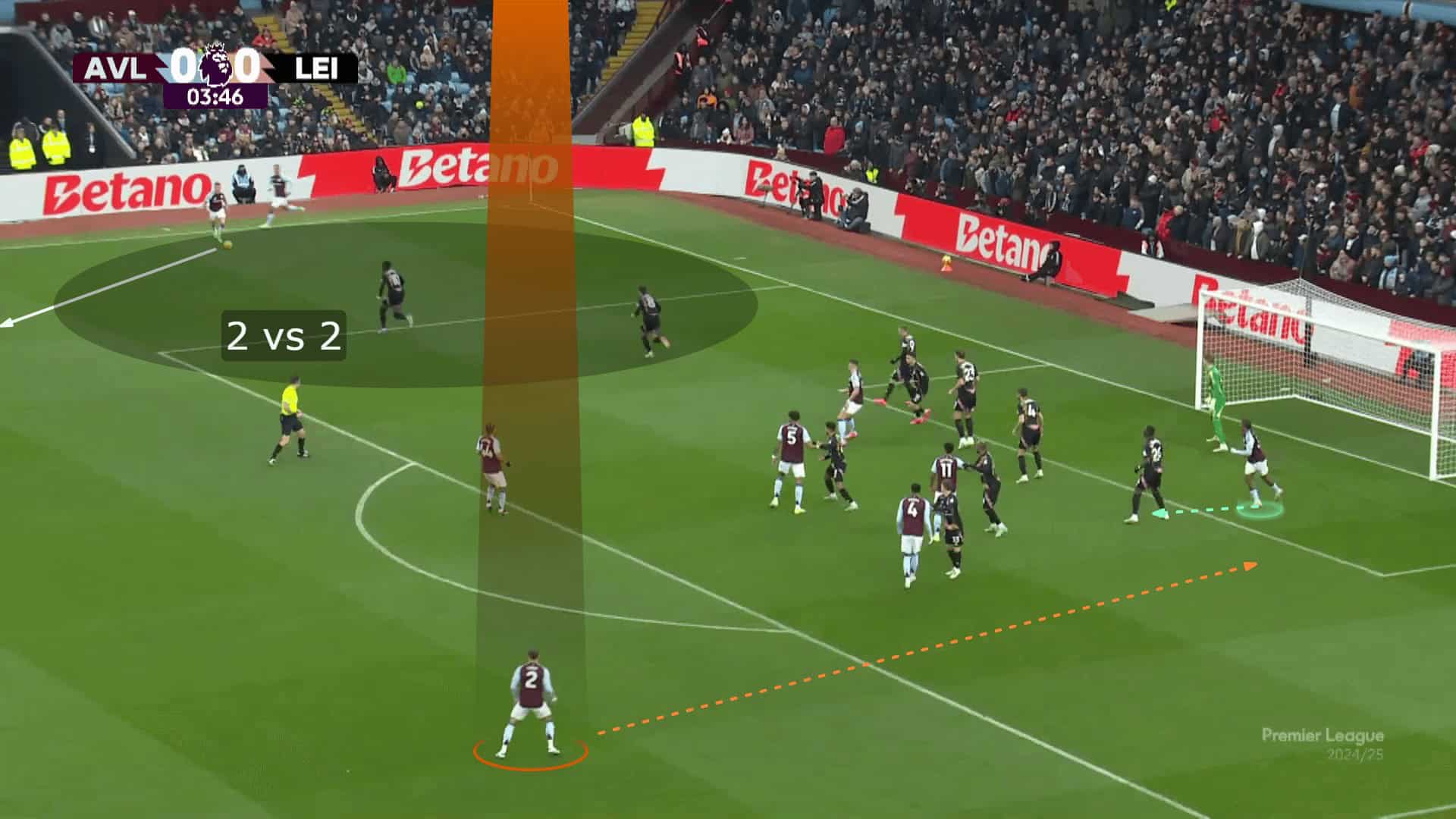
In the photo below, you can see that Aston Villa have a solution against this 2v2 situation by passing the ball back to a third player.

At the same time, a late player (orange), who had been waiting for the rebound or counterattacks, suddenly penetrates the box from the blind side of all the defenders, who must push up and focus on the moving ball.

In the final magic touch, the green player, who was near the goalkeeper, blocks the last zonal defender coming from the blind side of the zonal defenders.
austin-macphee-set-piece-tactics-at-aston-villa-tactical-analysis-tactics

In the photo below, you can see all the steps taken by the short-option attacker (blue), who goes to the near post to frame the goalmouth because the targeted player may not be able to play it directly to the goal.
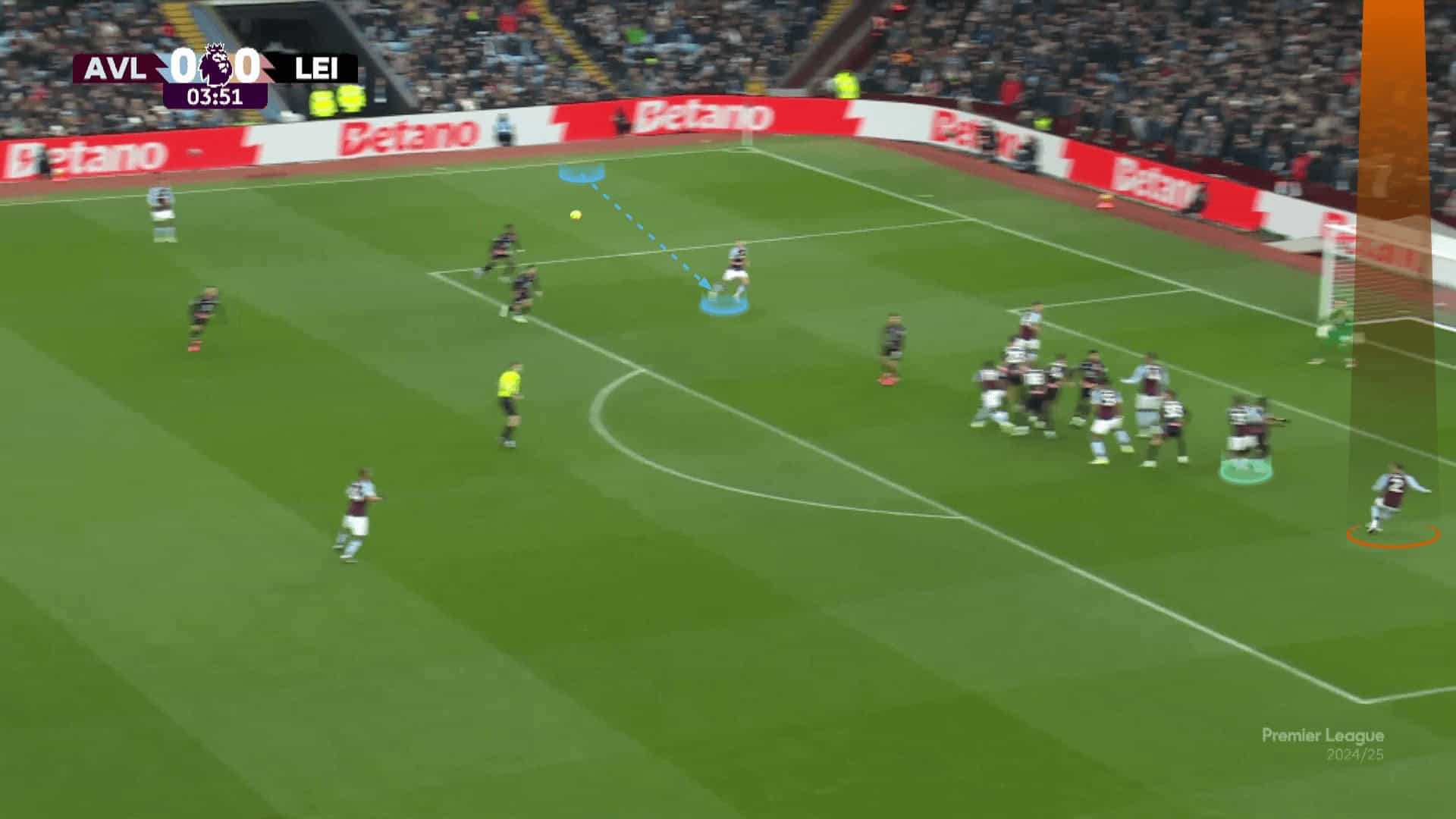
austin-macphee-set-piece-tactics-at-aston-villa-tactical-analysis-tactics

As shown below, the plan worked with four players framing the goal and two players behind them for the rebound, but the ball was a bit stronger, so the targeted player couldn’t control it well.
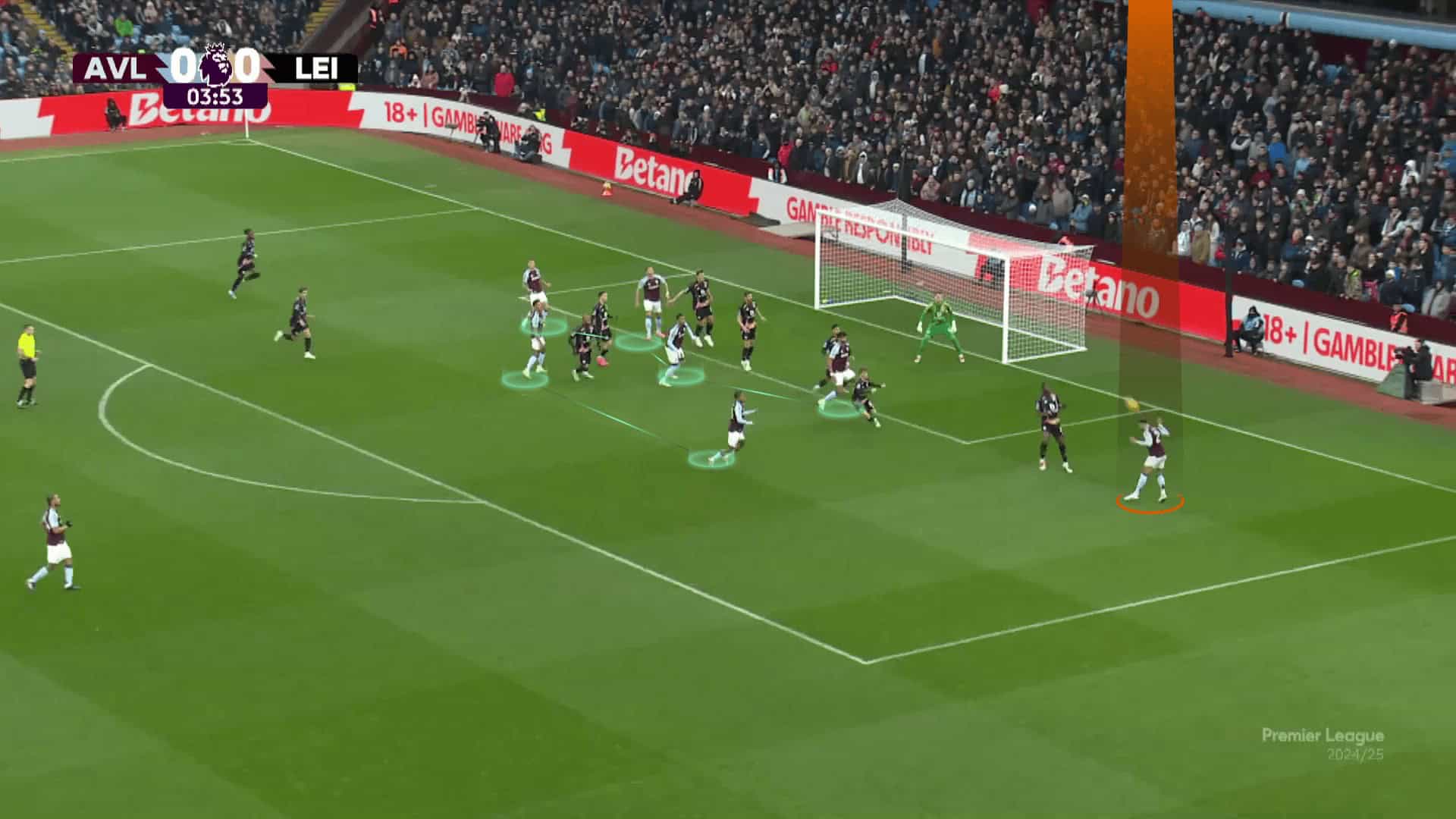
austin-macphee-set-piece-tactics-at-aston-villa-tactical-analysis-tactics

They also had a variation against this defending team, like Leicester City.

As shown below, they can also use this 3v2 situation to drag the first zonal defender (green) a little bit to make him reach the rebound area late, where they can pass the ball to a fourth player.
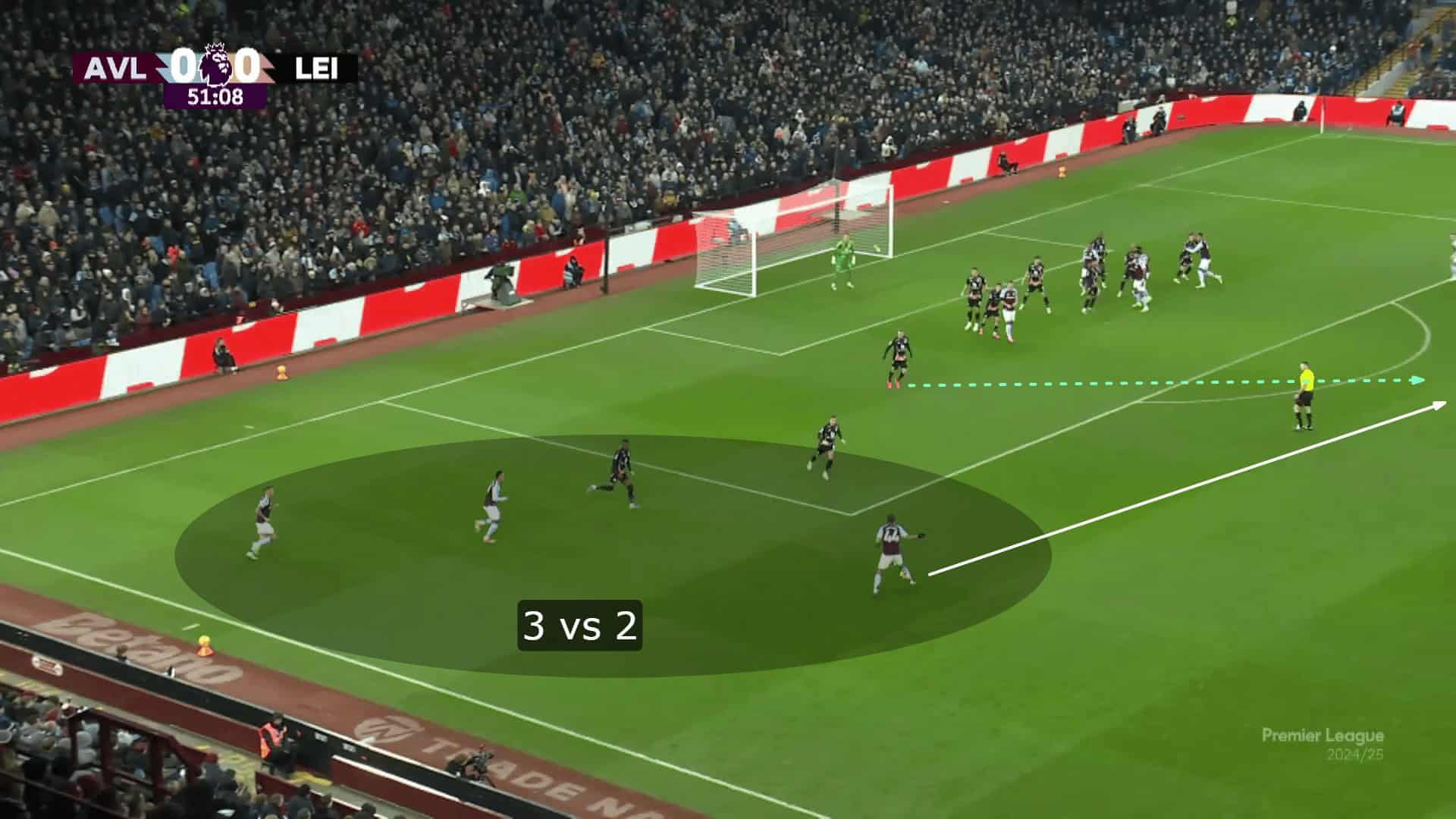
austin-macphee-set-piece-tactics-at-aston-villa-tactical-analysis-tactics

As shown below, the plan works while the player can shoot and has two wide options; however, he chooses to dribble, resulting in a loss of possession.
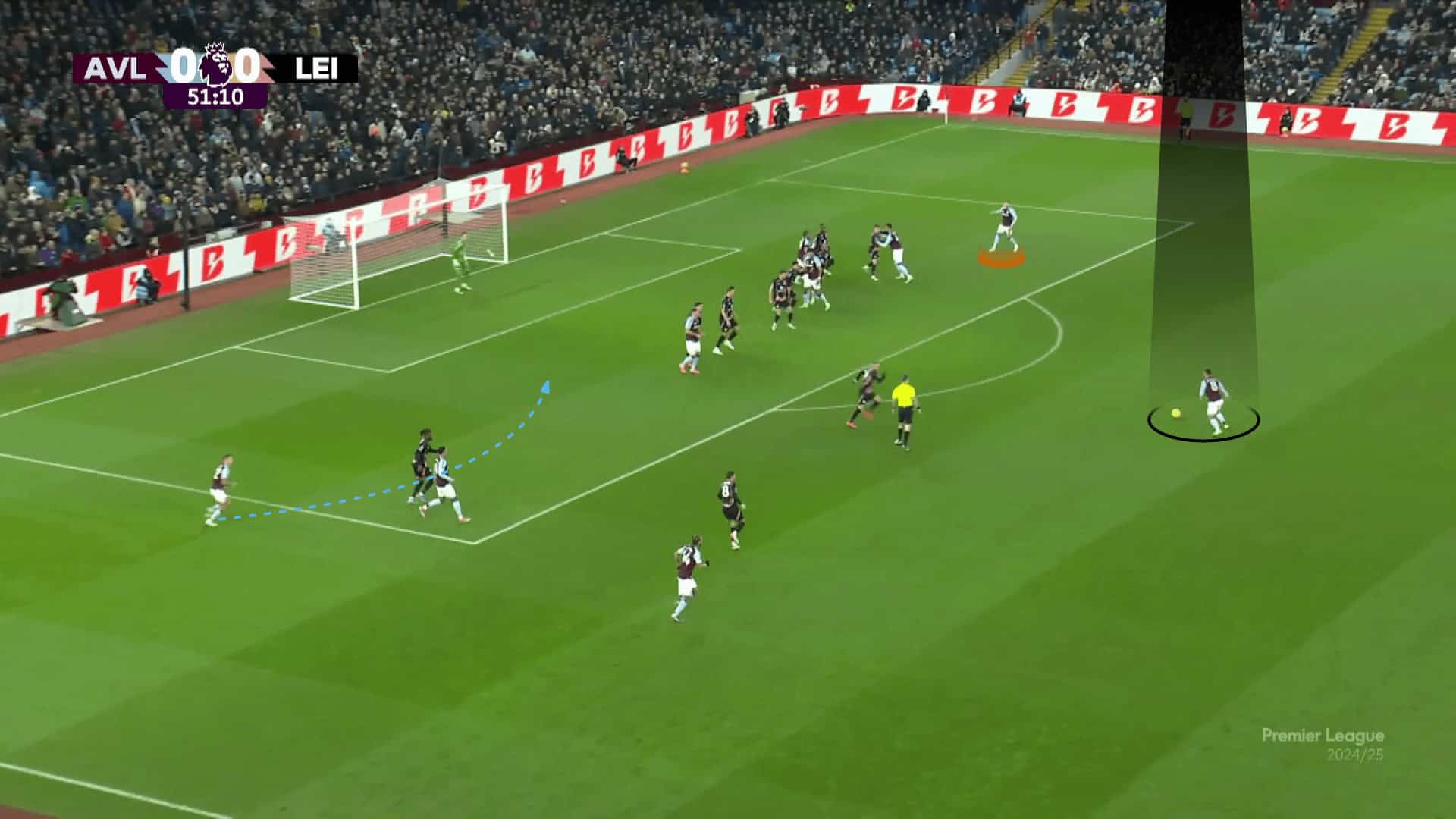
austin-macphee-set-piece-tactics-at-aston-villa-tactical-analysis-tactics

You can then ask about how they react against teams who protect the short corners and the area around the edge of the box well.

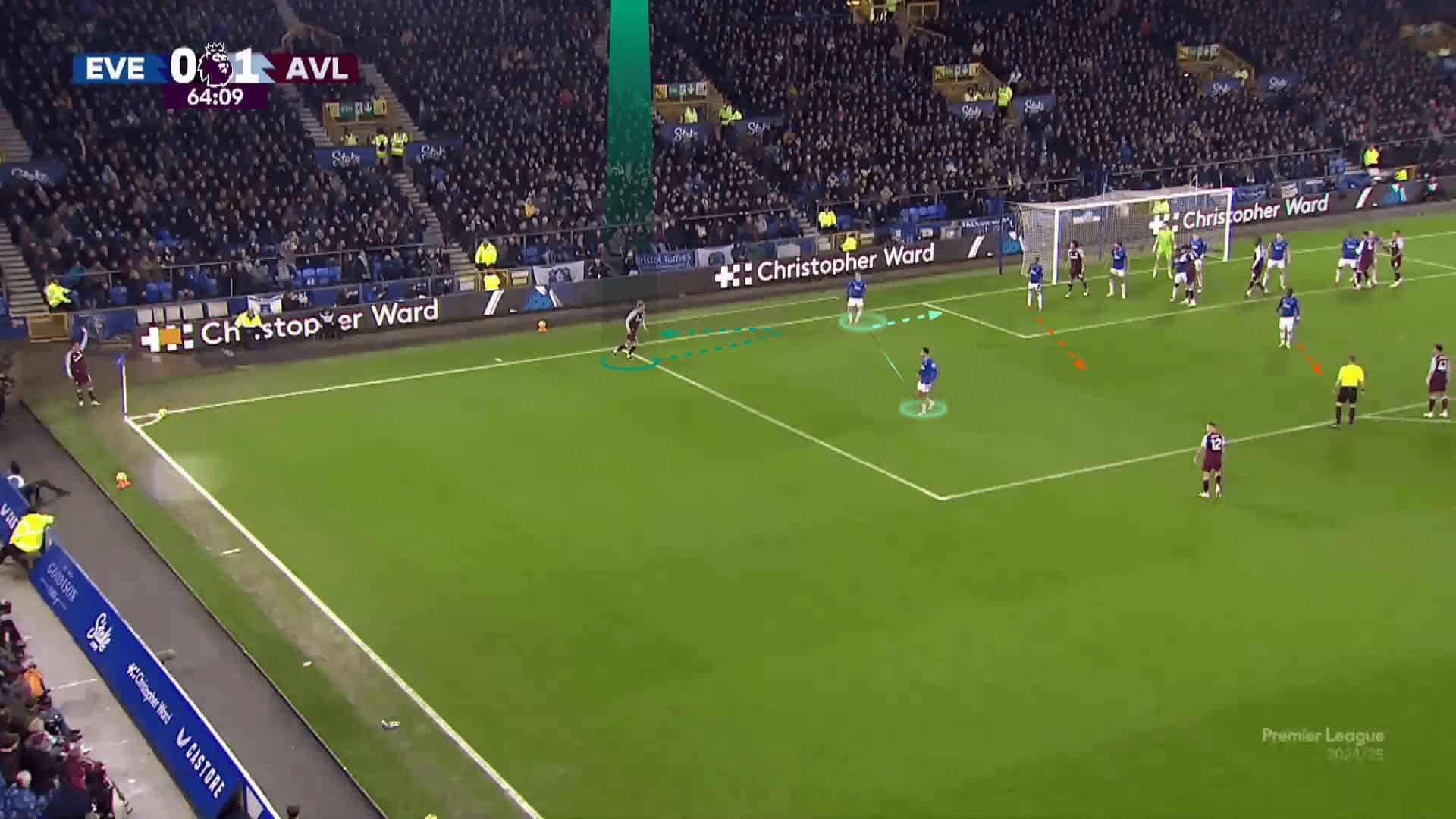
As shown below, Everton deployed two short-option defenders (green) while having two players (orange) ready to move to the edge of the box; one is positioned near the penalty spot, while the other is the first zonal defender.

To counter this, Aston Villa’s short-option defender has a different starting position near the line, moves toward the box, acting as if the ball will be crossed, and then turns around suddenly to receive the ball.

He did that to make the first short-option defender step back so he could have time to send the cross from such a dangerous position.
austin-macphee-set-piece-tactics-at-aston-villa-tactical-analysis-tactics

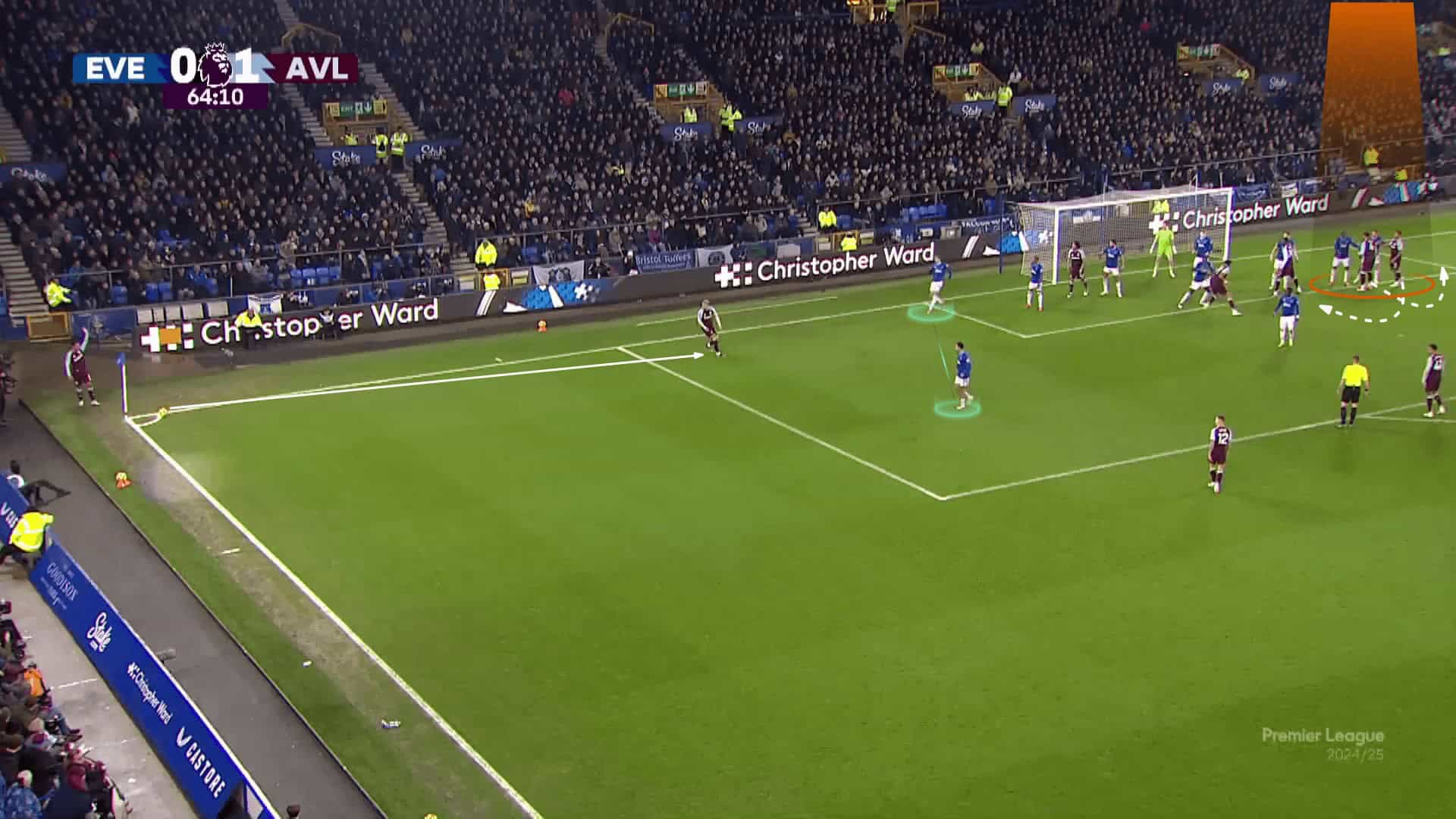
As shown below, he has the time and space to turn around and send a cross from a nearby position.

At the same time, two players start on the zonal defenders’ blind side and make cross-route movements to manipulate their man markers, which leads to a separation between them and the man markers.
austin-macphee-set-piece-tactics-at-aston-villa-tactical-analysis-tactics

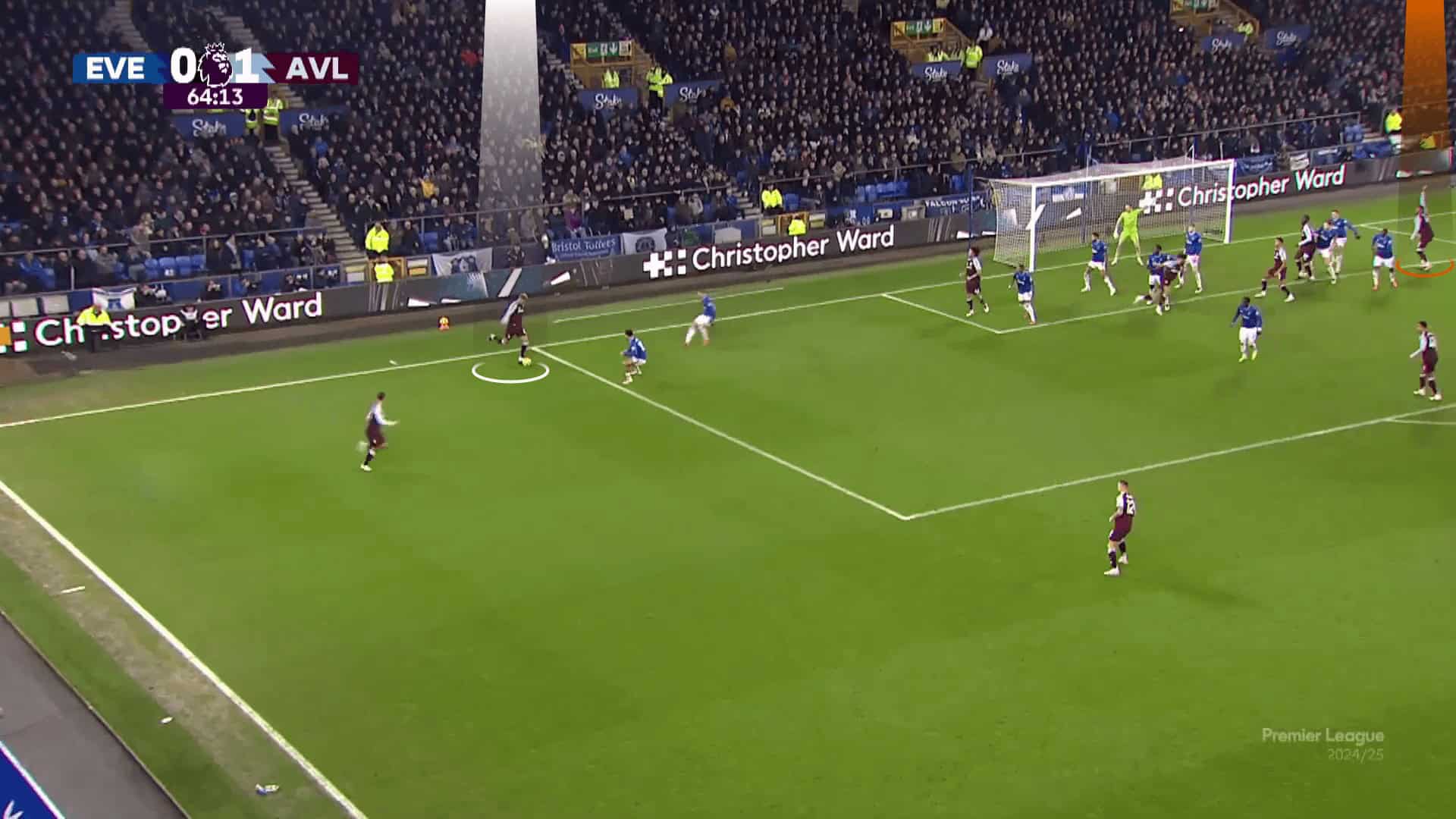
The plan works, but the cross isn’t optimum, as shown below.
austin-macphee-set-piece-tactics-at-aston-villa-tactical-analysis-tactics

Aston Villa Near Post

Now, we want to discuss how they use their brilliant reputation for using short corners to empty the near post.

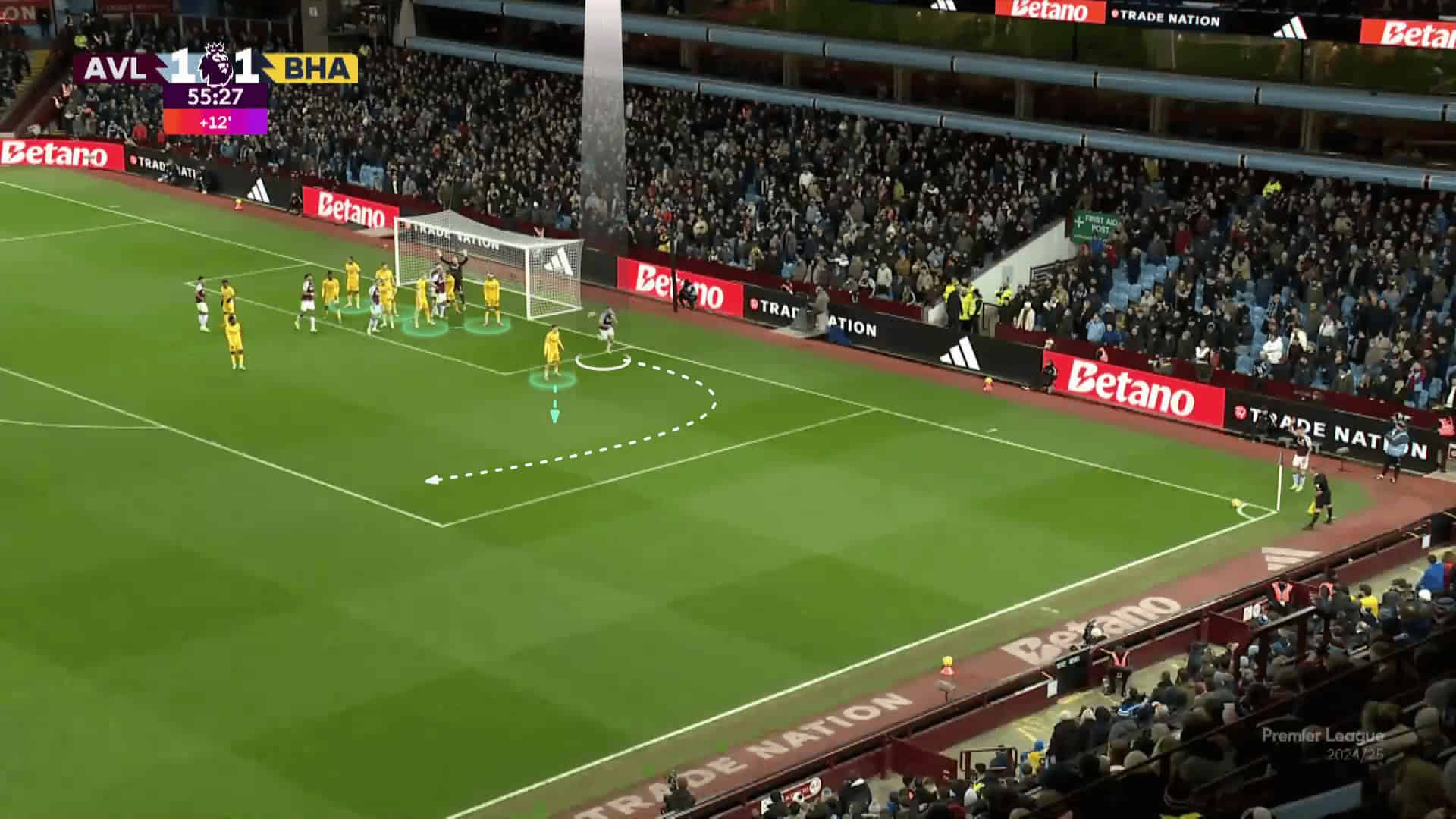
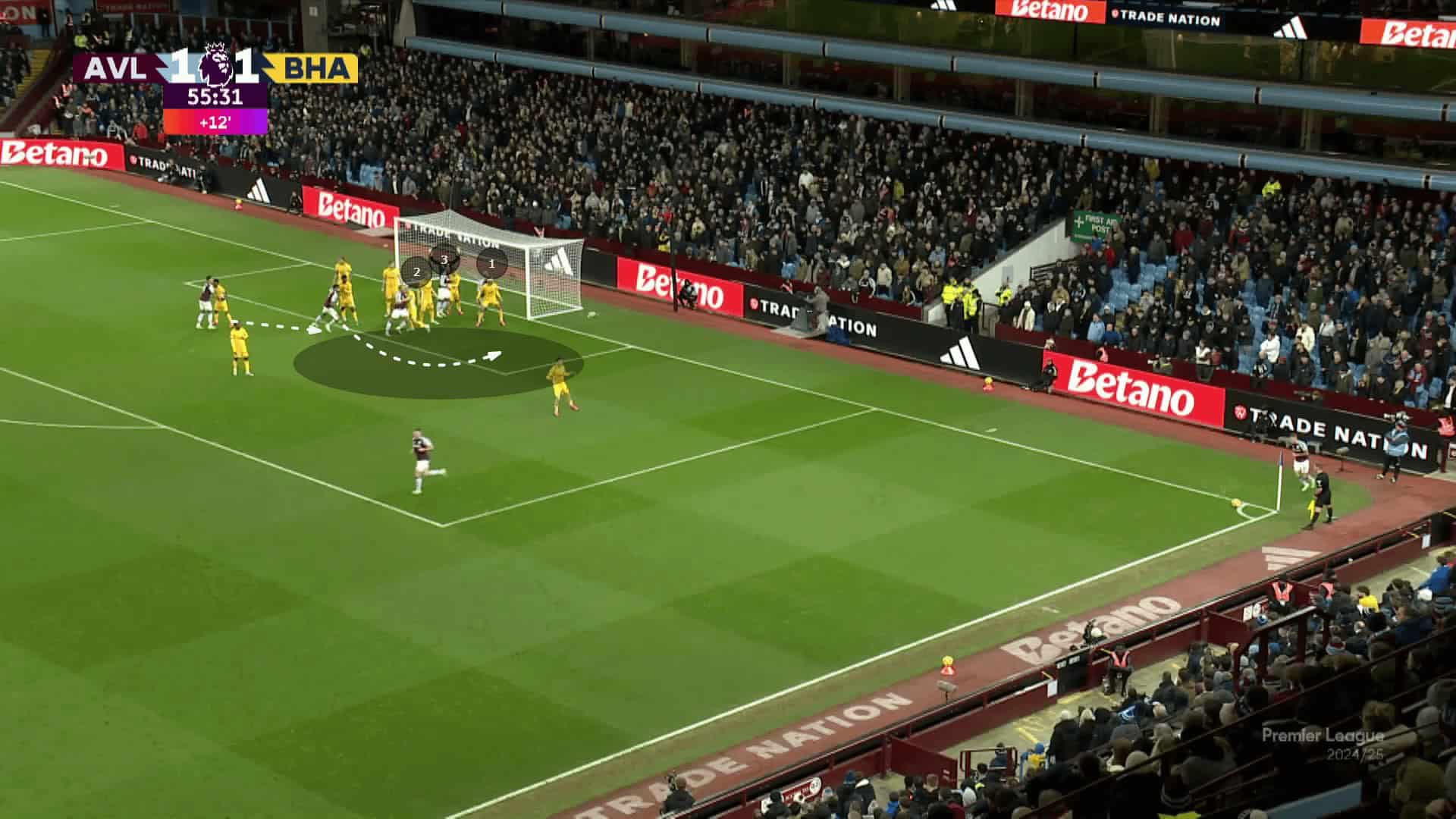
As shown below, Brighton defend with four zonal defenders (green), with an additional one defending the area ahead of the near post.

The team is also ready to defend short corners.

Hence, Aston Villa asks a player from the box to run from his back, trying to drag him a little, and eventually stands as a rebound player, playing a double role.
austin-macphee-set-piece-tactics-at-aston-villa-tactical-analysis-tactics

As shown below, the plan works to evacuate the near post.

Here, we should discuss the importance of the three players inside the six-yard line, who make the zonal line shift more towards the back towards the goalkeeper, thereby making this area larger.

The first two block the first two zonal defenders, while the third blocks the goalkeeper, preparing the field for the two players coming from the blind side to the near post, one behind the other, to frame the ball’s path.
austin-macphee-set-piece-tactics-at-aston-villa-tactical-analysis-tactics

In another trick, they target the area ahead of the near post for flick-ons.

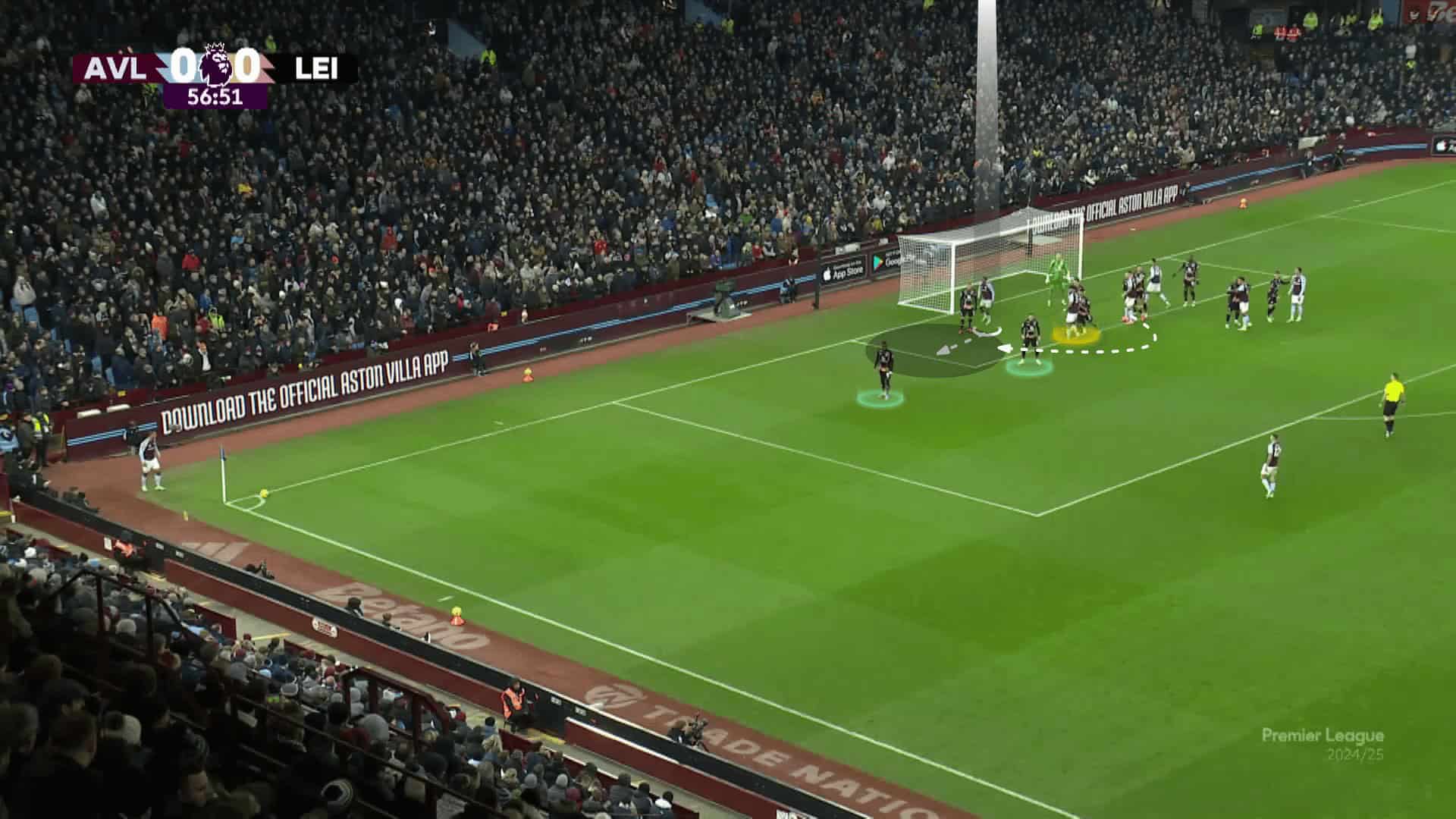
Leicester City have the same defending scheme that we discussed earlier, with a short-option defender and the zonal defender behind him who is ready to help him, four fixed zonal defenders and four man markers.

Aston Villa did the two amazing short corners that we discussed before, so they had to have a variation.

So, they exploited that the green zonal defender makes steps out of the six-yard box, being ready to go outside to target the area behind him ahead of the near post, as shown below.

Having four man markers against six attackers inside the box means that two of them become free.

These two players (white) will go to the targeted area from the near-post zonal defender’s blind sides while the yellow attacker blocks the second zonal defender.
austin-macphee-set-piece-tactics-at-aston-villa-tactical-analysis-tactics

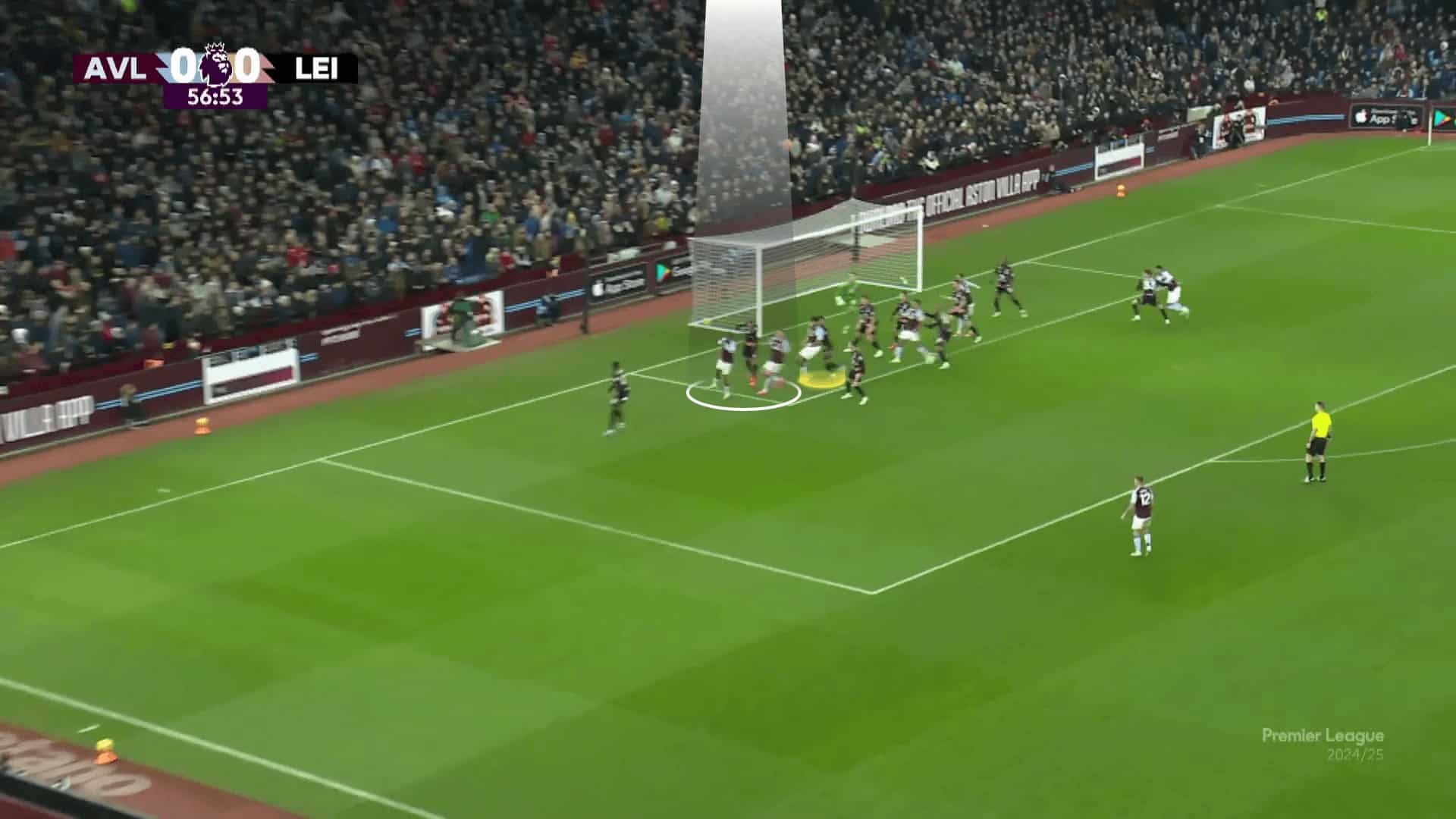
The plan almost works, as shown below, but the targeted player can’t hit the ball well.
austin-macphee-set-piece-tactics-at-aston-villa-tactical-analysis-tactics

Hence, you have two choices: Get killed by short corners or a cross to the near post.

Conclusion

In this analysis, we have discussed the key factors that distinguish Aston Villa in corners.

These factors have made them the highest-scoring team from set pieces in the Premier League so far, with 13 goals.

In this set-piece analysis, we have also highlighted Aston Villa’s clever tactics, including their use of synchronized movements and role exchanges between the players guarding the edge of the box.

This strategy confuses the opponent and forces them to choose between defending the short corners or defending the near post and the space ahead of it.

Previous Post

Advice For Going To An Away Football Match For The First Time

Next Post

Nuno Mendes Scout Report At PSG 2024/2025: Finding Similar Attacking Full-Backs (Andrei Borza, El Hadji Malick Diouf, Maxim De Cuyper) – Data Analysis

Next Post
6 Potential Strikers For Arsenal FC scouting report 1

Nuno Mendes Scout Report At PSG 2024/2025: Finding Similar Attacking Full-Backs (Andrei Borza, El Hadji Malick Diouf, Maxim De Cuyper) - Data Analysis

  • About Total Football Analysis
  • Contact Total Football Analysis
  • Write For Total Football Analysis
  • Advertise
  • Privacy Policy
  • Cancellation / Refund Policy
  • Resources
  • Terms Of Service

© 2026 Total Football Analysis

No Result
View All Result
  • Football Analysis
    • Data Analysis
    • Formations
      • 2-2-4 Formation
      • 2-3-5 Formation
      • 3-1-4-2 Formation
      • 3-2-2-3 Formation
      • 3-2-4-1 Formation
      • 3-1-6 Formation
      • 3-3-4 Formation
      • 3-4-1-2 Formation
      • 3-4-2-1 Formation
      • 3-4-3 Formation
      • 3-5-1-1 Formation
      • 3-5-2 Formation
      • 4-1-4-1 Formation
      • 4-2-2-2 Formation
      • 4-2-3-1 Formation
      • 4-2-4 Formation
      • 4-3-1-2 Formation
      • 4-3-3 Formation
      • 4-4-2 Formation
      • 4-5-1 Formation
      • 5-3-2 Formation
      • 5-4-1 Formation
      • 6-3-1 Formation
    • Head Coach Analysis
    • Match Analysis
    • Player Analysis
    • Recruitment Analysis
    • Set Piece Analysis
    • Tactical Theory
    • Tactical Preview
    • Team Analysis
    • Training Analysis
    • Tactical Analysis
    • Scouting Report
  • Competition
    • ALL Competitions
    • English Premier League
    • Champions League
    • La Liga
    • Bundesliga
    • Serie A
    • Ligue 1
    • Eredivisie
    • EFL Championship
    • FIFA World Cup 2022
    • WEURO 2022
    • Women’s Super League
    • NWSL
    • Belgian First Division A
    • A-League
    • Liga Profesional de Argentina
    • Austrian Bundesliga
    • Campeonato Brasileiro Série A
    • DFB Pokal
    • 1. HNL
    • Danish Superliga
    • EFL League One
    • EFL League Two
    • FA Cup
    • EFL Cup
    • Indian Super League
    • K-League
    • J1 League
    • Liga MX
    • Copa América 2021
    • Copa del Rey
    • MLS
    • Eliteserien
    • Euro 2020
    • Primeira Liga
    • Scottish Premiership
    • Allsvenskan
    • Europa League
    • UEFA Nations League
    • Liga AUF Uruguaya
  • Coaches
    • All Coaches
    • Alfred Schreuder
    • Ange Postecoglou
    • Antonio Conte
    • Arne Slot
    • Bo Svensson
    • Brendan Rodgers
    • Bruno Lage
    • Carlo Ancelotti
    • Christophe Galtier
    • Claude Puel
    • Claudio Ranieri
    • David Moyes
    • Dean Smith
    • Diego Simeone
    • Domenico Tedesco
    • Frank Lampard
    • Eddie Howe
    • Edin Terzić
    • Emma Hayes
    • Erik ten Hag
    • Ernesto Valverde
    • Gennaro Gattuso
    • Gerardo Seoane
    • Gian Piero Gasperini
    • Giovanni van Bronckhorst
    • Graham Potter
    • Igor Tudor
    • Imanol Alguacil
    • Jesse Marsch
    • Jonas Eidevall
    • Jorge Sampaoli
    • José Bordalás
    • José Mourinho
    • Julen Lopetegui
    • Julian Nagelsmann
    • Julien Stéphan
    • Jürgen Klopp
    • Luciano Spalletti
    • Lucien Favre
    • Manuel Pellegrini
    • Marcelo Bielsa
    • Marco Rose
    • Marco Silva
    • Massimiliano Allegri
    • Mauricio Pochettino
    • Maurizio Sarri
    • Mikel Arteta
    • Niko Kovač
    • Nuno Espírito Santo
    • Oliver Glasner
    • Patrick Vieira
    • Paulo Fonseca
    • Pep Guardiola
    • Peter Bosz
    • Rafa Benítez
    • Ralf Rangnick
    • Ralph Hasenhüttl
    • Roger Schmidt
    • Roy Hodgson
    • Sean Dyche
    • Sérgio Conceição
    • Simone Inzaghi
    • Sonia Bompastor
    • Stefano Pioli
    • Steffen Baumgart
    • Steven Gerrard
    • Thiago Motta
    • Thomas Frank
    • Thomas Tuchel
    • Unai Emery
    • Vincenzo Italiano
    • Xavi
  • Teams
    • ALL Teams
    • AC Milan
    • Ajax Amsterdam
    • Arsenal
    • AS Monaco FC
    • Atalanta
    • Atlético Madrid
    • FC Barcelona
    • FC Bayern Munich
    • Borussia Dortmund
    • Celtic FC
    • Chelsea FC
    • Everton F.C.
    • Inter Milan
    • Juventus F.C.
    • Leeds United F.C.
    • Liverpool FC
    • Manchester City
    • Manchester United FC
    • Paris Saint-Germain
    • Rangers FC
    • RB Leipzig
    • Real Madrid CF
    • Tottenham Hotspur
    • West Ham United
  • Players
    • ALL Players
    • Alisson Becker
    • Bukayo Saka
    • Erling Haaland
    • Harry Kane
    • Jack Grealish
    • John Stones
    • Julián Alvarez
    • Kalvin Phillips
    • Kevin De Bruyne
    • Kyle Walker
    • Kylian Mbappé
    • Lamine Yamal
    • Lionel Messi
    • Luis Díaz
    • Mohamed Salah
    • Phil Foden
    • Virgil Van Dijk
  • Contact
  • Write For TFA
  • Login

© 2026 Total Football Analysis