
Bodø/Glimt hosted Lazio last Thursday in their UEFA Europa League quarter-final first leg and succeeded in playing one of their best games this season while winning 2-0 and getting a very important advantage over their Italian opponents ahead of the second leg.
This tactical analysis will cover what happened in the first leg, with a primary focus on Bodø/Glimt’s strengths and exceptional attacking performance.
The analysis will also reserve a section that explores Lazio’s errors and studies the tactics and solutions that need to be used in the second leg to bring Lazio back into the game and snatch the qualification ticket.
Bodø/Glimt Vs Lazio Lineups
Bodo/Glimt’s Kjetil Knutsen started the match according to the 4-3-3 formation with Nikita Haikin as a goalkeeper, Fredrik Sjøvold as a right-back, Odin Bjørtuft and Jostein Gundersen as centre-backs, Fredrik André Bjørkan as a left-back, Patrick Berg, Håkon Evjen and Ulrik Saltnes as central midfielders, Ole Didrik Blomberg and former Milan’s Jens Petter Hauge as wingers, with Kasper Høgh being the team’s striker.
On the other hand, Lazio’s Marco Baroni opted for the 4-2-3-1 formation with Christos Mandas as a goalkeeper, Elseid Hysaj as a right-back, Mario Gila and Alessio Romagnoli as centre-backs, and Adam Marušić as a left-back.
In midfield, Baroni used both Matías Vecino and Mattéo Guendouzi as central midfielders, Mattia Zaccagni and Gustav Isaksen as wingers, Pedro as an advanced playmaker and Boulaye Dia as the team’s striker.
Bodø/Glimt’s Exceptional Attacking Performance
Bodø/Glimt put on one of the most outstanding performances of their continental season against Lazio.
They were very dangerous and continuously threatened the Biancoceleste’s defence, whether with penetrations from the wings, quick short-passing combinations between Hauge, Blomberg, Høgh, or with additional support from the creative midfielders Saltnes and Evjen.
It is sufficient to say that Saltnes, who scored both Bodø/Glimt’s goals, was aware of the attacking input from the team’s midfielders.
Bodø/Glimt could tire Lazio’s defence with interceptions in their opponent’s own half and by launching quick counter-attacks relying on the talent of their attacking players.
Many of Bodø/Glimt’s counterattacks were very dangerous for Lazio’s defence, and it was obvious to everyone that Lazio’s defence could not stop Bodø/Glimt’s attempts.
It was only thanks to Mandas saving many of Bodø/Glimt’s shots that Lazio even remained in the game.
The following opportunity highlights Berg’s role in intercepting the ball and launching quick counterattacks with passes directed automatically to the wings, where Hauge and Blomberg are used as lethal weapons.
In this case, Hauge received the ball from Saltnes, who attracted the defenders to him by joining the box while passing to Hauge.
This allowed him the needed space and time to enter the box, dribble past Guendouzi, and opt for a curved shot that could have scored if Mandas was not having a good day.
Jens Petter Hauge’s Dangerous Penetrations
 Moreover, attacking with numbers and intensively arriving inside the box made Lazio’s defence suffer as it confused their marking system.
It made it complicated for them to guess the receiving player.
In fact, Bodø/Glimt’s rhythm was much higher than that of Lazio in this match, and the players’ passing and movement with and without the ball served Bodø/Glimt much more than Lazio since Bodø/Glimt’s players were faster and more intelligent on many occasions.
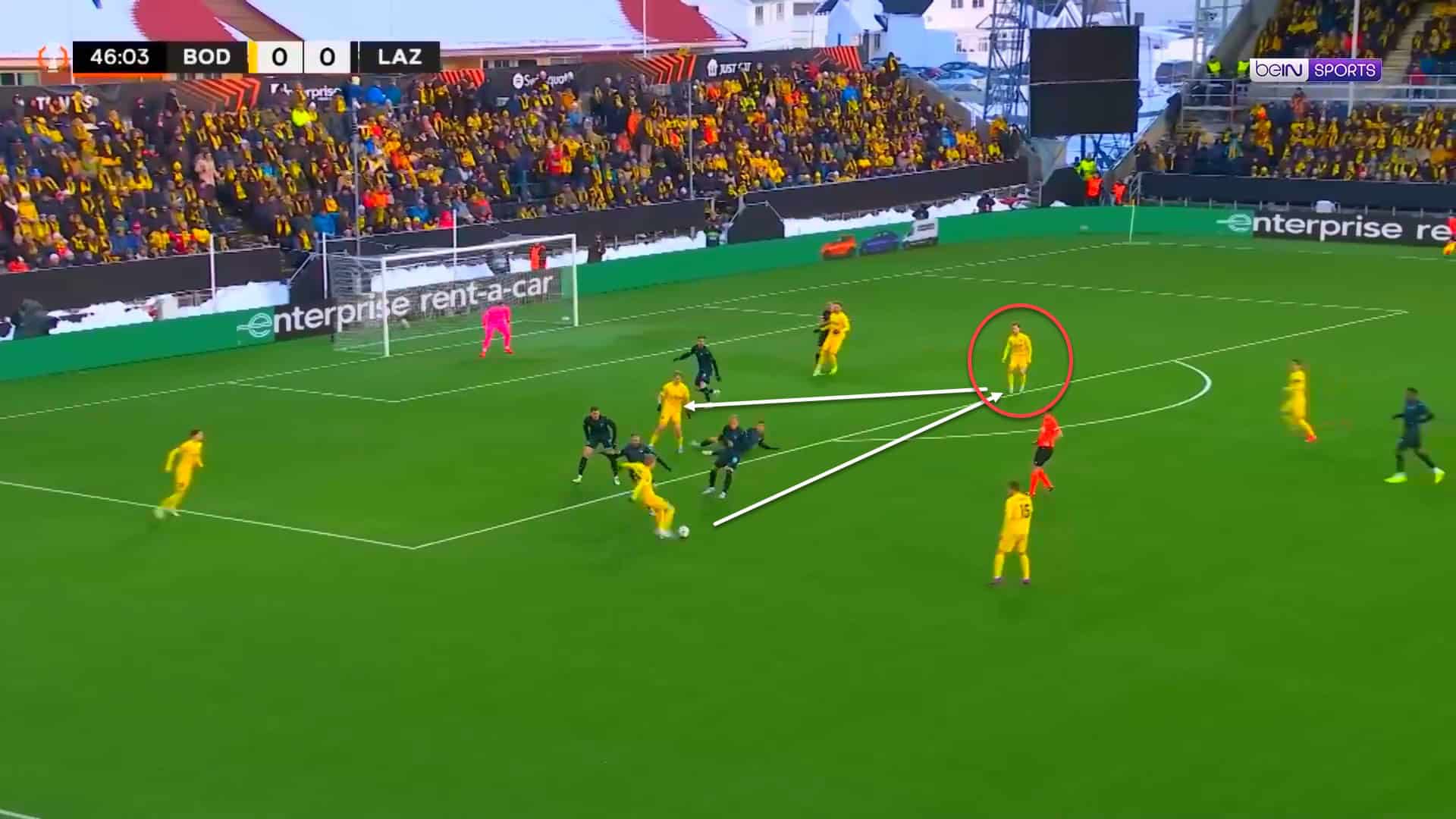
In this action, the quick passing between the ball holder and the one inside the box and the intensive presence of many players in that area made things complicated for Lazio, who tried intercepting passes but were late each time.
Luckily for Lazio, Blomberg’s shot was not as accurate as it needed to be on this occasion.
Bodø/Glimt’s Dangerous Actions
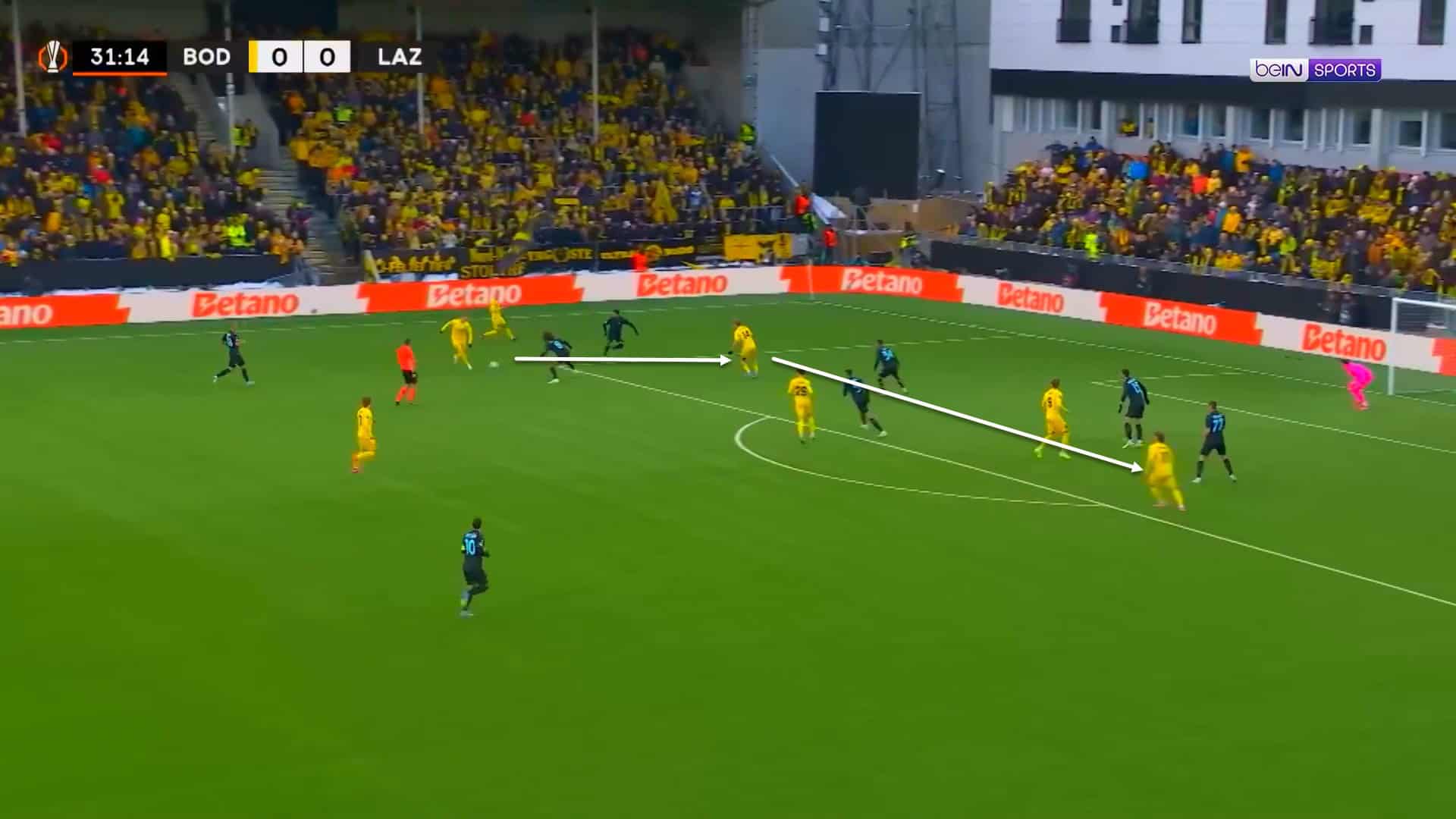 In addition to the obvious chemistry between the players, what made Bodø/Glimt so dangerous up front was their attacking players’ movement behind defenders and midfielders in an unexpected way.
The team looked in great shape, and there was a lot of understanding between everyone during the attacking actions, and that’s what helped them surprise Lazio in almost every attack.
This attacking action highlights this ability to confuse Lazio’s players with actions that start from the wing and are accompanied by penetrations without the ball towards the box (in this case, from Hauge).
What is exceptional in this action is that Bjørkan passed the ball to Hauge at the right time, as soon as Hauge made the needed run, making the action very dangerous, as Hauge could shoot from a very close spot.
Bodø/Glimt’s Dangerous Movements Without The Ball
 Lazio’s Issues & The Improvements Needed For The Second Leg
Unlike Bodø/Glimt, Lazio played one of their worst games this season despite having a relatively positive campaign in the UEFA Europa League.
We are saying this mainly because Lazio lost 2-0, but they also did not deserve a positive result from this match.
Their performance was very poor, both from an attacking and a defensive point of view.
Defence-wise, Lazio were unable to stop or limit Bodø/Glimt’s dangerous attacks as they failed to win most of the defensive duels, knowing that their opponent relied a lot on short passes and dribbling skills to reach the goal, with less reliance on crosses and aerial duels.
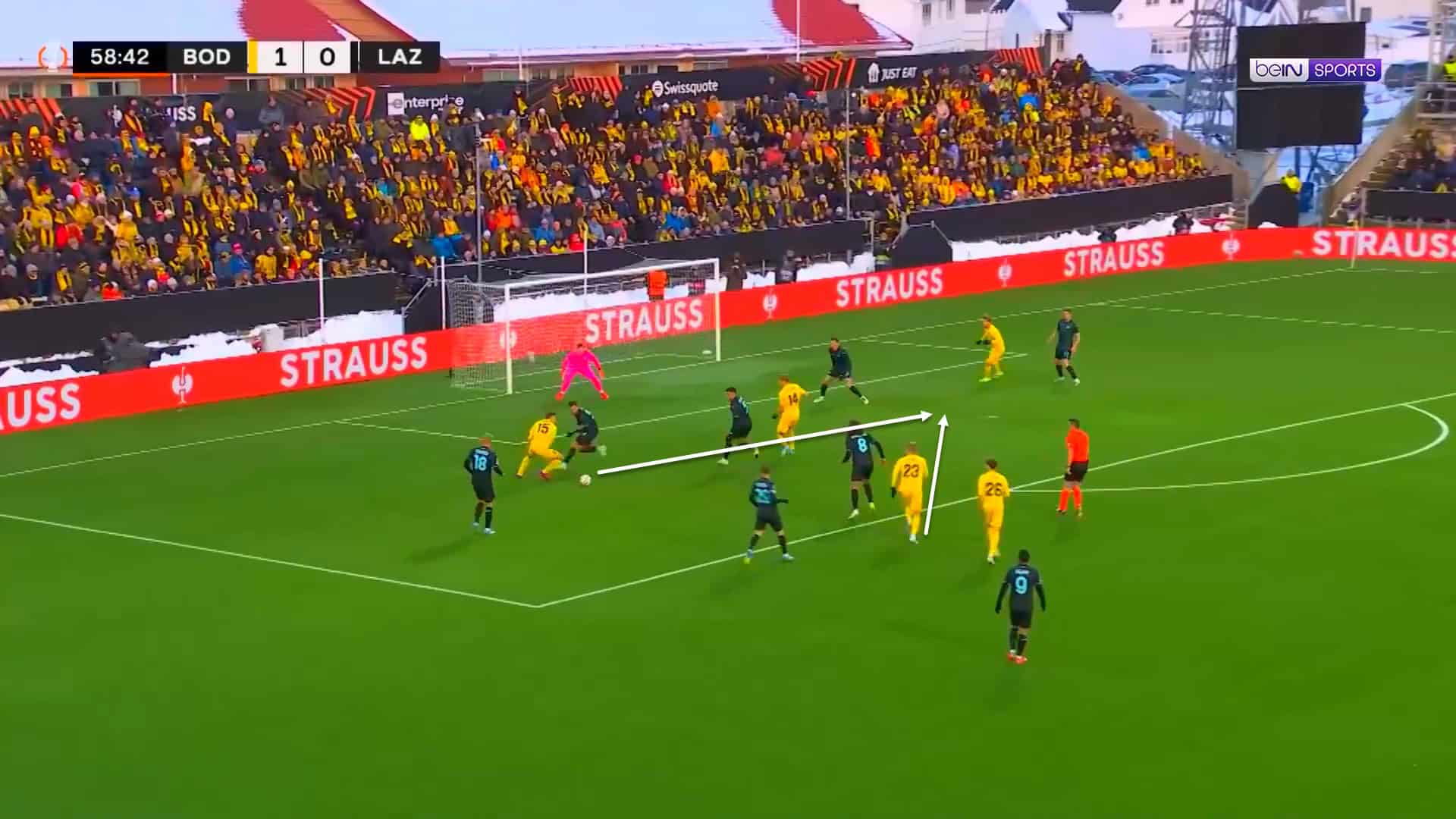
The first conceded goal action showcases a lot of confusion within Lazio’s defensive line.
They do not retreat quickly enough during counterattacks, leaving players unmarked in key areas.
In this case, Blomberg was the one left unmarked in a dangerous spot, and he could receive and quickly pass the ball to Saltnes.
Likewise, Romagnoli was not decisive in his marking on Saltnes, allowing him to control and shoot the ball on goal without being as aggressive as needed in this situation.
Saltnes also deserves credit for being quicker than Romagnoli and doing everything very quickly to prevent his marker from disturbing him.
Lazio Defensive Mistakes In The First Conceded Goal
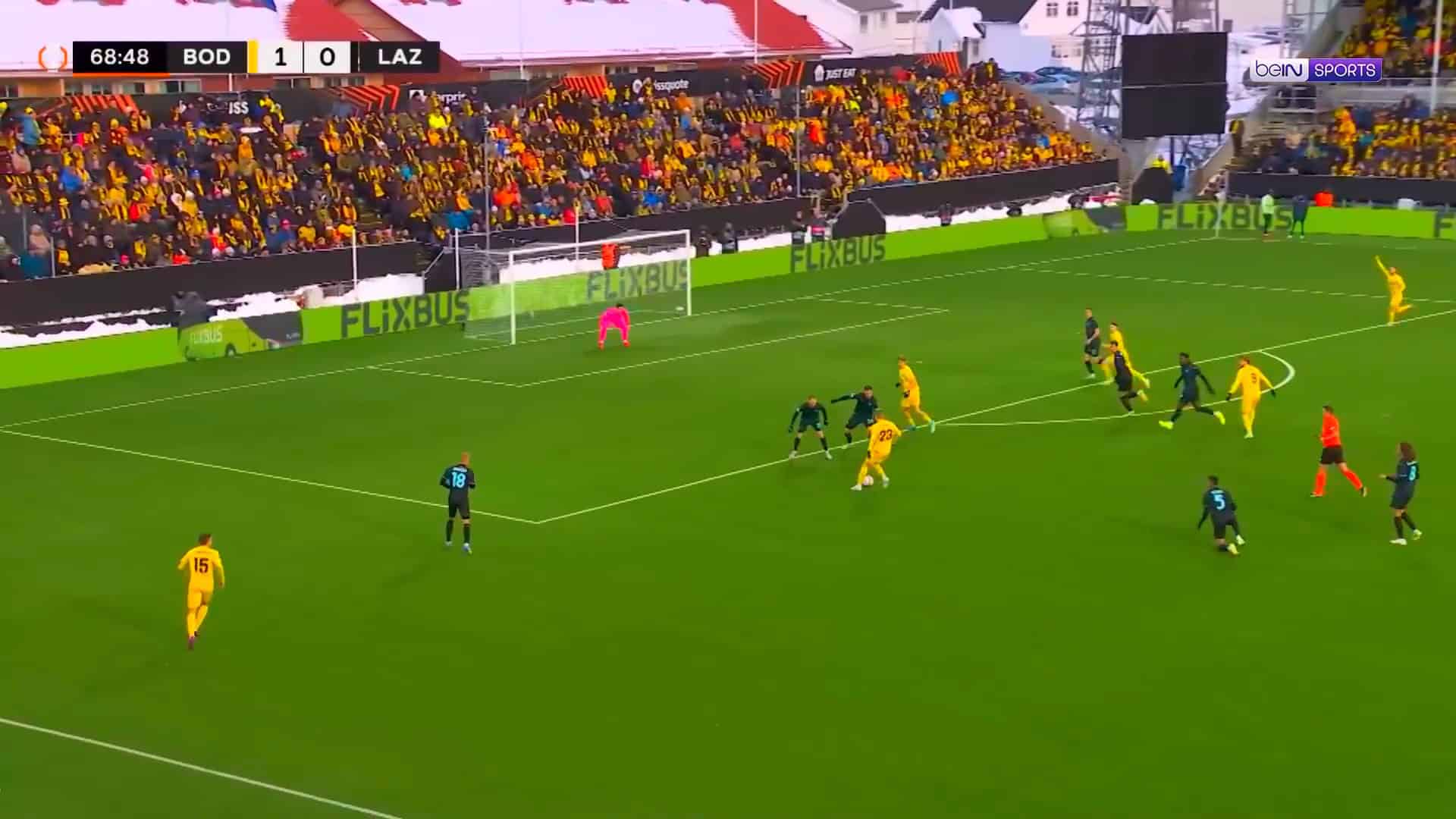
 The second conceded goal also shows that Lazio were too slow compared to Bodø/Glimt as the Norwegian team succeeded in scoring a very beautiful goal, exploiting Lazio’s marking issues.
In this goal action, Hauge dribbled past Vecino with ease to clear the way for himself to advance towards the box.
Lazio’s players Gila and Lazzari made the error of defending against Hauge while standing on the same line, leaving Saltnes almost at their backs, where there was no one to cover for them.
This positioning and marking error led to conceding a painful goal that put Lazio in trouble for the second leg.
Lazio’s Errors During The Second Conceded Goal
 Attacking-wise, Lazio could not threaten Bodø/Glimt in a concrete way and could only create very few desperate chances that did not disturb their opponent.
Lazio will have to use their attacking players’ traits more usefully.
This can be achieved by positioning players like Pedro, Zaccagni, and Isaksen closer to each other, allowing them to exchange passes more frequently and move continuously without the ball, thereby providing solutions.
This can help Lazio a lot in the playmaking phase, especially in avoiding losing the ball and linking midfield and attack.
Moreover, the presence of a decisive goalscorer like Valentín Castellanos from the start would be highly beneficial for Lazio, as the Greek striker can make a significant difference thanks to his goal-scoring skills, movements inside the box, and abilities in the air.
In this regard, exploiting set-pieces and the team’s abilities in the air would also be a suitable goalscoring solution, knowing that many powerful air players, such as Castellanos, Romagnoli, Hysaj, and Tavares, are within Lazio’s squad.
Furthermore, opting for Lazzari as a right-back from the start and Nuno Tavares as a left-back if he recovers from his current injury would be a very good solution for playing an attacking game and exploiting both full-backs’ excellent attacking input.
Both players can be crucial to Lazio, whether it’s thanks to their penetrations, crosses, or shots from distance.
Conclusion
Bodø/Glimt were the victorious side from this first leg, scoring two crucial goals that will allow them to come to Rome with the needed confidence to secure qualification to the semi-finals.
However, their mission will not be as easy as it might sound, especially if Lazio fix their defensive and attacking issues.
On the other hand, Lazio will have to limit Bodø/Glimt’s attacking danger, be much more compact and organised in defence, and be more decisive and aggressive in defensive duels.
Lazio will also need to play all their attacking cards in this second leg to score the highest number of goals and advance to the next round.
