
The moment that FC Barcelona and Borussia Dortmund were destined to meet in the UEFA Champions League quarter-finals, it was clear that two different worlds were going to meet up twice in April.
Barcelona, on the other hand, has worked through its winter slump and is in stellar form coming into the matchup.
They are leading La Liga, qualifying for the Copa del Rey final against Real Madrid, and cruising into the quarter-finals of the Champions League.
Borussia Dortmund, on the other hand, have had huge troubles this season.
After losing in the Champions League final last season, manager Edin Terzić decided to step down, and assistant manager and club legend Nuri Şahin took over the team.
After a disastrous start to their league campaign, the club decided to move on from the young coach after not even a year and signed Niko Kovač as a replacement.
The situation in the league remains dire for the black-and-yellows, and they are desperate to find some form in the competition they have played way better in over the last two years, the Champions League.
In this tactical analysis and post-match analysis, we will examine the tactics that the two coaches used in this game, how the game shaped up, and why it ended the way it did.
Barcelona Vs Dortmund: Players & Formations Used
Hansi Flick once again trusted in his 4-2-3-1 formation that he’s used throughout his entire career.
Wojciech Szczęsny started in goal, hoping to keep his unbeaten streak running with Pau Cubarsí and Iñigo Martínez playing as the two centre-backs, with Alejandro Balde on the left defensive side and Jules Koundé as the right-back.
Frenkie de Jong played the more defensive part of the double pivot next to Pedri, and Fermin López played the attacking midfielder for the Blaugrana against Borussia Dortmund.
The attack consisted of wunderkind Lamine Yamal on the right, Raphinha on the left, and superstar striker Robert Lewandowski as the German manager’s lone striker.
Borussia Dortmund had to suffer through losing their best centre-back, Nico Schlotterbeck, for the rest of the season with a torn meniscus and had to compensate.
Gregor Kobel started in goal, with Emre Can filling in at centre-back, who partnered with Waldemar Anton in the middle of the backline.
The two full-backs selected were Ramy Bensebaini and Julian Ryerson.
Julian Brandt, Carney Chukwuemeka, and Felix Nmecha formed the three-man midfield, with speedsters Jamie Gittens and Karim Adeyemi playing on the wings.
Serhou Guirassy played as the striker for Niko Kovač in a 4-5-1 formation with a very free-roaming midfield.
Barca’s Pressing Masterclass
The game started out, and Hansi Flick tactics had his men do what they do best: Press the opponent deep in their half.
Flick knew that Dortmund’s backline had suffered a huge loss to their build-up with the loss of Schlotterbeck.
Now lacking class in passing and a left-footed centre-back, Flick had his players account for that.
Dortmund tried to build up, with their backline dropping deep, all four defenders staying back, and two midfielders dropping back as well, with the rest of the team pushing up the field.
 Barcelona had a very interesting solution to that.
They obviously can’t commit six players forward here to match the numbers and leave their defenders in 1v1 duels against the pacey Dortmund wingers, so they had to find a workaround in their press.
They did so with a zonal approach in the first phase against the ball.
As seen in the picture above, Robert Lewandowski is dropping back out of the first line, and Yamal and Raphinha are moving forward into the half spaces and lining up in the gap between the centre-backs and the full-backs.
One midfielder was now pushing forward, and Lewandowski was cutting off the other midfielder, leaving the centre-backs to play passes between themselves, which Barcelona didn’t attack.
Flick now had two triggers for his men.
The first one was the pass to the full-back, which they easily were able to press; the second one was more proactive, with one of the wingers attacking the centre-back from the outside and forcing them into a pass to the other side.
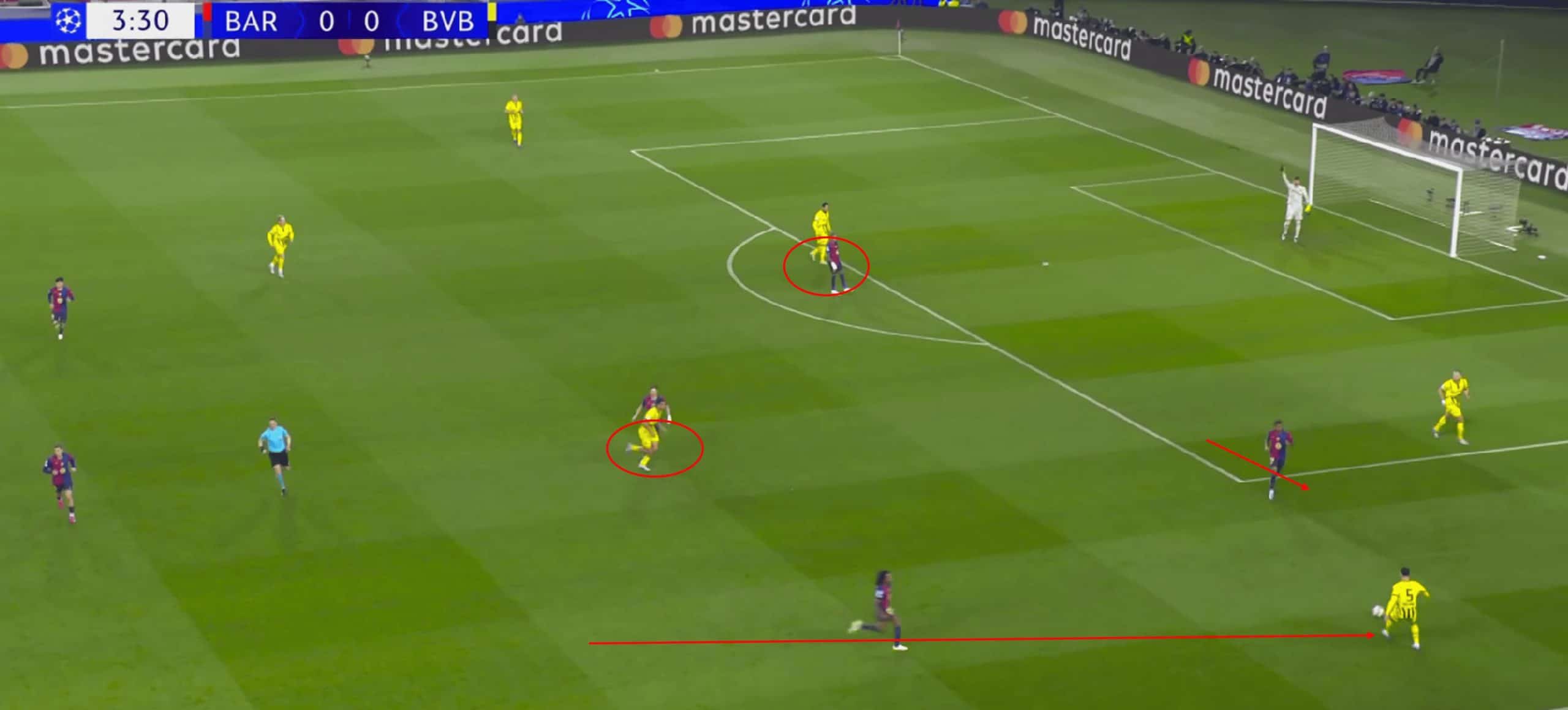
Now, Barcelona managed to force the pass to the full-back and can commit fully to the press.
The winger is cutting off play back to the inside, and the full-back now runs at the other full-back at full speed with Barca switching to a man-marking in their press from here on out.
Koundé moves forward before Bensebaini even receives the ball, and the rest of Barcelona are taking away all the passing options for the Algerian full-back, which already leaves Dortmund in a dire situation.
Bensebaini can now only pass down the line and can only play a rather mediocre pass towards Adeyemi, who already has a defender in his back and cannot control the ball at all.
Dortmund lose the ball here, and Barcelona are able to recover possession easily.
With this simple zone marking while Dortmund are building up and their two easy triggers, Flick managed to have his men stay in control even without the ball and Dortmund were never able to find solutions throughout the entire game, which cost them dearly overall, because they never were able to keep possession for long.
Only after Barcelona had already created a comfortable lead, Dortmund were able to finally get some of their own actions on the ball and tried to create chances on their own.
In the end, Barcelona had 60% of possession throughout the game, and it was even more suffocating in the first 60 minutes of play.
Creating Space
It was not like Dortmund were not trying to take some proactive actions in the game, but they just really struggled with actually executing their coach’s ideas.
For most of the game, BVB were outmatched by Barcelona on the pitch, and therefore, many of their ideas went down the drain.
While Hansi Flick’s ideas are not as radical as those of former Barcelona coaches like Pep Guardiola, the German manager still prefers possession and structures his game around the basic principles of positional play.
Dortmund tried to attack the build-up of Barcelona many times in this game, but just struggled to even get a grip on any of the Barcelona players or even the ball.
Flick’s men moved around very well and showed a lot of individual class in the passing game.
The club is obviously known for this, and they managed to keep that identity under Flick.
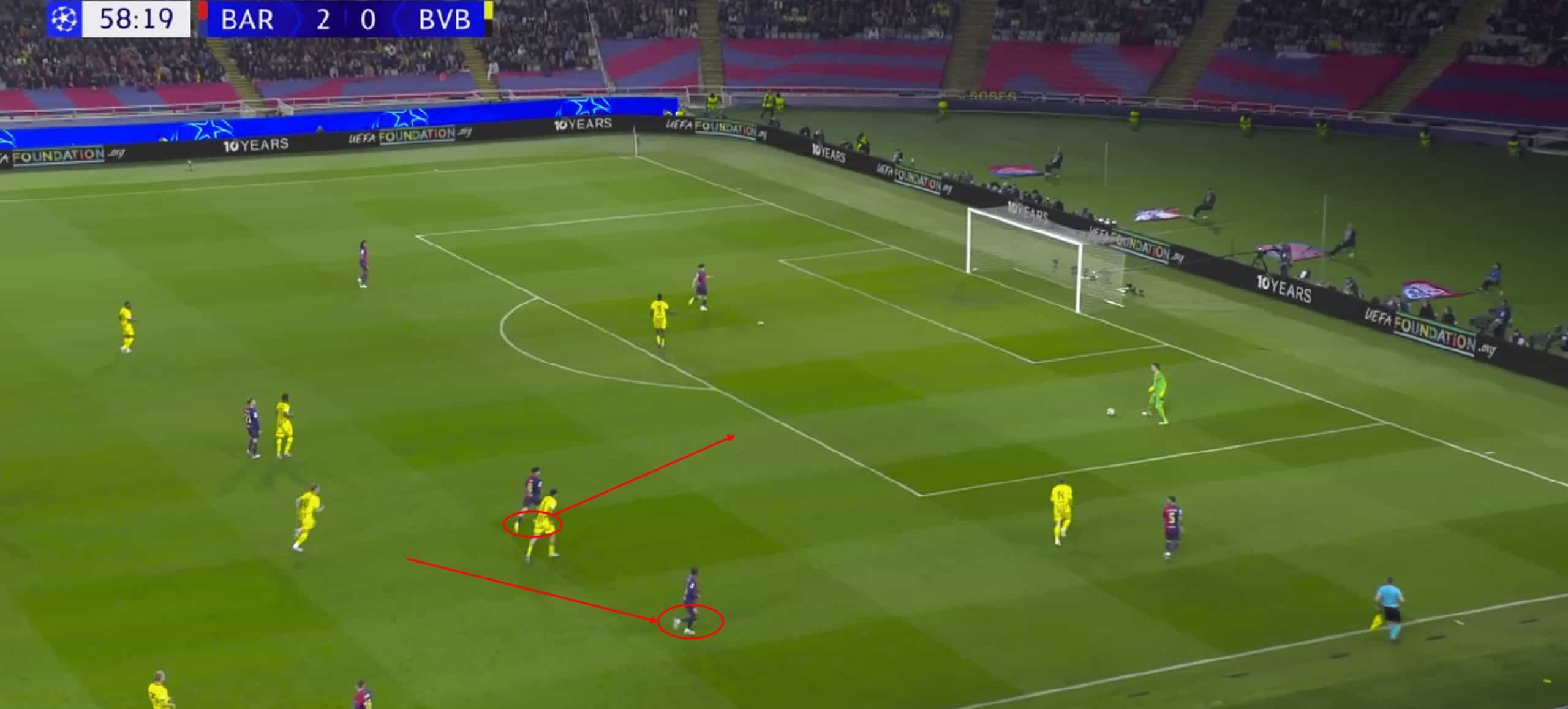
We are going to look at an example from the second half now, where we can just see how Hansi Flick and his team were able to dominate the game with simple movements.
The situation starts out with Barcelona recovering a long ball and passing it back to their goalkeeper, who now has the ball in their own box.
Dortmund is trying to press now, but if we are taking a look at it, their entire shape is not perfect here.
Alejandro Baldé, who was in a central position here, is now moving to the outside again, while Pedri, who was higher up the pitch, is now falling backwards towards the edge of their own box.
These two movements now create dissarray in the assignments for Borussia Dortmund, both Julian Brandt and Felix Nmecha are covering Pedri from here on out.
This opens up space on the left side for Baldé, and Szczesny quickly recognises the passing lane and immediately plays a pass towards his left-back.
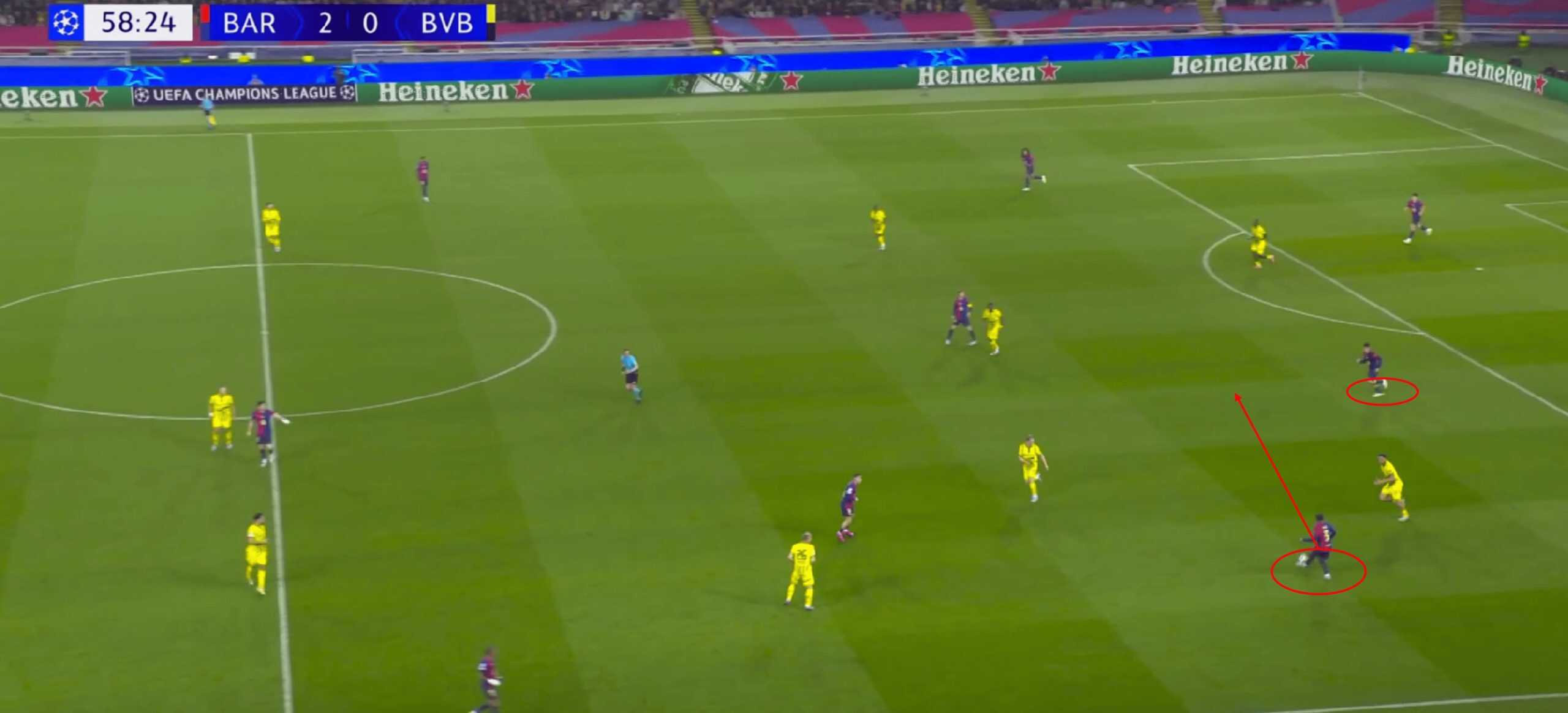
Now, Kovač’s men are on the back foot already and scramble to recover their lost position.
Both Brandt and Nmecha realize their crucial mistake and are now trying to minimize the damage done, mainly trying to prevent Baldé from passing or carrying the ball forward.
Barca now forms a diamond in their midfield, which allows Baldé to pass the ball backwards towards Pedri, who is now wide open.
This one pass takes away the entire pressure that Dortmund had.
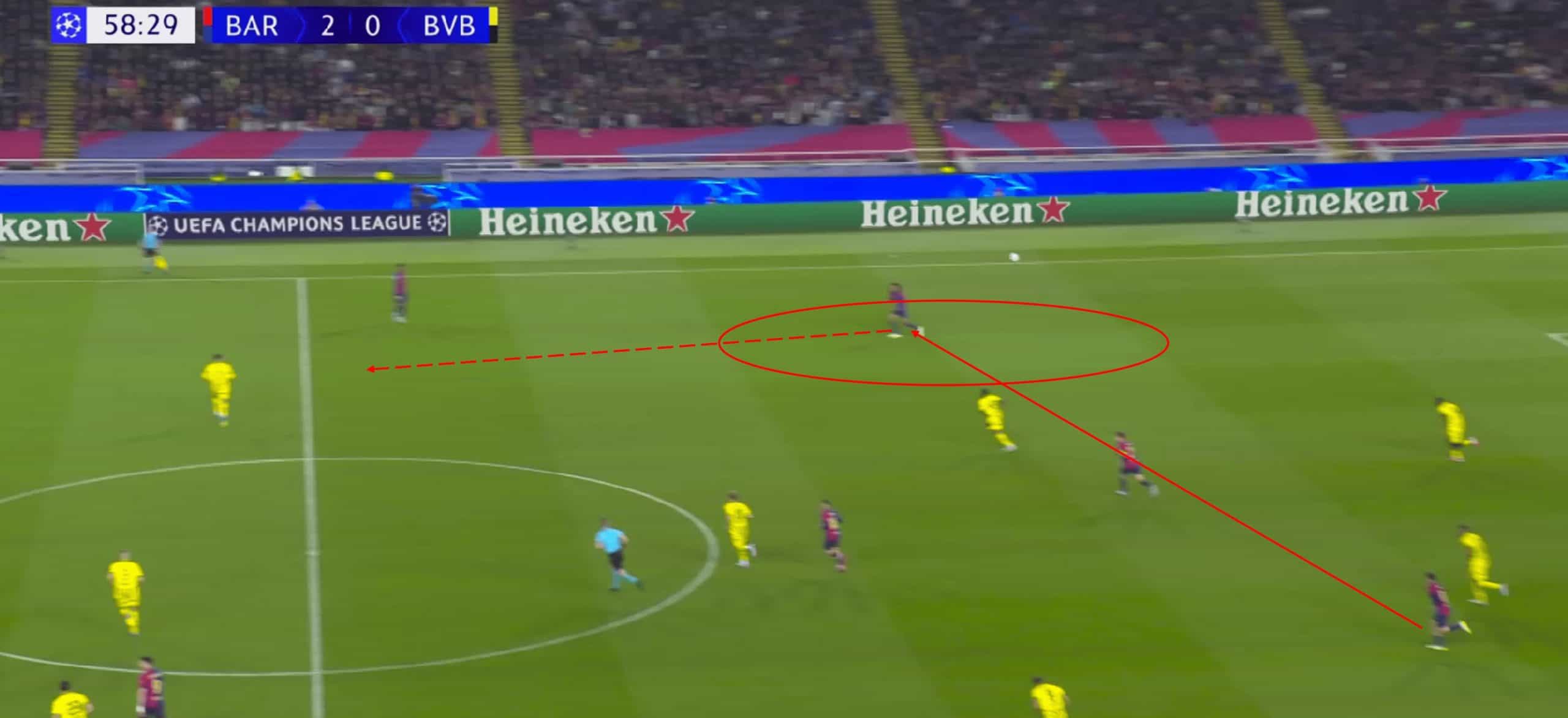
Because their first line of press got played through so easily, Dortmund had to commit more players to the left side, which now leads to Jules Koundé being wide open on the right side for Barcelona.
Pedri has enough time to control the ball and just play the switch to Koundé here, which again has Dortmund trying to recover their lost position.
Koundé is now easily able to just carry the ball into the half of Borussia Dortmund and about five Dortmund players are now behind the ball and barely able to recover.
Hansi Flick’s men were able to create space with simple movements in midfield for the entire game.
With these solutions, the team found it easy to consistently exploit Dortmund’s defenders in tough situations, which helped them create many chances and keep possession.
Exploiting Space
While Barcelona are a team that has been historically known for being excellent in possession, they also have become one of the best counterattacking teams in world football under Flick’s coaching style.
After taking the lead relatively early in the 25th minute, Dortmund was trying more and more to score a goal themselves, and it left them vulnerable to these fast-paced attacks that Barcelona is really good at this season.
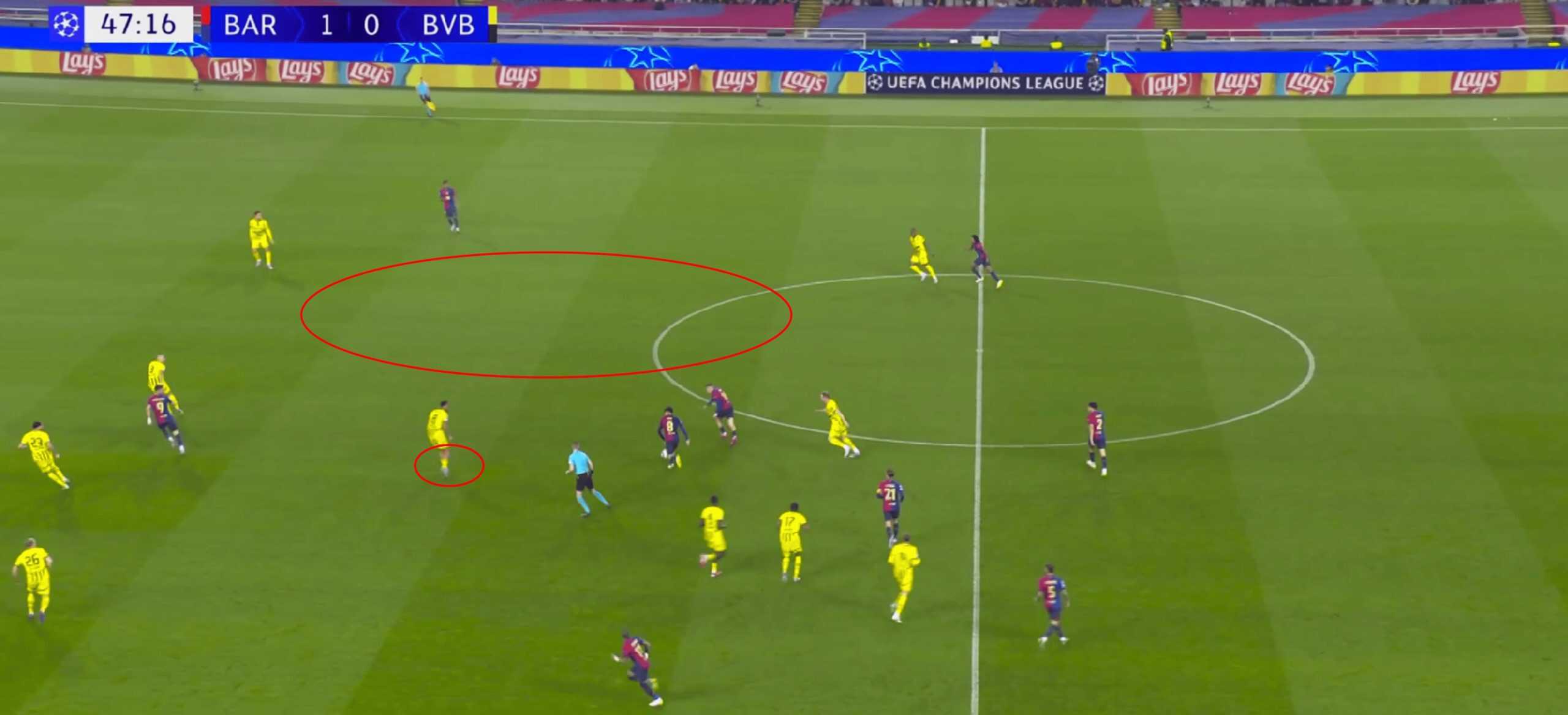
Here, we can see Dortmund losing the ball on their right-hand side with five players forward.
This now leaves Felix Nmecha alone in midfield, having to cover the entire width of the pitch, which is just impossible for one player.
Lewandowski is threatening a run behind the defensive line, forcing the two centre-backs to drop back as well, opening up the half space on the right attacking side.
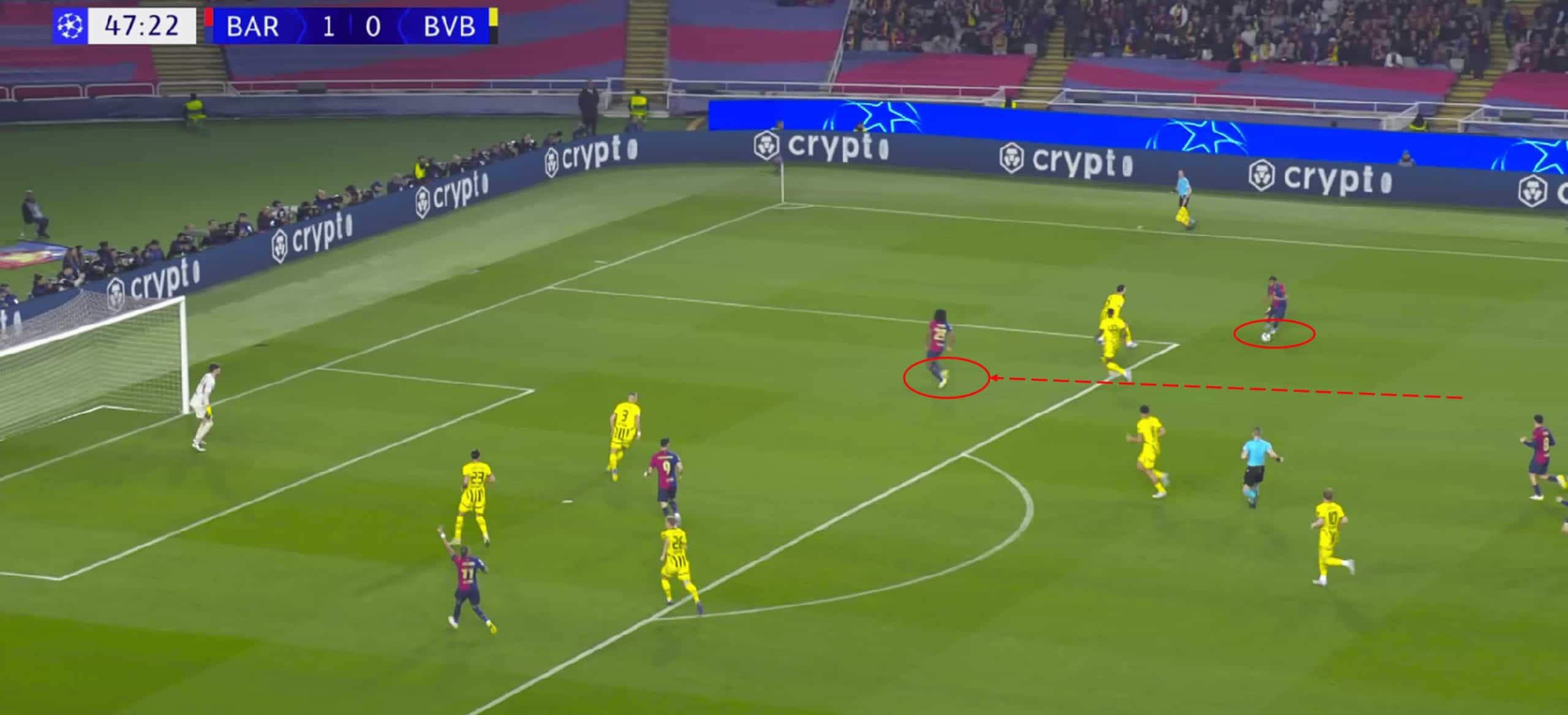
Barcelona now gets Lamine Yamal in an isolated situation against a full-back.
Dortmund now has to recover, but as Kovač said in his interview after the game, the entire team lacked the mentality to cover that distance against the ball, and it cost the team in these situations.
Dortmund now tries to double Yamal on the wing so as not to let him play out his biggest strength with his dribbling.
Jules Koundé now makes a good overlapping run into the box, forcing the Dortmund defenders to account for the pass behind themselves.
This allows Yamal to cut inside and get the ball on his strong left foot.
In the box, Lewandowski and Raphinha are now in a 1v1 situation with good leverage in the backs of their respective defenders.
Yamal now puts in a cross to the far post, Raphinha squares it, and Lewandowski doubles the lead for FC Barcelona with a header from just about half a metre out.
These counterattacks worked for FC Barcelona in the entire second half.
Dortmund was just having way too many losses in their forward movement, which Barcelona was able to exploit many times and, in the end, score four goals in the first leg.
Conclusion
In the end, we can examine the tactics all we want, but Borussia Dortmund was simply outmatched by Barcelona in every regard.
Hansi Flick had his men were well-prepared mentally, physically, and tactically.
With their classy players and good form, his team secured a decisive win and is now one and a half feet in the semi-finals of the UEFA Champions League.
For Borussia Dortmund, it was just a continuity of their struggles in the Bundesliga over the course of the entire season.
They never really got into the game, and their tactical ideas were not executed well.
After losing by one goal to a strong FC Barcelona, they did not seem to believe in themselves anymore.
Hansi Flick and his team have all the cards in their hands for the second leg and, without any significant shakeups, will probably reach the semi-finals.
