
The UEFA Champions League quarter-final first-leg clash between Paris Saint-Germain and Aston Villa was a fascinating encounter of contrasting tactical philosophies between 2 Spanish managers, Luis Enrique vs Unai Emery.
Luis Enrique’s PSG utilised a fluid and adaptable 4-3-3 setup, which was a testament to their quality.
In contrast, Unai Emery’s Aston Villa had a more risk-averse 4-2-3-1 approach, which later morphed into a 6-3-1 defensive shape out of possession.
The gulf in quality between the two teams, particularly in wide areas, was evident for viewers as PSG’s ability to exploit Villa’s defensive vulnerabilities ultimately defined the first tie with a 3-1 win for the Parisians.
This tactical analysis will unpack the tactical battle by looking into the structural dynamics of both teams, the individual matchups, and the theoretical implications of their respective approaches.
The discussion will also explore key moments that shaped the game, focusing on the pressing structures, defensive organisation, and the limitations of Aston Villa’s attacking transitions.
PSG Tactics: Fluidity Within A 4-3-3 & Central Overloads
Paris Saint-Germain’s nominal 4-3-3 formation was a foundational structure but was characterised by plenty of fluidity in execution.
One of the most notable aspects of PSG’s tactical approach was the role of Ousmane Dembélé, who frequently left his position on the wing to drop into central areas as a false nine.
This movement enabled PSG to create a 4v2 numerical superiority in central midfield, overloading Aston Villa’s midfield pairing of Boubacar Kamara and Youri Tielemans.
The execution of these central overloads relied heavily on the positional discipline and technical aptitude of PSG’s midfielders.
Fabián Ruiz, in particular, played a massive role in pinning Kamara deeper into his own half.
This positional manipulation prevented Kamara from stepping forward to press PSG’s build-up, thereby allowing the likes of Vitinha and João Neves to see more of the ball and dictate the tempo of the game.


Furthermore, Nuno Mendes‘ aggressive overlapping runs on the left stretched Villa’s defensive line horizontally.
This movement created space for Khvicha Kvaratskhelia to drift into the left half-space, where he could receive the ball in dangerous positions.
The relationship between Mendes and Kvaratskhelia was emblematic of PSG’s ability to combine positional fluidity with disciplined width.
This ensured that their attacking structure maintained depth, width, and control at all times (principles of play).
PSG Pressing Structure: From 3-2-4-1 To Aggressive Man-To-Man
One of PSG’s most glaring tactical features was their 3-2-4-1 pressing structure, which transitioned into an aggressive man-to-man press as Villa aimed to progress further up the pitch.
At the forefront of this pressing scheme was Dembélé, whose curved runs were instrumental in cutting off Villa’s passing lanes into midfield.
As seen in the image below, Dembélé’s run forced Villa’s defenders to either play sideways or attempt risky vertical passes, both of which PSG were well-prepared to counter.
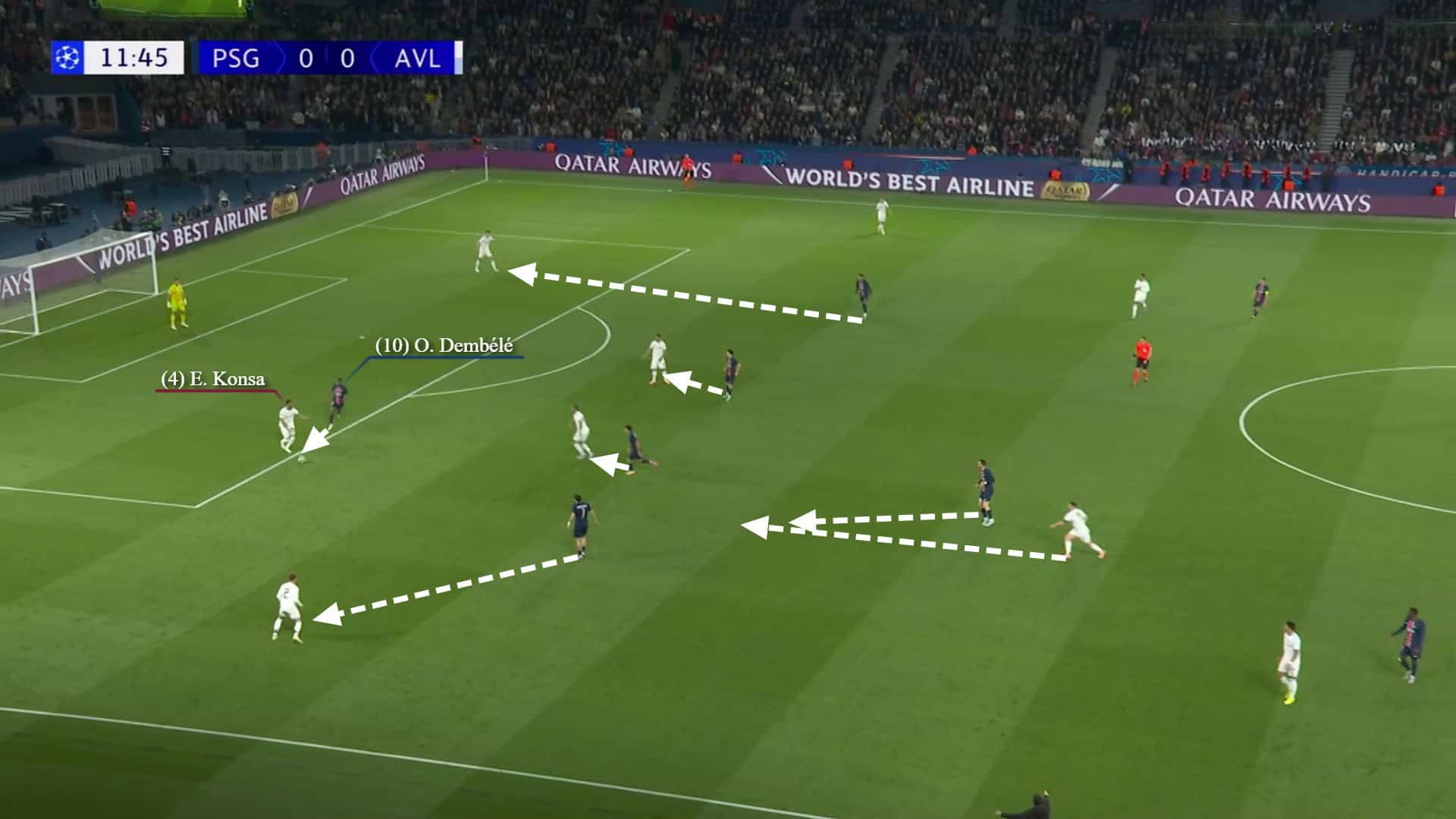
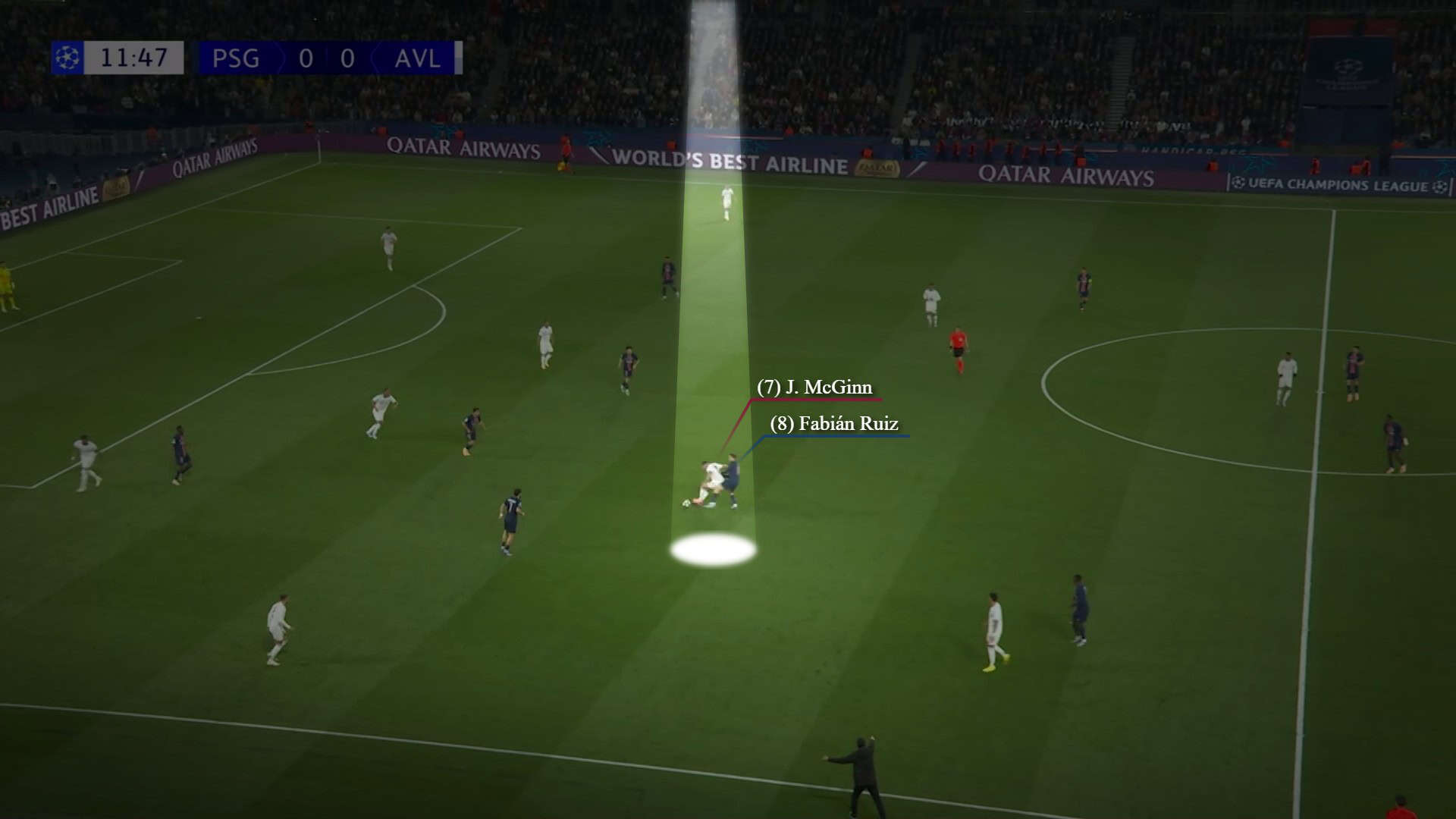
Dembélé initiates the man-to-man press with a curved run, cutting off Villa’s passing options and triggering PSG’s coordinated pressing scheme.
We can see that the PSG players all have a duty to one player (see Ruiz to John McGinn).
This pressing structure relied on coordination among the entire PSG squad.
The midfield duo of Neves and Ruiz acted as the first line of support, closing down passing options into Villa’s central midfielders.
Meanwhile, the back three maintained a high defensive line, so Villa’s long balls were met with immediate resistance.
This suffocating press disrupted Villa’s build-up and forced them into hurried clearances, often leading to turnovers in dangerous areas.
Aston Villa’s 6-3-1 Shape: A Risk-Averse Approach To Limiting PSG
Aston Villa’s out-of-possession setup was cautious as well as pragmatic.
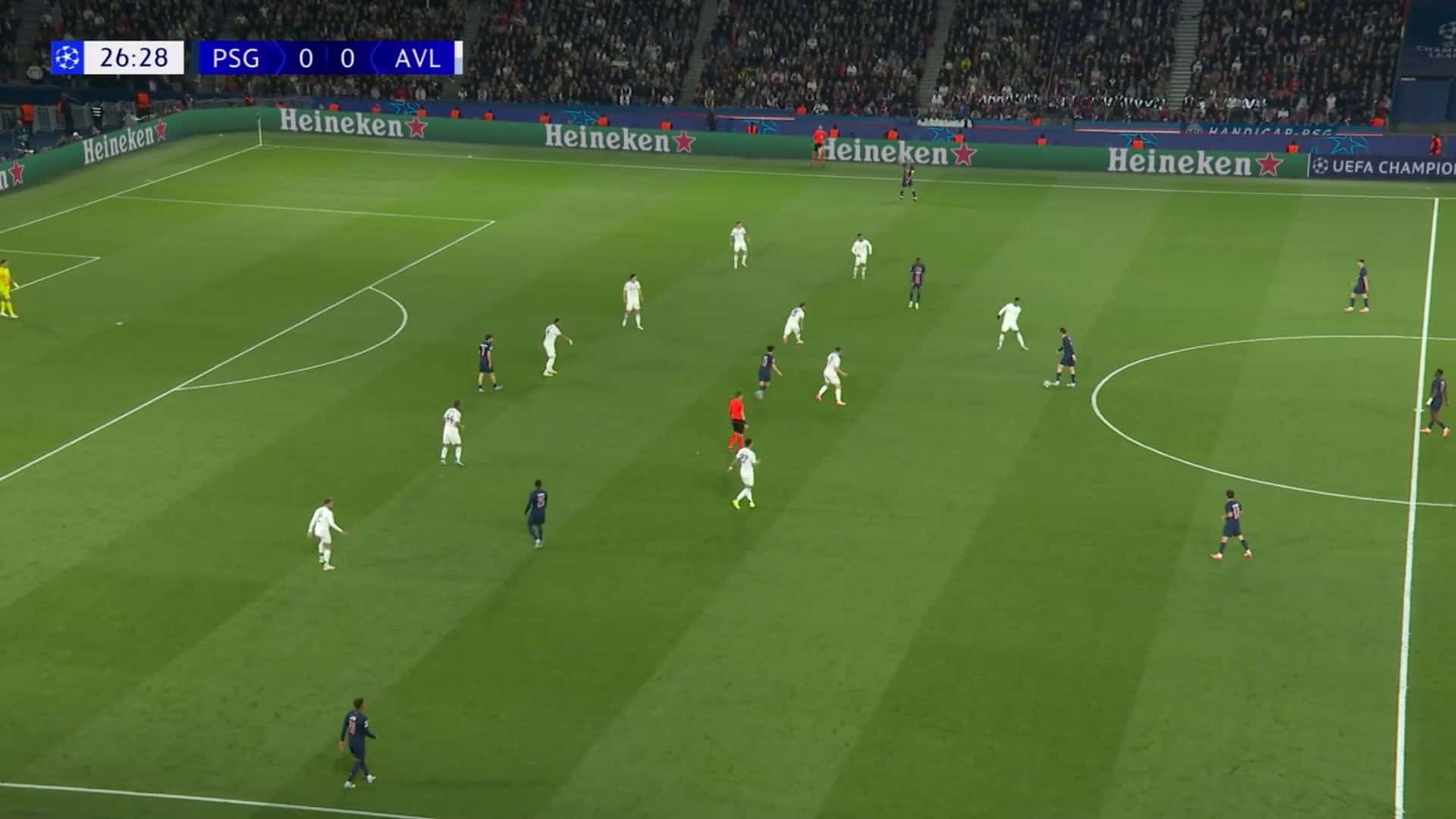
The team transitioned into a 6-3-1 defensive shape, with their wide midfielders retreating to form a compact back six.
This structure was designed to neutralise PSG’s wide threats, particularly the dynamic link-up between Nunes, Kvaratskhelia, Achraf Hakimi, and Désiré Doué.
By committing additional bodies to the wide areas, Unai Emery’s tactics sought to double up on PSG’s wingers and prevent them from creating overloads in wide areas.
However, while this approach did somewhat limit PSG’s ability to penetrate through the wings, but it also exposed Villa’s defensive frailties.
The lack of quality in their right-back position, where Matty Cash and Axel Disasi struggled to cope with PSG’s rotations, proved a weakness.
Advantages & Limitations Of The 6-3-1 Shape
The 6-3-1 defensive shape is a highly compact formation that has several theoretical advantages.
It provides excellent coverage in wide areas, as the additional defenders allow for doubling up against overlapping full-backs and wingers.
Secondly, three central midfielders offer protection against late runs into the box, ensuring that the defensive line is not overwhelmed.
However, one of the biggest drawbacks is its inherent passivity.
By committing so many players to defensive duties, the team sacrifices its ability to transition quickly into attack.
This is particularly problematic when the lone forward is isolated, as was the case with Marcus Rashford in this match.
Furthermore, the compact nature of the shape makes it susceptible to switches of play.
PSG exploited this weakness by constantly shifting the ball across the pitch, forcing Villa’s defenders to constantly adjust their positioning.
Aston Villa’s Struggles In Build-Up & The McGinn-Rogers Positioning Conundrum
One of Unai Emery’s most intriguing tactical decisions was the role of John McGinn and Morgan Rogers in Villa’s midfield.
In this game, McGinn was the furthest of the midfield three but was also tasked with assuming deeper build-up responsibilities, a role that seemed not to match his skill set.
Whereas, Rogers played as the right winger.
While McGinn is an excellent ball-winner, his ability to evade pressure and progress the ball is limited compared to Rogers, who is far more comfortable in possession.
As a result of this tactical adjustment, Villa’s build-up play was often slow and predictable.
McGinn’s inability to resist PSG’s aggressive pressing structure led to turnovers or backward passes, thereby stifling Villa’s ability to progress through the thirds.
A more progressive and riskier approach might have been to drop Rogers deeper or more of a central role, where his composure and press resistance could have alleviated the pressure on Villa’s backline.
The Absence Of A Physical Outlet Up Top
Aston Villa’s inability to have a physical presence up top was an obvious tactical limitation that affected their ability to bypass PSG’s aggressive press.
The absence of a target man or even a forward capable of holding up the ball, left Villa unable to relieve defensive pressure and transition into attacking phases.
Villa’s failure to provide an outlet directly contradicted many attacking principles.
One of the most critical principles in breaking a high press is the ability to penetrate vertically either through direct passes into advanced positions or by bypassing the press altogether with long balls to a striker capable of holding possession.
Villa’s attempts at direct play were ineffective without a physical forward to contest aerial duels or shield the ball against PSG’s defenders.
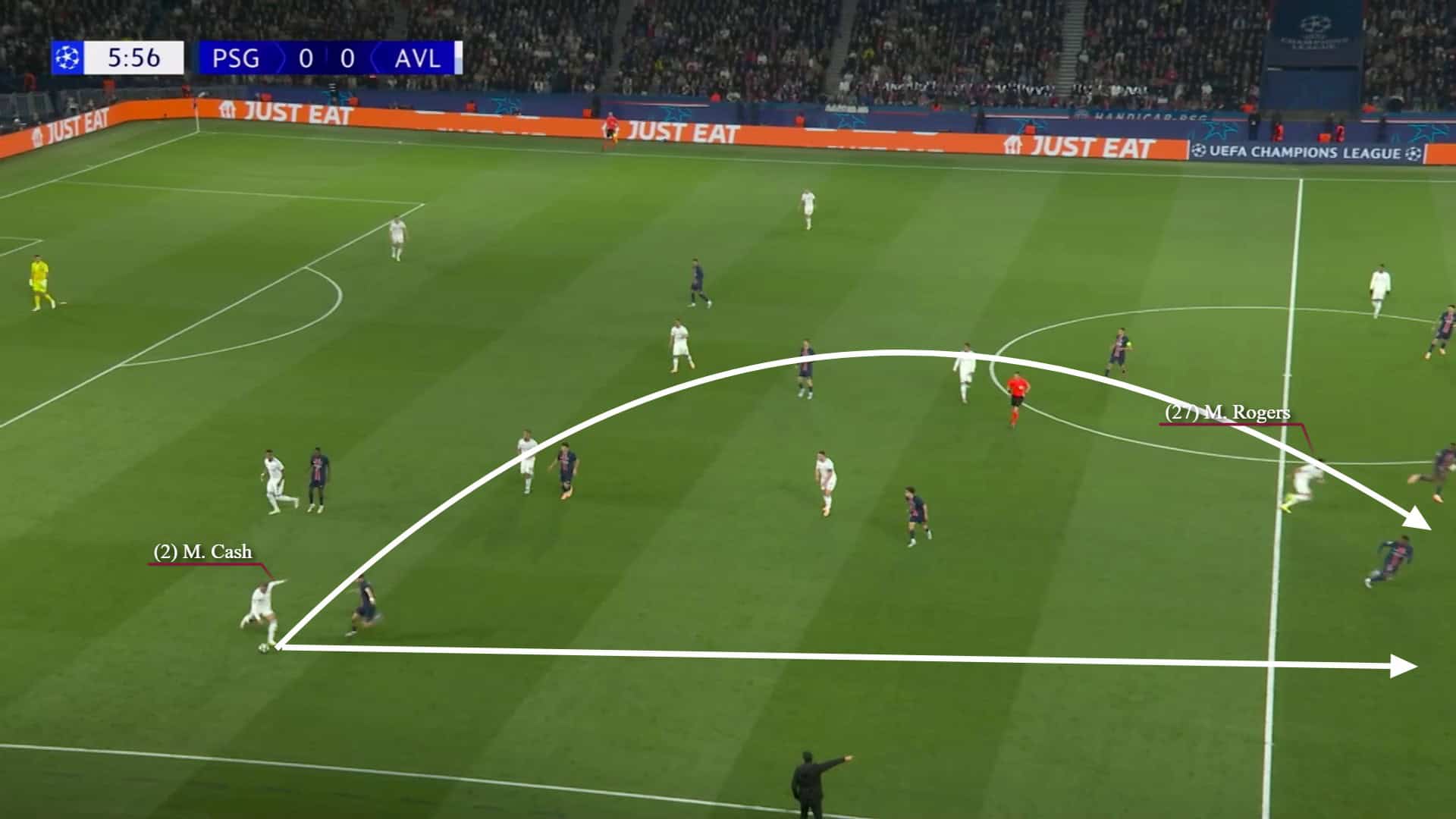
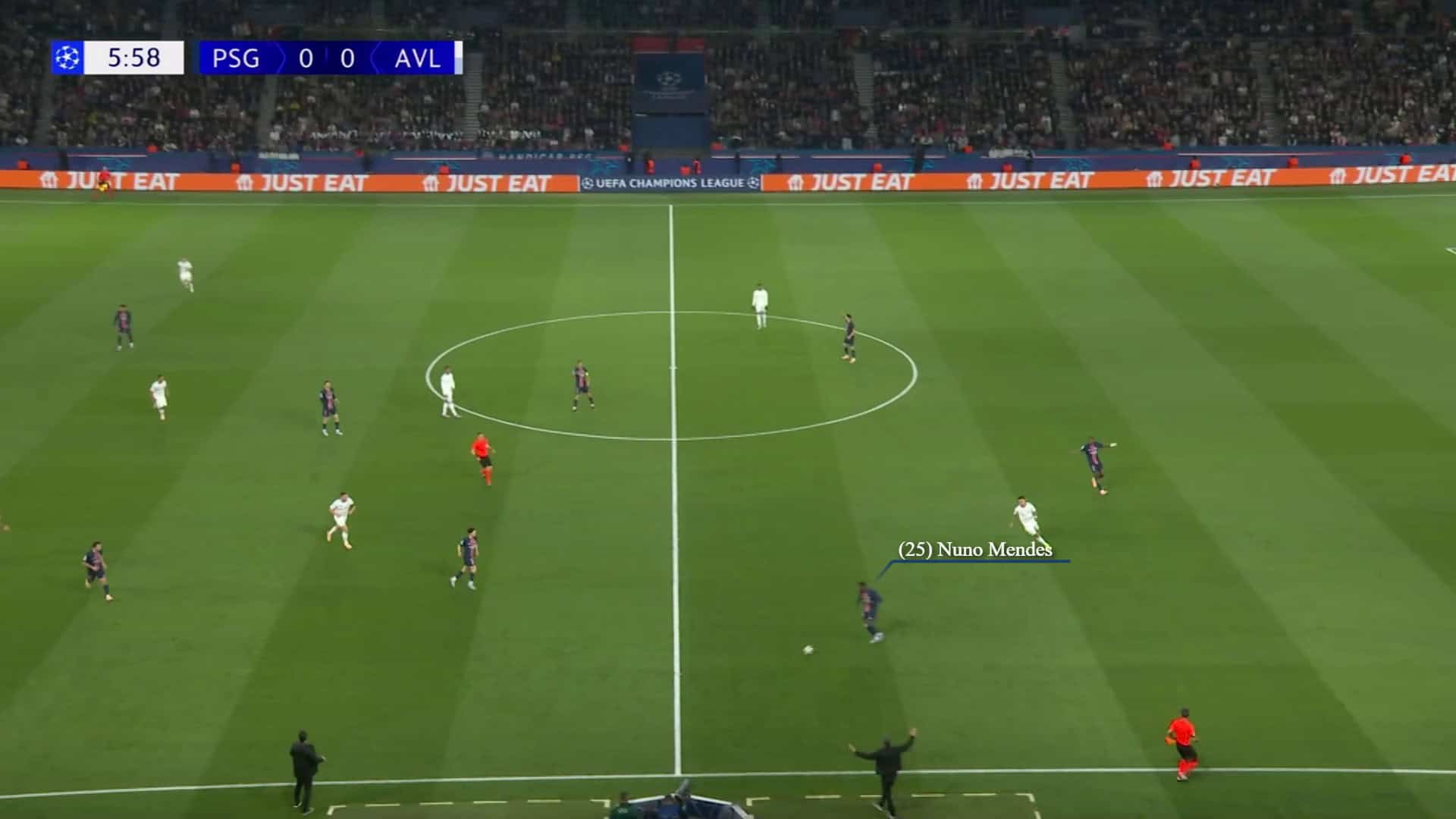
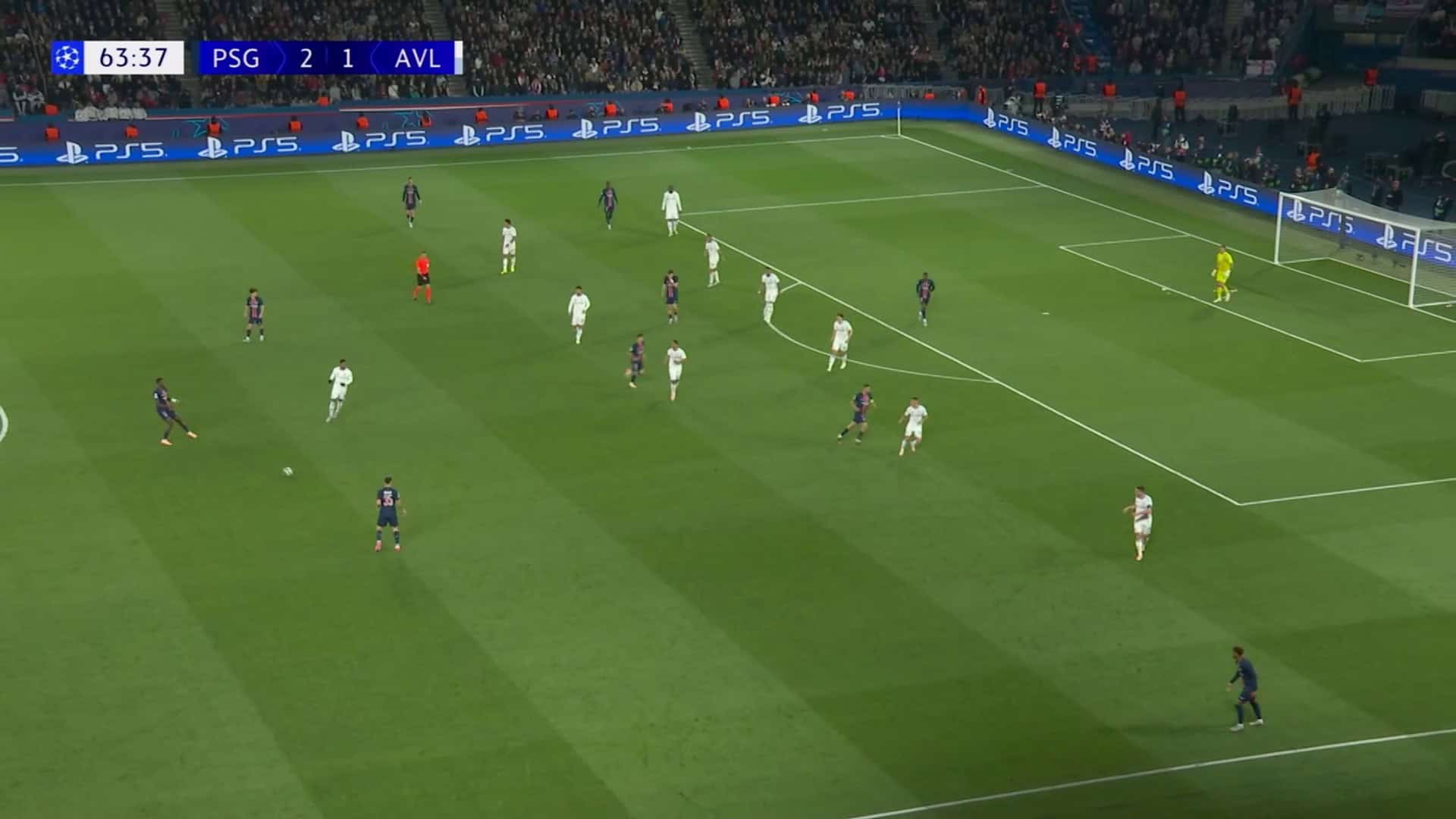
In this scenario, Aston Villa progressed the ball into an advanced wide area, with Matty Cash positioned on the right.
However, the play broke down due to the lack of an effective forward run into the channel.
Rogers, tasked with making the run, was unable to execute the movement with the precision required to exploit the space behind PSG’s defensive line.
He is not a natural forward, lacking the instincts and technical ability to curve or angle his run.
His movement was too linear and predictable, allowing Mendes to easily step forward and intercept the pass.
A player like Ollie Watkins would have been far more dangerous in this situation.
Watkins possesses the natural instincts of a striker and can angle his runs diagonally into dangerous spaces.
Unlike Rogers, Watkins would have understood the importance of delaying his movement slightly to time his run with the delivery of the ball, so that he can arrive in the channel at the optimal moment to receive possession.
Additionally, Watkins’ ability to curve his runs off the shoulder of the defender would have created uncertainty for Mendes, forcing him to decide whether to hold his position or track the forward.
A player like Watkins, who understands the nuances of forward runs, would have been far more threatening in turning this promising attacking situation into a goal-scoring opportunity.
Theoretical Note: The Role Of A Target Man in Press Resistance
In modern tactical theory, the use of a target man is a mechanism for teams aiming to bypass high-pressing opponents.
The target man’s role is not merely about physicality but encompasses many functions that contribute to the team’s overall attacking structure:
- Winning Aerial Duels: Aerial dominance allows a team to bypass the opponent’s press by exploiting the vertical space behind the pressing players; this forces the opposition to drop deeper, reducing their pressing intensity.
- Holding Up Play: A target man can act as a fulcrum, securing possession under pressure and allowing teammates to advance into attacking positions; this is useful against teams like PSG, who commit numbers forward during their press.
- Drawing Fouls to Break Momentum: A well-positioned target man can attract fouls from aggressive defenders, disrupting the opposition’s rhythm.
- Second-Ball Opportunities: A target man can create second-ball situations by flicking on aerial passes or battling for loose balls and midfield runners to exploit spaces vacated by pressing opponents.
Villa’s failure to start a player like Ollie Watkins prevented them from executing these principles, allowing PSG to press with impunity.
This tactical imbalance played directly into PSG’s hands, as their defenders were rarely forced to retreat or reorganise.
Tactical Implications For Villa’s Build-Up Play
The absence of a physical outlet also had a ripple effect on Villa’s ability to progress through the thirds.
With their lone forward isolated, Villa’s midfield was forced to drop deeper to receive the ball, further limiting their ability to transition into the attacking phase.
This tactical issue was most evident when Villa attempted to stretch the pitch horizontally during build-up.
Although this approach initially appeared to create space against PSG’s man-to-man press, there was a lack of vertical options.
From a transition theory perspective, Villa’s inability to establish a vertical threat meant that any turnovers in their defensive half were immediately capitalised upon by PSG, who could counter-press aggressively without the fear of being exposed in behind.
The absence of a long-ball outlet disrupted Villa’s ability to enact defensive-to-offensive transitions – an essential component for teams sitting in a low-block or mid-block.
Conclusion
In conclusion, the first leg of this Champions League tie highlighted the tactical gulf between Paris Saint-Germain and Aston Villa on the day.
It is lining up to be an exciting second leg at Villa Park.
Aston Villa must abandon their risk-averse approach and play with greater freedom as soon as possible.
The home advantage, combined with the need to overturn a two-goal deficit, should encourage Villa to let loose.
By integrating players like Ollie Watkins, who can provide a focal point up front and commit more numbers forward, Villa can create the vertical penetration and dynamism required to unsettle PSG’s defence.
Villa could pose a far greater challenge in the return leg, but they must embrace a bolder identity to have any chance of progressing.
