
Borussia Dortmund, a club with a rich footballing tradition, has been under scrutiny this season.
Despite being undefeated in the Bundesliga, the team’s performance has been questioned, particularly in their encounters with less-favoured opponents.
Matches against Heidenheim and Bochum yielded a solitary point each, raising questions about the team’s consistency.
Their struggles continue in the UEFA Champions League, with Dortmund yet to find the back of the net.
The loss of key players like Jude Bellingham and Raphaël Guerreiro left significant voids in the squad, and it was always a challenge for the team to replicate the scintillating form they displayed in the latter half of the previous season.
It’s clear that foundational issues are affecting the squad’s overall performance in various phases of the game.
In this forthcoming tactical analysis, we will delve deeper into Edin Terzić’s formations and style of play complexities.
We will focus on build-up play, chance creation, and defensive structure to uncover the reasons behind their mixed results this season.
Let’s examine the intricacies of the issues plaguing this talented team in this analysis and understand what steps might be needed to get them back on the path to success.
Dortmund Early Struggles: Build-up Play
Despite often dominating possession with an average of 61.4% per game, Borussia Dortmund has been grappling with significant issues in their build-up play this season.
While their possession statistics are impressive, ranking second only to FC Bayern‘s 63.3%, the nature of their possession is uninspiring.
The team has frequently showcased a lack of incisiveness in their play.
They tend to pass the ball back and forth between the flanks without posing a genuine threat to their opponents.
In essence, it appears as though Dortmund has almost abandoned a possession-based build-up strategy.
Their approach sometimes lacks the drive and determination required during the build-up phase, which raises questions about their work ethic and commitment to breaking down their opposition.
This lack of dynamism in their possession play has been a notable source of concern for the club this season.
Borussia Dortmund’s issues with build-up play persist, and they often appear uncertain about how to advance the ball into the opponent’s half.
It’s challenging to believe that Edin Terzić and his analysis team devised a strategy centred around forcing long passes to the wing-backs.
In reality, Dortmund plays the most long passes from the top teams in the Bundesliga.
On average, they execute 41.68 long passes per 90 minutes, surpassing teams like Stuttgart (40.27), Leipzig (36.52), FC Bayern (30), and Leverkusen (25.99) by far.

This heavy reliance on long passes is quite unusual for a possession-based side like Dortmund.
It highlights their struggles in executing a more refined build-up play.
In comparison, even clubs such as Wolfsburg, Heidenheim, Köln, and Augsburg play fewer long passes.
The statistics underline Dortmund’s need for a more well-rounded and effective strategy in their build-up play rather than a heavy dependence on long passes to resolve their issues.
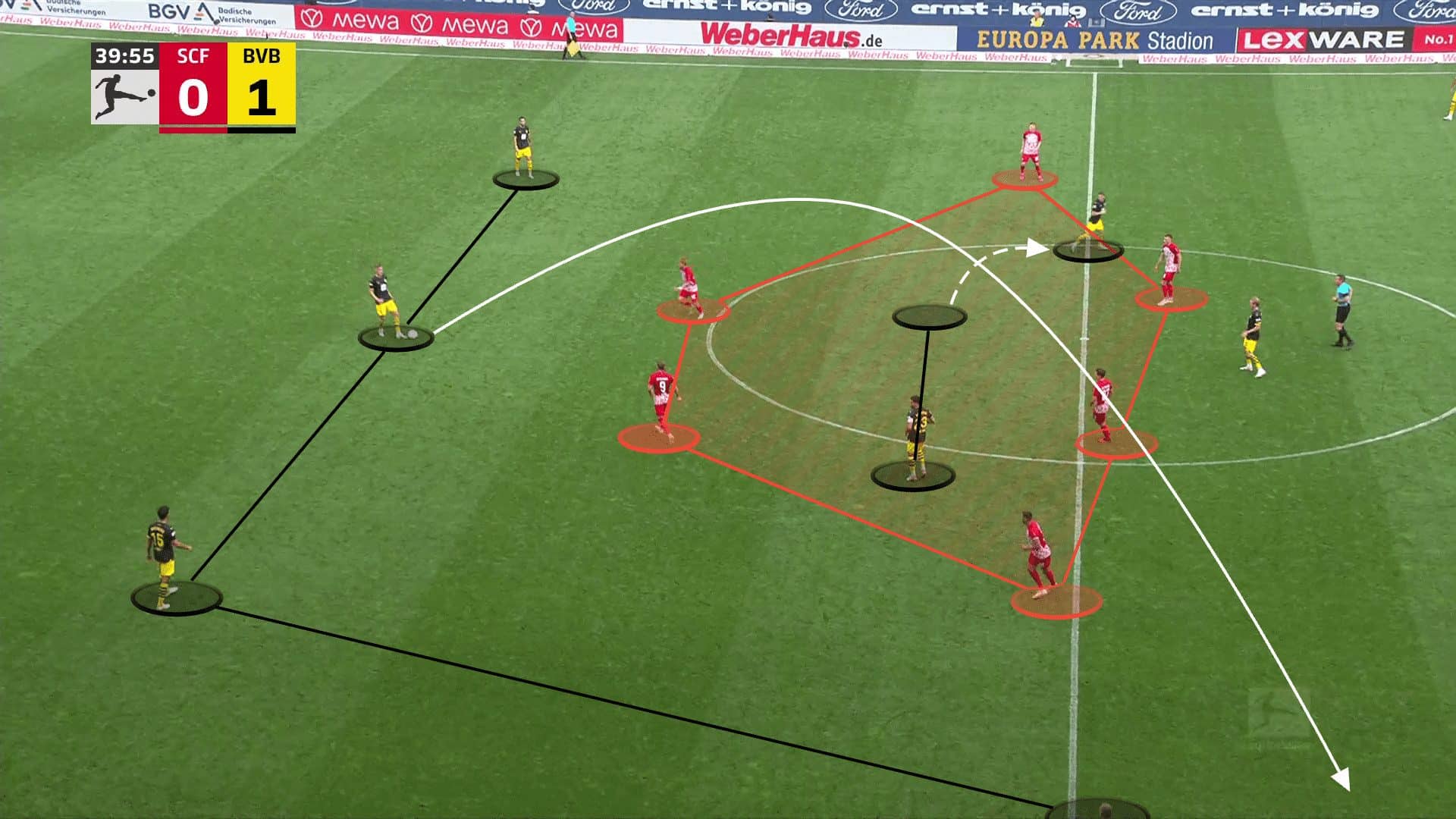
Borussia Dortmund’s struggles in build-up play can be attributed to a combination of factors.
Their domestic opponents have displayed cleverly structured pressing schemes, effectively putting pressure on Dortmund’s centre-backs and midfielders.
Following the departures of Jude Bellingham and Raphaël Guerreiro during the summer, Dortmund found it challenging to assemble a midfield that excels in ball retention and outperforms its opponents, particularly against defensively-minded teams.
The new arrivals, Marcel Sabitzer and Felix Nmecha have yet to prove they possess the creativity to outmaneuver opponents.
Emre Can, who was made captain, has not demonstrated the exceptional form he displayed in the second half of the previous season.
The idea of playing short passes and building up through the middle seems reasonable, but the problem lies in the lack of cohesion between Can, Sabitzer, and Brandt.
They struggle with off-the-ball movement to provide additional passing options, which hampers the build-up play.
For example, Sabitzer’s limited passing options often result in losing possession, as the other players don’t provide alternative outlets.
Dortmund’s passing abilities have been a significant issue, with the team losing possession an average of 98.18 times per 90 minutes, even more frequently than their opponents.
These factors combine to create the current struggles in Dortmund’s build-up play.
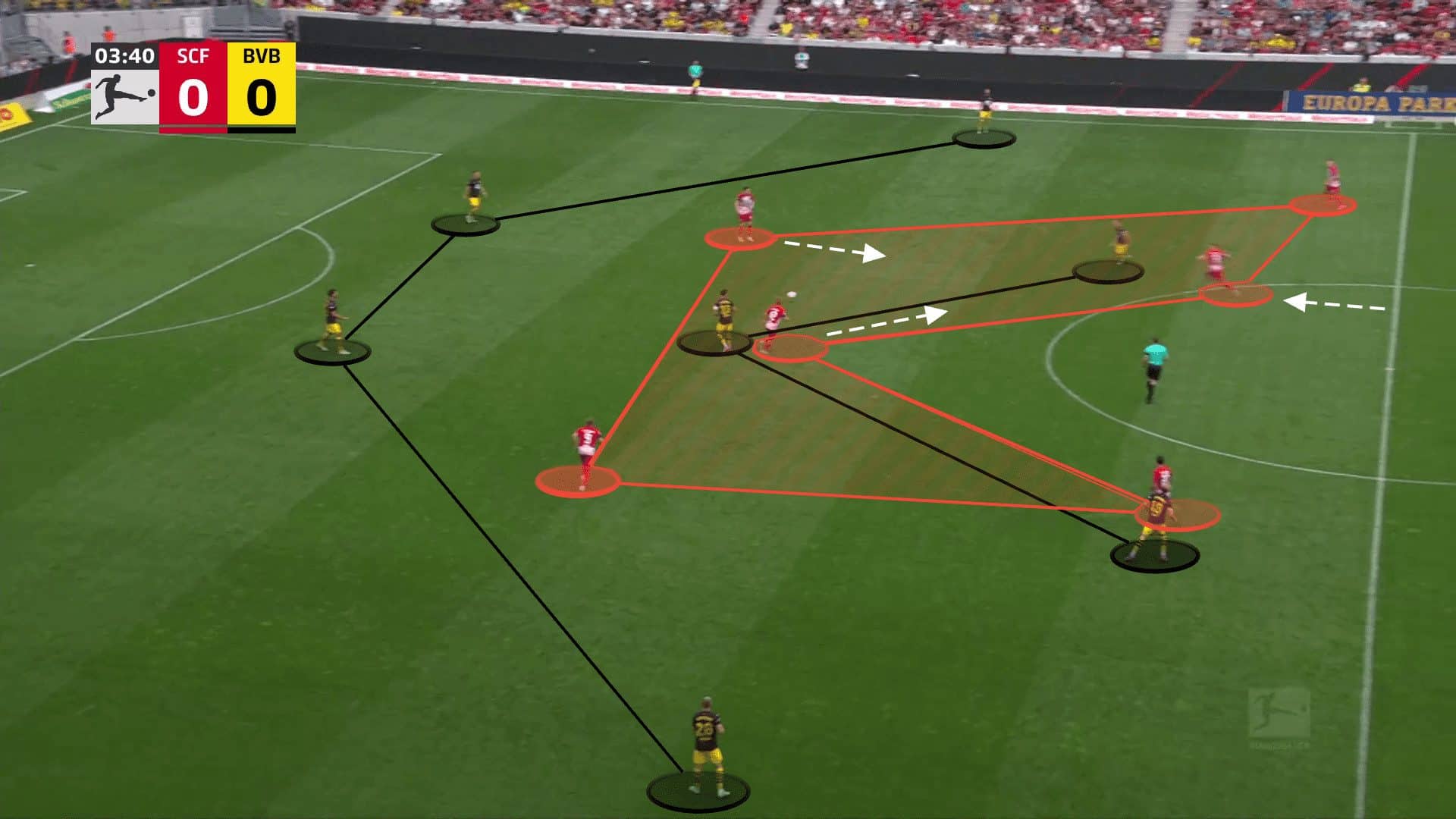
Coach Edin Terzić made a tactical switch in Borussia Dortmund’s home game against Wolfsburg to address their struggles in build-up play.
Departing from the customary 4-2-3-1 formation, he opted for a 3-4-2-1 setup and left Emre Can out of the starting lineup in favour of Salih Özcan.
This change allowed Dortmund to move the ball more fluidly, particularly in the first half, when facing a deep-sitting Wolfsburg side.

The move showcased one of the better sequences of BVB’s build-up play against Wolfsburg.
Several factors contributed to its success.
Firstly, Özcan wasn’t man-marked, allowing him to find spaces behind the pressing centre-forwards.
Secondly, Füllkrug exhibited higher activity off the ball than expected, which enhanced the build-up options.
Lastly, there was a pinpoint switch from Felix Nmecha and a more direct approach from Ryerson.
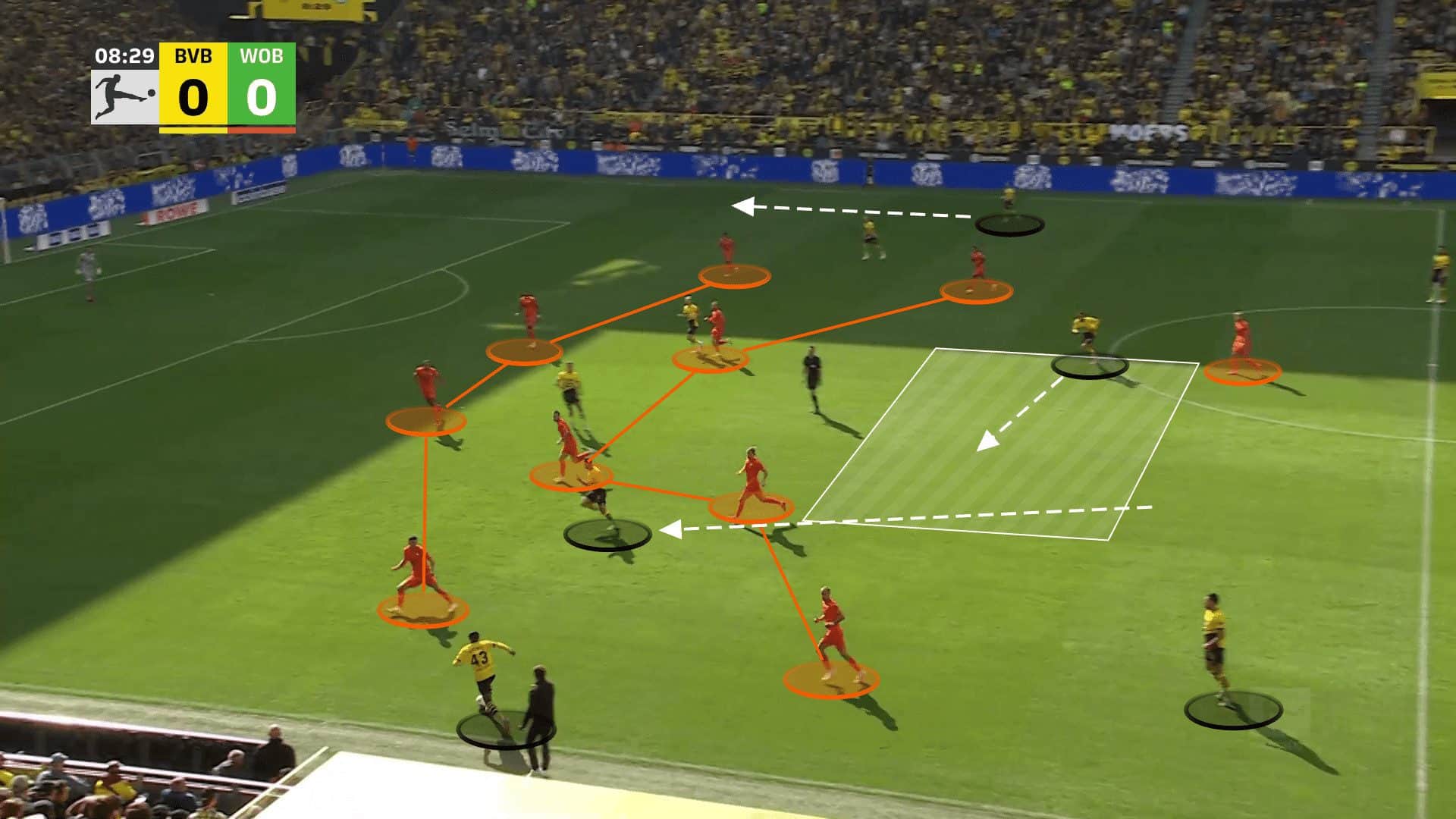
This tactical adjustment demonstrated the potential for improved build-up play.
Still, it remains to be seen whether Dortmund will continue experimenting with such changes or revert to their familiar 4-2-3-1 formation.
These strategies’ effectiveness could significantly impact Dortmund’s performance, especially against teams that employ deep-lying defensive tactics.
Dortmund Early Struggles: Defense Tactics
Borussia Dortmund have been grappling with systemic issues in their defensive phases this season.
Even if individual mistakes occur too often despite numerical superiority, these problems extend beyond individual players and are deeply rooted in the team’s overall defensive structure.
In particular, key players’ lack of defensive effort and engagement has been a significant concern.
In specific instances, Dortmund’s defending struggles aren’t limited to a single player or a one-off situation.
Instead, it appears to be a recurring problem ingrained within the team’s defensive approach.
This has been apparent when key players fail to demonstrate the necessary determination to regain possession.
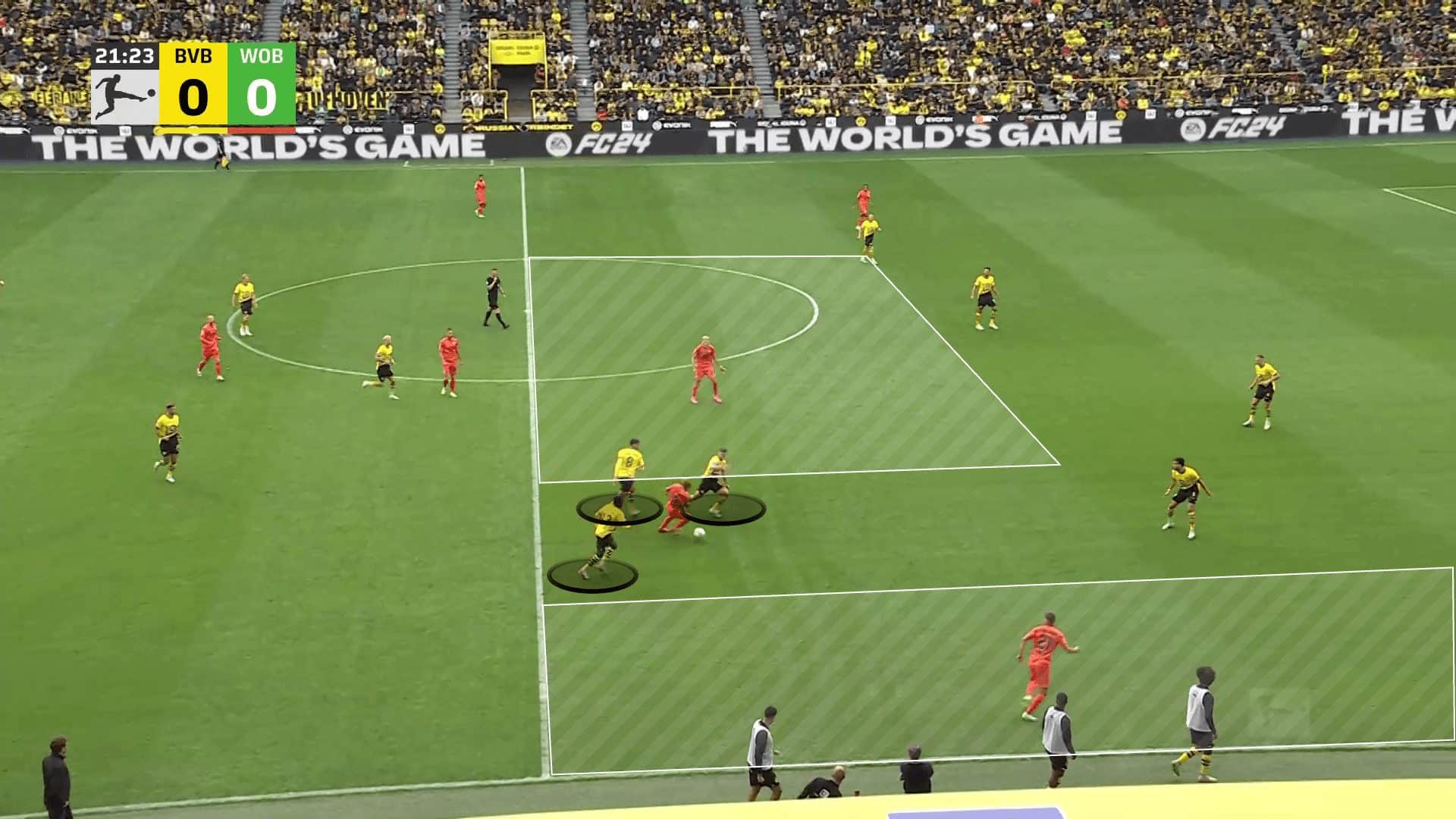
One such example includes Felix Nmecha’s apparent struggles in defensive phases.
However, it’s essential to recognize that Nmecha is not the sole contributor to these issues.
The lack of defensive commitment extends to other influential players as well.
Marco Reus, a seasoned team member, has been criticized for not being actively involved in defensive phases.
This passive approach can be detrimental, as defensive contributions from key attacking players are crucial to maintaining a balanced team.
Reus showed another attitude in the match against Union Berlin, fighting for the ball – an excellent first reaction.

But, one notable positive aspect of Borussia Dortmund’s play is their defensive transition.
In this phase, the team demonstrates several commendable attributes that enhance their overall performance.
Dortmund boasts the highest challenge intensity (6.8) in the Bundesliga, which signifies its commitment and determination when pressing opponents.
They relentlessly pursue the ball and don’t shy away from challenges.
Moreover, the team maintains a low PPDA (Passes Allowed Per Defensive Action) of 8.65, which indicates their effectiveness in restricting the opponent’s ability to build up play.
This implies that Dortmund doesn’t afford their rivals much time or space to execute their moves.
Borussia Dortmund High Regains – Bundesliga 2023/24
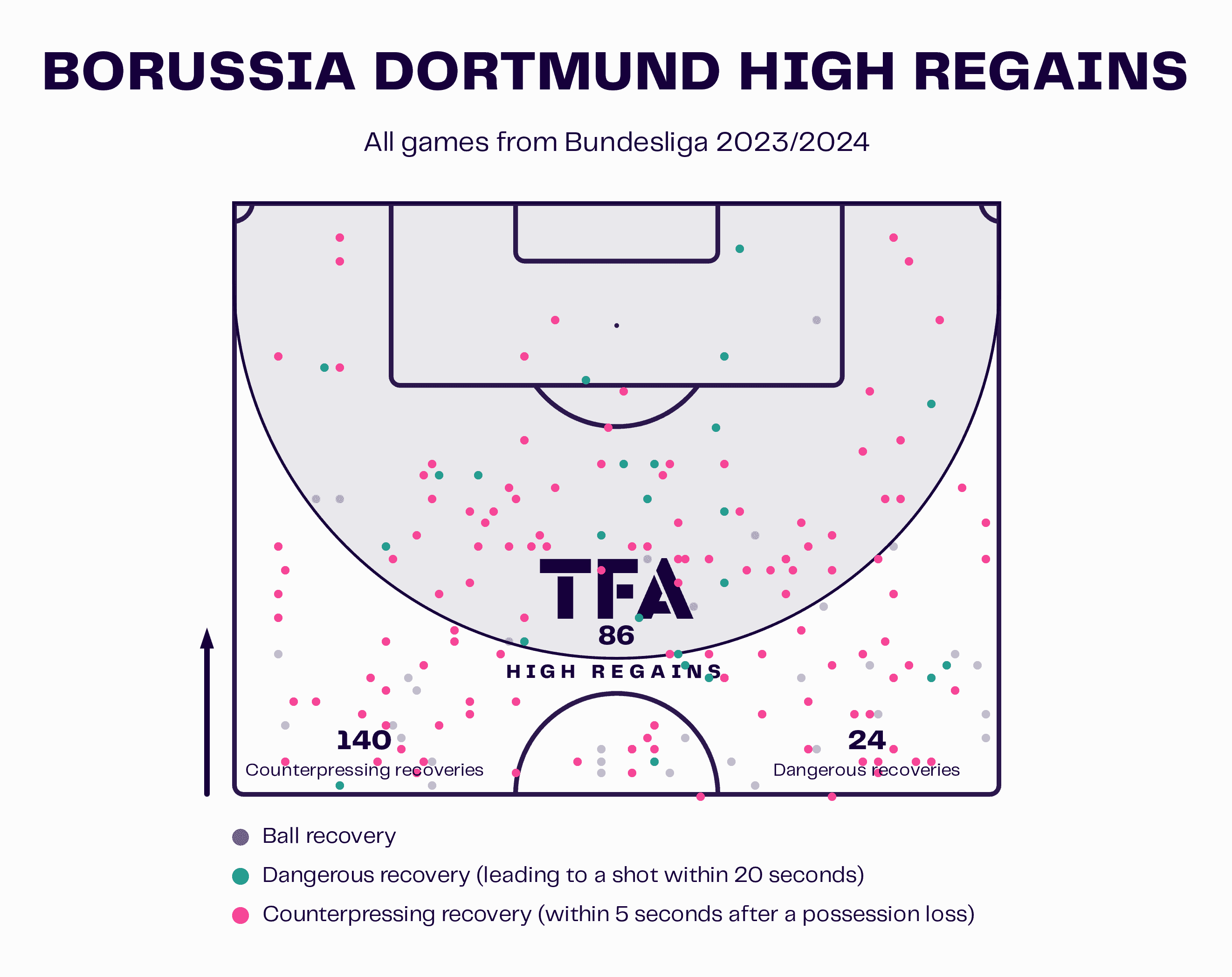
When Dortmund’s pressing game is firing on all cylinders, it often results in a more robust and successful overall performance.
This success can be attributed, in part, to players like Füllkrug, Reus, and Brandt, who actively contribute to the high-intensity pressing.

However, Dortmund must consistently maintain this high level of intensity, as they tend to encounter difficulties when their defensive transition isn’t as effective as desired.
In such situations, they can become vulnerable, and their performance may suffer.
Hence, maintaining the same high level of challenge intensity and effective pressing is vital for Dortmund’s overall success.
Dortmund Early Struggles: Chance Creation
Edin Terzić has been keen to address Borussia Dortmund’s struggles in the finishing department, focusing on the team’s inability to convert opportunities.
He has pointed out scenarios where either the ball is delivered into the box, but there’s no one there to capitalize, or they have players in the box but fail to provide the correct delivery.
This issue came to the forefront in their recent match against Milan.
Terzić acknowledged that they had numerous high-field turnovers but failed to convert them into tangible outcomes, deeming it insufficient.
Borussia Dortmund Crossing Zones – Bundesliga 2023/24
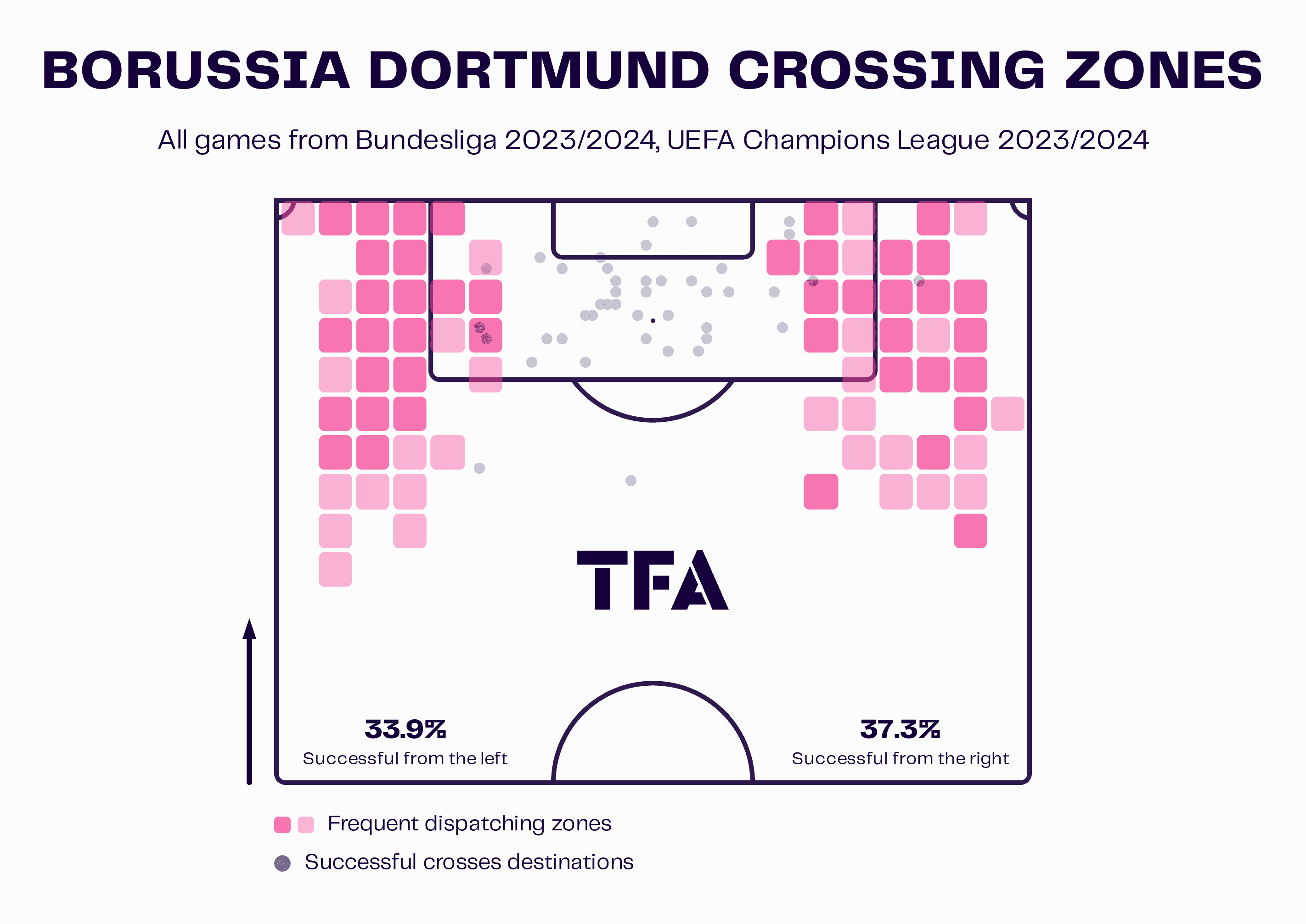
However, the numbers don’t entirely support the notion that Dortmund can’t finish.
They’ve scored 16 goals in seven league games, and the expected goals (xG) value of 14.94 indicates that Dortmund have not been particularly inefficient in front of the goal.
The problem seems to lie more in the team’s ability to create high-quality chances.
Dortmund averages just 4.47 shots on target per 90 minutes, ranking them seventh in the league in this metric.
Borussia Dortmund Shots – Bundesliga 2023/24
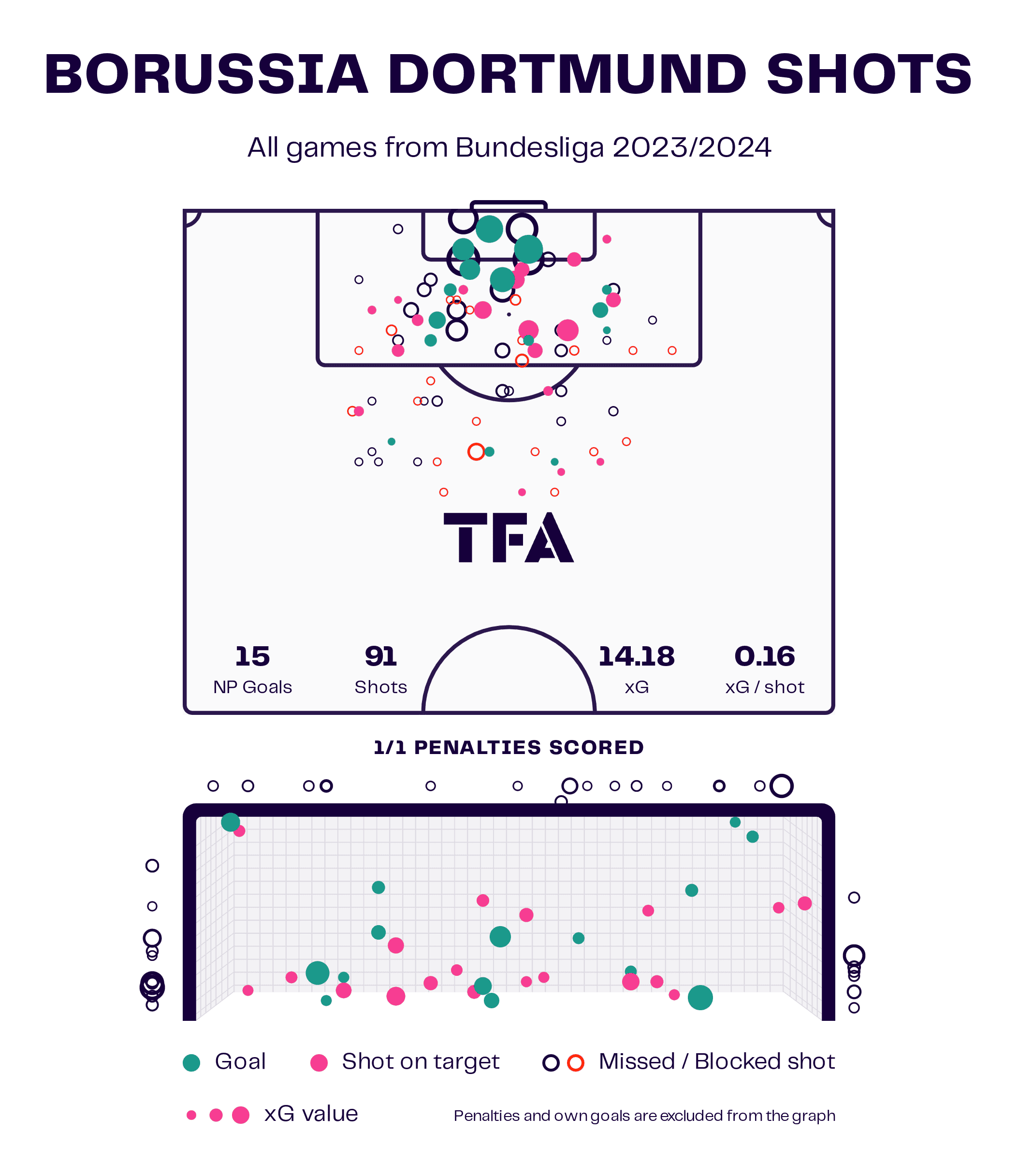
In essence, it’s not that they can’t finish; it’s more about their inability to craft the kind of goal-scoring opportunities that would allow their attackers to shine.
This is an area where Dortmund certainly needs improvement to maximize their offensive potential.
Individual struggles have collectively contributed to Borussia’s difficulties in consistently creating high-quality goal-scoring opportunities, adding another layer to the issues they’ve been facing this season.
Sebastien Haller, in particular, has been underwhelming.
His physical fitness seems to have suffered from his chemotherapy treatment last year, and he’s lacking his usual strengths, such as playing with his back to the goal and shielding the ball.
Haller’s contributions to the team are minimal at the moment, and he appears somewhat lost on the pitch.
Even his prowess in aerial duels is not as effective as expected.
This disconnect between his playing style and Dortmund’s fast-paced, crossing-oriented approach has made him less influential.
Sebastien Haller Touch Map – Bundesliga 2023/24
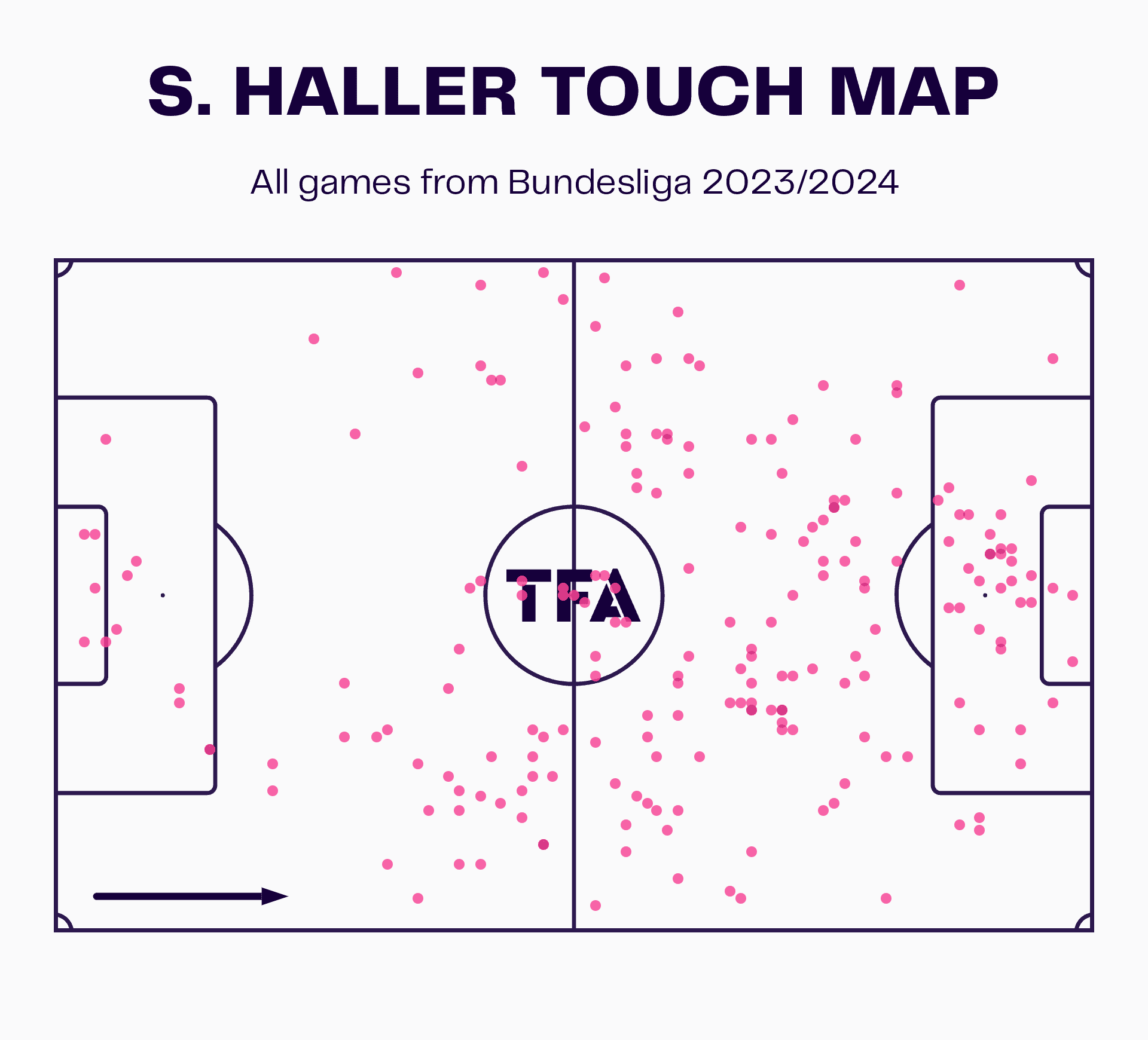
Karim Adeyemi, known for his blistering pace, has also struggled to maintain his earlier level of performance in the final third.
His threat has dwindled compared to early 2023.
Meanwhile, talents like Giovanni Reyna and Youssoufa Moukoko have found it challenging to carve out significant roles within the squad.
Füllkrug has emerged as a potential solution to Borussia’s problems in this regard, given his ability to take up wide positions and progress the ball into dangerous areas.
He’s demonstrated a more practical approach in this regard compared to Dortmund’s other strikers.
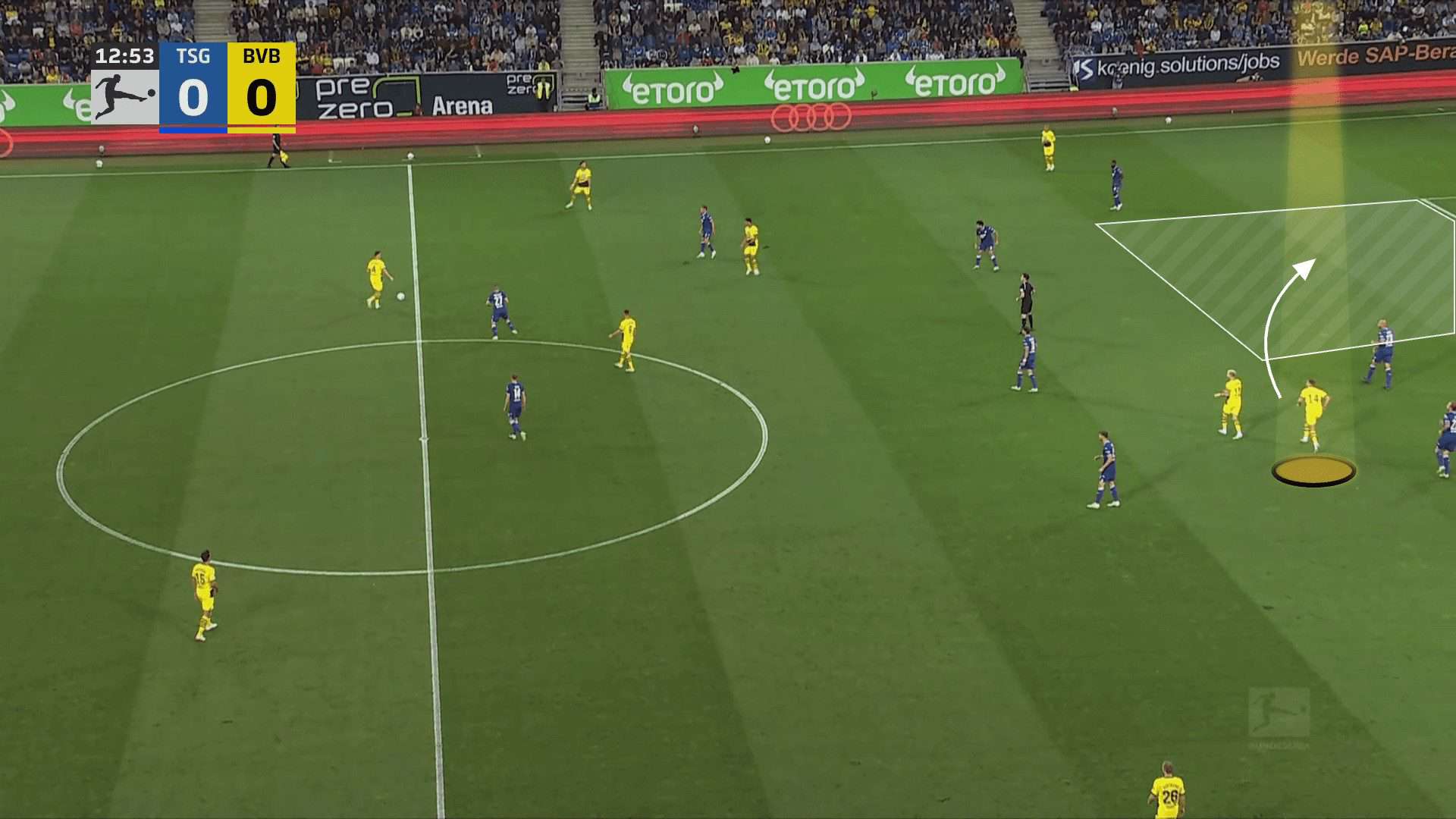
However, there’s still room for improvement, especially in utilizing the speed and potential of Karim Adeyemi.
Dortmund’s most threatening player must be granted the space to exploit and run at the defence.
Adeyemi’s pace is a valuable asset that, when fully harnessed, can be a game-changer for the team.
The emergence of Jamie Bynoe-Gittens, consistent high-level performances from Julian Brandt, and the promising trajectory of Donyell Malen all provide hope for Dortmund’s chance creation.
Malen’s success, for instance, hinges on his freedom to roam and seek opportunities for aggressive vertical ball-carrying.
Edin Terzić’s style of play will likely emphasize these critical attacking threats even more as Dortmund strives to enhance its offensive capabilities and create higher-quality goal-scoring opportunities.
How can Edin Terzić overcome these shortcomings?
Edin Terzić, despite facing criticisms, has shown an aptitude for in-game adjustments during his time at Borussia Dortmund.
To address some of the team’s issues, he can implement tactical changes that maximize their potential.
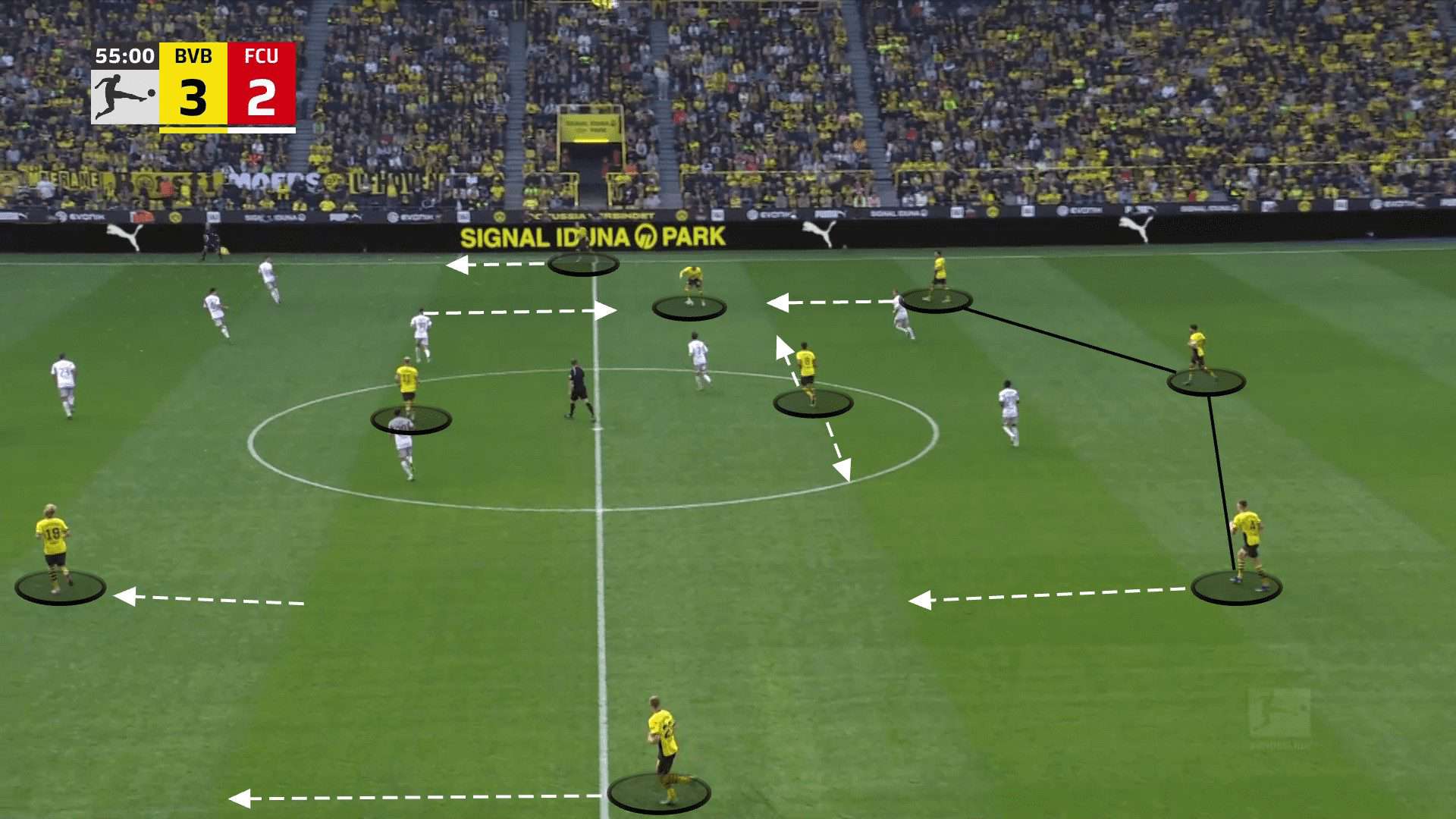
One adjustment has been seen in the positioning of Emre Can.
When the centre-backs face limited passing angles due to opponents’ pressure, Can drops in between them, creating a triangular back three behind Nmecha.
This tactical shift frees the fullbacks to push forward and enables the centre-backs to carry the ball forward to disrupt the opponent’s defensive structure.
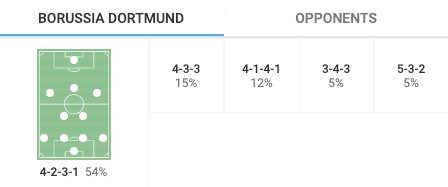
Dortmund has already experimented with different formations, primarily using the 4-2-3-1, followed by the 4-3-3 and 4-1-4-1.
Occasional use of the 3-4-3 and 5-3-2 systems has also been observed.
Terzić may consider starting with a 4-2-3-1 formation but utilizing Emre Can in a back-three role during build-up play.
Mats Hummels and Nico Schlotterbeck could be more efficient in progressing the ball in that setup.
This adjustment creates space in the centre for players like Nmecha, Sabitzer, or Özcan to exploit.
Furthermore, Dortmund should emphasize their high challenge intensity and fast transition game as key strengths.
Wingers like Malen, Adeyemi, and Bynoe-Gittens’ consistent top-class performances can further enhance the team’s capabilities.
Conclusion
In essence, Terzić has the tools to adapt Dortmund’s tactical approach.
These suggestions could help the team regain its form and compete at the highest level.
It remains to be seen whether the Borussians can improve after the international break and regain the highest success possible.
