
Frank Schmidt has been the manager of Heidenheim since 2009 and has taken charge of over 600 games. In what has been his first and only job, Schmidt has overseen the club’s rise from the fifth tier of German football to the first, becoming the longest-serving manager at a single club in German history.
In the last game of the 2022/23 season, 1. FC Heidenheim scored two stoppage-time goals to send them to the Bundesliga for the first time in the club’s history. Currently, the top-tier debutants are maintaining their status in the league, with a position in the top half of the league table.
From open play, only FC Koln have created fewer chances than Heidenheim, but, their impressive set-pieces have aided their solid position in the Bundesliga. No side has scored more than the 10 goals Heidenheim have managed from dead balls, making up 40% of their total league goals. These set play goals have earned the newcomers 9 points, 45% of their total points earned, at the halfway stage of the season.
Jan-Niklas Beste, a Borussia Dortmund youth product, has been key to Heidenheim’s set play success with 12 goal contributions in 14 league appearances. His superb technique on dead balls means that every delivery into the box is fired in with speed and precision, causing chaos for opposition defenders.
In this tactical analysis, we will look into the tactics behind Heidenheim’s offensive set-pieces, with an in-depth analysis of the key differences between the routines of inswinging and outswinging corner kicks. This set-piece analysis will examine why these routines have helped them score goals so frequently, but also the steps to take to increase the efficiency.
Inswinging Corners
FC Heidenheim’s most used method for creating chances has been to attack the near side of the six-yard box, attacking the space in front of the zonal defenders. Rather than relying on the attackers to win aerial duels against zonal defenders, Heidenheim attack the space where attackers don’t have to compete for aerial duels, but just have to arrive in the space at the right time, where the attacker has to utilise the pace and curve of the ball to direct it towards goal, although from a slightly less favourable angle.
The inswinging corner makes it easier for attackers to get a dangerous shot off from these tight angles, as seen below, where the attacker’s momentum takes him away from the goal. With the run taking the player away from the goal, it is hard to generate enough power to beat the goalkeeper, but the superb delivery of the corner means that the speed on the ball is already there, and it is simpler to redirect the ball towards the goal as seen in the example below.
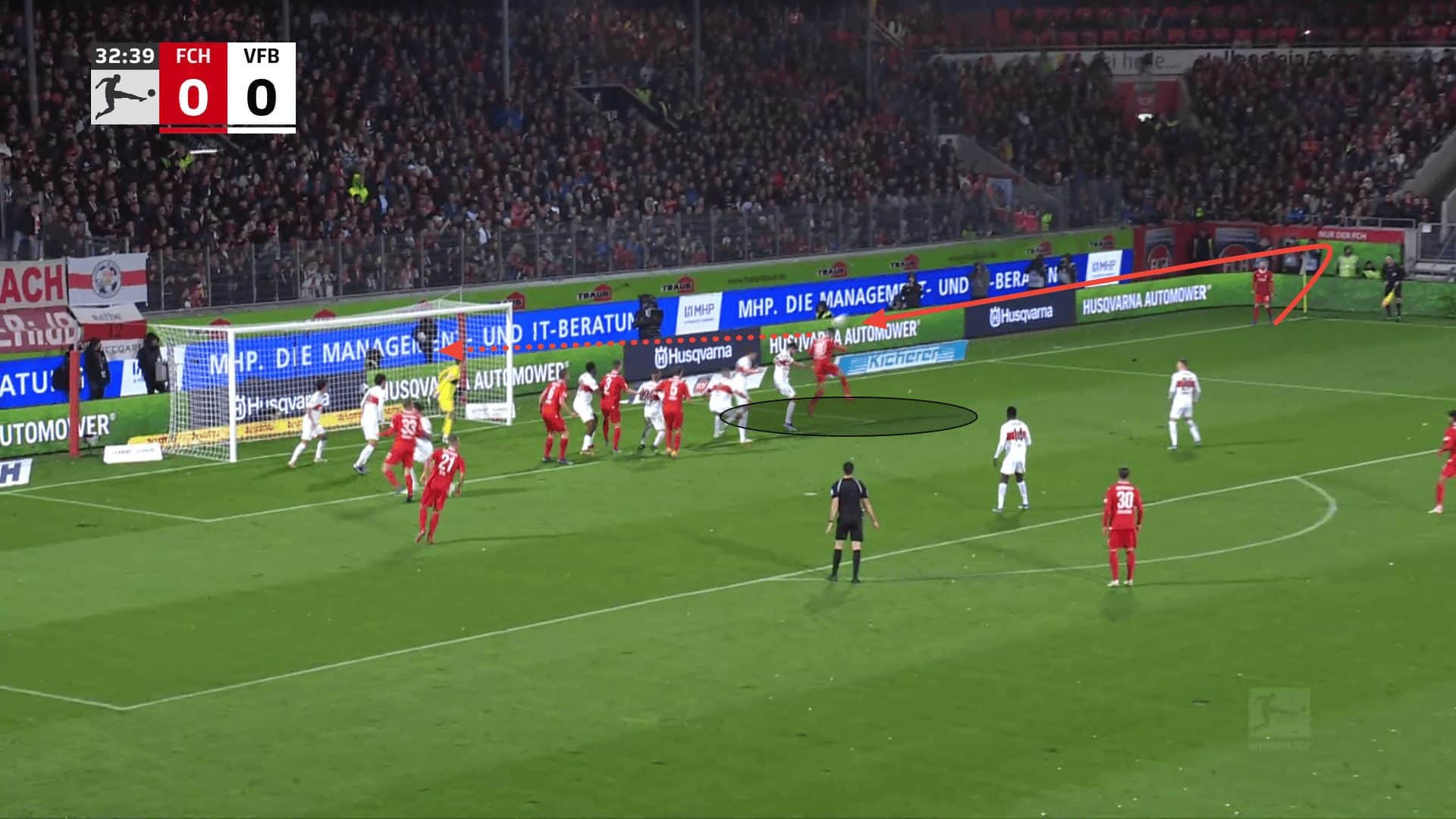
The key to attacking the space at the near side of the six-yard box is through the timing of the movement. If an attacker waits in the target area, he will attract a defender towards them. When the ball is eventually played in, the players in the area would have to compete in a potential aerial duel. Through the right timing of the run, the attackers are able to attack the ball without any defensive pressure forcing a mistake.
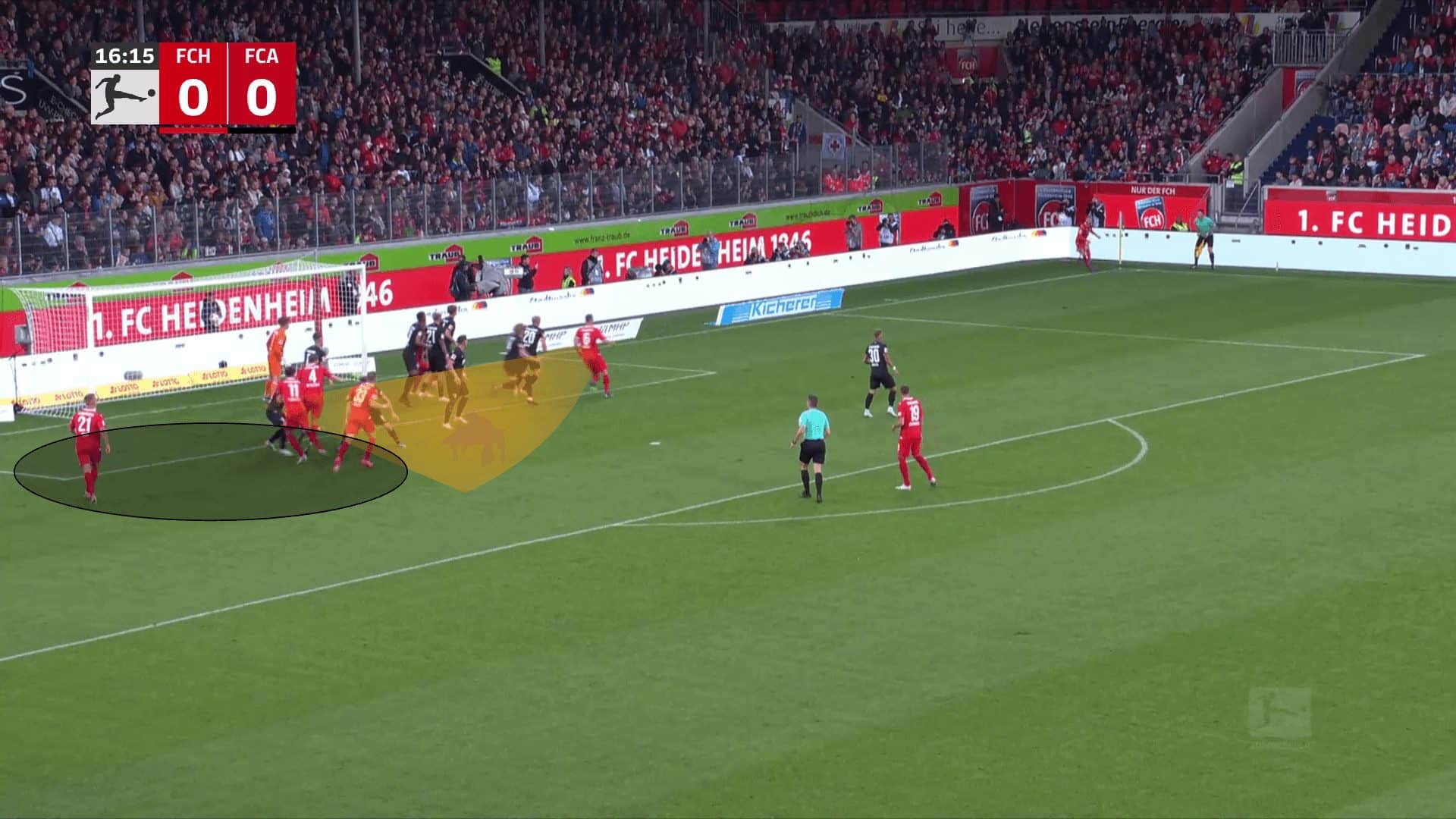
As seen in the image below, the defender’s attention is on the ball and the space in front of him. In order for attackers to be able to arrive in the space with as much time as possible, the attacker must be out of the defender’s sight. The best way to remain out of a defender’s sight is to lurk in the defender’s shadow behind their back before sprinting into space as the corner is about to be taken.

Beste’s ability to deliver the ball into the six-yard box with pace and precision provides Heidenheim with a layer of unpredictability that many teams lack. While the same movements are made regularly attacking the near side of the six-yard box, the goalkeeper has to maintain a position where he is ready to deal with a potential shot from the closest potential recipient of the ball. As the keeper has to have his body facing the player attacking the near side of the six-yard box, he is left in a vulnerable position where it is tough to claim a longer cross headed towards the back side of the six-yard box.
This means that whilst the keeper is preoccupied with the near side, the far side of the box is less of a priority. Most teams are unable to access both sides of the six-yard box simultaneously, but Beste can deliver the ball into the far side of the penalty area in a way that doesn’t give the goalkeeper enough time to react to the change in the target area and adjust his position.
Other teams, when trying the same ideas, require more decoys attacking other areas of the goal in order to fool the opponent; however, with the accuracy of deliveries, only one attacker targeting the near side is enough to force opponents to crowd that area, to prevent a near post header from being scored. This leaves a big numerical overload at the back post for Heidenheim, where one effective screen is all that is required to provide the three remaining attackers with all the time in the world to score at the back post.
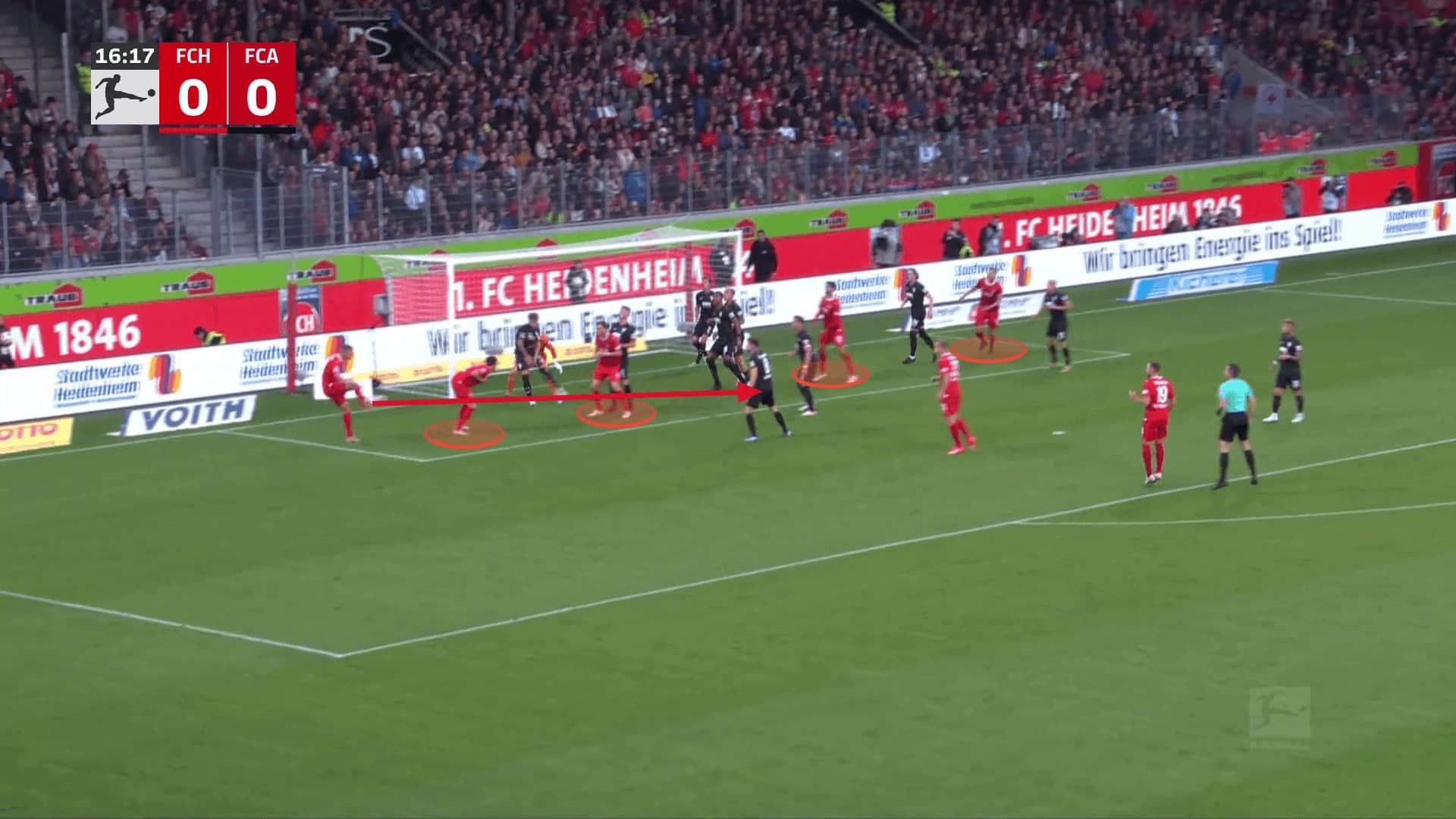
Beste’s ability and consistency in playing the ball into the six-yard box and finding teammates regularly also allows Heidenheim to confidently crowd the six-yard box with lots of players.
Being able to attack the six-yard box with such a significant numerical presence provides Heidenheim with additional opportunities to score during the second contact after a ball is knocked down following the initial contact. With back post crosses like the one above, the recipient is able to fizz the ball back across the face of the goal, where four teammates are ready to attack the ball.
Furthermore, these attackers are all spread out across the width of the goal to ensure that no matter where the ball may bounce during the chaos, there will always be a red shirt to put the ball into the back of the net.
Outswinging Corners
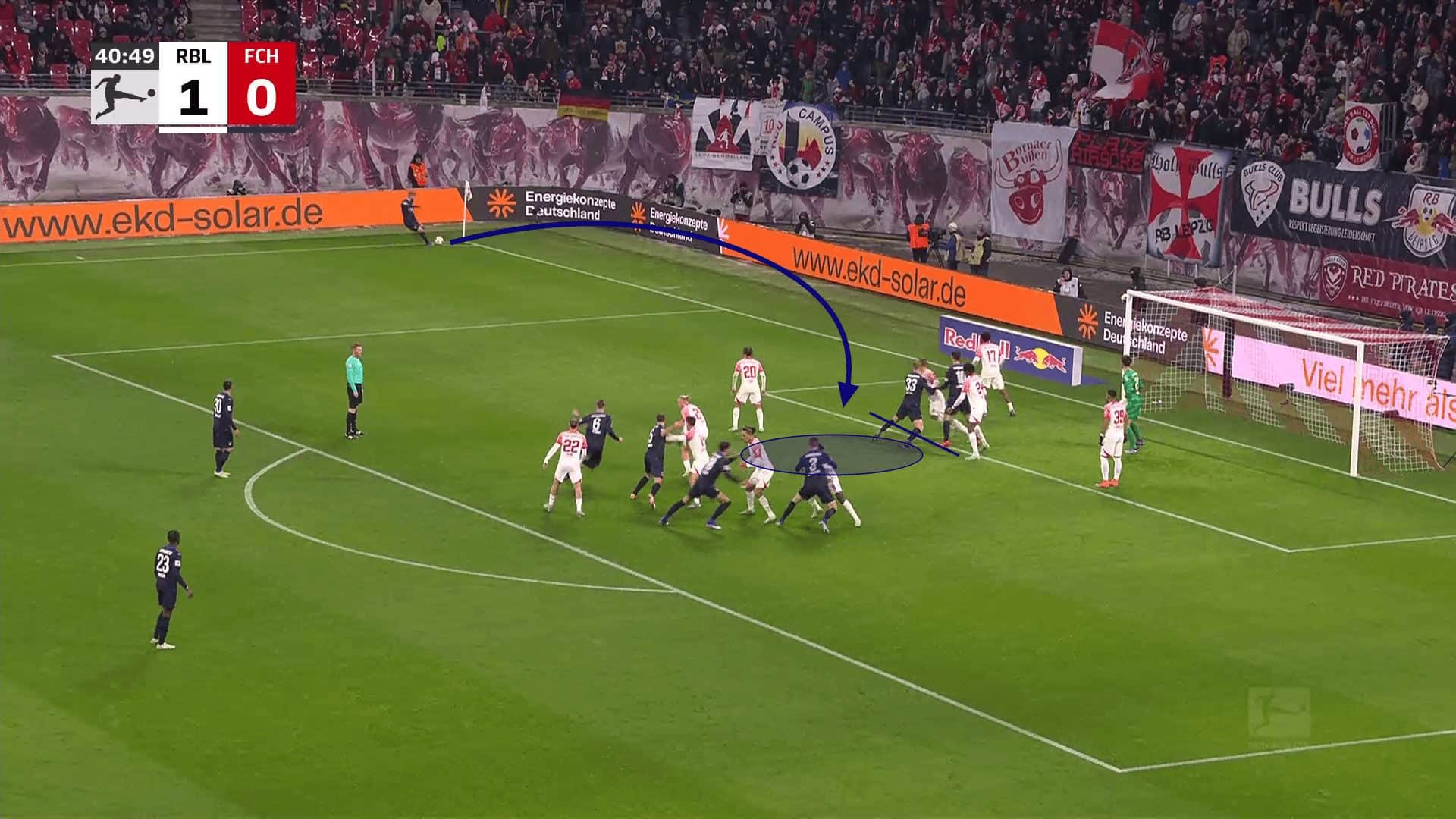
During outswinging corner kicks, there is less of a threat at the near side of the six-yard box. Rather than trying to score or assist the goals, the players in the six-yard box turn into space creators by setting screens on zonal defenders. The goalkeeper is allowed to take up a higher starting position, making the entire six-yard box impenetrable, meaning Heidenheim must look elsewhere.
The most common area to exploit for Heidenheim is just outside the six-yard box, where the example below shows the screen being set on RB Leipzig‘s zonal defenders around the six-yard box, which gives the other Heidenheim attackers space to attack the ball just outside the six-yard box. However, whilst the space is ready to be attacked, we can see that every other attacker has struggled to create the separation required from their marker to be able to arrive in the area and attack the ball in time.
One way in which Heidenheim have attempted to create space for each individual attacker is by increasing the depth of the space they have. This means that rather than all the attackers starting around the six-yard box, they start near the edge of the penalty area. The added depth gives each attacker the opportunity to lose their marker, where they then gain the opportunity to arrive in the highlighted space below rather than just starting inside it with a defender. Each attacker has the chance to make a 5-yard sprint away from their markers.
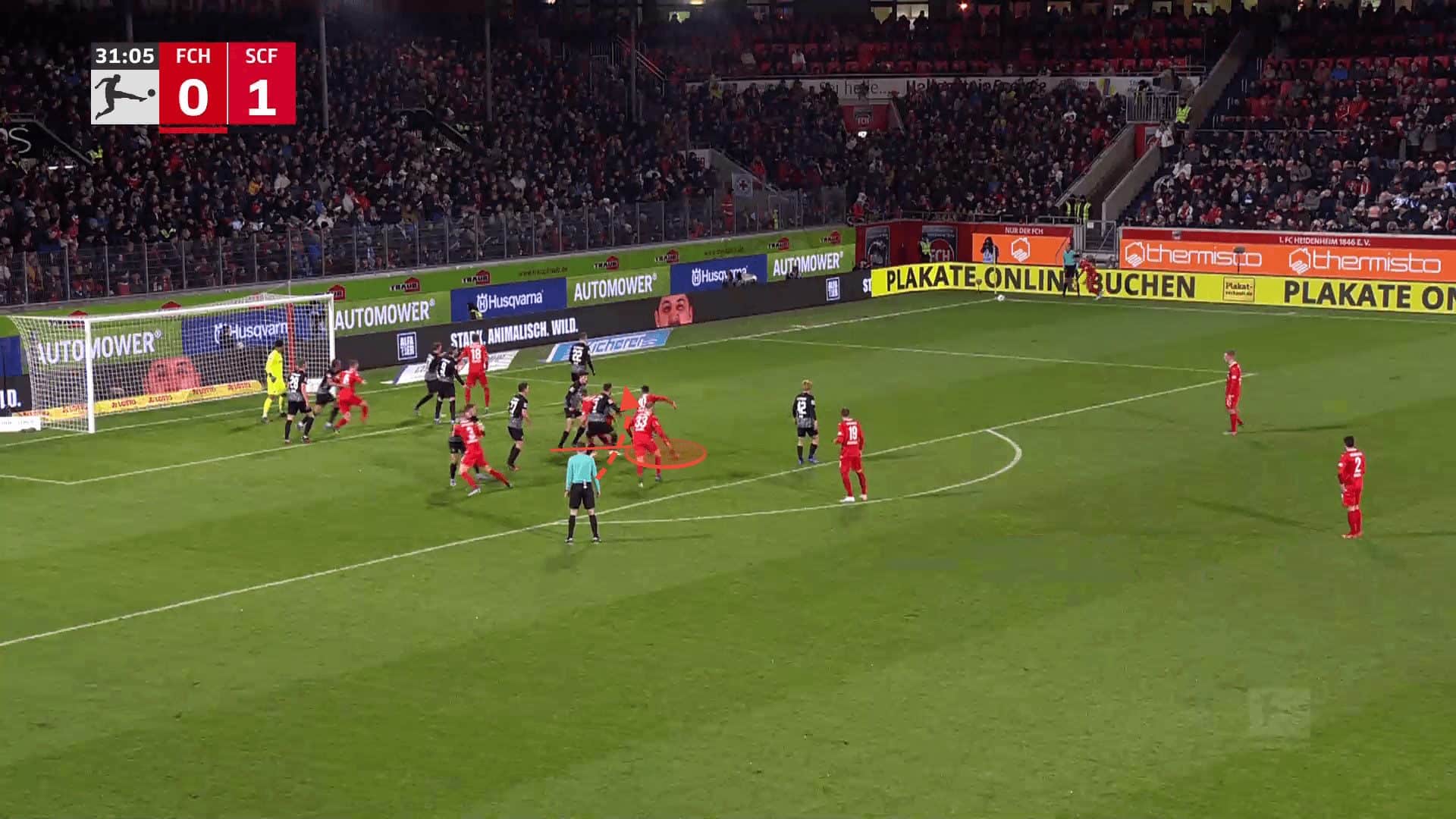
The tight grouping of the attacking unit is also deliberate to form a cluster, where an attacker is able to run around the cluster, using it as one big screen to get away from his marker. Suppose an attacker can use the cluster to his advantage and time the run, along with the other screens used on zonal defenders. In that case, it provides the blueprint for consistent quality chance creation from outswinging corners. In that scenario, there would be no zonal defender in the way attempting to clear the ball, whilst the attacker also has no opposition attempting to disrupt him from executing the headed effort to his peak.
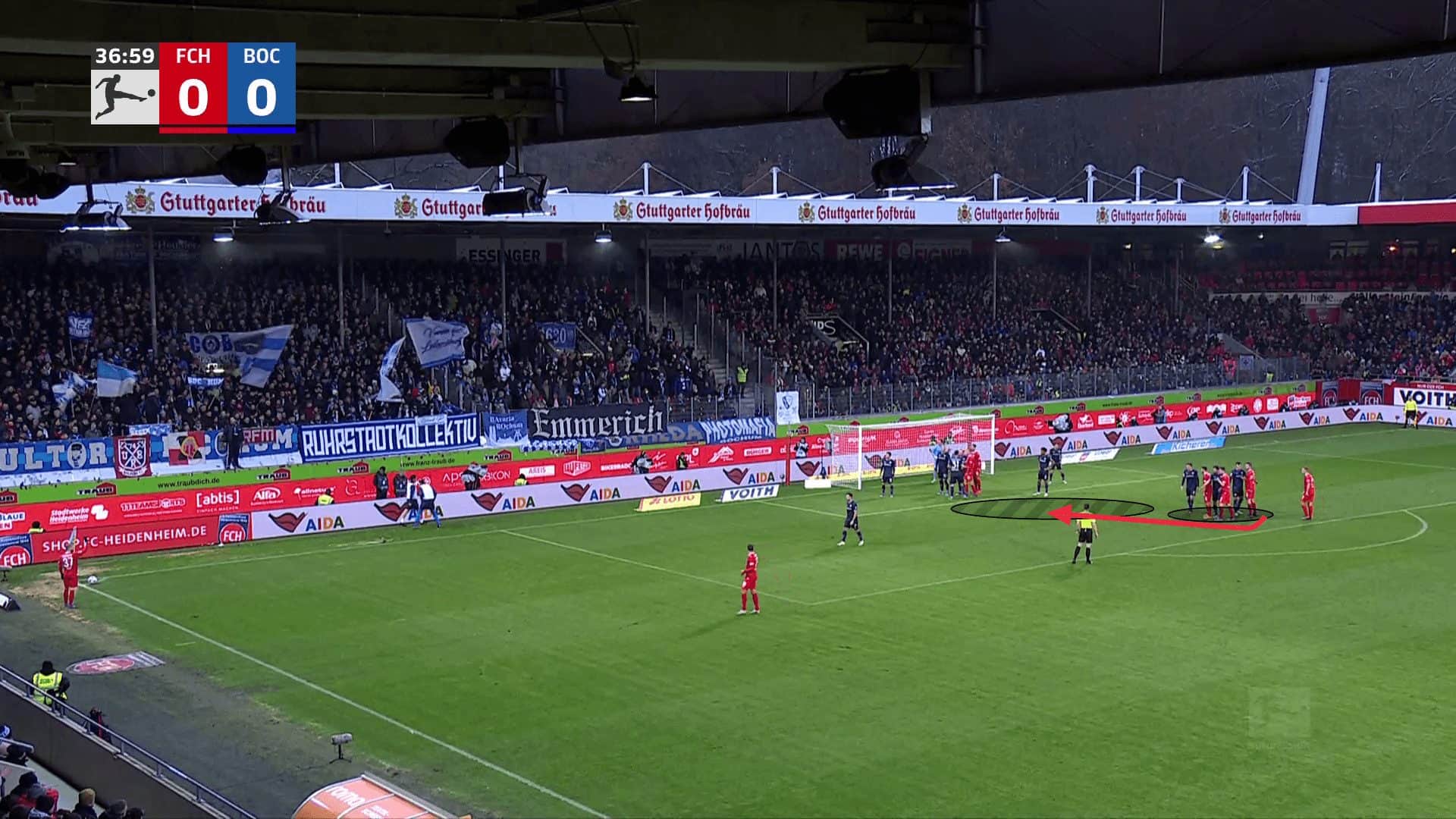
Within these clusters, one other way in which the players have been able to create separation from their markers has been through the use of screens. In these tight situations like the one pictured below, there is an attacker starting deep who has no intention of attacking the ball, but rather, he purposely moves into the path of a defender who is trying to track his marker. He cuts off the defender’s path, which gives the attacker the yard of space needed to execute the header on goal.
Summary
Heidenheim have shown that through the ability to adapt the delivery depending on the curve of the ball, there are different areas of the pitch that are more easily accessible for inswingers or outswingers. The flat and quick deliveries mean that there is no need for an aerial monster. All that is required to score from a corner kick is sharp movement as well as excellent timing. Their use of screens has been promising, although not always coordinated with the runs of the attackers.
It is important to disguise the players whose role is to create space for teammates through screens or decoy runs as attackers, who genuinely want to score a goal. If the players who provide screens make it clear what they are about to do, teams will not mark them and will be able to double up on the actual target players.
If Heidenheim can increase the rate and efficiency of screens and create a process where the team knows the target area for every corner, they will be able to further increase the number of goals they score from set plays.
Variety is important, as they have sometimes focused on the near side of the six-yard box too much, which meant that teams could throw lots of zonal defenders in those zones whilst leaving other areas open.
