
As we go into the middle of February, TSG 1899 Hoffenheim are hovering just above the relegation zone in the Bundesliga, four points clear of 1. FC Heidenheim who occupy the relegation play-off berth, with just thirteen games left this season.
With just 18 points accumulated, it’s the lowest points return for the Sinsheim-based club at this stage of the season since the 2015/16 season and the second-lowest overall since their promotion to the top flight way back in 2008.
Only the 2012/13 campaign saw worse than their current record.
It’s been a tumultuous year for the club, with exits from the DFB-Pokal and UEFA Europa League compounding their poor league form.
In addition, they have cycled through two different managers and quite possibly a third soon if results don’t improve under Christian Ilzer.
It’s quite a downslide for a club that finished in seventh position just nine months ago, which earned them a fourth-ever European qualification and first in four years to begin with, especially given that their squad boasts nearly a dozen international players across Europe and Africa.
They have had their share of misfortune with injuries, with a long and growing list of players currently out of action, but is the explanation for their struggles this season that simple?
This tactical and data analysis will uncover what’s not clicking this year for Hoffenheim despite the team having gone through two managers relatively early on in the campaign.
TSG 1899 Hoffenheim Summer Investment & Problems Under Pellegrino Matarazzo
After leading the team back to European football last term, Pellegrino Matarazzo was given the opportunity to continue his work with the team this season as he went into the final year of a two-and-a-half-year contract he signed when taking the job back in February 2023.
The biggest reason for TSG Hoffenheim’s success last season was undoubtedly their offensive production.
They posted sixty-six goals, the highest in the league outside those who finished in the Champions League slots, for an average of nearly two goals a game.
They also possessed two of the league’s top six goalscorers throughout the campaign: Maximilian Beier and the club’s all-time top scorer, Andrej Kramarić.
Beier ended up leaving in the summer for Borussia Dortmund, as the club reinvested some of his commanding €28.5 million transfer fee in Czech forward Adam Hložek from title-winning Bayer Leverkusen and joint 2. Bundesliga top scorer Haris Tabaković from Hertha Berlin.
In fact, Hoffenheim ended up spending twice the amount they received from Beier’s transfer, for a total of €57 million, which is the most the club has ever spent in a single transfer window in their entire history.
Coming off a good season, qualifying for Europe, investing the most they had ever done and brought in some quality players, it seemed like everything was set for Hoffenheim to build on last year with another solid campaign.
But things just haven’t panned out all season, especially in the Bundesliga.
Under the American manager up until his dismissal in November 2024, Hoffenheim continued lining up in their usual 3-4-1-2 formation from last year, with some variations to a 3-4-3 and 5-3-2 on occasion.
Besides Beier’s departure, players like Wout Weghorst, Robert Skov, and John Brooks also left the club, but they brought in plenty of reinforcement in those positions.
More than half of their spending came in the defensive department, understandably so after they shipped as many goals as they scored last season for the fourth-worst defensive record in the league.
So why did things not improve after all the investment they made?
It’d be difficult not to mention the injury problems they have faced all season long, right from the very start, when three key players, Ozan Kabak, Ihlas Bebou, and Grischa Prömel, all went down with serious knee injuries in the summer.
Their fortunes in this area have not improved until now, either, with twelve players currently on the injury list as of mid-February.
While this has obviously made things difficult from a squad management standpoint, as the team balanced three competitions during the first half of the campaign, other issues with the team’s performance on the field prior to Matarazzo’s departure also contributed to their struggles.
Pellegrino Matarazzo Inconsistency
When the club released an official statement to announce Matarazzo’s departure, one of the main factors in the decision that was cited was the lack of consistency in the team’s performances leading up to that point.
The bloew graphic shows just how evident that was in his final weeks, with multiple goal games followed up by blanks on a few occasions there.

While the injuries and balancing act of playing on three fronts made matters difficult for the New Jersey-born manager, his inability to find any real consistency ultimately proved fatal to his job.
By mid-November, the Hoffenheim board had decided it was time for a change and went down south to find their next manager.
Hoffenheim Performances After Christian Ilzer Took Over
On November 15, 2024, Austrian manager Christian Ilzer was appointed.
He had left Sturm Graz after four years in charge and had won a league and cup double in his last full season.
At the time of his decision to go to Sinsheim, Sturm Graz were in first place again.
But while there were hopes that he could turn things around, that just hasn’t been the case, with his record nearly identical to Matarazzo’s since taking over.
Despite that, there have been some clear differences in set-up and some aspects of Hoffenheim’s performances, which the data supports and which may lead to an upturn in fortune sooner or later.
Tactically, upon his arrival, Ilzer instantly shifted to a four-back defensive structure with a 4-2-3-1 formation, which is always a difficult switch to make mid-season, especially with a team like Hoffenheim that had been designed to play with three at the back for some time.
While this change has led to their defensive issues continuing thus far, it’s on the offensive side where perhaps this team could recapture their spark soon.
Let’s look at a few data visualizations that will allow us to clarify that further, comparing the team’s metrics under both managers.
Hoffenheim Shots Maps 2024/2025
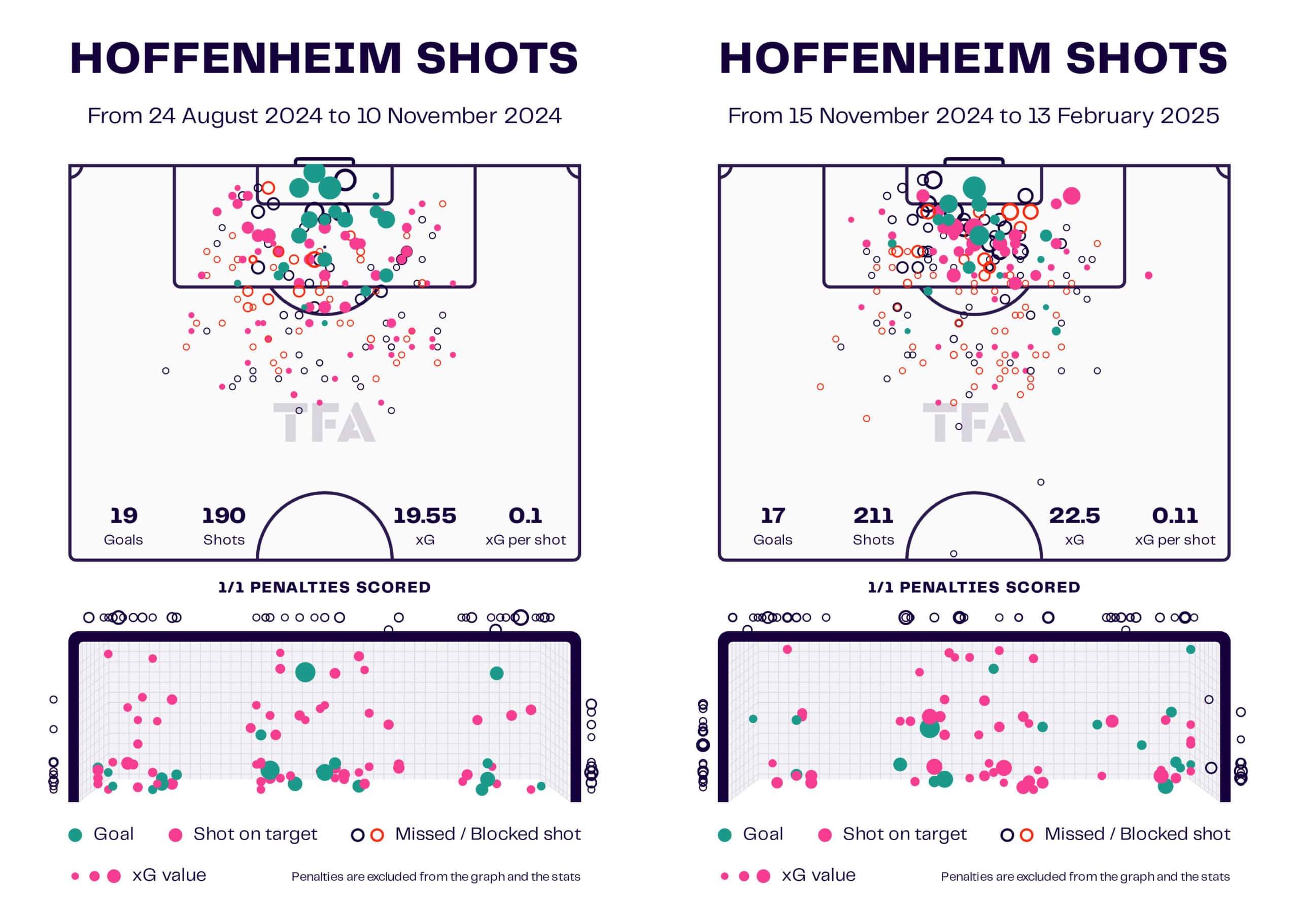
First, Hoffenheim shots map is displayed above across two different parts of the season: the opening league game until Matarazzo’s final game in charge and Ilzer’s appointment until the present day.
On the left, we can see that under Matarazzo tactics, Hoffenheim were matching their expected goals (xG) of nineteen goals with the same return, but on the right, their xG has been higher under Ilzer, yet they have scored five fewer than expected.
Typically, creating more high-quality opportunities that raise a team’s xG value should lead to more goals, particularly if the team was matching its xG beforehand, but that clearly hasn’t been the case with Hoffenheim.
Still, they are creating more under Ilzer tactics than in the earlier part of the season, and eventually, their finishing should catch up with that more consistently, which we’ve seen signs of already this spring.

While they did take a step back in the recent drubbing at the hands of Union Berlin, they were finding the back of the net with more regularity before that and enjoyed their most consistent period of scoring goals in the five games prior, all while keeping a relatively healthy xG average.
Hoffenheim Shot Assists Maps 2024/2025
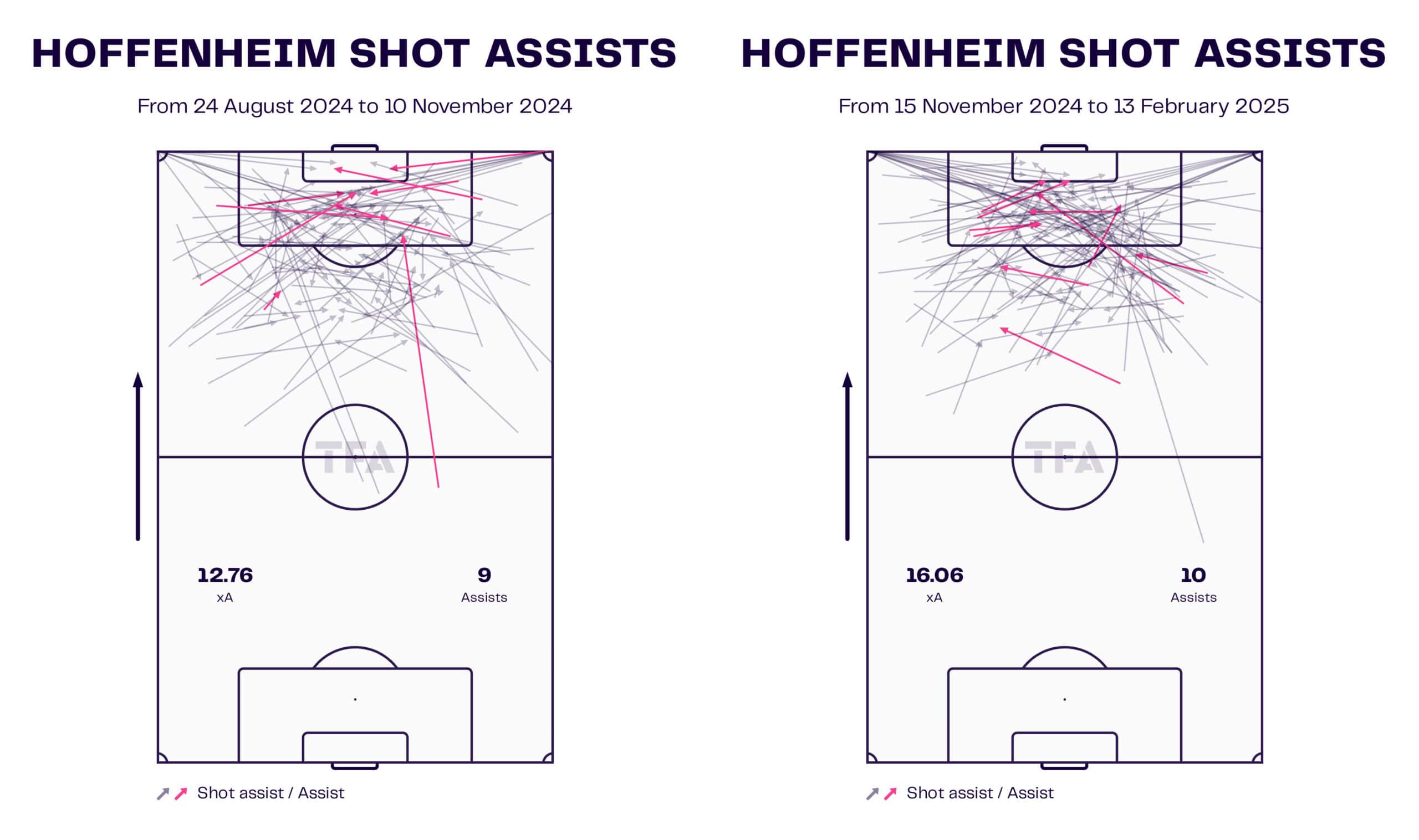
Besides expected goals, another metric we could look at is their expected assists (xA).
Once again, the numbers on the right under Ilzer look more promising.
Their xA count is more than three higher than under Matarazzo, and a higher volume of attempts is generated from set pieces and across the attacking third.
Overall, it’s clear that, based on their recent games, at least before the Union match, Hoffenheim are starting to turn a corner offensively, and the underlying data seems to support that well.
But it’s not just how they attack with the ball that seems to be improving again; it’s also what they do when they don’t have the ball, especially higher up the field.
Hoffenheim High Regains Maps 2024/2025
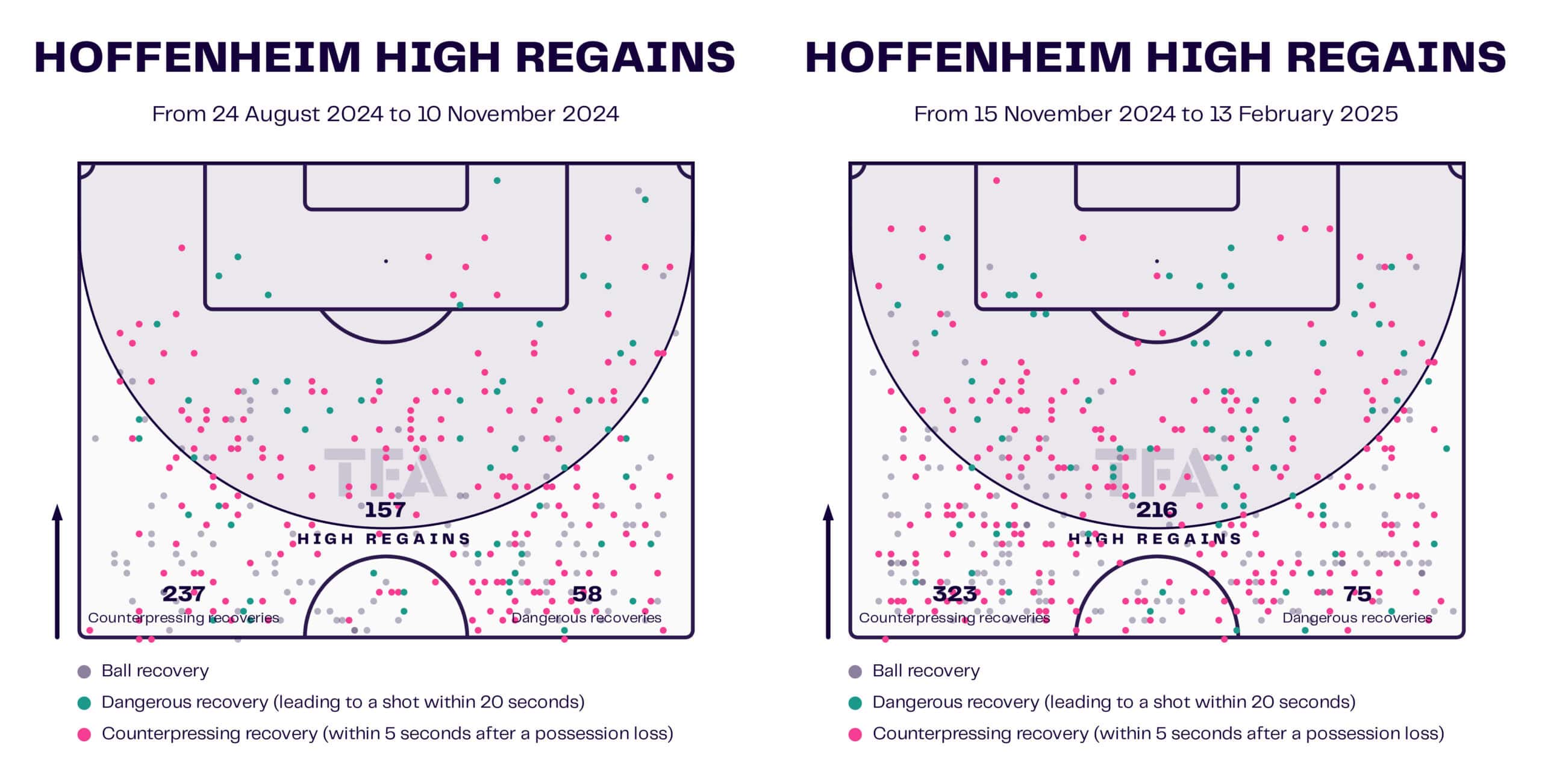
The high regains maps above compare their pressing under both managers and how effective they have been at regaining possession in advanced areas, particularly after losing the ball initially and those that led to attempts at goal in transitions.
As we can see, they have recorded nearly sixty more high regains under Ilzer, including eighty-four more counter-pressing recoveries, which means that’s how many more times they won the ball back within five seconds in the opposing half.
Given that it’s a similar amount of games against similar-level opponents on both sides, it’s impressive to note how much more Ilzer is getting out of the team when it comes to being proactive and looking to make things happen, even when they don’t have possession of the ball.
All of these metrics seem to lend support to Ilzer that while results haven’t really improved as of yet, they are improving in terms of chances generated and their ability to press opponents higher up the field.
Recent weeks have shown that they are starting to trend upwards again on the attacking front.
However one area that continues to be a thorn in their side is the defensive side of proceedings.
Hoffenheim Defensive Problems
Just as last season when Hoffenheim had one of the worst defences in the Bundesliga despite finishing seventh, that fact hasn’t changed this season, with them struggling at the other end of the table.
With forty-four goals conceded so far, they possess the third-worst defensive record in the division, only worsened by the bottom two sides, Holstein Kiel and VfL Bochum.
It’s not a good omen for a side currently in a relegation fight.
While their defensive metrics overall don’t seem too dissimilar to those of their previous manager, we’ve picked out one that is, and it includes their captain and German international, Oliver Baumann.
Hoffenheim Shots Faced Maps 2024/2025
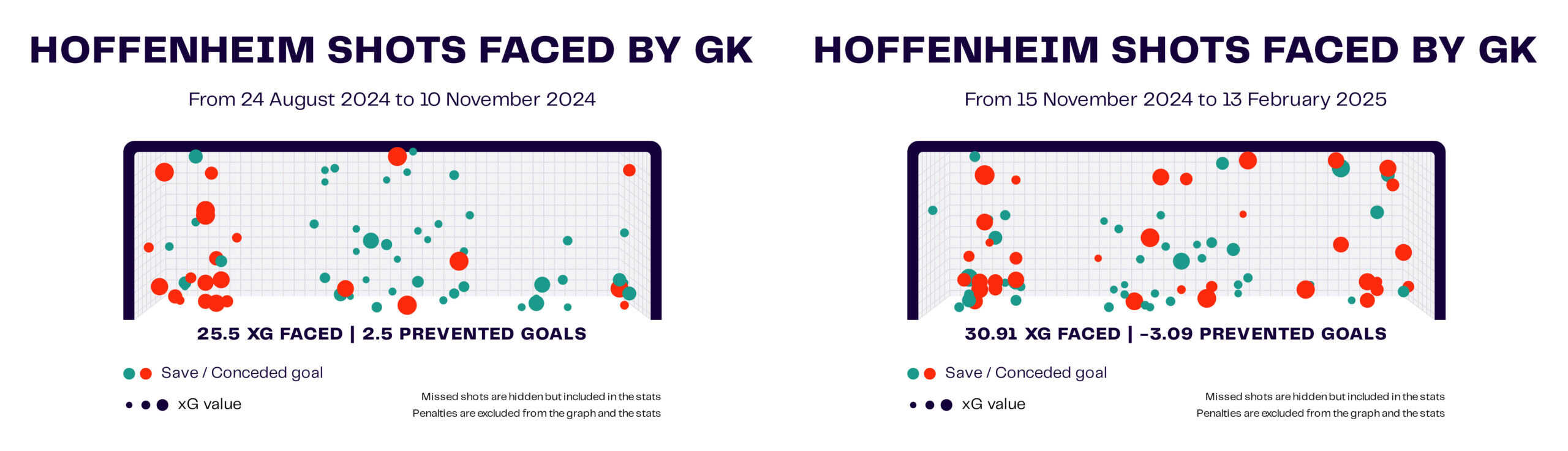
As we can see by their shots faced maps, they are actually allowing a higher xG value of attempts to their opposition under Ilzer, with five more expected goals against since his arrival.
What makes that even more concerning is that prevented goals number, which is negative and means that their #1 goal is struggling to bail them out even when their defence proves incapable of protecting him.
While their defensive struggles have been paramount whether they play with a three, four, or five-man system at the back, given what the data indicates above, questions will be raised about Baumann and the team’s leader.
Baumann has been one of the best goalkeepers in the league for some time now, so it may just be a bad period that he can put behind him soon with the business end of the season coming up.
However, given the rest of the defence’s long-standing issues with keeping the ball out of their own net, there is a lot less credit in the bank and a lot more to prove.
Conclusion
Hoffenheim have had a difficult season on all fronts, with their defensive frailties from last year still lingering and their offensive production massively down from their high-scoring efforts of 2023/24.
While their current manager, Christian Ilzer, hasn’t been able to resolve everything since arriving in November, some evidence suggests a turnaround may not be far off for the club.
They will certainly need that to be the case, given that they’re locked in a relegation battle at the moment and are only just floating above the danger zone by four points.
With exciting young players already there and coming through at the club, including new signing Bazoumana Touré and Fisnik Asllani, who’s producing on loan at Elversberg, they’re a team that has plenty to offer to the Bundesliga in the coming years.
But first, they must find a way to maintain their top-flight status for an eighteenth consecutive season.
