
MLS newcomers San Diego FC currently sit second in the Western Conference.
The West Coast side have been mightily impressive in their inaugural season.
They have the second-best attacking and defensive records in the league, as well as having won as many fixtures as the first-placed Vancouver Whitecaps.
Whilst the club have been visibly ambitious in their approach towards recruitment, arguably the biggest provocateur of this success is head coach, Mikey Varas.
Varas arrived in San Diego with a very impressive pedigree, gained from stints as USMNT Interim boss and a successful coaching period at FC Dallas.
That being said, as an MLS head coach, many questions over his potential to bring success could have arisen.
This tactical analysis will examine the strategies implemented by the 42-year-old American and consider what has made Mikey Varas style of play so difficult to compete against this season.
San Diego FC Starting XI
San Diego typically set up in a standard 4-3-3 formation, as visualised below.

Varas heavily prefers this formation due to its flexibility, which is utilised in both attack and defence, as we will analyse in more detail later in the article.
Varas is eager to rotate personnel minimally and likes maintaining a stable core to his lineup.
Chris McVey, Anders Dreyer, Onni Valakari, CJ Dos Santos, and Luca de la Torre have all made 17 out of 18 possible appearances this season, while a further three players have appeared 16 times.
This continuity in terms of the lineup has certainly helped Varas stamp his style and personality on the team, and has successfully achieved a level of consistency in their performances that few could have predicted.
San Diego FC Style of Play
Varas demands that his team totally control games and aims to achieve this through possession dominance.
The American coach is a big believer in managing games through proactivity rather than reactivity, and this is evident in the San Diego style of play this season.
San Diego play mostly short passes and only go long if it is the absolute last resort.
Varas’ side have played an average of 537.89 passes per 90 this term—the second-most in all of MLS—with 87.3% accuracy, the third-highest total in the league.
At the same time, they’ve played an average of 35.18 long passes per 90—sixth-lowest of all 30 teams in MLS this year.
Adopting this short-passing approach naturally reduces the risk of interceptions by the opposition, as passes played have less distance to cover.
While this strategy is sometimes categorised as ‘safe’ and ‘anti-attacking’, this is far from the case in this instance.
Whilst a key focus is placed on possession, their football is far from risk-averse.
San Diego rank top of MLS for progressive passes per 90 (73.97) and second in progressive carrying distance.
SDFC look to be very direct and vertical in their play as soon as opportunities present themselves.
This season’s goalscoring success is largely due to the team’s patience.
Rather than forcing half chances with hopeful and improbable plays, the team is patient enough to wait for opportunities.
The team backs itself to carve out better percentage chances through their creative movements and innovative runs than long punts, a mentality that has paid vast dividends thus far.
In combination with this on-the-ball strategy, they also seek to maintain control out of possession through structured aggression.
Varas’ side seek to win the ball back as soon as possible and are comfortable pressing high up the pitch to smother the opposition side.
They do this because they know whichever team holds the ball dictates the play, and so regaining it is essential to their chances of success.
Below, we will discuss in more depth how they achieve this, carefully analysing their structure and shape.
Mikey Varas Defensive Tactics
When sitting deep under pressure, San Diego typically maintain a strict 4-3-3 shape, as outlined previously, out of possession.
However, when an opportunity arises, they often look to press high.
Varas asks his team to be intelligently aggressive in their off-the-ball decisions, and their shape can become more flexible to enable this.
When pressing, the three forwards are allowed to go man-to-man, and one of the three central midfielders usually joins to create a four-man press in the attacking third.
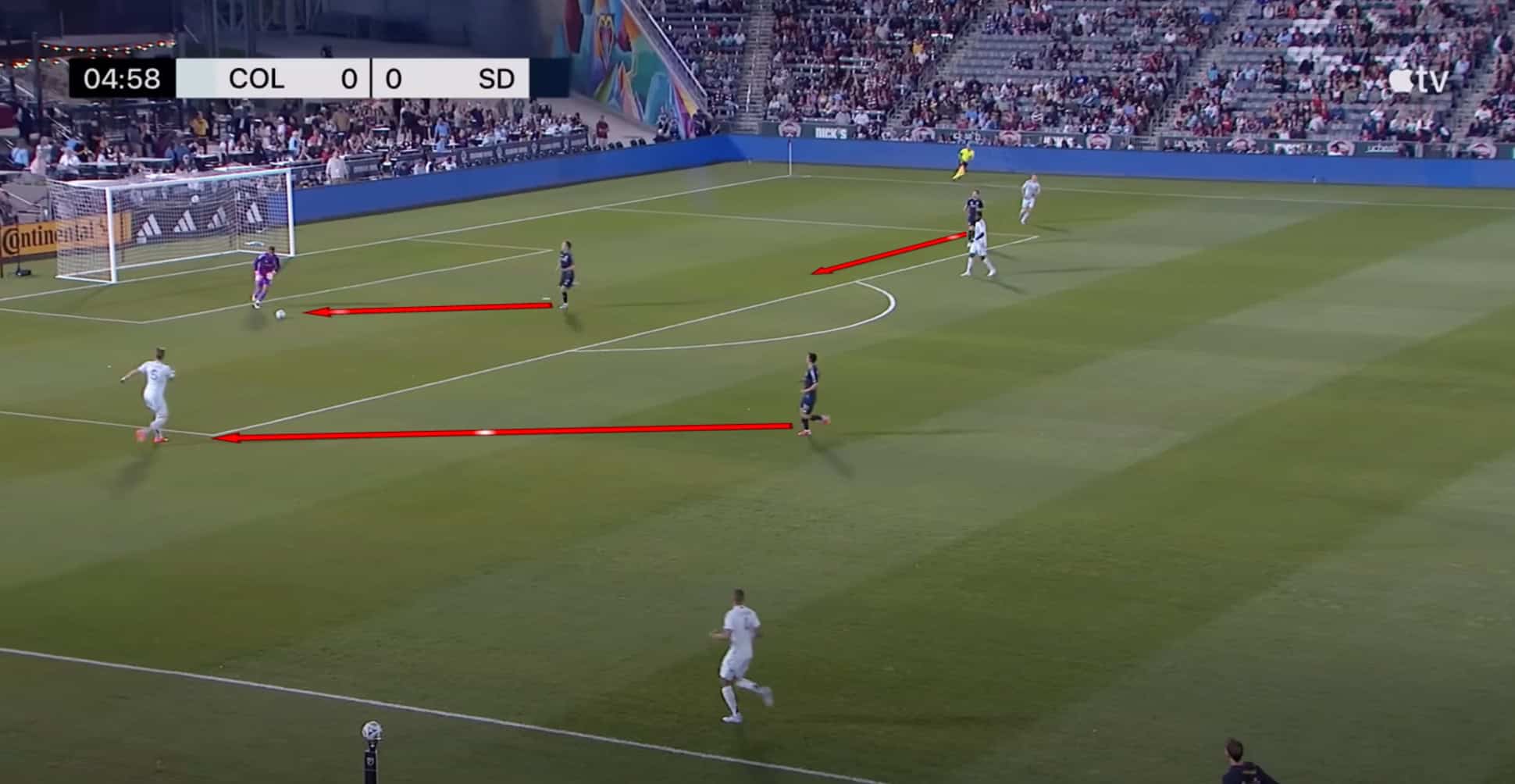
Behind this, they manage to maintain structural solidity, as this approach leaves a two-man pivot sitting in front of the back four.
San Diego have averaged 58.9% possession this season, and this is as much due to their ability to win back the ball as it is to their ability to retain it.
Although this is a huge part of their success and determines their ability to dictate play, it has also brought some challenges.
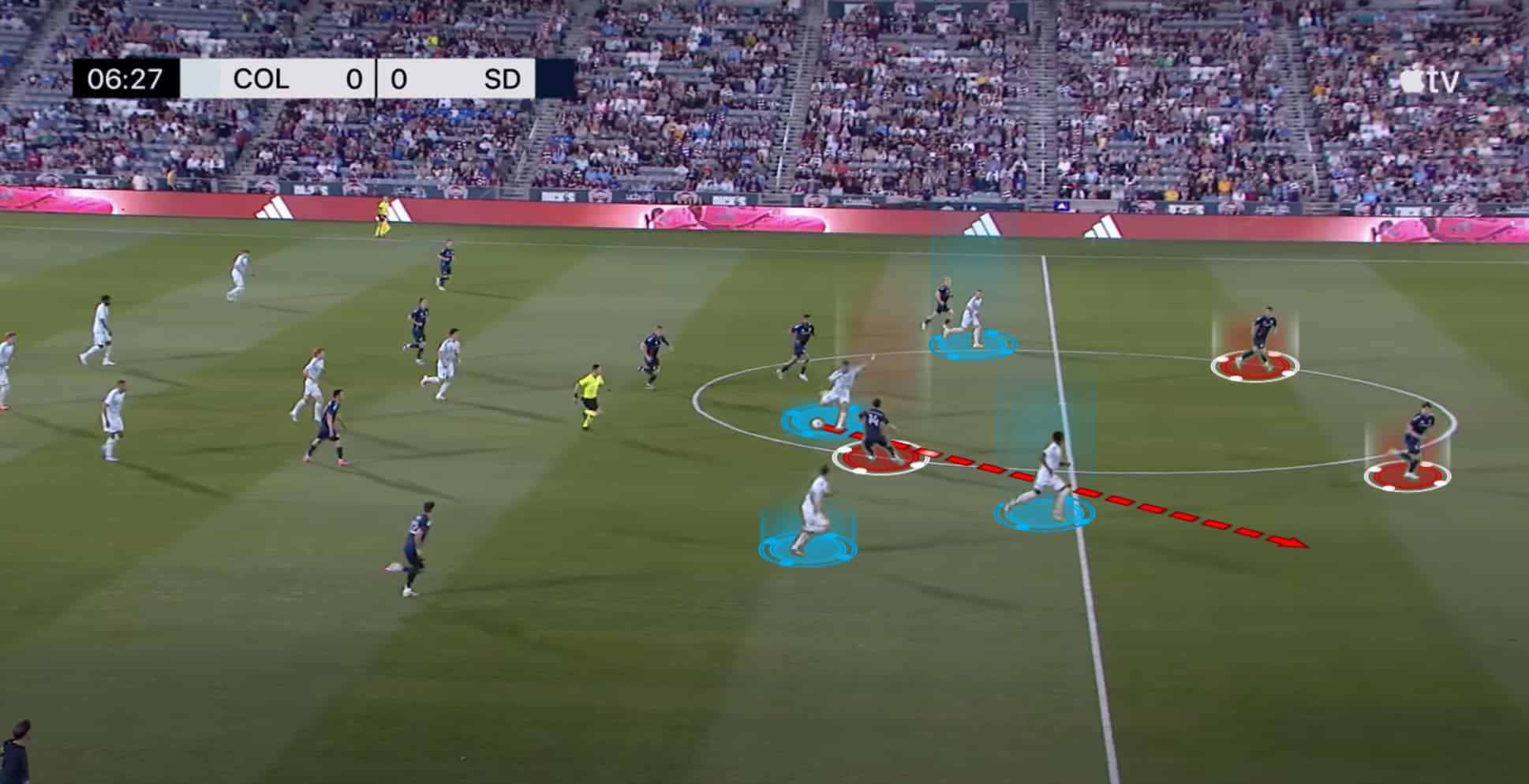
Due to their infancy and inexperience, sometimes San Diego can display an overeagerness in their press.
This can lead to opposition counterattacks, which has, in turn, led to goals conceded in certain games.
Mikey Varas Attacking Tactics
One key element of the SDFC style of play is verticality.
Rather than playing wide and around the sides of the opposition’s defence, San Diego often look towards central zones as chance-creation opportunities.
The beauty of the 4-3-3 set-up adopted is it allows a lot of flexibility in the team’s movements.
On the San Diego side, one winger regularly inverts into central zones, accompanying the striker.
At the same time, the other winger can maintain width, or one of the three holding midfielders can pull out wide to keep the options open.
From watching recent games, another huge part of their attacking movement comes from one of the two ‘8’s in possession.
The three-man midfield allows two to sit, while one pushes on and makes vertical runs alongside and often past the striker.
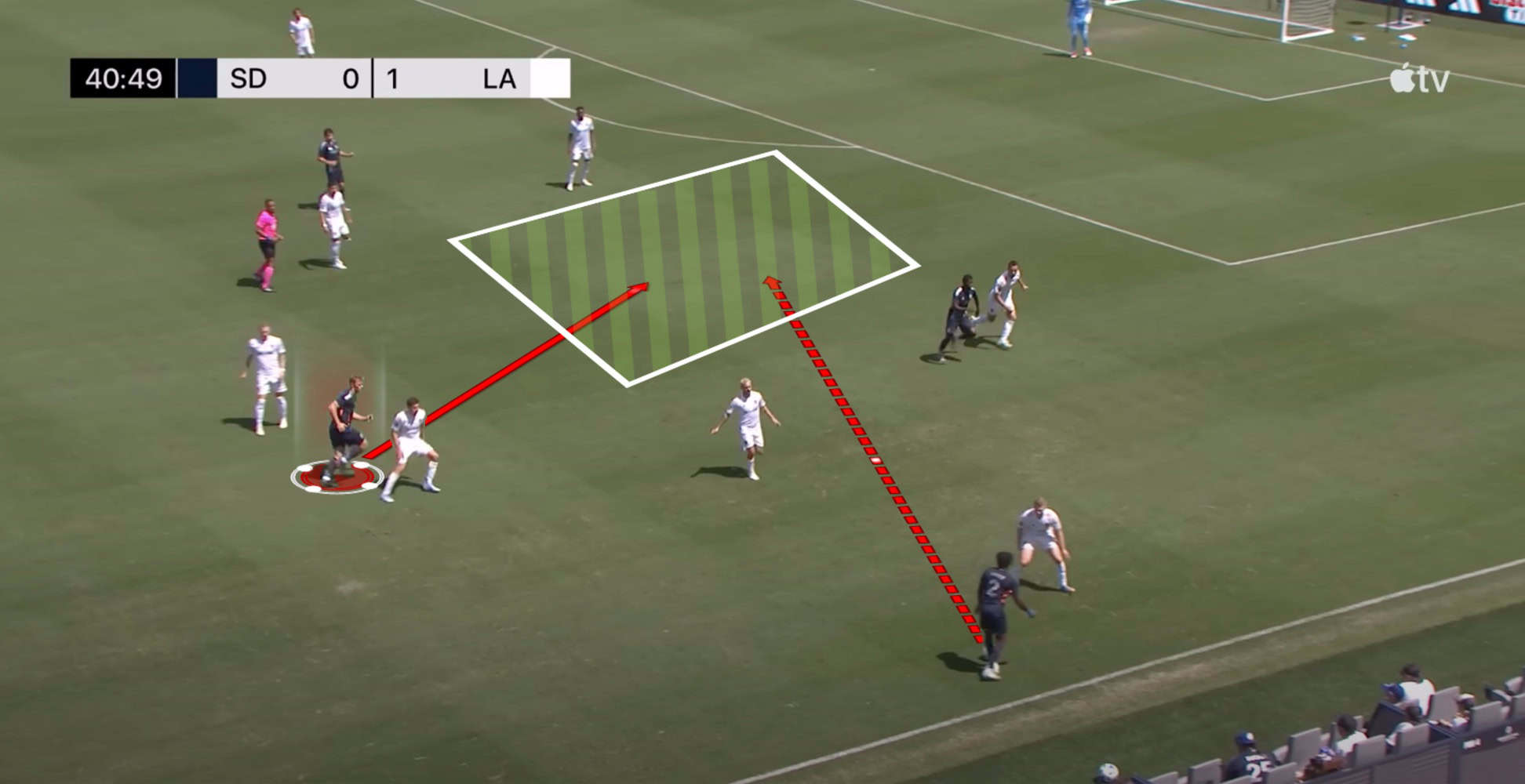
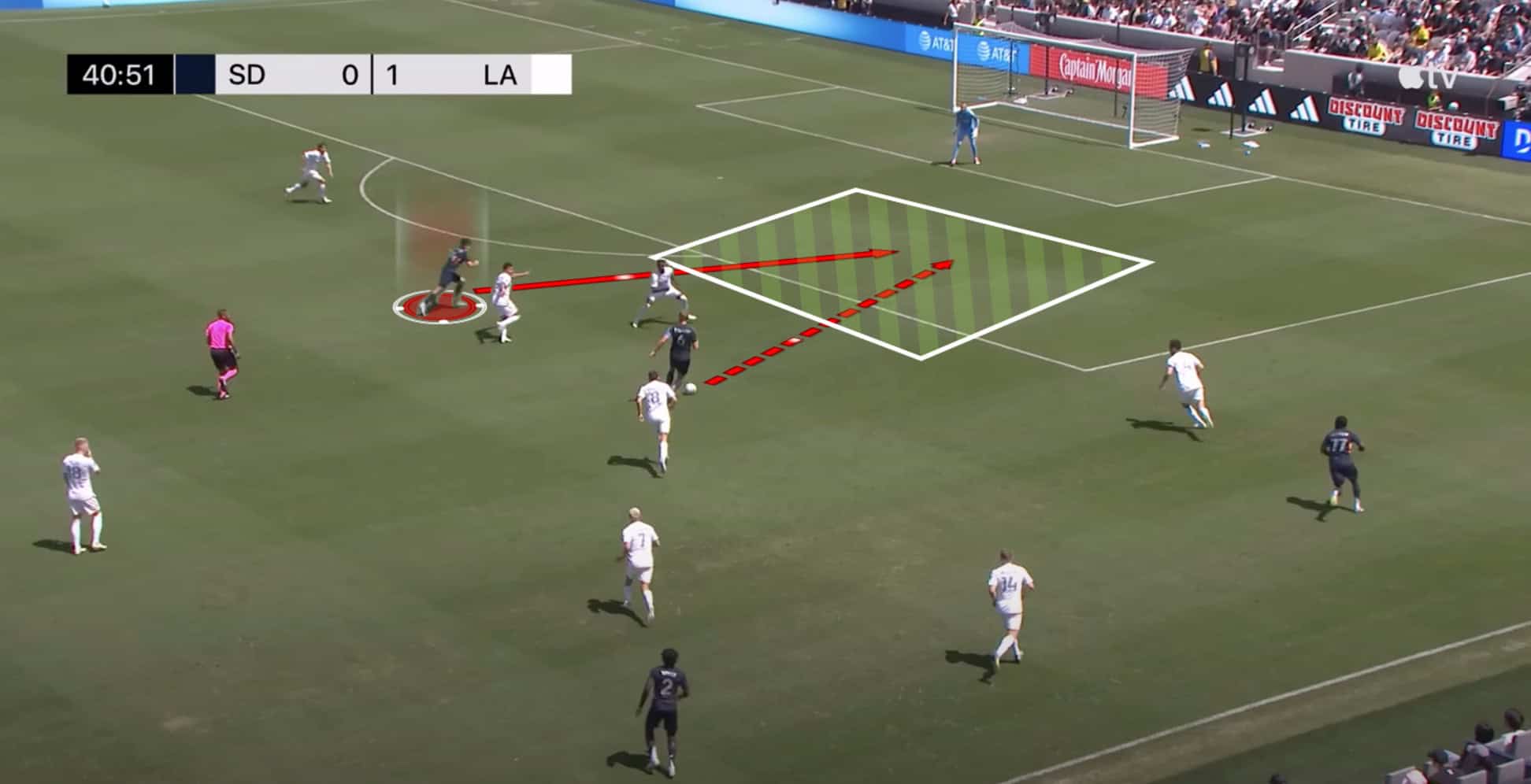
Whichever of these options the side chooses to take varies depending on the in-game situation.
However, the similarity of both movements is that the team often ends in a near 4-4-2 in attack.
A 4-4-2 means more options in central attacking areas, making more passing routes visible and providing more central overloads, which are harder for the opposition defence to deal with.
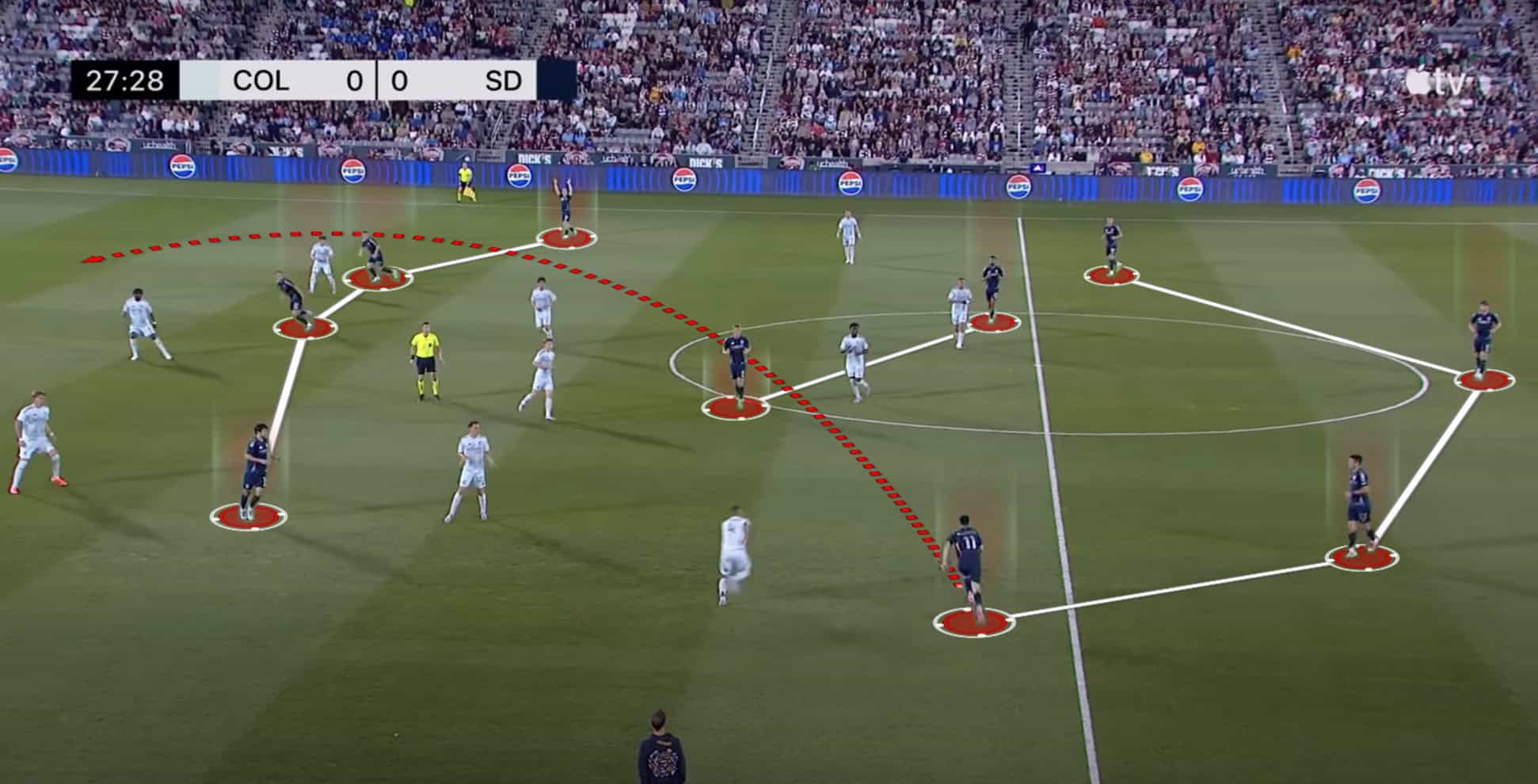
These movements are also often accompanied by attacking full-backs.
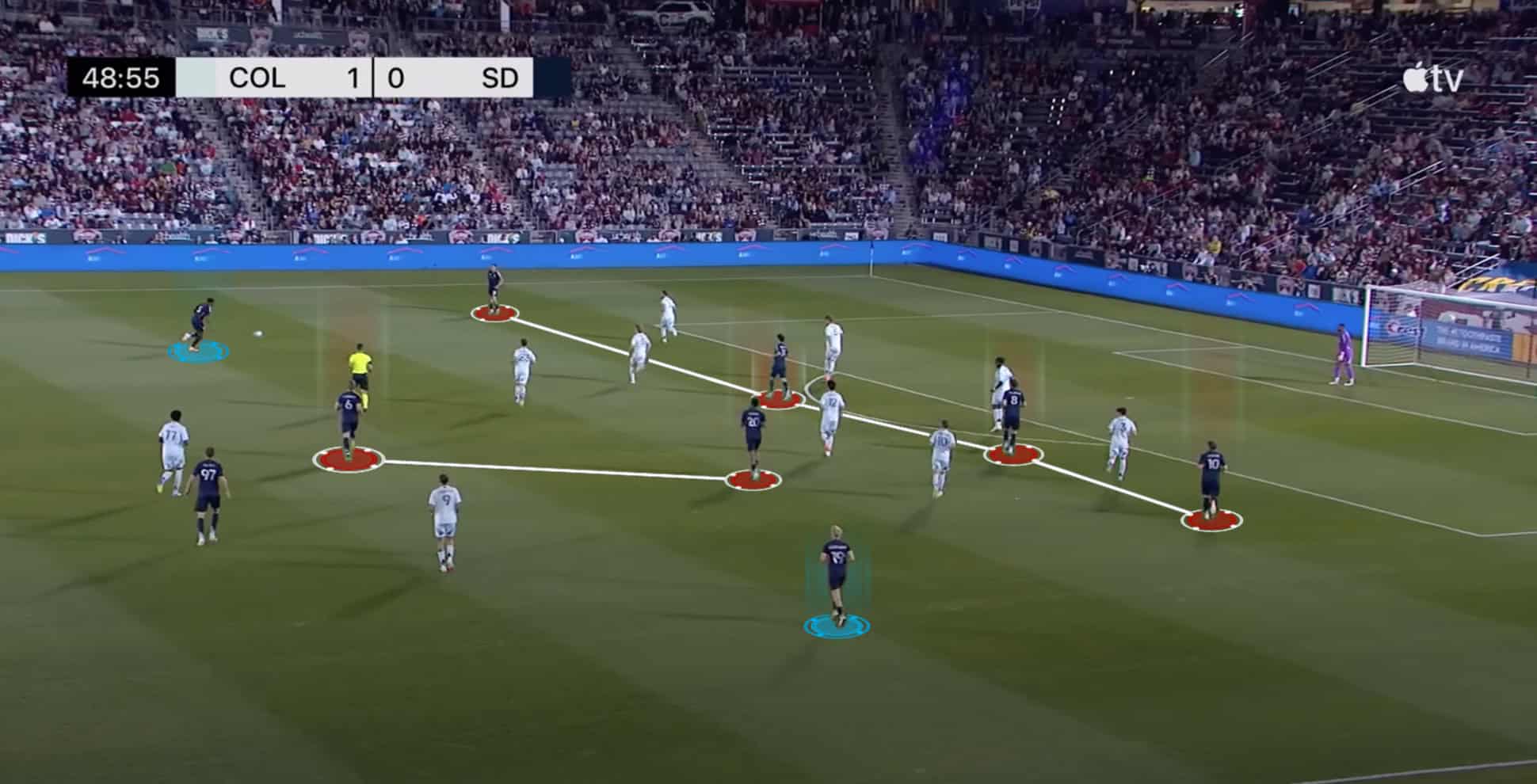
In the build-up phase of attack, the full-backs can join the midfield two, who sit if one of the three has made a run forward.
This is effective in progressing play, as it means in deeper zones the opposition have more men to mark, and so whoever ends up receiving the ball has more time to pick out a careful, incisive pass.
Mikey Varas Difficult To Beat Tactics
As newcomers to the league, San Diego were bound to face one huge obstacle: being perceived as weak and inexperienced.
As we have seen in the English Premier League, many sides come into the league only to be quickly humbled.
Ipswich Town, Leicester City, and Southampton all thrived in the tier below before showing their naivety and lack of qualities in the top flight.
Whilst this challenge is unique to that scenario, Varas still had to ensure his side were ready and brave enough to fight the big sides in MLS.
In this regard, Varas has shown his abilities as a coach and a man-manager.
His team works extremely hard, does not give in, and grinds for results when necessary.
They are willing to scrap and master the dark arts, conceding the eighth-most fouls in MLS.
In addition, they have become a very strong side in duels.
No side in the MLS wins more of their aerial battles, and they combine this with a high ground duel win rate.
Conclusion
Mikey Varas first season at San Diego FC has been an overwhelming success thus far.
With room still to grow, the Azules fans should be very excited now.
His side plays attacking, intricate football while retaining an element of control and stability.
Their football is attractive, and they are as good at entertaining as they are at getting results.
With both at the very beginning of their respective journeys, it can be comfortably predicted that Mikey Varas and San Diego will have hugely successful times ahead.
