
Tottenham Hotspur have announced the appointment of Thomas Frank as the Spurs new Head Coach, with a contract running until 2028.
Keith Andrews, who worked with Frank as Brentford‘s set-piece coach, is a leading candidate to replace Thomas Frank as head coach.
He has helped Brentford achieve a strong set-piece performance in the previous season, both in attacking and defensive aspects.
In attack, they accumulated the third-most xG from set pieces in the Premier League, 16.71, after Crystal Palace (17.02) and Arsenal (16.87), respectively.
In that tactical analysis, we discussed his set-piece attacking tactics, particularly in long throw-ins.
In defence, they conceded the fewest goals from set pieces in the previous season, with just two corners, surpassing Manchester City, who conceded five goals.
Brentford FC were particularly effective in defending corners, conceding the fewest goals in the previous season, with Aston Villa also conceding two.
This tactical analysis will be a set-piece analysis that examines Keith Andrews tactics in defending corners, highlighting the strengths and weaknesses of his defensive scheme.
Listen to this article free on the Total Football Analysis Podcast via Spotify, Apple Podcast, or RSS.
Keith Andrews Main Defending Corner Scheme At Brentford
Let’s start with their main defensive scheme in corners and then explain their reactions to different situations, highlighting their strengths.
As shown below, they defend the expected in-swinging cross using a hybrid and very balanced system.
Four main zonal defenders and an additional one (yellow) are ahead of them to defend this area and get the first touch, usually against flick-ons.
This additional one has many different uses, such as a short option or a rebound player, as we will show later.
In addition, they use four man markers (blue) and a player on the edge of the box (green) to get the rebound and go to defend short corners.

Against out-swinging crosses, they follow the same main scheme in the same match.
However, the zonal defenders’ positions vary somewhat depending on the opponent.
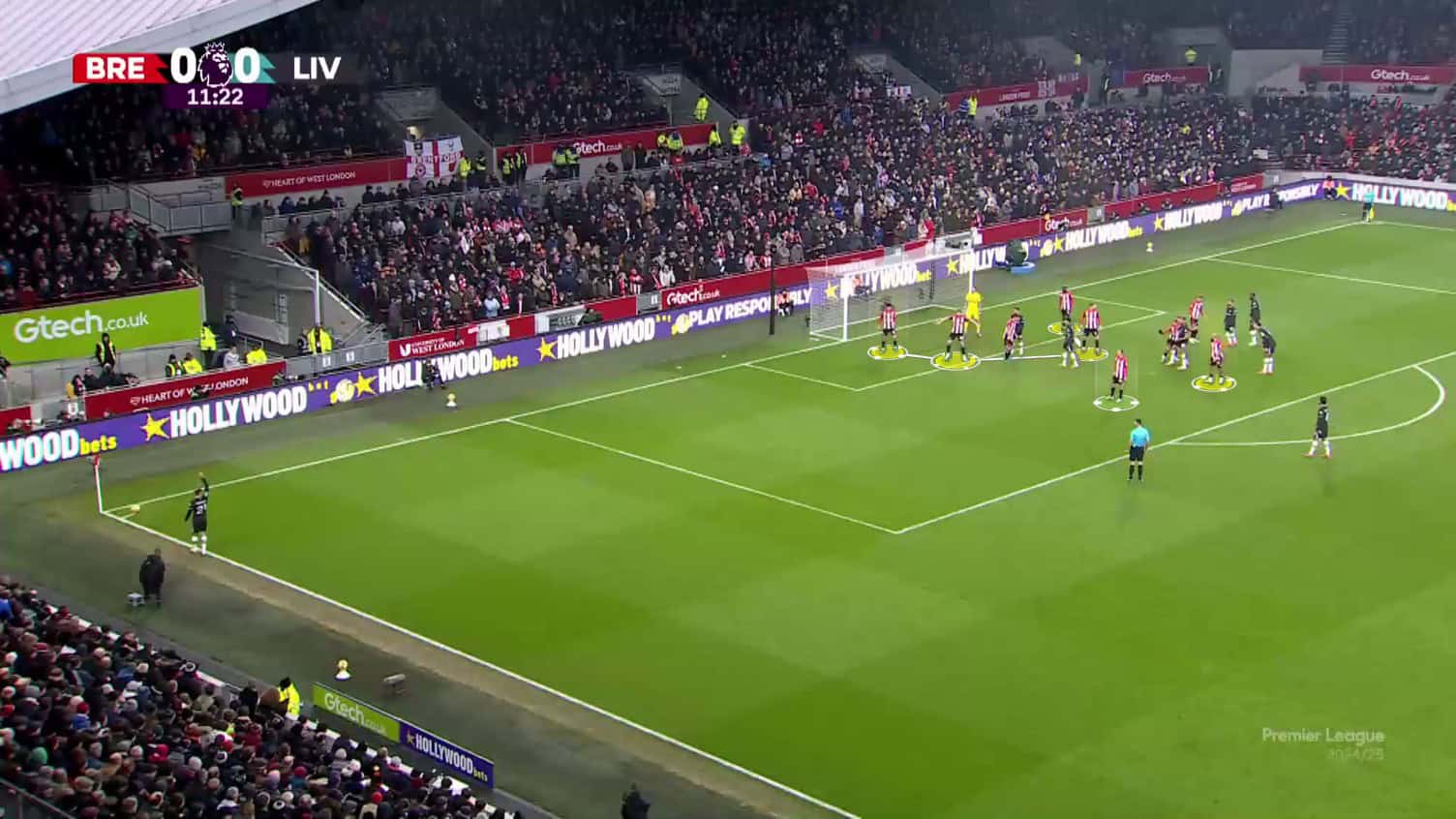
For example, Liverpool usually target Virgil van Dijk in the middle with out-swinging crosses, so they follow the shape shown below.
Moreover, the additional zonal defender goes to stand near the edge of the box for the rebound, thinking that the flick area is no longer as dangerous as it was with in-swinging crosses.
They put their best defenders as the zonal defenders, so it makes sense that the man markers aren’t the best ones in aerial duels.
Hence, their priority is to annoy the attackers until the zonal defenders deal with the situation, not chasing the ball.
As shown below, the four man markers (red) focus more on the attackers and start getting closer to them to obstruct them as the ball is played.
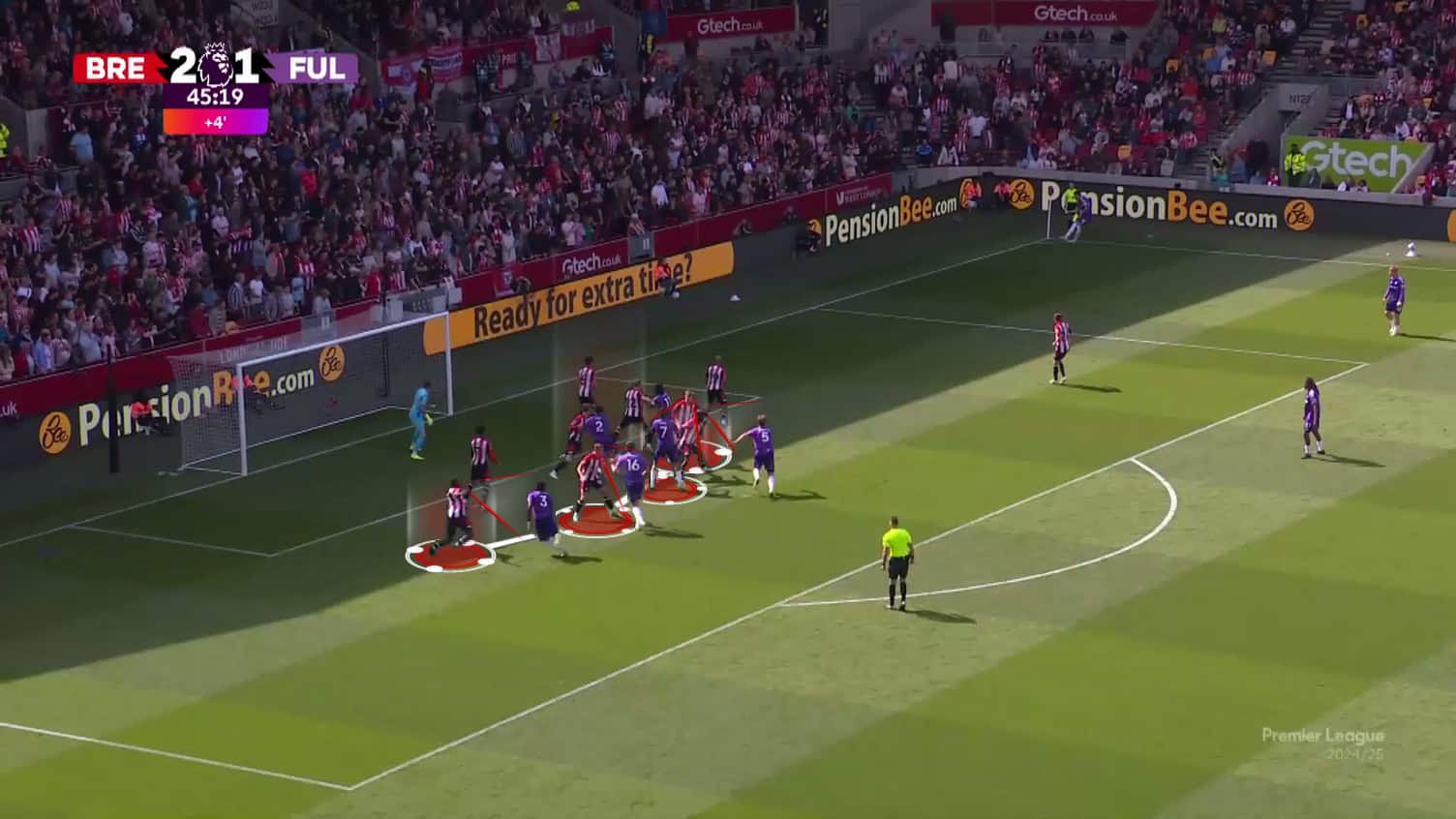
As shown below, the ball is in the air while the man markers grapple to contain the attackers well.
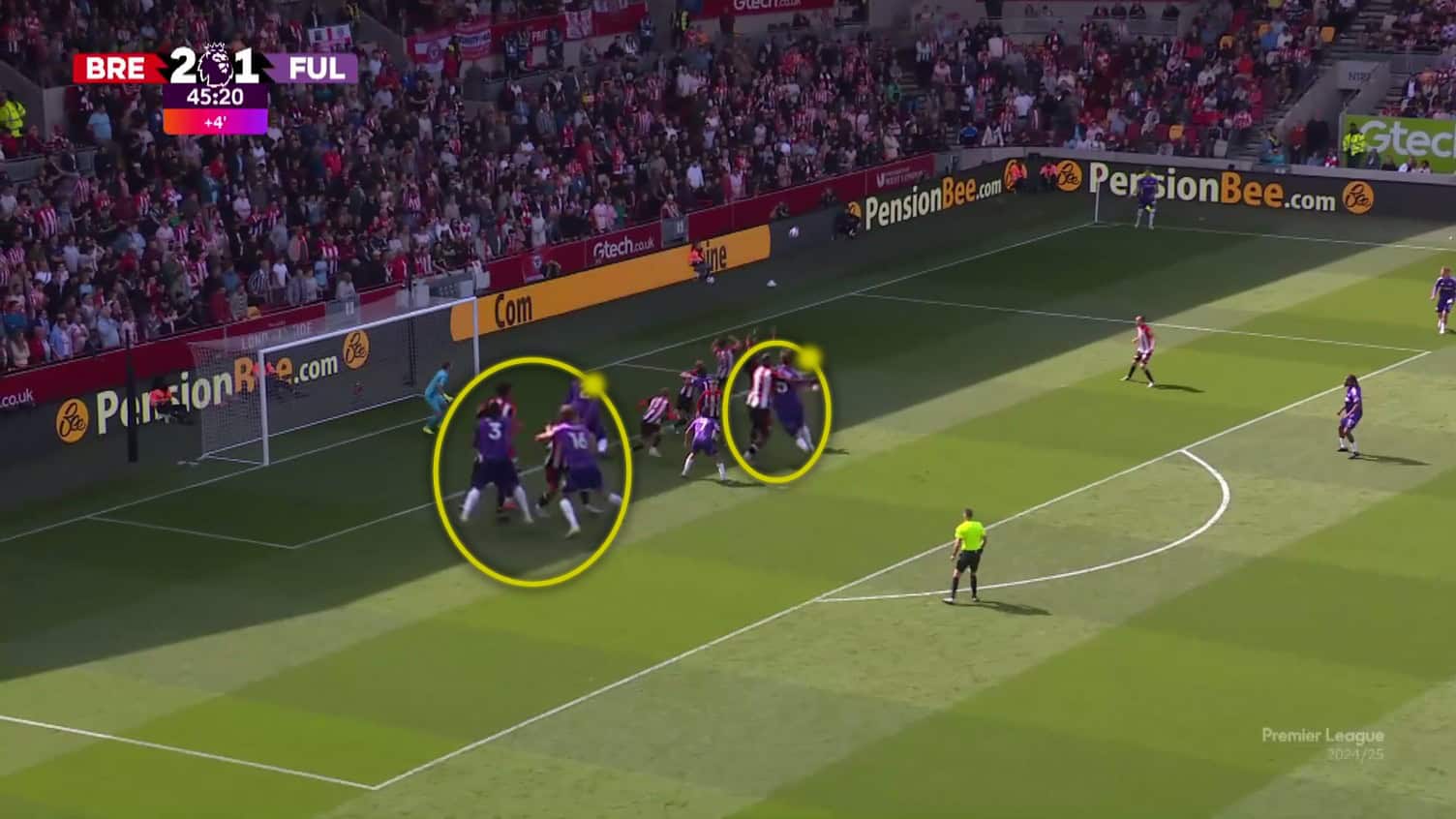
Their man markers can also deal with different attackers’ situations, knowing that the four man markers are assigned to the best four attackers, regardless of the attackers’ position.
For example, if the fifth-best attacker starts near the goalkeeper or the zonal line, they leave him free, knowing that the goalkeeper and the zonal defenders can deal with that, as we will explain.
One of these situations involves dealing with runners who are stuck together in a pack or stack.
As shown below, the man markers wait for the runners to separate, at which point they begin grappling.
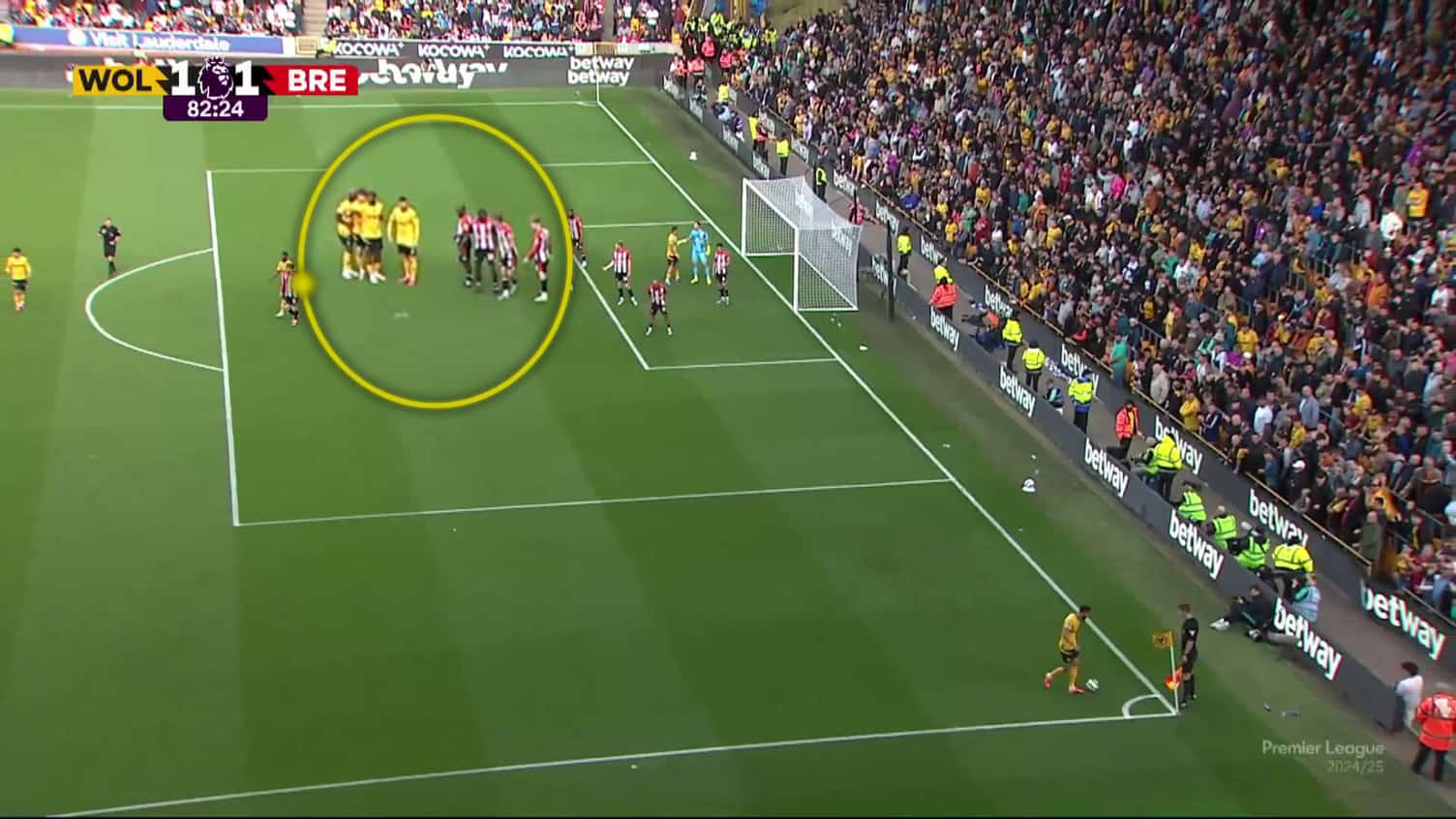
As shown below, the four man markers contain the runners at the right moment when they get separated.
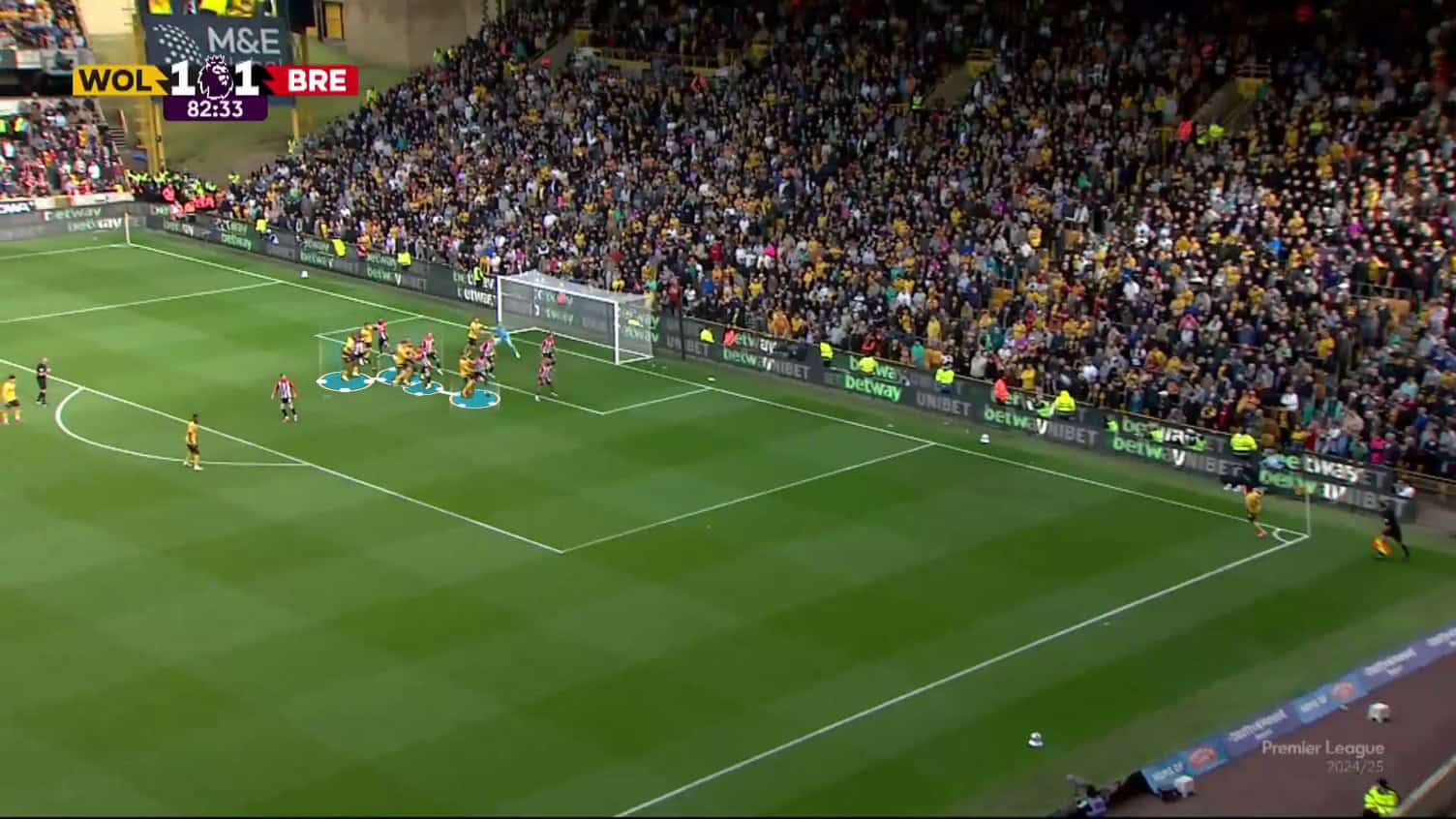
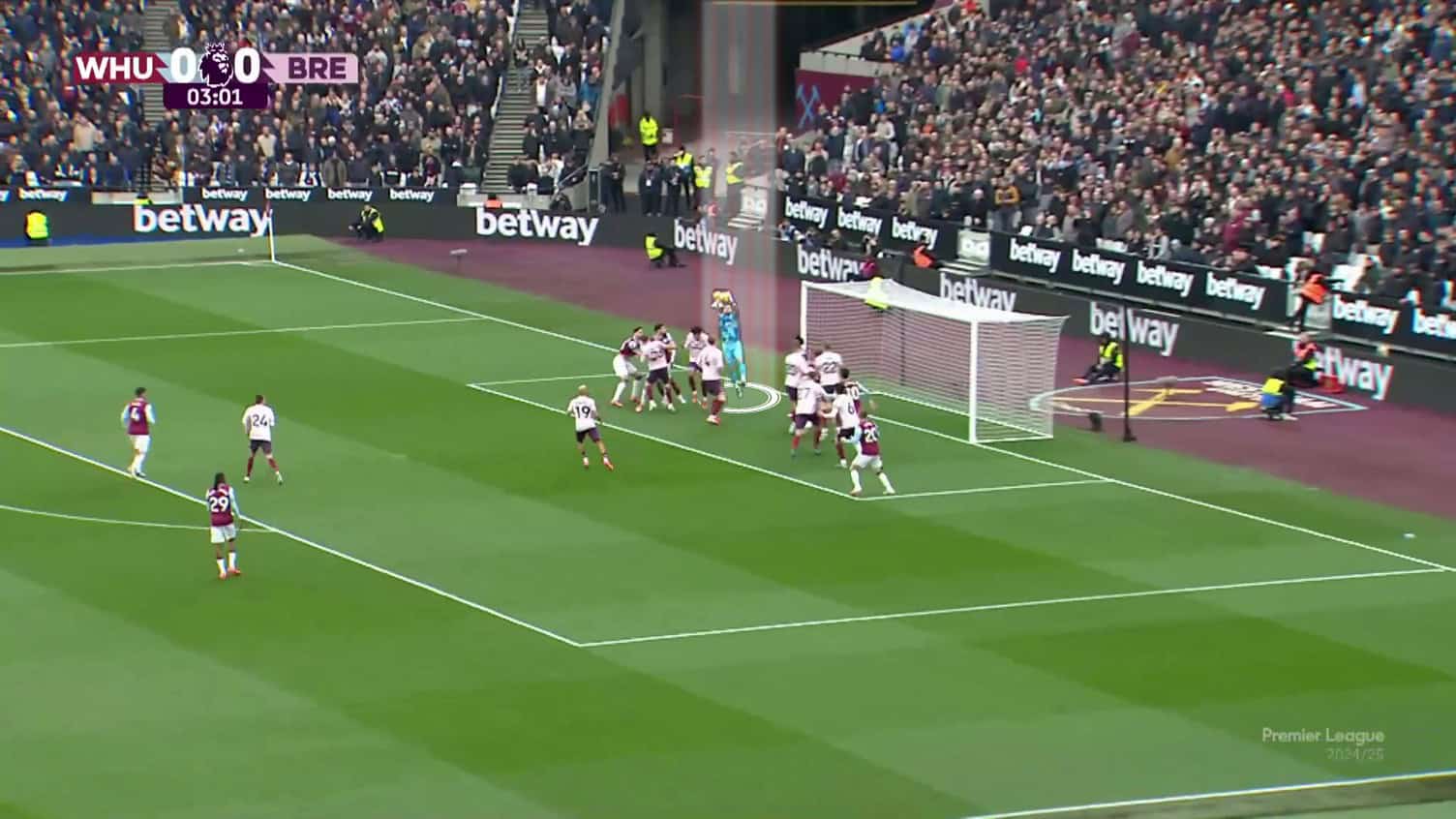
We can’t discuss Brentford’s scheme for defending corners without mentioning the significant role of the goalkeeper, Mark Flekken.
As shown below, he tries to claim every ball passing over the six-yard line, especially from the middle to the far post, thereby eliminating the danger from the outset.
He was one of the top performers in high claims in the Premier League during the previous season.
He was the fourth goalkeeper in high claims (46) after Emiliano Martínez, David Raya, and Robert Sánchez, with 56, 53, and 47, in that order.
Keith Andrews Defending Corner Scheme Strengths
Now that we know Keith Andrews’s main scheme, let’s examine why it was effective.
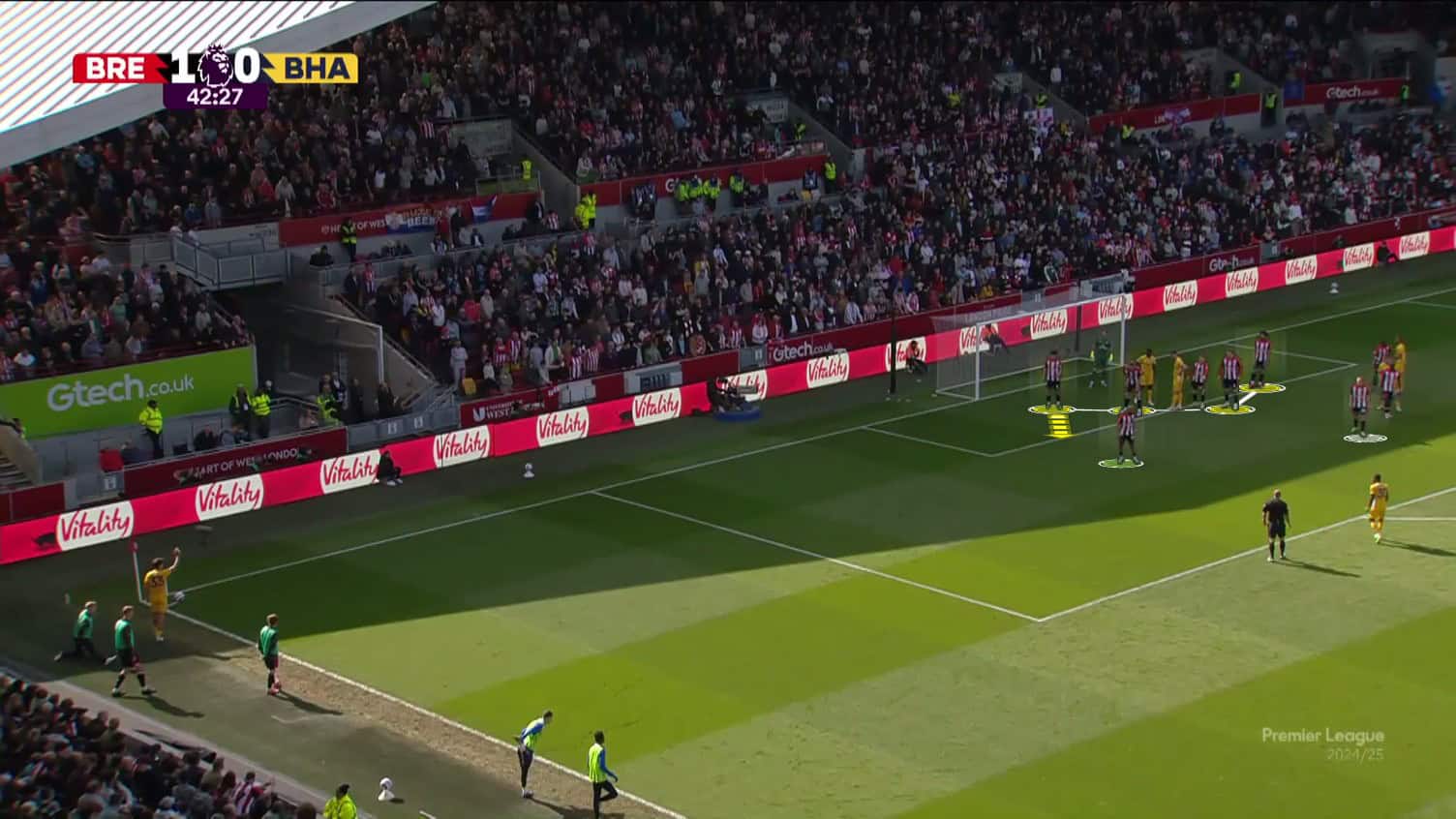
First, we must mention their flexibility in dealing with the opponent.
As shown below, they push the additional zonal defender (green) more forward against the out-swinging cross.
In this case, they asked the first zonal defender to take responsibility for getting the first touch in the area ahead of the near post and not to stick to the near post from the beginning.
The second strength is that this balanced hybrid system is challenging to break, meaning that if you are one of the top four attackers, you should be able to overcome your man marker, the zonal defence, and the goalkeeper in certain zones.
As an example below, the targeted player (red) goes to the targeted area (ahead of the near post) while his mate stands close to him, ready to block his man marker to free him, giving his back to the ball.
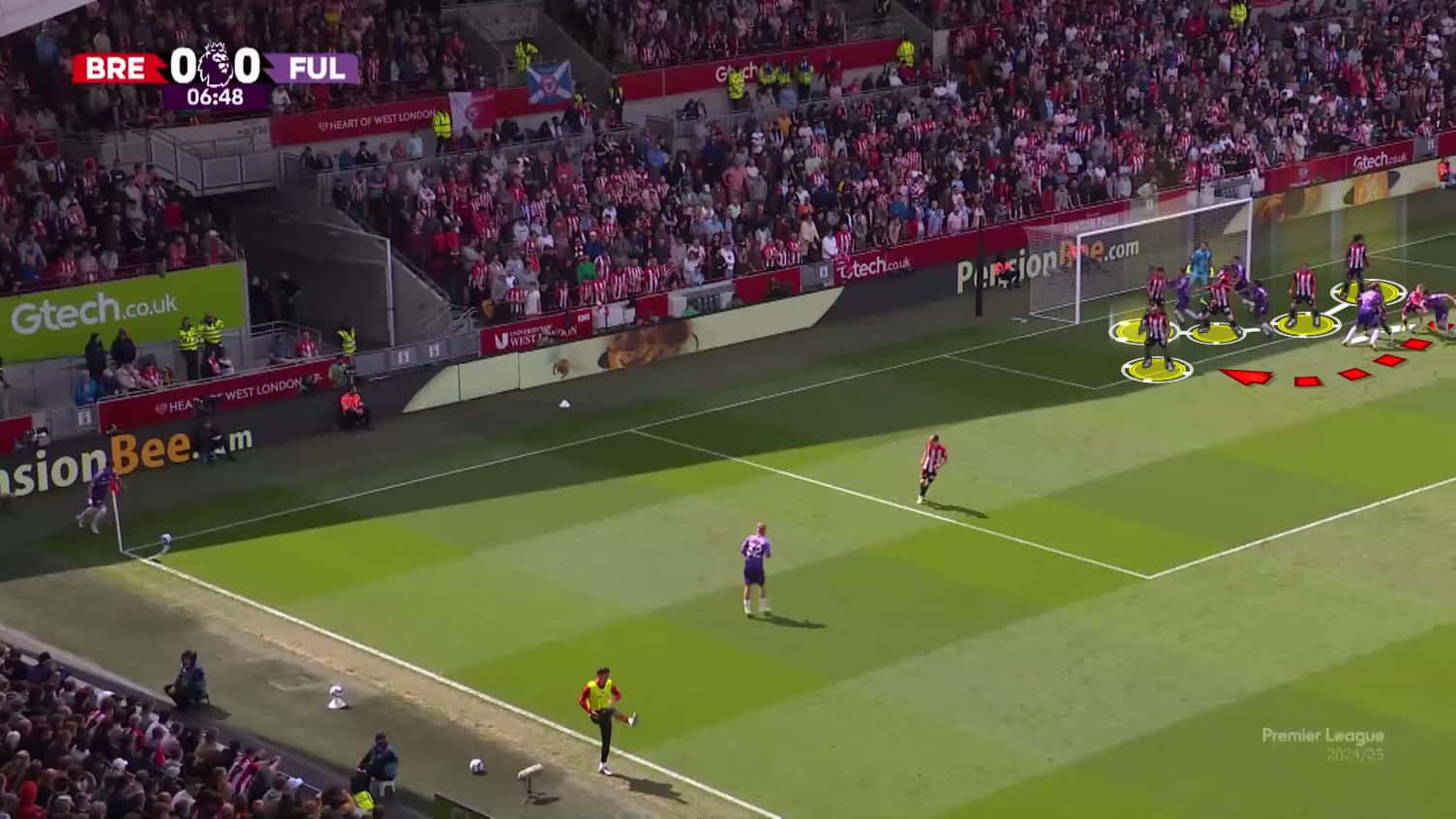
As shown below, the targeted player is now free, while the opponent’s two free players block the two zonal defenders in the goalmouth.
However, they have an additional zonal defender positioned ahead of the near post, ready to clear the ball, as has already happened.
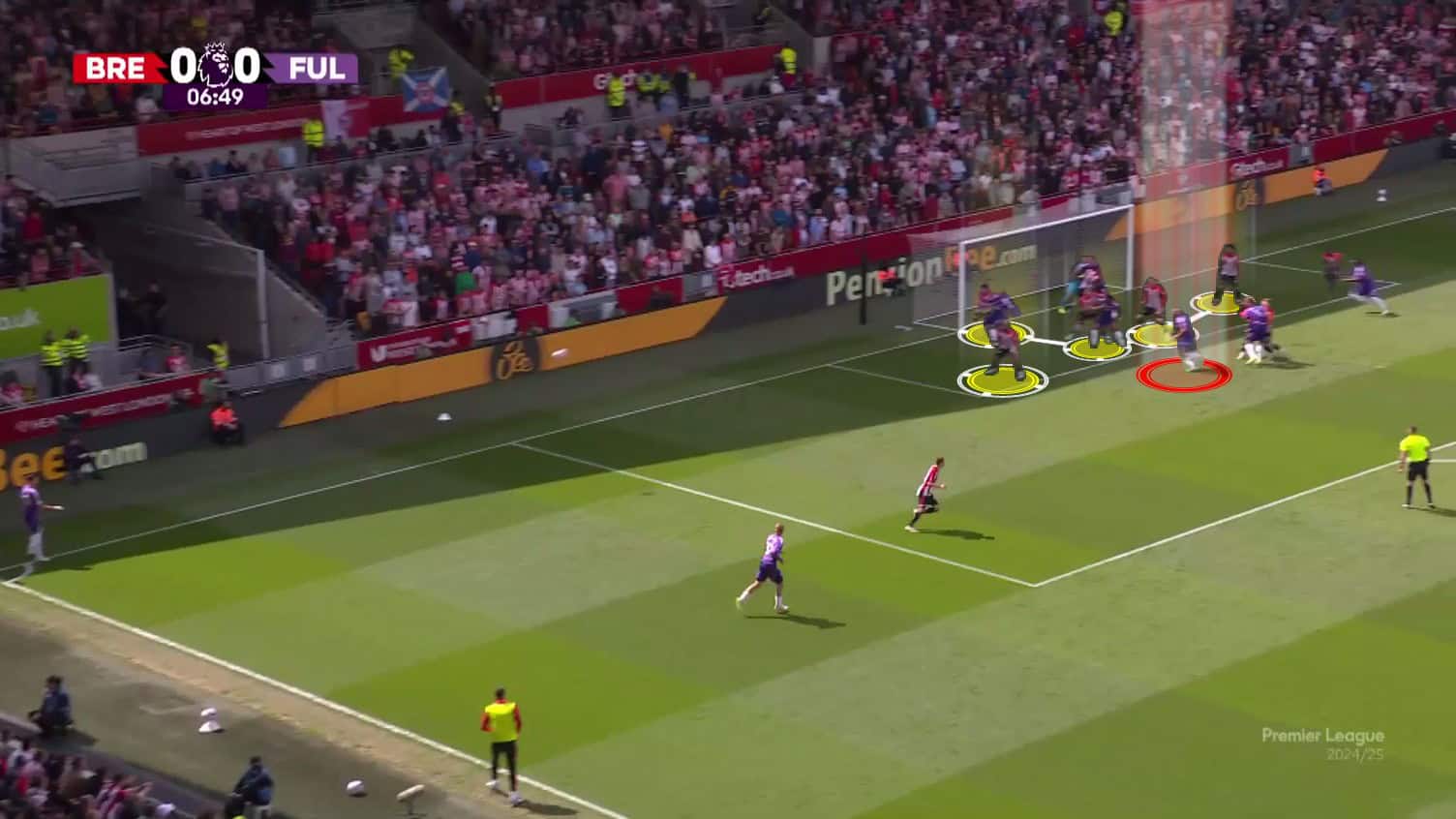
Hence, we can say that the opponents have some difficulty getting through this defensive scheme.
One of the other strengths, which increases the layers of difficulty, is how the opponents struggle to block one of their zonal defenders.
As shown below, the highlighted attacker (white) tries to block one of the zonal defenders (yellow).
Still, he is marked, which makes it difficult for him to overcome his marker and block the zonal defender, especially since the man markers are aware that one of their roles is to protect their zonal defenders from blocking.
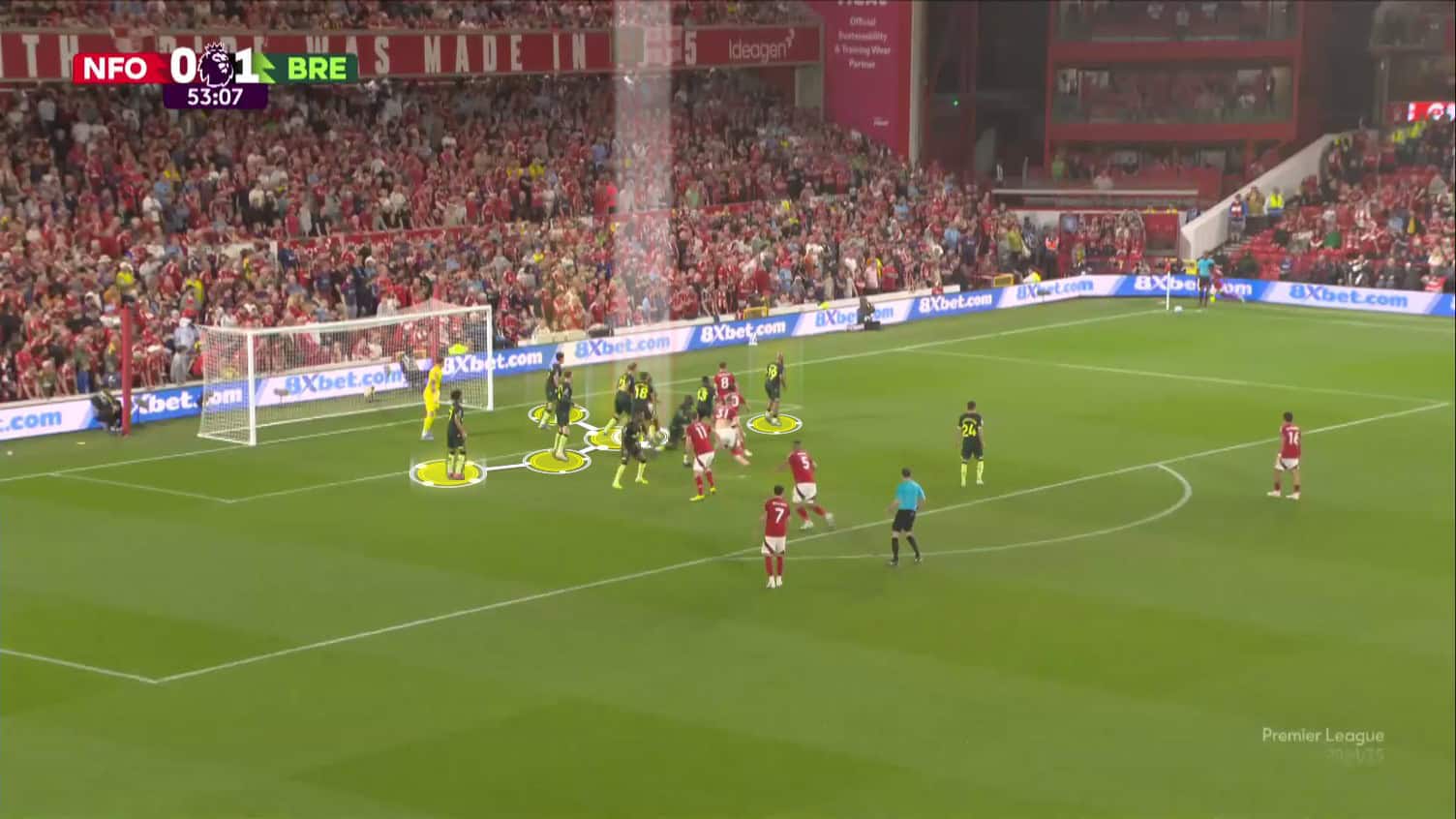
You may ask, what if one of the free attackers (the fifth or sixth best attackers) tries to block a zonal defender?
The zonal defenders are ready to deal with anyone who gets close to them before the ball is played, so you can see the zonal defender pushes the attacker away, preventing him from implementing the block, as shown below.
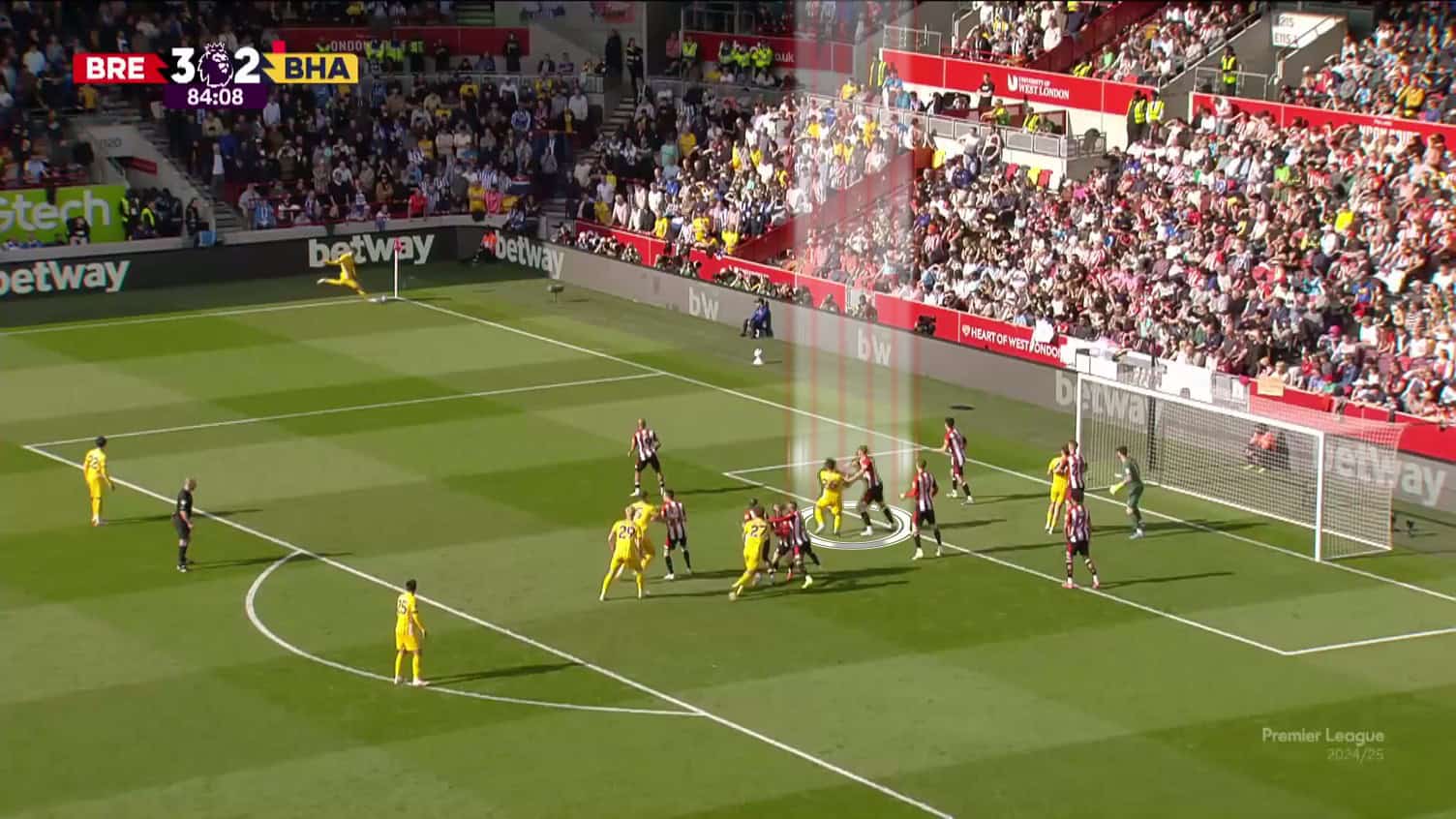
Keith Andrews Defending Corner Scheme Weaknesses
Like any good defence scheme, it should have some weaknesses that some opponents tried to test.
The first weakness is the near post.
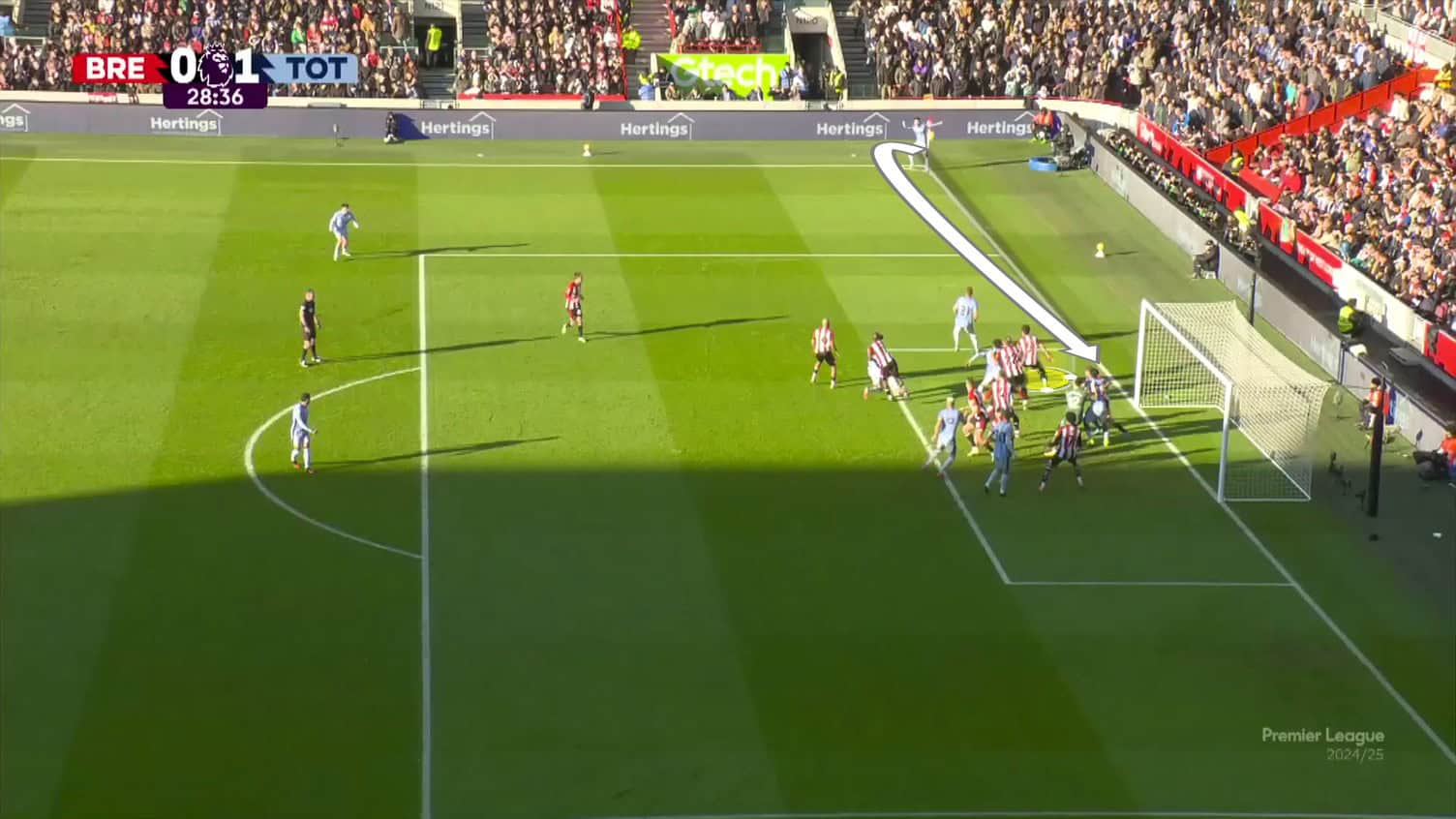
When they don’t have this additional zonal defender to defend flicks, the first zonal defender must go out to protect the flick, leaving the near post unprotected.
Let’s see an example.
As shown below, the rebound player shifts with the attacker toward the short-corner area, which causes the additional zonal defender to hesitate in defending the rebound or approaching the flick area.
This causes the first zonal defender to exit with any decoy run to the area ahead of the near post.
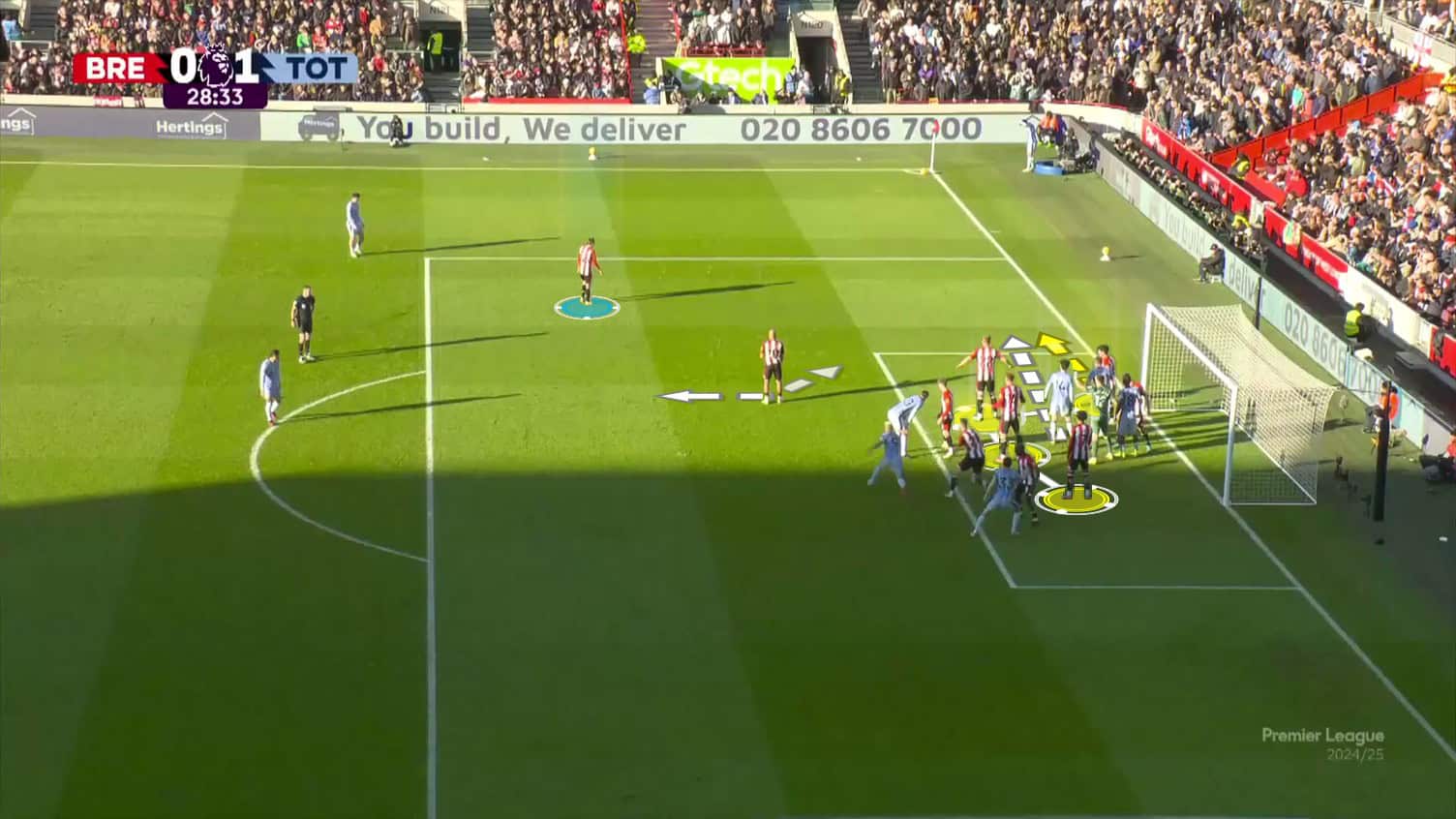
As shown below, it leaves the near post itself unprotected, allowing the ball to reach the attacker, who stands next to the goalkeeper without any obstruction.
The ball hits his man marker’s back, ending up in the net.
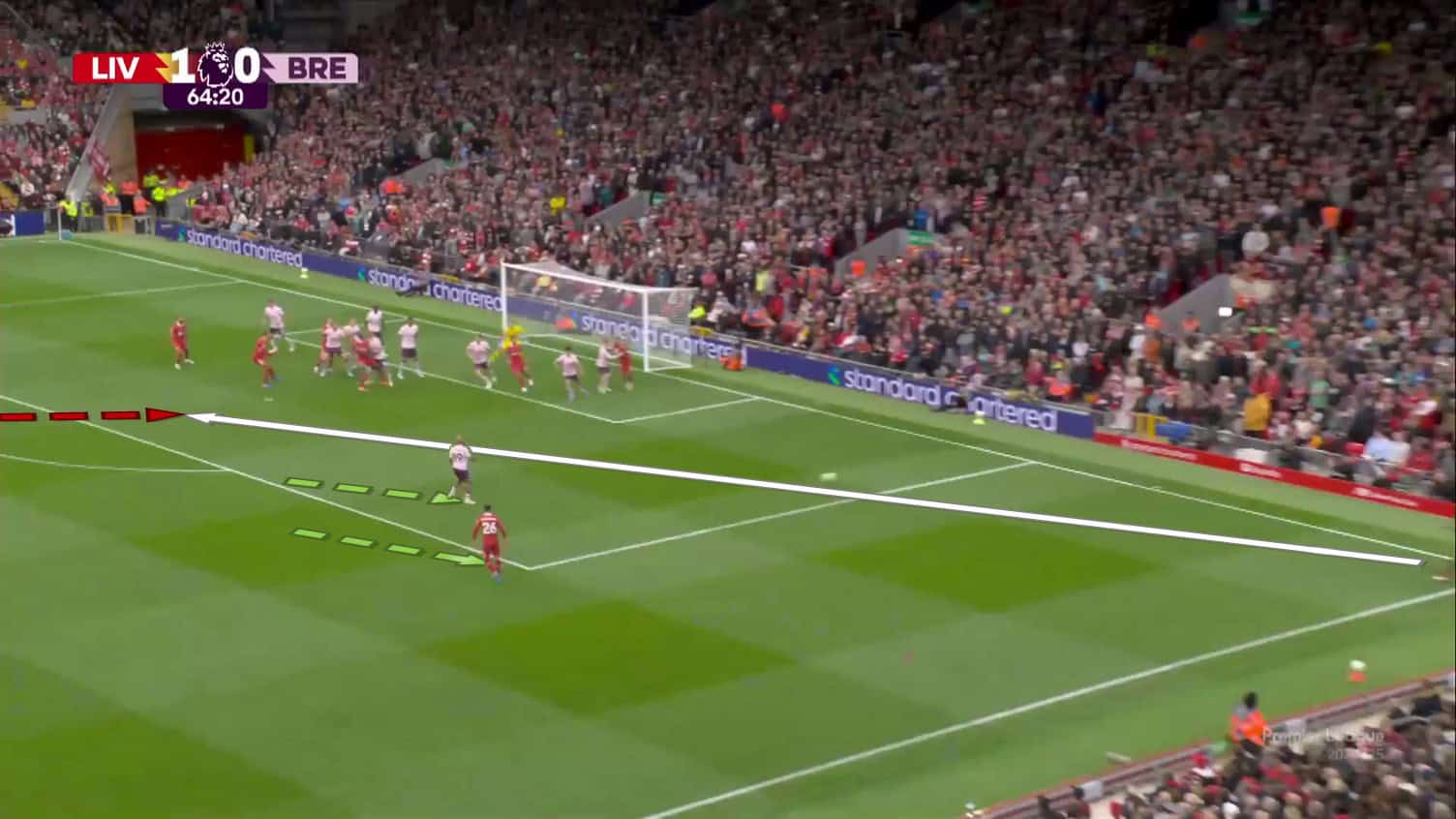
When they didn’t do that (asking the additional zonal defender to push up to have one rebound player and one short-option player), they had a problem defending the edge of the box.
As shown below, Liverpool exploited that gap, asking an attacker (green) to drag the rebound player toward the short-corner area to send a grounded pass directly to the far edge-of-the-box player.
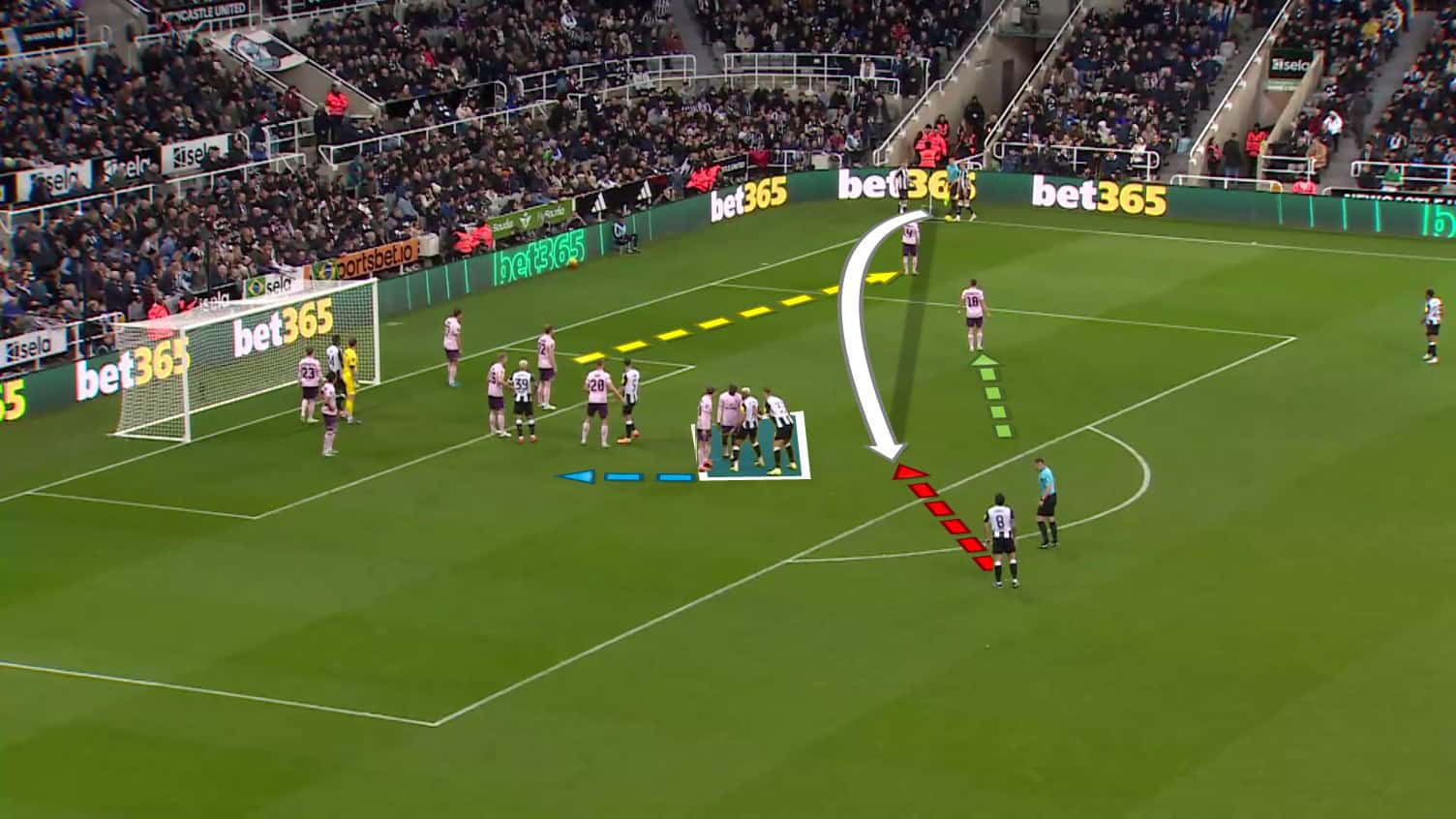
As shown below, Newcastle United tried to test that differently.
They used two takers and a player standing near the corner of the box to drag them both while asking the two far runners to evacuate the targeted area for the far edge-of-the-box player.
Finally, some teams (like Arsenal) tried using short corners to achieve numerical superiority.
As shown below, they follow the same scheme, with the rebounding player going to defend the short corners because the Gunners overload the short and rebound areas with four players (some of whom are out of the shot) besides the taker.
This makes one of the markers (blue) stand on the edge of the box, especially since Leandro Trossard.
Fixes the additional zonal defender who is ready to help against short corners.
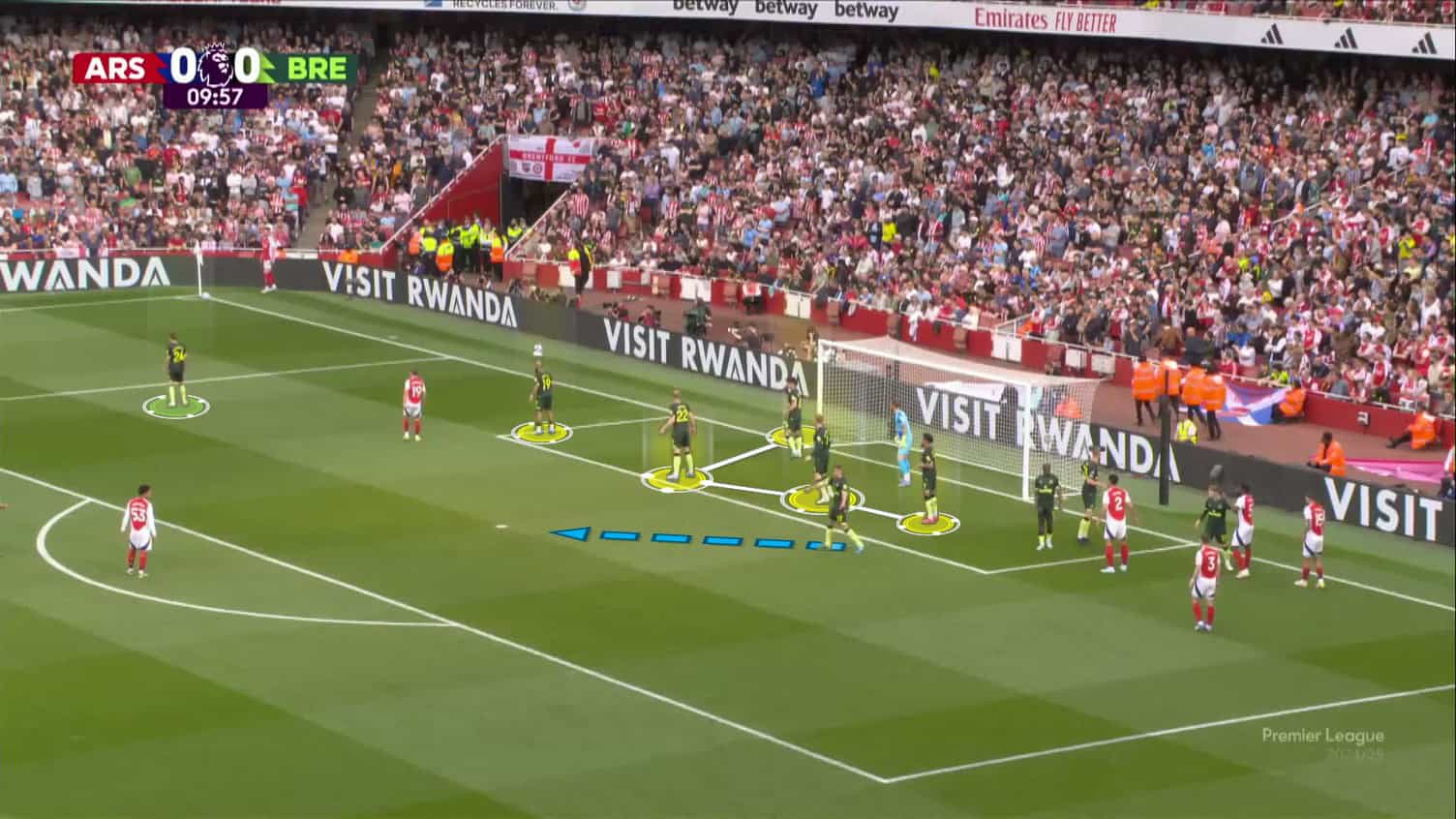
As shown below, the taker passes the ball directly to the player who stands on the corner of the box, which makes Arsenal have a five-against-three situation.
We can say against two because Leandro Trossard delayed Bryan Mbeumo‘s reaction.
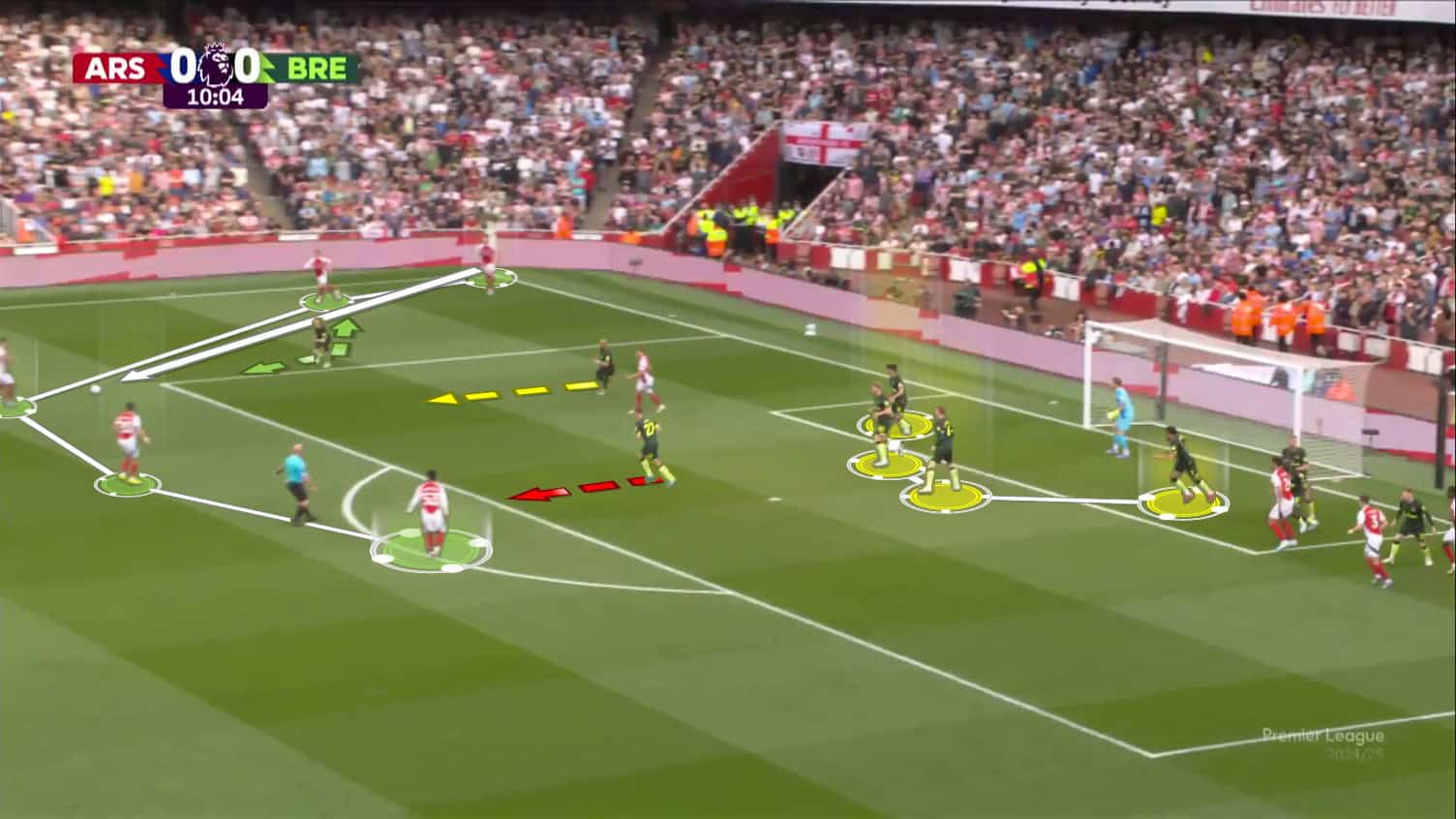
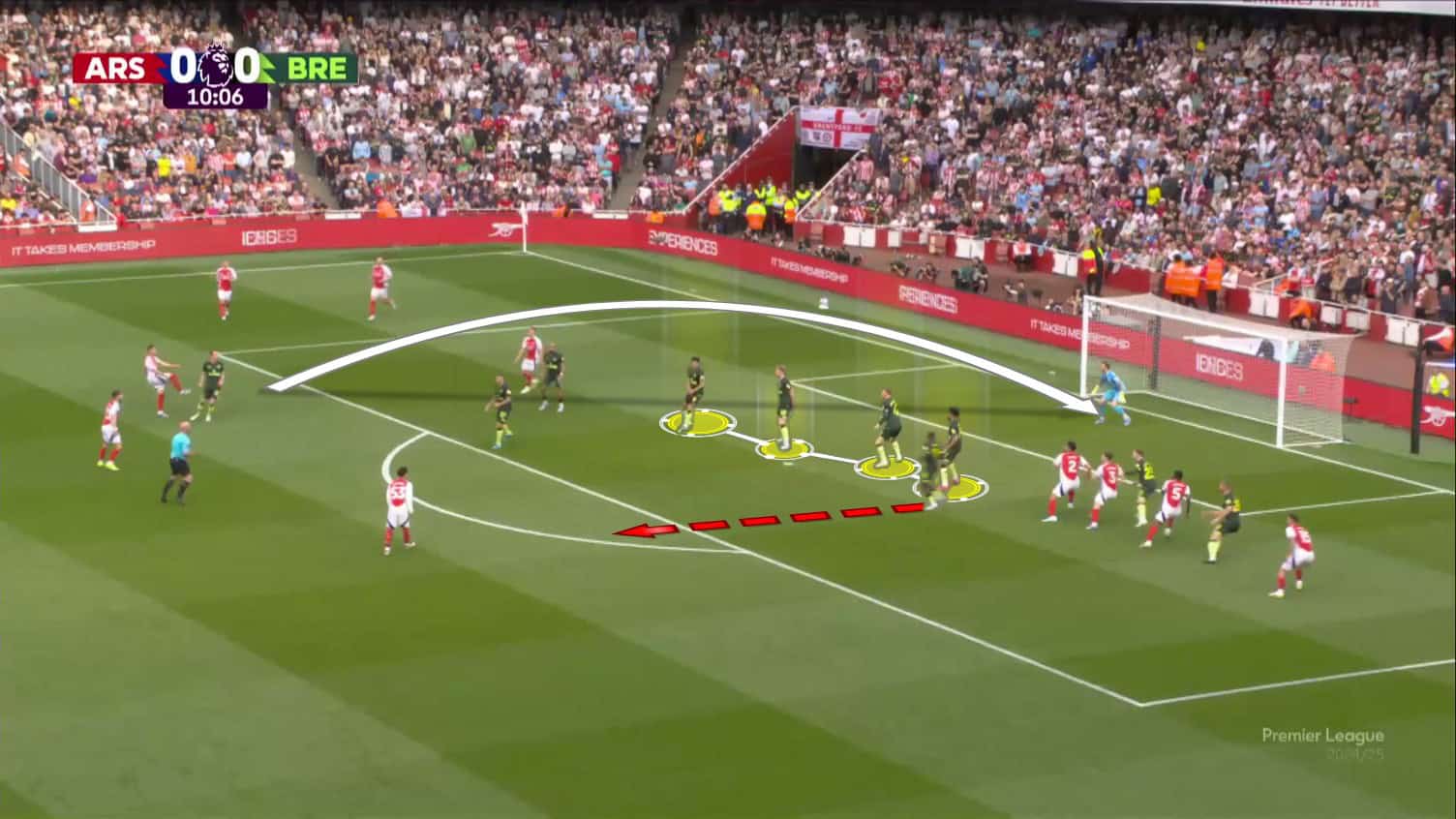
This motivates another one of the man markers (red) to go help avert the ball rotation to the edge-of-the-box player who can shoot, as shown below.
In the end, the ball is crossed to Arsenal’s attackers on the far post on the blind side of the zonal defenders (yellow), who have numerical superiority over their remaining two man markers.
The man markers also have orientation problems because it is difficult for them to track the ball and the attackers on their blind side simultaneously.
Conclusion
In this analysis, we have dissected Brentford’s defending scheme under the set-piece coach, Keith Andrews, one of the candidates to replace Thomas Frank as Brentford’s new head coach.
In this set-piece analysis, we have also highlighted the strengths of this scheme, demonstrating how it was too difficult to break.
We have also shown the weaknesses of this corner-defending scheme that some teams tried to exploit.
