
After a season full of drama for AS Roma and their supporters, I Giallorossi finished the season in fifth place in Serie A, an achievement whose merit goes to Claudio Ranieri, who led the team during a complicated period, saving them from playing to avoid relegation to playing for European spots.
With Ranieri’s spell coming to an end, Roma announced that he would remain their trusted director and senior advisor to the ownership, and Gian Piero Gasperini would be appointed as Roma’s new head coach.
This appointment was made at the advice of Ranieri himself.
He believed in Gasperini‘s ability to build on what was established this season and in his potential success with the team, given his extensive experience in Serie A.
In fact, Gasperini not only has extensive experience in Serie A but also success at most of the clubs he has managed.
The most notable success remains his latest long journey with Atalanta, where he developed a revolutionary style of football and helped the team become one of the top teams in Serie A, after they had previously played in mid-table at best during the early 2000s.
During that period, Atalanta alternated between playing in Serie B and Serie A.
With Gasperini’s arrival, he succeeded in turning the team into a much more powerful one that battled for Europe without fear.
Although things did not instantly improve for Atalanta, they continued to progress year after year, reaching UEFA Champions League football on numerous occasions and finishing third in Serie A on multiple occasions.
Moreover, he led them to winning their first-ever European trophy in 2023/2024 by winning the UEFA Europa League title.
In this tactical analysis, we will focus on presenting Gasperini’s preferred playing system, his footballing philosophy, and how he can apply it to the current Roma team, as well as identifying which players are better suited for his system.
Listen to this article free on the Total Football Analysis Podcast via Spotify, Apple Podcast, or RSS.
Who Is Gian Piero Gasperini?
Before delving deeper into the concepts Gasperini believes in, it is worth noting that his coaching career began at Juventus, where he coached the youth team before moving to Crotone from 2003 to 2006.
In that year, Genoa signed a contract with Gasperini, and he led them to promotion to Serie A in his first season.
In the following season, his tactics and management helped the team finish fifth in Serie A, the highest placement for the team in 19 years.
This secured a UEFA Europa League spot for I Rossoblù.
His spectacular footballing system, which relied on the 3-4-3 formation at the time, was renowned throughout Italy.
Nevertheless, he failed during his first months at Inter Milan and was sacked soon after he joined the team.
This should be considered when analysing Gasperini’s profile, as his lack of experience managing top teams may be an issue for him at a popular club like Roma.
This also means that Roma need to give Gasperini some time to apply his system successfully.
He should experiment with the players initially until he finds the best possible lineup and formation.
The process will likely result in some initial defeats, as the players and the head coach will need some time to adapt to each other and to Gasperini’s desired movements and plans on the pitch.
That’s why it will be much wiser to opt for the largest possible number of friendly games before the start of the season to avoid experimenting during the Serie A games.
Gian Piero Gasperini Style Of Play
Gasperini was inspired by Ajax’s playing style of the 1990s, which was characterised by the 3-3-3-1 formation, a formation that drew upon many footballing legends of that time.
He relies on a progressive style of football, characterised by a lot of movement without the ball, interchangeability of positions, and outstanding abilities in individual 1v1 duels, whether in defence or attack.
Gasperini adopted this 3-3-3-1 model and adjusted it to suit his footballing philosophy and needs, sometimes turning it into a 3-4-1-2 formation or a 3-4-2-1 formation.
Gian Piero Gasperini Attacking Tactics: Role Of The Advanced Playmaker
Gasperini attacking tactics rely heavily on the advanced playmaker’s movements without the ball to help create numerical superiority on one of the two flanks.
This allows the team to exploit the half-spaces created by the advanced playmaker and use triangular passes to penetrate towards the opponent’s final third.
As shown below, the advanced playmaker’s movement into empty spaces provides the wing-back with the opportunity to exchange short passes with him, allowing the latter to find space and time to advance and receive the ball again.
The advanced playmaker’s movement attracts defenders to him and leaves some room not just for the wing-back but also for the second striker, who would exploit such spaces on the wing.

This is one of the recurrent movements Gasperini needs from his players without the ball, since he believes in chance creation from the wings, and that’s his preferred way to start the attacking actions.
Gian Piero Gasperini Interchangeability Of Positions
Given that Gasperini believes in the total football concept and the reliance on duels, we always expect to see interchangeability within the teams he coaches.
In other words, his teams always expect one of the centre-backs to advance in attack and create the triangular passes with his teammates on the wing while being replaced by one of the midfielders at the back.
This interchangeability helps Gasperini’s sides confuse opponents, disrupt their marking plans, and alternate attacking solutions, as most of the players used by Gasperini are trained to advance and create danger when needed, even if they are centre-backs.
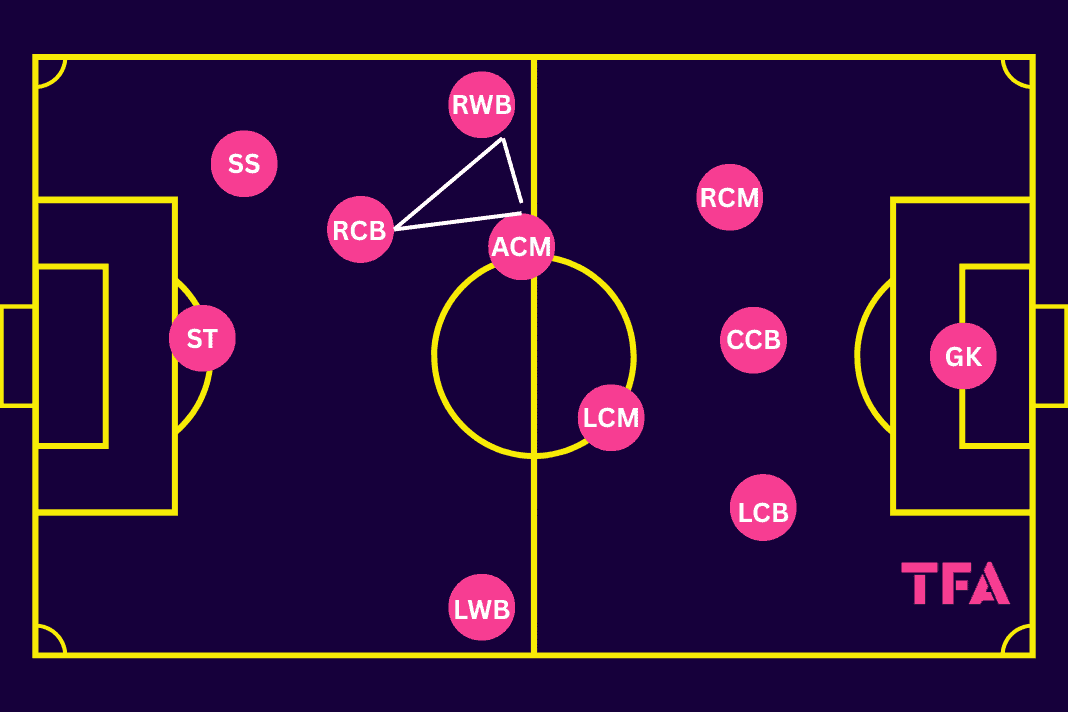
Therefore, Gasperini relies on the interchangeability of positions, quick triangular short passing, and continuous movements without the ball to always provide passing solutions to the ball holder.
This is Gasperini’s typical approach to attacking, with adjustments he makes according to the opponent, especially when playing with two strikers and a playmaker or one striker and two playmakers or wingers.
Gian Piero Gasperini Build-Up Phase
The build-up phase is another aspect that needs our attention since Gasperini does not really apply the “modern” way of building up from the back but rather relies on long passes from the goalkeeper to players like Charles De Ketelaere and Mateo Retegui, who are exceptional in aerial duels.
This means that Gasperini would also prefer players with high aerial duels’ winning averages upfront at Roma to help win the ball and attack from the flanks.
The idea is to start the action from one of the flanks usually.
If that is not possible due to high pressing, the goalkeeper would automatically resort to long passing instead of finding an alternative short passing solution.
This is a different idea from the mainstream approach when it comes to building up from the back.
Upon assessment, we can confirm that it avoids taking unnecessary risks with short passing in dangerous areas, as it favours Gasperini’s side by winning aerial duels.
Gian Piero Gasperini Tactics At Roma
It is important to note that Roma have already been playing with a back-three defence under Ranieri’s management.
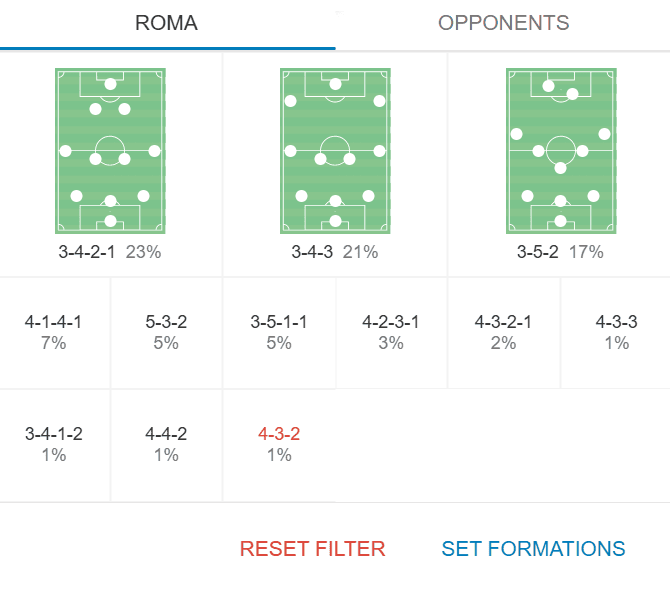
Despite using a 3-5-2 formation more often lately, Roma alternate between that formation, the 3-4-2-1 formation, and the 3-4-3 formation.
AS Roma Formation
Therefore, Roma’s playing system already suits Gasperini’s style well, and that will certainly help both sides win more often when the pre-season phase begins.
The following graphic also confirms that Roma’s most frequently used formation this year was the 3-4-2-1, which is Gasperini’s preferred formation.
Furthermore, Gasperini will undoubtedly need to add some summer reinforcements to his squad ahead of the new season.
Nevertheless, the current Roma team is good enough to start the work with, especially with a few player changes according to Gasperini’s preferences.
Knowing that he loves to work with quick, disciplined, and risk-taking players with dribbling skills and, preferably, shooting abilities, Gasperini will already get along well with many of the team’s names while needing to impose his tactical tweaks and instructions so that the players apply the required movements without the ball without hesitation.
Having a powerful goalkeeper like Mile Svilar, who was one of Serie A’s most consistent goalkeepers last season, is definitely a strong defensive reference to build on.
In defence, Gasperini will likely use full-backs as right or left centre-backs, as he believes in the interchangeability of positions.
We can see him continuing to work with Zeki Çelik as a right centre-back, similar to what Ranieri did on numerous occasions, knowing that Gasperini will also have three powerful defenders at his disposal: Gianluca Mancini, Mats Hummels, and Evan Ndicka.
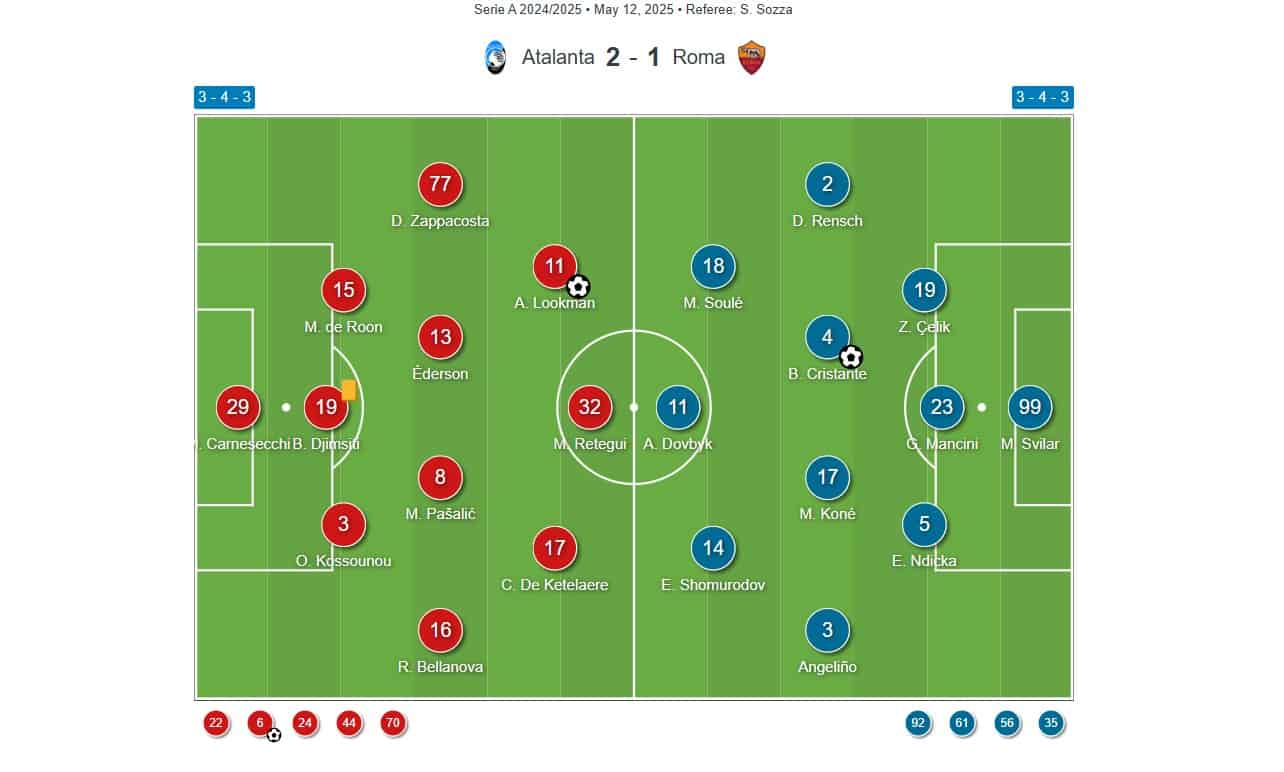
AS Roma Vs Atalanta Lineup
The following formation picture is the perfect example of Gasperini’s preference to use players out of their natural positions, especially in defence, exploiting their acceleration and dribbling abilities while working on improving their defensive qualities inside the box.
For example, he used Marten de Roon as a left centre-back during Atalanta’s match against Roma.
For the wing-backs, it is very probable that Roma will sell Angeliño soon, following the latest rumours.
This will be unfortunate for Gasperini because Angeliño is the type of player who can be very useful for any manager, especially for Gasperini.
Therefore, it will be crucial to identify players in this position.
Tommaso Baldanzi, a left-footed winger who can adapt well to playing in this position under Gasperini, represents a potential experiment in this role.
This would be the emergency solution until a better-suited player for that role is found.
On the other hand, Devyne Rensch and Saud Abdulhamid will compete for the right wing-back role.
Numerous good options exist for midfield players: Niccolò Pisilli, Manu Koné, Leandro Paredes, Lorenzo Pellegrini, and Bryan Cristante.
These players will be competing for starting spots as central midfielders.
Since the squad has more quality wingers than advanced playmakers, Gasperini will more likely use two wingers and a striker upfront or one advanced playmaker and two strikers as a plan B.
Plan A will most likely rely on one of Paulo Dybala or Matías Soulé on the right wing, Eldor Shomurodov or Stephan El Shaarawy on the left wing, and Artem Dovbyk as a striker.
Plan B would consist of Paulo Dybala as an advanced playmaker and both Shomurodov and Dovbyk as strikers.
Conclusion
Gasperini’s style of football is well-suited to the current Roma squad, and it will likely help them become much more efficient, particularly in terms of attacking and goal-scoring.
The key to success will be to ensure that the players grasp Gasperini’s ideas as quickly as possible and apply the instructions with discipline in each game.
This will allow the experienced head coach to achieve the team’s full potential.
